AAMJAF, Vol. 10, No. 1, 95–131, 2014 M J of ACCOUNTING andFINANCE
DEFAULT RISK ANALYSIS IN MICRO, SMALL AND
MEDIUM ENTERPRISES: DOES DEBT OVERHANG
THEORY OCCUR?
Imam WahyudiDepartment of Management, Faculty of Economics and Business, University of Indonesia, Depok 16424, West Java, Indonesia
E-mail: [email protected]
ABSTRACT
This paper intends to analyse the default risk in micro, small and medium enterprises (MSMEs) and its relation to new debt opportunities, debt overhang theory and growth intention. The results confirm that cash flow, capacity and leverage are the major determinants of firms’ default, while gross margin and efficiency measure are not significant predictors. By analysing the rating transition behaviour, we found that the further the rating migrates, the smaller the probability of transition and that the probability towards default is greater along with the decreased quality rating. By extending the analysis, we found that the debt overhang theory is not applied in relationships between banks and MSMEs.
Keywords: microfinance, debt overhang, enterprise, default risk, finance
INTRODUCTION
I
n Organisation for Economic Co-operation and Development (OECD) countries, the percentage of Small Medium Enterprises (SMEs) of total firms in the economy is greater than 75% (Altman & Sabato, 2007). This is also the case for emerging countries, such as Indonesia, where micro, small and medium enterprises (MSMEs) are considered to be the backbone of the economy (Gunawidjaja & Hermanto, 2010). We use the term MSME instead of SME in order to include micro-sized enterprises. In Indonesia, micro-sized enterprises outnumber small and medium-sized enterprises (Center of Statistics Bureau, 2008), therefore constituting most of this sector. The role of MSMEs in the economy is expected to become even more significant in the future, as it gained considerable attention in the New Basel Capital Accord (Altman & Sabato, 2007).MSMEs not only present a potential market for banks, but they also bring a different kind of risk treatment. For example, the financial information of MSMEs, unlike corporate financial information, is considered to be less reliable because reports are usually unaudited (Gunawidjaja & Hermanto, 2010). Theoretically, this situation is called information opacity (Hyytinen & Pajarinen, 2008). Other factors causing information opacity are a firm’s young age, small-collateralised assets, low technology exposure, and insufficient track record to manage the business (Bartels, 2002).
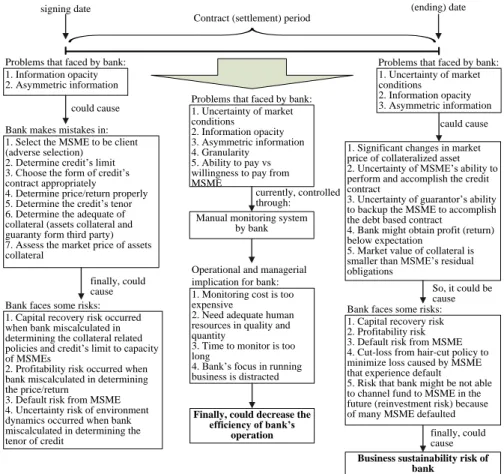
Information opacity increases the probability of asymmetric information, which causes banks to be more reluctant to fund MSMEs (Akerlof, 1970). Asymmetric information serves as a bank’s rationale in implementing credit rationing (Stiglitz & Weiss, 1981). Thus, banks will ask a higher return to compensate for the increasing likelihood of default due to adverse selection. Imperfect information may also lead the bank to experience adverse selection, especially of MSMEs. To minimise this risk, Bester (1985) suggested using effective screening tools to differentiate clients that will be defaulted or prospectively defaulted after the bank approves their proposal. The problems of information opacity in MSMEs are present not only in the screening process but also in the overall financing period (Figure 1).
Data extracted from Indonesian Banking Statistics (SPI). Macroeconomic data such as inflation, exchange rates and domestic loan rates are obtained from Indonesian Economic and Financial Statistics (SEKI). These reports were published by Bank Indonesia (retrieved at www.bi.go.id). The changes in subsidised oil prices, which are gasoline, kerosene and diesel fuel, were gathered from the Indonesian Ministry of Energy (retrieved at www.esdm.go.id/).
Another challenge is the situation in which an MSME’s individual financing is nominally small but large in number. This condition is often called granularity (Srinivas, 2005), which leads to high monitoring costs for the bank and potentially decreases the bank’s efficiency in the operation. Therefore, the bank requires a tool to monitor MSMEs efficiently (Stiglitz & Weiss, 1981).
The problem of adverse selection and granularity could cause a bank to restrict its funding to MSMEs. Nevertheless, MSMEs are one of the main pillars of economic development, especially in creating economic growth and employment. Observing the employment level and its contribution to the economy, the number of MSMEs in 2008 reached 43.46 million firms (99% of total firms in Indonesia), and MSMEs absorbed approximately 79.01 million workers (99.40% of the total labour force) and contributed to approximately 56.70% of the gross domestic product (Center of Statistics Bureau, 2008). Their unique traits enable MSMEs to be more flexible and adaptable to the dynamics
of market demand (World Bank, 2005; Srinivas, 2005; Altman & Sabato, 2007). However, due to both problems (i.e., adverse selection and granularity), banks tend to be discouraged in funding MSMEs despite persistent encouragement from the central bank (see Table 1).
Selection and monitoring systems need information related to the determinants of MSMEs’ default. These determinants have been analysed by researchers such as Edmister (1972), Dietsch and Petey (2002, 2004), Lehmann (2003), Behr, Guttler, and Plattner (2004), Lopez (2006), Altman and Sabato (2007), Agarwal, Chomsisengphet, and Liu (2008), Altman, Sabato, and Wilson (2010), Rikkers and Thibeault (2011), and Gama and Geraldes (2012). Early studies focused only on examining financial ratios (Edmister, 1972). In the 2000s, researchers added soft information as qualitative variables, such as banks’
Contract signing date
Contract (settlement) period
Contract termination (ending) date 1. Information opacity 2. Asymmetric information 1. Uncertainty of market conditions 2. Information opacity 3. Asymmetric information
Problems that faced by bank: Problems that faced by bank:
1. Select the MSME to be client (adverse selection)
2. Determine credit’s limit 3. Choose the form of credit’s contract appropriately
4. Determine price/return properly 5. Determine the credit’s tenor 6. Determine the adequate of collateral (assets collateral and guaranty form third party) 7. Assess the market price of assets collateral
could cause 1. Uncertainty of market
conditions 2. Information opacity 3. Asymmetric information 4. Granularity
5. Ability to pay vs willingness to pay from MSME
Problems that faced by bank:
Bank makes mistakes in:
currently, controlled through:
Manual monitoring system by bank
1. Significant changes in market price of collateralized asset 2. Uncertainty of MSME’s ability to perform and accomplish the credit contract
3. Uncertainty of guarantor’s ability to backup the MSME to accomplish the debt based contract
4. Bank might obtain profit (return) below expectation
5. Market value of collateral is smaller than MSME’s residual obligations
cauld cause
1. Capital recovery risk occurred when bank miscalculated in determining the collateral related policies and credit’s limit to capacity of MSMEs
2. Profitability risk occurred when bank miscalculated in determining the price/return
3. Default risk from MSME 4. Uncertainty risk of environment dynamics occurred when bank miscalculated in determining the tenor of credit
finally, could cause Bank faces some risks:
Operational and managerial implication for bank: 1. Monitoring cost is too expensive
2. Need adequate human resources in quality and quantity
3. Time to monitor is too long
4. Bank’s focus in running business is distracted
Finally, could decrease the efficiency of bank’s
operation
So, it could be cause Bank faces some risks: 1. Capital recovery risk 2. Profitability risk 3. Default risk from MSME 4. Cut-loss from hair-cut policy to minimize loss caused by MSME that experience default
5. Risk that bank might be not able to channel fund to MSME in the future (reinvestment risk) because of many MSME defaulted
Business sustainability risk of bank
finally, could cause
Tab le 1 C red it c h a n n ellin g in MS ME fr o m In d o n esia n b a n kin g , 2 0 0 0 –2 0 1 1
relationships with debtors (Lehmann, 2003), credit history (Behr et al., 2004; Altman et al., 2010), a firm’s type of legal entities (Behr et al., 2004), credit structures and entrepreneurs’ profiles (Lopez, 2006). Nevertheless, all of those studies only observe the impact and significance of the default predictor and do not extend their research by incorporating MSMEs’ unique behaviour as well as banks’ distinctive treatment of MSMEs. For example, we found the total debts in several MSMEs to be bigger than their total assets, but they are still given new credits or credit extension from their banks. Another example is that when its gross profits are low, an MSME extends its investment into the future, which is unlikely for a corporation.
To analyse the determinants of default by MSMEs, we try to extract valuable information from unaudited financial statements. To reduce the effect of manipulation in financial statements, we use non-operating expenses to measure financial performance, such as gross profit, fixed assets, total debt and operating cash flow. A firm’s growth will be calculated based on the fundamental assumption that an MSME should reinvest all of its earnings. Therefore, MSMEs that were proven to take portions of their earnings for owners’ personal use will be excluded from the model. In the first stage, we will use a Logit model to examine significant factors affecting MSMEs’ occurrence of default. Factors presumed to be default determinants are gross margin, inefficient operation, potential growth and cash flow from operation. Then, these findings are validated with an instantaneous hazard rate model. The hazard model is applied to evaluate the accuracy and validity of a bank’s internal rating system, with an additional role of providing effective and efficient monitoring tools. The hazard model gives another advantage of calculating the probability of default for the purpose of assessing the additional capital that is required by regulators.
In the next stage, we will confirm various relationships that cannot be explained by classical corporate finance theory. We will estimate the model to observe the impact of leverage and investment in MSMEs’ performance. Usually, an increase in leverage should respond positively to the increase in future operating cash flow (Ross, 1977; Ravid & Sarig, 1991; Shenoy & Koch, 1996). However, the increase in leverage is seen as a positive signal of the growth of future cash flows. Whenever the cash flow in the next period does not change or even decreases, the signal is not proven. If the firm were a public firm, its stock price would fall (Battacharya, 1979; Allen & Faulhaber, 1989).
T ab le 2 B a n k fin a n cin g to MS MEs in I n d o n esia , 2 0 0 0 –2 0 1 1
N o te : F in an ci n g d at a ar e b as ed o n t h e ec o n o mi c sec to r an d d is p la y ed i n b il li o n R u p ia h . D at a w er e g at h er ed f ro m th e In d o n esi an B an k in g S ta ti st ic s (S P I) p u b li sh ed b y B an k I n d o n esi a (r et ri ev ed a t U R L: w w w .b i. g o .i d ).
Then, to analyse why banks still intend to give new credit or credit extensions despite an MSME having total debts greater than its total assets, we will use the theory of debt overhang (Stiglitz & Weiss, 1981; Tirole, 2006) to explain this phenomenon. In addition, the factors of entrepreneurs (which are risk acceptance and obsession after a positive net present value [NPV] project), firm growth and financial distress will be analysed.
LITERATURE REVIEW
Micro, Small and Medium Enterprises (MSMEs)
There are several definitions of MSME businesses. Based on the Regulation of Ministry of Finance no. 571/KMK 03/2003, a small enterprise is a business that has a yearly gross revenue not more than Rp. 600 million. Based on Government Regulation no. 10/1999, a medium business is business with a net wealth ranging between Rp. 200 million to Rp. 10 billion. According to UU no. 20/2008, micro, small and medium enterprises are defined as in Table 3.
Table 3
Definition of micro, small and medium enterprises
Category of business Net worth (excluded land and
building used to business) Annual revenue
Micro enterprise Maximum Rp. 50 million Maximum Rp. 300 million Small enterprise Rp. 50 million – Rp. 500 million Rp. 300 million – Rp. 2.50 billion Medium enterprise Rp. 500 million – Rp. 10 billion Rp. 2.50 billion – Rp. 50 billion
Note: The criteria of these nominal values could be changed in accordance with the economy’s development
and would be regulated by President’s Decree.
In Indonesia, MSMEs have significant roles in the economy. Since the World Bank referred to 2005 as the International Microcredit Year, the microcredit sector in Indonesia has been skyrocketing. From total financing of Rp. 716,792 billion in July 2006, direct financing of MSMEs has accounted for at least Rp. 377,224 billion, except in channelling programs and credit cards (Bank Indonesia, 2007). Boosts in microfinance enable MSMEs to access external capital from microloans.
MSMEs have proven their resilience to crises. The simple form enables MSMEs to quickly alter their business terms based on the dynamics of the economy (Altman & Sabato, 2007; Srinivas, 2005). Resilience to crises was shown by the non-performing loan (NPL) indicator, where the NPL of corporate financing is higher compared with that of MSMEs (Bank Indonesia, 2007). At least two factors affect the resilience of MSMEs to market shocks. First, the
business of MSMEs is more diversified, which leads to lower risk in an MSME’s financing portfolio. Second, profit margins of MSMEs are usually higher than corporate profit margins, implying a better repaying ability. Statistically, MSMEs proved to be able to survive during the Indonesian financial crisis of 1997–1998. During that time, many banks diverted their funding strategies from targeting the corporate segment to MSMEs (see Tables 1 and 2).
Table 1 summarises the credit channelling by MSMEs from Indonesian banks during 2000–2011 along with macroeconomic data such as inflation, exchange rate, and domestic loan rates as well as changes in subsidised oil prices. In 2005, many fundamental changes occurred in the market such as a doubling of the domestic fuel price, a high volatility of the exchange rate and high inflation. The changes of subsidised oil prices are highlighted because they indicate the increase in the overall fuel cost. That year was a difficult period for business activities, including banking. Despite this, the credit absorption capacity of
MSME remains good and higher than the previous period, which was Rp. 354,908 billion (see Tables 1 and 2).
Factors Affecting an MSME’s Credit Risk
Debt overhang theory, credit rationing and credit risk
Debt overhang (or being over debt capacity) often serves as a rationale for banks to implement credit rationing (Stiglitz & Weiss, 1981). Firms experience debt overhang when they are unable to raise new financing for a profitable project (Tirole, 2006). This happens when future income and current fixed assets have been forfeited, and the firm cannot obtain "debt forgiveness" from existing creditors. Under this condition, a bank will not add credit, even if firms are willing to pay higher rates (Stiglitz & Weiss, 1981; Tirole, 2006). Moreover, an increase in leverage will be followed by default risk (Cai & Zhang, 2011; Dimitrov & Jain, 2008). Because they are limited in terms of adding new debt, firms with high leverage will have a reduced ability to take positive NPV investment projects in the future (Mura & Marchisa, 2010; Cai & Zhang, 2011). Thus, leverage will have a negative impact on future investment and growth (Aivazian, Ge, & Qiu, 2005). Further, Tirole (2006) explained that debt overhang occurs when firms cannot raise new debts for a profitable project if they have already committed future income linked to existing assets and if they cannot renegotiate some “debt forgiveness” or more generally “claim forgiveness” or “claim dilution” with initial investors/creditors.
Firm growth, investment and profitability
Along with pecking order theory, Lang, Ofek and Stulz (1996) found a negative relationship between leverage and growth in large and established manufacturing firms. Positive earnings growth will generate higher cash flows in the future. Because debt is the residual function of internal funds, having a larger cash flow available leads to a smaller portion of leverage needed for investment. On the other hand, debt is often used as an effective tool to reduce the moral hazard from managers in wasting free cash flow and overinvesting in risky projects. Therefore, leverage will obstruct a firm’s future growth (Lang et al., 1996). A firm’s ability to attain potential projects could be decreased (Mura & Marchisa, 2010). A negative cash flow relationship between leverage and investment was also found by Aivazian et al. (2005). The negative relationship is likely to emerge when managers lower leverage in anticipating future investment, and vice versa (Aivazian et al., 2005). In contrast, higher leverage will cause higher firm profitability. Managers are more controlled in utilising cash flow and choosing projects with positive NPV. Investment decisions by managers will be constrained by the availability of free cash flow, such as pre-commitment to pay principal and interest. As an addition, high leverage is also positively correlated with tax benefits and more cash flow available. However, the negative effect of leverage on growth disappears with the sophistication of the agency control mechanism (such as stock options) to convince external parties that the manager is working to maximise the firm’s value (Francis, Hasan, & Sharma, 2011).
Availability of operating cash flow
Operating cash flow is the measure of an entrepreneur’s ability and experience in managing a business. In financial management, it is renowned that "cash, not profits, is king". This statement follows Keown, Martin, Petty and Scott (2005). Damodaran (2010) explains two reasons why cash flow is superior to accounting earnings in measuring a project’s return. First, accounting problems are related to the issue of operating expenses versus capital expenditures, noncash charges, and accrual versus cash revenue and expenses. Furthermore, Damodaran (2010) said that accounting earnings, especially at the equity level (net income), could be manipulated at least for individual periods through the use of creative accounting techniques. Second, cash flow is the answer to liquidity problems. Earnings cannot be used as a payment for goods and services delivered; all of them require cash. Operating cash flow provides various types of information, such as the availability of liquid funds for running a business, a firm's ability to meet operational expenses, sufficient funds to repay liabilities and an internal fund’s adequacy in supporting business expansion. In addition, banks may use the increase in operating cash flow as a positive signal for a firm’s success in utilising financing funds.
Debt capacity, firm size and composition of assets
Fixed assets as a measure of firm size are associated with a firm’s capacity to generate revenue and cash flow. Naturally, creditors will analyse a firm’s asset composition to foresee their ability to repay debt in the future. When a firm has larger tangible fixed assets, they have more available assets to be collateralised. A firm’s debt capacity should be in accordance with a firm’s ability to generate cash flow and the availability of collateralised assets. Frequently, larger firms tend to be more diversified. Therefore, they are more resilient to the environmental dynamic risk, which affects their performance. This situation leads to larger firms being more difficult to bankrupt, even with high leverage. Myers and Majluf (1984) stated that greater intangible assets owned by firm could cause greater asymmetric information and a higher cost of equity, which encourages increased leverage. Unlike tangible assets, intangible assets do not have markets where investors or creditors could compare their prices. Their value is defined historically based on cost disbursed, which of course is undisclosed for the market. In this case, the debt ratio will be positively correlated with the proportion of fixed tangible assets (Shenoy & Koch, 1996). Instead, by selling secured debt, a firm can increase the value of equity by taking over the welfare of existing unsecured creditors (Myers & Majluf, 1984; Myers, 1984).
Leverage, default risk and financial constraints
An increase in leverage is often perceived as a positive signal that a firm is still growing and prospective. The profitability of a firm with high leverage will increase in the future as long as it runs a project with positive NPV. However, Cai and Zhang (2011) found that in several circumstances, returns from the project, after fulfilling any debt obligations, are lower than the hurdle rate asked by the investor. Furthermore, an increase in leverage will also be followed by default risk. A manager that is motivated to use debt will also be barred by financial constraints and debt capacity. In financially healthy firms, the increase in leverage is still compensated by the rise of the firm’s value (profitability), which is higher than the increase in the potential of financial distress and bankruptcy risk. On the other hand, in financially constrained firms (such as those in high default risk), the increase in leverage will positively affect a firm’s likelihood to default (Cai & Zhang, 2011) and negatively affect a firm’s return (Dimitrov & Jain, 2008). As an addition, high leverage in the present will potentially reduce a firm’s ability to take on prospective projects in the future (Mura & Marchisa, 2010). Debt usage is constrained by financial constraints such as financial distress, friction in accessing capital markets and the cost of bankruptcy risk. The larger the debt ratio, the greater the financial leverage, and firms are more sensitive to volatility of operating income (Cai & Zhang, 2011). Fazzari, Hubbard, Petersen, Blinder and Poterba (1988) provided evidence that a
financing hierarchy is almost always present in firms that are identified as financially constrained firms. As leverage increases, debt capacity is reduced, and thus, the market will respond negatively to the increase of a firm’s default risk. The firm will face funding restrictions (Boyle & Guthrie, 2003; Gatchev, Pulvino, & Tarhan, 2010). Moreover, Boyle and Guthrie (2003) stated that investment timing would face capital market friction, which will restrict investment alternatives. Alti (2003) found that a small and young firm with high growth and a low dividend payment ratio tends to have higher investment sensitivity to cash flow. Young firms face the uncertainty of future growth, and this uncertainty will be answered along with cash flow realisation in which new information is provided.
METHODOLOGY
Data and Description of Variables
The data used in this study include the financial statements of MSMEs and ratings provided through internal rating systems. Financial statement data are available annually from 2003 to 2007. Ratings data were obtained on a monthly basis from January 2005 to December 2008. There are 2,172 sample firms. After treating for missing variables, an unbalanced panel of 5,501 observations from 2,172 firms and 4 years of a sample period remain for Logit model estimation. There are 100,317 observations available from unbalanced panel data from 2,172 firms and 47 months for hazard model estimation.
Based on the Decree of Directorate of Bank Indonesia no. 31/147/KEP/DIR/1998, there are five categories of ratings: the L (current), DPK (special mention), KL (substandard), D (doubtful) and M (loss). In this decree, Bank Indonesia stated that financing is considered defaulted when three conditions are met. First, when there is an unpaid sum in principal and/or interest and/or other charges for 90 days, even though the productive assets are not overdue. Second, when the payment of principal and/or interest and/or other charges is not met and the productive assets are overdue. Third, when conditions other than the principal and/or interest payment cannot be met. This definition is also stated in the regulation of Bank Indonesia no. 7/2/PBI/2005 about a bank’s asset quality, especially on article 34(2). The Basel committee on banking supervision (2004) categorised a credit as defaulted when (i) a bank takes the obligor as unable to pay the credit obligation in full term without legal action, such as confiscation, and (ii) when the obligor has passed 90 days from the past due loan. In this study, financing is categorised as defaulted when it is in the category of M (loss), although it occurred only once in the year. However, in practice, not all firms that fall into rating M are actually defaulted. It is likely that
despite the firm currently being in category M, the ratings improve significantly in the next period.
In analysing the determinants of an MSME’s default, we utilise several variables taken from financial statements, which are the gross profit margin (GPM), the ratio of operating expenses to revenues (BOPO), operating cash flow (CASHFLOW), and a firm’s capacity (CAPACITY) and leverage (LEVERAGE). We prefer to use the gross profit margin as profitability measures compared with other accounting metrics such as ROA and ROE. In addition, the gross profit is an appropriate proxy for measuring a firm’s ability to obtain safety margins. Positive gross profit indicates that the firm is still worth maintaining. Therefore, despite being in default rating, as long as it has a positive gross profit, banks may restructure or extend the financing period. Meanwhile, the bank expects a firm’s operating performance to improve in the future, such as through a tight efficiency policy. In contrast, when gross profit is consistently negative over the last three years, the financing should be terminated immediately. Capital recovery should be made through the liquidation of collateral assets or from a guarantor.
Even if a firm’s gross profit is positive, it does not necessarily mean that the firm has a sufficient ability to pay. An adequate margin to restore the bank’s capital and sharing return depends on the firm’s efficiency in managing its business. In this study, the measure used is the BOPO, where a smaller BOPO indicates that a firm is more efficient. CASHFLOW is calculated as [EBIT +
DEPR – TAX + DLWC]. EBIT is earnings before interest and tax expenses. It is
also called operating income. DEPR is the sum of depreciation, amortisation and depletion expenses. TAX is calculated from the effective tax rate (tax payment divided by earnings before tax expenses) multiplied by EBIT. DLWC is the decrease in net working capital calculated as:
[(CAt–1 – CLt–1) – (CAt – CLt)] (1) where CA is current assets and CL is current liabilities.
To capture the variation in cash flow among different firm sizes and to avoid bias in the estimation model as well as minimise potential problems of heteroscedasticity, we will divide CASHFLOW by total assets.
The firm’s CAPACITY is calculated as the proportion of tangible fixed assets to total assets. This measure could reveal various significant explanations. First is the firm’s capacity to generate current income. Second is the firm’s ability to expand and scale up the business’ capacity in the future. Third is financing (debt) capacity. Along with an increasing number of collateralised fixed assets, a firm’s ability to obtain additional funds through financing will also increase. The
bank as a creditor will measure the recovery rate of capital given based on the amount of tangible fixed assets that can be collateralised. Lastly, LEVERAGE is calculated as the ratio of total debts to total assets. This variable is used to control debt capacity as well as to observe the effect of leverage on a firm’s default risk. Long-term debt is a part of a firm’s strategy and lies within a strategic area. It is different with the short-term liabilities that usually arise spontaneously along with a firm’s operating activities. However, the sum of both will be total debts that must be paid by the firms and should be at least equal to the liquidation value of the firm’s assets. Table 4 summarises the variables used in this research.
Table 4
Definition of variables and measurement
Variable Proxy Code Measurement
Profitability Gross profit margin GPM [Revenue – cost of goods sold]/revenue
Efficiency Ratio of operating expenses to revenue
BOPO Operating expenses/ revenue
Liquidity (cash availability)
Operating cash flow CASHFLOW [EBIT + depreciation, amortisation and depletion expenses – effective tax payment + decreasing in net working capital]/total assets
Capacity Proportion of tangible fixed assets to total assets
CAPACITY Tangible fixed assets/ total assets
Leverage Debt ratio LTDR Total debt/total assets
Model Specification
Logit regression model
This study employs Logit regression models to examine various determinants of default in MSME. Logit regression models are established through non-linear regression techniques categorised as Limited Dependent Variables Regressions (LDV). In this study, the dependent variable is the probability of default or no default. One should note that the dependent variable is an observed variable, allowing only the probability of 1 or 0. Because there are only two possible events, default (1) and no default (0), then the probability of the occurrence of default (or no default) follows a binomial distribution. By using metric variables as explanatory variables in this study, the Logit regression model specification can be written as follows:
(2)
where logit(pi) is natural logarithm of the ratio between the probability that firm i experiences default (pi) and the probability that firm i does not experience default (1 – pi), where it is linearly related with f(Xi). Xi is a set of explanatory variables, which in this model are GPMi, BOPOi, CASHFLOWi, CAPACITYi and LEVERAGEi and can be written as follows:
(3) where b is constant and e is error terms that is distributed according to a standard logistic distribution (e ~ Logistic[0,1]).
By mathematical derivation, the following is obtained:
1 1 exp[ ( )] i i p f X (4)
Parameters in f(Xi) cannot be estimated using a least-squares method, as in a classical regression, because the Logit model is a non-linear model. To estimate the parameters in a Logit model, the maximum likelihood method is a better estimator than the least-squares method.
Reduced-form model
When an internal rating system is developed, hazard models as a type of reduced-form model can be used as an efficient monitoring tool. The transition rating model using the parameter hazard rate (λ) has improved over time. It is formulated from two theories: the probability theory (Markov chain) and survival analysis. Various studies have been conducted to improve the use of the hazard model, especially in the credit risk model, such as Aalen and Johansen (1978), Andersen, Hansen and Keiding (1991), Kavvathas (2000), Bangia, Diebold, Schuermann, Kronimus and Schagen (2002), Lando and Skodeberg (2002), and Jafry and Schuermann (2004). This model is divided into two categories: discrete time and continuous time. Essentially, the Markov chain framework assumes that the matrix transition is constant. In other research, Aalen and Johansen (1978) develop the hazard model by assuming that parameter λ is time invariant. This model follows a first-order Markov framework. A homogeneous-continuous time assumption is used to transform a matrix generator into a rating transition probability matrix. A matrix generator is built from the recapitulation of
transition ratings during the observation period for each firm. This matrix is calculated as:
(5)
where λij 0 for ij and ii jiij. Both conditions are necessary in order to ensure that the sum of a row in the generator matrix is one. This reveals that the rating transition is single stochastic, in which amount of firms migrating to another rating is equal to firms out of the origin rating.
0 ( ) , ( ) ij ij T i N T Y s ds
whereλij is the instantaneous hazard rate from state i to state j, Nij(T) is the sum of the total transition from state i to state j within period [0,T], and Yi(s) is the sum of firms on rating i at time s.
In this study, it is assumed that the rating transition follows an exponential distribution, which has a memory-loss property. Using a Laplace transformation, a transition matrix is generated as follows:
P(t) = exp (t), t 0 (6) Note that the transition probability pij(t) is for a quarter ahead. The transition probability for a year ahead where T = 4t could be calculated by replacing the data duration from quarterly to annually. Another method is by converting P(t) to
P(T = 4t) without incorporating original data. Assuming that the transition probability is equal to [P1(t)= P2(t)= P3(t)= P4(t)= P(t)] and independent across years and quarters, P(T = 4t) is generated by multiplying the monthly transition probability of k-months, Pk(t), in one year (k = 1, 2, 3, 4), written as:
4 4
12
( 4 ) k k( ) [ ( )]
P T t
P t P t (7)The extension of the hazard rate model
The extension model is used to assess the determinants of the default rate. This model was developed by Loffler and Posch (2007). They introduced the model from the Poisson distribution and proved that Poisson is the valid approximation
of the binomial case (see the Logit model in the section Model Specification). By assuming that the transition to default λi varies according to the set of explanatory variables through the relations, the following could result:
(8)
The exponential function on the right side of the equation assures that the expectation of the instantaneous hazard rate toward the default value is always non-negative. The equation above can be rewritten as:
(9)
ANALYSES AND DISCUSSION
Descriptive Statistics and Correlation Analysis
Table 4 shows the descriptive statistics for every firm’s profitability, efficiency, cash flow, capacity and debt usage (leverage) over the entire sample. The sample includes 2,172 firms with 5 years of data except for CASHFLOW (4 years of data were available). Table 5 implies that the data on each firm are highly varied, shown by a standard deviation that is similar to the average value. By using the ratio to define exogenous variables, we could reduce the variation among firms, although not entirely perfectly. Table 6 also indicates the presence of an extreme value for each variable by looking at the maximum values. However, the value is still reasonable and can be explained by observing the firm’s practice. For example, the value of BOPO is 1.603, which implies that general, administrative and operational expenses are equal to 1.603 times the firm’s revenue. Perhaps the firm’s revenue is very low in that year, but at the same time, operating expenses are very large. Similarly, the value of LEVERAGE is 1.866. Firm debt in terms of both operating and financing liabilities exceeds its total assets. This output indicates that the firm has experienced “debt overhang”. Debt overhang explains why a bank would not extend credit or grant a new credit even if the firm were willing to pay higher rates and why loan markets are personalised and clear through quantities, i.e., credit limits, as well as through prices, i.e., interest rates (Tirole, 2006).
Furthermore, we analyse the correlation of explanatory variables to detect multicollinearity. Table 6 shows the correlation between exogenous variables. All bivariate correlations are below 0.3 (absolute) except the correlation between GPM and BOPO (which is 0.686). As described in the introduction section, one of the characteristics of MSMEs is their flexibility and
speed of adjustment to the market’s dynamics. In the case of corporations, the correlation between GPM and BOPO is usually low. It is harder for corporations to reduce (or increase) operating expenses when market demand falls (or rises). They have been operating at the most efficient level. Large capacity measured in terms of total fixed assets, total revenue or the number of employees causes a corporation to be more resistant to any changes in the market. Corporations tend to focus on their strategic planning and its implementation rather than paying attention to short-term dynamics of the environment. In contrast, MSMEs can easily add employees or perform subcontracts and outsource to meet the rising market demand. When the market is slow, MSMEs can easily reduce the operational burden, and in extreme conditions, MSMEs are easily able to change their core business. Given that the correlation between GPM and BOPO is under 0.75, these two variables can still be included in the regression model. Gujarati (2004) suggested a rule of thumb that if the pair-wise or zero-order correlation coefficient between two regressors is high, for example, more than 0.8, then multicollinearity is a serious problem. However, high zero-order correlations are a sufficient but not necessary condition for the existence of multicollinearity because it can exist even though the zero-order or simple correlations are comparatively low (for example, less than 0.50).
The Determinants of Default by MSMEs
The estimation result of the binary Logit regression model is shown in Table 7. The dependent variable used is the probability, given the current condition, that firm will default (or not) in the next year. This is a binary variable that takes a value of 1 when a firm defaults and 0 otherwise. Various numerical factors that are assumed to be the determinants of default are: GPM, BOPO, CASHFLOW, CAPACITY and LEVERAGE. Given that the correlation between GPM and BOPO is relatively high, 0.686 (see Table 6), a robustness test is performed to the model specification. The original model includes both variables (GPM and BOPO) because the correlation level is still below 0.75. To observe the multicollinearity effect, a regression is conducted on the two other models by inserting GPM and BOPO one by one. The results showed that robustness in the two models does not provide a significant impact on the overall estimation results. In addition to GPM and BOPO, all of the variables, namely CASHFLOW, CAPACITY and LEVERAGE, significantly affect the tendency of firms to default next year. As expected, GPM and BOPO are not major determinants of firms’ default. An entrepreneur’s persistence and flexibility in managing business enable an MSME to withstand the default risk, despite its gross profit margin being negative and the core business being inefficient.
Table 5
Descriptive statistics
Notes: The sample includes 2,172 MSMEs in Indonesia from December 2003 to 2007. Data are obtained from firms’ annual unaudited financial reports. The summary statistics are the values at the end of fiscal year 2007. MSME is defined as a firm with maximum total assets of Rp. 10 billion (see Government regulation no. 10/1999). GPM is the gross profit margin calculated as the gross profit divided by total revenue. BOPO is the ratio of operating expenses including general, administrative and operational expenses and divided by total
revenue. CASHFLOW is the operating cash flow calculated as [EBITt + (depreciation, amortisation and
depletion expenses)t – (effective tax rate × EBIT)t + (CA–CL)t–1 – (CA–CL)t] divided by total assets.
CAPACITY is the firm’s capacity, calculated as the proportion of tangible fixed assets to total assets. LEVERAGE is defined as the ratio of total debts to total assets. Descriptive statistics for each variable are the average, median, standard deviation, skewness, kurtosis, minimum, maximum and percentage values.
Table 6
Table 7 shows that CASHFLOW, CAPACITY and LEVERAGE positively and significantly affect the likelihood of a firm to default next year. Cash flow availability is required to ensure business sustainability, pay operating liabilities, purchase raw materials, increase business capacity or expand business into other areas. It is similar with CAPACITY. Firms should have a space to grow. Cash flow availability from operations must be supported by the adequacy of a fixed asset’s capacity, especially for expansion in the current business. When a firm’s capacity is limited, the cash flow generated might be an idle fund, which does not increase the firm's profitability and ability to repay financing funds in the future. If a firm has larger tangible fixed assets, it has a wider capacity to use debt. At least, a firm has adequate assets as collateral that are ready to be liquidated when operating cash flow is insufficient to repay its liability to a bank. However, it is noteworthy that the greater the leverage, the greater the default risk faced by the firm. The firm will bear a high leverage cost, and when it exceeds the firm’s ability to generate earnings, it may push the firm to default.
Observing the direction of the regression coefficients, all coefficients from the three variables, namely CASHFLOW, CAPACITY and LEVERAGE, are positive. This implies that these variables positively influence a firm’s probability of default. In corporate finance theory, an increase in leverage will be followed by default risk (Dimitrov & Jain, 2008; Cai & Zhang, 2011). Furthermore, if a firm is financially healthy, an increase in leverage is offset by raising the firm’s value, which is higher than the increase in the probability of financial distress and bankruptcy risk. Otherwise, for financially constrained firms, an increase in leverage will be followed by a decrease in the stock price or firms’ return. Furthermore, high leverage in the present time could reduce a firm’s ability to take on prospective projects in the future (Mura & Marchisa, 2010).
Unlike CASHFLOW and CAPACITY, LEVERAGE should contribute positively to default. These two variables should have a negative effect on the probability of default. One of the possible explanations of this phenomenon is that MSMEs might be mistakenly using an unmatched financing method. Nevertheless, Table 7 shows that the results of the regressions vary among groups of total assets. T-test statistics on the difference of each coefficient variable are significant at 1%, except for CAPACITY (significant at 5%). This indicates that the determinants of risk and its behaviour differ for firms based on their asset size. Interestingly, bias in this behaviour is present for 3 medium asset groups, while the coefficient sign in the 2 smallest asset groups and 5 biggest asset groups follow the behaviour of the general sample. Bias in the coefficient sign occurred in the GPM, BOPO and LEVERAGE variables, while the remaining variables are the same.
T ab le 7 Dete rmin a n ts o f th e likelih o o d o f d efa u lt b y MS MEs N o te s: T h e Lo g it m o d el sp ec if ic at io n u se d is lo g it (pi ) = ln [p i /( 1 –pi )] = f ( Xi ) an d pi = 1 /( 1 + ex p [– f ( Xi )] ), w h er e f ( Xi ) = b0 + b1 G P M i + b2 B O P Oi + b3 C A S H F LO W i + b 4 C A P A C ITY i + b 5 LEV ER A G Ei + ei . Th e m o d el i s es ti m at ed u si n g M ax imu m L ik el ih o o d a n d N ew to n -R ap h so n me th o d s. Q u as i-M ax im u m Li k el ih o o d ( Q M L) ( H u b er /W h it e) i s u se d t o c h ec k t h e ro b u st n ess o f st an d ar d e rr o rs an d c o v ar ia n ce . T h e n u mb er s o f o b serv at io n s u se d a re 5 ,5 0 0 f ro m 2 ,0 4 4 fi rms an d a 4 -y ea r sa mp le p er io d . F o r ro b u st n ess, sam p le s ar e g ro u p ed i n to 1 0 d ec il es b as ed o n t o ta l ass et s. T h en , th e m o d el i s re -e st im at ed f o r ea ch d ec il e. Th e n u m b er i n b ra ck et s sh o w s st an d ar d e rr o r. * * * i n d ic at es si g n if ic an ce a t 1 %, * * i n d ic at es si g n if ic an ce a t 5 % an d * i n d ic at es si g n if ic an ce a t 1 0 %. T h e g o o d n ess -of -f it t est s u se d a re t h e L ik el ih o o d R at io ( L R ) te st , H o sm er -Le m esh o w ( H -L) t es t, a n d A n d re w s te st . H0 o n t h e LR t es t st at ed t h at t h e mo d el i s n o t fi t, w h il e H0 o n t h e H -L te st a n d A n d re w s t est s ta te d t h at t h e mo d el i s fi t.
Rating the Transition Behaviour of MSMEs
The second stage is to examine the rating transition behaviour. The hazard model assumes that firms within similar ratings would have identical behaviour and probability of rating transitions in the next period. Firms with similar ratings are categorised as one cohort. By assuming that their rating movement is not affected by their experience of rating movement in the past (i.e., the memory-loss property) and independent from one firm to another, the rating transition intensity rate Λ(t) is obtained as follows in Table 8. Table 8 (Panel A) explains the frequency of firms with each rating within a specified time. The number in each cell implies a firm’s transition from the original rating to the destination rating. For example, among 78.219 firms that were once rated as L, only 1 firm migrates to category M (loss). It also shows that none of the firms had actual defaults, as none of the firms migrated from M to NR. All of the firms that fall into the M rating remained in M or upgraded in the next period. Table 8 (Panel B) shows the average of quarterly rating transitions, revealing that the transitions did not occur instantly but shifted gradually from one rating to another, showing that no firm has an M rating except for those coming from a D rating.
In Table 8, the sum of a row should equal one to ensure the single stochastic condition on rating transition intensity. The number of firms migrating to another rating except the original rating should equal the number of firms coming from the initial rating. Based on historical data, we found that none of firms at rating L and DPK directly descended to rating M (default). Firms from these two ratings only downgraded to the nearest rating. This is different for firms that are already categorised as default (M). There is empirical evidence that they can experience an upgrade directly from M to L or DPK. From a risk management perspective, banks should focus on the downgrade behaviour. When a financing portfolio tends to downgrade, banks need to immediately evaluate and monitor their financing policies regardless of whether the rating downgrade is caused by an MSME’s business factors, extreme changes in market conditions, or weak selection and monitoring systems that banks applied.
By conducting a Laplace transformation on the matrix generator, we obtain the transition probability matrix as shown in Table 8 (Panel C). In contrast with Table 8 (Panel B), it was found that pL,M and pDPK,M are positive. However, the data show that no firms with rating L and DPK transitioned to M in the following month. This indicates that firms gradually shift from L and DPK into M in the quarter. For example, a firm that is rated as L dropped to DPK in the next month, plunged again to KL in the next month, and finally remains in M at the end of the quarter.
Table 8 (Panel C) also shows the nature of monotonous behaviour. It means that the probability of a firm with a rating L to stay in rating L is 0.929, while the probability of a firm with a rating L to migrate to the lower rating of DPK is 0.059, which is bigger than the probability of a firm with a rating L to move to ratings KL (0.006) and D (0.004). Overall, the further the rating, the smaller the probability of transition, for example: pL,L(0.929) > pL,DPK (0.059) >
pL,KL (0.006) > pL,D (0.004) > pL,M (0.001). In addition, the probability of default is greater along with the decreased quality rating, i.e., p
M,M(0.985) > pD,M (0.586) >
pKL,M (0.342) > pDPK,M (0.042) > pL,M (0.001). This finding supports previous results from Kavvathas (2000), Bangia et al. (2002), Lando and Skodeberg (2002), and Jafry and Schuermann (2004).
To calculate the additional minimum capital that is required by regulators, one needs to measure the transition probability matrix of one year ahead. This matrix can be calculated by multiplying the transition probability matrix P(t) in Table 8 (Panel C) by itself 4 times. The probability of firms with a current rating i to default in the next year is shown in Table 8 (Panel D).
The Extension Model: Determinants of Default Rate Variation Across Time In the Logit model, information about transition rates and the probability of movement in the next quarter is ignored. Likewise, in hazard models, the variety of information related to a firm’s performance and individual characteristics is also ignored. Therefore, in the extension model used, both the transition rate (λi) and various determinants of default (GPM, ROA, CASHFLOW, CAPACITY and LEVERAGE) are used together.
The estimation results of the model parameters in equation 9 are shown in Table 9. The findings in Table 9 are similar to those in Table 7. CASHFLOW, CAPACITY and LEVERAGE positively and significantly affect a firm’s transition rate from the “performing” category (i.e., L and DPK) to the “less performing” category (i.e., KL, D and M). GPM and BOPO positively and insignificantly contribute when included altogether in the model. Both significantly contribute when entered separately. Interestingly, both also positively affect the firm’s tendency toward default. When GPM and BOPO increase, the transition rate towards KL, D and M ratings is accelerated. These variables cannot be explained by general corporate finance theory but need to be inspected for each individual case, for example, in the case when the BOPO coefficient is positive. Positive operating cash flows are used to increase capacity. The increase in capacity is responded to negatively by revenue and positive operating expenses.
Based on Table 9, there are no variations of the coefficient signs of various asset groups except for 3 variables: GPM, BOPO and CASHFLOW. Nevertheless, Table 9 also shows significant differences in the coefficient values of the smallest and biggest assets except CAPACITY. It shows that despite the coefficient sign being the same, the impact of factors on a firm’s likelihood of default is based on the asset size.
The Impact of Leverage and Investment on an MSME’s Performance
Therefore, in order to explain the impact of leverage and investment on an MSME’s performance, the operating cash flow will be regressed on leverage, along with GPM, BOPO and CAPACITY. The estimation results of these parameters are shown in Table 10.
Table 10 supports prior findings. GPM has a positive and significant coefficient when separated from the BOPO. This indicates a positive relationship between them, which is gross profit and operating cash flow, and is in line with theory in finance. BOPO is also statistically negatively related to operating cash flow. Larger gross profit and smaller operating expenses lead to an increase in cash flow available from operating activities. Interestingly, the data show a negative impact of leverage (LEVERAGE) and investment (CAPACITY) in the prior period to the firm’s current performance (CASHFLOW). The increase in leverage is not accompanied by an increase in operating cash flow. In the context of signalling theory, an increase in leverage should respond positively to the increase in operating cash flow in the next period (Ross, 1977; Ravid & Sarig, 1991; Shenoy & Koch, 1996). However, the increase in leverage is seen as a positive signal of the growth in cash flows in the future. Whenever the cash flow in the next period does not change or even decreases, the signal is not proven. If the firm is a public firm, its stock price would fall (Battacharya, 1979; Allen & Faulhaber, 1989).
For a bank as a creditor, this condition should be a negative signal that an MSME is not efficient in managing its business. In addition, we found that current investment has a negative impact on firm’s performance. Supposedly, investment in fixed assets increases business capacity and ultimately increases a firm’s operating cash flow. When the impact is negative, it indicates that the firm is not prepared to increase its capacity. Increasing revenue insufficiently offsets additional operating expenses. As a result, this discrepancy will lower a firm’s profitability and availability of operating cash flow.
Table 8
Rating transition analysis
Notes: There are 100,317 data points from 2,172 firms in 48 months of observation. Left and right censoring is
applied by adding “not rated” (NR). Panel A shows the frequency of the firms in each rating. Panel B shows the
matrix generator (Λ). The spontaneous transition rate (λij) is calculated as the average of 16 quarters during the
period January 2005 – December 2008. The instantaneous hazard rate from state i to state j, λij is defined as
Nij(T)/(∫0TYi(s)ds) for i ≠ j and must be λij ≥ 0, where Nij(T)is the total sum of the transition from state i to state j
within period [0, T], and Yi(s) means the sum of firms with rating i at time s. The λiiis defined as –Σj ≠ iλij. These
two conditions are necessary to ensure that sum of the numbers in a row is one. Panel C shows the probability matrix transition one quarter ahead. This matrix, P(t), is calculated using a Laplace transformation: P(t)= exp(Λt). Panel D shows the probability of default one year ahead, estimated by P(T)=[P(t)].4
Debt Overhang Hypothesis: New Debt and Future Investment Opportunities To test the impact of debt overhang, we will examine how leverage change affects future investment (see also Cai & Zhang, 2011). In this paper, future investment will be measured by the investment rate and capital expenditure, while R&D expenditure is not used because none of the MSMEs has it. The investment rate is calculated as the percentage change in total assets. Capital expenditure is calculated as the ratio of delta fixed assets divided by total assets of the previous period. We also added a measure of investment, i.e., delta net working capital divided by the total assets of the previous period to examine the presumptions in Table 7 that the new debt is not used to finance investment but working capital. The three measures of future investment will be regressed on current leverage increase (DLEV) along with return on equity (ROE), GPM, BOPO, CAPACITY and CASHFLOW. However, ROE is often misunderstood when total equity and net income are both negative. To control these conditions, ROE is only calculated for MSMEs that have positive total equity.
Table 11 reveals several significant pieces of information. It shows that ROE affects future investment positively and significantly at 10%. This indicates an entrepreneur’s aggressiveness to invest as long as the business returns are positive. Interestingly, the GPM actually discourages future investment. The same response occurs when the MSME’s operation becomes more efficient. A firm does not use this moment to increase its business capacity, but instead, it restricts future investment on total assets (Regression 1), fixed assets (Regression 2) and working capital (Regression 3). The firm will increase future investment when the availability of operating cash flow is rising, but only in terms of the net working capital (Regression 3) and not fixed assets (Regression 2). This implies that the internal funds generated from operating activities tend to be used to expand the business scale and not to increase the business capacity. It is supported by the negative relationship between current installed capacity and future investment.
T ab le 9 Dete rmin a n ts o f d efa u lt ra tes a cro ss time a n d fir ms N o te : T hi s ta bl e sh ow s th e re su lt o f th e est ima tio n m od el : ln λi = b 0 + b 1 G P M i + b 2 B O P Oi + b 3 C A S H F LO W i + b 4 C A P A C ITY i + b 5 LEV E R A G Ei + ei . T h e de pe nd en t va ri ab le i s ln λi , w he re λi is a n i n st an ta n eo u s h az ar d r at e o f d ef au lt , w h ic h i s ta k en f ro m th e av er ag e tr an si ti o n p er q u ar te r to K L, D a n d M i n Ta b le 7 [e xc ep t λii i s re ca lc u la te d a s Nij ( T )/ [∫0 TY i (s) d s ], w h er e Nij ( T ) is t h e su m o f th e to ta l tr an si ti o n s fr o m st at e i t o s ta te j w it h in p er io d [ 0 , T ], a n d Yi (s) m ea n s th e su m o f fi rms w it h r at in g i a t ti m e s ] an d m u lt ip li ed b y 4 . T h e mo d el i s est ima te d u si n g O LS w it h W h it e ro b u st st an d ar d e rr o rs. T h e sam p le c o n si st s o f 4 ,4 6 0 o b se rv a ti o n s fr o m 1 ,8 9 8 f ir ms fr o m D ec em b er 2 0 0 4 t o D ec em b er 2 0 0 7 . F o r ro b u st n ess, th e sam p le i s g ro u p ed i n to 1 0 d ec il es b ase d o n d eb t u sa g e. Th e n u mb er s in p ar en th eses in d ic at e th e st an d ar d e rr o rs. * * * i n d ic at es si g n if ic an ce a t 1 %, * * i n d ic at es si g n if ic an ce a t 5 % a n d * i n d ic a te s si g n if ic an ce a t 1 0 %. G o o d n ess o f fi t w as te st ed u si n g a n F t est a n d R amse y R ES ET(1 ) te st . H0 o f th e F t est s ta te s th at t h e co ef fi ci en ts o f al l v ar ia b le s in cl u d ed i n t h e m o d el si mu lt an eo u sl y a re z er o . H0 o f th e R ams ey R ES ET(1 ) te st s ta te s t h at t h e co ef fi ci en ts o f th e ad d ed v ar ia b le s ar e jo in tl y z er o .
Interestingly, current capacity and leverage negatively (and significantly) affect the future investment in fixed assets (Regressions 1 and 2). When installed fixed assets as well as current leverage are large, MSMEs tend to limit future investment. Higher leverage encourages MSMEs to reduce future investment, which is consistent with the findings in Table 7. One of the possible explanations for this is that when a firm’s leverage is high, the firm tends to be constrained in obtaining additional external funds (via financing facilities/credit) from creditors (Tirole, 2006) and the firm's ability to take on favourable projects in the future decreases (Mura & Marchisa, 2010; Cai & Zhang, 2011). Firms invest solely in net working capital when their leverage is high (Regression 3). This indicates that banks tighten policy mechanisms to control MSMEs in using their funds. Firms should invest in order to optimise their unutilised capacity through working capital. The findings in Table 11 also support this argument, where BOPO positively affects future investment in working capital (Regression 3). This restriction is reasonably applied, as banks still consider that MSMEs are inexperienced in making appropriate capital spending policy. The firms invest in total assets when they operate inefficiently (higher BOPO) and unprofitably (lower gross margins). On the contrary, when firms operate efficiently and able to generate higher gross margin, they reduce future investment.
This result, which is a negative relationship between current leverage and future investment in fixed assets, can be explained by the “debt overhang” theory. Banks would restrict additional financing to MSME when a firm’s leverage is high. Banks consider that firms have reached their limit in terms of their ability to receive additional credit/financing. The additional credit/financing would only cause the firm’s financial distress. A firm's ability to generate profit is not enough to offset the increasing financial expense and only increases the firm’s likelihood of default. This condition is revealed in a negative relationship between leverage change and future investment (Cai & Zhang, 2011).
However, the findings in Table 11 show different results. The DLEV coefficient indicates a positive sign, although not significantly, in all three regressions. This means that an MSME has yet to experience debt overhang. Firms without financial constraints could easily access external funds from financial markets (i.e., bonds) or banks (i.e., credit) to finance investment in fixed assets (Regression 2) and net working capital (Regression 3). Thus, it can be concluded that although a bank implements restrictions on MSMEs in using their funds, banks do not apply “credit rationing” on MSMEs when they request additional funds to finance their investments. There are several reasons for a bank to retain typical firms and keep extending their funding, including the following: well-established relationship lending, an entrepreneur as a community leader as a bank’s liaison to the community, and that their characters are essentially good and credible. Obviously, this must be under strict supervision from the bank in order to ensure that the realisation of funding allocation is matched with their proposal being approved, either in the case of normal credit/financing or debt restructuring.
Leverage Effects: Debt Overhang, Financial Distress and Firm Growth As discussed earlier, when leverage increases, debt capacity will be reduced, the market (investor) or bank will respond negatively to increasing default risk, and financially constrained firms will face even more restrictions in future financing (Boyle & Guthrie, 2003; Gatchev et al., 2010). This is called debt overhang (Tirole, 2006). Debt overhang theory predicts that firms with higher financial distress or those facing financial constraints tend to experience debt overhang (Cai & Zhang, 2011).
To examine this theory, we first sort and categorise the sample into 5 groups based on debt usage in capital structure (leverage) at the beginning of the year. Then, the samples in each group are ranked based on their measure of financial distress, which is firm’s tendency to fall into a default rating category (which are KL, D and M) during the year, and then the sample is divided into five sub-groups. Panel A in Table 12 shows the average value of debt change calculated for each sub-group. The results do not support the debt overhang theory, as shown in Table 11. In fact, we found a positive relationship between leverage level and debt change, which is stronger as an MSME faces financial difficulty in paying its obligations to the bank. For the unweighted method, in the smallest class of financial distress, the debt change difference between the highest and lowest leverage is 0.14 and significant at 1%. Interestingly, this difference is not linear with financial distress, and it even forms a curve pattern, in which the debt change difference is high when the financial distress faced by the firm is lowest and highest and low between two extreme points of financial distress, which are 0.12, 0.10, 0.12 and 0.13, and all are significant at 1%. Based
on Panel A of Table 12, MSMEs experienced negative debt change when the current leverage was very low and positive when leverage was high. This indicates the positive behaviour of MSMEs that when leverage is low, they are motivated to pay off their debts. In contrast, when leverage is high and debt change is positive, it indicates two things. First, it indicates that an MSME is experiencing financial difficulties and it encourages the bank to inject new debt. Second, an MSME is focused on increasing its debt and utilising its leverage benefit. This second condition arises when business opportunities are abundant and the management is simultaneously in the best form in running the business and generating profit. Findings for the weighted method are almost the same, except with regard to the magnitude and curve pattern on the debt change differences between the highest and lowest leverage, which are 0.13, 0.07, 0.12, 0.10 and 0.10, where all are significant at 1%.
Panel B in Table 12 shows a positive relationship between leverage and firm growth. Firm growth is calculated as ROE multiplied by the retention rate, which is the portion of net income earned and reinvested in the current year. As young firms, all net income should be reinvested. However, many firms take out the net income for personal withdrawals. To control the personal withdrawal from internal funds, the sample includes only firms that reinvest all of their net income earned in the current year or for which the retention rate is 100%. The results support the findings in Panel A of Table 12 that a firm’s motivation to increase debt when leverage is high is driven by the firm’s focus on obtaining positive NPV projects and eventually increasing the firm’s profitability. Firm growth increases along with the increase in leverage and debt change. These findings also confirm that the debt overhang theory does not apply to MSMEs. In the unweighted method, the difference between the top and bottom groups of leverage levels tend to increase along with the increasing debt change, which are 0.04, 0.06, 0.08, 0.04 and 0.10 with a significance level of 5%, 1%, 1%, 10% and 1%, respectively. The same findings were also found in the weighted method except in terms of magnitude, the difference in the values of both groups, and their significance, namely 0.03, 0.05, 0.05, –0.00 and 0.05 with a significance of 10%, 5%, 1%, not significant and 5%, respectively.