www.ccsa.ca • www.ccdus.ca
Developing Canada’s First National Lower-risk
Gambling Guidelines
The Challenge
On average, 79% of Canadian adults participate in some form of gambling in a given year (Canadian Partnership for Responsible Gambling, 2015). Gambling is a legal behaviour that poses potential risks to Canadians. Problem gambling has been
recognized as a significant public health issue. Yet people are not aware of the risks of problem gambling. There is a lack of
evidence-informed guidelines to provide individuals who gamble with recommendations about how to gamble in a way that poses minimal risk to themselves and those around them. There is an important need for guidelines to help individuals who gamble make well-informed, responsible decisions about their gambling that would reduce gambling-related harms for themselves and those around them.
The Response
CCSA is leading the development of Canada’s first Lower-risk Gambling Guidelines (LRGGs) by the year 2020. Funded by Mise sur toi, these evidence-informed guidelines will help Canadians make informed, responsible decisions about their gambling behaviour in general and in specific situations or circumstances that are particularly risky, such as in the context of alcohol or cannabis use. The LRGGs will also assist those who implement responsible gambling programs or promote public health to provide consistent, evidence-informed advice and messaging across all jurisdictions about how to gamble in a lower-risk manner.
Who Will These New Gambling Guidelines Help?
The LRGGs are intended to assist a wide variety of audiences, including: Anyone who gambles or who has friends or family who gamble;
Policy makers, gambling regulators and operators promoting responsible gambling;
Those developing training materials and capacity-building programs for healthcare providers and allied professionals on how to identify risky gambling behaviour; and
Those within public health who are developing awareness campaigns to inform the public about lower-risk gambling.
The Canadian Centre on Substance Use and Addiction (CCSA) was created by Parliament to provide national leadership to address substance use in Canada. A trusted counsel, we provide national guidance to decision makers by harness-ing the power of research, curating knowledge and bringing together diverse perspectives.
The Approach
At the beginning of the project in the spring of 2016, two expert groups were formed to oversee the development of the LRGGs:
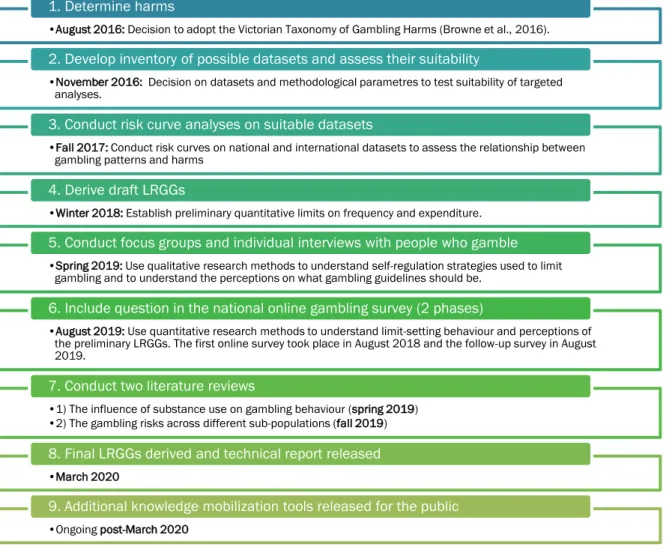
The National Lower-risk Gambling Advisory Committee (NLRG-AC) is composed of representatives from organizations and sectors that provide leadership or advocacy in the field of gambling, such as prevention, treatment, public health, regulation and finance, as well as the gambling industry. The NLRG-AC has endorsed the need for evidence-informed LRGGs and is responsible for providing input over the course of the project and assisting with the promotion of the LRGGs once developed. The Lower-risk Gambling Guidelines Scientific Working Group (LRGG-SWG) provides expert advice and conducts qualitative and quantitative research to support the development of LRGGs. Ultimately, the LRGG-SWG will make recommendations about quantitative limits on frequency and expenditure that are associated with a reduced risk of experiencing gambling-related harms (i.e., lower-risk gambling limits). The research plan is presented in Figure 1.
1. The LRGG-SWG began its work by determining which gambling-related harms could be targeted in the LRGGs. Based on the best available evidence, it was decided to adopt the Victorian
Taxonomy of Gambling Harms. This taxonomy classifies gambling harms in seven categories: financial, relationships, emotional, work or school, health, legal and cultural (Browne et al., 2016).
2. The LRGG-SWG then identified and developed an inventory of strong datasets from Canada and around the world that assess the relationship between gambling patterns and harms. These datasets were then evaluated for their suitability to conduct the risk curves1 of gambling-related
harms to identify lower-risk gambling thresholds. The custodians of the suitable datasets were invited to participate in the project, all agreed to participate.
3. Risk curve analyses were conducted on datasets from different countries, including Canada, the United States, Iceland, France, Sweden, Finland, Australia and New Zealand.
4. The results of the risk curves were meta-analyzed and were used to establish preliminary quantitative limits on frequency and expenditure that are associated with a lowered risk of harm (i.e., first draft of the LRGGs).
5. The LRGG-SWG conducted a series of focus groups and individual interviews with people who gamble to understand self-regulation strategies used to limit their gambling and to understand the perceptions on what gambling guidelines should be.
6. Further, the LRGG-SWG is collaborating with the Alberta Gambling Research Institute and other researchers to fund a portion of a national online gambling survey (August 2018 and August 2019) that will help increase our current understanding of limit-setting behaviours of people who gamble as well as other questions relevant to the development of the LRGGs.
7. The LRGG-SWG also identified the need for two comprehensive literature reviews to be conducted to inform the development of the LRGGs.
1 A risk curve can determine the upper limits that when crossed increase the risk of developing gambling-related harms. In other words, at which point does gambling too much, too often or for too long substantially increase the risk of the onset of gambling-related harms?
I. The influence of substance use on gambling behaviours: This literature review looks at how use of substances might affect the ability of someone who gambles to set limits. Results of this review will permit the LRGG-SWG to understand how the use of alcohol and other substances should be taken into account when developing and promoting the LRGGs.
II. The gambling risks across different sub-populations: This literature review and meta-analysis will focus on the gambling risks across different sub-populations (e.g., elderly, adolescents, minorities and different genders). Given that each group possesses unique characteristics that confer different vulnerability to the harms of gambling, identifying those who are at higher risk and the level of risk will also be taken into account when developing and ultimately promoting the LRGGs.
8. The final LRGGs will be released in a technical report for addiction professionals, policy makers, regulators, communication experts and gambling providers in March 2020. 9. Additional knowledge mobilization tools for the public will be developed and released after
the technical report. The aim is that these guidelines will be widely used in communication products that educate the general public about lower-risk gambling in general and in specific, hazardous situations such as in the context of alcohol or substance use.
Join Us
Throughout the course of the project, the project team will be reaching out to those interested in the national LRGGs with updates on progress and opportunities to be involved. You can sign up to our mailing list by emailing [email protected].
Table 1. Groups Overseeing the Establishment of the Lower-risk Gambling Guidelines
National Lower-risk Gambling Advisory Committee
(NLRG–AC) Lower-risk Gambling Guidelines Scientific Working Group (LRGG–SWG)
Membership Louise Nadeau, University of Montreal (co-chair) Rita Notarandrea, CCSA (co-chair)
Representatives from organizations and sectors addressing gambling-related issues, such as prevention, treatment, public health and finance, as well as the gambling industry and regulators.
David Hodgins, University of Calgary (co-chair) Matthew Young, CCSA (co-chair)
Natacha Brunelle, Université du Québec à Trois-Rivières
Shawn Currie, University of Calgary
Magali Dufour, Université du Québec à Montréal Marie-Claire Flores-Pajot, CCSA
Louise Nadeau, Université de Montréal Catherine Paradis, CCSA
Purpose To provide advice over the course of the project, and assist in the dissemination, promotion, uptake and use of LRGGs by key networks and stakeholders.
To provide expert advice and conduct research to support the development of the LRGGs. The group operates as an independent expert working group that will consult with the NLRG–AC, as required.
Figure 1: The Lower-risk Gambling Guidelines Progress to-Date
•August 2016: Decision to adopt the Victorian Taxonomy of Gambling Harms (Browne et al., 2016).
1. Determine harms
•November 2016: Decision on datasets and methodological parametres to test suitability of targeted analyses.
2. Develop inventory of possible datasets and assess their suitability
•Fall 2017: Conduct risk curves on national and international datasets to assess the relationship between gambling patterns and harms
3. Conduct risk curve analyses on suitable datasets
•Winter 2018: Establish preliminary quantitative limits on frequency and expenditure.
4. Derive draft LRGGs
•Spring 2019: Use qualitative research methods to understand self-regulation strategies used to limit gambling and to understand the perceptions on what gambling guidelines should be.
5. Conduct focus groups and individual interviews with people who gamble
•August 2019: Use quantitative research methods to understand limit-setting behaviour and perceptions of the preliminary LRGGs. The first online survey took place in August 2018 and the follow-up survey in August 2019.
6. Include question in the national online gambling survey (2 phases)
•1) The influence of substance use on gambling behaviour (spring 2019) •2) The gambling risks across different sub-populations (fall 2019)
7. Conduct two literature reviews
•March 2020
8. Final LRGGs derived and technical report released
•Ongoing post-March 2020
References
Browne, M., Langham, E., Rawat, V., Greer, N., Li, E., Rose, J., Rockloff, M. … Best, T. (2016).
Assessing gambling-related harm in Victoria: a public health perspective. Melbourne, Australia: Victorian Responsible Gambling Foundation. Retrieved Jan. 23, 2017, from
www.responsiblegambling.vic.gov.au/__data/assets/pdf_file/0007/28465/Browne_assessing_ gambling-related_harm_in_Vic_Apr_2016-REPLACEMENT2.pdf.
Canadian Partnership for Responsible Gambling. (2015). Canadian Gambling Digest 2013–2014. Toronto, Ont.: Responsible Gambling Council. Retrieved Jan. 23, 2017, from
www.responsiblegambling.org/docs/default-source/default-document-library/cprg_canadian-gambling-digest_2013-14.pdf?sfvrsn=2.
ISBN 978-1-77178-585-3 © Canadian Centre on Substance Use and Addiction 2019
CCSA was created by Parliament to provide national leadership to address substance use in Canada. A trusted counsel, we provide national guidance to decision makers by harnessing the power of research, curating knowledge and bringing together diverse perspectives. CCSA activities and products are made possible through a financial contribution from Health Canada. The views of CCSA do not necessarily represent the views of the Government of Canada.