Editor: Christof Ebert
Vector Consulting Services [email protected]
SOFTWARE
TECHNOLOGY
Component Stacks for
Enterprise Applications
Panos Louridas
Mobile enterprise application development is transitioning from
SQL-based traditional servers toward JavaScript for server and
client. MEAN as a component stack is replacing LAMP, with a
growing number of adopters and Web applications. As the world
turns faster, we’ll see increasingly fl exible and evolving component
stacks. In this instalment of the Software Technology department,
Panos Louridas gives an introduction to LAMP and MEAN and
shows how to practically use MEAN. I look forward to hearing from
both readers and prospective column authors. —Christof Ebert
WE INTERACT WITH Web applications to carry out most of our everyday tasks. From paying taxes to booking vaca-tions, our basic means of interaction is a Web browser that communicates with an application running somewhere on a server. Consequently, Web development is a primary source of employment for programmers. Programming languages such as Ruby, PHP, and JavaScript, which are used primarily for Web devel-opment, feature prominently in the top 10 popular languages in yearly rankings,
such as those issued by IEEE Spectrum.1
Until relatively recently, the tools used to develop Web applications followed a well-established architecture called the LAMP stack. Recently, the MEAN stack has taken the Web developer world by storm and is replacing LAMP.
LAMP
The LAMP stack has been around for many years and is the established way to
develop Web applications. Originally it stood for “Linux, Apache, MySQL, and PHP,” but its meaning is now broader. Ba-sically, developers build Web applications using specifi c software components at dif-ferent levels. At the base level, the OS of choice is Linux. With the OS in place, a Web application needs a webserver. Tra-ditionally, this has been the Apache web-server. The data the Web application uses is stored in a relational database; the most popular one is MySQL. The application itself is written in a programming lan-guage offering good support for Web pro-gramming; this was initially PHP.
Things have changed considerably over time. PHP is popular for Web devel-opment, but many programmers prefer Java or Python, which are still compat-ible with the LAMP stack. And it would be ludicrous to say that LAMP doesn’t cover Ruby on Rails. In the same vein, MySQL remains the most popular data-base, but PostgreSQL powers many Web
94 I E E E S O F T WA R E | W W W.C O M P U T E R .O R G / S O F T WA R E | @ I E E E S O F T WA R E
applications. And although nobody can doubt the Apache webserver’s importance, the nginx webserver’s popularity has been increasing. With the LAMP acronym blurred, we had better fi nd a better way to identify what LAMP development is.
Defi ning LAMP Development
LAMP has four main components. First, the OS is open source—in most cases, a Linux distribution, although nobody would say that a Web application running on Free-BSD is automatically denied the LAMP moniker.
Second, the Web application is based on user interaction with HTML pages that, after being ppared, are sent by a webserver in re-sponse to HTTP protocol requests.
Third, the application needs to keep and process some data. The LAMP stack assumes that the data can and should be described using the relational-database model. The actual database of choice isn’t of
much consequence; what’s impor-tant is that it should be relational.
Fourth, the application must pre-sent views that depend on the user’s input. That means that not all the HTML pages the webserver returns can be static. Most of the HTML pages the user sees are prepared dy-namically, on the basis of the user’s input. The chosen programming lan-guage—for example, PHP, Python, Ruby, Java, or Perl—takes that input and presents a new HTML page on the fl y that the webserver sends back to the user.
Deviating from Tradition
Traditionally, a MEAP (mobile en-terprise application platform) appli-cation works with the cycle of HTTP request, process, and HTTP re-sponse. That is, the user, through the browser, interacts with an HTML page and issues a request to the server. The server processes the re-quest, prepares a new HTML page, and sends it to the user.
LAMP stack is through HTTP re-quest and response pairs. This prin-ciple is relinquished in MEAN, and a new Web-programming paradigm emerges.
MEAN
Like LAMP, MEAN is an acronym but comprises more than the acro-nym components. M is for Mon-goDB, a popular NoSQL database that powers MEAN applications. E is for Express, a Web application framework built on Node.js. A is for AngularJS, a JavaScript framework for endowing Web applications with modern interactive features. N is for Node.js, the basic computational en-gine for MEAN applications. The MEAN stack is a server-side Java-Script execution environment, letting developers write generic JavaScript applications that are executed by Node.js, and not just traditional Web JavaScript code that executes in a browser. (For a brief look at the rise of MEAN, see the related sidebar.)
Node.js is pretty low-level; al-though you can write webserver ap-plications directly on it, it’s much better to rely on frameworks that let you access higher-level abstractions. Express is such a framework, letting you focus more on the logic of your applications than on the nitty-gritty.
MEAN asks developers to stop relying on relational databases and make the jump to the NoSQL world. That doesn’t mean you can’t use re-lational databases alongside the MEAN stack. NoSQL databases,
tasks for which they’ve been using Java, Python, or Ruby on the server. That’s a challenge and an opportunity. JavaScript uses a specifi c ming model based on events. To make programs that perform well, program-mers must be careful to use asynchronous programming patterns, which often requires a change in thinking. At the same time, Web developers already know JavaScript because they use it to add interactive components on their webpag-es. Instead of having to work with two programming languages in a single Web application—for example, Python on the server-side components and JavaScript on the front-end, browser-side components—developers can program every-thing in the same language.
SOFTWARE TECHNOLOGY
though, are a better fi t, especially MongoDB, which uses JavaScript as its primary interface. In this way you can use the same language for front-end interaction programming, server-side logic processing, and da-tabase access and manipulation.
MongoDB organizes data into collections instead of tables. A col-lection contains documents, which are key–value pairs. A value can be a key–value pair itself, so that docu-ments can represent complex nested structures. Documents are essen-tially JSON (JavaScript Object Nota-tion) objects, a JavaScript subset that can describe nested data structures. MongoDB converts the JSON objects to BSON (Binary JSON) format and places them in persistent storage.
MongoDB collections are sche-maless; that is, the documents don’t adhere to a predefi ned schema (as do rows in an SQL table). A collection might contain objects with different structures. That makes MongoDB a good choice for storing data that might have a changing structure and that can’t be converted to standard relational formats.
The schemaless nature of Mon-goDB databases has several conse-quences. MongoDB collections tend to eat up a lot of space. In a typical relational database, the data type defi nitions are stored only once in the database dictionary. In a sche-maless database, you must specify the structure of each document in the collection, even if all documents have a similar structure. SQL data-bases have benefi tted from years of research and practice in query opti-mization and execution, nothing of which transfers to schemaless data-bases. In practice, most queries that are practical in schemaless databases are simple key–value lookups. If you want to run queries that combine
different documents or calculate ag-gregate values, you might fi nd that performance grinds down to a halt. Moreover, MongoDB doesn’t of-fer transactions like the traditional transactional models of relational databases—although other NoSQL databases offer more transaction support.
At the same time, if relatively simple queries will meet your data needs, MongoDB can be blazingly fast. It can distribute data among different MongoDB instances (this process is called sharding). This makes it well suited for very big amounts of data (“mongo” comes from “humongous”) that can be stored in a distributed fashion.
AngularJS is a fully fl edged devel-opment framework for webpage ap-plications, structuring them along the Model-View-Controller design pattern. With AngularJS, develop-ers can describe how data from the server links to events and GUI com-ponents on the webpage and how events and input from the user alter the GUI components’ state. Angu-larJS extends HTML with a template
syntax that allows easy manipulation of page elements and lets develop-ers specify how, in response to user events, data can travel to and from the server asynchronously via Ajax.
The culmination of this program-ming model is single-page applica-tions (SPAs). In SPAs, all the Web
ap-plication (the HTML and templates for everything the user will see and all associated JavaScript) is downloaded at once. Then, the pages the user sees change continuously depending on the user events, without any page re-loading from the server. That entails a signifi cant departure from MEAP applications’ HTTP request–response sequence. A MEAN application can issue a single HTTP request and get a bundle of HTML, templates, and JavaScript in a single HTTP re-sponse. Then, all the other data is exchanged through REST (Repre-sentational State Transfer) calls from the browser to the server. The REST calls typically pass data from the browser to function callbacks run-ning in Node.js and return the re-sults. Data and results are passed as a JSON object payload in the REST calls and responses.
A good way to think about this design is that the front end that the browser gets is an independent client application, which stands on its own and interacts with a Web service plication in the server. The client ap-plication interacts with the server
application with an agreed REST API. The client application handles user interaction; the server applica-tion handles the business logic.
AngularJS isn’t the only choice. The Ember.js development frame-work has goals similar to those of AngularJS and a strong, devoted
So much LAMP code is in
production that LAMP won’t
go away easily, if at all.
96 I E E E S O F T WA R E | W W W.C O M P U T E R .O R G / S O F T WA R E | @ I E E E S O F T WA R E
community. It provides different programming abstractions, but the basic idea of having the front end as a client application communicating with a REST API in the back end re-mains the same.
For an example of the practical
use of MEAN, see the sidebar, “A MEAN Example.”
The Dividing Line
Although MEAN and LAMP em-ploy different technologies and tools, the line dividing them often isn’t so
clear-cut that MEAN applications can’t have features from LAMP ap-plications, or vice versa.
The platonic ideal of a MEAN ap-plication would have the front end served in one go at the start, but in reality that might not be practical. You might need to strike a balance in which some parts of the application are served in stages through successive HTTP requests and responses. Also, you can’t rely on the client side to en-force access controls: with a modicum of JavaScript, someone could bypass all security features of such an appli-cation. The controls must be enforced on the server side as well.
It’s conceptually appealing to reg-iment development stacks into those that can rely on NoSQL databases versus those that require SQL data-bases. However, you might encoun-ter situations in which an otherwise MEAN application needs an SQL database or in which a LAMP ap-plication would be much better off with a NoSQL database.
Table 1 compares LAMP and MEAN.
Now, Where?
Where should you go now—down the well-trodden path of LAMP or the trail blazed by MEAN?
This question has no single an-swer. If a development team has achieved excellence with LAMP, there’s no reason to dump it and jump on the MEAN train just to be in fashion. So much LAMP code is in production that LAMP won’t go away easily, if at all. MEAN moves fast—perhaps too fast for some people’s taste. For example, an an-nouncement from AngularJS’s devel-opers that AngularJS 2.x would have breaking changes from AngularJS 1.x raised a wave of protest. At other times, things that developers take
A MEAN EXAMPLE
Consider an online catalog that presents various services (such as cloud stor-age or online applications available as software as a service) from third-party providers. For each service, the catalog includes basic information and ratings on a set of criteria. The criteria might differ depending on the nature of the service, and it’s not clear that a single schema could fi t them all. The nature of the service description might also differ among services.
MongoDB is a good fi t for this catalog. Most queries are simple reads and some updates; no queries contain complex calculations. You only need to re-cord the information and the criteria ratings for each service, which you can do with JSON (JavaScript Object Notation) documents.
All of the catalog’s functionality is through a REST (Representational State Transfer) API, through which JSON documents are updated, written, or read. That API defi nes a set of actions available through specifi c URLs (for exam-ple, /service/amazing_cloud_storage/15/put). The actions are implemented through Express routing rules calling server-side JavaScript; Node.js is the underlying engine.
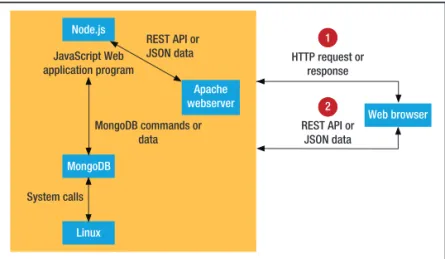
The user’s browser interacts with the REST API, sending and receiving JSON documents. The browser renders the documents as HTML, using a Mod-el-View-Controller framework such as AngularJS. Figure A shows the setup.
JavaScript Web application program Apache webserver REST API or JSON data MongoDB commands or data System calls REST API or JSON data HTTP request or response Node.js MongoDB Linux Web browser 2 1
FIGURE A. A typical MEAN setup, for an online catalog that presents various services from third-party providers. REST stands for Representational State Transfer; JSON stands for JavaScript Object Notation.
SOFTWARE TECHNOLOGY
for granted in LAMP, such as well-established interfaces for talking to SQL databases, don’t yet exist in MEAN—and the argument that you don’t need SQL in MEAN doesn’t hold much water. That said, once you’ve seen what you can do with AngularJS or Ember.js, you won’t likely want to go back.
As I indicated, though, there’s no reason why the twain shall not meet. You can combine very well an SQL database and a Python development framework, or Ruby on Rails, with AngularJS in the front end. Or you can use both an SQL and a NoSQL
database in the same application, if that suits your needs.
Developers are in a lucky situ-ation in which they’re, in a sense, spoiled with choices. The best an-swer to my question is to use your best judgment and pick and choose as you need.
N
either LAMP nor MEANwill be the last word on developing Web applica-tions. New ideas and approaches will emerge to respond to emerging needs. For example, the Internet of
Things will require rethinking how we develop our applications to make them fit in all sorts of small, embed-ded devices. The emergence of dis-tributed applications built from au-tonomous nodes needs technologies appropriate for building networked services instead of shoehorning ex-isting tools—the reception of the Go programming language might hint at that. Moreover, future applica-tions will be built from many inde-pendent components. Those compo-nents won’t all need to be deployed and configured in tandem, nor will they need to be updated together.
TAB
L
E 1
LAMPLAMP vs. MEAN.*
MEANMaturity High Still bleeding-edge in some parts
Adoption High High in new projects
Community Very large Large, very enthusiastic Ecosystem Huge (many programming languages, frameworks, and
databases)
Homogeneous (one programming language, few frameworks and databases)
Availability Both open- and closed-source solutions Open source solutions Hip factor Low (the traditional way to do things) High (the new way to do things) Programming
paradigm
Well established Requires adopting new thinking (asynchronous, event-based programming)
Support Good, from both established commercial vendors and online communities
Commercial support mostly through startups. Good online communities fill the gap.
Performance Depends on the framework. Java-based frameworks are usually faster than those based on scripted languages. LAMP has plenty of experience with robust, performing enterprise applications.
Node.js is very fast. However, it’s not clear whether this is enough to support high-performance enterprise applications.
Developer productivity Depends on the framework. For instance, Ruby on Rails has been developed with that in mind.
Can be high if the developers are well versed in the JavaScript mind-set. Otherwise, it can be poor. Security Depends on the framework. Thanks to accumulated
experience, a set of secure practices exists.
Must be considered on both the server and client sides. Users can always subvert the client-side JavaScript.
Usefulness for embedded systems and the Internet of Things
Depends on the framework. A full MEAN stack isn’t designed to run on an embedded device, so developers must use MEAN technologies with small footprints.
Although it’s too early to say with certainty, Node .js seems to be a good fit for embedded devices running Linux.
98 I E E E S O F T WA R E | W W W.C O M P U T E R .O R G / S O F T WA R E | @ I E E E S O F T WA R E
Frameworks will be judged by their fl exibility and their facilities for han-dling component modules.
For links to more information on LAMP and MEAN, see the “For More Information” sidebar.
Reference
1. S. Cass, “The 2015 Top Ten Program-ming Languages,” IEEE Spectrum, 20 July 2015; http://spectrum.ieee .org/computing/software/the-2015 -top-ten-programming-languages.
PANOS LOURIDAS is an associate professor at the Athens University of Economics and Business and a consultant at the Greek Research and Technology Network. Contact him at louridas@ aueb.gr.
FOR MORE INFORMATION
If you’re interested in LAMP frameworks, check out these sites:
• The Java Spring Framework, http://projects.spring.io/spring-framework; • Ruby on Rails, http://rubyonrails.org;
• Python Django, www.djangoproject.com; and • PHP, https://secure.php.net.
To explore MEAN, start with these sites: • Node.jsQ, https://nodejs.org/en; • Meteor, www.meteor.com; • Express, http://expressjs.com; • AngularJS, https://angularjs.org; and • Ember, http://emberjs.com.
Security is important in Web application development. A good starting point is the OWASP (Open Web Application Security Project) Top 10 Project (www .owasp.org/index.php/OWASP_Top_Ten_Project), which presents the most critical Web application fl aws.
Ad Index Here
Dennis, Marian out
sick Tuesday. I’ll
check back with her
Wednesday.
Advertising Personnel
Debbie Sims: Advertising Coordinator Email: [email protected]
Phone: +1 714 816 2138 | Fax: +1 714 821 4010 Chris Ruoff: Senior Sales Manager
Email: [email protected]
Phone: +1 714 816 2168 | Fax: +1 714 821 4010 Advertising Sales Representatives (display) Central, Northwest, Southeast, Far East: Eric Kincaid
Email: [email protected] Phone: +1 214 673 3742 Fax: +1 888 886 8599
Northeast, Midwest, Europe, Middle East: David Schissler Email: [email protected] Phone: +1 508 394 4026 Fax: +1 508 394 1707 Southwest, California: Mike Hughes Email: [email protected] Phone: +1 805 529 6790
Advertising Sales Representative (Classifieds & Jobs Board) Heather Buonadies
Email: [email protected] Phone: +1 201 887 1703