The European Commission has issued a Green Paper on the future of VAT. It be-lieves that the Member States should strive towards simpler, more robust and effi cient VAT systems. The common VAT is distortionary, unnecessarily complex, and susceptible to fraud. Base broadening, rate unifi cation, and improvements in VAT coordination should be on the tax reform agendas of the Member States. The Commission invites submissions on a wide range of topics.
This volume contains three studies on the EU VAT. The fi rst study aims at improv-ing the understandimprov-ing and dialogue on the VAT between lawyers, economists, and accountants. The second study analyses VAT fraud, particularly carousel fraud, evaluates various proposals that have been made to replace the current transitional regime by a defi nitive regime under which intracommunity supplies would be taxed in conjunction with a credit in the state of acquisition, and rev-enue clearing between supply and acquisition states. The study argues that it is not the break in the VAT collection chain (the zero rating of intracommunity supplies) that is at the root of the problem, but the break in the VAT audit trail. Accordingly, it recommends the introduction and intensifi cation of cross-border audits. The third study proposes that changes in the value of exempt immov-able property should be included in the VAT base. This base extension should re-place the highly inequitable and distortionary transfer and registration taxes and stamp duties that are currently levied on transactions in immovable property. Sijbren Cnossen is advisor at CPB and professor in the economics faculty of the University of Pretoria. He is emeritus professor of economics of the University of Maastricht and emeritus professor of tax law of Erasmus University Rott erdam. He has held appointments at the Law Schools of Harvard University and New
T h re e V A T S tu d ie s
Three VAT Studies
No 90
December, 2010
Three VAT Studies
CPB Netherlands Bureau for Economic Policy Analysis Van Stolkweg 14
P.O. Box 80510
2508 GM The Hague, the Netherlands
Telephone +31 70 338 33 80 Telefax +31 70 338 33 50 Internet www.cpb.nl
ABSTRACT IN ENGLISH
Abstract in English
This volume presents three studies on the VAT. The first study is a VAT primer for lawyers, economists, and accountants who rarely talk to each other about tax issues, particularly in the Netherlands. The different views illuminate the nature and workings of the VAT. The second study examines and evaluates VAT coordination in the EU against the backdrop of an analysis of VAT fraud. Carousel fraud is dwarfed by shadow economy fraud and contrived insolvency fraud. The taxation of intracommunity exports is not the solution to VAT coordination
problems. Rather the focus should be on cross-border VAT audit, followed up, if necessary, by investigation and prosecution of fraudsters. The third study argues that value changes in exempt immovable property should be brought into the VAT base, similar to value changes in other second-hand goods that are traded by taxable dealers. This extension of the VAT base should replace the inequitable and distortionary transfer or registration taxes and stamp duties on transactions in immovable property that are currently levied in the various member states.
Key words: VAT , European Union, VAT coordination, carousel fraud, retail sales tax, consumption taxes, VAT treatment of housing
JEL code: H2, H7, K34
Abstract in Dutch
Deze bundel bevat drie studies over de BTW. De eerste studie is een kort begrip van de BTW voor juristen, economen, en accountants die zelden met elkaar praten over
belastingvraagstukken, met name in Nederland. De verschillende zienswijzen werpen licht op de aard en de werking van de BTW. De tweede studie onderzoekt en beoordeelt de coördinatie van de BTW in de EU tegen de achtergrond van een analyse van BTW-fraude. De belasting van intracommunautaire uitvoer is niet de oplossing voor BTW-coördinatieproblemen. In plaats daarvan dient de aandacht zich te richten op grensoverschrijdend boekenonderzoek en, zo nodig, opsporing en vervolging van fraudeurs. De derde studie pleit er voor om
waardeveranderingen van vrijgesteld onroerend goed in de BTW-heffingsgrondslag te betrekken, zoals ook gebeurt met tweedehands goederen die door BTW-plichtige personen worden verhandeld. Deze uitbreiding van de heffingsgrondslag dient in de plaats te komen van de unfaire en verstorende overdrachts- of registratiebelastingen en zegelrechten op transacties in onroerend goed die thans door de verschillende lidstaten worden geheven.
Steekwoorden: BTW, Europese Unie, BTW-coördinatie, carrouselfraude, kleinhandelsbelasting,
CONTENTS
Contents
Preface 7
Summary 9
Nederlandse samenvatting (Dutch summary) 13
1 VAT primer for lawyers, economists, and accountants 17
1.1 Introduction 17
1.2 Broad-based consumption taxes 18
1.2.1 Forms of consumption tax 18
1.2.2 Equivalence of consumption taxes 19
1.2.3 Differences between consumption taxes 21
1.2.4 VAT: the preferred choice 24
1.2.5 Prevalence of consumption taxes 26
1.3 Lawyers, economists, and accountants 28
1.3.1 The rigor of lawyers 28
1.3.2 The insight of economists 30
1.3.3 The precision of accountants 32
1.4 Lessons from world-wide experience 36
2 VAT coordination in common markets and federations: Lessons from the European
Experience 39
2.1 Introduction 39
2.2 Experience with RSTs and VATs 41
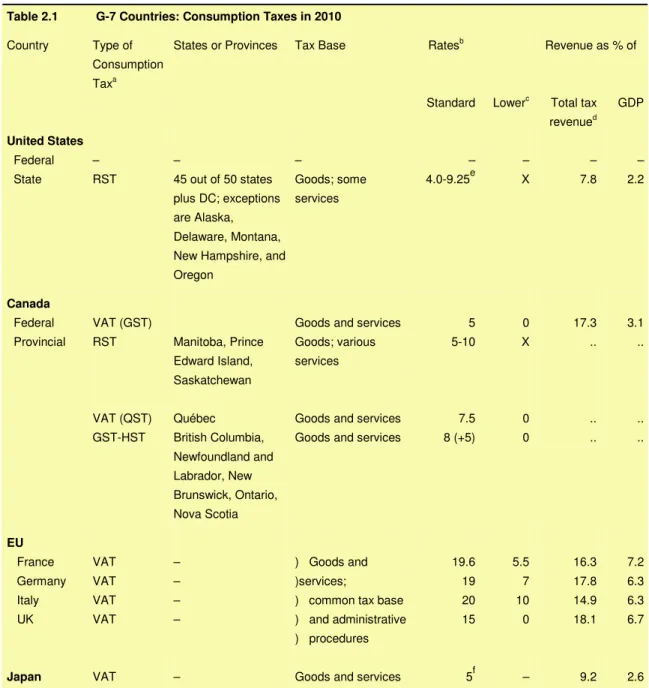
2.2.1 G-7 countries 41
2.2.2 Considerations affecting the choice between VAT and RST 44
2.2.3 Conclusions 46
2.3 VAT coordination in the European Union 47
2.3.1 Cross-border transactions in goods 47
2.3.2 Cross-border transactions in services 49
2.3.3 Conclusion 51
2.4 VAT evasion in the European Union 52
2.4.1 Forms of VAT evasion 52
2.4.2 Scale of the problem 53
2.5 Exporter rating proposals 56
2.5.1 European Commission proposals 56
2.5.2 Proposals in the tax literature 58
2.5.3 Further analysis by the European Commission 61
2.5.4 Evaluation of exporter rating proposals 62
2.6 The German and Austrian proposal 64
2.6.1 Main features 64
2.6.2 Reverse charging vs. VAT 65
2.6.3 Universal cross-checking and VAT bank accounts 67
2.6.4 Conclusion 68
2.7 Summary of findings 69
3 Improving the VAT treatment of exempt immovable property in the European Union 71
3.1 Introduction and summary 71
3.2 VAT treatment of exempt immovable property 73
3.2.1 Theoretical considerations 73
3.2.2 Practical observations 74
3.2.3 Putting the equivalence notion into practice 76
3.2.4 Conclusions 77
3.3 Actual VAT treatment of immovable property 78
3.3.1 Common rules 78
3.3.2 Member state practices 78
3.3.3 Additional or alternative taxes 83
3.4 Improving the nexus between VAT and transfer duties 88
3.4.1 Applying the margin scheme to transfers of exempt property 88
3.4.2 Abolition of stamp duties 91
PREFACE
Preface
Recently, the European Commission has issued a Green Paper on the future of VAT in the European Union. It believes that the Member States should aspire towards simpler, more robust and efficient VAT systems. Having been harmonised in 1977, long before the internet and the onset of globalisation, the common VAT appears an anachronistic tax compared with modern VATs in New Zealand, Canada, Australia, South Africa, and Singapore. The exemptions and differentiated rates that are prevalent throughout the EU violate the logic and functionality of the VAT. More importantly, they are highly distortionary and greatly complicate the
administration and compliance with the tax.
The three studies in this volume attempt to make a contribution towards a better understanding of the VAT. The first study does this by analysing the nature and role of the VAT and
comparing the views of lawyers, economists, and accountants. Base broadening and domestic rate unification should be high on the tax reform agendas of the Member States. Two issues, that is, VAT coordination aspects and the treatment of exempt immovable property are singled out for separate treatment. The study presents evidence that domestic shadow economy fraud and contrived insolvency fraud are far more important than carousel fraud, which receives so much attention. Little can be said in favour of some form of exporter rating, that is, the imposition of VAT on intracommunity supplies and a credit for VAT on intracommunity acquisitions, together with the payment of the VAT collected by supply states to acquisition states (to maintain the destination principle, that is, revenue allocation to the state of
consumption). Instead, present arrangements should be retained, although compliance control should be extended across borders in the form of joint audits. Finally, the author proposes to replace the current inequitable and highly distortionary transfer, registration and stamp duties on immovable property by the imposition of the VAT on changes in the value of exempt immovable property. This would eliminate the cascade effects of the current taxes and duties, although the locked-in effect would remain. The proposal merits further consideration.
The studies, written by Sijbren Cnossen at CPB, are based on papers presented at conferences held in Vienna, Washington DC, and Oxford, and published in the related proceedings. The author wishes to thank the organisers of the conferences for their support, and Jeannette Verbruggen for preparing the studies for publication.
Coen Teulings Director CPB
SUMMARY
Summary
VAT primer for lawyers, economists, and accountants
Lawyers, economists, and accountants with a grounding in taxation hardly talk to each other about professional issues, particularly in the Netherlands. Each profession tends to confine the circle of discussion to colleagues with a similar educational background. Joint conferences to learn from each other’s insights and experiences are rare. The value-added tax (VAT) is a good example of this insular attitude. The first paper in this volume attempts to bridge the gap between the three professions by articulating and comparing the views that are peculiar to each group. In practice, lawyers view the VAT as a tax on transactions, emphasizing the importance of unambiguous legislation on who should be taxed, on what, where, and to what extent. In the process, the nature of the VAT and its economic effects and costs tend to overlooked.
Economists, on the other hand, are aware of the economic distortions of exemptions and differentiated rate structures, but tend to be dismissive of the legal design requirements for a good tax, which are essential for tax certainty. Economists enhance the understanding of the VAT by showing that it is a tax on labour income and business cash flow. Unlike the income tax, the VAT does not tax the normal rate of return on capital. Accountants emphasize that the VAT is not a cost for business. It does not enter a business firm’s profit & loss account, although this account can be used to calculate the VAT liability. There is much to be learned from the views of the various professions.
As background to these views, the paper outlines the nature and basic workings of the VAT and other broad-based consumption taxes by reference to a stylized example of the production-distribution process. Given identical bases and rates, it is shown that exactly the same amount of tax can be levied under a retail sales tax (RST), a direct subtraction method tax levied on the difference between sales and purchases, an addition method tax imposed on the sum of wages and business cash flow, a flat tax applied to business cash flow combined with a tax on individual wage earners, and a personal expenditure tax levied on the difference between incomings and savings. Although in theory identical, design and feasibility considerations have important implications for the ability to achieve basic tax objectives, such as fairness, neutrality, revenue allocation to the country of consumption, minimization of administration and
compliance costs, and political robustness with respect to the various taxes. The comparative review indicates that the VAT emerges as the consumption tax of choice. It is a highly neutral, productive, stable, and flexible source of government revenue. Not surprisingly, the VAT is found in some 150 countries around the world.
VAT coordination in common markets and federations: Lessons from the European experience
While there is wide agreement on the basic design features of a VAT, the consensus on the most appropriate way to coordinate the VATs levied by different taxing jurisdictions is smaller. Some believe that an RST, which is inherently destination-based, is the best consumption tax in a common market without border controls or in a federation. The RST is found in 45 out 50 states in the United States and in 3 out of 10 provinces in Canada. It has also been advocated by Germany and Austria as a solution to the problem of carousel fraud, that is, the VAT-free importation of goods from other states and their subsequent sale, inclusive of VAT in the domestic market, but without payment of the VAT collected from the purchaser to the tax authorities. To begin, this paper, basically written for American readers, shows that the VAT is to be preferred over the RST, essentially because it is more conducive in distinguishing exempt producer use of goods and services from taxable consumer use; hence, it is a more neutral tax. Also, the multistage collection feature of the VAT means that large firms collect most of the tax paid by the consumer on behalf of the tax office, in contrast to an RST under which retailers remit the full tax to the tax authorities, although they are the weakest link in the tax collection process. The preference of VAT over RST is backed up by the experience of various countries, which were faced with the choice.
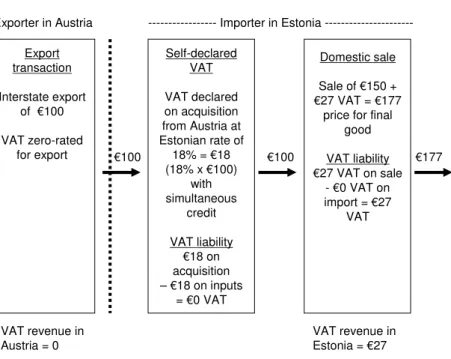
Some continue to prefer the RST, because it is inherently destination-based and does not seem to require border tax adjustments (exports exempt, imports taxed). Accordingly, it is argued, an RST is not susceptible to carousel fraud. Currently, in the absence of (physical) customs controls, these border tax adjustments are effected through the accounts of exporters and importers under the so-called deferred payment system. The system requires purchasers of out-of-state goods and services to self-assess the VAT. Instead of the seller being liable to account for the VAT (the normal procedure), the buyer has to account for the tax (and give himself a credit at the same time). This is called reverse-charging. The European Commission has long sought to replace the deferred payment system, called transitional regime, by a definitive regime under which the exporter is taxed, the importer receives a credit for the exporter’s tax, and the exporting country remits the VAT collected from the exporter to the importing country – a regime which is called ‘exporter rating’. Various high-profile exporter rating proposals have also been made in the tax literature, which go by the names of Viable Integrated VAT
(VIVAT), Compensating VAT (CVAT), and Dual VAT (D-VAT).
This study argues that the current deferred payment system is to be preferred over any of the exporter rating proposals. Basically, it is not the break in the VAT-collection chain (the zero-rating upon export), which undermines the efficacy of the VAT, but the break in the VAT-audit trail. This break can be repaired by extending the jurisdictional reach of each state’s VAT administration through cross-border audits, followed up, if indicated, by investigations and prosecutions. Replacing deferred payment by exporter rating simply would shift fraudulent
SUMMARY
practices from the export stage to the import stage through the use of false invoices showing VAT credits. Perhaps, it is time to put the various exporter rating proposals, which have dominated the debate for the last 20 years, to rest.
The study also shows that the size of carousel fraud is much smaller than shadow economy fraud, that is, the VAT-free provision of all kinds of personal services, ranging from home and car repairs to hairdressing and consultancy services in violation of the law. Understandably but incorrectly, carousel fraud receives so much attention because it is a mafia type of activity involving few transactions but large sums of money. By contrast, shadow economy fraud – much larger in terms of VAT revenue foregone – entails numerous small transactions across the whole spectrum of personal services provision. Germany and Austria have proposed to solve the smaller problem, that is, carousel fraud, by reverse-charging the VAT throughout the entire production-distribution process (effectively transforming it into an RST) and backing this up with a pervasive Stasi-like monitoring system under which the details of every transaction have to be fed into a central computer to match the VAT on purchases of one taxable person with the VAT on sales of some other taxable person. Drawing on the Chinese and Korean experience, the study argues that wholesale data matching is largely unproductive and does not uncover fraudulent practices. In short, it is no substitute for comprehensive audit.
Improving the VAT treatment of exempt immovable property in the European Union The European VAT, harmonised in 1977 (before the internet and globalization) and not changed since then, is riddled with largely senseless exemptions and differentiated rate structures. It is an anachronism compared with modern VATs found in, for instance, New Zealand, Canada, South Africa, Australia, and Singapore. One of the most difficult areas concerns the appropriate treatment of immovable property. Since rental values and by extension rents cannot be taxed, the value of newly created immovable property is taxed instead. At the time of creation, the tax on the full value equals the tax on the discounted present value of all future building services. Subsequent transactions in immovable property are exempt from VAT, although taxable persons can elect to include business property in the VAT base, meaning that a VAT credit is available for purchases and that tax must be charged on sales.
The exemption of transactions in residential property and business property (unless use is made of the tax option) implies, however, that future increases (and decreases) in the value of the property are left out of the VAT base. This hole in the VAT’s coverage can be repaired by taxing the increase in property values (and refunding the tax on the decrease in property values falling below the taxed acquisition price). The VAT on the increase/decrease in value should replace the current transfer/registration duty on the sale of immovable property (although consideration could be given to retaining the tax collection mechanism of the duty). The transfer duty is a highly inequitable and distortionary element in the tax system, which can be
of property. This verdict applies also to the crazy quilt of stamp duties found in most EU member states. These anachronistic levies should be abolished, the sooner the better. Another improvement would be to tax all non-residential property sales (and to abolish the tax option), which is what is done under modern VATs. Last but not least, a strong case can be made for applying the standard rate across-the-board to all transactions in or relating to immovable property.
SUMMARY
Nederlandse samenvatting (Dutch summary)
Kort begrip van de BTW voor juristen, economen, en accountantsJuristen, economen, en accountants onderlegd in de belastingheffing praten bijna niet met elkaar over beroepsmatige vraagstukken, zeker niet in Nederland. Elke beroepsgroep is geneigd de discussiekring te beperken tot collegae met eenzelfde educatieve achtergrond.
Gemeenschappelijke conferenties om van elkaars inzichten en ervaringen te leren zijn
zeldzaam. De BTW is een goed voorbeeld van deze kortzichtige houding. De eerste studie in dit geschrift probeert de kloof tussen de drie beroepsgroepen te verkleinen door de verschillende zienswijzen te articuleren en te vergelijken. In de praktijk beschouwen juristen de BTW als een belasting op transacties en benadrukken zij het belang van ondubbelzinnige wet- en regelgeving omtrent wie dient te worden belast, waarover, waar, en in welke mate. Daarbij worden de aard van de BTW en haar economische effecten en kosten veelal over het hoofd gezien. Economen, aan de andere kant, zijn zich bewust van de economische verstoringen van vrijstellingen en gedifferentieerde tariefstructuren, maar neigen er toe geringschattend te doen over de wettelijke vormgeving van een goede belasting, die van essentieel belang is voor de rechtszekerheid. Economen dragen bij aan een beter begrip van de BTW door er op te wijzen dat zij een belasting is over arbeidsinkomen en ondernemingscashflow. In tegenstelling tot de
inkomstenbelasting, belast de BTW niet de normale beloningsvoet van kapitaal. Accountants benadrukken dat de BTW geen kostenpost is voor de onderneming. Zij komt niet in de verlies- en winstrekening van een onderneming voor, hoewel die rekening wel kan worden gebruikt om de BTW-verplichting te berekenen. Er valt veel te leren van de zienswijzen van de
verschillende beroepsgroepen.
Als achtergrond voor deze zienswijzen, schetst de studie de aard en de basiskenmerken van de BTW en andere brede consumptiebelastingen aan de hand van een gestileerd voorbeeld van het productie-distributieproces. Gegeven identieke grondslagen en tarieven wordt aangetoond dat precies eenzelfde bedrag aan belasting kan worden geheven onder een kleinhandelsbelasting, een subtractiebelasting over het verschil tussen verkopen en inkopen, een optelbelasting over de som van lonen en ondernemingscashflow, een vlaktaks over de ondernemingscashflow
gecombineerd met een belasting van individuele loontrekkers, en een persoonlijke
consumptiebelasting geheven over het verschil tussen ontvangsten en besparingen. Hoewel in theorie identiek, zijn de mogelijkheden en beperkingen die verband houden met de vorm en de uitvoering van de onderscheidene belastingen van groot belang bij het in de praktijk brengen van elementaire doelstellingen van belastingheffing, zoals fairness, neutraliteit,
opbrengsttoewijzing aan het land van consumptie, minimalisatie van administratieve en nalevingskosten, en politieke weerbaarheid. De vergelijkende beschouwing geeft aan dat de BTW de voorkeur verdient. Zij is in hoge mate een neutrale, productieve, stabiele en flexibele bron van overheidsinkomsten. Het wekt dan ook geen verbazing dat de BTW is ingevoerd in
BTW-coördinatie in gemeenschappelijke markten en federaties: Lessen uit Europa Hoewel er in het algemeen overeenstemming is over de grondtrekken van een goede BTW, is de consensus over de meest geëigende manier om de BTW te coördineren tussen verschillende landen geringer. Sommigen zijn van oordeel dat de kleinhandelsbelasting de beste
consumptiebelasting in een gemeenschappelijk markt is zonder douanecontroles of in een federatie. De kleinhandelsbelasting wordt geheven in 45 van 50 staten in de Verenigde Staten en in 3 van de 10 Canadese provincies. Zij is ook naar voren geschoven door Duitsland en Oostenrijk als oplossing voor het probleem van carrouselfraude, dat wil zeggen, de BTW-vrije invoer van goederen uit andere staten, die vervolgens met BTW op de binnenlandse markt worden afgezet, echter zonder de door de koper betaalde BTW af te dragen aan de
belastingdienst. Om te beginnen, toont deze, voornamelijk voor Amerikaanse lezers geschreven studie, aan dat de BTW de voorkeur verdient boven de kleinhandelsbelasting, omdat zij in beginsel beter een onderscheid kan maken tussen vrijgesteld producentenverbruik van goederen en belast consumentenverbruik; daarom is het een neutralere belasting. Ook betekent de gefractioneerde inning van de BTW dat grote ondernemingen het leeuwendeel van de door de consument betaalde belasting afdragen, in tegenstelling tot een kleinhandelsbelasting waaronder kleinhandelaren de volle mep aan de belastingdienst dienen te betalen, ook al zijn zij de zwakste schakel in de keten van belastinginning. De voorkeur van de BTW boven de
kleinhandelsbelasting blijkt ook uit de overwegingen van verschillende landen die tussen een BTW en een kleinhandelsbelasting konden kiezen.
Echter, sommigen blijven de voorkeur geven aan een kleinhandelsbelasting, omdat zij van nature naar de bestemming wordt geheven. Grenscorrecties om de uitvoer van belasting te schonen en de invoer te belasten zouden niet nodig zijn. Daarom, zo wordt beweerd, is een kleinhandelsbelasting minder gevoelig voor carrouselfraude. Na de afschaffing van (fysieke) douanecontroles in de EU, worden grenscorrecties thans geëffectueerd via de boekhoudingen van exporteurs en importeurs onder de zogenoemde verleggingsregeling. Deze regeling eist dat kopers van uit andere landen geïmporteerde goederen en diensten zichzelf aanslaan voor de daarover verschuldigde BTW. In plaats van dat de verkoper verantwoordelijk is voor de heffing (de normale procedure), is het de koper die zichzelf de belasting in rekening dient te brengen (terwijl hij zichzelf tegelijkertijd een belastingaftrek voor hetzelfde bedrag kan verlenen). Dit wordt wel ‘reverse-charging’ genoemd. De Europese Commissie heeft lang geprobeerd de verleggingsregeling, overgangsregime genoemd, te vervangen door een definitieve regeling waaronder de uitvoerder wordt belast, de invoerder een aftrek krijgt voor de aan de uitvoerder betaalde belasting, en het uitvoerland de BTW van de uitvoerder afdraagt aan het invoerland – een regime dat met ‘exporter rating’ wordt aangeduid. In de literatuur zijn voorstellen van eenzelfde strekking gedaan onder de etiketten van ‘Viable Integrated VAT’ (VIVAT), ‘Compensating VAT’ (CVAT), en ‘Dual VAT’ (D-VAT).
SUMMARY
Deze studie beargumenteert dat de huidige verleggingsregeling de voorkeur verdient boven welk exporter-rating voorstel dan ook. In principe is het niet de breuk in het
BTW-inningsproces (de nultarifering bij uitvoer) die de doeltreffendheid van de BTW ondermijnt, maar de breuk in het controlesysteem. Deze breuk kan worden gerepareerd door de
controlespanne van elke staat te vergroten door middel van boekenonderzoek over de grens, en, zo nodig, opsporing en vervolging. De vervanging van de verleggingsregeling door exporter-rating zou de frauduleuze praktijk eenvoudig verleggen van de uitvoer naar de invoer door het gebruik van vervalste inkoopfacturen waarop belastingaftrek staat genoteerd. Wellicht is het moment gekomen om de verschillende exporter-rating voorstellen, die het debat van de afgelopen 20 jaar hebben gedomineerd, in de la te leggen.
De studie toont ook aan dat de omvang van carrouselfraude veel kleiner is dan de fraude in het binnenlandse informele circuit (en gekunstelde faillissementsfraude) in de vorm van allerlei vormen van BTW-vrije persoonlijke dienstverlening, van woning- en autoreparaties tot kappers- en adviesdiensten – in strijd met de wet. Begrijpelijkerwijs maar ten onrechte, krijgt carrouselfraude zoveel aandacht, omdat het een maffia-achtige activiteit is bestaande uit een gering aantal transacties waarmee veel geld gemoeid is. In tegenstelling gaat het bij de informele circuitfraude, waarmee een veelvoud van BTW is gemoeid, om een groot aantal kleine transacties die het hele spectrum van de persoonlijke dienstverlening beslaan. Duitsland en Oostenrijk hebben voorgesteld het kleinere probleem, dat wil zeggen, carrouselfraude, aan te pakken door de verleggingsregeling verplicht te stellen voor het hele productie-distributieproces (waarmee de BTW een kleinhandelsbelasting wordt), ondersteund door een Stasi-achtig controlesysteem waarbij de details van elke transactie in een centrale computer moeten worden ingevoerd om de BTW van kopers en verkopers met elkaar te kunnen vergelijken. Onder verwijzing naar de Chinese en Koreaanse ervaringen op dit gebied, vestigt de studie er de aandacht op dat grootscheepse datavergelijking grotendeels onproductief is en echte fraude niet op het spoor komt. Om kort gaan, het is geen substituut voor grondige boekhoudcontroles.
Verbetering van de BTW-behandeling van vrijgesteld onroerend goed in de Europe Unie De Europese BTW, geharmoniseerd in 1977 (lang voor het internet en de globalisering) en sindsdien niet veranderd, is doorschoten met grotendeels zinloze vrijstellingen en
gedifferentieerde tariefstructuren. Zij is een anachronisme vergeleken met de moderne BTW’s in, bijvoorbeeld, Nieuw Zeeland, Canada, Zuid Afrika, Australië en Singapore. Een van de meer problematische aspecten betreft de geëigende behandeling van onroerend goed. Omdat huurwaarden en in het verlengde daarvan huren niet kunnen worden belast, wordt in plaats daarvan de waarde van nieuw gebouwd onroerend goed in de heffing betrokken. Op het moment van oplevering is de belasting over de nieuwwaarde gelijk aan de belasting over de verdisconteerde tegenwoordige waarde van alle toekomstige huisvestingsdiensten van het goed. Daaropvolgende transacties in gebruikt onroerend goed zijn vrijgesteld van BTW, hoewel
heffingsgrondslag te betrekken, hetgeen betekent dat de belasting bij aankoop kan worden afgetrokken en dat belasting geheven dient te worden bij verkoop.
De vrijstelling van transacties van in gebruik genomen woningen en zakelijk onroerend goed (tenzij gebruik wordt gemaakt van de belastingoptie) impliceert echter dat de toekomstige toename (en afname) van de waarde van onroerend goed, gerealiseerd bij verkoop, niet in de heffing wordt betrokken, hoewel dat wel zou moeten. Dit gat in de BTW-heffingsgrondslag kan worden gerepareerd door BTW te heffen over de waardetoename van gebruikt onroerend goed (en de BTW terug te geven indien de waarde daalt beneden de belaste aankoopprijs). De BTW over de toename/afname zou in de plaats moeten komen van de huidige overdrachtsbelasting geheven bij de verkoop van onroerend goed (onder handhaving van het inningsmechanisme van de overdrachtsbelasting). De overdrachtsbelasting is een buitengewoon unfair en verstorend element in het belastingstelsel dat kan worden vergeleken met een cumulatieve omzetbelasting die wordt geheven telkens wanneer onroerend goed wordt overgedragen. Dit oordeel gaat ook op voor de lappendeken van zegelrechten die in de meeste EU-landen voorkomt. Deze anachronistische heffingen dienen te worden afgeschaft, hoe eerder hoe beter. Een andere verbetering zou zijn om alle transacties in zakelijk onroerend goed aan de BTW te onderwerpen (en de belastingoptie af te schaffen), hetgeen de vigeur is onder moderne BTW’s. Ten slotte kan een sterk pleidooi worden gehouden voor de toepassing van het standaardtarief over de volle breedte van transacties in of gerelateerd aan onroerend goed.
INTRODUCTION
1
VAT primer for lawyers, economists, and accountants
1On the basis of a comparative analysis of various broad-based consumption taxes, this paper argues that the value-added tax (VAT), which has been adopted by more than 150 countries, is the preferred form of consumption tax. The nature and workings of the VAT can be illustrated by the perceptions that lawyers, economists, and accountants have of the tax. Lawyers emphasize that the VAT is a transactions-based tax. Economists point out that the VAT is a tax on wages and business cash flow. Accountants show that the VAT is accounts-controlled, just like the business income tax. The world-wide experience with the VAT indicates that its base should be designed as broadly as possible and that it should be levied at a single, uniform rate.
1.1
Introduction
The value-added tax (VAT) is the consumption tax of choice of some 150 countries. With the exception of the United States (U.S.), all countries that are member of the Organization for Economic Cooperation and Development (OECD) have a VAT, including the partners of the U.S. in the North American Free Trade Agreement (NAFTA) – Canada and Mexico. In the European Union (EU), which comprises 27 member states, the adoption of the VAT is a prerequisite for membership because it is uniquely equipped to tax imports on par with domestically produced goods and services and to free exports from tax.
This paper examines the nature and workings of the VAT by comparing it with other broad-based consumption taxes. The paper contains four sections. Following this introduction, the second section discusses the different forms of consumption tax. In theory, the base of the various consumption taxes is the same; hence, their economic impact and revenue yield should not differ. In practice, however, open economy aspects and feasibility constraints imply that there are important differences among them. The VAT emerges as the preferred choice, primarily because it is the most neutral and feasible alternative. The VAT does not affect the forms and methods of doing business or, more broadly, trade and investment, and does not discriminate between domestically produced and foreign-made products. Importantly, the VAT is not a cost to business.
These observations form the background for a discussion in the third section of how the tax is perceived by lawyers, economists, and accountants. Lawyers emphasize that the VAT is a tax on transactions – sales and purchases – made by registered businesses. This requires clear definitions of who should be taxed, on what, where, when, and to what extent. In short,
1 This paper was originally presented at a conference on Value Added Tax and Direct Taxation: Similarities and Differences,
organized by the Institute for Austrian and International Tax Law in Vienna, 26-28 March 2009. Subsequently, the paper was published in Tax Notes International (27 July 2009) and included in the proceedings of the conference, which were edited by
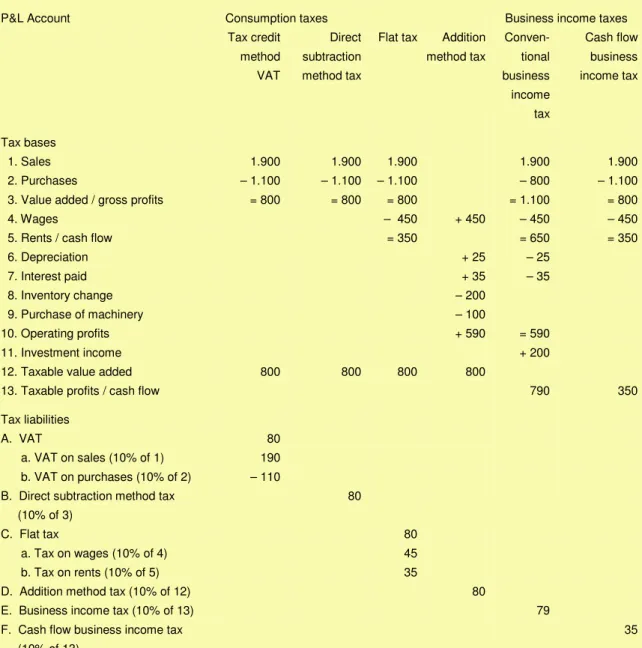
unambiguous legislation is essential if the VAT is to be effectively implemented. Economists argue that the VAT is a tax on labour income and the business cash flow component of capital income. Unlike the income tax, the VAT does not include the normal or hurdle rate of return on capital in its base; that is, at the margin, it does not interfere with investment. As accountants show, consumption taxes can be best understood by working through the intricacies of a profit & loss (P&L) account in determining the tax bases and liabilities. It appears that there is much to learn from the insights provided by the views of the various professions. Finally, the fourth section sums up the three major lessons learned from world-wide experience. It is important that the VAT should be as broadly based as possible and that a single rate apply to all transactions. Only exports should be freed of tax.
Note that this paper is a primer on VAT, not a detailed treatment of all its legal aspects,
economic effects, or political implications. Readers whose appetite has been wetted should refer to Ebrill et al (2001); Schenk and Oldman (2007); Bird and Gendron (2007); Crawford, Keen and Smith (2010); and the many references cited in these publications.
1.2
Broad-based consumption taxes
Much can be learned about the VAT by comparing it with other broad-based consumption taxes. Therefore, this section defines the various forms of consumption tax that can be distinguished. This is followed by an exposition of the computation of the tax base of each consumption tax, highlighting its equivalence with other consumption taxes. Subsequently, the practical and economic differences between the various taxes are noted. The VAT emerges as the consumption tax of choice, a view that finds support in the VAT’s prevalence around the world.
1.2.1 Forms of consumption tax
The nature of the VAT can be best understood by comparing it to the following broad-based consumption taxes, which are levied or have been proposed in the U.S., the EU, or in the tax literature.
• A retail sales tax (RST) that is applied to sales of goods and services by registered businesses to consumers and unregistered entities.
• A credit-invoice method of VAT that taxes all sales by registered businesses but permits these businesses a credit (deduction) for the tax on purchases (including investment goods) invoiced by other registered businesses against the tax on sales.
• A direct subtraction method tax (also called business transfer tax (BTT) in the U.S.) that permits registered businesses to deduct purchases (including investment goods) from other
BROAD-BASED CONSUMPTION TAXES
registered businesses from sales and that taxes the difference between sales and purchases directly rather than indirectly as under the VAT.2
• An addition method tax that taxes aggregate wages as well as residual value added (capital income) by registered businesses as computed from their P&L accounts.
• A flat tax, much discussed in the U.S. tax literature, that allows registered businesses to deduct wages from value added as calculated under the direct subtraction method, but that taxes these wages at the level of individual wage earners (permitting a basic exemption). Residual value added is taxed at the business level, without an exemption – hence the name “flat tax.” • A personal expenditure tax that taxes expenditures on goods and services at the level of the
taxpaying individual by subtracting savings (including loan repayments and purchases of stocks, bonds and non-residential real estate) from aggregate incomings (including loan receipts and proceeds from the sale of assets), both calculated on a cash-flow basis.
1.2.2 Equivalence of consumption taxes
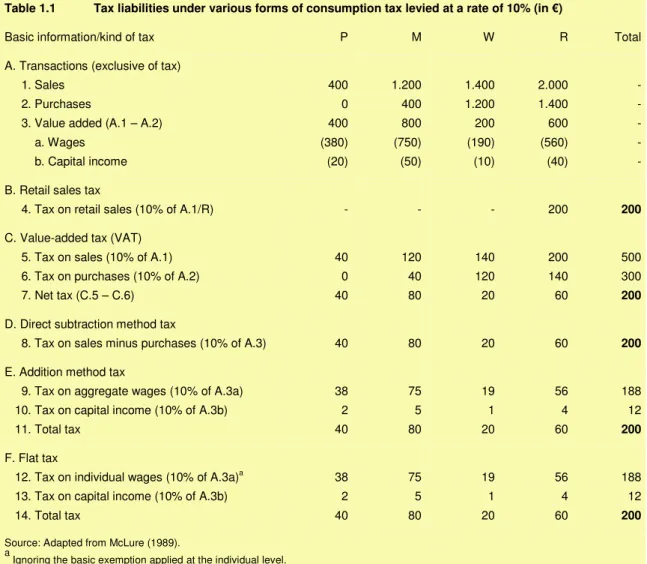
The equivalence of the various consumption taxes can be illustrated best by reference to the stylized example in table 1.1, which traces the manufacture and sale of the desk at which the first draft of this paper was written.3 Following the production and distribution cycle, we start with the lumber company P (the primary producer), who sells wood to the furniture
manufacturer M, who delivers the desk to the wholesaler W, who distributes it to the furniture store R (the retailer), who in turn puts the desk at our disposal. For simplicity, it is assumed that each stage purchases the whole output of the previous stage and that P has zero inputs.
In each stage, the value of the inputs increases by the value of labour (wages) and capital (to be defined below) applied in the production or distribution of the desk. In terms of the example: A.2 + A.3 = A.1, which can also be written as: A.3 = A.1 – A.2. In other words, value added is identical to the difference between sales and purchases. Consequently, at the final (retail) stage, the sum of all values added throughout the production-distribution process, and, by the same token, the sum of all the differences between sales and purchases (in either case, €2.000 in the example), equals the consumer price, exclusive of tax.
2 In this paper, the acronym VAT is reserved for the credit-invoice method of consumption tax, although, in principle, the
Table 1.1 Tax liabilities under various forms of consumption tax levied at a rate of 10% (in €)
Basic information/kind of tax P M W R Total
A. Transactions (exclusive of tax)
1. Sales 400 1.200 1.400 2.000 -
2. Purchases 0 400 1.200 1.400 -
3. Value added (A.1 – A.2) 400 800 200 600 -
a. Wages (380) (750) (190) (560) -
b. Capital income (20) (50) (10) (40) -
B. Retail sales tax
4. Tax on retail sales (10% of A.1/R) - - - 200 200
C. Value-added tax (VAT)
5. Tax on sales (10% of A.1) 40 120 140 200 500
6. Tax on purchases (10% of A.2) 0 40 120 140 300
7. Net tax (C.5 – C.6) 40 80 20 60 200
D. Direct subtraction method tax
8. Tax on sales minus purchases (10% of A.3) 40 80 20 60 200
E. Addition method tax
9. Tax on aggregate wages (10% of A.3a) 38 75 19 56 188
10. Tax on capital income (10% of A.3b) 2 5 1 4 12
11. Total tax 40 80 20 60 200
F. Flat tax
12. Tax on individual wages (10% of A.3a)a 38 75 19 56 188
13. Tax on capital income (10% of A.3b) 2 5 1 4 12
14. Total tax 40 80 20 60 200
Source: Adapted from McLure (1989).
a
Ignoring the basic exemption applied at the individual level.
The example incorporates a number of accounting identities, which are worth repeating because they are fundamental to a good understanding of the VAT. Thus, the consumer price is always equal to the algebraic sum of all values added, is always equal to the sum of the differences between sales and purchases, and is always equal to the sum of wage payments and capital income. If this is borne in mind, it will readily be apparent that exactly the same total tax can be collected in either of two ways:
• In full under a retail sales tax.
• Fractionally throughout the production-distribution process by confining the tax to the value added at each stage. In turn, the fractional or multistage collection technique can be
implemented in either of four ways:
• Indirectly by crediting the tax on purchases against the tax on sales under the indirect subtraction technique, called credit-invoice VAT;
• Directly by subtracting purchases from sales and applying the tax rate to the difference under the direct subtraction method;
BROAD-BASED CONSUMPTION TAXES
• Directly by taxing aggregate labour income and capital income jointly at the business level under the addition method; or
• Directly by taxing labour income and capital income separately at the individual and business level, respectively, under what is called the flat tax.
Table 1.1 illustrates these accounting identities. Under the basic assumption that the tax base and tax rate are identical, the total net tax collected under a retail stage tax (that is, €200, line B.4) equals the tax collected throughout the production-distribution process under the VAT (C.7), which equals the tax under the direct subtraction method tax (D.8), which equals the tax under the addition method tax (E.11), which, finally, equals the tax collected under a flat tax (F.14).
The computation of the tax liability under the personal expenditure tax is not shown in table 1.1 because it is not derived from P&L accounts but from aggregate recordings of incomings and outgoings (savings) by individuals. Nevertheless, given the same base and rate, the tax liability under the personal expenditure tax should be the same as under the other consumption taxes.
1.2.3 Differences between consumption taxes
Although in theory all consumption taxes are economically equivalent, in practice various important differences arise between them. Design and feasibility constraints, and open economy aspects have important implications for achieving basic, if sometimes conflicting, tax
objectives, such as:
• Fairness in the tax burden distribution;
• Neutrality with respect to producer and consumer choices;
• Tax revenue allocation to the country of consumption (destination principle); • Minimization of administration and compliance cost; and
• Restraining the ability of special interest groups to tinker with the tax base and rate (political robustness).
Each of these implications is examined briefly below.
Fairness
The retail sales tax, VAT, direct subtraction method tax, and the addition method tax are in rem
taxes collected at the business level, without regard to the personal circumstances of individual consumers, who are assumed to bear the tax. In this context, fairness simply means that all goods and services should be taxed alike. The flat tax and, especially, the personal expenditure tax, on the other hand, are in personam taxes, primarily collected at the individual level and hence equipped to incorporate basic allowances and graduated rates in order to achieve vertical
equity goals. In fact, the personal expenditure tax, just like the income tax, can be levied fully in accordance with the ability-to-pay principle.
Neutrality
If consumption taxes are not to interfere with producer and consumer choices, the base should be defined as comprehensively as possible, while producer goods should not be taxed. As shown in real world experience, this is possible under the VAT, but the retail sales tax has difficulty reaching services performed by small establishments (there is no tax on purchases that can be linked to the tax on sales) and in freeing dual-use goods (which can be used for exempt business as well as taxable personal purposes) from tax. Under the VAT, a tax credit will not be permitted unless the taxpayer proves to the satisfaction of the tax authorities that the dual-use goods have been applied for business purposes.4
There is no widespread experience with the design and administration of other in rem
consumption taxes, but since they are accounts-based rather than transactions-based, in practice equal treatment of all goods and services may be more difficult to achieve than under the VAT. Presumably, the flat tax and the personal expenditure tax should be judged primarily because of their effects on the work-leisure choice and the intertemporal consumption choice. All
consumption taxes are neutral regarding the choice between present and future consumption, but they discriminate in favour of leisure, which cannot be taxed. By contrast, an income tax distorts both the work-leisure choice and the intertemporal consumption choice. However, since the base of the income tax is broader than the base of a consumption tax, the rate of an income tax can be set at a relatively lower level to yield the same amount of revenue. This lower rate should mitigate distortions whose size tends to increase with the square of the tax rate. Accordingly, it is an empirical question whether an income tax or a consumption tax is, on balance, more distortionary.
Destination principle
In an open economy, the revenue of the retail sales tax, VAT and the direct subtraction method tax is allocated to the country of consumption by applying appropriate border tax adjustments (BTAs). Exports are freed of tax, and imports are taxed on par with domestically produced goods. In practice, the VAT is better equipped to apply correct BTAs than either the retail sales tax or the direct subtraction method tax. The difficulty of freeing dual-use goods from tax under the retail sales tax means that the tax enters into export prices, while imports (whose price does not include any tax on dual-use goods) tend to be undertaxed compared with similar
domestically produced goods. Under the direct subtraction method tax, furthermore, there is no
4 This favours the VAT on the plausible assumption that a taxpayer is less likely to cheat the tax authorities under the VAT
than his suppliers under the retail sales tax. Under the retail sales tax, moreover, a taxpayer has an incentive to treat his customer no less favourably (by refusing the exemption) than his competitor might do. For a thorough comparison of the VAT and the retail sales tax, see the next paper in this study.
BROAD-BASED CONSUMPTION TAXES
presumptively correct documentary evidence (such as VAT invoices) of tax paid in previous stages of production and distribution, which hampers the application of unambiguous BTAs.5
In contrast, the addition method tax, the flat tax and the personal expenditure tax would be levied on an origin basis (exports taxed, imports free of tax) or a source basis, to use income tax terminology. Generally, this means the primary impact of the tax is on producers, because consumers can buy goods at world prices without tax. In economics literature, origin taxation is more likely to violate production efficiency than destination taxation (Diamond and Mirrlees, 1971).6 The taxation of exports, moreover, would invite transfer pricing issues similar to those that bedevil the corporation tax under an arm’s length separate accounting system.
Administration and compliance costs
Compliance and tax administration costs should be largely the same under the VAT, the retail sales tax and the direct subtraction method tax, but these costs would probably be greater under the flat tax and the personal expenditure tax, which are mainly collected at the level of
individuals. Presumably, the retail sales tax, the direct subtraction method tax and the addition method tax are more vulnerable to evasion than the VAT. Administratively, the retail level tends to be the weakest link in the production-distribution chain. The account-based nature of the direct subtraction method tax and the addition method tax also implies that the tax is not shown on invoices. Hence, there is less of an audit trail than under the VAT. Also, sellers and buyers do not have opposing interests in the amount of tax that is being charged. The personal expenditure tax probably is the most complicated consumption tax, because it requires the registration and monitoring of wealth.
Political robustness
Politically, the VAT is the most robust consumption tax, primarily because pre-retail firms do not benefit from exemptions that make it impossible for them to pass the tax of their suppliers on to customers. By contrast, the subtraction method tax, the flat tax and the personal
expenditure tax, and to a lesser extent the retail sales tax, are vulnerable to erosion through political favouritism. Under the direct subtraction method tax, it would be tempting to exempt some “worthy” product, sector, or activity. The flat tax and the personal expenditure tax would be susceptible to the same politically motivated concessions as the individual income tax.
5 This feature might invite objections from trading partners, who would argue that the direct subtraction method tax is not a
tax on products per se but rather an accounts-based tax on value added comparable to the business income tax, and hence not eligible for export rebate under the rules of the World Trade Organization (WTO).
6 See the lucid exposition in Crawford, Keen, and Smith (2010). These authors point out that under the equivalence theorem,
it is asserted that it does not matter for trade and investment whether goods and services are taxed on a destination or an origin basis. Since imports are exchanged for exports, a tax on exports is equivalent to a tax on imports. In practice,
1.2.4 VAT: the preferred choice
The VAT emerges as the consumption tax of choice. A well-designed VAT does not distort trade and investment and is highly successful in applying appropriate BTAs. This neutrality feature is important for the proper functioning of common markets, such as the EU, and free trade areas, such as NAFTA, which do not permit discriminatory taxes on imports or subsidies on exports. Beyond that, the VAT is a productive, stable and flexible source of government revenue. Since a VAT is collected on a current basis, say, monthly, its revenue generating capacity is not affected by inflation and the effect of rate changes on revenue is immediately visible. While the VAT scores high on neutrality and feasibility grounds, as an in rem tax it cannot be levied on an ability-to-pay basis, but this should be acceptable if adjustments to the income tax and social benefit schemes can be made.
Table 1.2 Workings of the value-added tax a. Basic transactions, excluding VAT (in €)
Production distribution chain Purchases Sales
Producer 0 400
Manufacturer 400 1200
Wholesaler 1200 1400
Retailer 1400 2000
Consumer 2000
b. VAT payments to suppliers and by buyers (10% tax in €)
Production distribution chain VAT paid to supplier VAT paid by buyer
Producer 0 40
Manufacturer 40 120
Wholesaler 120 140
Retailer 140 200
Consumer 200
c. Fractional collection of VAT paid by consumer (in €)
Production distribution chain Tax paid to supplier Tax paid to government
Manufacturer 200
Wholesaler 140 60
Retailer 120 20
Consumer 40 80
Producer 40
The VAT’s neutrality deserves to be emphasized. For this purpose, the basic transactions, shown in table 1.1, are replicated in table 1.2a. Value added – the difference between sales and purchases – is not shown, simply because businesses, unlike authors of textbooks, do not compute it. In practice, for any business, the VAT is shown on the invoices that it issues to its registered buyers and that it receives from its registered suppliers, while VAT payments to suppliers and by buyers are made accordingly, as shown in table 1.2b. Generally, the VAT on all purchases made for the purpose of the business is immediately creditable against the tax on
BROAD-BASED CONSUMPTION TAXES
(unrelated) sales, or, if there are no sales, any excess credit is eligible for refund without undue delay.7 Consequently, no VAT is collected by government on transactions between registered businesses.
But if no net tax is borne by registered businesses in relation to their own value added, why does each firm nevertheless remit some tax to the tax authorities? To understand this apparent paradox, look upstream at financial flows rather than downstream at the flow of goods and services. The answer is then, as shown in table 1.2c, that the consumer pays the full tax that is collected, again in full, by the retailer, but which is remitted to the tax authorities by all registered businesses in proportion to their share in the total value added embodied in the final product. Any net tax remitted by upstream firms is simply paid to them by their successors in the production-distribution chain. The only plausible assumption that needs to be made for this to occur is that the average length of time for remitting tax and processing any net refunds is the same as the average length of time required for settling accounts receivable and payable (inclusive of VAT).8
It is this feature that has made the VAT such a neutral tax from a business point of view. It ensures that the effective rate of tax does not depend on the forms or methods of doing business. The rate is the same (and equal to the legal rate) regardless of how many stages a good passes through before it reaches the consumer or, for that matter, whether the value is added in earlier rather than later stages in the production-distribution process. The VAT is also neutral between capital-intensive or labour-intensive modes of production, between the corporate and the non-corporate form of business, or between home-produced and foreign-made goods.
In sum, the timing of tax collections under the VAT is the same as under a retail sales tax. Under both taxes, net tax is collected only when taxable products leave the “ring” of registered firms and are sold to final users or consumers (or to small, unregistered firms). So, why not impose the tax at retail only? Because retailers are less likely to default on the VAT invoiced to them by their suppliers than on the tax they would have had to pay in full to the tax authorities if, instead, an equivalent retail sales tax had been imposed. This feature makes the VAT particularly robust from a tax collection point of view that is reinforced by requiring sellers to state the VAT on invoices. This facilitates the correct and expeditious application of BTAs (the VAT shown on the exporter’s purchase invoices is simply refunded) and compliance control 7 In legal terms (as stated unequivocally in Article 167 of the EU’s Council Directive (2006), a taxable business’s right to a
tax credit (and refund) arises at the same time that the supplier has to account for the tax: the date of both events is based on the same VAT invoice date.
8 To be sure, cash flow benefits (or costs) arise under the VAT (as well as a retail sales tax) if a taxable business's collection
date (the date at which the tax is collected from customers before being handed over to the tax authorities) does not coincide with the remittance date (the date after the collection date but before the latest day designated for handing over the tax). For a general treatment of cash flow benefits and costs, see Sandford, Godwin, and Hardwick (1989).
(cross-checking). In other words, the tax leaves a clear audit trail. The invoice method also facilitates the calculation of the tax liability: the tax shown on all purchase invoices is simply summed and subtracted from the tax shown on all sales invoices.
1.2.5 Prevalence of consumption taxes
Not surprisingly, the VAT is the most prevalent form of consumption tax in the world. Some 150 countries have adopted it, although in practice differences can be large. Viewed globally, the advance of the VAT is the most significant development in the field of taxation in the past 50 years. The march of VAT started in the 1960s in the EU (where the introduction of the harmonized VAT is a nonnegotiable condition for membership) and South America, and ended in the 1990s in Central and Eastern Europe and the countries that are now members of the Commonwealth of Independent States (CIS, the republics of the former Soviet Union).
Australia is the latest industrialized country that has converted to VAT. India is set to introduce a dual VAT, levied separately at the state as well as the federal level. The spread of the VAT owes much to the IMF’s Fiscal Affairs Department, where Michael Keen has been the intellectual driving force.
The retail sales tax (RST) is levied by 45 out of 50 U.S. States and the District of Columbia (plus some 9,000 local governments), as well as 3 out of 10 Canadian provinces.9 The retail sales taxes in the U.S. are not as broad-based and neutral as most VATs are because they exclude most services from the base and widely tax investment goods. The Nordic countries and Switzerland also used to levy a retail sales tax, but these countries switched to the VAT because it is better equipped to free producer goods of tax and easier to enforce. In the U.S., the retail sales tax received support (generally, as a replacement for the income tax) from Sen. Richard G. Lugar, R-Ind., former House Ways and Means Committee Chair Bill Archer, former Reps. Dan Schaefer and Bill Tauzin, and the lobbying group Americans for Fair Taxation.
The direct subtraction method tax used to be levied in Belarus, apparently with little success (Bird, 1995). Further, some CIS countries used to impose a tax credit type of VAT through producer stages, but taxed distributors on their margins. Although this does not seem to make much sense (the difference in function between producers and distributors can hardly be made relevant for tax purposes), the explanation should be sought in the way in which businesses were taxed under the old turnover tax (Summers and Sunley, 1995). In the U.S., the direct subtraction method tax has been pushed by Rep. Sam Gibbons and the lobbying group
9 The Federal Government in Canada levies a VAT, called Goods and Services Tax (GST) as does the province of Québec. The Atlantic provinces (New Brunswick, Newfoundland and Labrador, and Nova Scotia, as well as, recently, Ontario and British Columbia) have piggybacked the federal VAT in the form of surtaxes. Oil-rich Alberta has neither a retail sales tax nor a GST.
BROAD-BASED CONSUMPTION TAXES
American Council for Capital Formation. The appeal of this tax lies in its resemblance to a business tax, which may enhance its acceptability to consumers.
The flat tax has been proposed by Robert Hall and Alvin Rabushka (1985, 1995). It has received much attention in the U.S. because its wage component resembles a progressive income tax through the application of a basic exemption. As a result, it mitigates the regressivity of a consumption tax for lower-income groups. What the flat tax cannot do, of course, is make the tax burden distribution more progressive for higher-income groups who receive capital income. In the U.S., legislation for a flat tax has been tabled by former House Majority Leader Richard K. Armey and Sens. Richard C. Shelby, R-Ala., and Arlen Specter, D-Pa.
The addition method tax is used in some countries to tax the value added by financial institutions, which is difficult to compute under a tax credit invoice VAT, because the intermediation charge that should be taxed is embedded in the interest, premium, or return, which should not be taxed. Israel, Argentina, and France have experience with the addition method tax. Italy administers a direct addition method tax, called IRAP, at the regional level. It is not a destination-based VAT, however, because the tax is not refunded at export or levied at import.
India and Sri Lanka used to levy a non-cash flow type of personal expenditure tax in the 1950s, but abandoned it after a few years because the tax proved difficult to administer properly. Subsequently, the feasibility of the expenditure tax has greatly improved following the pioneering work of an able lawyer, William Andrews (1974), and in his wake the U.S. Department of the Treasury (1977) and the Meade Committee (1978). Andrews showed that annual taxable consumption expenditures can be computed on an aggregate cash flow basis as the difference between incomings and savings rather than by having to add up all individual expenditures made during the year. In the U.S., the expenditure tax, called Unlimited Savings Allowance Tax (USA) tax, has been tabled by the Strengthening of America Commission under the leadership of former Sens Sam Nunn and Pete V. Domenici, who proposed that it be combined with a direct subtraction method tax at the business level (Seidman, 1997).
1.3
Lawyers, economists, and accountants
This section discusses the views of the legal, economic, and accounting professions on the VAT. There is much to learn from the opinions, which emphasize different aspects of the tax.
1.3.1 The rigor of lawyers
VAT law design
Lawyers are indispensable in making the VAT operationally possible. Unambiguous legislation is essential if a VAT is to be effectively implemented. Under any tax, but particularly a tax that is based on voluntary compliance, clear definitions are required of who should be taxed, on what, where, when, and to what extent. In legal jargon, the terms, “taxable person,” “taxable and exempt supplies,” “place and time of supply,” and “taxable value” should be minutely prescribed.10
Taxable persons, who must apply for registration, are liable to tax for all amounts received or receivable by them for taxable supplies made in the course of a business, trade, or similar activity. Persons, natural and legal, are considered taxable persons only if they make taxable supplies independently. This excludes employees and agents acting for and on behalf of a principal from the taxable persons category. Only taxable persons can issue VAT invoices, which entitle buyers of taxable supplies to a credit for the tax shown on the invoice. In addition, they must keep prescribed records of their economic activities, which serve as the basis for verifying whether or not they have met their obligations.
The VAT is imposed on “supplies of goods and services,” meaning all economic activity unless specifically exempted. A supply of goods is defined as “the transfer of the right to dispose of tangible property as owner,” a civil law concept. Generally, tangible property includes “electricity, gas, heat, refrigeration, and the like.” Services, tangible as well as intangible, are defined in catch-all fashion as “any transaction that does not constitute a supply of goods,” including “obligations to refrain from an act or to tolerate an act or situation.” To be taxable, supplies must be made against consideration, called the “taxable value,” which includes all forms of payment received by the supplier, in cash or in kind, whenever and however paid, regardless of who pays them. Gifts are not taxable, but non-business use of a supply, e.g. for personal or employee consumption, is taxable if provided free of charge. Exceptionally, arm’s length prices may be substituted for actual realized values, for example if the parties to a transaction are the same or related.
LAWYERS, ECONOMISTS, AND ACCOUNTANTS
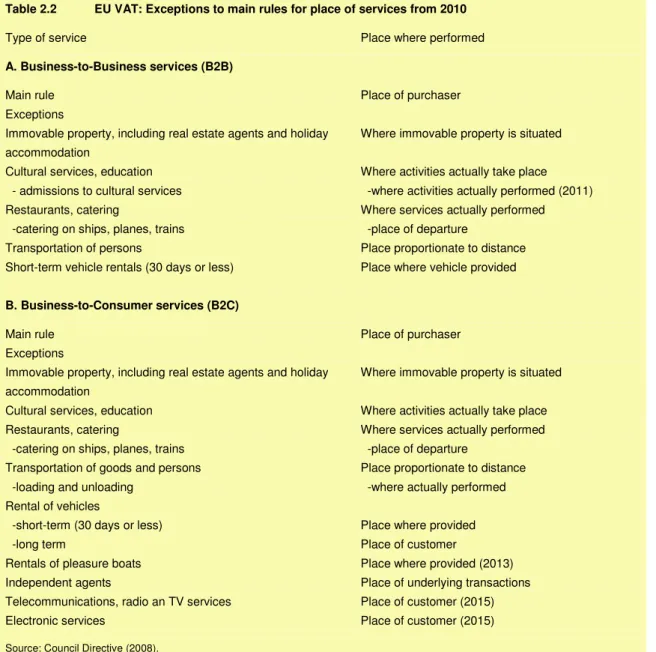
When it has been determined that a supply of goods and services has taken place, it is important to ascertain the place and time of the supply. The charge to VAT extends only to goods and services supplied within a particular taxing jurisdiction or imported into that jurisdiction. Supplies of goods are located where the goods are delivered, made available, or handed over, except if goods are to be assembled or installed, in which case the place of supply is the place where the goods are assembled or installed. Since services cannot be the subject of physical observation and control, some other definition of the place of supply is needed. Under the EU’s new rules the place of supply for business-to-business (B2B) services is the place where the recipient of the services has his business, while business-to-consumer (B2C) services are taxed at the place of the provider of the services.11
Furthermore, the timing of the supply is important for deciding when a VAT invoice has to be issued. This in turn determines the tax period in which the VAT is due regarding the supply. As a rule, the time of supply occurs when an invoice is issued, generally within a week of the time when goods are delivered, made available, transported or paid for – whichever event occurs earlier. The time of supply of services occurs when the services are rendered. Generally, input tax credits follow these timing of supply rules. Apportionment rules are in place for those cases when taxable persons make exempt as well as taxable supplies, or when they make personal use of business assets. No input tax credit is allowed for a number of goods and services which although used in the course of taxable activities are indistinguishable from goods and services bought by consumers. Examples are personal or living expenses, employee benefits,
recreational equipment and facilities, and passenger vehicles.
The VAT as a transactions tax
As implied by this very brief description of VAT rules, the legal profession is quite adamant about viewing the VAT as a tax on transactions by registered entities against consideration. Lawyers also maintain that the VAT is a tax on consumption expenditures rather than on, more broadly, consumption activities. Moreover, they assert that the VAT is a tax on current consumption – on all goods and services that leave the ring of registered entities, regardless of whether they are consumed immediately or embody a stock of services that are consumed over the lifetime of the asset (for example, residential housing, cars, household appliances, and furniture).
This contrasts with the view held by economists that, ideally, the VAT should tax all
consumption activities, including self-produced items of consumption, such as meals, because this would ensure equal treatment with other products bought in the marketplace. Lawyers would not consider this a taxable event, although they would tax, say, vegetables withdrawn
from business stock for personal use by the greengrocer as a taxable self-supply on the argument that the vegetables are produced in a business context, not in a personal capacity. Accordingly the greengrocer’s home-grown carrots used for personal consumption (and not sold to customers) would not be subject to VAT. Economists would like to tax both events.
Furthermore, economists maintain that the VAT is a tax on flows rather than stocks. In other words, ideally, the home-owner should be taxed periodically on the rental value of his property, just as the tenant should be taxed on the rent invoiced by the landlord. However, lawyers would argue that residential property should be taxed when the house is transferred from the taxable builder to the exempt owner-occupier. This follows from the legislator’s point of view that owner-occupiers should not be registered for VAT purposes. Lawyers point out that the in rem
nature of the VAT does not support the position that durable consumer goods should be treated differently from nondurable goods. As a transactions-based tax, VAT should be imposed when the title to a durable consumer good passes on to the exempt consumer.12
Finally, the tendency of lawyers to accept the legislator’s product as given means that they tend to pay notably less attention to the distortions caused by the VAT than do economists. These distortions, which are a cost to society over and above the revenue yield of the VAT, result mainly from exemptions and, to a lesser extent, from rate differentiations. Exemptions distort input choices (for example, outsourcing) and harm exports. Rate differentiations interfere with consumer preferences and hence producer choices.
1.3.2 The insight of economists
Economists are good in analyzing the nature of a consumption tax.13 This can be done on the basis of a simple equation showing the identity between the sources (wages and capital income) and the uses of income (consumption and savings) in a household budget or a country’s national accounts. The following identity shows the relationship between the two sides of the budget for a closed economy and abstracting from government operations.
Y ≡ W + R ≡ C + S (≡ I) (1)
or
C ≡ Y – S ≡ W + R – I (2)
12 Both views result in the same tax liability when the VAT on the value of newly created residential property is viewed, as it
should be, as the tax on the present discounted value of the future dwelling services of the property. This implies, of course, that increases or decreases in the value of the dwelling services, reflected in changes in the value of the property, are not included in the tax base. For a more detailed treatment of the differences between an economist’s and a lawyer’s point of view of VAT (illustrated by the treatment of real estate), see Cnossen (1996).