University of Zagreb Faculty of Metallurgy
Sisak, Croatia
University of Ljubljana
Faculty of Natural Sciences and Engineering Ljubljana, Slovenia
University North Koprivnica, Croatia
Technical University of Košice
Faculty of Materials, Metallurgy and Recycling
Košice, Slovakia ELKEM ASA Oslo, Norway
PROCEEDINGS BOOK
18
th
INTERNATIONAL FOUNDRYMEN
CONFERENCE
Coexistence of material science and sustainable
technology in economic growth
ORGANIZERS
University of Zagreb Faculty of Metallurgy, Sisak, Croatia
University of Ljubljana Faculty of Natural Sciences and Engineering, Ljubljana, Slovenia University North, Koprivnica, Croatia
Technical University of Košice Faculty of Materials, Metallurgy and Recycling, Košice, Slovakia
ELKEM ASA, Oslo, Norway PROCEEDINGS BOOK
18th INTERNATIONAL FOUNDRYMEN CONFERENCE
Coexistence of material science and sustainable technology in economic growth EDITORS
Natalija Dolić, Zdenka Zovko Brodarac, Anita Begić Hadžipašić
TECHNICAL EDITOR
Anita Begić Hadžipašić
PUBLISHER
University of Zagreb Faculty of Metallurgy Aleja narodnih heroja 3 44000 Sisak
Croatia PRINT
InfOmArt Zagreb d.o.o. Nikole Tesle 10 44000 Sisak Croatia ISSUE 200 copies ISBN 978-953-7082-34-5
-A CIP record is available in computer catalogue of the National and University Library in Zagreb under the number 001029655.
UNDER THE HIGH AUSPICES
President of Croatia Kolinda Grabar –Kitarović
UNDER THE PATRONAGE
Ministry of Science and Education of the Republic of Croatia
Ministry of Economy, Entrepreneurship and Crafts of the Republic of Croatia University of Zagreb
World Foundry Organization (WFO)
Mittel Europäische Giesserei Initiative (MEGI) Chamber of Commerce of Republic of Croatia Sisak – Moslavina County
City of Sisak
SPONSORED BY
SILVER SPONSOR
HEMOLAB Ltd, Beograd (RS) LABTIM ADRIA Ltd, Sesvete (HR)
BRONZE SPONSOR
BENTOPRODUCT Ltd, Šipovo (BA) BITUS Ltd, Zagreb (HR)
EBERT Ltd, Ljubljana (SI) FERRO-PREIS Ltd, Čakovec (HR) HAGI GmbH, Pyhra (AT)
HEINRICH WAGNER SINTO MASCHINENFABRIK GmbH, Bad Laasphe (DE) LABEKO Ltd, Zagreb (HR)
MECAS ESI s.r.o., Plzen (CZ) & TC LIVARSTVO Ltd, Ljubljana (Sl) TROKUT TEST GROUP Ltd, Zagreb (HR)
MEDIA COVERAGE
IRT 3000
Foundry Lexicon Foundry Planet
SUPPORTING ASSOCIATION AND COMPANIES
Croatian Foundry Association Slovenian Foundry Association
ORGANIZING COMMITTEE
Zdenka Zovko Brodarac, president
Anita Begić Hadžipašić Sandra Brajčinović
Damijan Cerinski
Natalija Dolić Gordana Gojsević Marić
Martina Hrubovčáková Franjo Kozina Stjepan Kožuh Ladislav Lazić Jožef Medved Marin Milković Primož Mrvar Tomislav Rupčić Sanja Šolić Iveta Vasková
PROGRAM COMMITTEE
Hasan Avdušinović (BA) Srećko Manasijević (RS) Branko Bauer (HR) Dragan Manasijević (RS) Anita Begić Hadžipašić (HR) Jožef Medved (SI)
Jaka Burja (SI) Daniel Novoselović (HR) Lidija Ćurković (HR) Mitja Petrič (SI)
Mile Djurdjević (AT) Bojan Podgornik (SI)
Natalija Dolić (HR) Karlo T. Raić (RS)
Peter Cvahte (SI) Vera Rede (HR)
Regina Fuchs-Godec (SI) Zdravko Schauperl (HR)
Dario Iljkić (HR) Peter Schumacher (AT) Sebastjan Kastelic (SI) Ljerka Slokar Benić (HR)
Varužan Kervorkijan (SI) Božo Smoljan (HR) Ivica Kladarić (HR) Tahir Sofilić (HR)
Borut Kosec (SI) Davor Stanić (HR)
Dražan Kozak (HR) Sanja Šolić (HR) Stjepan Kožuh (HR) Iveta Vaskova (SK)
Zoran Kožuh (HR) Maja Vončina (SI)
Ladislav Lazić (HR) Zdenka Zovko Brodarac (HR)
REVIEW COMMITTEE
Vesna Alar (HR) Ladislav Lazić (HR)
Ljubiša Balanović (RS) Martina Lovrenić-Jugović (HR)
Jakov Baleta (HR) Dragan Manasijević (RS)
Marko Ban (HR) Ivana Marković (RS)
Branko Bauer (HR) Adrijana Milinović (HR)
Anita Begić Hadžipašić (HR) Aleš Nagode (SI)
Mile Djurdjević (AT) Daniel Novoselović (HR) Natalija Dolić (HR) Vesna Ocelić Bulatović (HR) Nikša Čatipović (HR) Mitja Petrič (SI)
Vladan Ćosović (RS) Zora Pilić (HR)
Stanisław Gil (PL) Grzegorz Piwowarski (PL)
Vesna Grekulović (RS) Milena Premović (RS) Tamara Holjevac Grgurić (HR) Žarko Radović (ME)
Dario Iljkić (HR) Ankica Rađenović (HR)
Ivan Ivec (HR) Matija Sakoman (HR)
Miće Jakić (HR) Božo Smoljan (HR)
Ivan Jandrlić (HR) Ivan Stojanović (HR) Sebastjan Kastelic (SI) Sanja Šolić (HR)
Zvonimir Katančić (HR) Iveta Vasková (SK)
Witold Kazimierz Krajewski (PL) Tatjana Volkov Husović (RS) Varužan Kevorkijan (SI) Darja Volšak (SI)
Ana Kostov (RS) Maja Vončina (SI)
Stjepan Kožuh (HR) Domagoj Vulin (HR)
Jure Krolo (HR) Zdenka Zovko Brodarac (HR)
18
thINTERNATIONAL FOUNDRYMEN CONFERENCE
Coexistence of material science and sustainable technology ineconomic growth Sisak, May 15th-17th, 2019
http://www.simet.hr/~foundry/
227
INFLUENCE OF Mn ON THE CORROSION BEHAVIOR OF CuAlMn ALLOY
IN NaCl SOLUTION
Senka Gudić1*, Blanka Rakuljić1, Ladislav Vrsalović1, Milan Bizjak2, Ivana Ivanić3, Stjepan Kožuh3, Mirko Gojić3
1
University of Split Faculty of Chemistry and Technology, Split, Croatia
2
University of Ljubljana Faculty of Natural Sciences and Engineering, Ljubljana, Slovenia
3
University of Zagreb Faculty of Metallurgy, Sisak, Croatia
Poster presentation Original scientific paper Abstract
The corrosion behavior of different CuAlMn shape memory alloys (Cu-12%Al-4%Mn, Cu-12.3%Al-5.2%-Mn and Cu-12%Al-6%Mn) in 0.9% NaCl solution at pH = 7.4 and T = 37°C was investigated using open circuit potential measurements, polarization and electrochemical impedance spectroscopy methods. It has been found that the corrosion resistance of the tested samples at open circuit potential increases with increasing Mn content in the alloy, i.e. growing in the order of: Cu-12%Al-4% Mn < Cu-12.3%Al-5.2%Mn < Cu-12%Al-6% Mn. Namely, the corrosion current decreases in same order, while the polarization resistance and the resistance, thickness and compactness of the surface oxide layer increase. However, at high anodic potentials (E > 0.1 V), the corrosion rate increases with Mn content in the alloy, and light microscopy investigations reveal pits on the surface of Cu-12.3%Al-5.2%-Mn and Cu-12%Al-6%Mn alloys, while Cu-12%Al-4%Mn surface is almost clear of any corrosion damage.
Keywords: shape memory alloys, CuAlMn alloy, corrosion, polarization, electrochemical methods
*Corresponding author (e-mail address): [email protected]
INTRODUCTION
Shape memory alloys (SMA) are significant and growing group of intelligent materials which
have ability to “remember” their original shape and return to it by heating above a certain
temperature due to its crystallographic structure changes between low temperature martensite and the high temperature austenite phase [1-4]. Mainly three alloy systems
18
thINTERNATIONAL FOUNDRYMEN CONFERENCE
Coexistence of material science and sustainable technology ineconomic growth Sisak, May 15th-17th, 2019
http://www.simet.hr/~foundry/
228
which are known to exhibit the shape memory phenomena have been in the focus of research and development: Ni-Ti, Cu-Al and Fe based alloys [5]. Nickel-titanium alloys (Nitinol) possess the unique thermal shape memory and superelasticity effects as well as excellent corrosion resistance and biocompability, that make these alloys very attractive for medical use [6,7]. However, their difficulty in production and processing, high cost and low transformation temperatures prohibit their use where Cu-based shape memory alloys fill in the need [5,8]. The main advantages of Cu-based shape memory alloys are their low price, relatively simple fabrication procedure, higher range of potential transformation temperatures, high thermal and electrical conductivity. Shortcoming of Cu-based shape memory alloys are brittleness and low mechanical strength which are close related to the microstructure characteristics of Cu-SMAs, such as coarse grain size, high elastic anisotropy and the segregation of secondary phases [9-11]. Some research has shown that CuAlMn alloy possess good strain recovery, better ductility, higher shape memory strain, larger recovery power, and higher damping capacity than CuAlNi [11-14]. Investigated CuAlMn alloys were produced by melt spinning methods which enables the formation of homogeneous solution and have unique advantages in refining the microstructure [15-17]. Most research on influence of alloying elements in CuAlMn shape memory alloys have focused on its microstructure and mechanical properties, however little attention has been devoted to their influence to the electrochemical behavior [5,8,18]. Thus some studies have
shown that additions of Mn to the binary Cu-Al alloy stabilize the b -phase and widen the
single-phase region to lower temperature and lower Al contents [18]. With the increase in the aluminum and manganese concentration of the alloy, the martensite morphology is modified and the transformation temperature decrease [8]. Also, increase in the Al:Mn ratio leads to increase in grain size as well as cast hardness [5].
This paper deals with the influence of Mn content on corrosion behavior of CuAlMn alloy in NaCl solution.
MATERIALS AND METHODS
The CuAlMn alloys used in this study were Cu-12%Al-4%Mn (A), Cu-12.3%Al-5.2%-Mn (B), and Cu-12%Al-6%Mn (C). Alloy ribbons were manufactured with the single roll melt spinning apparatus. The cast precursors were inserted into the graphite crucible, inductively melted in Ar atmosphere and sprayed through the nozzle onto a rotating cooled copper wheel. The
obtained ribbons were 4-5 mm wide and 30-100 mm thick. The as-prepared specimens were
cut at the proper dimensions and solder to an isolated copper wire to insure good electrical contact. Solder joints were isolated with polyacrilate resin and prepared electrodes were degreased ultrasonically in ethanol, rinsed in deionized water and immersed in 0.9% NaCl
solution (pH = 7.4, T = 37 oC). Since melt-spin alloys are rather thin, the surface of the
ribbons was not mechanically polished.
Experiments were performed with a PAR 273A potentiostat/galvanostat and a PAR M5210
lock-in amplifier. A double walled three-electrode glass cell was used, thermostated at 37 °C,
18
thINTERNATIONAL FOUNDRYMEN CONFERENCE
Coexistence of material science and sustainable technology ineconomic growth Sisak, May 15th-17th, 2019
http://www.simet.hr/~foundry/
229
electrode. Prior the electrode immersion, solution was deaerated with Ar for a 20 min and the deaeration continued during the experiment.
The corrosion behaviour of CuAlMn alloys in 0.9% NaCl solution was performed by open
circuit potential measurements (EOC) in 60 min time period, linear polarisation method in the
potential region of ±20 mV vs. EOC with the scan rate of 0.2 mV s−1 and potentiodynamic
polarisation method in the rangeof −0.250 V from EOC to 0.7 V with scan rate of 0.5 mV s−1.
Electrochemical impedance spectroscopy measurements were carried out at EOC using the
signal amplitude of 10 mV and a frequency interval from 50 kHz to 30 mHz. All
electrochemical measurements were performed after 60 min electrode stabilisation on EOC.
After the potentiodynamic polarization measurements electrode surfaces were cleaned ultrasonically in deionized water, dry in desiccator and investigated with light microscope MXFMS-BD, Ningbo Sunny Instruments co., with magnifications of 100 times.
RESULTS AND DISCUSSION
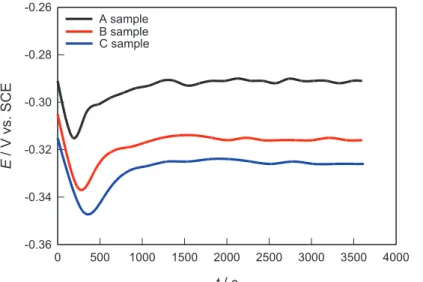
Figure 1 shows the variation of EOC of investigated alloys with time in the NaCl solution. The
open circuit potential reflects the composite results of the electrochemical reactions which take place at the electrode/solution interface. As can be seen, all investigated samples
shows similar changes of EOC. Namely, immediately after immersing each electrode in NaCl
solution, values of EOC were shifted towards negative values due to the adsorption of
chloride ions on the surface of the electrode [19]. After the initial drop, EOC for all alloys
increases gradually towards positive values which indicate the formation and thickening of
the protective passive film on their surfaces during the immersion. The stabilization of EOC
for all alloys occurs in period of 20 minutes. It can also be noted that by increasing the Mn
content in alloy, the final EOC value become more negative.
Figure 1. Evolution of open circuit potential as a function of time for investigated CuAlMn alloys in a 0.9% NaCl solution
t / s 0 500 1000 1500 2000 2500 3000 3500 4000 E / V vs. S CE -0.36 -0.34 -0.32 -0.30 -0.28 -0.26 B sample A sample C sample
18
thINTERNATIONAL FOUNDRYMEN CONFERENCE
Coexistence of material science and sustainable technology ineconomic growth Sisak, May 15th-17th, 2019
http://www.simet.hr/~foundry/
230
The general corrosion behavior of tested CuAlMn alloys in NaCl solution was investigated by recording the polarization curves in wide potential range. The purpose of these measurements was to evaluate influence of Mn on anodic and cathodic behaviour of alloy
and determination of corrosion current density (icorr) and corrosion potential (Ecorr). Obtained
results are presented on Figure 2 and Table 1.
Significant differences in corrosion behavior of tested samples can be noticed. The slight increases of the anodic current density in Tafel region and gradually reduction of cathodic current density along with the slight changes the values of corrosion potential in the cathodic side can be observed with increasing Mn content in alloy. This direction of change ultimately leads to a reduction in the corrosion rate.
Figure 2. Potentiodynamic polarization curves for investigated CuAlMn alloys in 0.9% NaCl solution Table 1. Corrosion parameters of investigated CuAlMn alloys in 0.9% NaCl solution
sample Ecorr / V icorr / µA cm-2 Rp / kΩ cm2
A -0.29 3.17 5.24
B -0.31 2.54 6.53
C -0.33 2.09 7.18
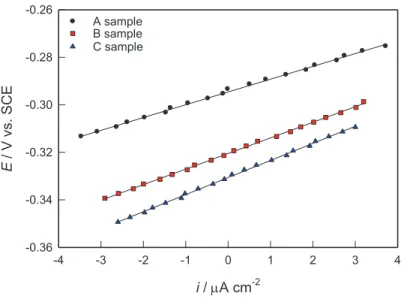
As can be seen from Table 1 the lowest icorr and the most negative Ecorr have been obtained
for C sample (alloy with the largest Mn content) which also have the highest polarization
resistance, Rp (i.e. resistance of metal to corrosion). The Rp data were determined from the
slope of linear part of polarization curves obtained by measurements in the potential range
close to EOC (Figure 3). Thus, it can be concluded that the corrosion resistance of the tested
samples at open circuit potential increases with increasing Mn content in the alloy (i.e. growing in the order of: A < B < C).
i / mA cm-2 10-2 10-1 100 101 102 103 104 E / V vs . S CE -0.6 -0.4 -0.2 0.0 0.2 0.4 0.6 B sample A sample C sample
18
thINTERNATIONAL FOUNDRYMEN CONFERENCE
Coexistence of material science and sustainable technology ineconomic growth Sisak, May 15th-17th, 2019
http://www.simet.hr/~foundry/
231
Figure 3. Linear parts of polarization curves for investigated CuAlMn alloys in 0.9% NaCl solution
However, at high anode potentials (after passing through Tafel area, E > 0.1 V) the opposite
trend is noticed. Anodic current density, and thus the corrosion are increased with the increase of Mn content in the alloy. After polarization measurement (which ended at 0.7 V) electrode surfaces were examined with light microscope with magnification of 100 times, and obtained results have shown on Figure 4 (a-c). Pits are visible on the surface of samples C and B, while surface of sample A is almost clear of any pitting corrosion damages.
a) b) c)
Figure 4. Light microscopy images of the electrode surfaces after potentiodynamic polarization measurements for a) sample A, b) sample B and c) sample C
Impedance measurements were undertaken in order to obtain physical insight into the processes occurring at the CuAlMn alloys/solution phase boundary. Figure 5 shows the Nyquist plots for CuAlMn electrodes in NaCl solution obtained after 60 minutes stabilization
at EOC. The response of the systems in the Nyquist complex plane was a semicircle that can
be correlated with the dielectric properties of the naturally formed oxide film on alloy
surface, which mostly consists of aluminum and manganese oxides [20,21]. The diameter of
capacitive loop increases with the increase of the Mn content in the alloy. i / mA cm-2 -4 -3 -2 -1 0 1 2 3 4 E / V vs. S CE -0.36 -0.34 -0.32 -0.30 -0.28 -0.26 B sample A sample C sample 200 mm 200 mm 200 mm
18
thINTERNATIONAL FOUNDRYMEN CONFERENCE
Coexistence of material science and sustainable technology ineconomic growth Sisak, May 15th-17th, 2019
http://www.simet.hr/~foundry/
232
Figure 5. Nyquist plots for investigated CuAlMn alloys in 0.9% NaCl solution
In mathematical analysis of impedance diagrams the constant phase element, CPE, was used instead of an "ideal" capacitor to account for the deviations observed as capacitive loops are
depressed. The impedance, ZCPE, of CPE is described by the expression [22]:
CPE
[
(
)
]
1
-= Q j n
Z w (1)
with n and Q constants, that can be used in data fitting when interpreting frequency
dispersions. When the value of n is close to 1, the CPE behaves like an ideal capacitance.
The equivalent circuit, shown in the Figure 6 was used to fit the experimental data. Rel
represents the resistance of electrolyte. R is the resistance and Q is the capacitance of the
surface oxide film (n» 1; Q »C).
Figure 6. Proposed equivalent circuits for modeling the impedance data
The parameters of the equivalent circuit Rel, R and Q were evaluated using a simple least
square fit procedure and are presented in Table 2.
Z real / kW cm 2 0 2 4 6 8 10 -Z im a g / k W cm 2 0 2 4 6 B sample C sample A sample R R el Q
18
thINTERNATIONAL FOUNDRYMEN CONFERENCE
Coexistence of material science and sustainable technology ineconomic growth Sisak, May 15th-17th, 2019
http://www.simet.hr/~foundry/
233
Table 2.Impedance parameters of investigated CuAlMn alloys in 0.9% NaCl solution
sample Rel/ Ω cm2 Q × 106/ Ω-1 sn cm-2 n1 R / kΩ cm2
A 8.31 44.75 0.91 5.24
B 8.04 38.62 0.93 6.53
C 7.78 34.21 0.93 7.18
Increase in Mn content lead to the increase in alloy surface film resistance (R), while the
surface layer capacity (Q) decreases. This is attributed to the increase of protective
properties of the surface oxide layer on the electrode.
According to the plate capacitor model, the surface film capacity, C,is inversely proportional
to its thickness, d (according to C = eoe/d; eo is the permittivity of vacuum; and e the relative
permittivity of the film). Hence, the reduction of Q (from 44.75 to 34.21 W-1 sn cm-2), with the
increase of Mn content matches the corresponding increase in the thickness of the surface layer, which additionally corresponds to an enhancement in the protective properties of the surface layer. This indicates that Mn (with constant content of Al) increases the stability of
oxide layer on the surface and effectively prevents alloy corrosion at EOC.
Properties of the oxide films which are formed on the alloy surfaces primarily depend on the chemical composition of the based metal, i.e. the content of the individual alloying elements in the investigated samples. If the alloying element facilitates alloy passivation, the properties of the oxide film will be better (higher resistance and thickness, more compact structure), which will ultimately increase the corrosion resistance of the metal, i.e. less corrosion currents and greater polarization resistance.
Cu-Al alloys represent the base material for production of copper shape-memory alloys. The role of Al is primarily in reducing weight and increasing corrosion resistance of the alloy. High corrosion resistance of Cu-Al alloys is primarily due to the presence of a protective layer which, according to the data in the literature, has a two layer structure and consists of an
inner thin, compact layer (mainly containing Cu2O and Al2O3) and an exterior enriched
porous layer [23]. Inner compact layer decelerate the passage of Cu+ cations and prevent
surface alloy dissolution [24,25]. It should be emphasized that Al has an extremely high
affinity for oxygen and that Al2O3 is one of the most stable oxides found in nature. At
standard conditions, Al2O3 has more than 11 times high stability over Cu2O.
However, Cu-Al alloys manufactured by conventional procedures are often very fragile that
is related to their large anisotropy and a crushed microstructure [1,2,4].The microstructure
can be affected by micro-alloying and by applying a rapid cooling process (resulting in a large
number of limited-diameter crystal chips) [10].
As already noted, the addition of Mn to the binary Cu-Al alloy further increases the corrosion resistance of the alloy (Table 1 and 2). According to literature, addition of Mn in small amounts influences the microstructure of the alloy, i.e. reduces the size of the crystal grain. Specifically, Mn diffuses easily and rapidly disperses through the mass of alloy, and
accumulates on the grain boundaries and thus prevents further growth of grain [21,26].
18
thINTERNATIONAL FOUNDRYMEN CONFERENCE
Coexistence of material science and sustainable technology ineconomic growth Sisak, May 15th-17th, 2019
http://www.simet.hr/~foundry/
234
mechanical properties, significantly increases corrosion resistance of alloys [21]. This fine
microstructure positively affects the compactness and stability of the passive oxide film formed on the alloy.
CONCLUSIONS
In this paper, corrosion behavior of different CuAlMn shape memory alloys (Cu-12%Al-4%Mn, Cu-12.3%Al-5.2%-Mn and Cu-12%Al-6%Mn) was studied in 0.9% NaCl solution. From the analysis of the obtained results can be concluded as follows:
- By increasing the Mn content in alloy, the final EOC value becomes more negative.
- Significant differences in corrosion behavior of tested samples at open circuit potential
and at high anodic potentials can be noticed by polarization measurements.
- The corrosion resistance of the tested samples at open circuit potential is following the
order: Cu-12%Al-4%Mn < Cu-12.3%Al-5.2%Mn < Cu-12%Al-6%Mn. Namely, the corrosion current decreases in same order, while the polarization resistance increases.
- The corrosion resistance of the CuAlMn alloys is a consequence of the oxide layer
formation whose properties depend on the Mn content in the samples. Namely, impedance measurements carried out on open circuit potential have shown that Mn facilitates passivation of tested alloys and improve surface film properties (higher resistance and thickness, more compact structure).
- At high anodic potentials (after passing Tafel¢s region, E > 0.1 V), the corrosion rate
increases with Mn content in the alloy, and light microscopy investigations reveal pits on the surface of Cu-12.3%Al-5.2%-Mn and Cu-12%Al-6%Mn alloys, while Cu-12%Al-4%Mn surface is almost clear of any corrosion damage.
Acknowledgements
This work was fully supported by the Croatian Science Foundation under the project HRZZ-IP-2014-09-3405.
REFERENCES
[1] I. Ivanić, M. Gojić, S. Kožuh, Slitine s prisjetljivosti oblika (I. dio): najznačajnija svojstva,
Kem. Ind., 63(2014), pp. 323-330.
[2] I. Ivanić, M. Gojić, S. Kožuh, Slitine s prisjetljivosti oblika (II. dio): podjela, proizvodnja i
primjena, Kem. Ind., 63(2014), pp. 331-344.
[3] M. Čolić, R. Rudolf, D. Stamenković, I. Anžel, D. Vučević, M. Jenko, V. Lazić, G. Lojen,
Relationship between microstructure, cytotoxicity and corrosion properties of Cu-Al-Ni
18
thINTERNATIONAL FOUNDRYMEN CONFERENCE
Coexistence of material science and sustainable technology ineconomic growth Sisak, May 15th-17th, 2019
http://www.simet.hr/~foundry/
235
[4] S. Sathish, U. S. Mallik, T. N. Raju, Microstructure and shape memory effect of Cu-Zn-Ni
shape memory alloys, JMMCE, 2(2014), pp. 71-77.
[5] A. K. Jain, S. Hussain, P. Kumar, A. Pandey, Effect of varying Al/Mn ratio on phase
transformation in CuAlMn shape memory alloys, Trans. Indian Inst. Met., 69(2016), pp. 1289-1295.
[6] S. Shabalovskaya, J. Anderegg, J. Van Humbeeck, Critical overview of nitinol surfaces
and their modifications for medical applications, Acta Biomater., 4(2008), pp. 447-467.
[7] S. Kožuh, L. Vrsalović, M. Gojić, S. Gudić, B. Kosec, Comparison of the corrosion
behavior and surface morphology of NiTi alloy and stainless steels in sodium chloride solution, J. Min. Metall. Sect. B-Metall., 52(2016), pp. 53-61.
[8] U. S. Mallik, V. Sampath, Influence of aluminium and manganese concentration on the
shape memory characteristics of Cu-Al-Mn shape memory alloys, J. Alloy Compd., 459(2008), pp. 142-147.
[9] A. O. Moghaddam, M. Ketabchi, R. Bahrami, Kinetic grain growth, shape memory and
corrosion behavior of two Cu-based shape memory alloys after thermomechanical treatment, Trans. Nonferrous Mat. Soc. China, 22(2013), pp. 2896-2904.
[10] K. K. Alaneme, E. A. Okotete, M. O. Bodunrin, Microstructural analysis and corrosion
behavior of Fe, B, and Fe-B-modified Cu-Zn-Al shape memory alloys, Corros. Rev., 35(2017), pp. 3-11.
[11] S. Kožuh, M. Gojić, I. Ivanić, T. Holjevac Grgurić, B. Kosec, I. Anžel, The effect of heat
treatment on the microstructure and mechanical properties of Cu-Al-Mn shape memory alloy, Kem. Ind., 67(2018), pp. 11-17.
[12] M. R. Rezvani, A. Shokuhfar, Synthesis and characterization of nano structured
Cu-Al-Mn shape memory alloy by mechanical alloying, Mater. Sci. Eng. A, 532(2012), pp. 282-286.
[13] U. S. Mallik, V. Sampath, Influence of quaternary alloying additions on transformation
temperatures and shape memory properties of Cu-Al-Mn shape memory alloy, J. Alloys Comp., 469(2009), pp. 156-163.
[14] J. Chen, Z. Li, Y. Y. Zhao, A high-working-temperature CuAlMnZr shape memory alloy, J.
Alloys Comp., 480(2009), pp. 481-484.
[15] H. Morawiec, J. Lelątko, D. Stróż, M. Gigla, Structure and properties of melt-spun
Cu-Al-Ni shape memory alloys, Mat. Sci. Eng. A, 273-275(1999), pp. 708-712.
[16] M. Izadinia, K. Dehghani, Structure and properties of nanostructured Cu-13.2Al-5.1Ni
shape memory alloy produced by melt spinning, Trans. Nonferrous Met. Soc. China, 21(2011), pp. 2037-2043.
[17] G. Lojen, I. Anžel, A. Kneissl, A. Križman, E. Unterweger, B. Kosec, M. Bizjak,
Microstructure of rapidly solidified Cu-Al-Ni shape memory alloy ribbons, J. Mater. Process. Technol., 162-163(2005), pp. 220-229.
[18] R. Kainuma, S. Takahashi, K. Ishida, Thermoelastic marthensite and shape memory
effect in ductile Cu-Al-Mn alloys, Metal. Mater. Trans., 27(1996), pp. 2187-2195.
[19] L. Vrsalović, E. Oguzie, M. Kliškić, S. Gudić, Corrosion inhibition of CuNi10Fe alloy with
18
thINTERNATIONAL FOUNDRYMEN CONFERENCE
Coexistence of material science and sustainable technology ineconomic growth Sisak, May 15th-17th, 2019
http://www.simet.hr/~foundry/
236
[20] L. Vrsalović, M. Matulić, S. Kožuh, I. Ivanić, M. Gojić, Effect of pH on corrosion of
CuAlMn alloy in 0.9% NaCl solution, Proceedings of the MTSM 2017, (S. Jozić, B. Lela),
Croatian society for mechanical technologies, 21.-22. September, 2017., Split, Croatia, 159-163.
[21] S. N. Saud, E. Hamzah, T. Abubakar, H. R. Bakhsheshi-Rad, Correlation of microstructural
and corrosion characteristics of quaternary shape memory alloys Cu-Al-Ni-X (X=Mn or Ti), Trans. Nonferrous Met. Soc. China, 25(2015), pp. 1158-1170.
[22] D. D. Raistrick, J. R. Macdonald, D. R. Franceschetti, in: J. R. Macdonald (Ed.), Impedance
Spectroscopy, J. Wiley & Sons, New York, 1987.
[23] W. A. Badawy, M. El-Rabeiee, N. H. Hilal, H. Nady, Electrochemical behavior of Mg and
some Mg alloys in aqueous solutions of different pH, Electrochim. Acta, 55(2010), pp. 1880-1887.
[24] H. Nady, N. H. Hilal, M. M. Rabeiee, W. A. Badawy, The role of Ni content on the
stability of Cu-A-Ni ternary alloy in neutral chloride solutions, Mater. Chem. Phys., 134(2012), pp. 945-950.
[25] W. A. Badawy, M. El-Rabeiee, N. H. Hilal, H. Nady, Effect of nickel content on the
electrochemical behavior of Cu-A-Ni alloys in chloride free neutral solutions,
Electrochim. Acta, 56(2010), pp. 913-918.
[26] G. N. Sure, L. C. Brown, The mechanical properties of grain refined β-cuaini strain