Open Access Dissertations Theses and Dissertations
12-2016
The application of natural language processing to
open source intelligence for ontology development
in the advanced persistent threat domain
Corey T. Holzer Purdue University
Follow this and additional works at:https://docs.lib.purdue.edu/open_access_dissertations
This document has been made available through Purdue e-Pubs, a service of the Purdue University Libraries. Please contact [email protected] for additional information.
Recommended Citation
Holzer, Corey T., "The application of natural language processing to open source intelligence for ontology development in the advanced persistent threat domain" (2016).Open Access Dissertations. 948.
THE APPLICATION OF NATURAL LANGUAGE PROCESSING TO
OPEN SOURCE INTELLIGENCE FOR ONTOLOGY
DEVELOPMENT IN THE ADVANCED PERSISTENT THREAT
DOMAIN
by
Corey T. Holzer
A Dissertation
Submitted to the Faculty of Purdue University In Partial Fulfillment of the Requirements for the degree of
Doctor of Philosophy
Department of Technology West Lafayette, Indiana
THE PURDUE UNIVERSITY GRADUATE SCHOOL
STATEMENT OF DISSERTATION APPROVAL
Dr. J. Eric Dietz, Chair
Department of Computer and Information Technology Dr. Biajian Yang
Department of Computer and Information Technology Dr. Dongyan Xu
Department of Computer Science Dr. John A. Springer
Department of Computer and Information Technology
Approved by:
Dr. Kathryne A. Newton
This work is dedicated to my wife, Rachael, and our children who selflessly support me in all my endeavors; allowing me to pursue my dreams.
ACKNOWLEDGMENTS
There are several people that I would like to acknowledge for their support of this endeavor.
My wife, Rachael, who has shown me unwavering support for the 23 years that we have been together. I could never have accomplished what I have without her. I also want to thank my children Christina, Gwendolyn, Alannah, Joshua and Destini. Their faith in and love for me is a constant source of strength each and every day.
My Committee Chair, Dr. Eric Dietz for his guidance and mentorship throughout my dissertation and as my advisor while attending Purdue. My committee Dr. Yang, Dr. Xu, and Dr. Springer for their insights and guidance throughout the dissertation process. My thanks to Dr. Eugene "Spaf" Spafford, Director Emeritus of the CERIAS Program, because without his urging and guidance I might not have had this opportunity in the first place. To Mrs. Marlene Walls whose help and guidance through the administrative aspects of graduate life at Purdue saved me many hours of work and needlessly running around campus.
I want to acknowledge U.S. Army Cyber Command for selecting me as one of their FY15 Army Cyber Scholars. They saw in me the potential as a Cyber leader for the Army and demonstrated their confidence in that potential by selecting me. What I have accomplished over the last two years demonstrates that their confidence was well founded.
I wish to acknowledge Colonel Timothy Frambes, Lieutenant Colonel Charles D. (Dean) Smith, and Tommie L. Walker, Lieutenant Colonel (USA Retired) whose
mentorship and leadership has been invaluable. I continually seek to emulate and incorporate their leadership styles into my own. I also want to thank James Lerums Colonel (USA Retired), Major Patrick Glass, and Captain Chris Baker fellow students and colleagues in military life. You were always there willing to give me the azimuth check as I made my way through my scholarly pursuits.
TABLE OF CONTENTS
LIST OF TABLES ... x
LIST OF FIGURES ... xi
List of Abbreviations ... xii
Abstract ... xiii Introduction ... 1 Background ... 2 Scope ... 2 Significance... 3 Statement of Purpose ... 3 Assumptions ... 3 Limitations ... 3 Delimitations ... 4 Summary ... 4
Review of Relevant Literature ... 5
Defining Advanced Persistent Threats... 5
APT as an Attack ... 6
APT as an Organization ... 6
Phases of the APT Attack ... 7
Reconnaissance ... 7
Weaponization ... 8
Delivery ... 8
Exploitation ... 8
Installation ... 8
Command and Control ... 9
Actions on Objective ... 9
History of APTs ... 10
Shady Rat ... 10
Poison Ivy Attack on RSA ... 11
Icefog ... 11
Stuxnet ... 12
GhostNet/Shadows in the Cloud ... 12
New York Times Attack ... 13
Trojan.APT.Seinup ... 14
The Cost of the APT Threat ... 14
Understanding the Challenge of Detecting APTs ... 15
Challenges Specific to APT Detection... 15
Anti-detection Methods Employed with Malware ... 15
Anti-emulation ... 16
Anti-online ... 16
Anti-Analysis ... 16
Anti-hardware ... 16
Anti-debugger, Anti-disassembler, and Anti-Tools ... 16
Anti-memory ... 17
Anti-process ... 17
Packers and Protectors ... 17
Metamorphic or Polymorphic ... 17
Defining and Evaluating Open Source Intelligence ... 17
The Science of Natural Language Processing ... 18
Defining NLP and Key Terms ... 18
Examples of NLP in the Public Domain ... 20
IBM’s Watson ... 21
Stanford’s CoreNLP... 21
BookNLP ... 22
Natural Language Toolkit ... 22
How NLP Processes Human Language ... 22
The Role of Ontology ... 23
Ontology Basics ... 24
Prior Related Research ... 25
Mundie and McIntire ... 25
Huang, Loia, and Kao ... 26
Meckl, Tecuci, Boicu, and Marcu ... 26
Lundquist, Zhang, and Ouksel ... 27
Summary ... 27
Framework and Methodology ... 28
Framework ... 28 Researcher Bias ... 28 Methodology ... 28 Data Collection ... 30 Analysis... 31 Credibility ... 32 Summary ... 32
Research and Analysis ... 33
Building the Corpus ... 33
Building the Initial Training Lexicon ... 34
Processing Documents through BookNLP ... 34
Errors with NLP Output ... 35
Unhandled Exception ... 35
Import File Error – Non-ASCII Character ... 36
Import File Error – Quotation Marks ... 37
Escaping Characters ... 37
Examining the Documents in the Corpus ... 37
Understanding the Tokens ... 38
Examining the Corpus Tokens ... 39
Removing Common Words from the Data ... 41
Using Lemma ... 41
Discrepancy between Variation and Lemma Counts ... 42
Multiple Lemma for One Variation ... 43
NER Misidentification ... 45
Multi-Token NER Issue ... 45
Building the Ontology... 46
Selecting Terms for the Ontology ... 46
Statistical Analyses that were Applied ... 46
Statistical Analyses that were Rejected ... 48
How Analyses were Applied ... 50
Building the Ontology Structure ... 50
Classifying and Categorizing Terms ... 50
Class ... 50
Individual ... 51
Property ... 51
Organizing the Ontology... 52
Building the Draft Ontology ... 52
Basic Structure ... 54
Summary ... 55
Conclusions and Recommendations ... 56
Summary of Study ... 56 Purpose of Study ... 56 Significance of Study ... 57 Methodology Review ... 57 Learning Curve ... 58 Software Challenges ... 58
Recommendations for Future Research ... 59
Expand the Ontology ... 60
Incorporate Other Related Ontologies ... 60
Apply the Ontology for Further Ontology Development ... 60
Improve Knowledge through Link Analysis ... 61
The Role of Link Analysis ... 61
Measuring Knowledge ... 63
Human Resources Accounting (HRA) ... 63
Balanced Scorecard (BSC) ... 64
Intellectual Capital (IC) ... 65
Economic Value Added™ (EVA™) ... 65
Recommended Solution for Measuring APT Knowledge ... 66
Basic Scoring Approach... 67
Weighted Scoring Approach... 67
Apply the Ontology to Support Cyber Resiliency ... 67
Summary ... 68
References ... 69
Appendix A. Corpus Statistics ... 78
Appendix B. Five Hundred (500) Most Common Tokens ... 96
Appendix C. Sample of the Ontology ... 113
LIST OF TABLES
Table 1: NER Classifications ... 20
Table 2: Capture as an example lemma ... 20
Table 3: Quantiles for All Tokens in the Corpus ... 40
Table 4: Quantiles for All Words in the Corpus ... 40
Table 5: 10 Most Common words in Contemporary American English ... 41
Table 6: Sample Lemma ... 42
Table 7: Sample of One Variation with Two or More Lemmas ... 43
Table 8: NER Classifications ... 44
Table 9: Top 15 Tokens (by Various Factors) ... 48
LIST OF FIGURES
Figure 1: Visual Representation of Coreference (Stanford NLP Group, n.d.-a) ... 19
Figure 2: Visual Representation of NER (Stanford NLP Group, n.d.-a) ... 19
Figure 3: Watson structures Natural Language Resources within a domain (International Business Machines, n.d.). ... 21
Figure 4: Example of the Vertical and Horizontal Aspects of an Ontology ... 24
Figure 5: Methodology Workflow ... 29
Figure 6: “Unhandled Exception” Error ... 35
Figure 7: Sample character that createsd import issues ... 35
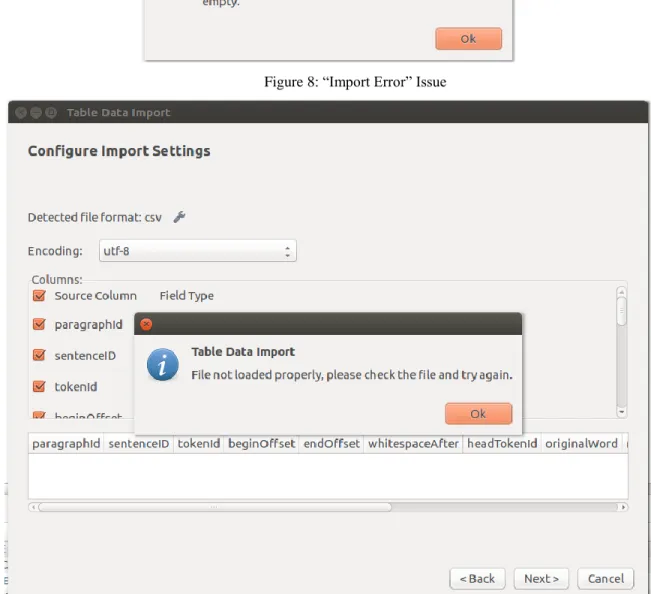
Figure 8: “Import Error” Issue ... 36
Figure 9: “File Not Loaded Properly” Message ... 36
Figure 10: Quotation Marks Example... 37
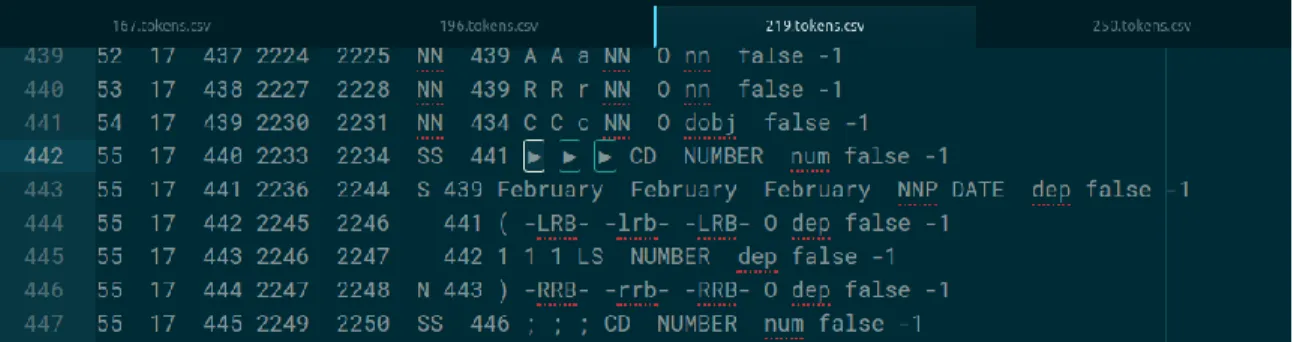
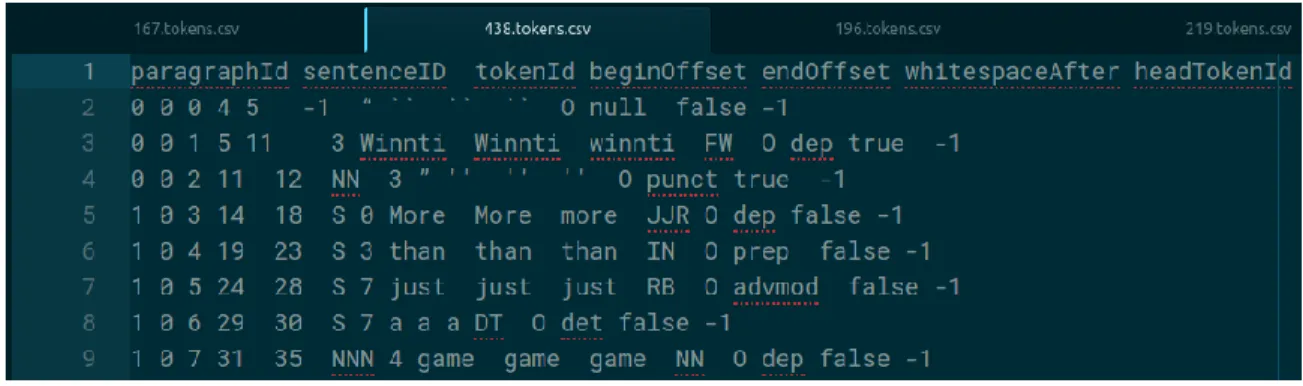
Figure 11: Sample of Document Tokens ... 38
Figure 12: Distribution of Tokens (by Document) ... 39
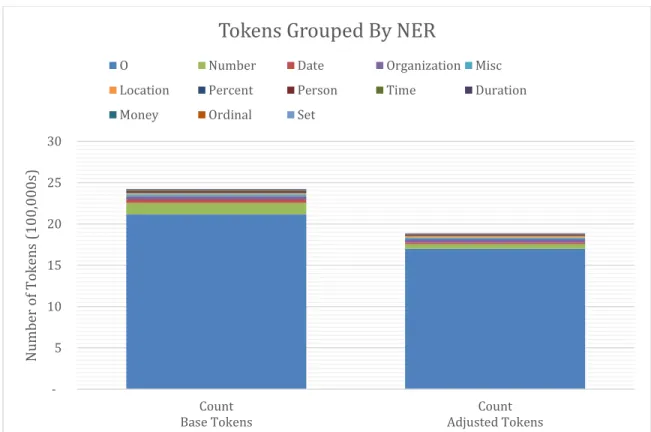
Figure 13: NER Classification Breakdown... 45
Figure 14: Sample of URLs Misidentified as Dates ... 45
Figure 15: Representation off appearance Count as a Percentage of the Entire Corpus .. 49
Figure 16: Appearance Ratio for All Tokens in the Corpus ... 49
Figure 17: MySQL Database of Ontology Structure ... 53
Figure 18: An example of a Class when viewed as a MySQL database table ... 53
Figure 19: The class-subclass structure in Protégé ... 54
Figure 20: Nesting of Classes ... 55
LIST OF ABBREVIATIONS
APT Advanced Persistent ThreatC2 Command and Control
CND Computer Network Defense
CNE Computer Network Exploitation
CoCA Corpus of Contemporary American English
CSS Creative Style Sheets
FTP File Transfer Protocol
GREAT Kaspersky Lab Global Research and Analysis Team
HTTP Hypertext Transfer Protocol
IDS Intrusion Detection System
NCHC National Center for High Performance and Computing
IMF Information Warfare Monitor
NER Named Entity Recognition
NLP Natural Language Processing
OSINT Open Source Intelligence
OWL Ontology Language
OWL2 W3C’s Ontology Language 2.0
PoS Parts of Speech
RAT Remote Access Toolkit
SaaS Software as a Service
SCADA Supervisory Control and Data Acquisition
SCP Secure Copy Protocol
SFTP Secure File Transfer Protocol
SIEM Security Information and Event Management
SSH Secure Shell
SSL Secure Socket Layer
TTP Tactics, Techniques, and Procedures
VPN Virtual Private Network
ABSTRACT
Author: Holzer, Corey, T. Ph.D. Institution: Purdue University Degree Received: December 2016
Title: The Application of Natural Language Processing to Open Source Intelligence for Ontology Development in the APT Domain
Major Professor: J. Eric Dietz.
Over the past decade, the Advanced Persistent Threat (APT) has risen to forefront of cybersecurity threats. APTs are a major contributor to the billions of dollars lost by corporations around the world annually. The threat is significant enough that the Navy
Cyber Power 2020 plan identified them as a “must mitigate” threat in order to ensure the
security of its warfighting network.
Reports, white papers, and various other open source materials offer a plethora of information to cybersecurity professionals regarding these APT attacks and the
organizations behind them but mining and correlating information out of these various sources needs the support of standardized language and a common understand of terms that comes from an accepted APT ontology.
This paper and its related research applies the science of Natural Language Processing Open Source Intelligence in order to build an open source Ontology in the APT domain with the goal of building a dictionary and taxonomy for this complex domain.
INTRODUCTION
Sophisticated hackers today employ complex operations in order to achieve their goals. They use intelligence gathering techniques to collect information about a potential target. They study these target networks and organizations to find weaknesses that they can use to their advantage. They execute attacks in a precise and careful manner in order to remain hidden from their targets. These attacks can even go dormant for months at a time or be executed over an extended period so as not to trip standard cybersecurity measures employed by their victims.
Conversely, intelligence about potential threats aids cybersecurity professionals in the defense of their networks as well. Like military forces on the battlefield these
professionals need knowledge about those attacking their network and the means of attack that these adversaries employ in order for these professionals to better defend their network.
The rise in frequency and complexity of cyberattacks means that cybersecurity professionals are fighting a pitched battle and the intelligence they have is their best means of dealing with the threats that infiltrate their network and remain hidden within it in order to steal data or to do harm. Over the last decade these complex attacks known collectively as Advanced Persistent Threats (APTs) presented some of the greatest challenges to network and national security as the perpetrators executed these attacks against both the private and public sector.
This paper represents the author’s research into the development of an APT ontology through the mining of open source intelligence. By employing the science of Natural Language Processing, it is the goal of this research to build a useful tool which will enable cybersecurity professionals to learn about these attacks
This chapter breaks down into seven sections. The first provides a brief
background regarding APTs over the last decade. The second addresses the scope of the research. The third section lays out the significance of the research. The fourth provides the Statement of Purpose for the research. The final three sections outline the
Background
Nearly one decade ago the term APT was coined. It described an emerging and complex form of cyberattacks that were engineered to steal data over an extended period of time while evading detection through a variety of techniques including small data transfers, use of non-malicious applications for malicious ends, etc. (Brill, 2010). These attackers were not seeking to do drastic or violent harm to an infected network. Instead they laid in wait eavesdropping on the network waiting for the right opportunity to present itself.
In his seminal work on APTs, Eric Cole likened these attackers and their attack to shoplifters. Cole notes, “At the point of entry the legitimate customer and shoplifter look identical. … If that shoplifter is only in the store for 5 min[sic], the store has less than 5 min to detect and deal with the problem (Cole, 2012, p. 7).” To carry his analogy one step farther, if the shoplifter browses around the store doing little to cause suspicion and waiting for an ideal time (i.e. when the store owner is busy with a lunchtime crowd) to pilfer the item he desires the shop owner or the shop workers may never be any the wiser.
According to a market research report in 2015, the APT protection market
generated $3.9B USD in 2015 (PR Newswire, 2015). The figure is based on expenditures on items including Sandboxing, Endpoint Protection, Forensic Analysis, Security
Information and Event Management (SIEM), Intrusion Detection Systems (IDS),
Intrusion Protection Systems (IPS), Firewalls, etc. (PR Newswire, 2015). The same report by MarketsandMarkets estimated that this expenditure would more than double to $8.7B USD in 2020 (PR Newswire, 2015). The cost of APT attacks will be discussed in greater depth in Chapter 2.
Scope
The research focused on the development of an ontology in the APT domain. This effort will not attempt to create new signatures or update existing signatures nor will it test to see if modified signatures can improve detection. For the reasons of timeframe and skillset, such an effort is beyond what the researcher would be able to complete to satisfy the requirements for his degree.
Significance
In a world where so much of our commerce, infrastructure, and even national defense depends on the communication pathways provided by the internet, failure to detect and mitigate the threat represented by APTs could impact businesses, civilian infrastructure, and potentially national security of all nations. Current Cyber Network Defense measures are unable to reliably and regularly detect APTs that compromise both commercial and government networks. Part of the problem is incomplete understanding of these APTs and to see the various components of a single APT attack as parts of the larger whole.
The goal of this research is to build a comprehensive ontology based on
information resources found in the open source domain. This work uses both open source intelligence and open source tools in the fields of natural language processing and
ontology development.
Statement of Purpose
Upon its conclusion, this research will produce an ontology, built to OWL2 specifications in Protégé, for use in the APT culled from Open Source Intelligence (OSINT) resources found in the public domain of the World Wide Web.
Assumptions
The design of this study is based upon the following assumptions:
An APT domain ontology does not already exist in the public domain. The pool of Open Source Intelligence (OSINT) is significantly large enough
to create a useful ontology pertaining to the APT domain.
Limitations
The design of this research incorporates the following limitations:
OSINT – The pool of information used for this research will be limited to what information about APTs exists in the public domain.
Skillset – While I have some programing experience it is not significant enough nor do I possess the expertise in malware forensics needed to properly develop signatures for use by existing cybersecurity systems to detect and/or mitigate an APT attack.
Delimitations
Factors outside of the control of the researcher creates the following delimitations:
Time – The Army has afforded the author a finite amount of time, two (2) years, to complete all the requirements of a graduate degree.
Machine Processing - The identification of ontological terms will be performed by software. Therefore, the amount of data that can be processed will be limited by how much data can be obtained and by the processing power of the systems being employed.
Open Source Intelligence – What information about APTs is available in the public domain is limited both by what cybersecurity companies wish to keep proprietary and what governments identify as classified information.
Exclusion of other OSINT – Limited assets for scanning and limited time for manually processing non-digital OSINT means that the research must exclude non-digital OSINT.
Summary
In this chapter, you were provided with an overview of rise of the APT over the past decade as well as the projected growing costs of protecting systems and networks from these attacks over the next 5 years. We reviewed the significance of the research and the deliverables this researcher expects to provide upon completion. Finally, it addressed assumptions, limitations, and delimitations impacting the project at hand. The next chapter consists of a review of relevant literature pertaining to the current field of research.
REVIEW OF RELEVANT LITERATURE
With the overview of the research complete, we will now move into a review of the relevant existing literature. This chapter covers eight areas of literature relevant to the current research effort. The first three sections provide context for the Advanced
Persistent Threat by defining APTs, examining the APT attack in detail, and through an exploration of the decade long history of APT attacks and the costs associated with them. The fourth section defines the present challenges of detecting APT attacks as well as exploring the countermeasures used by malicious individuals in order to evade detection.
The last four sections examine concepts, disciplines, and related research in the APT domain which is relevant to this research. The first addresses the concept of Open Source Intelligence. The second explores the science of Natural Language Processing. The last defines ontologies. This chapter concludes with an exploration of research in the field of Advanced Persistent Threats, with particular focus on the development of APT ontologies.
Defining Advanced Persistent Threats
The United States Air Force first coined the phrase Advanced Persistent Threat in 2006 (Arsene, 2015; Ask et al., 2013; Bejtlich, n.d.). They created the term in order to facilitate discussions about the characteristics, activities involved, and the classification of these types of attacks (Ask et al., 2013).
It is proper to begin this research endeavor by defining how Advanced Persistent Threat will be used for our purposes. The threat is Advanced in that adversaries can employ tactics that cover the full spectrum of cyber-attacks (Ask et al., 2013; Bejtlich, n.d.; Bodeau, Graubart, Heinbockel, & Laderman, 2014; Cole, 2012). It is Persistent in that he is not an opportunistic hacker searching for easily infiltrated systems (Bejtlich, n.d.). Instead, the persistent attack is one that will operates over an extended period of time with a pre-determined target and desired end state for the cyber-attack (Bejtlich, n.d.; Bodeau et al., 2014; Radzikowski, 2016).
APT as an Attack
The APT attack involves multiple methods, tools, and techniques used in a sophisticated complex manner in order to compromise the target and achieve what is usually a long-term objective (Chandran, P, & Poornachandran, 2015; ISACA, n.d.-a). The attacks are referred to as complex because they involve multiple forms of attack in order to compromise a target. A single APT can include a combination of social
engineering of human targets, a phishing campaign as a call to action by a victim, and the use of malware to gain access and elevated permissions on target systems (Ask et al., 2013; ISACA, n.d.-b, n.d.-c).
The actual phases of an APT attack will be discussed in a later section. The discussion will follow the framework outlined by Lockheed Martin in its Cyber Kill Chain (Ask et al., 2013). It is important to note that as the APT attack phases should not be considered as discrete events where one phase ends and the next begins (Chandran et al., 2015). Keep in mind that there can be overlap as the attack propagates across the target network. It is also important to understand that while we use the term persistent it is not intended to mean that the attack is constantly active or that connections between the APTs’ C2 server and compromised hosts is constant (Ask et al., 2013; Hutchins, Cloppert, & Amin, 2011; Raj, Chezhian, & Mrithulashri, 2014).
The sophistication and complexity of APT attacks make it hard for organizations to recognize one particular element as being only one piece of a larger plan (Armerding, 2012; Ask et al., 2013). In this game of cat and mouse the attacker has the advantage of having unlimited time, resources, the victim organization’s prioritization of its business processes, and less fear of prosecution when the attack takes place across international borders (Auty, 2015).
APT as an Organization
In addition to describing the attack, the term APT is used to describe the organizations that execute these attacks. In this context the discussion focuses on organizations that are well funded, well organized, and patient (Cole, 2012). They can infiltrate a network and remain hidden while monitoring it for a specific target or data to
exfiltrate (Bodeau et al., 2014). Their goal is stealthy execution instead of the kind of attack that draws attention to the person or persons committing the crime.
While it is understood that those responsible for APT attacks are well organized and that they possess significant funds, cybersecurity professionals must not confuse this with meaning that they are sponsored by state actors (Ask et al., 2013). Cybersecurity professionals attribute some APTs to state sponsored actors but state sponsorship in not a required component of the definition (Bejtlich, 2013; Mandiant, 2013). With APT
defined let us explore the costs, both in financial and national security terms, associated with the threat.
Phases of the APT Attack
With the definitions complete, let us delve into the several phases that an APT attack employs in order to obtain the attacker’s desired end state. One of the more widely accepted description of the APT Attack comes from Lockheed Martin. The “Lockheed Martin Cyber Kill Chain” breaks the attack into seven phases. We will use their model as a means of discussing Lockheed Martin’s definition of each phase. The seven phases are as follows: Reconnaissance Weaponization Delivery Exploitation Installation
Command and Control Actions on Objective
Additionally, the descriptions will include elements that other cybersecurity professionals and professional organizations include when discussing the APT attack.
Reconnaissance
Reconnaissance is the selection and identification of the desired target. In this stage the APT is footprinting the target organization and collecting information including but not limited to names, positions, email addresses, physical locations, operating
systems, etc. (Hutchins et al., 2011). Through this information gathering process the APT determines who has ownership of the desired information that they seek to steal (2013). The APT will determine which employee to compromise as well as a potential means for doing so.
Weaponization
In the Weaponization phase, the APT puts together the code that they will use to compromise a target system (Hutchins et al., 2011). This will often involve the use of existing and proven code but, if needed, APTs will adapt or modify code in order to address a specific configuration or defensive challenge (Ask et al., 2013; Cole, 2012; Hutchins et al., 2011). When using code designed for the specific target, the code has no anti-virus signature which the target company might use to detect it (Websense, 2011).
Delivery
In the Delivery phase, the APT transmits the weapon to the targeted system (Hutchins et al., 2011). Lockheed Martin identifies the most common delivery methods as email attachments, websites and removable media. In addition to those three, Ask, et.al. (Ask et al., 2013) identified social media as another means for launching at attack against an individual within the target organization. For the attack to move beyond this phase, the targeted individual most click on the link, attachment, or application for the attack to move into the next phase (Auty, 2015).
Exploitation
Exploitation involves compromising the host machine on the network. It is where the weaponized tool is triggered (Hutchins et al., 2011). The exploitation can be of a flaw in the operating system or an individual application on the host (Ask et al., 2013;
Hutchins et al., 2011).
Installation
The next phase of the attack is the Installation phase. Installation refers to the installation of a Remote Administration Tool (RAT) or backdoor that the APT can use to
gain control of the target’s computer (Ask et al., 2013; Hutchins et al., 2011). Once the victim triggers the malicious code (e.g. by clicking the malicious link, opening the infected file, or visiting the compromised site, etc.) the code reaches back to its Command and Control (C2) server and provides the attacker with useful information about the target network’s environment that could be useful in executing the later stages of the APT attack (Ask et al., 2013). Once installed the RAT can also lay dormant until the C2 server connects to it (Ask et al., 2013; Sikorski & Honig, 2012).
Command and Control
The Command and Control phase begins once the infected host beacons the C2 server (Hutchins et al., 2011). Attackers need to maintain access to the victim’s network means that each communication with a compromised system (Auty, 2015). During this phase the APT will seek to obtain elevated privileges on the system and will install additional software to facilitate the attack (i.e., encryption) on compromised system and network (Ask et al., 2013). While the initial installation is achieved by software designed to exploit a zero-day vulnerability, the additional software is likely to be commonly known software that may even be approved to operate on the network for legitimate activities (e.g., SSH, SecureFTP, etc.) (Ask et al., 2013).
Actions on Objective
The final stage in Lockheed Martin’s APT Kill Chain is the Actions on Objective phase. During this phase the APT is actively going after the data that they originally identified as their target (Hutchins et al., 2011). The APT uses previously installed software to determine the network layout including, but not limited to, mapping the hosts of networked drives, database servers, domain controllers, PKI, etc. (Ask et al., 2013). The goal here is to footprint the network and to establish a network account and elevate the privileges for that account (Ask et al., 2013). During this phase, the APT will also seek to compromise more hosts in order to strengthen its foothold in the target network. The extraction of the target data may also be accomplished using custom encryption and/or tunneling within other protocols to hide the data from security professionals (Websense, 2011).
Conventionally, malware will remove itself once its task is complete or it is discovered and removed by antivirus software (Ask et al., 2013). The APT, however, is designed to stay invisible. It maintains persistence by reaching back to the C2 server for updates to the malicious code (Ask et al., 2013). Changing code enables the APT attack to avoid detection. Mandiant’s APT Attack model includes cleanup as part of this phase (Mandiant, 2013; Saarinen, 2013). However, it is more likely that the APT will leave some software in place in order to facilitate quicker access if the adversaries wish to exfiltrate more information in the future. The security firm Mandiant has data
demonstrating that a group identified as APT1 has left software in place to re-access a target network months, and even years, later (Bejtlich, 2013; Mandiant, 2013; Raj et al., 2014).
History of APTs
With an understanding of the APT attack established, we will next look at some examples of cyber-attacks that were qualified as APTs. By no means is this intended to be an all-inclusive list. It is intended to demonstrate the variety of attack elements and the variety of targets.
Shady Rat
With earliest evidence indicating that this APT collected data in mid-2006, it is possible that it was stealing data even earlier than the logs provide (Alperovitch, 2011). Evidence collected by McAfee indicates that, unlike other APTs discussed here, this APT was used against a wide range of individuals and organizations in multiple industries. Initial installation took place via a spear-phishing email. The attachment triggered the download and installation of malware that, in turn, created a backdoor communication channel with its C2 server. In four of 71 instances where Shady RAT gained control of a target system, it remained persistent for 24 or more months (Alperovitch, 2011).
Night Dragon
This attack targeted the Global Energy Business Community (McAfee, 2011). Commencing in 2009, Night Dragon employed social engineering and spear-phishing
attacks to exploit vulnerabilities and compromise Microsoft Active Directory machines. The initial targets were extranet web servers and then internal desktops and servers to gain elevated permissions within the hosts and target network. Finally, the APT harvested sensitive proprietary and project-financing related information sending that information back to C2 servers on the Internet (McAfee, 2011).
Poison Ivy Attack on RSA
The APT identified two specific independent groups of RSA employees and crafted a spear-phishing campaign tailored to the target employees’ job functions (RSA FraudAction Research Labs, 2011). The email contained a spreadsheet which executed code that leveraged an Adobe Flash vulnerability in order to inject a Poison Ivy RAT which, in turn, established a hard to connect reverse connection to the APT’s C2 servers. The data stolen included RSA’s SecureID two-factor authentication products (Ashford, 2011). Executive Chairman Art Coviello issued an open letter to customers in which he acknowledged that the stolen information “could potentially be used to reduce the effectiveness of a current two-factor authentication implementation as part of a broader attack (Ashford, 2011; Coviello, n.d.).”
Icefog
This APT attack has been used numerous times starting in 2011 with most of the attacks targeting organizations in Japan and South Korea (Kaspersky Lab Global
Research and Analysis Team, 2013). Kaspersky Lab's Global Research & Analysis Team (GREAT) researched the attacks and determined that their targets were supply chains of “government institutions, military contractors, maritime and ship-building groups,
telecom operators, satellite operators, industrial and high technology companies and mass media (Kaspersky Lab Global Research and Analysis Team, 2013).”
The APT achieved their initial insertion through spear-phishing campaigns and attachments which exploited known vulnerabilities in the host’s operating system
(Kaspersky Lab Global Research and Analysis Team, 2013). GREAT identified at least 6 variations in the manner in which Icefog exfiltrates data (Kaspersky Lab Global Research
and Analysis Team, 2013). They are as follows (with designations established by GREAT) (Kaspersky Lab Global Research and Analysis Team, 2013):
The “old” 2011 Icefog — sends stolen data by e-mail Type “1” “normal” Icefog — interacts with C2 servers
Type “2” Icefog — interacts with a script-based proxy server that redirects attacker commands
Type “3” Icefog — observed to use a certain kind of C2 via a different means of communication
Type “4” Icefog — another C2 variation with a different means of communication
Icefog-NG — communicates by direct TCP connection to port 5600
Stuxnet
In 2010 this worm was weaponized with the specific goal of impacting systems that run Supervisory Control And Data Acquisition (SCADA) engineered by Siemens (Kushner, 2013). The worm was initially uploaded via USB to a Windows workstation and started spreading across the target network without impacting any systems that did not run the SCADA software. Once it entered a machine where the SCADA was present it would connect with its C2 server and receive software updates (Kushner, 2013). The worm then compromised the system and began gathering information in order to get the elevated permissions needed to take control of centrifuges making them fail. The
software would also provide false information back to the user giving the appearance that everything was functioning normally (Kushner, 2013).
GhostNet/Shadows in the Cloud
In a collaborative effort, Information Warfare Monitor (IMF) and Shadowserver Foundation (2010) documented the complex network of systems used to conduct cybercrime and cyber espionage operations against unsuspecting targets in the
government, academic, and corporate sectors. The research built upon a research effort conducted by an Information Warfare Monitor partner, SecDev, titled GhostNet which they performed in 2009 (Bradbury, 2010; Information Warfare Monitor & Shadowserver
Foundation, 2010). SecDev initiated the GhostNet investigation at the behest of the Office of the Holiness the Dali Lama which was a victim of the APT attack (Bradbury, 2010).
The IMF and Shadowserver (2010) determined the following:
C2 infrastructure leveraged cloud-based social media services in order to compromise unsuspecting targets.
The complex network of compromised systems employed C2 servers, malware, botnets, and drop sites in order to compromise targets and to exfiltrate data undetected.
Stolen data included classified and sensitive documents as identified by classified markings on multiple documents.
Hackers exfiltrated data from 44 systems across nine countries.
The investigation determined that the entire system required four different types of hacking tasks in order to successfully complete the task of stealing data (Information Warfare Monitor & Shadowserver Foundation, 2010):
Malware Authors to develop the malware that compromised target systems. Website Crackers to maintain the malicious websites
Envelope Stealers who are individuals who steal username and password combinations on compromised networks.
Virtual Asset Stealers and Virtual Asset Sellers who possess an understanding of what data has value in the underground or criminal economy.
New York Times Attack
In 2013, the New York Times announced that their network was compromised through the installation of malware which led to the extraction of the network’s user database (Perlroth, 2013). In its 2014 “M-Trends: Beyond the Breach” Report, Mandiant stated that the suspected APT group took specific steps to change their cyber operations following the disclosure in order to “better hide its activities (Mandiant, 2014, p. 20).”
Trojan.APT.Seinup
Discovered in 2013, this Trojan targeted Google Docs. The APT attack leveraged this legitimate cloud based Software as a Service (SaaS) in order to leverage the
legitimate Secure Socket Layer (SSL) of Google Docs to protect their malicious communications (Naval, Laxmi, Rajarajan, Gaur, & Conti, 2014).
With this brief sample the reader can see that detecting APTs is a challenge for cybersecurity professionals. Next, we will examine some of the technical reasons that make it so difficult.
The Cost of the APT Threat
On a regular and increasingly frequent basis companies, government
organizations, and industries are reporting breeches of their network and the extraction of thousands if not millions of data records. Despite the security measures these
organizations put in place to ensure the security of the data customers provide to them. For example, in 2011 RSA spent $66 million USD to undo the damage caused by an APT attack (TrendLabs, n.d.). In a 2015 study by the Ponemon Institute, the researcher
estimated that it can cost up to $161 each record lost (Ponemon Institute, 2015). When one considers that some APT attacks can compromise millions of users’ records the cost could potentially bankrupt businesses.
The threat is not limited to consumer market. The US government’s Office of Personnel Management reported a data breech in 2014 which involved 25,000 or more personnel records of government employees (Bisson, 2015). Breeches like this could present a risk to national security. The Stuxnet attack in 2010 had the potential of causing significant damage to nuclear facilities which could place lives and national
infrastructures at risk as well (Damballa, 2010; Kushner, 2013). It is for this reason that the U.S. President issued an Executive Order in 2013 calling for the development of a Cyber Resiliency Framework (United States. The White House, 2013). It also prompted the U.S. Navy to declare APTs as a “must mitigate” threat (Card & Rogers, 2012).
Understanding the Challenge of Detecting APTs
With the previous examples providing a context for understanding how APTs function we can now address what challenges exist in detecting APTs. While APTs can employ a variety of known attack elements (e.g., phishing, malware, etc.) which can be detected by current security measures, attackers are still able to execute their attacks unnoticed. The question for security professionals, therefore, how are these attackers employing these detectable tools in a manner that leaves them undetected.
Challenges Specific to APT Detection
Conventional means of intrusion detection often fail to detect APTs because they are implemented to mitigate risks associated with automated viruses and worms, not the focused manually-operated attack of an APT (Hutchins et al., 2011). In its annual
M-Trends, Mandiant (Mandiant, 2010), estimated that only 24% of APT malware is detected
by security software. This is due to multiple factors. The target organization’s decision not to inspect outbound packets (Ask et al., 2013; Auty, 2015; Villeneuve & Bennett, 2012). Data is encrypted (Ask et al., 2013; Villeneuve & Bennett, 2012). The affected machines send data to a trusted source (Villeneuve & Bennett, 2012).
Anti-detection Methods Employed with Malware
As discussed in the previous section, APTs commonly employ malware as a means to gain their initial foothold into a target network and to gain elevated permissions on host machines. Malware comes in many forms including Trojan horses, worms, rootkits, scareware, spyware, and viruses (Egele, Scholte, Kirda, & Kruegel, 2012; Sikorski & Honig, 2012). Regardless of which family the malware belongs to the software is designed to remain undetected on an infected system (Brand, Valli, & Woodward, 2010).
Malware developers must overcome the various forms of detection the forensics analysts use to reveal the presence of malware as described above. Malware developers have varied methods at their disposal to defeat detection. These means fall into several areas.
Anti-emulation
Malware developers employ techniques which detect that their malware is running in a virtual environment and the malware will either stay dormant or use deception code to provide a false signature to forensic experts trying to dissect the malware (Brand et al., 2010).
Anti-online
Companies offer third party malware analysis services online. However, there are limits to how well these services work because the online environment may not match conditions to trigger the malware or it may act differently than it would in a real-world network (Brand et al., 2010).
Anti-Analysis
Anti-analysis refers to changing the code such that it becomes harder to read during the analysis process (Brand et al., 2010; Shosha, James, Hannaway, Liu, & Gladyshev, 2012). These techniques target the way analysis is conducted. Code is deceptively transformed such that the analysis tools cannot establish a signature for the malware (Brand et al., 2010). De-obfuscation methods of analysis fail because that analysis happens on the files whereas the malware’s transformation back into identifiable malicious code happens in memory as part of the unpacking process (Egele et al., 2012).
Anti-hardware
Malware developers can use check to determine whether the malware is being analyzed based on signatures of CPU usage and register usage during the debugging session (Brand et al., 2010).
Anti-debugger, Anti-disassembler, and Anti-Tools
In the same way that malware can detect if the operating system is running in a virtual environment, malware developers can design their malware to detect if the code is being debugged, disassembled, or examined by other tools (Brand et al., 2010).
Anti-memory
In case the malware analyst is clever or experienced enough to dump memory as a means of defeating anti-analysis measures, the malware developer can use anti-memory measures in order to frustrate the forensics analyst’s effort. For example, the developer can have the packer that unpacks the code into memory to delete code as soon as it is executed (Brand et al., 2010).
Anti-process
Anti-Process techniques are designed to mitigate the attempts by forensic analysts debugging of running processes. The technique changes the entry point from to a
different one which foils the debugging effort (Brand et al., 2010).
Packers and Protectors
Obfuscation and its subset, packing, are techniques used by malware developers to make static analysis more difficult for the forensics experts (Brand et al., 2010; Sikorski & Honig, 2012). Obfuscation is a means of hiding or disguising code (Sikorski & Honig, 2012). Packing uses compression and a wrapping program as a means of disguising the true purpose of program (Sikorski & Honig, 2012). Even more challenging for analysts and malware detection is recursive packaging which obfuscates code in multiple layers of recursive compression (Egele et al., 2012).
Metamorphic or Polymorphic
This type of malware is constructed in such a manner that it can re-engineer or recode itself (Raj et al., 2014; Sikorski & Honig, 2012). This recoding takes place each time it propagates or is distributed through a network. This type of malware hinders the use of signature-based protection tools (Raj et al., 2014).
Defining and Evaluating Open Source Intelligence
With related research understood, we can start to explore the independent elements that will go into the present research. Therefore, the next three sections will
address Open Source Intelligence (OSINT) which will be used to establish our ontology and as our data for text-mining and link analysis, which will be discussed in the following two sections.
Intelligence organizations and law enforcement at all levels of government use data and information found in open sources for decades (Fleisher, 2008; Steele, 2007). Traditionally, OSINT was characterized by searching through publicly available sources of information to include books, journals, magazines, etc. (Burwell, 1999; Fleisher, 2008). Steele formalizes the definition of OSINT as “information that has been deliberately discovered, discriminated, distilled and disseminated to a select audience (Steele, 2007, p. 132).”
Steele (2007) notes that the change to OSINT is the result of three distinct trends (1) the proliferation of the Internet; (2) the consequence of the related “information explosion” of published useful knowledge which is experiencing an exponential growth; and (3) the availability of formerly restricted sources of information resulting from failed states and newer non-state threats. Best (2011) acknowledges that the challenge with OSINT is not the collection of information but the filtering and distillation of the retrieved content into meaningful metadata that can be analyzed.
The Science of Natural Language Processing
In this section, we will explore the science of Natural Language Processing (NLP). It is broken down into three subsections. First, we will define the concept of Natural Language Processing (NLP) and terms used within this field of study that are applicable to the present research. Next, we will provide some examples of applications of NLP in the public domain. The third section provides a brief examination into how NLP analyzes human language. The last section explores some of the NLP tools available in the public domain with particular attention to the tools used within the present
research.
Defining NLP and Key Terms
NLP is the science which enables computers to breaking down unstructured human language (Radev, 2015; Sims, 2015). It is a subset of machine learning which
draws upon the fields of Linguistics, Theoretical Computer Science, Mathematics, Statistics, Artificial Intelligence, Psychology and more (Radev, 2015). When we say unstructured human language, we refer to language as it is written or spoken.
While human language has its own structure it is not a structure that is conducive for machine searching or for relating ideas, concepts, or terms to one another (Radev, 2015). Documents that cover a particular area of study are referred to as the corpora (Börner, 2007; International Business Machines, n.d.).
The following list identifies commonly used NLP terms.
Information Extraction – The process of extracting structured information from unstructured natural language texts (Waldron, n.d.).
Bag of Words – A modeling techniques for training the NLP software to identify the sentiment of a given passage of text (Waldron, n.d.).
Coreference – is the ability of software to identify relationships between specific and general terms within a text. Figure 1 is an illustration of determining a relationship between the multiple instances of his with President Xi Jinping mentioned at the beginning of the sentence.
Figure 1: Visual Representation of Coreference (Stanford NLP Group, n.d.-a)
Named Entity Recognition (NER) – the process of identifying or classifying terms within text by a broader classification (Finkel, Grenager, & Manning, 2005). Figure 2 illustrates how NLP software uses NER to classify words in analyzed text. Table 1: NER Classifications lists the 13 NER classifications used by Stanford CoreNLP. It is important to note that the Classification ‘O’ is a catch-all for any term that cannot be distinguished as one of the other NERs.
Table 1: NER Classifications
Named Entity Recognition Classification
DATE DURATION LOCATION MISC MONEY NUMBER O ORDINAL ORGANIZATION PERCENT PERSON SET TIME
Sentiment Analysis – The ability to extract not only terms but also the positive or negative tone of the text (Waldron, n.d.).
Corpora or Corpus – A large collection of texts within a specific domain (Waldron, n.d.)
Lemma – the root word of tokens appearing in the corpora or in a single document (Jones, 1999). Table 2.1 below provides an illustration. The words capture, captured, captures, and capturing appear in the corpus. All of these words are derivatives of the lemma capture.
Table 2: Capture as an example lemma
Lemma Word Appearances
capture
capture 195
captured 93
captures 60
capturing 35
Examples of NLP in the Public Domain
A variety of well-known and frequently used tools apply NLP to accomplish specific goals. The most common example is search engines (Radev, 2015). These websites, and their related robots, use NLP as a tool to index websites and facilitate user searches. Other examples include web-based translation tools (i.e. Google Translate), and Natural Language Assistants (e.g. Siri, Cortana, etc.) (Radev, 2015).
IBM’s Watson
Another example of an NLP application is International Business Machines’ (IBM) Watson Application Program Interface (API). The Watson system, like the other NLP tools described later, processes various forms of the written human word (e.g. Word Documents, Portable Document Format (PDF), HTML web pages, etc.) and pairs of questions and answers are stored within Watson’s database which users can then query (International Business Machines, n.d.).
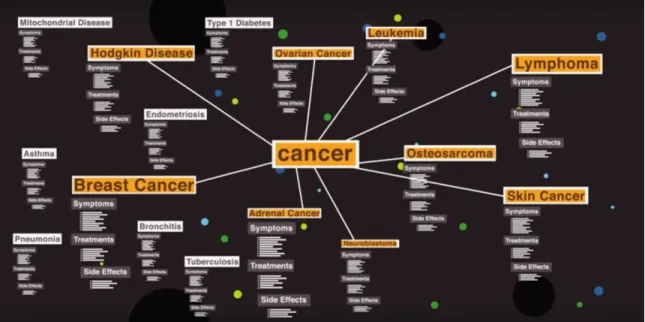
The Watson application has been used to analyze thousands of medical documents and build searchable databases of diseases and their symptoms. Error! Reference source not found., below, provides an example of how Watson processes numerous medical resources to build a structured understanding of cancer and other diseases with similar symptoms, treatments, and side effects.
Figure 3: Watson structures Natural Language Resources within a domain (International Business Machines, n.d.).
Stanford’s CoreNLP
Stanford’s CoreNLP (CoreNLP) is actively developed by Stanford’s Natural Language Processing Group (NLP Group). The NLP Group members include faculty, post doctorates, graduates, undergraduates, and programmers (Stanford NLP Group, n.d.-b). CoreNLP is a collection of tools, built in Java, which can extract word lemmas, parts
of speech, proper names of individuals and corporations, markup sentence structure and more (Manning et al., 2014).
BookNLP
BookNLP is an extension of the CoreNLP. It is designed to scale CoreNLP’s functionality to larger source documents (Bamman, Underwood, & Smith, 2014). It also leverages MaltParser for dependency parsing (trained on CoreNLP’s typed
dependencies). The project was last updated over 3 years ago, based on its GitHub repository (https://github.com/dbamman/book-nlp),
Natural Language Toolkit
Natural Language Toolkit (NLTK) is a collection of tools written in Python designed to work with human language data (Bird, Loper, & Klien, 2009). An open source package currently in its third version, NLTK has over 100 predefined corpora and training models and can process 14 languages (Bird et al., 2009).
How NLP Processes Human Language
The two main functional roles of NLP are semantic and syntactic analysis
(Collobert et al., 2011). Syntactic focuses on the way language is structured and deriving an understanding of the language through the understanding of the structure. Semantics focuses on the mapping of language to derive meaning from the way that words are used within natural language(Wang, Berant, & Liang, 2015). Collobert et. al. (2011) further divides these two areas into four main roles for NLP as follows:
Parts of Speech (PoS) Tagging which is used to identify words by their syntactic role (e.g. nouns, verbs, adjectives, etc.) (Collobert et al., 2011; Wang et al., 2015);
Shallow Parsing or Chunking which is used to identify syntactic phrases, commonly Noun Phrases and Verb Phrases (Collobert et al., 2011); Named Entity Recognition (NER), which identifies parts of the sentence
Semantic Role Labelling analyzes the semantics of a sentence and
establishes relationships between the semantic components (Collobert et al., 2011).
Beyond these parsing functions, NLP offers the following functionality when processing text:
Deep Analytics involves advanced data processing techniques to facilitate more precisely targeted and more complex searches (Sims, 2015);
Machine Translation which involves converting human text from one language to another (Sims, 2015);
Co-reference Resolution is a tool that resolve the relationship between terms that refer to the same subject (Sims, 2015), and;
Automatic Summarization functionality in NLP can be used to produced readable summaries of denser texts (Sims, 2015).
In order for NLP to provide usable data regarding a particular domain it is often useful to train the NLP system with a lexicon (Collobert et al., 2011; Hake &
Vaishalideshmukh, n.d.; Lee et al., 2011; Wang et al., 2015). With the lexicon, the NLP application has a starting point from which to analyze documents within a domain. It is for this reason that the methodology in the first iteration includes a manual processing of documents by the research team. By default, CoreNLP is trained using the coreference library developed out of the SIGNLL Conference on Computational Natural Language Learning 2011 (CoNNL-11) (Lee et al., 2011).
The Role of Ontology
An ontology is designed to establish a common vocabulary and give practitioners the ability to easily share concepts (Mundie & McIntire, 2013). An ontology helps improve knowledge management within a domain (Dey, Rastogi, & Kumar, 2007). The development of an ontology is further intended to streamline the process of information sharing and to avoid problems of misrepresentation or miscommunication resulting from parties using incompatible terminology (Huang, Acampora, Loia, Lee, & Kao, 2011). Previous research in the area of malware analysis and APT detection will be discussed in the section on Prior Related Research.
Ontology Basics
Dey, Rastogi, and Kumar (2007) notes that the role of ontologies is to help improve knowledge management by formalizing the representation of domain-specific knowledge. Hitzler, et al. (2012) adds that these terms, often referred to as vocabulary, are used to precisely describe the domain. These terms can be identified by the frequency of their appearance in natural language texts (Dey et al., 2007; P Velardi, Fabriani, & Missikoff, 2001). The importance of terms and their relationship to other terms can be determined by the co-occurrence of terms within natural language texts (P Velardi et al., 2001). Karoui, Aufaure, and Bennacer (2007) take co-occurrence one step farther by weighting the relationship based on the proximity of terms to one another within the document.
Ontology Development
Ontologies are developed both vertically and horizontally (Navigli & Velardi, 2004; P Velardi et al., 2001; Paola Velardi, Faralli, & Navigli, 2013). From top-to-bottom, terms move from broader terms to more specific ones (Paola Velardi et al., 2013). For example, if the term at the top of the chain is communication, the next level could contain two terms secure and unsecure. Under Unencrypted Communications there would be more specific individuals including Hypertext Transfer Protocol (HTTP), File Transfer Protocol (FTP), and email. Individuals under Secure Communications could include Secure File Transfer Protocol (SFTP), Secure Shell (SSH), Secure Copy Protocol (SCP), Virtual Private Network (VPN), etc. In other ontologies the subordinate terms may also be a part of the parent term (e.g. the lobby of the hotel) (P Velardi et al., 2001). Individuals are specific instances of the parent term (i.e. Apache or Nginx are instances of a web server) (P Velardi et al., 2001). Figure 4: Example of the Vertical and Horizontal Aspects of an OntologyFigure 4, below, is a visual representation of the same.
In addition to classes and individuals, ontologies can specify properties of classes and properties of individuals (Horridge, Knublauch, Rector, Stevens, & Wroe, 2004). Properties define attributes of a class or an individual. In the example, above, a property might be the type of encryption used (e.g. MD5 or SHA2) to encrypt the communication or it could be the ports used to communicate between hosts.
Prior Related Research
This section will look at some of the research that focus on the use of ontologies for malware analysis and the development of fuzzy logic and cognitive agents for use in detecting APT attacks. As has been previously illustrated, malware is a significant tool in the execution of an APT attack. Therefore, research done in this area is impactful on the work in the present effort.
Mundie and McIntire
In Mundie and McIntire’s (Mundie & McIntire, 2013) research they sought to develop an ontology for Malware Analysis. Their work was motivated by four challenges in the business of malware analysis: (1) security teams and their customers were wasting time negotiating requirements because they did not “speak the same language;” (2) human resources departments couldn’t hire the right malware analysts because they could not properly explain job requirements; (3) certification programs did not have a
standardized way to assess the abilities of malware analysts; and (4) information sharing within the malware analysis community is impeded by a lack of shared foundation (Mundie & McIntire, 2013).
Their work employed six increasingly complex levels of knowledge representation (Mundie & McIntire, 2013):
Controlled Vocabulary – collection of preferred terms.
Taxonomy - hierarchically related terms in a controlled vocabulary. Static Ontology – an ontology that describes static aspects of the world. Dynamic Ontology – an ontology hat describes changing aspects of the
Intentional Ontology – a subjective ontology based on the motivation of agents.
Meta-model – An ontology template that can generate ontologies by filling-in the parameters.
Their work yielded a vocabulary of approximately 270 malware analysis terms and a taxonomy outlined in World Wide Web Consortium’s Web (W3C) Ontology Language (OWL). Mundie and McIntire built their initial ontology using the email archive of a malware analysis team. They also included various recognized textbooks in the malware analysis field and some Internet resources (Mundie & McIntire, 2013).
Huang, Loia, and Kao
Huang, Loia, Lee, and Kao (Huang et al., 2011) research sought to apply fuzzy logic and ontologies for their application of inferring knowledge about malware, and designing an intelligent decision making system whose behavioral rules can be used to detect viruses and other malicious programs. As with Mundie and McIntire’s research they employed OWL to build their malware behavior ontology (Huang et al., 2011).
To test the effectiveness of their decision-making system they evaluated its performance against 30 “attendance records” from the National Center for High Performance and Computing (NCHC) malware repository. Their reported results and conclusion indicate that the employment of fuzzy logic and ontology was feasible and usable for a malware behavioral analysis system (Huang et al., 2011).
Meckl, Tecuci, Boicu, and Marcu
Meckl, Tecuci, Boicu, and Marcu (2015) attempted to improve cyber defense against APTs using an operational semantic approach. The motivation for their work was to reduce false positives thus increasing the efficiency and reducing the costs associated with automated APT analysis. To achieve this, they are proposing developing
collaborative cognitive agents that can apply updates based on new intelligence. In theory, the work of this present study could potentially inform this agent (Meckl et al., 2015).
Lundquist, Zhang, and Ouksel
In Lundquist, Zhang, and Ouksel (Lundquist, Zhang, & Ouksel, 2015), the research focused on applying an ontology to the analysis of network traffic in order to determine the nature of the traffic as a threat or as innocuous. The extent of the threat (or non-threat) is also determined as part of this scan. If the sentiment scan is inconclusive the traffic data goes through further processing that involves alternate ontologies and/or expanded data from a longer observation window (Lundquist et al., 2015).
These and potentially other research efforts have some overlap with our current effort, but the researcher contends that this does not invalidate our efforts. Instead, the researcher holds that the research could augment these other research efforts and others like them.
Summary
In this chapter, we defined of the term Advanced Persistent Threat both in terms of the attack and the actor. With that groundwork laid, we explored the phases of the APT attack in the context of the widely-accepted Lockheed Martin “Cyber Kill Chain.” We looked at several illustrative historic examples of known APT attacks and the current challenges cybersecurity professionals face when trying to detect APT attacks. We also examined the costs associated with data breeches resulting from APT attacks.
We examined the concepts of OSINT, ontology development and natural
language processing as an intelligence building tool. Finally, we examined prior research efforts in the fields of APT and malware ontologies and the application of those
FRAMEWORK AND METHODOLOGY
With definitions, history, and a review of prior APT research complete, it is time to layout the approach that the author intends to apply in the present endeavor. This chapter will examine the framework, researcher’s biases, the proposed methodology including the two phases the research will take, a review of the data to be collected, the tools that will be used to analyze the raw data, and finally the researcher’s credibility.
Framework
As demonstrated in the literature review, previous research efforts sought to develop a meaningful ontology as a part of malware analysis and incorporating a
semantic approach to improve defense against APT attacks. However, none of these prior efforts sought to apply link analysis to the existing APT knowledgebase in an effort to refine or improve the threat intelligence that exists for each individual APT.
The author acknowledges that some corporate entities may have explored employing link analysis to expand their threat intelligence about APTs but, that work being of a proprietary nature, it has not been published in the public domain as open research.
Researcher Bias
While there is always a risk of bias when dealing with qualitative or hybrid research efforts, steps within the methodology outlined below are designed to minimize the possibility that it will affect the outcome of this research effort. My only vested interest in this research is to provide the most thorough effort that I can within the time parameters available to me.
Methodology
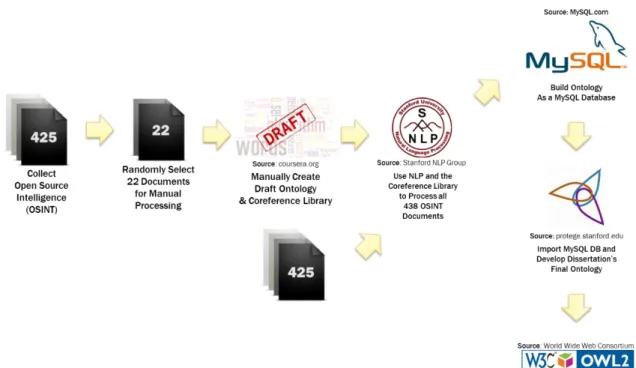
This section lays out the methodology used in the research related to this paper. It describes the workflow illustrated in , below.
Figure 5: Methodology Workflow
The first step in the research process involved the collection of OSINT pertaining to APT incidents over the past decade. During the literature review research, the search for resources uncovered two repositories of documents pertaining to APT attacks. These two repositories contain over 700 documents include reports by cybersecurity
professionals and organizations covering individual incidents and studies of trends about cyberattacks over time. Organized by year, these primary sources span from 2008
through 2016. The size of these repositories provides a significant foundation for building this study’s ontology.
As a part of the merging of the two repositories, this step included the removal of duplicates documents. Other documents were removed for other reasons as explained in Chapter 4.
As discussed in the ‘Science of NLP’ section of the Literature Review, in order for NLP software to produce the most useful analysis regarding a domain, the software needs to be trained regarding the lexicon of the domain. Therefore, the researcher selected 5% of the documents randomly from the final knowledgebase and read through the selected documents and identified terms and phrases that are meaningful within the APT domain.
The next two steps on the methodology were performed in parallel as neither required the other as a preceding task. The two steps were the NLP processing of the remaining documents in the corpus and the building of an initial ontology using the terms identified during the manual analysis.
The researcher included this step for multiple reasons. First, to understand the breadth and scope of an APT domain ontology. Second, as a familiarization with the ontology building software used in the research.
After completing the two parallel tasks, the next step was the extraction of domain relevant terms from the processed documents. Using knowledge gleaned from the manual processing of documents, I determined to use a statistical approach to initially identify ontological terms and then to use contextual analysis to identify additional terms. From there I used a tool I am familiar with to build the relational structure of the ontology and then connected Protégé to the database in order to develop and the final ontology
(presented in OWL2 in Appendix C).
Data Collection
The data collected in this research comes in two forms. The first is the statistical analysis of the tokens outputted by NLP. The second is the identified terms in the APT ontology and the lexicon used in the NLP step of the methodology.
As mentioned in the previous section, statistical analysis of the NLP output (in the form of tokens) enabled the identification of terms for use in the ontology and would facilitate the identification of additional terms through their contextual use.
In order to facilitate the statistical analysis of the NLP output, I first turned to Excel but the number of tokens in the entire corpus made statistical analysis in excel difficult. Excel spreadsheets are limited to 1,048,576 rows or records and, as mentioned previously, the corpus of 425 documents consists of 2,423,738 tokens. Therefore, it would take three separate tabs of a spreadsheet just to contain the raw data. This would make analysis more complex than it needed to be.
As a result, I turned to MySQL for its ability to handle the 2.4+ million tokens (records) in the corpus and use its querying capability to summarize the data the output to build the domain ontology. I used MySQL to summarize the data in the corpus and then