Tree Management
Guidelines
2010
City of Boroondara
Responsible Directorate:
Environment & Infrastructure
Authorised By:
Council
Date of Adoption:
16 August 2010
Revocation/Sunset Date:
5 Years
1 TABLE OF CONTENTS
1.0 INTRODUCTION ... 3
1.1 Benefits of Trees ... 4
1.2 General tree management principles ... 5
1.3 Tree Management Guidelines goals ... 6
1.4 Definitions ... 6
1.5 Authority levels ... 8
1.6 Appeals on tree development & management decisions ... 9
2.0 TREE RISK MANAGEMENT ... 11
2.1 Introduction & principles of tree risk management ... 11
2.2 Tree risk management procedure ... 12
2.3 Identifying tree risk zones within the City ... 13
2.4 Risk zones within parks and reserves ... 14
2.5 Rating roads for tree risk ... 14
2.6 Tree risk zone inspection schedule ... 14
2.7 Tree risk assessment methods ... 15
2.8 Additional inspections ... 17
2.9 Quantified risk assessments ... 17
2.10 Programming works ... 18
2.11 Emergency work - Immediate hazard ... 18
2.12 Documentation systems ... 18
2.13 Method of review ... 18
3.0 TREE REMOVAL ... 20
3.1 Introduction ... 20
3.2 General guidelines for tree removal ... 21
3.3 Tree removal associated with allergic reactions ... 22
3.4 Tree removal associated with infrastructure improvements by Council or other authority ... 22
3.5 Unauthorised tree removal ... 22
3.6 Planning Scheme Overlays & Provision 52.17 - Native Vegetation ... 23
3.7 Procedures for tree removal ... 23
3.8 Notification of removals / works to residents and committees ... 24
3.9 Notification for Non-Significant Trees... 25
3.10 Notification for Significant Trees ... 25
4.0 STREET TREES AND NEW VEHICULAR CROSSOVERS ... 27
4.1 Investigation into potential impacts on street trees from new vehicle crossovers ... 27
4.2 Transplant/Relocate existing street tree to accommodate new vehicle crossover .. 27
5.0 TREE SELECTION, PLANTING AND ESTABLISHMENT ... 29
5.1 Tree Selection ... 29 5.2 Tree Planting ... 32 5.3 Tree Establishment ... 37 5.4 Community Consultation ... 37 6.0 TREE PRUNING ... 40 6.1 Introduction ... 40
6.2 Tree pruning – general requirements ... 40
6.3 Programmed tree services ... 41
6.4 Programmed tree services – Street trees ... 41
6.5 Powerline clearance requirements ... 41
6.6 Other clearance requirements ... 42
6.7 Clearance of existing structural branches ... 42
6.8 Programmed tree services – Park and other Council managed land ... 42
6.9 Reactive tree services ... 43
6.10 Formative tree pruning ... 43
2
6.12 Unauthorised tree pruning ... 44
6.13 Community consultation ... 44
7.0 WATERING MATURE TREES... 45
8.0 TREE SUPPORT SYSTEMS ... 46
9.0 MANAGEMENT OF CANARY ISLAND DATE PALMS ... 47
9.1 CIDP audit ... 47
9.2 Pruning of CIDP ... 47
9.3 Pest and diseases ... 47
10.0 PROTECTION OF TREES ON COUNCIL MANAGED LAND DURING CONSTRUCTION ... 48
10.1 Introduction ... 48
10.2 Guidelines for tree protection ... 49
10.3 Gantry scaffolding and hoardings ... 50
10.4 Service installation guidelines ... 50
10.5 Diversion or re-alignment of the service... 51
10.6 Trenchless thrusting and directional boring ... 51
10.7 Hand and root sympathetic excavation ... 51
10.8 Damage to trees ... 52
11.0 TREE ROOT MANAGEMENT ... 54
11.1 Root pruning ... 54
11.2 Tree root barrier / Deflector installation ... 54
11.3 Root pruning procedures ... 54
11.4 Documentation of tree root management events ... 56
12.0 MANAGEMENT OF PEST, DISEASE, ANIMAL, AND WEED SPECIES... 57
12.1 Introduction and principles of pest and disease management ... 57
12.2 Major animal pests ... 58
12.3 Insect Pests ... 58
12.4 Diseases of trees... 59
12.5 Woody weed management ... 61
12.6 Mistletoe ... 61
13.0 TREE VALUATION ... 62
13.1 Replacement tree costs for the City of Boroondara ... 62
13.2 Determining a Monetary Value ... 62
13.3 City of Boroondara – Tree Amenity Value Formula ... 63
13.4 Quantifying Environmental Benefits of Trees on Council Managed Land ... 63
14.0 BIBLIOGRAPHY ... 64 APPENDIX 1: TREE SPECIES FOR VARYING SIZED PLANTING SITES ... I APPENDIX 2: TREE CLEARANCE REQUIREMENTS ... IV APPENDIX 3: MANAGEMENT OF CANARY ISLAND DATE PALMS ... VI APPENDIX 4: GUIDELINES FOR TREE PROTECTION ZONES... VIII APPENDIX 5: ROOT PRUNING AND ROOT BARRIER / DEFLECTOR INSTALLATION
GUIDELINES ... XIV APPENDIX 6: MANAGEMENT OF PEST & DISEASES ... XIX APPENDIX 7: CITY OF BOROONDARA – AMENITY VALUE FORMULA ... XXXII
3
1.0
INTRODUCTION
The City of Boroondara is renowned for the rich diversity and maturity of trees found within its streetscapes, parkland and private gardens. Tree lined avenues, mature exotic gardens and specimen trees are all present throughout the city. There are approximately 125,000 Council managed trees.
The goal of tree management is based on an understanding of the dynamic nature of the resource, its aesthetic and safety requirements, public attitude and perception, and Council’s commitment to engaging and working with the community. All avenues and stands of trees have a finite lifespan and at some point in time trees need to be removed and replaced.
As trees age, their ability to tolerate and adapt to change decreases and they require more and more management to maintain them in a safe and attractive condition. In an urban environment, some changes to the trees environment cannot be avoided however, to ensure the continued health of our tree population and in particular mature trees, all efforts are made to minimise the extent of change.
In order to sustain the landscape and meet public needs, trees need to be planted and established, maintained and removed. Planning is required in order to facilitate each of the processes to the benefit of the landscape and public requirements. The Tree Management Guidelines provide an overview for the management of trees on Council managed land. This document is intended for use by staff dealing with issues relating to trees on Council managed land and as a document that can be referred to by the community. It is to be used in conjunction with the Tree Policy, a strategic document that articulates Council's philosophies on management and maintenance of trees on Council managed land.
The Tree Management Guidelines include: Tree Risk Management
Tree Removals
Street Trees and New Vehicular Crossovers Tree Planting
Tree Selection, Planting and Establishment Overview Community Consultation
Tree Pruning
Tree Support Systems
Management of Canary Island Date Palms Protection of Trees During Construction Tree Root Management
Management of Pests, Disease, Animal and Weed Species Assigning a Monetary Tree Value.
The document is in line with the following City of Boroondara strategies and policies: Tree Policy
Council Plan 2010 – 2015; Key Direction - Ensuring liveability and amenity
Biodiversity Strategy Open Space Policy
4 1.1 Benefits of Trees
The value of trees in our urban landscape
The value of trees within an urban environment is widely accepted as high, due to their positive contribution towards maintaining a city’s sustainability and to community health and serenity. Collectively, trees add beauty to our urban landscapes by softening the harsh lines of buildings, complimenting architecture, screening unsightly views and providing privacy and a sense of security and place.
Trees absorb air pollutants, release oxygen and sequester carbon dioxide. They reduce stormwater runoff and erosion, ameliorate climate, can save energy, provide wildlife habitat and strengthen a sense of community within a given area.
Trees provide social, environmental and economic benefits. Social benefits
Trees and other landscape plantings provide the community with a fundamental reminder of nature as an important component of people’s lives. In an urban environment, trees provide a critical link to the natural world from which we have evolved and help restore an individual’s mind and spirit.
Humans respond to nature, we like trees around us because they make life more pleasant. The understanding of the role that trees play in our urban environment has lead to an increase in the veneration of trees and they can evoke strong passions, particularly when their removal is debated.
Environmental benefits
Trees alter the environment in which we live by moderating climate, improving air quality, conserving water and providing habitat for wildlife.
Trees modify local climate, primarily by lowering air temperature and increasing humidity. Trees shade buildings and hard surfaces reducing re-radiated energy and the ‘heat island’ effect. The evaporation of water from trees also has a cooling effect. Wind speed and direction can be affected by trees. The more compact the foliage on the tree or group of trees, the greater the influence of the windbreak.
Trees can influence the flow of water in several ways. The downward fall of rain and hail is initially absorbed or deflected by trees, reducing its force. This allows greater capture of rainfall into the soil reducing runoff and erosion. Water is also allowed to percolate through the natural mulch layer created beneath the canopies of trees. Trees remove carbon dioxide from the atmosphere and store (sequester) it as carbon in the plant material and the surrounding soil. Trees can have a significant impact through the effects they create when strategically planted near buildings, leading to a reduction in energy use.
Trees, in particular native vegetation, benefit biodiversity (diversity of ecosystems, species and genes within species). Diversity of trees and shrubs in the urban landscape return it to a more natural, less artificial environment. Birds and other wildlife are attracted to the area as a result of trees.
Economic Benefits
Individual trees and shrubs have value, but the variability of species, size, condition, and function makes determining their economic value difficult. The economic benefits of trees can be both direct and indirect.
5 Direct economic benefits are usually associated with energy costs. Well-placed shade trees can reduce energy consumption in a home by as much as 30 percent.
The indirect economic benefits of trees are based on the cumulative effect of individual savings and reliance on external energy sources.
Studies have shown that trees in the metropolitan area contribute between 13 and 20 percent of the value of the property. Houses located in tree-lined avenues have higher property values than those without street trees. Well treed suburbs are more appealing to newcomers.
Research has established a number of benefits in terms of consumer experiences of business districts with trees. Consumers generally reported a willingness to pay an average of 11% more for goods in a landscaped business district than a non-landscaped district, with this figure being as high as 50% for convenience goods. Trees Require an Investment
While trees provide numerous benefits, they also incur some costs. The most significant costs incurred include the initial tree purchase and establishment, ongoing maintenance pruning and the disposal of leaves and branches and ultimately, tree removal.
The greatest benefit is derived from healthy, structurally sound trees planted in locations that support their development. Planting the right tree in the right place will maximise benefit while minimising the ongoing maintenance costs.
The long-term goal of urban tree management is sustainability; the maintenance of ecological, social and economic functions for the duration of a trees useful life.
1.2 General tree management principles
To make effective management decisions it is necessary to have a core group of basic objectives. It is assumed that the following basic principles apply to most urban tree situations:
Management is preferable to no management; Safety is the absolute priority;
Reasonable management costs are an important secondary objective; and Sustaining amenity is an equally important secondary objective.
Specifically, Council will:
Place public safety in respect to the planning, provision and maintenance of its trees as a priority;
Maintain a tree management system for street and open space trees as part of Council’s Asset Management System;;
Seek to achieve a sustainable urban forest taking into consideration the possible conflict between trees, community expectations and the built environment;
Implement and manage appropriate tree removal/replacement programs that ensure the tree resource is continually renewed thereby ensuring a sustainable tree population; and
Implement tree management in line with relevant legislative requirements, strategic policies, principles of sustainability and accepted tree care practices.
6 Any operation that is known to be detrimental to long-term tree health will not be accepted.
1.3 Tree Management Guidelines goals
The Tree Management Guidelines provides a framework for the efficient and effective
management of Council’s tree stock.
Council will:
Maintain and enhance the existing tree population for inheritance by future
generations by preserving tree health, aesthetic appearance and amenity value.
Utilise a program of systematic tree assessment and best practice tree
management to mitigate tree risk for residents and visitors to the City.
Remove poor performing trees where necessary in order that the City’s
landscapes are reinvigorated and maintained with regard to safety.
Select tree species for planting for their suitability to the site, performance, and potential to contribute to the landscape.
Protect Council trees from development and other activities that threaten their
health and viability. The conflict between trees and infrastructure will be minimised where possible.
The community will be consulted and informed about all major projects
involving tree removal and tree planting. 1.4 Definitions
1.4.1 Tree
A tree is a woody plant with generally a single erect perennial trunk at least 75 millimetres in diameter at breast height (DBH). Most trees have definitely formed crowns of foliage and attain heights in excess of four (4) metres.
1.4.2 Significant Trees
The term “Significant” is commonly used within the arboricultural industry to describe a tree or group of trees as outlined below. The following criterion applies strictly to this Tree Management Guidelines and differs from that which qualifies a trees inclusion to the City of Boroondara Significant Tree Register.
Significant trees can be either living or dead and shall be defined by the contribution the tree makes to the area and the impact the removal shall have on the amenity of the area. A significant tree or group of trees shall specifically include:
large specimen trees (trunk diameter greater than 250mm and more than five [5] metres tall);
trees that are representative of more than 30% of trees in any street (may comprise both Significant and Non-Significant trees);
habitat trees - living or dead; remnant indigenous vegetation;
7 tree(s) identified in City of Boroondara Significant Tree Register;
tree(s) identified as having heritage or cultural significance; or rare or endangered tree species or specimen.
1.4.3 Non-Significant Trees
Those trees that are not contributing significantly to the amenity of the streetscape or parkland due to one of the following:
the tree is less than five (5) metres in height;
the tree is 50% or more dead and not a habitat tree of value; or the tree is a weed species
1.4.4 Hazard
Source of potential harm or damage, or a situation with potential for harm or damage (Environmental Management Systems 2004; Standards Australia / Standards New Zealand 2004). "Hazard" is the general term for anything which has the ability to cause injury or for the potential to cause injury (Heriot Watt University 2005).
1.4.5 Risk
Expose to a chance of loss or damage (Cognitive Science Laboratory, Princeton University 2005); a prediction of the likelihood and extent of harm (negative consequences) resulting from a given action; risk = hazard x exposure (American Chemical Society 2005).
This term must not be confused with the term "hazard". It is most correctly applied to the predicted or actual frequency of occurrence of an adverse effect of hazard (Heriot Watt University 2005).
1.4.6 Hazardous Trees Are defined as;
Those trees that have a defect that may cause injury or property damage if not removed such as;
Structurally Unsound - bifurcation with high chance of failure within the next five (5) years, excessive borer activity, dying or dead
Exposed Roots - having a high potential as a trip hazard (provided no remedial action is possible)
Inappropriately Located - tall tree species with structural defects under power lines; a tree leaning over road/paths/property whose form cannot be corrected by pruning or other arboricultural methods
Trees Causing Major Damage - where tree branches/roots are causing significant damage to Council, utility, or private infrastructure and where this has the potential to increase significantly
1.4.7 Immediate Hazard
Immediate attention required as the tree has a condition, which makes failure imminent or the tree be deemed to be structurally unstable due to:
8 being unstable in the ground and susceptible to wind-throw.
Decisions on hazard rating are made after the tree has been inspected and assessed by a suitably qualified person.
1.5 Authority levels
Tree development and management within the City of Boroondara will be centralised under a person suitably qualified and with the necessary expertise to manage the resource. This person will have nominated officers assisting in the management of the resource.
The nominated officers should, as far as possible, deal with all tree related problems, but limit their involvement to one of fact and professional technical opinion. Council’s Senior Arborist or the Manager Parks and Gardens will make decisions based on a balance of experience and informed judgements.
The diagram shows Council’s management structure in relation to the authorisation for Tree Development and Management on Council managed land.
DIRECTOR ENVIRONMENT AND INFRASTRUCTURE
MANAGER PARKS AND GARDENS
SENIOR ARBORIST
ARBORIST(S)
1.5.1 Authority levels for tree removals
Removal shall be seen to be the last resort when alleviating tree related problems. All other options are to be assessed and used in preference to removal wherever reasonable. Options include, root severance / barriers, pruning, increased sweeper services, drain cleaning, infrastructure modification or other management programs. 1.5.2 Removal of significant trees
The Senior Arborist or delegated officer(s) may authorise the removal of a tree identified as significant in order to avoid unreasonable risk or damage where a tree is assessed as being HAZARDOUS.
Where a tree is identified as an IMMEDIATE HAZARD removal may be authorised by the Senior Arborist or delegated officer(s) and undertaken immediately.
Where a tree does not comply with the General Guidelines for Removal and its removal is required as part of a park improvement program, Capital Works project or similar, the Senior Arborist or delegated officer(s) shall provide a brief overview report to the Manager Parks and Gardens for approval.
9 1.5.3 Removal of non-significant trees
Parks and Gardens Team Members and approved Parks and Gardens Contractors, may, without further authorisation, remove trees that are non-significant and are assessed as DEAD, NEARLY DEAD or HAZARDOUS. (See sections 1.4.6 & 1.4.7) Where a tree is assessed as being non-significant and is inappropriately located, removal may be authorised by the Senior Arborist, delegated officer(s) or higher authority.
Inappropriate locations shall be determined by distance and existing features
restrictions defined in 5.2.6 Existing Street Features Restrictions and 5.2.8
Existing Council Managed Park or Reserve Features Restrictions. 1.6 Appeals on tree development & management decisions
Residents or other interested parties may appeal a Council Officer decision to have a tree removed or retained or other tree management decision on Council Managed Land.
1.6.1 Appeals relating to tree removal
If a resident insists on the removal or retention of a tree despite advice and assurances from the Senior Arborist or delegated officer(s) that the contrary or an alternative is more appropriate, this request must be in writing and addressed to the Manager Parks and Gardens. Following receipt of the written request, the Manager Parks and Gardens shall initiate the following appeal process:
The Senior Arborist will provide a brief ‘objective over-view’ report to the Manager Parks and Gardens that describes the arboricultural issues concerning the tree removal or retention.
Following a site inspection, the Manager Parks and Gardens will either base his/her decision upon the information contained within the report from the Senior Arborist; or
determine to obtain an independent report from a qualified arborist to confirm the arboricultural issues; or
refer the matter to the Director Environment and Infrastructure for review in accordance with this policy.
The Manager Parks and Gardens will inform the Ward Councillor of the issues regarding the tree removal or retention.
When considerable community concern is expressed following notification of the removal of a tree or group of trees, the Senior Arborist will refer the matter to the Manager Parks and Gardens.
The Senior Arborist will provide a report to the Manager Parks and Gardens that describes the arboricultural issues concerning the removal of the tree or group of trees.
The Manager Parks and Gardens will either base his/her decision upon the information contained within the report from the Senior Arborist; or
determine to obtain an independent report from a qualified arborist to confirm the arboricultural issues; or
refer the matter to the Director Environment and Infrastructure for review in accordance with this policy.
The Manager Parks and Gardens will inform the Ward Councillor of the issues regarding the removal of the tree or group of trees.
10 Removal of a tree or group of trees for any reason in a road reserve, park or reserve (subject to statutory constraints) may be authorised by the Director Environment and Infrastructure where on the individual merits of the situation it is considered appropriate. These situations would involve judgment based on a combination of the related arboricultural issues combined with such factors as social, technical, economic or environmental considerations.
When the matter is referred to the Director Environment and Infrastructure for review, the Senior Arborist will provide a brief 'objective over-view' report and recommendation for action that is signed off by the Manager Parks and Gardens. Once the matter has been referred, the Manager Parks and Gardens will advise the resident in writing.
The Manager Parks and Gardens may liaise with the Director Environment and Infrastructure and consult with the resident or other interested parties in order to determine an outcome.
In situations where the Director Environment and Infrastructure does not support the removal or retention of a tree, the Manager Parks and Gardens will advise the resident in writing.
11
2.0
TREE RISK MANAGEMENT
Guiding principles
Public safety will be maintained through the use of generally accepted professional practices of tree evaluation and treatment in order to reduce risk associated with hazardous trees to an acceptable level.
Utilise a program of systematic tree assessment and best practice tree
management to mitigate tree risk for residents and visitors to the City
Maintain accurate and current documentation on the management of Council’s
tree assets
Undertake proper selection, placement and planting of trees to reduce long-term
risk
Maintain high standards of tree management to current best practice and
recognised standards
Provide adequate resources to ensure proper tree management to mitigate risk
potential
2.1 Introduction & principles of tree risk management
A key issue confronting the community is how to manage an extensive tree resource, both from an ecological / landscape perspective and from a public safety standpoint of ensuring that reasonable care is taken to manage the risks associated with trees. The City of Boroondara manages vast numbers of trees over a large area and within many varied landscape contexts. In the majority of cases, the shear quantity of trees prohibits an individual tree assessment approach. The time involved in the inspection procedure and the works generated from such inspections would be extensive and prohibitively expensive for the community.
Consequently, a broader, systematic and proactive approach to tree assessment is required that prioritises works on hazard trees based on the establishment of tree risk. A tree risk management program provides a systematic process for scheduling and inspecting trees, enables the prioritisation of works based on perceived risk, and allows judicial use of community resources.
Tree risk management within the City of Boroondara encompasses a broad range of tree related issues. This section of the Tree Management Guidelines addresses the overall notion of tree asset inspection and management. Varying types of risk associated with trees and the City of Boroondara’s processes for addressing these issues are included in other sections of the document, for example tree removal, tree pruning, species selection, tree planting and root and infrastructure conflicts.
12 2.2 Tree risk management procedure
The first step in a risk management program for public trees within Boroondara is to understand what the assets include and where the risks lie; secondly, to inspect the trees within the assets and perform maintenance to address the risk issues within a reasonable timeframe; and thirdly, to maintain a record of the inspections and the subsequent maintenance.
While it is not possible to avoid all risk associated with trees, it is possible to implement scheduled asset tree inspections in order to have a proactive tree management system that identifies and mitigates future incidents rather than a reactive system that attends to incidents as they occur.
The City of Boroondara uses a systematic process for the allocation of resources for the assessment and management of trees on Council managed land. It is cost prohibitive to continually assess and monitor all the trees. Rather, Council uses a system that prioritises tree assessments and maintenance works based on levels of risk. Based on these defined levels of risk a scheduled program of inspections is recommended, so that, given time, all sites within the municipality will have been inspected at varying levels of detail.
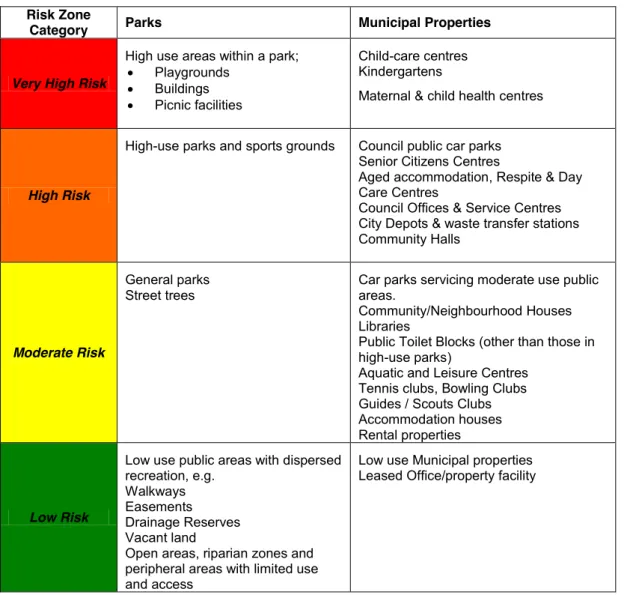
The scheduling of inspections does not negate the client request system available to residents and other stakeholders for requesting work on trees. The works produced from tree requests, once inspected, can be prioritised according to the level of risk. Council managed facilities and properties that contain trees are allocated into risk zones. The zones, categorised as Very High Risk, High Risk, Moderate Risk and Low Risk, designate how these areas are to be treated with regard to the type and timing of scheduled tree inspections. The zones are based on the tree resource and the occupancy of the area surrounding the trees.
The risk zone determines the timing of scheduled tree inspections of Council assets; for example, Very High Risk zones require assessment every year, whereas Moderate Risk zones require inspection every 3-5 years. The method of scheduled inspection will also vary depending on the risk zone and asset type.
The first step is the inspection of the trees within the asset, which consists of either an on ground or drive-by/windshield visual inspection to determine if there are any trees that are hazardous and therefore, require maintenance works or a more detailed inspection. This inspection would be recorded on Council’s Asset Management System.
The second step is to record and detail relevant information as to the location, species, size, health and structure of trees requiring maintenance works. This process involves a consistent, repeatable inspection process to identify and evaluate hazards within the trees. This assessment is also used for inspections performed through the works request system and for planning application requests. The tree inspection reports will also determine the priority for works required from the inspection.
Utilising this process, City assets containing trees will be inspected based on a scheduled basis. The inspections will generate maintenance works that will be prioritised. Priority for completing the works could vary within a site based on potential targets; for example, trees requiring work near facilities could be completed before those in open space or low use areas.
Implementation of scheduled asset tree inspections, with follow-up maintenance if required, shifts the activities of managing the tree resource from reacting to incidents as they occur, to proactive management to mitigate future incidents.
13 2.3 Identifying tree risk zones within the City
To assist the City of Boroondara with the prioritising of scheduled inspections, all Council assets with trees that require inspection are allocated into tree risk zones. The Senior Arborist will determine allocation of Council managed assets and facilities into risk zones and inspection frequency.
Determining the level of risk for each asset and therefore the corresponding zone is based on:
Public use and occupancy patterns within public areas, which could be considered to be low, moderate or high;
Tree resource characteristics, including tree condition, such as species characteristics or age, and location factors, for example the position of trees in relation to areas used by the public.Table 1 presents the risk classification of assets within the City of Boroondara. The colour coding system of red, orange, yellow and green can also be plotted onto a map or GIS system to visually articulate the risk zones.
Individual assets may be classed into different risk categories from similar asset types based on further considerations, for example, the presence of known ‘problem’ species, declining tree populations, or different occupancy levels to similar assets. Table 1: Tree risk zone categories (Adapted from Pokorny 2003).
Risk Zone
Category Parks Municipal Properties
Very High Risk
High use areas within a park;
Playgrounds
Buildings
Picnic facilities
Child-care centres Kindergartens
Maternal & child health centres
High Risk
High-use parks and sports grounds Council public car parks Senior Citizens Centres
Aged accommodation, Respite & Day Care Centres
Council Offices & Service Centres City Depots & waste transfer stations Community Halls
Moderate Risk
General parks Street trees
Car parks servicing moderate use public areas.
Community/Neighbourhood Houses Libraries
Public Toilet Blocks (other than those in high-use parks)
Aquatic and Leisure Centres Tennis clubs, Bowling Clubs Guides / Scouts Clubs Accommodation houses Rental properties
Low Risk
Low use public areas with dispersed recreation, e.g.
Walkways Easements Drainage Reserves Vacant land
Open areas, riparian zones and peripheral areas with limited use and access
Low use Municipal properties Leased Office/property facility
14 2.4 Risk zones within parks and reserves
High-use parks will be inspected on a more regular basis than moderate to low use park. There will also be areas within particular open space (parks / reserves / sports grounds) that will present a higher risk due to tree type, condition and location. For example, trees around a playground, toilet block or car park, may present higher risk than trees on the periphery of the space, adjacent to semi-natural areas where occupancy rates are lower and targets are low.
Park facilities that attract high public use and are within the fall-zone of an adjacent tree will be inspected on an annual basis, e.g. playgrounds, pavilions and picnic facilities.
The general open space areas in high-use parks will be inspected on a two-year cycle. All areas within a site will be inspected at that time. Assessment of the trees and the level of work required will be based on the targets near the tree and the level of risk. A quantified assessment to establish tree risk can be used to determine risk thresholds.
2.5 Rating roads for tree risk
The risk management of street trees within roads is encapsulated within the routine tree maintenance cycle. The street trees located in the road reserve of every suburb are inspected and maintained on a two (2) year cycle.
The Contractors responsible for the management of street trees within the City, record details of street tree inspection and assessments.
Consideration is given to the road hierarchy, use and occupancy of the road, as well as the tree resource and expected management inputs.
Main roads and roads around commercial areas may need to be inspected on a more regular basis. The scheduling of inspections will take into consideration the tree condition and size, for example established avenues like Mont Albert Road and sections of Balwyn Road will be inspected on a more regular basis than Camberwell Road or Belmore Road, which have smaller, more recent plantings.
The Senior Arborist will determine scheduling of tree inspections on main roads. 2.6 Tree risk zone inspection schedule
Scheduling of asset tree inspections in the risk zones is based on the classification of each zone. Therefore, trees in municipal assets in Very High Risk zones are inspected more frequently than, for example, those classified into Moderate Risk zones.
The type of inspection for municipal properties, parks and reserves will primarily be via ground based visual assessments with follow-up detailed inspections if required. Initial assessment of roads will be via drive-by/windshield tree inspections. If potentially hazardous trees are identified by Council arborist’s then more detailed tree inspection procedures would be implemented.
Table 2 recommends minimum guidelines for inspection schedules and methods for each risk zone.
15 Table 2: Tree risk zone assessment methods and inspection schedules
(Adapted from Pokorny, 2003)
Risk Zone Category Timing of Inspections Suggested Inspection Method
Very High Risk
Annual Scheduled Tree Inspections
Ground – municipal properties, parks reserves & roads
Individual tree inspections
High Risk
1-2 years Scheduled Tree Inspections Ground – municipal properties, parks reserves
Drive-by/windshield – roads Individual tree inspections
Moderate Risk
3-4 years Scheduled Tree Inspections Ground – municipal properties, parks reserves
Drive-by/windshield – roads Individual tree inspections
Low Risk
5-7 years Scheduled Tree Inspections Ground – municipal properties, parks reserves, vacant land, leased properties
All Zones
After severe storms Resident observations & requests Scheduled maintenance programs Other Council employees
Emergency services Community requests
Individual tree inspections (if required)
2.7 Tree risk assessment methods
Tree inspections within the municipality will be undertaken by qualified and experienced arborists that can demonstrate good judgement based upon sound arboricultural knowledge utilising a range or combination of tree assessment methods dependent on condition of the trees, their location, land use and perceived risk. The underlying principles of the tree assessment are reiterated in the Visual Tree Assessment (VTA) method developed by Mattheck and Breloer (1997).
The VTA is a method of evaluating structural defects and stability in trees. The first stage is the visual inspection of the tree for defect symptoms and vitality. If problems are suspected on the basis of symptoms a thorough examination is carried out. If a defect is confirmed it could be measured or further diagnostic work undertaken, for example testing the strength of the defective tree part, root plate investigation, or pathogen identification.
i) Drive-by / Windshield assessment method
The assessment of roads can initially use a drive-by / windshield inspection method. One person drives a vehicle slowly along the road while another person inspects and records the trees. Drive-by inspections could use two passes along the road. The first pass is to get a feel for the tree resource and the second to evaluate and record the trees that require work. Windshield surveys are most efficient when the arborist is looking for one or two particular tree characteristics.
16 The assessment aims to identify visual indicators of faults or road clearance issues, which suggest a tree requires further inspection. The method is limited in that it can only assess defects that are visible from the road, as only that side of the tree will be visible. Furthermore, even on the visible side, small defects, such as narrow cracks or girdling roots, may not be apparent. Rooney et al. (2005) compared the reliability of windshield inspections to walk through inspections. They found that the reliability of identifying highly hazard trees with the windshield method was as high as 89%, but the inclusion of less hazardous defects decreased the reliability to as low as 58%. In short, the method is better in picking major, more visible hazards than minor hazards. Given the resource limitations of some communities, drive-by / windshield inspections can provide a cost-effective approach to assess large areas or long sections of roadside vegetation. This method may also be useful after storms, where damage to trees or fallen branches may be visible from the road.
The main factor in deciding when and where to use the windshield survey is efficiency. Some limitations of the survey method are outlined below:
The windshield survey works well in low-traffic areas as in high-traffic areas the drivers and assessors are concerned about the traffic. In high-traffic areas, walking or using other means, such as a bicycle to move from tree to tree, would be advisable.
Poor weather conditions can limit visibility and delay assessment schedules. If the trees are not well maintained the method may not be suitable due to the
volume of work it generates or that some tree defects may be missed, a thorough street tree inventory may be the best choice. If the trees are reasonably maintained, the windshield survey could be used just to locate quickly developing hazardous conditions such as hanging branches or recent storm damage.
The drive-by / windshield inspection method can also be used for regular update of streetscape conditions for the development of planting programs.
ii) Ground inspection assessment method
Ground inspections of trees can be used for scheduled tree inspections of Council managed properties and parks. The method can also be used to undertake more detailed inspections of street trees.
The process consists of a walk through inspection of trees located in a site. In remote sites in may only be necessary to inspect trees within striking distance of a target. The inspection is based on overt, visual indicators of faults that suggest a tree requires further inspection. Trees should be inspected from all sides for indicators of tree defects, not limited to (adapted from Pokorny 2003):
Dead tree – a dead tree or branches.
Decline – Reduced vigour, crown thinning or dieback.
Decay – wood that has rotten or is missing from trunk or major structural branches, includes cavities, holes, open cracks, bulges or fungal fruiting bodies.
Crack – a split through the bark into the wood where the wood has separated, in the trunk or major branches.
Root problems – inadequate anchorage of the roots, includes dead, severed, decayed, or girdling roots, trunk lean, or evidence of soil root movement, soil movement or soil lifting.
17 Weak branch union - an epicormic branch attachment or branch union with included bark includes co-dominant stems or unions of large branches. Pronounced collar formation.
Poor architecture – growth patterns indicate structural imbalance or weakness in the branch, stem or tree.
Other considerations are altered growing conditions, for example excavation, increased exposure.
This method may not detect all problems with all trees, yet it should identify the majority of major faults or those most likely to cause harm.
2.8 Additional inspections
If required, the initial tree inspection can lead to additional assessments, for example: A quantified risk assessment, which involves recording of the target value and occupancy rates to determine a probability of harm;
An aerial inspection of the tree crown; Root plate investigation;
Diagnostic works, e.g. pathogen identification, decay detection. 2.9 Quantified risk assessments
It may be occasionally necessary to further define the level of risk using a numerical or quantified tree assessment method. This component can help identify acceptable risk levels and priority for action.
These detailed risk assessments estimate the degree of risk associated with a given tree to fail and potentially injure persons or damage property. There are many evaluation systems that rate the risk of damage or injury posed by a defective tree or tree part Paine (1971), Helliwell (1990, 1991), and Matheny and Clark (1994), Forbes-Laird (2007) and Ellison) 2005). Some systems define a numerical risk value while others are categorical, e.g. low to very high.
As far as hazards are concerned, the need is to be able to quantify them and any associated risk, so that the risk can be kept within acceptable or reasonable limits, without implementation of disproportionate risk control measures, e.g. unnecessary tree removal. The use of quantification in the assessment of tree hazards will enable managers to operate, as far as is reasonably practicable, to a predetermined limit of reasonable or acceptable risk.
Once a threshold has been reached, according to a particular risk assessment method, action can be instigated to mitigate the risk or the quantified level of tree risk can be presented to appropriate Council Officers for a decision on the management of the tree.
Tree risk assessment methods generally consider three components of tree failure: risk-target value, probability of failure, and impact potential.
18 2.10 Programming works
Tree maintenance generated through the tree risk management process will be recorded and scheduled for works. Trees recommended for removal will be subject to the tree removal procedures outlined in Section 3.
Completed works will be documented and recorded with the asset tree inspection details.
2.11 Emergency work - Immediate hazard
Emergency work is defined as tree removal required due to the immediate risk of damage to property or personal safety as deemed by a suitably qualified person. A tree must only be removed as emergency work if it is considered to be hazardous or structurally unsound and is likely to fail in the near future and there is a potential target.
A record of trees removed under the emergency work provisions will be maintained to ensure replanting occurs, where replacing is appropriate.
Notification of nearby residents may be required in accordance with 3.8 Notification of removals / works to residents and committees.
2.12 Documentation systems
The key to the success of tree risk management program is accurate and current documentation. Accurate recording of all aspects of Council’s tree assets provides management with clear information on the resource being managed and enables the tracking of issues related to specific trees.
Council will develop and implement recording systems either in line with current systems, for example the Asset Management System, or independently to document and record information related to the tree asset. The system should address the following requirements:
A clear documented procedure for inspection of assets and trees detailing relevant information as to the location, species, size, health and structure of public trees within the City.
A documented system of logging customer requests or notification of problems with respect to public trees.
A documented system for assessing the risk posed by trees identified and prioritising the risk posed by such trees.
A documented system for addressing the risks posed through appropriate maintenance procedures for abating risks identified consistent with the general financial constraints upon the authority having regard to its general responsibilities.
Adapted from Gardner (2005) 2.13 Method of review
In line with AS/NZS 4360:2004 (Risk Management) ongoing review is essential to ensure that tree risk management remains relevant. Factors that affect the likelihood of inspection activities may change, for example, severe drought may cause rapid tree decline prompting the need for more frequent inspections. Similarly, knowledge
19 gained through experience and implementation of tree management could provide beneficial insights and allow refinement of tree risk management.
Monitoring and review also involves learning lessons from the risk management process, by reviewing events, the treatment plans, and their outcomes.
The tree risk management program will be reviewed every five years. The process will include reassessment of Council’s asset classification into risk zones, and evaluation of the tree inspection and assessment methods and recording processes.
20
3.0
TREE REMOVAL
Guiding principles
The City of Boroondara will seek to avoid tree removal wherever possible. Tree removal is an acceptable management option in road reserves, parks and other Council managed land when required for public health and safety, to protect infrastructure, to facilitate approved development and infrastructure improvements, to maintain a healthy urban forest or for ecological restoration.
Tree removal in road reserves, public open space and Council managed properties will meet the following objectives:
Council will investigate all tree management options prior to the recommendation
for tree removal.
Council will consider the removal of trees where necessary in order that the City’s
landscapes are reinvigorated and maintained with regard to safety.
In all cases, tree removals will be conducted within the procedures outlined and in
regard to tree assessment and risk management procedure (See section 2) and with minimal environmental impacts.
Council will consult and inform the community about all major projects involving
tree removal. 3.1 Introduction
This policy for the removal of trees on Council managed land (parks, reserves and road reserves) for the City of Boroondara is to be referred to by all Council officers when assessing a proposal for tree removal.
All avenues and stands of trees have a finite lifespan and at some point in time trees need to be removed and replaced. As trees age they require more and more management to maintain them in a reasonably safe and attractive condition. Consequently, a difficult decision has to be made about how to manage mature trees and avenues, including how, when and over what period of time to replace old or declining trees.
Significant reductions of mature trees would not be generally considered as good practice or acceptable. It is also not good practice to artificially keep trees in a position that they are clearly unsuitable for.
Trees provide many benefits but in all situations close to people or property, safety must be the priority consideration above economics, amenity or sentiment. In addition, managers of public open space have a duty of care under law to ensure that a reasonable degree of safety is maintained. The measure for action is hazard potential.
Risk potential is related to the tree/tree part size, tree structure/hazard and the number of targets that it could hit. As trees grow bigger their potential to cause damage increases; as tree structure becomes more suspect so the probability of failure increases; as the number and value of targets that could be hit increases so the potential cost of damage or injury increases.
All trees are capable of shedding branches and no guarantee of absolute safety can ever be given to a living dynamic organism. It would be unreasonable and unnecessary to remove every tree on the basis that it may have the potential to cause harm or damage.
21 The priority when managing trees with a high hazard potential should be to reduce the risk to an acceptable level or to mitigate it entirely. This can be achieved through removing the tree, removing the targets or treating the tree.
Removing targets from beneath established trees is often impractical, particularly in a street situation. It may be possible to barricade a tree located in public open space with suspect structure to restrict access thus eliminating target potential.
Treating the tree can include canopy management techniques such as reduction pruning, crown maintenance and the installation of hardware to reinforce or arrest failing structures.
All tree management options will be investigated prior to the recommendation for removal.
3.2 General guidelines for tree removal
A set of tree removal criteria is used to prevent indiscriminate removal. Wildlife habitat is considered a factor in making all tree management and removal decisions. Trees and groups of trees may be removed only when one or more of the following criteria are met:
The tree or tree group poses a severe safety hazard that cannot be corrected by pruning, transplanting or other treatments. The tree risk assessment and Council’s Risk Management Officer perceives an unacceptable risk.
The tree or tree group severely interferes with a neighbouring tree or tree group to the extent that neither tree can develop to its full potential. The more desirable tree will be preserved.
The aesthetic values of the tree or tree group are so low or negative that the site is visually enhanced by the trees removal.
Trees or tree group is dead or close to death.
The tree or tree group poses an extreme public nuisance because of its species, size, location or condition. The nuisance could be caused by excessive fruit or seed drop, suckering, harbouring of insects or excessive twig or limb breakage. Work improvements or infrastructure repair or maintenance required to be made
around the tree or tree group will kill or render the tree a hazard or significantly impact on the trees condition and useful life expectancy.
The tree may be found to be substantially contributing to damages or nuisance to public or private property and no other viable means are available to rectify the situation.
The tree or tree group is infected with an epidemic insect or disease where the recommended control is not applicable and removal is the recommended practice to prevent transmission.
The tree or group of trees is a recognised woody weed species.
The tree or group of trees is included in the Street Tree Replacement Program (See section 5.4.2)
The tree or tree group needs to be inspected and assessed for the above criteria by a suitably qualified person. Tree health (vigour), structure, useful life expectancy, and hazard potential must be assessed.
22 3.3 Tree removal associated with allergic reactions
Trees can cause allergic reactions to people. Examples of tree taxa include the plane tree, cypress, silver birch, maple, olive, pine, poplar, ash, wattle, tea-tree and oak (Allergy Net Australia, 2002), which are all commonly grown ornamental trees in Melbourne.
In relation to vegetation and pollen production the pasture grasses and weeds are the worst offenders. Melbourne has millions of hectares of grassland to the north, and spring in Victoria is characterised by hot, gusty northerly winds, which carry the pollen over Melbourne.
Melbourne can become quite polluted, as it is a large city with a great number of cars and a great deal of industry, particularly to the west. This type of pollution has been shown to increase allergies.
In order to clarify the cause of personal allergies there should be a requirement to undertake scientific/medical testing to ascertain the causal agents of the allergies. A reaction to these tests however, does not necessarily mean the substance reacts in the lungs (Asthma Victoria, 2001) and may not provide definitive answers as to the cause of the allergy.
It would seem that the removal of problem trees alone would not solve the problem of allergenic reactions within people. There are simply too many other species of plant that cause the same responses and there are extenuating circumstances in Melbourne that can exacerbate the condition.
Therefore tree removal will be considered when:
medical testing indicates a particular tree species growing on Council managed land is causing the allergy; or
Council’s Risk Management Officer perceives an unacceptable risk; or
the tree fulfils one of the criteria under 3.2General guidelines for removal in this policy.
3.4 Tree removal associated with infrastructure improvements by Council or other authority
There will be instances where utility companies, Council and other public authorities require the removal of trees to facilitate the construction of new infrastructure or the maintenance of existing infrastructure.
As part of a consultation process with the relevant authorities or Council department, design and construction alternatives should be sought.
If alternatives cannot be established and the project cannot be reasonably re-routed away from the tree(s) and the infrastructure works require the removal of the trees or the works will have detrimental impact on the health and structure of the trees, residents visually affected by the tree removal will be notified of the proposed tree removal as outlined in 3.8 Notification of removals / works to residents and committees.
3.5 Unauthorised tree removal
If a Council managed tree or group of trees is removed by any person or authority without Council authorisation, that person or authority may be subjected to
23 enforcement action under the jurisdiction of the City of Boroondara Local Law. That person or authority shall also meet the full cost of reinstatement (purchase of an advanced tree, tree planting and a minimum two-year tree establishment period) of the tree within the landscape. See Section 13 – Tree Valuation.
3.6 Planning Scheme Overlays & Provision 52.17 - Native Vegetation
The Boroondara Planning Scheme has three Overlays and one particular Provision within the municipality that applies to vegetation.
The Overlays are located primarily along the banks of the Yarra River from Balwyn North, Kew through to Hawthorn. The Overlays are as follows:
Significant Landscape Overlay (SLO) Environmental Significance Overlay (ESO) Vegetation Protection Overlay (VPO)
A permit is required to remove destroy or lop vegetation as specified in the Overlay. Exemptions apply.
Provision 52.17 - Native Vegetation applies to all areas within the City that have a cumulative area greater than 0.4 hectares. The provision focuses on the retention of Victorian Native species and offsetting what is removed. Exemptions apply.
When required, Parks and Gardens will consult Statutory Planning for advice and direction when removing vegetation in these areas.
3.7 Procedures for tree removal 3.7.1 Removal requests
Tree removals may be generated through either Council Officers and approved Parks and Gardens contractors as part of on-going maintenance works and inspections or via residents.
Residents may request a tree removal by contacting Parks and Gardens. All requests for tree removal shall be recorded, inspected and assessed by a suitably qualified person.
3.7.2 Approvals
All approvals for removal of a significant tree or non-significant tree on Council Managed Land shall be authorised as outlined in 1.4.2 and 1.4.3.
Where removal is not justifiable because a tree does not meet one of the criteria under 3.2 General guidelines for tree removal in this policy and a member of the community insists on such action, a standard format letter of refusal is to be sent by the Senior Arborist.
3.7.3 Appeals
Residents or other interested parties may appeal a Council Officer decision to have a tree removed or retained on Council Managed Land.
24 If a resident or other interested party insists on the removal or retention of a tree despite advice and assurances from the Senior Arborist or delegated officer(s) that the contrary or an alternative is more appropriate, this request must be in writing and addressed to the Manager Parks and Gardens. Following receipt of the written request, the Manager Parks and Gardens shall initiate the appeal process as outlined in section 1.6.
3.7.4 Costs of tree removal
Costs for the removal of a tree that complies with the General guidelines for removal shall be borne by Council.
If through an appeal process (See section 1.6) a healthy tree located on Council managed land is approved for removal and its condition does not comply with any of the General guidelines for removal, in the majority of instances, the party requesting the tree removal will incur the full cost imposed upon Council for the tree's removal, purchase of an advanced tree, tree planting and a minimum two-year tree establishment period. See Section 13 – Tree Valuation.
The costs assigned to the value of a tree will be established by Council, based on current suppliers of such goods and services. Planting of a replacement tree ensures no net loss of Council managed trees.
Application of the City of Boroondara Amenity Value Formula may also be applied in some instances. The Amenity Value Formula can be seen in Appendix 7.
3.7.5 Request / response times
Requests shall be actioned within the following time frames; Imminent danger - immediate action
Identified as hazardous - 2 working days
Require removal, but not hazardous - as soon as possible Stump removal - within 4 weeks of tree removal.
Tree replacements - the following planting season. 3.7.6 Inspection of a hazardous tree
All Council trees reported as being unsafe or hazardous by the public or identified as being of concern by staff are to be inspected by an appropriately qualified and experienced Arborist.
3.7.7 Records
If a significant tree (See 1.4.2) is removed, a tree inspection report, including photographs and the details of the removal are to be entered into Council’s Asset Management System. The report and photograph is to be maintained for a period of no less than (12) twelve months.
3.8 Notification of removals / works to residents and committees
The Notification to relevant committees or residents of any proposed action must include details of relevant arrangements for stump removal, site reinstatement and tree replacement.
In emergency situations notification prior to removal may not be possible, but follow-up advice, including notification details, must occur within one (1) workday.
25 3.9 Notification for Non-Significant Trees
3.9.1 Road Reserves
At the time of tree removal works being undertaken in a road reserve, the resident immediately adjacent to the site is to be given written or verbal notice of the proposed action including arrangements for stump removal, reinstatement & tree replacement. 3.8.2 Parks, Reserves and other Council Managed Land
No resident, management or Park Committee notification is required for the removal of Non-Significant trees in parks, reserves and other Council managed land.
3.10 Notification for Significant Trees 3.10.1 Road Reserves
Prior to the works being undertaken in a road reserve, residents immediately adjoining or adjacent to the site (''visually'' affected by the trees removal) are to be given no less than fourteen (14) days written notice of the proposed action, including arrangements for stump removal, reinstatement & tree replacement.
When more than 30% of street trees are to be removed from a given street or location and their removal may impact upon the wider community the following will apply. Resident and Ward Councillor notification will be undertaken as above.
Signage, that explains the reason/s for tree removal and providing Council contact details for further information, will be erected no less than fourteen (14) days prior to the proposed works occurring. Size of signage will be:
o A2 – Residential Streets; o A1 – Main & Secondary Roads.
3.10.2 Parks, Reserves and other Council Managed Land
Prior to the work being undertaken in parks, reserves or other Council managed land, any Park Committee, Friends of Group or residents immediately adjoining or adjacent to the site (''visually'' affected by the trees removal) are to be given no less than 14 days written notice of the proposed works, including arrangements for stump removal, reinstatement & tree replacement.
When the extent of tree removal works are significant enough to have an impact upon the wider community, signage that explains the reason/s for tree removal and providing Council contact details for further information will be erected no less than 14 days prior to the proposed works occurring. Size of signage will be a minimum A3. When considerable community concern is expressed following notification of the removal of a tree or group of trees, the Senior Arborist will refer the matter to the Manager Parks and Gardens.
The Senior Arborist will provide a brief ‘objective overview’ report to the Manager Parks and Gardens that describes the arboricultural issues concerning the removal of the tree or group of trees
The Manager Parks and Gardens will either base his/her decision upon the information contained within the report from the Senior Arborist or,
26 determine to obtain an independent report from a qualified arborist to confirm
the arboricultural issues or,
refer the matter to the Director Environment and Infrastructure for review in accordance with this policy.
The Manager Parks and Gardens will inform the Ward Councillor of the issues regarding the tree removal or retention.
A public meeting may result dependent on the community response where the issues associated with the proposed works will be presented. Proposed tree removals may be part of a broader landscape concept plan in which case other representatives of the project can be present to convey their particular views of the works.
The decision to hold a public meeting will be at the discretion of the Manager Parks and Gardens in accordance with Council’s commitment to community consultation and engagement.
27
4.0
STREET TREES AND NEW VEHICULAR CROSSOVERS
Guiding principles
Application for the construction of a vehicular crossover must be in accordance
with Council’s Vehicular Crossover Policy for Individual Residential Property Titles.
Street trees shall not be removed to accommodate a new or altered vehicular
crossover unless they meet one of the criteria under 3.2 General guidelines for tree removal in this policy.
4.1 Investigation into potential impacts on street trees from new vehicle crossovers In accordance with Council’s Vehicular Crossover Policy for Individual Residential Property Titles, the minimum distance (separation) from the edge of a new proposed crossover to existing street trees is 2.0m.
In some instances, the minimum distance of 2.0m may be increased at the discretion of the Senior Arborist or delegated officer(s). Typically, this will occur where the subject tree is identified as a significant specimen (See section 1.4.2) or part of a significant treed avenue and tree health is likely to be compromised by the proposed crossover.
A non-destructive root investigation may be required to ascertain potential impacts to an established street tree as a result of a new vehicle crossover.
The aim of a non-destructive root investigation is to ascertain the extent of major roots in the vicinity of a proposed new vehicle crossover while minimising the damage to the root system. Non-destructive root investigations can be undertaken utilising hand digging, or hydraulic and/or pneumatic excavation equipment.
The recommendation to undertake such works will be made by the Senior Arborist or delegated officer(s).
The cost of a non-destructive root investigation will be borne by resident and/or developer requesting the new vehicle crossover.
If Council determines that the works have the potential to damage community owned assets, in this case street trees, Council will require that an Asset Protection Permit be obtained prior to the work commencing.
4.2 Transplant/Relocate existing street tree to accommodate new vehicle crossover It may be possible to transplant/relocate an existing street tree to accommodate a new vehicular crossover. This will only be applicable to a tree that has been planted within the last two years.
The potential to transplant/relocate an existing street tree will be based on the opinion of the Senior Arborist or delegated officer(s).
The tree will be relocated to an agreed location on the naturestrip outside the subject property. If an appropriate site on the naturestrip outside the subject property is not feasible, the tree will be planted elsewhere in the same street or local neighbourhood. Tree transplant/relocation will be subject to the following terms: