University of South Florida University of South Florida
Scholar Commons
Scholar Commons
Graduate Theses and Dissertations Graduate SchoolApril 2019
Security Framework for the Internet of Things Leveraging Network
Security Framework for the Internet of Things Leveraging Network
Telescopes and Machine Learning
Telescopes and Machine Learning
Farooq Israr Ahmed ShaikhUniversity of South Florida, [email protected]
Follow this and additional works at: https://scholarcommons.usf.edu/etd Part of the Electrical and Computer Engineering Commons
Scholar Commons Citation Scholar Commons Citation
Shaikh, Farooq Israr Ahmed, "Security Framework for the Internet of Things Leveraging Network Telescopes and Machine Learning" (2019). Graduate Theses and Dissertations.
https://scholarcommons.usf.edu/etd/7935
This Dissertation is brought to you for free and open access by the Graduate School at Scholar Commons. It has been accepted for inclusion in Graduate Theses and Dissertations by an authorized administrator of Scholar Commons. For more information, please contact [email protected].
Security Framework for the Internet of Things Leveraging Network Telescopes and Machine Learning
by
Farooq Israr Ahmed Shaikh
A dissertation submitted in partial fulfillment of the requirements for the degree of
Doctor of Philosophy
Department of Electrical Engineering College of Engineering
University of South Florida
Co-Major Professor: Nasir Ghani, Ph.D. Co-Major Professor: Elias Bou-Harb, Ph.D.
Ismail Uysal, Ph.D. Zhuo Lu, Ph.D. Srinivas Katkoori, Ph.D.
Date of Approval: March 13, 2019
Keywords: Darknet, Ensemble Learners, Deep Learning, Network Statistics Copyright c 2019, Farooq Israr Ahmed Shaikh
Dedication
To my mother, Reshma, for being my mentor, fan, critic, friend and my inspiration. To my beloved father, Israr Ahmed, for believing in me.
Acknowledgments
I would like to acknowledge and dedicate my gratitude to the following who made the completion of this work possible:
God, for giving me strength, capability and perseverance.
My mother, Reshma, and my sister, Fatima, for their unconditional love and support. My supervisor, Dr. Nasir Ghani, for believing in me and his continuous help and advise-ment throughout my Ph.D. study.
My co-supervisor, Dr. Elias Bou-Harb, for his contribution and continuous assessment throughout my research.
My dissertation committee members, Dr. Ismail Uysal and Dr. Zhuo Lu, for their valuable suggestions and advice on this dissertation work.
My former and current research colleagues, Dr. Hao Bai, Dr. Mahsa Pourvali, M.E. Andrea Wright, Dr. Mohammed Jasim, M.E. Nazli Siasi and Mr. Aldin Vehabovic, for their collaboration.
My friends at the Whitehatters Computer Security Club, especially M.E. Kristopher Willis and Mr. Brad Daniels, for their support and encouragement.
Table of Contents
List of Tables . . . iii
List of Figures . . . iv Abstract . . . vi 1 Introduction . . . 1 1.1 Background Overview . . . 1 1.2 Motivations . . . 3 1.3 Problem Statement . . . 5
1.4 Proposed Work and Contributions . . . 6
2 Background and Related Work . . . 8
2.1 Survey on the Internet of Things . . . 8
2.2 Survey on IoT Security Threats . . . 11
2.3 Survey on Machine/ Deep Learning Applications in IoT . . . 14
2.4 Applications in Intrusion Detection System . . . 17
2.5 Survey on SDN/NFV Solutions for IoT Security . . . 21
2.6 Open Challenges . . . 24
3 Correlating Active and Passive Measurements to Infer and Characterize Unsolicited IoT Devices . . . 25
3.1 Notation Overview . . . 26
3.2 Inferring and Characterizing Internet-Scale Compromised IoT Devices . 27 3.2.1 Exploiting Network Telescopes . . . 28
3.3 Leveraging Internet-Wide Scanning . . . 30
3.4 Correlating Active and Passive Measurements . . . 31
3.5 Generating IoT-Specific Malicious Signatures . . . 32
3.6 Sharing of IoT Unsolicited Empirical Threat Information . . . 34
3.7 Empirical Evaluation . . . 36
4 Malicious IoT Device Classification using Machine Learning . . . 42
4.1 Notation Overview . . . 43
4.2 Exploiting Network Telescopes to Infer Malicious IoT Behavior . . . 44
4.3 Darknet Data Categorization . . . 45
4.3.1 Scanning . . . 46
4.4 Feature Extraction from Network Telescopes . . . 48
4.5 Data Processing . . . 49
4.6 Machine Learning Models . . . 51
4.6.1 Random Forest . . . 54
4.6.2 Gradient Boosting . . . 55
4.6.3 AdaBoost . . . 56
4.7 Performance Evaluation . . . 57
5 IoT Threat Detection Leveraging Network Statistics and GAN . . . 63
5.1 Experimental Setup . . . 64
5.2 Attack Methodology . . . 67
5.3 Overview of GAN . . . 69
5.3.1 ALI GAN . . . 72
5.3.2 AnoGAN . . . 73
5.4 Data Processing and Feature Selection . . . 75
5.5 Performance Evaluation . . . 77
6 Concluding Remarks . . . 82
6.1 Summary of Research Findings . . . 83
6.2 Future Work . . . 86
References . . . 87
Appendix A Proof of Copyright Permissions . . . 96
List of Tables
Table 1 List of variables . . . 27
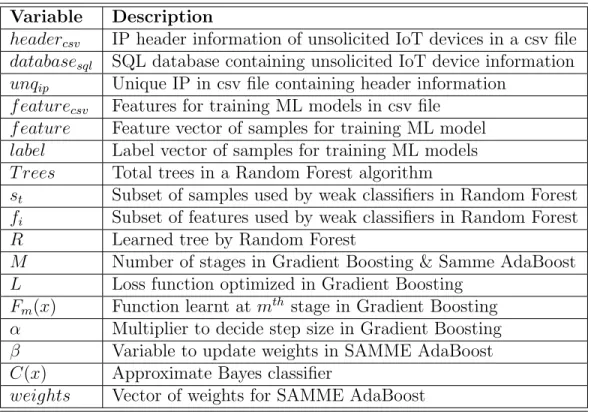
Table 2 List of variables . . . 44
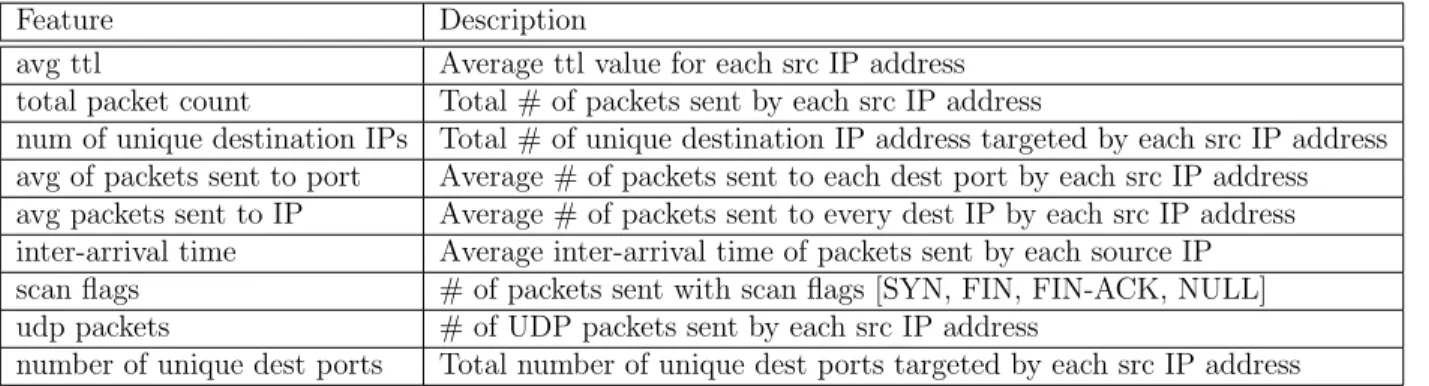
Table 3 Features for training ML algorithms . . . 50
Table 4 Recall and precision values for the January 2017 dataset . . . 60
Table 5 Recall and precision values for the February 2017 dataset . . . 60
Table 6 Recall and precision values for the March 2017 dataset . . . 60
Table 7 Exploits against Netgear DGN 2200 . . . 68
Table 8 Attacks against IoT network . . . 69
Table 9 Description of GAN models . . . 75
List of Figures
Figure 3.1 Network telescopes capturing Internet-scale IoT unsolicited traffic . . . . 29
Figure 3.2 Correlation algorithm for unsolicited IoT device identification . . . 32
Figure 3.3 Inferring and mitigating Internet-scale unsolicited IoT devices: A network telescope approach . . . 35
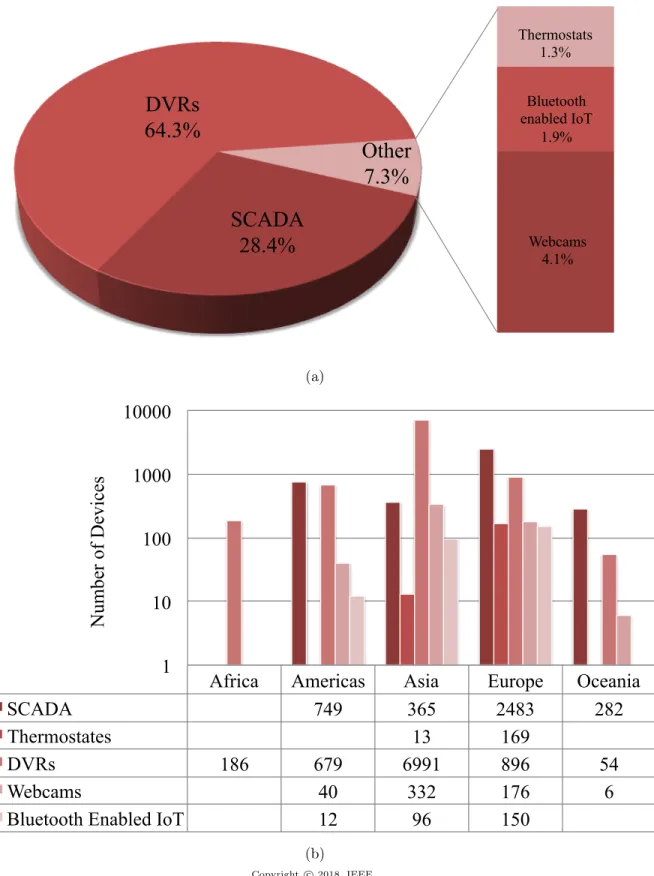
Figure 3.4 IoT devices: a) signatures and b) distributed by types . . . 39
Figure 3.5 Exploited IoT devices: a) by types and b) by type and region . . . 40
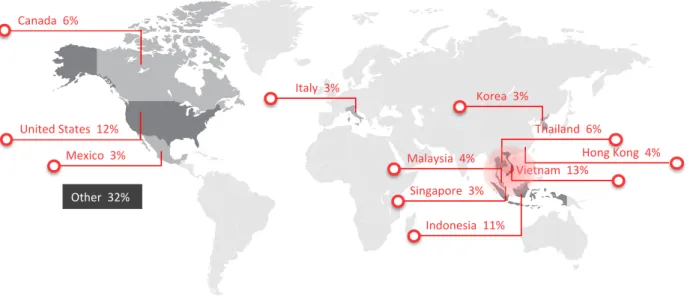
Figure 3.6 Global distribution of exploited IoT devices . . . 41
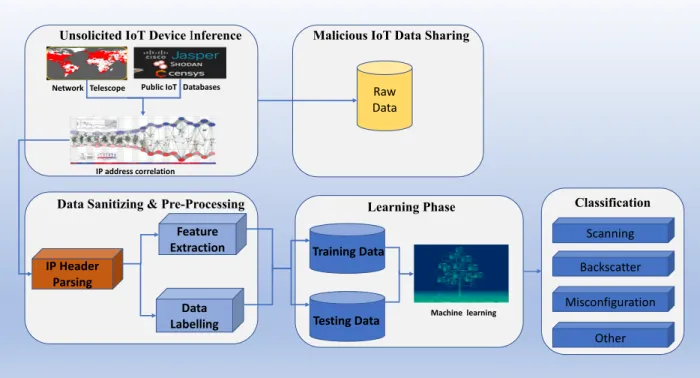
Figure 4.1 Proposed IoT device classification methodology . . . 51
Figure 4.2 Data labelling and feature selection algorithm . . . 51
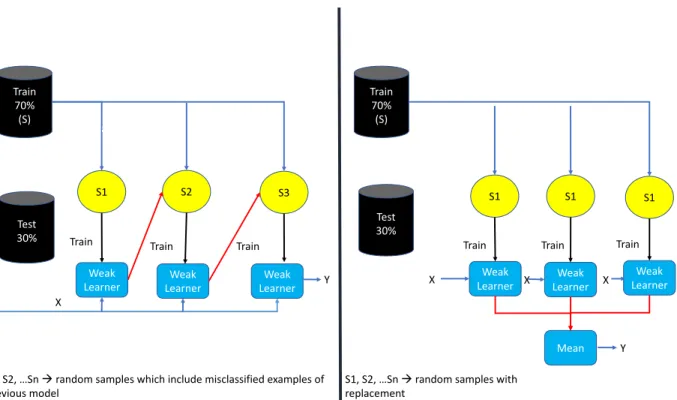
Figure 4.3 Boosting vs Bagging . . . 53
Figure 4.4 Random Forest algorithm . . . 54
Figure 4.5 Gradient Boosting algorithm . . . 55
Figure 4.6 SAMME AdaBoost algorithm . . . 56
Figure 4.7 Recall and precision scores for: a) January 2017 and b) February 2017 . 61 Figure 4.8 a) Recall and precision scores for March 2017 and b) categorization based on activity . . . 62
Figure 5.1 Holistic overview perspective of the experimental testbed attack setup . . 64
Figure 5.4 Overview of ALI GAN framework . . . 73
Figure 5.5 ALI GAN model for IoT threat detection . . . 74
Figure 5.6 GAN performance on a) 3 IoT devices b) 31 IoT devices . . . 80
Abstract
The recent advancements in computing and sensor technologies, coupled with improve-ments in embedded system design methodologies, have resulted in the novel paradigm called the Internet of Things (IoT). IoT is essentially a network of small embedded devices enabled with sensing capabilities that can interact with multiple entities to relay information about their environments. This sensing information can also be stored in the cloud for further analysis, thereby reducing storage requirements on the devices themselves. The above fac-tors, coupled with the ever increasing needs of modern society to stay connected at all times, has resulted in IoT technology penetrating all facets of modern life. In fact IoT systems are already seeing widespread applications across multiple industries such as transport, utility, manufacturing, healthcare, home automation, etc.
Although the above developments promise tremendous benefits in terms of productivity and efficiency, they also bring forth a plethora of security challenges. Namely, the current design philosophy of IoT devices, which focuses more on rapid prototyping and usability, results in security often being an afterthought. Furthermore, one needs to remember that unlike traditional computing systems, these devices operate under the assumption of tight resource constraints. As such this makes IoT devices a lucrative target for exploitation by adversaries. This inherent flaw of IoT setups has manifested itself in the form of various distributed denial of service (DDoS) attacks that have achieved massive throughputs without the need for techniques such as amplification, etc. Furthermore, once exploited, an IoT device can also function as a pivot point for adversaries to move laterally across the network and exploit other, potentially more valuable, systems and services. Finally, vulnerable IoT
devices operating in industrial control systems and other critical infrastructure setups can cause sizable loss of property and in some cases even lives, a very sobering fact.
In light of the above, this dissertation research presents several novel strategies for iden-tifying known and zero-day attacks against IoT devices, as well as ideniden-tifying infected IoT devices present inside a network along with some mitigation strategies. To this end, network telescopes are leveraged to generate Internet-scale notions of maliciousness in conjunction with signatures that can be used to identify such devices in a network. This strategy is fur-ther extended by developing a taxonomy-based methodology which is capable of categorizing unsolicited IoT behavior by leveraging machine learning (ML) techniques, such as ensemble learners, to identify similar threats in near-real time. Furthermore, to overcome the chal-lenge of insufficient (malicious) training data within the IoT realm, a generative adversarial network (GAN) based framework is also developed to identify known and unseen attacks on IoT devices. Finally, a software defined networking (SDN) based solution is proposed to mitigate threats from unsolicited IoT devices.
1 Introduction
This dissertation presents a study of security frameworks and methodologies for the Internet of Things (IoT). The focus is on leveraging recent advances in the area of machine learning (ML) and deep learning (DL), along with novel networking paradigms, to boost IoT security. Hence this introductory chapter presents an overview of security threats to IoT devices and networks, as well as the key motivations for this work. Subsequently, an overview of the core contributions of this research are presented along with a broad outline of the remaining chapters.
1.1 Background Overview
The last few years have seen an exponential rise in the popularity of tiny embedded devices collectively known as IoT. These devices have steadily forayed into all aspects of modern society and are changing the way people, businesses and industries operate. One of the primary motivations for development in this domain has been the need to havesmart devices and applications that can operate autonomously without the need for human intervention (for control and data analysis). IoT growth has been further fueled by advances and cost efficiencies in embedded systems design, optimized application development and improved communication protocols.
The manifold benefits of IoT technology are already being seen across multiple diverse sectors. For example, pervasive medical devices are being used to continuously monitor pa-tient health and independently and immediately communicate any abnormalities to health monitoring centers. The benefits of IoT devices are also visible in the manufacturing sector,
this, the visions for smart homes, intelligent transportation and smart cities are now being realized with the help of IoT devices as well, leading to improved standards of living and convenience in daily life. For example, massive amounts of sensor data gathered by IoT devices can be used by the transport industry to improve efficiency and reduce operational costs. Legacy power distribution infrastructures are also being enhanced with the use of IoT devices, leading to efficient resource utilization and energy distribution. IoT devices are also seeing applications in waste management and environmental monitoring. New commu-nication technologies, such as radio frequency identification (RFID), are also enabling novel concepts such as smart parking and optimized traffic routing. New paradigms like vehicle-to-vehicle communication are also being envisioned, leveraging various sensors connected in an intelligent network to improve road travel safety. Furthermore, IoT devices will also be key enablers in future self-driving cars.
Clearly, the large scale deployment of IoT devices promises to transform many aspects of contemporary life. However, as is the case with any disruptive technology, IoT too brings with it a pandora’s box of challenges [1]. One of the most prominent flaws of IoT has been the lack of built-in security mechanisms akin to those seen in traditional systems, e.g., like servers, personal computers and laptops. This shortcoming arises due to the fact that most embedded devices do not have the computational resources required to implement advanced security policies and encryption. Furthermore, due to increased market competition, manufacturers of IoT devices typically have paid more attention to the “three Ps”, i.e., prototype, production and packaging, without giving much importance to security. Software updates and patches for IoT devices are also not automated and in many cases not even supported. In the few instances that one can find certain security mechanisms, they are mostly ad hoc and often do not extend beyond simple software implementations. Note that along with these inherent security deficiencies, the sheer number and type of IoT devices made by different
manufacturers inevitably facilitates exploitation by adversaries. This fact makes it very difficult to come up with a singular security framework that adapts well to all scenarios.
Also, one of the key benefits of IoT is the massive amounts of data that its various sensors generate, which in turn can be processed offline using big data analytics. However, these steps often involve the use of third-party cloud hosting platforms, raising further issues of user privacy and data integrity (both while the data is in transit and when it is stored on remote servers). Thus, it becomes imperative to ensure that proper security mechanisms are implemented to help maintain the integrity of IoT data, as well as protect private user information from falling into the hands of malicious actors. As a result, the traditional security triad of confidentiality, integrity and authentication (CIA) is no longer sufficient and needs to include other security attributes, e.g., such as access control and availability, given the dynamic nature of IoT networks. Finally, since a significant portion of IoT device communication occurs over the wireless medium, this has further potential to lead to attacks such as relay, man-in-the-middle (MITM), etc.
Overall, the above-noted vulnerabilities of IoT devices have manifested themselves in the form of various malware and DDoS attacks. The most prominent of these was the Mirai botnet [2] and the attack on Dyn DNS severs using an army of infected IoT cameras to cause large scale disruption of Internet services. Similarly, other such attacks have also been carried out using infected IoT devices to cause Internet-scale disruptions, see [3] [4].
1.2 Motivations
One critical challenge in developing security frameworks for IoT devices is the lack of empirical data that can aid in the analysis of attacker behavior. This deficiency can be attributed to multiple reasons, primary among them being logistics and privacy concerns. The situation is further exacerbated by the variety of existing IoT devices in terms of their types, versions, operating system, etc. Hence, inferring and characterizing unsolicited IoT
behavior will directly benefit researchers in understanding critical weaknesses in related protocols and system design. Ultimately these steps can lead to faster remediation strategies. Nevertheless, attackers are also adapting to post-Mirai defense mechanisms installed by various organizations. In essence, Mirai was basically a primitive malware that brute-forced factory default username and passwords to gain access to insecure IoT devices. Hence this modus operandi could be identified by looking for traffic directed towards or transmitted by the telnet port, i.e., since telnet was the service used by Mirai to exploit IoT devices. However, newer IoT malware variants are now evolving to remote code and other exploits directed towards a specific device. These attacks are much harder to detect and can go unnoticed by the aforementioned defense mechanism. This problem was clearly displayed in the case of Reaper, Owari [5] and other Mirai variants which employed a much more complex and discreet attack strategy.
Now the current body of research work on IoT security has primarily focused on context-aware or behavioral models. The objective of these studies is to create and enforce col-laborative models keeping in mind the heterogeneous nature and complex interactions of IoT devices. Other endeavors have analyzed protocol weaknesses in specific IoT devices, as well identifying access control and monitoring mechanisms in some of them. Meanwhile researchers working in the area of wireless sensor networks (WSN) have focused their efforts on MITM, denial of service (DoS), replay and similar attacks on the networking layer. Ef-forts have also been made to leverage ML techniques and develop anomaly detection and signature-based algorithms to identify unsolicited IoT behaviors.
However, as noted later, many of these solutions suffer from the lack of sufficient data points to help build effective models to cover the entire spectrum of possible attacks. Yet in other cases, proposed defense mechanisms are only effective for a certain type of device, reducing their effectiveness in real world scenarios where many different types of devices and communication protocols are used, i.e., a higher level of heterogeneity. It is also
impor-tant to remember that attacker strategies are consimpor-tantly evolving to defeat current security mechanisms (as was pointed out earlier). This fact implies that simple signature-based al-gorithms will prove inefficient in securing IoT setups. Thus the need of present and future IoT systems is a dynamic and flexible security framework that can identify both simple and complex threats to the network. In addition to this, such a framework should be able to actively identify malicious IoT devices present within a network.
1.3 Problem Statement
This dissertation addresses the above challenges and develops a novel set of methodolo-gies to secure IoT networks deployed in residential and enterprise environments. To this end, network telescopes, i.e., darknet data, is leveraged to infer and characterize Internet scale notions of maliciousness. A taxonomy of darknet data is then generated to categorize unsolicited IoT data. This labelled data is then used in a security framework that employs ML-based ensemble learners to identify malicious IoT traffic directed towards a network, infected IoT devices within a network, as well as DoS activities conducted by IoT devices.
Finally, a generative adversarial network (GAN) based framework is also proposed to identify zero-day attacks along with known exploits against IoT devices. The unique ad-vantage of this model is that it does not rely on any malicious data for training purposes and thus overcomes one of the key hindrances of securing IoT networks. This methodology (when used in conjunction with the previous ensemble learning methodology) can potentially identify a wide spectrum of threats. Innovative concepts such as software defined networking (SDN) and network function virtualization (NFV) are also incorporated to build dynamic security strategies that can be used with the aforementioned models to quickly mitigate a threat once it has been identified.
1.4 Proposed Work and Contributions
This dissertation studies the problem of securing IoT devices found in residential and business enterprise networks. The key contributions of this effort include the following:
• A unique approach that leverages network telescopes (darknet data) to infer and char-acterize malicious IoT devices seen on the Internet by correlating active and passive empirical measurements (along with generating IoT-specific signatures using a rolling hash algorithm).
• Characterization and labelling of different unsolicited IoT behaviors as well as train-ing and testtrain-ing of ensemble learners to classify IoT devices based on network traffic characteristics.
• Design of a novel framework using a GAN-based neural network to identify known and zero-day attacks on IoT devices based on network flow characteristics.
The remainder of this dissertation is organized as follows. First, Chapter 2 presents a detailed survey of the IoT ecosystem along with some of the security models proposed to defend IoT networks. Next, Chapter 3 details an empirical approach that leverages data from the CAIDA darknet repository for characterizing unsolicited IoT devices seen on the Internet. A rolling hash algorithm is also proposed for generating signatures that can be used alongside intrusion detection systems (IDS) to help organizations identify attacks against their IoT infrastructures.
Chapter 4 then extends this work by developing a taxonomy-based methodology for cat-egorizing malicious IoT activities. This framework is then used to train a set of ensemble learners to capture the unique characteristics of each type of malicious activity. This setup can also be used as a stand-alone system for detecting malicious IoT activities. Meanwhile Chapter 5 presents a GAN-based neural network for identifying various seen and unseen
attacks on actual IoT devices. An advanced implementation framework for quickly mitigat-ing these threats is also proposed. Finally, conclusions and directions for future work are thereafter presented in Chapter 6 to conclude this dissertation.
2 Background and Related Work
The overall area of IoT security has received a lot of attention in the last few years, especially in the light of recent large scale DDoS attacks and crypto-mining bots. In response, researchers have proposed various methodologies and frameworks to strengthen defenses for IoT devices. Along these lines, this chapter overviews some of the latest developments in the IoT domain and details key security mechanisms, with a particular focus on empirical analysis and ML-based methods. Several SDN and NFV-based solutions are also surveyed.
2.1 Survey on the Internet of Things
The legacy Internet has rapidly evolved in the past few decades from a simple platform for static web page transfers to a dynamic network consisting of multiple entities interacting and exchanging information. Sensor networks and near field wireless communication technologies have also seen a significant surge recently. Hence, the overall goal of IoT is to essentially combine the advantages of these two technology domains and create an efficient system where machines can operate autonomously in a self-organizing fashion. Indeed, the global ubiquitous computing model along with the context-aware nature of IoT devices is bound to provide many benefits for both individuals and organizations [6].
However the current standards and protocols developed for the Internet are not sufficient for the IoT sector owing to its heterogeneous nature and the low resource constraints of its tiny embedded devices. Thus, the research community and various standardization bodies have concentrated their efforts on developing solutions that are better-suited for the IoT ecosystem.
In particular, the following is a brief summary of some of the encapsulation, routing and session layer protocols that have been developed (or improved upon) to suit better the diverse nature of IoT:
• 6LowPAN: Protocol to enable IPv6 packets to work effectively in low-powered and lossy environments (IEEE 802.15.4)
• IEEE 802.15.4-206: Layer 1 or physical layer specifications for lossy networks
• Constrained Application Protocol (CoAP): Representation State Transfer (REST) based protocol for web-based communication with low-powered IoT devices
• Zigbee: Communication protocol built on the IEEE 802.15.4-2003 standard to enable the creation of low-rate ad-hoc wireless networks
• MQTT: A publish/subscribe architecture for asynchronous transfer of telemetry mes-sages for low power and resource-constrained networks
• RPL: Distance vector routing protocol for lossy IoT networks
• IPv6 over Bluetooth: Low energy bluetooth-based solution using 6LowPAN compres-sion techniques
• BACnet: Communication protocols for use in supervisory control and data acquisition (SCADA) and industrial control systems (ICS) systems
As seen above, the efforts in this domain have primarily focused on improving commu-nication methodologies in light of the resource requirements of an IoT network. However, middleware is another important aspect of IoT communications. Namely, middleware, as de-fined in [7], is a layer of abstraction between the devices and the applications that use them. The primary motivation for using middleware has been the fact that creating customized
IoT devices. Hence, middleware enables much easier integration with legacy technologies as well as rapid development of new ones. Along these lines, [7] discusses the individual components that collectively form the IoT middleware, a brief summary of which is provided below:
• Service Composition: Top layer that enables composition of individual services for creating specific applications
• Service Management: Focuses on the management of services and devices in the IoT ecosystem
• Object Abstraction: Enables standard web-based communication in an IoT environ-ment by wrapping individual objects under a common framework to simplify accessi-bility
Akin to [7], a number of other studies have explored various trends and developments in the IoT domain. For example, [8] provides a comprehensive survey of IoT technologies in which the authors discuss various advances in hardware and application development. This work also points out the various challenges encountered when integrating IoT devices with conventional systems. However, this survey fails to provide any in-depth analysis of security concerns for IoT devices (although the authors do touch upon issues of data privacy and authentication). Meanwhile, [9] analyzes some important wireless communication protocols and also discusses some applications for IoT, e.g., smart parking, augmented maps, logistics, etc.
Overall, the general trend in IoT research has been to focus on issues related to the inter-operability between various devices, protocols, and the applications built on top of them. By contrast, security in this domain has only now started to gain traction in the past few years, i.e., owing to the increasing severity of DDoS attacks as well as privacy concerns raised by the vulnerability of these pervasive devices. However, the number of IoT devices is only
expected to increase with the move to a more digital and automated future. Furthermore, the integration of legacy systems with IoT devices will also give rise to hitherto unforeseen security vulnerabilities.
Hence, in light of the above, conventional security standards and policies need to be reinvented. Furthermore, new developments in data analytics and networking also need to be adopted to provide more pro-active identification of IoT threats and rapid remediation strategies.
2.2 Survey on IoT Security Threats
Although the market for IoT devices has been expanding rapidly, in the rush to realize the vision of connected things, security concerns have largely been neglected. This is similar to the initial days of the Internet, where the main efforts were focused on improving connectivity and scalability. However, as noted earlier, the traditional security triad of confidentiality, integrity and availability (which was sufficient for the Internet) fails to meet new challenges in the IoT sector. Particularly, issues of privacy and authentication, along with access control, also need to be taken into account due to the rising popularity of service models such as Infrastructure-as-a Service (IAAS) and Software-as-a-Service (SAAS) for provisioning IoT devices. Specifically, in these frameworks personal user data is stored and managed by a separate entity. Furthermore, most traditional security policies and methodologies need to be re-evaluated to factor in the new and emerging IoT protocols and standards discussed in Section 2.1, as well as the constrained computational resources of IoT devices. Now the IoT itself is traditionally divided into 3 different layers, i.e., termed as perception, network and application [10]. As such, each layer has its own set of technological and security challenges, which are now further discussed.
The perception layer is primarily composed of sensing elements which monitor values such as the temperature, motion, humidity, etc. This acquired data can then be processed (if the
sensing element has adequate computational capability) and appropriately forwarded to the network layer. Meanwhile, the network layer focuses on routing collected data (from the perception layer) to various other devices, and in some cases, cloud service providers on the Internet. Finally, the application layer is concerned with the applications and services built on top of IoT devices and serves as the primary interface between the user and the device. Bearing the above setup in mind, some recent literature analyzing IoT security principles, technologies and possible countermeasures is now reviewed.
The authors in [11] provide an in depth analysis of the security requirements in an IoT environment. Most importantly, they discuss the need to consider other challenges to IoT security in the form of authentication, heterogeneity, policy and key management systems, etc. Furthermore, they also analyze inherent security issues associated with each layer in the IoT framework, namely perception, network and application. The authors then provide a high-level overview of some potential countermeasures to the various security concerns identified in recent literature. However these discussions focus on a few light-weight authentication and access control measures, as well as key management issues for trust establishment. The authors also emphasize the need for universal standards and policies, as well as strict enforcement to ensure optimum performance and security in a heterogenous IoT network.
Similarly, [12] discusses and analyzes the various layers, sub-layers and related function-alities in the IoT architecture. The authors also highlight some potential attacks on each of these layers. For example, perception layer threats can include attacks on availability, authentication and service integrity as seen in WSNs. RFID security issues, such as tag disabling, cloning and tracking, are also mentioned. Similarly, attacks on the network and application layer (such as jamming, flooding, MITM and DoS) are also discussed. However, further measures to secure IoT devices from the aforementioned threats are not covered in this paper.
Meanwhile, [13] provides a unique analysis of security in the IoT domain. Namely, this paper proposes to use the unique features of IoT devices to identify potential security and privacy concerns in the network. The argument here is that since IoT devices and the environments in which they operate are significantly different from traditional computer networks, any security analysis needs to incorporate these features. For example, the features being analyzed here include interdependence, diversity, intimacy, ubiquitousness, mobility, unattended access, constrained environments, and heterogeneity. The authors then provide a detailed description of each of these features, along with a discussion of the associated threats and security challenges for each. In addition, they also review recent research literature that addresses some of the issues highlighted above and point to promising areas for future research.
Other recent studies have also analyzed security issues for specific IoT applications. For example, [14] and [15] consider security requirements in IoT-enabled smart grids. Namely, [14] provides a comprehensive discussion of several security issues seen in smart grids such as spoofing, eavesdropping, DoS and privacy issues. Similarly, [15] presents a survey of ex-isting methodologies being proposed to improve security and privacy in such infrastructures. Additionally, the authors also try to identify some challenges across different domains in the smart grid architecture, primarily focusing on privacy issues and network layer attacks. Meanwhile, [16] presents a case study of two IoT devices that are commonly used in con-sumer and industrial IoT systems, i.e., a smart care hub for home automation and a smart meter for smart grids. For each device, the authors examine the underlying hardware being used and thereafter proceed to identify a few attack vectors. They also discuss the safety, security and privacy implications of compromising such devices.
Overall, the above studies reaffirm the need to study IoT security from a fresh perspective, i.e., to take into account the unique security challenges encountered in such settings. A few potential solutions here include frequent and secure update mechanisms, anonymizing user
identification data, as well as secure hardware and design principles. In addition, a pro-active strategy to identify various IoT threats also needs to be developed. These studies also highlight the need to carefully address privacy considerations for users in light of the ubiquitous and pervasive nature of IoT devices.
2.3 Survey on Machine/ Deep Learning Applications in IoT
Machine learning (ML) is a subset of artificial intelligence (AI) that learns a predictive model without being explicitly programmed to do so. Specifically, the goal of ML-based algorithms is to optimize a certain objective function, often called the error or loss function, in an iterative manner using a set of training samples. Such models also consist of various hyper-parameters that can be fine-tuned to improve prediction accuracy. Now in the past, ML applications were somewhat limited due to the high computation and storage requirements of the data needed to train and test related models. However, today this field is seeing much renewed interest from applications in various industries such as finance, health care, web search engines, etc. Again, this renewed focus can be attributed to improvements in enabling hardware and software technologies (that are also responsible for the growth of the IoT technology sector and market).
Furthermore, deep learning (DL) is a form of ML that mimics the functioning of the human brain. Specifically, this approach uses multiple hidden layers of neurons and can excel at learning from complex high-dimensional data sets to produce highly accurate prediction models. The uses of ML have been further broadened by advances in graphical processor unit (GPU) technologies. Namely, GPUs have evolved from supporting mostly video games into more generalized computing-type roles. These devices differ from CPUs in that they support a large number of simple cores and a significantly large number of concurrent hardware threads, thereby enabling much more efficient and faster computations. As such, these devices are very amenable to DL models (neural networks with a large number of nodes)
that need to perform large amounts of calculations during the learning phase. Finally, the massive amounts of generated data these days (also known as big data) has enabled researchers to overcome the issue of overfitting, which is a common limitation arising due to smaller sample sizes.
Overall, ML algorithms can be broadly classified into two key categories, namely unsu-pervised and suunsu-pervised learning. A brief description of the two is provided below:
• Unsupervised learning: The main objective of these techniques is to identify natural patterns or structures in unlabelled data, e.g., or in other words, the expected outcome value is unknown. Unsupervised learning can also be used for dimensionality reduction, which is especially useful when the number of features for a given data set may be too large.
• Supervised learning: The main objective of these techniques is to identify relationships or patterns that help predict the correct labels for a given data set. Hence these learning models are supplemented with labels to help transfer some domain knowledge to the data sets. These algorithms are mainly used for classification and regression problems.
In general, a review of the core literature in ML and DL reveals that most studies have focused on improving performance for applications such as image classification, linguistics and audio tasks. However, recent efforts have also started to explore the applications of such techniques in other domains as well, including cybersecurity. For example, [17] presents a detailed survey on the applications of data mining and ML methods in cybersecurity. Namely, the paper reviews the various steps involved here, which include data pre-processing, feature extraction, class labelling as well as training and testing. The paper also discusses some of the typical metrics used to ascertain the predicting capabilities of the model, e.g., such as accuracy, sensitivity, false accuracy rate (FAR), etc. The authors also review some
of the common data types and data sets being used by researchers in the cybersecurity domain and provide a detailed analysis of the more popular ML and DL algorithms. Finally, important observations and challenges in applying such techniques to cybersecurity problems are discussed and recommendations are made for selecting the most appropriate algorithms for a specific task.
Meanwhile, in [18] the authors analyze ML applications for WSNs and present a brief overview of three main types of models, i.e., supervised, unsupervised and reinforcement learning. Related ML literature that addresses some of the functional challenges seen in WSNs is also reviewed, e.g., such as activity recognition, query optimization, medium access control (MAC) protocol design, broadcast scheduling, etc. The paper also highlights the challenges in applying ML algorithms to the IoT domain and identifies areas for future research. In [19] the authors present a statistical model that tries to characterize IoT devices based upon their network traffic. Essentially, this paper proposes a behavioral model using network traffic generated by IoT devices that are typically seen in smart cities and campuses. In particular the authors collect network data from 28 unique IoT devices and generate a statistical model that clusters data using the K-means algorithm for identification.
Meanwhile, [20] proposes a cloud-based offloading mechanism for malware detection. This work demonstrates the tradeoff between transmission cost and detection performance as seen in the radio channels of mobile devices. Additionally, the authors also propose three reinforcement learning techniques using Q-learning algorithms and related variants to improve detection accuracy and bandwidth utilization (by offloading application traces to cloud-based servers). Similarly, in [21] the authors analyze various security issues in WSNs such as DoS, spoofing, eavesdropping, etc. Furthermore, they also propose a multi-layered computational intelligence based architecture to be used as a wireless intrusion detection system (IDS). The advantages of this design are also outlined, e.g., such as robustness, adaptability, faster detection times, etc. Finally, in [22] the authors identify physical layer
spoofing attacks as a zero sum game of authentication between the adversary and WSN nodes. The Nash-Equilibrium (NE) of this game is then derived and akin to [20], Q-learning techniques are used to identify attacks based upon the uniqueness of the channel state of the transmitter. Overall, the above works attempt to address security concerns for WSNs and also present some unique solutions for certain functional challenges as well. However, security vulnerabilities of other communication technologies and protocols that are typically seen in IoT environments are not addressed here.
Meanwhile, in [23] the authors propose a classification algorithm that can distinguish between IoT and non-IoT devices using ML and network traffic characteristics. Namely three popular ensemble learners are used here (i.e., gradient boosting, random forest and XGBoost) in a multistage process. The authors also test their algorithms on 9 commercial IoT devices. Overall, this solution demonstrates high accuracy in identifying IoT devices from non-IoT data in a supervised learning environment. However, the lack of sufficient non-IoT data and the reliance on just the hyper-text transfer protocol (HTTP) protocol can potentially lead to overfitting. Along these lines, the authors acknowledge the need to include other protocols and test system scalability in future research. Furthermore, [24] presents another example of an application of Q-learning for WSN security. Namely, this model proposes a Markov-based framework that models a 2 player game between the sensor and the attacker, and results show high accuracy in identifying signal-to-interference-plus noise ratio (SINR) based DoS attacks on WSN nodes.
2.4 Applications in Intrusion Detection System
Network traffic characteristics are extensively used by various intrusion detection and prevention systems (IDS/IPS) to identify threats to general computing systems. Specifically, these detection systems are generally divided into the following two major categories.
• Signature Matching: This mechanism identifies the key features of a malware and generates a signature based upon these features to identify its future presence.
• Anomaly Detection: This mechanism generates a “normal” profile for the devices in a network and flags any deviations from this behavior as an anomaly.
As expected, a signature-based IDS needs to constantly adapt to an evolving threat landscape. However, such a methodology can potentially fail against zero-day or never-before-seen attacks. On the other hand, anomaly-based mechanisms identify deviations in the “normal behavior” of a device and hence are better at identifying previously-unseen attacks. However, such methods tend to produce a higher number of false positives, i.e., they can be very sensitive to changes in behavior profiles.
Accordingly, the authors in [25] use ML algorithms to classify malware on the Internet by observing network data packet payloads. Specifically, they use the Random Forest, Naive Bayes’ and J48 learning algorithms to identify malware activities using multiple network pro-tocols and different resolution of network activities. However, these schemes can suffer from high operational overheads and fail to identify new threats (whose characteristics deviate from the family of malware used for training). Additionally this research does not include any provisions for IoT devices. Meanwhile, [26] presents a selection methodology using the chi-square method to identify the best features in a given feature set for a payload-based IDS. These selected features are then used in a multi-class support vector machine (SVM) classifier, and the results show improved performance as compared to other payload-based classifiers (on the NSL-KDD and KDDCup 1999 datasets).
Additionally, [27] proposes the use of recurrent neural networks (RNN) to identify anoma-lies in network activity. Namely, the authors liken network communication between two computers to human speech, wherein grammar rules are represented by the underlying pro-tocols and services being supported. This interaction is then modeled using a long short-term memory (LSTM) RNN that uses flow sequences derived for every pair of IP addresses
com-municating in the network. The model is then trained using benign traffic, and flows are generated based upon sequences of port and protocol numbers. Note that two different datasets are used here, one which contains no attack traffic and another which includes some attack traffic. The overall results show that ML or DL models can provide an efficient tool to detect anomalous device behavior. In [28] the authors also explore the use of artificial immune systems to mitigate DoS attacks. Namely, the proposed solution is modeled after the behavior of human biological defense mechanisms, and a distributed sensor network is used to monitor the environment and coordinate and improve defense capabilities against DoS attacks.
Furthermore, [29] presents a study on the behavioral analysis of darknet data to iden-tify malware activities of infected hosts. A data mining approach is then used for early identification of DDoS attacks by extracting features based upon network traffic character-istics. This work shows how darknet data, when combined with data mining techniques, can help identify Internet-scale malicious activities. Also, in [30] the authors use association rule extraction to detect anomalies and identify recurrent packets in the data with features similar to NetFlow. However, this solution does not provide automatic traffic classification and requires human expertise to analyze data and draw useful conclusions. Furthermore, no IoT-specific concerns are addressed in this work either.
In [31] the authors propose an IDS called SVELTE (literally meaning elegantly slim) for IoT networks. However, this system is only applicable to 6LoWPAN IoT networks using the IPv6 Routing Protocol for Low-Power and Lossy Networks (RPL). The authors also evaluate their approach using the Contiki operating system. Meanwhile [32] presents an anomaly detection framework for IoT devices. The algorithm essentially generates a normal profile for devices by using bit pattern matching of payload data. Thereafter, any deviations are flagged as anomalous. Similarly, the work in [21] tables a computational intelligence framework to generate behavior profiles for devices in a wireless system environment. Meanwhile, the
authors in [33] also use ML methods to detect suspicious IoT devices connected to a network through the use of static whitelists within the enterprise (which define allowable devices). However this scheme can easily be bypassed given (unauthorized) access to the whitelist. Furthermore, the authors do not consider other malicious activities that may target IoT devices from outside the enterprise domain.
An artificial neural network (ANN) based IDS for IoT devices is also presented in [34]. However, this work only focuses on the identification of a single type of attack i.e., DoS and DDoS attack. Furthermore, this scheme is not very computationally-efficient and may not be suitable for online learning. Similarly, [35] also uses ANNs to identify malicious IoT ac-tivity. The experimental setup here consists of an IoT testbed emulating node devices and a Raspberry Pi device which serves as a gateway for these nodes. However, this methodology requires a sufficient number of data points to validate its efficacy. Although the authors introduce invalid data points to define anomalous activity, they do not provide a solid ex-planation of what constitutes an anomaly for devices used in their testbed. Overall, the lack of sufficient data points has been known to cause overfitting in the case of ANNs with many tunable parameters. Furthermore, [34] uses an ANN to detect unsolicited IoT behavior. However, this approach uses simulated data which again is not necessarily a very accurate representation of real world attack patterns. Clearly the lack of realistic empirical IoT data can be a significant hindrance in testing the efficacy of any proposed intrusion and anomaly detection systems.
To address some of the above concerns, the authors in [36] propose a DL model that is trained and tested on the NSL-KDD dataset. The algorithm is primarily meant for fog networks, i.e., using a distributed attack detection architecture consisting of multiple fog nodes running the DL algorithm. Namely, these nodes are managed by a centralized master node to share model parameters and optimize performance. However, even though the model exhibits good accuracy, the dataset used here is quite old and does not include any
IoT-specific provisions. Furthermore, as shown in [37], this particular dataset is not necessarily a good representation of real world network traffic.
Finally, [38] uses autoencoders to identify malware, such as Mirai and Bashlite, which exploit port scanning and brute force authentication to infect IoT devices and launch large scale DDoS attacks. Namely, this work uses auto-encoders, which are known to be good inference machines, and trains them using network traffic statistics for detecting such attacks. Specifically, an auto-encoder is trained for each device in the network and a normal profile is also generated for these devices. Thus, when a device is infected, the previously trained auto-encoder will flag it as an anomaly. However, this approach has the added operational overhead of training an auto-encoder for every possible device in the network (and hence may not scale in large networks).
Overall, the above studies show the efficiency of ML and DL models for detecting secu-rity vulnerabilities in IoT devices. However it is also quite apparent that a lack of sufficient malicious training data is a major shortcoming when developing these models and this can potentially lead to over-fitting. As such, many of the proposed methodologies will be in-effective against zero-day attacks. Furthermore, some of the proposed solutions also carry additional processing and storage overheads making them unsuitable for real-time detection.
2.5 Survey on SDN/NFV Solutions for IoT Security
The large amount of data generated by millions of IoT devices and their varying com-munication needs are bound to stress current networking infrastructures. Furthermore, the move by many cloud providers to offer SAAS offerings for IoT users further complicates matters. However, SDN and NFV are two novel networking paradigms that have been de-veloped to address many of the scalability, management and security issues encountered in traditional networks. As a result, these frameworks enable network administrators to im-plement policies that can dynamically adapt to network requirements. Furthermore, SDN
also separates the control and data planes, thereby providing a global view of the network with routing/switching elements that can be programmatically configured using a centralized controller. Meanwhile, NFV on the other hand virtualizes conventional networking functions such as firewall, load balancers, etc. As such, NFV-enabled setups allow dynamic service provisioning with greatly-reduced operational costs, i.e., as specialized hardware is no longer required (and a single server can host multiple virtual functions).
In light of the above, researchers have also explored the potential applications of SDN and NFV concepts in various networking environments and analyzed the security and per-formance implications of these software-centric strategies. Accordingly, [39] enumerates the various advantages of this framework, e.g., such as scalability, granularity, service chaining and improved security capabilities. The authors also detail multiple approaches that leverage these technologies along with ML classification methods for implementing a stateful firewall in an enterprise network. Finally, they also discuss various challenges in implementing a SDN/NFV-based firewall design with a particular focus on security issues at the control plane and performance limitations of flow-based policy enforcement. Meanwhile, [40] pro-poses a priority-based algorithm to handle DoS attacks launched against the SDN controller. Akin to an anomaly detection scheme, this solution defines normal user behaviors and assigns priorities to new flows by using a ranking algorithm that compares them to benign profiles (generated earlier). Hence in the case of a DoS attack, the algorithm follows a differential policy by assigning lower priorities to attack traffic and higher priorities to legitimate users. Meanwhile, numerous other studies have also tried to leverage SDN and NFV solutions to improve the performance and security of IoT networks. For example, [41] addresses potential “new-flow” attacks in SDN-based IoT networks. Specifically, this attack is a particular type of DoS attack that attempts to exhaust the resources in a switching element by sending many packets that have no flow-rules associated with them. Hence a new flow attack can exhaust the caching and bandwidth capacity of switching elements, ultimately leading to connectivity
issues for legitimate IoT devices in the network. The paper also proposes a smart security mechanism which proactively mitigates such attacks by redirecting anomalous traffic to a security middleware.
Meanwhile, [42] proposes a Black SDN security architecture for IoT where the controller serves as a trusted third party to manage network security and performance optimization. Essentially, the framework encrypts the header and payload data of all packets, thereby making it very difficult to infer any important information from user traffic in case of MITM or inference attacks. Furthermore, any routing issues arising from encrypted headers are handled by using a relatively simple broadcasting scheme. However, this work is primarily focused only on the IEEE 802.15.4 protocol and imposes additional encryption overheads which may affect performance in large scale networks.
The authors in [43] also leverage/apply emerging block chain technology within the SDN framework to secure IoT devices. Namely, a DistBlockNet scheme is introduced, comprising of multiple modules (such as OrchApp, Shelter, etc.) that dynamically adapt to network changes and quickly identify and remediate attacks. The proposed architecture also uses a distributed block chain network to securely update flow tables for all IoT forwarding devices. Similarly, [44] proposes a distributed SDN architecture for IoT security. The concept is similar to the grid of security network and utilizes a border (or security) controller that is responsible for secure intra-SDN domain communication.
Finally, [45] uses a role-based security mechanism to improve security in IoT networks. Namely, this framework implements different control functionalities (such as access con-trol, key management, intrusion detection, etc.) on multiple controllers, thereby eliminat-ing the problem of a seliminat-ingle-point-of-failure and improveliminat-ing bandwidth utilization. However, the authors admit that the proposed approach imposes consistency concerns and has high communications overhead, which may affect its overall performance. Other works like [46] and [47] have also explored SDN/NFV frameworks to improve network security and address
scalability issues. Overall, these studies affirm the importance of a centralized management philosophy with software implementations to improve efficiency and security in computer and IoT networks.
2.6 Open Challenges
Overall, the above literature review clearly indicates the growing need to secure IoT devices. Indeed, the heterogeneity and massive number of such devices makes it very difficult to provide a one-fits-all solution. Furthermore, the lack of sufficient data (due to logistic and privacy concerns) makes it even more challenging to infer large scale malicious activities of IoT devices (and identify attacker trends and behavior). This lack of data also makes it very hard to build effective ML and DL models, i.e., since these algorithms generally require a sufficiently large amount of data to improve prediction accuracy and avoid generalization. Furthermore many of the above works do not include popular and disruptive malware which use brute force and other covert mechanisms to infect devices and launch large scale DDoS attacks, e.g., such as Mirai, Reaper, etc. Therefore any security framework needs to take into account not only the dynamic nature of IoT, but also evolving attacker behaviors which are critical for identifying zero-day threats.
Finally as noted, SDN and NFV technology paradigms have also emerged as promising security solutions and are rapidly challenging conventional networking practices. As a result, several recent research studies have also tried to address various security challenges in IoT devices by leveraging these concepts. However, further challenges relating to overhead and latency are critical areas that need to be addressed in such cases in order to ensure efficient and optimized IoT operation.
3 Correlating Active and Passive Measurements to Infer and Characterize Unsolicited IoT Devices1
The seamless interconnectivity of IoT devices with the physical world is delivering many improvements across diverse application domains. However, compromised IoT devices pose a significant and growing threat to user data integrity and privacy. Furthermore, as noted in Chapter 2.2, when coupled with the highly-interconnected nature of IoT setups, even a few poorly secured Internet-connected devices could potentially affect the security and the resilience of the Internet at a global scale, not just locally. For example, an unprotected camera or smart home hub infected by malware might send thousands of harmful spam emails to worldwide recipients using the owner’s home Wi-Fi Internet connection [48]. Alternatively, it may also try to infect other devices with the same malware. Additionally, exploited Internet-scale IoT devices can be leveraged by an attacker to orchestrate malicious botnets, causing immense damage to corporate and Internet services via DDoS attacks or other typical misdemeanors [48]. In fact, examples of such Internet-scale attacks already exist as evidenced by malware such as Mirai and its variants.
In light of the above, the imperative tasks of quantifying, characterizing and attributing such vulnerable IoT devices will deliver a vital first step towards uncovering their inherent vulnerabilities and understanding their malicious behavior [48]. Hence this chapter leverages active measurements through (Internet-wide scanning) in conjunction with passive measure-ments (in the context of darknet traffic analysis) to shed further light on compromised
de-1Parts of this chapter were published in F. Shaikh et al. Internet of Malicious Things: Correlating
Active and Passive Measurements For Inferring and Characterizing Internet-scale Unsolicited IoT Devices. International Wireless Communication and Mobile Computing Conference, 2018. Permission included in Appendix B
vices and analyze their unsolicited network traffic characteristics. Specifically the following contributions are made here:
• An innovative approach to infer, characterize and attribute unsolicited Internet-scale IoT devices by correlating passive and active empirical measurements.
• Generate IoT-specific malicious signatures by scrutinizing passive measurements. These signatures, which are based upon fuzzy hashing techniques, can then be deployed in local IoT realms for effective mitigation as well as for inferring other Internet-wide unsolicited IoT devices.
• Analysis of close to half a million compromised IoT devices in smart home appliances, critical infrastructures and automated control sector environments.
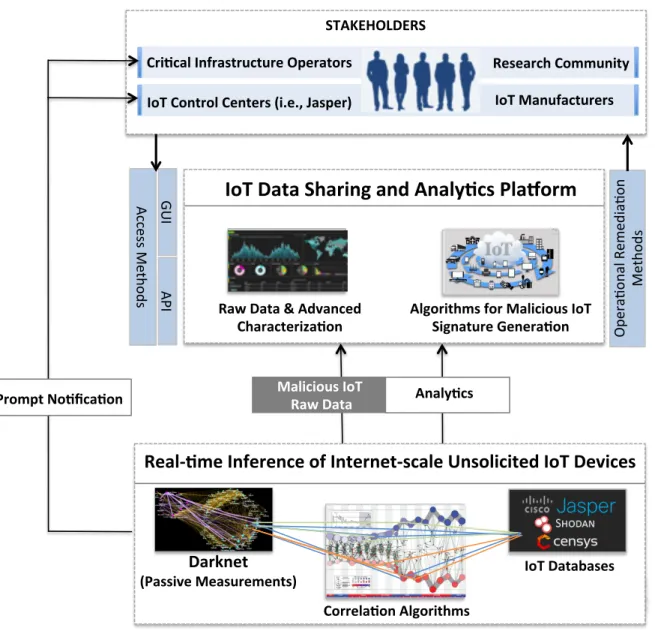
In a nutshell, as noted in [48], the proposed approach endeavors to generate actionable cy-ber threat intelligence related to Internet-scale IoT devices by applying several data-driven methodologies. These schemes mainly operate by scrutinizing passive empirical measure-ments. Overall, the garnered insights and inferences can be distributed, in an operational cyber-security fashion, to IoT stakeholders (i.e., operators, manufacturers, etc.) to assist with prompt remediation and thus mitigation support. Therefore, an additional artifact of the envisioned approach is also a repository which aims to index malicious IoT empirical threat information to be shared with the research and operational communities at large. Indeed such a facility can help provision advanced IoT threat analytics as well as support further forensic investigations.
3.1 Notation Overview
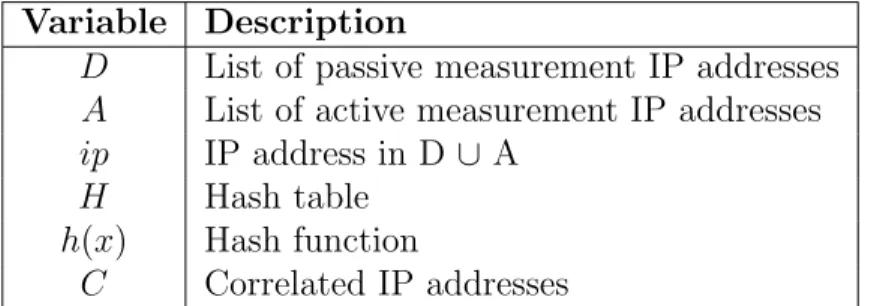
Before presenting the details of the proposed scheme, the requisite notation is introduced first. Namely, D is a list of IP addresses obtained from the CAIDA network telescope. Meanwhile, A is defined as a list of IP addresses obtained from active measurements in the
Shodan and Censys databases. Furthermore, H denotes the hash table which stores the value of the hash function for IP addresses obtained from the Shodan and Censys databases. Finally, h(x) is the hash function, and C is a list of all correlated IP addresses.
Table 1: List of variables
Variable Description
D List of passive measurement IP addresses
A List of active measurement IP addresses
ip IP address in D∪ A
H Hash table
h(x) Hash function
C Correlated IP addresses
3.2 Inferring and Characterizing Internet-Scale Compromised IoT Devices
The heterogenous nature of IoT devices and their wide-scale deployment in different environments (in addition to lack of visibility into local IoT realms) makes it very difficult to generate substantial insights to characterize unsolicited IoT behaviors [48]. Therefore any attempts to infer and characterize such IoT devices can be highly impactful and beneficial, as they can effectively pinpoint infected devices to improve mitigation strategies. Overall, the final objective here is to thwart malicious activity by adversaries and prevent them from recruiting infected IoT devices as part of a bot network. In this context, a macroscopic approach to infer Internet-wide malicious IoT devices is further realized by correlating passive empirical passive measurements as well as active Internet measurements. This macroscopic approach enables inferring large scale malicious IoT behaviors as well as evolving attacker strategies.
3.2.1 Exploiting Network Telescopes
Network telescopes, also known as darknets, constitute a set of routable and allocated, but unused Internet Protocol (IP) addresses. Indeed darknet IP addresses provide a means to passively measure Internet-scale maliciousness of devices, i.e., due to the fact that there are no legitimate services or real devices that are actually using these addresses. Therefore, any traffic with a destination IP address in the darknet is surely considered to be unso-licited. Now darknets are commonly distributed on specific Internet IP address subspaces, e.g., usually operated by Internet Service Providers (ISPs), educational and research enti-ties, and corporate and backbone networks. However, darknet IP addresses are, by nature, indistinguishable from other routable addresses, rendering them as an effective means to amalgamate Internet-wide, one-way unsolicited network traffic. Along those lines, network telescopes are used to identify network traffic originating from unsolicited IoT devices.
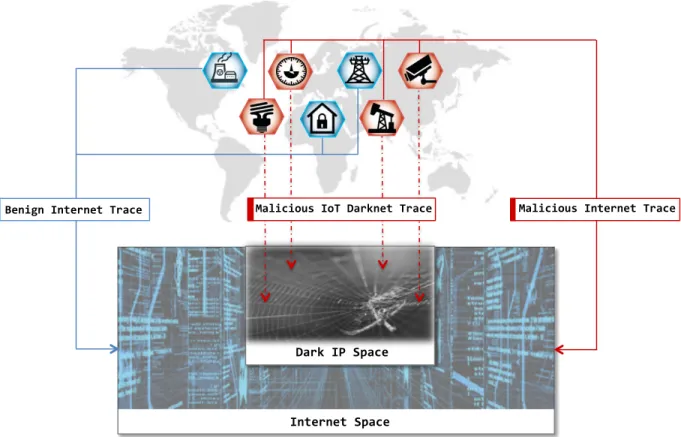
The proposed solution is illustrated in Figure 3.1. The overall rationale here is rendered by initial empirical observations which confirm the hypothesis that, as compared to typical Internet hosts, exploited IoT devices will attempt to propagate and infect other online IoT devices. Specifically, related actions can include launching scanning activities towards the Internet space or initiating DDoS attacks. In fact, most recently, malware such as Mirai, Bashlite etc., have exhibited similar behaviors, wherein a central command and control (C&C) setup is used to recruit infected devices in a bot network. These devices can then be used to launch large scale DDoS attacks against targets, and these bots can also continue to scan the Internet to infect other vulnerable devices.
In either case, depending upon the vantage points of the employed network telescopes, a varying portion of such malicious activities will indeed target darknet IP address spaces. To this end, well-established algorithms, methods, and techniques can be leveraged to scrutinize darknet data, also termed as Internet Background Radiation (IBR), i.e., to fingerprint such activities and infer sources of unsolicited IoT devices. In addition, corresponding darknet
Internet&Space& Dark&IP&Space& Malicious&IoT&Darknet&Trace&&
Benign&Internet&Trace&& Malicious&Internet&Trace&&
Copyright c2018, IEEE
Figure 3.1: Network telescopes capturing Internet-scale IoT unsolicited traffic
traffic traces [48] can also be extracted here. For instance, such algorithms could leverage threshold analysis to infer IoT-generated scanning activities or exploit backscattered packet analysis (i.e., by analyzing reply packets originating from victims of DDoS attacks that have been targeted by spoofed attackers to pinpoint targeted IoT devices).
In order to successfully recognize DDoS activities targeting IoT devices, this work ana-lyzes close to 1.5 TB of real darknet data obtained from a /8 network telescope, as provided by the CAIDA facility [49]. Carefully note that the proposed approach can only characterize malicious IoT devices whose traffic targets the darknet, a limitation typically encountered in network telescope analysis.
3.3 Leveraging Internet-Wide Scanning
Although empirical darknet data can help characterize Internet-scale malicious activities, it still may not yield any insights into unsolicited IoT behaviors. Therefore, it is imperative to also filter darknet sessions that originate from IoT devices. Now the task of fingerprinting many different types of IoT devices by analyzing IBR is an open research challenge. Ac-cordingly, this issue is addressed here by correlating packet information from the CAIDA darknet data repository with data measurements obtained from Internet-wide scanning of active IoT devices. Note that this correlation is performed mainly using source IP addresses and transport layer protocol information (of the darknet sessions). Furthermore, the task of identifying active IoT devices involves continuous probing of the Internet space for all active devices, including IoT devices. Clearly, this approach is less efficient and will be unable to provide real-time cyber operational capabilities which are crucial for mitigating large scale orchestrated attacks.
In light of the above, instead of performing continuous Internet probing, measurement archives from the Censys and Shodan facilities are used for correlation with darknet data. Namely, both of these facilities probe the Internet for connected IoT devices and provide this information in comma separated value (CSV) files. Specifically, the Shodan database is built by scanning the entire IPv4 address space and usually provides IP addresses as well as the type of device, operating system, etc. Meanwhile the Censys facility was developed by a team at the University of Michigan and also supports another search engine to expand the number of IP addresses and help consolidate results. Overall, 275,478 online IoT IP addresses related to various device types, including, home automation devices, IoT cameras and industrial control devices are gathered as noted in [48]
3.4 Correlating Active and Passive Measurements
In order to identify darknet sessions which belong to IoT devices, a novel correlation algorithm is designed and implemented using Python, the overall pseudocode of which is presented in Figure 3.2. Now given a list of source IP addresses in the darknet space and a list of IoT-specific IP addresses from the IoT databases, a rudimentary linear search can be performed i.e., to compare each IP address obtained from the passive measurements to those from the active measurements. However, the time complexity of such an algorithm is of orderO(n2), and this is clearly unscalable for most high-volume scenarios. Hence in order to
address this concern, a hash table approach is developed based upon the active IP addresses from Shodan. The passive measurements are then correlated with the active measurements by searching the hash table for their associated entries, Figure 3.2. As a result, the resultant run-time complexity is now reduced from quadratic to linear, i.e., O(n) since hash lookup is an expected constant time operation.
Furthermore, another key challenge in correlating the two measurements is the need to properly sanitize darknet data and filter out misconfiguration traffic. Namely traffic can often be erroneously directed to the darknet due to software, hardware or routing errors. Therefore such sessions need to be proactively identified and removed before any correlation search is performed. Another concern relating to the Shodan and Censys databases is how to identify relevant IoT device information. This identification can include device type, IP address, geographical location, etc. Furthermore, there is also a need to properly download, sanitize and store the obtained information. In general, the actual design of the correlation algorithm is optimized for efficiency, especially since it is envisioned that such information will be made available to the general research community and industry partners.
1: INPUT: D,A
2: OUTPUT: C
3: forall ip∈A do . Convert list of active IoT IP addresses to a hash table
4: H ← h(ip)
5: end for
6: forall ip∈Ddo . Correlate active and passive measurements
7: if ip in H:
8: C ←ip
9: end for
10: returnC . Return list of IoT IP addresses in darknet
Figure 3.2: Correlation algorithm for unsolicited IoT device identification
3.5 Generating IoT-Specific Malicious Signatures
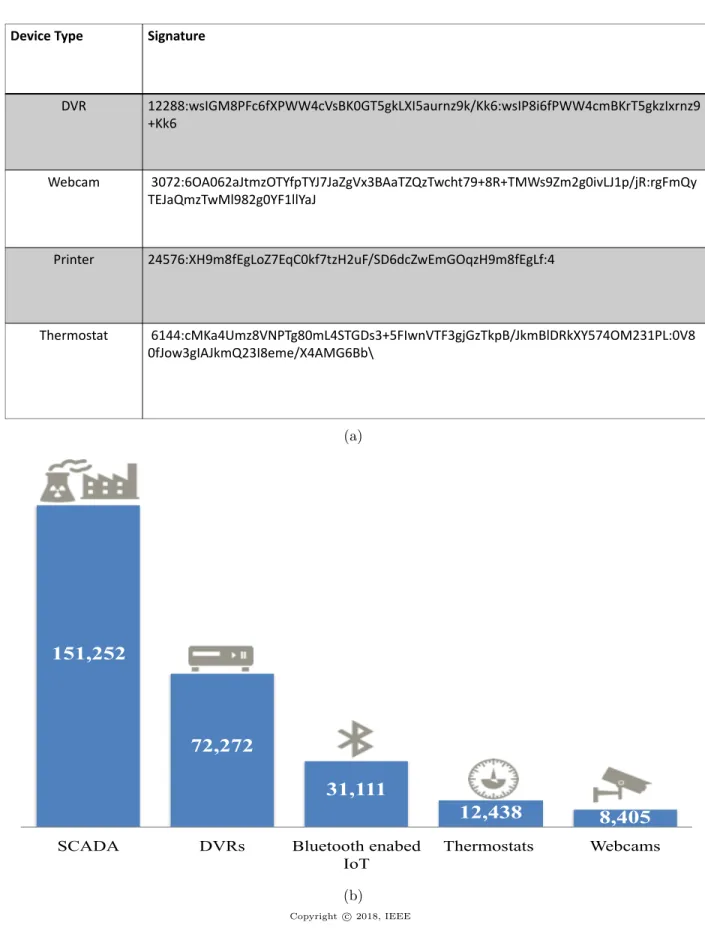
Overall there is a notable lack of tangible malicious indicators that are derived from empirical data in the context of IoT devices [50]. This shortcoming is also noted in Chapter 2 and can be attributed to various physical and logistical constraints that are often strictly enforced by IoT operators. Additionally, analytic efforts in this domain (which aim at addressing the distributed and heterogenous nature of the IoT ecosystem) are not yet mature enough. In light of the above, there is an urgent need to address IoT security research and development concerns. Accordingly, as noted in [48], the proposed methodology here attempts to facilitate the generation of such artifacts. Specifically, performing network traffic correlation between passive measurements (from CAIDA) and active IoT IP addresses (from Shodan and Censys) can provide rare insights into Internet-scale activity of unsolicited IoT devices. In turn, new insights into compromised device behaviors can be used to develop signatures to help strengthen perimeter defenses for IoT networks. These signatures can also be employed on new darknet sessions to fingerprint devices that have not yet been indexed by databases such as Shodan and Censys. Finally, signatures can also be distributed to local IoT realms to be used as part of IDS or IPS frameworks.
To further support the aforementioned objectives, this effort uses the concept of fuzzy hashing by tailoring and applying the Context Triggered Piecewise Hashing (CTPH) algo-rithm [48] on darknet traces (that are generated by inferred unsolicited IoT devices). Overall, the CTPH algorithm only operates in the current context of the input, i.e., maintaining its state solely based upon the last few bytes of the data file. This operation ultimately produces a pseudo-random value as output. The algorithm also generates discrete hashes by dividing the file into multiple segments/blocks and computes hashes for these segments, i.e., instead of computing a single hash for the entire file.
Essentially, the modified CPTH scheme uses a pre-determined block size, and the data length is used to generate an initial block size. Subsequently, the Fowler-Noll-Vo (FNV) algorithm is used to generate hashes on each byte of data, i.e., this algorithm produces a 32-bit output for any input. Then upon reaching a specified trigger value, further base 64 encoding is done for the last 6 bytes and added to the final signature [51]. This process is repeated once again with twice the block size to improve the robustness of the algorithm. Once the algorithm has run the entire length of data, a unique signature is generated for the file. The algorithm then uses dynamic programming to calculate the edit distance, which is essentially the benchmark used to identify similarity. Namely, the edit distance can be any value between 0 and 100, with anything above 0 indicating correlation and 100 indicating almost identical files. By contrast, most of the traditional hashing algorithms (such as md5, SHA1 etc.) only generate binary outputs, i.e., even a single bit variation can provide two uncorrected hashes. Therefore, the CTPH algorithm is much more robust to localized changes and thus can provide a relative degree of similarity to better compare two files.
In the context of this work, the CPTH algorithm is used to generate signatures for IoT devices based upon their