Citizens' Readiness for E-government
in Developing Countries
A thesis submitted to Middlesex University
in partial fulfilment of the requirements for the degree of
Doctor of Philosophy
By
Hany A. Abdelghaffar Ismail
School o f Computing Science Middlesex University, London, U KA B S T R A C T
Electronic government (e-government) has become one of the most evolving and important applications of Information and Communication Technology (ICT) in récent years. Due to its positive impact on Citizens, government and society alike, most developed and developing countries have attempted to apply e-government projects with mixed success. Many developing countries were facing difficulties in applying successful e-government projects due to différent electronic readiness (e-readiness) problems, such as poor I C T infrastructure and a high percentage of digital illiteracy among Citizens that have lead to e-government projects abandoned by users. Despite the various efforts by developing countries to overcome thèse problems, the factors that particularly affect Citizens and their use of e-government have not been adequately identified and tested.
This research proposed a model based on e-readiness assessments and relevant literature that investigates the impact of Citizens' readiness for government ( C R E G ) on e-government success within developing countries. The C R E G model explores a new vision for e-government success by introducing a combination of e-readiness and trust factors that together directly affect e-government projects in developing countries. The focus of the research is on government to citizen (G2C) services. Egypt was selected as an example of a developing country in which to conduct the study and three e-government services were selected for focused investigation.
The research confirmed the importance of the C R E G model to achieve successful government projects in developing countries. The proposed C R E G factors including e-readiness, trust and other factors were found to be crucial in Citizens' use or non-use o f e-government services. E-readiness factors showed a significant impact on increasing Citizens' usage of e-government services as Citizens who used online e-government services were more e-ready than non-users. The results also highlighted that e-readiness factors need to be combined with trust in both the technology and e-government in order to encourage more Citizens to use e-government services. Adéquate security and privacy measures that ensure information protection combined with providing a crédible service that satisfies Citizens' needs were shown to be important factors to encourage trust in technology and e-government.
A C K N O W L E D G E M E N T S
A t the beginning, I would like to thank Middlesex University for providing the educational and financial support that enabled me to undertake this research.
I am greatly indebted to my director of studies Dr, Penny Duquenoy for her invafuable guidance and support through out the préparation and completion of this thesis. I owe my thanks and gratitude to my supervisor Professor Colin Tully whose knowledge and expérience expanded my vision of the research and led me to this stage. Spécial thanks are due to my supervisor M r . Walaa Bakry whose precious advices and guidance helped me to start the research and finish the thesis. I express my warm thanks to my advisor Dr. Shérif Kamel who assisted and supported me in conducting the research and overcoming many problems through my fieldwork in Egypt.
Thanks and appréciation for my sincère spouse for her efforts, encouragement and patience and for my dear son whose love gives me hope and enthusiasm. A H the time, they have been a source of energy and motivation. Words are not enough to thank my parents for their numerous support and confidence that I would be able to achieve this stage. Grateful words are also due to the rest of my family members.
I would like to thank ail people who provided me with their help and efforts that enabled me to conduct the research.
T A B L E OF CONTENTS
A B S T R A C T 2 A C K N O W L E D G E M E N T S 3 G L O S S A R Y 8 K E Y DEFINITIONS 9 1 C H A P T E R 10 I N T R O D U C T I O N 101.1 Introducing the research 10
1.2 Research scope 13 1.3 Research design.. 13 1.4 Thesis structure 14 1.5 Contribution of the research 15
2 C H A P T E R 16 L I T E R A T U R E R E V I E W 16
2.1 Introduction 16 2.2 E-government in gênerai 16
2.2.1 E-government characteristics 17 2.2.2 E-government services and phases 19 2.2.3 E-government delîvery channels 20 2.3 Issues of e-government in developing counlries 21
2.3.1 E-government o p p o r t u n i t é s 21 2.3.2 E-government challenges 22 2.3.3 E-government success: previous approaches 22
2.3.4 ICT challenges for e-government 24
2.4 E-readiness assessments 26 2.4.1 Problems of e-readiness assessments 26
2.4.2 E-readiness factors in assessments 32
2.5 E-government and trust issues 33
2.5.1 Defining trust 35 2.5.2 E-government trust: previous approaches 35
2.5.3 Trust factors in C R E G 37 2.6 Initial theoretical framework 41
2.7 Conclusion 42 3 C H A P T E R 43 R E S E A R C H M E T H O D O L O G Y 43
3.1 Introduction 43 3.2 Pilot Study 43 3.3 Redefining the theoretical framework 46
3.4 Main study 47 3.4.1 Projects' sélection 47
3.4.2 Research methods 48 3.4.3 Analysis strategy 53 3.4.4 Reliability and validity 55 3.5 Research design background 56
3.6 Conclusion 57 4 C H A P T E R 58 E G Y P T I A N E - G O V E R N M E N T D E S C R I P T I O N 58
4.1 Introduction 58 4.2 Egyptian e-government programme description (www.egypt.gov.eg) 58
4.2.1 E-government strategy 59 4.2.2 Egyptian e-government services and phases 60
4.2.3 Egyptian e-government delivery channels 60
4.2.4 Current Egyptian e-readiness 61 4.3 E-government services description 64
4.3.1 Reissue of birth certificates 64 4.3.2 Renewal of vehicle licences 65
4.4 Conclusion 67 5 C H A P T E R 68 D A T A R E S U L T S A N D A N A L Y S I S 68
5.1 Introduction.. 68 5.2 Data analysis strategy 69
5.2.1 Analysis of interview data 69 5.2.2 Analysis of survey data 69 5.3 Analysis of interviews with government managers 70
5.3.1 Government attitude to e-readiness factors 70 5.3.2 Government attitude to trust factors 74 5.3.3 Government attitude to other factors 76 5.3.4 Government attitude to e-readiness assessments 77
5.4 Analysis of survey responses: birth certificates and vehicle licences. 83
5.4.1 Significance of e-readiness 83 5.4.2 Significance of trust 87 5.4.3 Significance of other factors 89 5.5 Analysis of survey responses: U C A S 92
5.5.1 Significance of e-readiness 92 5.5.2 Significance of trust 95 5.5.3 Significance of other factors 98
5.6 Conclusion 100 6 C H A P T E R 102 C O M B I N E D R E S U L T S A N D FINDINGS 102
6.1 Introduction • 102
6.2 Answering the research sub-questions 103 6.2.1 SQ1: How do factors from e-readiness assessments affect citizens' usage of e-government? ..103
6.2.2 SQ2: How do trust factors affect citizens' usage of e-government? 111 6.2.3 SQ3: How do other factors affect citizens' usage of e-government? 116 6.2.4 SQ4: How do e-readiness assessments affect e-government projects? 120
6.3 Final C R E G model 123
7 C H A P T E R 127 C O N C L U S I O N A N D R E C O M M E N D A T I O N S 127
7.1 Introduction 127 7.2 Summary of findings 127
7.2.1 Findings from interviews with government managers 128
7.2.2 Findings from citizens' surveys 128 7.3 The final C R E G model derived from the research results 129
7.4 Implications for improving the success levels of e-government projects 130 7.4.1 To benefit from e-readiness fore-government projects success 131
7.4.2 To gain citizens' trust for e-government projects 132 7.4.3 T o gain more benefits from e-readiness assessments for e-government projects 132
7.5 Contribution 133 7.6 Future work 134 R E F E R E N C E S 136 A S S E S S M E N T S R E F E R E N C E S ; 150 A P P E N D I X A 153 A P P R O V A L L E T T E R S 153 A P P E N D I X B 155 Q U E S T I O N N A I R E S A N D Q U E S T I O N S 155 A P P E N D I X C 183 D A T A R E S U L T S 183 A P P E N D I X D 203 A S S E S S M E N T S F A C T O R S 203 A P P E N D I X E 209 LIST O F I N T E R V I E W E E S 209 A P P E N D I X F 211 A B S T R A C T S O F P U B L I S H E D P A P A E R S 211
LIST O F T A B L E S
Table 2-1: E-govemmerit phases 19 Table 2-2: List of assessments 29 Table 2-3: E-readiness factors and sub-factors influencing C R E G 33
Table 2-4: Country's e-readiness versus citizens' use of e-govemment 34
Table 2-5: Trust factors and sub-factors influencing C R E G 41 Table 3-1 : Other factors and sub-factors influencing C R E G 46 Table 5-1: Factors and sub-factors influencing C R E G 68
Table 5-2: Nu!l and alternative hypothèses 69 Table 5-3: Respondent statistics: birth certificates and vehicle licences 83
Table 5-4: ICT infrastructure sub-factors: birth certificates and vehicle licences 84 Table 5-5: ICT usage sub-factors: birth certificates and vehicle licences 85 Table 5-6: Classification of computers used in online birth certificates and vehicle licences 85
Table 5-7: Human capital sub-factors: birth certificates and vehicle licences 86 Table 5-8: Technology trust sub-factors: birth certificates and vehicle licences 87 Table 5-9: E-govemment trust sub-factors: birth certificates and vehicle licences 88 Table 5-10: Other sub-factors: awareness of e-govemment: birth certificates and vehicle licences 89
Table 5-11: Other sub-factors: non-resistance to e-government: birth certificates and vehicle licences 90 Table 5-12: Other sub-factors: perception of e-government: birth certificates and vehicle licences 91
Table 5-13: Types of online problems: birth certificates and vehicle licences 91
Table 5-14: Respondent statistics: U C A S 92 Table 5-15: ICT infrastructure sub-factors: U C A S 93
Table 5-16: ICT usage sub-factors: U C A S 94 Table 5-17: Classification of computers used in online U C A S 94
Table 5-18: Human capital sub-factors: UCAS 95 Table 5-19: Technology trust sub-factors: U C A S 96 Table 5-20: E-government trust sub-factors: U C A S • 97
Table 5-21: Other sub-factors: awareness of e-govemment: U C A S 98 Table 5-22: Other sub-factors: non-resistance to e-govemment: U C A S 98 Table 5-23: Other sub-factors: perception of e-govemment: U C A S 99
Table 5-24: Types of online problems: U C A S 100
Table 6-1 : Hypothesis (1) findings 103 Table 6-2: Hypothesis (2) findings 109 ^ Table 6-3: Hypothesis (3) findings 111
Table 6-4: Hypothesis (4) findings 117 V Table 6-5: Hypothèses findings 123
LIST O F FIGURES
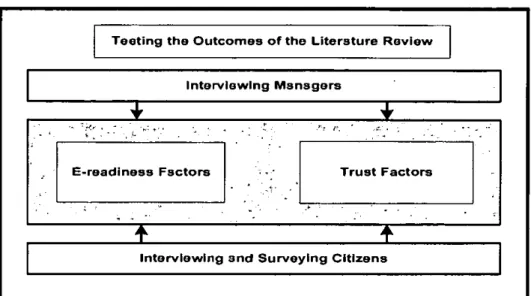
Figure 2-1: Theoretical framework-1 33 Figure 2-2: Theoretical framework-2 42 Figure 3-1: Testing the outcomes of the literature review 44
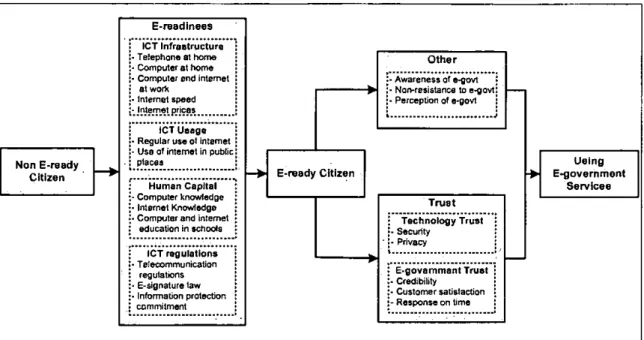
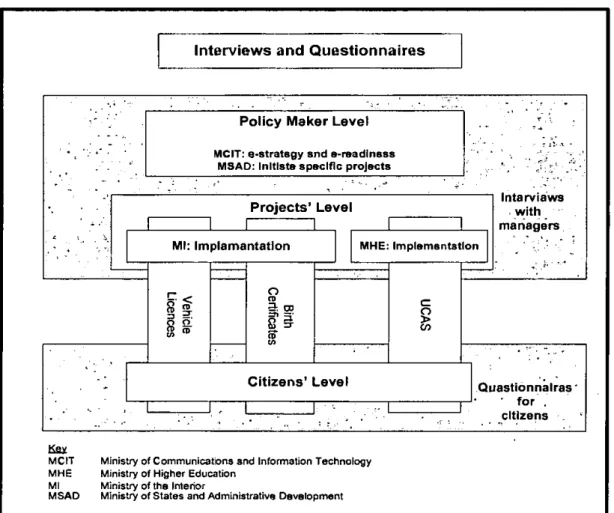
Figure 3-2: Proposed C R E G model 47 Figure 3-3: Interviews and questionnaires construction 48
Figure 3-4: Research framework and analysts 54 Figure 4-1: Egyptian e-govemmcnt framework 60 Figure 6-1: Achieving research findings 103 Figure 6-2: Managers' responses for e-readiness factors 104
Figure 6-3: Significant e-readiness factors - C R E G model 105 Figure 6-4: Citizens' responses for e-readiness factors: birth certificates and vehicle licences
(significant factors) 106 Figure 6-5: Citizens' responses for e-readiness factors: UCAS (significant factors) 106
Figure 6-6: Citizens' responses for e-readiness factors: birth certificates and vehicle licences
(non significant factors) 108 Figure 6-7: Citizens* responses for e-readiness factors: UCAS (non significant factors) 108
Figure 6-8: Improvements in e-readiness factors from citizens* surveys 2005-2006: birth certificates and
vehicle licences (significant factors) 110 Figure 6-9: Improvements in e-readiness factors from citizens' surveys 2005-2006: UCAS
(significant factors) 110 Figure 6-10: significant trust factors - C R E G model 112
Figure 6-11: Managers' responses for technology and e-government trust factors 112 Figure 6-12: Citizens' responses for technology trust factors (significant factors) 113 Figure 6-13: Citizens' responses for e-govemment trust factors (significant factors) 115
Figure 6-14: Other significant factors - C R E G model 117 Figure 6-15: Citizens' awareness of e-govemment services (significant factor)...: 118
Figure 6-16: Citizens' non-résistance to use e-government services (significant factor) 119
Figure 6-17: Considering e-readiness assessments: M S A D 120
Figure 6-18: Final C R E G model 124 Figure 7-1 : The final C R E G model 130
\
GLOSSARY
C R E G Citizens' readiness for e-government
E-government Electronic government
E-readiness Electronic readiness
E G P Egyptian pounds G 2 B Government to business G 2 C Government to citizen G 2 E Government to employée G 2 G Government to government G B P British pounds
I C T Information and communication technology
I D S C Information and Décision Support Centre
IS Information Systems
IT Information technology
M C I T Ministry of Communications and Information Technology
M H E Ministry of Higher Education
M I Ministry of the Interior
M S A D Ministry o f States and Administrative Development
P C Personal computer
U C A S Universities and Colleges Admission Services
U N D E S A United Nations Department for Economie and Social Affairs
K E Y DEFINITIONS
E-government
E-government is the use o f information and communication technologies (ICT) in improving the activities and services o f government and delivering services over the internet (Adapted from Heeks, 2004).
Country e-readiness
A country e-readiness is the degree to which a country is prepared to participate in the networked world (Adapted from CID, 2003).
Government e-readiness
A government e-readiness is the degree to which a government is prepared to participate in the networked world (Adapted from C I D , 2003).
Citizens' e-readiness
Citizens' e-readiness is the degree to which citizens are prepared to participate in the networked world (Adapted from C I D , 2003).
E-ready citizen
The e-ready citizen is one who is able to use ICT and benefit from the internet.
Non-e-ready citizen
The non-e-ready citizen is one who is not able to use I C T and benefit from the internet.
Trust
"Trust is an expectancy o f positive outcomes that can be received from another party" (Bhattacharya etal, 1998).
C H A P T E R 1
INTRODUCTION
1.1 Introducing the research
One o f the most important developments in ICT in recent years is electronic government (e-government). It has the potential to make government operations and processes more transparent and more effective for citizens and businesses, and to provide a variety o f benefits for the community at large such as reducing services' time and connecting businesses and citizens to government information at anytime (Liikanen, 2003).
Because of the remarkable potential benefits of e-government, most governments in both developed and developing countries have launched e-government projects. However, few of them have succeeded in achieving their set targets. In developing countries, Heeks (2003a) reports in his survey on 40 e-government projects that 35% totally failed as they were terminated or never used by users, 50% partially failed to achieve their goals and only 15% succeeded. Furthermore, the failure rate of e-government projects worldwide is identified by Gartner Group (2002) as 60%. The cost of failed e-government projects is high, including not only tangible costs such as wasted project expenditure and employee time, but also intangible costs such as loss of citizen trust (Heeks, 2003c).
In many cases, countries which achieved their set targets for e-government projects (Accenture, 2004; Blakemore and Lloyd, 2007) had high levels of e-readiness. Examples are Canada, U S A and U K which got the highest ratings for e-readiness ( D A I , 2003; E I U , 2006). Conversely, developing countries are typically reported as having low levels o f success in e-government and low e-readiness ratings ( D A I , 2003; U N D E S A , 2005). This is because they were not electronically ready ce-ready' in terms of ICT and had major
problems with regard to their ICT fundamentals.
Many developing countries have accordingly launched strategic plans to enhance their e-readiness. These plans usually start with an essential step, undertaken in 188 countries (Bridges, 2005b), to measure their current e-readiness and decide how it could be improved. This was followed by developing action plans (Brown, 2002) to enhance their citizens' capabilities in ICT as well as enabling their businesses and governments to take the opportunities offered by ICT. Nevertheless, these plans did not lead to more
successful government projects used by Citizens. Thal is because the available e-readiness assessments are designed to assess countries' e-e-readiness in gênerai without a specific focus on the issues that affect e-government projects in particular (Ojo et al, 2007). Furthermore, these assessments do not identify how their Factors affect Citizens' usage of e-government services.
This research Starts from two propositions.
(1) The broad concept o f e-readiness has a number o f component concepts, one o f which may be termed readiness for e-government. (Another component concept, for instance, would be readiness for e-business.')
(2) In turn, the concept of readiness for e-government has a number of component concepts, one of which may be termed Citizens* readiness for e-government.
(Another component concept, for instance, would be government readiness for e-government.)
Citizens' readiness for e-government. subsequently abbreviated for convenience to CREG, the factors that influence it, and the extent to which it affects e-government success. form a primary focus of the research. It should be noted that Citizens' readiness for e-government is distinct from Citizens' usage of e-government. Roughly, Citizens' readiness partially détermines Citizens' usage, which in turn partially détermines e-government success.
The research specifically does not investigate other factors that may affect either Citizens' usage or e-government success (such as reduced cost or improved quality of government services).
One contribution claimed for this research is to propose factors that influence C R E G . The proposed factors are in three catégories.
• The first category of factors is drawn from the many e-readiness assessments that attempt to rate or rank the e-readiness of sets o f countries: some (but by no means all) o f the factors that they believe influence e-readiness in général also influence C R E G in particular.
• The second category is drawn from the published literature relating to Citizens' trust in e-government, and to the broader issues of trust in government and trust in
• The third category comprises other factors that fall into neither of the previous two catégories.
The research question and the sub-questions that the research ad dresses are the following.
RQ: What are the factors that affect Citizens' readiness for e-government ( C R E G ) in
developing countries?
SQ1: H o w do factors from e-readiness assessments affect Citizens' usage o f
e-government?
SQ2: H o w do trust factors affect Citizens' usage of e-government?
SQ3: H o w do other factors affect Citizens' usage of e-government?
SQ4: H o w do e-readiness assessments affect e-government projects?
SQ1 was introduced as a resuit o f reviewing the current e-readiness assessments (discussed in section 2.4) that show e-ready Citizens who have appropriate I C T infrastructure and have computer and internet skills are using e-government services more than non e-ready Citizens. Consequently, it becomes crucial to identify the e-readiness factors that Citizens' in developing countries should have to be ready for e-government.
Identifying e-readiness factors was not sufficient to have successful e-government projects in developing countries. This is because there are some developing countries with reasonable levels of e-readiness but nevertheless with low levels of e-government success (Prattipati, 2003) which draws the attention to the existence o f other factors. Reviewing the literature (discussed in section 2.5) showed that many researchers report that Citizens' trust in e-government is important in encouraging their usage o f e-government services (Al-adawi et al, 2005; Gefen et al, 2002; Otto, 2003). Identifying thèse factors, based on the discussion about them in the published literature, forms a second and crucial category of factors influencing C R E G and is thus presented in SQ2.
Conducting a pilot study (discussed in section 3.2) with Citizens showed the existence o f other factors including awareness, perceptions o f e-government services and non-resistance to use (or conversely résistance to use) that affect Citizens' usage o f
e-government. These formed the third group of factors affecting C R E G and are investigated
in SQ3.
The pilot study with managers, on the other hand, demonstrates the importance of
understanding how e-readiness assessments, which e-readiness factors are drawn from,
influence government strategy on e-government as appears in SQ4.
A l l the identified C R E G factors from e-readiness assessments. literature review and
Citizens' and managers' e x p é r i e n c e s (in the pilot study) formulated the proposed C R E G
model which is tested in the main study. The results which formed the final model will
lead to more successful e-government projects in developing countries.
1.2 Research scope
Section 1.1 s p é c i f i e s the questions that the research sets out to answer - what the research
is about. For clarity, this section s p é c i f i e s what it is not about.
• 1t is about e-government, not e-governance. E-governance is generally regarded as
including wider issues such as e-democracy and e-voting.
• It is about central e-government, not local e-government.
• It is about G 2 C , not government to business ( G 2 B ) , government to government
(G2G) or government to e m p l o y é e (G2E).
• It is about demand-side factors influencing C R E G , not supply-side. For instance, one factor is "affordable internet prices". That factor is considered only from the
point of view of its demand-side influence on Citizens, not from the point of view of
the supply-side extent to which government is able or Willing to influence those
prices.
• It is about applications that deliver government services to Citizens, not those that
just provide information.
1.3 Research design
In order to answer the research question, a pilot study was carried out with Citizens and
government managers to test the significance of the proposed factors and where necessary
to redefine the research question. The main empirical study was conducted using
qualitative and quantitative research approaches. Egypt was selected as an example of a
designed to improve the delivery of government services to citizens. Nevertheless, Egypt faces many ICT problems similar to those in many other developing countries (Sayed, 2004). A t the time of conducting the research, there were eight services available online. Three of them were selected, according to the research scope criteria, for in-depth investigation. These are:
• reissue of birth certificates; • renewal of vehicle licences;
• Universities and Colleges Admission Services ( U C A S ) .
The study was structured into two main data collection phases conducted in 2005 and 2006 to test the proposed C R E G model. Each phase consisted of three levéis of data.
• The first level of data addresses issues of how policy makers, project managers and executive managers in the relevant government departments in Egypt consider e-readiness within the design and implementation of e-government projects and what measures exist to increase citizens' trust in e-government. Face-to-face interviews (Denscombe, 1999) were used atthis level.
• The second level of data targets managers, technicians and other relevant stakeholders involved with the provisión of each o f the selected e-government services again using face-to-face interviews. This was important to have an in-depth understanding of the e-government project processes on the ground, to understand their experience and the lessons they have learned, and to understand how e-readiness and trust impact the services for which they are responsible.
• The third level of data addresses end-users (citizens) o f the selected e-government services to evalúate the impact of the services offered to the community at large and to have a clear understanding of the impact of readiness within society on using e-government services. To achieve this, a survey o f end-users (Weisberg et al, 1996) has been run twice (in two consecutive years: 2005 and 2006). Consequently, comparable results become available to show how progress in e-readiness and trust on the part of end-users affect e-government success and how policy makers and managers design their e-government plans to adjust to the changes in these factors.
1.4 Thesis structure
Chapter 2, "literature review", discusses: (a) the available literature on e-government in general (its characteristics, the types and levéis of services offered, delivery channels); (b)
government in developing countries (opportunities, challenges, approaches); (c) e-readiness assessments (problems of assessments, list of assessments, factors used in assessments); and (d) trust in relation to e-government (available studies, achieving trust); (e) the initial theoretical framework for C R E G .
Chapter 3 describes the pilot study conducted with managers and citizens. This is followed by the research design (data collection procédures and analysis framework) and the discussion of the methodological background o f the design.
Chapter 4 gives the background of the Egyptian public administration sector and how e-government is applied, with spécial référence to the current situation of e-readiness plans and previous e-readiness assessments. The second part describes the three e-government services selected for investigation.
Chapter 5 provides a description of data findings and analysis. The analysis covers the collected data through interviews and questionnaires separately. Chapter 6 brings together the results o f the data analysis from chapter 5, in order to answer the research questions as set out in section 1,1 and achieve the final C R E G model.
Chapter 7 summarises the findings of the research, notes the implications of the findings for improving the success rates of e-government projects, détails the contributions to knowledge resulting from the research and outlines possible future work.
1.5 Contribution of the research
The contribution to knowledge in the field of Information Systems, made by this research, cornes from the provision of a model for citizens' readiness for e-government that includes e-readiness factors from assessments and literature as well as factors arising from this research. The research shows that readiness for e-government is not necessarily the same as readiness in gênerai nor that readiness means citizens* use o f e-government. A i l factors included in the model have been tested and confirmed by managers (policy-makers and project implementers) and citizens (end-users) as being significant to citizens' use of e-government. Consequently, the model bridges the gap between e-ready citizens and citizens who would make use o f e-government services.
C H A P T E R 2
L I T E R A T U R E REVIEW
2.1 Introduction
The chapter starts by discussing the available literature on e-government in gênerai (section 2.2). It follows by discussing e-government in developing countries (section 2.3), e-readiness assessments (section 2.4), and trust in relation to e-government (section 2.5). The final section 2.6 explains the initial theoretical framework used in the research.
2.2 E-government in gênerai
The concept of e-government was first introduced in 1979 by Simon Nora and Alain Mine when they provided a report to the French président about how to build the civil and political society using "télématique" or telematics (Nora and Mine, 1980). They define telematics as a combination of computers and télécommunications. In their report, they describe how most aspects of society, such as éducation, health and the activities o f daily life, could benefit from telematics through a long term strategy between government and business (Cats-Baril and Jelassi, 1994).
Over subséquent years, various new définitions of e-government were proposed. However, the core part of each définition was based on the concept introduced by Simon Nora and Alain Mine. A récent more comprehensive définition (World Bank, 2007) is "the use by government agencies of information technologies that have the ability to transform relations with citizens, businesses, and other arms of government. Thèse technologies can serve a variety of différent ends: better delivery of government services to citizens, improved interactions with business and industry, citizen empowerment through access to information, or more efficient government management".
Most définitions emphasise better delivery o f government services to citizens and businesses using technology. This was summarised in Heeks (2004) définition o f e-government as '''the use of information and communication technologies (ÏCT) in improving the activities and services of government" which is the basis of the définition of e-government for this research with the addition of "and delivering services over the internet".
E-govemment is not limited to providing government services to citizens or business but is part of a broader concept of e-governance as defined by Riley (2001); "E-governance is the commitment to utilise appropriate technologies to enhance governmental relationships, both internal and external, in order to advance democratic expression, human dignity and autonomy, support economic development and encourage the fair and efficient delivery of services". This concept considers e-government as one step towards reforming the shape of interaction between government and society through transparency of information and decision making by using I C T (Elmagarmid et al, 2001; Gisler et al, 2001). Consequently, society would be able to organise itself better to benefit from I C T (LaVigne, 2002; Sakowics, 2001 ; Wimmer and Bredow, 2002).
Determining e-governance, according to Saxena (2001) and U N D E S A (2003b), could be achieved by having e-democracy that allows citizens to participate in their community in more efficient ways by having virtual meetings and cyber campaigns, public surveys and community forums, in addition to e-voting. Consequently, citizens will be participating more in the decision processes that affect the achievement of their social targets.
E-governance also includes e-administration - the improvement of government communication and information flows both within and between individual government departments, so as make government administrative processes more effective (Heeks, 2001). Although all aspects of governance are important, this research is limited to e-government as previously defined, and more specifically to the provision of e-e-government services to citizens in developing countries.
2.2.1 E-government characteristics
Although e-government projects follow similar steps as information system projects (Heeks, 2006) from initiation to deployment, Abdelghaffar et al (2005) claim that e-government projects have particular characteristics that influence their design and implementation.
• A s e-government projects improve the delivery of services to citizens, they have a great attraction for policy makers. Therefore, politicians often make e-government decisions independently from experts, and subsequent success or failure may have a significant impact on their careers (Heeks, 2002).
A s for any project, an e-government project needs continued high-level (political) support for its progress, otherwise project management may be unable to sustain the project to achieve its targets (Heeks, 2003b; U N D E S A , 2003b).
A s the main aim for e-government is to reform the public administration sector through enhancing its operations and providing new methods of service delivery, government employees may feel a loss of power in transferring the provisión of services online. This might lead to a resistance to change on their behalf. Consequently, e-government managers have to clarify the main objectives and benefits o f their projects in order to minimise the fears o f their staff (InfoDev, 2002).
Providing services online to the broad public requires dealing with a far more diverse group o f users than in almost any other kind of application (Stamoulis, 2000; Wimmer and Bredow, 2002).
E-government implementation may require a change in public culture to enable citizens to adapt to the new methods o f providing services (Cohén and Eimicke, 2002).
E-government objectives differ from those of prívate sector projects because of the existence o f politics. Consequently, productivity and customer services are not the-only issues that should be considered (Cohén and Eimicke, 2002). On the other hand, Csetenyi (2000) has argued that some experts believe e-government follows the same concepts as the prívate sector, but on a wider scale.
E-governments can be described as the "e-business of the state" (Schubert and Hausler, 2001). This is because the tools of applying e-business are embedded within e-government. Consequently, e-commerce (Csetenyi, 2000) and e-business technologies (Nahon and Scholl, 2007) could be applied to e-government to increase the efficiency o f providing services to citizens (Swedberg and Douglas, 2003). However, Sakowics (2001) argües that the concept of e-government is broader than e-business in that it covers rules and connections with government agencies. In addition to that, the main target of e-business is to increase profitability and market share for enterprises using web technologies while the aim of e-government is to provide services without profít (Liikanen, 2003).
2.2.2 E-government services and phases
E-government provides different types of services to society and their implementation depends on government's objectives (Pacific Council on International Policy, 2002; Stamoulis, 2000; U N D E S A , 2003d).
• One type o f service is govemment-to-citizen (G2C) which allows citizens to access information and receive government services such as submitting tax returns, or requesting identity cards, social security numbers or voter registration.
• Another type of e-government service is government-to-business ( G 2 B ) where government provides services to business such as launching new companies, taxation, inquines and downloading forms online.
• G o ve rnment-to-government (G2G) is the third type of e-government service. It is where a government department or agency supplies information or services to another.
• Ndou (2004) and A O E M A (2004) propose that e-government services could go even further to affect government employees (G2E) as the government can change the relationship with its employees by increasing their involvement for instance through knowledge management applications (Riley, 2001).
A country's development of e-government typically passes through a number of phases. Proposed phases vary between five ( A O E M A , 2004), four (Gartner Group, 2000; Seifert, 2003) and three (InfoDev, 2002). The different number of phases can all be mapped onto the three defined by the InfoDev (2002), as shown ¡n table 2-1.
E-government
phases InfoDev
G a r t n e r G r o u p ;
Seifert A O E M A lst phase 1 Publish government
information
I Publish govemment information
l(a) Establish website l(b) Website contents updated regularly 2nd phase 2 Government interacts
with citizens 2 Govemment interacts with citizens 2 Govemment interacts with citizens 3rd phase 3 Transactions conducted and completed by citizens online 3(a) Transactions conducted and completed by citizens online 3(b) Full intégration of transactions 3(a) Transactions conducted and completed by citizens online 3(b) Full intégration of transactions Table 2-1: E-government phases
• The ßrst phase is to publish government information such as laws and rules at a static website where the relationships between Citizens and government are passive/passive (no interaction between the government and Citizens). A O E M A (2004), on the other hand, argues that this phase should be divided into two small Steps. A n initial step for the government is to have a website which contains basic information about government organisations such as their working hours and phone numbers and then the website contents to be updated regularly with government documents and information.
• The second phase which ail organisations agreed to it is where the government begins to interact with Citizens and business. However, this interaction is mainly from the society side only (Citizens and business), while the government is still passive. In this case, Citizens can download forms and applications from the government website and use them in further transactions. In some cases, the government can be active through e-mails. Both of thèse two phases are important to get Citizens used to using e-government websites and to gain their trust.
• When the government is ready to provide füll services online, it moves to the third phase where transactions are conducted and completed by Citizens and businesses online. So, both Citizens and the government start to become active (there is interaction between the government and Citizens online). This is the most important part for an e-government project when both government and Citizens start to gain benefits from ICT to facilitate transactions and reduce time and effort. This aspect is the focus of this research. A O E M A (2004), Gartner Group (2000) and Seifert (2003) explain a sub-phase, 3(b), that is still more advanced, where füll intégration transaction takes place. In sub-phase 3(b), boundaries between government organisations have disappeared. Consequently, Citizens can apply for services related to one government Organization which will link them to any other part of other organisations to provide Citizens with other services.
2.2.3 E-government delivery Channels
A s the main goal of e-government is to deliver better services for Citizens, governments provide various types of delivery Channels so that they can reach as many Citizens as possible. In most cases, thèse Channels dépend on the direct use of the internet to access the e-government website to request the service.
Accessing services over the internet may happen in different ways to fit the national conditions within each country. It could be through using computers within government premises, public internet cafés, or at work in case there is a low penetration of personal computers for citizens at homes. In some developing countries and in rural areas another model can be provided in cooperation with the private sector by having an educated person request e-government services online on behalf o f uneducated citizens (Bhatnagar, 2002) . Moreover, in rural areas where there are no network connections, using wireless connections for kiosks would solve the problem. In Brazil, for instance, mobile units with wireless connection are used to visit rural areas regularly with government staff who are able to provide wireless services through the e-government website (InfoDev, 2002).
Alternative channels to request e-government services are the call centres that depend on phone calls and digital T V s . These delivery channels could be useful for some citizens who may not be educated about how to use a computer - such as elderly people (Cohen and Eimicke, 2002). In that case, telephones may be the most suitable method of requesting services.
Although different channels for delivering e-government services are important, providing services over the internet, which is the topic of this research, is seen as the most effective tool compared to other channels. This is because the internet provides the most effective means of interaction, enabling services to be provided continuously, 24-7 (InfoDev, 2002).
2.3 Issues of e-government in developing countries
2.3.1 E-government opportunities
The potential benefits of implementing e-government projects in developing countries are remarkable at all levels. Governments can use e-government application as a step for reforming the whole public sector process, which means that the process of each service has to be revised and changed to adapt to the new shape of service delivery (Liikanen, 2003) . For example, in Chile a new process for tax return was established to reduce the time taken to respond to taxpayers to 12 hours only instead o f 25 days for the traditional system (Heeks, 2001). Another benefit o f e-government is to provide government services around the citizens' locations, meaning that citizens can access government services
either by using their home computers or they can find service centres around their living areas such as shopping malls and libraries. E-government is claimed to have tangible benefits on the economy in terms o f cutting government costs. In Egypt, for instance, it has been estimated (Darwish, 2004) that e-govemment could increase government productivity to the extent of saving 900,000 working hours.
There are also seen to be indirect benefits of e-government, such as reducing the complexity of bureaucracy, simplifying the process of providing services and increasing transparency and accountability of the government to the public ( U N D E S A , 2003b). The democratic process is thus enhanced through increasing citizens' access to government information and services (Liikanen, 2003). This is as a result of the changing communication channels between the government and citizens from one-way to two-way.
2.3.2 E-government challenges
As a result of the importance of e-government, many developed and developing countries have attempted to apply e-government projects, but with mixed success. O f these countries, very few have succeeded in achieving their set targets whilst a larger number have arguably failed (Heeks and Bhatnagar, 1999; U N D E S A , 2003c). In developing countries, based on a survey done on 40 e-government projects by Heeks (2003a), 35% of projects were considered as being total failures due to termination of the project, such as the electronic voter registration in Uganda and a land licensing and planning system for Beira city in Mozambique. 50% are considered being partial failures, where they only achieve part of their goals, such as the Cameroon's tax website. Only 15% succeeded.
The types and causes of failure in e-government projects have many similarities to those in information systems projects in general. These have been subject to well known analyses by (for instance) Lyytinen and Hirschheim (1987) and Sauer (1993). It is important to understand the types and causes o f success and failure as set out in those and other published works, and to act on that understanding.
2.3.3 E-government success: previous approaches
A number o f researchers have discussed factors that might help reducing failure rates and achieving higher success rates in e-government projects. Their focus is mainly related to how government could improve its own e-government processes (the supply side). In this
context, many researchers, such as Papantoniou, et al (2001), Cohén and Eimicke (2002), Burn and Robins (2003), Hackney and Jones (2002) and Reffat (2003) agree on the importance o f change management as a success factor for e-government. Oberer (2002) adds that the changes in organisational conditions should include administrative measures for adapting to the new e-government process. This is because e-government projects require new technology, so organisations need to be able to change their business processes to adjust to it.
Heeks (2003b) agrees with the previous researchers on the importance of management for the success of e-government. However, he provides two further approaches for overcoming e-government failure. The first approach is to reduce the gap between current organisational realities (information, technology, processes, staff skills and management) and the future realities that w i l l be necessary for e-government success. In his second approach Heeks (2001) defines lack of e-readiness for e-governance as a strategic challenge in Africa that might cause project failure. This includes the lack of adequate citizen data, and of legal and institutional infrastructure.
Although there are a number of approaches that focus on how government could improve its own e-government processes (the supply side) to achieve successful e-government projects, few researchers have studied the factors that affect citizens' usage o f e-government (demand side). Bélanger and Cárter (2006) conducted an empirical study to define the impact of the digital divide on e-government. Although their research does not directly address e-readiness, they consider some factors such as education and use o f the internet as factors that affect e-government usage. However, this was a study conducted on a small scale and in a developed country (on 105 participants in one American state) which could be criticised as not being generalisable to other countries. Choudrie and Dwidedi (2005) conducted a study in the UK. which correlated levéis of education, together with possession o f computers and broadband access, with awareness and use of e-government. This indicates the probable importance of citizens' e-readiness, in developing as well as developed countries, in influencing e-government success (Olí, 2007). Although the supply side clearly affects the demand side to the extent that citizens are influenced by government pólices and projects, it is still important to have a better understanding of all the demand-side factors that influence e-government success.
From the government viewpoint (the viewpoint taken by most researchers), e-government
success factors may be partitioned into internai (government-related) and external (for
instance, society and the technology environment). Huijboom and Hoogwout (2004)
emphasise the importance o f taking external factors into account in the development of
e-government projects. The main problem o f external factors is that government has less
control over them (Garner, 1986). Both society (Citizens) and the technology environment
need to be e-ready, otherwise there is a high risk o f e-government failure.
The few studies that discuss the impact o f e-readiness on Citizens' usage of e-government
take into account relatively few e-readiness factors, and omit considération o f other
citizcn-related factors found in the large number o f assessments that attempt to rate or
rank the e-readiness o f sets o f countries: section 2.4 reviews thèse e-readiness
assessments. Further, t h è s e studies address developed rather than developing countries.
This research aims to fill this gap by identifying the factors that may influence Citizens to
be ready for e-government ( C R E G ) and to use it.
2.3.4 ICT challenges for e-government
In order to define the factors that affect Citizens' readiness for e-government within
developing countries and how they influence e-government success, it is crucial to
understand the major problems o f I C T in developing countries that might cause
e-government failure. One reason that might contribute to the e-government failure is the
lack o f appropriate I C T infrastructure. This is because e-government, as defined
previously in section 2.2, is based on the use o f ICT to deliver government services for
Citizens.
ICT infrastructure includes basic access infrastructure (Ndou, 2004) which consists of,
among other factors, t é l é p h o n e lines, personal computers, internet accessibility and
pénétration in rural areas, the speed available for the public to access the internet and the
cost o f the services provided in comparison to Citizens' income. This problem o f lack o f
infrastructure can be clearly demonstrated by comparing the situation o f I C T
infrastructure between developed and developing countries (Hui, 2006). In t é l é p h o n e
pénétration, at a time when there were 693 t é l é p h o n e s per thousand Citizens in the U K ,
time when there were 416 personal computers per thousand Citizens in developed countries, there were only 6 per thousand in developing countries (World Bank, 2003).
ICT infrastructure also includes issues related to the reliability o f networks and the availability o f communications companies that support différent services such as satellite communications in rural areas (Ndou, 2004). In India, for example, the government installs Kiosks in local rural areas to provide e-government services for Citizens. However, because of the lack of leased unes and the dependence on téléphone lines only at thèse areas, many reliability problems have occurred which decreases the use o f thèse Kiosks (Bhatnagar and Vyas, 2001).
Developing countries face a high level of digital illiteracy which is a significant ICT problem that has left e-government projects abandoned without users and has contributed to e-government failure (InfoDev, 2002). The issue in some countries is even worse as rates o f illiteracy (never mind digital illiteracy) are very high in both urban and rural areas. In Egypt, for example, 43% of the population is illiterate (InfoDev, 2004). Consequently, e-government projects end by having a limited number of digitally literate Citizens (InfoDev, 2002). Ndou (2004) summarises the digital divide (Norris, 2001) in developing countries as the gap between Citizens who are able to access information through the internet and those without access (InfoDev, 2002). The digital illiteracy problem goes beyond using computers only to how Citizens are using technology in their daily life so that différent electronic applications, such as e-commerce and e-government, can succeed.
The absence of législation regulating the provision o f online services may be another problem. A n example of such législation would be an electronic signature law, which is important in generating Citizens' confidence (InfoDev, 2002; Ndou, 2004). ICT régulations should go further to include appropriate législation Ieading to prosecution for illegal access to government and Citizens' computers and provide more protection for Citizens' data collected by the government.
Another issue is that some e-government projects in developing countries, use 'already designed' applications and plans that have been applied successfully in developed countries. These applications are mainly designed according to the needs of the developed countries - which do not necessarily suit the conditions in developing countries and might
lead to project failure. For example, crédit cards are mainly used as a payment method for ail e-government projects in developed countries while in most developing countries cash is still the major concept of payment and there is a major Iack of crédit cards (Bhatnagar, 2002, 2004).
2.4 E-readiness assessments
2.4.1 Problems of e-readiness assessments
As a resuit of the lack o f basic I C T provision in developing countries, which might cause problems for e-government and other internet-based projects, many countries have launched e-strategy plans to enhance that provision. On the whole, thèse plans consist o f many steps that start by defining the country's objectives. This isfollowed by an essential step (conducted by 188 countries around the world (Bridges, 2005b)) to measure their e-readiness situation to understand how it could be improved through an action plan (Bridges, 2002; Brown, 2002; U N D E S A , 2003a). Measuring e-readiness is mainly done by using international e-readiness assessments that have predefined criteria. Finally, a detailed action plan is designed and followed to move the country towards its objectives. In later stages, an annual e-readiness assessment is conducted to assess the yearly changes and improvements within the country and how the country stands in regards to other countries (Bridges, 2005a; GeoSINC, 2002).
Although e-readiness assessments are important as an initial step towards having a more e-ready society that is able to beneflt from e-government projects, thèse assessments présent various problems that might have a négative effect on countries' plans. To identify those problems, it is important to establish what e-readiness means. Currently, there are various conflicting e-readiness définitions (Bridges, 2005a). According to the Centre o f International Development at Harvard University (CID), which focuses on measuring the networked world, e-readiness is "the degree to which a community is prepared to participate in the Networked World" (CID, 2003). On the other hand, McConnell International (2000) defines e-readiness as "the capacity of nations to participate in the digital economy". The C S P P (1998) defines an le-ready' community as
"the one that has high-speed access in a compétitive market; with constant access and application of ICTs in schools, government offices, businesses, healthcare faciliiies and homes; user privacy and online securiiy; and government policies which are favourable to promoting connectedness and use of the Network". Despite the importance o f
e-readiness, there is no a single définition which is accepted universally for e-e-readiness, as each organisation works from ils own perspective (Bridges, 2005a).
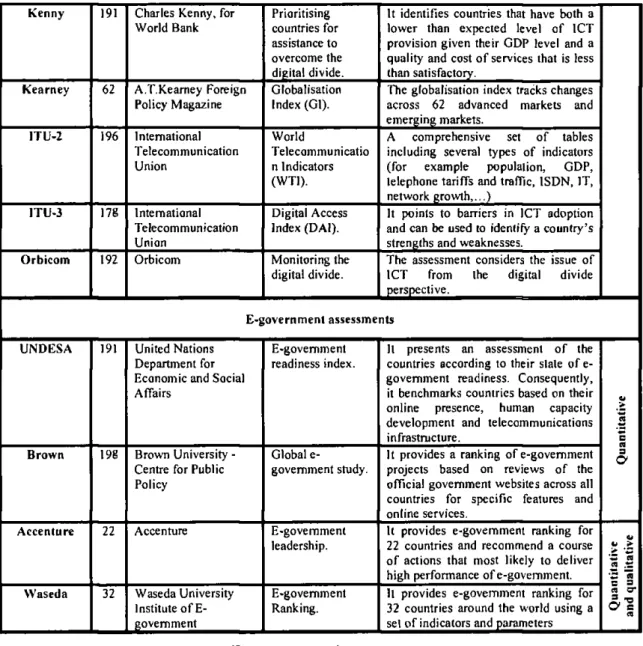
The problem o f the diversity in e-readiness assessments is not limited to définitions. Currently, there are many organisations providing varied methods o f assessment as listed in table 2-2 (Bridges, 2005a). These assessments have différent objectives and goals for what they measure. McConnell International (2000), for instance, assesses the national' economy's e-readiness to participate in the global digital economy. Asian Pacific Economie Cooperation ( A P E C ) , on the other hand, provides an assessment o f e-commerce readiness and what should be focused on to improve it ( A P E C , 2000). International Télécommunications Union (ITU) has a différent perspective that focuses on analysing the factors that affect a country's internet usage (ITU, 2001). Some assessments target enhancing business and the economy through improving ICT, while others might focus on enhancing society.
The following table shows the range of assessments conducted by various organisations.
Abbreviation of organisation undertaking assessment Assesse d countrie s Organisation füll
name Assessment title Assessment description
& _o 'S -a o JS w E-readiness assessments CID 15 Centre for
Internationa) Development -Harvard University
Readiness for the networked world.
The assessment provides a report that defines the degree to which a
Community is prepared to participate in the networked world for each of the catégories identified by the
assessment. _> u
APEC 10 Asia Pacific Economie Cooperalion
E-commerce readiness assessment.
The assessment provides détails on the areas that need to focus on within the criteria provided by the assessment. ^uantit
a
CSPP 1 Computer Systems Policy Project
Readiness guide for living in the networked world.
The assessment produces a rating that indicates which of four progressive stages of development the community is at for each of the five catégories provided by the assessment.
ITU-1 53 International Télécommunication Union
Internet country case study.
The assessment provides an analysis of
the factors affecting internet use along with recommendations. This is done using mosaic methodology.
USAID 24 US Agency for International Development Information and communication technology (ICT) country assessment.
A set of detaiied case studies, each describing an individual country's progress and giving an action plan for it to pursue in the future.
Cas
e
Stud
y
InfoDev 13 Information for Development
Readiness for the networked world.
The study explores possible ways to move forward the e-readiness in the developing world. The assessment is
SIDA 7 Swedish International Development Cooperation Agency
Country ICT survey.
A set of detailed case studies, each describing an individual country's ICT landscape and a basic analysis of
factors of major interest for the promotion of use of ICT for development reasons. A S E A N 10 Association of Southeast Asian Nations E-commerce readiness assessment.
Evaluating countries aecording to four stages of development identified by
I B M : emerging, evolving, embedding and extending. McConnell 42 McConnell International Risk e-business: seizing the opportunity of global e-readiness.
Countries are examined aecording to their capacity to particípate in the digital economy.
Researc
h
Report
s
VVITSA 51 The World Information Technology and Services Alliance International survey of e-commerce.
The survey focused on the direct expérience of companies with e-commerce and their subjective views
of what is needed to promote
e-commerce. Researc h Report s Crenshaw& Robinson
126 Crenshaw& Robinson A cross-national analysis of internet development.
Statistical metrics stating the probable relationship between the variables and an explanation of how these factors are likely to shape the technology development.
Researc
h
Report
s
C I D C M 3 The Centre for International Development and Con fl i et Management
Negotiating the net model.
A report that comprises a detailed narrative description of the processes and outeomes of negotiations between key players o ver the phases of
development and the issues likely to remain problematic in the future.
Researc
h
Report
s
EIU 69 Economist Intelligence Unit
E-readiness ranking.
The ranking covers the world's 60 largest économies and suggests areas to focus on govemment policy and funds.
Researc
h
Report
s
SIBIS 26 Statistical Indicators Benchmarking the Information Society Malching up to the information society. A n évaluation of the E U , the EU accession countries, Switzerland and the United States
The assessment measures and monitors the information society, for benchmarking and policy évaluation.
Researc
h
Report
s
MetricNet 43 MetricNet Worldwide IT Benchmarking.
It measures IT performance and productivity by organisations
Worldwide and produces priorities for IT companies which help organisations to self assess their IT performance.
Researc h Report s K4D 98 Knowledge for Development Program (World Bank) Knowledge Assessment Methodology ( K A M ) (interactive datábase)
A detailed, interactive Statistical assessment of how 98 countries économies are prepared for an information economy and society.
Researc
h
Report
s
IDC-1S1 53 IDC Information Society Index
Information Society Index (IS1) 2005.
Ranks 53 countries aecording to their ability to access and absorb information and IT in the future.
Researc h Report s W E F 102 World Economic Forum Networked Readiness Index (NRJ).
NRJ defines the degree of préparation of a nation orcommunity to participate in and benefit from ICT developments.
Researc h Report s InfoDev and Pyramid Research
60 Pyramid Research, for the Information for Development Program
Information infrastructure index.
It has developed a set of indicators and defined empirical data to assess the information infrastructure Worldwide.
Researc
h
Report
Kenny 191 Charles Kenny, for World Bank Prioritising countries for assistance to overcome the digital divide.
It identifies countries that have both a lower than expected level of ICT provision given their GDP level and a quality and cost of services that is less than satisfactory.
Kearney 62 A.T.Kearney Foreign Policy Magazine
Globalisation Index (Gl).
The globalisation index traéks changes across 62 advanced markets and emerging markets. ITU-2 196 International Télécommunication Union World Telecommunicatio n Indicators (WT1).
A comprehensive set of tables including several types of indicators (for example population, GDP, téléphone tariffs and trafflc, ISDN, IT, network growth,...) ITU-3 178 International Télécommunication Union Digital Access Index (DAI).
It points to barriers in ICT adoption and can be used to rdentify a country's strengths and weaknesses.
Orbicom 192 Orbicom Monitoring the
digital divide.
The assessment considers the issue of ICT from the digital divide perspective.
E-governmenl assessments U N D E S A 191 United Nations
Department for Economic and Social Affairs
E-govemment readiness index.
Il présents an assessmenl of the countries according to their State of e-government readiness. Consequently, it benchmarks countries based on their online présence, human capacity development and télécommunications
infrastructure. mtitativ
e
Brown 198 Brown University -Centre for Public Policy
Global
e-government study.
It provides a ranking of e-government projects based on reviews of the officiai govemment websites across ail countries for specific fealures and online services.
s O
Accenlure 22 Accenture E-government leadership.
It provides e-govemment ranking for 22 countries and recommend a course
of actions that most likely to deliver high performance of e-govemment. ntitativ
e
ualitativ
e
VVaseda 32 Waseda University Institute of
E-E-government Ranking.
H provides e-govemment ranking for 32 countries around the world using a Qua
i
an
d
q
i
government set of indicators and Parameters
Qua i an d q i
Table 2-2: List of assessments
Source: Based on, and extended from Bridges (2005a)
Solutions are provided by différent researchers and organisations for overcoming this problem by having a taxonomy for e-readiness assessments. This classification for assessments might assist policy makers to have a clearer vision o f which assessment is appropriate to achieve a country's goals. Bridges (2005a) provides an approach for classifying e-readiness assessments according to the data collection and analysis techniques. These techniques include the following:
• Statistical techniques, to analyse data from différent countries and to make links among factors collected from ail studies;
• Best practice techniques, which provide comparisons between similar countries so that they can learn from other countries' expérience;
• Historical analysis techniques, which focus on social, economical and political issues to forecast I C T of the country.
Another approach by Bridges (2005a) was to classify e-readiness assessments according to their Outputs, whether they are descriptive, diagnostic of the problems within the country, or prescribing actions for specific problem.
GeoSINC (2002) suggests an alternative approach to the problem of assessment diversity, by using combinations of différent assessments, because no single assessment Covers all criteria. The difficulty remains, however, of the extent to which one assessment may fit with one or more others. Addressing that problem, Bakry (2004) proposes a single assessment applicable to all countries, rather than trying to classify or combine conflicting assessments. Bakry explains that the lack of agreement on standard e-readiness assessments may lead to inaccurate diagnoses for countries. His proposai for a standard assessment is based on five éléments of development, which are given the acronym S T O P E : strategy (for development), technology, organisation and people (for delivering the strategy), and environment (within which the strategy is to be delivered). Bakry's approach has not, however, been applied in practice.
A further problem arises from the existence of assessments for a single country by a number of différent organisations. This problem leads to have conflicting figures for the same country. According to Bridges (2005b), 69 countries have been assessed more than ten times by différent organisations (such as Egypt, South Africa and China). Another 68 countries have been assessed between five and ten times by différent organisations. Other countries (such as North Korea and Nauru) have not been assessed at ail. Accordingly, government policy makers would have to choose between conflicting figures to décide their action plan, which could give rise to problems (Abdelghaffar and Bakry, 2005; Bakry, 2003). A clear example of this confusion between e-readiness assessments figures occurred when McConnell ranking for e-readiness in 2001 concluded that India needed improvement in many areas of Connectivity in contrast with the findings o f MetricNet assessment (Budhiraja and Sachdeva, 2003).
Each assessment organisation uses its own set of assessment criteria, depending on its assessment objectives, and thèse criteria vary between assessment organisations (Bridges, 2005a). Furthermore, even where two or more organisations apparently use the same criterion, they may use différent sets o f variables to measure it. For example, the access criterion consists o f bandwidth, industry diversity, export controls and crédit card régulation in the A P E C assessment (2000), while in the C I D assessment (2003) it consists of information structure, internet availability, internet affordability, network speed and quality, hardware and software, and service and support.
Not only this, but also, defining parameters is static in terms of neglecting the current situation for each country (Mwangi, 2006). Further, the définition of parameters is static and may neglect important différences between countries or in a single country over time (Mwangi, 2006). For example, assessments may not consider the distribution of âges in a population. In Egypt, 33.4% of the population is under fifteen and are therefore not in the work force (Gronlund et al, 2005), so that it is misleading to compare the number o f Personal computers per thousand population in Egypt with the number per thousand in a country with a substantially older population.
The assessments discussed so far measure e-readiness in gênerai but not the more spécifie readiness for e-government (Ojo et al, 2007). In this context, the United Nations has produced reports on e-government readiness ( U N D E S A , 2003d, 2004, 2005, 2008). The advantage of thèse assessments is that they focus on measuring both those e-readiness factors that specifically relate to e-government, such as human capacity and the télécommunication infrastructure index, and other factors that relate only to e-government readiness, sùch as the e-government web index. However, thèse assessments ignore other important e-government readiness factors such as ICT usage and législation, in addition to not defining the impact of the measured factors on citizens' behaviour towards using e-government projects.
There are a small number of other assessments that specifically address e-government readiness, but again their différent objectives and assessment criteria mean that there is no agreement between them on what should be measured.
• Accenture (2004) assesses e-government leadership, using service and delivery maturity as criteria. Service maturity is based on the number o f services provided
oniine and on the phase achieved in e-government (see section 2.2.2). Service delivery focuses on customer (user) relationship management.
• Brown University Center for Public Policy (2005) produces the Global E -Govemment Ranking based on reviewing e-government websites only, using the criteria of oniine information, electronic services, privacy and security, disability access, foreign language access, advertísement, user fees and public outreach. • Waseda University Institut