DATA CENTER ENERGY MANAGEMENT
A Dissertation
Presented to the Faculty of the Graduate School of Cornell University
in Partial Fulfillment of the Requirements for the Degree of Doctor of Philosophy
by
Lakshmi Ganesh January 2012
© 2012 Lakshmi Ganesh ALL RIGHTS RESERVED
DATA CENTER ENERGY MANAGEMENT Lakshmi Ganesh, Ph.D.
Cornell University 2012
Data centers form the underpinnings of the global technology revolution that is cloud computing. There is enormous pressure for data center growth and expansion, to meet the computational demands of an increasingly digital world. With energy costs over-taking server costs in data centers, energy is fast becoming a significant bottleneck to data center scale-out. Further, the global data center energy footprint is growing to be a significant burden on the world’s energy resources. Yet energy is a signally ill-managed resource in most data centers; average data center energy efficiency is less than 50%. With increasing industry awareness of the magnitude and urgency of this problem, many solutions are cropping up to combat each of the several sources of data center energy inefficiency.
The objective of this dissertation is three-fold: First, we examine the causes of data center energy inefficiency from first principles, and identify the challenges involved in addressing them. We find two categories of energy inefficiency: Idle resource energy consumption, andsupport infrastructure energy consumption. Second, we present solu-tions to address each form of inefficiency. We describe two ways to combat idle resource energy consumption, and also present a systemic solution to tackle both forms of energy inefficiency. Finally, throughout this dissertation, we examine the related work and lit-erature, and attempt to map them into the solution space to identify how the solutions relate with each other, and what gaps remain to be addressed.
The cloud has the potential to enable everything from ubiquitous computing and universal access to knowledge, to smart power grids, greater social connectivity, and
near-infinite extensibility of compute/storage power. The cloud turns computation into a utility, and by doing so, has the potential to make it accessible to a much larger part of the world. This dissertation explores ways to enable sustainable scaling of the data centers that power the cloud and enable this vision.
BIOGRAPHICAL SKETCH
Lakshmi was born in Trivandrum, in southern India, on the 27th of November, 1982, and grew up in nomadic fashion all over India. She has warm associations and close ties in most of India’s metros and several little towns besides. Though she complained bitterly during the many moves of her childhood, in retrospect she wouldn’t have it any other way.
Through the many variables in her life, Lakshmi has been fortunate to have the following constants: Her mother, Radha, who has managed the feat of being the best of parents as well as her best friend; her father, Ganesh, who has made his children the protagonists of all his stories; her brother, Anand, who has shown by demonstra-tion the meaning of a good life; her sister, Meena, who has always had her back; and her extended family, which has unconditionally supported her. Lakshmi is named after her maternal grandmother, from whom she would like to learn the wonderful ability to evolve at every stage of life. Lakshmi has probably inherited her student gene from her mother, her writer gene from her father, and has learnt from her siblings about the pur-suit of excellence. She is now learning from her husband and his family the secret of leading a life infused with joy.
On looking back, Lakshmi finds that most of her life’s highpoints correspond to the times that she met and befriended some very special people. Her highschool years, spent in the company of friends who have grown to be foster-sisters, have the warm, golden glow of sepia photographs. Lakshmi’s undergraduate years were truly formative: She found a home away from home among the many lovely people she met there; she discovered a love for theater; she learnt how to power through difficult times; she found her future husband, Madhav!
Lakshmi has now spent over seven years in the United States. It is a very broaden-ing experience to find your place in a foreign country, and Lakshmi is in awe of what a
welcoming country this is. She spent two busy years in sunny Santa Barbara, getting her first taste of Systems research working with Ben Zhao. Ben gave her a gentle introduc-tion to the process of crafting a research paper, and inspired her to pursue a doctorate degree. Lakshmi then found herself in gorgeous Ithaca, working with Ken Birman and Hakim Weatherspoon. Living in Ithaca is a little like doing a PhD—there are beauti-ful moments of discovery, mixed in with hard winters of deadline-chasing and doubt. Both are a trial by fire, and standing at the other end, Lakshmi feels the same mix of accomplishment and nostalgia for both.
Lakshmi now looks forward to post-doctoral work with Mike Dahlin and Lorenzo Alvisi at the University of Texas at Austin. Moreover, after six long years, Lakshmi is finally in the same city as Madhav, and she couldn’t be more excited to begin the adventure of life together.
ACKNOWLEDGEMENTS
People tend to picture PhD advisors as grim, bearded men with little interest in their students beyond their publishing ability. Picture instead an advisor who knows of your interest in theater and takes you to watch plays with him and his wife; an advisor who lets you pursue a Theater minor during your Computer Science PhD, absurd as the pairing seems; an advisor who shows you by example that it is possible to juggle a very successful career with a very successful family life. I have had not one but two advisors who have been friends as much as career mentors. I would like to thank Ken Birman and Hakim Weatherspoon for pushing me to work hard, but also urging balance; for pointing out my mistakes, but with humor; for showing me how to look for exciting questions to work on, but also be productively engaged while looking; and for much else besides. I have learnt all I know of the art of Systems research from them.
As I look back on my PhD, I see many points where thoughtful feedback and kind words have helped steer my course. I would like to thank Robbert van Renesse for being (possibly unbeknownst to him!) a stabilising influence in my career. I learnt some key lessons about precision in thought and speech, and time management from Fred Schneider (a pithy lesson in time management: work harder!). I admire Emin Gun Sirer for his remarkable work ethic, and his whole-hearted commitment to quality Systems work. I would like to emulate Bobby Kleinberg in his energy and enthusiasm as much as in the clear joy his work brings him. I admire Eva Tardos for being such a great teacher, and for being a role model for women in computer science. Finally, I shall remember David Feldshuh and Beth Milles fondly for welcoming me into the Theater world, and for showing me how many life skills may be learnt from the crafting of a play.
Most PhD careers, I think, have their ups and downs; mine was no exception. I had a great Ithacan community to celebrate my ups with me, and help me through the downs. My friends in the Distributed Systems group have inspired me with their
exam-ple, worked closely with me, given me key feedback for my work, and laughed with me over the many absurdities of PhD life. Thank you, Mahesh Balakrishnan, Tudor Marian, Yee Jiun Song, and Hussam Abu-Libdeh. My house and office mates were my Ithacan family. Ainur Yessenalina and Nikos Karampatziakis, I am going to miss our Sangam dinners very much. You have been very good friends to me. Sucheta Soundarajan, thank you for giving me a truly unique perspective on life, work, and animals! Saikat Guha, you have been a friend, a mentor, and an inspiration—thank you! As I look back I see so many lovely people who have enriched my life in Ithaca—Muthu Venkitasubramaniam, Rachel Lin, Edgar Velazquez-Armendariz, Bruno Abrahao, Nitin Gupta, Amit Sharma, and Parvati Iyer—thank you!
My non-Ithacan friends have supported me through my PhD career in innumerable ways—daily phone calls, visits, holidays together, and so much more. You are all so dear to me, and I miss you every day.
I come now to my best friend, Madhav. He also happens to be my husband. I want to thank him for making me laugh, for being dismissive of all my self-doubt, for seeing beyond my personal crises. His music, his worldview, his remarkable ability to see possibilities in everything enrich my life every day. Life is full of joy with such a traveling companion.
TABLE OF CONTENTS
Biographical Sketch . . . iii
Dedication . . . v
Acknowledgements . . . vi
Table of Contents . . . viii
List of Figures . . . x
List of Tables . . . xii
1 Introduction 1 1.1 Data Center Energy Management . . . 2
1.1.1 Context and Background . . . 3
1.1.2 Energy Profile of an Ideal Data Center . . . 5
1.2 Research Questions . . . 7
1.2.1 Energy consumption by idle resources . . . 8
1.2.2 Energy consumption by support infrastructure . . . 10
1.3 Contributions . . . 12
1.3.1 Energy consumption by idle resources . . . 13
1.3.2 Energy consumption by support infrastructure . . . 15
1.4 Discussion: State of the Industry . . . 16
1.5 Organization . . . 18
2 Idle Resources: Matching Power to Load 19 2.1 Context . . . 19
2.1.1 Idea Overview . . . 21
2.2 Related Work . . . 22
2.3 KyotoFS: A New Solution . . . 25
2.3.1 Log-Structured File System . . . 25
2.3.2 LFS: A Power-Saving Opportunity . . . 26 2.4 Evaluation . . . 28 2.4.1 Methodology . . . 28 2.4.2 Results . . . 29 2.5 Prototype . . . 32 2.6 Conclusion . . . 34
3 Idle Resources: Matching Load to Power 36 3.1 Stranded Power . . . 38
3.2 The RackPacker Approach . . . 42
3.2.1 A Running Example . . . 42
3.2.2 Rackpacker Overview . . . 43
3.2.3 Filtering and Classification . . . 44
3.2.4 Bundling . . . 46
3.2.5 Packing . . . 50
3.3.1 RackPacker: Comparative Performance . . . 52
3.3.2 RackPacker: Workload Exploration . . . 56
3.4 Related Work . . . 58
3.5 Summary . . . 61
4 Support Infrastructure: Larger Power Management Units 63 4.1 PUE: Where does the power go? . . . 63
4.2 Related Work . . . 65
4.3 Power-Lean Approach . . . 66
4.3.1 Power Cycle Unit . . . 67
4.3.2 The Case for a Larger PCU . . . 70
4.4 Evaluation . . . 73
4.4.1 Methodology . . . 74
4.4.2 Results . . . 78
4.5 Summary . . . 84
5 Future Work 86 5.1 Global Network of Data Centers . . . 86
5.2 Cooperative Storage . . . 88
5.3 Smart Grid . . . 90
6 Conclusion 93
Glossary 95
LIST OF FIGURES
1.1 Schematic Diagram Of Data Center Power Consumption As A
Func-tion Of Load . . . 7
2.1 KyotoFS: Effect of varying percentage of powered-up disks on perfor-mance (complementary CDF). . . 30
2.2 KyotoFS: Effect of varying percentage of powered-up disks on power consumption . . . 31
2.3 KyotoFS: Effect of varying percentage of powered-up disks on trace running time and energy . . . 32
2.4 KyotoFS Implementation: Random write throughput without and with Gecko . . . 34
3.1 An illustration of power provisioning at the rack level. About 40% of available power is reserved for handling spikes and failover. . . 39
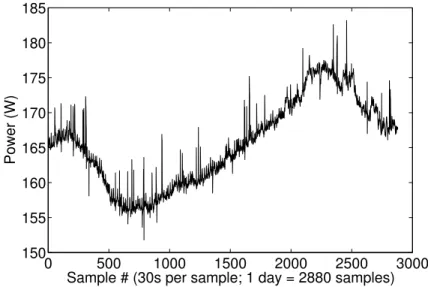
3.2 A real power consumption trace of a production server. . . 41
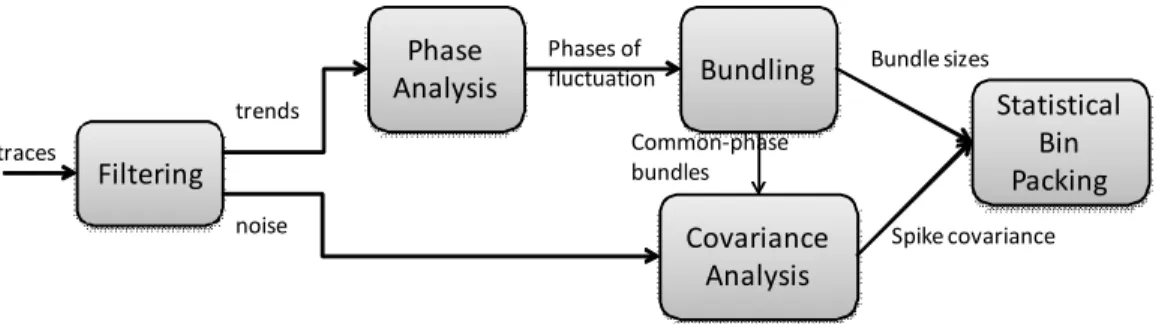
3.3 The flow of the RackPacker algorithm. . . 43
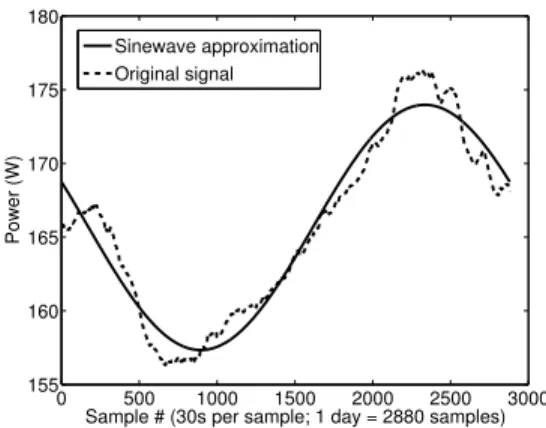
3.4 RackPacker: Filtering and approximation of the power consumption time series. . . 45
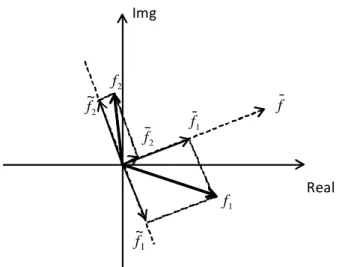
3.5 RackPacker Bundling: Bundling two servers toward the common phase. 47 3.6 RackPacker Bundling based on the decomposition of the 2nd FFT co-efficient vectors. . . 49
3.7 Choice of Confidence Factor . . . 52
3.8 Average power consumption behavior for the various server types . . . 55
3.9 Server assignment results for a realistic workload trace. . . 55
3.10 Workload with shifted phases: Average power consumption behavior for the various server types . . . 56
3.11 Server assignment results for a workload trace with shifted phases. . . 57
3.12 Randomized workload: Average power consumption behavior for the various server types . . . 58
3.13 Server assignment results for a workload trace with randomized phases. 58 4.1 Rack Power Cycle Unit . . . 67
4.2 System model . . . 69
4.3 Impact of data organization scheme on PCU power-down opportunities 69 4.4 Power-Lean Approach Evaluation: Comparing the simulator against Gecko . . . 77
4.5 Computing optimal PCU size for the Internet Archive . . . 79
4.6 Effect of PUE on optimal PCU size . . . 80
4.7 Optimal PCU size when disk-to-CPU ratio is 24 . . . 80
4.8 Energy savings from tuning number of live replicas . . . 82
4.9 Optimal PCU choice for a container farm . . . 82
5.1 The Smoke and Mirrors File System. (1) A primary-site storage system simultaneously applies a request locally and forwards it to the remote mirror. After the network layer (2) routes the request and sends ad-ditional error correcting packets, it (3) sends an acknowledgement to the local storage system—at this point, the storage system and applica-tion can safely move to the next operaapplica-tion. Later, (4) a remote mirror storage system receives the mirrored request—possibly after the net-work layer recovered some lost packets. It applies the request to its local storage image, generates a storage level acknowledgement, and (5) sends a response. Finally, (7) when the primary storage system re-ceives the response, it knows with certainty that the request has been mirrored and can garbage collect. . . 88
LIST OF TABLES
2.1 KyotoFS Evaluation: Sample trace characteristics . . . 28 3.1 RackPacker Configuration Parameters . . . 51 3.2 Description of data using which RackPacker and other solutions are
evaluated . . . 54 4.1 Power-Lean Approach Evaluation: Simulator Parameters (applicable
unless specified otherwise) . . . 75 4.2 Power-Lean Approach Evaluation: Trace Characteristics . . . 76
CHAPTER 1 INTRODUCTION
From government bodies to private companies, banking institutions to hospitals, uni-versities to individuals, data center use is ubiquitous. They are used to store and pro-cess private and corporate email and documents, financial and health records, media and games. They facilitate everything from data storage and computation, to commu-nication, collaboration, and entertainment. Large (global-scale) organizations operate dozens of data centers spread across the world, each containing tens or even hundreds of thousands of servers. More data centers are springing up every day, and existing fa-cilities are expanding continuously [74]. In both scale and reach, the global network of data centers is comparable to as basic an infrastructure as the electricity grid. Yet, in the matter of efficiency—of design and operation—the comparison fails.
The focus of this dissertation is data center energy management—a key aspect of data center operational efficiency. Energy costs can account for over 35% of the total cost of ownership (TCO) of data centers [78]. As servers grow ever more powerful, and data center server densities continue to increase, wattage per square foot has been growing as well. This compounds the amount of heat generated per square foot—in turn requiring the expenditure of more energy to remove. Energy costs now rival server costs [75], yet average industry energy efficiency is a mere 50% [61]. A telling measure of rising industry awareness of this problem is that global investment in greener data centers is projected to increase six-fold between 2011 and 2015, to $41B [8]. In this dissertation, we first establish the scope of the problem, and identify the fundamental research questions that underly it. We then describe our approach to addressing each of these questions.
1.1
Data Center Energy Management
Global-scale online services typically run on hundreds of thousands of servers spread across dozens of data centers worldwide [42]. Google is estimated to own over a million servers (as of 2009) [60], while Microsoft’s Chicago data center alone is estimated to contain over 300,000 servers (as of 2011) [59]. These scales will only increase signifi-cantly as the cloud computing model [56] matures, and approaches what many perceive as a likely vision of the future—a handful of infrastructure providers hosting most of the world’s data and computation [44]. As companies compete to take the lead in this space, the operational efficiency of their massive data centers assumes central importance; even small gains in efficiency translate into end-user perceivable cost reductions, providing key competitive advantage [48]. With energy costs comprising a significant portion of data center TCO, streamlining energy consumption has assumed central importance.
Data center energy consumption is also of concern due to its significant environ-mental impact. Studies show that the combined electricity use of the Internet and cloud (data center and telecommunications network) ranks fifth among the countries of the world, and is growing annually at a rate of about 12% [12]. Data centers worldwide are estimated to account for over 2% of global greenhouse gas emissions, and a significant fraction depend on coal for a majority of their power needs [12]. The cloud has the po-tential to significantly reduce global energy consumption, through enabling technologies like the smart grid, teleconferencing, and cloud storage, among others. Yet its growth, at current trends, will soon be bottle-necked by its own energy footprint. Committing to green data center design and operation is, therefore, essential to the realization of the cloud’s rich potential.
oper-ational efficiency, it is perhaps surprising that average industry energy efficiency is less that 50% [61]. Before exploring the reasons underlying data center energy inefficiency, and identifying ways to mitigate it, it is worthwhile to take a closer look at how the data center industry got to this point. In what follows, we formally define the space, and present a brief history of the data center. We then describe the ideal data center energy profile, and proceed to identify a path towards achieving it.
1.1.1
Context and Background
A data center is a facility dedicated to housing a large group of networked servers and associated power distribution, networking, and cooling equipment, and used to host applications that store, manage, and process digital data. In essence, a data center is a warehouse-sized computer [35].
Physically, a data center may be abrick-and-mortarfacility that typically takes years to build, and can house tens to hundreds of thousands of servers; Alternately, it may be a containerized data center, which is a shipping container pre-populated with a few thousand servers and associated infrastructure, and can be commissioned and deployed in a month or less [58].
Functionally, data centers may be private, where the entire facility is devoted to hosting applications belonging to the facility owner, orshared, where the facility owner leases out portions of the facility to different application providers [56]. A shared data center may be operated as one of three kinds of services, depending on the interface ex-posed to the lessees: Infrastructure-as-a-Service (IaaS) exposes the lowest-level inter-face, and is essentially the leasing out of physical servers;Platform-as-a-Service (PaaS) is one level higher, and leases out virtual CPUs and disks; and finally,
Software-as-a-Service (SaaS)leases out hosted software [56]. The scope of this dissertation includes brick-and-mortar, containerized, private and shared data centers.
The evolution of the data center can be traced back to the mainframes of the 1960’s. These room-sized machines were very expensive, powerful, and highly customized for use in mission-critical data processing in large industries, military and space pro-grams [46]. Commissioning one of these machines would often take years, and due to their highly complex and custom nature, developing applications for them was slow, error-prone, and lacked portability. The introduction of the personal computer (PC) in the 1970’s suddenly made computers much more accessible, bringing them to small businesses and even homes [71]. Though not comparable to mainframes in terms of compute power, these machines were cheap, and much easier to develop software for with their standardized hardware and operating systems [46]. The next game-changer was the invention of Ethernet [57], and distributed computing. This led directly to the evolution of the modern data center, by enabling two parallel trends: First, the high-performance computing (HPC) community, which traditionally revolved around special computing hardware with unique processing capabilities (mainframes), found that the same massive computational and storage capacities could be achieved at much lower cost from large clusters of commodity machines [63]. Enterprises in all sectors, ranging from technology, to finance, military, and government, began to move away from the mainframe model, to the data center model. Second, personal computing in-creasingly shifted online, with data and computation both moving to remote third-party servers [81, 19]; the economies of scale argument saw online service providers concen-trating their servers in large facilities, either private, or shared. Thus, in an interesting cyclical pattern, computing has evolved from the room-sized mainframe computers of the 1960’s to the warehouse-sized server farms that comprise today’s data centers.
The so-calledmega data centeris of relatively recent origin; data centers containing hundreds of thousands of servers did not exist even two years before the writing of this dissertation. This is a rapidly evolving space, with the pace of innovation not quite keeping up with the pace of growth/expansion. Data centers at large scale are, thus, often cobbled together from designs meant for a smaller, earlier generation operation [48]. The space is populated with point solutions and incremental improvements. What is needed is an examination of the fundamental sources of data center energy inefficiency. We start by identifying the energy profile of an ideally efficient data center; contrasting this with reality will then help uncover the research questions that need to be addressed in order to optimize data center energy consumption.
1.1.2
Energy Profile of an Ideal Data Center
Before delving into the sources of data center energy inefficiency, it is worthwhile to examine the energy profile of an ideal data center. This exercise establishes our goals in designing optimal energy management solutions.
Ideally, a data center should consume only as much energy as is needed to process incoming requests. Consider a request for a data item; given the application logic on the data center servers, this request translates to some number of CPU instructions, memory accesses, disk accesses, and network flows. These require some amount of energy to execute, which can be computed given the IT resource specifications of the data cen-ter. In reality, however, processing the request would additionally incur a number of energy overheads: energy used by idling resources, by air conditioners that cool the servers processing the request, and energy wasted in inefficient power delivery to the servers, among other overheads. The amount of these overheads depends on the energy
(in)efficiency of the data center. An ideal data center would minimize these overheads. We enumerate two target properties of a data center that capture this idea:
1. Power-proportionality: This property states that executing a given job consumes a minimal amount of compute energy, irrespective of how much time it takes— energy consumed by IT resources being proportional to work done [21]. This is possible only if base-line power consumption (i.e., power consumed when no job is being executed) is zero. In other words, idle resource power consumption must be zero.
2. Power Utilization Efficiency (PUE) Close To 1: This property states that the en-ergy consumed during job execution is within a small margin of the amount of usefulwork done. In other words, the constant of proportionality relating energy consumed to useful work done should be close to 1. PUE is defined as the to-tal energy consumed by the data center, divided by the toto-tal energy consumed by the servers in the data center. As energy consumed by a data center is divided between servers (which do directlyusefulwork) and the power, cooling, and net-working infrastructure that supports the correct functioning of servers (thus not directly useful), PUE can be much larger than 1. The industry average is 2 [78], which indicates considerable inefficiency in the operation of data center support infrastructure [77].
Together, these properties assert that the power consumed by a data center is a mini-mal function of its load. Data center power proportionality requires power consumption to track load, and eliminates overheads from idle resource power consumption. Low data center PUE ties power consumption closely touseful work done, and minimizes over-heads from support equipment power consumption. Thus, a data center that is power
proportional and has a PUE of 1 would consume only as much energy as the applica-tion logic requires from the IT equipment. The next secapplica-tion examines the fundamental research challenges to achieving these target properties.
1.2
Research Questions
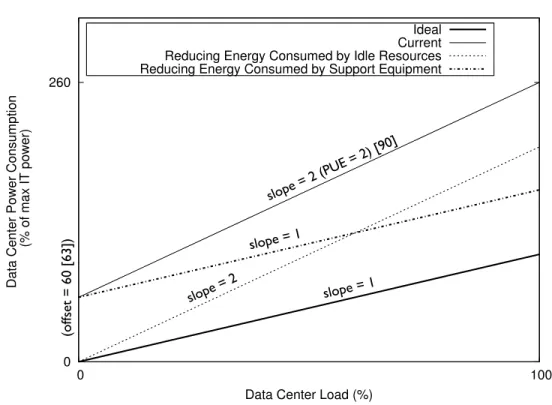
slope = 2 (PUE = 2) [90] slope = 2 slope = 1 slope = 1 (o ffs et = 60 [63]) 0 260 0 100Data Center Power Consumption
(% of max IT power)
Data Center Load (%)
Ideal Current Reducing Energy Consumed by Idle Resources Reducing Energy Consumed by Support Equipment
Figure 1.1: Schematic Diagram Of Data Center Power Consumption As A Func-tion Of Load
Figure 1.1 compares an ideal power consumption curve, as described in the pre-vious section, with the prevalent reality. The differences between these curves signal the presence of various inefficiencies in current data center design and operation. We identify two problem areas: (1) Energy consumption byidle resources, and (2) Energy consumption by support equipment. We discuss the magnitude of each problem area, and the challenges involved in addressing it.
1.2.1
Energy consumption by idle resources
The ideal data center consumes zero energy under zero load. The reality, however, is that in inadequately managed facilities, servers consume almost as much energy when idle or lightly loaded, as when heavily loaded [55]. This is the reason for the high offset in the power:load curve of the average data center (see figure 1.1). The problem is exacerbated by the fact that most data centers, being provisioned for peak rather than average load, are very lightly loaded on average—considerably less than 50% typically [48].
So why don’t data center operators just turn off idle resources? Many server compo-nents also have the ability to operate in multiple power modes (corresponding to com-mensurate levels of performance), so that they can be manipulated to consume power proportional to their load, or desired level of performance. However, there are several challenges to this approach:
• Performance Tradeoff: Switching between power modes takes time, and can translate to degraded performance if load goes up unexpectedly. Most services can tolerate very little, if any, performance degradation.
• Load Unpredictability: The load on a given server can be impacted by a plethora of factors, including time of day, day of year, current world affairs, geography, and flash crowds, among others, making it very hard to predict accurately. Power managing servers without adequate fore-knowledge of their anticipated load can lead to significant performance degradation.
• Short Idle Times: Load spread—the set of servers that serve the load—can also vary continually (a result of load balancing, for example), leading to short idle times for most servers; this means that the time and energy cost of switching them to lower power modes is often not worth the potential energy saving from the
switch.
The research question here, then, is: how can we minimize energy consumption by idle resources in a data center environment with high load variability, without unaccept-able performance impact?
There are two basic approaches to addressing this question. The first approach tries to reduce power consumption by idle resources by finding ways to enable switching them to lower power modes (or turning them off). This approach relies on design-ing mechanisms that improve the predictability and length of resource idle periods, to enable effective power-down. The second approach tries to eliminate (or reduce) the presence of idle resources at all, by provisioning fewer resources, and over-subscribing them. This approach is premised on the same principle as virtual memory—that all the contenders for the data center resources will not load-peak at the same time, thus allowing the pool of resources to be time-shared between them.
Examples of the first approach include disk power management solutions like Mas-sive Array of Idle Disks (MAID) [31], Popular Data Concentration (PDC) [67], Hiberna-tor [85], and Power-Aware Caching (PA-Cache) [84], among several others [40, 22, 41]. These attempt to reduce storage power consumption by powering down idle disks. Some of the shortcomings of these proposals are additional expense (MAID), inability to adapt to different workloads/applications (PDC), complexity (Hibernator), and insufficient re-turns (PA-Cache). Dynamic voltage and frequency scaling (DVFS) is a mechanism that allows CPU power to be manipulated to match its utilization. This is a useful tool, but needs an effective management framework that can maximize its benefit, by enabling sufficiently long idle CPU periods. We discuss how to design such a framework, in chapter 2.
Resource over-subscription solutions typically employ a power-tracking and capping approach [35, 51, 45, 25, 68, 79]. Power-tracking, as the name implies, is a mechanism to monitor power use, while power-capping prevents resources from exceeding a given (tunable) power cap. These are essentially safety mechanisms to enable resource over-subscription without the danger of overload and its repercussions. In chapter 3, we show how to go beyond power tracking and capping, to actively consolidate load to maximize resource utilization.
1.2.2
Energy consumption by support infrastructure
In addition to the servers and IT equipment that are doing directly useful work, data centers contain a considerable amount of support infrastructure like power distribution and cooling equipment, that enables the IT equipment to function correctly, but does not contribute directly to useful work done. In the ideal data center, the energy consumption of the support equipment should be a small fraction of the energy consumption of the IT equipment. In reality, however, support equipment consumes a comparable amount of energy to the IT equipment. This leads to the steep slope of the power:load curve of the average data center (see figure 1.1). Support infrastructure performs the following functions:
• Cooling: A prevalent rule-of-thumb in the industry suggests that for every Watt of energy being consumed by servers, about 0.5 W is needed to cool them [43]. Traditional data center cooling infrastructure consists of a chiller unit to chill the coolant used (water, or air), and fans to direct cool air towards the servers and hot air away from the servers. These are both intrinsically power-hungry processes. Further, the cooling infrastructure and the system it serves—the racks of variably
hot or cold servers—form a thermodynamically highly complex control system, which is hard to get exactly right [62]. The average data center, therefore, errs on the safe side and loads the cooling equipment more than required.
• Power Delivery: Power is typically delivered to a data center as high voltage AC power; this is stepped down to lower voltage AC power for distribution to racks for use by servers and other IT equipment. Inside this IT equipment, power supplies convert the AC power to the DC power needed for digital electronics. For every Watt of energy used to power servers, up to 0.9 W can be lost through this series of power conversions; further, more power is needed to cool the conversion equipment [76].
• Power Backup: In order to prevent outages, data centers use a backup power supply that can kick in temporarily if the primary supply fails. Traditionally, this backup takes the form of a central UPS (Uninterruptible Power Supply); power to the facility flows through the UPS, charging it, and is then routed to the racks. Significant power loss can result from this model, as the average UPS has an efficiency of only about 92% [36].
The research question here, then, is: how can we minimize energy consumption by support infrastructure in a data center, without impacting correct server functioning or overall complexity?
Solutions have been proposed, especially of late, to address each of the power over-heads from support equipment. A highly effective solution to reduce cooling power overheads isfree cooling, a system that uses ambient air for facility cooling, thus obvi-ating the need for power-hungry chillers. It has been shown that free cooling can help bring data center PUE down to as low as 1.07 [11]. However, a severe limiting factor for this solution is the requirement that ambient temperatures be suitable for use in
facil-ity cooling—which does not hold for a majorfacil-ity of extant data centers. Power delivery efficiency has been shown to improve significantly by supplying the data center with DC power instead of AC power [76]. However, this shift also comes at a significant de-ployment cost. Finally, it has been demonstrated that moving from a central UPS power backup solution to a distributed model with each server backed up by its own battery can eliminate the power loss through UPS inefficiencies [36].
Another approach to reducing support infrastructure energy consumption is to power manage them in a similar manner to IT equipment—i.e., power them down when not needed. Along these lines, Thereska et al. [73] have shown how storage power con-sumption can be reduced by enabling the power down of entire servers, rather than just disks. However, to the best of our knowledge, explicitly power managing the power distribution, networking, and cooling infrastructure has not been tried. In chapter 4, we argue that this approach can be highly effective in reducing data center PUE, and show how to enable it without adding significantly to system complexity.
1.3
Contributions
In this dissertation, we present ways to address both of the research questions raised above. We describe two ways to reduce the energy wasted on idle resources, and achieve power proportionality. We also show how finer-grained control over the support infras-tructure reduces its power burden, lowering data center PUE.
1.3.1
Energy consumption by idle resources
There are two ways to approach the problem of idle resource energy consumption. First, we attempt to match power consumption to load, by enabling power-down of idle re-sources. Second, we attempt to match load to provisioned power—we consolidate load so that resource utilization is maximized and idle resources minimized.
Matching Power to Load: In order to match data center power consumption to its load, we need to power down idle resources, so that baseline power consumption is minimized. The challenge here is in accurately predicting resource idle periods—if the idle period is not long enough, resource power down becomes counter productive. Current solutions have tried various means for predicting resource idle periods, with varying success. We suggest a new approach that circumvents the need for predicting resource idle periods, by manipulating load distribution intelligently.
We apply this approach in a low-power storage system design, called KyotoFS. Ky-otoFS is a distributed log-structured file system (LFS) [70] that leverages the read/write separation enabled by an append-only log model to significantly improve power-down opportunities among back-end disks. The key insight behind KyotoFS is that using a log makes all write accesses completely deterministic—they all go to the disks housing the log head. With write accesses constituting an increasing fraction of large-scale storage accesses [64], we find that a significant portion of disk accesses become completely pre-dictable. Our evaluation suggests that KyotoFS can reduce storage energy consumption by up to 20%.
This approach finds a way to naturally distribute load in an energy-optimal manner, without the need for additional levels of indirection for load redistribution, or load anal-ysis for predicting access distribution. At a high level, we can see this as a clean-slate
approach, rather than a patching approach. While both approaches have their place in engineering solutions, a clean-slate approach wins when its deployment cost is low, as it is here. As we discuss in chapter 2, the log model has regained prominence with the advent of flash storage; this allows us to combine the simplicity of a clean-slate design, with the low deployment overhead of an increasingly prevalent storage model (the log). As we will see, this combination is a recurrent theme in this dissertation.
Matching Load to Power: In order to match load to provisioned power, we need to consolidate load in such a manner that we maximize resource utilization. We propose a novel approach for consolidation: power-aware server placement in racks. The key insight behind this approach is the observation that there is considerable variation among the utilization patterns of servers in data centers; this suggests that cumulative load, per rack, could be smoothed by populating the rack with an intelligent choice of servers. A smooth load curve allows for maximal resource utilization.
RackPacker is an application of this approach. It is an algorithm for power-aware server placement on racks. It works by observing server utilization patterns over a pe-riod of time and determining optimal groupings of servers into racks such that average rack utilization approaches peak rack utilization, thus reducing resource stranding (idle resources). Our evaluation suggests that RackPacker can improve load consolidation to the extent that data center capacity could be increased by 18%. With more and more data center servers being virtualized, server placement decisions become a matter of virtual machine migration; thus, RackPacker can make frequent server placement decisions at low cost.
The RackPacker approach is applicable to more than just power consolidation. Data centers are increasingly being virtualized to improve server utilization; hosting multiple virtual machines on each physical server consolidates load, and reduces the physical
resources needed. Rackpacker is highly applicable in this context—it can be used to find near-optimal groupings of virtual machines to host on each physical server, to maximally consolidate load metrics such as CPU utilization, or memory usage. What is needed is an understanding of how this metric would aggregate over multiple virtual machines, which is non-trivial in some cases (memory, for instance) [47].
1.3.2
Energy consumption by support infrastructure
We show how to reduce support infrastructure energy consumption by moving to larger units of power management, such as racks, or even entire containerized data centers. The key insight behind this approach is that support infrastructure power consumption should be tied to the IT equipment it is meant to support; further, it is controlled in software, with the same algorithms controlling both the IT equipment, and its support infrastructure. The advantage of power management at rack granularity is that commod-ity racks are available that have their own power distribution, networking and cooling equipment; powering a rack down, therefore, also powers down its associated support infrastructure, thus improving PUE.
In our research on power-lean data centers, we show how to enable this approach, through power-aware data placement and load distribution. Further, we show that cur-rent data center design trends strongly support such an approach. Our evaluation re-sults suggest that moving to rack-based power management can result in an eight-fold reduction in data center energy consumption, when compared with conventional power-management solutions.
The power-lean data center approach is another instance of combining a clean-slate approach with low deployment cost. The space of data center power management
so-lutions is fragmented—there are soso-lutions for powering down idle IT equipment (disks, CPUs, servers), and solutions for reducing non-IT power overheads. Our solution uni-fies these two approaches; further, it does so at low cost by using prevalent data center practices such as data and compute cross-domain redundancy and rack-sized resource commissioning units (chapter 4).
1.4
Discussion: State of the Industry
Industry leaders like Google and Facebook have been making their data centers more energy efficient [83, 82, 65, 11]. In this context, it is reasonable to ask whether they have already solved the problems we describe. In a broader sense, we ask whether the industry is adequately addressing data center energy inefficiencies. We argue that while they are moving in the right direction, there remain important gaps to address.
In section 1.2, we sketched some of the solutions currently being proposed and de-ployed to streamline data center energy consumption; here we reiterate why they are not sufficient. Our argument is three-fold: first, the data center energy management space is fragmented—consisting of point solutions addressing individual sources of en-ergy inefficiency, and lacking a systemic solution; second, most of the current solutions have high deployment overhead, and require significant data center design overhaul; and third, current solutions fail to address poor IT resource utilization in data centers, and the resulting power overheads from idle resources.
Google [82], Facebook [11], and others have reported facilities with PUE close to 1.00. They achieve this reduction of energy overheads through a number of point so-lutions. We have mentioned free cooling; this is arguably the single most effective means of reducing data center PUE. However, the required ambient conditions do not
pertain everywhere. With an increasing push for data center geo-diversification (orig-inating from reasons of performance as well as failure-resilience) [39], it is likely that most future data centers also cannot assume suitable ambient conditions. Arguments for wave-powered data centers [34] face the same objections.
Other industry innovations for PUE reduction include per-server batteries [36], cold aisle containment [82], and a central CRAC controller [82]. Dell has designed servers capable of functioning in higher temperatures [10], thus reducing cooling needs. Future data center designs can and should make use of these solutions to improve their energy efficiency. However, existing facilities will need to undertake a significant design over-haul to adopt these solutions. In chapter 4 of this dissertation, we present a systemic data center energy management solution that has low deployment cost for both existing and new facilities.
Low data center server utilization is typically combated with virtualization. Host-ing multiple virtual machines on each physical server can significantly increase average server utilization [9]. However, there are two weaknesses to this approach that we ad-dress in this dissertation. First, for optimal load consolidation, the right set of virtual machines need to be co-hosted in each server; co-hosting virtual machines with the same (or very similar) individual utilization curves will result in poorer load consolida-tion than if the co-hosted virtual machines have opposing utilizaconsolida-tion curves (i.e., when one curve peaks, the other troughs). Chapter 3 presents an algorithm to compute near-optimal sets of virtual machines for load consolidation. The second weakness to the virtualization approach is a more insidious one: most servers in a data center tend to have similar utilization curves, leading to poor overall load consolidation potential. No matter how many virtual machines you co-host in a physical server, if they all have load troughs at the same time, there will be idle server periods. Thus, virtualization and load
consolidation have to be complemented with idle resource management for true data center energy streamlining. Chapter 2 addresses the question of how to power down idle resources without impacting performance.
This dissertation argues that there is a need for a systemic approach to data center energy management, addressing both idle resource energy consumption and support in-frastructure energy consumption. However, truly sustainable operations go beyond data center energy management to include investment in green energy research and develop-ment, usage of renewable energy, and active measures for protecting the environment; industry leaders are beginning to take heed [82].
1.5
Organization
We have discussed the importance of improving data center energy management, and identified two research questions that need to be addressed in order to do so. We have outlined our approach towards answering these questions, and contrasted them against related work.
The rest of this dissertation is organized as follows. Chapter 2 presents KyotoFS, a proportional storage system that matches power consumption to load by power-ing down idle disks. In chapter 3, we describe RackPacker, a server placement algorithm that consolidates data center load to match provisioned power, thus reducing resource stranding. Chapter 4 discusses how larger units of power management can drastically re-duce support infrastructure energy consumption, resulting in improved data center PUE. Finally, chapter 5 presents some future research directions, and chapter 6 concludes.
CHAPTER 2
IDLE RESOURCES: MATCHING POWER TO LOAD
We have identified idle resource energy consumption to be one of the sources of data center energy inefficiency. Managing idle resources presents a tradeoff between perfor-mance and power; turning off idle resources saves power, but can result in a perforperfor-mance penalty or even service unavailability in case of accesses to the powered-off resources. This chapter shows how to walk the tightrope of reducing idle resource power consump-tion, while maintaining performance.
A significant fraction of the total cost of ownership (TCO) of data centers is the cost of keeping hundreds of thousands of disks spinning. We present a simple idea here that allows the storage system to turn off a large fraction of its disks, without incurring unacceptable performance penalties. Of particular appeal is the fact that our solution is not application-specific, and offers power-savings for a very generic data center model. In this chapter, we describe our solution, identify the parameters that determine its cost-benefit tradeoffs, and present a simulator that allows us to explore this parameter space. We also present some simulation results that add weight to our claim that our solution represents a new power-saving opportunity for large-scale storage systems. Finally, we demonstrate the practicality of our solution through a prototype implementation.
2.1
Context
The declining costs of commodity disk drives has made online data storage a way of life, so much so that companies like Google and Yahoo host hundreds of thousands of servers for storage [60]. However, a hundred thousand servers consume a lot of power! Not only does this translate to many millions of dollars spent annually on electricity bills,
the heat produced by so much computing power can be searing. Since disks account for a significant fraction of the energy consumed [85], several approaches for disk power management have been proposed and studied. We will examine some of these here. But first let us lay out some of the groundwork.
Any disk power management scheme essentially attempts to exploit one fact: disks can be run in high-power mode, or low-power mode, with a corresponding performance tradeoff. In the limit, a disk can be shut off so that it consumes no power. Given a large cluster of disks, only a fraction of them is accessed at any time, so that the rest could potentially be switched to a low-power mode. However, since mode transitions consume time and power, disk management schemes have to walk the tightrope of finding the right balance between power consumption and performance.
The solution space explored thus far in the literature can be divided as follows: (1) Hardware-based solutions, (2) Disk Management solutions, and (3) Caching solutions. Each of these solutions proposes a new system of some kind; hardware-based solu-tionspropose novel storage hierarchy to strike the right balance between performance and power consumption;disk management solutionsinterject a new ‘disk management layer’ on top of the file system, which controls disk configuration and data layout to achieve power-optimal disk access patterns;caching solutionsdevise new power-aware caching algorithms that allow large fractions of the storage system to remain idle for longer periods of time, allowing them to be switched to lower power modes.
This chapter argues that there is a fourth niche as yet unexplored: (4) File System solutions. We do not present a new system; instead, we take an idea that has been around for well over a decade now—the Log-Structured File System (LFS) [70]—and argue that technological evolution has given it a new relevance today as a natural power-saving opportunity for large-scale storage systems. The key insight is that, where other
solutions attempt to predict disk access to determine which disks to power down, the LFS automatically provides a perfect prediction mechanism, simply by virtue of the fact that all write-accesses go to the log head. Section 3 explains and expands on this idea.
2.1.1
Idea Overview
To see why the LFS is a natural solution to the problem of disk power management, consider some of the challenges involved:
• Short Idle Periods: Typically, server systems are not idle long enough to make it worthwhile to incur the time and power expense of switching the disk to a low-power mode, and switching it back when it is accessed. This is a notable point of difference between server systems and typical mobile device scenarios (like laptops), which makes it hard to translate the solutions devised for mobile devices to server systems. The LFS localizes write-access to a small subset of disks; this feature, when combined with a cache that absorbs read-accesses, results in long disk idle periods.
• Low Predictability of Idle Periods: Previous studies [41] have shown that there exists low correlation between a given idle period’s duration and the duration of previous idle periods. This variability makes it difficult to devise effective predic-tive mechanisms for disk idle times. The LFS neatly circumvents this problem by predetermining which disk is written to at all times.
• Performance Constraints: Server systems are often constrained by Service Level Agreements (SLAs) to guarantee a certain level of performance, so that finding a solution that provides acceptable performance to only a fraction of the incoming requests (albeit a large fraction) may often not be sufficient. The LFS provides an
application-independent solution that allows the system to perform consistently across a wide range of datasets.
• The law of large numbers: Large scale server systems process incredibly large request loads. Directing these to a small fraction of the total number of disks (the fraction that is in ‘high-power mode’) can significantly raise the probability of error and failure. The fact that the disks used in these contexts are typically low-end with relatively weak reliability guarantees exacerbates this problem. Our solution alleviates this problem by making sure that the live subset of disks is not constant.
The rest of this chapter is organized as follows: Section 2.2 describes some of the solutions explored in the first three quadrants mentioned above. Section 2.3 presents and analyzes our solution, while Section 2.4 discusses our evaluation methodology and results. We describe a prototype implementation in section 2.5, and conclude in Sec-tion 2.6.
2.2
Related Work
Hardware-based Solutions
The concept of a memory hierarchy arose as a result of the natural tradeoff between memory speed and memory cost. Carrera et al. point out in [22] that there exists a similar tradeoff between performance and power-consumption among high-performance disks and low-performance disks such as laptop disks. They explore the possibility of setting up a disk hierarchy by using high- and low-performance disks in conjunction with each other. In a related vein, Gurumurthi et al. [40] propose Dynamic Rotations Per Minute (DRPM) technology, whereby disks can be run at multiple speeds depending on
whether power or performance takes precedence. DRPM, however, poses a significant engineering challenge whose feasibility is far from obvious.
Another approach is proposed by Colarelli et al. in [31], using massive arrays of inexpensive disks (MAID). They propose the use of a small number of cachedisks in addition to the MAID disks. The data in these cache disks is updated to reflect the workload that is currently being accessed. The MAID disks can then be powered down, and need only be spun up when a cache miss occurs, upon which their contents are copied onto the cache disks. This approach has several of the weaknesses that memory caches suffer, only on a larger scale. If the cache disks are insufficient to store the entire working set of the current workload, then ‘thrashing’ results, with considerable latency penalties. Further, the cache disks represent a significant added cost in themselves.
Disk Management Solutions
Pinheiro and Bianchini [67] suggest that if data is laid out on disks according to fre-quency of access, with the most popular files being located in one set of disks, and the least popular ones in another, then the latter set of disks could be powered down to conserve energy. Their scheme is called Popular Data Concentration (PDC) and they im-plement and evaluate a prototype file server called Nomad FS, which runs on top of the file system and monitors data layout on disks. Their findings are that if the low-access disks are powered down, this results in a considerable performance hit; they suggest instead that they be run at low speed. While their idea is sound, it is not clear whether this scheme would adapt to different workloads.
Son et al. propose another data layout management scheme to optimize disk access patterns [72]. Their approach uses finer-grained control over data layout on disk, tuning it on a per-application basis. Applications are instrumented and then profiled to obtain array access sequences, which their system then uses to determine optimal disk layouts
by computing optimal stripe factor, stripe size, start disk etc. Again, the wisdom of marrying the disk layout to the application seems questionable.
Hibernator, proposed by Zhu et al. [85], combines a number of ideas. It assumes multispeed disks, and computes online the optimal speed that each disk should run at. To minimize speed transition overheads, disks maintain their speeds for a fixed (long) period of time - they call this the coarse-grained approach. Hibernator includes a file server that sits on top of the file system and manipulates data layout to put the most-accessed data on the highest speed disks. The authors address the issue of performance guarantees by stipulating that if performance drops below some threshold, then all disks are spun up to their highest speed.
Caching Solutions
Zhu et al. [84] observe that the storage cache management policy is pivotal in deter-mining the sequence of requests that access disks. Hence, cache management policies could be tailored to change the average idle time between disk requests, thus providing more opportunities for reducing disk energy consumption. Further, cache policies that are aware of the underlying disk management schemes (eg. which disks are running at which speeds, say) can make more intelligent replacement decisions. The authors present both offline and online power-aware cache replacement algorithms to optimize read accesses. They also show through experiments the somewhat obvious fact that for write accesses, back policies offer more opportunities to save power than write-through policies.
2.3
KyotoFS: A New Solution
We now argue that there remains an unexplored quadrant in this solution space. Caches are used to minimize accesses to disk. Good caching algorithms practically eliminate read accesses to disk. However, write accesses (whether synchronous or not) must still eventually access the disk. Thus, assuming perfect caching, disk access will be write-bound. Putting a disk management layer on top of the file-system to optimize data layout for writes is only halfway to the solution. To take this idea to its logical conclusion, it is necessary to rethink the file system itself. In the context of write-access optimiza-tion, a very natural candidate is the log-structured file system [70]. We now give a brief overview of the log-structured file system before describing the power-saving opportu-nity it represents.
2.3.1
Log-Structured File System
The Log-Structured File System (LFS) was motivated by a need to optimize the latency of write-accesses. Writing a block of data to a Seagate Barracuda disk costs about 11.5ms in seek time and 0.025ms/KB in transmission time. The key observation here is that seek time is a large andconstantterm in latency computation. To eliminate this term, LFS replaces write operations by append operations. Secondary storage is treated as a large append-only log and writes always go to the log head. Seek time is thus eliminated, and write latency becomes purely a function of the disk bandwidth.
How do reads work in the LFS? In the same way as in conventional file systems! Reads require random-access, and hence do not avoid seek-latency. However, the as-sumption is that with good caching mechanisms, reads will be a small fraction of disk
accesses.
As can be imagined, space reclamation is a tricky problem in log structured file systems. However, excellent solutions have been proposed to solve it, and one such is of interest to us: the disk is divided into large log segments. Once a log segment gets filled, a new log segment is allocated and the log head moves to the new segment. When some threshold of a segment gets invalidated, its valid data is moved to another segment (replacing that segment’s invalid data), and it is then added to the pool of free log segments. Over time, this process results in a natural division of allocated segments into stable (ie.. consisting almost entirely of data that is rarely invalidated/modified), and volatile ones (which need to be constantly ‘cleaned’). We will see how this feature can be used to save power.
2.3.2
LFS: A Power-Saving Opportunity
The disk-management policies described in the related works section essentially attack the problem by trying to predict in advance which disk any given access will go to. They optimize the data layout on disks to ensure that accesses are localized to some fraction of the disks, so that only these need be powered up. However, these are all probabilistic models - a new access has some probability of not fitting this model and needing to access a powered-down disk. Further, in such schemes, disk layout becomes tied to particular applications; two applications that have completely different access patterns might require different data layouts on disk leading to conflicts that reduce possible power-savings.
Since all writes in the LFS are to the log head, we know in advance which disk they will access. This gives us the perfect prediction mechanism, at least for write-accesses.
Besides being deterministic, this prediction mechanism is also application-independent. Thus, if most accesses to disks were writes, we could power down every disk but the one that the log head resides on. This, however, is an ideal case scenario. Our view is that, with a good caching algorithm (the power-aware caching algorithms described in section 2.2 are good candidates), reads to disk can be minimized, and only a small fraction of the disks need be powered on in order to serve all writes as well as reads.
However, what about the performance and power costs of log cleaning? Matthews et al present some optimizations in [54] to hide the performance penalty of log cleaning even when the workload allows little idle time. The power costs of log cleaning are a little more tricky to justify; however, this is where the natural division of segments into stable and volatile ones that the log cleaning process results in (as described above) can help. After a significant fraction of segments on a disk have been classified as stable, volatile, or free, we power the disk on and copy the stable segments to a ‘stable’ disk, volatile segments to a ‘volatile’ disk (disk is kept on), and the entire disk is freed for reuse. This is similar to the log cleaning scheme described in [66], which uses a ‘hidden’ structure embedded in the log to track segment utilization. Cleaning an entire disk amortizes the cost of powering it on.
The LFS has returned to prominence at the time of this writing as the file system of choice for use in flash storage devices [15]. Flash storage is increasingly being adopted in data centers as an intermediate level in the storage hierarchy between primary mem-ory and disk. However, it has certain properties like block-sized erase and limited erase cycles, which make log-based storage models a good fit [15]. This means that an im-portant piece of the puzzle for KyotoFS—log-based storage—is already seeing wide adoption in data centers today, facilitating industry adoption of KyotoFS.
Table 2.1: KyotoFS Evaluation: Sample trace characteristics Number of accesses 476884
Number of files touched 23125 Number of bytes touched 4.22GB Average number of bytes/access 8.8 KB
2.4
Evaluation
2.4.1
Methodology
We have proposed the use of the LFS in lieu of conventional file systems in data-center scenarios to achieve power conservation. For this idea to be accepted, two questions need to be answered in the affirmative: (1)Does this new scheme result in significant power savings?, and (2) Does this new scheme provide comparable performance to existing schemes? Further, the answers to these questions must be largely application-independent, and must apply to a generic data center model. To address these questions, we present a simulator - Logsim. Logsim consists of less than a thousand lines of Java code and is a single-threaded, discrete event-based simulator of a log-structured file system. Given a trace of read and write requests, Logsim returns the observed access latencies, disk utilization, cache-hit ratio, disk-mode transitions etc., for the chosen set of configuration parameters. We use real-world traces for our simulations from a web-server that serves images from a database [69]. Table 2.1 describes the characteristics of a sample trace.
The mechanism we simulate is as follows: All (non-empty) disks are assumed to begin in the ‘on’ state, and an access count (an exponentiated average) is maintained for each disk. The user specifies the maximum percentage (m) of disks that are kept powered on. Periodically (200ms, in our experiments), a ‘disk check’ process scans the access
count for each disk and powers down all but the most-accessed topm% of the disks, as well as any disk which does not have access count at leastt. t is 0 in our experiments. If a cache-miss results in an access to a powered-down disk, then this disk is spun up (to remain powered on until the next ‘disk check’), and there is a corresponding latency penalty. Judicious choice ofmandtminimizes the probability of this occurrence.
2.4.2
Results
To save power, we must turn off some percentage of disks in the storage system. How-ever, there are two opposing forces at play here. A large number of powered-on disks re-sults in good performance (low latency), but also low power savings. On the other hand, decreasing the number of powered-on disks incurs two possible penalties: increased latencies, and increased mode-transitions. Mode-transitions consume power and thus counter the potential savings achieved by powered-down disks. To find the optimal per-centage of disks to be powered down, we ran a set of simulations on Logsim and varied the number of disks that we kept powered up from none (except the log-head disk), to all, in steps of 20%. Thus, out of a total of 66 disks, 1, 13, 26, 39, 52, and 66 disks were kept powered up, respectively. For each run, we examine both its performance (in terms of observed access latencies), as well as its power-consumption. Figure 2.1, 2.2 and 2.3 show the results of these simulations.
The performance of our system depends heavily on its cache configuration. Since cache optimization is an orthogonal issue that comprises an entire field of research in itself, it is important to isolate its effect on performance. To achieve this, we imple-mented an ‘ideal cache’ algorithm, which we term the oracle. Experiments using the oracle approximate the best performance we could achieve since an oracle has future
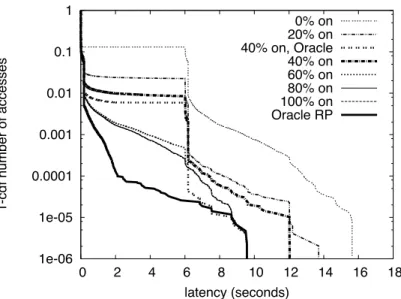
1e-06 1e-05 0.0001 0.001 0.01 0.1 1 0 2 4 6 8 10 12 14 16 18 1-cdf number of accesses latency (seconds) 0% on 20% on 40% on, Oracle 40% on 60% on 80% on 100% on Oracle RP
Figure 2.1: KyotoFS: Effect of varying percentage of powered-up disks on perfor-mance (complementary CDF).
knowledge and is able to replace items accessed furthest in the future [33]. In figure 2.1, 2.2, 2.3, the data points that use this algorithm are annotated with the word ’Oracle’.
Finally, we also wish to compare our system against conventional (not log-structured) file systems. As an approximation of such a system, we implemented a ‘random placement’ (RP) algorithm, which maps each block to a random disk. All disks are kept powered up, and ideal caching (oracle) is assumed. This data point is labeled ‘Oracle RP’ in our graphs.
Having set the context, let us examine our results. Figure 2.1 shows the relation between performance (per-access latency) and the number of disks that are powered on. If we imagine a line at y=.001 (ie.. 99.9% of the accesses live above this line) 60% disks ON is the third best configuration, next only to the Oracle RP and 100% disks ON configurations. Further, the performance degradation in going from 100% disks ON to 60% disks ON is negligibly small. The principal take-away is that, for the system under test, the optimal configuration is to have 60% of the disks powered on. In other words,
0 20 40 Oracle 4060 80 100 Oracle RP %disks on 0 200 400 600 800 P ower C onsumpt ion (W) Transition Standby On
Figure 2.2: KyotoFS: Effect of varying percentage of powered-up disks on power consumption
40% of the disks can be spun down while still maintaining performance comparable to that of a conventional file system.
Figure 2.2 shows an estimate of the actual power savings achieved by our solu-tion. The height of each bar is the average power consumed while processing the trace. Further, each bar shows the break-up of power consumed by powered-up disks (On), powered-down disks (Standby), and mode-transitions (Transition). We assume the fol-lowing disk specifications: Average operating power = 12.8 W, standby power = 1.5 W, mode transition power = 13.2 W, and time for transition = 6s. We see that turning off 60% of the disks results in about 18% power savings while maintaining acceptable performance.
Figure 2.3(a) shows how much time the disks spend in on/standby/transition states. The height of each bar is the cumulative time spent by each disk in each of these three states. When 0% disks are on, the run takes 7253 cumulative hours; we omit this bar from our graph for clearer presentation. We see that both the total duration of the exper-iment as well as the number of mode-transitions increase as the percentage of disks that
20 40 Oracle 4060 80 100 Oracle RP %disks on 0 500 1000 1500
Cumulative Time (hours)
Transition
Standby
On
(a) Trace running time
20 40 Oracle 4060 80 100 Oracle RP %disks on 0 50000 100000 150000 200000 Energy Consumption (Wh) (b) Energy
Figure 2.3: KyotoFS: Effect of varying percentage of powered-up disks on trace running time and energy
is powered on is decreased. Figure 2.3(b) shows the effect of this increased running time on energy consumption (we omit the bar for 0% disks on, as it corresponds to about 800 kWh and is off the scale of the graph). However, as in figure 2.1, we see that keeping 60% disks on strikes an acceptable balance. While there is an inherent tradeoff between power and performance as is illustrated in figure 2.3, we show in the next section that a less read-dominant workload can actually result in KyotoFS outperforming conventional file systems, while also consuming less power.
2.5
Prototype
In this section, we describe a proof-of-concept implementation of KyotoFS, and show that it is a practical storage solution which can match raw disk performance and even exceed it in certain cases.
We implemented a prototype of KyotoFS as a block device driver called Gecko. Gecko is a non-distributed version of KyotoFS, running on a single node, and occupying the same position in the storage stack as conventional RAID solutions. It implements
a logical address space over a physical one that is formed by concatenating or chaining all the drives in the node’s disk array into a single address space. In its simplest form, Gecko uses the physical address space strictly as a circular log. It maintains tail and head pointers that inform it of the current location of the log in this address space. It also maintains a blockmap from logical blocks to physical positions on the log. When updates are initiated by the OS on the logical address space, Gecko logs them to the tail and then updates its blockmap. When reads occur on the logical address space, Gecko checks this blockmap for the current position of the requested block in the log, and then fetches it from the disk array.
Each link in a Gecko chain can be a mirrored pair of drives for availability and read throughput properties similar to RAID-1. The advantage of this model is that one of each mirror pair on the log tail can be powered down without impacting data availability. This would lower read throughput, but would not compromise availability or fault tolernce. In this model, Gecko can also decouple log cleaning across mirrors in the log tail. Consider an example where the log tail consists of mirrored drives D0 and D0’, and the log head consists of drives D1 and D1’. Gecko cleans D0 first, moving valid data to the head of the log at D1 and D1’.
The key power-saving opportunity in KyotoFS is from the separation of reads and writes to different disk drives, so that there is power-down opportunity for disks that are read-only (the disks in the log tail). Gecko ensures this separation by maintaining the log head and log tail on different drives. We are also exploring ways to send cleaning and first-class writes to different drives on Gecko, so that the write throughput of the system is unaffected by cleaning.
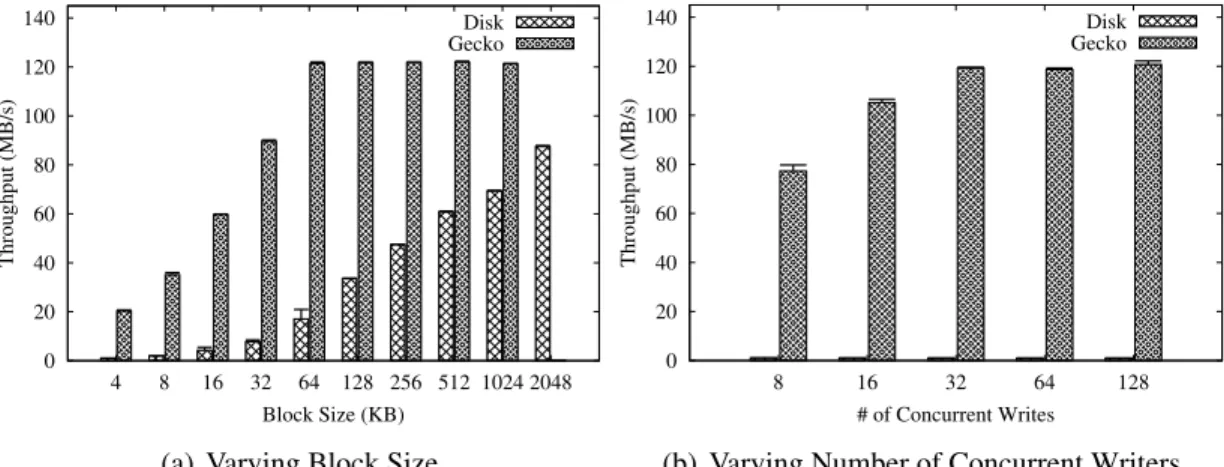
We evaluated Gecko performance on a node with six disk drives. Figure 2.4 shows that Gecko exceeds raw disk performance for writes; since Gecko sequentializes writes
0 20 40 60 80 100 120 140 4 8 16 32 64 128 256 512 1024 2048 Throughput (MB/s) Block Size (KB) Disk Gecko
(a) Varying Block Size
0 20 40 60 80 100 120 140 8 16 32 64 128 Throughput (MB/s) # of Concurrent Writes Disk Gecko
(b) Varying Number of Concurrent Writers
Figure 2.4: KyotoFS Implementation: Random write throughput without and with Gecko
by design, this throughpu