Procedia Environmental Sciences 31 ( 2016 ) 255 – 263
1878-0296 © 2016 The Authors. Published by Elsevier B.V. This is an open access article under the CC BY-NC-ND license (http://creativecommons.org/licenses/by-nc-nd/4.0/).
Peer-review under responsibility of Tsinghua University/ Basel Convention Regional Centre for Asia and the Pacific doi: 10.1016/j.proenv.2016.02.034
ScienceDirect
The Tenth International Conference on Waste Management and Technology (ICWMT)
Immobilization of rare earth elements of the mine tailings using
phosphates and lime
Hailong Tang, Xiaojing Wang, Weitao Shuai, Yangsheng Liu*
College of Environmental Sciences and Engineering, Peking University, Beijing Key Laboratory for Municipal Solid Waste Utilization and Management, Beijing 100871, China
Abstract
Excessive exploitation of rare earth mines produced a great deal of mine tailings which needs proper treatment. High concentration of the total rare earth elements (REEs) (685.8 ± 48.7 mg/kg) still existed in the mine tailings, which was more than 3 times as much as the average background concentration of China. More importantly, 88.8% of the REEs fractionated in exchangeable fraction under sequential extraction analysis, and 91.7% were leached under TCLP procedure, which indicated a high risk of leaching of REEs into the surrounding environment. Stabilization method was adopted to control the REEs leachability in the mine tailings. Soil incubation experiments were conducted to evaluate the effectiveness of soluble phosphates and lime in immobilizing REEs in the mine tailings. The results revealed that, with the addition of lime, the leachability of REEs reduced by 0.4%-18.3% with the addition of lime at 0.1%-1% (by weight). A more effective immobilization result was obtained with the addition of phosphates, as the REEs leachability reduced by 71.1%-98.4%. The sequential extraction analysis revealed that the lime treatment converted REEs in F1 into F2. In contrast, phosphate treatment converted the REEs into more stable fractions. The mechanism of the efficient immobilization of REEs with the soluble phosphates was described as follow: (1) Cation exchange between free proton or potassium ion and the soil bounded REEs; (2) Complexation and precipitation reactions between phosphate and REEs. In addition, the final pH value after soil incubation also influenced the effect of the immobilization of REEs.
© 2015 The Authors. Published by Elsevier B.V.
Peer-review under responsibility of Tsinghua University/ Basel Convention Regional Centre for Asia and the Pacific. Keywords: Immobilization; REEs; mine tailings; sequential extraction analysis; phosphates
* Corresponding auther. Tel.:+86 10 62751756; fax: +86 10 62751756.
E-mail address: [email protected] (Y,-S, Liu).
© 2016 The Authors. Published by Elsevier B.V This is an open access article under the CC BY-NC-ND license (http://creativecommons.org/licenses/by-nc-nd/4.0/).
1. Introduction
Rare earth elements (REEs) are worthful additives in chemical engineering, military, medicine, agriculture, as well as scientific research. China has been the maximal production and export state of REEs for many years. The U.S. Geological Survey revealed that, in 2013 and 2014, China produced 200 thousand tons of REEs, which accounted for 90.9% of the world’s production (Salazar and McNutt, 2014). The excessive exploitation causes massive devastation to the environment. The rural areas close to the mining sites of Ganzhou city of Jiangxi Province (southern China) are typical victims. In these areas, the REEs exist in a type of rare-earth-bearing (ion adsorption) clay. In order to extract the REEs, the clay is either excavated and soaked in ponds, or in-situ soaked using ammonium sulfate as an extractant. The residual clay soil after extraction is then piled to form the mine tailings. According to a local government report, the production of each ton of rare earth would result in 200 m2 of vegetation destruction, 300 m2 of surface soil stripping, 2,000 m3 of mine tailings, and 12 million m3 of annual soil erosion. In addition, the exposed soil is more susceptible to leaching; the leached REEs will contaminate the ground water and downstream farmland. The exogenous REEs have caused widespread concern because of their accumulation in soil, water as well as biota (Hirano and Suzuki, 1996; Krejčová et al., 2012; Pérez-López et al., 2010; Xu et al., 2012; Zhang et al., 2000). High concentration of REEs in the soils is harmful to the soil ecosystems (Li et al., 2011),and may prohibit the growth of plants (Liang et al., 2005; Thomas et al., 2014). REEs may be also accumulated in organs of human by ingestion, inhalation, and dermal contact, resulting in a chronic toxicity to human cells and an increase of health risks (Li et al., 2013; Tong et al., 2004; Wei et al., 2013; Oliveira et al., 2014). Therefore, there is a demand of a cost-effective technology to control the bioaccessibility and leaching of the REEs in the mine tailings.
Chemical stabilization is a widely applied soil remediation technology to treat heavy metal polluted soils (Guo et al., 2006). Phosphate is one of the most effective reagents in stabilizing heavy metals due to the formation of secondary phosphate precipitates, which are considered stable over a wide variation of geochemical conditions (Cao et al., 2002; Hettiarachchi et al.,2000; Xenidis et al., 2010). Lime and oxides are also useful in immobilizing heavy metals in soils acting as sorbents and precipitators (Lim et al.,2013; Komárek et al., 2013). The solubilities of the phosphates and hydroxides of REEs are rather low, with the solubility product constants of 10-20 or lower. Therefore, phosphates and lime are chosen as the remediating reagents for immobilizing REEs. Sequential extraction, proposed by Tessier et al. (1979), is universally used to evaluate the speciation and leachability of heavy metals besides REEs (Cao et al., 2001). Five sequential fractions were defined in this method: the exchangeable fraction (F1), susceptible to changes in ionic composition of water; acid soluble fraction (F2), susceptible to pH changes; reducible fraction (F3), bound with iron and manganese oxides, unstable in reducing conditions; oxidizable fraction (F4), organically bound fraction which may be decomposed under oxidizing conditions and results in a release of the metals into the soil solution; and residual fraction (F5), the least leachable, since stable minerals of the metals are believed to exist (Li et al.,2005; Maiz et al., 2000; Zufiaurreet al., 1998). F1 and F2 are thought to be the most readily leached under moderate altering meteorological and geochemical conditions and they contribute greatly to the bioaccessibility of the metals (Tyler, 2004; Cao et al., 2000).
A Chinese government ad hoc environmental investigation of Jiangxi Province in 2012 showed that until the year of 2012, only in Ganzhou City, there were 302 deserted mines, 191 million tons of mine tailings, and 97.34 square kilometers of land areas influenced at the mining sites. A fair amount of the mine tailings were rampant piled without proper disposal. Due to the weak acid soil environment and rain leaching, the surrounding farmland and groundwater are suffering or under threat of the leaching of REEs at various degrees. A chemical immobilization technique was attempted to control the leaching of the REEs of the mine tailing samples in this study. We hope that it will become available as a cost-effective measure in the future in decreasing the leaching and bioaccessibility of REEs.
2. Materials and methods 2.1 Materials
Surface soil samples (0-20 cm) were taken from a recent set tailing pile (about 5-10 years) at Ganzhou City of Jiangxi Province in the Southern China. Soil samples were air-dried and passed through a 1-mm sieve prior to being used. Analytical grade potassium di-hydrogen phosphate (KH2PO4, Beijing Chemical reagent), calcium superphosphate (mainly CaHPO4,with 14%-20% H3PO4,Beijing Chemical reagent) and lime (Ca(OH)2, Beijing Chemical reagent) were used as the immobilizing reagents. All the phosphates chosen are soluble in order to facilitate the immobilization process (Basta et al., 2001; Ma and Rao, 1995; Raicevic, 2005).
2.2 Analytical methods
2.2.1 Characterization of the soil samples
The pH value of the soil sample was measured using a pH meter (PHS-3C, INESA, China) in soil and water suspension (1:5 [w/v]). Soil organic matter was determined by solid TOC analyzer (TOC-V SSM-5000A, SHIMADZU, Japan). The cation exchangeable capacity (CEC) was measured using 1 N ammonium acetate extraction method at pH 7 and an atomic absorption spectrophotometry (AAS) (AAnalyst700 AAS, Perkin Elmer, USA) (Tan, 2005). The total concentration of the REEs was determined by ICP-MS (X-series 2, Thermo Scientific, USA) after digestion of the soil sample with HNO3, HF, and HClO4 (Tessier et al., 1979). The sum of the REEs rather than individual element was analyzed, as they show similar trends and Y, La, Ce accounted for most of the REEs. Mineralogical analyses of the soil samples were conducted by X-ray diffraction (XRD) (DMAX-2400, Rigaku, Japan). Scans were made from 10q to 90q with a rate of 8q/min 2θ. All XRD analyses were performed using back-filled, randomly oriented mounts.
2.2.2 Sequential extraction procedure
To determine the speciation of REEs in the soil samples, a five-step sequential extraction analysis was carried out following the scheme proposed by Tessier et al (1979). The total content of REEs was separated into five defined fractions: exchangeable (F1), acid soluble (F2), reducible (F3), oxidizable (F4), and residual (F5) fractions. The sequential chemical extraction procedures may help in assessing the relative stability of REEs in the soils.
An air-dried soil sample of 1.00 g was weighed into a 50-mL polyethylene centrifuge tube. After a sample was being treated with the procedure in each step, separation was done by centrifuging the suspension at 4,000 r/min for 20 min. The pellets were again washed with 5 mL deionized water and separated by centrifugation again. The supernatants from the above centrifugating process were gathered together, filtered through a 0.22-μm nucleopore polycarbonate membrane filter, and analyzed of the content of REEs by ICP-MS.
2.2.3 TCLP procedure
The leachability of heavy metals from the stabilized soils was determined using the TCLP procedure in accordance with the USEPA Method 1311 (USEPA, 1992). 1 g soil sample was mixed with 20 mL leachant (pH = 4.93) in a 50 ml polyethylene centrifuge tube. The tube was sealed with a cap and placed on an end-over-end shaker at 30±2r/min for 18 h at 20 °C. After extraction, supernatant was separated by centrifugation at 4,000 r/min for 10 min. The leachate was filtered using a 0.22μm filter, and diluted with 1% HNO3 at proper times for the ICP-MS analysis.
2.3 Immobilization experiments
10 g soil sample and a certain dosage of amendment were mixed in a 50 mL polyethylene centrifuge tube; 20 ml de-ionized water was added to facilitate the interaction of the immobilizing process. The mixtures were thoroughly mixed in a shaker under 200 r/min at 20 ± 2 °C for 24 hours, and kept sealed in the ambient temperature with continuous shaking for 1 month. Treatment P1-P3 were added with potassium di-hydrogen phosphate at the dosage of 0.1%, 0.5%, and 1% (wt%); treatment O1-O3 were added with lime at the dosage of 0.1%, 0.5% and 1%; in addition, treatment CaP was added with calcium superphosphate at the dosage of 0.5%.
2.4 Quality assurance
The precision and accuracy of the soil samples were established by the determination of REEs in the certified reference materials GSS 5 (National institute of Metrology, China). Three replications were made for each sample.
Good agreement and repeatability was achieved between the data obtained by the present method and the certified values for both soil samples and reference samples. The operating conditions for the determination were optimized and 115In, 101Ru, and 103Rh were used as an internal standard.
3. Results and discussion
3.1 Characterization of the mine tailing
Physical and chemical properties and contents the REEs of the tailing soil sample were listed in Table 1. The soil pH was 5.35 (acid soil). The clay mineralogy of the soil were mainly microcline and quartz. The total concentration of REEs was 685.8 ± 48.7 mg/kg, which was 3.4 - 3.9 times as much as the background concentration of 186.7 mg/kg of China (Chen et al., 1991), and 91.7% of the REEs in the mine tailings were leached under TCLP procedure. The results from the sequential extraction showed that 88.8% of the REEs fractionated in F1, which mostly accounted for the leachable REEs. The results above indicated a high risk of leaching of REEs into the surrounding environment.
Table 1 Basic characterization of the sampled soil.
Characteristics Values pH 5.35 Clay (%) 3.44 Silt (%) 11.36 Sand (%) 85.20 TOC (%) 0.10 CEC 4.95 cmol/Kg Total REEs 685.8 ± 48.7 mg/kg
3.2 TCLP evaluation of different treatments
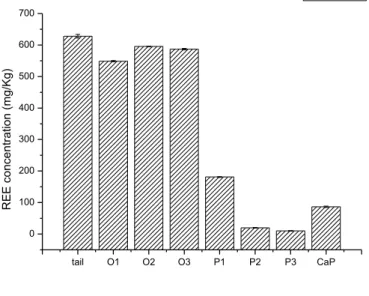
Figure 1 illustrates the TCLP leachability of REEs of the soils amended by different reagents. The pH values of the soils before and after amendment were listed in Table 2. The addition of lime at 0.1% slightly decreased the content of the REEs leached from the mine tailings, however an anomaly increase of the leached REEs was obtained when the dosage reached 0.5% and 1%. Previous studies showed that high cation exchange capacity (CEC) lower the pH mobility of the metals (Cao et al., 2003; Rinehart,1997). In contrast, the CEC capacity was rather low of the soil sample in our study, the calcium (due to lime addition) might substitute the adsorbed REEs on the finely weathered clay minerals via competing adsorption mechanism and increased the mobility of the REEs. Since the weak buffer capacity of the soils, the immobilization effect resulting from the hydroxides were easily counteracted by TCLP extraction reagent. However, the treatment P1-P3 and CaP significantly decreased the content of REEs leached under TCLP by 63.0%, 96%, 98.0% and 82.3% respectively.
tail O1 O2 O3 P1 P2 P3 CaP 0 100 200 300 400 500 600 700 REE concent rat ion (mg/ K g) REEs
Fig. 1. Effects of different treatments on TCLP leachable REEs
Soil pH was usually considered as an important variable that influenced trace metal precipitation, occlusion, and sorption (Coles and Yong, 2002; Voegelin et al., 2001). The soil pH was also found to have a strong effect on the release of REEs (Cao, 2001). The pH value alone might not be sufficient to explain the immobilization effects, since the final pH of the soils amended by phosphates were 5.39 - 5.86 of P1-P3, and 4.57 of CaP, which were weak acid. Speciation and XRD analysis would provide a further understanding of the immobilization mechanism of the amendments.
Table 2 Soil pH of the tailing soil before and after different treatments
Treatments tail O1 O2 O3 P1 P2 P3 CaP pH 5.35 8.56 9.35 10.27 5.39 5.56 5.86 4.57
3.3 Variation of the Speciation of REEs
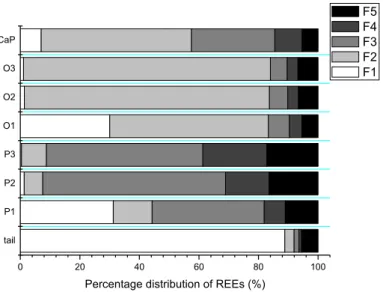
The contents of each fraction of REEs in the sequential extraction were expressed as a percentage of the total amount of REEs in figure 2. The sequential extraction provide operationally defined speciation data that generally reflect trends and major differences in metal speciation. The relative availability decreases from F1 to F5 of metals (Maiz et al., 2000; Scheckel et al., 2003). Sequential extraction analysis showed that REEs were bound to the mine tailings predominantly in F1. The trace metals in F1 is readily leachable and considered more bio-toxic than those in other four fractions (Bolan et al., 2003; Lacal et al., 2003; Margui et al., 2004). As illustrated in figure 2, the addition of lime reduced the content of REEs in F1 moderately, and they were mostly transformed into F2. Alkaline amendments increase the soil pH and favor the formation of oxides, metal-carbonate precipitates, complexes, thereby decreasing metal solubility (Chlopecka and Adriano, 1996). All the solubility of REE hydroxides reaches the magnitude of 10-20. However, the trace metals in both F1 and F2 may be leachable with the alteration of meteorological and geochemical conditions, therefore they are usually considered as the main body of the
bioaccessible speciation (Tyler, 2004;Cao et al., 2000), hence the sum of the REEs in F1 and F2 are taken as that was in Fb. Due to little change of the content in Fb, the reduction of the bioaccessibility of REEs was very weak in treatment O1-O3. The immobilization effect of lime was totally pH dependent, while taken into consideration the acid precipitation climate and the acid soil environment in the southern China, the effectiveness of lime immobilization was seriously compromised.
A notable reduction of more than 99% of the content of REEs in F1, and a reduction of 92.4% in Fb was obtained in treatment P3. A weaker reduction of 92.3% in F1 and 39.3% in Fb was obtained in treatment CaP. As the increase of the amount of the phosphates added, the REEs were gradually transformed into relative more stable fractions. A significant enhancement of the reduction of the REEs in F1 and Fb were obtained with the increase of dosage of KH2PO4 from 0.1% to 0.5%. The immobilized REEs were mainly turned into F3, and partially into F4 and F5. After treatment P3, 88.4% of the REEs in the mine tailings were transformed from F1 into F2 (5.2%), F3 (49.9%), F4(20.5%), and F5 (11.7%) respectively. Adsorption, complexation and precipitation reactions may account for the immobilization effect of the phosphates (Chen et al., 1997; Kumpiene et al.,2008). XRD analyses were conducted to gain a further understanding of the immobilization process.
tail P1 P2 P3 O1 O2 O3 CaP 0 20 40 60 80 100
Percentage distribution of REEs (%)
F5 F4 F3 F2 F1
Fig. 2 Changes of REEs speciation in soils(in weight percentage, %) by different treatments
3.4 Mineralogical analysis
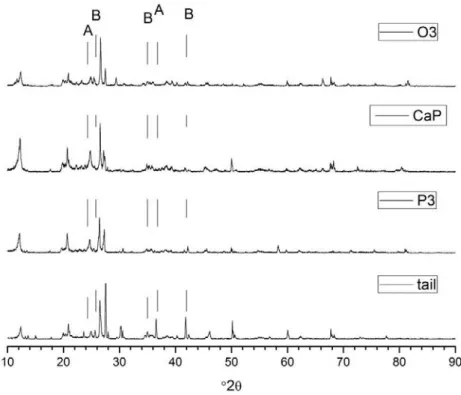
Mineralogical changes with different treatment were shown in figure 3. Yttrium was chosen as a representative of the REEs, as it accounted for nearly half of the contents of the total REEs. The major mineral of yttrium in the mine tailing was YPO4, and the prominent peaks can be seen at 25.80°, 35.02°, and 41.98° (2θ). A change of the XRD pattern was obtained in every treatment. Yttrium hydroxide, Y(OH)3 was not found in the treatments with lime as supposed. The formation of Yttrium Phosphate, YP5O14 was observed with the prominent peaks at 24.30° and 30.80° (2θ).The XRD result demonstrated that the formation of Yttrium Phosphates had an a good effect on the immobilization of REEs.
Fig. 3 X-ray diffraction patterns of the tailing soil before and after different treatments:A, Yttrium Phosphate, YP5O14; B, Xenotime-(Y), YPO4.
A possible mechanism of the immobilization of the phosphate treatment may be as follows: (1) Cation exchange between free proton or potassium ion and the soil bounded REEs; (2) Complexation and precipitation reactions between phosphate and REEs. The dissolution-comlexation/precipitation mechanism of phosphates has been found for lead (Hashimoto et al., 2009; Singh et al., 2012). The soluble phosphates provide the species for cation exchange, complexing, as well as precipitating reactions. The exchangeable REEs was exchanged (or mobilized) by the free proton and potassium ions, then complexed or precipitated by the phosphates. Furthermore, the REE phosphate polymers are more affinitive to the soil minerals, hence increased the stability of the immobilization process even at low pH environment (Tiberg et al., 2013).
4. Conclusions
The REEs in the mine tailings are highly leachable and pose a potential risk of leaching into the surrounding environment. Immobilization treatment with lime was able to transform the REEs in exchangeable fractions into carbonate-bound fractions, but showed little effect on reducing the leachability of REEs under TCLP procedure. Treatment with phosphates reduced the contents of REEs leached under TCLP procedure, and the REEs originally fractionated in F1 were transformed into relative stable ones. XRD pattern analyses revealed the formation of new REE-phosphates minerals, which contributed to the immobilization effect of phosphates. REE-phosphates precipitation and complexes could be formed and stay stable even at weak acid environment in the immobilizing experiments, however lower pH was not favorable for the effectiveness of the immobilization. The dissolution-comlexation/precipitation mechanism may explain the efficiency of the phosphates in immobilization. We hope that the chemical immobilization treatment will become available as a cost-effective measure in the future in decreasing the leachability of REEs from the mine tailings, and further studies are required to investigate the long term stability and molecular scale of mechanism of this method.
Funding for this study was partly provided by the National Science Foundation of China (grant 21077002). References
1. Basta, N.T., Gradwohl, R., Snethen, K.L., Schroder, J.L., Chemical immobilization of lead, zinc, and cadmium in smelter-contaminated soils using biosolids and rock phosphate. J. Environ. Qual. 2001; 30(4): 1222-1230.
2. Bolan, N.S., Adrinano, D.C., Naidu, R., Reviews of Environmental Contamination & Toxicology. Springer, New York, USA. 2003. 3. Cao, X., Chen, Y., Wang, X., Deng, X., Effects of redox potential and pH value on the release of rare earth elements from soil.
Chemosphere. 2001; 44(4): 655–661.
4. Cao, X., Ma, L.Q., Chen, M., Singh, S.P., Harris, W.G., Impacts of phosphate amendments on lead biogeochemistry at a contaminated site.
Environ. Sci. Technol. 2002; 36(24): 5296-5304.
5. Cao, X., Wang, X., Zhao, G., Assessment of the bioavailability of rare earth elements in soils by chemical fractionation and multiple regression analysis. Chemosphere. 2000; 40(1): 23-28.
6. Chen, J., Wei, F., Zheng, C., Wu, Y., Adriano, D.C., Background concentrations of elements in soils of china. Water Air Soil Poll. 1991;57-58(1): 699-712.
7. Chen, X.B., Wright, J.V., Conca, J.L., Conca, J.L., Peurrung, L.M., Effects of pH on heavy metal sorption on mineral apatite. Environ. Sci. Technol. 1997;31(3): 624-631.
8. Chlopecka, A., Adriano, D.C. Mimicked in-situ stabilization of metals in a cropped soil: bioavailability and chemical form. of zinc. Environ. Sci. Technol. 1996;30(11): 3294-3303.
9. Coles, C.A., Yong, R.N., Aspects of kaolinite characterization and retention of Pb and Cd. Appl. Clay Sci. 2002. 22(2): 39–45.
10. Guo, G., Zhou, Q., Ma, L.Q., Availability and assessment of fixing additives for the in situ remediation of heavy metal contaminated soils: a review. Environ. Monit. Assess. 2006;116(1-3): 513-528.
11. Hashimoto, Y., Takaoka, M., Oshita, K., Tanida, H., Incomplete transformations of Pb to pyromorphite by phosphate-induced immobilization investigated by X-ray absorption fine structure (XAFS) spectroscopy. Chemosphere. 2009; 76(5): 616–622.
12. Hettiarachchi, G.M., Pierzynski, G.M., Ransom, M.D., In situ stabilization of soil lead using phosphorus and manganese oxide. Environ. Sci. Technol. 2000; 34(21): 4614-4619.
13. Hirano, S., Suzuki, K.T., Exposure, metabolism, and toxicity of rare earths and related compounds. Environ. Health presp. 1996; 104(1): 85-95.
14. Krejčová, A., Pouzar, T.M., O-TOF-ICP-MS analysis of rare earth elements, noble elements, uranium and thorium in river-relating species. Int. J. Envrion. An. Ch. 2011; 92(5): 620-635.
15. Kumpiene, J., Lagerkvist, A., Maurice, C., Stabilization of As, Cr, Cu, Pb and Zn in soil using amendments--a review. Waste Manage. 2008; 28(1): 215–225.
16. Lacal, J., Silva, M.P., Garcia, R., Sevilla, M.T., Procopio, J.R., Hernández, L., Study of fractionation and potential mobility of metal in sludge from pyrite mining and affected river sediments: changes in mobility over time and use of artificial ageing as a tool in environmental impact assessment. Environ. Pollut. 2003; 124(2): 291–305.
17. Li, S.J., Dou, S., Wang, L.M., Liu, Z.S., Geochemical characteristics of rare earth elements on sunflower growing area in the west of Jilin province. J. Environ. Sci-China. 2011; 32(7): 2081-2086.
18. Li, W., Zhang, M., Shu, H., Distribution and fractionation of copper in soils of apple orchards. Environ. Sci. Pollut. R. 2005; 12(3): 168-172. 19. Li, X., Chen, Z., Chen, Z., Zhang, Y., A human health risk assessment of rare earth elements in soil and vegetables from a mining area in
Fujian province, southeast China. Chemosphere. 2013; 93(6): 1240–1246.
20. Liang, T., Zhang, S., Wang, L., Kung, H.T., Wang, Y., Hu, A. et al. Environmental biogeochemical behaviors of rare earth elements in soil– plant systems. Environ. Geochem. Health. 2005; 27(4): 301-311(11).
21. Lim, J. E., Ahmad, M., Lee, S. S., Shope, C. L., Hashimoto, Y., Kim, K., et al. Effects of limeϋbased waste materials on immobilization and phytoavailability of cadmium and lead in contaminated soil. Clean-Soil Air Water. 2013; 41(12): 1235–1241.
22. Ma, Q.Y., Rao, G.N., Effects of phosphate rock on sequential chemical extraction of lead in contaminated soils. J. Environ. Qual. 1997; 26: 788-794.
23. Maiz, I., Arambarri, I., Garcia, R., Millán, E., Evaluation of heavy metal availability in polluted soils by two sequential extraction procedures using factor analysis. Environ. Pollut. 2000; 110(1): 3–9.
24. Marguı́, E., Salvadó, V., Queralt, I., Hidalgo, M., Comparison of three-stage sequential extraction and toxicity characteristic leaching tests to evaluate metal mobility in mining wastes. Analytica. Chimica. Acta. 2004; 524: 151–159.
25. Komárek, M., Vaněk, A., Ettler, V. Chemical stabilization of metals and arsenic in contaminated soils using oxides--a review. Environ. Pollut. 2013; 172(1): 9–22.
26. Oliveira, M.S., Duarte, I.M., Paiva, A.V., Yunes, S.N., Almeida, C.E., Mattos, R.C. et al., The role of chemical interactions between thorium, cerium, and lanthanum in lymphocyte toxicity. Arch. Environ. Occup. H. 2014; 69(1): 40-45.
27. Pérez-López, R., Delgado, J., Nieto, J.M., Márquez-García, B., Rare earth element geochemistry of sulphide weathering in the são domingos mine area (iberian pyrite belt): a proxy for fluid–rock interaction and ancient mining pollution. Chem. Geol. 2010; 276: 29–40.
28. Raicevic, S., Kaludjerovic-Radoicic, T., Zouboulis, A.I., In situ stabilization of toxic metals in polluted soils using phosphates: theoretical prediction and experimental verification. J. Hazard. Mater. 2005; 117(1): 41-53.
30. Singh, A., Catalano, J.G., Ulrich, K.U., Giammar, D.E., Molecular-scale structure of uranium(vi) immobilized with goethite and phosphate. Environ. Sci. Technol. 2012; 46(12): 6594-6603.
31. Scheckel, K.G., Impellitteri, C.A., Ryan, J.A., McEvoy, T., Assessment of a sequential extraction procedure for perturbed lead-contaminated samples with and without phosphorus amendment. Environ. Sci. Technol. 2003; 37(9): 1892-1898.
32. Tan, K.H., Soil sampling, preparation, and analysis (2nd ed.). Boca Raton, Florida, USA. 2005.
33. Tessier, A., Campbell, P. G., Bisson, M., Sequential extraction procedure for the speciation of particulate trace metals. Anal. Chem. 1979; 51(7): 844-851.
34. Tong, S.L., Zhu, W.Z., Gao, Z.H., Meng, Y.X., Peng, R.L., Lu, G.C., Distribution characteristics of rare earth elements in children's scalp hair from a rare earths mining area in southern china. J. Environ. Sci. Health. A. 2004; 39(9): 2517-2532.
35. Thomas, P.J., Carpenter, D., Boutin, C., Allison, J.E., Rare earth elements (REEs): effects on germination and growth of selected crop and native plant species. Chemosphere. 2014; 96(2): 57–66.
36. Tiberg, C., Sjöstedt, C., Persson, I., Gustafsson, J.P., Phosphate effects on copper(ii) and lead(ii) sorption to ferrihydrite. Geochim. Cosmochim. Ac. 2013; 120: 140–157.
37. Tyler, G., Rare earth elements in soil and plant systems - a review. Plant Soil. 2005; 267(1-2): 191-206(16). 38. USEPA, Method 1311: Toxicity Characteristic Leaching Procedure, Washington DC., USA. 1992.
39. Voegelin, A., Vulava, V.M., Kretzschmar, R., Reaction-based model describing competitive sorption and transport of Cd, Zn, and Ni in an acidic soil. Environ. Sci. Technol. 2001; 35(8): 1651-1657.
40. Wei, B., Li, Y., Li, H., Yu, J., Ye, B., Liang, T., Rare earth elements in human hair from a mining area of china. Ecotox. Environ. Safe. 2013; 96(4): 118-123.
41. Xenidis, A., Stouraiti, C., Papassiopi, N., Stabilization of pb and as in soils by applying combined treatment with phosphates and ferrous iron. J. Hazard. Mater. 2010;177(1-3): 929-937.
42. Xu, Q., Fu, Y., Min, H., Cai, S., Sha, S., Cheng, G., Laboratory assessment of uptake and toxicity of lanthanum (la) in the leaves of hydrocharis dubia (bl.) backer. Environ. Sci. Pollut. R. 2012;19(9): 3950-3958.
43. Zhang, H., Feng, J., Zhu, W., Liu, C., Xu, S., Shao, P., et al. Chronic toxicity of rare-earth elements on human beings. Biol. Trace Elem. Res. 2000; 73(1): 1-17.
44. Zufiaurre, R., Olivar, A., Chamorro, P., Callizo, A., Zufiaurre, R., Speciation of metals in sewage sludge for agricultural uses.