UC Berkeley
UC Berkeley Previously Published Works
Title
Constructing a New Asset Class: Property-led Financial Accumulation after the Crisis
Permalink
https://escholarship.org/uc/item/2100x5p6Journal
Economic Geography, 94(2)ISSN
0013-0095Author
Fields, DesireePublication Date
2018-03-15DOI
10.1080/00130095.2017.1397492 Peer reviewedConstructing a new asset class: Property-led financial accumulation after the crisis
Accepted for publication in Economic Geography as of 9 June 2017
Desiree Fields
Department of Geography, University of Sheffield Winter Street
Sheffield, S10 2TN United Kingdom [email protected]
This paper has been substantially strengthened through constructive feedback and criticism from a number of colleagues. I would like to especially thank David Madden, Martin Jones, and members of the Power, Policy, and Place research cluster at the University of Sheffield. Participants at the Critical Finance Seminar at Goldsmith University’s Centre for Research Architecture and members of the Political Economy Research Group in the Department of Politics at the University of Sheffield also provided insightful questions and comments on various versions of this paper. Finally, feedback from four anonymous reviewers and helpful guidance from the editor were invaluable in helping me to clarify the core contributions and analytic frame of the article.
Abstract: This paper is concerned withnew modes of property-led financial
accumulation emerging in the wake of the 2008 financial crisis. Focusing on the US, the paper traces the creation of an asset class derived from securitizing the rental income of foreclosed homes turned rental properties. The study strategically
combines conceptual agendas often pursued separately. Theories of market formation rooted in science and technology studies inform the method of analysis, so as to attend to the work of realizing markets, the role of calculative devices in market formation, and the contingent and conditional aspects of markets. This analysis reveals the single-family rental (SFR) asset class as a practical accomplishment. However, a broader framework rooted in political economy is necessary to attend to the broader significance of the SFR asset class in terms of power, politics, and the dynamics of capital accumulation. The paper particularly focuses upon the historical and geographic contingencies making it possible to conceive of a large-scale SFR market, the work of state and capital market actors in reframing repossessed single-family homes as rental properties and the role calculative practices played in this process, and the strategies of issuers and credit rating agencies to frame a novel asset class for institutional investors. The SFR asset class affirms the fundamental role for housing in the ideology of capital, and speaks to new entanglements of financial actors and home life as financial accumulation is adjusted to the post-crisis context. Beyond shedding light on post-crisis housing financialization, the paper demonstrates how economic geographers can carefully integrate theoretical perspectives to
critically examine both the circumstances of market formation and the social, spatial, and political consequences of markets.
Keywords: financialization, marketization, political economy, real estate, financial assets, credit rating agencies
Social scientific inquiry generally and human geography specifically has increasingly mobilized the concept of financialization since the 2008 global financial crisis. The idea has taken hold as a means of understanding the distinctive role of finance in (contemporary) capitalism, and its influence on space, the economy, governance, and everyday life (Aalbers 2016). Such wide-ranging concerns point to the diverse meanings attached to financialization (Christophers 2015a), including the expanded role of financial channels in profit generation and capital accumulation (cf. Krippner 2005) and the increasing reach of financial actors, imperatives, and processes into domains often understood primarily in “non-financial” terms, such as social reproduction and the home (cf. Allon 2010; Martin 2002; Roberts 2013).
The concept of financialization offers ongoing theoretical, empirical, and analytic purchase. But as research proliferates and the idea assumes the status of the next neoliberalization or globalization, it risks being invoked in analytically imprecise and theoretically superficial ways, potentially stretching the concept beyond meaning (Christophers 2015a; French, Leyshon, and Wainwright 2011). Too often,
financialization is treated as an explanation in and of itself, leaving finance itself ‘black-boxed’(Ouma 2015). Such work fails to illuminate the concerted effort, supporting infrastructures, and practices that allow financializing projects to come to fruition (or disruptions causing them to fail) (Christophers 2015a; Ouma 2015; Poovey 2015). In the wake of the 2008 crisis financialization is extending into new frontiers and new modes of financial rent extraction are emerging. Here the task of critical economic geography is to both shine a light on the processes allowing such transformations to occur, and theorize their broader significance in terms of power, politics, and the dynamics of capital accumulation, i.e. their political economy.
This paper offers such an analysis. It demonstrates the value of integrating approaches to the study of market formation rooted in science and technology studies
finance1--with a critical political economy of financialization. My case study is a new asset class2 constructed from income flows from foreclosed single-family homes3 turned rental properties in the US. The activities of private equity funds undertaking large-scale purchases of repossessed single-family homes and converting them to rental housing kicked off the creation of this asset class. Focusing on the single family rental (SFR) asset class as a frontier of financial rent extraction, I seek to better integrate the concerns of political economy with an analysis of the
“microgeographical” processes of market formation, or marketization (Berndt and Boeckler 2012, 205; Çalışkan and Callon 2010).
The paper deploys an analytic of marketization without losing sight of how market formation is resurrecting property-led financial accumulation in the post-2008 context. Drawing on performative understandings of economies and markets I demonstrate this re-financialization of housing as a practical accomplishment: made possible by social, political, economic, and material conditions, it is therefore open to contestation and change. Integrating such STS-inspired approaches with critical political economy usefully addresses the limitations of each conceptual starting point. The former considers market construction as a power-laden process but can fall short where questions of the socio-spatial and political effects of markets are concerned. Meanwhile accounts rooted in critical political economy often understand
financialization as a “spatiotemporal fix of a notoriously crisis-prone economic system”, but fail to show how processes of financial economization unfold (Ouma 2015, 227). The paper’s core contribution is to show that while these approaches are often pursued separately, combining them highlights the political economic import of market formation as well as the material, provisional, and contingent aspects of
1 Later mentions of “approaches drawn from STS” and “STS-inspired approaches” indicate
this diffusion.
2The term asset class denotes “a set of assets that bear some fundamental economic
similarities to each other, and that have characteristics that make them distinct from other assets that are not part of that class” (Greer 1997, 86).
3 A single-family home is a structure designed to be inhabited by one family, in the US
financialization. This work also adds to a wider effort to bridge these conceptual approaches, including Ouma’s (2016) application of Mezzadra and Neilson’ (2015) notion of operations of capital to finance-farmland relations, Mackenzie’s (2016) material political economy of high-frequency trading, and Christophers’ (2014b) dialogue between “techno-cultural” (12) and Marxist political economy perspectives on markets.
After this introduction, the paper has four sections. First I ground the analysis in approaches drawn from STS and consider recent efforts to bridge political
economy with these more practice-oriented approaches. I then introduce the case study and discuss the empirical material underpinning my analysis. The main body of the paper examines SFR marketization, starting by situating this process within political economic, geographic, and material contingencies that provided favorable conditions for acquiring and operating foreclosed suburban single-family homes as rental properties and issuing rent-backed financial instruments. Mobilizing the processes of framing (or pacifying) goods and marketizing (or calculative) agencies Çalışkan and Callon (2010) have highlighted as crucial to marketization, I then focus on how distressed single-family homes were extracted from their association with crisis and reframed in terms of the benefits of large-scale SFR; the role of the recent technology boom in rendering a fragmented market legible for investment; and the framing of the SFR asset class by credit rating agencies and bond issuers. I conclude by discussing the relationship between the SFR market, power relations, and patterns of accumulation.
Politicizing geographies of actually existing markets
A critical political economic perspective stresses the integral, and inherently crisis-prone, relationship between finance capital and the urban process. Urban development requires a functioning credit system, which allocates interest-bearing
highest and best returns (Harvey 1985; Moreno 2014). The urban landscape therefore makes an attractive escape valve for the finance capital that has accumulated globally in recent decades and is on a perpetual hunt for yield (Fernandez and Aalbers 2016; Christophers 2011). But as we know from the role of subprime lending in the US housing bubble, finance capital’s pursuit of accumulation through real estate also creates cycles of speculation-fuelled crisis (cf. Coakley 1994; Pryke 1994 for further examples). The detrimental effects of such crises on the urban landscape
subsequently offer new opportunities for value extraction, propelling the uneven reproduction of urban space (Harvey 1985; Smith 1984). Thus we can understand the process by which the US mortgage crisis created the conditions for the SFR asset class, with homeowners’ dispossession setting in motion a new round of financial accumulation situated in the rental sector. While this account rightly points to the geographical inequalities finance-led accumulation depends on and perpetuates, it treats the market as “an object of critique and resistance rather than one to study” (Berndt and Boeckler 2012, 203).
Centering markets in social science inquiry requires bypassing notions of ‘the economy’ as a realm separate from social, political, and cultural relations, focusing instead on economization, or “the processes through which activities, behaviors and spheres or fields are established as being economic” (Çalışkan and Callon 2009, 370). The establishment of markets, or marketization, is but one such process (Çalışkan and Callon 2009). Influenced by STS, economic sociology, and social studies of finance, Berndt and Boeckler’s geographies of marketization approach aims for “a better understanding of how markets are assembled and put to work” in order to “open up new perspectives toward the emergence of market orders” (2012, 203–4, 2011a, 2009). This approach is well suited to the SFR market, so recently reimagined as a source of financial value.
Concerned with opening up the black box of markets, a marketization perspective understands markets as a contingent but purposeful coming together, or assemblage of material and technological elements in combination with human activity. That is, no market is given, even under ideal conditions of supply, demand, and capital access. Instead markets are realized through practical and strategic achievements, reached as calculative devices (e.g. financial models, credit scoring, stock tickers, and traders’ computer screens, cf. Mackenzie 2006; Poon 2009; Preda 2006; Zaloom 2006) and physical objects join with the beliefs, expertise and specialized knowledge of market agents (including Callon’s (2007, 336) “confined economists”, i.e. academics, and “economists in the wild”, e.g. consultants, traders and “quants” (cf. Derman, 2007)). The term agencement is here used to encompass both this careful arrangement of elements and how it entails a “diffuse and
entangled”--or distributed--agency “intended to enact material realities” (Kanai and Kutz 2013, 84; Berndt and Boeckler 2011a). It is in this sense markets may be understood as performed: the distributed agency of sociotechnical assemblages4 intervenes in the world; the nature of this intervention depends on how the assemblage is configured (Berndt and Boeckler 2011a; Callon 2007).
Bringing actually existing markets into being and keeping them in formation entails significant labor (Li 2014). As detailed by Çalışkan and Callon (2010) marketization entails the objectification of things to construe them as property
(pacifying goods), the work of defining and valuing goods (calculative or marketizing agencies), organizing encounters between goods and calculative devices to make valuation possible (market encounters), translating the qualities of goods into prices
4As Anderson and colleagues (2012) note, “The relation between the French word
agencement and assemblage in English is vexed” (187); the latter is an imprecise translation that does not fully capture the distributed agency emergent in the arrangement of
heterogeneous elements. In this paper I rely on the English term assemblage, but use it in a way that retains “dynamic potential” and “the often uneven and uncomfortable practices of composition”(Anderson et al., 2012, 173), i.e. without reducing assemblage to a merely
(pricet setting), and facilitating the orderly exchange of goods (market design and maintenance). All these processes depend on collaboration and are subject to error, breakdowns, and disagreements: markets are therefore “the temporary and fluctuating result of conflicts and power struggles” (Callon 2007, 335), subject to destabilization or realignment “through contestation, shifting power relations, or new contexts” (McFarlane 2011, 209).
Revealing markets as provisional assemblages reminds us markets, and market rule, can also be disrupted. In one view then, the study of actually existing markets is fundamentally political because it makes the contested, conflictual praxis of their construction visible and “available for critical reflection” (Li 2014, 590; Boeckler and Berndt 2013; Ouma 2016). Yet such analyses can risk an inward focus, eclipsing questions about the “common logics of global capitalism” (Mezzadra and Neilson 2013, 13). Practice-oriented approaches would benefit from more sustained engagement with political economy to interrogate how the groundwork for markets is laid, how market construction sustains capitalist accumulation, and the role of
markets in perpetuating uneven development (Brenner, Madden, and Wachsmuth 2011; Christophers 2014b; Kanai and Kutz 2013; MacKenzie 2016). This
engagement would also attend to dynamics of power and politics beyond the formation of markets to their social and spatial effects, and how these may reinforce or alter existing power relations and instantiate struggle by those enrolled into markets (Fields 2015; Garcia Lamarca in press; Christophers 2014a; MacKenzie 2016).
This paper resonates with other efforts to bridge practice-oriented analytics with political economy. Mackenzie’s material political economy (2016) highlights how the ascendance of high frequency trading brought painful economic
consequences through changing the very structure of trading. Working on finance-farmland relations, Ouma (2016) extends Mezzadra and Neilson’s (2015) operations
of capital framework. This approach goes further than Mackenzie’s in synthesizing the concern with materiality and technologies in practice-oriented approaches with political economy’s emphasis on the violence inherent to capitalist abstraction and accumulation. As Ouma (2016) argues, “operations are quotidian and abstract at once” (84), referencing both particular instances of capital’s operations, and how they articulate into larger historical and geographical shifts that reproduce capitalist social relations. Sharing the concerns motivating such approaches, I draw upon theories of marketization to analyze the construction of the SFR asset class, while interpreting its significance in terms of critical political economy. Rendering these frameworks complementary is crucial for understanding how property-led financial accumulation is being restored in the “post-crisis” moment.
The financialization of single-family rental housing
The SFR market is in the midst of a paradigm shift we may characterize as financialization. In the widest definition, financialization effects a “structural transformation of economies, firms (including financial institutions), states, and households” through “the increasing dominance of financial actors, markets, practices, measurements, and narratives” (Aalbers in press). This understanding of financialization applies to post-2008 restructuring of the United States SFR sector by private equity funds (including one operated by Blackstone, an industry leader), who since 2012 have been acquiring foreclosed properties and converting them to rental housing. The entrance of financial actors to the SFR market has led to two
interrelated structural transformations: institutionalizing a historically fragmented market and constructing a new financial asset class.
Though long part of the overall rental picture in the US, single-family rental homes have never been owned or managed at scale by corporate actors. The norm has instead been small inventories (overwhelmingly a single property), typically owned
by non-professional landlords (Savage 1998).5 Institutional investment (e.g. by private equity funds, pension funds) in rental housing faces many barriers, including poor market information (in part due to market fragmentation), high management costs, risks such as renters’ increased vulnerability to economic shocks, and the absence of a track record for structured finance opportunities (Berry 2000). In just a few years “private equity landlords” in the US have breached these barriers: today several companies operate portfolios consisting of many thousands of geographically dispersed single-family properties. Such large-scale ownership helps constitute SFR as an asset class by making it possible to understand the market on a (more) national basis (see discussion by Kear 2014 on the production of national financial markets), setting the stage for the construction of a new asset class.
Large-scale ownership by financial actors has changed the structure of the SFR sector, and in so doing helped initiate financial modes of capital accumulation within a sector where investors typically rely on income from rents and long-term capital gains (Savage 1998). In 2013 Blackstone’s rental subsidiary Invitation Homes pioneered a new financial product, becoming the first investor to securitize the rental income stream from SFR properties. Since then, Blackstone and other private equity landlords have packaged 27 additional SFR securitizations; the rental income from a total of more than 100,000 properties provides the basis for these instruments (Alan, Jadhav, and Polasanpalli 2017). This structured finance opportunity has begotten further structured finance opportunities, such as variations on SFR securitization in which new sources of non-bank financing for smaller-scale landlords help create a supply line for financial instruments. Investors have therefore capitalized on the crisis, searching out and aggregating mundane real assets so as to construct the new income streams on which financial accumulation depends (Leyshon and Thrift 2007).
5 Statements about the nature and norms of the SFR market drawn from Savage (1998) are
based on the 1995 Property Owners and Managers Survey, the only national survey of US property owners and managers conducted by the US Census.
In the analysis to follow I elaborate on the ongoing transformation of the single-family rental sector sketched above, using concepts and insights drawn from STS. A number of data sources inform the study, including reports from business and financial media, finance industry white papers, the website of a trade group for the SFR industry, and marketing emails from a credit rating agency. These materials assert economic models, theories, and beliefs that are “actively engaged in the constitution of the reality that they describe” (Callon 2007, 318). As a vital force in the construction of markets such artefacts are necessary to my analysis. Recent inquiry similarly interrogates media and expert knowledge to examine marketization processes, as in Langley and Leyshon’s (2016) study of platform capitalism. Other data sources informing this study include observations conducted at a 2014 SFR investment forums and transcripts of a 2012 field hearing by the US House of Representatives Committee on Financial Services. The still-evolving construction of the SFR asset class began in earnest in 2013, and merits further study through
gathering additional primary empirical data. By attending to the formation of the SFR asset class in process, this paper constitutes a necessary stage in such a program of research.
Constructing a new asset class
Political economic, geographic, and material contingencies
Understanding markets as provisional underlines the deeply historical dimension of market formation (Callon 2007), making it important to situate the SFR asset class more firmly within the contingencies allowing it to be performed. These include federal government interventions to the foreclosure crisis, its suburban geography and the accompanying devaluation of relatively new homes, and the growth in renting and constrained mortgage credit seen since the crisis.
Conspicuous policy and regulatory absences are crucial conditions of possibility for the construction of the SFR market. These are selective absences, situated in a federal regulatory environment intervening more often on behalf of financial institutions than struggling homeowners, e.g. by pre-empting state consumer protection laws targeting predatory lending (Dan Immergluck 2015). Leading up to the crisis, government inaction largely abandoned borrowers to their own efforts to prevent foreclosure; afterwards federal responses targeted the needs of lenders and investors more than homeowners, who contended with complicated, confusing, and often ineffective programs (Bratt and Immergluck 2015). Homeowners benefited little from government responses due to loan servicers’ perverse incentives to pursue foreclosure, the failure to mandate lender participation in relief programs, and bankruptcy judges’ inability to reduce mortgage principal (Bratt and Immergluck 2015).
The state’s selective absence undoubtedly contributed to the volume of foreclosed homes that would accumulate around the country. Between 2004 (when the US homeownership rate peaked at 69%) and 2014, seven million foreclosures were completed (CoreLogic 2014). The foreclosure crisis spared few parts of the US, but the metropolitan geography of home repossessions was spatially uneven and changed over time. When home prices plateaued in 2006, foreclosures initially increased in weak markets in formerly industrial centers of the Midwestern Rust Belt, where the inventory of bank-owned repossessed homes accumulated most in low-income, predominantly African-American and Hispanic central city neighborhoods subjected to high levels of subprime and predatory lending (D. Immergluck 2010). After the larger financial crisis hit over 2007-2008, a different geography of foreclosures emerged as repossessed properties accumulated more in suburban, middle-class neighborhoods in the Sun Belt (southern California, the Southwest, and the Southeast) (D. Immergluck 2010).
The Sun Belt “housing bubble was bigger and more likely to burst” (Aalbers 2009, 37) because prices increased rapidly in the 2000s and many homeowners took out mortgages just ahead of 2008, when prices peaked and “exotic” loan products (e.g. adjustable interest rate) were being marketed to middle-class borrowers (Aalbers 2009; Dan Immergluck 2015). When the bubble did burst, Sun Belt markets
experienced the steepest, most rapid price declines (Aalbers 2009; Dan Immergluck 2015). In 2008 prices fell by 26.9% in California, 26.5% in Nevada, 21.1% in Arizona, and 19.5% in Florida (CoreLogic 2009), tipping many homeowners into foreclosure. In 2014, nine of the 15 metropolitan areas with the highest proportion of homes in negative equity (ranging from 24-35%) were in the Sun Belt (Dreier et al. 2014). It is difficult to overestimate the importance of this property devaluation for the construction of the institutional SFR market.
The distinctive geography of mortgage foreclosure and price declines lent a material specificity to the inventory of repossessed, bank-owned homes. For generations, urban crises set off by financial exploitation were largely confined to aging buildings in inner city, African-American neighborhoods. This time the single-family home, representing suburban middle-class life, became the “mascot” of the financial crisis (Easterling 2014, 18). No longer “an immaterial node in the pulsing global networks of finance”, the single-family home was instead, undeniably, a “durable object” (Easterling 2014, 20). Cul-de-sacs in low-density subdivisions were lined with for sale signs, and auction notices dotted the front yards of McMansions. In sunny California, Arizona, and Florida, ‘zombie pools’ in abandoned properties grew algae and bred mosquitoes, becoming incubators for disease (Reisen et al. 2008). Speaking to how the crisis overflowed the spatial, racial, and class boundaries of the urban core, Schafran (2011) observed, “Just as burned-out housing projects in inner cities were the iconic images of the mid-1970s recession, trashed-out tract
homes in California and the Sun Belt are the signature images of crisis in post-millennial America” (no page).
Therefore not just any properties were steeply devalued, but large, often relatively new or recently renovated properties. Middle-class families who would soon be in search of a place to live vacated these properties, creating a ready population of tenants. According to US Census estimates of the nation’s housing inventory, the percentage of homes occupied by renters climbed from 31% in 2004 (the peak of home ownership) to 36% in 2015, a rate last seen in the mid-1990s. The conversion of 3.8 million properties from owner-occupied or for-sale to rental between 2003 and 2013 has helped meet growing rental demand; materially most of this tenure switch occurred in the single-family housing stock, where three million units became rentals (Joint Center for Housing Studies 2015b).
The growth of renting goes hand in hand with tightened access to mortgage credit since 2008 (Krainer and McCarthy 2014). Constrained mortgage lending makes the likelihood of homeownership substantially reduced today, even compared to historical credit availability rather than the exceptionally loose credit of 2004 to 2007 (Acolin et al. 2016). While favorable for landlords, these conditions are troubling from the perspective of a financial system heavily dependent on mortgages as raw materials for financial products (Newman 2009). In 2012, the financial industry was “somewhere between anxious and desperate for new products”, and traders and credit rating agencies were on the hunt for new products and revenue streams (Alloway, Raval, and Massoudi 2014; industry executive quoted in Neumann 2012). As suggested by Kitchin, O’Callaghan, and Gleeson (2014), the ‘ruins’ of suburban subdivisions in recently expanded Sun Belt metropoles unsettled both past and future: a decade of prosperity was exposed as one of speculative excess, while the institution of homeownership as the core of a stable and secure existence and linchpin of
financialized capitalism was in doubt moving forward. The new SFR market was built from amidst these ruins.
Reframing single-family homes
The geographic, material, and political economic conjuncture sketched above indicates the moment the financialized homeownership market grew fragmented and destabilized to the extent that single-family homes could not be disconnected from the crisis and its consequences: in Callon’s (1998) terminology they ‘overflowed the frame’ of financial accumulation predicated on mortgage-backed financial
instruments. To construct a new financial asset class, single-family homes had to be disentangled from their association with crisis and dispossession and embedded within a different set of connections (or reframed), a marketization process Çalışkan and Callon (2010) describe as the pacification of goods. Here Li’s (2007) work on practices of assemblage is useful. Li studies community forest management, but mobilizes a notion of assemblage consonant with those working on markets (cf. Çalışkan and Callon 2010; Berndt and Boeckler 2011a). The practices of forging alignments among those with a stake in, and containing critiques of, an assemblage-to-be (Li 2007) help get at the power relations involved in reframing single-family homes for the purpose of adjusting property-led financial accumulation to the post-crisis context.
Parties to the SFR market assemblage are many. First, a state concerned to restore housing’s role in capital circulation and reinforce an ideology of housing foregrounding “private property ownership, market allocation mechanisms and accumulation strategies” (Aalbers and Christophers 2014, 384). Second, capital market actors including traders and credit rating agencies, banks holding repossessed homes, investors seeking yields in a low interest rate environment, and the private equity funds tasked with pursuing those returns. Third, municipalities struggling with
Fourth, homeowners in negative equity due to an accumulation of repossessed homes in their neighborhoods. And finally, former and would-be homeowners relegated to being tenants, but desirous of a family home in a suburban setting. In the years since 2008 the state and the financial industry have cooperated to position an
institutionalized SFR market as unifying the interests of these parties, bringing this use of repossessed homes to the fore and excluding other possible uses.6
In 2012 the Federal Housing Finance Agency (FHFA) rolled out the REO7 Pilot Program. Under the program, FHFA aimed to sell 2500 government-owned foreclosed properties for conversion to rental housing in bulk sales, focusing on hard-hit metropolitan areas including Atlanta, Chicago, Las Vegas, Phoenix, and parts of Florida. In a field hearing (Committee on Financial Services 2012), its architects framed the pilot as a test case “to gauge investor appetite for a new asset class, that is scattered-site single-family rental housing” (testimony of FHFA Senior Associate Director of Housing and Regulatory Policy, 5). The Counselor to the Treasury Secretary of Housing Finance Policy testified the initiative would attract investment to hard-hit neighborhoods with weak homeownership demand, stabilize house prices in these areas by removing properties from the market, add to the stock of rental housing for “former homeowners and those not interested or able to buy a home” (7), offer a private-market complement to federally-funded neighborhood stabilization activities, and provide financial institutions a means of offloading foreclosed properties at scale.
The REO Pilot Program’s intended outcomes map neatly onto the parties to the SFR market assemblage outlined above, demonstrating the critical role state
6For example, the state could have compelled financial institutions to sell repossessed
properties to nonprofit ownership or rental schemes that would benefit residents and stabilize neighborhoods while lifting banks’ responsibility to maintain physical assets. But such alternatives would undermine, rather than restore housing’s role in financial accumulation, thus dramatically transforming its political economy.
practices played in starting to extract repossessed homes from their association with suburban ruins and dispossessed homeowners and repositioning them as a new asset class. Speaking to the performative aspects of state practices in market construction, in the same hearing the chief executive of a company advising institutional investors testified “because of the [Fannie Mae] pilot programs, we and others have embarked on building the appropriate platform to shepherd the necessary capital to the market” (statement of Amherst Holdings CEO, 24, emphasis added). When the state, through the REO Pilot Program, signalled it saw private investment by large-scale actors as a means of stabilizing the suburban, Sun Belt landscapes hit by the crisis, it
materialized a concept real estate investors had considered for years (Brennan 2012). In turn economists began to act toward organizing encounters between investors and goods (Çalışkan and Callon 2010) by building a platform to channel capital to the market.
Reframing single-family properties has been an ongoing process. Once private equity funds established a presence in the market, they formed the National Rental Home Council (NRHC), an industry trade group that attempts to normalize the paradigm shift within SFR, and to cast this shift as a socially and economically beneficial one. The NRHC represents itself in terms of “investing in America’s recovery and helping to rebuild communities” by renovating and re-occupying vacant properties, stabilizing and improving property values, stimulating local economies, and meeting contemporary housing needs (NRHC 2017b). Including features like “Blight to Bright”, a visual essay of “the transformation of neighborhood eyesores to beautiful rental homes”, the group’s website emphasizes community revitalization and positive consequences of an institutionalized SFR market. It also enrols tenants in this project, pointing to how “in many cases, the residents that rent NRHC member homes are renting in communities they have already lived in for many years” (NRHC
2017a). Such messages present the industry in a favorable light, anxious to cast private equity landlords as doing good by communities the crisis left in ruins.
Industry discourses also aim to contain critiques that might maintain the links between the emergent SFR market assemblage and the ruins from which it has been extracted. On the NHRC website the Frequently Asked Question (FAQ) “what is securitization and why are rental contracts being securitized?” evidences how the trade group anticipated unease about the novel rent-backed instruments as a possible fracture point in the emergent assemblage. Given the role mortgage securitization played in the onset and severity of the 2008 crisis this FAQ is inherently political. Posing it provides an opportunity for NRHC’s to respond in a way that emphasizes the technical (Li 2007), stating: “securitization is a common financial practice that is well-regulated and regularly done with all types of assets” (NRHC 2017a). The discourse about the SFR market advanced by the NRHC seeks to align interests and elide potential conflicts, e.g. between landlords and first-time homeowners, renters and neighboring homeowners, landlords and tenants, as a means of firming up the new frame for single-family homes as rental properties providing a flow of income for financial instruments.
Acquiring calculative agency
Though reframing foreclosed single-family homes was a crucial marketization process, realizing SFR as an asset class also depended on acquiring and managing properties in volumes never seen in this sector. The actors best able to consolidate ownership could secure opportunities for efficiencies and structured investment through developing shared understandings, standards, and practices in accordance with the needs and requirements of capital markets. In the words of a founder of Waypoint Homes, an early institutional entrant to SFR, getting to scale meant creating “a production line”, treating the acquisition, renovation, and leasing of single-family homes “like a factory” (quoted in Rich 2012). Able to raise cash
cheaply on capital markets rather than relying on the uncertainties of mortgage credit, actors like Waypoint, Blackstone, Colony Capital, and American Homes 4 Rent enjoyed an advantage over smaller scale investors in creating a SFR production line (Molloy and Zarutskie 2013). But building up portfolios of foreclosed homes in key markets before prices recovered necessitated “a process of classification, clustering and sorting that makes products both comparable and different” so as to allow institutional investors to select properties for purchase (Callon and Muniesa 2005, 1235).
The historical fragmentation of SFR, consisting of local and disconnected sub-markets, created difficulty obtaining a broader picture of the market. The lack of standardized and comprehensive information on how the sector has functioned over time and different geographies and spatial scales (see also Kear 2014 on
fragmentation as market barrier) can be understand as a deficit of calculative agency, or the ability to objectify things to facilitate an orderly process of market exchange (Çalışkan and Callon 2010). Crucially, this is the distributed agency of socio-technical assemblages rather than a purely human ability, involving the participation of entities and techniques like maps, statistical models, spreadsheets, and measuring devices (Callon and Muniesa 2005). Acquiring calculative agency called for precise, systematic information about the quantity of foreclosed single-family homes and their qualities in relation to other similar objects in different locations. Such transparency and commensuration must be created, and often rests on producing flows of
information, systems of measure and metrics, and picturing devices to organize market encounters (Bitterer and Heeg 2012; Ducastel and Anseeuw 2016; Cooper 2015; Li 2014).
The convergence of the foreclosure crisis with the ascendance of a tech boom led by big data, new approaches to analytics, and mobile and cloud computing
agency and rapidly scale up portfolios in the most desirable markets, i.e. those with unmet rental demand and large stocks of steeply devalued but relatively new homes. From 2012-2013 industry leaders like Blackstone and Colony Capital and newer companies like American Homes 4 Rent undertook programs of fast-paced, high-volume acquisitions, with investor home purchases peaking in early in early 2013 at close to one third of home sales nationally and more than half of sales in markets like Atlanta, Phoenix, Las Vegas, and Tampa (Zandi and Kamins 2015). The largest private equity landlords (all controlling 35,000 to 50,000 homes) assembled portfolios that exhibit a distinct bias toward Sun Belt metropoles: of approximately 46 local markets where the three largest institutional landlords rent properties, 32 are in the Southeast, Southwest, and Southern California.8
New systems of measurement and techniques of abstraction, particularly advances in (big) data analytics, played an important role in objectifying repossessed homes. Companies like CoreLogic and RealtyTrac rose to prominence in tandem with the foreclosure crisis because they analyze and visualize property, mortgage, and financial records on a national basis through cleaning and standardizing publicly available local data. Both companies produce “statistical picturing devices” (Demeritt 2001): maps of foreclosure activity, negative equity, and other measures of crisis. Constructing a quantitative, nationwide representation of the crisis imposed an order that made specific markets calculable as opportunities were measured and made visible (Demeritt 2001).
However this representation of the crisis neither provides insight on rental market performance, nor aids in forecasting potential rents. The paucity of granular, nationwide data presented difficulties for evaluating rental and turnover rates in local and regional markets throughout the country (Honea 2015). This capability became
8 Based on the markets listed on the websites of Invitation Homes, American Homes 4 Rent,
more important to make acquisitions with greater precision as the inventory of repossessed homes dwindled, prices began to recover, and more players entered the market (Barnard, 2015). Data providers like RentRange, a company that purchases data from rental listing websites, property management companies, and landlords and feeds it into algorithms that estimate rents and profit potential, thus afford calculative agency specific to the SFR market. The ability to see across local markets affords new methods of thinking about, comparing, and selecting investment sites.
RentRange demonstrates how, by separating data from the locally and contextually situated material objects it represents, socio-spatially fragmented assets may be aggregated “in ways that traditionally have been difficult, overly time-consuming or expensive” (Lycett 2013, 382).
The use of data and processing techniques to create value, or ‘datafication’ (Lycett 2013; Mayer-Schönberger and Cukier 2014), is therefore a critical aspect of agencing the SFR market. With the right data and proprietary software and
algorithms, investors do not require their own local knowledge of target markets to identify the most desirable (recently built, three-bedroom two-bath suburban) homes for acquisition. Instead they can develop custom underwriting engines by importing data from vendors like RentRange; public data on local school quality, crime, and public transportation; and information on neighborhood and property-level
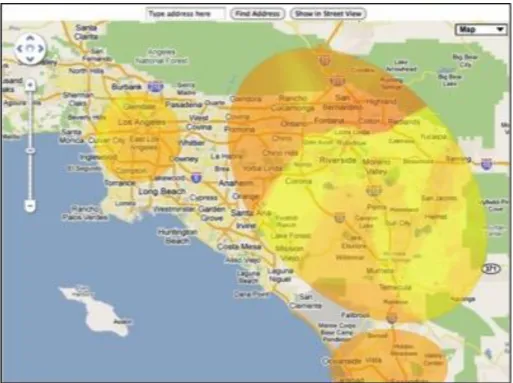
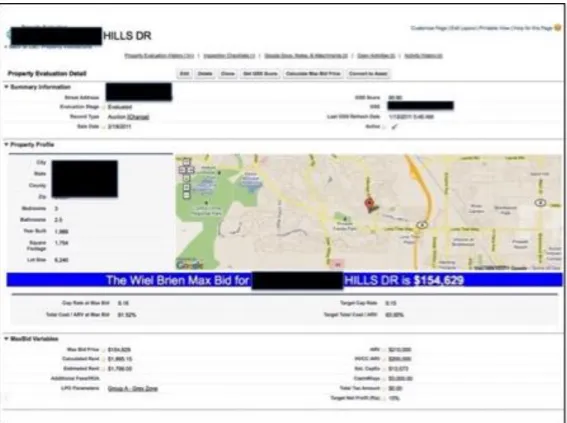
characteristics, then conduct algorithmic assessments to identify geographical areas with supplies of properties that meet their yield requirements (the “buy box”, as seen in figure 1) and generate maximum bids for individual properties within the buy box (see figure 2). This kind of purchasing engine “helps certify, to the dollar, that each
home's rent will more than cover its costs: Every home becomes a monitored asset,
and every renter a revenue stream” (Harwell 2013, no page, emphasis added). During
purchasing engines (Perlberg and Gittelsohn 2013). Datafication thus aids the process of meaningfully “aggregating hitherto unsuspecting geographies”, a coalescence that makes new financial asset classes possible (Leyshon and Thrift 2007, 109).
Insert figures 1-2 about here Framing a hybrid asset class
The bundling of rental income flows to be issued and sold as bonds completed the transformation of distressed single-family homes into the basis of a desirable institutional asset class, positioning the SFR market as “a frontier of financial expansion” (Bryan and Rafferty 2014, 895). Where single-family properties first had to be reframed in terms of the social and economic benefits of large-scale scatter-site rental housing to extract them from their associations with the 2008 crisis, the rollout of SFR securitization entailed another round of framing. At this stage framing sought to afford capital market actors the ability to “form expectations, make plans, stabilize their preferences, and undertake calculations” (Çalışkan and Callon 2010, 5) about the new asset class. Credit rating agencies have played a leading role here; indeed the participation of multiple rating agencies itself lent important credibility to SFR securitization (Rahmani, George, and Tomasello 2014). That is, rather than
measuring an objective reality, credit ratings are performative: the very fact of their existence, and importantly, their ubiquity (three agencies have issued ratings on SFR securitizations), verifies the value of that being rated (Carruthers 2013, 2010). The AAA ratings9 bestowed upon the top tranche of SFR securitizations from the first issuance contributed to the liquidity of these new instruments, offering a “seal of approval” and inculcating beliefs that buyers and sellers knew what the bonds were worth (Carruthers 2010, 164).
9 Across the first 25 SFR securitizations, issued between 2013 and June 2016, 51% of the total
issuance offered (approximately $7 billion of $13.8 billion offered) was rated AAA (author’s calculations based on Morningstar rating agency presale reports).
Behind that seal of approval were two years of debate and uncertainty (Raymond 2014). Would the underlying homes appreciate? Could the industry withstand adverse economic conditions? Could private equity landlords manage geographically dispersed portfolios in a cost-effective way? Without historical data on SFR, how could rents, rental delinquency rates, maintenance costs, and vacancy rates be estimated? Confusion swirled about what structure SFR securitization should take and potential risks and strains embedded therein, including “uncertainty
regarding whether an SFR securitization would be more like CMBS or RMBS”10 (Raymond, 2014 no page). This period of searching underlines how the SFR asset class is a work in progress, something in the process of coming together and being invented along the way. Ultimately ratings agencies used models from both commercial and residential securities to determine the probability and severity of default, and to conduct stress tests to generate ratings for different tranches (Raymond 2014). The resulting financial instrument can be understood as a hybrid asset class whose construction represents a process of reassembling, “grafting on new elements and reworking old ones” (Li, 2007, 263) as circumstances change. Here, reassembling pulls together a bespoke financial instrument, drawing selectively on previous models to fit a new type of asset (rental income from single-family homes).
However the nature of the asset also posed new challenges for assessing the performance of the asset class over time, with uncertainty about property
management and maintenance standing as a major source of discomfort within capital markets. This anxiety is highlighted in comments emphasizing the importance of commensurable property-level information by the managing director of residential mortgage-backed securities from a major rating agency at a 2014 SFR investment forum:
“capital markets cannot get into a home…So how do you take all the expenses, all of the maintenance, the water heaters, the roof, and flatten it into a format that can be consumed by capital markets—this remains a big
challenge for this market. It’s going to take some time for the market to evolve to a point where people have some comfort on this dimension.”
Moving from (incalculable) uncertainty to (calculable) risk on this issue was a practical accomplishment (Carruthers 2013), seen in how issuers and the
Morningstar rating agency developed requirements for reporting operational data, produce knowledge to meet them, and disseminate this information to capital markets. Morningstar’s approach here contrasts with that of Standard & Poor’s Rating Service (the oldest of the Big Three credit agencies), which has refused to rate SFR securitizations based in part on the lack of market data, with the former head of the agency’s structured finance department arguing “If rating firms don’t have the data, they shouldn’t rate the deals” (quoted in Neumann 2012). In contrast Morningstar has approached this problem by enlisting issuers as partners in building up data about the SFR market.
Morningstar’s rating model requires issuers to submit property-level data on vacancies, delinquencies, and turnover each month. This imperative serves the purpose of providing ongoing insight into the performance of individual
securitizations and creates a body of information about the asset class as a whole to draw on as more deals are rated and monitored. To further enhance market comfort and familiarity with the SFR asset class, Morningstar publishes a monthly SFR performance report; as the email alert for a recent performance summary stated, “Given the limited historical performance data available for the [SFR] asset class as a whole, Morningstar recognizes the importance of sharing detailed property-level performance information with the market”.
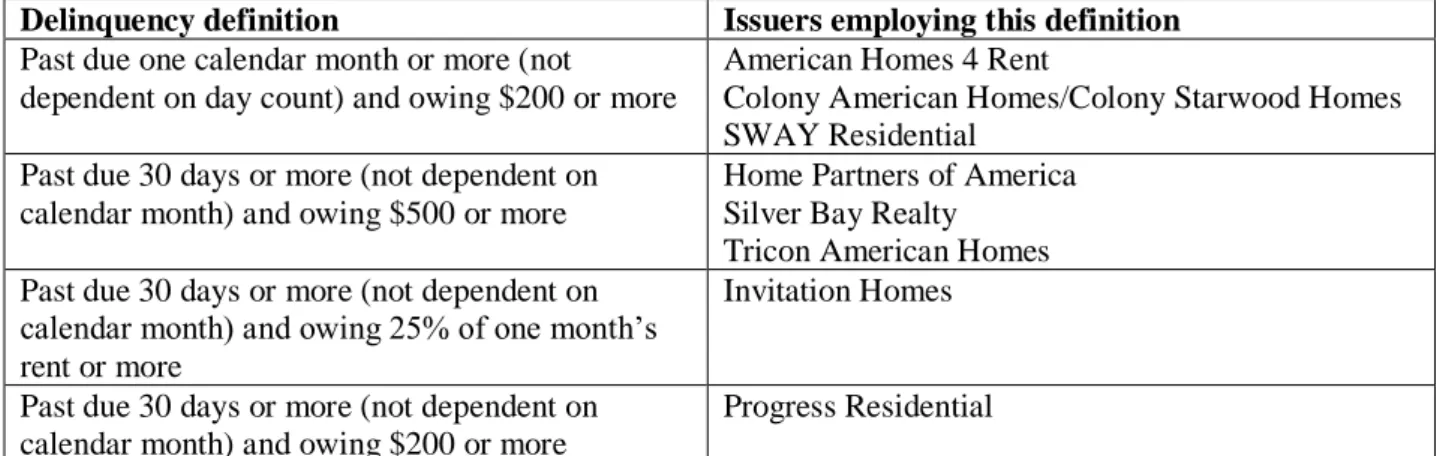
Yet different operators often calculate the same data points differently: as Morningstar points out “the vacancy rate might be calculated based on property count, by cash flow, or by days of occupancy” (Alan, Jadhav, and Polasanpalli 2016, 29). Taking the example of delinquency, eight operators employ four different definitions of delinquency (see table 1). Despite the flow of information the rating agency has induced, it still requires a process of establishing commonality across different measures; the “flattening” referred to above. Overall this standardization process coaxes into effect the kind of “transparency and comparability” Bitterer and Heeg (2012, no page) have shown to be so crucial to the emergence of new real estate asset classes, and their reception by international investors. Through issuing ratings and setting and fulfilling requirements to build a knowledge base about SFR, rating agencies and issuers, together with data tapes and performance reports, co-perform the hybrid SFR asset class.
Conclusions
This paper set out to analyze how new modes of financial rent extraction are being established within the US housing market in the wake of the 2008 crisis, and their wider significance in reproducing capitalist accumulation. To meet these objectives I strategically combined the STS-inspired marketization approach (Çalışkan and Callon 2010; Berndt and Boeckler 2012) with understandings of financial accumulation rooted in critical political economy (Aalbers 2016; Moreno 2014; Harvey 1985; Fernandez and Aalbers 2016). The marketization perspective is valuable for revealing the work of realizing markets, the role of calculative devices in market formation, and the contingent and conditional aspects of markets. This ‘pragmatic turn’ in the study of markets (Berndt and Boeckler 2011b; Muniesa, Millo, and Callon 2007) is especially well-suited to studying the emergence of a new financial asset class such as SFR. However, such analyses must transcend “local,
(Christophers 2014b, 12) to consider the distributional consequences of markets and how they change or maintain current power relations and patterns of accumulation. Aiming to think through the political economic import of market formation, I employed marketization as a method for opening the black box of finance in order to understand how property-led accumulation is being reworked for the post-crisis context.
This paper contributes a theoretical synthesis that makes it possible to interrogate both the circumstances of market formation and the social, spatial, and political consequences of markets. The approach taken here is not the only means of incorporating political economy’s utility for systematic explanation with
perspectives that emphasize the material, provisional, and performative aspects of economies and markets (cf. Christophers 2014b; MacKenzie 2016; Ouma 2016). But for critical economic geographers, working across these frameworks is a matter of some significance, and should comprise a wider agenda for the development of theory and method. As the rest of these concluding comments will discuss, the actual effects of markets and the way in which they participate in the wider reproduction of capitalist accumulation and exploitation are intimately linked to how markets come into being, and the conditions under which particular markets are formed. Bringing both sets of concerns into the analytic frame, as this paper has done, may therefore open up crucial questions about developing strategies and tactics of resistance that contest the uneven impacts of markets in ways specific to the social, political, and cultural relations through which they emerge. Consequently, the study adds value to critical economic geography scholarship by providing a heterodox analytic technique for studying the accomplishment and reproduction of market exchange and
circulation without sacrificing attention to power relations and their structural dynamics.
This paper also enhances knowledge of how property-led financial accumulation has been adjusted for the post-2008 context. The construction of the SFR asset class demonstrates that financial markets are “discovering new attributes of households” (Bryan and Rafferty 2014, 895), namely their attachments to rental housing markets. Although the notion that financial actors and home life are entangled through relations of mortgage debt and everyday investments is by now well-established (Martin 2002; Aalbers 2016; Langley 2010; Sassen 2009), SFR securitization shows these entanglements operating through landlord-tenant relations that draw together renters, private equity funds, and institutional investors. These relations exemplify Bryan and Rafferty’s (2014) logic of the derivative, in which “ordinary people” are “decomposed into a range of risks and a range of assets” and aggregated as “bundles of exposures”(898). The SFR asset class affirms the financial industry’s collective power over Kear’s (2013) homo subprimicus, even when the cord of mortgage debt has been snipped, reproducing neoliberal capitalism’s always-already uneven social relations of housing.
Indeed, a variety of mechanisms help landlords ensure tenants do not interfere with the flow of capital to SFR bondholders. The unprecedented growth in rental demand since the crisis (Joint Center for Housing Studies 2015a) and limited tenant protections in the US (particularly in Southern states) means tenants are “easily displaced and replaced” (Call, 2017, 38), as unusually high eviction rates by large private equity landlords in Atlanta, Georgia demonstrate (Raymond et al. 2016). Predictive consumer credit ratings that incorporate rent payment history (Experian 2012), tenant blacklisting facilitated by screening companies (Lebovits and
Addonizio 2015), and eviction automation platforms further indicate the disciplinary terrain of today’s rental market. As large-scale investors and other actors pour resources and technology into rental housing, we may begin to observe more formal
disadvantage the poor and people of color (cf. boyd and Crawford 2012; Kirchner 2016). Uneven power relations and the violence of eviction, and their mediation and amplification via information communication technologies, thus comprise some of the wider architecture stabilizing the SFR market assemblage.
The rapid post-crisis transformation of SFR into an institutional asset class underlines both how crucial housing is to the circulation of capital (Aalbers and Christophers 2014), and the adaptability of financialization to changing market conditions (Fields & Uffer, 2016). This adaptability constitutes “capital’s “defensive” work vis-à-vis markets” (Christophers 2015b, 1863), here working to ensure the durability of rentier capitalism by constructing a new asset class that helps resolve the financial-real estate crisis. The recent announcement that Fannie Mae will guarantee up to one billion dollars worth of SFR bonds issued by Blackstone’s Invitation Homes indicates the state’s belief “homeownership will remain out of reach for many Americans”, making financing more affordable for institutional investors while also symbolically endorsing the industry (Dezember and Timiraos 2017). Thus whereas a STS-oriented perspective emphasizes markets as “contingent phenomena, requiring the successful and coordinated enrolment of so many agents, activities, devices, and discourses”, we must also consider the resilience of market rule (Christophers 2014b, 1861). Though the financialized US housing market failed in 2008, today devalued single-family have been selectively incorporated into a re-worked regime of financial accumulation based on rental housing. The SFR asset class affirms the fundamental role for housing in the ideology of capital by assuring private property ownership, resource allocation by market exchange, and satisfaction of the accumulation imperative (Aalbers and Christophers 2014).
If the SFR asset class maintains, rather than transforms, the broader power relations of housing, these power relations are not going unchallenged. In the US, Spain, and Ireland, the crisis has opened space for struggles with the production of
space organized around financial imperatives. Localities in the US have sought to disrupt prevailing constructions of value and risk, declaring “local jurisdiction over [underwater] mortgage debt that is presumed to be ‘delocalized’ as it churns through the circuits of finance capital” (Christophers and Niedt 2016, 13). Activist
occupations of vacant properties owned by banks and investment funds in cities struggling with rising housing costs and homelessness attempt to produce new spatial possibilities while exposing the contradictions of financial capitalism (Lovett 2016; Neumann 2014; Garcia Lamarca in press; Di Feliciantonio 2016; O’Callaghan, Di Feliciantonio, and Byrne forthcoming). Interest in non-speculative housing models is mounting, evidenced by the rapid growth of community land trusts in the US since 2005 (Moore and McKee 2012). Such developments indicate there is yet will to challenge the central place of housing in the ideology of capital.
References
Aalbers, Manuel. in press. “Corporate Financialization.” In The International Encyclopedia of Geography: People, the Earth, Environment, and Technology, edited by Douglas Richardson, Noel Castree, Michael Frank Goodchild, Audrey Kobayashi, Weidong Liu, and Richard Marston. Wiley. ———. 2009. “Geographies of the Financial Crisis.” Area 41 (1): 34–42.
———. 2016. The Financialization of Housing: A Political Economy Approach. Routledge Studies in the Modern World Economy. London: Routledge. Aalbers, Manuel, and B Christophers. 2014. “Centering Housing in Political
Economy.” Housing, Theory and Society 31.
Acolin, Arthur, Jesse Bricker, Paul S. Calem, and Susan M. Wachter. 2016. “Borrowing Constraints and Homeownership.” SSRN Scholarly Paper ID 2720313. Rochester, NY: Social Science Research Network.
http://papers.ssrn.com/abstract=2720313.
Alan, Brian, Rohit Jadhav, and Srikar Polasanpalli. 2016. “Single-Family Rental Research: Performance Summary Covering All Morningstar-Rated Securitizations.” Morningstar Credit Ratings.
———. 2017. “Single-Family Rental Research: Performance Summary Covering All Morningstar-Rated Securitizations.” January 2017. Morningstar Credit Ratings.
Allon, Fiona. 2010. “Speculating on Everyday Life: The Cultural Economy of the Quotidian.” Journal of Communication Inquiry 34 (4): 366–81.
doi:10.1177/0196859910383015.
Anderson, Ben, Matthew Kearnes, Colin McFarlane, and Dan Swanton. 2012. “On Assemblages and Geography.” Dialogues in Human Geography 2 (2): 171– 89. doi:10.1177/2043820612449261.
Berndt, Christian, and Marc Boeckler. 2009. “Geographies of Circulation and
Exchange: Constructions of Markets.” Progress in Human Geography 33 (4): 535–51.
———. 2011a. “Performative Regional (dis)Integration: Transnational Markets, Mobile Commodities, and Bordered North–South Differences.” Environment and Planning A 43 (5): 1057–78.
———. 2011b. “Geographies of Markets: Materials, Morals and Monsters in Motion.” Progress in Human Geography 35 (4): 559–67.
———. 2012. “Geographies of Marketization.” In The Wiley-Blackwell Companion to Economic Geography, edited by Trevor Barnes, Jamie Peck, and Eric Sheppard, 199–212. Blackwell Publishing.
Berry, Mike. 2000. “Investment in Rental Housing in Australia: Small Landlords and Institutional Investors.” Housing Studies 15 (5): 661–81.
Bitterer, Nadine, and Susanne Heeg. 2012. “Implementing Transparency in an
Eastern European Office Market: Preparing Warsaw for Global Investments.” Articulo - Journal of Urban Research, no. 9 (September).
http://articulo.revues.org/2139#text.
Boeckler, Marc, and Christian Berndt. 2013. “Geographies of Circulation and Exchange III The Great Crisis and Marketization ‘after Markets.’” Progress in Human Geography 37 (3): 424–32.
boyd, danah, and Kate Crawford. 2012. “Critical Questions for Big Data.” Information, Communication & Society 15 (5): 662–79.
Bratt, Rachel G., and Dan Immergluck. 2015. “The Mortgage Crisis: Historical Context and Recent Responses.” Journal of Urban Affairs 37 (1): 32–37. Brennan, Morgan. 2012. “Investors Flock to Housing, Looking to Buy Thousands of
Homes in Bulk.” Forbes, April 3.
Brenner, Neil, David J. Madden, and David Wachsmuth. 2011. “Assemblage
Urbanism and the Challenges of Critical Urban Theory.” City 15 (2): 225–40. Bryan, Dick, and Michael Rafferty. 2014. “Financial Derivatives as Social Policy
beyond Crisis.” Sociology 48 (5): 887–903.
Çalışkan, Koray, and Michel Callon. 2009. “Economization, Part 1: Shifting
Attention from the Economy towards Processes of Economization.” Economy and Society 38 (3): 369–98.
———. 2010. “Economization, Part 2: A Research Programme for the Study of Markets.” Economy and Society 39 (1): 1–32.
Callon, Michel. 1998. “Introduction: The Embeddedness of Economic Markets in Economics.” In Laws of the Markets, edited by Michel Callon, 1–68. Oxford: Wiley-Blackwell.
———. 2007. “What Does It Mean to Say That Economics Is Performative?” In Do Economists Make Markets? On the Performativity of Economics, edited by Donald Mackenzie, Fabian Muniesa, and Lucia Siu. Princeton: Princeton University Press.
Callon, Michel, and Fabian Muniesa. 2005. “Peripheral Vision: Economic Markets as Calculative Collective Devices.” Organization Studies 26 (8): 1229–50. Carruthers, Bruce. 2010. “Knowledge and Liquidity: Institutional and Cognitive Foundations of the Subprime Crisis.” In Markets on Trial: The Economic Sociology of the Financial Crisis, edited by Michael Lounsbury and Paul Hirsch, 157–82. United Kingdom: Emerald Group Publishing.
http://www.emeraldinsight.com.eresources.shef.ac.uk/doi/pdfplus/10.1108/S0 733-558X%282010%29000030A009.
———. 2013. “From Uncertainty toward Risk: The Case of Credit Ratings.” Socio-Economic Review 11 (3): 525–51.
Christophers, Brett. 2011. “Revisiting the Urbanization of Capital.” Annals of the Association of American Geographers 101 (6): 1347–64.
———. 2014a. “Wild Dragons in the City: Urban Political Economy, Affordable Housing Development and the Performative World-Making of Economic Models: Performative World-Making of Economic Models, UK Case.” International Journal of Urban and Regional Research 38 (1): 79–97. ———. 2014b. “From Marx to Market and Back Again: Performing the Economy.”
Geoforum 57 (November): 12–20.
———. 2015a. “The Limits to Financialization.” Dialogues in Human Geography 5 (2): 183–200. doi:10.1177/2043820615588153.
———. 2015b. “Constructing and Deconstructing Markets: Making Space for Capital Introduction: Market Works.” Environment and Planning A 47 (9): 1859–65.
Christophers, Brett, and Christopher Niedt. 2016. “Resisting Devaluation:
Foreclosure, Eminent Domain Law, and the Geographical Political Economy of Risk.” Environment and Planning A 48 (3): 485–503.
Coakley, J. 1994. “The Integration of Property and Financial Markets.” Environment and Planning A 26 (5): 697–713.
Committee on Financial Services. 2012. An Examination of the Federal Housing Finance Agency’s Real Estate Owned (REO) Pilot Program. Washington, DC.
Cooper, Mark H. 2015. “Measure for Measure? Commensuration, Commodification, and Metrology in Emissions Markets and beyond.” Environment and
Planning A 47 (9): 1787–1804.
CoreLogic. 2009. “Residential Property Values Fell $2.4 Trillion During 2008.” CoreLogic.
https://avmselect.corelogic.com/documents/20090218_Residential_Property_ Values_Fell_24_Trillion_Dollars_in_2008.pdf.
———. 2014. “National Foreclosure Report: August 2014.” CoreLogic.
http://www.corelogic.com/research/foreclosure-report/national-foreclosure-report-august-2014.pdf.
Demeritt, David. 2001. “Scientific Forest Conservation and the Statistical Picturing of Nature’s Limits in the Progressive-Era United States.” Environment and Planning D: Society and Space 19 (4): 431–59.
Dezember, Ryan, and Nick Timiraos. 2017. “Blackstone Wins Fannie’s Backing for Rental Home Debt.” Wall Street Journal, January 24, sec. Markets.
http://www.wsj.com/articles/blackstone-wins-fannies-backing-for-rental-home-debt-1485265237.
Di Feliciantonio, Cesare. 2016. “Social Movements and Alternative Housing Models: Practicing the ‘Politics of Possibilities’ in Spain.” Housing, Theory and Society 0 (0): 1–19.
Dreier, Peter, Saqib Bhatti, Rob Call, Alex Schwartz, and Gregory Squires. 2014. “Underwater America: How the So-Called Housing ‘Recovery’ Is Bypassing Many American Communities.” Haas Institute for a Fair and Inclusive Society.
Ducastel, Antoine, and Ward Anseeuw. 2016. “Agriculture as an Asset Class: Reshaping the South African Farming Sector.” Agriculture and Human Values, January, 1–11.
Easterling, Keller. 2014. Subtraction. Berlin: Sternberg Press.
Experian. 2012. “Experian RentBureau to Receive Rental Payment History Data from Riverstone Residential Group.”
https://www.experianplc.com/media/news/2012/experian-rentbureau-to-receive-rental-payment-history-data-from/.
Fernandez, Rodrigo, and Manuel B Aalbers. 2016. “Financialization and Housing: Between Globalization and Varieties of Capitalism.” Competition & Change 20 (2): 71–88. doi:10.1177/1024529415623916.
Fields, Desiree. 2015. “Contesting the Financialization of Urban Space: Community Organizations and the Struggle to Preserve Affordable Rental Housing in New York City.” Journal of Urban Affairs 37 (2): 144–65.
doi:10.1111/juaf.12098.
French, Shaun, Andrew Leyshon, and Thomas Wainwright. 2011. “Financializing Space, Spacing Financialization.” Progress in Human Geography 35 (6): 798–819. doi:10.1177/0309132510396749.
Garcia Lamarca, Melissa. in press. “From Occupying Plazas to Recuperating Housing: Insurgent Practices in Spain.” International Journal of Urban and Regional Research. doi:10.1111/1468-2427.12386.
Greer, Robert J. 1997. “What Is an Asset Class, Anyway?” Journal of Portfolio Management 23 (2): 86–91.
Harvey, David. 1985. The Urbanization of Capital: Studies in the History and Theory of Capitalist Urbanization. First Edition. Baltimore, Md: The Johns Hopkins University Press.
Harwell, Drew. 2013. “Land Rush.” Tampa Bay Times, March 24.
http://www.tampabay.com/news/business/realestate/blackstone-other-investors-snap-up-thousands-of-tampa-bay-rental-homes/2110744.
Honea, Brian. 2015. “Technology Figures to Play a Significantly Greater Role in the SFR Market.” DSNews. October 13. http://www.dsnews.com/news/10-13- 2015/technology-figures-to-play-a-significantly-greater-role-in-the-sfr-market.
Immergluck, D. 2010. “The Accumulation of Lender-Owned Homes During the U.S. Mortgage Crisis: Examining Metropolitan REO Inventories.” Housing Policy Debate 20 (4): 619–45.
Immergluck, Dan. 2015. “A Look Back: What We Now Know about the Causes of the US Mortgage Crisis.” International Journal of Urban Sciences, May, 1– 17. doi:10.1080/12265934.2015.1044460.
Joint Center for Housing Studies. 2015a. “America’s Rental Housing: Exploring Options for Diverse and Growing Demand.” Harvard University. http://www.jchs.harvard.edu/americas-rental-housing.
———. 2015b. “The State of the Nation’s Housing.” Cambridge, MA: Harvard University. http://www.jchs.harvard.edu/research/state_nations_housing. Kanai, J. Miguel, and William Kutz. 2013. “Entrepreneurial Assemblages from off
the Map: (Trans) National Designs for Tangier.” Environment and Planning D: Society and Space 31 (1): 80–98. doi:10.1068/d20311.
Kear, Mark. 2013. “Governing Homo Subprimicus: Beyond Financial Citizenship, Exclusion, and Rights.” Antipode 45 (4): 926–46. doi:10.1111/j.1467-8330.2012.01045.x.
———. 2014. “The Scale Effects of Financialization: The Fair Credit Reporting Act and the Production of Financial Space and Subjects.” Geoforum 57
(November): 99–109. doi:10.1016/j.geoforum.2014.08.013.
Kirchner, Julia Angwin, Surya Mattu, Jeff Larson, Lauren. 2016. “Machine Bias: There’s Software Used Across the Country to Predict Future Criminals. And It’s Biased Against Blacks.” ProPublica. May 23.
https://www.propublica.org/article/machine-bias-risk-assessments-in-criminal-sentencing.
Krainer, John, and Erin McCarthy. 2014. “Housing Market Headwinds.” 2014–32. Economic Letter. Federal Reserve Bank of San Francisco.