Selected mechanical properties and the
structural grading of young Pinus patula sawn
timber
“Thesis presented in partial fulfilment of the requirements for the degree Master of Science in Forestry (Wood Products Science) at the Faculty of
AgriSciences, Stellenbosch University
Supervisor: Mr. Brand Wessels Faculty of AgriSciences
Department of Forest and Wood Science
December 2010 by
Declaration
By submitting this thesis electronically, I declare that the entirety of the work contained herein is my own, original work, and that I have not previously in its entirety or in part submitted it for obtaining any qualification.
December 2010
Copyright © 2010 University of Stellenbosch
~ I ~
SUMMARY
In this study 1345 pieces of 38x114 mm timber sawn from 16-20 year-old Pinus patula trees were obtained from a wide variety of sites along the Mpumalanga escarpment in South Africa. The samples were tested for various mechanical and physical properties. The objectives of this study were (1) to determine the variation in the bending strength, tension strength, and stiffness of the sawn timber, (2) to assess the efficiency of the current visual and mechanical grading rules on this sample, and (3) to evaluate the potential of some indicator properties to be used as structural grading parameters on this resource.
A large number of non-destructive measurements were performed on all the samples, including scanning of the boards with a commercial X-ray density scanner, moisture content measurement, growth ring measurements, warp measurement, acoustic frequency measurement and measurement of the stiffness using a mechanical grader. The data from the X-ray density scanner was used to calculate a number of knot-related variables for each board. Visual grading according to the SANS 1783-2 (2005) specifications for structural timber was performed by a certified grader on all the boards. The timber was divided into two groups for destructive testing, one group each for bending and tension tests. Tests were conducted according to the SANS 6122 (1994) method for in-grade testing. Due to the sampling method followed, the destructive tests effectively used a random placement of defects with regard to the load application position. From the destructive tests the modulus of elasticity (MOEedge), bending strength (MOR) and tensile strength were
determined.
The study showed that the MOEedge of the sawn timber was far below the
requirements of the current national standard (SANS 10163-1) for all of the visual and mechanical grades. The mean MOEedge of the visually graded S5 timber was
about 30% lower than required. The 5th percentile values for bending strength of all
the visual and mechanical grades were above the required values of SANS 10163-1. The 5th percentile values for tensile strength of all the visual and mechanical grades
~ II ~
Correlations between flatwise measured MOE (MOEflat) and edgewise measured
MOE (MOEedge) were smaller than expected, as well as the correlations between
both MOEedge and MOEflat with MOR. Dynamic MOE (MOEdyn), calculated from
acoustic frequency tests on the timber, was found to be the best single predictor of MOEedge, MOR and tension strength. Multiple regression analysis showed that a
combination of MOEdyn, density and knot parameters can be used to improve the
predictability of some of the strength and stiffness characteristics of the timber. It is recommended that a comprehensive study on the structural grading of SA Pine be performed which includes (1) an analysis of market requirements in terms of strength and stiffness properties of timber, (2) in-grade testing of a representative sample of structural timber in South Africa, and (3) a review of the standards used in South Africa to regulate the structural grading of timber.
~ III ~
OPSOMMING
In hierdie studie is 1345 stukke 38x114 mm 16-20 jaar-oue Pinus patula planke, afkomstig van ‘n wye verskydenheid groeiplekke teen die Mpumalanga platorand in Suid Afrika, gebruik. Die planke is getoets vir verskeie meganiese sowel as fisiese eienskappe. Die doelwitte van hierdie studie was om (1) die variasie in buigsterkte, treksterkte en styfheid van die gesaagde planke te bepaal, (2) die effektiwiteit van die huidige visuele -en meganiese graderingsreëls op hierdie monster planke vas te stel, en (3) die potensiaal te evalueer van sommige eienskappe wat gebruik kan word as strukturele graderingsparameters.
‘n Groot hoeveelheid nie-destruktiewe toetse is op alle planke uitgevoer, wat ingesluit het skandering van planke met ‘n kommersiële X-straaldigt-heidskandeerder, metings van voginhoud, groeiringwydtes, deformasie, akoestiese frekwensie en die bepaling van styfheid met behulp van ‘n meganiese gradeerder. Die data van die X-straalskandeerder is gebruik om ‘n aantal kwasverwante veranderlikes vir elke plank te bereken. Visuele gradering is op alle planke uitgevoer ooreenkomstig met die SANS 1783-2 (2005) spesifikasies vir strukturele hout deur ‘n gesertifiseerde gradeerder. Die hout is in twee groepe opgedeel vir destruktiewe toetse, een vir buigtoetse en een vir trektoetse, ooreenkomstig met die SANS 6122 (1994) metode vir binnegraadse toetse. As gevolg van die monsternemingsmetodiek wat gevolg is, is daar effektief gebruik gemaak van ‘n lukrake plasing van defekte met betrekking tot die las-aanwendingsposisie. Die modulus van elastisiteit (MOEedge), buigsterkte (MOR) en treksterkte is deur middel van destruktiewe
toetsresultate bepaal.
Die studie het aangetoon dat die MOEedge van gesaagde hout aansienlik minder as
die vereiste van die huidige nasionale standaard (SANS 10163-1) is vir al die visuele en meganiese grade. Die gemiddelde MOEedge van die visueel-gegradeerde S5
planke was omtrent 30% laer as vereis. Die 5de persentiel waardes vir buigsterkte
van alle visuele en meganiese grade was hoër as die vereiste waardes soos voorgeskryf deur SANS 10163-1. Die 5de persentiel waardes vir treksterkte van alle
visuele en meganiese grade was gelykstaande aan wat vereis word deur SANS 10163-1.
~ IV ~
Korrelasies tussen MOE, gemeet op die wydte sy (MOEflat), en MOE, gemeet op
die diktesy (MOEedge), asook die korrelasies van beide MOEedge en MOEflat met
MOR van die planke was laer as verwag. Dinamiese MOE (MOEdyn), wat bereken
was vanaf die akoestiese frekwensie resultate, is vasgestel as die beste enkele indikator van MOEedge, MOR en treksterkte.
Meervuldige regressie analise het aangetoon dat ‘n kombinasie van MOEdyn, digtheid
en kwasparameters gebruik kan word om die voorspelbaarheid van sommige van die sterkte- en styfheids eienskappe van die hout te verbeter.
Daar word aanbeveel dat ‘n omvattende studie gedoen word op die strukturele gradering van SA Dennehout, wat insluit (1) ‘n analise van die markbehoeftes in terme van die sterkte- en styfheids eienskappe van hout, (2) binnegraadse toetsing van ‘n verteenwoordigende monster strukturele hout in Suid Afrika, en (3) die hersiening van standaarde in gebruik in Suid Afrika om die strukturele gradering van hout te reguleer.
~ V ~
ACKNOWLEDGEMENTS
A special word of thanks to the following people and organisations:
− Brand Wessels for supervising my studies;
− Deon Breytenbach of York Timber for his support and also York’s Nicholson and Mullin sawmill (Leslie Glass) for the sawing and drying of the timber and the Sabie sawmill (Bruce Waller) for the scanning of the timber with their X-ray scanner;
− Jos Louw, Barry Muller and students from Saasveld for the tree sampling and co-operation in this project;
− KLF for supplying the trees for the project and for the funding of some of the tasks (Francois Malan);
− Lewis Silberbauer and Cape Sawmills for the use of their mechanical grader and help with the setup of the test;
− Professor Daan Nel for his advice on the statistical analysis;
− Peter Muller for his advice on structural grading;
− Martin Bacher (Microtec) for advice and support with the X-ray scanning analysis;
− Sawmilling SA for sponsoring this project;
− Hans Merensky for sponsoring my studies;
− the examiners of this thesis, Thomas Seifert and Peter Muller for their constructive advice; and
~ VI ~
TABLE OF CONTENTS
PAGE
SUMMARY I
OPSOMMING III
ACKNOWLEDGEMENTS V
LIST OF TABLES IX
LIST OF FIGURES X
LIST OF SYMBOLS XIII
1. INTRODUCTION 1
2. LITERATURE REVIEW 3
2.1. Characteristic stress values of structural timber 3 2.2. Structural grading of sawn timber 4
2.2.1. Properties which influence timber strength and stiffness 5
2.2.1.1. Knots 5 2.2.1.2. Density 7 2.2.1.3. MOE 7 2.2.1.4. Microfibril angle 8 2.2.1.5. Spiral grain 9 2.2.1.6. Juvenile wood 9
2.2.1.7. Natural vibration frequency 10 2.2.1.8. Combinations of properties 12 2.2.2. Visual and machine grading 13
~ VII ~
2.2.3. Proof grading 14
2.3. Structural grading and grade verification in South Africa 15 2.4. In-grade testing variables 17
2.4.1. Defect placement 17
2.4.2. Density measurement 18
2.4.3. Rate of loading 18
2.4.4. Size effect 19
2.5. Requirements for a grading system 20
3. METHODS AND MATERIALS 22
3.1. Tree and log sampling 22
3.2. X-ray scanning 26
3.3. Growth ring measurements 27 3.4. X-ray scanning and acoustic frequency pre-study 28 3.4.1. X-ray scanner comparisons 28 3.4.2. Acoustic frequency variables 29
3.5. Mechanical grading 31
3.6. Acoustic frequency testing 31
3.7. Dimension measurements 32
3.8. Visual grading 33
3.9. Warp measurements 33
~ VIII ~
3.10.1. Bending tests 35
3.10.2. Tension tests 37
3.11. Calculations and analysis 39 3.11.1. Calculation of strength and stiffness values 39 3.11.2. Statistical evaluation 41
3.12. General observations 42
4. RESULTS AND DISCUSSION 43
4.1. Selected physical and mechanical properties of P. patula sawn timber 43 4.1.1. Non-destructively evaluated (NDE) properties 43 4.1.2. Destructive test results 45 4.2. Results related to structural grading 54 4.2.1. Correlations between measured properties 54 4.2.2. Using combinations of properties to predict strength and stiffness 60 4.2.3. Structural grading according to different NDE properties 62 5. CONCLUSIONS AND RECOMMENDATIONS 65
6. REFERENCES 68
~ IX ~
LIST OF TABLES
Table 1: Characteristic stresses for South African pine according to grade 3 Table 2: Degrees of determination (R2) from various investigations of the
relationship between strength and other properties of Norway spruce timber (Picea abies) 6 Table 3: Degrees of determination (R2) for MOR predictions by different
indicator properties 6
Table 4: Degrees of determination (R2) between density, MOE and MOR for
different pine species with different bending test setups 8 Table 5: Comparison of old and new crop R2 values for New Zealand radiata
pine 8
Table 6: Average value of specific gravity, MOEedge, and MOR at average
number of rings from the pith for two different age trees 16 Table 7: Average properties by age for loblolly pine 17 Table 8: Results from both biased and random bending tests on three
different species of pine 18 Table 9: Size effect factors for 3 different grades 20 Table 10: Testing parameters for four-point bending and tension tests 34 Table 11: NDE properties of the 1345 sawn 38x114x2100 mm Pinus patula
boards 43
Table 12: Timber strength and stiffness properties determined by means of
destructive tests 46
Table 13: Bending strength and stiffness properties according to board
position within a tree 52
Table 14a: Pearson’s correlation coefficient (r) between destructive and
non-destructively tested values 55
Table 14b: Pearson’s correlation coefficient (r) between destructive and non-destructively tested values 56
Table 15: Coefficients of correlation and determination values between destructive tests and both single and combined indicator
properties 61
Table16: Comparison of current SANS visual and mechanical strength grading rules with experimental acoustic grading rules 64
~ X ~
LIST OF FIGURES
Figure 1: Density variation in radiata pine trees from the pith to the outer
part of the tree 10
Figure 2: Knot parameters against MOR 13 Figure 3: Comparison of New Zealand radiata pine with various strength
class systems 16
Figure 4: Failure stress versus logarithm of rate of loading 19 Figure 5: Summary of process steps from log sampling to the final data
analyses and reporting 23
Figure 6: Map of SA highlighting the material sampling area 24 Figure 7: Log initial breakdown showing samples removed from each tree 24 Figure 8: The cant sawing pattern used 25 Figure 9: Example of scanned board showing optical and X-ray views 26 Figure 10: Material storage and sorting before sanding of board ends 27 Figure 11: Annual ring-width measurements taken perpendicular to annual
rings 27
Figure 12: Flatwise mechanical grading of test material 31 Figure 13: Frequency testing setup 32 Figure 14: Method for twist measurement 34 Figure 15: Method for spring measurement 34 Figure 16: Method for bow measurement 34 Figure 17: The four-point bending test setup on the Instron 36 Figure 18: Shear and moment diagrams for four-point bending tests 37 Figure 19: Tension test setup on the Instron 38 Figure 20: Distribution for MOEedge of all timber tested 48
Figure 21: Distribution for MOR of all timber tested 49 Figure 22: Distribution for tension of all timber tested 51 Figure 23: Scatterplot of MOR against MOEedge 57
~ XI ~
Figure 25: Scatterplot of MOR against MOEdyn 59
Figure 26: Scatterplot of tension against MOEdyn 60
~ XII ~
LIST OF SYMBOLS
# Knots The number of knots on a single piece of timber
Knot avg. The mean area per knot on a piece of sawn timber (mm2)
Knot area / board Total area of the timber surface containing knot material (mm2)
Knot max Maximum knot size on a piece of timber (mm2)
Knots 1-7F Parameter calculated by the X-ray scanning device using data of a combination of 7 knots on each full piece of timber
KParf Knot parameter from the most influential knot on the full board
KParc Knot parameter from the most influential knot on the centre
third of the board
KSC The product of the knot size and the stress index of a specific knot where the stress index is a ratio of the bending stress at a specific knot to the maximum bending stress in a piece of timber
MC Moisture content of timber (%)
MOE Modulus of elasticity (stiffness) of timber (MPa)
MOEdyn Dynamic modulus of elasticity calculated from the acoustically
determined natural frequency and the mean density of a piece of timber (MPa)
MOEedge Modulus of elasticity determined from an edgewise bending
test where the neutral axis is parallel to the thickness edge of a piece of timber (MPa)
MOEflat Modulus of elasticity calculated from a flat-wise bending test
where the neutral axis is parallel to the width of a piece of timber (MPa)
~ XIII ~
MOR Modulus of rupture also known as bending strength (MPa) (determined in edgewise bending throughout this study) N The number of timber pieces tested (test sample size) NDE Non-destructively evaluated
Position A position number allocated to each timber piece starting from the pith being 0
ρm Mean density of a piece of timber calculated after kiln drying
from manual measurements of dimensions and mass (kg/m³)
ρs Mean density of timber measured after kiln drying by X-ray
scanner (kg/m³)
r A correlation coefficient between outcomes and their predictors or indicator properties. It indicates how good a property is at predicting another
R2 The square root of r. Determination coefficient
Ring max Maximum annual ring width in a single piece of timber (mm) Ring min Minimum annual ring width in a single piece of timber (mm) Ring avg. Mean annual ring width in a single piece of timber (mm) St. Dev Standard deviation
Tension Tension strength measured parallel to grain (MPa) Timber Defect containing pieces of sawn wood
Warp Collective term for timber that has deformed from its original
position. Includes twist, spring and bow
X-Dev Density deviations measured by X-ray scanning device within a single piece of timber.
~ 1 ~
1.
INTRODUCTION
Nearly 70 percent of South Africa’s sawn pine timber production is classified as structural or building timber (Crickmay and Associates, 2009). Structurally graded timber may be used in load bearing structures such as roof trusses, beams or floor supports. Concerns have been raised in the past that the mechanical properties of SA pine are changing (Burdzik, 2004). The main concern is that structural timber conforming to the SANS visual grade requirements might have inferior strength and stiffness properties relative to the requirements of a specific stress grade. Burdzik (2004) tested structural timber from four sawmills in “low density regions”, and found that only one sawmill’s timber made the grade requirements for bending and tensile strength. None of the sawmills’ graded timber met the requirement for mean modulus of elasticity (MOE). However, the timber auditing company SATAS reported that timber from ten sawmills that has recently been tested in tension conformed to the grade requirements (personal communication between Brand Wessels and Abe Stears, 27/01/2009). Graded timber in South Africa is being used mainly in roof trusses of residential houses where the safety of the inhabitants, builders and maintenance workers is at stake. It is important for both the producers and users of structural timber that timber products comply with the strength and stiffness values used by designers of structures (as published in SANS 10163-1). The argument that we do not see many timber structures failing is insubstantial. Timber under stress looses strength over time - this is also referred to as the load duration effect. This means that the effect of non-compliance to grade strength requirements might only be seen in 10 or 15 year’s time.
Timber grading can simply be explained as the sorting of timber into different strength classes without damaging it (Pellerin and Ross, 2002). A more detailed description of structural grading follows in the literature review section of this thesis. Although the actual strength of wood can only be determined by destructive tests, the non-destructive methods used during grading estimates the strength of the wood through the use of indicator or concomitant properties (Hanhijärvi and Ranta-Maunus, 2008). These are properties such as knots, density and stiffness. When timber falling into certain stress grades according to the current grading rules (i.e. visual or mechanical) does not comply with the required characteristic strengths or
~ 2 ~
stiffness of that grade, it means that either the grading rules have to be altered or the characteristic strength and stiffness values have to be changed.
In this project a specific part of the South African sawn timber resource, young Pinus patula trees from the Mpumalanga area, was used as study material. Various properties of the timber were non-destructively evaluated after which the timber was destructively tested in bending and tension. The objectives of this study were as follow:
• to determine the variation in the bending and tension strength, and stiffness of sawn timber from young Pinus patula trees;
• to assess the efficiency of the current visual and mechanical grading rules on this resource (SANS 1783-2, 2005 and SANS 10149, 2002); and
• to evaluate the potential of some indicator properties that could be used as structural grading parameters on this resource.
Results from this study can either be used to reassure users of structural P. patula timber of the structural integrity of these products, or impress the need for new grade properties with regard to the current timber resource. It will also show the effectiveness of the different grading methods in separating timber according to its actual strength and stiffness properties. New, more refined grading methods can improve the efficient use of our current and future resources by better identification and assignment of timber into the appropriate strength classes. The proper grading of timber has the potential for increasing the profitability of sawmills as well as for the conservation of our natural wood resource.
~ 3 ~
2.
LITERATURE REVIEW
2.1. Characteristic stress values of structural timber
The strength and stiffness of a piece of timber can be described by six different strength values and a stiffness or modulus of elasticity (MOE) value. Table 1 shows these values, also referred to as characteristic values, for the different structural grades of SA Pine (SANS 10163-1, 2003).
Table 1: Characteristic stresses for South African pine according to grade (SANS 10163-1, 2003). Values in MPa.
1 2 3 4 5 6 7 8
Grade Bending Tension parallel to grain Tension perpendicular to grain Compression parallel to grain Compression perpendicular to grain Shear parallel to grain Modulus of elasticity 5 11.5 6.7 0.36 18 4.7 1.6 7800 7 15.8 10 0.51 22.8 6.7 2.0 9600 10 23.3 13.3 0.73 26.2 9.1 2.9 12000
These characteristic values are also referred to as “design values” or “5th percentile
values”. The characteristic 5th percentile value is derived from destructively testing a
large number of samples of a given grade. In simple terms: if 100 pieces of timber are destructively tested, the 5th lowest value will be the characteristic value for that
grade. Testing in most countries is performed using a process called in-grade testing, where timber is tested destructively in order to evaluate and / or adjust the grading process. Madsen (1992) describes the in-grade testing process as follows:
• the testing should emulate the end use conditions of the material as closely as possible;
• representative samples of full-sized specimens are tested in sufficient quantities to reliably establish the characteristic strength (5th percentile);
• the concept of a proof load failing about 10-15% of the test specimens is used;
• relatively fast load application is employed in order to speed up the testing process;
~ 4 ~
• portable testing equipment is preferable so that the testing could be performed at the sawmill;
• bending tests are performed with a span to depth ratio of 17 to 1 and loads in the third point; and
• the worst defect is placed randomly with respect to tension zone and length. The in-grade test procedures are different depending on the standards authority i.e. the ISO 13910 (2005) method requires the worst defect to be placed randomly whereas the SANS 6122 (1994) method requires the worst defect to be placed in the centre third of a bending test.
2.2. Structural grading of sawn timber
Grading is the process of sorting lumber into categories to which allowable design properties can be assigned using standardized methodology through non-destructive evaluation (Pellerin and Ross, 2002). The real strength of timber can only be determined by destructive tests (Hanhijärvi and Ranta-Maunus, 2008), therefore an in-grade testing procedure is needed to determine the characteristic values for each grade. In other words, timber must first be graded non-destructively before the characteristic values of a grade can be determined using in-grade testing. In-grade testing for grade verification is typically performed only when there are changes to the nature or character of a timber resource – which is normally not very often. The quality of a timber resource can change because of silvicultural factors, including forest management rule changes, harvesting cycle time changes and introduction of new timber species, as well as climate changes affecting seasonal growth and growth rate of trees (McKeever, 1997).
The problem with structural grading is that concomitant or indicator properties must be used to predict the actual strength and stiffness of sawn timber and the efficiency of grading depend on the strength of the relationship between this indicator property and strength or stiffness. The following section describes some of these indicator properties and the relationship with timber strength and stiffness. It is important to realise that timber containing defects has a different failure mode to clear wood (Madsen, 1992). For this reason timber (wood containing all the natural growth
~ 5 ~
characteristics) and clear wood have to be viewed as two different materials when strength properties are determined. A considerable part of research in the past focused on clear wood strength properties which are not applicable to structural grading of timber.
2.2.1. Properties which influence timber strength and stiffness
For structural grading systems it is important that the indicator properties used to grade the timber have a strong relationship with timber strength and stiffness. The following growth characteristics or properties of timber influence the strength and stiffness thereof.
2.2.1.1. Knots
The average knot volume in a stem is generally between 0.5 to 2%. The affected surface area of the timber, however, is up to 3 times greater than that of the knot itself, as the alignment of the axial tracheids around the knot is disturbed (Walker, 1993). Walker also notes that knot volume is proportionally greater in young stands, especially with wide initial spacing and thinning, where the trees have larger branches. Large knots drastically reduce strength and are a major cause of downgrade in timber. Edge knots are knots that borders on the side or edge of the board, and are normally under tension or compression. They behave as if they are internal knots of approximately twice their actual size (Walker, 1993).
Knots alone are poor predictors of strength, but when locations of knots are taken into account, prediction values improve somewhat (Johansson in Thelandersson and Larsen, 2003). Both Johansson and Giudiccandrea and Verfurth (2006) compared different studies and found degrees of determination (R2) of 0.20 to 0.42 between various knot parameters and timber MOR and tension (see Tables 2 and 3). When knot parameters were measured using a modern X-ray scanner an R2 of 0.5 with MOR of some of the European pines were found (Bacher, 2010). In a study done by Johansson et al. (1998) it was found that in destructive bending or tension tests the failure is caused almost exclusively by knots, while Johansson et al. (in Thelandersson and Larsen, 2003) found that knots account for up to 66% of downgrades during visual grading. Knuffel (1984) found from laboratory data that
~ 6 ~
visual grading could be improved by placing more emphasis on knot data than on density.
Table 2: Degrees of determination (R2) from various investigations of the relationship between strength and other properties of Norway spruce timber (Picea abies) – the sources of the investigation
are numbered from 1 to 6 (Hoffmeyer in Thelanderson and Larsen, 2003)
Characteristics that can be measured non-destructively Degree of determination R2 MOR Tension Source [1] [2] [3] [4] [1] [5] [6] Knots 0.27 0.2 0.16 0.25 0.36 0.42 0.30
Annual ring width 0.21 0.27 0.2 0.44 0.36 0.33 0.28
Density 0.16 0.3 0.16 0.4 0.38 0.29 0.38
MOE, bending or tension 0.72 0.53 0.55 0.56 0.70 0.69 0.58
MOE, flatwise, short span 0.74
Knots + annual ring width 0.37 0.42 0.39 0.49
Knots + density 0.38 0.38 0.55 0.61 0.64
Knots + MOE 0.73 0.58 0.64 0.70 0.76 0.78
[1]. Johansson et al. (1992), [2].Hoffmeyer (1984), [3].Hoffmeyer (1990), [4]. Lackner et al. (1988), [5]. Glos et al. (1982), [6] Johanssen (1976)
Table 3: Degrees of determination (R2) for MOR predictions by different indicator properties (from Glos, 2004 as recreated by Giudiccandrea and Verfurth, 2006).
Indicator properties to predict timber strength
(Grading modulus) Degree of determination R
2
Knots 0.15 – 0.35
Density (using X-ray etc) 0.20 – 0.40
Frequency (acoustics) 0.30 – 0.55
MOE 0.40 – 0.65
Knots & density (data combined) 0.40 – 0.60
~ 7 ~
2.2.1.2. Density
Density is a direct measure of the amount of cell wall material in the timber (Walker, 1993). Although density has traditionally been considered as the most important “quality property” in wood (Zobel and Van Buijtenen, 1989), its correlations with the strength of timber are generally regarded as poor, with Table 2 showing R2 values of
0.16 to 0.40 between density and bending or tensile strength. Guidiccandrea and Verfurth (2006) reported R2 values of 0.2 to 0.4 between density and strength
(MOR). Hanhijärvi and Ranta-Maunus (2008) however found an R2 of 0.55 between
density and MOR of 38x100 mm P. sylvestris from Europe.
Density in wood increases considerably from earlywood to latewood. A study done on ten 80-100 year-old Scots pine trees from Australia showed the latewood percentage to be an important criterion in assessing wood properties (Wimmer, 1991). Density is also affected by the silvicultural interventions typical of plantation forestry. Moschler et al. (1988) showed a decrease in earlywood density after thinning (425 kg/m3 to 408 kg/m3) and an increase in density for latewood (576 kg/m3
to 643 kg/m3) for 16 year-old Pinus taeda trees.
2.2.1.3. MOE
MOE, or stiffness, is normally seen as the best individual predictor of strength, with results found by Johansson et al. (in Thelandersson and Larsen, 2003) and those in Table 2 reporting R2 values of between 0.51 and 0.73 between edgewise MOE and
tension or MOR. Glos (2004) found R2 values of between 0.4 and 0.6 (Table 3).
Knuffel (1984) found an R2 value of 0.47 between MOR and MOEflat of SA Pine using
a 600 mm span.
These values are confirmed by the results in Table 4, which depicts correlation results from the tests done by Bailleres et al. (2009). This study also compared the difference in results when locating the worst defect in the central third of the test span (biased) vs. random placement of defects (random). The r values of 0.7 to 0.81 for the correlations between MOEedge and MOR are equivalent to R2 values of 0.49 to
~ 8 ~
Tests done by Gaunt (1999) show MOE and MOR comparisons done on both old crop as well as 19 year old radiata pine from New Zealand. Flatwise stiffness values (MOEp at the point of lowest stiffness) were related to MOR as well as MOEedge
values for the two samples. The R2 values found are shown in Table 5. The differences can however not be said to be only because of the crop age differences, as the 19 year old crop was tested at the position of lowest MOE, while the old crop was tested with random defect placement.
Table 4: Degrees of determination (R2) between density, MOE and MOR for different pine species with different bending test setups (Bailleres et al., 2009)
Test position Resource Dry density MOE
Biased
Radiata E MOR (MPa) MOE (MPa) 0.46 0.37 0.64 Radiata R MOR (MPa) MOE (MPa) 0.27 0.12 0.55 Caribbean MOR (MPa) MOE (MPa) 0.10 0.04 0.49
Random
Radiata E MOE (MPa)
MOR (MPa) 0.50 0.35 0.66
Radiata R MOE (MPa)
MOR (MPa) 0.42 0.17 0.56
Caribbean MOR (MPa) MOE (MPa) 0.10 0.06 0.61
Table 5: Comparison of old and new crop R2 values for New Zealand radiata pine (Gaunt, 1999)
Old crop 19 year old crop
MOEp min vs. MOR 52.4 15.03
MOEp min vs. MOEedge 68.37 47.87
2.2.1.4. Microfibril angle
Cellulose occurs in the predominant cell wall layer (S2) as very long crystalline microfibrils, wrapped in a steep helix, which provides longitudinal stiffness in the direction of the microfibril axis (Cave and Walker, 1994).
The term microfibril angle refers to the angle between the direction of the helical windings of cellulose microfibrils in the secondary cell wall of fibres and tracheids and the long axis of the cell (Barnett and Bonham, 2004).
~ 9 ~
Microfibril angle affects both the strength and dimensional stability properties of wood. The overall strength of juvenile wood of P. radiata has been found to be affected more by differences in microfibril angle than wood density (Cave and Walker, 1994). Cave and Walker concluded that fibril angle was the only factor that alone could account for the pronounced decrease in MOE of this species from pith to bark. Microfibril angle, however, cannot be measured rapidly and economically as is required for industrial grading systems.
2.2.1.5. Spiral grain
Spiral grain is grain that does not run parallel to the longitudinal axis of a tree. In sawn timber it manifests in the grain of the piece of timber not being parallel to the length axis of the board. Therefore, the actual strength values will be a combination of parallel-to-grain and perpendicular-to-grain characteristics.
Hankinson (1921) developed an equation to calculate the strength of timber at any grain angle when the parallel-to-grain and perpendicular-to-grain strength values are known. The longitudinal tension strength has been found to be more severely affected by grain deviation than longitudinal bending strength and compression strength (Dinwoodie, 2000). Glos (2004) stated that severe spiral grain occurs very seldom, but when it occurs it has a negative effect on the strength of timber. The influence of spiral grain is, however, more pronounced in some species and growth regions than others. For these reasons, restrictions are included in many structural timber grading standards i.e. EN 518 (1995), SANS 1783 (2005) and AS 2858 (2003).
Other defects in wood that will affect strength but are not discussed here include, amongst others, fissures, cracks, resin pockets, soft rot and compression breaks.
2.2.1.6. Juvenile wood
Juvenile wood has a very strong bearing on various wood properties. These include density, microfibril angle, fiber lengths and other properties.
The inner part of the tree is called juvenile wood and generally has lower strength and stiffness properties than the outer or adult wood (Walker, 1993). The less
~ 10 ~
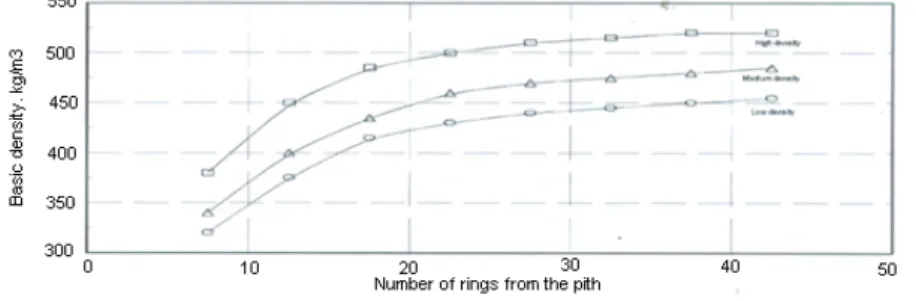
desired properties of juvenile wood include low basic density, a tendency to contain above average amounts of compression wood and a greater longitudinal shrinkage, giving a higher percentage of warped timber (Walker, 1993). The change in timber quality has to do with the gradient in density and other properties from pith to the bark that generally occurs in pines. The lower density wood in the 5 to 10 growth rings surrounding the pith is called juvenile or corewood (Walford and Gaunt, 2006). Figure 1 shows the increase in density up to 20 years, after which it flattens out. In the relatively few studies that compared MOR and MOE of juvenile and mature wood, consistently lower values were found for juvenile wood (Larson et al., 2001).
Figure 1: Density variation in radiata pine trees from the pith to the outer part of the tree
(Walford and Gaunt, 2006) 2.2.1.7. Natural vibration frequency
Jayne (1959) proposed the hypothesis that the energy storage and dissipation properties of wood are controlled by the same mechanisms that determine static behaviour of the wood. As a consequence useful relationships between the acoustic and vibrational properties, and static elasticity and strength are attainable. For instance, a strong relationship exists between the microfibril angle, an important determinant of wood stiffness, and the acoustic velocity in wood.
Wang et al. (2007) reported a degree of determination (R²) value of 0.86 between acoustic velocity and microfibril angle of radiata pine. Evans and Ilic (2001) reported similar values. There are a number of techniques that can be used to measure these energy storage and dissipation properties of timber but the method of choice, for the majority of researchers as well as industry role players, is that of measuring the natural vibration frequency using acoustic measurement devices.
~ 11 ~
Natural vibration frequency testing is fairly simple because of the fact that the force one needs to induce a vibration is not very big (Hanhijarvi et al., 2005). The sample is hit at one end, generating a compression wave that moves down the sample as the particles at the leading edge of the wave become excited, while the particles that are at the trailing edge come to rest. The wave hits the other end of the sample and the tensile wave is reflected and travels back down the sample (Pellerin and Ross, 2002).
The modulus of elasticity is calculated with the equation (Bacher, 2008):
MOEdyn = ρ
·
(2·
l·
f)2 where:MOEdyn is the modulus of elasticity calculated from frequency tests, in MPa;
ρ is the density of the test specimen at the time of testing, in kg/m3;
l is the length of the test specimen in meters; and f is the frequency of the wave, in Hertz.
Bucur (2005) explains that care must be taken to ensure that frequency losses through the suspension system used to support the test samples are not significant compared to losses through the specimen itself.
Fast Fourier Transformation (FFT) is a widely used signal processing and analysis method for frequency measuring. Frequency measuring as a method for strength determination, as well as the variables that affect it, is discussed in an honours report on the subject (Dowse, 2009). The study showed high correlation values of about 88% between MOEdyn and MOEedge, although this was on a very small sample
size (25 samples). Different frequency analysing programs were also tested in this study and finally the AG-Portable software (Falcon Engineering) was suggested for use in follow-up tests. Görlacher (1984) found the natural frequency method to correlate very well with the statically determined MOE. Blass and Gard (1994) obtained an R2 of 0.45 between natural frequency and strength of Douglas fir, while
the relationship between MOEedge and bending strength gave an R2 of 0.50. Table 2
shows R2 values of between 0.3 and 0.55 obtained between MOE
~ 12 ~
Larsson (1997) tested Norway spruce and obtained R2 values of 0.68 to 0.91 between MOEdyn and MOEedge.
2.2.1.8. Combinations of properties
Several commercial grading systems on the market today can measure a combination of dimensions, density, natural vibration frequency, moisture content, knots and other defects in timber. They make use of cameras, optical lasers, radiation and ultrasound or frequency measurement units (Bacher, 2008; Rais et al., 2010; Schajer, 2001). Destructive tests were in many cases performed to identify the correct machine settings for a specified species (Rais et al., 2010). Schajer (2001) compared the X-ray method, where density was used together with knots and knot positions, with destructively measured MOR and found an R2 of 0.7, whereas
traditional bending based lumber strength grading machines had R2 values of around
0.55 or less. The X-ray method was equally successful in predicting tension, compression strength and MOR.
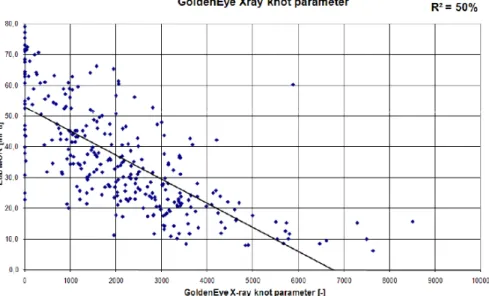
In practice, grading machines consider the knots in the full length of the board and not only the centre part, where laboratory testing machines are not always able to test the full length of the timber because of the test setup. Rais et al. (2010) found a five percent increase in the correlation between the indicator property and MOR by combining knots with MOE. The study also showed that the additional knot information is of more importance in higher strength classes. This can be expected as the stronger wood is normally found on the outside part of the tree where the branch diameters are bigger than closer to the pith. Bacher (2008) compared some combination machines and found the GoldenEye-706 to have the highest grading performance for an industry strength grader. It was found to measure timber density with an R2 of 0.89. A knot parameter comparison to timber strength with the use of a GoldenEye X-ray scanner also showed R2 values as high as 0.5, depicted in Figure 2, (Bacher, 2010).
Numerous tests done on spruce and pine by Hanhijärvi et al. (Hanhijärvi and Ranta-Maunus, 2008), showed that combining two good NDE measurements raises the R2
values in most cases by about 0.1. By combining density and knot measurements, R2 values of 0.5 to 0.7 were obtained.
~ 13 ~
The results from Table 2 show the ability of NDE methods to predict MOR and tension. Table 3 also shows R2 values for MOR predictions by different combinations of indicator properties. Both Tables 2 and 3 show a moderate correlation when combining knots and density as a predictor of timber strength. That value is increased when frequency is added as a predictor.
Figure 2: Knot parameters against MOR (Bacher, 2010)
Rais et al. (2010) compared two indicator properties. The one was based on dynamic MOE (MOEdyn) (eigenfrequency and density) alone and the other on
MOEdyn and knot information. The inclusion of knots led to an increase in the degree
of determination (R2) for MOR by about five percent over MOE
dyn alone.
It is very important that the machine settings are calibrated regularly. Tests were done by Dowse (2009), on a combination X-ray machine of which the settings were not correctly calibrated. The study showed very poor results with the dimension measurement accuracy in particular.
2.2.2. Visual and machine grading
Some of the measurable properties discussed in the previous section are used in both visual and machine grading systems to separate timber into strength classes. Visual grading focuses mostly on knot properties to grade timber and the visual grading rules were established in various countries based on many destructive tests.
~ 14 ~
These rules are valid for a defined species from a specified growth area. The grading rules are observed by the visual grader, but it is assumed that he will not change the rules according to the timber source (Rais et al., 2010). Rules regarding visual grading for structural timber are described in the SANS 1783-1 and 1783-2 (2004; 2005). According to SANS 1783-2 (2005), the main purpose of grading structural timber is “to establish and maintain an acceptable uniformity in the products of different mills, so that a given grade will represent the same quality and be usable for the same purpose, regardless of the nature of the raw materials from which it was derived or the mill by which it was produced”. In a study done on radiata pine timber from New Zealand, Walford and Gaunt (2006) found that visual grading will be able to take care of strength but not stiffness of timber. For this reason, they conclude, visual grading needs to be accompanied by machine stress grading where MOE is of importance.
Machine grading refers to any grading process where properties are measured by mechanical or electronic devices. In the past, machine grading was limited to the measurement of MOE by a flatwise bending apparatus. Currently there are many types of machine grading systems which measure single properties or combinations of properties (Glos, 2004) as discussed in the previous section.
2.2.3. Proof grading
The only way to know how strong a material sample is would be to test it to destruction. Madsen (1992), however, explains that if you are only concerned with how weak the sample is, proof loading can be applied. Since the characteristic stresses of a grade are 5th percentile values, it means that if you set the test load at the 5th percentile value only stronger pieces will survive the test. It has been argued that some timber might be weakened during the test without breaking, however, in actual fact it has been found that the 5th percentile strength of samples tested to destruction was higher than during the initial proof loading (Madsen, 1992). In a study done by Gaunt (1999), on radiata pine, it was found that different proof loading regimes before grading generally effect no change in bending stiffness or compression strengths, but effect a consistent improvement in the bending and tension strengths. Since this study does not involve proof grading it will not be discussed in depth here.
~ 15 ~
2.3. Structural grading and grade verification in South Africa
Vinopal et al. (1978) published findings on the basic strength properties of SA pine, which was then used by the South African Bureau of Standards to draw up visual stress grading rules. Knuffel (1984) published a report containing results from an in-grade test verifying that the design stresses of the visual and mechanical grading methods under industrial conditions did in fact match up to the predicted values derived from laboratory tests. This report suggested the revision of both grading systems in use at the time. Subsequently Knuffel (1984) performed in-grade testing of the then existing SABS visual grades at four Eastern Transvaal sawmills. A new set of grading rules was designed, and they were able to increase allowable bending, tension and compression grade stresses by 30 to 38% with exactly the same yields as before.
Burdzik (2004) tested timber in bending, tension and compression from selected mills in areas in South Africa known to produce low density timber. Between the four mills tested the results showed a 5th percentile MOR value of 10.64 MPa, mean
MOEedge of 6513 MPa, and 5th percentile tension of 5.44 MPa. None of these values
conform to the current requirements for the lowest structural grade as published in SANS 10163-1 (2003). According to Mr. Abe Stears of the independent timber auditing company SATAS, they recently destructively tested timber samples in tension from ten saw mills and all of the results conformed to the current SANS grade requirements (personal communication between Brand Wessels and Abe Stears, 27/01/2009).
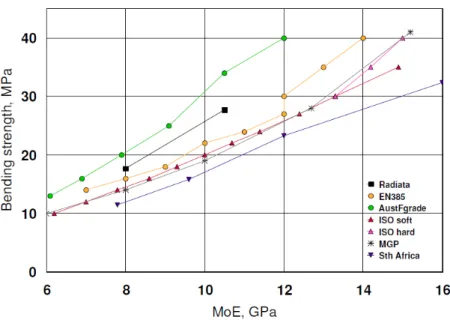
Walford (2002) compared the characteristic MOE and MOR values of structural grades in the USA, Europe, Australia, New Zealand and South Africa with each other. The characteristic MOE of SA’s SANS grades S5, S7 and S10 is comparable to the values of structural grades in other countries while the MOR values are in most cases lower, as shown in Figure 3. However, the author does not mention the relative volume distribution of timber between the structural grades in the different countries.
~ 16 ~
Figure 3: Comparison of New Zealand radiata pine with various strength class systems. SANS 10163-1 values depicted by bottom line
In South Africa the recent fires as well as economic pressure forced many forestry companies to harvest relatively young plantations. Harvesting age has been found to affect some structural properties of timber. Larson et al. (2001), refer to data from a study by Pearson and Ross (1984) comparing wood from a 15 year-old loblolly pine progeny test and a 25 year-old commercial plantation. They also refer to data from Bendtsen and Sendft (1986) based on a 30 year-old loblolly pine plantation. Results from the aforementioned comparisons are shown in Tables 6 and 7. A clear increase in both MOEedge and MOR can be seen from the 15 year-old to the 25 year-old trees
in Table 6. Table 7 shows a 5 fold increase in MOEedge from year one to year 15.
These results suggest that there can be a big difference between young and old trees.
Table 6: Average value of specific gravity, MOEedge, and MOR at average number of rings from the
pith for two different age trees (Pearson and Ross in Larson et al., 2001)
Number of rings from
pith
Specific gravity MOE (x106 lb/in2)a MOR (lb/in2)
25 yr-old
tree 15 yr-old tree 25 yr-old tree 15 yr-old tree 25 yr-old tree 15 yr-old tree
0+ 0.4 0.38 0.88 0.64 9,080 7,260
2+ 0.43 0.39 1.31 1.04 10,600 8,980
5+ 0.47 0.44 1.53 1.36 13,100 11,400
10+ 0.5 0.52 2.08 1.64 16,700 13,900
~ 17 ~
Table 7: Average properties by age for loblolly pine (Bendtsen and Sendft in Larson et al., 2001)
2.4. In-grade testing variables
The results from both bending and tension tests may differ simply because of a difference in the test setup, or the placement of the test piece within the setup. Some of these differences are discussed in the next section.
2.4.1. Defect placement
The timber test piece can be placed in the test setup in two ways. Biased testing has the biggest strength reducing defect in the test piece situated in the centre of the test setup, where the maximum stress will be applied. During random testing the defect placement is not considered. In biased testing the weakest edge of the timber can also be placed in tension.
Leicester et al. (1998) compared three different in-grade testing rules for bending and tension tests. It was found that a difference of up to 20% in both the MOEedge
and MOR values can be obtained between different load configurations and setups. In bending, the European methods, in which the biggest defect is situated in the centre of the test setup, showed lower MOEedge and MOR values than the
Australasian and ISO methods where random defect location is used. For the tension tests the longer length test samples showed lower tension values, most probably because of the fact that even though the worst defects were selected, there’s a higher chance of a big defect contained in the longer test specimen (Leicester et al., 1998).
~ 18 ~
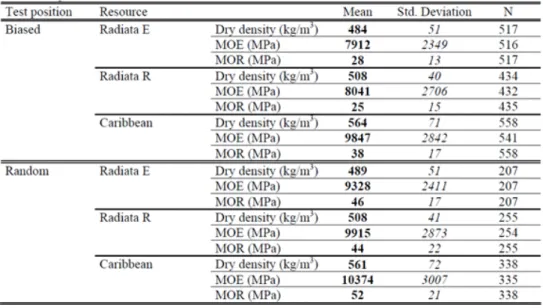
Bailleres et al. (2009) tested different species of pine using both random and biased testing methods. From the results of that study, shown in Table 8, it is noticed that there can be a big variation of strength properties with the two testing methods. The mean MOR and MOE values for the three pine species tested are roughly 44% and 13% lower respectively with biased testing than when random testing was used. The mean MOR values are clearly more affected by the test setup than mean MOE. Unfortunately the difference in 5th percentile values is not reported and cannot be
accurately estimated from the data provided.
Table 8: Results from both biased and random bending tests on three different species of pine (Bailleres et al., 2009)
2.4.2. Density measurement
Densities can vary within a timber specimen, and therefore local density measurements are usually taken at the point of failure. Studies, however, show that there is a very good correlation between local density measured at the point of failure and average density (Vinopal et al., 1978; Hanhijarvi et al., 2005; Hanhijärvi and Ranta-Maunus, 2008).
2.4.3. Rate of loading
Dr. R.A. Spencer, of the department of Civil Engineering at the University of British Columbia, conducted bending tests on 1052 pieces of structural size timber, applying
~ 19 ~
different rates of loading ranging from 0.06 seconds to 3 days (Madsen, 1992). The results are depicted in Figure 4.
From the results it can be seen that the rate of loading only starts to play a more significant role for timber with a MOR stronger than 35 MPa, which is higher than the 5th percentile values of most structural timber grades. Tests performed by Madsen
also suggest that tension is not much affected by the rate of loading over the range tested.
The effect of the rate of loading on the MOE of timber was, however, not discussed in this study. For normal in-grade testing the rate of loading, therefore, does not seem to be such a critical factor. Testing speed for this study will however still be kept reasonably conservative.
Figure 4: Failure stress versus logarithm of rate of loading (Madsen, 1992).
2.4.4. Size effect
The size effect refers to the effect that different size timber pieces has on the strength and stiffness of timber.
Tension members
Tension members are loaded by a constant force along the entire length of the member, which means that failure will occur at the weakest point between the grips. The longer the tension span the higher the probability of a weak spot where failure will occur. When a knot is situated in the centre of the cross section, the load stress
~ 20 ~
is distributed along the timber on the sides of the knot. This means that the smaller the cross section, the less material is available to support the knot-affected material. This leads to a weaker timber specimen.
Bending members
Bending moment varies across the length of the test piece, and the strength depends on whether a large defect is located where the maximum bending moment occurs.
Madsen (1992) describes a test comparing 5th percentile strength values to beam
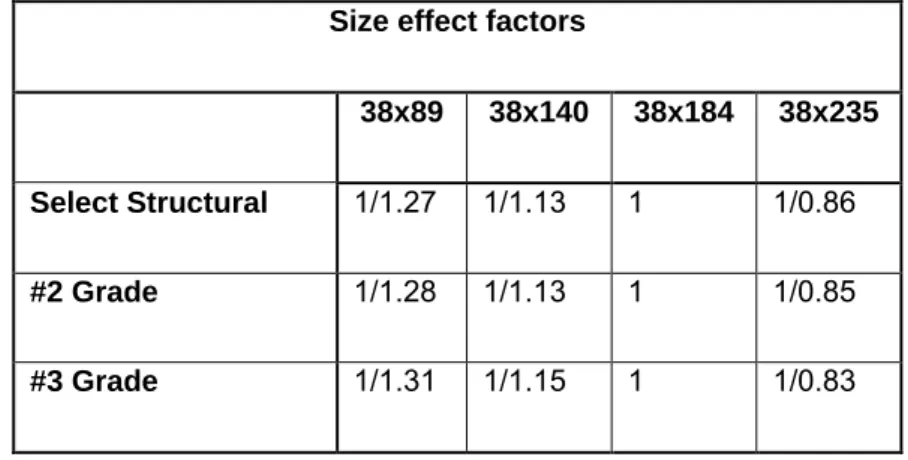
depth for different species. It was found that, for all species, the strength declines with an increase in beam depth. Size effect factors for 3 different grades were determined in order to bring the data to a common value. The size effect factors needed to bring the data to a common value are shown in Table 9.
Table 9: Size effect factors for 3 different grades (Madsen, 1992)
Size effect factors
38x89 38x140 38x184 38x235
Select Structural 1/1.27 1/1.13 1 1/0.86
#2 Grade 1/1.28 1/1.13 1 1/0.85
#3 Grade 1/1.31 1/1.15 1 1/0.83
The results from the size-effect tests showed that, under normal circumstances, the material with smaller depths are under-utilized, while material with larger depths are overstressed.
2.5 Requirements for a grading system
Since this study evaluates specific grading systems and techniques it might be of interest to discuss the requirements of a structural grading system – which often has practical limitations not covered in academic literature.
~ 21 ~
Madsen (1992) lists the following requirements for a grading system:
− the grading system must result in premium prices for a sawmill and a new grading system must generate more value than before for the average sawmill;
− the grade strength properties must be reliable and consistent;
− only products used for single members require high reliability and needs high quality control requirements. For less important members descriptive standards can be used;
− the number of grades should be kept small, because extra warehousing space for more grades is costly, and in order to justify big enough price differences, the strength differences between the grades also need to be relatively large;
− the overlapping of the strength of the grades should be kept to a minimum and the coefficient of variation should be as small as possible;
− restrictions with regard to appearance and straightness have to be imposed in order for the products to be suitable for the intended end-use. Yet it is important that these requirements are not overly restrictive but reflect the real needs of the market; and
− there should be a demand for the quantities developed in the different grades, as there is no use in having timber in a grade for which there is no demand.
~ 22 ~
3.
METHODS AND MATERIALS
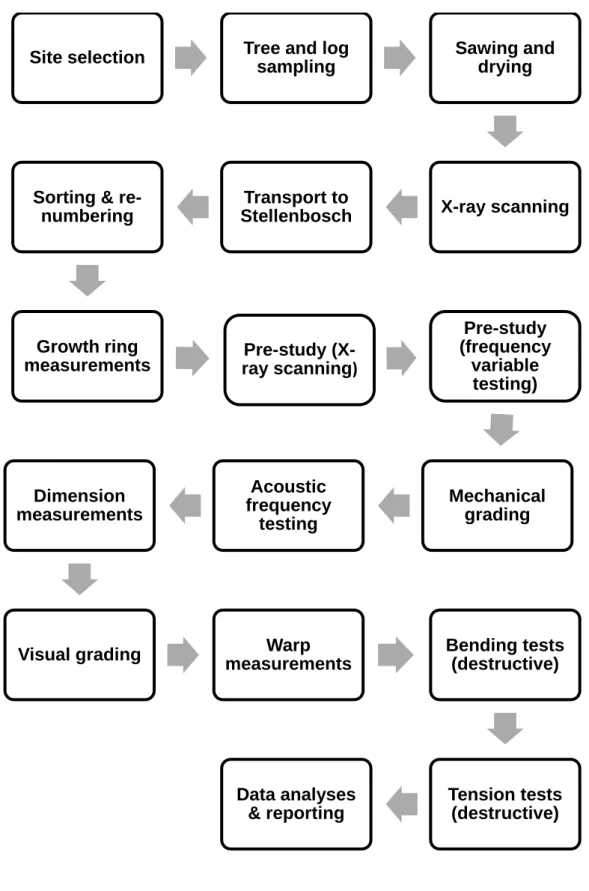
Figure 5 shows a schematic of the process steps that were followed in this study.
3.1. Tree and log sampling
The logs used for this study were obtained from 17 different compartments in the Mpumalanga escarpment (Fig. 6). The compartments varied between 810 and 1930 m above sea level, had a mean annual rainfall of between 840 and 1640 mm and a mean annual temperature of between 13.7 and 19.4 ºC. The variability in growth sites should ensure that most of the variability in strength and stiffness for this species from the Mpumalanga escarpment is present in the samples.
The compartments were selected to represent the different growth conditions within the sample area, with the tree ages varying between 16 and 20 years. The strength of timber increases with tree age, therefore the strength distributions of the timber will increase slightly with more mature trees, and the correlations between different indicator properties and strength may also change. The results from this young sample should however provide meaningful insight into the current strength properties and relationships between properties within a tree, especially when shorter rotation periods are considered in future.
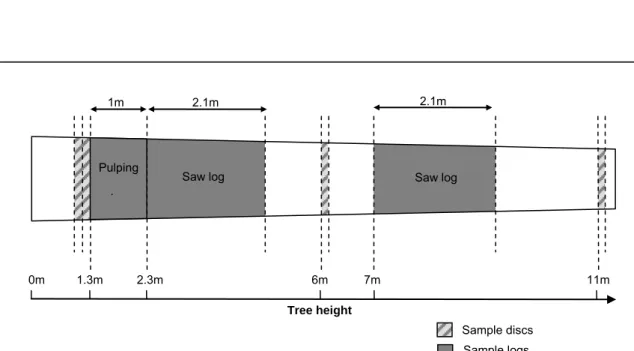
All the trees were pruned up to a height of five meters, while some compartments were pruned up to seven and nine meters in height respectively. The trees were felled and two saw-logs were removed from each tree trunk. Figure 7 schematically shows the sampling procedure where one log was removed from the pruned section and one from the unpruned section. The logs were kept under water sprinklers for roughly two months before further processing took place. The sample consisted of 170 trees which were processed firstly into 340 logs (two logs per tree) and finally into 1402 boards.
The material used in this study was obtained from another research project which examined the effect of site on some wood properties. It was thus not possible to specify any changes to the tree sampling strategy for this specific study. However, the resource used here is typical of the intake of some sawmills and will be
~ 23 ~
representative for some processors in South Africa. The effect of site is intentionally not examined in this study as it will be covered in a different research project.
Figure 5: Summary of process steps from log sampling to the final data analyses and reporting
Site selection Tree and log sampling Sawing and drying
X-ray scanning Transport to
Stellenbosch Sorting &
re-numbering
Growth ring
measurements ray scanningPre-study (X-)
Pre-study (frequency variable testing) Mechanical grading Acoustic frequency testing Dimension measurements
Visual grading measurementsWarp Bending tests (destructive)
Tension tests (destructive) Data analyses
~ 24 ~
Figure 6: Map of SA highlighting the material sampling area
Figure 7: Log initial breakdown showing samples removed from each tree
1m 2.1m 2.1m 1.3m 2.3m 6m 7m 11m 0m Tree height Pulping l
Saw log Saw log
Sample discs Sample logs
~ 25 ~
The logs were processed at York's Nicholson and Mullin sawmill in White River using frame-saws and a cant sawing pattern (Fig. 8). Each log was turned so that the plane of curvature was vertical (sometimes referred to as “horns-up” sawing) before it entered the primary breakdown saw. The log was centred and some boards removed from the sides by the primary breakdown saw so that a cant of thickness 120 mm (wet size) remained. The cant was centred and sawn with the secondary breakdown saw into 40 mm (wet size) boards. The secondary breakdown saw used a curve-sawing device so that the grain of the boards was parallel to the longitudinal direction. Each board was numbered with a unique number to identify the site and the tree from which the board originated. A device which measured the time-of-flight of an acoustic stress wave, the Fakopp Treesonic, was used on each wet board to obtain the dynamic MOE of each wet board.
After all the wet measurements were completed the boards were kiln dried, together with other timber from the Nicholson and Mullin sawmill, using a medium temperature schedule (temperatures below 100 oC).
~ 26 ~
3.2. X-ray scanning
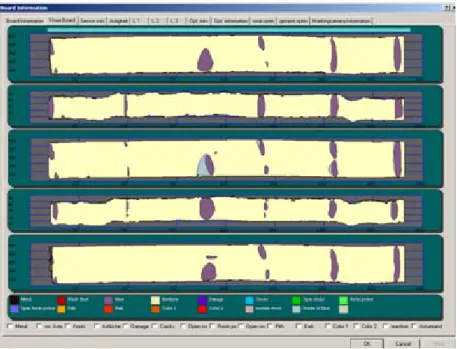
The boards were scanned at York Timbers in Sabie with a Goldeneye-702 commercial X-ray scanner from Microtec. Figure 9 shows an example of a scanned board. At the time of testing the scanner was being used for the optimization of cuts for the finger jointing of timber. The Goldeneye scanner has a number of sensors including optical cameras, a laser scanning device and an X-ray density scanning device to measure a number of knot parameters including knot location and quality, board dimensions, board warp, presence of pith, density, cracks, resin pockets and bark.
Through a pre-study by the author of this thesis (Dowse, 2009), it came to light that some results, especially dimensions and warp, as measured by the scanner were not very accurate. During discussions with the manufacturers in 2010 it was found that the machine had not been calibrated for some length of time prior to the time of scanning the sample, and, therefore, some sensors could have been inaccurate. Knot location and size measurements, however, were deemed to be reasonably accurate and results from the data obtained should be reliable.
All questionable data from the scanner (warp, density, and dimensions) were manually measured and only this manually measured data were used in the study.
~ 27 ~
3.3. Growth ring measurements
The boards were transported to the Department of Forest and Wood Science at Stellenbosch University for further analysis. On arrival the boards were sorted into the original positions within a log and re-numbered so that the location of a board within a log could be identified (Fig. 10). The ends of the boards were sanded to provide clearly visible annual rings. Roughly 55 boards were lost somewhere after the drying process and before transport of the boards to Stellenbosch.
The number of annual rings on each board was counted and numbered from the pith outwards. The cambial age (mean, maximum and minimum) of the wood within each board was therefore known. The cambial age is the age by ring count from the pith. A line drawn from the pith to the bark and perpendicular to the growth rings (Fig. 11) was used to do ring width measurements using a dial calliper. The line was drawn to include the maximum number of rings in each board. Measurements were rounded to the nearest 0.1 mm. For each board the minimum, maximum, and mean ring width was calculated.
Figure 10: Material storage and sorting before sanding of board ends
~ 28 ~
3.4. X-ray scanning and acoustic frequency pre-study
The pre-study is fully explained in the honours project report by Dowse (2009). The study was performed with 25 samples selected to represent the compartments from which the trees originated from as well as the range of MOEdyn values obtained with
the Treesonic device on wet boards at the sawmill.
3.4.1. X-ray scanner comparisons
Each of the 25 selected samples was evaluated by comparing the Microtec X-ray scanning data to actual measurements. From the saved data for the knots and defects, measured by all of the different sensors in the scanner, the virtual knot and defect locations were marked on the boards with different coloured permanent markers. The distance between the actual knot and defect locations and the virtual ones were measured and recorded. An average offset value of 12 mm per knot was found. The most probable reason for this offset was explained by a technician from Microtec as being the fact that the sensor calibration was slightly off because of the poor service records. It can be assumed that the offset value of 12 mm should not have too big an influence on the predictions of the strength characteristics.
The other measurable properties such as warp and density values were also compared. The scanner spring, bow and twist values were very inaccurate, and it was decided to only use manual measurements for this project. Dimension measurements were also found to be less accurate than can be expected from commercial grading machines. According to Microtec, all of the above mentioned inaccuracies of the scanner data were probably due to the fact that the scanner had not been serviced recently.
By using the knot information gathered from the X-ray scanner, the following knot parameters were determined:
# Knots is the number of knots on a single piece of timber; Knot average (knot avg.) is the mean size (area in mm2) of individual knots on
a particular piece of sawn timber. X-ray scanning evaluated each board in its thickness direction and the area measurement is similar to the knot-covered area one will see if you look from above at a knot in a transparent board. Take note that this is different to
~ 29 ~
the knot area ratio (KAR) often used in research studies;
Knot area / board is the total area of the piece of timber that contains knot material (mm2);
Knot maximum (knot max) is the size of the biggest knot on a piece of timber (mm2);
Knots 1-7F is a knot parameter calculated by the X-ray scanning device (programmed by Microtec) using data from a combination of 7 knots on each full piece of timber. The exact method of calculation was not available; KParf is a knot parameter from the most influential knot on
the full board (programmed by Microtec). The exact method of calculation was not available;
KParc is a knot parameter from the most influential knot on
the centre third of the board (programmed by Microtec). The exact method of calculation was not available; and
KSC is the product of knot size and the stress index of a specific knot. The stress index is a ratio of the bending stress at a specific knot to the maximum bending stress in a piece of timber (the stress index in the centre third of the board will be higher than at the ends). This parameter was determined during the data analysis process.
3.4.2. Acoustic frequency variables
The test setup was located in a laboratory at Stellenbosch University. Different variables were tested including hammer and support material, testing surface and the frequency analyzing software.
~ 30 ~
The results showed that the ends where the hammer impact occurs can be a rough surface, as long as there are no tags or other materials attached to the impact area.
Hammer material
The best hammer material to be used in future studies was determined to be either wood or steel, with repeatability results of between 98 and 100%. The rubber hammer showed excellent repeatability, however, correlations with MOEedge results
showed a group of outlying values when using the rubber hammer. For the best consistency with regards to MOE prediction the use of either a steel or wooden hammer was suggested for this study.
Analysis program
The two analysis programs compared were those of the FFT analyzer, provided by FAKOPP Enterprise, and the A-Grader portable provided by Falcon Engineering. The comparisons showed that either one can be used with good accuracy and repeatability. The differences are that the Fakopp software is faster, as there is no need for the input of dimensions, as is the case with the A-Grader portable software. The A-grader software on the other hand automatically selects the correct frequency waves, which describes the different modes of the waves going through the timber. With the Fakopp software attention needs to be given to ensure the correct frequency waves are selected.
The preferred program to use is up to the user and the circumstances under which the tests will be performed. The A-Grader was selected for use in this project as it automatically selects the correct frequencies and therefore accurate results are ensured.
Board supports
Results suggested that the location of the supporting material underneath the boards needs to be constant. Correlating, for example, results obtained with the support material on the extreme ends of the boards to results with the supports near the decided optimum placement, gave an R2 value of 54.8%, which is quite poor. The
provider of the frequency software suggested support distances of 0.22 times the length of the board from the ends.
~ 31 ~
3.5. Mechanical grading
The first test that was performed after the pre-study was completed was flatwise mechanical grading of all the samples (Fig. 12). A mechanical grading machine, known as a TRU-grader, from Cape Sawmills in Stellenbosch was brought to the department to perform the tests. The grader performs a flatwise static bending test with the load applied on the centre of the span. It has a span of 914 mm between the two bottom supports. The board is placed on the supports with the weakest part, estimated by visual observation, in the centre. A load of 1200 N was applied and the deflection of the board at the centre point was measured.
During the mechanical grading there were about 14 boards that failed under the test load. These boards were thrown out as they could not be used for further testing.
Figure 12: Flatwise mechanical grading of test material
3.6. Acoustic frequency testing
The test setup and software used was based on the findings in the pre-study (Dowse, 2009). The frequency test was set up on a flat, clean surface at a comfortable working height. The boards were placed on two polystyrene supports, 450 mm from each end, to provide clearance between the boards and the table (Fig. 13), as well as to prevent frequency channelling through the table. A quick hit was then made with the use of a wooden hammer which sends a vibration through the board. The sound caused by the resonance of the wave was recorded with a microphone on th