DISCUSSION
PAPER
SERIES
Discussion paper No.70
Team Incentives and Reference-Dependent Preferences
Kohei Daido
School of Economics, Kwansei Gakuin University
Takeshi Murooka
Department of Economics, University of California, Berkeley
May, 2011
SCHOOL OF ECONOMICS
KWANSEI
GAKUIN
UNIVERSITY
1-155 Uegahara Ichiban-cho
Nishinomiya 662-8501, Japan
Team Incentives and Reference-Dependent Preferences
∗
Kohei Daido
†and
Takeshi Murooka
‡First Version: November 10, 2010
This Version: May 1, 2011
Abstract
This paper examines a multi-agent moral hazard model in which agents have expectation-based reference-dependent preferences `a la K˝oszegi and Rabin (2006, 2007). The agents’ utilities depend not only on their realized outcomes but also on the comparisons of their realized outcomes with their reference outcomes. Due to loss aversion, the agents have a first-order aversion to wage uncertainty. Thus, reducing their expected losses by partially compensating for their failure may be beneficial for the principal. When the agent is loss averse and the project is hard to achieve, the optimal contract is based on team incentives which exhibit either joint performance evaluation or relative performance evaluation. Our results provide a new insight: team incentives serve as a loss-sharing device among agents. This model can explain the empirical puzzle of why firms often pay a bonus to low-performance employees as well as high-performance employees.
JEL Classification Numbers: D86, M12, M52
Keywords: Moral Hazard, Team Incentives, Reference-Dependent Preferences, Loss Aversion, Joint Per-formance Evaluation, Relative PerPer-formance Evaluation
∗We are especially grateful to Fabian Herweg and Botond K˝oszegi for their invaluable discussions and suggestions. We also
thank Stefano DellaVigna, Ben Hermalin, Hideshi Itoh, Michihiro Kandori, Maciej Kotowski, Sheng Li, Fumio Ohtake, Aniko ¨
Ory, Matthew Rabin, Dan Sasaki, Steve Tadelis, as well as seminar participants at University of Tokyo, UC Berkeley, Contract Theory Workshop (CTW), Contract Theory Workshop East (CTWE), and participants at the 4th annual meeting of Association of Behavioral Economics and Finance (ABEF) for their helpful comments. Daido thanks UC Berkeley for hospitality while some of this work was completed. Murooka gratefully acknowledges financial support from the Murata Overseas Scholarship Foundation.
†School of Economics, Kwansei Gakuin University (E-mail: [email protected]).
1
Introduction
Teams have been widespread in many firms. As teams have become popular, the role of team incentives has been increasingly crucial in workplaces.1 Why team incentives have so prevailed is one of the main themes
in organizational economics, and a central issue is whether an incentive scheme should be based on indepen-dent performance evaluation (IPE), relative performance evaluation (RPE) or joint performance evaluation (JPE).2While most existing literature has studied team incentives from the view of competition, cooperation or mutual monitoring, we focus on a prominent behavioral aspect,loss aversion: people evaluate losses more
than same-sized gains. We show that when the agents feel a psychological gain-loss from comparing the realized outcome with the reference outcomes, team incentives could serve as a device which alleviates their feeling of losses.3 In contrast to the previous literature, team incentives in this paper become relevant only
when the agent fail to succeed his own project. The result can explain some empirical evidence that firms pay a bonus not only to high-performance agents but also to low-performance ones. For example, Google gave $1000 cash holiday bonus to all employees in 2010.4
We build a multi-agent moral hazard model with limited liability in which agents have expectation-based reference-dependent preferences `a la K˝oszegi and Rabin (2006, 2007). We derive which of the above three types of performance evaluation is optimal as a function of the degree of loss aversion and the probability of success in the project. A principal wants to minimize the expected payments to the agents given that each of them works hard in his own project.5 The agent’s utility depends not only on his realized outcome but also
on the comparisons between his realized outcome and his reference outcomes. That is, each agent’s utility consists of an intrinsic “consumption utility” which is same as the standard one, and a “gain-loss utility” which is defined over the differences between his realized consumption and his reference consumption. The agent is loss-averse in both the wage dimension and the effort dimension, and his reference point is determined
1Lazear and Shaw (2007) introduce the evidence of popularity of teams and team incentives. For example, from 1987 to
1996, the share of large firms that have 20% or more employees in teams rose from 37% to 61% and that have more than 20% of employees working with some kind of group-based incentives rose from 26% to 53%. Che and Yoo (2001) also provide much evidence of successful adaptation of teams in workplaces.
2IPE, RPE or JPE means that a worker’s wage is irrelevant to, decreases in, or increases in the other workers’ performance,
respectively.
3We use the term “team incentives” to refer to incentives by a wage scheme based on either JPE or RPE.
4See Blodget (2010) which is an article inBusiness Insider. Also, Lufthansa paid 700-euro ($930) bonus to all employees in
January 2011 (Lavell 2010). As a unique (non-monetary bonus) example, IKEA gave a bicycle as a bonus to all U.S. employees in 2010 (Angelico 2010).
by his recent expectations regarding his wage and effort.6 Due to loss aversion, the agent dislikes wage uncertainty in a way that is different from usual concave utilities. Consider an example that an agent had expected to receive either $0 or $30 with equal probabilities when he would work hard with cost $10. Suppose that he actually works hard. Regarding the wage dimension, his expected gain-loss utility consists of a weighted average of the following four cases with equal weights on each case. In two cases, there is no gain-loss: he expects $0 and actually gets $0, and he expects $30 and actually gets $30. However, if he expects $30 but actually gets $0, he feels a loss of $30. Similarly, if he expects $0 but actually gets $30, he feels a gain of $30. Since the agent is loss-averse, his feeling of $30 loss is greater than that of $30 gain. Thus, his expected gain-loss utility for wage is negative and represents his averseness of risk in this example. Regarding the effort dimension, he feels no gain or loss because he expected to work hard and actually works hard.
To determine the agent’s reference points endogenously, we assume that each agent’s reference points are updated to his chosen action before the outcome is realized. Since he knows that his belief will be adapted to his chosen action, he takes it into account when he chooses the action. This notion is called the choice-acclimating personal equilibrium (CPE) and advocated by K˝oszegi and Rabin (2007).7 CPE is
plausible when the action is determined long before the outcome realizes, and his belief is acclimated before he knows the actual outcome.
In adopting the concept of CPE, we consider a symmetric two-agent case with limited liability and derive the optimal wage scheme. The crux is that the principal faces a trade-off between the standard incentives
effect in the intrinsic utility and theloss-sharing effect in the gain-loss utility. The loss-sharing effect means
that the agent can share his expected loss with his colleagues by being compensated for his failure. Regarding the intrinsic utility, the agent is less willing to work under team incentives with compensation than under IPE because his incentive to work hard decreases if the principal compensates for his failure.8 In contrast,
with respect to the gain-loss utility, he is more willing to work under team incentives than under IPE. This is because team incentives with partial compensation for the agent’s failure reduce his wage uncertainty when
6As we will explain below, in our multi-agent setting, the agent’s wage depends on his colleagues’ actions and outcomes as
well as on his own actions and outcomes. Shalev (2000) investigates game theoretic models in which the players are loss averse.
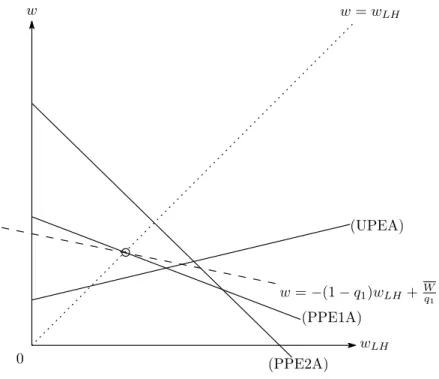
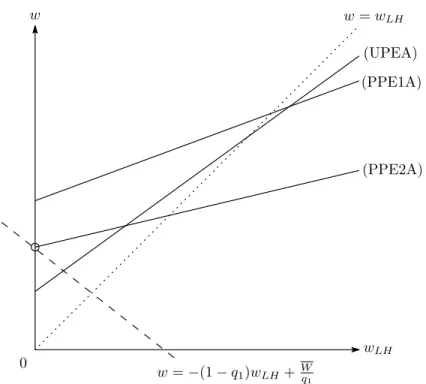
7K˝oszegi and Rabin (2006, 2007) develop another equilibrium concept, thepreferred personal equilibrium(PPE). In Appendix
B, we explain the notion of PPE and fully characterize the optimal contracts in our two-agent model based on this concept. When the degree of loss aversion is large, the properties of equilibrium wage schemes under PPE are similar to under CPE. We also discuss these points in Appendix B.
he works, and increase it when he shirks. In other words, the loss-averse agent can share his fear of losses from failure with his colleagues by partially compensating for his failure via team incentives. As a result, the trade-off between the standard incentive effect and the loss-sharing effect determines the optimal wage schemes.
We analyze how and when team incentives are used in the optimal contract. When the degree of loss aversion is moderate and the possibility of success in the task is small even if the agent works hard, JPE becomes optimal. As the possibility of success becomes small, the agent is less likely to work hard under IPE because his wage uncertainty under working compared to under shirking becomes large. Then the principal’s incentive to compensate for his failure increases, and JPE as a partial compensation for his failure becomes the optimal wage scheme. When the degree of loss aversion is large, there are three cases in which team incentives are optimal. If the agent is less likely to succeed when he shirks, not only JPE but also RPE may be optimal. In particular, RPE is optimal when the agent is more likely to succeed if he works. The standard incentives effect of discouraging to work under RPE is smaller than that under JPE, and this effect determines the optimal wage scheme. In contrast, JPE is optimal when the agent is less likely to succeed even if he works. However, when the agent is very unlikely to succeed even if he works, the principal has strong incentives to compensate for his failure. Since the probability of compensating for the agents’ failure is larger under RPE than under JPE in this situation, RPE instead of JPE may become optimal.
In addition, we extend our two-agent model to many agents case. As in the two-agent case, the trade-off between the standard incentive effect and the loss-sharing effect drives the results. Hence, compensating for the agent’s failure is beneficial for the principal when the latter effect overweighs the former one. However, as the probability of the compensation goes to one, the standard incentive effect dominates the loss-sharing effect. Thus, the principal compensates for the agent’s failure only partially. The optimal contract specifies that the principal pays the bonus either when the agent succeeds in his task or when the total profit (derived from other agents’ performance) is higher than a certain level. It is consistent with the above empirical evidence that firms often pay a bonus to all employees when they earn a high profit. Also, this result is sharply different from that of Herweg, M¨uller and Weinschenk (2010); in their model the principal wants to compensate for the agent’s failure as much as possible.9
9In their model, the expected wage payment to the agent is decreasing in the probability that the principal compensates for
the agent’s failure if the degree of loss-aversion is more than two, because the amount of base wage goes to negative infinity as the probability goes to one. We discuss it in detail in section 4.
Notice that, if the principal can commit to stochastically compensate for the agent’s failure regardless of other agents’ outcomes, our results do not need to be team incentives. However, JPE as team incentives is more plausible than the individual stochastic compensation in practical situations. For example, if the principal has the possibility of facing a budget constraint, then she cannot pay a bonus when all of the agents fail under the individual stochastic compensation but she can pay it under JPE. Also, if the principal is risk or loss averse, then she prefers JPE to the individual stochastic compensation because the distribution of profits is less dispersed under JPE than under the individual stochastic compensation. In addition, it may be hard to find verifiable stochastic signal other than the company’s profit or other agents’ outcomes, and this difficulty may prevent using the individual stochastic compensation.10 These advantages of team incentives over the individual stochastic compensation separate our results from the stochastic ignorance examined by Herweg, M¨uller and Weinschenk (2010).
Last but not least, our model does not shed light on the aspects which constitute team production: our model has no common noise, no externalities on production and no activities among agents such as help, sabotage and mutual monitoring. In this sense, our model differs from the existing literature on team incentives. However, we show even if we do not explicitly incorporate such aspects of team production, making teams and introducing team incentives may be beneficial for managers. It helps to understand why teams and team incentives are ubiquitous even when some workplaces do not seem to have above aspects of team production. Moreover, our results of team incentives as compensating for the agent’s failure are easy to test empirically, because we only need to check when low-performance agents get a bonus. This feature of our results may contribute to investigate one empirical puzzle pointed by Chiappori and Salani´e (2003): firms seem to use JPE for executive compensations very often.
The remainder of this paper is organized as follows. We set up the model and explain the CPE condition in the next section. In Section 3, we analyze the optimal wage schemes in the two-agent case. In Section 4, we extend our model to the case with many agents. We summarize the related literature in Section 5. Section 6 concludes. Proofs and the analysis under PPE are provided in Appendix.
10In this argument, we assume that the agents’ total outcome is perfectly correlated with the firm’s profit. If the profit is a
2
The Model
Consider the following moral hazard model in which a risk-neutral principal hires two identical agents. The agents are subject to a limited liability and his utility consists of an intrinsic (standard material) utility and a gain-loss utility. Agent i (i = 1,2) makes a binary effort decision ai ∈ {0,1} at the cost of d·ai where
d >0. Actionsai = 0 and ai= 1 mean that agenti shirks and works, respectively. The outcome of agent
i is either high or low, denoted by Qi ∈ {H, L}. The probability for agent i of realizing Qi =H is q1 if ai = 1 and q0 if ai = 0, where 0 ≤q0 < q1 <1. We define ∆q ≡q1−q0. The wage vector for agenti is
wi ≡(wiHH, wiHL, wiLH, wLLi ) wherewiQiQj is the wage for agent i when the outcome of agenti isQi and
that of agentj is Qj (i, j = 1,2 and i̸=j).11 Suppose that agents iand j choose actions ai ∈ {0,1} and
aj∈ {0,1}, respectively. Agenti’s expected wage underwi is represented by
πi(ai, aj,wi) =qaiqajw i HH+qai(1−qaj)w i HL+ (1−qai)qajw i LH+ (1−qai)(1−qaj)w i LL,
The characteristic of a wage scheme is determined by how each agent’s wage is related to his colleague’s performance. For agenti, a wage schemewi exhibits joint performance evaluation (JPE) if (wHHi , wiLH)>
(wiHL, wLLi ): given an agent’s performance, his wage increases in his colleague’s performance.12 A wage scheme exhibits relative performance evaluation (RPE) if (wHHi , wiLH) < (wHLi , wiLL): given an agent’s performance, his wage decreases in his colleague’s performance. Finally, if (wi
HH, w i LH) = (w i HL, w i LL), a
wage scheme exhibits independent performance evaluation (IPE): an agent’s wage does not depend on his colleague’s performance.
A key assumption of our model is that each agent’s overall utility consists of an intrinsic utility and a psychological gain-loss utility. We assume that agents have expectation-based reference-dependent prefer-ences `a la K˝oszegi and Rabin (2006, 2007). In our model, agenti’s both consumption bundle and reference consumption bundle consist of his effort and his wage. For each consumption dimension, the agent feels psychological gain-loss by comparing his realized outcome with his reference outcomes. We assume that all agents have the same gain-loss function for each consumption dimension. For deterministic reference point cases, suppose that agent i’s reference point for his effort and his wage are ˆai
i and ˆwi, respectively. If he
11Our multi-agent model can be interpreted as the following multi-task model: a principal has two identical tasks and chooses
either to hire one agent who is assigned both tasks or hire two agents each of whom is assigned one task. We refer to this point later.
actually exerts his effortai and gets wagew, then his utility is
w−aid+µ(w−wˆi) +µ(−aid+ ˆaiid),
whereµ(·) is a universal gain-loss function that satisfies the assumptions introduced by Bowman et al. (1999) which corresponds to Kahneman and Tversky’s (1979) value function. In what follows, we assumeµ(·) to be piecewise linear to focus on the effect of loss aversion. Then, we can simply define the gain-loss function when the consumption isxand reference point isras
µ(x−r) =
(
η(x−r) ifx−r≥0,
ηλ(x−r) ifx−r <0.
whereη≥0 represents the weight on the gain-loss payoff, andλ≥1 is the degree of the loss aversion. As in K˝oszegi and Rabin (2006, 2007), we assume that the reference point is rational beliefs about outcomes and that the reference point itself is stochastic if the outcome is stochastic. The agent feels gain-loss by comparing each possible outcome with every reference point. For example, suppose that agentiwith
η >0 andλ > 1 had been expecting to receive $100, $150 or $200 with equal probabilities. If he actually receives $150, then he feels a psychological gain of $50 relative to $100, no gain-loss relative to $150 and a psychological loss of $50 relative to $200. Since the loss of $50 looms larger than the gain of $50 for him, his gain-loss utility is negative in this case.13 Since we consider a multiple-agent model, an agent’s reference
outcomes and realized outcomes may depend on his colleague’s action. We represent both consumption and reference bundles of agent i as including his colleague’s action as well as his action and wage. Formally, agenti’s expected intrinsic utility is
πi(ai, aj,wi)−aid.
Let (ˆai
i,ˆaij) be agenti’s reference point for his own effort decision (ˆaii) and his colleague’s one (ˆaij). That is,
(ˆai
i,aˆij) represents agenti’s belief that he will choose ai and agent j will chooseaj. Similarly, denote ˆwi as
agenti’s reference wage based on (ˆai
i,ˆaij). Then, agenti’s expected gain-loss utility is
πi(ai, aj,wi|ˆaii,ˆa i j,wˆ i) +µ(−a id+ ˆaiid) whereπi(a
i, aj,wi|ˆaii,aˆij,wˆi) represents the gain-loss utility in the wage dimension andµ(−aid+ ˆaiid)
repre-sents that in the effort-cost dimension.14 Let ˆqaii (resp. ˆqaij) denote agenti’s reference point of the probability
13By using (1), below we explain the pointwise comparison in detail. See K˝oszegi and Rabin (2006) for a general definition. 14We write down the detailed representation ofπi(a
for realizingQi=H(resp. Qj=H) when his reference effort decision is ˆaii(resp. ˆa i
j). Suppose, for instance,
that agentiexpects that both agents succeed with probability ˆqi aiqˆ
i
aj and his reference wage is ˆw
i
HH. When
agent i succeeds with probability qai and his colleague succeeds (resp. fails) with probability qaj (resp. 1−qaj), he compares his reference wage ˆw
i
HH to his actual wagewiHH (resp. wiHL) with probabilityqaiqaj (resp. qai(1−qaj)). Conversely, when agentifails with probability 1−qai and his colleague succeeds (resp. fails) with probability qaj (resp. 1−qaj), he compares his reference wage ˆw
i
HH to his actual wage wLHi
(resp. wi
LL) with probability (1−qai)qaj (resp. (1−qai)(1−qaj)). Then, the gain-loss utility in the money dimension of this situation is represented by
ˆ qaiiqˆ i aj h qaiqajµ(w i HH −wˆ i HH) +qai(1−qaj)µ(w i HL−wˆ i HH) + (1−qai)qajµ(w i LH−wˆ i HH) + (1−qai)(1−qaj)µ(w i LL−wˆ i HH) i . (1)
We derive the optimal wage schemes according to the equilibrium concept defined by K˝oszegi and Rabin (2007); the choice-acclimating personal equilibrium (CPE).15 Under CPE, the agent’s reference point is acclimated to his taken action. This is plausible when the action is determined long before the outcome and the payment occur; hence, he modifies his belief to his taken action before the outcome realizes. Because the agent knows that his belief will change based on his own action before the outcome and the payment occur, he takes the change into account when he decides what action to take. Denote agent i’s expected overall utility beUi(a
i, aj,wi|aˆii,ˆaij,wˆi)≡πi(ai, aj,wi)−aid+πi(ai, aj,wi|ˆaii,ˆaij,wˆi) +µ(−aid+ ˆaiid). Since each
agent’s action determines his reference point in CPE, the condition to choose working in CPE is represented by
Ui(1,1,wi|1,1,wˆi)≥Ui(0,1,wi|0,1,wˆi). (CPE)
for alli.16 The condition (CPE) means that, given that agentiexpects agentj to choose effort 1, agenti’s
utility when his reference of his own action is 1 and he chooses 1 is higher than that when his reference is 0 and he chooses 0. We confine our analysis to pure strategies and focus on symmetric equilibria.17
15In Appendix B, we analyze thepreferred personal equilibrium(PPE): another equilibrium concept introduced by K˝oszegi
and Rabin (2006, 2007).
16In Appendix A, we rewrite this condition in detail.
3
The Optimal Wage Scheme
3.1
The Optimal Contract without Loss Aversion
Before analyzing the optimal wage scheme in our model, we study a benchmark case in which each agent is not loss-averse.
Note that, if the high effort is not beneficial for the principal and she does not prefer to encourage the agents to work, then settingwQiQj = 0 for allQi, Qj ∈ {H, L}is obviously the optimal wage scheme. Thus, throughout this paper, we assume the tasks are so valuable that the principal wants to make the agents work.
The principal’s problem can be rewritten as:
min wHH,wHL,wLH,wLL q12wHH +q1(1−q1)wHL+q1(1−q1)wLH+ (1−q1)2wLL subject to q1wHH+ (1−q1)wHL−q1wLH−(1−q1)wLL ≥ d ∆q , (IC) wQiQj ≥0 for allQi, Qj ∈ {H, L}. (LL)
where (IC) is the incentive compatibility constraint to induce the agents to exert high efforts, and (LL) is the limited liability constraints. Note that the left hand side of (IC) is decreasing in wLH andwLL. Hence
the optimal contract scheme satisfieswLH =wLL = 0. Also, the ratio between the coefficient ofwHH and
the coefficient ofwHLin the objective function is same as that in (IC). Thus, any pairs of wHH (≥0) and
wHL(≥0) that satisfy (IC) with equality andwLH=wLL= 0 are the optimal wage schemes.
To confirm the robustness of the result, we investigate another case in which the agents are risk averse. Suppose that the agents have a utility functionm(·) such thatm(0) = 0,m(·) is twice differentiable,m′(·)>0 andm′′(·)<0. Then, (IC) is replaced by
q1m(wHH) + (1−q1)m(wHL)−q1m(wLH)−(1−q1)m(wLL)≥
d
∆q
. (IC’)
Note that the left hand side of (IC’) is still decreasing inwLH and wLL. Becausem(·) is strictly concave,
wHH = wHL holds at the optimum. As a result, wHH = wHL =m−1(∆dq) and wLH =wLL = 0 is the
3.2
The Optimal Contract with Loss Aversion
Now, we return to the case in which he agents are loss-averse and examine the optimal wage schemes. As mentioned by K˝oszegi and Rabin (2007) and Herweg, M¨uller and Weinschenk (2010), it is suitable to apply CPE when the outcomes are resolved long after the agents’ actions are taken. In the following analysis, we assume away the “negative bonus” wage schemes to make the property of team incentives clear and simplify the analysis.18
Assumption 1. wHH ≥wLH andwHL≥wLL.
By this assumption, the possible smallest wage is eitherwLH orwLL. Notice that if the smallest wage is
strictly positive, then the principal can reduce the payment without changing CPE constraint by decreasing the same amount from each wage.19 Also, since agents dislike wage uncertainty, if w
HH ̸=wHL then the
principal can encourage the agent to work by reducing the wage variation when he succeeds. Thus, we have the following characteristics of the optimal wage scheme.20
Lemma 1. The optimal wage schemes under CPE satisfy (i) min{wLH, wLL}= 0 and (ii)wHH =wHL.
Lemma 1 implies that team incentives in our model would have different forms from those in the existing literature, like Che and Yoo (2001) and Kvaløy and Olsen (2006), which show the optimality of team incentives. These studies find that, when the agent fails, his wage is zero regardless of his colleague’s outcome while it may depend on their outcomes when he succeeds.21 In contrast, our results mean that
team incentives become relevant only when the agent fails the project. Whether the principal compensates the agent’s failure or not depends on another agent’s outcome. As a result, the wage schemes may have forms of team incentives. In what follows, we denotewHH =wHL≡w.
Notice that Lemma 1 represents an empirically testable prediction in our model: if the agents’ loss aversion matters, the optimal team incentives exhibit the forms of compensation but do not exhibit the concentration of the payments likewHH >0 and wHL =wLH =wLL = 0, which is often predicted in the
18We also characterize the optimal wage scheme under CPE in which we allow such negative bonuses. The optimal contract
in this case is the same as long asη(λ−1)≤1. If it does not hold, then the negative bonuses are used if the probability of success when the agent shirks is small, and the probability of success when the agent works is either very large or very small. The detailed analysis is available upon request.
19See (CPE’) in Appendix A.
20The proof is provided in Appendix A.1.
21For example, Che and Yoo (2001) and Kvaløy and Olsen (2006) predict no compensation for the agents’ failure (w
LH=
previous literature.
By Lemma 1, we have two possible types of wage schemes: (i)w≥wLH ≥wLL = 0 and (ii)w≥wLL≥
wLH= 0. We find the optimal wage scheme in each case. Then, we compare these schemes and characterize
the optimal wage scheme as CPE.
First, we examine case (i)w≥wLH≥wLL= 0. The principal’s problem becomes as follows:
min w,wLH q1w+q1(1−q1)wLH subject to {1−(1−q1−q0)η(λ−1)}w+ [−1 +{1−q1−q0+ (1−q1)(2−q1−q0)}η(λ−1)]q1wLH ≥ d ∆q , (CPEJ) w≥0, and wLH ∈[0, w]. (LLJ)
where (CPEJ) is the condition of CPE and (LLJ) is the limited liability condition in this case, respectively. Now we focus on the left hand side of (CPEJ):
{1−(1−q1−q0)η(λ−1)}w +{−|{z}q1 (SI) +|q1(1−q1−{zq0)η(λ−1)} (LS1) +|q1(1−q1)(2−{zq1−q0)η(λ−1)} (LS2) }wLH.
There are three effects for increasingwLH. We call the first effect (SI) as thestandard incentive effect, and a
sum of the latter two effects (LS1) and (LS2) as theloss-sharing effect. (SI) is came from the intrinsic utility
and implies that increasingwLHreduces the incentive to work hard. (LS1) is came from the gain-loss utility
comparing wLH with w. It means increasing wLH encourages the agent to work hard because it reduces
wage uncertainty when working, providedq1+q0<1. (LS2) is came from the gain-loss utility comparing wLH withwLL. It implies increasingwLH encourages the agent to work hard it adds wage uncertainty when
shirking. Notice that (SI) does not depend onη,λ, while the effects on (LS1) and (LS2) increases asη orλ
increases. The cut-off point at which loss-sharing effect becomes crucial than the standard incentive effect is given by ΩJ ≡ {1−q1−q0+q1(1−q1)(2−q1−q0)}η(λ−1). That is, the principal preferswLH >0 rather
thanwLH= 0 if and only if ΩJ≥1.
The analysis and the trade-off between the standard incentive effect and loss-sharing effect are similar in the case of (ii)w≥wLL ≥wLH = 0. The principal prefers wLL>0 rather thanwLL = 0 if and only if
Finally, we compare above two cases to derive the optimal wage schemes. If both ΩJ <1 and ΩR <1
hold, then IPE is optimal. Otherwise, team incentives are optimal and whether JPE or RPE to be optimal is determined by the relationship among ΩJ, ΩR, and the cut-off point ΩJ R≡ {(1−q1−q0)−q1(1−q1)2(2− q1−q0)}η(λ−1) derived by comparing between the expected payment under JPE and that under RPE.
On the one hand, when ΩJ ≥ΩR, JPE is optimal if ΩJ R ≤ 1, otherwise RPE is optimal. On the other
hand, when ΩJ <ΩR, JPE is optimal if ΩJ R ≥ 1, otherwise RPE is optimal. As a result, we have a full
characterization of optimal wage schemes as in the following proposition.22
Proposition 1. The optimal wage scheme under CPE is:
1. wI = (wI, wI,0,0) where wI = d
∆q[1−(1−q1−q0)η(λ−1)] if both ΩJ <1 and ΩR<1 hold.
2. wJ = (wJ, wJ, wJ,0) where wJ ≡ d
∆q(1−q1)[1−{1−q1−q0−q1(2−q1−q0)}η(λ−1)] if one of the following
con-ditions holds; (i) q1≤ 12 and ΩR<1≤ΩJ, (ii)q1≤ 21 and ΩJ R≤1≤ΩR≤ΩJ, and (iii) q1> 12 and
1≤ΩJ R<ΩJ<ΩR.
3. wR = (wR, wR,0, wR) where wR = d
∆qq1[1−{1−q1−q0−(1−q1)(2−q1−q0)}η(λ−1)] if one of the following
conditions holds; (i) q1 ≤ 12 and 1<ΩJ R<ΩR≤ΩJ, (ii) q1 > 12 and ΩJ <1≤ΩR, and (iii)q1> 12
and ΩJ R<1≤ΩJ<ΩR.
As we described above, the optimal wage schemes depend on the trade-off between the standard incentive effect and the loss-sharing effect. Regarding the intrinsic utility, the agent is less willing to work under team incentives than under IPE because he gets a wage with positive probability even when he fails. However, regarding the gain-loss utility, he is more willing to work under team incentives than under IPE because it reduces his wage uncertainty.
Proposition 1 provides the following insights about team incentives. First, team incentives become optimal only when q0 < 0.648. When q0 is large, the agent is very likely to succeed his project even if
he shirks. In other words, his expected loss becomes small even if he shirks. Then, compensating for his failure is not optimal for the principal because the standard incentive effect becomes more salient than the loss-sharing effect in this case. Consequently, team incentives are not optimal whenq0is large. Second, when
the degree of loss aversion is moderate, i.e. η(λ−1)≤1, only JPE appears as the optimal team incentives.23 Third, when the degree of loss aversion becomes larger than the above value, by and large JPE becomes optimal whenq1≤ 12 and RPE becomes optimal whenq1>12.
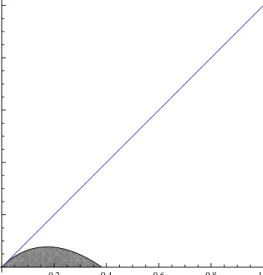
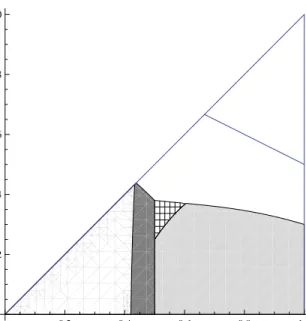
We explain the above results in detail by providing two figures with numerical examples of η and λ. Figure 1 represents the optimal contracts when the degree of loss aversion is moderate such thatη = 1 and
λ= 2. Asq1 decreases, the agents’ wage uncertainty under working compared to under shirking becomes
large, and the agents are less likely to work hard under IPE. Then the principal’s incentive to compensate the agents’ failure increases. As a result, JPE becomes optimal ifq1 is small.
0.2 0.4 0.6 0.8 1.0 q1 0.2 0.4 0.6 0.8 1.0 q0
Figure 1: CPE when η = 1,λ= 2. The region of each contract scheme which is optimal in CPE is shown by: IPE=White, JPE=Gray.
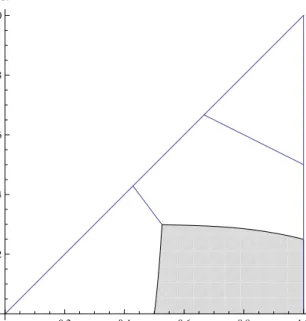
When η(λ−1) becomes large, not only JPE but also RPE may be optimal. Figure 2 represents the optimal contracts when the degree of loss aversion is large such thatη= 1 andλ= 3. Considering the case (ii)w≥wLL≥wLH = 0, we can represent the CPE condition by
{1−(1−q1−q0)η(λ−1)}w +{−(1−q1) | {z } (SI’) + (1−q1)(1−q1−q0)η(λ−1) | {z } (LS1’) +q1(1−q1)(2−q1−q0)η(λ−1) | {z } (LS2) }wLL ≥ d ∆q . (CPER)
23Some theoretical literature which analyzes reference-dependent preferences imposesη(λ−1)≤1 as an assumption. See,
First, suppose that q1 is not too small. Notice that the absolute value of (SI’) is smaller than (SI) if and
only ifq1>12. In words, the effect of discouraging to work hard under RPE is smaller than under JPE if the
agent is more likely to succeed when he works. In addition, the coefficient (LS1) or (LS1’) becomes smaller or even negative whenq1is large. Hence the comparison of the standard incentive effects between (SI) under
JPE and (SI’) under RPE becomes crucial when we determine whether JPE or RPE is the optimal wage scheme in that case. As a result, in Figure 2 we get the optimality of RPE when q1 > 12 and that of JPE
whenq1≤12, providedq1 is not too small andq0 is not too large.
However, asq1decreases, the principal needs to compensate much more in order to make the agents work
hard. Notice that the probability of payingwLH is lower than that of payingwLL if and only ifq1 ≤ 12.24
Whenq1 is very small, the probability of payingwLH becomes low, and (CPEJ) is hard to satisfy because
both (LS1) and (LS2) become small. In that case RPE is more attractive than JPE because (LS1’) becomes large asq1 decreases. Thus, the principal chooses RPE instead of JPE as the optimal contract when q1 is
quite small in order to alleviate the agents’ loss aversion. In Figure 2, this corresponds to the region where RPE is optimal in the region ofq1≤12.
0.2 0.4 0.6 0.8 1.0 q1 0.2 0.4 0.6 0.8 1.0 q0
Figure 2: CPE when η = 1,λ= 3. The region of each contract scheme which is optimal in CPE is shown by: IPE=White, JPE=Gray, RPE=Light Gray.
It is worth clarifying that if the principal can commit an individual stochastic compensation regardless of
24The probability of payingw
other agents’ outcomes when the agent fails, our results do not need to be team incentives. As described in Herweg, M¨uller and Weinschenk (2010), if the principal can use the lottery which is observable and verifiable for the compensation, commit to ignore the bad outcome and pay the bonus unconditionally with a positive probability, the contract with such individual stochastic compensation is optimal. However, there are some conceptual and practical advantages of team incentives. First, it is difficult for the principal to commit the individual stochastic compensation. If the lottery by which the principal implements the individual stochastic compensation is not observable or not verifiable, then the commitment is not credible. Thus, not only is such compensation unobserved in practice, but also it is not clear how the principal can commit and convince each agent of it.25 In contrast, we focus on the multi-agent model. Since each agent’s performance is observable and verifiable, the principal can credibly compensate for the agent’s failure according to other agents’ performance by adopting team incentives. Next, if we take managerial aspects into account, JPE as team incentives becomes strictly better than the individual stochastic compensation. For example, if the principal has a possibility to face a budget constraint, she cannot pay a bonus when all of the agents fail under the individual stochastic compensation. In contrast, if the principal adopts JPE, she can pay a bonus only if some agents succeed their projects. Thus, provided the tasks are highly valuable, she can implement the wage scheme with a stochastic compensation for the agents’ failure by using JPE even when it is impossible to do so by using the individual stochastic compensation. Moreover, if the principal is risk/loss averse then she prefers JPE to the individual stochastic compensation. This is because the distribution of profits is less dispersed under JPE than under the individual stochastic compensation. These aspects differentiate team incentives in our model from the individual stochastic compensation in Herweg, M¨uller and Weinschenk (2010).26 Our results may provide an explanation of the effectiveness of adopting teams
and recent popularity of teams in many firms.
Interestingly, in addition to the above advantage to use JPE rather than individual stochastic compensa-tion, JPE may become the optimal wage scheme even ifη(λ−1)≤1.27 This result implies that, even when the agent does not have large loss-aversion sensitivities and hence the principal can induce their efforts under
25Herweg, M¨uller and Weinschenk (2010) also refer to the plausibility of the individual stochastic compensation that
“[r]estricting the principal to offer nonstochastic wage payments is standard in the principal-agent literature and also in accor-dance with observed practice.”
26For other important differences between our results and Herweg, M¨uller and Weinschenk (2010), see Section 4.
27The condition η(λ−1) ≤ 1 corresponds with “no dominance of gain-loss utility” assumption in Herweg, M¨uller and
Weinschenk (2010). In their Proposition 7, they show that if the assumption is satisfied, then the stochastic compensation is not optimal. We discuss the details of the difference in Section 4.
IPE, JPE may be still better than IPE. This is because we address the impact of CPE constraint on the optimal wage schemes, and the agents prefer JPE to IPE due to its role of partially compensating for their failure. Thus, in the optimal contract they get a same bonus even when one agent achieves high performance and the other one achieves low performance. This result is consistent with firms’ bonus payment schemes mentioned in Section 1, and empirical literature which reports the validness of JPE reviewed in Section 5. To analyze it more clearly, in the next section we investigate the many-agent case.
4
The Optimal Wage Scheme with Many Agents
In this section, we characterize the optimal wage schemes when the principal hires many agents. LetN+ 1 be the number of agents. Consider the case in which each agent’s wage depends not only on his outcome but also on the number of other agents whose outcomes are high. Letn (≤N) denote this number. The agent’s wage can be written asw(Qi, n)≥0, whereQi∈ {H, L} andn∈ {0,1,· · · , N}. Here, we make the
following assumptions.
Assumption 2. (i)∀n w(H, n)≥w(L, n).
(ii)∀Qi ∀n∀n′≥n w(Qi, n′)≥w(Qi, n).
(iii) (1−q1)N ≤12.
As in Section 3, we assume away the “negative bonus” wage schemes in the first assumption. The second assumption implies that the agent’s wage weakly increases as the total outcome of his colleagues increases. That is, we focus on the cases in which the principal can choose either IPE or JPE.28The third assumption is a sufficient condition that the high effort is implementable. It obviously holds for any q1 when N is
sufficiently large.
The following lemma means that the principal can induce each agent to exert high effort, the agent gets a bonus whenever he succeeds his task, and the principal offers a binary payment scheme in generic as the optimal contract.29
Lemma 2. (i) High effort (Qi=H) is implementable.
28As shown in the previous section, JPE seems to be kept as the optimal wage schemes even if the degree of loss aversion
is small. In addition, recent surveys on empirical research of team incentives like Chiappori and Salani´e (2003) and Lazear and Oyer (forthcoming) mention that firms often use JPE for executive compensations. Thus, we here focus on JPE as team incentives and compare it with IPE.
(ii)∀n, n′ ∈ {0,1,· · · , N} w(H, n) =w(H, n′)≡w >0.
(iii) In generic, ∀n∈ {0,1,· · ·, N} w(L, n)∈ {w,0} where w >0, and the optimal payment scheme is unique.
As in Lemma 1, the agent dislikes the wage uncertainty. Hence the principal can encourage him to work by paying a fixed bonus for sure when his outcome is high (Lemma 2 (ii)). Also, as described in Herweg, M¨uller and Weinschenk (2010), the principal’s payment minimization problem becomes a linear programming problem because we assume linear consumption utilities and piece-wise linear gain-loss utilities. Hence in generic it has a unique solution at an extreme point of the constraint set (Lemma 2 (iii)).
By Lemma 2, the agent with low outcome can get a bonus if and only if the number of other agents whose outcomes are high is equal or more than some critical numbern∗.30 Letαbe the probability thatn
is equal or greater than this critical number: α≡P rob(n≥n∗). Then, we can interpret that the principal compensates the agent’s failure with this probability.
Now, the principal’s problem can be reduced to choose the bonus wagewand the compensation probabil-ityαso as to minimize her expected payment. In what follows, we ignore the integer problem: the principal hires sufficiently many agents so that she can (approximately) choose any level of the compensation proba-bilityα∈[0,1]. In this setting,α= 0 means IPE: the agent’s wage depends only on his outcome. On the other hand,α= 1 means full compensation: the agent gets the bonus for sure even if he fails. In two-agent case withwHH =wHL=wLH >0 andwLL= 0,αis equal toq1.
Then, the principal’s problem becomes:
min w>0,α∈[0,1]{ q1+α(1−q1)}w s.t. (1−α) | {z } (SIM) w+ (1−α){1−(1−α)(2−q0−q1)}η(λ−1) | {z } (LSM) w≥ d ∆q . (CPEM) Notice that ifα < 3−2q1−2q0
4−2q1−2q0, then (LSM) is increasing inα. In this region, (CPEM) exhibits a clear trade-off
between the standard incentive effect (SIM) and the loss-sharing effect (LSM) in the many-agent case. Also,
α= 1 (full compensation) is never optimal because it does not satisfy (CPEM). As a result, we characterize the optimal compensation probability as follows:31
30We denoten∗=N+ 1 ifw(L, N) = 0.
Proposition 2. The optimal compensation rateα∗ that comprises the optimal wage scheme is as follows: α∗= 0 if 1 η(λ−1) ≥(2−q0−q1)(1 +q1)−1, 1 1−q1 ³q 1− {1 +η(λ1−1)} · 1−q1 2−q0−q1 −q1 ´ if η(λ1−1) <(2−q0−q1)(1 +q1)−1.
Proposition 2 means that the principal pays a fixed bonus either when the agent succeeds his task or when most of other agents succeed.32 It is consistent with the empirical evidence mentioned in Section 1 that
firms sometime pay a bonus not only to high-outcome employees but also low-outcome ones when the firms earn a high profit. The optimal compensation probability is increasing inη(λ−1). That is, the principal is more likely to adopt team incentives with partial compensation as the agents’ loss aversion becomes more significant. Also, similar to Proposition 1, team incentives (α∗>0) are optimal only whenq0<0.708. This
is because the standard incentive effect becomes larger than the loss-sharing effect in that region.
Proposition 2 exhibits a sharp difference from Herweg, M¨uller and Weinschenk (2010)’s “turning a blind eye”: when η(λ−1) > 1 the principal wants to compensate for the agent’s failure as much as possible under the optimal contract. This is because they impose the individual rationality constraint (IR) and the effect of reducing the agent’s expected loss by increasing the compensation probability as holding IR with equality totally dominates the our main trade-off in (CPEM). Though the logic itself is clear, they have two unattractive results. First, the optimal compensation probability in their model is not well-defined. Second, and more importantly, a base wage goes to negative infinity and a bonus wage goes to infinity as the compensation rate goes to one in their result. In contrast to Herweg, M¨uller and Weinschenk (2010), we pay attention to CPE constraint (or equivalently the incentive compatibility constraint) by imposing the limited liability constraints. Then, we shed light on the trade-off between the standard incentive effect and the loss-sharing effect.33 By this trade-off, the principal may use team incentives with partially compensating
for the agents’ failure even if IR does not bind. This is because the partial compensation for their failure provides the loss-averse agents with the incentives to work, while such compensation makes the agents more likely to shirk if they are loss-neutral. Consequently, the features of our results are driven via the trade-off between the standard incentive effect and the loss-sharing effect.
32Precisely, a low-outcome agent can get the bonus if the ratio of high-outcome agents is more than or equal to 1−α∗.
33Herweg, M¨uller and Weinschenk (2010) mention that if the agent is subjected to limited liability, the optimal compensation
5
Related Literature
We summarize the literature on the multi-agent moral hazard and on the expectation-based reference-dependent preferences, which are most related to this paper. We also refer to the literature on team incentives which incorporates the agents’ social preferences.
First of all, much literature has studied moral hazard problems with multi-agent in this three decades. It is straightforward to show that incentives based on IPE are optimal in the simple moral hazard model with risk-averse multi-agent and no common shock.34 Holmstrom (1982), one of the seminal papers in this field, shows that RPE can be optimal if the performance measure includes a common noise factor because RPE reduces agents’ risk exposure. Lazear and Rosen (1981) and Green and Stokey (1983) also study a tournament scheme, which is an extreme incentive scheme based on RPE, and demonstrate its potential efficiency. Although these studies illustrate the positive aspects, RPE has certain disadvantages. In addition to collusion problems, it discourages cooperation among agents and gives incentives to sabotage. JPE can alleviate these negative effects of teams. These points are supported by empirical studies that team incentives based on JPE are frequently associated with increased productivity.35 Holmstrom and Milgrom (1990) and Itoh (1993) show that if agents coordinate their efforts and share risk in a Pareto-efficient way, then JPE may be an optimal wage scheme. Itoh (1991) shows that if an agent can help other agents and the help is desirable for a principal, the optimal contract should be based on JPE. Lazear (1989) demonstrates that JPE can be effective when the issue of sabotage is relevant. Whereas these models are static, Che and Yoo (2001) and Kvaløy and Olsen (2006) analyze the repeated interactions among agents, and show that JPE may be preferable to RPE even if it does not hold in the static settings.36
Next, a notion of reference-dependence is originally investigated by Kahneman and Tversky (1979). Models of the expectation-based reference-dependent preferences are developed by K˝oszegi and Rabin (2006, 2007), and they are applied to understand many economic phenomena. Heidhues and K˝oszegi (2008) analyze price competition among firms with loss-averse consumers, and show that firms offer a sticky (deterministic)
34We briefly study the optimal contracts where the agents are risk-neutral or risk-averse but not loss-averse as the benchmark
case in section 4.1.
35See, for example, Jones and Kato (1995), Ichniowski, Shaw and Prennushi (1997), Hamilton, Nickerson and Owan (2003),
and Boning, Ichniowski and Shaw (2007).
36As we briefly mentioned in footnote 11, this paper also relates to the multi-task literature like Holmstrom and Milgrom
(1991). In fact, we could see our multi-agent model as a multi-task model in particular situation: a principal has two identical tasks and chooses either to hire one agent and assign two task to him or hire two agents and assign one task to each of them. Our results imply that when the agents loss aversion matter, the principal may want to hire one agent and assign two task to alleviate his expected loss even though it is not optimal in the classical case.
price in equilibrium even if their cost functions are stochastic and asymmetric. Lange and Ratan (2010) and Eisenhuth (2010) investigate auctions with loss-averse players. Herweg and Mierendorff (2011) analyzes a nonlinear pricing when consumers are loss-averse and uncertain about their own demand, and shows the optimality of flat-rate tariff. Hahn, Kim, Kim, and Lee (2010) investigates a screening problem when consumers are loss-averse and uncertain about their own valuation.37
As literature related to moral hazard problem where the agent has the expectation-based reference-dependent preferences, Daido and Itoh (2010) build a simple model with limited liability and study the Pygmalion and the Galatea effects as self-fulfilling prophecies. Gill and Stone (2010) analyze a rank-order tournament with the agents’ loss aversion.38 Macera (2010) extends K˝oszegi and Rabin (2009)’s dynamic loss aversion model to a repeated moral hazard situation and studies the intertemporal allocation of incentives. Herweg, M¨uller and Weinschenk (2010), which is most closely related to our study, analyze a single-agent moral hazard model when the agent is loss averse. They find that the optimal contract is a binary bonus scheme even for a rich performance measure. Also, they show that even if implementation problems arise in usual payment schemes as originally described by Daido and Itoh (2010), the principal can induce the agent to exert the desired action by using the stochastic ignorance. Though their logic of the stochastic ignorance is similar to our logic of compensating for the agents’ failure, there are some sharp differences. First of all, Herweg, M¨uller and Weinschenk (2010) focus on a single agent case and do not mention how the principal can commit the stochastic ignorance. Second, if we care not only on the agents’ loss aversion but also on the managerial aspects such as the principal’s budget constraint or risk/loss aversion, team incentives may be strictly better than the stochastic ignorance for the principal as we mentioned in Section 1. Third, our focus is on the CPE constraint (or equivalently the incentive compatibility constraint) and to analyze the trade-off between the standard incentive effect and the loss-sharing effect, whereas the trade-off on the CPE constraint is not investigated in Herweg, M¨uller and Weinschenk (2010) because an individual rationality constraint has a deterministic role in their model. It clearly contrasts our result with their stochastic ignorance result in Section 4.39
37For contract literature which incorporates reference-dependent preferences but the reference point is not determined by the
expectation, see Carmichael and MacLeod (2003, 2006), de Meza and Webb (2007), Hart (2007), Hart and Moore (2008) and Fehr, Hart and Zehnder (2009, 2011).
38Although Gill and Stone (2010) call their equilibrium concept a desert equilibrium, it is basically same as CPE.
39As another difference, we characterize the optimal contracts under PPE as well as under CPE and show the robustness of
Empirical and experimental research has recently confirmed the importance of expectation-based reference-dependent preferences. Crawford and Meng (forthcoming) estimate cab drivers’ labor supply decisions based on the model of K˝oszegi and Rabin (2006), and reconcile the findings between Camerer, Babcock, Loewenstein and Thaler (1997) and Farber (2005, 2008). Abeler, Falk, Goette and Huffman (2011) design a real-effort experiment in which the subjects choose how long they work on a simple repetitive task. They confirm the validity of expectation-based reference-dependent preferences models; the higher the subjects’ expectations are, the longer they work and the more they earn. Gill and Prowse (forthcoming) conduct a real-effort sequential-move tournament experiment, and their result is consistent with the theoretical prediction of expectation-based reference-dependent preferences with the concept of CPE.40
Finally, as another behavioral approach to study team incentives, some multi-agent moral hazard models with social preferences have been developed. Englmaier and Wambach (2010), Bartling and Siemens (2010) and Bartling (forthcoming) study multi-agent moral hazard models when the agents have social preferences. They show that, even though IPE would be optimal for purely self-interested agents, team incentives can be optimal. Their optimal team incentives exhibit either a wage scheme that the agent may get the bonus even if he fails, or a wage scheme that the agent may not get the bonus even if he succeeds. On the other hand, we predict that the optimal team incentives exhibit the forms of compensation when the agent fails his task. The prediction is easy to test empirically.
6
Concluding Remarks
We have built a multi-agent moral hazard model in which the agents have expectation-based reference-dependent preferences. We have used this model to study optimal wage schemes and characterized it using both CPE and PPE as in K˝oszegi and Rabin (2006, 2007). As a result, we show that when agents’ loss aversion is not so small, the optimal wage scheme should be based on a kind of performance evaluation that depends not only on the agent’s own outcome but also on that of his colleagues. Thus, the optimal wage schemes exhibit team incentives. More specifically, if the probability of success is less than a half but not too small, the principal offers a positive wage unless both agents fail, which exhibits joint performance evaluation; otherwise the principal offers a positive wage unless one agent fails and the other agent succeeds,
40As non real-effort lab experiments, Ericson and Fuster (2010) conduct two stochastic endowment experiments and show
that how subjects’ expectation on keeping (or getting) the endowment affects their actual behavior. Sprenger (2010) conducts risky choice experiments and argue that how expectation-based reference-dependent preferences can explain his results.
which exhibits relative performance evaluation.
We predict that the optimal team incentives exhibit the forms of compensation when the agent fails his task, while the existence literature shows how the agent’s wage should depend on his colleagues’ outcomes when he succeeds. This prediction makes our results empirically testable. Our result provides a new insight that team incentives serve as a loss-sharing device among agents, and it may bridge the gap between the current multi-agent theoretical literature and empirical observation in the workplace.
Appendix
A
Proofs
Before providing the proofs of lemmas and propositions, we represent agenti’s expected gain-loss utility and CPE condition in detail.
First, agenti’s expected gain-loss utility on wage is represented as follows:
E[πi(ai, aj,wi|ˆaii,ˆa i j,wˆ i)] = ˆqi aiqˆ i aj h qai{qajµ(w i HH−wˆ i HH) + (1−qaj)µ(w i HL−wˆ i HH)} + (1−qai){qajµ(w i LH−wˆ i HH) + (1−qaj)µ(w i LL−wˆ i HH)} i + ˆqia i(1−qˆ i aj) h qai{qajµ(w i HH−wˆ i HL) + (1−qaj)µ(w i HL−wˆ i HL)} + (1−qai){qajµ(w i LH−wˆ i HL) + (1−qaj)µ(w i LL−wˆ i HL)} i + (1−qˆaii)ˆqiaj h qai{qajµ(w i HH−wˆ i LH) + (1−qaj)µ(w i HL−wˆ i LH)} + (1−qai){qajµ(w i LH−wˆ i LH) + (1−qaj)µ(w i LL−wˆ i LH)} i + (1−qˆaii)(1−qˆ i aj) h qai{qajµ(w i HH−wˆiLL) + (1−qaj)µ(w i HL−wˆiLL)} + (1−qai){qajµ(w i LH−wˆ i LL) + (1−qaj)µ(w i LL−wˆ i LL)} i . Next, usingq2 1−q20= (q1−q0)(q1+q0),q1(1−q1)−q0(1−q0) = (q1−q0)(1−q1−q0) and (1−q1)2−(1−q0)2=
−(q1−q0)(2−q1−q0), (CPE) can be replaced as
q1wHH+ (1−q1)wHL−q1wLH−(1−q1)wLL +(q1+q0)(1−q1)q1 h µ(wHL−wHH) +µ(wHH −wHL) i +(1−q1−q0)q12 h µ(wLH−wHH) +µ(wHH−wLH) i +(1−q1−q0)(1−q1)q1 h µ(wLL−wHH) +µ(wHH−wLL) i +(1−q1−q0)(1−q1)q1 h µ(wLH−wHL) +µ(wHL−wLH) i +(1−q1−q0)(1−q1)2 h µ(wLL−wHL) +µ(wHL−wLL) i −(2−q1−q0)(1−q1)q1 h µ(wLL−wLH) +µ(wLH−wLL) i ≥ d ∆q .
Notice that for anyx, y∈R,
µm(x−y) +µm(y−x) =−η(λ−1)|x−y|.
Then, (CPE) is rewritten again as
q1wHH+ (1−q1)wHL−q1wLH−(1−q1)wLL −q1(1−q1)(q1+q0)η(λ−1)|wHH −wHL| −q12(1−q1−q0)η(λ−1)|wHH −wLH| −q1(1−q1)(1−q1−q0)xη(λ−1)|wHH−wLL| −q1(1−q1)(1−q1−q0)η(λ−1)|wHL−wLH| −(1−q1)2(1−q1−q0)η(λ−1)|wHL−wLL|+q1(1−q1)(2−q1−q0)η(λ−1)|wLH−wLL| ≥ d ∆q . (CPE’)
A.1
Proof of Lemma 1
Proof. (i) We prove this by contradiction. Suppose that w = (wHH, wHL, wLH, wLL) which satisfies
min{wLH, wLL}>0 is the optimal wage scheme. By Assumption 1, we can reduce the same amount from
each possible wage without violating limited liability constraints. Also, reducing the same amount from all payments does not affect (CPE’). Thus, the principal can decrease the expected payment. A contradiction.
(ii) We prove this by contradiction. Suppose w= (wHH, wHL, wLH, wLL) is the optimal wage scheme.
Consider a case in which wHH > wHL. Then, we can take ∆w > 0 such that a new contract w =
(wHH −(1−q1)∆w, wHL+q1∆w, wLH, wLL) satisfies the limited liability constraints and has the same
ordinal position as the original contract.
First, suppose that wHH > wLH. If wHL ≥ wLH, the difference between the new contract and the
original one for the left hand side of (CPE’) is
C(w)−C(w) =q1(1−q1)(q1+q0)η(λ−1)∆w>0.
where we denote the L.H.S of (CPE’) as C(w′) when a wage scheme is w′. If wHH > wLH > wHL, the
C(w)−C(w) =q1(1−q1)(q1+q0)η(λ−1)∆w+ 2q21(1−q1)(1−q1−q0)η(λ−1)∆w
=q1(1−q1){(1−q1)(q1+q0) +q1(2−q1−q0)}η(λ−1)∆w
>0.
Thus, the principal can relax (CPE’) without violating the limited liability constraints. Because an expected payment under the new contract is the same as under the original contract, the principal can decrease the expected payment. A contradiction.
Second, suppose thatwHL< wLH =wHH. By (i) of this Lemma,wLL = 0 holds. The left hand side of
(CPE’) is
C(w) =(1−q1)[1− {(1−q1−q0)−q1(2−q1−q0)}η(λ−1)]wHL.
Since we suppose thatwsatisfies (CPE’), 1− {(1−q1−q0)−q1(2−q1−q0)}η(λ−1)>0 must hold. Then
we can take ∆w>0 such that a new contract ˜w= (wHH−(1−q1)∆w, wHL+ ∆w, wLH−(1−q1)∆w, wLL)
satisfies the limited liability constraints and has the same ordinal position as the original contract. The difference between the new contract and the original one for the left hand side of (CPE’) is
C( ˜w)−C(w) =(1−q1)[1− {(1−q1−q0)−q1(2−q1−q0)}η(λ−1)]∆w>0.
Thus, the principal can relax (CPE’) without violating the limited liability constraints. Because an expected payment under the new contract is the same as under the original contract, the principal can decrease the expected payment. A contradiction.
We can prove this in the case wherewHH < wHL in the same way except for taking w= (wHH+ (1−
q1)∆w, wHL−q1∆w, wLH, wLL) or ˜w = (wHH + (1−q1)∆w, wHL−q12∆w, wLH, wLL−q21∆w) as a new
contract.
A.2
Proof of Proposition 1
First, consider the case of (i) w ≥ wLH ≥ wLL = 0. Suppose that 1−(1−q1−q0)η(λ−1) > 0. By
substitutingwwhich holds (CPEJ) with equality into the objective function, this problem is reduced to min wLH · 1−q1(1−q1)(2−q1−q0)η(λ−1) 1−(1−q1−q0)η(λ−1) ¸ wLH
subject to
wLH∈[0, w].
If the coefficient of wLH is positive,wLH should be zero. On the other hand,wLH should be equal tow
if the coefficient ofwLH is not positive. As a result, the optimalwLH is presented by
wLH=
(
0 if ΩJ <1,
w if ΩJ ≥1,
where ΩJ ≡ {1−q1−q0+q1(1−q1)(2−q1−q0)}η(λ−1).
Next, suppose that 1−(1−q1−q0)η(λ−1)≤0<1− {1−q1−q0−q1(2−q1−q0)}η(λ−1). Since the
coefficient ofwLH is positive but that ofwis negative. Thus, the solution exists andwLH=wholds at the
optimum.
Finally, suppose that 1− {1−q1−q0−q1(2−q1−q0)}η(λ−1)≤0. Then the solution does not exist in
this case.
As a result, if ΩJ <1, the optimal wage scheme iswI = (wI, wI,0,0) where
wI = d
∆q[1−(1−q1−q0)η(λ−1)] ,
and the expected wage is
WI =q1
d
∆q[1−(1−q1−q0)η(λ−1)]
. (IPE)
If ΩJ>1 and 1−{1−q1−q0−q1(2−q1−q0)}η(λ−1)>0, the solution in this case iswJ = (wJ, wJ, wJ,0)
where
wJ≡ d
∆q(1−q1)[1− {1−q1−q0−q1(2−q1−q0)}η(λ−1)] ,
and the expected wage is
WJ =q1(2−q1)
d
∆q(1−q1)[1− {1−q1−q0−q1(2−q1−q0)}η(λ−1)]
. (JPE)
If 1− {1−q1−q0−q1(2−q1−q0)}η(λ−1)≤0, the solution does not exist in this case. This result can
be summarized as follows.
Lemma 3. Suppose thatw≥wLH ≥wLL= 0. The solution exists iff 1−{1−q1−q0−q1(2−q1−q0)}η(λ−1)>
0. If it does exist, the optimal wage scheme is wI = (wI, wI,0,0) if Ω
J <1, andwJ = (wJ, wJ, wJ,0) if
Second, we examine the case of (ii)w≥wLL≥wLH= 0 . The principal’s problem is as follows. min w,wLL q1