FInest – Future Internet enabled optimisation
of transport and logistics networks
D1.3
Business Requirements
Project Number 285598
Work package WP1 Domain Characterization and Requirements Analysis
Lead Beneficiary Kühne + Nagel
Editor(s) Michael Zahlmann
Stefan Seysen
Kühne + Nagel Kühne + Nagel
Contributors(s) Andreas Köstler
Evert-Jan van Harten Agathe Rialland Hande Koç Cyril Alias Oyvind Olsen Michael Stollberg Kühne + Nagel Air France KLM Marintek Arcelik (ARC) UDE NCL SAP
Reviewer Dirk – Henning Stuhr Kühne + Nagel
Prof. Dr. Bernd Noche UDE
Prof. Dr. Rod Franklin Kühne + Nagel Dissemination Level
Contractual Delivery Date 31.03. 2012 Actual Delivery Date 31.03.2012
Abstract
International transport and logistics operations are concerned with the planning and execution of the world-wide shipment of goods and people. The FInest project addresses this domain as a useful example for how Future Internet based services can improve operations within a complex domain while “leveling the playing field” so that small companies can better participate. The FInest project has identified three different use case scenarios in this domain that characterize different aspects of transport and logistics operations that will serve as examples for building Future Internet based services. Based on the preliminary analysis of the domain business requirements, and based on the project’s initial analysis of these use cases, the next step for the project was to analyze the domain to develop detailed Business Requirements for possible future ICT (information and computer technology) solutions based on Future Internet technologies.
This document is being submitted as specified in the FInest Description of Work (DoW) as the foundation of deliverable D1.3 – Business Requirements for future transport and logistics ICT solutions. The work done in this deliverable has been one of collaboration with all other work packages in the project. The need to use the detailed information flows that pass between partners in the project to define technical requirements for work packages 5 – 8 required that business requirements be examined from the perspective of the development of an ICT solution to the opportunities for improvement identified in work package 2. This theme/perspective necessarily biases the analysis. However, given the parallel nature of the project work packages where technical deliverables require information about certain business needs before requirements definition has been completed, this approach was selected so that the greatest benefit to the project in total could be achieved. The reader interested in the detailed information passed between domain partners, its format, source, and destination should review the Appendix to this document, which has been provided as part of this deliverable.
The use cases that have been identifed for analysis within the project are:
Use Case 1 – Fish Transport from Ålesund (Norway) to Europe: The use case is covered by three companies (Port of Ålesund, NCL and Tyrholdm&Farstad), and focus has been put on the perspective of three different roles covering one part of a transport chain: the port, the shipping line and the container terminal. The intention has been to understand the challenges of this shipment process from the perspective of these three roles, and on understanding the interactions among business partners in the process. Focus has not been on covering a complete door-to-door transport chain.
Use Case 2 – Air Transport of Equipment: The use case is covered by two companies (Kuehne + Nagel and Air France-KLM Cargo) representing the two main parties in this transport chain. Focus has been put on describing a complete door-to-door transport chain. This transport chain has been divided into three main parts: 1. Shipper-to-Carrier, 2. The Carrier process (Forwarder-to-Shipper-to-Carrier, then Carrier-to-Forwarder), and 3. Carrier-to-Consignee.
Use Case 3 – Global Consumer Goods Production and Distribution: The use case is covered by one company (Arcelik). The perspective is, therefore, of the manufacturer, and the use case consists of three transport chains: two covering the inbound logistics of materials (from the Far East and Europe to Turkey), and one covering the export of manufactured products to the UK.
The initial business requirements identified that the FInest platform should address include the following:
Improved information exchange to ensure that the right information arrives at the right time, with easy access, but with security in transfer
Improved coordination of business activities among all involved actors The ability to integrate with legacy systems
Event-driven monitoring and real time tracking of processes A standardized communication interface between all participants Improved operational transparency between partners
Flexible operations to respond to variable market demands Pro-active alerts to allow for problem avoidance
Improvement in resource planning
Automated data entry (eliminate paper and manual processes) Improvement in visibility to resources and their availability Safe and efficient transfer of documents
Ability to plan and replan activities based on real time market conditions Improve operational efficiency to lower carbon emissions
Disclaimer
The content of the publication herein is the sole responsibility of the publishers and it does not necessarily represent the views expressed by the European Commission or its services.
While the information contained in the documents is believed to be accurate, the author(s) or any other participant in the FInest consortium make no warranty of any kind with regard to this material including, but not limited to the implied warranties of merchantability and fitness for a particular purpose.
Neither the FInest Consortium nor any of its members, their officers, employees or agents shall be responsible or liable in negligence or otherwise howsoever in respect of any inaccuracy or omission herein.
Without derogating from the generality of the foregoing neither the FInest Consortium nor any of its members, their officers, employees or agents shall be liable for any direct or indirect or consequential loss or damage caused by or arising from any information advice or inaccuracy or omission herein.
Document History
Version Date Comments
V0.1 24-01-2012 First draft V0.2 27-02-2012 Revised draft V0.3 15-03-2012 Revised draft V0.4 21-03-2012 Revised draft V0.5 28-03-2012 Revised draft V0.6 29-03-2012 Revised draft V0.7 30-03-2012 Revised draft
Table of Contents
Abstract ... 3 Disclaimer ... 5 Document History ... 5 Table of Contents ... 6 Acronyms ... 9 1 Introduction ... 11 1.1 Work Package 1 ... 111.2 Relationship with other Work Packages ... 12
1.3 Task 1.2: Detailed Business Requirements Analysis ... 13
2 Business requirements for transport and logistics domain ... 14
2.1 4Phases methodology ... 14 2.1.1 Sales / Marketing ... 15 2.1.2 Planning ... 15 2.1.3 Execution ... 16 2.1.4 Completion ... 17 2.2 Requirements Analysis ... 17 2.2.1 Introduction ... 17
2.2.2 General Requirements identified in the Domain Analysis (D1.1)... 17
2.3 Generic requirements identified in the Analysis of the Transport and Logistics Domain ... 19
3 Generic requirements overview ... 20
3.1 Collaboration ... 20
3.2 Planning ... 21
3.3 Resource Management ... 22
3.4 Monitoring and Visibility ... 22
3.5 Targets to be achieved ... 23
3.5.1 Simplifying the ICT landscape ... 23
3.5.2 Reduction of manual input and tasks ... 23
4 Communication / Information Exchange ... 23
4.1.1 Data Flow ... 24
4.1.2 Communication Analysis ... 25
5 Use case requirement analysis ... 26
5.1 Use Case 1 – Fish Transport from Ålesund (Norway) to Brasil... 28
5.2 Use case 2 – Air Transport of Equipment... 34
5.3 Use case 3 – Global Consumer Good Production and Distribution ... 39
6 Detailed Domain Business Requirements ... 48
6.1 Business Collaboration ... 48
6.1.1 Business alignment ... 49
6.1.2 E-market place ... 49
6.1.3 E-Contracting ... 49
6.1.4 Administrating of business partners ... 50
6.1.5 Security and privacy ... 50
6.1.6 Technical Collaboration ... 50
6.2 Planning ... 50
6.2.1 Event management ... 51
6.2.2 Re-planning (multiple solution planning) ... 51
6.2.3 Strategic planning ... 51
6.3 Resource Management ... 52
6.4 Monitoring & Visibility ... 52
6.5 Business opportunities for SME ... 52
7 Conclusion ... 52
8 Next steps ... 54
9 References ... 55
List of Figures
Figure 1: Interactions between WP1-WP3 and WP5-WP8 ... 13
Figure 2: FInest domain mapping approach ... 15
Figure 3: Generic requirements identified in D1.1 Analysis of the TL Domain ... 20
Figure 4: Data Flow Example (MARINTEK, 2011) ... 24
Figure 5: IBM and KN Secure Trade Lanes Project ... 25
Figure 6: Big picture Use Case 1 ... 28
Figure 7: Information Flow UC1 1 ... 29
Figure 8: Information Flow UC1 2 ... 30
Figure 9: Big picture Use Case 2 (IATA, 2011) ... 34
Figure 10: Document Flow Airfreight (IATA, 2012) ... 35
Figure 11: Information Flow UC3 Export (ARCELIK, 2011) ... 39
Figure 12: Information Flow UC3 Import (ARCELIK, 2011) ... 40
Figure 13: UC1 Port Information flow consolidation ... 45
Figure 14: UC1 NCL information flow consolidation ... 45
Figure 15: UC2 information flow consolidation ... 46
Figure 16: UC3 Import information flow consolidation ... 46
Figure 17: UC3 Export information flow consolidation ... 47
Figure 18: Requirements related to 4 phase methodology ... 53
List of Tables Table 1: High level Use Case Requirements ... 27
Table 2: Challenges and needs UC1 ... 33
Table 3: Challenges and needs UC2 ... 39
Table 4: Challenges and needs UC3 ... 44
Acronyms
Acronym Explanation
AFKLM Air France KLM
ANSIX12 EDI format
ARC Arcelik
ÅRH Port of Ålesund
dfd
AS2 Data transport specification
AWB Air Waybill
BL Bill of lading
C2k Cargo2000
D Deliverable
D2D Door-to-door
EDI Electronical data interchange ERP Enterprise Resource Planning ETA Estimated time of arrival ETD Estimated time of department
FFM Flight manifest
FHL IATA message
FSU Freight status update FTP File transfer protocol
FWB Freight Waybill
HTTP Hypertext transfer protocol
HWB House Waybill
ICT Information and Communication Technology ISPS International Ship and Port Facility Security
IT Information technology
KN Kuehne+Nagel
LSP Logistics service providers NCL North*Sea Container Line
OP Operation Plan
PCS Port Community System
PPP Private Public Partnership
RCS IATA message
RFID Radio frequency identification
SCM Supply chain management
SLA Service level agreement SME Small and medium enterprises SoftShip Specialized ERP System
TEU Ton Equivalent unit
TF Tyrholm og Farstad
TIP Transport Information Provider TL Transport and Logistics
TR Transport Regulator
TSP Transport Service Provider TSU Transport Service User
ULD Unit Load Device UNEDIfact EDI format
VHF Very high frequency
WB Waybill
WP Work package
XML Extensible Markup Language XML Data interchange format
1
Introduction
The Future Internet Public Private Partnership (FI-PPP) focuses on the development of innovative open network and service ICT solutions with generic common enablers serving a multiplicity of demand-driven use cases in "smart applications". The work in Objective FI.ICT-2011.1.8: Use Case Scenarios and Early Trials, focuses on vertical use case scenarios whose intelligence, efficiency, sustainability and performance can be radically enhanced through a tighter integration with advanced Internet-based network and service capabilities. The work includes use case characterization; specification of ICT solution requirements; development and technological validation of prototypes, and large scale experimentation and validation. The FInest (Future Internet Enabled Optimisation of transport and Logistics Business Networks) project aims to develop such an infrastructure on the basis of Future Internet technologies for the Transport and Logistics (T&L) domain. Modern transport and logistics activity is often a highly distributed, inter-business activity spanning several countries with each of the involved business partners aiming at optimizing their individual complex supply and production chains while not considering what these actions may do to the efficiency of the entire supply chain process.
The FInest project addresses international transport and logistics businesses that are concerned with the planning and execution of world-wide shipments of goods. These companies operate in a highly competitive industry, one that demands novel ICT solutions for enhancing their inter-organizational collaboration in cooperative business networks.
1.1
Work Package 1
The overall goal of Work Package 1 (WP1): Domain Characterization and Requirements Analysis, is to determine the generic business requirements for the next generation of ICT solutions for the transport and logistics domain. In the context of the FInest project, logistics is considered to be the summation of individual tasks and actions within the supply chain. It includes all supply activities from planning through execution and delivery completion. WP1’s purpose is to ensure the suitability of the technological solution that shall be designed by the project team for satisfying the business needs across these logistics activities.
To ensure a common understanding by all users of the results of the FInest project, the domain analysis has been conducted with a view towards the development of a shared understanding of the central domain elements. The identified business requirements form the foundation for designing the technological solution to be developed in WP3 of the project and the conceptual prototypes to be designed in WP5 – WP8. The use case scenarios, defined in WP2 of the project, will be used to demonstrate the ability of these technical artifacts to address the identified business requirements.
The specific objectives of this work package are, therefore, to:
Establish a common understanding of the important elements of the transport and logistics domain,
Identify the business challenges arising in transport and logistics, and define a detailed set of business requirements for the next generation of ICT solutions,
Provide a comprehensive state-of-the-art analysis of ICT solutions for collaboration and integration that are currently employed in the transport and logistics domain, Review and assess the design of the envisioned technological solution with respect to
its suitability for satisfying the identified business requirements, and
Investigate business models and identify business opportunities for the envisioned technological solution for involved industries.
1.2
Relationship with other Work Packages
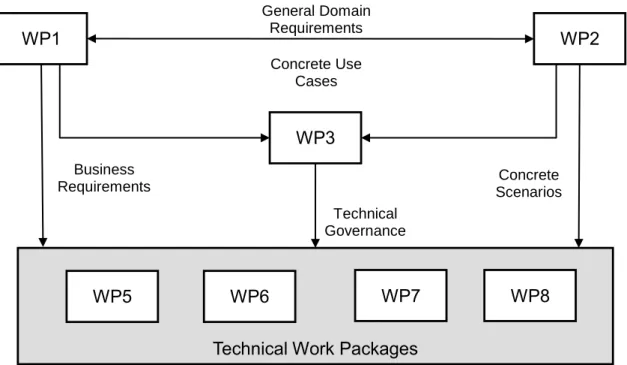
Work packages 1 and 2 (WP1 and WP2) of the FInest project are concerned with collecting general domain requirements from the domain-partners involved in the project. Domain requirements are relevant throughout the entire project as the FInest project is – in contrast to many other research projects – not technology driven, but domain driven. This means that domain requirements define the need for certain technical services (they “pull” the proper technology from designers). These services are not pre-defined and “pushed” onto the domain partners who are then forced to fit them to their business requirements if they can. Additionally, WP1 and WP2 define concrete use cases that will be applied to demonstrate the effectiveness of the FInest extension to the FI PPP Core ICT solution and that address the business requirements of the transport and logistics domain. WP1 and WP2 provide the essential inputs for all other work packages in the FInest project as displayed in Figure 1.
Figure 1: Interactions between WP1-WP3 and WP5-WP8
WP1 is concerned with eliciting and documenting business requirements and to understand the actual status of current ‚ICT systems for collaboration’. These Business Requirements provide the overall design goals and rationale for the development of the technical solutions in WPs 3 and 5-8.
WP2 is concerned with the definition of use case scenarios, which serve two main purposes:
1.
They support the refinement and illustration of the business requirements and “state of affairs” (from WP1), and2.
They are used as demonstration, test and evaluation scenarios for assessment of prototypes (in WP3) and the design of the experimentation environment (in WP4) Additionally, WP2 provides a methodology that is used by WPs 5-8 to provide a refined “as-is“ and “to-be“ situation analysis.1.3
Task 1.2: Detailed Business Requirements Analysis
The Task 1.2: Detailed Business Requirements Analysis aims to identify the detailed business requirements for various forms of the international and domestic shipment of goods (air, sea, land, etc.). The requirements documentation is developed based on standard protocols that the consortium has established for this purpose. The identified business requirements serve as the basis for designing of the technical solution (WP3) and are addressed for detailed demonstration and evaluation in particular use case scenarios (WP2), therewith forming the principal foundation for achieving the objectives of the project.
Technical Work Packages
WP2
WP6
WP7
WP8
WP1
WP5
WP3
General Domain Requirements Concrete Use Cases Technical Governance Business2
Business requirements for transport and logistics domain
This deliverable will provide the detailed business requirements analysis, presenting the central result of the domain analysis that forms the principal foundation for technology and use case scenario design.
The 4phases process model methodology (Section 2.1) has been chosen by the FInest team as the framework and standard tool for documenting all business process tasks, investigations and results. To identify the business requirement for the transport and logistics domain, a high level domain analysis has been conducted (deliverable 1.1). Beside the business requirements identified in deliverable 1.1, current communication processes and protocols among domain business partners has been another focus of the research. The messages exchanged, regardless of the technology used, are crucial elements in the proper execution of a shipment and without which a supply chain could not function. The evaluation of general business requirements from the domain and requirements derived from communication flows among the parties involved in a supply chain act as the input to the detailed business requirements analysis of this deliverable.
2.1
4Phases methodology
Within WP2 (D2.1) a methodology has been introduced that segregates supply chain activities into 4 process phases. These phases represent different states of the process and facilitate the modularization of supply activities.
The 4phase methodology segments a logistics process into four distinct activities. These activities are:
1. Sales and marketing of the service; 2. Planning of the service execution; 3. Execution of the service; and 4. Completion of the service.
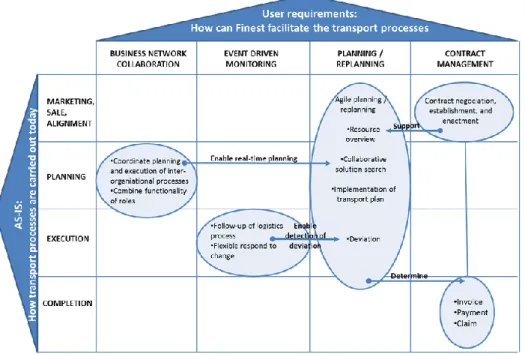
An example of how this approach is used for organization of information concerning domain processes is shown in Figure 2 following.
Figure 2: FInest domain mapping approach
2.1.1
Sales / Marketing
Marketing, Sales, and Alignment processes are concerned with creating contact between parties that have a need for transport or logistics services and those who can offer transport and logistics services that fulfil the demand. This activity consists of the following steps:
publishing of needs or offered services, establishing contact between the parties, agreeing on the terms of the service, and sale of the service.
2.1.2
Planning
The provision of transport and logistics services is planned and managed based on actual and forecast demand, information about the transportation network infrastructure, and traffic conditions. Planning includes decisions about:
routes, schedules, service types, and utilization of resources.
Shipping consolidation and load/trip planning is the planning of the physical loads for placement in a transport unit (truck trailer, sea freight container, ULD, etc. depending on the
mode of transport). This type of planning assigns shipments (goods) to a transport mode, taking into account constraints like pickup and delivery time windows and allowed combination of goods. Trip planning is used to define the most efficient trip, based on geographical maps and plans. Combining both load and trip planning is necessary to create the the most efficient transportation trip.
Load design means to plan how the goods will be stored in the container (three dimensional). Design is done based on criteria such as sequence of loading and unloading and stackability of the products. This process can include load design for pallets using alternative stacking patterns driven by product, customer and transport unit data/constraints.
Route planning is based on the created trip. The actual route is determined by customer delivery requirements, carrier network design and more granular information depending on the type of transport being used.
In case the planner’s own equipment is used to execute the actual shipment, the planning process needs to allocate loads appropriate to the equipment and schedule the correct operating personnel to the equipment and routes. Constraints that typically can be taken into account are operating hours, the current location of personnel, equipment and the condition of the transport equipment.
Carrier selection can include transport mode selection and the selection of the actual carrier. In its most basic form the planner assigns a transport mode and/or carrier to the shipment. Decision rules might be used that simplify the selection criteria, such as having an approved carrier for each mode or lane. It is also possible that carrier selection is supported by tendering of loads amongst contract carriers or via public tendering on the web.
2.1.3
Execution
The Execution phase begins when work processes are initiated in accordance with the execution plans and ends when the shipment is completed or cancelled. The execution of the operations includes movement of goods, cargo handling, document handling, monitoring and control of operations and goods, supporting effective coordination and accomplishment of the whole transport chain. This may include transport and terminal operations managed by several logistics service providers (LSPs). This phase also deals with detection and management of deviations.
Order entry and consolidation is the registration, validation and management of orders. The exact content differs considerably depending on the user role; either shippers, LSPs or carriers. For a shipper it is the key to register the relation between the customer order and the transportation/orders/deliveries that are being created as part of the fulfilment process. A logistics service provider typically receives transportation orders from customers, either by phone, fax, email or electronically. Depending on the activities being outsourced and the IT
solutions used, LSPs and carriers might only get a transportation order, possibly with a reference to a client customer order.
When dispatching the carriers internal execution resources need to be informed. Confirmation may need to be obtained, especially when subcontracted carriers are used. At this point additional information, such as vehicle identification and operator information, might be part of the confirmation.
The process used to record order status information related to the pick-up/collection and delivery of shipments is sometimes called the visibility or track and trace process. This process is used to monitor the execution of transportation and logistics services for every order. Information captured during this process can be used for financial settlement later.
Global logistic execution/customs and transport documentation generation processes support international transportation with trade compliance information for import and export. These processes provide compliance information about rules and regulations and support printing of specific import/export documents. (Lidasan 2012)
2.1.4
Completion
The completion phase commences when the shipment has been delivered. It includes all “after shipment” processes such as the handling of payment and claims when the actual service has deviated from the agreed terms. Note that while the handling of payment for services may come at any time in the process (e.g. prepayment), it fits in the completion phase from a logical viewpoint.
2.2
Requirements Analysis
2.2.1
Introduction
This section formulates the high level business requirements. It aims to be self-contained, thus providing the necessary background, where needed, in order to understand these requirements. It builds on top of the terminology and the definitions introduced in the previous sections. An important aspect of the requirements definition at this level is to define precisely which business problems should be solved in lieu of proposing technical solutions. This is done by means of describing scenarios, actors, incentives and use cases.
2.2.2
General Requirements identified in the Domain Analysis (D1.1)
Within a supply chain several parties are linked together. These parties have the common purpose of fulfilling the service requested by a shipper and consignee. Managing the supply chain requires that certain activities for aligning the partners, suppliers and subcontractor be carried out. These activities include those of Collaboration, Planning, Resource Management,
Monitoring and Tracking so that the shipment can be observed and actions taken in case of expected or unexpected deviations from the defined process.
Defining business requirements for supply chain operations, therefore, requires that the particular supply chain process be documented and the information flows between process stakeholder be defined. The approach taken in this deliverable was to develop a questionnaire that asked domain partners to document their current inter-company processes (intra-company processes were “black boxed” to ensure that competitive internal activities were not revealed) along with the volume, format and frequency of the information that is sent between process partners. The goal of the survey process was to describe the information flow among the partners involved in managing a supply chain so that proper ICT services can be designed. The assumptions made in using this methodology can be summarized as:
Input data is that information that a preceding process steps creates as output so that the following process step can perform the particular tasks assigned to the step and generate outputs required as inputs to the next downstream process.
Output data is the result of certain processes performed by a partner in the supply chain on the input data, as well as new data generated by the process. It is mandatory input for the process step(s) that follow.
The data collected in the survey included information about: who the sender / receiver of the data was,
what technology was used to exchange the data (e-mail, fax, EDI, etc.), if applicable, which format was used (e.g., ANSIX12, UNedifact, XML, etc.) ,
the content to be delivered / sent (e.g. order ID, quantity, weight and dims, DG code, etc. ).
Gaps, missing information that is important for the receiver, was also identified to ensure that any ICT solution includes this information.
The results of these inquiries form the basis for the information exchange study.
In cooperation with WP2 the use case gap analysis, part of D2.3, has provided very valuable input and assistance in identifying the detailed requirements. Within the gap analysis, the investigation and documentation of challanges and root causes in the as-is use case scenarios has been approached in two steps.
1. Challenges
• Collection and consolidation of Challenges • Localization of Challenges in the supply chain • Challenge description (what, why, where, etc) 2. Root Causes
• Hierarchy • Categorization
All uses cases have been investigated and a certain number of challanges, as well as their root causes, have been identified. A number of requirements have been identified based on the work performed in the development of D2.3. While the detailed analysis of the «as is» processes for each use case is a part of D2.3, the results of this work has informed the work performed in D1.3 as well.
2.3
Generic requirements identified in the Analysis of the Transport
and Logistics Domain
This section summarizes the findings of D1.1 where generic high level requirements were identified. These requirements were developed based on an analysis of the current state of the transport and logistics domain. What is found in the domain today is a complex set of service providers, shippers, consignees and regulatory bodies interacting with one another using a fragmented ICT landscape and multiple modes of communication. As has been documented elsewhere (e.g., Kummer, 2009), in this business domain where information is critical to the success of shipment processes, the complex, heterogeneous makeup that exemplifies the ICT and information exchange landscapes means that organizations must develop operational and strategic “patches” to overcome the various information exchange failures.
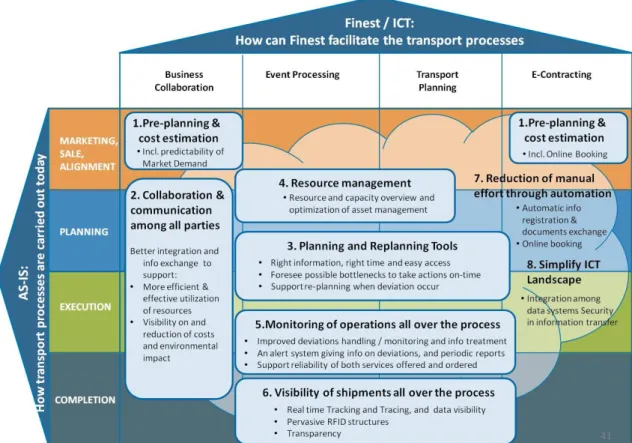
The figure below shows the generic requirements identified in D1.1 in relation to the 4phases process model and the FInest core modules. .
Figure 3: Generic requirements identified in D1.1 Analysis of the TL Domain
3
Generic requirements overview
3.1
Collaboration
Collaboration within the supply chain has two main parts: 1. Business alignment and contracting, and
2. Technical collaboration / communication.
Business alignment part is part of the sales and marketing activities of each party. When looking for business partners, a supply chain entity needs to have knowledge concerning the capabilities of potential partners. A service in which both parties could meet each other and negotiate rates, terms and conditions would be more efficient than the common current process of calling or sending e-mails to potential partners.
Collaboration requires the definition of information flows between partners. In addition, to properly collaborate, partners need to define the methods and technologies they will use to exchange the defined information (Blecker, 2000).
The definition of the information to be exchanged is a basic requirement for all interactive tasks and action within a supply chain. Information that is required to as input to a task, as well the information the task has to provide, are mandatory definitions that must be developed. Communication standards, such as e-mail and fax (basic), or EDI (advanced), need to be defined. Also, the content of the information to be provided has to be agreed to. With respect to EDI, the protocol (AS2, FTP, HTTP, etc.) and the message standard (UN/EDIFACT, ANSI X12, XML, etc.) have to be agreed to among the partners.
While collaboration is a relationship that must be organized between two parties, to efficiently operate and manage a supply chain requires a more global approach.
3.2
Planning
The main function of planning is to guarantee availability, which is used to procure or produce the required quantities on time. The planning process includes the monitoring of stocks and, in particular, the creation of procurement proposals for purchasing and production.
Planning tries to strike the best balance between: optimizing service levels, and
minimizing costs and capital lockup.
These objectives are often in conflict, thus making the planning process a very difficult one to carry out effectively in complex supply operations.
Planning in a supply chain has two primary tasks. The first is to plan material flows for the procurement of raw and semi-finished products, the production of goods, as well the distribution of finished goods and ensuring their market availability. This task is generally covered by ERP solutions that could provide essential inputs to a global collaborative supply chain ICT solution.
The second task concerns planning the efficient physical flow of items within the supply chain. This task requires an overview of available resources, technical constraints/capabilities on the legs of the supply chain, as well as costs, risks and the points at which responsibilities transfer. The coordination of several legs in the supply chain requires reliable input from suppliers and partners. The risk of deviations increases rapidly with the level of uncertainty in shipment data or transport operator reliability.
Planning is closely linked to resource management, monitoring and visibility. It requires transparency from all parties involved. Transparency facilitates monitoring, which is mandatory if one wishes to pro-actively manage their supply chain.
3.3
Resource Management
Resource management is the efficient and effective deployment of an organization's resources when they are needed. Such resources may include financial resources, inventory, human skills, production resources, or information technology.
The requirement for resource management within the transport and logistics domain consists of:
demands for various resources based on shipment type, logistics process, etc., forecasts of resource demands by time period,
resource configurations required based on demand requirements, and
resource availability based on demands
, again forecast by time period into the future.The goal of resource management is to achieve 100% utilization of each resource, but this goal must be traded off against other constraints such as maintenance requirements, service level impacts and costs.
Efficient resource management is a key factor in the successful operation of a supply chain. It is also a critical component of any planning system used to plan supply chain operations. Since resources must be planned and consumed in each step of supply chain operations, the requirement for resource management demands that there be transparent access to resource requirements for each task, the availability of appropriate (and alternative) resources for each task (by partner), the constraints that impinge on each resource by task, the costs of each resource, their capabilities, etc. Resource management is an essential part of the planning.
3.4
Monitoring and Visibility
Management of the execution activities within a supply chain requires access to information about where shipments are, what state/condition they are in, notifications about status changes and any one of numerous other pieces of real time information concerning the shipment. Since there are numerous partners providing services during the shipment of goods, there are several ways to retrieve the necessary information from the business partners. (E-Freight, 2012)
The events to be monitored are different for each party involved in a shipment. This means that information can be provided in different formats with different levels of timeliness. Systems that are used to address these varying requirements for status and notification data should be flexible and have the ability to be configured appropriately for the event being monitored and tracked.
3.5
Targets to be achieved
Along with the high level generic requirements identified in D1.1, a set of objectives, or targets, was developed in that deliverable for the FInest project. These targets are discussed briefly in the paragraphs that follow.
3.5.1
Simplifying the ICT landscape
SCM software is a highly fragmented collection of software applications. Each of the major supply chain transport and storage modes is composed of dozens of specific tasks, most of which have separate software solutions. Organizations need to track supply, demand, manufacturing status, logistics and distribution on a real-time basis. They also need to share data with supply chain partners at an ever increasing rate. Vendors assemble these different chunks of software under a single roof, but no single vendor will have a complete package that is right for every company. (OECD,2012)
3.5.2
Reduction of manual input and tasks
While the ICT landscape within the transport and logistics domain is highly fragmented, the physical processes performed by those providing execution services is also fragmented. This leads to the requirement of employing multiple organizations in any international shipment of goods. Each of these organizations have their own information processing systems that may, or may not, be integrated. The need for multiple organizations to perform execution tasks, the highly fragmented nature of the ICT landscape and the lack of common standards contribute to numerous manual information exchange and input processes. (Freightwise, 2006) This reality requires that any system developed in the FInest project should take as a target the net reduction in manual input required to maintain accurate information for system partners.
4
Communication / Information Exchange
Building a well-organized supply chain requires a well-defined communication mechanism to provide a precise and complete set of definitions for both business communication and transaction data. A common communication mechanism is needed to manage individual member companies. It can also be useful for creating an operation strategy in a supply chain. Furthermore, the data specification for the chain can be used to support the design of a distributed database among companies using Electronic Data Interchange (EDI) or an internet protocol. There are several information modelling methodologies, modelling languages, and implementation methods available to support the development of such communication mechanism. The approach to developing this communication mechanism and the data specification are listed here:
Perform case studies to investigate a real supply chain system. Identify the scope of the target application.
Identify core processes of supply chain management. Analyze communication data flow.
Layout data specification.
This deliverable provides a generic specification of supply chain management data with which the supply chain members use to communicate with one another.
4.1.1
Data Flow
The transport and logistics domain is highly fragmented with a large number of participating companies in all sizes, offering numerous different services and approaching the marking in various levels of capabilities and professionalism (Kaltenbrunner, 2012). To manage the complexity that this highly fragmented structure yields requires smooth data exchange between partners so that each partner can do their part in fulfilling the supply chain’s objectives. Unfortunately, data flow becomes more fragmented and difficult to align with the supply chain’s overall objectives as the number of heterogeneous parties involved in the transport process increases. This is one of the main issues in the set up and execution of modern supply chains (Evangelista, 2012).
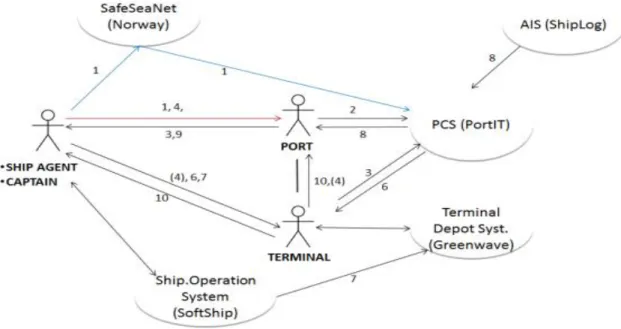
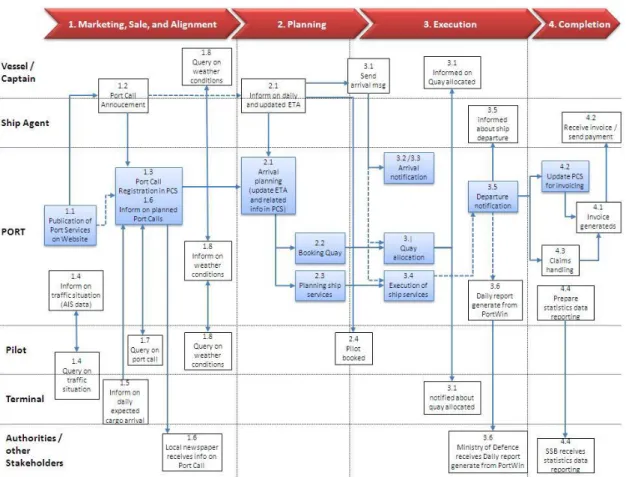
Figure 4: Data Flow Example (MARINTEK, 2011)
As an example of how quickly fragmentation of partners and activities within the supply chain can lead to complex information exchange patterns, take a small slice from the activities that occur in shipping fish from Norway to Brazil. The figure above is taken from the gap analysis of Use Case 1 in the FInest project (D2.3). This figure shows just a small part of the of the complete use case process (the scheduling of ship into port for unloading and loading), but
displays the complex and fragmented communication processes among the partners and their ICT systems.
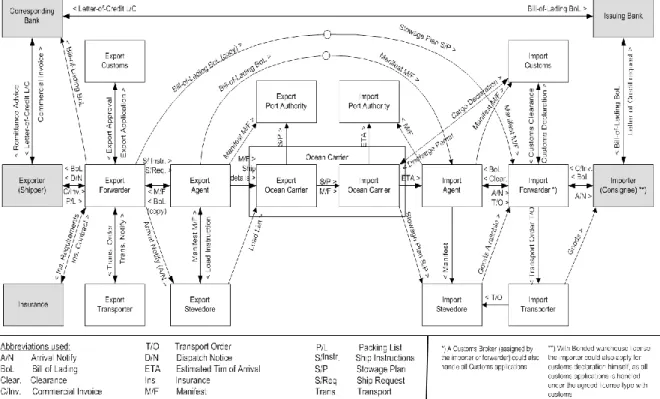
Figure 5: IBM and KN Secure Trade Lanes Project
Figure 5 above shows the complex relationships among partners when attempting to clear customs. This complex process occurs in parallel to the process noted in Figure 4 and is performed by an entirely different group of actors using entirely different systems from those used by the ship captain, the port and the terminal operator. Complexity is layered on top of complexity at each step in the supply chain creating a significant challenge for any supply chain manager to keep track of their goods and ensure that they arrive at the required destination at the right time. Expanding this complexity on a global scale indicates that the effort to seamlessly share information and align partners in a global shipment process is an extremely difficult task given current approaches to communications and data management.
Within this deliverable the information flow of the three FInest use cases will be used as examples for documenting the concrete information flows in a supply chain. These use cases will also be used to document the content of the information being exchanges as well as the technologies typically employed for exchanging and managing this information.
4.1.2
Communication Analysis
Based on the use cases chosen for the FInest project, detailed requirements have been developed through an in depth analysis of each use case scenario. The flow of information
among the parties with regard to tasks and actions has been used as the foundation for business requirements to establish a supply chain. The information exchange that is required to execute the tasks identified in the use case scenarios enables the parties to collaborate, plan and manage resources while monitoring the flow of goods through their supply chains. The next section of this report documents the requirements that have been derived from this analysis.
5
Use case requirement analysis
Based on the results of Work Package 2 “Use Case Specification”, and especially based on deliverable D2.2 “High level specification of use case scenarios”, this chapter will describe the resulting requirements identified for each of the three use cases. The following table summarizes the high level requirements determined in WP2 – Root Cause Analysis.
Use Case 1
Fish Transport from Norway to the EU
Use Case 2
Air Transport – Import from Asia to NL
Use Case 3
Global Consumer Goods Production and Distribution
Centralized and improved exchange of information: right information, right time, easy access, higher coordination among all involved actors. More automation of
information registration (reduced manual work) A system adapted to current
systems in place Online Booking
Improved predictability of market demand (Statistics, forecasts, market portal) Enabling high cooperation
and capacity overview and management (resource hub; one virtual meeting place for all actors)
Increase transparency and enable flexibility
(Networking/pooling could be a valuable strategy) Facilitate Port Call and more
flexible use of slot-time (need more coordination) Improved handling of
deviations; Better
monitoring and immediate
Event-driven monitoring and tracking of logistic processes Collaboration manager (A
standardized
communication interface between all participants) Transparency
Pervasive RFID structures Real -time Tracking and
Tracing
Clear responsibilities# Predictability
Resource overview
Better overview over available capacity / availability
Real-time tracking and data visibility
Automation of information and documents exchange Ensure security in
information transfer Legal documents: need for
e-transfer of legal documents Integration with the data
systems with the partners to reduce manual inputs Need to access the right
information
Needs an alert system which gives info on deviations, and/or periodic reports Foresee possible bottlenecks
& problems to take action on-time
Re-planning of the routes when deviations from the plans
Need less manual work A unique reference number
which can be used to trace the materials/products and data associated with them
treatment of information (e.g. PTI check)
Real- time tracking of container and vessels around the world.
through all the phases of the transport
Visibility on environmental carbon footprint and reduction of carbon emissions
Table 1: High level Use Case Requirements
As one can see, the requirements of the different use cases are either the same or strongly correlated with one another. This indicates that many of the seemingly different modal requirements could be fulfilled through a few common, but configuration, features in an ICT system.
Because of these observations, a requirements analysis has been performed for each of the three use cases with a focus on ICT. Several interviews with each domain partner who is involved in one of the use cases were performed to gather all the needed information regarding processes and information flows in their respective supply chain scenarios. A set of core processes in the use cases was identified. The input and output flow of information in these processes between the different stakeholders was categorized and analyzed. As a result, the information required for the integration of this processes in an ICT system has been identified. These information requirements are a set of different kinds of messages that are exchanged or shared among all stakeholders through different communication channels. The information flow of each use case was examined for the amount of three kinds of information that are necessary to transport every kind of good:
Addresses:
Addresses can be the address of the shipper or the consignee, which identifies the start and end points of the transport chain or, for example, the port of loading / discharge or an airport or any other stopover in the chain.
Freight details:
Freight details include the basic facts concerning the goods that have to be transported. This could be the measurements (volume / size / weight / etc.) or the number / type / weight of containers that have to be shipped, depending on the use case.
Time:
Information about time contains the date of the start / end of a shipment and estimated times of arrival / departure.
These three kinds of information have been identified as the most important information types in every use case. It does not matter by which means goods have to be transported, without knowledge about addresses, details on cargo and critical times in the supply chain it is not possible to effectively execute a supply operation. Using this fact as a basis of analysis, each of the FInest use cases business requirements (documented in the next sections) were analyzed and a set of requirements for the FInest ICT solution was developed.
5.1
Use Case 1 – Fish Transport from Ålesund (Norway) to Brasil
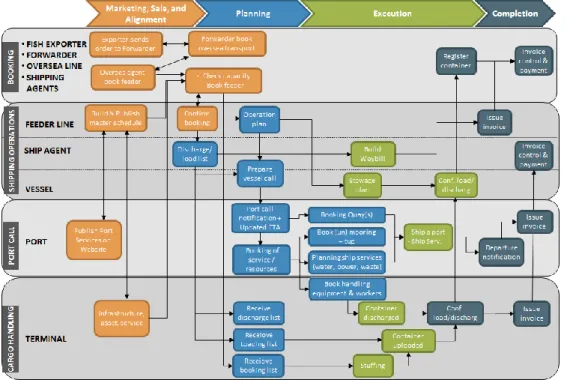
Figure 6: Big picture Use Case 1
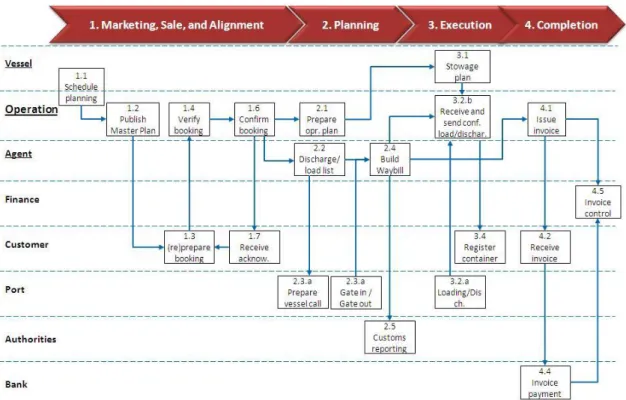
This first of the FInest use cases consists of the export of fish in containers from Norway to Brazil. The business process is documented above in Figure 6. The project partners represented in the use case are the shipping operator (feedering operations) NCL, the container terminal operator Tyrholm & Farstad , and the Port of Ålesund. The use case focuses on the parts of this chain in which the three domain partners are engaged in order to highlight their main processes and challenges, but especially the interaction among these three actors
Figure 7: Information Flow UC1 1
As depicted in Figures 7 and 8, and refined in the detailed process flow analysis in the appendix, a large amount of information is carried through this link in the transport chain. Because of the importance of information to effective and efficient execution of these partners’ operations, it is critical that every message reaches the intended receiver at the right time. For example if customs is not informed about the kind of goods that are being imported before they arrive, the whole transport process is forced to pause until the shipment is inspected, the proper paperwork received, reviewed and signed off and the goods get released. By evaluating the data that is exchanged it comes clear that some kinds of information are transmitted more often than others.
Figure 8: Information Flow UC1 2
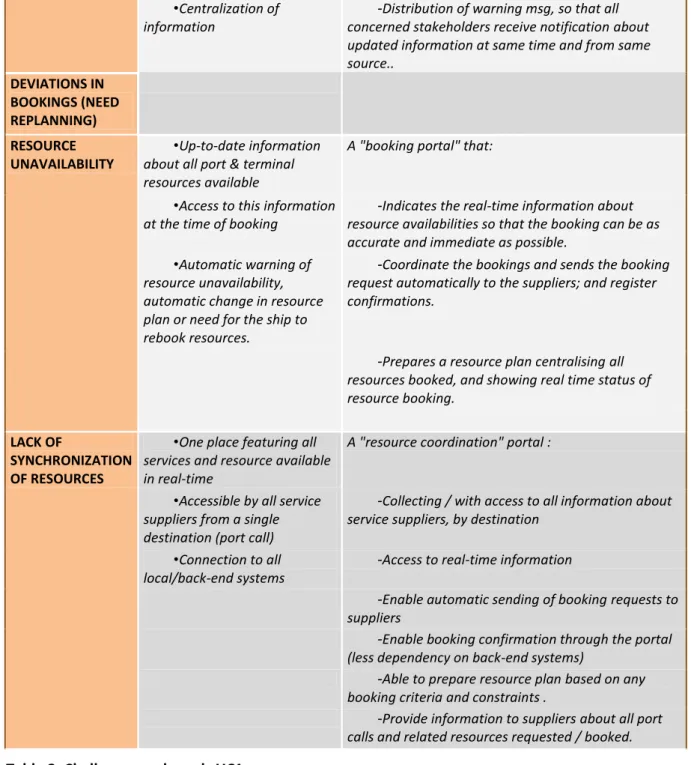
Based on the analysis of gaps or current challenges that the partners have experienced, a set of requirements and potential ICT “solutions” were developed. A summary of this information appears in Table 2 following.
Challenge Needs Possible IT Solution
Late cancellations: A. Open reservation of capacity Online Market place:
Dummy booking + (Maintain flexibility for customers) transport services offer•Collect and display transport needs and
No-show
B. Alternative cancellation windows & price models
Booking Manager: (Incentives for less
cancellations)
•Register booking according to status (reservation / confirmed booking)
•Impossible to register several identical bookings
C. Early warning of cancellation Booking manager:
(for longer reaction time and replanning window) •Register cancellations and update of booking list shipping agents, terminals)•Simultaneous warning of all actors (forwarder,
(find replacement to the cancelled booking) •Integration with external market places departure•Identify available capacity short time before
•Identify pending transport needs
•Suggest best match
•Send offer to shipper on behalf of carrier (both replacement bookings and rebooking of cancelled shipment)
E. Offer alternatives to keep cancellation (to minimize the consequences of cancellations)
Change in booking (Late notification)
•Real- time information Early-warning:
•Immediate notification of changes in TEP
Signalising any cancellation of booking
•Single source of information Late Changes in Booking •Improved planning upstream i SC
•Booking manager (carrier-shipper) with more binding booking
•Reduce number and frequency of cancellation
•Match maker (carrier-shipper) enabling last minute booking of available cargo at terminal
•Reduce number of late cancellation
•Enable the quick
replacement of cancellation with cargo available at terminal Information Exchange • Less one-to-one communication
-Integration with backend system
• single information source -Standard e-document (lad/ldis charge list and booking list) for automatic transfer and registration
• Less manual processing of data
• standard format
•All trucks equipped with PC to remove paper communication
Ship delay
Early warning Port traffic information platform:
Single information source •Combining all information and real-time data related to port call and maritime traffic
•Provide up-to-date info on planned port calls •Sends automatic warnings in case of changes in
ETA/ETD (event characteristics to be defined by receiver of warning)
Cargo delayed ••Early warning Early warning from cargo owner
LOW AWARENESS ABOUT SEA TRANSPORT
•More coordinated
marketing of sea transport A "information centre" for the entire maritime transport community, combining:
LOW USE-FRIENDLYNESS
•Simplified regulations
-up-to-date information on any TSD
•Centralization of
information -Simulation tools (as a support for TEP) INCOMPLETE
OVERVIEW OF PORT & TERMINAL SERVICES
•Centralization of
information (one place) Partly presented in DEMO2 (only for
information on destination (port & terminal services)
•Easy-to-find information
•Centralization of
real-time data
•Support for
benchmarking of services
•Support for planning BOOKING PORT /
TERMINAL SERVICES: LOW
USER-FRIENDLYNESS
•A single login for any registration of port call and booking of all related services
A "booking portal"enabling:
•A single platform for any destination (port/terminal)
-Captain or ship agent to register all information related to port call in a same place, both legal and commercial information.
•Harmonization of information (voyage nr) and messages
-Access to all existing registration systems (SSN),
•Automatic retrieval of information from existing systems
-Send booking request and automatic updates to the concerned suppliers/stakeholders,
•Booking based on real-time information on resource availability
-The port/terminal service suppliers to confirm booking directly in the platform.
•Handling of booking confirmation
-Access to real-time information about resource availabilities so that the booking can be as accurate as possible.
•Centralization of reporting
-Prepares a resource plan centralising all resources booked, and showing real time status of resource booking.
Single window for centralizing all mandatory legal reporting
Already tackled by SingleWindow concept
(e-Freight/e-maritime) LATE OR NO UPDATES OF PORT CALL AND BOOKINGS OF SERVICES
•Notification asap of any changes in ETA / ETD
A "booking portal" that allows for:
•Notification asap of any changes in services / resources needed
-direct updates in plan,
•Correct information -Automatic reception of deviation messages (directly from AIS system, or other local system etc)
•Centralization of information
-Distribution of warning msg, so that all concerned stakeholders receive notification about updated information at same time and from same source.. DEVIATIONS IN BOOKINGS (NEED REPLANNING) RESOURCE UNAVAILABILITY •Up-to-date information about all port & terminal resources available
A "booking portal" that:
•Access to this information at the time of booking
-Indicates the real-time information about resource availabilities so that the booking can be as accurate and immediate as possible.
•Automatic warning of resource unavailability, automatic change in resource plan or need for the ship to rebook resources.
-Coordinate the bookings and sends the booking request automatically to the suppliers; and register confirmations.
-Prepares a resource plan centralising all resources booked, and showing real time status of resource booking.
LACK OF
SYNCHRONIZATION OF RESOURCES
•One place featuring all services and resource available in real-time
A "resource coordination" portal :
•Accessible by all service suppliers from a single destination (port call)
-Collecting / with access to all information about service suppliers, by destination
•Connection to all local/back-end systems
-Access to real-time information
-Enable automatic sending of booking requests to suppliers
-Enable booking confirmation through the portal (less dependency on back-end systems)
-Able to prepare resource plan based on any booking criteria and constraints .
-Provide information to suppliers about all port calls and related resources requested / booked. Table 2: Challenges and needs UC1
5.2
Use case 2 – Air Transport of Equipment
Figure 9: Big picture Use Case 2 (IATA, 2011)
The second FInest use case is covered by the companies (Kuehne+Nagel and AirFrance-KLM Cargo) representing the two main roles in the transport chain. Focus has been put on describing a complete door-to-door transport chain by dividing it into three main parts:
1. Shipper to Carrier,
2. Carrier process (Forwarder to Carrier, then Carrier to Forwarder), and 3. Carrier to Consignee.
Figure 10 shows the standard flow of documents that occurs in the airfreight shipping process used for the FInest use case. This flow has been established by work of member of the International Air Transport Association (IATA) and is one of the few true standards in any of the international shipment processes.
Figure 10: Document Flow Airfreight (IATA, 2012)
Note: 0,n means that there may be no associated documents but possibly more, i.e. zero to many 1,1 means that there must be only 1 associated document, i.e. one to one
1, n means that there must be at least 1 associated document but possibly more, i.e. one to many
The various documents that are exchanged in Figure 10 are described below (note that this information is provided to maintain the self-contained nature of this document. This information is available in the FInest domain dictionary at www.finest-ppp.eu).
Air Waybill:
A shipping document used by the forwarders and airlines for air freight. It is a contract for carriage that includes carrier conditions of carriage including such items as limits of liability and claims procedures. The air waybill also contains shipping instructions to airlines, a description of the commodity and applicable transportation charges. Air waybills are used by many truckers as through documents for coordinated air/truck service. Air waybills are not negotiable. The airline industry has adopted a standard formatted air waybill that accommodates both domestic and international traffic. The standard document was designed to enhance the application of modern computerized systems to air freight processing for both the carrier and the shipper.
Flight Manifest:
Details of consignments loaded onto a specified flight. House Waybill:
Document made out by an agent / consolidator which specifies the contract between the shipper and the agent/consolidator for the arrangement of carriage of goods
House Manifest:
Document containing the same information as a cargo manifest and additional details on freight amounts, etc
Receipt for the Cargo:
A documentwhich is provided to the shipper, upon shipper’s request, by the Carrier creating a shipment record as a substitution for the issuance of an air waybill and which permits identification of the shipment.
Shipment Record:
Any record of the contract of carriage preserved by Carrier, evidenced by means other than an air waybill.
The Shipment Record is initiated by the FWB information and confirmed or modified by the subsequent FSU(RCS). FSU/RCS would only modify the information regarding Total Number of Pieces, weight and Volume Amount of the shipment. Only at that time the Cargo Contract shall be deemed concluded.
FFM Message:
The FFM message provides the details of consignments loaded onto a specified flight. It is the electronic message of the Flight Manifest.
FHL Message:
The main objective of the FHL message (type 1) is to provide a “check-list” of Freight Forwarder house waybills associated with a Master Air Waybill.
A second type of FHL (type 2) has been accommodated to provide details of one House Waybill consignment in order for the carrier to provide Customs with advance information based on the house waybill information provided by the origin freight forwarder.
Under IATA e-freight the IATA Cargo-IMP Consolidation List (FHL type 1) message serves as the house manifest document.
FWB Message:
The FWB message is used to transmit a complete set of Air Waybill data in accordance with the IATA Cargo Services Conference Resolutions.
FSU(RCS) Message: The FSU message is used to notify/update interested parties with a (change of) status of a specified consignment as recorded in the system of a handling party.
The standard code “RCS” specifies that “The consignment has been physically received from the shipper and is considered by the Carrier as ready for carriage on this date at this location". FHL’ Message:
For the purpose of these specifications, the message that contains House WayBill (HWB) data sent by the Origin Freight Forwarder with potential updates made by the Origin Ground Handler.
FWB’ Message:
For the purpose of these specifications, the message that contains Air WayBill (AWB) data sent by the Origin Freight Forwarder with potential updates made by the Origin Ground Handler on data such as weight, number of pieces, volumes. (IATA, 2012)
Some of the documents shown in Figure 10 already have an electronic standard message format developed through IATA:
Flight Manifest (CIMP-FFM), Air Waybill (CIMP-FWB),
Shipper’s Declaration for Dangerous Goods (CIMP-FDD or XML-SDDG). House Manifest (CIMP-FHL),
House Waybill (CIMP-FZB), Invoice (XML),
Packing List (XML),
Certificate of Origin (XML),
Generally, the Flight Manifest is a list of all Air Waybills that are loaded onto a specific flight. The Shipper’s Declaration or Dangerous Goods is associated to the Air Waybill.
The flow of information required to ship goods by air, while relatively well documented (Figure 10) is still open to implementation interpretations. Those documents that are exchanged that have not been standardized in message form by IATA are still exchanged in formats that vary by partner. In addition, even though IATA has defined standard electronic formats for many of the documents, not all partners are able to exchange information in electronic form. This leads to many paper based documents being exchanged and numerous manual data entry processes in a normal goods shipment.
Based on the detailed root cause analysis conducted in WP2, the following challenges have been identified:
Order management: From booking to actual receipt
Monitoring and visibility of shipment
Deviation management
Optimize data quality
Similar to the first use case, analysis of the business processes results in different kinds of requirements that are listed in Table 3.
Challenge / Root Causes Needs Ideas for solutions
•Volatile Market demand
•Correct booking information
•A collaboration platform that delivers in real time information to all parties in the supply chain chain, when a deviation occurs in the process from booking to the actual shipment.
•Forget to communicate due to daily operational priorities
•Being informed about changes as soon as possible/when the moment it occurs
•A booking intelligence applications who combines booking information from different supply chain partners and gives a trigger when inconsistencies occur. For example: products, dimensions versus weight. •Human Errors, wrong
processing of
information/data input
•Not informing other partners about changes
•Traffic Jams
•Measurements often are bottle neck, creating wrong dimensions for further planning
•The right dimensions of the freights, on different aggregation levels, from smallest package to total.
•Weighing at the source / shipper, sharing via the Finest Platform to all relevant parties.
•Information too late available
•Information being exchanged with several supply chain partners, including authorities, without or with a minimum of human interface
•A collaboration platform that delivers in real time information to all parties in the supply chain chain, including authorities. This system also monitors deadlines and gives triggers on time when information needs to be sent to be in the ‘safe zone’
•Missing or Wrong information
•The right information on time in full
•Data quality management in within the platform •Next “step” in transport can only be initiated if all necessary input (correct, weight, dimension etc) is filled in
•Shipper not aware of information needed or documentation
• Shippers and forwarders fill in and deliver all the required documents
•A push system for shippers & forwarders regarding the right information delivery system. Based on the booking & product, the system forces the shipper to fill in all relevant documents.
•Data Quality existing measurements
•Time stamping done without human interface
•A collaboration platform that collects data from containers via tags. This should be a solution where the internet of things is combined with the Finest
Collaboration Manager to exchange the data. •Not enough milestones •Time stamping done
without human interface