WAC Websites as Knowledge Webs
danmelzer, californiastateuniversity, sacramento
BooKS FoCUSEd oN dEvEloPiNg Writing Across the Curriculum such as Mcleod and Soven’s Writing Across the Curriculum: A Guide to Developing Programs,
Fulwiler and young’s Programs that Work, and Mcleod et al.’s WAC for the New Millennium provide helpful advice for starting a WAC initiative: designing work-shops, organizing a faculty writing committee, creating a newsletter, planning a retreat, etc. This advice, however, doesn’t include creating a website as an impor-tant first step in developing a WAC program. The creation of a website is often an afterthought for those building WAC programs—something to get to after the program is off the ground. in this essay, i argue that creating an online presence for WAC is an important initial step, as crucial as designing workshops, organizing a campus writing committee, or creating a newsletter. As Sarah Kimball argues in her essay “WAC on the Web,” “decisions involved in designing and revising a web-site are rhetorical” (62). The goal of this essay is to provide not technical advice but a rhetorical framework for building a WAC website, with reflections on my expe-riences creating a WAC website and my observations about model websites from three WAC programs that i looked to for inspiration in designing a site: Writing Across the Curriculum at george Mason University, the University of Missouri at Columbia Campus Writing Program, and the North Carolina State University Campus Writing and Speaking Program. Using these models, i argue that WAC websites should be thought of as much more than tools for delivering information. WAC websites can be used to persuade, connect, and support students and faculty to create what distance learning theorist Chris dede terms a “knowledge web”: a
socially constructed clearinghouse of information connected by hyperlinks in an ever-expanding web. i end the essay with my vision of the future of WAC online and use the example of the WAC Clearinghouse to argue that a website should be thought of not as a supplement to a WAC program but as the center of the WAC “knowledge web.”
in the fall of 2003, i was hired to start a WAC program at California State University, Sacramento (CSUS). Along with the usual first steps that are familiar in the literature on starting WAC—a series of workshops, a newsletter, meeting with departments to talk about writing—i decided that i wanted to build an online presence as quickly as possible. i felt a website would be a nice complement to the newsletter i was planning to circulate and the advertising i was going to do for my first workshops. When i created the website, my primary purpose was informative: i wanted to have a place online where faculty could get easy access to a list of upcom-ing events and basic information about the WAC program. i created a brief mission statement, an explanation of the WAC movement, and a “News and Events” section. in my first semester as a WAC director, i was thinking of the rhetorical purposes of the site in extremely limited terms.
As useful as a website is for disseminating information, i soon began to see it as much more than a space to achieve informative aims. A website can also persuade, and i found that much of what i was posting online as i expanded the site was meant not to inform but to persuade both faculty and administrators. The simplest exam-ple of this is a quote from Barbara Walvoord that is the first piece of text on the main frame of the home page of the website: “Writing is so complex an activity, so closely tied to a person’s intellectual development, that it must be nurtured and practiced over all the years of a student’s schooling and in every curricular area.” The home page begins with persuasion, then, and this includes visual persuasion: just above the Walvoord quote is a series of pictures of diverse faculty attending a WAC work-shop (see Figure 1). A more extensive kind of persuasion happened when the Faculty Senate Writing Committee created a position statement on class size. i added a “posi-tion statements” link to the home page and posted the Writing Committee’s posi“posi-tion statement along with links to other position statements by NCTE and CCCC, and i often refer to this site when i make arguments for smaller class sizes or a focus on teaching writing as a process. Persuasion is also the goal when i post links to WAC research. on the website there’s information from our WAC program’s survey of faculty attitudes toward writing and a pilot study of alumni writing, both of which make arguments for the importance of teaching writing in every discipline.
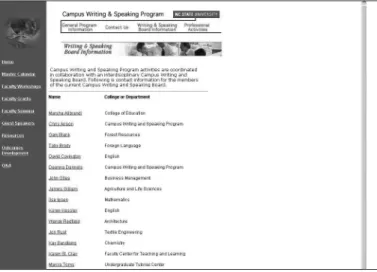
Persuasion is a primary aim of the three WAC program websites i used as mod-els. The websites for both the North Carolina State University Campus Writing and Speaking Program and Writing Across the Curriculum at george Mason contain links to the U.S. News and World Report’s issue ranking colleges, which honored both colleges for their writing in the disciplines programs. of course, sometimes inform-ing is also persuadinform-ing: by includinform-ing news and events, links to resources for students and faculty, WAC newsletters, position statements, and annual reports on the CSUS WAC home page, i hope that i am persuading faculty and administrators that i’ve created an extensive WAC program. North Carolina State’s Writing and Speaking Program’s website certainly would persuade any audience that they have an impres-sive breadth of programs and resources: there are links from the home page to work-shops, grants, seminars, resources, outcomes, professional activities, and the advisory board. Even the list of advisory board members is persuasive, with fifteen members from across disciplines listed (see Figure 2). in an educational climate where many WAC programs struggle to get funding and faculty support, persuasion is an impor-tant aim of a WAC website, and creating an online presence could help persuade faculty and administrators that your program is extensive and valuable.
in his essay “Negative Spaces: From Production to Connection in Composition,” Johndan Johnson-Eilola encourages us to think of hypertext in
Figure 1: California State University, Sacramento Writing Across the Curriculum home Page www.csus.edu/wac
terms of connections and relationships. He argues that building connections and relationships is part of the creative power of the hyperlink. Focusing on the connec-tive power of the CSUS WAC website was another way i moved beyond the merely informative function. The links that i chose to include at the top of the website, for example, signify WAC’s connection and relationship to other academic programs. There’s a link to Academic Affairs, which sponsors our WAC program, and a link to the Writing Center, which i often collaborate with. The WAC website’s Url links me closely to CSUS itself: you simply add “wac” to the CSUS root to get to the site. i am also linked to the institution through my connection from the CSUS home page. By clicking on the “faculty and staff” button from the CSUS home page, the link to WAC can be found under the “Professional development” heading. Being just two links away from the CSUS home page reinforces the institutional support of the WAC program and is a kind of argument for its legitimacy. in addition to WAC connecting to other programs, sometimes other programs and faculty mem-bers link to WAC. For example, graduate Studies includes a link on their website to WAC’s thesis writing workshops and peer response group programs, and the library links to WAC from their preventing plagiarism website. Because the WAC website includes resources for students, some instructors include a link to it on their syl-labus. This kind of linking reinforces the spirit of collaboration and connection
Figure 2: north Carolina State University Campus Writing and Speaking Program board www2.chass.ncsu.edu/CWSP/header/board_info.html
that WAC programs stress and provides concrete examples to administrators that the WAC program is collegial and works with other campus programs and faculty across disciplines.
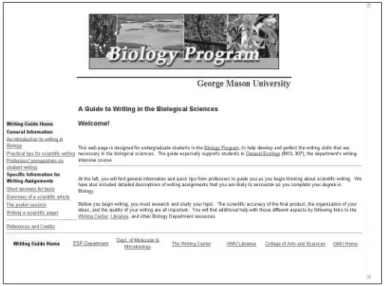
This connection goes beyond just links, however. in WAC workshops, retreats, and conferences, faculty often share favorite writing assignments, grading rubrics, peer response prompts, etc. The website allows me to connect to these faculty-generated materials with one click of a hyperlink. in the collection of resources for students and faculty, there is material created by the WAC program as well as mate-rial generated by faculty. For example, a writing guide created by the philosophy department which is now linked to the WAC student resources page, a guide to peer response created by a faculty member from geology and the dean of the College of Health and Human Services, and advice for thesis writers from a Public Policy and Administration instructor. Currently my WAC student assistants are working on creating writing guides for different disciplines in collaboration with the professors from the disciplines, an idea i borrowed from the george Mason WAC program. WAC at george Mason uses the connective power of hyperlinks to create writing guides for a variety of disciplines: biology, history, psychology, nursing, etc. Each site is faculty-driven. The biology site, for example, has a link to “Professors’ per-spectives on student writing.” This link contains tips from the professors, example
Figure 3: george Mason’s guide to Writing in the biological Sciences http://classweb.gmu.edu/biologyresources/writingguide/index.htm
assignments, and even entire course descriptions (see Figure 3). WAC websites allow programs to make connections to professors across disciplines in ways that we are just beginning to take advantage of in the WAC movement.
Connection is also a theme of the home page of the University of Missouri at Columbia Campus Writing Program. From the list of links at the top of the page instructors can learn more about Writing-intensive courses, tutoring, and news and events. The left-hand frame has links to the Writing Program faculty and staff. The “CWP info” link has further links to other WAC programs and campus pro-grams that have a relationship with the CWP, such as the English department, the Teaching and learning Council, and general Education (see Figure 4). The CWP website is also linked closely to the University of Missouri itself: it is only a few links away from the University’s home page.
A unique feature of a website published on the internet is how quickly it can connect to a national and even international audience: i connected the CSUS WAC website to a broader audience beyond campus by including it in the
WAC Clearinghouse’s list of links to programs as well as the National Network of Writing Across the Curriculum’s list of programs and their websites. you can also find my WAC program through a google search using key terms like “writing across the curriculum,” and over time it has joined a kind of WAC web ring of programs: one of the websites i am using as a model, the University of Missouri at Columbia Campus Writing Program, has a link to the CSUS WAC website as well as the other websites i am using as models in this essay. Although it’s difficult to gauge just how often audiences beyond campus are visiting the CSUS WAC website, a number of institutions, from Alaska to New york, have
Figure : University of Missouri Campus Writing Program Campus links http://cwp.missouri.edu/cwpinfo/campuslinks.htm
requested consultations after coming across the website, and i’ve received emails from teachers all over the United States asking if they could draw from a survey i posted online or use one of the handouts on the website in their own WAC workshop. Hyperlinks provide a unique opportunity to connect a WAC program to other academic units, faculty from across disciplines, and an audience beyond the campus. This idea of ever-expanding resources and information, connected by hyperlinks both within campus and beyond, leads me to my discussion of WAC websites as knowledge webs.
Chris dede’s notion of knowledge webs, as applied to distance learning, describes the phenomenon of internet resources linking through search engines, hyperlinks, web rings, etc. to form multiple layers of information. Since each link leads to further links, there’s a sense of an ever-expanding web of knowl-edge. This web of knowledge is a socially constructed series of relationships and connections, with dispersed but like-minded members of a discourse commu-nity connected through the linking powers of websites. The Writing Across the Curriculum website that most closely resembles dede’s definition of a knowledge web is the WAC Clearinghouse at http://wac.colostate.edu. i will focus on the
Clearinghouse website to explore what i think will be the future of WAC websites as knowledge webs.
in my vision of WAC websites as knowledge webs, the power of hyperlinking will provide almost unlimited connections to resources aimed at a variety of audiences both on and off-campus. Consider the information and resources available through hyperlinks on the home page of the Clearinghouse: a list of members, a meeting room, news and updates, recent publications, WAC programs and consultants, WAC jour-nals, WAC conferences, the WAC-l listserv, etc. Most of these links lead to further links. For example, the link to WAC programs will lead you to a list of links to the home pages of over twenty WAC programs, each of these home pages will lead you to links of WAC resources, these resources are often connected to other resources, and so on. As hypertext theorist Jay david Bolter argues, “a hypertextual network can extend indefinitely, as a printed text cannot” (24). one way a hypertext network can extend indefinitely is through the participation of the readers in the creation of links and content. in the case of the Clearinghouse, anyone visiting the site can add news and events, information about conferences, links to their program’s website, resources for teachers, etc. in one section of the Clearinghouse in particular, the “Teaching Exchange,” instructors can post writing assignments and syllabi (see Figure 5). To be truly hypertextual networks, WAC websites would allow instructors from across
disciplines to add assignments, writing activities, and advice from their disciplines to the knowledge web, much like the Clearinghouse’s “Teaching Exchange.”
in addition to the layers and layers of links, the audience for a knowledge web can also extend indefinitely. Clearinghouse visitors include everyone from those who want to know more about the WAC movement, to experienced WAC program direc-tors, to faculty from across disciplines, both inside and outside of the United States. in my role as the News and Events editor of the Clearinghouse, i’ve received emails from germany, New Zealand, and Africa. our primary audience for WAC websites may be faculty on our campus, but we should also consider students, administra-tors, and off-campus audiences as well—both national and international.
As much as i admire the WAC Clearinghouse, i think there is one crucial aspect of the ideal WAC knowledge web that the Clearinghouse lacks. The builders of the
Clearinghouse knowledge web are, for the most part, WAC program or Writing Center coordinators. Contributors to the Teaching Exchange, the News and Events, and other sections of the Clearinghouse are mostly faculty directing WAC programs, not faculty from across the disciplines, and the majority of the advice, tip sheets, model assign-ments, etc. do not come directly from instructors in the disciplines. The Clearinghouse
is an excellent site, but it is not as broad a representation of faculty from across the curriculum as i envision occurring on WAC websites of the future.
Figure 5: WAC Clearinghouse Teaching exchange http://wac.colostate.edu/exchange/index.cfm
The CSUS WAC website is in its infancy, but someday i hope to have a truly faculty-centered, socially constructed knowledge web. i imagine a place where faculty can post favorite assignments, rubrics, course syllabi, and other materials using their campus email user name and password. i can envision links to student essays from across disciplines, as well as links to innovative writing projects such as class websites or electronic portfolios. Someday i hope to have extensive links to both research i’ve conducted on campus as well as writing research being conducted by faculty across disciplines at my institution. i can foresee a nearly endless layering of hyperlinks, but with faculty adding links and pointing students to further resources in their discipline. This might include writing guides similar to those being created at george Mason or a campus-wide guide for the teaching of writing with advice and resources from faculty who have served on the university writing committee or participated in the summer faculty development retreat. it might include materials that are generated by a departmental writing assessment, such as example student essays or discipline-specific grading rubrics. WAC websites of the future, like WAC programs themselves, should be ground-up: coordinated by the WAC director, but with content generated by faculty across disciplines.
The WAC movement has just begun to explore what can be done with WAC websites, in part because for many of us the creation of an online presence was an afterthought or at best seen as a complement to the more important tasks of workshops and consultations. i hope i have made a convincing argument that web-sites should be central to fulfilling our most important goals as well as promoting our program to students, faculty, and administrators. Through the power of the hyperlink, the audience for a WAC website can even extend beyond our campus and connect us to the online community of WAC programs and resources in an ever-expanding web of knowledge and support. This online presence might begin with the directors of WAC programs, but in the future it is faculty in the disciplines who must expand the WAC knowledge web.
Works Cited
Bolter, Jay david. Writing Space: The Computer, Hypertext, and the History of Writing. Hillsdale, NJ: lawrence Erlbaum, 1991.
Campus Writing Program. University of Missouri at Columbia. 23 Feb. 2006 http://cwp.missouri.edu/.
Campus Writing and Speaking Program. North Carolina State University. 23 Feb. 2006 http://www2.chass.ncsu.edu/CWSP.
dede, Chris. “Emerging Technologies and distributed learning.” American Journal of Distance Education 10.2 (1996): 4-36.
Fulwiler, Toby and Art young, Eds. Programs that Work: Models and Methods for Writing across the Curriculum. Portsmouth, NH: Boynton, 1990.
Johnson-Eilola, Johndan. “Negative Spaces: From Production to Connection in Composition.”
Literacy Theory in the Age of the Internet. Eds. Todd Taylor and irene Ward. New york: Columbia University Press, 1998. 17–33.
Kimball, Sara. “WAC on the Web: Writing Center outreach to Teachers of Writing intensive Courses.” Wiring the Writing Center. Ed. Eric Hobson. logan, Utah: Utah State University Press, 1998. 65-74.
Mcleod. Susan, Eric Miraglia, Margot Soven, and Christopher Thaiss. WAC for the New Millennium: Strategies for Continuing Writing-Across-the-Curriculum Programs. Urbana, il: NCTE, 2001.
Mcleod, Susan and Margot Soven. Writing Across the Curriculum: A Guide to Developing Programs.
Newbury Park, CA: Sage Publications, 1992.
WAC Clearinghouse. 23 Feb. 2006 http://wac.colostate.edu.
Writing Across the Curriculum. California State University, Sacramento. 23 Feb. 2006 http://www.csus.edu/wac.