Williams Honors College, Honors Research
Projects The Dr. Gary B. and Pamela S. Williams Honors College Spring 2020
The Impact of Loan Forgiveness Programs on Out-of-State
The Impact of Loan Forgiveness Programs on Out-of-State
Migration
Migration
Jessica VongsaphayFollow this and additional works at: https://ideaexchange.uakron.edu/honors_research_projects Part of the Labor Economics Commons
Please take a moment to share how this work helps you through this survey. Your feedback will be important as we plan further development of our repository.
Recommended Citation Recommended Citation
Vongsaphay, Jessica, "The Impact of Loan Forgiveness Programs on Out-of-State Migration" (2020).
Williams Honors College, Honors Research Projects. 1190.
https://ideaexchange.uakron.edu/honors_research_projects/1190
This Dissertation/Thesis is brought to you for free and open access by The Dr. Gary B. and Pamela S. Williams Honors College at IdeaExchange@UAkron, the institutional repository of The University of Akron in Akron, Ohio, USA. It has been accepted for inclusion in Williams Honors College, Honors Research Projects by an authorized administrator of IdeaExchange@UAkron. For more information, please contact [email protected], [email protected].
The Impact of Loan Forgiveness Programs on Out-of-State Migration
Abstract
This research paper seeks to understand the effectiveness of state-sponsored loan
forgiveness policies on migration decisions for health professionals. Many factors are taken into consideration when deciding on whether to move, including economic and personal preference. The preferences of recent college graduates (who largely consider job opportunity, urban life, and social amenities) can differ from the preferences of retiring professionals (where space, amenities, and weather may be large factors). With the growth in student debt, states have begun implementing loan forgiveness programs. While these programs can be aimed mainly at
encouraging higher education, state sponsored programs that require a minimum in-state work
residency can also reduce the “brain drain” out of the state. Retaining high-skilled workers will lower the “brain drain” away from states that can negatively impact population growth and the
local economy.
Funding from the Health Resources & Services Administration (HRSA) in 2013 when the program began was used along with individual demographics from the American Community Survey four years later in 2017 to determine if the program has a significant effect on migration rates in the United States. After running a probit model we found that these state sponsored loan forgiveness programs do reduce out of state migration by about 1% for recently graduated health professionals. These results slightly concur with our original expectations and support the
effectiveness in loan forgiveness programs with in-state work requirements, though in a very low percentage.
Acknowledgements
Thank you to Dr. Francesco Renna and Dr. Michael Nelson along with my fellow classmates graduating Spring 2020 for their invaluable guidance and ongoing support. The completion of this research project would not
Table of Contents Introduction...4 Literature Review...6 Economic Theory...9 Methodology...10 Empirical Results...12
Conclusion and Limitations...13
References...14
Appendix...16
Introduction
Over the past 50 years, there have been some U.S. states that have seen a decline in population growth compared to other U.S. states. Many of these metropolitan areas losing residents were highly invested in the manufacturing sector and have seen workers leave as the industry began shrinking their workforce. These states are losing talent and high-skilled human capital to larger, more innovative cities with larger urban settings. Rust Belt states (Pennsylvania, Ohio, Indiana, Michigan, Wisconsin, and Missouri) have had a historically difficult time
attracting and retaining highly educated adults, resulting in a “brain drain”. This highly skilled population is moving out of the Rust Belt states into parts of the country with dynamic states, such as Massachusetts, New York, California, Illinois, and Texas, many of which are known for their big cities and urban life (Losing Our Minds: Brain Drain across the United States. 2019). This phenomenon can be referred as the brain drain as highly educated individuals move away to find work elsewhere for innovative jobs, better amenities, and larger urban environments. The brain drain can cause states to experience economic stagnation, lower production and slower population growth. Brain gain states can eventually experience high costs of living and other externalities associated with a highly dense population, such as overcrowding. The city of Denver, Colorado for example has experienced a big shift in population but lags behind in building infrastructure to support those new and existing residents. A drainage of highly skilled workers can negatively affect local economies from population loss and lower productivity. Important establishments such as hospitals in out-migration states could become understaffed and leave the community without enough doctors and nurses to help them. Brain gain states and big cities could also suffer from overcrowding and bottlenecks as the population grows each year.
This research project seeks to examine if state sponsored policies that promise debt forgiveness will increase retention of college graduates in their state for specific occupations or areas of study. Ohio, which has experienced high levels of the brain drain, implemented a bill in
2017 called the “STEM Degree Loan Repayment Program” to incentivize students to stay in the
state after graduation. Under the program, which began operating in July 2018, allowed the Ohio Chancellor of Higher Education to make loan payments on behalf of eligible participants. These
participants must meet the requirement of having obtained an Associate, Bachelor’s, Master’s or
Doctorate degree in a STEM-related field, have an outstanding student loan for the degree, and be employed in their degree field in the state of Ohio (Ohio Legislative Service Commission, 2017). Recipients could have around $2,000 to $8,000 in payments to their student loans annually for a maximum of five years. The initiative by the Ohio Department of Higher
Education encourages people to obtain a college degree in STEM and also incentivizes them to stay in the state for work after they complete their degree
If students graduate and continue working in the state, the brain drain from that state will be reduced. The research question for this project is “What is the effect of state sponsored loan forgiveness programs on interregional migration for college graduates?” The results we find will
inform us on the effectiveness of these programs and policies on reducing the net out-migration in some states in the United States.
Literature Review
Hawley and Rork (2012) examined the impact of state sponsored scholarship programs (or SSSPs) on university enrollment, graduation, and if they lowered brain drain from states. They found that in aggregate there was no significant change in out-of-state migration trends
following the implementation of SSSPs. However, their results also showed that younger graduates were more likely to stay in the state while older graduates (ages 35-65) had an out-migration rate of 1.5 percentage points. This implies that these programs are working in the short run, but eventually individuals move away. This could be due to lifted time constraints that required these people to stay in the state for a specific amount of time, such as residency work requirements or family obligations.
Gootlieb and Joseph also sought to analyze the out-of-state migration trends of PhD graduates in the absence of government incentives (2006). They expected science and
engineering graduates to be disproportionately attracted to large metropolitan statistical areas (MSAs) compared to other occupations, but their results show otherwise. Gootlieb and Joseph found that a relatively large amount of college graduates will stay in-state upon graduation and the trend is more prominent when the graduates were born or graduated high school in the same state where they received the degree.
Polimeni and Iorgulescu study a specific case of the brain drain in New York counties. Some counties in New York have invested heavily in education through a program called the Tech Valley since 1998. This study aims to answer four questions revolving around the
magnitude and the reasons why graduates leave the Capital District region of New York (2008). Polimeni and Iorgulescu used area specific data and administered their own qualitative survey to graduates to determine their reasons why each individual chose to leave or stay. As expected, they found that the overwhelming reason that graduates left was to seek out better employment opportunities that what existed in their states.
Sasser emphasizes the phenomenon of residents who are “voting with their feet” (2010).
and income. Housing affordability followed closely after the labor market and income, which has become a more significant factor in recent decades (post-1980’s). While these are the most significant factors from Sasser’s results, state specific policies that reduce student loans can have a direct effect on disposable incomes, changing the relocation benefits for movers. Rising debt will also become a larger burden on future college graduates, increasing the significance of loan repayment programs in the choice of relocation.
Hadland, like Polimeni and Iorgulescu studied the out-migration trends of a specific region or state. Similar to the Capital District region in New York, Alaska has historically experienced a large number of out-migration. The belief is that the migration out of the state stems from young graduates leaving after they completed their education. The study estimates that almost 62% of the population age 15-16 in 1994 pursued their college degree in Alaska. Of the 62% that stayed in-state to get their degrees, about 84% were still residents in the state in
2002 (2004). The high percentage of stayers can be attributed to Alaska’s economic environment
(unemployment rates or earnings) along with state funded training programs. Hadland also used these state funded training programs as an identification measure for postsecondary educational activity.
These studies are limited to observing education and scholarship programs that have little incentive to pull or keep graduates in the state for work after completing their degrees. By looking at loan forgiveness programs specific to the states themselves, we can determine if these policies are more effective at decreasing the brain drain. The migration of health professionals is also a growing concern for state governments. A low share of health professionals in the
population could leave the state with underserved areas, negatively impacting citizens in those areas and restricting them from proper health care, resulting in more health complications and
possibly death. Focusing on policies that repay student loans for health professionals will determine if these policies are effective at lowering out-migration and thus increasing the population of health care workers in the state.
Policy
Ohio has notably created a technology-oriented program, “Choose Ohio First” that has
offers college tuition scholarships for students that complete the in-state residency requirement
(2011). The goal of the program is to “fund higher education and business collaborations that
will have the most impact on Ohio’s position in world markets such as aerospace, medicine,
computer technology and alternative energy. These collaborations will ultimately produce substantive improvements to the pipeline of STEMM graduates and STEMM educators in Ohio.
Choose Ohio First is part of a strategic effort to bolster Ohio’s economic strength by ensuring a
ready workforce for STEMM-Related industries.” (OhioHigherEd, 2020). To be eligible for this
program, students must be enrolled full-time or part-time at a university in Ohio. The scholarship is also limited to Ohio residents or previous residents returning for additional education in Ohio. This program has increased enrollment rates at state universities, but as other studies have found, it does not significantly decrease out-of-state migration after students receive their degrees. When there is no further obligation to remain in-state after graduation, out-migration trends will not change even when scholarships are implemented.
To combat this, states have begun implementing programs that specifically target
high-skilled retention. The “STEM Degree Loan Repayment Program” is an example that
policymakers are concerned on not just state-funded scholarships for universities but also programs that help high-skilled workers after obtaining their degrees. More loan repayment
programs are also being implemented in recent years in light of student debt skyrocketing to levels unseen previously.
Economic Theory
Much like the Push-Pull theory on the brain drain, there are factors that attract and repel workers which can affect their preferences for migration. Pull factors, which typically include economic opportunities and amenities, are factors that help retain and attract workers to states that have better economic climates compared to other states in the U.S. Gottlieb recognizes the different theories surrounding the brain drain and human capital flows (2011). What is more important for increasing economic growth in a state? Is it the stock of educated individuals (supply) or the companies building and bringing talent (demand)? The Make-or-Buy theory
assumes that each state’s educational programs will train the labor force for the state’s own
economy, but in reality, we see that graduates are not attached to the state where they received their education. We expect this, since people are rational and will move to states that meet their preferences.
Another theory on migration comes from John Harris and Michael Todaro. Although the model focuses largely on rural to urban migration, the factors that Harris and Todaro use can also be applied to state-by-state migration. Harris and Todaro note that individuals will migrate from rural to urban areas if the expected urban income is larger than rural incomes. We can expect the same shift for states, as high-skilled labor will move to states that have dynamic cities along with other amenities. State policies that reduce the burden of student loans will increase disposable incomes.
Based on these migration theories, we expect that loan forgiveness programs incentive graduates to stay in-state for work. These policies may also pull out of state residents to attend a local university. The incentives that loan forgiveness programs have for graduating students will act as a pull and keep factor, retaining high-skilled workers which can allow for higher state economic growth.
Methodology
Data for this research project was extracted from the IPUMS USA database and the Health Resource and Services Administration (HRSA). The HRSA, a government agency, funds a state loan forgiveness initiative strictly for graduates in the health professional field. This H56 program awards various grants to states in order to help states incentivize newly qualified health professionals to work with the state in underserved regions. Each state program has different qualifications and independently operates the program; the HRSA does not set guidelines for who gets their loans forgiven (except that they are health professionals), how much can be forgiven, or the residency requirement for the recipients. Using the American Community Survey, information on gender, sex, ethnicity, educational attainment, state location, migration flows, and occupational data were collected in order to clearly identify how these state loan forgiveness programs (SLFP) effect individuals in each U.S. state. While educational attainment includes K-12 education along with post-secondary degrees, we will primarily be looking at five categories of educational attainment: high school dropout, diploma, some college, bachelor’s
degree, and graduate degrees. Location along with state-to-state migration flows will also be used to determine the amount of in-state migration and out-of-state migration for each of the 50
states. Using the occupational data obtained from IPUMS will also sort out how graduates with specific STEM degrees will respond geographically to programs that repay student debt.
Using the probit model, we will observe states that have implemented loan forgiveness programs and compare the effect of these programs to those states that have no similar policies in place at the time. We expect states that received funding from the HRSA to organize state loan forgiveness programs in 2013 to see a reduction in migration rates of recently graduated health professionals in 2017 (four years later). Model I and Model II depict the various independent variables used to determine out-of-state migration status.
Model I: OUT_OF_STATE = 𝛼 - 𝛽1LOGFunding - 𝛽2Age - 𝛽6Bachelors_Degree -
𝛽7More_College - 𝛽8Health_Profession
Model II: OUT_OF_STATE = 𝛼 - 𝛽1LOGFunding - 𝛽2Age - 𝛽3Female - 𝛽4Black - 𝛽5Latino -
𝛽6Bachelors_Degree - 𝛽7More_College - 𝛽8Health_Profession
OUT_OF_STATE is a binary variable that represents whether individuals in the 2017 American Community Survey moved away from the state they were previously in the past year. LOGFunding is the amount of funding from the Health Resource and Services Administration that is awarded to each state. The amount which varies from no funding to $949,000 is then awarded to eligible health professionals that have completed their degrees and have begun working in the state. The amount awarded to each individual is dependent on the reciepient’s
existing loans and the guidelines set in place by each state. In this model, we will only be looking at adults between the ages of 22 and 30 years, in consideration of recently graduated health
professionals and those completing residencies within the state. The variables Female, Black,
Latino, Bachelor’s Degree, and More College are also all binary variables that take into
consideration an individual’s demographics. Female, Black, and Latino represent an individual’s
sex, race, and ethnicity. Bachelor’s Degreerepresents individuals that received their bachelor’s
degree in 2017 from either a public or private university. More College represents individuals that have received education past four years in college, including those who received graduate
degrees such as master’s and doctorate degrees. We expect that all variables in the models will
reduce out-of-state migration, as increased funding towards loan repayments will incentivize recent college graduates to stay and work in-state to meet eligibility requirements.
Empirical Results
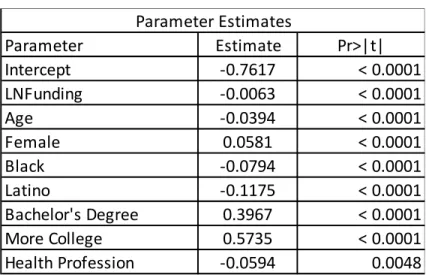
Both models of the dataset use a Qualitative and Limited Dependent Variable model (QLIM). This allows us to correctly use a probit model with heteroscedasticity. Our results, indicated as Table I, shows us that the states that receive more funding experience a lower probability of residents moving out of the state. Age, black, latino, and health profession also
seem to lower the probability of moving out of the state as well, while female and bachelor’s
degree and more increase the probability of relocation. This matches our expectations for the coefficients, as we expect increase job opportunities for college graduates and health
professionals. Table I represents the parameter estimates for our variables and the Appendix has the tables on our variables and descriptive statistics. If people are staying in states with the presence of forgiveness programs, that may indicate the program is effective, but with the
Table I: Parameter Estimates for Model II
Conclusions and Limitations
Both Model I and Model II confer with our original hypothesis. We expect that the probability of out of state migration should decrease as more states receive funding from the HRSA to fund their state-lead loan forgiveness programs. The coefficients from the results also match the expectations from our models. Limitations of this research include omitting non-economic variables. Personal preference does play a role in determining where individual graduates relocate but finding measurements for these factors can be challenging. Since states can choose whether or not to apply for funding from the HRSA, the states with increasing out-migration can self-select themselves for the policy as well.
Parameter Estimate Pr>|t| Intercept -0.7617 < 0.0001 LNFunding -0.0063 < 0.0001 Age -0.0394 < 0.0001 Female 0.0581 < 0.0001 Black -0.0794 < 0.0001 Latino -0.1175 < 0.0001 Bachelor's Degree 0.3967 < 0.0001 More College 0.5735 < 0.0001 Health Profession -0.0594 0.0048 Parameter Estimates
References
Hawley, Zachary. Rork, Jonathan. The Case of State Funded Higher Education Scholarship Plans and Interstate Brain Drain. Regional Science and Urban Economics. 2012.
Gottlieb, Paul. Joseph, George. College-To-Work Migration of Technology Graduates and Holders of Doctorates Within the United States. Journal of Regional Science. 2006.
Gottlieb, Paul. Supply or Demand, Make or Buy: Two Simple Frameworks for Thinking About a State-Level Brain Drain Policy. Economic Development Quarterly. 2011
Polimeni, John. Iorgulescu, Raluca. Understanding the Brain-Drain from The
Capital District Of New York State. International Business & Economics Research Journal. 2008.
Hadland, Jeff. Alaska’s ‘Brain Drain’: Myth or Reality? Monthly Labor Review. 2004
Harris, John. Todaro, Michael. Migration, Unemployment and Development: A Two-Sector Analysis. American Economic Association. 1970
Sasser, Alicia. Voting with Their Feet: Relative Economic Conditions and State Migration Patterns. Regional Science and Urban Economics. 2010
Joint Economic Committee. Losing Our Minds: Brain Drain across the United States. Social Capital Project Report No. 2-19. 2019
Choose Ohio First. Ohio Department of Higher Education. 2020. https://www.ohiohighered.org/cof
H.B. 396 Bill Analysis. Ohio Legislative Service Commission. 2017. https://www.legislature.ohio.gov/download?key=8651&format=pdf
Appendix
Variable Mean Standard Deviation Minimum Maximum
Year 2017.00 0.00 2017 2017 Age 26.06 2.58 22 30 Female 0.50 0.49 0 1 White 0.50 0.45 0 1 Black 0.71 0.31 0 1 American Indian 0.01 0.10 0 1 Asian 0.04 0.21 0 1 Latino 0.04 0.20 0 1 Alabama 0.01 0.11 0 1 Colorado 0.01 0.13 0 1 Indiana 0.02 0.14 0 1 North Carolina 0.03 0.17 0 1 Oklahoma 0.01 0.10 0 1 Utah 0.01 0.10 0 1 High School 0.32 0.46 0 1 Some College 0.00 0.00 0 1 Bachelors Degree 0.26 0.43 0 1 More College 0.07 0.26 0 1 Health Profession 0.02 0.16 0 1 In State 0.22 0.41 0 1 Out of State 0.05 0.22 0 1 Abroad 0.01 0.10 0 1 SLFP 0.35 0.47 0 1 Funding 303,837.50 321,160.67 1 949,001.00 LNFunding 8.34 6.15 0 13.76 Descriptive Statistics
Index Value Total Frequency 1 0 320631 2 1 17028 Measure Value Likeliness Ratio (R) 3884.4 Upper Bound of R 134914.0 Aldrich-Nelson 0.0114 Cragg-Uhler 1 0.0114 Cragg-Uhler 2 0.0347 Estrella 0.0116 Adj. Estrella 0.0116 McFadden's LRI 0.0288 Veall-Zimmermann 0.0398 McKelvey-Zavoina 0.0461 Parameter Estimate Pr>|t| Intercept -0.7495 < 0.0001 LNFunding -0.0061 < 0.0001 Age -0.0393 < 0.0001 Bachelor's Degree 0.3993 < 0.0001 More College 0.5746 < 0.0001 Health Profession -0.0758 0.0003
Discrete Variable Profile of Out-Of-State for Model I
Goodness-of-Fit Measures
Index Value Total Frequency 1 0 320631 2 1 17028 Measure Value Likeliness Ratio (R) 4019.2 Upper Bound of R 134914.0 Aldrich-Nelson 0.0118 Cragg-Uhler 1 0.0118 Cragg-Uhler 2 0.0359 Estrella 0.0120 Adj. Estrella 0.0120 McFadden's LRI 0.0298 Veall-Zimmermann 0.0412 McKelvey-Zavoina 0.0481 Parameter Estimate Pr>|t| Intercept -0.7617 < 0.0001 LNFunding -0.0063 < 0.0001 Age -0.0394 < 0.0001 Female 0.0581 < 0.0001 Black -0.0794 < 0.0001 Latino -0.1175 < 0.0001 Bachelor's Degree 0.3967 < 0.0001 More College 0.5735 < 0.0001 Health Profession -0.0594 0.0048 Goodness-of-Fit Measures
Discrete Variable Profile of Out-Of-State for Model II
SAS Code
DATA WORK.ONE;
MERGE WORK.GRANTH56 WORK.ACS1; BY STATEFIP; RUN; DATA WORK.ONE; SET WORK.ONE; IF AGE >=22; IF AGE <=30; RUN; DATA WORK.ONE; SET WORK.ONE; FUNDING=Amount+1; RUN; DATA WORK.ONE; SET WORK.ONE; LNFUNDING=LOG(FUNDING); RUN; PROC MEANS DATA=WORK.ONE; RUN; PROC QLIM DATA=WORK.ONE;
MODEL OUT_OF_STATE=LNFUNDING AGE BACHELORS_DEGREE MORE_COLLEGE HEALTH_PROFESSION / DISCRETE (D=PROBIT);
RUN; PROC QLIM
DATA=WORK.ONE;
MODEL OUT_OF_STATE=LNFUNDING AGE FEMALE BLACK LATINO BACHELORS_DEGREE MORE_COLLEGE HEALTH_PROFESSION / DISCRETE (D=PROBIT);