ScholarWorks
Walden Dissertations and Doctoral Studies Walden Dissertations and Doctoral Studies Collection
2017
A Structural Equation of Leader-Member
Exchange, Employee-Supervisor Relationship,
Performance Appraisal, and Career Development
William Joseph Henkel Walden University
Follow this and additional works at:https://scholarworks.waldenu.edu/dissertations
Part of theBusiness Administration, Management, and Operations Commons, and the
Management Sciences and Quantitative Methods Commons
This Dissertation is brought to you for free and open access by the Walden Dissertations and Doctoral Studies Collection at ScholarWorks. It has been accepted for inclusion in Walden Dissertations and Doctoral Studies by an authorized administrator of ScholarWorks. For more information, please [email protected].
Walden University
College of Management and Technology
This is to certify that the doctoral study by
William Joseph Henkel
has been found to be complete and satisfactory in all respects, and that any and all revisions required by
the review committee have been made.
Review Committee
Dr. Al Endres, Committee Chairperson, Doctor of Business Administration Faculty Dr. Matthew Gonzalez, Committee Member, Doctor of Business Administration Faculty
Dr. Robert Hockin, University Reviewer, Doctor of Business Administration Faculty
Chief Academic Officer Eric Riedel, Ph.D.
Walden University 2017
Abstract
A Structural Equation of Leader-Member Exchange, Employee-Supervisor Relationship, Performance Appraisal, and Career Development
by
William J. Henkel Jr.
MBA, Webster University, 2006 BS, Park University, 2004
Doctoral Study Submitted in Partial Fulfillment of the Requirements for the Degree of
Doctor of Business Administration
Walden University October 2017
Abstract
Some employees perceive that supervisors do not accurately reflect employees’ performance or effectively differentiate among employees’ performances during performance appraisals (PAs). Other employees believe the performance feedback they receive is not valuable for supporting their career development (CD). Employing leader-member exchange (LMX) theory and the distributive and interactional justice dimensions of organizational justice theory as the theoretical framework, this correlational study examined the relationships among LMX and employee-supervisor relationships (ESRs) and the relationships’ influence on employees’ CD through the mediating effect of employees’ perceived efficacy of the PA process. Participants consisted of 44 defense contractor employees in the United States who completed a combination of 4 validated survey instruments (LMX-7, Interactional Justice, Appraisal System Satisfaction,
Perceived Career Opportunity) and 1 demographic instrument. Results from the structural equation model, using partial least squares analysis, indicated significant (p < .001) positive relationships between the independent variables of LMX and ESR, the dependent mediating variable PA, and the dependent variable CD. The results indicated that a
positive relationship between LMX and ESR will influence employees’ CD through the mediating effect of employees’ PAs. The implications for positive social change include the potential to improve communications between employees and supervisors, increase organizational performance by increasing employees’ job satisfaction, potential
benefiting career development for improving employees’ families’ quality of life, and contributions to the communities.
A Structural Equation of Leader-Member Exchange, Employee-Supervisor Relationship, Performance Appraisal, and Career Development
by
William J. Henkel Jr.
MBA, Webster University, 2006 BS, Park University, 2004
Doctoral Study Submitted in Partial Fulfillment of the Requirements for the Degree of
Doctor of Business Administration
Walden University October 2017
Dedication
I dedicate this doctoral study to the power of Jesus Christ. Without His power in my life, this doctoral study would not be possible. I also dedicate this doctoral study to my wife, Phyllis, who guided me back to Jesus and who has supported me throughout the process of completing this doctoral study.
Acknowledgments
I wish to acknowledge those individuals who had an impact on my abilities to complete my doctoral study. First, I wish to acknowledge Dr. Stephanie Lyncheski, Dr. Steve Rousas, Dr. Carol-Anne Faint, Dr. Steven Munkeby, Dr. Arthur Tyler, Dr. Cheryl Winsten-Bartlett, Dr. Arnold Witchel, Dr. John Latham, and Dr. Michael Ewald who provided me with instructions and guidance in acquiring the knowledge and skills to complete my doctoral study. I would also like to acknowledge Dr. Freda Turner and Dr. Fred Walker, who encouraged me to be successful by providing valuable knowledge and experience during residencies. I would also like to acknowledge our new DBA Program Director, Dr. Nina Nabors. I would also like to acknowledge Dr. Sarah Prince and the Walden University Writing Staff, who have provided me with valuable guidance on APA style and proper writing procedures. Finally, I would like to express a special
acknowledgment to my committee, Dr. Al Endres, chairperson; Dr. Matthew Gonzalez, second committee member; and Dr. Robert Hockin, University Research Reviewer, for their guidance and feedback throughout my doctoral journey.
i
Table of Contents
List of Tables ...v
List of Figures ... vii
Section 1: Foundation of the Study ...1
Background of the Problem ...2
Problem Statement ...4
Purpose Statement ...4
Nature of the Study ...5
Research Question ...6
SRQs ... 9
Hypotheses ... 9
Theoretical Framework ...10
LMX Theory ... 11
Organizational Justice Theory ... 12
Operational Definitions ...13
Assumptions, Limitations, and Delimitations ...15
Assumptions ... 15
Limitations ... 16
Delimitations ... 17
Significance of the Study ...18
Contribution to Business Practice ... 19
ii
A Review of the Professional and Academic Literature ...20
Summary of the Professional and Academic Literature ... 22
Theories Comprising the Theoretical Framework ... 29
LMX ... 34
ESR ... 57
PA ... 70
CD ... 83
Previous Studies’ Demographics ... 94
Summary ... 104
Transition ...105
Section 2: The Project ...107
Purpose Statement ...107
Role of the Researcher ...107
Participants ...109
Research Method ...111
Research Design...113
Population and Sampling ...115
Population ... 115
Sampling ... 116
Ethical Research...121
Data Collection Instruments ...123
iii
Interactional Justice Instrument ... 130
Appraisal System Satisfaction Instrument ... 132
PCO Instrument ... 135
Data Collection Technique ...138
Data Analysis ...143
Data Screening ... 147
Measurement Model Assessment ... 156
Structural Model Assessment ... 166
Study Validity ...177
External Validity ... 178
Statistical Conclusion Validity ... 179
Construct Validity ... 183
Transition and Summary ...187
Section 3: Application to Professional Practice and Implications for Change ...189
Introduction ...189
Presentation of the Findings...190
Participants’ Demographics ... 192
Measurement Model Assessment Results ... 195
Structural Model Assessment Results ... 202
Addressing the Research Questions and Testing the Hypotheses ... 207
Applications to Professional Practice ...214
iv
Recommendations for Action ...216
Recommendations for Further Research ...218
Reflections ...220
Conclusion ...221
References ...223
Appendix A: Initial Invitation Letter to Site Managers and HR Directors ...251
Appendix B: Follow-up Letter to Site Managers and HR Directors ...253
Appendix C: Employee Invitation to Participate in Research ...255
Appendix D: Demographics Survey ...257
Appendix E: Survey Instruments ...258
Appendix F: Survey Instrument Permissions ...262
Appendix G: National Institutes of Health (NIH) Certificate ...266
v List of Tables
Table 1. Summaries of Types and Percentages of References ...24
Table 2. LMX Theoretical Framework and Variable Synchronization Map ...26
Table 3. Organizational Justice Theoretical Framework and Variable Synchronization Map ...27
Table 4. Measurement Analysis Statistics and Criteria for Partial Least Squares– Structural Equation Models ...44
Table 5. Goodness-of-fit Indices for Covariance Based–Structural Equation Models...96
Table 6. Minimum Sample Size Calculations: Methods, Results, Remarks, and References ...117
Table 7. Summary of Study’s Instruments ...126
Table 8. Data Analysis Plan for Addressing the Principal and Subsidiary Research Questions...144
Table 9. Tests of Normality ...153
Table 10. Data Distribution Frequency ...155
Table 11. Data Matrix for the PLS-SEM Conceptual Model ...164
Table 12. Participants’ Demographics (N = 44) ...193
Table 13. Model Fit Indices and p Values (N = 44)...197
Table 14. Combined Loadings and Cross-Loadings (N = 44) ...198
Table 15. Indicator Weights (N = 44) ...200
vi
Table 17. Summary of PLS-SEM Analyses of Latent Variables (N = 44) ...204
Table 18. Latent Variable Correlation with Square Root AVEs (N = 44) ...205
Table 19. Absolute Effect Sizes and Standard Errors for Path Coefficients (N = 44) ...206
Table E1. LMX-7 Survey Instrument - Employee...258
Table E2. Interactional Justice Instrument...259
Table E3. Appraisal System Satisfaction Instrument ...260
vii List of Figures
Figure 1. A conceptual model of LMX, ESR, PA, and CD. ...8 Figure 2. Scatter plots of indicator variables and latent variables’ relationships. ...151 Figure 3. Formative and reflective indicator variables and latent variables (LMX,
ESR, PA, CD) ...164 Figure 4. Structural model of latent variables LMX, ESR, PA, and CD. ...167 Figure 5. Predictor exogenous variables (LMX, ESR) on the endogenous variable
(PA). LMX and ESR are exogenous independent variables connected to
PA the dependent endogenous variable. ...174 Figure 6. Predictor exogenous variable (PA) influence on the endogenous variable
(CD). ...175 Figure 7. Latent variables’ path coefficients...203 Figure 8. Mediator variable (PA) indirect effect. ...211
Section 1: Foundation of the Study
Effective employee-supervisor relationships (ESRs) promote (a) employees’ trust in supervisors, (b) employees’ career development (CD), (c) positive organizational relationships, and (d) organizational effectiveness (Boukis & Gounaris, 2014; Casimir, Ng, Wang, & Ooi, 2014; Cropanzano, Dasborough, & Weiss, 2017; Treadway, Witt, Stoner, Perry, & Shaughnessy, 2013). Managers’ understanding that internal
communications within their organization could be beneficial to organizational
relationships helps managers develop internal communication strategies to ensure vertical and horizontal progression of information. Throughout this study, the term manager refers to the senior organizational policy and decision makers, and the term supervisor refers to the employee’s immediate supervisor responsible for the employee’s (a) day-to-day work activities, (b) training requirements, (c) work performance, and (d) performance appraisal (PA).
Managers need to understand what and how supervisors are communicating to their employees and the effects the communications can have on employees and organizational performance. Mazzei and Ravazzani (2015) noted that, during the 2008-2009 global financial crisis, a communication deficiency existed between supervisors and employees. Supervisors used evasive communications strategies resulting in
miscommunications with employees (Mazzei & Ravazzani, 2015). Supervisors’
miscommunications with employees resulted in employees’ mistrust of their leadership and degraded company credibility (Mazzei & Ravazzani, 2015). Supervisors
supervisors and create a positive working relationship that could catalyze organizational efficiency (Casimir et al., 2014).
Supervisors’ efficient use of the PA process is one pathway that could lead to positive ESR within the organization. However, employees believe that PAs are an annual event that managers require, but employees also believe that supervisors do not recognize the PA to be of importance (Sumelius, Bjorkman, Ehrnrooth, Makela, &
Smale, 2014). Furthermore, Dusterhoff, Cunningham, and MacGregor (2014) posited that managers and researchers also believe that PAs are of no importance because of the interpersonal relationship involved. In addition, some employees consider PAs as valueless because some employees believe supervisors focus on completing PAs rather than ensuring the accuracy of the evaluations (Sumelius et al., 2014). Rowland (2013) identified that employees mistrusted PAs and believed that supervisors were just going through the motions. However, Dusterhoff et al. posited that researchers have claimed that employees’ satisfaction with their PA results is affected by the level of leader-member exchange (LMX) and ESRs the employees share with their supervisors.
Background of the Problem
In most for-profit organizations, leaders’ primary purpose is to generate and grow profits for their organizations’ shareholders. For managers to drive organizational
performance improvements, they must develop and implement strategies for increasing and sustaining their organizations’ competitive advantage (Zachary, Gianiodis, Payne, & Markman, 2015). A primary vehicle for senior managers to remain competitive is to create value for the organization and their stakeholders. Researchers identified employees
as human capital and intangible assets who create value for the organization (Tsai, Tsai, & Chang, 2013; Wei, 2015). Researchers have defined human capital as employees’ attributes beneficial to the organization, such as experiences, skills, knowledge, and abilities (Tsai et al., 2013; Wei, 2015). Supervisors must develop these attributes of employees to catalyze and maintain organizational competitiveness. Supervisors promote positive interaction and trust with employees through communications and utilize
effective communication to improve high-level LMX and ESR, and through the PA process, assist employees with CD.
LMX is the measure of employees’ perceptions of their relationships with their supervisors as articulated through (a) trust, (b) respect, (c) competence, (d) commitment, and (e) professionalism (Casimir et al., 2014; Graen & Uhl-Bien, 1995). The primary objectives of the PA process are to (a) increase motivation, (b) develop trust, (c) establish goals, and (d) assist employees in their CD (Dusterhoff et al., 2014; Farndale & Kelliher, 2013). Lo, Lin, Tung-Hsing, and Tu (2014) defined CD as the integration of employees’ career planning with the organization’s career management program for developing employees for a long-term career within the organization. Throughout this study, I used the term career development (CD) to identify the dependent endogenous reflective variable that measures supervisors and employees’ perceptions of their company’s policies on CD through skills and knowledge training.
After conducting a review of the literature through Google Scholar, I determined that although there have been a plethora of studies on (a) LMX, (b) ESR, (c) PAs, and (d) CD, relatively few researchers have examined the relationship between (a) LMX, (b)
ESR, (c) PAs, and (d) CD. For this study, I applied LMX theory and organizational justice theory to examine the relationships of (a) LMX, (b) ESR, (c) PAs, and (d) CD, and the mediating effects of (a) LMX, (b) ESR, (c) PAs, and (d) CD via partial least squares–structural equation modeling (PLS-SEM; Hair, Hult, Ringle, & Sarstedt, 2014).
Problem Statement
The 2015 federal employee viewpoint survey results showed that 31% of federal employee respondents stated their PAs did not accurately reflect their performance, and 67% stated that differences in employee performance were not recognized (U.S. Office of Personnel Management, 2015). The 2015 federal employee viewpoint survey results also showed that 39% of respondents stated that the performance feedback they received from their supervisors was not worthwhile, and 36% stated that their supervisors did not support CD. The general business problem is some employees perceive that their supervisors are conducting PAs that do not represent their performance or address their CD (Dusterhoff et al., 2014). The specific business problem is that some defense
contractor supervisors do not understand the influence of the relationship between LMX and ESR on employees’ CD through the mediating effect of employees’ perceived efficacy of the PA process.
Purpose Statement
The purpose of this quantitative correlation study was to examine the extent and nature of the influence of the relationship between LMX and ESR on employees’ CD through the mediating effect of employees’ perceived efficacy of the PA process. The independent variables were LMX and ESR, and the dependent variables were PA and
CD. The population for this study consisted of employees from federal defense contractor companies in the United States.
Findings from this study could provide supervisors with the means for developing positive LMX and ESR, which could facilitate employee CD and increase organizational performance through increased employee satisfaction and performance. Supervisors could also improve PA processes to catalyze the development of employees’ technical and leadership skills and accelerate employees’ CD. The implications for positive social change include the potential to contribute to the betterment of employees’ CD through increasing employees’ job satisfaction and affording employees the benefits for improving their families’ quality of life and the betterment of their communities.
Nature of the Study
I employed a quantitative methodology to examine the extent and nature of the relational pathways among (a) LMX, (b) ESR, (c) PA, and (d) CD. Whereas employing a qualitative methodology would have involved exploring and identifying the meanings of the lived experiences of the participants, using the inductive method would not have produced statistical data to support the deductive hypotheses for examining the relational pathways among (a) LMX, (b) ESR, (c) PA, and (d) CD (Mayoh & Onwuegbuzie, 2015; Palinkas et al., 2015). Although I could have collected data in support of my hypotheses using a mixed method, it would be time-consuming to include a qualitative portion to my study to explore participants’ lived experiences (Mayoh & Onwuegbuzie, 2015;
I used a correlational design to collect numeric data through surveys and examine the relationships among the variables. Researchers use experimental designs to examine
cause-and-effect relationships through manipulating one or more variables
simultaneously, which allow researchers to observe the effect of one or more dependent variables (F. R. Johnson et al., 2013). Employing an experimental design would have provided the desired data to address the research questions examining the attitude or behavior of the population (F. R. Johnson et al., 2013). However, for this study, assigning random treatment combinations of the independent variables to participants would not be feasible.
Quasi-experimental designs resemble the experimental design in that the
researcher attempts to manipulate variables to test the effects of one variable on another variable (D'Onofrio, Lahey, Turkheimer, & Lichtenstein, 2013). Using a
quasi-experimental design would require a pretest and posttest to examine the effects of the variable manipulations (D'Onofrio et al., 2013), which, for this study, would not have been feasible. Therefore, I employed a correlational design because I sought to examine the extent of the relationship, if any, among (a) LMX, (b) ESR, (c) PA, and (d) CD via structural equation modeling (SEM).
Research Question
To address the specific business problem, I formulated the following research questions and hypotheses for examining the potential application of LMX theory and influence of distributive and interactional justice dimensions of organizational justice
theory for examining LMX, ESR, PA, and CD. To address the specific business problem, the principal research question (PRQ) was this:
To what extent does the relationship between LMX and ESR influence
employees’ CD through the mediating effect of employees’ perceived efficacy of the PA process?
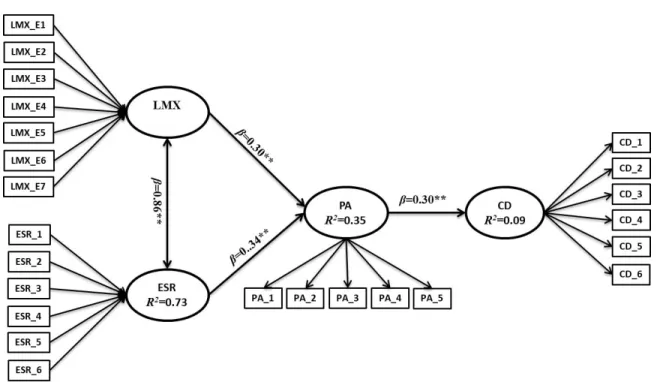
To address my business problem and answer the PRQ, I used the SEM in Figure 1. The SEM consists of the two independent latent variables, LMX and ESR, and the two dependent latent variables, PA and CD. Madu (2014) examined via analyses of variance (ANOVA) employees’ intentions to quit using six independent variables and one
dependent variable. Lotfy (2015) examined factors influencing competitive advantage from users of enterprise resource planning tools. Lofty included eight independent variables and four dependent variables via SEM of his dissertation.
Figure 1. A conceptual model of LMX, ESR, PA, and CD.
As portrayed in Figure 1, the model reflects a direct pathway between the independent exogenous formative variable LMX and ESR. The model also reflects a direct pathway between the independent variables LMX and ESR and the dependent endogenous reflective variable PA. Furthermore, the model reflects a direct pathway between the dependent variable PA and the dependent endogenous reflective variable CD. The indicator variables LMX_E1 through LMX_E7 directly measure the independent variable LMX. The indicator variables ESR_1 through ESR_6 directly measure the independent variable ESR. The indicator variables PA_1 through PA_5 indirectly measure the dependent variable PA. The indicator variables CD_1 through CD_6 indirectly measure the dependent variable CD.
To address the PRQ via SEM modeling, I obtained answers to the following subsidiary research questions (SRQs).
SRQs
SRQ1: To what extent does a relationship exist between LMX and ESR?
SRQ2: To what extent does the relationship between LMX and ESR influence the
employees’ perceived efficacy of the PA process?
SRQ3: To what extent does the relationship between LMX and ESR influence
employees’ CD through the mediating effect of employees’ perceived efficacy of the PA process?
Hypotheses
Cho and Abe (2013) posited that researchers use significance tests to support or not support their hypotheses. Furthermore, Cho and Abe stated that researchers should employ two-tailed significance testing when the proper directionality of the hypothesis is unknown or the researchers have developed a nondirectional hypothesis. Therefore, I employed two-tailed hypotheses because the purpose of this study was to determine if there were significant positive or negative relational pathways among independent and dependent variables (Cho & Abe, 2013; Kock, 2014b).
After reviewing Figure 1, the PRQ, and the SRQs, I formulated three two-tailed hypotheses to test the significance of the relationship between the independent variables (LMX, ESR) that influences employees’ CD through the mediating effect of employees’ perceived efficacy of the PA process.
H10: There is no significant relationship between LMX and ESR.
H20: There is no significant relationship between LMX and ESR that influences
employees’ perceived efficacy of the PA process.
H2a: There is a significant relationship between LMX and ESR that influences
employees’ perceived efficacy of the PA process.
H30: There is no significant relationship between LMX and ESR that influences
employees’ CD through the mediating effect of employees’ perceived efficacy of the PA process.
H3a: There is a significant relationship between LMX and ESR that influences
employees’ CD through the mediating effect of employees’ perceived efficacy of the PA process.
Theoretical Framework
To gain a better understanding of the potential influence of management on (a) LMX, (b) ESR, (c) PA, and (d) CD, researchers (e.g., Cheng, 2014; Dusterhoff et al., 2014; Harris, Li, & Kirkman, 2014) examined management, LMX, and ESR through the composite lens of their theoretical frameworks. K. J. Mayer and Sparrowe (2013) stated that to gain a better understanding of the underlining aspects of management researchers examine management through multiple lenses of various theories. K. J. Mayer and Sparrowe commented that combining theories during management research enhances the relevance of the management field. Furthermore, examining management through
multiple lenses enables researchers to expand their boundaries and widen their theoretical scope (K. J. Mayer & Sparrowe, 2013).
Researchers have used multiple theories to develop their theoretical or conceptional framework for their doctoral studies (K. J. Mayer & Sparrowe, 2013). Sinclair (2013) included social exchange theory and organizational citizenship behavior (OCB) theory in the theoretical framework of his doctoral study. Turner (2015) included systems theory, chaos theory, and complexity theory in the conceptual framework of her doctoral study. Therefore, I based my study on the conceptual framework combining LMX theory and organizational justice theory.
LMX Theory
Because of LMX’s dyadic interaction properties, I used LMX theory to examine the relationships among (a) LMX, (b) ESR, (c) PA, and (d) CD. Homans (1958), the founder of social exchange theory, described human interaction as the process of
exchanging material and nonmaterial goods, to elicit a material or nonmaterial response, such as information or reward. Homans’ theory of interaction rewards, as integrated into Figure 1, portrays the potential mediating effects on (a) LMX, (b) ESR, (c) PA, and (d) CD.
Thibaut and Kelly (2009) stated that social exchange theory, based on human behavior interaction, motivated managers to maximize benefits and minimize losses. In 1959, Thibaut and Kelly published the first edition of their book The Social Psychology
of Groups in which they elaborated on Homans’ social exchange theory by introducing
the concept of the dyadic relationship. Researchers continued to build on the dyadic relationship through the development of LMX traits and defining subordinates and leaders’ roles during LMX (Dulebohn, Bommer, Liden, Brouer, & Ferris, 2012). For
example, Graen (1976) introduced the terminology LMX theory in his article “Role-Making Processes in Complex Organizations” and described the role development process between supervisors and employees.
I focused this study on LMX theory as LMX theory might explain the dyadic relationship, or the two-person relationship, between supervisors and employees (Thibaut & Kelley, 2009). I used LMX theory to examine LMX and ESR through the PA process to advocate the employee’s CD and gain an understanding of the social phenomenon of interpersonal relationships (Thibaut & Kelley, 2009). Organizational justice theory is another aspect of the dyadic relationship and, by combining it with LMX theory; I gained a better understanding of the relationships of LMX and ESR with employees’ PA and CD.
Organizational Justice Theory
Karakoc and Ozer (2016) postulated that organizational justice is a key component of the PA process. Karakoc and Ozer identified three dimensions of organizational justice: distributive, procedural, and interactional. Theorists subdivided interactional justice into interpersonal and informational justice affecting employees’ perceptions of their supervisors’ fairness during the PA process and supervisors’ routine feedback on employees’ job performance (Karakoc & Ozer, 2016). Employees’
perception of their supervisors’ procedural and distributive fairness directly affects employees’ job performance and satisfaction (Karakoc & Ozer, 2016).
I used the distributive and interactional justice dimensions of organizational justice theory to examine employees’ CD (fairness of achieved goals) through the PA
process (fairness of achieved process), and the relationship between LMX and ESR (Nicklin, McNall, Cerasoli, Strahan, & Cavanaugh, 2014; Strom, Sears, & Kelly, 2014). Byrne, Pitts, Wilson, and Steiner (2012) identified both employees’ and supervisors' dissatisfaction with their organization’s PA process. Furthermore, Abdulkadir, Isiaka, and Adedoyin (2012) accentuated supervisors’ and managers’ responsibilities for their
employees’ PA and CD. However, there has been little, if any, literature in which researchers have examined the relationship between LMX and ESR and the effects on employees’ PA or CD.
Operational Definitions
This section contains the definitions of key terms relevant to this study. I included the literature definitions of the key terms in this study.
Career development (CD): CD is the integration of employees’ career planning
with the organization’s career management program for developing employees’ long-term career within the organization (Lo et al., 2014).
Dyadic relationship: Thibaut and Kelley (2009) described the dyadic relationship
as the interaction between two individuals to obtain a self-serving reward.
Dyadic responses: Graen and Uhl-Bien (1995) described the development of
LMX as the interaction between supervisors and employees to develop their working relationships through trust, respect, and mutual obligation. Dyadic responses to the survey instruments pose similar questions to both supervisors and their employees to gain an understanding of both supervisors’ and their employees’ perceptions of their
Employee-supervisor relationship (ESR): ESR is the relationship that supervisors develop with their employees to promote (a) employees’ trust in supervisors, (b)
employees’ CD, (c) positive organizational relationships, and (d) organizational
effectiveness (Boukis & Gounaris, 2014; Casimir et al., 2014; Cropanzano et al., 2017; Treadway et al., 2013).
Identification issues: Hair, Ringle, and Sarstedt (2011) used this term to explain
the limitations of using covariance based–SEM (CB-SEM) to identify either prediction objectives or causal effects of latent variables.
Leader-member exchange (LMX): LMX is the measure of employees’ perceptions
of their relationships with their supervisors as articulated through (a) trust, (b) respect, (c) competence, (d) commitment, and (e) professionalism (Casimir et al., 2014; Graen & Uhl-Bien, 1995).
Performance appraisal (PA): Researchers defined PA as the process that
supervisors use to mentor and develop employees to increase employees’ value as an organizational asset and create value for the organization (Tsai et al., 2013; Wei, 2015). The primary objectives of the PA are to (a) increase motivation, (b) develop trust, (c) establish goals, and (d) assist employees in their CD (Dusterhoff et al., 2014).
Skewness assessment: Hair et al. (2014) defined assessing skewness by examining
the extent that the distributions of participants’ responses indicated a protracted left tail or right tail versus a normal distribution. Skewness is a nonnormal data distribution
Soft-modeling-technique: Researchers have used this term to describe how PLS-SEM lessens the demands on (a) measurement scales, (b) sample sizes, and (c) residual distributions of a quantitative correlational study using the SEM approach (Henseler & Sarstedt, 2013).
Straight lining: Hair et al. (2014) used this term to describe a phenomenon in
which survey participants’ response patterns consisting of selecting one response straight down the survey, such as choosing the middle selections (3s) out of five possible choices on a survey.
Assumptions, Limitations, and Delimitations
I will provide assumptions about the (a) participants, (b) population samples, (c) survey instruments, and (d) the statistical analysis. I will discuss the limitations within the study associated with (a) quantitative correlational methodology, (b) cross-sectional approach, (c) PLS-SEM, (d) self-reported surveys, (e) common method variance, and (f) external validity. Finally, I will discuss delimitations contained within my study relating to (a) the geographical location of the study, (b) the type of companies used for the study, and (c) the type of positions held by the surveyed participants.
Assumptions
Assumptions are beliefs that researchers expect to be true but are not verifiable. For this study, I assumed that the participants of this study would answer the survey questions with honesty and did not possess a personal agenda causing them to manipulate or skew their responses. I also assumed that the participants would be familiar with their company’s (a) PA process, (b) human resource (HR) policies, and (c) CD programs. I
also assumed that the study’s population sample contained participants who volunteered freely and not subjected to coercion by the company’s leadership to participant in the study. Finally, because the participants comprised a purposeful sample, I assumed that nonparticipating employees could have possessed differences of opinions not reflective of the study’s results. Although I have presented numerous assumptions, participants’ honesty and potential coercion posed the largest threats to my study’s validity results.
I used my survey instruments to measure my constructs for which previous researchers have designed and validated the instruments in peer-reviewed articles.
Therefore, based upon the published results, I assumed that the survey instruments would be valid and reliable for my study. Also, I tested the internal consistency reliability of my study’s instruments for my study’s population using both Cronbach’s α and composite reliability (ρϲ). Following Hair et al.’s (2014), Kock’s (2015), and Sarstedt, Ringle,
Smith, Reams, and Hair’s (2014) guidelines in Table 4, the results of my analysis
indicated that, for this study’s population, my instruments’ Cronbach's alphas (α) were > .90 and composite reliabilities (ρϲ) were also > .90, thereby demonstrating internal
consistency reliability. Using PLS-SEM to analyze the data results from my survey instruments, I assumed that because PLS-SEM could identify latent variable relationships through the SEM approach, my analysis would explain variances of latent variables within SEM (Hair et al., 2011).
Limitations
Using the quantitative research approach provided data for examining the relationships among (a) LMX, (b) ESR, (c) PA, and (d) CD. However, employing the
qualitative and mixed methodology could have produced results that explored and examined the lived experiences of the surveyed participants. Whereas using a
longitudinal experimental or quasi-experimental design could have explained the causal relationships among the variables, employing a cross-sectional quantitative correlational design might not have displayed any causal relationships.
Using a cross-sectional study through the administration of self-reported surveys to collect data at a single point in time could have induced common method variance within the study’s results (Balkan & Kholod, 2015; Coenen & Van den Bulck, 2016). However, Fuller, Simmering, Atinc, Atinc, and Babin (2016) posited that self-report surveys could distort results, but Fuller et al. concluded that this was not the case.
Therefore, by administering the survey to employees of several federal defense contractor companies within the United States, I was able to lessen common method variance errors within the study’s results. In addition, by collecting data from employees of several federal defense contractor companies, I expected to decrease the effects of potential variables that could jeopardize the external validity of the study.
I also understood that limitations might have existed pertaining to numerous external stimuli that could have affected participants’ responses, such as (a) economic constraints, (b) budget constraints, (c) competition, (d) political landscape, (e) social environment, and (f) customer requirements, which I did not address in this study. Delimitations
The geographical location for my study was the United States. I solicited employees from federal defense contractor companies as my study participants. The
participants performed duties relating to (a) information technology operations and maintenance, (b) automotive and facilities maintenance and operations, (c) live fire range maintenance and operations, and (d) general services and support operations. Data from employees’ responses were the only data available for my study’s (a) analysis, (b) findings, (c) conclusions, and (d) recommendations.
Significance of the Study
Private individuals and organizational leaders fund research to benefit society and increase value for organizational shareholders (Bornmann, 2013; Dicks et al., 2014). The results of my study could provide organizational leaders with increased returns on
investments from research funding marketable products and services by increasing a positive work environment through improving ESR (Bornmann, 2013; Dicks et al., 2014). The purpose of this quantitative correlation study was to examine the extent and nature of the influence of the relationship between LMX and ESR on employees’ CD through the mediating effect of employees’ perceived efficacy of the PA process.
Researchers have noted that there are initiatives to quantify the effect of research on society, which is the first step in evaluating the benefits of research for society and business ventures (Bornmann, 2013; Dicks et al., 2014). The results of this study could provide senior managers and supervisors with (a) findings, (b) conclusions, and (c) recommendations for reviewing and improving their HR policies to establish PA processes that could increase employee performance and develop employee CD. Supervisors and employees could also benefit from the findings of this study by developing a more positive working environment through increased LMX and ESR.
Increasing LMX and ESR could create value for the organization through improved (a) job satisfaction, (b) organizational commitment, (c) work performance, and (d)
employee-organizational relationship (Casimir et al., 2014).
To benefit the organization and contribute to positive business practices,
supervisors need to identify and promote leadership qualities and traits that will facilitate building cohesiveness with employees. Supervisors also need to know how to engage LMX and ESR to mentor their employees through the PA process to guide the employees in their CD (Abdulkadir et al., 2012). In the following subsections, I will explain how the results of this study could contribute to business practice and effect positive social
changes.
Contribution to Business Practice
The results of examining the combined relationships of the variables (LMX, ESR, PA, and CD) could provide senior managers and supervisors with the information they need to address the dissatisfaction of supervisors and employees with their organizations’ PA and CD. Furthermore, the results could also provide senior managers and supervisors with an introductory impression of the combined effects of the variables on (a) job satisfaction, (b) organizational commitment, (c) work performance, and (d) employee-organizational relationship; thus increasing employee-organizational value (Biswas & Varma, 2012; Byrne et al., 2012). The results could also provide senior managers and supervisors with an expanded view of the relationships among the variables (LMX, ESR, PA, and CD), which could provide senior managers and supervisors with guidance for reviewing and improving their organization’s PA and CD HR practices and policies. Furthermore, these
improvements could also increase organizational value by increasing (a) job satisfaction, (b) organizational commitment, (c) work performance, and (d) employee-organizational relationship (Biswas & Varma, 2012; Byrne et al., 2012).
Implications for Social Change
The results of examining the combined relationships of the variables (LMX, ESR, PA, and CD) could influence positive social change by (a) improving communications between employees and supervisors, (b) increasing employees’ job satisfaction, (c) improving employees’ family’s quality of life, and (d) contributing to the betterment of communities (Jokisaari, 2013; Mroz & Allen, 2015; Omilion-Hodges & Baker, 2013; Stephan, Patterson, Kelly, & Mair, 2016). Organizational leaders could indirectly
increase and maintain organizational competitive advantages by increasing employee job satisfaction and promoting CD, which might lessen employees’ voluntary attrition and thereby allow the organization to retain knowledgeable and skilled employees
(Abdulkadir et al., 2012). Communities could also benefit from organizational leaders retaining satisfied and skilled employees through encouraging employees to become active community members and effect positive social changes to create a better living environment for their families (Casimir et al., 2014).
A Review of the Professional and Academic Literature
Managers encourage supervisors to develop positive working relationships with their employees through leader-member exchange (LMX). Positive interactions between employees and supervisors develop employee-supervisor relationship (ESR) through (a) increasing employees’ trust in supervisors, (b) enhancing employees’ career development
(CD), (c) promoting positive organizational relationships, and (d) enhancing
organizational effectiveness (Boukis & Gounaris, 2014; Casimir et al., 2014; Cropanzano et al., 2017; Treadway et al., 2013). There has been a plethora of research and literature on the constructs of (a) LMX, (b) ESR, (c) performance appraisal (PA), and (d) CD. However, there has been little if any research examining the relationship between (a) LMX, (b) ESR, (c) PA, and (d) CD in one study. The purpose of this literature review was to (a) investigate gaps in literature; (b) review, summarize, and evaluate current literature; (c) compare and contrast previous researchers’ findings and conclusions; (d) review, summarize, and evaluate related researchers’ methodologies and designs; and (e) defend the choices for the proposed theoretical frameworks, variables, constructs, and instruments (Boell & Cecez-Kecmanovic, 2015).
Researchers use the Latin letter b to indicate estimated population samples’ statistical results and the Greek letter β to indicate actual population parameter results (de Smith, 2014). However, Field (2014), and Jones and Waller (2015) noted that researchers will use the Latin letter b to indicate unstandardized regression coefficients’ results and the Greek letter β to indicate standardized regression coefficients’ results when
conducting multiple regression analyses. Some researchers do not include explanations of the relationships or definitions of symbols within their studies. Therefore, throughout this study I use the symbols that the cited authors used to report the results of their variables’ correlational significance.
The general business problem is some employees perceive that their supervisors are conducting PAs that neither represent their performance nor address their CD
(Dusterhoff et al., 2014). The specific business problem is that some defense contractor supervisors do not understand the influence of the relationship between LMX and ESR on employees’ CD through the mediating effect of employees’ perceived efficacy of the PA process. The focus for my business problem emerged from my experiences relating to (a) employee-supervisor interactions, (b) substandard PAs, and (c) supervisors’ lack of focus on employees’ CD.
Summary of the Professional and Academic Literature
The development of the literature review for this study began with a critical analysis of the professional and academic literature ranging from (a) theoretical and seminal books, (b) peer-reviewed and scholarly articles, and (c) professional and
academic journals. I conducted an extensive web-based literature search and review using multiple databases that included (a) Google Scholar, (b) ProQuest Central, (c)
ABI/INFORM Global, (d) Academic Search Complete, (e) Business Source Complete, and (f) PsycINFO. I searched for all related peer-reviewed articles and then refined my focus on research articles emerging within the past 5 years (2013 through 2017) of my expected 2017 year of graduation. I searched the databases, Google Scholar, and the Walden University Library using a combination of the following keywords: leader-member exchange, employee-supervisor relationship, performance appraisal, performance review, career development, professional development, leader-member
exchange theory, social-exchange theory, and organizational justice theory.
Within this literature review, I address the theoretical justifications for (a) LMX, (b) ESR, (c) PA, and (d) CD constructs and the related SRQs and hypotheses.
Furthermore, I justify establishing the hypothesized relationships among the constructs included in Figure 1. I include both a summary of the types and percentages of total references by type in Table 1.
Table 1
Summaries of Types and Percentages of References
Reference typea Recent
referencesb
Older referencesc
Total Percentage of total referencesd Doctoral Study References
Books 5 4 9 5%
Peer-reviewed articles 151 25 176 93%
Other resources 4 0 4 2%
Total 160 29 189 100%
100 x (Number of peer-reviewed references / total number of references)
93%
100 x (Total number of recent references / total number of references)
85%
Literature Review References
Books 5 1 6 7%
Peer-reviewed articles 69 12 81 91%
Other resources 2 0 2 2%
Total 76 13 89 100%
100 x (Number of peer-reviewed references / total number of references)
91%
100 x (Total number of recent references / total number of references)
85%
aThe reference type column identifies the particular type of reference. bThe recent
references column identifies the number of references that were published within 5 years of the expected 2017 date of the Chief Academic Officer’s approval. cThe older
references column identifies the number of references that are older than 5 years old from the expected 2017 date of the Chief Academic Officer’s approval. dThe percentage of total references is the total number of a particular type of references divided by the total number of references, multiplied by 100.
This study comprises 189 references consisting of (a) five books less than 5 years old, (b) four books exceeding 5 years old, (c) 151 peer-reviewed articles less than 5 years old, (d) 24 peer-reviewed articles exceeding 5 years old, and (e) four other resources less than 5 years old (two websites, two personal communications). This study consists of 93% peer-reviewed references and 85% of the total references published within 5 years of the expected 2017 date of the Chief Academic Officer’s approval. The literature review heading contains 89 references consisting of (a) five books less than 5 years old, (b) one book exceeding 5 years old, (c) 69 peer-reviewed articles less than 5 years old, (d) 12 peer-reviewed articles exceeding 5 years old, and (e) two other resources (personal communication) less than 5 years old. The literature review consists of 91%
peer-reviewed references and 85% references that were published within 5 years of the expected 2017 date of the Chief Academic Officer’s approval.
Table 2 contains the key component synchronization map for elements of the LMX theoretical framework for this literature review. Table 3 contains the key component synchronization map for elements of the organizational justice theoretical framework for this literature review. The key components included in Table 2 and Table 3 are (a) corresponding and rival theories, (b) variable, (c) measurement instrument, (d) purpose of the instrument, (e) related topics, and (f) alternative measurement instruments.
Table 2
LMX Theoretical Framework and Variable Synchronization Map
Corresponding and rival theoriesa Variableb Measurement instruments Purpose of the instrumentc
Related topicsd Alternative
measurement instrumentse Leadership-motivated excellence theory (Graen & Schiemann, 2013); social exchange theory (Homans, 1958); equity & inequity theory (Adams, 1965); relative deprivation theory (Ren et al., 2013) LMX (independent variable) LMX-7 (Graen & Uhl-Bien, 1995) Measures the interaction between employees and supervisors. Dyadic relationship: trust, respect, competence, commitment, obligation. LMX-7 (Scandura & Graen, 1987; Scandura, Graen, & Novak, 1986); UWES (Schaufeli, Taris, & Bakker, 2006); In-role performance (Podsakoff & Mackenzie, 1989); ESR (independent variable) Interactional Justice (Moorman, 1991) Measures employees’ perceptions of their relationship with their supervisors. Dyadic relationship: communications, fairness, feedback, civility, justice and equity, honesty. Organizational Justice (Colquitt, 2001); Innovative behavior (Janssen, 2000); Affective organizational commitment (Meyer & Allen, 1990)
Note. LMX (Leader-Member Exchange), ESR (Employee-Supervisor Relationship),
UWES (Utrecht Work Engagement Scale),
aThe corresponding & Rival Theories column includes theories within the literature
review other than LMX Theory. bThe Variable column indicates each latent variable as indicated in Figure 1. cPurpose of the instrument column explains what the instrument listed in the Measurement instruments column measures. dRelated topics column lists the
individual items that the instruments in the Measurement instruments column measures.
eThe alternative measurement instruments column includes instruments within the
literature review other than the instruments listed in the Measurement instruments column.
Table 3
Organizational Justice Theoretical Framework and Variable Synchronization Map
Corresponding and rival theoriesa Variableb Measurement instruments Purpose of the instrumentc
Related topicsd Alternative
measurement instrumentse Organizational justice theory (Rupp et al, 2014); equity & inequity theory (Adams, 1965); relative deprivation theory (Ren et al., 2013); Job characteristic theory (Parker, 2014); theory of purposeful work behavior (Barrick, Mount, & Li, 2013) PA (dependent variable) Appraisal System Satisfaction (Waldman, 1997) Measures employees’ perceptions of their organization’s PA system. Performance Assessment: PA assessment accuracy, PA rating fairness, performance improvement, CD, PA satisfaction. Accuracy component: Trust, Trustworthiness, and Performance Appraisal Perceptions Measure (R. C. Mayer & Davis, 1999);
OCQ (Meyer & Allen, 1997) CD (dependent variable) Perceived Career Opportunity (Kraimer, Seibert, Wayne, Liden, & Bravo, 2011) Measures employees’ perceptions of their organization’s career opportunities. CD: Career opportunities, career goal achievement, career aspiration satisfaction. Continuous Improvement Measure (Robert et al., 2000); Career Development Scale (Lo et al., 2014)
Note. PA (Performance Appraisal), CD (Career Development). OCQ (Organizational
Commitment Questionnaire),
aThe corresponding & Rival Theories column includes theories within the literature
review other than Organizational Justice Theory. bThe Variable column indicates each
latent variable as indicated in Figure 1. cPurpose of the instrument column explains what the instrument listed in the Measurement instruments column measures. dRelated topics column lists the individual items that the instruments in the Measurement instruments column measures. eThe alternative measurement instruments column includes
instruments within the literature review other than the instruments listed in the Measurement instruments column.
The purpose of this quantitative correlation study was to examine the extent and nature of the influence of the relationship between LMX and ESR on employees’ CD through the mediating effect of employees’ perceived efficacy of the PA process. The principal hypothesis for this study was that there are significant relationships among the variables (a) LMX, (b) ESR, (c) PA, and (d) CD. I organized the literature review for this study to examine and discuss (a) the theories comprising the theoretical framework; (b) the variables LMX, ESR, PA, and CD; (c) the measurement instruments for each variable; (d) alternative measurement instruments included in key previous studies for each variable; and (e) the demographics focus of previous key studies.
Under the subheading Theories Comprising the Theoretical Framework, I discuss theories I used as a base for my theoretical framework and the corresponding and rival theories to my study’s theoretical framework. Under the subheadings (a) LMX, (b) ESR, (c) PA, and (d) CD, I have continued to review and evaluate previous researchers’ studies by comparing and contrasting the researchers’ (a) theories for their studies, (b) purpose of their studies, and (c) researchers’ results and findings.
Under the subheadings (a) LMX measurement instruments, (b) ESR measurement instruments, (c) PA systems’ effectiveness measurement instruments, and (d) CD
measurement instruments, I have continued to review and evaluate previous researchers’ (a) survey instruments used, (b) purpose and/or hypotheses of the research, and (c) analysis method employed. Under the subheadings (a) alternative LMX measurement instruments, (b) alternative measurement instruments for measuring the ESR, (c) alternative measurement instruments to measure PA, and (d) alternative measurement
instruments to measure CD, I have continued to review and evaluate alternative measurement instruments in previous researchers’ studies for each variable. Under the subheading Previous Studies’ Demographics, I (a) restate previous researchers’ purpose for their studies, (b) discuss the geographical location for the studies, (c) present the number of validated surveys from the number of invited participants (response rate), and (d) discuss previous studies’ reliability.
Theories Comprising the Theoretical Framework
To gain a better understanding of management and ESR, researchers examined management, LMX, and ESR through the composite lens of their theoretical framework. K. J. Mayer and Sparrowe (2013) stated that to gain a better understanding of the
underlining management constructs, the research of management encompasses a plethora of sciences. Therefore, to gain a deeper understanding of the science and mechanics of management, researchers examine management through multiple lenses of various theories (K. J. Mayer & Sparrowe, 2013). K. J. Mayer and Sparrowe commented that, by combining theories, researchers could enhance the relevance of the management field. Furthermore, K. J. Mayer and Sparrowe commented that examining management through a multiple-lens technique enables researchers to expand their boundaries and widen their theoretical scope.
Researchers use multiple theories to develop their theoretical or conceptional frameworks for their doctoral studies. Sinclair (2013) included social exchange theory and OCB theory in the Theoretical Framework heading of his doctoral study. Turner (2015) included systems theory, chaos theory, and complexity theory in the Conceptual
Framework heading of her doctoral study. Because LMX theory and organizational justice theory are both extensions of Homans’ (1958) social exchange theory, I based this literature review on both LMX theory and organizational justice theory.
LMX theory. Researchers have examined employee-supervisor interactions through the lens of LMX theory. Homans (1958), founder of social exchange theory, described human interaction as the process of exchanging material and nonmaterial goods, to elicit a material or nonmaterial response, such as information or reward. Homans’ theory of interaction rewards, as integrated into Figure 1, explained the significance of the effects among (a) LMX, (b) ESR, (c) PA, and (d) CD.
Thibaut and Kelly (2009) stated that social exchange theory, based on human behavior interaction, motivated managers to maximize benefits and minimize losses. In 1959, Thibaut and Kelly published the first edition of The Social Psychology of Groups in which they elaborated on Homans’ social exchange theory by introducing the concept of the dyadic relationship. Researchers continued to build on the dyadic relationship through the development of LMX traits and defining subordinates’ and leaders’ roles during LMX (Dulebohn et al., 2012).
Dulebohn et al. (2012) noted that researchers identified two levels of LMX as (a) low-quality exchange, and (b) high-quality exchange. Dulebohn et al. noted that both the leader and the follower contribute to the quality of the exchange. Researchers (e.g., Harris et al., 2014; Runhaar, Konermann, & Sanders, 2013) defined low-quality exchanges as those in which supervisors restrict their employees’ abilities to develop their roles during LMX by withholding feedback and rewards. Researchers (e.g., Harris et
al., 2014; Runhaar et al., 2013) defined high-quality exchanges as those in which supervisors allow employees to grow and influence their roles during LMX through mutual trust and respect. In contrast to Dulebohn et al., Dik et al. (2015) postulated that employees would decide what roles to adopt during LMX and with whom to develop personal and professional relationships in the organization. Since the conceptualization of LMX Theory, researchers have refined LMX Theory into leadership taxonomies that explain the role of the development process between supervisors and employees (Graen & Uhl-Bien, 1995).
Organizational justice theory. Researchers gauge the level of LMX and ESR by examining the results of employee-supervisor interactions through organizational justice theory. Rupp, Shao, Jones, and Liao (2014) described organizational justice as research on how individuals judge one another based off of attitudes and behaviors. Furthermore, Rupp et al. conceptualized organizational justice theory as an alternative theory grounded into the dyadic relationship that Homans (1958) expanded on from social exchange theory. Karakoc and Ozer (2016) postulated that organizational justice is a key component of the PA process. Furthermore, Karakoc and Ozer postulated that
employees’ perceptions of their supervisors’ procedural and distributive fairness directly affected employees’ job performance and satisfaction. Nasser and Zaitouni (2015) concluded that organizational justice is a key component of the psychological contract between employees and supervisors, and contributes to employees’ perceptions of their supervisors’ fairness during the PA process and subsequent allocation of rewards.
Byrne et al. (2012) identified employees’ and supervisors' dissatisfaction with their organization’s PA process. Furthermore, Abdulkadir et al. (2012) accentuated supervisors’ and managers’ responsibilities for their employees’ PA and CD. However, there is little if any, literature reflecting previous researchers’ examination of the relationship between LMX and ESR and the effects on employees’ PA or CD.
Corresponding and rival theories to the theoretical framework. Over the past several decades, organizational leaders designed, developed, and implemented various leadership and management styles and programs. Furthermore, in contrast, and as an addendum to LMX theory and organizational justice theory, researchers examined and tested numerous theories in support of, and complementary to, emerging leadership and management styles and programs. In addition to LMX theory, Graen and Schiemann (2013) suggested that, when developing leadership and management styles and programs for an increasing modern organizational environment, managers incorporate leadership-motivated excellence theory with LMX theory. Graen and Schiemann postulated that leadership-motivated excellence theory characterized the responsibility of managing people as a privilege and not a right. Furthermore, professional and competent supervisors should manage employees (Graen & Schiemann, 2013).
In complement to Homan’s (1958) social exchange theory, to gain a deeper understanding of LMX and ESR, Adams (1965) developed equity theory and inequity theory. Adams defined equity theory as employees’ perceptions that their outcomes (i.e., pay, benefits, and promotions) equal their inputs (i.e., accomplishments, organizational contributions). Furthermore, Adams defined inequity theory as explaining employees’
perceptions that their outcomes do not reflect their inputs to the organization, and therefore as affecting employees’ motivation to contribute to the organization. Adams also described levels of ESR, as correlating with employees’ perceptions of what level of LMX (low LMX or high LMX) existed between the employee and the supervisor.
Furthermore, Adams explained those employees’ perceptions of inequality, affected employees’ perceptions of their relationships with their supervisors.
Building on Homans’ (1958) social exchange theory, Adams (1965) described that relative deprivation emerged from the theory of distributive justice; whereas
employees perceived they deserved the same recognition and outcomes as their peers. In addition, Ren, Bolino, Shaffer, and Kraimer (2013) postulated that employees experience relative deprivation when employees perceive they are deprived of recognition and view their contributions to the organization as being unrecognized. Employees also experience relative deprivation when they perceive they are overcompensated and underemployed (Ren et al., 2013). Ren et al. explained that both underrecognition and overcompensation could result in employees’ relative deprivation and affect job satisfaction. Supervisors could lessen employees’ relative deprivation through positive work reinforcement through increased high LMX and ESR (Ren et al., 2013).
In contrast to employees’ perceptions that high/low LMX affects employees’ perceptions of input/output equality, Parker (2014) concluded that employees’ reactions to their job design influence their (a) job satisfaction, (b) motivation, and (c)
performance. Furthermore, to examine methods of increasing employees’ work performance and productivity, Parker (2014) examined several theories (scientific
management theory, sociotechnical systems theory, self-determination theory) to complement the relative efficacy of job characteristics theory. By redesigning job characteristics to be more meaningful and challenging, organizational leaders could increase work quality and productivity (Parker, 2014). In addition, Barrick, Mount, and Li (2013) noted that the theory of purposeful work behavior facets that striving for purposefulness and meaningfulness are goal setting methods that employers use to increase the meaningfulness and challenges of jobs to promote job satisfaction, performances, and organizational commitment. Increasing the meaningfulness and challenges of employees’ jobs through the inclusion of goal setting and feedback during employees’ PAs, supervisors can assist employees’ in the development of the employees’ CD plans.
In the following subheadings, (a) LMX, (b) ESR, (c) PA, and (d) CD, I discuss the current literature pertaining to LMX theory, and LMX theory’s relationship to the variables LMX and ESR. Furthermore, I discuss the current literature pertaining to the procedural, distributive, and interactional dimensions of organizational justice theory and the relationships of procedural, distributive, and interactional justice with PA and CD. LMX
People conduct social exchanges for various reasons to acquire positive results and to obtain favorable benefits. Supervisors and employees incorporate personal strengths during LMXs to obtain positive results to accomplish personal and organizational goals (Dik et al., 2015). Thibaut and Kelley (2009) applied social
and motivation created by maximizing benefits and minimizing losses. Leader and member role development is a critical element of LMX theory (Dulebohn et al., 2012). The leader’s and member’s roles emerge from the interaction between the leader and the member to establish the quality of the employee-supervisor interaction (Dulebohn et al., 2012).
Graen and Uhl-Bien (1995) noted that researchers had identified numerous
dimensions in LMX to measure the quality of the ESR. The authors defined LMX quality as the level of the interpersonal exchange relationship between the employee and the supervisor, which the authors categorized as being either low LMX quality or high LMX quality. However, Graen and Uhl-Bien only identified three dimensions in their LMX-7 instrument to measure employee-supervisor interaction (trust, respect, obligation).
Dulebohn et al. (2012) identified competence and commitment as additional dimensions of LMX. Therefore, I base this subheading of the literature review on (a) LMX Theory, (b) Graen and Uhl-Bien’s (1995) three dimensions of LMX (trust, respect, obligation), and (c) Dulebohn et al.’s additional two dimensions of LMX (competence, commitment). Furthermore, employing Graen and Uhl-Bien's LMX-7 instrument and Waldman’s (1997) 5-item Appraisal System Satisfaction instrument (Table E3 in Appendix E) enabled me to address my business problem by examining the relationship between LMX and ESR.
Trust. Graen and Uhl-Bien (1995) identified trust as a dimension of the LMX-7 instrument and noted that for employees and supervisors to gain each other’s respect requires trust during LMX and ESR. Dysvik, Buch, and Kuvaas (2015) employed social
exchange theory and LMX theory to examine the relationship between employees’ knowledge sharing and managers’ knowledge-collecting and how, if at all, social LMX and economic LMX moderated the relationship. Dysvik et al. noted that trust between employees and supervisors is the basis for high-levels of social and economic LMX, and therefore, paramount for the level of knowledge sharing between employees and
supervisors.
Dysvik et al.’s (2015) results indicated a significant positive correlation between manager’s knowledge collecting and employees’ knowledge sharing (β = .23, p < .001). Furthermore, Dysvik et al.’s results indicated that social LMX moderated the relationship between managers’ knowledge collecting and employees’ knowledge sharing (t = 1.83, p < .05). However, Dysvik et al.’s results indicated that economic LMX did not moderate the relationship between managers’ knowledge collecting and employees’ knowledge sharing (p > .05). Dysvik et al.’s findings indicated that trusting relationships between employees and supervisors contributed to levels of social LMX. Furthermore, high-levels of social LMX influences the amount of knowledge shared by employees and supervisors. Therefore, Dysvik et al.’s results indicate that the trust dimension of LMX increases ESR, and catalyzes employees’ knowledge sharing with their supervisors; thereby influencing employees’ PAs.
Using social exchange theory Erturk and Vurgun (2015) identified a positive significant relationship between goal internalization with LMX (β = .26, p < .01) and perceived organizational support (POS; β = .21, p < .01). Furthermore, the authors’ results indicated a positive significant relationship between perceived control and LMX
(β = .25, p < .01) and POS (β = .28, p < .01). However, the results indicated a negative significant relationship between turnover intentions and LMX (β = -.29, p < .01) and POS (β = -.33, p < .01). Erturk and Vurgun noted that supervisors who develop high-levels of LMX with their employees through a trusting relationship increased employees’ POS, and therefore, lessened employees’ turnover intentions. Furthermore, employees who share high LMX with their supervisors develop high ESR through trust and respect. Therefore, employee-supervisor high LMX and high ESR contribute to employees’ higher levels of OCB (Erturk & Vurgun, 2015).
Moideenkutty and Schmidt (2016) identified trust and LMX as dimensions of social exchange. Therefore, supporting Erturk and Vurgun’s (2015) hypothesis that employees who share high LMX with their supervisors, influence high ESR,
Moideenkutty and Schmidt hypothesized a significant positive relationship of ESR with supervisor-directed OCB through the mediating effects of trust and LMX. Moideenkutty and Schmidt examined the relationship between ESR and supervisors-directed OCB through the potential mediating effects of trust and LMX. Moideenkutty and Schmidt’s results indicated a significant positive relationship between ESR and supervisors-directed OCB through the mediating effects of trust (β = .423, p < .001) and LMX (β = .011, p < .001). Moideenkutty and Schmidt’s results demonstrated that supervisors who develop high-ESR through trust and high-levels of LMX create positive employee behaviors and attitudes, and thereby, enhance OCB.
Similar to Moideenkutty and Schmidt (2016), Tandon and Ahmen (2015) examined the relationships among LMX, trust, self-efficacy, and service performance.