-DOCUMENT RESUME
:11
ED 331 700 SE 051 520
AUTHOR Medina, Suzanne L.
TITLE A Study of the Effects of the Kumon Met1Ild Upon the t,t
Mathematical Development of a Group of Inner-City Junior High School Students.
PUB DATE 10 Dec 89
NOTE 49p.; The small type in appendix D has been enlarged
to improve readability. .42
PUB TYPE Reports - Research/Technical (143)
EDRS PRICE MF01/PCO2 Plus Postage.
DESCRIPTORS Grade 7; Grade 8; *Hixpanic Americans; Junior High
Schools; *Junior High School Students; Learning Activities; *Mathematics Achievement; Mathematics Education; Mathematics Instruction; *Secondary School Mathematics; Standardized Tests; Teaching Methods;
*Urban Education
IDENTIFIERS *Kumon Mathematical Method
ABSTRACT
In this research, 103 Hispanic junior high school students were instructed using the Kumon Mathematical Method. Instruction took place 1 hour per day, 5 days a week in a public school setting. Instruction extended over an eight month period. Student subjects were pretested and posttested on the Mathematics
batteries of the California Achievement Test (CAT). The amount of progress in mathematics was determined by computing gain scores for
each section of the examination. Data included in this report includes: (1) CAT math concepts scores; (2) CAT computation and applications scores; (3) CAT total math scores; (4) school
attendance; (5) Kumon Examination scores; (6) Kumon time scores; (7) number of packets completed; (8) Kumon level advancement; (9) class period; (10) academic track; and (11) grade level. Correlational
relationships between variables are also discussed. Reported were significant gains in math computation, math concepts, and math applications scores at the seventh grade level; grade 8 students maintained their percentile rankings for the duration of the study;
subjects significantly increased their speed on the Kumon exam; and CAT math gain scores were greater for the seventh graders than for the eighth graders. CAT gain scores were correlated with post Kumon exam scores. CAT gain scores were not correlated with Kumon exam time scores, number of Kumon packets completed, or Kumon advancement.
(Author/CW)
***********************************************************************
Reproductions supplied by EDRS are the best that can be madefrom the original document.
1
A STUDY OF THE KFFECTS OF THE KUMON METHODUPON THIt MATHEMATICAL DEVELOPMENT OF
A GROUP OF INNER-CITY JUNIOR HIGH SCHOOL STUDENTS
Suzanne L. Medina
December 10, 1989
1
'PERMISSION TO REPRODUCE THISMATERIAL HAS BEEN GRANTED BY
I
... r
TO THE I. Duc,A1 IoNAL RE SOuRC.F.S INFoRmATION cINTEP I Ric,
0
ici
)a
1
-.13
i
REST COPY AVAILABLE
4)
I
f")
2
ABSTRACT
One-hundred three Hispanic junior high school students were instructed using the Iumon Mathematical Method. Instruction took place one hour per day, five days a week in a public school setting. Instruction extended over an eight month period beginning October 1988 and ending in early June of 1989.
Student subjects were pretested and post tested on the Math betteries of the C.A.T. (California Achievement Test). The amount of mathematical progress made over the eight months was determined by computing gain scores for each of the sections of the CAT examination. These data are presented in the report as are the data on a number of other variables: 1) CAT Math Concepts pre and post scores, 2) CAT Math Computation and Application pre and post scores, 3) Total Math pre and post scores, 4) Attendance, 5) Kumon Exam pre and post
scores, 6) Union Time pre and post scores, 7) Number of Packets Completed, 8) Kumon Level Advancement, 9) Period, 10) Ttack, and 11) Grade. Also included in the report is a description of the correlational relationships between CAT Gain scores and the other variables.
Seventh grade pre and post CAT Math Computation scores were statistically significant (.001). Seventh grade Meth Concepts and Application scores were
also significat. (.01). Eighth graders maintained their percentile ranks over
the course of the eight months. Subjects significantly increased their speed on the Kumon Exam. CAT Math Gain scores were greater for seventh graders than they were for eighth graders.
CAT Gain scores were correlated with post tumon Exam scores, yet CAT Gain scores were not correlated with Kumon Exam Time scores, number of Kumon packets completed or amount of Kumon advancement.
ORGANILATION OF THIS REPORT
This report was organized into nine major sections:
INTRODUCTION SUBJECTS DESIGN PROCEDURES RESULTS SUMMARY OF FINDINGS OBSERVATIONS APPENDICES REFERENCES I INTRODUCTION
The focus of the study is established in this section. Following this is a brief discussion of the series of events which preceded this study.
II SUBJECTS
This section describes the student subjects including tneir school
environment, tracking system and school calendar. It delineates the manner in which students were selected for this study, then presents a breakdown of student participants by grade, track and period. Finally, based on CAT
pretest scores, it describes the students' linguistic abilities as compared to the national norm population.
III DESIGN
The overall structure of the study is discussed in this section, as are each of the variables which make up this study.
IV PROCEDURE
In this section of the report, the instructional and testing procedures used during the course of this study are described.
V RESULTS
The RESULTS are divided data on the mean scores deals specifically with and the other variables
into two parts. The first part describes and presents belonging to each variable, while the second section correlational relationships between CAT Gain scores in the study.
,y.ek - S a.nl.nt.a..asJt4 4 ,....,..-ac]J.11,1,41itti- tl vala.u.L.
-74.1,1.11e.1.15-.C...zda..4.-Lai-LILL:::,izlatinta.-VI SUMMARY OF FINDINGS
Here, the reader is provided with a summary of the data reported previously in the RESULTS section of this report. This more comprehensible rendition of the data May be directly consulted without previously reading the RESULTS section in order to learn of the most significant findings in the study. If greater detail is desired, the reader may wish to consult the tables in the RESULTS
section.
VII OBSERVATIONS
This section contains a number of remarks and observations which may or may not have been supported by the data.
VIII APPENDICES
Included in this section is the correlation matrix of all variables as well as three frequency distributions : 1) CAT Math Computation Gain Scores, 2) CAT latal Math Gain Scores, and 3) CAT Math Concepts and Application Gain Scores.
IX REFERENCES
This section provides bibliographic information of the texts mentioned in this
TABLE OF CONTENTS
I INTRODUCTION 1
II SUBJECTS 2
School Setting 2
Tracking and the School Calendar 2
Selection of Students 2
Distribution of Subjects 3
Linguistic Characteristics of Subjects 4
III DESIGN 5
Variable Definition and Measurement 5
CAT Math Scores 5
Attendance 5
Limon Exams 6
Kumon Packets Completed 6
Kumon Level Advancement 6
Other Variables 6
IV PROCEDURES 7
The Kumon Method of Mathematical Instruction 7
V RESULTS
8SECTION A GROUP MEANS
1. CAT Math EX11111 Scores
8
9
A. CAT Mathematical Computation 9
B. CAT' Mathematical Concepts and Application 10
C. CAT Total Math 11
D. CAT Gain Scores 12
2. Attendance 13
3. Kumon Exam 14
A. Kumon Exam Scores 14
B. Kumon Exam Time Scorea 15
4. Kumon Packets Completed 16
5. Kumon Level Advancement 17
SECTION B CORRELATIONS BETWEEN VARIABLES AND GAIN SCORES 18
1. CAT Math Exam Scores 19
A. CAT Mathematical Computation 19
B. CAT Mathematical Concepts and Application 19
C. CAT Total Math 19
D. CAT Gain Scores 19
2. Attendance 20
3. Kumon Exam 20
A. Kumon Exam Scores 20
B. Kumon Exam Time Scores 20
4. Kumon Packets Completed 20
5. Kumon Level Advancement 20
6. Grade 21
VI SUMMARY OF FINDINGS 22
.,-f
1. CAT Math Scores 22
A. CAT Mathematical Computation 22
B. CAT Mathematical Concepts and Application 23
C. CAT Total Math 24
D. CAr, ;lain Scores 25
2. Attendance 26
3. Kumon Exam 27
A. Kumon Exam Scores 27
B. Kumon Exam Time Scores 28
4. Kumon Packets Completed 29
5. Kumon Level Advancement 30
6. Grade 30
VII OBSERVATIONS 31
Kumon Program Modifications 32
Interpretation of Results 32
VIII APPENDICES 33
APPENDIX A - Frequency Distribution; CAT Math Computation Gain Scores.34 APPENDIX B - Frequency Distribution: CAT Math Concepts and Application
Gain Scores 35
APPENDIX C - Frequency Distribution: CAT Total Math Gain Scores 36
APPENDIX D - Correlation Matrix of All Variables 37
LIST OP TABLES
Table 1 - Distribution of Subjects by Grade Level and Period
Table 2 - Seventh and Eighth Grade CAT Vocabulary, Reading Comprehension and Total Reading Scale Score Means, Percentiles, and Grade Equivalents Table 3 - Seventh and Eighth Grade Pretest and Post Test CAT Meth Computation
Scale Score Means, Percentiles, and Grade Equivalents
Table 4 - Seventh and Eighth Grade Pretest and Post Test CAT Math Concepts and Application Scale Score Means, Percentiles, and Corresponding Grade
Table 5 - Seventh and Eighth Grade Pretest and Post Test CAT Tbtal Math Scale Score Means, Percentiles, and Grade Equivalents
Table 6 - Seventh and Eighth Grade CAT Gain Scale Score Means for Math Computation, Math Concepts and Application, and Total Math Table 7 - Seventh and Eighth Grade Total and Quarterly Attendance Means Table 8 - Seventh and Ei
- Tir,st
1
1
1
3
1
: -;;;-.. ..A STUDY OF THE EFFECTS OF THE KUMON METHOD UPON THE MATHEMATICAL DEVELOPMENT OF
A GROUP OF INNER-CITY JUNIOR HIGH SCHOOL STUDENTS
INTRODUCTION
1
The present study was designed to investigate*the relationship between Kumon mathematics instruction and mathematical progress as measured by the CAT
(California Achievement Test). Pre and post test score means were compared for all three sections of the CAT exam and the Kumon Exam. Attendance means were also computed over the three quarters as were the number of packets
completed. Average Kumon level advancement for the eight month period vas also determined. Furthermore, this study investigated the correlational
relationships between the amount of mathematical improvement as measured by CAT gain scores and a number of variables: 1) CAT Math Scores, 2) Attendance, 3) Kumon Exam (Exam Scores and Time scores), 4) Kumon Packets Completed, 5) Kumon Level Advancement, 6) Other variables (Grade, Track, and Period).
This current study evolved as a result of a pilot study which was
conducted in 1988 at Macey Intermediate School in Montebello. In this previous study, a total of 63 junior high school seventh and eighth grade students
comprised Kumon and Traditional mathematical instructional groups. Several factors made it difficult to formulate any conclusions regarding the
effectiveness of one method over the other. First, due to a high attrition rate, the number of subjects participating in the study were insufficient. Furthermore, the number of students comprising the Kumon groups was so small (i.e. ten) that it made it difficult to perform a matched pairs statistical analysis. An additional difficulty presented by this study study was the
relatively short duration of time over which the study extended.
Consequently, it was determined that a more substantive analysis was in order, one which involved a larger number and better balance of subjects over a
longer period of time. The principal of Macey Intermediate School then transferred to Bell Gardens Intermediate school where, after a series of
negotiations, the Kumon mathematical program was installed beginning September
of 1988. During the Spring of 1988 a number of meetings were held to discuss
the findings of the pilot and it was decided that a larger study was possible.
Li
II
SUBJEMS
School Setting
Subjects participating in this study were enrolled at Bell Gardens
Intermediate School. This secondary institution, a member of the Montebello School District, is located in Bell Gardens, California, which is southwest of Los Angeles. Bell Gardens serves a student population of 2001 sixth, seventh and eighth graders, the vast majority of whom are Hispanic and low-income. Tracking,and the School Calendar
Consistent with the policies of the district, Bell Gardens Intermediate School functions on a year-round calendar basis. Thus, students are assigned to one of four groups of "tracks" : A,B,C, or D. Each track completes four quarters .
over the course of the school year though at differing times during the school
year. 'Typically, an instructional period of anywhere from 38 to 49 days is followed by a vacation period of 21 days. The exact number of instructional days varies with each track and does not include assemblies or student
holidays. This pattern repeats itself over the course of the academic year
thereby creating year-round schooling. Given this configuration, there are no :
more than three tracks on the school premises at any given period of time. Selection of Students
Selection for participation in this study was made on a referral basis. That is, letters describing the Kumon Math program were distributed to all
mathematics teachers, counselors, and vice principals. In these letters,
school personnel were urged to recommend students who met at least one of the following criteria:
(1) Students were performing unsuccessfully in their traditional mathematics
class,
(2) A teachers felt that more individualized attention might benefit the
student,
(3) There were gaps in the student's knowledge of mathematics.
It should be noted that in most instances, the referred students were low-ed:levers, though this was not always the case. High achievers were referred into the Kumon class because the traditional mathematics course was not
sufficiently challenging. Also, referred students often demonstrated behavior and attendance problems in their former math classes. Using these referral procedures, often no more than four students from each traditional mathematics class were referred into the Kumon class. A total of 198 students enrolled in the Kumon Math class. However, for a number of reasons students were dropped
,
,
--_ cl,
.. from the study, Ihirty.7five left the progFem because theyswere transferred to
--, , other schOole. Another 59 wers.,,dropped because thOrelterCno,Mtvietests on
I
, .11:11t:iteUtietnth:::agn1 ItigientrtgV:!:,:tt;41
"typts. . . nVi-E,. .*403
. .examination in October. Still other students were dropped from this study when they were radically unlike the other subjects in the study. One student, for example, was dropped because he was mentally retarded unlike the other
subjects in this study who were normal. Three others were dropped because their studies were not continuous and consistent like the other subjects, but instead had been interrupted for long periods of time. The remaining student .
participants consisted of 103 normal seventh and eighth grade students, 76 of
which were seventh grade students and and 27 of whom were eighth grade 11,...,:c%
, ,tt
students.
Distribution of SubJects - {.
f
:;`t:
..
44.0This program was made available to students belonging to all periods. grades (seventh and eighth) and tracks. Thus, subjects participating in this study were distributed across two grade levels (i.e. seventh and eighth grades), six
:
periods, and four tracks. As Table 1 indicates, the seventh grade group was larger (N=76) than the eighth grade group (N=27). Also, there was a somewhat greater representation from Track B in both grade levels than there was Track
A. Similarly, period one was more heavily represented than the other periods,
:
.
Table 1
Distribution of Subjects by Grade Level and Period
11M1=
4.4 Grade 7 Grade 8 , ;PeriodABCD
Track Total A B Track C Total 1 5 8 7 7 27 0 0 2 0 2 2 0 2 3 0 5 0 5 0 4 9 3 4 6 2 3 15 0 1 1 1 3 A 4 0 3 . 0 5 0 2 0 0 2 5 8 0 3 2 13 2 0 2 1 5 t 6 0 6 0 5 11 0 5 1 0 64111
Total 17 25 17 17 76 2 13 6 6 27Linguistic Characteristics of Sublects
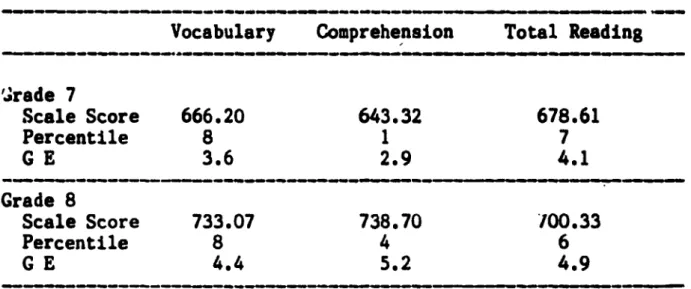
Table 2 presents mean scores of the language sections of the CAT examination. Seventh grade students obtained a mean of 666 on the CAT vocabulary section, and 643 and 678.61 on the Reading CPmprehenSion and Total Reeding elections of the examination. Eighth graders scored 687.00, 712.74, and 700.33 on the
Vocabulary, Reading Comprehension and Total Reading portions respectively. Student means on the various CAT batteries ranged from the first percentile to the eighth percentile. The seventh graders participating in this study scored no higher than the first percentile of the norm population on Reading
Comprehension. Stated differently, 99 percent of the population performed better than the seventh grade group. Eighth graders ranked slightly better at the fourth percentile, indicating they scored higher than 4 percent of the
population. In terms of vocabulary, both grade levels ranked at the eighth
percentile. CAT Total Reading Snore means belonging to the seventh and eighth graders placed them in the seventh and sixth percentiles respectively.
Table 2
Seventh and Eighth Grade CAT Vocabulary, Reading Comprehension and Total Reading Scale Scores Means, Percentiles and Grade Equivalents
MIMM
ImMllmMININIPMOINe-VMbwram.mbwlmmM.NIImNMOMMalIe 111.10Vocabulary Comprehension Total Reading
*MID 'Jrade 7
011=0MMINIIMI
Scale Score 666.20 643.32 678.61 Percentile 8 1 7 G E 3.6 2.9 4.1OMmb
Grade 8 Scale Score 733.07 738.70 100.33 Percentile 8 4 6 G E 4.4 5.2 4.9.4.
.1.1111.111101.0111.MMIIINII.MANID momm....5
III DESIGN
Themathematical abilities of these students were, in most instances,
particularly low, therefore, they constituted a subset of the total school population. Given the special characteristics of this group, it would not have been appropriate to compare this group with another. Instead, the effects of the Kumon instruction on all students in this group was measured by computing their CAT Gain scores on the three mathematical sections of the exam.
Data were obtained on the variables related to the objectives of this study. This involved the maintenance of records for each student including his track
identification, grade, period, quarterly attendance in the program, number of Kumon packets completed per quarter, number of Kumon levels progressed, pre and post scores on three math sections of the CAT examination, and pre and
pat Kumon exam scores.
Variable Definition and Measurement CAT Math Scores
The major measure of math proficiency consisted of a standardized examination, the CAT ( California Achievement Test). Tito mathematical batteries from the
CAT exam were used for the purposes of this study: Mathematical Computation and Mathematical Concepts and Application, which consists primarily of word
problems and applications. Two verbal batteries of the CAT examination were used as well for the pre testing only: the Vocabulary and Reading
Comprehension sections. Furthermore, mathematics battery scores were
averaged, generating a Total Math score. Similarly, Total Reading scores were .representative of both verbal scores. Scale scores were used since these
provided interval level data. Attendance
Records regarding the number of days which students participated in the program were also matntained for each quarter. Because attendance was determined on the babis of first period attendance records, the numbers
provided here must be considered as approximations. To make these
calculations, the number of absent days from first period roll call were subtracted from the number of days possible given the quarter, the student's track, and date of entry into the Kumon program. Therefore, the total number of days in the program during any given quarter varied depending upon a number of factors: the number of quarter absences, track membership, and date of
entry into the Kumon program since students were allowed to enter the program at any point in the semester. It should be noted that each track differed
slightly in the number of days during which instruction was conducted. During the second quarter, for example, Track A consisted of 42 days, Track B, 43 days. Track C. 45 days and Track D, 42 days.
6
Kumon Exams
The Kumon diagnostic exam (P-2), tested elementary mathematical notions of addition and subtraction. Furthermore, the Kumon test was timed: The amount of time which it took the student to complete the exam was recorded in
minutes. Consequently, a score of the number of problems correct was recorded as well as the time in minutes. This exam was administered before and after Kumon instruction.
Kumon Packets Completed
The number of Kumon packets completed by each student was recorded as well. This consisted of the number of packets which had been turned in each quarter. Since students were allowed to work on packets at home, this count included packets completed during the school periods as well as those completed at
home. The total number of Kumon packets completed were recorded as well as the number completed per quarter.
Kumon Level Advancement
In order to determine the number of Kumon levels which students had completed for the duration of this study, records were kept of students' Kumon entry and exit levels. Entry and exit levels were then compared to determine the total amount of Kumon progress made over the course of the eight month period. By assigning a value for each Kumon level (e.g., 3Aw100, 2An200,etc.) and a value
of .05 for each booklet completed, it was possible to generate interval level data, and consequently compare and compute differences between entry and exit
levele. Thus, if a student had entered at level 2A and exited at level C-20, he had completed 4.1 levels. In this way it was possible to determine the total number of levels which had been completed for each student subject.
Other Variables
Other variables included in this study consisted of the following:
1) Grade level (7th and 8th)
2) Track (A, B, C and D)
7
IV PROCEDURES
The following section describes the instructional method and testing procedure used with the 103 subjects.
The Kumon Method of Mathematical Instruction
Students participating in the Kumon classes received instruction five days per
week for 50 minutes each day. Kumon instruction was delivered by a male American public school teacher who had received in-service training i. the Kumon method. Format and methods used did not differ from one period to the
other. Instructional consistency was maintained across tracks.
Given the nature of the student clientele and the public school setting, certain adjustments were required. Diagnostic testing, competency testing, and student record keeping were maintained in compliance with the Kumon
Method. However, if a student could pass the level exam, he was allowed to
advance to the next level, even if he had not completed all of the level packets. In most instances, students completed all level packets before testing out to the next level.
Instruction began on October 6, 1988 and ended on May 30 for those in Tracks A, B, and D and June 12 for those in Track C.
Testing Schedule
All students enrolled at the school, including the participants in this study, were tested in the middle of October of 1988 on the verbal and mathematical
batteries of the CAT. After administration of these tests and prior to
receiving test results, Kumon participants were identified using the selection procedure already described. Form E of levels 16 and 17 respectively were
admigistered to seventh and eighth graders during the pre and post testing
sessions. The post tests of the CAT took place over a three day period during
the last two weeks of the fourth quarter. During the first testing day,* students received a practice test while the other two mathematics batteries were given on the following two days.
Upon entry into the Limon program, the P-2 Kumon diagnostic test was
administered. Students were placed in the appropriate Kumon level on the basis of these test results. At the conclusion of their Kumon studies, that is, during the last two weeks of the fourth quarter, students were again tested using the P-2 examination. Those students who were absent during the initial administration of the CAT or Kumon Post tests, were allowed to make up these tests upon their return to school during the two week testing period.
8
V RESULTS
In this section of the report, the data will be presented for each of the
variables. The first section reports group means for each of the yariables and other corresponding measures (i.e., percentile, grade equivalent). The second concentrates upon correlational relationships among the variables, most importantly, the correlations between CAT Gain scores and other variables.
SECTION A GROUP MEANS
In the following section, sample means will be reported for each of the previously mentioned variables. A few comments are in order prior to their interpretation. First, in this section, the data will be broken down by grade level. Secondly, levels of significance are specified using asterisks. One to three asterisks symbolize the .05, .01, and .001. levels of significance
respectively. These simply refer to the extent or degree to which a statistic
can be attribitted to chance.
(When a statistic is significant at the .01 level in a pre and post test situation, it means that it is highly unlikely that the observed differences between scores can be attributed to chance. Conversely, it is highly likely that thlt differences can be attributed to the treatment being used. In this case the instructional method is the treatment.)
Although there were a number of measures which were available for interpreting CAT scores, it was decided to report scale scores, percentile and grade
equivalents since these were more appropriate giVen our objectives. Scale scores were recorded because they provided interval level data. Percentile ranks showed the relative placement of this sample group with respect to the national norm group.
Grade equivalent scores were also included in this study. Grade equivalent score refers to the grade equivalent which corresponds to a given scale score. For example, a group scale score of 706 is the mean belonging to a norm group which had completed mathematical instruction up to the seventh month of the fourth grade, or 4.7 grade equivalent.
Although grade equivalents have been provided here, caution must be taken in their interpretation. They represerc the mean of the norm population which is a composite of scores belonging to students from a variety of ethnic
backgrounds. According to the CAT aorms manual, there may be a difference of approximately 20 scale scores across ethnic groups. Therefore, the grade equivalents in the following tables represent this central point in that
spread.
9
1. CAT Math Exam Scores
A. CAT Mathematical Computation
On the Math Computation battery of the CAT examination, seventh graders pretested at 706.64 which corresponded to 4.7 grade equivalent units. These same students post tested at 724.64 which represented 4.8 grade equivalent units. The difference between seventh grade pre and post test scale scores was statistically significant. Seventh grade percentile rank at the time of the pre test was 6 while it was 10 at the time of the post test. As Table 3 indicates, the eighth grade Math C/mputation pretest score mean was 733.07 while the post test mean was 738.70. The difference between pre and post test means was not statistically significant. Eighth grade grade equivalents were 5.6 and 5.3 for the pre and post tests respectively. Eighth grade pretest percentile rank was 9 while the post test percentile was 10.
Table 3
Seventh and Eighth Grade Pretest and Post Test CAT Math Computation Scale Scorey Means, Percentiles, and Grade Equivalents
WmewiroM.
Pretest Post Test t value
Grade 7 Scale Score Percentile GE 706.64 6 4.7 724.64 10 4.8 *** 5.48
...1.0.4=.=1.1111111111.11
Grade 8 Scale Score 733.07 738.70 Percentile 9 10 GE 5.6 5.3 *** P < .0011 2,
B. CAT Mathematical Concepts and Application
As Table 4 indicates, the difference between seventh grade pre and post test means (671.41 and 681.53 respectively) was significant (.01) on the Math Concepts and Application battery. Eighth grade pre and post test differences were not statistically significant. The seventh grade GE (grade equivalent score) of 3.9 remained constant at the time of the pre and post tests; grade equivalent scores belonging to the eighth grade group decreased slightly from 4.3 to 4.0. The seventh grade percentile rank increased from the eighth percentile at the time of the pretest to the ninth percentile during post testing. Eighth grade percentile status decreased from the sixth to the fifth percentile rank.
Table 4
Seventh and Eighth Grade Pretest and Post Test CAT Math Concepts and Applications Scale Score Means and Corresponding Grade Equivalents
....,411.11M
Pretest Post Test t value
wom..mm.momwommommempemmomoml
Grade 7 Scale Score Percentile GE 671.41 8 3.9 681.53 9 3.9 ** 2.99 Grade 8 Scale Score Percentile GEIIIMIIIIMINIDMMINIINEW111111.
682.30 684.67 .58 6 5 4.3 4.0 ** P .0038011.=11p1M.Olmil.100.111.111.11111M.11.0.
11
C. CAT Total Math
Seventh graders averaged 689.26 on the pretest of the CAT Tbtal Math exam and 703.36 on the post test. This difference in means was statistically
significant (.001) for seventh graders. Grade equivalent scores corresponding to seventh grade pre and post tests were 4.5 and 4.4 respectively. The
difference between the eighth grade Total Math pretest mean (708.04) and the post test mean (711.96) was not statistically significant. The eighth grade percentile rank was 6 for both pre and post tests. The eighth grade pretest grade equivalent score was 5.1, while the post test grade equivalent was 4.8.
Table 5
Seventh and Eighth Grade Pretest and Post Test CAT Total Math Scale Score Means, Percentiles, and Grade Equivalents
IIIMMIIIIKI.M.M.1.14.11141.110=8/111.1.0111M01111MONMIIIMMIMOVII= =11111MMIMIVIIMM=11,
Pretest Post Test t value
.mNmmmwmmmwmmmodmmwmrmmwwmsmw4mmmmmmmmnirmrrmmmmmw.m.M Grade 7 *** Scale Score 689.26 703.36 6.03 Percentile 6 8 GE 4.5 4.4 4111011.110111. 1114/01111111.1.11=1110MIPMMIDINIIMENIMMIMMENIMMOMMEMMINM111=1111M Grade 8 Scale Score 708.04 711.96 Percentile 6 6 GE 5.1 4.8
....M.m11..0010-*** P < .001 1.0612
D. CAT Gain Scores
Table 6 below summarizes the gain scores for each of the CAT exams already mentioned in this report. Seventh graders averaged a gain score of 18
points on the Math Computation portion ot the CAT exam and 10.12 gain points on the Math Concepts and Application portion. This resulted in a Total Math Gain score mean of 14.09. For eighth graders, the Math Computation gain score mean was 5.63; the Math %ncepts and Application mean was 2.37 yielding a
Total Math mean of 3.93.
Table 6
Seventh and Eighth Grade CAT Gain Scale Score Means for Math Computation, Math Concepts and Application, and Total Math
Math Math
Computation Concepts and
Application
IIIIIIMMI.
Grade 7 18.00 Total Math 10.12 14.09eyNiM40..b
Grade 8 5.63 2.37 3.9313
2. Attendance
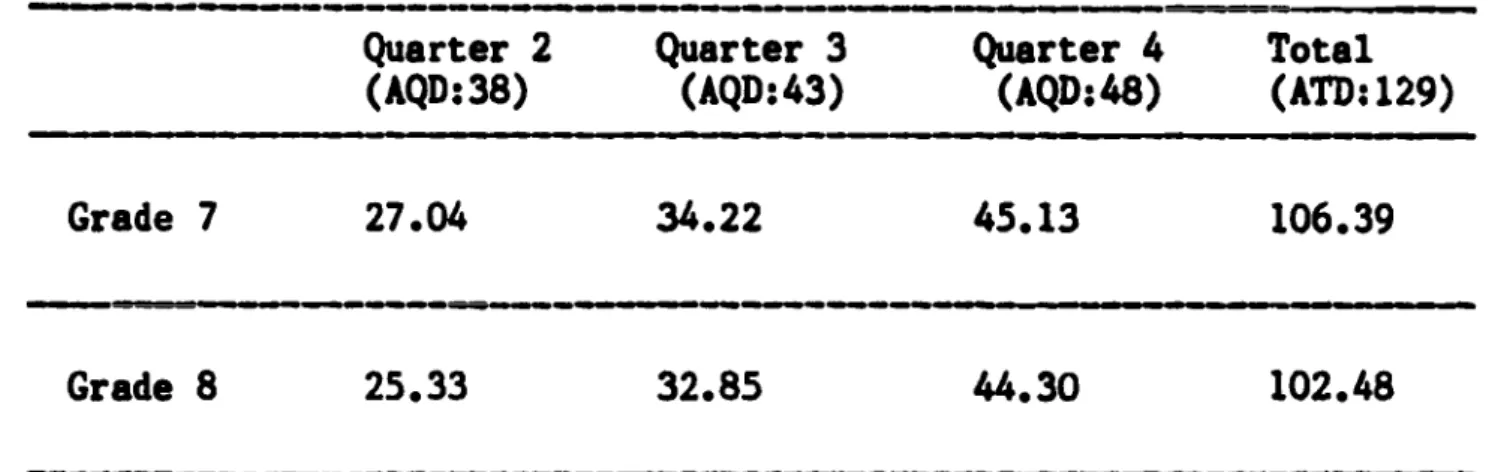
Table 7 presents the average number of days which seventh and eighth graders received Kumon instruction per quarter. Seventh graders attended an average of 27.04 days during the second quarter, 34.2 during the third quarter, and
45.13 during the fourth quarter. Eighth graders attended an average of 25.33 days during the second quarter, 32.85 days during the third quarter and 44.30 days during the fourth quarter. The mean number of days which seventh graders
participated in Kumon instruction over the eight month period was 106.39; eighth graders participated a total mean of 102.48 days. In Table 7 the letters AQD denote the average number of days for a given quarter. ATD
represents the average number of total days which the students could possibly attend for the three quarters.
Table 7
Seventh and Eighth Grade Total and Quarterly Attendance Means
/BOMBAMIMNIMID1111./MMEIO.INNOMMONEMIN1111MMI111111411=111111.1,11.
IMIMM110111
Quarter 2 Quarter 3 Quarter 4 Total
(AQD:38) (AQD:43) (AQD:48) (ATD:129)
Grade 7 27.04 34.22 45.13 106.39
Grade 8 25.33 32.85 44.30 102.48
.1111011111M11111
The average number of Kumon instructional days was relatively low during the second and third quarters. This, however, was most likely due to the large numbers of students who entered the class late in the semester during these two quarters.
3. Kumon Exam
A. Kumon Exam Scores
14
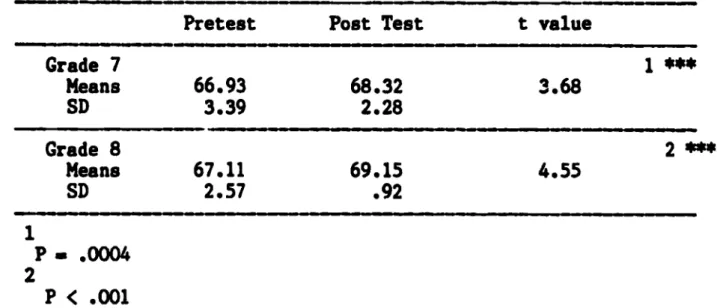
The seventh grade Kumon pretest mean of 66.93 was significantly different (.01) from the post test mean of 68.32. The eighth grade pretest mean (67.11) and post test mean (69.15) were statistically significant at the .001 level. Table 8 displays these means as well as their corresponding standard
deviations and t values.
Table 8
Seventh and Eighth Grade Kumon Pretest and Post Test Siore Means, Standard Deviations and t Values
IMIIIIM11
N
Pretest Post Test t value
Grade 7
1***
Means 66.93 68.32 3.68 SD 3.39 2.28 Grade 8 2 *** Means 67.11 69.15 4.55 SD 2.57 .92 =11...111111! 1 P = .0004 2 P < .001While the difference of 2 to 3 points was statistically significant, the actual magnitude was small and does not represent a substantive ccntent gain. It should be noted that with means in the high 60's, and a total possible cf
70, the distribution was highly skewed with many students achieving the maximum score.
B. Kumon Exam Time Scores
As displayed in Table 9, 7.54 minutes represent the seventh grade pretest mean; 4.91 minutes represent the post test mean. This difference in pretest and post test scores was statistically significant (.001). Eighth graders pretested with a meah of 6.78 minutes and post tested with a mean of 4.23 minutes. The diffbrence between pre and post tests was statistically significant (.001) as well.
Table 9
Seventh and Eighth Grade Kumon Pretest and Post Test Time Score Means (in minutes) and Corresponding t Values
.1111M1M110IMMMWO
.11111MMII
Pretest Post Test t value
*** Grade 7
4111
7.54 4.91 8.25 *** Grade 8 6.78 4.23 6.12 *** P < .001=111111111
15The average number in Table 10 below. graders during the 34.22, and 45.13. 30.73, and 15.33.
16
4. Kumon Packets Completed
of Kumon packets completed per quarter have been displayed The mean number of Kumon packets completed by seventh
second, third, and fourth quarters was as follows: 27.04, For eighth graders these means per quarter were 36.33,
Table 10
Seventh and Eighth Grade Mean Number of Packets Completed per Quarter
=IMM.MMMIOMMD.MINOMINIDONWMIMIIIIMINO.M. 16.6MMIDIMIMMIMM=
Quarter 2 Quarter 3 Quarter 4
IIIIIIMEMIIMINININIII
IIIMENIAMMO11111=14MMENIMIMIIMMIMMMINNIMGrade 7 27.04 34.22 45.13
4.=1...m.IMMONO.1MIIM
Grade 8 36.33 30.73 15.33
...~.1 _.Inmwo.pmimmomm
A number of factors may have influenced that number of packets completed. Lower level Kumon packets require less time to complete than do the higher level packets, therefore, one would expect higher level students to complete fewer pockets. Also, the figures provided in Table 10 include the number of
packets completed by students who entered at differing times during the quarter. Given this, it is not surprising that the mean number of packets were so low during the second quarter when a large number of students entered the program late in the quarter. During the fourth quarter, most students were
1
5 lamon Level Advancement... .
The average l'Alsion'entry4nd exit levels.belonging to seventh' and eighth
graders are displayed in tte Table 11. As determined.by the Kumon diagnostic examination, the average seventh grade Kumon entry level was 2A-31 while the average exit level was D-51. This difference represented a mean advancement. of 4.10 Kumon levels (i.e., 4 levels and 2 packets). The eighth graders advanced four Kumon levels over the duration of this study since they began a a mean level of 2A-81 and exited at level D-81.
17
Table 11
Seventh and Eighth Grade Means of Limon Entry Level, Exit Level and Total Levels Completed
11M1.10101.41.11i...11.,
Entry Level Exit Level Total Levels
MINIMMIINIMIONMM=NIAMI/NO
IIMM
Grade 7 2A-31 D-51 4.10
Itrenrmwoloasommiwolmmil
Grade 8 2A-81 1081 4.00
18
SECTION B - CORRELATIONS BENEEN THE VARIABLES AND GAIN SCORES
The following section describes 'he significant correlations between each of the variables and the CAT Math gain scores: CAT Mathematical Computation Gain, CAT Mathematical Computation and Application Gain, and CAT Total Math Gain Scores. It should be noted that these correlations are based on a
composite of data belonging to seventh and eighth grade subjects. Both of these groups were combined because there was no significant difference between their correlations.
It should further be noted that, given the number of subjects in this study, correlation coefficients which were statistically different from zero had to be greater than .254 to be significant at the .01 level. Those coefficients greater than .195 were significant at the .05 level.
Once a correlation is considered significant (r# 0), it must be then
interpreted in terms of its strength. In Fundamental Statistics in Psychology and Education, Guilford (1956) distinguishes between the varying degrees of correlational strength (See Table 12).
Table 12
Guilford's Correlational Strengths
Correlatior Strength of the Correlation
0 - .2
.2 - .4
.4 - .7 .7 - .9
.9 - 1.00
Slight, almost negligible Low, definite but small Moderate, substantial High, marked
Very high, dependable
For a complete listing of all correlational relationships please see Appendix
19
1. CAT Math Exam Scores
A. CAT Mathematical Computation
The CAT Mathematical Computation pretest scores were negatively correlated (-.355 **) with CAT Total Math Gain scores. Math Computation pretest scores were also correlated negatively at the same significance level with Math Cbmputation gain scores (-.415 **). Math Computation post scores were
positively correlated with the Math Computation Gain scores. Math Computation gain scores were positively correlated (.336 **) with post Math Computation
scores.
B. CAT Math Concepts and Application
Math Concepts and Application pretest scores were significantly correlated at the .01 level (-.420 **) with Math Concepts and Application Gain scores.
Math Concepts and Applications post test scores were negatively correlated (-.238 *) at the .05 level of significance with Total Math Gain scores.
C. CAT Total Math
Total Math pretest scores were negatively correlated with all three CAT Gain scores: Math Computation Gain 'mores (-.225 *), Math Cbncepts and Application Gain scores (-.297 **), and Total Math Gain scores (-.355 **).
Total Math post test scores were positively correlated with the following gain
scores: Math Computation Gain scores (.212 *) and Total Math Gain scores
(.240 *).
D. CAT Gain Scores
Math Computation Gain scores were significantly correlated with Total Math Gain scores (.731 **). Math Concepts and Application Gain scores were also significantly correlated with Total Math Gain scores (.730 **). These are expected correlations since the Total Gain scores are an average of these two sections of the CAT exam.
20
2. Attendance
There were no significant correlations between any of the CAT Gain scores and quarterly attendance. Neither were there any significant correlations between Total Attendance scores and the CAT Gain scores.
3. Kumon Exam A. Kumon Exam Scores
A significant negative correlation existed between the Kumon Exam pretest scores and Math Concepts and Applications Gain scores (-.241 *).
Kumon post exam scores were significantly correlated with two CkT gain scores:
Math Concepts and Application Gain score (-.433 **) and Total Math Gain score
(-.319 **).
B. Kumon Exam Time Scores
Neither the pre, nor the post Kumon Exam Time scores were significantly correlated with any of the three gain scores.
Kumon post Exam Time scorve were significantly correlated with post Math Computation exam scores (-.417 **), post Math Concepts and Applications (-.417 **) and Total Math post test scores (-.459).
4. Kumon Packets Completed
No significant correlations existed between CAT gain scores and the number of packets completed per quarter.
5. Kumon Level Advancement
There were no significant correlations between the three CAT Math Gain scores and the number of Kumon levels advanced. Furthermore, there were no
significant correlations between the Kumon Exit Level and the CAT Gain scores.
There was a positive correlation between Kumon exit level and CAT Math
Computation post test scores (.5888 **) and Math Computation pretest scores
21
6. Grade
Grade level was negatively correlated with Math Computation Gain (-.197 *). There v7- also a negative correlation between Grade level and Total Math Gain
(-.221 **).
7. Additional Correlations
There were other correlations found in the data which were not directly related to the issue at hand. Here, track and period correlations will be discussed briefly.
Track
There were no significant correlations between the track to which the student belonged and the CAT Gain scores.
Period
There were two negative correlations between the Period and CAT Gain scores. Period was significantly correlated with Math Computation Gain scores
(-.238 **) and Total Math Gain scores (-.278 **).
In short, a number of other significant correlations were found in
however, it was not within the scope of this study to deal with all oi Chese. For a complete listing of all correlational relationships please refer to Appendix D.
22
VI SUMMARY OF FINDINGS
The following section summarizes the findings for each of the variables
discussed in this report. Each variable is discussed in terms of the seventh and eighth grade means as well as its correlation with gain scores.
1. CAT Math Scores
A. CAT Mathematical Computation
1) Means, (Table 3)
* The 18 point difference between pre and post CAT Math Computation scores was statistically significant (.01) for seventh graders.
* The 5.63 difference between pre and post CAT Math Computation scores was not statistically significant for eighth graders.
* The seventh grade percentile rank increased from the 6th percentile on the pretest to the 10th percentile on the post test of the CAT Math
Computation exam.
* Eighth grade percentile rank did not significantly change between pre and post tests of the Math Computation exam. Eighth grade students
appear to have maintained their percentile rank in Math Computation.
2) Correlations with CAT Math Gain scores
* Low Math Computation pretest scores were related to high gain scores: 1) Total Math Gain scores (.355 **), and 2) Math Computation Gain
scores (.415 **).
* High gains on the Math Computation portion of the exam were correlated with high post Math Computation scores (.336 **).
23
B. CAT Mathematical Conce ts and A lication
ILAVEIL
(Table 4)* Seventh grade pre and post test means on the Math Concepts and Application portion of the CAT Exam were statistically significant
(.01).
* Eighth grade pre and post test means on the Math Concepts and
Application portion of the CAT Exam were not statistically significant.
* Both grade levels maintained their percentile ranks.
2) Correlations with CAT Math Gain Scores
* Low pretest CAT Math Concepts and Application scores were associated with high Math Concepts and Applications Gain scores (.420 **).
* Low post test CAT Math Concepts and Application scores were associated with high Total Math Gain score (.238 *).
24
C. CAT Total Math
111WEIE
(Table 5)* CAT Total Math pre and post scores were significantly different for the seventh grade group. This was expected since Total Math scores are an average of the other two CAT Math exams which were also significant.
* The eighth grade CAT Total Math pre and post scores were not significantly different.
2) Correlations with CAT Math Gain Scores
* The lower the scores were on the CAT Total Math pretest, the higher were the following gain scores: 1) Math Computation Gain scores
(-.225 *); 2) Math Concepts and Application Gain scores (-.297 **); and 3) the Total Math Gain scores (-.355 **). It was important to note that the relationship between the gain scores represented a regression
effect. This implies the existence of some regression effect with lower
scores making higher gains. While statistically significant at the .01 level, it represents only 12.6 Z of the common variance (r squared equals .126).
* The higher the scores were on the CAT Total Math post test, the higher were the following gain scores: 1) Math Computation Gain scores (.212 *) and 2) Total Math Gain Scores (.240 *).
25
D. CAT Gain Scores
112.1111E (Table 6)
* Total CAT Math Gain score means were higher for seventh graders than
tbc; -mt.& for eighth graders. This included Math Computation Gain ',Jth Concepts and Applications Gain scores, and Total MAth Gain
sco:...
* The greatest gain scores reported for seventh graders was on the Math Computation battery of the CAT exam.
2) Correlations with CAT Math Gain Scores
* High 'Ath Computation Gain scores as well as Math Concepts and Application Gain scores were correlated with high Total Math gains. Given that the Total Math gains are an average of the first two, this relationship was expected.
1
1
1
1
26 2. Attendan eal
lIELIE
(Table 7)* For seventh graders, the mean number of Kumon instructional days increased over the course of the three quarters.
* For eighth graders, the mean number of Kumon instructional days increased over the course of the three quarters.
* The average total number of days the two grade levels attended Kumon classes differed by 4 days.
2) Correlations with CAT Math Gain Scores
* The attendance variable did not appear to be related to any of the CAT Gain scores.
3. Kumon Exam
A. Kumon Exam Scores
altEris
(Table 8)27
* Differences between pre and post Kumon exam scores were statistically significant for the seventh grade group (.01).
* Differences between pre and post Kumon exam scores were statistically significant for the eighth grade group (.001).
2) Correlations with CAT Math Gain Scores
* Low Kumon pretest scores were associated with high Math Concepts and Applications Gain scores (-.214 *).
* Low Kumon post test scores (-.433 **) were associated with high gains in Math Concepts and Application.
* Low scores on the Kumon Post test were correlated with high Total Math Gains scores (-.319 **)
II0
I1
28
B. Kumon Exam Time Scores
Jalittat (Table 9)
* The amount of time required to complete the Kumon examination significantly decreased for seventh graders (.001).
* The amount of time required to complete the Kumon examination significantly decreased for eighth graders (.001).
2) Correlations with CAT Math Gain Scores
* There was no relationship between Kumon Time scores and CAT Math Gain
scores.
* Low Kumon Post test time scores were related to high scores Oh two CAT Math exams: 1) Post Math Computation exam (-.417 **), and the Post Math Concepts and Application Exdh (-.417 **). Consequently, low Kumon post test time scores were correlated with Total Math post test scores (.459 **).
29
4. Kumon Packets Completed
lijiejins (Table 10)
* The number of Kumon packets completed by seventh graders increased with each quarter.
* The number of Kumon packets completed by eighth graders increased with each quarter.
* Eighth grade packet ccmpletion dropped from an average of 30.73 packets during the Quarter 3 to 15.33 packets during Quarter 4.
* During the fourth quarter, the mean number of Kumon packets completed by eighth graders consisted of 15.33 packets.
* Diring the fourth quarter, the mean number of Kumon packets completed by seventh graders consisted of 45.13 packets.
2) Correlations with CAT Math Gain Scores
* The number of packets completed per quarter were not correlated in any way with CAT Math Gain scores.
30
5. Kumon Level Advancement
112129m
(Table 11)* Eighth graders advanced an average of 4 Kumon levels.
* Seventh graders advanced an average of 4.10 Kumon levels.
* The average seventh grade Kumon entry level was 2A-31 while the exit level was D-51.
* The average eighth grade Kumon entry level was 2A-81 while the exit level was D-81.
2) Correlations with CAT Math Gain Scores
* There was no relationship between CAT Math Gain scores and Kumon levels completed.
* CAT Math Gain scores and Kumon exit level were not correlated.
* A high Kumon exit level was related to CAT Math Computation post test scores (.588 **).
* A high Kumon exit level was related to Math Computation pretest scores
(.494 **). Based on these last two correlations, the Kumon levels appear to have a degree of construct validity with respect to the
CAT (r squared equals .336).
6. Grade
Correlations with CAT Math Gain Scores
* The low grade level was related to high Math Computation Gain scores (-.197 *) and high Total Math Gain scores (-.221 *).
31
VII OBSERVATIONS
A number of relationships uncovered by the data have been presented and
discussed in this report, yet there are a number of observations which will be made with respect to the program and these data.
Kumon Program Modifications
There were a number of modifications which were made to the Kumon instruction presented at Bell Gardens Interme:iate school which distinguish it from the Kumon instruction which might take place in a private school setting.
1) Kumon in the Traditional Curriculum
At Bell Gardens, Kumon materials were used in place of the traditional ones. That is, Kumon instruction was not used to supplement a traditional
curriculum.
2) Motivation Techniques
These public students were motivated by their instructor in a number of ways which may not be similar to those methods employed in the privately instructed Kumon classes. These included pep talks, certificates, the opportunity to
purchase candy rewards, etc. 3) Public School Setting
In this study, Kumon Math was studied during the various periods of the day. Those participating during the later periods may have been subject to a number of factors which could have affected their performance. The correlations
between period and CAT Gain scores support this: Students attending later in the day had lower CAT Math Computation Gain scores (-.238 *) and Total Math Gain scores (-.278 **) than those attending earlier.
4) Implementation of the Kumon Method
The way in which the Kumon program was executed also differed. The Bell
Gardens Math instructor modified the method slightly by allowing students to have greater control over the time at which the mastery test was taken. That is, students were allowed to prove mastery of a given level when they felt they were ready. This introduced into the Kumon method an element of "learner control" (Hannafin and Peck, 1988), a highly desirable characteristic of
instructional programs. Yet, it should be understood that students were not permitted to advance themselves to the next level, but simply have the freedom to take a level mastery test prior to completing all of the packets belonging to that level.
32
This element, however, does not characterize the Kumon method in its current
form. The Kumon method is linear in its approach to instruction, therefore,
once a student is placed into the appropriate level, there is no deviation from a prescribed sequence of levels and materials. The learn does not have the option of taking the mastery test prior to the completion of packets for that given level.
Interpretation of Results
While tho results were not dramatic, the Kumon Method did appear to have positive effects upon a segment of the students participating in the study. It was apparent from studying the seventh grade CAT pre and post test scores that significant improvement had been made. (See Tables 3 thru 5) Students moved from the 6th percentile rank during their pretest to the 10th percentile
during the post test in Math Computation.
Although eighth graders did not experience a similar increase, eighth graders maintained their percentile rank, indicating that they, at least, experienced an expected amount of progress in mathematical skill over the duration of this
study. Since these studens were mathematically several grade levels behind
upon entry into this Kumon program, the maintenance of mathematical grade level should be viewed positively as the normal expectation is that students below grade level tend to fall further behind over time.
The results obtained characterize Kumon instruction in a public setting during an initial eight month stage only. The amount of improvement may have been
greater than that reported here if the study had extended over a longer period
gcr
34
A PPE NDDC A
FREQUENCY DISTRIBUTION
CAT MATH COMPUTATION LAIN SCORES
FREQUENCY DISTRIBUTION OF 1400/GN
CLASS FREQ FREQ
INTERVAL
4-
4-20 - 29
1.97
30 - 39
32.91
40 - 49
65.83
50 - 59
98.74
60 .. 69
1110.68
70 - 79
1918.45
80 - 89
1110.68
90 - 99
1211.65
100 - 109
1211.65
110 - 119
87.77
120 - 129
76.8
130 - 139
21.94
140 - 149
00
150 - 159
0
0
160 - 169
1.97
170 - 179
1.97
>180
0
0
Note: A gain scare of 70 represents no gain. Gain
scores
below 70 signify negative gains, while those above 70
reiresent positive gains.
35
APPENDDC B
FREQUENCY DISTRIBUTION
CAT MATH CONCEPTS AND APPLICATION GAIN SCORES
FREQUENCY DISTRIBUTION OF MCN/GN
CLASS FREQ FREQ
INTERVAL
4-
4-10 - 19
.21.94
20 - 29
1.97
30 - 39
32.91
40 - 49
6
5.83
50 - 59
17:6.5
60 - 69
9
8.74
70 - 79
1817.48
80 - 89
1615.53
90 - 99
1312.62
100 - 109
76.8
110 - 119
43.88
120 - 129
1.97
130 - 139
21.94
140 - 149
32.91
150 - 159
0
0
160 - 169
1.97
> 1700
0
36
A PPE ND:IX C
FREQUVICY DISTRIBUTION CAT TOTAL MATH GAIN SCORE
FREQUENCY DISTRIBUTION OF TOM/GN
CLASS FREQ FREQ
INTERVAL 25 - 29 1 .97 30 - 34
o
o
35 - 39o
o
40 - 44 2 1.94 45 - 49 1 .97 50 - 54 3 2.91 55 - 595
4.85 60 - 64 13 12.62 65 - 69a
7.77 70 - 74 6 5.83 75 - 79 8 7.77 80 - 84 11 10.68 85 - 89 9 8.74 90 - 94 10 9.71 95 - 99 5 4.85 100 - 104 6 5.83 105 - 109a
7.77 110 - 114 1 .97 115 - 119 2 1.94 120 - 124 2 1.94 125 - 129o
o
130 - 134 2 1.94 > 135o
o
A PPE ND IX D
CORRELATION MATRDC OF ALL VARIABLES
.Owsw 61
42310.1.611131 2411170. 1 2 3 MCC MAN /00/711 .13706 .2211 1 .6166 .21237 .52209 .91629 .30372 .31331 .43481 .41514 .10333 .06077 .03012 .02185 .1032 .02417 .12933 .17123 .05337 .09212 .0127S .16395 .01293nu
.13317 .14627 .10632 .13546 .17112 TRACI 1 .06184 ClAbe .06188 1 VOC/140 .15706 .1281 CCVVW .29801 .27752 ROOM .08217 41207 MOI/P11 .04992 .12166 TOR/P1' .2646% .29513 111WPIt .0705 .2A011 1C0/70 .01791 .17196 1401/P0 .04292 .03696 TOVIV .03365 .11436Mr
.4620 .1230 .19129 .12116 104 .18192 .07927 TOMQ .01194 .04645[TIM
.0503 .1119 LSC139 .01381 .02433 MVO° . .0122 .12S% TSCV04 .06236 .17122 0711127$ .27378 .07415 OPALQ3s .03199 .10133 0404 . .14899 .20161AVM
.08814 .12221 LAU .0220 .11313 LVLCVT .06616 .07919 AVIS .06406 .0043 MIOD .10444 .13314 14111/(31 .003 .19702 P031/C11 .0131 .1237 MVO, .07003 .22138 4 00201 3 P100/72 6 1131/71 7 10/P1 1334/P11 9 20/70 1110 101/10 .29101 .0017 .04992 .26463 .07355 .01791 .0092 .27731 .31207 .12166 .29513 .24021 .17118 .036% .6166 .38207 .32209 .91629 .30372 .31331 .43441 1 .33617 .48513 .115905 .46985 .32273 .40726 .35617 1 .61133 .41333 .19181 .71607 .36613 .44313 .61133 1 .56704 .9031 .63307 .74341 .85905 .41533 .56704 1 .5473 .36577 .48092 .46983 .19188 .9031 .5475 1 .7504 .73209 .32273 .*:1607 .63307 .3607 .7504 1 .62342 .40736 .56613 .74341 .41092 .73209 .62382 1 .40672 .70931 .76384 .47082 .42146 .19742 .90561 .12693 .07279 .09122 .00301 .09813 .10251 .209 .01496 .31271 .0003 .01218 .14573 .21395 .06797 .19824 .16111 .07343 .09733 .06837 .23334 .02729 .0023 .18469 .0311 .0116 .0225 .11263 .001112 .0674 .3760 .2093 .12636 .35961 .3609 .219% .09296. non
.31324 .03098 .313329 .26667 ,13163 .18371 40444 .22459 .17061 .39594 .41731 .4170 .24191 .311195 .52443 .2364 .47E291 .29966 .24149 .11634 .28771 .16374 .00011 .219013 .24056 .29433 .0067 .13939 .0019 .07313 .1360 .2001 .1387 .0748 .04303 .01992 .07249 .07307 .12267 .14398 .07436 .2700 .10424 .13395 .25139 .1032 .36164 .0303 .32176 .32117 .01072 .30141 .276 .17114 .08191 .49477 .33707 .12356 .47234 .31134 .33322 .05n3 .27136 .2067 .1083 .26137 .40623 .24491 .09695 .0920 .17117 .1301 .15014 .2704 .3103 .06004 .41399 .00013 .08386 .22344 .33649 .05166 .14235 .10547 .4033 .15557 .29725 .0036 .29442 .13592 .35.50 .21311 .1611 .3508 .19373 .23141BEST COPY AVAILABLE
11 101/10 .0330 12
0
.46263 1 13 .19229 14 /06 .16192 IS 1171VOQ .01194 16apn
.050 170001
.023111 IS 11 ETWO .03122 190020
.06236 20/PA=
.2737$ .11436 .12343 .12116 .07927 .01643 .111 .0203 .12396 .17122 .0740 .41314 .10333 .06077 . .03012.
.0210 .163 .02417 .12933 .17123 .03337 .40672 . .12693 .01496 .19624.
.00713 .067 .09296 .10371 .24191 .1104 .70931 .07279 .31271 .1661S .111669 .3740 .0013 . .36444103
42771 .76364 .09662 .0610 .07345.out
.269! .31324 42439 .52443 .1074 .47012 .00301 .0120 .00733 .01916 .121k .03091 .17061 .2366 .000111 .82146 .09613 .14373.007
.011223 .3391 .3029 .39394 .47391 41903 .0742 .1001 .21393 .23334 .11263 363.. .26667 .41728 .29966 .24056 .90366 .209 .06797 .02729 .00162 .131115 .41713 44149 .29433 1 .17433 .13629 1106 .01213 .36.V .2304 .43977 .29646 .29637 .17433 1 .16143 .37$011 .73397 .1631 .03607 .02023 .00963 .37117 .13629 .16143 1 .33119 .69074 .0721 .0406 . .16204 .01101 .02311 .1106.37=
.33119 1 .31993 .03139 .0201 .07629 .01132 .06263 .73397 .69974 .36993 1 .1371 .14064 .17972 .0213 .2260 .36332 .1630 .07243 .02433 .13743I
.14431 .0376 .14368 .0301$ .2306 .03107 .06406 .03139 .14064 .144: 1 .02339 .36762 .10241. .0977
.0200 .16201 .0061 .17972 .3637AM
1 .24066 .06331 .29646 .00963 .01101 . .07629 .0213 .1436 .367112 .24061 1 .07071 .29637 .37117 .02311 .002 .22101 .001 .10241 .06531 .07076 1 .21026 .29293 .01331 .13726 .44314 .067 .0606 .03676 .01632 .00433 .14721 .01361 .11363 .11397 .27336 .0131 .01619 .00339 .011013 .03214 .30126 .12326 .22114 .06123 .21963 .0393 .01693 .11314 .01161 .72300.007
.03149 .0623 .07036Ana
.4927 .23639 .36323 .2471 .311147 .3102 .0072202
.13067 .16464 .33111 .1007 .43746 03393 .31107 .3309 .02711 .1061 .07347 .21791.00r
.0014 . .17761 .1649 .49673 .32319 .031$9 .0262$ .007 .10630 .0633 .019 .01363 .0631 . .00723 41237 .04727 .14016 .07714 .1616 .0313 .0306 .02363 .03966 .03136 .13726 .11961 .13064 .07076 .0101 .0076 44137 .10336 .4331.1=3
.2409 .11091 .00611 .0094 .03702 .0162 33636 .011633 .31957 .10611BEST COPY AVAILABLE
21 OP143 32 RAF44 13
norm
1.111.1124 IS MOUT 26 27PIRKO MCO31C11
WIZ
1091/11113°.031199
JON
.0111114 .02203 .06616 .06606 .10644 .0673 .0131 .070113 - .10133JOIN
.12621 .10393 07919 .01043 .13314 . .19702 .1237 .22138 .09212 .01275 .111619, .01295 .13932 .13317 44027 .10633 .13316 .17112 .0017 .0744 .07454 .0303 .06196 .03233 .09693 .06004 .14255 .13392 .13930 .0303 .27061 .32176 .49477 .271136 .0920 .41399 . .10347 .3539 011719 .01092 .11424 .22117 .33707 .20367 .17117 .00013.4=
.21311 .07313 .07249 .13393 .01171 .12136 AOC .13131 .01366 .13557 .1611 .136211 .07307 .23139 .30141 .47234 26027 .13014 . .22364 . .29723 .35354 .2430 12267 .20230 .276 .5111134 .40613 .27134 .116611 .05336 .19323 .1317 .14394 .36164 .17114 .35311 .24491 .3103 .05166 .29442 .23141 .21026 .14721 .30620 .24637 .31172 .35439 .31319 .21237 .13726 4409 .29293 .01361 .12326 .03249 .0047 .03271 .03199 .04727 .11966 .11091 .0133$ .11363 .22114 .04623 .21532 .111362 .03828 .14066 .13014 .00111 43726 .11397 .06123 .07034 .13047 .07347 .0062 .07714 00 767702
.44314 .27336 .21963 .06626 .16414 .21791 .10696 3024 9761 .06676 .06319 .05935 .49272 .321111 .003n-
.06351 .03133 .1:0768A66% .01E9 .01693 .23429 .10067 .02%4
Aso
.03686 - .34137 .131136 .03676 .00539 .11314 .. .31323 .43746 .17761 .01363 .02363 . .10526 .01633 .011152 .04013 .011111 .2471 .3395 1649 .0651 .03961 .4331 - .31937 .0043 .03214anal
.. .31947 .32107 .49973 .00723 . 031311 -MSS .10611 1 .33419 .4005 .07299 2903 .26191 .23263 .10099 .06224 .11116 .33419 1 .31327 .0142 .3296 .32328 .16739 .10177 .06646 .1133 .4005 .39327 1 .11334 .49734 .63421 .16261 9.619999443 .0917 .07047 .07299 .01462 .21314 1 .313011 .29643 .0146 .07446 . .01313 .10146 .291113 .3294 .49734 .311301 1 .7637 .06312 .09936 .03101 .06627 .26191 .32326 .634211 . .29610 .7637 1 .02232 .133411 .0301 .13114 .23263 .16739 .16261 .0646 .06312 .02232 1 .23174 . .1734 .27139 .10099 .10177 .6499991143 .07446 .09936 .13341 .13674 1.06969 . 069% .73171 .06224 .06646 .0917 .01310 .03101 .03139 .1734 1 .73012 .11116 .1133 .07067 .101111 .13114 .27139 .73176 .73012 1slug COPY
AVAILABLE
38
IX REFERFXCES
Guilford, J. (1956) Fundamental statistics in _psTcholoss and education. New York $ McGraw.Mill Book Company.
Hannafin, M. & Peck, I. (1988) The desisn, development, and evaluation of instructional software. New York : Macmillan PUblishins Company.
1