EFFECT OF FIBER COMPOSITION ON MECHANICAL AND PHYSICAL PROPERTIES OF HIGH LOADING WOOD FIBER COMPOSITES
By
AMINULLAH ASHARI
Thesis submitted in fulfilment of the requirements for the degree of
Master of Science
ii
ACKNOWLEDGEMENTS
ALHAMDULLILLAH, Thanks to ALLAH for his guidance and giving me the strength to face all the challenges, to give a commitment and hard work in completing this project.
I would like to take this opportunity to thanks from deep of my heart to my supportive supervisors, Professor Dr. Zainal Arifin Mohd. Ishak, Professor Dr. Rozman Hj. Din, Dr. Ahmad Fuad Md. Yusof and Dr. Syed Mustafa Syed Jamaludin for their guidance and encouragement in this project.
Special thanks to all colleagues at Plastics Technology Group, SIRIM Berhad for their concern and assistance towards the success of this project. Sincere thanks should be addressed to Nor Azlan Mohd. Ramli and Mohd. Hafizi Nordin those who are working close with me especially in producing profiles from developed formulation.
I am pleased to acknowledge President and Chief Executive Officer of SIRIM Berhad for the opportunity given. Also thanks to Government of Malaysia especially Ministry of Science, Technology and Innovation for the PR Grant given to this project.
The most important part of my life is my family. I would never have been able to accomplish any of my goals without the support of my family members. Especially to my beloved wife, Siti Zuraida Ibrahim for her consistent support and to
iii
my children Muhammad Harraz, Nur Wajihah, Muhammad Adam Muaz, Nur Qiasara Malihah and Muhammad Anas Talhah for their inspiration.
iv TABLE OF CONTENTS Acknowledgements ii Table of Contents iv List of Tables ix List of Figures x
List of Abbreviations xiii
List of Symbols xv
Abstrak xvi
Abstrack xviii
CHAPTER 1 - INTRODUCTION
1.1. Background of research study 1
1.2. Problem statement 3
1.3. Objectives 5
CHAPTER 2 - LITERATURE REVIEW
2.1. Introduction to composite 7
2.2. Introduction to wood polymer composites (WPC) 7 2.3. Market of wood polymer composites 12
2.3.1. WPC in furniture industry 13
2.4. Matrix 16
2.4.1. Thermosetting matrix 16
2.4.2. Thermoplastics matrix 17
v
2.5. Fillers 19
2.6. Natural fillers 21
2.6.1. Density of natural fillers 24 2.6.2. Preparation method for natural fillers 24
2.6.3. Rice husk (RH) 27 2.6.4. Sawdust (SD) 28 2.6.4.1. Hardwood 28 2.6.4.2. Softwood 30 2.7. Additives in WPC 30 2.7.1. Coupling agent 33
2.7.1.1. Maleic anhydride grafted polypropylene
copolymer (MAPP) 35
2.8. Degradation and environmental effects 37
2.9. Aspect ratio 38
2.10. Specimen conditioning 38
2.10.1. Normal condition 39
2.10.2. Exposure to water immersion at room temperature 39 2.10.3. Exposure to temperature cycle 39 2.10.4. Exposure to accelerated Xenon-arc light 40
CHAPTER 3 - EXPERIMENTAL
3.1. Materials 41
3.1.1. Polypropylene (PP) 41
3.1.2. Mixed sawdust (SD) 41
vi
3.1.4. Maleic anhydride grafted polypropylene (MAPP) 44
3.2. Method 44
3.2.1. Filler treatment 44
3.2.2. Preparation of composites 45 3.2.2.1. Optimization of high filled natural filler
composites 45
3.2.2.2. Utilization of maleic anhydride grafted
polypropylene (MAPP) 45
3.2.2.3. Compounding 46
3.2.2.4. Extrusion 47
3.2.3. Test specimen preparation 48
3.3. Mechanical testing 49
3.3.1. Tensile test 49
3.3.2. Flexural test 49
3.3.3. Izod impact test 50
3.3.4. Morphology study 50
3.3.5. Water absorption test 51
3.3.6. 4-point bending test on extruded profiles 51
3.3.7. Density 52
3.3.8. Coefficient of linear thermal expansion (CLTE) 53 3.3.9. Colour change measurement 53
vii CHAPTER 4 - RESULTS AND DISCUSSIONS
4.1. The effect of filler loading 55
4.1.1. Density 55
4.1.2. Tensile test 56
4.1.3. Flexural test 61
4.1.4. Izod impact test 62
4.1.5. Water absorption test 63
4.1.6. 4-point bending test on profiles 65 4.1.7. Coefficient of linear thermal expansion (CLTE) 68
4.2. Effect on introduction of maleic anhydride grafted polypropylene
(MAPP) coupling agent 70
4.2.1. Tensile test 70
4.2.2. Flexural test 72
4.2.3. Izod impact strength 76
4.2.4. Water absorption test 76
4.2.5. 4-point bending test on profile 78
4.2.6. Density test 79
4.2.7. Coefficient of thermal expansion test (CLTE) 80
4.3. Effect of different type of environment exposure 81
4.3.1. Tensile test 81
4.3.2. Flexural test 84
viii
CHAPTER 5 - CONCLUSIONS AND RECOMMENDATION FOR FUTURE WORKS
5.1. Conclusion 89
5.2. Recommendation for further works 90
REFERENCES 92
APPENDIX 100
A1. Journal paper 1 - Effect of filler composition and incorporation of additives on the mechanical Properties of polypropylene composites with high loading lignocellulosic materials. Journal of Reinforced Plastics and Composites 29, (20), p.3115–3124.
ix
LIST OF TABLES
Page Table 2.1 The chemical constituents of some important plant fillers
(Lilholt and Lwather, 2003)
21
Table 2.2 Particle size conversion (cospheric) 26 Table 2.3 Additives used in WPC (Mali et al., 2003) 31 Table 3.1 Size distribution of SD filler 42 Table 3.2 Size distribution of RH filler 43 Table 3.3 Formulation of composites produced 45 Table 3.4 Formulation of (MAPP) treated composites 46
Table 3.5 Gray scale rating 54
Table 4.1 Colour change and grey scale of SD-PP composite (50/49/1) after 1000 hours Xenon-arc exposure
x
LIST OF FIGURES
Page Figure 2.1 Prototype of indoor furniture from WPC (Green
Furniture project by APCP, SIRIM)
16
Figure 2.2 Chemical structure of Polypropylene (Wikipedia) 18 Figure 2.3 Classification of fillers in polymer compounds (Brydson,
1982)
20
Figure 2.4 Chemical structure of cellulose (Bismarck et al., 2005) 22 Figure 2.5 Constituents of natural fibres used as fibre in wood
polymer composites (Kozlowski and Wladyka-Przybylak, 2002)
23
Figure 2.6 Scanning electron micrograph of hardwood species (Clemons and Caufield, 2005)
29
Figure 2.7 Scanning electron micrograph of softwood species (Clemons and Caufield, 2005)
30
Figure 2.8 Typical structure of maleic anhydride grafted polypropylene (Beg, 2007)
36
Figure 3.1 Stereo microscope image of SD filler with the dimension of length and width of 5 fillers. (Magnification 30X)
42
Figure 3.2 Stereo microscope image of RH filler with the dimension of length and width of 5 fillers. (Magnification 30X)
44
Figure 3.3 The compounding and extrusion machine Cincinnati Fiberex T45
47
Figure 3.4 Profiles produced using the Cincinnati Fiberex T45 48 Figure 3.5 Test specimens cut and milled from PP based composites
profile
49
Figure 3.6 Set up for flexural test (3-point bending) 50 Figure 3.7 Set up for 4-point bending test 52 Figure 4.1 The effect of filler loading on density of PP based
composites
56
Figure 4.2 The effect of filler loading on tensile modulus of PP based composites
xi
Figure 4.3 The effect of filler loading on tensile strength of PP based composites
58
Figure 4.4 The effect of filler loading on elongation at break of PP based composites
59
Figure 4.5 SEM micrograph of SD-PP composite at 50 wt. % filler loading (Magnification: 500 X)
60
Figure 4.6 SEM micrograph of RH-PP composite at 60 wt. % filler loading (Magnification: 200 X)
60
Figure 4.7 The effect of filler loading on flexural strength of PP based composites
61
Figure 4.8: The effect of filler loading on flexural modulus of PP based composites
62
Figure 4.9 The effect of filler loading on Izod impact strength of PP based composites
63
Figure 4.10 The effect of filler loading on water absorption after 24 hours immersion of PP based composites
64
Figure 4.11 The effect of filler loading on (4-point) flexural strength of PP based composite profiles
66
Figure 4.12 The effect of filler loading on (4 point) flexural modulus of PP based composite profiles
67
Figure 4.13 Crack along the edge of extruded profile 68 Figure 4.14 The effect of filler loading on CLTE of PP based
composite
69
Figure 4.15 The effect of MAPP on tensile strength of PP based composites
70
Figure 4.16 The effect of MAPP on tensile modulus of PP based composites
71
Figure 4.17 The effect of MAPP on elongation at break of PP based composites
72
Figure 4.18 The effect of MAPP on flexural strength of PP based composites
73
Figure 4.19 The effect of MAPP loading on flexural modulus of PP based composites
xii
Figure 4.20 SEM micrograph of RH-PP composites at 50 wt. % loading and 3 wt. % of MAPP (Magnification: 200 X)
75
Figure 4.21 SEM micrograph of SD-PP composites at 50 wt. % loading and 1 wt. % of MAPP (Magnification: 200 X)
75
Figure 4.22 The effect of MAPP loading on Izod impact strength of PP based composites
76
Figure 4.23 The effect of MAPP loading on water absorption of PP based composites
77
Figure 4.24 The effect of MAPP loading on flexural strength (4-point bending on profile) of PP based composites
78
Figure 4.25 The effect of MAPP loading on flexural modulus (4-point bending test on profile) of PP based composites
79
Figure 4.26 The effect of MAPP loading on density of PP based composites
80
Figure 4.27 The effect of MAPP loading on CLTE of PP based composites
81
Figure 4.28 The effect on tensile strength of SD-PP composites after exposure to different types of environmental conditions
83
Figure 4.29 The effect on tensile modulus of SD-PP composites after exposure to different types of enviromental conditions
83
Figure 4.30 The effect on flexural strength of SD-PP composites after exposure to different types of enviromental conditions
85
Figure 4.31 The effect on flexural modulus od SD-PP composites after exposure to different types of enviromental conditions
86
Figure 4.32 The colour change of SD-PP composite (50/49/1) after 1000 hours of Xenon-arc exposure
xiii
LIST OF ABBREVIATIONS
ABS APCP ASTM
Acrylonitrile butadiene styrene
Advanced Polymer and Composite Programme American Society for Testing and Materials CLTE Coefficient of linear thermal expansion DMA Dynamic mechanical analysis
EFB Empty fruit bunch
FAO The United Nation Food and Agriculture Organisation FRIM Forest Research Institute of Malaysia
HDPE MAPE
High density polyethylene
Maleic anhydride grafted polyethylene MAPP Maleic anhydride grafted polypropylene MOSTI
PE
Ministry of Science, Technology and Innovation of Malaysia Polyethylene
PP Polypropylene
PVC Polyvinyl Chloride
RH Rice husk
RH-PP Rice husk polypropylene composite RH-PP Rice husk polypropylene composite
SD Sawdust
SD-PP Sawdust polypropylene composite SEM Scanning electron microscopic UPCV Un-plasticised Polyvinyl Chloride
xiv USA United State of America UTM
UV
Universal testing machine Ultra violet
xv
LIST OF SYMBOLS
% Percent
% RH Percent relative humidity
g Gram
g/10 minute Gram per ten minute g/cm3 Gram per centimeter cube
J Joule
kg Kilogram
mm Millimetre
mN Milinewton
MPa Mega Pascal
N Newton
o
C Degree Celsius
SG Apparent Apparent specific gravity Tg Glass transition temperature
W Increased in weight
W A H2O Weight of sample in water W A sample Weight of sample
Wo Conditioned weight in air
Wt Wet weight
xvi
KESAN KOMPOSISI GENTIAN KE ATAS SIFAT-SIFAT MEKANIKAL DAN FIZIKAL KOMPOSIT GENTIAN KAYU BERMUATAN TINGGI
ABSTRAK
Sifat mekanikal komposit polimer kayu yang terdiri daripada polipropelina (PP) dan campuran pengisi kayu (SD) sebahagian besar dari spesis meranti dan juga pengisi serbuk sekam padi (RH) adalah dikaji. Tiga peratusan berat pengisi berbeza iaitu pada kadar 50 %, 60 % dan juga 70 % digunakan dalam proses gaulan dan penyemperitan menggunakan mesin penyemprit skru berkembar. Modulus fleksural dan modulus tegangan mengalami peningkatan manakala kekuatan tegangan, kekuatan fleksural, pemanjangan takat putus dan juga kekuatan hentaman mengalami penurunan apabila nisbah jumlah pengisi bertambah. Kemampuan serapan air meningkat dengan ketara apabila kadar pertambahan pengisi bertambah terutamanya komposit dengan 70 % berat pengisi. Komposit dengan kandungan pengisi sebanyak 50 % berat menghasilkan keputusan mekanikal dan fizikal yang optima, ianya juga digunakan dalam kajian seterusnya iaitu mengkaji kesan pengunaan agen penserasi. Kajian penambahbaikan pelekatan antaramuka di antara pengisi dan matrik PP menggunakan agen penserasi “maleated” dicangkuk PP (MAPP). Agen penserasi MAPP digunakan pada kadar 1 %, 2 % dan 3 % berat. Penambahan agen penserasi MAPP menghasilkan peningkatan kekuatan tegangan, modulus tegangan dan sifat fleksural. Pada kebanyakan masa, meningkatan ketara dapat dilihat apabila 1 % berat MAPP digunakan, penambahan % berat MAPP seterusnya tidak menghasilkan peningkatan yang bermakna kepada pengujian yang dibuat. Komposit SD-PP pada setiap kali pengujian menghasilkan sifat mekanikal dan fizikal lebih baik berbanding komposit RH-PP, kadar nisbah aspek yang lebih baik yang ada pada pengisi SD
xvii
adalah penyebab utama. Komposit SD-PP saterusnya digunakan untuk mengkaji kesan pendedahan sampel kepada situasi persekitaran yang mencabar. Sifat kekuatan tegangan dan fleksural komposit mengalami penurunan setelah didedahkan pada persekitaran yang mencabar. Sifat ketengan dan fleksural komposit SD-PP yang terdedah kepada sinaran Xenon adalah paling terjejas berbanding pendedahan situasi persekitaran yang mencabar lain. Komposit SD-PP tanpa MAPP mengalami penurunan sifat modulus ketegangan sehingga 46 % dan kejatuhan sifat mekanikal ini di sebabkan oleh pengoksidaan foto dan pemutusan rantaian molekul polimer. Degredasi sampel selapas 1000 jam pendedahan terhadap sinaran Xenon juga telah dibuktikan dengan analisis perubahan warna yang mana didapati kesemua sampel mengalami perubahan warna yang amat ketara.
xviii
EFFECT OF FIBER COMPOSITION ON MECHANICAL AND PHYSICAL PROPERTIES OF HIGH LOADING WOOD FIBER COMPOSITES
ABSTRACT
The mechanical properties of wood polymer composites (WPC) consisting of polypropylene (PP) and mixed sawdust (SD) of meranti shorea spp. dominant and rice husk (RH) filler have been studied. Three different fillers loading of 50 wt. %, 60 wt. % and 70 wt. % were used and the process of compounding and extrusion was carried out using a twin screw extruder. Increase in flexural modulus and tensile modulus are observed while tensile strength, elongation at break, flexural strength and Izod impact strength decrease with increasing filler loading. Water absorption capability increased significantly with the increased of filler loading especially composite with 70 wt. % filler loading. Composites with 50 wt. % of filler found to have an optimum mechanical and physical property, thus being used for further study on the effect of coupling agent. The interfacial bonding between wood filler and PP matrix were studied using maleic anhydride grafted polypropylene (MAPP). Three different loading of MAPP with 1 wt. %, 2 wt. % and 3 wt. % were used in this study. Addition of the MAPP shows some improvement especially tensile strength, tensile modulus and flexural properties. Most of the time, an improvements were observed at 1 wt. % of MAPP, further increment of the MAPP did not show any significant impact on the property tested. SD-PP composites consistently produce an excellence mechanical and physical property to compare with RH-PP composite, better aspect ratio value of SD filler is the main reason for the excellence property. SD-PP composites were used for further study on the impact of difference type of
xix
specimens conditioning. Tensile and flexural properties decreased with the exposure to difference extreme conditions. The tensile and flexural properties of the SD-PP composite exposed to xenon-arc light affected most to compare with other exposure. SD-PP composite (without MAPP) experience drop in tensile modulus about 46 % and the drop of mechanical properties is due to the photo-oxidation and chain scission of the polymer molecule. The degradation of specimens after 1000 hours exposure Xenon-arc light was also proven by colour change analysis where it is found that all samples lost most of it original colour.
1
CHAPTER 1 - INTRODUCTION
1.1. Background of research study
Wood Polymer Composite (WPC) refers to composites that contain wood/natural filler and plastic resins (matrix). The fillers may be sourced from wood such as softwood and hardwood (Mirbagheri et al., 2008 and Aranguren et al., 1998) or any non-wood sources such as cotton, flax, hemp, jute, kenaf, rice husk, etc. The fillers used for producing the composites may be in the form of flour, short fibres, chips and particles.
The use of natural filler materials as a filler and reinforcement in thermoplastics such as polypropylene (PP), polyvinyl chloride (PVC) and polyethylene (PE) are getting popular (Adhikary et al., 2008). Incorporation of organic fillers in thermoplastics is not new but had started as early as in the 60’s. This method became popular in the late 90’s due to increasing plastics cost and the trend on using renewable materials. According to H’ng et al. (2008), growing interest of using WPC in construction and industrial product is due to its renewability, less abrasive to processing equipment, environmental friendly, low maintenance and similarity to wood features. The use of waste natural fillers as filler had resulted in the promotion of WPC as environmental friendly products.
The objective of this study is to explore the effect of high filler loadings and coupling agent on the physical and mechanical properties of the wood polymer composites using locally resource natural fillers. The ultimate aim of this study is to
2
provide competitive alternative material to natural wood which is diminishing in supply and is becoming more expensive.
Although many research work have been conducted on the properties of wood polymer composite (Tajvidi and Takemura, 2010, Li et al., 2010 and Gu and Kokta, 2010), little has been reported on high filler loading using the profile extrusion process. One of the main reasons that not much work has been done on WPC with more than 50% filler contents is the availability of suitable processing equipment. However, a number of researchers have studied extruded WPCs with filler content of more than 50% such as Pathapulakkal et al. (2005) who used extruded sample to study the effect of coupling agent on the composite of HDPE filled with 65 % rice husk. Soury et al. (2011) used extruded WPC with up to 70% filler content to study the relationship between surface quality and water absorption.
According to Sercer et al. (2009), extrusion is the main method in WPC production and commonly used by WPC manufacturer all over the world and the products are widely used in verity of area such as decking, railing, shingles, window frame and door profiles.
Methods that used by researchers in preparing the test samples for the evaluation of the properties of the formulated materials included extrusion, compression and injection molding. Compression technique is one of the most popular methods used to prepare the samples for testing. It is considered to be one of the most practical methods for sample preparation and is being used by many researchers such as Bin and Jinmei (2004) and Gu and Kokta (2010).
3
Injection molding technique is also a popular method for sample preparation, Bengtsson and Oksman (2006), Yang et al. (2006) and Zabihzadeh et al. (2010) used this technique to prepare their test samples. According to Behravesh et al. (2002), the properties of the material obtained from the injection molded samples is more superior as the high pressure at the holding step and resulted in highly compacted products.
Shakouri et al. (2009) used test samples from extruded profiles in his study on effect of die pressure on mechanical properties of wood-plastic composites in extrusion process. He reported that in the extrusion process, the system cannot be easily controlled to a very high pressure, thus will limit the chances to superior test samples.
1.2. Problem statement
The main disadvantage of wood polymer composite (WPC) seems to be the poor dispersion of fillers and incompatibility between hydrophilic natural fillers and hydrophobic thermoplastic matrix (Keener et al., 2004). The strength of the composites very much depends on the dispersion and compatibility between materials.
Compatibilizers or coupling agents are often used to improve interfacial bonding of the two different phases. The most popular coupling agent that is being used by many researchers is maleic anhydride grafted polyolefin such as maleic anhydride grafted polyethylene (MAPE) and maleic anhydride grafted polypropylene (MAPP)
4
(Lai et al., 2003). There are some studies on the use of other coupling agents such as silane (Espert et al., 2004) and isocyanides (Raj et al., 1989). It had been clearly demonstrate that, the incorporation of coupling agents into the composites resulted in a significant improvement to the mechanical properties of the composites.
As the outdoor applications of WPC become more widespread, the durability of its products against weathering, particularly the ultra-violet (UV) light becomes of concern. UV exposure can cause changes in the surface chemistry of the composite, also known as photo-degradation, which may lead to discoloration making the products aesthetically unappealing (Stark and Matuana, 2003 and Stark et al., 2001). Scientists have begun to investigate the UV durability of WPC. Work with wood filler reinforced polyolefin composites has focused mainly on changes in appearance and mechanical properties (Stark and Matuana, 2003).
Another main concern is the hydrophilic nature of natural filler, which results in an incompatibility with hydrophobic polymeric matrices leading to poor mechanical properties. Further, in moist environment, due to this hydro-philicity, swelling by water uptake can lead to micro-cracking of the composite and degradation of mechanical properties (Peijs et al. 1998). For this to be predictable, an understanding is required of the relationship between water absorption with mechanical properties.
5 1.3. Objectives
In this study, the natural fillers and polypropylene were compounded using a twin screw compounder. The compounded materials were extruded into profiles. Test specimens were cut from extruded profiles. Three (3) main objectives of this study are listed below:
i. To characterize the mechanical and physical properties of high-filled wood polymer composite profiles using rice husk (RH) and sawdust (SD):
To compound and extrude the profiles 50, 60 and 70 wt. % of filler. To study the effect of filler on the mechanical and physical properties
of the extruded profiles.
ii. To investigate the effectiveness of incorporating coupling agent into the selected composite compounds:
To use coupling agent from maleic anhydride grafted polypropylene (MAPP) with amounts of MAPP used are set at 1, 2 and 3 wt. %. To investigate the effects of different percentage of MAPP relating to
the mechanical and physical properties of the composites.
iii. To investigate the effects of three different types of environmental conditioning exposure on the mechanical properties of the composites:
The types of exposure is as below: i. Temperature cycle
6
iii. Exposure to accelerated weathering using Xenon-arc light for 1000 hours.
Evaluation of the mechanical properties of the composites after the exposures.
7
CHAPTER 2 – LITERATURE REVIEW
2.1. Introduction to composite
Composites are comprised of combinations of two or more different materials with different composition of form. The constituents retain their identities in a composite and do not dissolve or merge, but act together (The Aviation History Online Museum).
A composite may have a ceramic, metallic or polymeric (thermoset or thermoplastic) matrix. The fillers can also be ceramic, metallic or polymeric. However, a more common classification relates to whether they are synthetic (e.g. glass fibre, carbon fibre, kevlar fibre) or natural (wood fibre, hemp fibre, flax fibre, jute fibre, etc). Therefore, the number and variety of composites available are very large (Beg, 2007).
Natural fillers have been used as reinforcement in composite materials since the beginning of our civilisation, when grass and straw or animal hairs were used to reinforce mud brick, also known as adobe (Cook, 1980). In ancient Egypt, Pharaoh Mummies were wrapped in linen cloth impregnated with Dead Sea salt, natural resins and honey in order to protect and reinforced them. This was, most likely, the first known man-made material composite in human history.
2.2. Introduction to wood polymer composites (WPC)
Wood polymer composites (WPC) are a new type of materials that are generating a lot of interest in wide variety of areas. The term WPC refers to any type of
8
composites that contain wood (of any form) and incorporated into either thermoset or thermoplastics polymer (Daniel et al., 2005).
WPC using thermosets as a matrix dated to early 1900s. An early commercial composite marketed under the trade name Bakelite was composed of phenol-formaldehyde and wood flour. Its first commercial use was reportedly as a gearshift knob for Rolls Royce in 1916 (Gordon, 1988).
The birth of the WPC industry involves the interfacing of two industries that historically knew little about each other and had very different knowledge bases, expertise and perspectives. The forest product industry has great experience and resource in the building products market and its production methods centre around the typical wood process: sawing, veneering, chipping, flaking and gluing. The plastics industry has knowledge of plastics processing that centre around extrusion, compression-moulding and injection-moulding technologies. Not surprisingly, some of the earliest companies to produce WPC’s were window manufacturers that had experience with both wood and plastics (Daniel et al., 2005).
The wood fillers can be from sawdust or scrap wood products. This mean that no additional wood resources are used in WPCs. Waste products that currently cost money for disposal are now valuable resources. Recycling is now viewed as both profitable and ethical. The plastics can be from recycled sources such as plastics bags and recycled battery case materials. Virgin plastics materials are often used for product with demanding applications.
9
The WPC are used mainly in building and construction, motor vehicles, interior design, sports and leisure. The use of WPC is a norm in North America and it is getting popular in Europe (Mali et al., 2003). The use of WPC in Malaysia is relatively low but Malaysia has a lot of natural resources with the possibility to be used in producing WPC. Palm oil fibre (empty fruit bunch and oil palm frond), rice husk, kenaf, rice straw and sawdust are the most widely used natural fillers in WPC industry in Malaysia.
Natural fillers have a good potential for replacing of conventional fillers such as talc, calcium carbonate, carbon and glass fibres. With the proportion varies from 10 % to 80 % between the two main materials, WPC have the advantages of having the characteristics for both, natural fillers and polymer. The main advantage of using natural fillers in composites products are that they are from renewable resources, lighter and are less expensive.
Extrusion is the most common processing method for WPCs and manufacturers use a variety of extruder types (such as single screw, twin screw with co-rotating or twin screw with counter-rotating) and processing strategies (Mapleston, 2001). Certain manufacturers run compounded pellets through single-screw extruder to form the final shape. Others compound and extrude final profiles in a single-step process using twin-screw extruders.
According to Daniel et al., (2005), there are few companies which are specializing in producing WPC compound or pellets using wood and other natural fillers mixed with thermoplastics. These compounders supply pre-blended,
free-10
flowing pellets that can be reheated and foamed into products by a variety of processing methods. The pellets benefit the manufacturers such as most single-screw profilers of injection moulding companies who do not typically do their own compounding due to lack of facilities.
Other processing technique such as injection moulding and compression moulding are also used to produce WPCs, but the total tons produced are smaller (English et al., 1996). These alternative processing methods have advantages when processing of a continuous piece is not desired or a more complicated shape is needed. Composite formulation must be adjusted to meet processing requirements (e.g., the low viscosity needed for injection moulding would limit wood content)
Nowadays, highly engineered WPCs are under study. These WPCs will have a better structural performance and more efficient design. Foaming technologies and multilayered profiles are under development. The current trends are also more focused on the shelf life of the WPC (Brouwer, 2000).
The advantages of composites using natural fillers as filler are listed below (Brouwer, 2000):
Properties comparable to those of materials reinforced with glass fibre.
Better elasticity of polymer composites reinforced with natural fillers, especially when modified with crushed fibres, embroidered and 3-D weaved fibres.
Display acoustic insulation and absorb vibrations and large quantities of energy when subjected to destruction.
11
Lower density of polymer composites reinforced with natural fibres than those reinforced with glass fibre.
Price of polymer composites reinforced with natural fibres is from two to three times lower than that of polymer reinforced with glass fibres.
Kozlowski and Wladyka-Przybylak (2002) in their study listed a few limitations of natural fillers when applied to composites, as listed below:
Quality production efficiency depends on natural condition.
Non-homogeneity of natural fibrous raw materials, associated with cultivation and growing, harvesting and primary processing conditions.
Preparation of fillers is time and labour consuming.
Changes in properties and dimensions of polymer composites reinforced with natural fillers depend on inherent physical properties of the natural fillers.
Large areas of cultivation, if big amount of raw materials are required.
Low density of natural fillers can be disadvantageous in processing due to the necessity of pressure application (the fillers tend to emerge on the surface). Knowledge of the best properties used for composites and the best modification
methods is still not sufficient.
The first generation of WPC was a combination of recycled wood flour of chips and binders and was developed for relatively undemanding applications such as decking and wall cladding. Nowadays with rapid development in material formulation and the high technology applied into the processing machine, the WPC materials are used for more demanding applications such as pillar or other structural applications.
12 2.3. Market of wood polymer composites
The market growth of WPC has averaged more than 25 percent a year since 1998. The market demand in North America and Europe was about 50,000 tons per year in 1995 and had increased up to 700,000 tons per year in 2002. The market growth of WPCs has been biggest in the segment of plastic industry. No other building products have reached this strong market demand (Morton, 2003).
The market leaders for WPC related products are from USA such as Trex, Timbertech and Fibre Composites. The number of WPCs supplier is growing and this will generate price pressure and rivalry of the market shares.
Decking is the most popular application of WPC. It is being used to replace traditional decking materials such as pressure-treated wood and the very durable and expensive tropical wood species. WPC decks volume is over 50 percent of total production. The most filler used is wood filler, wood flour and rice husks; on the other hand the most popular polymers used are polypropylene (PP) and polyethylene (PE). Although WPC decking is more expensive than pressure-treated wood, manufactures promote its lower maintenance, lack of cracking or splintering, and high durability. The actual lifetime of WPC profiles is currently being debated, most manufacturers offer a 10 years warranty (Caulfield et al., 2005).
In Europe, decking market is not as popular as in the USA but the market for WPC is in other segments such as windows, doors and product for automotive applications.
13 2.3.1. WPC in furniture industry
WPC has a big potential to be used for indoor furniture application. In Malaysia there are 3 companies involved in manufacturing of indoor furniture using WPC (Rosmi and Wan Saegar, 2009). Most WPC manufacturers in Malaysia are producing WPC for outdoor applications such as decking, door frame and garden furniture. Fibersit Sdn. Bhd. and CT Wood Sdn. Bhd. are examples of manufacturers that produce rice husk based WPC products applying injection moulding and extrusion processes.
According to Gobi International market report (2009a), dining and office furniture hold RM394 million and RM49.25 million market sizes respectively for the year of 2009. The Malaysian furniture industry has emerged as a formidable industry and was ranked the tenth world’s largest furniture export nation, third in Asia and second in ASEAN. The Malaysian furniture industry, being a star performer industry has an exponential growth over past two decades.
The total export of wooden furniture alone increased by an average annual rate of 13.3 % from RM2.1 billion in 1996 to RM5.8 billion in 2005 (Gobi International, 2009b). From January to September 2008, furniture export exceeded RM6.4 billion, an increase of 1.1 %, compared to the same period last year which registered RM6.3 billion. Malaysian furniture is now being exported worldwide. Malaysian export is targeted to grow at an annual rate of 6.4 % to reach RM53 billion by 2020.
14
Data from the market reports show that the “green” WPC indoor furniture is commercially feasible in Asian countries such as Malaysia, and dining set furniture represents 40 % of total furniture market in Malaysia.
Driven form the huge potential in the indoor furniture segment, SIRIM Berhad through the Advanced Polymer and Composite Programmes (APCP) had carried out R&D works and was awarded a Techno-Fund grant by MOSTI in June 2007 to further explore the potential of WPC to be utilised as indoor furniture. The project focused on utilising the rice husk filler with PP matrix with filler content of at least 70 %. Figure 2.1 (a-d) below show some of the prototypes of indoor furniture developed by SIRIM Berhad researches using WPC with 70% rice husk filler.
15
b. WPC 4-seater dining set with a combination of glass top
16
d. WPC school desk and chair
Figure 2.1: Prototype of indoor furniture from WPC (“Green” Furniture project by APCP, SIRIM)
2.4. Matrix
Matrix plays an important role for the performance of the composites. The characteristics of the composites very much depend on how the matrix binds and coats the fillers. In order to make polymers more suitable for processing or end-use in a certain applications, different polymers may be blended with each other or additives may be added. Matrix is often divided into three groups, such as thermoplastics, thermoset and elastomer. In this study, thermoplastics polypropylene (PP) material is used as the matrix.
2.4.1. Thermosetting matrix
Thermosets are usually chemically cured to a highly cross-linked and three dimensional network structures. These cross-linked structures are highly solvent and
17
creep resistant. Epoxy, phenols and polyesters are the most popular thermosets used in composites (Beg, 2007).
Advantages of thermosetting matrix:
Thermosets have a highly cross-linked chain structure which does not allow the chains to slide and rotate easily
This chain structure gives thermosets high strength and good stiffness properties but ductility suffers, with thermosets generally showing a brittle form of failure.
Chemical makeup of thermosets being the most similar to natural fillers Production is a lot simpler, as resin moulders can be used allowing the matrix
and the reinforcing agent to be cured under mild processing conditions
Disadvantages of thermosetting matrix: Complex formulation
Long processing cycle High material cost Brittle (may crack)
Require careful installation High installation cost
2.4.2. Thermoplastics matrix
Thermoplastics are polymeric materials which can be repeatedly melted and processed at elevated temperatures with different technique such as extrusion, compression and injection (Mali et al., 2003). Polyethylene (PE), polypropylene (PP)
18
and polyvinylchloride (PVC) are some examples of thermoplastics polymer materials.
Thermoplastics that melt or can be processed at temperatures below 200 oC are commonly used in WPC due to limited thermal stability of the wood fillers. Currently most WPC are made with polyethylene, both recycled and virgin and used for exterior building components. WPC made with wood-polypropylene are typically used in automotive applications and consumer products and is gradually being used in building and construction products. WPC made with PVC are typically used in window frame manufacturing and also in decking segment (Clemons, 2002). PP was selected as a matrix for this study due to its best combination of strength and stiffness.
2.4.2.1. Polypropylene
Polypropylene (PP) is commonly used and can be found in many applications such as packaging, stationary, textiles, households, automobiles and plastics parts. This commodity was polymerized by Karl Rehn and Giulio Natta on 1954 (Peter, 2005) and became a commercial product in 1957.
19
PP has a melting point of about 165 oC and glass transition temperature (Tg) at about -10 oC. Most commercial PP has an intermediate level of crystallinity, between 40-60 % (Joseph et al., 2002). Density ranges from 0.85 g/cm3 to 0.95 g/cm3 depending on their crystalline. PP Young's modulus is at intermediate range. It is less tough than high density polyethylene (HDPE) and less flexible than low density polyethylene (LDPE). This allows PP to be used as a replacement for engineering plastics, such as acrylonitrile butadiene styrene (ABS) (Beg, 2007). PP also has a very good resistance to fatigue.
PP can be made by addition polymerisation process. PP can be classified by the orientation or tacticity of methyl group (CH3). The orientation of the methyl group will determine the physical properties and the end use of the polymer. According to Billmayer (1984), polypropylene can be made in isotactic, syndiotactic or atactic form. 90 % to 98 % of commercial PP is in isotactic form.
2.5. Fillers
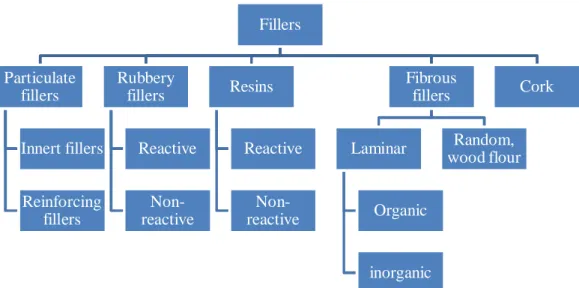
Fillers are particles with different types or shapes that are added to materials such as polymers, composites or concrete. The addition of filler is used for many purposes among others to reduce the consuming of matrix that is usually more expansive or to create new materials with certain combination of value. According to Brydson (1982), there are few types of fillers recognised in polymer technology and these are summarised in Figure 2.3.
20
Figure 2.3: Classification of fillers in polymer compounds (Brydson, 1982)
In this study, two types of fillers are used, rice husk (RH) and sawdust (SD). Classification of fillers in Figure 2.3 divides particulate fillers into two types, inert and reinforcing fillers. According to Brydson (1982), inert filler is something of a misnomer as many properties may be affected by incorporation of such filler. The advantages of using fillers are reducing the die swell on extrusion material, increased modulus, hardness and insulation properties. Examples of fillers are calcium carbonate, china clay, talc and barium sulphate. The optimum impacts of the material properties are very much dependent on the average particle size and its size distribution, particle shape, porosity, chemical nature of the surface and impurities.
Fillers Particulate fillers Innert fillers Reinforcing fillers Rubbery fillers Reactive Non-reactive Resins Reactive Non-reactive Fibrous fillers Laminar Organic inorganic Random, wood flour Cork
21 2.6. Natural fillers
Natural fillers are largely composed of cellulose, hemicelluloses and lignin with varying composition between the three items depending on the type of fillers. Chemical constituent of some natural fillers are shown in Table 2.1.
Table 2.1: The chemical constituents of some important plant fillers (Lilholt and Lwather, 2003)
Fibre Type Cellulose
Content, % Lignin Content, % Pectin Content, % Flax Bast 65-85 1-4 5-10 Hemp Bast 60-77 3-10 5-14 Jute Bast 45-63 12-25 4-10 Kenaf Bast 45-57 8-13 3-5 Sisal Leaf 50-60 - - Abaca Leaf 60 12-13 1 Coir Seed 30 40-45 - Cotton Seed 85-90 - 0-1 Softwood Wood 40-45 26-34 0-1 Hardwood Wood 40-45 20-30 0-1
The use of natural fillers is getting popular in various industrial applications and fundamental research. These types of fillers are cheap, recyclable, renewable and biodegradable. The source of this natural fillers are abundant and can be sourced out from anywhere in this world. These natural fillers can be classified in different ways such as bast, leafs, seeds and wood (soft and hard).
22
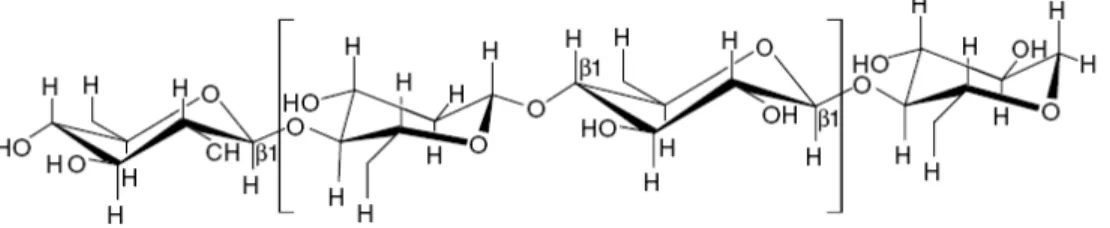
Wood fillers are widely used as filler as a result of it being widely used in logging industries. The bast type of natural filler is catching up due to concerns of environmental problems. Most of the bast type of filler is sourced out from non timber plant. The chemical structure of the cellulose is shown in Figure 2.4 and Some of the natural fillers used as reinforcing element are listed below in Figure 2.5.
23
Figure 2.5: Constituents of natural fillers used as filler in wood polymer composites (Kozlowski and Wladyka-Przybylak, 2002)
Natural fillers Bast Fillers Flex Hemp Kenaf Jute Mesta Ramie Urena Roselle Leaf Fillers Pineapple Banana Sisal Screw Pine Abaca Curaua Agaves Cabuja Henequen Seed Fillers Cotton Kapok Coir Fruit Fillers Coconut African Palm Wood Fillers Hard wood Soft wood Grasses and Reeds Wheat Oat Barley Rice Bamboo Bagasse Reed Corn Rape Rye Esparto Elephant Grass Cannery Grass
24 2.6.1. Density of natural fillers
There is some confusion in determining density between solid wood and natural fillers. The bulk density of most natural fillers (especially wood type) is about 1.44 to 1.50 g cm-3 (Kellogg, 1981) but the density of the porous anatomy of solid wood cell fall between 0.32 to 0.72 g cm-3 at dry condition (Simpson and Tenwolde, 1999).
According to Daniel et al. (2005), the high pressures encountered during the processing of plastics can cause the hollow fillers of the wood flour to collapse or filled with low molecular weight additives or polymers. The degree of collapse or filling will depend on variables such as particle size, processing method and additive viscosity. Wood densities in composites approaching the wood cell wall density can be attained in high-pressure processes such as injection moulding. Consequently, adding wood fillers to commodity plastics such as polypropylene, polyethylene, and polystyrene increases their densities.
The densities of composites using lingo-cellulose as filler are considerably lower than to compare with composites using inorganic fillers or inorganic reinforcements. This density advantage is important in applications where weight is important, such as in automotive components. Recently, chemical foaming agents and microcellular foaming technology have been investigated with a view to reducing the density of wood-plastic composites.
2.6.2. Preparation method for natural fillers
The fillers especially sawdust is derived from various scrap wood from wood processors. High quality wood flour must be of specific species or species group and