9
Network Intrusion Detection through
Adaptive Sub-Eigenspace Modeling
in Multiagent Systems
MEI-LING SHYU, THIAGO QUIRINO, and ZONGXING XIE University of Miami
SHU-CHING CHEN
Florida International University and
LIWU CHANG
Naval Research Laboratory
Recently, network security has become an extremely vital issue that beckons the development of accurate and efficient solutions capable of effectively defending our network systems and the valuable information journeying through them. In this article, a distributed multiagent intru-sion detection system (IDS) architecture is proposed, which attempts to provide an accurate and lightweight solution to network intrusion detection by tackling issues associated with the design of a distributed multiagent system, such as poor system scalability and the requirements of ex-cessive processing power and memory storage. The proposed IDS architecture consists of (i) the Host layer with lightweight host agents that perform anomaly detection in network connections to their respective hosts, and (ii) the Classification layer whose main functions are to perform misuse
This article is based on the paper “A Distributed Agent-Based Approach to Intrusion Detection Using the Lightweight PCC Anomaly Detection Classifier” by Zongxing Xie, Thiago Quirino, Mei-Ling Shyu, Shu-Ching Chen, and Liwu Chang, which appears in the Proceedings of the IEEE International Conference on Sensor Networks, Ubiquitous, and Trustworthy Computing, 446–453.
c
2006 IEEE.
For Mei-Ling Shyu, this research was supported in part by NSF ITR (Medium) IIS-0325260. For Shu-Ching Chen, this research was supported in part by NSF EIA-0220562 and NSF HRD-0317692. Authors’ addresses: M.-L. Shyu, T. Quirino, and Z. Xie, Department of Electrical and Computer Engineering, University of Miami, Coral Gables, FL 33124; S.-C. Chen, Distributed Multimedia Information System Laboratory, School of Computing and Information Sciences, Florida Interna-tional University, Miami, FL 33199; email: [email protected]; L. Chang, Naval Research Laboratory, Washington, DC 20375.
c
2005 Association for Computing Machinery. ACM acknowledges that this contribution was au-thored or co-auau-thored by a contractor or affiliate of the [U.S.] Government. As such, the Government retains a non-exclusive royalty-free right to publish or reproduce this article, or to allow others to do so, for Government purposes only.
Permission to make digital or hard copies of part or all of this work for personal or classroom use is granted without fee provided that copies are not made or distributed for profit or direct commercial advantage and that copies show this notice on the first page or initial screen of a display along with the full citation. Copyrights for components of this work owned by others than ACM must be honored. Abstracting with credit is permitted. To copy otherwise, to republish, to post on servers, to redistribute to lists, or to use any component of this work in other works requires prior specific permission and/or a fee. Permissions may be requested from Publications Dept., ACM, Inc., 2 Penn Plaza, Suite 701, New York, NY 10121-0701 USA, fax+1 (212) 869-0481, or [email protected].
C
2007 ACM 1556-4665/2007/09-ART9 $5.00 DOI 10.1145/1278460.1278463 http://doi.acm.org/ 10.1145/1278460.1278463
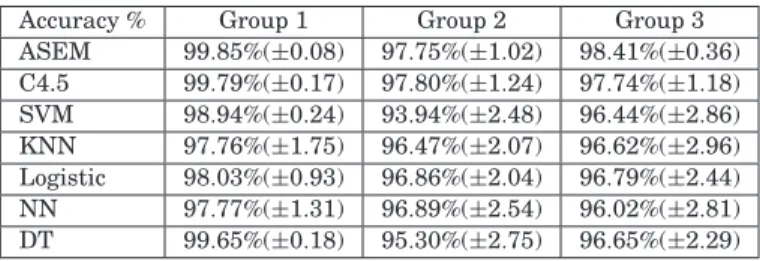
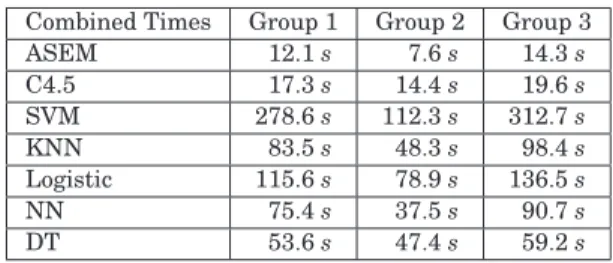
detection for the host agents, detect distributed attacks, and disseminate network security status information to the whole network. The intrusion detection task is achieved through the employ-ment of the lightweight Adaptive Sub-Eigenspace Modeling (ASEM)-based anomaly and misuse detection schemes. Promising experimental results indicate that ASEM-based schemes outperform the KNN and LOF algorithms, with high detection rates and low false alarm rates in the anomaly detection task, and outperform several well-known supervised classification methods such as C4.5 Decision Tree, SVM, NN, KNN, Logistic, and Decision Table (DT) in the misuse detection task. To assess the performance in a real-world scenario, the Relative Assumption Model, feature extrac-tion techniques, and common network attack generaextrac-tion tools are employed to generate normal and anomalous traffic in a private LAN testbed. Furthermore, the scalability performance of the proposed IDS architecture is investigated through the simulation of the proposed agent communi-cation scheme, and satisfactory linear relationships for both degradation of system response time and agent communication generated network traffic overhead are achieved.
Categories and Subject Descriptors: C.2.0 [Computer-Communication Networks]: General—
Security and protection; C.2.4 [Computer-Communication Networks]: Distributed Systems—
Distributed applications
General Terms: Experimentation, Security
Additional Key Words and Phrases: Agent communications, agent-based distributed system, adap-tive sub-eigenspace modeling (ASEM), intrusion detection, network security
ACM Reference Format:
Shyu, M.-L., Quirino, T., Xie, Z., Chen, S.-C., and Chang, L. 2007. Network intrusion de-tection through adaptive sub-eigenspace modeling in multiagent systems. ACM Trans. Au-tonom. Adapt. Syst. 2, 3, Article 9 (September 2007), 37 pages. DOI=10.1145/1278460.1278463 http://doi.acm.org/10.1145/1278460.1278463
1. INTRODUCTION
The increases of speed and capacity in computational and communication re-sources as well as the advances in computing and information technologies have enabled network systems to play an increasingly critical role in modern society. Particularly, the popularity of Web-based applications has led to the interconnection of almost all the computers in the world in a global network that facilitates communications among people. Securing such a large-scale net-worked system becomes a great challenge, since network intruders have found the perfect environment to develop innumerous algorithms that make effective use of the current simplistic, end-user empowering, networking model of the Internet [Clark 2001]. The fact that more sensitive data have been stored and manipulated through the Internet where numerous intrusions have brought serious damages to people, corporations, and the whole society has made net-work security an extremely vital issue. To address this issue, accurate and efficient intrusion detection systems (IDSs) have been developed to safeguard the network systems and crucial information.
There are two main categories for the existing intrusion detection methods that are employed in IDSs, namely misuse detection and anomaly detection [Anderson et al. 1995]. The methods in the misuse detection category are mainly based on signature modeling of known attacks [Lazarevic et al. 2003], and have the advantage of higher accuracy in detecting known attacks. How-ever, the most obvious shortcoming of the misuse detection methods is their
incapacity to detect previously unobserved attacks. Different from the misuse detection methods, anomaly detection methods are based on signature modeling of normal traffic [Labib and Vemuri 2004]. Anomaly detection methods have the advantage of detecting new types of attacks [Hochberg et al. 1993], but their false alarm rates are high. IDSs have undergone rapid developments in both power and scope in the last few years. Various types of IDS architectures have been developed in the literature, such as monolithic, hierarchic, agent-based, and distributed (GrIDS) systems [Verwored and Hunt 2002]. Improvements made to these methods and architectures would better enhance their ability to take into account the evolving nature of network attacks.
Recently, the agent concept has emerged as a powerful paradigm in dis-tributed computing environments due to its favorable characteristics including higher level abstractions, scalability, adaptability, graceful degradation of ser-vice and so on, over the non-agent based IDSs [Lee and Stolfo 2000]. It is a fact that many complex systems at work today in the real world are composed of components that are either geographically spread out hardware systems (traffic control systems and energy distribution systems), software subsystems spread out across many different servers (large scale database systems such as the ones maintained by government agencies, hospitals, and banks), or a combination of both (such as the Internet infrastructure itself and mod-ern mobile phone networks). According to the distributed agent (or multia-gent) design methodology, the characteristics that a system must present in order to be modeled as a distributed organization of agents are the following [Moreno 2005]:
(1) Environmental constraint: Knowledge is distributed in different locations of the system (decentralized information);
(2) System constraint: Several entities, possessing different abilities, work to-gether to solve a complex problem;
(3) Domain constraint: The problems in the application domain can be decom-posed into smaller subproblems, even if some type of interdependency exists among them.
Communication networks are large, complex, and modularized distributed systems, which present the aforementioned characteristics, and thus the dis-tributed agent (or multiagent) design methodology can and have been success-fully employed in the design of intrusion detection architectures suitable for such a distributed environment. Among some of the issues encountered in the design of a distributed agent-based IDS are (i) the amount of network traffic overhead introduced by the detection system into the residing network, (ii) the appropriateness of the expressive provisions of the agent communication lan-guage and negotiation protocols associating the various entities in the system, (iii) the hardware processing power required to execute the agents’ software, and (iv) the performance of the data mining detection algorithm employed by the agents. Most of the designed agent-based intrusion detection systems re-quire comparatively high processing power in local, end-user machines to ex-ecute the agents’ software and other supportive software, and introduce con-siderably more traffic into their residing network [Dasgupta and Brian 2001;
Spafford and Zamboni 2000]. All of these design issues are indications that a lightweight agent-based system, with low network traffic overhead genera-tion and low processing power requirements, is needed to overcome the issues encountered in the existing architectures.
In this article, a distributed IDS with multiagent design technology is pro-posed, where a set of classification agents communicate with each other and with lower level agents to acquire a global scope of the security state of the network. The proposed architecture integrates anomaly and misuse detection schemes, and focuses on the application of the lightweight agent concept in an attempt to solve the issue of executing agent software in end-user machines that have low processing power. It intends to detect heterogeneous intrusions in the network by seeking multiple information sources to extract features suitable for an effective intrusion detection process. The Adaptive Sub-Eigenspace Mod-eling (ASEM) based anomaly and misuse detection schemes are proposed, in-corporating our proposed Weighted Multiple Correspondence Analysis (WMCA) to handle nominal features. Our experimental results demonstrate that ASEM outperforms the K-nearest neighbor (KNN) method [Liao and Vemuri 2002] and LOF algorithm [Breuning et al. 2000] with high detection rates and low false alarm rates in anomaly detection. ASEM also outperforms several well-known supervised classification methods such as C4.5 Decision Tree [Quinlan 1993], Support Vector Machine (SVM) [Han 2003], K-Nearest Neighbor (KNN) [Tou and Gonzalez 1974], Logistic [Hooper 1999], Nearest Neighbor (NN) [Tou and Gonzalez 1974], and Decision Table (DT) (all implemented in the Weka package [Weka 2007]) in the misuse detection task. Moreover, in order to validate the feasibility of the deployment of our proposed distributed agent-based IDS ar-chitecture in a real-world scenario, in terms of scalability related criteria such as generated network traffic overhead and nonlinear degradation of system re-sponse time, the implementation for the proposed architecture was developed using Matlab [Mathworks 2007] and Java software. The promising experimen-tal results indicate both a satisfactory linear degradation of system response time and low overhead in agent communication related network traffic.
The remainder of this article is organized as follows. Section 2 discusses ex-isting work related to the design of agent-based IDSs. Section 3 presents our proposed distributed multiagent IDS architecture. In Section 4, WMCA and ASEM-based anomaly and misuse detection schemes are introduced. Experi-mental setup is presented in Section 5. Experiments and results are given in Section 6. Finally, in Section 7, conclusions are discussed.
2. EXISTING WORK
Various distributed intrusion detection architectures using the multiagent design methodology and/or the data mining techniques have been developed, ranging from those comprised entirely of mobile agents [Helmer et al. 2003], simulating the human body immune system model [Foukia et al. 2001], entirely comprised of static agents [Spafford and Zamboni 2000; Ertoz et al. 2004; Snapp et al. 1991], or as a combination of both [Kannadiga and Zulkernine 2005].
One well-known example of applying distributed agent design methodol-ogy in the intrusion detection domain is the Distributed Intrusion Detection System (DIDS) [Snapp et al. 1991]. DIDS was an attempt to build a distributed system based on monitoring agents that reside at every host in the network. A centralized data analysis component called the DIDS director agent is solely responsible for the analysis of the network traffic data collected by each mon-itor. DIDS architecture presents both advantages and disadvantages. On one hand, the system utilizes the real-time traffic information from various sources, namely, data from various host monitors, to assess the security status of its re-siding network. However, as a drawback, the system’s scalability is poor for large networks, as an increasing number of host monitors also significantly increase the work load of the DIDS director agent. Additionally, the data flow between host monitors and the director agent may generate significantly high network traffic overheads. In a recent study by [Kannadiga and Zulkernine 2005], the Distributed Intrusion Detection using Mobile Agents (DIDMA) sys-tem atsys-tempted to overcome the scalability issues inherent in the original DIDS architecture by employing mobile agents in the data analysis task. Thus, by de-centralizing data analysis, DIDMA hoped to significantly neutralize the effects of the scalability issues.
In contrast to DIDS, a more recent development in the domain of distributed IDS architectures is MINDS [Ertoz et al. 2004]. The MINDS system analyzes data collected directly by sensors distributed throughout the network, tapping information directly from the routers. It combines an unsupervised anomaly de-tection data mining algorithm, which assigns to each of the collected network connections a score reflecting how anomalous it is, and an association pattern analysis-based module, which generates a summarization report of those net-work connections that are ranked highly anomalous. Although MINDS seems to solve both anomaly and misuse detection problems, it requires human ef-forts to assist in its data mining techniques for their proper functioning. That is, the summarized anomalous data information needs to be supplied to a hu-man analyst who is then responsible for hu-manually performing the unsupervised anomalous data labeling process.
Another distributed agent-based IDS called Distributed Hybrid Agent Based Intrusion Detection and Real Time Response System [Vaidehi and Ramamurthy 2004] analyzes anomalies to detect and identify the Denial of Service (DoS) and data theft attacks, in addition to analyzing intrusion signa-tures capable of detecting wardriving-based hacks. It also attempts to respond to intrusions in real time by sending out alerts to the designated network ad-ministrator when network intrusions are detected. One of its main drawbacks is the design complexity of its comprising agents, in that each agent must take on almost all of the work load of network traffic sniffing, data parsing, and in-trusion detection. This makes the architecture inherently less lightweighted. In addition, its data mining techniques are less powerful since they are capable of detecting only a limited number of network attacks.
In Helmer et al. [2003], an IDS prototype entirely comprised of mobile agents was developed. In this architecture, the mobile agents travel among moni-tored systems in a network of distributed systems, obtain information from
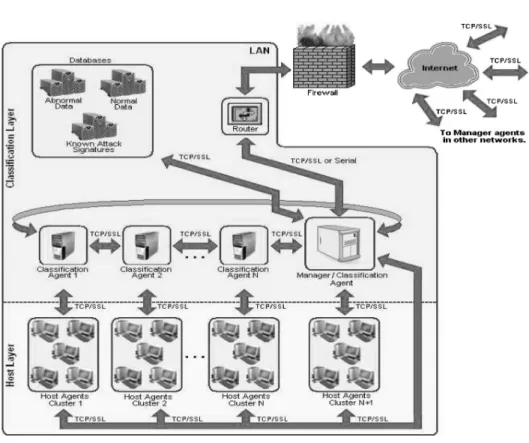
Fig. 1. The proposed IDS architecture.
designated data-cleaning agents that reside at each host, classify and correlate the supplied information, and finally report the analysis results to a desig-nated administrator through a user interface and several databases. One of its main advantages is its support for the runtime addition of new capabilities into the mobile agents. However, one of its main disadvantages is the overhead in time required to transmit the mobile agents’ code and required data among the monitored hosts in the residing network, which reduces the system’s ability to respond to network intrusions in real time.
All of these architectures, having both their advantages and disadvantages, attempt to achieve the common goal of effective intrusion detection, while at the same time minimizing the adverse side effects of realistic constraints, such as the limited availability of processing power at hosts, and the scalability issues inherent in distributed system design.
3. DISTRIBUTED MULTIAGENT INTRUSION DETECTION SYSTEM
Figure 1 presents our proposed distributed multiagent IDS architecture, which consists of a host layer and a classification layer.
3.1 Host Layer
A set of lightweight host agents constitutes the host layer. Virtually, every ma-chine in a network can be equipped with a host agent. Host agents run as
background processes in end user machines. Host agents are mainly concerned with detecting abnormal network traffic activities occurring in their hosts and properly responding to them. These agents collect information about the net-work connections in their hosts and classify these connections into two cate-gories, normal or abnormal, using the ASEM-based (Adaptive Sub-Eigenspace Modeling) anomaly detection scheme. Each host agent, upon coming online, connects to an upper-layer agent called a classification agent, to whom the host agent reports abnormal connections. To reduce network traffic requirements for the proposed IDS, no communication occurs among individual host agents. Furthermore, host agents make use of the fact that every connection to their respective hosts, whether normal or abnormal, must be analyzed for abnormal-ity using the ASEM-based anomaly detection scheme. Thus, host agents retain the information of a small percentage of normal connection instances and pass it along to the upper layers, which save this information into databases. This saved normal connection information can then be used to retrain the intrusion detection classifiers at a later time. This process introduces a desirable feature, where the burden of collecting updated training data for the classifiers is shared among every host agent connected to the proposed IDS network. The collected information is only sent to the upper layers during times of low network ac-tivity, thus preventing the IDS from overloading its residing network system during demanding periods. This delayed feedback scheme is facilitated by the fact that the intrusion detection classifiers do not have to be retrained so often as to require host agents to continuously feed back updated classifier training data to the upper layers.
3.2 Classification Layer
This layer is the classification agent layer, which is composed of classification agents. Classification agents are more specialized agents that attend to the con-cern of host agents on their suspicions of a possible ongoing attack. Multiple host agents connect to a single classification agent, a concept depicted in Figure 1 as the TCP/SSL connection between clustered host agents and their respective classification agents. Host agents rely on their respective classification agents to classify into known attack types, the abnormal connection instances found in their host machines through anomaly detection, a task performed by the clas-sification agent through our proposed ASEM-based misuse detection scheme. This is an important step, as the uncovering of the attack type will determine the proper response from an IDS to an intrusion. Within the classification layer, lies a more distinctive classification agent named the manager agent, which car-ries a briefly higher degree of authority and responsibility within its layer. The goal of the further specialization of the manager agent is to introduce a signif-icant degree of dynamism into the distributed system by having the manager agent serve as a central point to which all agents can register their presence within the IDS system and report, in real-time, interesting events taking place in the network.
Agents in the classification layer are assumed to be running in dedicated machines capable of delivering the processing power required to handle all the
misuse detection classification requests of their respective host agents, and communication with their fellow manager agent. These agents observe a strict sequence of communication steps upon uncovering an attack type from an ab-normal connection instance received from their respective host agents. This pro-cess was devised to provide a more effective, yet less costly manner of achieving global awareness of an ongoing threat:
(1) Upon uncovering of an attack, a classification agent will first quickly warn the host agent who is the source of the abnormal connection instance with information about the attack type. This is due to the fact that this host agent is a primary victim of the uncovered attack.
(2) Next, the classification agent will warn its fellow manager agent of the ongoing attack situation taking place in one of its nodes, by providing infor-mation regarding the attack type, source IP, and source port of the intruder. (3) Then the classification agent will initiate the process of warning all of its remaining connected host agents about the ongoing attack by providing them with the same information, so that they can prevent the attack from harming their respective hosts.
(4) The manager agent, upon receipt of a warning message from a fellow clas-sification agent, will in turn ask all the other fellow clasclas-sification agents to broadcast to all of their respective host agents the same information it received about the ongoing threat.
(5) Finally, the remaining classification agents, upon receiving a broadcast re-quest from the manager agent, will warn all of their respective host agents of the ongoing network threat so that the host agents can place barriers to prevent, or at least lessen, the effects of the ongoing threat.
This communication among agents in the classification layer is another im-portant feature of the proposed distributed multiagent IDS, as other classifica-tion agents can prevent or lessen the effects of a possible attack, by managing resources in their nodes that they expect to be affected by the incoming at-tack, such as bandwidth, communication ports, and connection authorizations. Finally, classification agents collect the normal connection information from host agents, in addition to those abnormal connection instances classified by the ASEM-based misuse detection scheme, and pass them along to the man-ager agent, who then saves it in the corresponding databases for the purpose of future classifier retraining.
As was previously mentioned, the manager agent is a classification agent, which is slightly more specialized within its class and performs extra manag-ing duties within the classification layer. It is the only agent in the proposed distributed multiagent IDS architecture that is required to reside in a machine with a static network address. One of the purposes of the employment of the manager agent is to enhance the dynamism of the proposed IDS architecture by introducing into the system desirable features such as:
(1) It allows host and classification agents to dynamically join the IDS network at any time and register their services and presence at a common point of access. This feature is depicted in Figure 1 at the classification layer as the
TCP/SSL connection link between the classification agents and the man-ager agent, and at the host layer as the TCP/SSL connection link between the host agent clusters and the manager agent. Classification agents can register their dynamic network addresses with the manager agent, thus preventing the need for hard-coding their addresses into the agents’ soft-ware or requiring human supervision.
(2) It prevents the issue of single point of failure. For instance, upon coming online and joining the IDS network, classification agents are required to register their services with the manager agent. If a classification agent requires maintenance or has a software issue that requires it to go offline for a period of time, host agents connected to that specific classification agent can be rerouted to other available classification agents by requesting from the manager agent the network address of others that are available. (3) It allows the misuse detection classification work load at the classification
layer to be fairly divided among the classification agents, thus allowing the distributed system to make full use of the available resources. As was pre-viously mentioned, classification agents attend to the concern of their host agents by classifying abnormal connection data instances into specific at-tack types. With the introduction of the manager agent, host agents coming online and joining the IDS network are required to request from the man-ager agent the network address of an available classification agent. Fur-thermore, classification agents are required to inform the manager agent of the number of host agents they are serving, as more and more host agents connect to them, in addition to providing information about their incoming communication message rates. Through this feedback scheme, the manager agent is able to control and fairly divide the workload among the classifica-tion agents by appropriately routing host agents.
(4) It provides the capability of detecting and blocking distributed network attacks such as DoS and network scanning. The manager agent, upon re-ceiving warning messages from various classification agents, can deduce from the received information about the attack, including the attack types, source and destination ports, intruders’ IP addresses, and so on, whether a distributed attack is taking place in hosts throughout the network. The manager can then utilize common protocols, such as SNMP and CISCO, or direct cable connections, to make routers and switches block attacks at specific points in the network.
(5) The task of retraining the ASEM-based anomaly and misuse detection schemes and updating the required databases is assigned to the manager agent. The manager agent has access to databases where information about normal and abnormal connection instances, and known attacks’ signature information are kept. This is depicted in Figure 1 as the link between the manager agent and the set of databases. The manager agent uses updated normal connection data found in the database for normal data and the ab-normal connection data classified into different attack types by the misuse detection scheme—found in the database for abnormal data—to retrain the classifiers. The retraining process yields attack signatures that are placed
in the known intrusion signature database. Upon retraining the classifiers, the manager agent sends updated classifier parameter information down to the lower layer.
(6) Finally, the manager agent can stay in contact with manager agents re-siding in other networks, while exchanging relevant information such as new intrusion signatures. This feature makes use of the proactive behavior of agents and continually strengthens the immunity of the system, while allowing it to maintain a global view of its network environment.
3.3 Communication between Two Layers
At the very core of the efficient performance of the coordination aspect of a dis-tributed multiagent system is an appropriate agent communication language (or ACL). An ACL must be capable of providing clear and declarative (what?) rather than mostly descriptive (how?) meaningful semantics [Singh 1999], in addition to an ontology with broad coverage in its domain, possibly extensible to other domains so as to allow for the interoperability of various classes of agents. The ACL must also provide a negotiation protocol that reflects a large domain of possible interaction among different agents (goals and operations) [Kone et al. 2000]. Due to all these requirements, the decision on the choice of which com-munication language to use in the design of a distributed multiagent system is not to be taken lightly. The KQML language is one of the most commonly used languages due to its versatility and generality of purposes. KQML sup-ports multiagent communication through an extensible set of reserved prim-itives called performatives, which represent communicative acts [Kone et al. 2000]. Having this knowledge in mind, the KQML language was adopted as the default ACL for our proposed architecture, and a simple and manageable communication scheme that utilizes a discrete number of KQML performa-tives was designed to accommodate the goals of all the agents. To provide total privacy and authentication capabilities, TCP/IP Secure Socket Layer (SSL) is adopted for the implementation of secure communication among agents. The adoption of cryptographic communication services is an important step toward making the distributed multiagent IDS architecture immune against attacks that can exploit the relatively simple agent communication scheme. Every pos-sible inter/intra-layer communication event that can arise was taken into con-sideration in the design of our proposed communication scheme. We propose a standard communication scheme that utilizes the following KQML performa-tives at the different architectural layers:
(1) RECOMMEND-ONE: Upon coming online, host agents connect to the man-ager agent. Since they are aware of the manman-ager agent’s unique network address, they request from it the address of an available classification agent using the RECOMMEND-ONE performative. A unique reply-id is placed
within the:reply-withfield of the message.
(2) REGISTER: Upon receiving from the manager agent the address of an avail-able classification agent, host agents connect to the respective classification agent and utilize the REGISTER performative to join that classification
agent’s cluster. Classification agents also utilize the REGISTER performa-tive upon coming online to inform the manager agent of their availability in the IDS network.
(3) UNREGISTER: Employed by both the host and classification agents to dis-connect from the IDS network.
(4) EVALUATE: Employed by the host agents to request misuse detection ser-vices from their respective classification agents, and consequently and indi-rectly, inform them of possible attacks. Host agents place the feature values
of the abnormal connections within the:contentfield and a unique reply-id
for the message within the:reply-withfield of the KQML message.
(5) TELL: Employed by classification agents for the purposes of both replying to host agents’ classification request and informing the manager agent, and consequently and indirectly all other classification agents, of an ongoing threat. Classification agents place information about an attack, including the extracted connection feature values, classification attack type, the
in-truder’s IP address and source port and so on, within the:contentfield of the
KQML message. The same message sent as a classification reply to a host agent can also be sent to the manager agent as the semantics of the message involve describing an ongoing threat in both scenarios. The only difference is that reply messages sent to host agents contain a unique reply-id within the:reply-tofield of the message, while warning messages sent to the
man-ager agent do not contain the:reply-tofield at all. The TELL performative is
also employed by the manager agent to reply to RECOMMEND-ONE per-formative messages sent by host agents requesting the address of available classification agents, upon coming online.
(6) BROADCAST: The BROADCAST performative is used to disseminate in-formation about an ongoing threat to the whole IDS network. It is employed by the manager agent to inform all other classification agents of an ongo-ing threat, while also requestongo-ing them to forward that information to all of their respective connected host agents.
(7) FORWARD: Employed by host agents, in periods of low network traffic con-ditions, to forward to the manager agent through their respective classifi-cation agents the normal connection instances that are temporarily stored
in files within a host agent’s residing machine. The :contentfield of the
message carries an embedded KQML database INSERT performative mes-sage that is employed to request the manager agent to save the connection instance into the database.
(8) INSERT: As mentioned above, this KQML database performative is em-ployed by host agents to send normal connection instances to the manager agent.
Additionally, an agent’s name within the IDS network, which is placed within the :sender and :receiver fields of all KQML messages, is defined in a man-ner that carries significant semantic information and uniquely identifies every agent within the IDS network. An agent’s name is defined as a string formed by the concatenation of the keywords “HA” for host agents, “CL” for classification
agents, or “MA” for the manager agent, followed by the “@” character, the agent’s host network IP address, the “:” character, and the agent’s desired local com-munication port. For instance, an agent with the name “[email protected]:3345” is a host agent embedded in a machine with IP address 10.0.1.4, and utilizing port 3345 for all of its network communication.
Please note that EVALUATE, TELL, and BROADCAST performatives are the three most commonly employed in this communication scheme and are the core of the information and knowledge exchange process required for effective intrusion detection. All the other performatives supplement the communication scheme in spite of being employed less often: when agents join or leave the IDS network and when data is sent to the manager agent during periods of low network traffic. One desirable feature that results from this communication scheme is that the employed KQML messages are equivalent to relatively small amounts of data exchanges among the agents. This contributes to making the proposed communication scheme very lightweight, as will be demonstrated in Section 6.
Finally, regarding the choice of languages used to encode the information
within the:contentkeyword of the KQML messages, many standard choices of
languages, such as Prolog and KIF, exist and have been found suitable for our communication purposes. The Knowledge Interchange Format (KIF) language is chosen, however, due to its expressive power and extensive online reference resources.
4. INTRUSION DETECTION SCHEMES
In response to the challenge of automated analysis of increasing network data and intrusion detection, the ASEM (Adaptive Sub-Eigenspace Modeling) scheme was developed to provide a lightweight solution to both the anomaly and misuse detection tasks, which can be incorporated into our proposed dis-tributed multiagent IDS architecture to facilitate an effective and efficient data mining process while taking into account the lightweight requirements of our proposed architecture.
4.1 Nominal Feature Handling
Features extracted from network connections can be either numerical or have some form of categorical (or nominal) significance [KDD 1999]. Examples of numerical features are the number of bytes transferred between two hosts, the duration of a connection, the number of successful or failed login attempts, the source and destination ports of a connection, among numerous another features. Examples of nominal features that can be extracted from network connections are the source and destination IP addresses of two communicating hosts, whether a connection successfully connected to a host (successful two-way TCP handshake), the username associated with a specific TCP connection to a host, the protocol of the connection, the service (HTTP, SSH, TELNET, FTP, etc.), whether the connection has reached root shell (full administrator privileges), among numerous others. Notice that some of these nominal features contain many categories (the service feature), while some are binary in nature
(whether a host successfully connected or not can either be “Yes” or “No”). Both numerical and nominal features contain valuable information that can make a significant difference in the effective discrimination between completely normal or malicious network connections. These motives beckon the exploration of the possibility of enhancing the capabilities of our proposed ASEM-based anomaly and misuse detection schemes (which inherently are capable of dealing only with numeric features) to also handle nominal variables. Two basic distinctive approaches that are commonly employed in the task of nominal to numerical feature conversion are:
(1) Using indicator variables in place of a nominal variable: This approach converts nominal values of each nominal feature into binary valued, zero-one dummy variables that each can be treated as if they were numerical attributes. The presence or absence of a specific nominal value in a data instance is signified by either 0 or 1 in its respective dummy variable. (2) Employing the Multiple Correspondence Analysis (MCA) approach to
com-pute numerical scaling values to each of the values of a categorical variable. Both of these solutions have their advantages and disadvantages. For in-stance, indicator variables are easy to generate from a data set. However, their utilization is analogous to assigning the same weight to each nominal value in a data set (either 0 or 1), which may not be desirable or fully correct in cer-tain scenarios. For instance, consider the nominal feature we discussed, which described whether or not a host successfully connected to another host. Its
nom-inal value “YES” combined with the information provided by other features may
indicate that an intruder has connected to a machine or is performing some sort of port scanning attack on a host, and thus may be more significant in the
in-trusion detection domain than its nominal value “NO.” This is exactly what
the MCA approach [Greenacre and Blasius 2006; Greenacre 1984] attempts to consider. In summary, MCA attempts to generate numerical scaling values for the nominal feature values in a data set that maximizes the overall correla-tion among the features. By analyzing a data set’s nominal feature space, MCA captures the degree of significance and similarities among each of the nominal feature values and generates respective numerical scaling values which, in con-trast to the indicator variable approach, do not necessarily have to be within the same numerical range. Moreover, numerical features can be incorporated into the MCA process as long as they are discretized into categories and then treated as nominal features. Based on MCA, we proposed the Weighted Mul-tiple Correspondence Analysis (WMCA) algorithm to consider more effectively all information from its statistical analysis on a data set. The WMCA algorithm is described as follows.
Let theQ×N-dimensional matrixX= {xi j,i=1, 2,. . .,Q and j=1, 2,. . .,
N}, be a data set comprised of N Q-dimensional column vectors Xj=(x1j,
x2j,. . .,xQ j), j=1, 2,. . .,N, which represent theN data instances in the data
set. Each of theQrows of matrixXcorrespond to a nominal attribute or feature.
Let us denote the number of categories for theqth nominal attribute byTq, that
Then, the total number of nominal attribute values in the entire data set is given by T = Q q=1 Tq. (1)
Next, an indicator matrix Z is generated to represent the data matrix X
numerically, where Z = {zi j, i=1, 2,. . .,T and j =1, 2,. . .,N}. The N T
-dimensional column vectors of Z, given by Zj = (z1j,z2j,. . .,zT j), j =
1, 2,. . .,N, represent the N data instances in the data set. The tth row of
Z corresponds to the zero-one dummy variable associated with one of the T
nominal values of the data set. Furthermore, matrix Z can be considered as
the concatenation of Q indicator matrices corresponding to the Q individual
nominal attributes of the data set, that is,Z=[ZT1ZT2. . .ZTQ]T. Next, the 1×T
-dimensional row vectorRis computed as the horizontal concatenation of theQ
row mass vectors of the indicator matrix ZasR=[R1 R2 . . .RQ], where each
row vectorRj ∈R, for j =1, 2,. . .,Q, is given by
Rj = 1 N 1TZTj. (2)
Now, theT×T-dimensional diagonal matrixD, corresponding to the row mass
matrix ofZ, is computed from the diagonalization of the row vectorRas
D= 1 Q ×diag(R), where (3)
diag(R) is the matrix whose diagonal elements correspond to the elements of
row vectorR. Next, the T×T-dimensional matrixC, also known as the Burt
matrix, is computed as the inner-product of the indicator matrixZusingC=
ZZT. Now, theT×T-dimensional square matrixMcan be defined as
M=D−12 C Q2N −D11 TD D−12, where (4)
—D−12 is the inverse of the matrix composed of the square root of the elements
in matrixD;
— is a 1×T column vector of 1’s.
Singular Value Decomposition (SVD) is now applied to matrixMin order to
extract its T eigenvalue-eigenvector pairs, namely, (λ1, E1), (λ2,E2),. . ., (λT,
ET), whereλ1≥λ2≥. . . ≥λT ≥0 andE=[E1E2. . .ET] is the matrix composed
of the T column eigenvectors Ej=(e1j,e2j,. . .,eT j), j =1, 2,. . .,T. It is at
this point where our proposed WMCA approach detaches, at least in a statistical sense, from the traditional procedure followed in the execution of the original
MCA approach. In essence, traditional MCA utilizes theT elements of the first
eigenvectorE1, namely, the first major principal component of matrixM, to
com-puteTscaling values for theTnominal attribute values found in the data set.
As a result of the utilization of a single eigenvector, all the information provided by the remaining eigenvectors and eigenvalues is simply discarded. In order to
more effectively utilize the valuable scaling value information provided by all
of the eigenvalues and eigenvectors of matrixM, we propose a procedure that
automatically selects significant eigenvectors and compute a weighted average of these eigenvectors, while taking into account the significance of each eigen-vector based on the magnitude of their eigenvalues. This automated procedure is described as follows.
First, the set of eigenvectors is refined by eliminating those possessing ex-tremely insignificant or null eigenvalues: carrying very little information. Thus, all those eigenvectors not satisfying the refinement equation (5) are discarded.
λυ> φ, where (5)
—φis an adjustable coefficient whose value is set by default to 0.01×λ1, based
on our empirical studies;
—λυ > φis the eigenvalue of the (υ)th eigenvectorEυ satisfying Equation (5);
—υ ∈Vis defined as the refined eigenvector space.
Next, a function based on the standard deviation values of the refined eigen-vector space, and which captures the similarity degree among the nominal fea-ture values in the data set, is defined. Thus, all those eigenvectors satisfying Equation (6) are retained while all others are discarded.
STD(Eψ)≤MeanSTD(Eυ). (6)
—MeanSTD(Eυ) is the average value of all the standard deviation values of the
eigenvectors in the refined eigenvector spaceV;
—STD(Eψ) is the standard deviation of the eigenvector satisfying Equation (6)
and corresponding to the (ψ)th eigenvectorEψ;
—ψ∈Wis defined as the final refined eigenvector space containing all
eigen-vectors satisfying both Equations (5) and (6).
Now, those eigenvectors satisfying both Equations (5) and (6) are combined
through a weighted average into a single T×1-dimensional column vectorH=
ψW
λψ λtEψ.
—λψ is the eigenvalue corresponding to the (ψ)th eigenvectorEψ in the final
refined eigenvector spaceψ∈W;
—λt=
ψ∈W
λψ is the total sum of the eigenvalues corresponding to those
eigen-vectors present in the final refined eigenvector spaceψ∈W.
TheTscaling values for theTnominal attribute values found in the data set,
and which are ordered by the order of appearance of their corresponding dummy
variables in the indicator matrixZ, are given by theT×1-dimensional column
vectorS=D−12H. Here,Scan be further divided intoQ column vectors
corre-sponding to theQnominal attributes of the data set, and which are represented
by theQ indicator matrices composing matrixZ, that is,S=[ST1ST2 . . . STQ]T.
of the nominal data set matrixX, is computed as: X=ZT1S1 ZT2S2 . . . ZTQSQ
T
. (7)
In summary, through a modified numerical scaling value generation process, our proposed WMCA approach attempts to make effective use of the similarity information found in all the eigenvectors and eigenvalues attained from a data set, rather than limiting our statistical analysis to a single major principal component.
4.2 Adaptive Sub-Eigenspace Modeling (ASEM)
Periodically, normal data connections collected from the host agents are stored in the database of normal data maintained in the manager agent. Using the normal data, the proposed Adaptive Sub-Eigenspace Modeling (ASEM) algo-rithm is employed in the ASEM-based anomaly detection and the misuse de-tection schemes, which are executed in the host agents and classification agents, respectively.
Letp×N-dimensional matrixX= {xi j, i=1, 2,. . .,p and j =1, 2,. . .,N},
represent the training normal data set, where theN p-dimensional column
vec-torsXj=(x1j,x2j,. . .,xpj), j =1, 2,. . .,N, represent theN training normal
data instances. Let Z= {zi j, i=1, 2,. . ., p and j =1, 2,. . .,N}represent the
normalized training normal data with the corresponding column vectors
rep-resenting normalized training normal data instances Zj=(z1j,z2j,. . .,zpj),
and let ¯μi andsiibe the mean and variance of theith row ofX. Equation (8) is
used to normalize the training normal data instances.
zi j=xi j√−μi¯
sii .
(8)
Let (λ1,E1), (λ2,E2),. . ., (λp,Ep) be the peigenvalue-eigenvector pairs of the
correlation matrix S =N1−1Nj=1(Zj −Z¯)(Zj −Z¯)for the normalized training
normal data setZ, ¯Z= 1
N
N
j=1Zj, andλ1≥λ2≥. . . ≥λp≥0. Thep
eigenvalue-eigenvector pairs make up the p-dimensional eigenspace, which is the platform
for both the anomaly detection scheme and the misuse detection scheme. Next, the transformation or projection of the normalized training normal data set can be obtained from the original space to the eigenspace. Let the
matrix Y= {yi j, i=1, 2,. . .,p and j =1, 2,. . .,N}be the projection or score
matrix of Zonto the p-dimensional eigenspace, where the score column
vec-torsYj=(y1j,y2j,. . .,ypj), j =1, 2,. . .,N, correspond to the projection of the
normalized training normal data instances. LetEi=(ei1,ei2,. . .,eip)be theith
eigenvector for the normalized training normal data set. Equation (9) defines
theith score value of the jth normalized vectorZj.
yi j=EiZj = ei1z1j +ei2z2j + · · · +eipzpj. (9)
After defining the score row vectors Ri=(yi1,yi2,. . .,yi N), i = 1, 2,. . .,p,
an adaptive sub-eigenspace selection function is proposed in Equation (10) to model the essential characteristics of the training normal data set.
where
—ais the preset coefficient to exclude extremely small principal components,
with the default value 0.0001;
—bis an adjustable coefficient, with the default valueMEANSTD(Rυ) (the
av-erage value of allST D(Rυ)), andRυsatisfies the left-hand side of Equation
(10);
—STD(Rm) is the standard deviation of the selected score row vector satisfying
Equation (10);
—m∈M,Mis defined as the adaptive sub-eigenspace.
The selection function in Equation (10) uses the extracted inherent statistical information from the training data to model the training data set. Standard deviation, a widely used statistical measure for differentiating the degree of variance or similarity [Pentland et al. 1994], is used based on our empirical study with comparison to other statistical measures like mean, slope, and so
on. In addition, the default values of bothaandbare also determined based on
empirical studies.
Here, the original training data set (normal data) is reconstructed and mod-eled in the adaptive subeigenspace with dimensionality reduction. The selected principal component contributing to the sub-eigenspace represent the most meaningful information of the training data set with respect to the hidden sim-ilarity and are possibly nonconsecutive, as demonstrated by our experiments. 4.3 ASEM-based Anomaly Detection Scheme
For anomaly detection, a suitable discriminate measure to differentiate nor-mal and abnornor-mal data instances is required. For this purpose, a distance threshold function for each training normal data instance is defined by using Equation (11). cj = m∈M (ymj)2 λm , (11) where
—m∈M is the index of the mth principal component selected from
Equation (10);
—λmis the eigenvalue of the correspondingmth principal component;
—ymj is the score value of themth feature in the adaptive subeigenspace;
—cj is the threshold value for each data instance in the training data set; all
of them contribute to the arrayC= {cj, j =1, 2,. . .,N}.
Accordingly, letSCbe the sortedCin an ascending order,h=[(1−α)×N]
be the nearest integer to (1−α)×N, andαbe the preset false alarm rate of the
classifier. A class-deviation threshold Cθ =SC[h] can be defined to differentiate
between the normal and abnormal data instances.
Let X= {xi j, i=1, 2,. . .,p and j =1, 2,. . .,N} be a p×N-dimensional
j =1, 2,. . .,N, representing Ntesting instances, including both normal and abnormal data instances. The testing data instances are then normalized with
zi j=x√i j−μi¯
sii , where Z
= {z
i j}represents the normalized testing data instances
with corresponding column vectors Zj=(z1j, z2j,. . .,zpj)’, and ¯ui and sii are
the same parameters used in Equation (8).
Let the testing data score matrixY={yi j, i=1, 2,. . .,p and j =1, 2,. . .,N}
be the projection ofZ onto the p-dimensional adaptive sub-eigenspace of the
training data set X, where the score column vectors Yj=(y1j, y2j,. . .,ypj),
j = 1, 2,. . .,N, correspond to the projection of each of the N testing data
instances. Then the ith score value of the jth normalized testing instance
vectorZj is given by:
yi j =EiZj = ei1z1j +ei2z2j + · · · +eipzpj, (12)
whereEi=(ei1,ei2,. . .,eip)is the same eigenvector used in Equation (9).
Compute the threshold vector C= {cj, j =1, 2,. . .,N} using the
class-deviation function in Equation (13).
cj = m∈M
(ymj)2
λm , (13)
where
—λmandMare the same parameters used in Equation (10);
—ymj is the the score value of themth eigenspace feature of the projected and
normalized original testing data instanceXj.
Thus, a testing observation Xj is classified as abnormal to the class of the
training normal data whencj>Cθ, or as normal whencj≤Cθ.
4.4 ASEM-Based Misuse Detection Scheme
For misuse detection, it is required to define a suitable discriminate measure
to differentiate each attack. LetXk= {xi j, i=1, 2,. . .,p and j =1, 2,. . .,Nk}
represent each attack in the training data set. The corresponding projection or score matrix onto the obtained subeigenspace from the training normal data set (described in Section (4.2)) can be obtained using Equation (9), and the
corresponding arrayCk= {c
j, j =1, 2,. . .,Nk}can be obtained using Equation
(11). Then, Equation (14) defines an attack reference threshold value Ck
θ to
differentiate each attack. For each testing observation Xj, the distance with
respect to each attackDkjis obtained with Equation (15). Accordingly, the attack
label forXj is determined by the smallestDk
j value. Ckθ = 1 Nk Nk j=1 cj. (14) Dkj = |cj−Ckθ|. (15)
The ASEM-based misuse detection scheme is inspired by the fact that each network attack has different characteristics and thus results in a self-cluster for the corresponding score values projected onto the adaptive subeigenspace, obtained from the training normal data set in different subsections, with an obvious gap. In other words, compared with the training normal network data, each network attack possesses distinct characteristics of anomaly, which is rep-resented as a separate subsection of the score values. Therefore, the gaps among different attacks can be captured for misuse detection.
5. EXPERIMENTAL SETUP
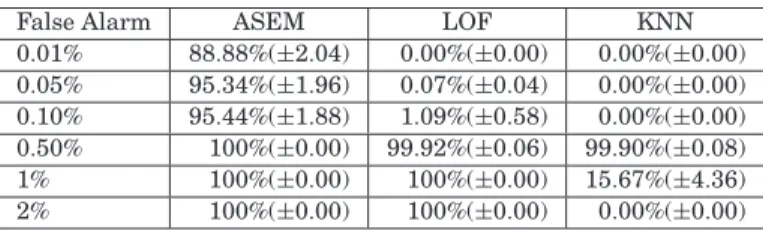
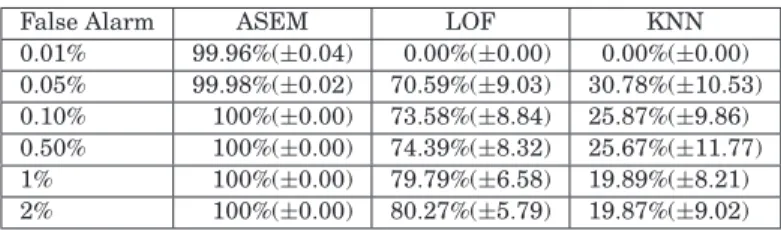
In order to test our framework, various experiments are organized to assess the performance of (i) the scalability characteristics of the proposed architecture in terms of the required agent communication, and (ii) the accuracy and time per-formance of the proposed ASEM-based intrusion detection schemes, which are the cores of agents’ reasoning module. Testing data sets were acquired from three resources: the KDD CUP 1999 Data [KDD 1999], network traffic data generated in our testbed through the application of our proposed Relative As-sumption Modeling algorithm, and network attacks traffic data also generated in our testbed through the application of specialized attack generation tools such as NMAP and Nessus vulnerability scanners, the THC-Hydra and Brutus multiprotocol brute-force scanners, the IRS port scanner, and finally the D-ITG network traffic generator [D-ITG 2006; InsecureOrg 2006; Oxid 2006]. Addi-tionally, all the generated network traffic data is preprocessed by our proposed feature extraction (FE) technique in order to acquire the necessary features for our proposed ASEM-based schemes. Experimental results include not only the agent communication and system scalability performance of the proposed architecture, but also the intrusion detection accuracy rates in comparison to several well-known data mining approaches. A 10-fold cross-validation process was performed for every intrusion detection comparison experiment for a fair and better evaluation, and the standard deviation of the classification accuracy for each approach is also included. A smaller standard deviation value indi-cates that the classification approach performs in a consistently stable manner, whereas a larger standard deviation value indicates inconsistent or unstable performance. The term cross-validation indicates the iterative process by which a given data set is randomly split randomly into training and testing sets
com-posed of2
3 and 1
3 of all data instances, respectively.
5.1 Private Network Testbed Setup
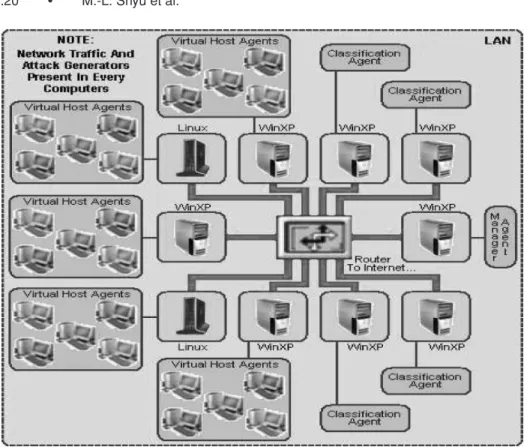
Figure 2 illustrates our private LAN network testbed setup, where the gener-ation of realistic network traffic and the performance assessment experiments of our proposed architecture take place.
The focus of our testbed-based experiments is on network attacks based on the TCP network protocol, since a great majority of attacks are either executed via, or rely to a certain degree, on the TCP protocol. This is due mostly to TCP’s frangibility and instability. For example, a survey has shown that 90%
Fig. 2. The private LAN testbed setup employed to generate realistic network traffic and test the proposed distributed IDS system.
to 94% of Denial of Service (DoS) attacks, which are among the major threats to the whole Internet community, are employed via the TCP protocol [Moore et al. 2001]. Note, however, that our proposed architecture is not limited to the detection of simply TCP-based network attacks. The network protocol is simply one of many categorical features employed to describe a network connection (TCP, UDP, ICMP, and ARP) and is seamlessly incorporated into our intrusion detection schemes through the employment of WMCA.
5.2 Relative Assumption Modeling
The Relative Assumption Modeling approach is proposed due to the fact that the so-called normal and abnormal data sets are relative concepts determined by factors such as the available bandwidth of a network, server processing ca-pability, average network load, network services provided, among innumerous others. The same type of network connections may be labeled distinctly among different kinds of networks. Furthermore, it is highly possible that the current increasing abnormal data sets would be considered as normal in the near fu-ture due to the rapid development of networks, computers, and their relative techniques.
In an attempt to produce both the normal and relatively complete abnormal data sets, we utilize a relative reversing method on core phases to propose a
pair of abstract definitions to express the following two opposite concepts: —typical normal connections:generate fewer data transfers during a moderate
time period in suitable rate, frequency, and pace.
—typical abnormal connections:generate increasing data transfers during a very short or very long time period continually and quickly.
Next, five pairs of opposite core phases are combined, such as (“suitable rate,” “increasing”), (“not much,” “much”), (“during a moderate time period,” “during a very short or very long time period”), (“suitable frequent,” “continually”), and (“suitable pace,” “fleetly”), to simulate the differences between typical normal and abnormal connections in a real-world network environment. In general, abnormal connections should possess at least one or more typical features that are in the form of core phases opposite to the normal ones. That is, for one group
of typical normal connections, there would be 31 ( C1
5+ C25+ C35+ C45+ C55)
groups of corresponding abnormal connections. Additionally, different groups with different degrees of anomaly or different distribution parameters can be naturally considered as different types of attacks. Finally, these abstract phases with different numeric values in different networks should yield good relative and adjustable generated network traffic patterns.
5.3 Feature Extraction (FE)
The proposed feature extraction (FE) technique is executed in order to trans-form the raw generated data into data applicable for data mining and classifica-tion. Furthermore, for any supervised classification method, feature extraction (FE) is an important module, as it can drastically affect an algorithm’s perfor-mance [Liu et al. 2003; Liu and Motoda 1998]. The generated network data contains all the required analysis information, which can be extracted from the data packets flowing across the network. Before the features are extracted from the network data, the network traffic needs to be collected and stored. The following three steps are proposed to extract features that are critical for effective network intrusion detection:
— Windump: the windows version of Tcpdump [Jacobson et al. 2007], which uses the Libcap [2007] library to extract low-level traffic from the network, is used to collect and store all the raw data directly from the network card. — Tcptrace [2007]: a tool used to produce several different types of outputs
containing information such as elapsed time, number of bytes and segments transferred both ways, number of retransmissions, round trip times, window advertisements, network throughput, and many more features, through the analysis of the Windump generated files, is used to extract basic information on each TCP connection from the Windump collected data.
— Our own FE techniques are used to extract/generate basic, time-based, connection-based, and ratio-based network features from the Tcptrace output file.
(1) Basic Features: basic information related to the connection. Seventeen basic features are extracted, which include duration, IP, port, total pack-ets, acknowledge packpack-ets, throughput, and so on.
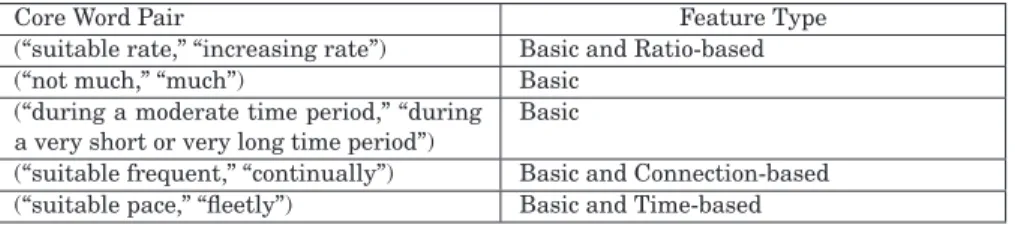
Table I. Relation between Core Phases and Features
Core Word Pair Feature Type
(“suitable rate,” “increasing rate”) Basic and Ratio-based
(“not much,” “much”) Basic
(“during a moderate time period,” “during a very short or very long time period”)
Basic
(“suitable frequent,” “continually”) Basic and Connection-based (“suitable pace,” “fleetly”) Basic and Time-based
(2) Time-Based Features: the number of connections having the same IP or/and port in a 3-second sliding window. Four time-based features are extracted to provide information on both the source and destination sides of a connection.
(3) Connection-Based Features: the number of connections having the same IP or/and port in the last 100 connections. Four connection-based fea-tures are also extracted to provide information on both the source and destination sides of a connection.
(4) Ratio-Based Features: the ratio of transferred packets between two con-nections that have the same IP and port. Sixteen ratio-based features are extracted to provide information on both the source and destination sides of a connection. Ratios are found between the current and neigh-bor connections (neighneigh-bor ratio) and between the current and the first connection having the same IP and port.
In fact, all of these features correspond to one or more of the core phases pre-viously described. For example, the first feature “duration” directly represents the core phase (“during a moderate time period,” “during a very short or very long time period”). Yet another example is the ratio features, which reflect the core phase (“suitable rate,” “increasing rate”). Detailed information about these relationships is shown in Table I.
5.4 Network Attack Generation Tools
In this article, a total of six software tools, ranging from vulnerability and network scanner to traffic generators, were selected in order to generate the network attack data needed for our studies.
(1) Nessus: It is perhaps the best free network vulnerability scanner today. It provides plugins for the generation of over 11,000 types of network related vulnerability tests including DoS, port scanning, and OS-specific vulnera-bilities.
(2) NMAP: Similarly to Nessus, this tool has been commonly employed for the assessment of vulnerabilities present in network system setups and also as a tool for the exploration of services available across hosts of a network. It effectively tests IDS and firewall policies by generating various types of network and port scanning attacks including SYN, FIN, ACK, Window, X-MAS Tree, among others.
(3) THC-Hydra: Developed byThe Hacker’s Choice Group(THC), THC-Hydra is a brute force password-guessing tool that supports over 30 protocols and services, including cryptographic-based services such as SSH2. THC-Hydra has the ability to break into not only hosts, but also routers and firewall, making this tool a real threat for network administrators.
(4) Brutus: It is another brute force network cracker, which offers the same functionalities as THC-Hydra with an even easier installation process. (5) IRS Scanner: It is a powerful tool that scans for IP-based restrictions rules
for a particular network service. It combines ARP Poisoning and Half-Scan techniques to generate totally spoofed TCP connections. IRS is the perfect software for complementing tools such as the ones we have described. (6) D-ITG: It provides a platform capable of producing various types of traffic
at the packet level and for the network, transport, and application layers, while accurately implementing appropriate stochastic processes for traffic flow features such as the packet interdeparture time and packet size. It plays an important role in the field of network traffic analysis and can be employed to test IDS, switches, ACLs, and firewalls, as well as to provide the traffic needed by analytical network applications.
6. EXPERIMENTAL RESULTS AND DISCUSSION 6.1 Agent Performance Evaluation
In order to assess the scalability performance of our proposed distributed multi-agent IDS architecture in a realistic scenario, a prototype of the proposed archi-tecture was implemented using Matlab [Mathworks 2007] and Java software. We conducted evaluations in terms of scalability-related criteria such as gen-erated network traffic overhead and the degree of linearity of the degradation of system response time for the employment of our proposed agent communica-tion scheme. Figure 2 shows our network testbed, where the different types of agents were placed in mutually exclusive hosts within the testbed, in a manner such that any communication among the agents could only be realized through the generation of network traffic rather than local traffic within any host. This means that host and classification agents were not executed together within the same machine, while the manager agent was placed in a host all by itself and without the presence of any other classification agents. This measure en-sures that every conversation between the agents would generate measurable network traffic and yield realistic scalability results. With these constraints in mind, the agents were placed in the hosts having the following IP addresses within the testbed:
— Host agents: host agents were placed in the hosts having local IP addresses 10.0.1.1, 10.0.1.2, 10.0.1.3, and 10.0.1.5.
— Classification agents: classification agents’ hosts occupied the local addresses 10.0.1.4, 10.0.1.7, and 10.0.1.8.
— Manager agent: the manager agent occupied by itself the host having the local IP address 10.0.1.6.
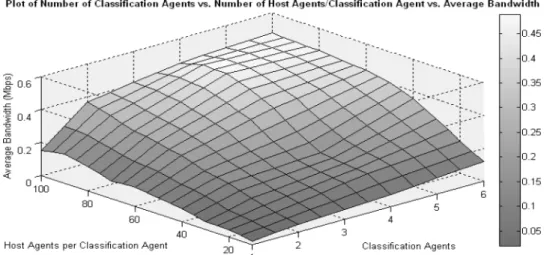
Each classification agent, including the manager agent was executed within its own Matlab session. An equal number of multiple Matlab sessions was ex-ecuted in the hosts occupied by the host agents in order to support the large number of host agents being simulated during the experiments. Each Matlab session was allowed to support a maximum of 50 host agents before a new ses-sion was initiated to support the execution of more host agents. Next, having decided on the location of the agents within the testbed, a realistic experimen-tal scenario was devised to capture the effects that the communication between an increasing number of classification and host agents would have on the traf-fic requirements, and consequently on the scalability performance, of the dis-tributed architecture. In summary, our experiments consisted of instantiating an ever increasing number of classification and host agents to simulate an ever increasing IDS network, in a manner that would reflect the performance of the proposed architecture as it was expanded from a small to a large scale. Throughout the experiments, the number of classification agents connected to the IDS ranged from a minimum of 1 (the manager agent running alone) to a maximum of 6 (the manager agent plus 5 more classification agents sharing an equal classification load). For each of these different numbers of connected classification agents, the total number of host agents varies from a minimum of 10 host agents to a maximum of 100 host agents per classification agent. There
are a total of 60 (6×10) experiments, 1 to 6 classification agents, each with 10,
20,. . ., 100 host agents. Therefore, the maximum number of agents is 600, to simulate a realistic network of 600 hosts connecting to the IDS network. For each experiment, the following simulation takes place:
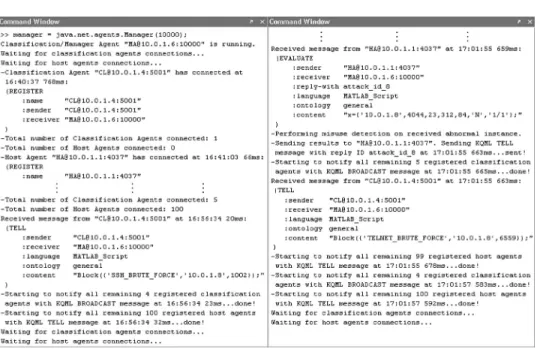
(1) The desired number of, and types of, agents are instantiated. The IDS network lies quietly waiting for an abnormal event.
(2) A host agent is chosen and is ordered to emulate the detection of an ab-normal connection to its residing host.
(3) The host agent requests the classification agent to which it is connected, to perform supervised classification of the abnormal connection instance and to reply with the attack type. This is achieved using the KQML EVAL-UATE performative.
(4) Upon receiving the abnormal instance from the host agent, the classifica-tion agent performs the misuse detecclassifica-tion task, and then sends the classi-fication results back to the host agent. This is achieved using the KQML TELL performative.
(5) The classification agent then informs the manager agent about the in-trusion recently detected by one of its host agents, by also sending the classification results to the manager agent. This is achieved using the KQML TELL performative.
(6) The classification agent then starts the process of informing, one by one, all of its remaining connected host agents of the ongoing threat. This is also achieved through the use of the KQML TELL performative.
(7) The manager agent, upon receiving the ongoing threat warning from the classification agent, informs the other remaining classification agents, one