Mobile VPN Access
with eNterPrise
serVices GAtewAy
Simplify the network, Streamline
operationS, open new marketS
application noteAbstrAct
Today’s business enterprises are quickly acknowledging the benefits of empowering their workforce with mobile devices equipped with key business applications to supercharge their productivity. To enable this emerging business reality, multi-access (fixed and mobile) service providers will need to change their data service architecture, augmenting their traditional fixed-line VPN access to include cellular VPN access by deploying an Enterprise Services Gateway (ESG).
This paper describes a comprehensive business model of this service enhancement based on a mid-sized European Tier-1 service provider and shows a cumulative revenue potential of approximately $130 million (US1) after Year 5 of the study. The paper details and quantifies the benefits of deploying the Alcatel-Lucent 7750 Service Router (SR) as an ESG to enable mobile VPN access compared to a more traditional approach. Addressable market, CAPEX, OPEX and revenue aspects are all detailed, culminating in the creation of incremental cumulative discounted cash flow (CDCF). Results show that, over a five-year study period, the traditional approach is twice as expensive in terms of CAPEX and ten times more expensive in terms of OPEX. The study also determined that by deploying the ESG and adopting the Alcatel-Lucent solution, services can be offered more quickly and with higher reliability, which translates to a much higher revenue potential.
tAble of coNteNts
abstract / ii
the market opportunity / 1
leveraging existing Vpn infrastructure / 1 revenue potential / 2
Scope of study / 2 Summary / 2
objective and solution advantages / 2 Study approach / 3
Study scenarios / 3
key revenue assumptions / 3
the enterprise Services Gateway network architecture / 3 Benefits of the eSG approach / 4
traditional approach: architectural model used / 4 alcatel-lucent solution: architectural model used / 5
Building the business case / 6
the addressable market and penetration rate / 6 the revenue / 7 capeX / 10 opeX / 11 Study results / 13 Greenfield scenario / 13 replacement scenario / 14 conclusion / 15 rererences / 15 acronyms / 16
the MArket oPPortuNity
Today’s enterprises are offering mobile devices and key mobile applications to their employees to foster responsiveness to customers while improving employee productivity. Yankee Group tells us that companies are using mobility to enhance both the employee’s productivity and the customer’s experience by providing the best possible service with a quick resolution of issues [8]. In addition, mobility is reducing service costs by streamlining processes, eliminating redundant data entry and minimizing errors [8]. Yankee Group believes that mobility can also increase revenue and improve cross-selling opportunities by matching real-time customer needs with products and services. As proof, Yankee Group indicates that customer relationship management (CRM) and sales force automation mobile applications have more than tripled in demand over the past five years and are now deployed in more than two-thirds of businesses [8].
To harness these mobile applications to full advantage, there are several requirements by three key groups (enterprise employee, enterprise IT department, service provider) that must be met. A few of the most important requirements follow.
Enterprise employee
• High-speed access with high availability
• Persistency of connection with no constant re-authentications and logins • Multi-device flexibility: bring your own device (BYOD)
Enterprise IT department
• Secure access and secure content
• Easy device management and asset tracking • Flexible reporting and billing
Service provider
• Flexible service definition within the existing framework • A simple implementation model
• Simplified operations, including end-to-end service assurance, SLA monitoring and traffic engineering
leveraging existing VPN infrastructure
To meet these stringent requirements, which are generally already available in the fixed-line VPN infrastructure, an enterprise can work with their service provider and other partners to provision dedicated cellular access circuits in their existing VPN infrastructure.
Frost and Sullivan comment that, although many mobile security technologies exist, mobile VPN technology offers advantages over more traditional forms of remote access:
“ a mobile Vpn is a Vpn with specific features designed to provide secure connectivity and persistence over wireless networks. while other technologies, such as mobile internet protocol (ip), ipSec, or Secure Sockets layer (SSl) Vpns, provide similar functionality, mobile Vpns unify persistence and security features into a single product built for wireless coverage. [3]”
revenue potential
For service providers, the mobile VPN market offers an innovative path to generate new revenue while differentiating their products and services from those of their competitors. By extending their fixed-line VPN business with mobile access, the revenue increase is significant. As shown in Figure 1, the market potential grows year-over-year, ending with revenue of almost $45 million in year 2018, with cumulative revenue over five years of more than $130 million.
Figure 1. Enterprise Services Gateway revenue opportunity
0 10 20 30 40 50 2014 2015 US$ (millions) 2016 2017 2018 MOBILE VPN REVENUE OPPORTUNITY
Overall revenue opportunity
0 20 40 60 80 100 120 140 2014 2015 US$ (millions) 2016 2017 2018 CUMULATIVE REVENUE OPPORTUNITY
Cumulative revenue opportunity
scoPe of study
summaryThis paper details a comprehensive study performed by Alcatel-Lucent Bell Labs that evaluates the business opportunity for a multi-access (fixed and mobile) service provider to extend its fixed-line VPN business with mobile VPN access from dedicated cellular access. This service will enable small and mid-sized enterprises to empower their employees with secure, managed and persistent nomadic access to critical business applications on their mobile devices.
objective and solution advantages
The objective of this study is to quantify the incremental benefit to the service provider of augmenting their fixed-line VPN infrastructure with mobile VPNs using the Alcatel-Lucent solution instead of a traditional approach for mobile access.
This analysis endeavors to show that the Alcatel-Lucent solution has clear CAPEX, OPEX and revenue advantages:
• CAPEX advantages: CAPEX will be lower because the Alcatel-Lucent 7750 Service Router (SR) as an ESG can collapse essential VPN routing capabilities (for example, Provider Edge [PE] Router) and essential mobile gateway capabilities (for example, Gateway GPRS support node [GGSN] in a single chassis using the same SR operating system.
• OPEX advantages: OPEX will be lower due to a simplified network infrastructure that is exploited by the Alcatel-Lucent 5620 Service Aware Manager (SAM). The 5620 SAM provides very fast and efficient service provisioning that also dramatically improves reliability. A more reliable configuration leads to less re-provisioning, better audit results, better customer experiences and, ultimately, lower churn rates.
• Revenue advantages: Revenue will increase because faster, more efficient service provisioning will lead to revenue acceleration. Faster provisioning with a more reliable service offering will also reduce customer churn and increase VPN business growth rates.
study approach
The study is modeled on a mid-sized European multi-access (fixed and mobile) service provider and involves market data from that geographical region. A conservative top-down approach is used to determine the addressable market. The relative, or incremental,
advantage of the Alcatel-Lucent solution over a traditional approach is measured in CAPEX, OPEX and revenue. The study culminates with a five-year timeline CDCF showing the net present value (NPV) of the Alcatel-Lucent solution over the traditional approach. study scenarios
There are two scenarios in the study. The first is a greenfield scenario where there is no existing support for mobile VPNs and a mobile VPN infrastructure is not in place in the service provider’s network. In this case, the Alcatel-Lucent solution and the traditional approach are compared from the same starting point. The second scenario is a replacement scenario where the Alcatel-Lucent solution is replacing the traditional approach that is already deployed in the service provider’s network. In the replacement scenario, CAPEX will not be considered as an expense for the traditional approach because the infrastructure is already in place and has been paid for.
key revenue assumptions
The baseline VPN subscriber growth assumption for the mobile VPN opportunity is modeled on the service provider’s existing fixed-line VPN growth projection of 1.9 percent per year (from the service provider’s publicly disclosed information) with a churn rate of 5 percent per year. These assumptions are applied to the traditional approach’s revenue calculations.
For the Alcatel-Lucent solution, the study applies two different and independent revenue assumptions. The first assumption (Model A) assumes that with a mobile VPN service that is faster to market and more reliable, the modeled service provider will benefit from an increased VPN growth rate on par with the fixed-line VPN revenue growth of the country, which is 7.4 percent per year.
Model B assumes that with a mobile VPN service that is faster to market and more reliable, the modeled service provider will benefit from a reduction in churn of 10 percent, a decrease from 5 percent per year to 4.5 percent per year.
Hereafter, the two revenue assumption models are referred to as “Model A” and “Model B”.
the eNterPrise serVices GAtewAy
Network Architecture
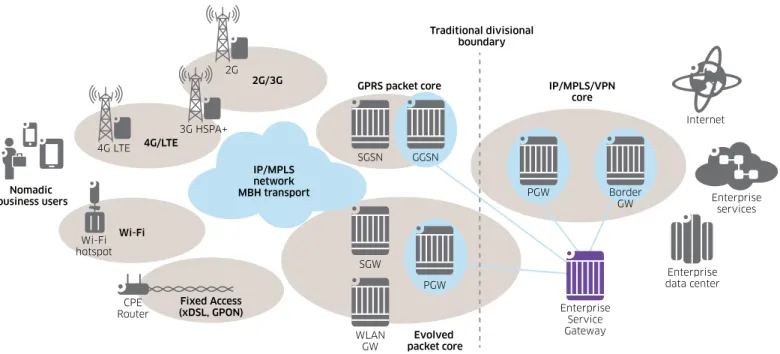
As the foundation for the ESG, the 7750 SR is an IP/MPLS router that has massive scalability, high performance and carrier grade resiliency for VPN services, and is also able to function as a mobile gateway. This unique combination of capabilities allows the ESG to concurrently replace the Mobile Gateway (PGW, GGSN), the PE Router, and the Border Gateway. This enables it to span across divisional boundaries (IP/MPLS VPN infrastructure and mobile). As such, the ESG operates as a single multi-functional converged router that greatly simplifies the network.
Figure 4 shows a generic end-to-end multi-access broadband architecture where many broadband services can be delivered. This figure also shows the elements that the 7750 SR ESG will replace in the Alcatel-Lucent solution.
This approach not only provides cost and revenue advantages for the MNO, but it also opens new markets to include small and mid-sized enterprises that may not have been candidates for this service in the past.
benefits of the esG approach
• Massive scalability, high performance and carrier grade resiliency for essential IP/MPLS VPN functions
• Simplified network and streamlined operational and provisioning model by replacing several network elements with a single element while collapsing divisional boundaries • Automated service provisioning to create a scalable service that enables MNOs to extend
the service offer beyond just large enterprises to small- and mid-sized enterprises • Simplified end-to-end QoS model with a single point of service and application
control for enterprises and their employees
• An infrastructure set in place for emerging enterprise service demands such as Machine-to-Machine (M2M)
traditional approach: Architectural model used
The traditional approach to deploying this capability is shown in Figure 3. In this
architecture, a traditional mobile gateway (such as a GGSN or PGW) is used to terminate enterprise business VPNs A and B.
Figure 2. Generic multi-access broadband architecture with areas of focus
Evolved packet core Traditional divisional boundary PGW GGSN PGW SGW IP/MPLS/VPN core Enterprise services Internet Enterprise data center SGSN GPRS packet core 2G/3G 4G/LTE Wi-Fi Fixed Access (xDSL, GPON) 3G HSPA+ 4G LTE Wi-Fi hotspot CPE Router 2G Nomadic business users Enterprise Service Gateway WLAN GW Border GW IP/MPLS network MBH transport
Figure 3. Traditional architectural approach to providing mobile VPN access GGSN/PGW Packet core Access circuits PE + BGW Tunnel VPN set-up PE + BGW Divisional boundary GGSN/PGW Nomadic users Nomadic users CLI provisioning CLI provisioning IP/MPLS network VPRN service Internet VPN A VPN B Internet VPN A VPN B VPN A VPN B VPN A VPN B VPN A VPN B VPN A VPN A VPN B Radius authentication
In addition to the MGW, the service provider needs to deploy a separate router that functions as both a PE router and a BGW router. This node terminates the tunnel between the MGW and itself while terminating multiple VPN spokes to the routers in the IP/MPLS core. Each of these entities needs to be configured manually using Command Line Interface (CLI). This process is slow and prone to manual error.
In addition, there could be inter-divisional boundaries that could slow down the VPN and mobile gateway service provisioning process because the mobile group that manages the MGW is likely to be different from the VPN group that manages the PE and BGW. Alcatel-lucent solution: Architectural model used
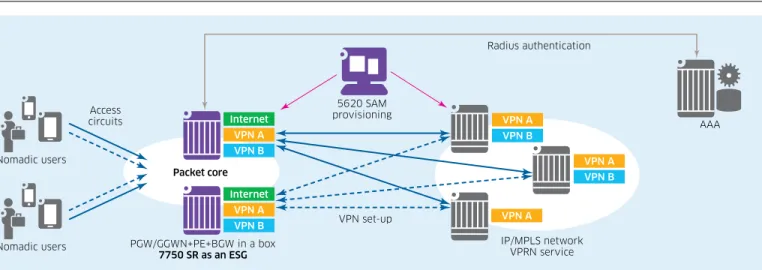
The Alcatel-Lucent solution is shown in Figure 4. The ESG is based on the Alcatel-Lucent 7750 SR and has the ability to collapse the mobile gateway capabilities (such as GGSN or PGW), the PE routing capabilities and the BGW routing capabilities on a single platform. Having a single platform for all these functions greatly simplifies the network.
This simplification leads directly to CAPEX advantages because less hardware is required. There are also OPEX advantages because there are fewer nodes, the network is simplified and service provisioning tasks to configure and manage the service are reduced.
Figure 4. Alcatel-Lucent architectural approach to providing mobile VPN access
Access circuits PGW/GGWN+PE+BGW in a box 7750 SR as an ESG Packet core VPN set-up Nomadic users Nomadic users 5620 SAM provisioning AAA Radius authentication IP/MPLS network VPRN service Internet VPN A VPN B VPN A VPN B VPN A VPN A VPN B Internet VPN A VPN B
The Alcatel-Lucent 5620 SAM is used to provision these mobile VPN services, which significantly increases service provisioning speed and efficiency over the traditional CLI-based approach. In addition, using the 5620 SAM to provision the VPN services dramatically increases the reliability of the service, which indirectly leads to a positive effect on revenue. Faster service provisioning and a more reliable service means: • Faster time to revenue for services
• Improved customer perception and loyalty, leading to an increased VPN growth rate • Fewer Service Level Agreement (SLA) violations, leading to less churn and fewer
penalties
buildiNG the busiNess cAse
This section takes a closer look at the addressable market and each of the components (CAPEX, OPEX and revenue) that make up the results of the study and the CDCF graphs. the addressable market and penetration rate
The addressable market is the starting point in the study, and it drives all of the other elements. Many sources were used as input to the Bell Labs model, including references from Yankee Group [8], Pyramid Research [7], Ovum [6], and service provider public financial statements.
The modeled service provider provides services to a country with a population of almost 17 million people. Of these, there are almost 5 million active mobile business subscriptions according to Pyramid Research [7].
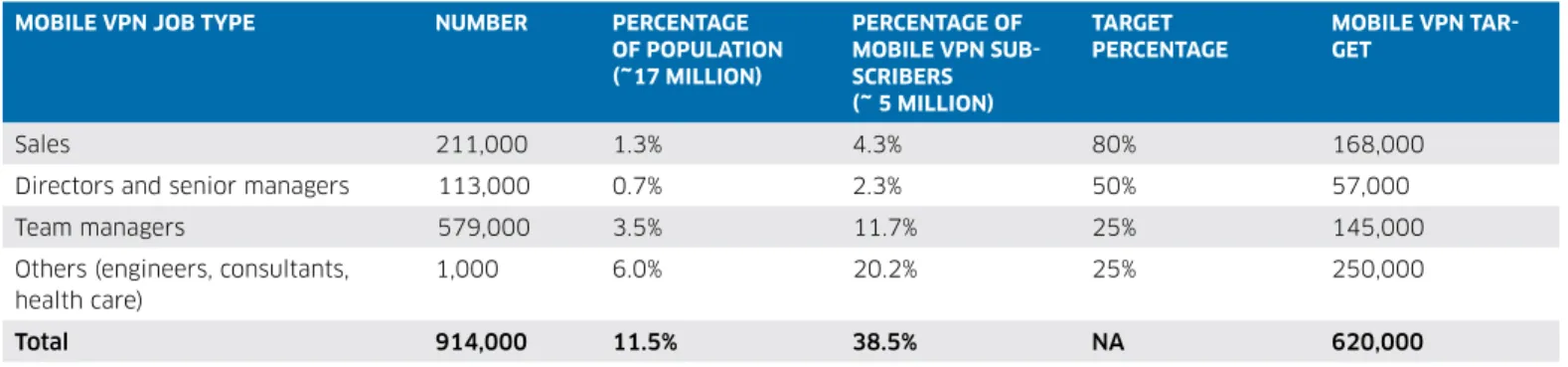
Table 1 describes the number of users that could reasonably be targeted as candidates for this solution by the service provider. For example, according to Internet job statistics [4, 5] there are 211,000 enterprise sales people who are strong candidates for a mobile VPN. Of these candidates it is assumed that 80 percent could be targeted, leading to a total target of 168,000. Other job categories, such as team managers, have a higher number of users but are less likely targets. When all of these categories are tallied, the result is a target addressable market of 620,000 candidate users.
table 1. Mobile business subscribers: candidates
Mobile VPN Job tyPe NuMber PerceNtAGe of PoPulAtioN (~17 MillioN) PerceNtAGe of Mobile VPN sub-scribers (~ 5 MillioN) tArGet PerceNtAGe Mobile VPN tAr-Get Sales 211,000 1.3% 4.3% 80% 168,000
Directors and senior managers 113,000 0.7% 2.3% 50% 57,000
team managers 579,000 3.5% 11.7% 25% 145,000
others (engineers, consultants, health care)
1,000 6.0% 20.2% 25% 250,000
Table 2 uses the addressable market of 620,000 candidate users in 2013 to determine the mobile VPN penetration rate in the country over five years.
table 2. Mobile business subscribers: Penetration
2013 2014 2015 2016 2017 2018
A mobile business subscribers 4,941,000 5,308,000 5,682,000 6,062,000 6,438,000 6,746,000
B mobile business subscriber growth na 7.4% 7.1% 6.7% 6.2% 4.8%
C addressable market 620,000 666,000 713,000 760,000 808,000 846,000
D penetration rate 14% 21% 40% 59% 74% 84%
E mobile Vpn subscribers (penetration) 87,000 143,000 283,000 448,000 600,000 712,000
Row D shows the penetration rate that was modeled using data from Yankee Group [8]. The percentage is the percentage of the addressable market that can reasonably be acquired as the service provider ramps up the solution and penetrates the market. This rate is applied to the addressable market from Row C to determine the year-by-year total penetration rate (Row E). This penetration is reflected in Figure 5.
Figure 5. Mobile business VPN subscribers
0 200 400 600 800 100 300 500 700 2014 2013 2015 Thousands 2016 2017 2018 the revenue
This section describes the revenue for models A and B. For all revenue, it is assumed that each new mobile business VPN subscriber will generate $13.50 of revenue per month with a three percent price erosion based on a North American Tier 1 service provider’s mobile VPN pricing plan.
Revenue Model A
Revenue Model A assumes that with a mobile VPN service from Alcatel-Lucent that allows the service provider to be faster to market and more reliable, the service provider will enjoy an increased VPN growth rate on par with the fixed-line VPN revenue growth of the country, which starts at 7.4 percent and decreases to 4.8 percent over a five-year timeline. The traditional approach will not benefit from this speed to market and reliability; therefore, the service provider will experience a growth rate of only 1.9 percent, as stated in the service provider’s financial statements. Table 3 reflects this assumption.
In Table 3, Row A, the market share percentage of the traditional approach is shown and is based on the growth rate of 1.9 percent. The market share (Row B) is determined by multiplying the subscriber penetration from Table 2 by the market share percentages in Row A.
Row C shows the market share percentage of the Alcatel-Lucent solution defined by a VPN growth rate of 7.4 percent. This percentage grows larger than the traditional approach because it is based on a larger VPN growth rate. The market share for the Alcatel-Lucent solution shown in Row D was determined by multiplying the subscriber penetration in Table 2 by the market share percentage in Table 3, Row C.
Table 3, Row E shows the improvement in the market share of the Alcatel-Lucent solution (Row D) over the traditional approach (Row B). This improvement in market share is used to determine the additional revenue in Row F that the Alcatel-Lucent solution will afford the service provider year-by-year.
table 3. revenue Model A: year-by-year revenue
2013 2014 2015 2016 2017 2018 totAls
A market share % (baseline
– traditional approach)
48.7% 46.2% 46.5% 46.7% 46.8% 47.2% na
B market share (baseline –
traditional approach)
42,500 66,100 131,7 00 209,3 00 281,000 336,4 00 na
C market share % (model a) 48.7% 48.8% 48.9% 48.8% 48.6% 48.2% na
D market share (model a) 42,500 69,800 138,500 218,700 291,400 343,300 na
E market share
improvement
na 3,800 6,800 9,400 10,300 6,900 na
F additional revenue
from market share improvement
na $304,000 $830,000 $1,237,000 $1,461,000 $1,235,000 $5,066,000
G Subscribers for faster revenue
na 23,600 65,600 77,600 71,800 55,400 na
H additional revenue from
faster time to market
0 $159,400 $429,300 $492,800 $442,100 $330,800 $1,854,000
I total additional revenues 0 $463,300 $1,259,400 $1,729,600 $1,903,100 $1,565,400 $6,921,000
In addition to improved market share, another source for additional revenue is the speed to market of deploying mobile VPN services. If the service provider chooses the Alcatel-Lucent solution, it can start to generate revenue for a portion of the subscriber base 15 days sooner than with the traditional approach, resulting in additional revenue as reflected in Row H.
Row I reflects the total additional revenue by using the Alcatel-Lucent solution, adding the additional revenue from an increase in market share in row F and a faster time-to-market from Row H.
Revenue Model B
Revenue Model B assumes that with a mobile VPN service from Alcatel-Lucent, the service provider will be able to offer a more reliable service with better quality of experience (QoE), resulting in increased subscriber loyalty, and therefore a 10 percent reduction in churn. This model assumes a baseline churn rate of 5 percent, resulting in a churn reduction of 0.5 percent per year.
In this model, both the Alcatel-Lucent solution and the traditional approach will generate a service provider VPN subscriber growth rate of 1.9 percent as stated in the service provider’s financial statements. Table 4 reflects this assumption.
table 4. revenue Assumption b: year-by-year revenue
2013 2014 2015 2016 2017 2018 totAls
A market share 42,500 66,100 131,700 209,3 00 281,000 336,4 00 na
B churn reduction % 0.5% 0.5% 0.5% 0.5% 0.5% 0.5% na
C Saved subscribers na 212 332 660 1,050 1,410 na
D market share after churn
reduction
na 66,310 131,990 209,920 282,080 337,790 na
E additional revenue from
reduced churn
0 $17,200 $42,700 $75,600 $126,400 $176,400 $438,000
F additional revenue from
faster time to market
0 $159,400 $429,300 $492,800 $442,100 $330,800 $1,854,000
G total additional revenues 0 $176,600 $472,000 $568,400 $568,500 $507,200 $2,293,000
Row C shows the number of subscribers preserved by a reduction in churn. Row E shows the additional revenue that these subscribers represent. Row F, the revenue from offering a faster service, is identical to that for Model A as shown in Table 3, Row H. Row G shows the total year-over-year incremental revenue (Row E + Row F).
Revenue analysis
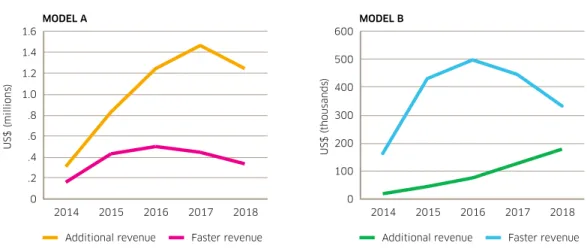
Figure 6 compares the incremental revenues that result from the Alcatel-Lucent solution. In both Model A and Model B, there are two sources of incremental revenues: the revenue due to increased market share from either increased VPN growth rate (Model A) or
reduction in churn (Model B) and the accelerated revenue due to faster service deployment (15 days per new subscriber).
In Model A, it is clear that the additional revenue from an increased VPN growth rate is significantly higher than faster revenue. This is not the case in Model B, where faster revenue is higher than additional revenue obtained as the result of a lower churn rate. Figure 6. Revenue: Additional subscribers at faster billing rate
0 .8 .6 .4 .2 1.0 1.2 1.4 1.6 2014 2015 US$ (millions) 2016 2017 2018 MODEL A
Additional revenue Faster revenue
0 200 100 300 400 500 600 2014 2015 US$ (thousands) 2016 2017 2018 MODEL B
Additional revenue Faster revenue
These graphs also show that additional revenue from reducing the churn rate by 10 percent (0.5 percent per year) is much smaller than additional revenue from an increased VPN growth rate from 1.9 percent to 7.4 percent.
Figure 7 compares total revenues resulting from Model A and Model B. The left graph reflects yearly additional revenues and the right side reflects cumulative revenue. The increase in market share from 1.9 percent to 7.4 percent (Model A) is much more significant than the increased loyalty, resulting in a 10 percent decrease in churn (Model B).
Figure 7. Revenue: Model A and Model B comparison
0 0.5 1.0 1.5 2.0 2014 2015 US$ (millions) 2016 2017 2018 REVENUE MODELS A AND B
Revenue – Model A Revenue – Model B
Cumulative revenue – Model A Cumulative revenue – Model B 0 2 4 6 8 2014 2015 US$ (millions) 2016 2017 2018 CUMULATIVE REVENUE MODELS A AND B
cAPeX
This section describes and compares the CAPEX requirements in the form of hardware and licensing for both the Alcatel-Lucent solution and the traditional approach. Figure 8 shows the number of nodes required for each approach.
Figure 8. CAPEX requirements for the traditional approach and the ALcatel-Lucent solution
GGSN/PGW TRADITIONAL APPROACH
HARDWARE REQUIRED FOR TRADITIONAL APPROACH Access circuits PE + BGW Tunnel VPN set-up PE + BGW Divisional boundary GGSN/PGW Nomadic users Nomadic users CLI provisioning CLI provisioning IP/MPLS network VPRN service Internet VPN A VPN B Internet VPN A VPN B VPN A VPN B VPN A VPN B VPN A VPN B VPN A VPN A VPN B Access circuits PGW/GGWN+PE+BGW in a box 7750 SR as an ESG Packet core VPN set-up Nomadic users Nomadic users 5620 SAM provisioning AAA Radius authentication IP/MPLS network VPRN service Internet VPN A VPN B VPN A VPN B VPN A VPN A VPN B Internet VPN A VPN B AAA Radius authentication ALCATEL-LUCENT SOLUTION
HARDWARE REQUIRED FOR ALCATEL-LUCENT SOLUTION
As shown, both approaches are geo-redundant. The traditional approach needs four nodes: two MGWs and two PE Routers. The Alcatel-Lucent solution needs only two nodes: two Alcatel-Lucent 7750 SRs acting as ESGs.
The CAPEX pricing model for this study provided pricing as the subscriber growth increased (see Table 3, rows B and D for the subscriber growth model). For both approaches, components of CAPEX consisted of the chassis, switching fabric, processing cards (packet processing), line cards (for input/output) and user licenses. The traditional approach was determined to be more than twice as expensive as the Alcatel-Lucent solution over the five-year timeline due to the additional hardware required.
oPeX
The OPEX components considered in this study are cooling, energy, footprint, service provisioning, script building and churn savings.
• Cooling: The cost to cool the equipment, ensuring that all components of the hardware remain within a safe operating temperature range
• Energy: The energy cost to power the equipment
• Footprint: The real-estate cost for housing the equipment
• Service provisioning: The cost to provision the VPN services on the network infrastructure
• Script building: The cost of building provisioning scripts for the traditional approach • Churn savings: This cost is applied to the Alcatel-Lucent solution and represents
the OPEX savings pertaining to the cost per gross additions (CPGA) and the decommissioning cost savings.
Several external sources were used to help develop the OPEX model and its underlying assumptions, including Ovum [6], Forrester [2] and Analysis Mason [1].
Service provisioning: Traditional approach
The most significant component of OPEX is service provisioning. It can be logically divided into two main parts: tunnel provisioning tasks and VPN provisioning tasks. The volume of provisioning tasks required is driven by the VPN user penetration (see Table 3). The labor costs associated with provisioning are assumed to be $130,000 per year per engineer.
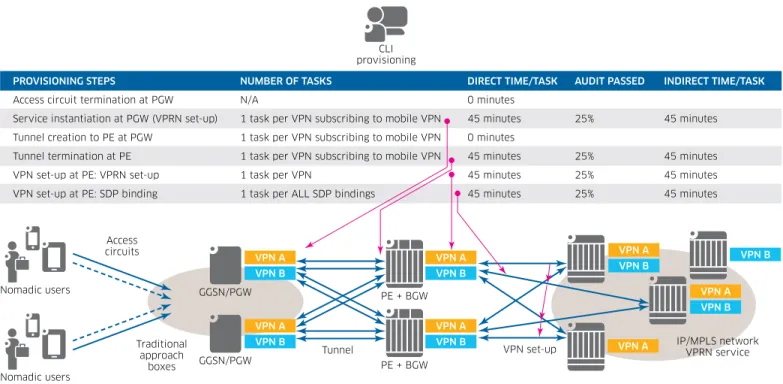
As shown in Figure 9, the traditional approach has both a GGSN or PWG and a PE Router; as a result, additional tunnel provisioning tasks are required between these components. Provisioning in this approach is assumed to be driven by using CLI, which is slower and less reliable than the Alcatel-Lucent solution, which uses the Alcatel-Lucent 5620 SAM.
Figure 9 breaks down the service provisioning tasks for the traditional approach. For each task, there are two related provisioning times. The first is the time it takes to complete the task (Direct time). The second is the time it takes to re-provision that task (Indirect time) if it is deemed to have failed its audit. This is a very important consideration and it is assumed that CLI provisioning is inherently prone to human error, resulting in many configuration errors.
In the traditional approach, an additional cost is built into the model due to inter-divisional overhead that occurs as the result of possible discontinuities when provisioning is broken up across two divisions. In this case, PGW provisioning is likely to be performed by the wireless division and PE Router or BGW provisioning is likely to be performed by the infrastructure (IP/MPLS) division.
Figure 9. Service provisioning tasks for the traditional approach
GGSN/PGW Access circuits PE + BGW Tunnel VPN set-up PE + BGW GGSN/PGW Traditional approach boxes Nomadic users Nomadic users CLI provisioning IP/MPLS network VPRN service VPN B VPN A VPN B VPN A VPN B VPN A VPN B VPN A VPN B VPN A VPN B VPN A VPN A VPN B PROVISIONING STEPS
Access circuit termination at PGW Service instantiation at PGW (VPRN set-up) Tunnel creation to PE at PGW
Tunnel termination at PE VPN set-up at PE: VPRN set-up VPN set-up at PE: SDP binding
NUMBER OF TASKS
N/A
1 task per VPN subscribing to mobile VPN 1 task per VPN subscribing to mobile VPN 1 task per VPN subscribing to mobile VPN 1 task per VPN
1 task per ALL SDP bindings
DIRECT TIME/TASK 0 minutes 45 minutes 0 minutes 45 minutes 45 minutes 45 minutes AUDIT PASSED 25% 25% 25% 25% INDIRECT TIME/TASK 45 minutes 45 minutes 45 minutes 45 minutes
The provisioning tasks “access circuit termination at PGW” and “tunnel creation to PE at PGW” have “0” times associated with them because it is assumed that for the traditional approach these tasks are automated. This automation would equate them to the Alcatel-Lucent approach; therefore, relative comparisons for these tasks would be irrelevant to the study.
Service provisioning: Alcatel-Lucent solution
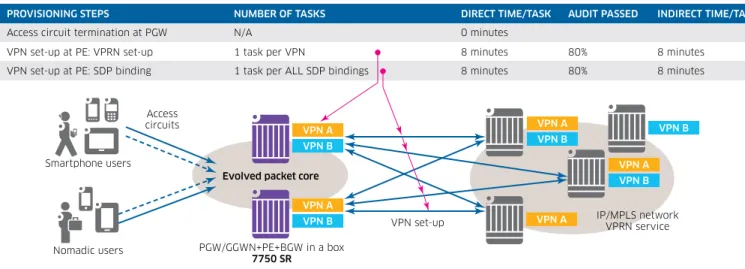
The Alcatel-Lucent solution benefits from the ability of the Alcatel-Lucent 7750 SR to collapse the GGSN or PGW, the PE Router and the BGW functions all on the same node. This ability greatly simplifies the number of provisioning tasks and also removes inter-divisional boundaries. Specifically, all of the tunnel provisioning tasks between the GGSN or PGW and the PE Router are removed. Figure 10 shows the simplified network and the associated reduced number of provisioning tasks.
Figure 10. Service provisioning tasks for the Alcatel-Lucent solution
PROVISIONING STEPS
Access circuit termination at PGW VPN set-up at PE: VPRN set-up VPN set-up at PE: SDP binding
NUMBER OF TASKS
N/A
1 task per VPN
1 task per ALL SDP bindings
DIRECT TIME/TASK 0 minutes 8 minutes 8 minutes AUDIT PASSED 80% 80% INDIRECT TIME/TASK 8 minutes 8 minutes Access circuits PGW/GGWN+PE+BGW in a box 7750 SR
Evolved packet core
VPN set-up Smartphone users Nomadic users SAM provisioning IP/MPLS network VPRN service VPN B VPN A VPN B VPN A VPN B VPN A VPN A VPN B VPN A VPN B
In addition to this network simplification, the Alcatel-Lucent solution is able to leverage the powerful provisioning, service assurance and troubleshooting capabilities of the Alcatel-Lucent 5620 SAM, thereby dramatically reducing service provisioning times while increasing provisioning reliability, as shown in Figure 10. The traditional approach was determined to be more than ten times as expensive as the Alcatel-Lucent solution over the five-year timeline primarily due to the simplified provisioning process that the 5620 SAM is able to exploit.
study results
The study results are expressed by using CDCF over a five-year timeline. The CDCF is built by determining the yearly NPVs of the incremental cost advantages of the CAPEX, OPEX and revenue aspects of the Alcatel-Lucent solution over a traditional approach. Results are created for both the greenfield and the replacement scenarios using both of the modeled revenue assumptions for each.
Greenfield scenario
Figure 11 shows the incremental CDCF of the greenfield scenario where the modeled service provider has no existing support for mobile VPNs and a mobile VPN
infrastructure is not in place.
The graph on the left shows the incremental CDCF for Model A, and the NPV in Year 5 is approximately $6 million, showing a very strong advantage for the Alcatel-Lucent solution over the traditional approach. There is a clear Alcatel-Lucent CAPEX advantage in Year 1 due to the consolidation of the essential VPN routing capabilities (such as the PE Router) and the essential mobile gateway capabilities.
Figure 11. Greenfield results using Model A and Model B -1 0 1 2 3 4 5 6 7 2014 2015 2016 2017 2018
GREENFIELD USING MODEL A
CDCF A -0.5 0 0.5 1 1.5 2 2.5 3 3.5 4 2014 2015 2016 2017 2018
GREENFIELD USING MODEL B
Investments Expenses Revenues
CDCF A
Investments Expenses Revenues
US$ (millions)
US$ (millions)
The Alcatel-Lucent OPEX advantage is also apparent but it is relatively small and spread out evenly over all years of the study. The OPEX advantages are the result of faster and more efficient service provisioning across a simplified network.
The most significant component of the graph is the revenue, which shows that by being able to provision mobile VPN services faster, more efficiently and with more reliability, the Alcatel-Lucent solution has a clear advantage over the traditional approach.
The graph on the right shows the incremental CDCF for Model B, and the NPV in Year 5 is approximately $3.5 million. Although there is still a clear advantage with the Alcatel-Lucent solution, this model is almost half as valuable as Model A. The CAPEX and OPEX remain the same but the revenue is markedly lower than with Model A. Reducing churn by 10 percent has a much smaller impact on revenue and NPV than does the growth rate increase (from 1.9 percent to 7.4 percent).
replacement scenario
Figure 12 shows the incremental CDCF of the replacement scenario where the traditional approach is already in place in the modeled service provider’s network. In this scenario the Alcatel-Lucent solution will need to replace the existing solution, so the CAPEX of the traditional approach is not factored into the cost of the analysis.
Figure 12. Replacement results using Model A and Model B
-2 -0.5 -1 -1.5 0 0.5 1 1.5 2 2.5 3 2014 2015 2016 2017 2018
REPLACEMENT AND MODEL A
-2 -1.5 -1 -0.5 0 0.5 1 2014 2015 2016 2017 2018
REPLACEMENT AND MODEL B
Investments Expenses Revenues Investments Expenses Revenues
US$ (millions)
The graph on the left is based on Model A, and the NPV is approximately $2.7 million in Year 5. Despite having to replace the traditional approach, the Alcatel-Lucent solution starts to show a positive NPV after only two years. The OPEX is lower for the Alcatel-Lucent solution each year. The revenue is significantly better with the Alcatel-Alcatel-Lucent solution and, combined with the OPEX advantages, the solution is able to overcome the CAPEX disadvantages and break even after two years.
The graph on the right is based on Model B, and only in Year 5 does the Alcatel-Lucent solution achieve a positive NPV. With the Alcatel-Lucent solution, Model B does not generate enough revenue to overcome the CAPEX or investment deficit it is faced with until Year 5.
coNclusioN
There is a definite opportunity for service providers to expand their existing fixed-line VPN business by augmenting it with mobile access to offer their enterprise customers persistent and secure access to important business applications for their nomadic employees. The cumulative revenue for this opportunity over a five-year timeline is more than $130 million.
The service provider must augment its infrastructure to provide this mobile VPN access. By deploying the Alcatel-Lucent solution, there are many inherent advantages, the two most important being:
• Simplifying the network using the Alcatel-Lucent 7750 SR by collapsing many network nodes into a single node
• Increasing the VPN service provisioning speed and increasing the reliability by using the Alcatel-Lucent 5620 SAM
The results of the study clearly point to the advantages of deploying the Alcatel-Lucent solution. For new greenfield deployments, the Alcatel-Lucent solution is shown to have an incremental NPV of more than $6 million over a traditional approach over a five-year timeline.
rerereNces
1. Analysis Mason, Return on Investment of the Alcatel-Lucent 5620 SAM, January 2011
2. Forrester Consulting, The Total Economic Impact of Alcatel-Lucent’s 5620 Service Aware Manager (5620 SAM), December 2007
3. Frost and Sullivan, Global Mobile VPN Products Market, September 2011 4. INSEE, Salariés du privé selon le type d’activité ou le type d’employeurs
(Salaries of the private sector based on the type of employment), 2013
5. Jobintree, quoting Observatoire permanent de la fonction commerciale, baromètre 2011 de la fonction commerciale (Barometer of the Commercial Function,
The Permanent Observatory of the Commercial Service), 2011
6. Ovum, VPLS Growth Requires Carrier-Class Network Features, October 2005 7. Pyramid Research, Mobile Data Forecast, June 2013
8. Yankee Group, Demand Triples for Mobile Business Apps, but Enterprises Must Deploy Strategically, July 2013
AcroNyMs
2G/3G/4G second-generation/third=generation/fourth-generation
5620 Sam 5620 Service aware manager
7750 Sr 7750 Service router
aaa authentication, authorization and accounting
arpU average revenue per user
BGw Border Gateway
BnG Broadcast network Gateway
capeX capital expenditures
cDcf cumulative discounted cash flow
cli command line interface
cpGa cost per gross addition (fix in body text)
crm customer relationship management
eSG enterprise Services Gateway
GGSn Gateway GprS support node
GprS General radio packet Service
hSpa high Speed packet access
ip internet protocol
lte long term evolution
mG-iSm mobile Gateway integrated Services module
mGw mobile Gateway
mplS multiprotocol label Switching
npV net present value
opeX operating expenditures
pe provider edge
pGw packet Gateway
Qoe quality of experience
ran radio access network
SDp service delivery platform
SGSn Serving GprS Support node
Sla Service level agreement
Sr Service router
Vpn Virtual private network
Vprn Virtual private routed network
wifi wireless fidelity
wlan wireless local area network