Department of Computer Science
Community Detection in Complex
Networks
Amenah Dahim Abbood Al-Dayyeni
August, 2018
Supervised by Professor Richard Everson & Professor Jonathan
Fieldsend
Submitted by Amenah Dahim Abbood Al-dayyeni to the University of Exeter as a thesis for the degree of Doctor of Philosophy in Computer Science , August, 2018.
This thesis is available for Library use on the understanding that it is copy-right material and that no quotation from the thesis may be published without proper acknowledgement.
I certify that all material in this thesis which is not my own work has been identified and that no material has previously been submitted and approved for the award of a degree by this or any other University.
Abstract
Finding communities of connected individuals in social networks is essential for understanding our society and interactions within the network. Recently attention has turned to analyse these communities in complex network systems. In this thesis, we study three challenges. Firstly, analysing and evaluating the robustness of new and existing score functions as these functions are used to assess the community structure for a given network. Secondly, unfolding community structures in static social networks. Finally, detecting the dynamics of communities that change over time. The score functions are evaluated on different community structures. The behaviour of these functions is studied by migrating nodes randomly from their community to a random community in a given true partition until all nodes will be migrated far from their communities. Then Multi-Objective Evolutionary Algorithm Based Community Detection in Social Networks (MOEA-CD) is used to capture the intuition of community identification with dense connections within the community and sparse with others. This algorithm redirects the design of objective functions according to the nodes’ relations within community and with other communities. This new model includes two new contradictory objectives, the first is to maximise the internal neighbours for each node within a community and the second is to minimise the maximum external links for each node within a community with respect to its internal neighbours. Both of these objectives are optimised simultaneously to find a set of estimated Pareto-optimal solutions where each solution corresponds to a network partition.
Centrality (NNC) strategy which is combined with the proposed model to improve the performance of MOEA-CD to find a local optimal solution.
We also design an algorithm which produces community structures that evolve over time. Recognising that there may be many possible community structures that ex-plain the observed social network at each time step, in contrast to existing methods, which generally treat this as a coupled optimisation problem, we formulate the prob-lem in a Hidden Markov Model framework, which allows the most likely sequence of communities to be found using the Viterbi algorithm where there are many candi-date community structures which are generated using Multi-Objective Evolutionary Algorithm.
To demonstrate that our study is effective, it is evaluated on synthetic and real-life dynamic networks and it is used to discover the changing Twitter communities of MPs preceding the Brexit referendum.
This a good opportunity to thank everyone who help me and contributed in realising this thesis specifically my supervisor, Prof. Richard Everson without him the thesis would never have been possible to finish. He always encourages me to do the best to get more experience throughout my PhD. I thank him for his time and patience.
I would like to thank forever my family who supported me in all aspects of my life. I am forever grateful to my husband Ammar Al-shahrablee who is the source of my strength, and he always stands by my side.
I would like to thank my second supervisor Prof. Jonathan Fieldsend for his guidance and time to finish this thesis. I would like to thank Dr Christopher Ferro, my mentor throughout my PhD. We are grateful to Iain Weaver, Hywel Williams, Iulia Cioroianu, Travis Coan and Susan Banducci for the MP Twitter data.
I also would like to thank the academic and technical staff of Exeter University for their support. I would like to thanks all my teacher in my life. I am also thankful Prof. Barra Ali Attea and Dr.Loay E. Geoge, Alma Rahat, Ali Kareem, Mohamed Younis, Huthaifa abo Hammad,Luma Harbi, Yuan Zuo, George De Ath, Chengqiang Huang for their friendship and support.
Special and deepest thanks express to the staff of Baghdad University, the university where I am employed, for nominating me to this PhD scholarship, which is provided by the Ministry of Higher Education of Iraq scholarship, the completion of this thesis would not have been possible without their grateful supports.
List of tables iii
List of figures v
Nomenclature and Abbreviations xiii
Publications xiv
1 Introduction 1
1.1 Key Challenges and Novel Contributions . . . 4
1.2 Organization of the Thesis. . . 8
2 Background 10 2.1 Network Theory . . . 10
2.2 Community Structure Evaluation Scores . . . 15
2.3 Multi-Objective Optimisation Problems . . . 19
2.4 Multi-Objective Evolutionary Algorithms . . . 21
2.5 Survey of Network Community Detection. . . 24
2.6 Evaluation Measures . . . 33
2.7 Community Detection in Dynamic Networks. . . 36
2.8 Summary . . . 40
3 Community Detection in Static Networks 41 3.1 Objective Function Formulation. . . 43
3.2 Empirical Evaluation of Objective Fidelity . . . 45
3.3 The proposed MOEA-CD for Community Detection . . . 49
3.4 Experiments. . . 54
3.4.1 Synthetic Networks. . . 56
3.4.2 Real-world networks with ground-truth partitions. . . 58
3.4.3 Real-world networks with unknown ground-truth partitions . 70 3.5 Summary . . . 71
4 Detecting Dynamic Communities Using Viterbi and Evolutionary Algorithms 74 4.1 Dynamic Community Detection with HMMs. . . 78
4.1.1 Multi-Objective Evolutionary Algorithm . . . 81
4.2 Results. . . 83
4.2.1 Synthetic Datasets . . . 83
4.2.2 Real-life Datasets . . . 89
4.3 Summary . . . 94
5 Conclusion and Future Work 96 5.1 Summary of Contributions. . . 96
5.1.1 Evaluation of Community Scores . . . 97
5.1.2 Community Detection in Static Networks . . . 98
5.1.3 Community Detection in Dynamic Networks . . . 99
5.2 Future work . . . 99
5.2.1 Community Score Evaluation . . . 100
5.2.2 Community Detection in Static Networks . . . 100
5.2.3 Community Detection in Dynamic Networks . . . 101
3.1 The average of the number of misleading partitions over twenty runs for each objective. These objectives are tested on six real-world net-works. . . 47 3.2 Network characteristics. . . 55 3.3 Maximum and average ofN M I and modularity for testing four
mod-els without Neighbourhood Node Centrality on five real-world net-works whose the ground-truth partition is known. N M IQmax
mea-sures the similarity between Qmax and true partition for each
net-work. P OSav is the average size of the Pareto optimal sets which
have been generated by different algorithms over twenty independent runs. P OSmin and P OSmax are the smallest and the largest values
among the approximation sets for each algorithm on each network respectively. The best score achieved for each network is in bold font. 59 3.4 Maximum and average ofN M I and modularity for testing four
mod-els with Neighbourhood Node Centrality on five real-world networks whose the ground-truth partition is known. N M IQmax measures the
similarity betweenQmax and true partition for each network. P OSav
is the average size of the Pareto optimal sets which have been gener-ated by different algorithms over twenty independent runs. P OSmin
and P OSmax are the smallest and the largest values among the
ap-proximation sets for each algorithm on each network respectively. The best score achieved for each network is in bold font. . . 63
algorithms (MOCD, MOGA-Net, MOPSO and MOEA-CD) per gen-eration on real-world networks. . . 70 3.6 Experimental results for testing four models without N N C strategy
on three real-world networks whose the ground-truth partition is un-known.. . . 71 3.7 Experimental results for testing four models with N N C strategy on
1.1 (a) A graph is partitioned into three communities. (b) The synthetic network consisting of four communities [Lancichinetti et al., 2008]. Different colours for each community. . . . 2
2.1 (a) A graph which consists of three communities. (b) Adjacency ma-trix which consists of three communities.. . . 11 2.2 Possible structures for communities in dynamic networks [Palla et al.,
2007]. . . 37
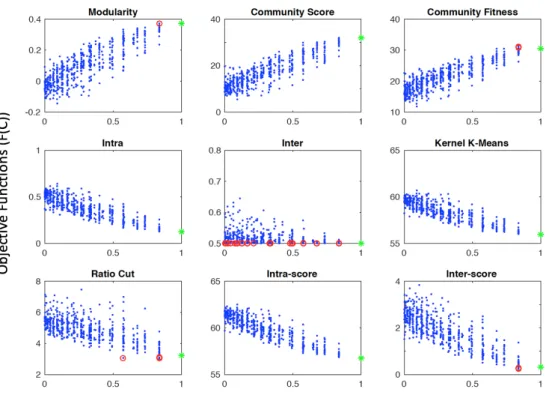
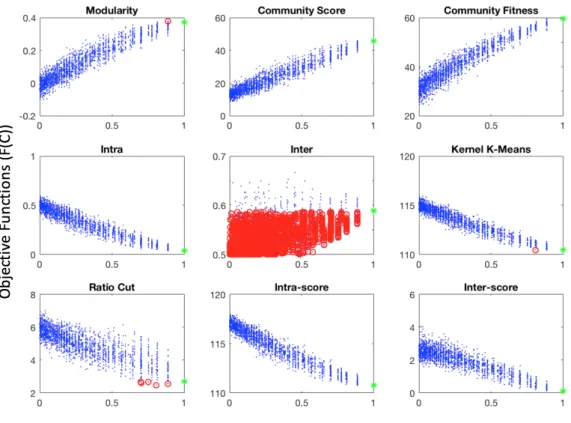
3.1 Objective function fidelity on Karate club network. Correlations of community scoring functions withN M Ito the true partitionP∗. The N M I between a randomly generated partition P and P∗ is plotted horizontally versus the scoring functionf(P) plotted vertically. Par-titions for which the scoring function is misleading are shown in red, and f(P∗) is shown in green. . . 48 3.2 Objective function fidelity on Dolphin network. Correlations
of community scoring functions withN M I to the true partition P∗. TheN M I between a randomly generated partitionP andP∗ is plot-ted horizontally versus the scoring function f(P) plotted vertically. Partitions for which the scoring function is misleading are shown in red, and f(P∗) is shown in green. . . 49
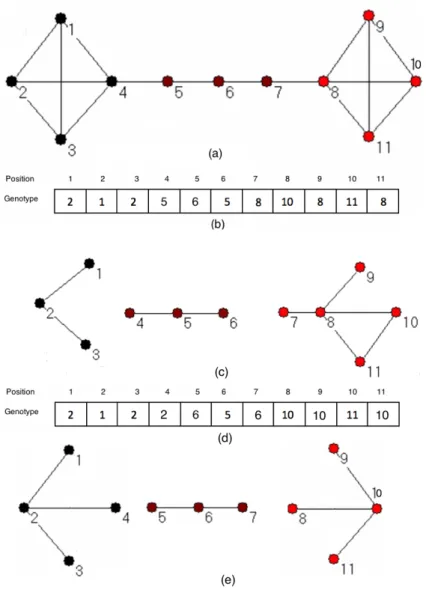
dicated by node colours. (b) The community structure induced by the given locus-based genetic representation, Cj = (gj1, g
j
2, . . . , g
j N).
Here eachgji is initialised to one of the neighbours of nodei[Pizzuti, 2012]. (c) The community structure resulting from Pizzuti modified initialisation. (d) Genotype induced by the given locus-based genetic representation. Here our modified initialisation in which all the unas-signed neighbours ofiare assigned the samegji, so that they are all in the same community. (e) The community structure by our modification. 51 3.4 Average bestN M I between ground truth and detected partitions for
MOGA-Net (black), MOCD (green), MODPSO (blue) and MOEA-CD (red) over twenty runs on the LFR128 benchmark networks (10 networks) with and without the Neighbourhood Node Centrality heuris-tic. Dashed and solid lines indicate results without and with the heuristic respectively.. . . 56 3.5 Average bestN M I between ground truth and detected partitions for
MOGA-Net (black), MOCD (green), MODPSO (blue) and MOEA-CD (red) over twenty runs on the LFR1000 benchmark networks (10 networks) with and without the Neighbourhood Node Centrality heuristic. Dashed and solid lines indicate results without and with the heuristic respectively. . . 58 3.6 Dolphin network partition without heuristic. (a) Community
struc-ture obtained by MODPSO. This partition corresponds to the parti-tion that have maximum modularity (Qmax = 0.5199) and N M I =
0.5820. (b) Community structure obtained by MOEA-CD. This par-tition corresponds to the parpar-tition that have maximum N M I of 1 and Q= 0.3734. . . 61
each generation withN M I to the true partition. TheN M I between the true partitionP∗and the partitionP that has maximum modular-ity is plotted horizontally versus the modularmodular-ityQplotted vertically. SOEA is used to optimise modularity and produce partitionsP with-out Neighbourhood Node Centrality. (a) Modularity evaluation on the Karate club networks (b) Modularity evaluation on the Dolphins networks. (c) Modularity evaluation on the Football 2000 networks. (d) Modularity evaluation on the Football 2001 networks. . . 62 3.8 Correlations of modularity for the partition that has maximumQ at
each generation withN M I to the true partition. TheN M I between the true partitionP∗and the partitionP that has maximum modular-ity is plotted horizontally versus the modularmodular-ityQplotted vertically. SOEA is used to optimise modularity and produce partitionsP with Neighbourhood Node Centrality at each generation. (a) Modularity evaluation on the Karate club networks (b) Modularity evaluation on the Dolphins networks. (c) Modularity evaluation on the Foot-ball 2000 networks. (d) Modularity evaluation on the FootFoot-ball 2001 networks. . . 64 3.9 Community detection results on the karate club network by
MOEA-CD model. (a) Pareto front of one run with the N N C method. The colour bar represents the range of N M Imax values. (b)
De-tected correct community structure which corresponds to solution b atN M I = 1. This is the best among a set of trade-off solutions. (c) Detected community structure which is corresponding to solution c at N M I = 0.8371, only node 10 is misclassified. (d) Detected commu-nity structure which is corresponding to solution d atN M I = 0.6872, the network is divided into four communities. Colours indicate the community that a node belongs to. . . 65
model. (a) Pareto front of one run withN N C method. (b) Detected correct community structure which is corresponding to solution b at N M I = 1. (c) Detected community structure which is correspond-ing to solution c atN M I = 0.8499, the network is divided into three communities. (d) Detected community structure which is correspond-ing to solution d at N M I = 0.6516, the network is divided into four communities. Colours indicate the community that a node belongs to. 66 3.11 Community detection results on the Football network by MOEA-CD
model. (a) Pareto front of one run with N N C method. (b) De-tected community structure which is corresponding to solution b at N M I = 0.926879. (c) Detected community structure which is cor-responding to solution c at N M I = 0.8940, the network is divided into thirteen communities. (d) Detected community structure which is corresponding to solution d at N M I = 0.8273, the network is di-vided into eight communities. Colours indicate the community that a node belongs to. . . 67 3.12 Box plots of the maximumN M Imaxbetween the detected partitions
and the true partition versus generation on the Karate network. The box plots show the distribution of maximum N M I over 20 runs for each of the four models: (a) Our proposed model; (b) MODPSO; (c) MOCD; (d) MOGA-Net. . . 68 3.13 Box plots of the maximumN M Ibetween the detected partitions and
the true partition versus generation on the Dolphin network. The box plots show the distribution of maximumN M Iover 20 runs for each of the four models: (a) Our proposed model; (b) MODPSO; (c) MOCD; (d) MOGA-Net. . . 69
trade-off set between Intra-Score and Inter-Score. Each blue circle in the estimated Pareto front is a solution that represents a different network partition to the SFI network. The red star is the network partition that corresponds to the solution at Q = 0.763. (b) SFI network is partitioned into seven main communities. Colours indicate the community that a node belongs to. . . 71
4.1 An example of the Viterbi algorithm captures the evolution of dy-namic communities over three time steps. . . 80 4.2 The trade-off set between the Inter-Score and Intra-Score for a single
snapshot (t = 5) for Var-Net, z = 5 data which will be described in section 4.2. . . 82 4.3 Kim and Han [2009] synthetic networks. N M I between candidate
partitions located by the MOEA and the true partition at each timestep (blue circles). N M I between the true partitions and the Viterbi op-timal path of partitionsc⋆t are shown as red squares. . . 84 4.4 Kim and Han [2009] synthetic networks. N M I between partitions
detected by the DYNMOGA and Kim-Han and the true partition with blue and red lines respectively over 10 time steps. (a) Fix-Net-z3. (b) Fix-Net-Fix-Net-z3. (c)Var-Net-Fix-Net-z3. (d) Var-Net-z5. The figure was taken from Folino and Pizzuti [2014] . . . 85 4.5 Greene et al. [2010] synthetic networks. N M Ibetween candidate
par-titions located by the MOEA and the true partition at each timestep (blue circles). N M I between the true partitions and the Viterbi op-timal path of partitionsc⋆t are shown as red squares. . . 87
by our algorithm on the cell phone network. (a): Community struc-ture on day one. The five important nodes in this partition (nodes 2(green), 3(orange), 4(blue), 6(purple) and 201(orange)) are assign to four communities. (b) partition is divided into four communi-ties on day six, the five important nodes (nodes 2(green), 3(orange), 4(blue), 6(purple) and 201(orange)) are assigned to four communi-ties. (c) Community structure on day seven. The important nodes are (2(green), 3(blue), 4(blue) and 6(purple)) are assigned to three communities. (d) Community structure on day eight. The impor-tant nodes 2, 3, 4, 6 and 201 changed their number to 310(green), 398(blue), 361(blue), 307(purple), 301(blue)) . . . 88 4.7 Communities and party affiliations for the MP twitter communities
data. Left: Communities discovered by the evolutionary and Viterbi algorithms. Nodes representing MPs belonging to the same commu-nity are depicted in the same (arbitrary) colour; grey symbols indicate MPs who did not tweet that week. Right: Political party affiliation of the MPs: red: Labour; blue: Conservative; yellow Liberal Democrat; cyan: Scottish National Party; purple: United Kingdom Indepen-dence Party (UKIP); dark green: Plaid Cymru; black: speaker and independent. . . 90
data illustrating the many smaller communities formed by Conserva-tive Party MPs in contrast to the single larger communities represent-ing other political parties. Left: Nodes representing MPs belonging to the same community are depicted in the same (arbitrary) colour; grey symbols indicate MPs who did not tweet that week. Right: Po-litical party affiliation of the MPs: red: Labour; blue: Conserva-tive; yellow: Liberal Democrat; cyan: Scottish National Party; pur-ple: United Kingdom Independence Party (UKIP); dark green: Plaid Cymru; light green: Sinn Feinh; black: speaker and independent. . 91 4.9 Weekly MP Twitter communities before and after the Brexit
refer-endum. Successive panels show the community structure and party affiliations 7 and 3 weeks before the referendum, the week of the ref-erendum and the week immediately following it. As the refref-erendum approaches, two of the three main communities (Labour, Conservative plus UKIP, and Scottish National Party) merge to form a single com-munity, which immediately after the referendum again splits apart along party lines. . . 92 4.10 The distribution of the number of communities in each of the Pareto
optimal solutions found by the MOEA-CD algorithm on 85 weeks of MP Twitter network.. . . 93 4.11 Modularity and Viterbi results on MPs Twitter networks. Red stars
represent the modularity values for each state (network partition). Blue stars are the most likely sequence of states (network partitions) over 85-time step using the Viterbi algorithm. . . 94
Nomenclature and
Abbreviations
Acronyms and abbreviations
CF Community Fitness (p. 17) CON CONductance (p. 4) CS Community Score (p. 4) EA Evolutionary Algorithm (p. 7) GA Genetic Algorithm (p. 20) ID Internal Density (p. 18) KKM Kernel K-Mean (p. 17)
MOEA Multi-Objective Evolutionary Algorithm (p. 8) MOP Multi-Objective Optimisation Problem(p. 20) NC Normalized Cut (p. 4)
NMI Normalised Mutual Information (p. 35) NNC Neighbour Node Centrality(p. 42) PS Pareto Set (p. 20)
Q Modularity (p. 4)
QD Modularity density(p. 39)
RC Ratio Cut (p. 18)
Publications
The materials presented in chapter 4 have been published in:
Dahim, Amenah and Everson, Richard, (2017). Detecting Dynamic Communi-ties in Complex Networks Using Viterbi and Evolutionary Algorithms. In Proceedings of the 2017 Conference on Complex Networks and Their Applica-tions, Complex Networks 6 ’14, pages 344–347, Lyon, France, November 29 -December 01.
Introduction
The recent science of network systems has brought important advances to represent and deeper understanding of the main characteristic of complex networks [Duan et al.,2014]. Understanding the configuration of networks provides positive effects in different fields such as computer science, engineering, biology, economics, etc. These techniques have attracted many researchers since these systems include real-world networks such as technological networks, networks, information networks (World Wide Web networks) [Broder et al.,2000], biological networks (protein-protein net-works and neural netnet-works) [Girvan and Newman, 2002], scientific collaboration networks [Newman,2001], and transportation networks [Banavar et al.,2000].
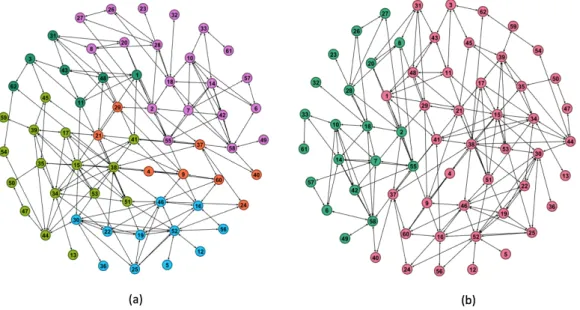
A graph representation is the simplest method to represent complex real-world net-works where nodes (vertices) represent objects such as individuals, neurones, pro-teins or countries and the connections between these objects are represented by edges or links such as communication, friendship or collaboration (for example, two authors (nodes) write a paper together and can therefore be joined by an edge). In general, a network can be divided into groups of nodes, called communities, modules or clusters, each group has dense connections within it (intra-connections) and is only sparsely connected with the rest (inter-connections), see Figure.1.1. This type
Figure 1.1(a) A graph is partitioned into three communities. (b) The synthetic network consisting of four communities [Lancichinetti et al., 2008]. Different colours for each community.
of organisation is known as the graph’s community structure. It is crucial to identify communities as it helps to determine the structural properties of the networks.
A common way of discovering community structure is to define an objective function or quality measure that quantifies the quality of a proposed partition of the nodes of a network into communities and then to optimise the objective function over possible partitions. This approach depends on (a) defining an appropriate quality function and (b) a search algorithm to efficiently locate good quality partitions. Generally speaking, all the proposed quality functions have the same two goals: they favour partitions with more connections inside communities and few connections with the rest [Girvan and Newman,2002;Lancichinetti et al.,2010]. This definition of community is known and accepted by most network scientists. Also, it is similar to general clustering techniques [Jain and Dubes,1988] which attempt to partition a set of data to maximise the similarity of members within the cluster and minimise similarity with the rest.
Many algorithms have been suggested to uncover communities in networks based on connections between nodes and these connections may be weighted or unweighted, directed or undirected [Girvan and Newman,2002;Lancichinetti et al.,2011;Miyauchi
and Kawase, 2016; Pizzuti, 2012]. However, understanding these networks is very challenging especially when the configuration of these networks is evolving as many real-world networks are complex and dynamic. Therefore, analysing community structures is still an open problem and it needs more investigations. In 2004, Girven and Newman made a most exciting contribution to the community detection research area when they used the modularity score to measure the strength of partitioning of the network into communities [Newman and Girvan, 2004]. If the modularity is high, the network partition has dense connections between nodes within the commu-nity but sparse connections between different communities. Although it is the most popular measure for evaluating community structures, it suffers from a resolution limitation as it cannot detect small communities even if there are sparse connections between these small communities [Chen et al., 2014; Lancichinetti and Fortunato, 2011].
In the last few years, single objective evolutionary algorithms have been used to optimise a partition quality measure to detect community structure. Although these algorithms have been successful in identifying correct partitions on some real-world networks, they have failed on others because they have produced a solution with fixed property for the community structure as SOEA optimise one objective [Hafez et al., 2014]. Based on the general definition of communities, we can usefully consider the optimisation of the two objectives. One of them tends to increase intra-connections, while the second decreases inter-connections. In this way, this problem has been formulated as the multi-objective optimisation problem to produce a set of trade-off solutions by optimising two conflicting objective functions [Shi et al.,2012;Pizzuti, 2012;Gong et al.,2014;Wu and Pan,2015].
Furthermore, Shi et al. [2014] proposed an algorithm to select objective functions in multi-objective community detection and they concluded that optimising two conflicting objectives using an evolutionary algorithm outperformed single objective evolutionary algorithms.
There is another important factor which should be taken into account when nodes and their connections change over time. It is generally expected that networks evolve slowly, so dramatic changes in community structure are unlikely. This is commonly modelled by the addition of a temporal cost that penalises abrupt changes in commu-nity structure from one time to the next. Existing methods for analysing commucommu-nity evolution have used only one objective to evaluate snapshot quality such as Mod-ularity, Community Score, CONductance, Normalised Cut. [Folino and Pizzuti, 2010,2014;Ma et al.,2014;Zhou et al., 2015] while the community detection issue is proved as multi-objective optimisation since networks having multiple structural properties [Shi et al.,2012;Pizzuti,2012;Gong et al.,2014;Wu and Pan,2015].
After this scenario, we wish to develop the analysis of the structure of communities in different types of synthetic and real-world networks. This analysis will be described in details in chapter 3 and 4.
The following chapters will present the algorithms that have been used to unfold community structures in static and dynamic networks.
1.1 Key Challenges and Novel Contributions
In the last few years, community detection has become an important research topic in complex network analysis. So far, many methods have been proposed to analyse these communities and provide a good understanding of the configuration of these networks, see [Fortunato and Hric,2016] for a review. However, some of the critical issues are still open questions. In this section, we describe some of these issues and attempt to deal with them as our main contributions in this thesis.
Objective Evaluation
As we discussed earlier, the nodes in the network are to be grouped by the community detection algorithm. In order to detect the structures of these communities, a score
function is needed to evaluate these structures. The study of score functions to determine the quality of a partitioning of the graph into communities is important. A few works of literature have been developed to evaluate the utility of the quality scores for community detection. Also, the evaluation of these scores based on the correct partition is missing in the literature. For example, Hafez et al. employed the single objective optimisation technique to investigate the quality of different objective functions [Hafez et al., 2014]. However, this method produces just one solution to validate the quality of the optimised objective with respect to the true partition. Therefore, the investigation in this research area is still not clear to determine the utility of scoring functions as the objective evaluation strategies need much of useful network partitions for the evaluation.
A New Methodology for Evaluating Partition Quality Scores
An evaluation technique is proposed to evaluate the accuracy of the community detection scores that are used to assess a given network partition. The proposed method is based on a random migration strategy and allows a proper empirical assessment of the suitability of objective functions for finding partitions.
Community Detection in Static Networks
Many quality measures have been suggested so far to uncover communities in net-works [Girvan and Newman,2002;Lancichinetti et al.,2011;Miyauchi and Kawase, 2016;Pizzuti,2012]. Although these measures have been used to successfully detect the true partition or more similar to the true partition on some real-world networks such as the Karate and Dolphin networks [Zachary,1977;Lusseau,2003], they have failed on others such as American football network [Girvan and Newman, 2002]. The vast majority of the current score functions attempt to minimise all connec-tions between communities, while in real networks the best particonnec-tions still have a few connections remaining between communities. This means that current score functions are ineffective at detecting some community structures in these networks.
Therefore, the critical question about the accurate structure of communities is still open: what score function or functions should be used to accurately recover the community structure in a wide range of real networks? The mathematical design includes the formulation of the intuition of intra-connections within a community and inter-connections with nodes outside the community. This issue needs more investigation and development on a variety of configurations of synthetic and real-world networks. An effective method is needed to capture the intuition of natural community identification.
A New Multi-Objective Algorithm for Static Community Detection
We define two novel objectives for optimisation by an evolutionary algorithm. These objectives are optimised to find a set of network partitions that trade-off between intra-connections and inter-connections to reflect different network partitions in a single run. These objectives are inspired by our investigation of relations between nodes in the network rather than relations between communities which has charac-terised most previous work such as Modularity [Newman and Girvan,2004], Com-munity Fitness [Lancichinetti et al., 2009], Normalised Cut [Dhillon et al., 2004], etc. The first objective attempts to increase the number of connections for each node within the community with respect to external connections. In contrast, the second objective minimises the maximum connections between communities. The new algorithm is shown to successfully locate network partitions in synthetic and real-world networks (see chapter 3).
Evolutionary Algorithms and Local Minima
Although the existing evolutionary algorithms for revealing community structure are able to explore large parts of the space of partitions, evolutionary algorithms tend to become stuck in local minima. In addition, few studies to tackle this issue by combining local search techniques with evolutionary algorithms for community detection [Gong et al.,2014;Wu and Pan,2015;Hariz et al.,2016]. Therefore this
area needs more investigation to derive heuristic techniques by studying the natural network partition.
Heuristic to Guide Evolutionary Algorithm Optimisation
We introduce a novel mutation operator that is based on neighbour relationships to assign nodes to more suitable communities, thus enhancing the performance of the mutation process and speeding up the convergence of the proposed evolutionary algorithm. In combination with the new objective functions, this heuristic facilitates the efficient location of community structure in complex networks.
Community Detection in Dynamic Networks
Although many techniques are now available to computationally analyse unchang-ing networks, particularly for detectunchang-ing communities of interconnected nodes (e.g., [Newman and Leicht,2007;Hofman and Wiggins,2008;Hafez et al.,2014;Wu and Pan, 2015; Chen et al.,2014]), a characteristic of many real networks is that they evolve over time [Hopcroft et al.,2004;Nguyen et al.,2014;Sun and Sun,2017; Piz-zuti,2012;Gong et al.,2014] as nodes and edges are added or deleted. Identifying the changing structures of communities in these networks is important for understanding the underlying processes generating the networks and for making predictions about future configurations. However, analysing and understanding these structures is a challenging research topic because communities must be detected and tracked over time. Although several algorithms have been proposed to detect communities and their evolution in dynamic networks [Lin et al.,2009;Folino and Pizzuti,2010;Tang et al.,2008;Xu et al., 2014;Ma et al.,2014; Cazabet and Amblard, 2014], further work is needed due to the wide variety of networks and how they evolve.
Evaluating and Tracking the Structure of Communities in Dynamic
Net-works
The detection of dynamic communities is formulated as a Hidden Markov Model to capture the evolution of these communities over time in the dynamic networks. Our Multi-Objective Evolutionary Algorithm (MOEA) is used to produce a candidate states at each time steps. Then the Viterbi algorithm is used to find the most likely sequence of network partitions over time as the communities evolve in time. We demonstrate the efficiency of the proposed algorithm on synthetic and real networks.
1.2 Organization of the Thesis
The thesis is organised as follows.
Chapter 2
We present background and the relevant work for analysing communities in static and dynamic networks. In particular, we discuss the existing score functions for eval-uating a given network partition. Then, we review community detection algorithms that have been used for detecting of community structures in static and dynamic networks and discuss their advantages and disadvantages.
Chapter 3
In this chapter, we evaluate the utility of existing and novel objective/score functions to identify the correct network partition. We then formulate two novel objective functions that characterise the intra and inter-community connections in a network. These are incorporated into an MOEA algorithm for community detection in static networks. This algorithm is combined with a heuristic strategy to speed up the convergence of our algorithm. We evaluate our model against three existing models with and without a local heuristic search, on synthetic and real-world networks.
Chapter 4
We examine the detection of communities evolving over time. This problem is formulated as a Hidden Markov Model (HMM) to find the most likely network partitions over time. The MOEA developed in chapter 3 is used to generate a set of possible partitions (states) at each time step by optimising two objective functions. A Viterbi algorithm is then used to find the most likely sequence of partitions. The proposed algorithm is evaluated on synthetic and real-world networks, and the evolving social network structure between MPs in the approach to the Brexit referendum is analysed.
Chapter 5
This chapter summarises our contribution for evaluating and detecting community structures in static and dynamic networks and the results that are presented in this thesis. In addition, we present the possible directions that are derived from our study for future work.
Background
In this chapter, we introduce some fundamental concepts of graph theory and rele-vant studies which have a relation to the aim of this thesis. Specifically, we discuss the current evaluation scores that have been used to judge whether the generated network partition is fit to a given network or not. Following this, we present the current literature on detecting community structure in both static networks where the given network is a snapshot at a specific time and dynamic networks when the input is a set of snapshots at successive time steps.
2.1 Network Theory
Network theory is the research area concerned with the analysis and understanding of the structure of complex networks. It is a part of graph theory, which is a mathematical method for modelling relations between objects (the structure of the graph). We begin by describing the basic notations that will be used throughout this thesis and some ways of characterising the structure of a network.
We model a static network as a graph G = (V, E), where V represents the set of nodes or vertices, V(G) = {v1, v2, . . . , vN} with N = |V| and E(G) represents a
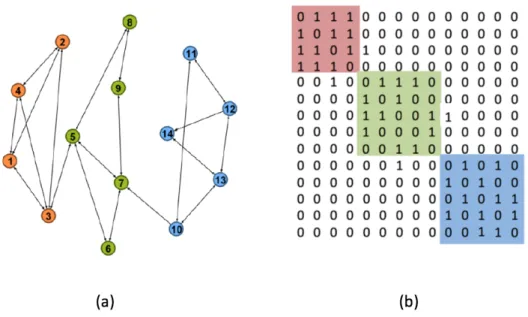
Figure 2.1 (a) A graph which consists of three communities. (b) Adjacency matrix which consists of three communities.
set of L links or edges between nodes; L =|E(G)|. The graph is considered to be undirected and unweighted. Each node has some connections to other nodes, and this number of connections is the degree dof the node. Let G be represented as an adjacency matrixA∈RN×N, whereAij = 1 if there is a link (edge) betweenvi and
vj wherei, j∈ {1,2, ..., N}, whileAij = 0 otherwise. The adjacency matrix contains all the important information about the graph. Each row and column is indexed by a node’s number, and each element indicates whether there is a link between a pair of nodes or not. All elements on the main diagonal in the adjacency matrix are zero as there are no connections between a node and itself. Figure 2.1a shows a graph that partitions into three communities in different colours and Figure 2.1b displays the corresponding adjacency matrix for the graph representation that partitions into three communities shown in three different colours.
The objective of community detection is to partition the graph, or equivalently, A into a set of K clusters or communities C = {C1, C2, . . . , CK}. We denote the number of nodes in clusterCk asnk=|Ck|.
Degree
As noted above the degree of node vi is the number of edges between node vi and other nodes: d(vi) = N ∑ j=1 Aij (2.1)
In addition to the degree of a node, we consider the degree of communities. The number of links within a particular community and between the community and other communities is important for the definition of communities. The degree of communityCk is defined as:
D(Ck) = ∑ i∈Ck N ∑ j=1 Aij (2.2)
We also define theexternal degree,
D(Ck) = ∑ i∈Ck ∑ j /∈C Aij (2.3)
and theinternal degree
D(Ck) = ∑ i∈Ck ∑ j∈Ck Aij (2.4)
which respectively count the number of links between nodes inCk to nodes not in
C and the number of links from nodes in Ck to other nodes also in Ck. Note that
D(Ck) is the twice the number of intra-connections inCk, as each edge is counted twice in the undirected graph. In a similar manner we define the external degree for anode vi in communityCk:
d(vi, Ck) =
∑
j /∈Ck
Likewise, theinternal degree of node vi ∈Ck is d(vi, Ck) = ∑ j∈Ck Aij. (2.6) Then d(vi) =d(vi, Ck) +d(vi, Ck) (2.7)
is the degree of node vi.
A nodevi in a communityCk is strong if
d(vi, Ck)> d(vi, Ck), (2.8)
And it is aweak if
d(vi, Ck)< d(vi, Ck), (2.9)
Strong and Weak Communities
A community Ck is termed strong [Radicchi et al.,2004] if
d(vi, Ck)> d(vi, Ck), ∀i∈Ck. (2.10)
That is, all nodes in a strong community make more connections to other nodes in the community than they do to nodes in other communities. A community is weak if there are more internal connections between nodes in the community than there are connections to external nodes:
∑ i∈Ck d(vi, Ck)> ∑ i∈Ck d(vi, Ck). (2.11)
The summation is used here to compare all the internal degree of nodes within the community with all the external degree of these nodes. These nodes could be either weak or strong while Equation2.10ensures that each node in communityCk should
be strong.
Clearly, a strong community is also a community in the weak sense, but a community is not necessarily either weak or strong.
Degree distribution is the distribution of node degrees in the network p(d). In real networks, these degrees are high for some nodes and low for others, and this distribution often follows power lawp(d)∝dαwhereαis a constant. This type of the network is called a scale-free network, in contrast to random networks where edges are put randomly between any pairs of nodes. Therefore, the degree distributions in random networks are homogeneous [Lancichinetti et al.,2008]. Many real-world networks are scale-free such as the Internet, World Wide Web and others [Broder et al., 2000]. Scale-free networks are inhomogeneous where many nodes have a few connections and a few nodes have large connections [Wang and Chen,2003].
Shortest path, or geodesic distance, is the minimum number of edges in any path between two given nodes in a graph. Dijkstra’s algorithm could be used to find the shortest paths in the graph [Cherkassky et al.,1996].
Average path lengthmeasures the average number of edges between all possible pairs of nodes in the network [Albert and Barab´asi,2002]. Suppose, we have a graph that consists ofN nodes and δ(i, j) is the distance betweenvi and vj. The average shortest path length is calculated as:
l= 1
N(N −1)
∑
i,j∈V
δ(vi, vj) (2.12)
Betweenness Centrality represents the number of times that a node is passed through on the shortest path between two other nodes [Freeman,1977;Wasserman and Pattison,1996;Brandes,2001;Faust,1997]:
BC(v) = ∑ i̸=j̸=v∈V
σi,j(v)
σi,j
where σi,j(v) represents the number of shortest paths between two nodes i and j that involved node v. σi,j is the number of possible shortest paths between two nodesiand j.
Closeness Centrality is defined as the reciprocal of the distance of a node to all other nodes in the network [Preparata et al.,2008]:
CC(v) = ∑N −1 i∈V δ(v, i)
, i̸=v (2.14)
Thus a node with a high closeness centrality is in some senses close to the centre of the network.
2.2 Community Structure Evaluation Scores
Community structure is an important feature in complex networks where this network is divided into groups of nodes that have dense connections within the group and sparsely with the others. These groups represent a fundamental concept for analysing and understanding the complex networks, because analysing at a group level is easier than at a node level. These structures are most often found in real networks, for example in social networks, communities may represent common inter-ests, or in biological networks, communities may refer to proteins that have similar functions [Scott, 2017; Lee and Lee, 2013; Newman, 2018]. The natural partition for a given network is based on connections between nodes. Each node is assigned to only one community, and nodes that have connections tend to be in the same community rather than nodes that are not connected. Finding community structure is a difficult issue as the number of communities and their size in real networks is unknown and the computational complexity of evaluating all possible partitions O(2N). Despite these difficulties, many algorithms have been proposed to unfold these communities as will be described later in sections 2.5, 2.6 and 2.7.
com-munity detections is evaluation scores: that is, what type of score is suitable to eval-uate community structures. We describe the most common score functions which have been used for quantifying how well a particular community structure fits a given network. The idea is that given a community structure, and the score func-tion, we can evaluate whether this structure is fitted to a given network or not. Some of the scores are minimised while the others are maximised. However, all of them are formulated with the same intuition that there are dense connections within communities, while communities are sparsely connected with the other communities in the network.
Many scores have been introduced for evaluating network partitions. We focus on the following scores:
Modularity: Modularity measures the strength of partitioning a network into com-munities [Newman and Girvan,2004]. Network partitions that have high values of modularity have dense connections within the community and sparse connections with the others. It is widely accepted as a score that has been used in optimisation methods for community detection in the networks. Modularity is defined as:
Q(C) = K ∑ k=1 . [ D(Ck) 2L − ( D(Ck) 2L )2] (2.15)
Q(Ck) may be shown to be the summed differences between the fraction of links within a community minus the expected fraction of links within the community if the graph were rearranged at random but preserving the degree distribution [Newman and Girvan, 2004]. The range values for modularity falls in the range of (-0.5, 1) where 1 point to accurate community structures [Brandes et al., 2008]. The modularity value is positive if the number of connections with the community is more than the number of expected from a random arrangement in which the degree distribution is preserved. It is negative when each node is in one community (or sometimes when the network is partitioned into very small communities) and 0 when all nodes are in one community.
Much existing literature uses Q for evaluating results. However, Fortunato and Barthelemy [2007] have shown that it may fail to identify clusters if their size is smaller than a scale which depends on the size of the network and the interconnec-tions between clusters. They concluded that the generated partition due to mod-ularity optimisation has a resolution limitation and optimising Q(C) may generate partitions which fail to identify small communities.
Community Fitness (CF): This score is proposed byLancichinetti et al.[2009]:
CF(C) = K ∑ k=1 D(Ck) (D(Ck) +D(Ck))α (2.16)
whereαis a positive value which controls the size of communities. Ifαis large then the network will be divided into small communities, while if it is small large commu-nities will predominate. Therefore, the external connections between commucommu-nities will be minimised when the CF gets a high value (whenα is small).
Normalised Cut (NC): This score minimises edge weights between clusters rela-tive to degrees of a cluster [Dhillon et al.,2004]. It aims to minimise the external degree of community with respect to the internal and external degree of this com-munity: N C(C) = K ∑ k=1 D(Ck) D(Ck) +D(Ck) . (2.17)
Network partitions that have a smallN C produce good communities, as these com-munities are well connected within themselves and sparsely with the other commu-nities in the network.
Kernel K-Mean (KKM): This objective is related to Kernel K-Means cluster-ing because KKM is a decreasing function and can generate a small number of communities [Angelini et al.,2007]. The KKM score is defined as:
KKM(C) = 2(N −K)− K ∑ k=1 D(Ck) |Ck| . (2.18)
The second term is maximised by maximising the average internal degree of the clusters; subtracting this term from the sufficient minuend (2(N −K)) to consider this objective as a minimisation objective and make the result of this score as a positive value. For example, if the partition C is divided into N communities that means each node in one community then the result is 0 due to the values of the first and second terms are 0. Otherwise, the result is positive. This score is used by Gong et al.[2014] for community detection.
Ratio Cut (RC): This score is an adaption of the Normalised Cut to solve the community detection problem. It is minimised when there are few edges between clusters relative to the size of the cluster [Gong et al.,2014;Dhillon et al.,2004]:
RC(C) = K ∑ k=1 D(Ck) |Ck| . (2.19)
By minimisingRC, partition with sparse connections between communities are pro-duced.
CONductance (CON): This score measures the fraction of edges that connect to the nodes out of community [Yang and Leskovec,2015]. It is defined as follows:
CON(C) = K ∑ k=1 D(Ck) D(Ck) +D(Ck) . (2.20)
Community Score (CS): The community score is an attempt to increase the weight of the degree of the internal nodes within community [Pizzuti,2008]. CS is calculated by the summation of the local score for each cluster:
CS(C) = K ∑ k=1 1 |Ck| ∑ v∈Ck ( d(v, Ck) |Ck| )r ×D(Ck) (2.21)
Where r controls the size of communities, as an attempt to increase the weight of the degree of the internal nodes within the community.
degree of the community [Yang and Leskovec,2015]. ID(C) = K ∑ k=1 1− D(Ck) |Ck|(|Ck | −1) (2.22)
Thus maximising ID(C) yields communities with strongly connected nodes within each community.
Although many objective functions have been proposed, there is little literature evaluating the quality of community detection scores. In 2015, Yang and Leskovec proposed an exciting method to evaluate quality scores based on the ground-truth partition [Yang and Leskovec,2015]. However, this method has not presented how well correlated the optimising score on the generated partitions and evaluating mea-sure between generated and correct partitions is. Hafez et al. investigated the performance of different objectives for community detection using single and multi-objective evolutionary algorithms [Hafez et al.,2014]. They used a single objective to optimise each of the existing objectives separately, and the authors used MOEA to optimise each pair of these objectives.
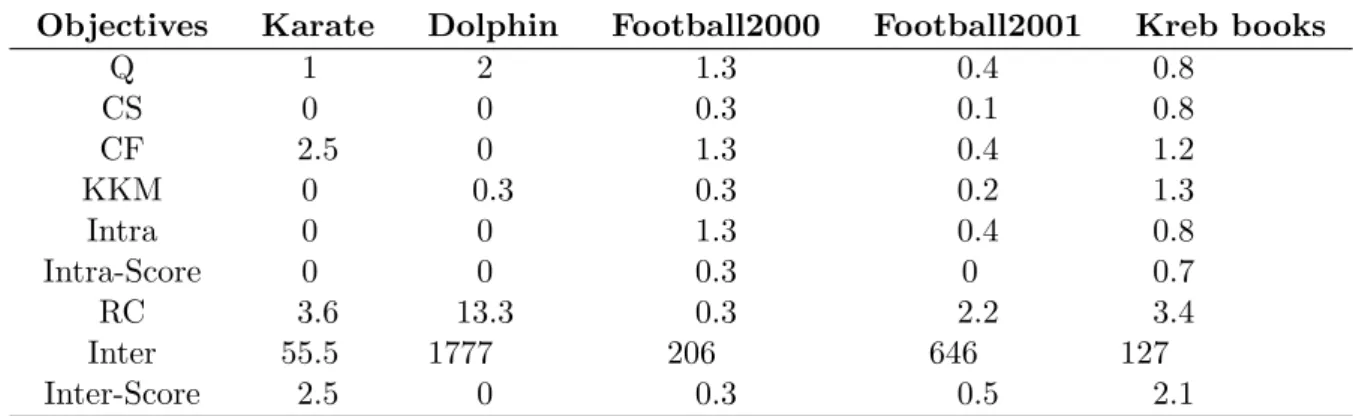
In general, all objectives have the same aim: either the objective is to increase the number of connections within the community (intra-connections) or decrease the number of connections with the rest (inter-connections). Later in chapter 3, we investigate the accuracy of these scores in assessing the difference between a partition and the true partition in terms of the Normalised Mutual Information [Danon et al., 2005].
2.3 Multi-Objective Optimisation Problems
In this thesis, we attempt to generate a set of network partitions with dense intra-connection and sparse inter-intra-connection by optimising two conflicting objectives si-multaneously. Therefore, we now describe the basic ideas of multi-objective op-timisation. An Optimisation algorithm attempts to find the best solution among
many feasible solutions under the specific constraints. Some real-world problems require more than one objective function to be optimised simultaneously. This pro-cess is called Multi-Objective Optimisation (MOO) which produces a set of trade-off optimal solutions, called Pareto-optimal solutions [Coello et al.,2007].
Consider the following Multi-Objective Optimisation Problem (MOP) which seeks to simultaneously minimisem objectives:
Minimise F(C) = (f1(C), f2(C), ...fm(C)) (2.23)
where C ∈ Ω is a solution and Ω denotes the space of feasible solutions. If the objectives are competing, then at the optimum any improvement in one objective must diminish the performance on at least one other. This idea is made precise through the notion of dominance. Given two solutions C1 and C2,C1 is said to dominate C2 (denoted asC1≺ C2) iff
∀i fi(C1)⩽fi(C2) ∧ ∃i fi(C1)< fi(C2). (2.24)
If neither solution dominates the other they are said to be mutually non-dominating. A solutionC∗ ∈Ω is a Pareto-optimal solution to the minimisation problem (2.23) if it is not dominated by any other feasible solution. The set of all Pareto optimal solu-tions is named thePareto Set(PS) and the image of the Pareto set underF is known as the Pareto front. For these solutions, an improvement in one objective makes a degradation on at least another one. The goal of practical search algorithms is to produce a set of mutually non-dominating solutions that approximate the Pareto set. We use this method of optimisation to capture the community structures and evolution of communities in chapters 3 and 4.
In the last two decades,Genetic Algorithms have played a useful and vital role in op-timising multiple objectives to solve real-world problems in different domains [Konak et al.,2006]. A Genetic Algorithm (GA) is an optimisation and search method which
is proposed by Holland [1975] to generate solutions based on biologically-inspired operators (selection, crossover and mutation). It evolves a population of chromo-somes where each chromosome has a fitness value which is the result of computing the objective function to evaluate each chromosome separately. The fitness func-tion has a vital role to develop the genetic algorithm, for more details about GA background see [B¨ack et al.,1997;Goldberg and Holland,1988; Boyd and Vanden-berghe,2004;Konak et al.,2006;Corne and Lones,2018]. GA has been developed to optimise more than one objective. In this case, multi-objectives are optimised by an evolutionary algorithm to find a set of feasible solutions called Pareto optimal set [Coello et al.,2007;Zhou et al.,2011].
2.4 Multi-Objective Evolutionary Algorithms
In last few decades, evolutionary algorithms (EAs) have been successfully used for optimization problems involving more than one conflicting objective, as these algo-rithms are capable to produce a set of solutions in a single run. This set of solutions are an approximation to the Pareto-optimal set, as described above. In 1985, the first real multi-objective genetic was proposed by Schaffer [1985]. This approach involves generating subpopulations at each generation. The number of subpopu-lations are equal to the number of objectives. Each sub-population is responsible for searching one objective. Since 1985, different evolutionary algorithms have been proposed for multiobjective optimisation using evolutionary algorithms (MOEAs). For example, [Fonseca et al., 1993; Srinivas and Deb, 1994; Fonseca and Fleming, 1996;Zitzler,1999;Zitzler and K¨unzli,2004;Zhou et al.,2011]
Multiobjective evolutionary algorithms can be classified into three groups:
Dominance-based algorithms: These are the most popular multi-objective evo-lutionary algorithms that have been proposed by many researchers. In 1999,Zitzler and Thiele[1999] proposed the Strength Pareto Evolutionary Algorithm (SPEA) for
approximating the Pareto-optimal set for multi-objective optimization problems. It combined different features from the previous multi-objective EAs in one algorithm. For example, it stores a non-dominant evaluated set of solutions in an external pop-ulation, assigns scalar fitness values to individuals based on the Pareto dominance concept and if the size of the Pareto set is larger than a predefined limit, then the Pareto set is reduced without destroying its characteristics by using clustering methods.
In 2000, Knowles and Corne proposed the Archived Evolution Strategy (PAES) that uses the dominance concept to evaluate solutions [Knowles and Corne,2000]. It is used a single-parent single-offspring EA similar to a (1+1) evolution method. They used binary strings and bitwise mutations to create offsprings. This algorithm compares the offspring with respect to the parent. If the parent is dominated by the offspring, the offspring is the next parent while if the offspring is dominated by the parent, the offspring is rejected and it finds a new one. On the other hand, if neither dominates the other, both the parent and the offspring are compared with an archive of best solutions found so far.
The Nondominated Sorting Genetic Algorithm II (NSGA-II) [Deb et al., 2002] is a commonly used MOEA. It is an elitist algorithm in which the approximation to the Pareto set (the maximal set of non-dominated solutions) is kept from generation to generation. A crowding distance strategy is used to limit the size of the Pareto set and help improve the spread of solutions across the Pareto front. The crowd-ing distance strategy is used to perform density estimation of solutions surroundcrowd-ing a specific solution in the population and create a Pareto rank for each individual. Nondomination individual rank and crowding distance are needed to create a pop-ulation of individuals. In addition, there are other algorithms based on dominance concepts such as the Niched Pareto Genetic Algorithm (NPGA) [Abido, 2003] and Multi-objective Differential Evolution (MODE)[Varadarajan and Swarup,2008].
al-gorithms is the approximation of the Pareto optimal set. Indicator based approaches use a scalar indicator such as hypervolume and generational distance to measure the quality of the Pareto front [von L¨ucken et al.,2014]. These algorithms used the indicator to direct the search. Zitzler and K¨unzli[2004] proposed the first indicator-based an evolutionary algorithm (IBEA). In this algorithm, a pair of solutions are compared using a binary indicator and it does not need any diversity preservation mechanism. In 2005, Emmerich et al. [2005] proposed S-metric selection-EMOA (SMS-EMOA) which is based on the hypervolume measure to combine the concept of a selection operator and non-dominated sorting. It is similar to NSGA-II except in selection and there is a different ranking method used for the Pareto optimal solutions. This algorithm is designed to maximise hypervolume which is the size of dominated space [Hopfe, 2009]. However, the complexity of computing the hy-pervolume indicator in high dimensions is expensive. This algorithm showed good results for two or three objective problems. In order to deal with this problemBader and Zitzler [2011] proposed the approximation of exact hypervolume values using a Monte Carlo algorithm and they presented this idea as Hypervolume Estimation Algorithm for Multi-objective Optimization (Hype).
Decomposition based algorithms: Another promising multi-objective evolution-ary algorithm for optimising multi objectives by using the scalar functions are de-composition algorithms [Jaszkiewicz,2004;Hughes,2007;Li and Zhang,2006;Zhang and Li,2007]. Two difficulties associated with solving multi-objective problems need to be determined: 1- The number of solutions to approximate the Pareto front in-creases exponentially [Ishibuchi et al.,2008]. 2- The ability of search will deteriorate. The advantage of these algorithms is computational efficiency for calculating the scalarisation function. One of the most popular decomposition methods is MultiOb-jective Evolutionary Algorithm based on Decomposition (MOEA/D which has been developed byZhang and Li [2007]. A lot of literature demonstrated that MOEA/D has a high ability of search on different test problems and it has a low computation of complexity [Chang et al.,2008;Ishibuchi et al.,2009,2010;Konstantinidis et al.,
2010; Li and Zhang, 2009; Peng et al., 2009; Zhang et al., 2010]. The main idea behind MOEA/D is to decompose the multiobjective optimisation problem into a number of scalar optimisation subproblems rather than solving a MOP as a whole. There are three approaches which have been used by Zhang and Li [2007] for the decomposition process. The simplest one is the weighted sum aggregation method. This method works well when the Pareto Front (PFs) is concave, but that disad-vantage is the nonconcave Pareto front can not be handled. The second one is the Boundary Intersection method which is used with nonconcave PFs. The last one and most popularly used is the Tchebycheff approach. This approach can be used with fronts that contain concave and convex regions. We have therefore used this method for the work presented here and the algorithm is described in more detail in Chapter 3.
In this thesis, we will use MOEA/D to optimise two conflicting objectives simultane-ously to produce a set of candidate solutions in evolutionary optimisation method; this will be discussed in chapters 3 and 4.
2.5 Survey of Network Community Detection.
In this section, we survey the existing methods for community detection in a given network. These methods attempt to divide G into small groups of nodes based on their relations. If the number of edges within these groups is large and between these groups are small, then a good partition could be generated.
In recent years, many efficient techniques have been proposed to unfold communities structure in the complex networks [Gong et al.,2014;Shi et al.,2012;Pizzuti,2012; Wu and Pan, 2015; Zhao et al., 2018]. At the heart of all these methods lies the definition of a score function to evaluate the quality of a candidate partition. Many authors also propose methods to generate “good” candidate partitions.
Hierarchical methods
Hierarchical methods are traditional methods that have been used to reveal the struc-ture of communities. In real-world, many graph strucstruc-tures have been represented as dendrograms where each dendrogram displays a multilevel structure. Each level reflects the grouping of nodes with small groups inside large groups, which are in turn within larger groups, etc. There are two types of strategies for constructing hierarchical structures: agglomerative and divisive hierarchical algorithms. Agglom-erative algorithms (bottom-up) start with every single node forming one cluster as the initial partition. After that, in each iteration, the most similar pair of clusters are merged and so on until all clusters are merged into one cluster [Jain et al.,1999]. Divisive algorithms (top-down) reverse the agglomerative algorithms: it considers all vertices as one big cluster initially. Recursively a division is implemented as each iteration moves down a level by removing edges. There are two advantages of the hierarchical methods:1) There is no need to specify in advance the number or size of the clusters in the network. 2) It can find a large number of network partitions. On the other hand, the disadvantage of this method that it can not correct a mistake made in early iterations. A similarity between clusters measure is required for each generation in both algorithms.
In 2002, Girvan and Newman used a divisive clustering method to detect commu-nity structure in biological networks [Girvan and Newman,2002]. This process was performed by calculating the edge betweenness; the edge with the highest edge be-tweenness is removed, and bebe-tweenness recomputed. The computational complexity of this method is O(N3) due to the cost of computing betweenness for all edges which makes this algorithm impractical for large networks.
In 2004, Newman and Girvan improved this method by maximising the modularity [Newman and Girvan,2004]. Divisive clustering was again used to iteratively remove edges with high edge betweenness to divide the network into communities, and the authors chose the partition which maximised the modularity. However, the time
complexity O(L2N) restricts this procedure from treating large networks. In the same year, Newman also proposed an agglomerative clustering algorithm to greedily maximise modularity without computing edge betweenness [Clauset et al., 2004]. While this algorithm has the advantage that the number of communities does not have to be pre-specified, the greedy nature of the search means that sub-optimal partitions may be located.
Evolutionary Algorithms
Many real-world problems have been solved using multi-objective evolutionary algo-rithms (MOEAs). The network can be clustered into communities and this clustering process can be formulated as an optimisation problem. Recently, a group of scien-tists have been working on community detection using evolutionary algorithms. In 2008 Pizzuti used a Genetic Algorithm (GA) for community detection, potentially avoiding some of the problems associated with the greedy search which can become stuck in local minima [Pizzuti,2008]. Pizzuti used a Single-Objective Evolutionary Algorithm (SOEA) to optimise the community score (Equation2.21). However, the disadvantage of using single objective is that it may be biased on community parti-tion which is obtained through optimisaparti-tion process [Shi et al.,2014]. In this case, the network partition is generated with the fixed property. Recognising that many alternative definitions of community quality are possible, Pizzuti developed her work by using the multi-objective evolutionary optimisation to approximate the optimal trade-off between more than one measure of community quality[Pizzuti,2012]. She proposed MOGA-Net which employed NSGA-II for community detection in net-works. The author formulated community detection as a two-objective optimisation problem. The first objective is Community Score (CS) (Equation2.21) and the sec-ond one is Community Fitness (CF) (Equation2.16), proposed byPizzuti[2008] and Lancichinetti et al. [2009] respectively. TheCS objective maximised by partitions with many connections within the same community (intra-connections), while the CF objective is optimised by partitions with few inter-connections.
Solutions to the multi-objective problem are partitions which are globally non-dominated: that is, no other feasible partition has a wholly betterCF(C) andCS(C). Thus this set of solutions – known as the Pareto set – represents the optimal trade-off between partitions optimising CS and CF and generally presents a variety of dif-ferent possible community structures. The results showed that MOGA-Net reflects a good performance to produce accurate community structures compared with the state-of-art methods at that time. Therefore, many researchers were encouraged to develop MOEA for community detection as a set of near-optimal solutions (different community structures) will be generated rather than one solution that is generated using SOEA.
In the same year, Shi et al. also formulated community detection as a multi-objective minimisation problem [Shi et al., 2012]. They divided modularity (Equation 4.2) into two terms as these terms describe conflicting properties of the structures of the communities, measuring the degree of intra-connection and the degree of inter-connections. They, therefore, define two objectives to be minimised as follows. The first measures the intra-connections:
Intra(C) = 1− K ∑ k=1 D(Ck) 2L , (2.25)
The maximum value for D(Ck)
2L is 1 when all nodes in one community. The maximum value for D(Ck)
2L is 1 when all nodes in one community (D is double of L). The authors subtracted the first term of modularity from 1 to formulate this problem as a minimisation optimization problem and 1 is sufficient to make the result of this score as a positive value or zero. The second objective measures the degree of inter-connections: Inter(C) = K ∑ k=1 [ D(Ck) 2L ]2 (2.26)
Shi et al. showed that the simultaneous optimisation of these two objectives can yield a wide range of possible community structures, placing more or less weight on intra and inter-community connections. Since the modularity is the sum of these
two objectives, it is clear that the partition that maximises the modularity must be a member of the Pareto set.
In 2014, Gong et al. introduced a Discrete Particle Swarm Optimization algorithm to unfold the structure of communities in the networks [Gong et al., 2014]. In this method minimisation of the first objective is Kernel K-Means (Equation 2.18) which maximises the average internal degree of the clusters: The second objective is the Ratio Cut (Equation 2.19) which is minimised when there are few edges between clusters relative to the size of the cluster. Like the other multi-objective optimisation algorithms, simultaneous optimisation of the Ratio Cut and Kernel K-Means objective results in a set of solutions trading off partitions with a high degree of intra-community connectedness with partitions possessing few inter-connections.
Recently, Cheng et al. developed a multi-objective evolutionary algorithm, termed LMOEA to solve the community detection problem [Cheng et al., 2018]. Two conflicting objectives are optimised in this algorithm: Negative Ratio Association (NRA) and Ratio Cut (RC) (Equation 2.19), respectively. The NRA is defined as:
N RA(C) =−1× K ∑ k=1 D(Ck) |Ck| . (2.27)
Mininmising the NRA promotes partitions with communities that have a high pro-portion of internal connections. This objective is conflict to theRCwhich minimises the connections between communities.
Empirical results indicated that this algorithm can detect the community structures with high quality.
In chapter 3, we will introduce a new two conflicting objectives are optimised simul-taneously using an MOEA/D to unfold more accurate community structures and we will propose a new heuristic strategy as a mutation operator to speed up the converge our algorithm.
![Figure 1.1 (a) A graph is partitioned into three communities. (b) The synthetic network consisting of four communities [Lancichinetti et al., 2008]](https://thumb-us.123doks.com/thumbv2/123dok_us/9894929.2483076/21.892.156.744.99.398/figure-partitioned-communities-synthetic-network-consisting-communities-lancichinetti.webp)
![Figure 2.2 Possible structures for communities in dynamic networks [Palla et al., 2007].](https://thumb-us.123doks.com/thumbv2/123dok_us/9894929.2483076/56.892.162.736.101.516/figure-possible-structures-for-communities-dynamic-networks-palla.webp)