Downturn Loss Given Default: mixture distribution
estimation
Raffaella Calabresea
a Essex Business School
University of Essex Wivenhoe Park Colchester CO4 3SQ
Abstract
The internal estimates of Loss Given Default (LGD) must reflect eco-nomic downturn conditions, thus estimating the “downturn LGD”, as the
new Basel Capital Accord Basel II establishes. We suggest a methodology to estimate the downturn LGD distribution to overcome the arbitrariness
of the methods suggested by Basel II. We assume that LGD is a mixture of an expansion and recession distribution. In this work, we propose an
accurate parametric model for LGD and we estimate its parameters by the EM algorithm. Finally, we apply the proposed model to empirical data on
Italian bank loans.
Keywords: Downturn LGD; Mixture model; EM algorithm; Mixed random variable
∗
Corresponding author. Tel.: +44 (0) 1206 874569; Fax: +44 (0) 1206 873429. Email address: [email protected](Raffaella Calabrese)
1. Introduction
Loss Given Default (LGD) is the loss incurred by a financial institution when an obligor defaults on a loan, given as the fraction of Exposure At
Default (EAD) unpaid after some period of time. In the Basel II framework (Basel Committee on Banking Supervision (BCBS), 2004, paragraph
286-317), banks adopting the advanced Internal Rating Based (IRB) approach are allowed to use their own estimates of LGDs that have to reflect economic
downturn conditions. Hence, the “downturn LGD” is the maximum of the long-run default-weighted average LGD and the stressed LGD.
It requires the banks to identify the appropriate downturn conditions and incorporate them so as to produce LGD parameters for the bank’s exposures,
which are consistent with the identified downturn conditions. The main reason for this requirement is that the Vasicek model (Vasicek, 2002) used in
Basel II does not have systematic correlation between Probability of Default (PD) and LGD and, to compensate for this deficiency, downturn LGD are required to be used as input to the model.
Although the downturn LGD is a key variable for banking practice, such a pivotal topic is relatively unexplored in the literature. The main aim
of this paper is to propose a methodology to estimate the downturn LGD distribution. To achieve this aim, we consider the dynamic behaviour of
LGD over the economic cycle characterized by two regimes: expansion and recession.
We assume that the LGD is a mixture of an expansion and a recession dis-tributions, each of these distributions is given by the mixture of a Bernoulli
random variable and a beta random variable, as Calabrese (2012) suggested. On the one hand, the Bernoulli random variable allows to reproduce the high
concentration of data at total recovery and total loss (Calabrese and Zenga, 2010; Renault and Scaillet, 2004; Schuermann, 2003). On the other hand,
the beta distribution is well suited1 to the modelling of LGDs (Bruche and Gonz´alez-Aguado, 2008; Gupton et al., 1997; Gupton and Stein, 2002). To
estimate the parameters of the downturn LGD distribution, we apply the EM algorithm (Dempster et al., 1977). To obtain a finite beta density function,
Calabrese and Zenga (2010)’s parametrization is used. With this method banks do not need to identify arbitrarily downturn conditions and, unlike
the factor method, data on the default risk and default correlation are not required. Finally, we apply this proposal to a comprehensive Bank of Italy
data set (Bank of Italy, 2001) of 149,378 Italian bank loans and we compare it with some methods used in the literature to estimate the downturn LGD.
The present paper is organized as follows. The next section analyses the available literature on downturn LGD. Section 3 describes some approaches
to estimate downturn LGD. The following section presents the proposed approach to estimate the downturn LGD distribution. Section 5 describes
the dataset of the Bank of Italy and shows the estimation results by applying the proposed model to these data. Finally, the last section is devoted to
conclusions.
2. Literature review
An extensive literature suggested a link between LGD and the economic cycle (e.g. Bellotti and Crook, 2012; Calabrese, 2012). The systematic
1
Since LGD lies in the interval [0,1], the beta distribution is a suitable parametric model for LGDs since it has support [0,1] and, in spite of requiring only two parameters, is quite flexible.
correlation between PD and LGD is not taken into account in many mod-els. In the standard rating-based credit risk model developed by Gupton
et al. (1997), it is assumed that recoveries on defaulted exposures are ran-dom outcomes, independent of the default event. A similar independence
assumption is made in the model of Jarrow et al. (1997) and in the Vasicek model (Vasicek, 2002) used in the Basel II Accord. However, if realizations
of recoveries are low exactly at times when many firms default, the assump-tion that recoveries are independent of default rates or constant would
re-sult in an underestimation of credit risk. To compensate for this deficiency, downturn LGD estimates are required to be used as an input to the model.
In the Basel II Accord (BCBS, 2005c), two approaches are presented to estimate downturn LGD. One approach would be to apply a mapping
function similar to that used for the PDs that would extrapolate downturn LGDs from bank-reported average LGDs. Alternatively, banks could be
asked to provide downturn LGD figures based on their internal assessments LGDs during adverse conditions. Provided that data is available, the latter
approach is the easiest to implement, so Basel III (BCBS, 2011 paragraph 20) considers only this method to compute downturn LGD.
The drawback is that LGD data is generally sparse and there is very limited industry experience with regard to LGD estimates. Downturn LGD estimation based on historical data is currently not possible for many banks
because of the short time periods available or for the lack of an economic downturn during the available period. The first approach of Basel II is an
appropriate solution when historical data is not available.
Following the first approach of Basel II, Miu and Ozdemir (2006) suggest
that the original LGD assessment by banks, without considering PD and LGD correlation, can be appropriately adjusted by incorporating a certain
degree of conservatism in cyclical LGD estimates within a point-in-time modelling framework. They use Monte Carlo to tabulate the relationship
between long-run and downturn LGD. Barco (2007) extends their work to develop an analytical relationship between long-run and downturn LGD.
Moreover, Sabato and Schmid (2008) suggest a simple mapping function to estimate downturn LGD. They investigate the relationship between LGD
and the credit cycle over the period from 2002 to 2007 using data covering a set of retail loans. The linear mapping function proposed by the Board
of Governors of the Federal Reserve System (2006) can be considered as a particular case of Sabato and Schmid’s proposal, as explained in Section 3.
Both the approaches presented by Basel II show the pivotal drawback of how economic downturn or mapping function of average LGD should be
defined and identified. This arbitrariness leads to very different approaches being implemented across banks and countries, and significant effects on the
level of capital requirements. As many authors have shown (e.g., Saurina and Trucharte, 2004; Altman and Sabato, 2005), Basel II Advanced-IRB capital
requirements are highly sensible to LGD values in particular for retail asset classes. Hence, there is the necessity of suggesting a method to estimate
downturn LGD to overcome the arbitrariness of the approaches suggested by Basel II.
3. Downturn LGD estimation models
Following the first approach of Basel II (BCBS, 2005c), Sabato and
Schmid (2006) suggest the following linear mapping function to estimate downturn LGD on unsecured positions
whereµLGD is the long-term average2 LGD, DLGD is the expected Down-turn LGD and LGDSF is the LGD Stressing Factor given by
LGDSF = stressed LGD−LGD
LGD . (2)
Sabato and Schmid (2006) suggest to compute the stressed LGD as a
func-tion (not specified) of the stressed PD, given by the average PD plus the standard deviation of the observed default rates. The mapping function
(1) implies that debts with relatively low historical LGD rates (e.g. se-nior bank loans) should have relatively large adjustments to their long-term
average LGD rates, while debts with high historical LGD rates (e.g. subordi-nated bonds) should have relatively small adjustments. In other words, the
difference between downturn LGD and the long-term average LGD varies inversely with the long-term average LGD.
In recognition that banks may be unable to estimate the LGD stressing factor, the Board of Governors of the Federal Reserve System (2006)
pro-poses the following particular case of the equation (1) withLGDSF = 0.08
DLGD=.08 +.92µLGD. (3)
whereµLGD equals the long-term average LGD and DLGD is the expected Downturn LGD. It is worth noting that the magnitudes of the proposed
adjustments to LGD are relatively modest, with a maximum adjustment of only eight percentage points. The Federal Reserve has offered no justification
for the linear mapping function (3) except perhaps its intuitive appeal that debts with the lowest historical average LGD rates receive the largest upward
downturn LGD adjustments.
2
µLGD is known aslong-run default-weighted average loss rate given default in Basel II (BCBS, 2005).
The methodology suggested by Miu and Ozdemir (2006) and then gen-eralized by Barco (2007) also belongs to the first approach of Basel II. To
analyse Barco’s model, we start with the well-known Merton framework where the log return of the obligori’s asset value is given by
Ai =ρP Di Xm+ q
1−(ρP Di )2X
is
whereρP Di is known as correlation of asset returns. The independent stan-dard normal random variables Xm and Xis are the systematic factor and
obligor-specific idiosyncratic factor, respectively. Barco (2007) models the value of the asset of the creditor with a lognormal distribution. This is
achieved by first establishing the following relationship for the standardised asset return
Ri =ρRi Xm+ q
1−(ρRi )2Y
m
whereYm is an independent standard normal random variable representing the residual systematic asset return not explained by Xm. The parameter
ρRi correlates the assets of the obligor to the systemic factorXm. Assuming obligor exposure is one unit with mean default rate denoted byµP Di , its loss
random variable is defined by
Li = 1{Ai<Φ−1(µP Di )}L R i
where 1{}(·) is the indicator function and Φ−1(·) is the quantile function of the standard normal distribution.
Assuming a fully granular portfolio, Li is contained in a homogeneous portfolio and continue to suppose that its exposure is equal to one unit, so Barco (2007) defines L∞= lim N→∞ 1 N N X i=1 Li.
In a model with two systematic factors, from Proposition 3 in Gordy (2003) and the strong law of large numbers Barco (2007) obtains
qα(L∞) =qα " lim N→∞ 1 N N X i=1 Li # =qα[E(Li|Xm, Ym)]
whereqα is theα quantile.
An important result obtained by Barco (2007) is the analytical expres-sion of the downturn LGD
DLGD= qα[E(Li|Xm, Ym)] Φ Φ−1(µP D i )+ρP Di Φ−1(α) √ 1−(ρP D i )2 (4)
where Φ(·) is the cumulative distribution function of a standard normal distribution.
The main drawback of the first approach of Basel II is that the mapping function between long-run and downturn LGD can change from model to
model. This difference can have a significant effect on capital requirements. For example, Barco (2007), Miu and Ozedemir (2006) using the normal
distribution underestimate tail contributions.
4. A new modelling approach for downturn LGD
We consider a dynamic behaviour of LGD over the economic cycle char-acterized by two distributions of LGDs held over expansion and recession
periods. By considering two regimes of the economic cycle, expansion and recession, LGDs are drawn from a mixture of an expansion (E) and a
reces-sion (R) distributions
where FLGD/S(y) is the cumulative distribution function of the LGD over a given period conditional on the state S (S =E, R) of the economic cycle
andπis the probability of the expansion regime (Filardo, 1994). We assume that the parameter π is fixed over a given period of time.
In order to fit the model (5) to LGDs data, we first specify the cu-mulative distribution functions FLGD/E(·) and FLGD/R(·), which later we
estimate jointly with the parameter π. Since the incidence of LGDs equal to 0 or 1 is high (Calabrese and Zenga, 2010; Renault and Scaillet, 2004;
Schuermann, 2003), to supply accurate estimations for the extreme values, Calabrese (2012) proposes to consider LGD as a mixed random variable,
ob-tained as the mixture of a Bernoulli random variable and the beta random variable B. This means that the distribution function of LGD FLGD/S(·)
conditional on the stateS of the economic cycle is defined as
FLGD/S(y) = ps0 y = 0 ps0+ [1−ps0−p1s]FB/S(y) y ∈(0,1) 1 y = 1 (6)
whereFB/S(·) denotes the distribution function of the beta random variable
Bconditional on the stateSof the economic cycle andpsj =P{LGD=j/S}
is the conditional probability that the LGD is equal tojwithj= 0,1 given
the stateS of the economic cycle.
Consistently with the hypothesis that LGD is a mixed random variable,
we define the cumulative distribution estimator of LGD as
ˆ FLGD(y;π,θ,σ) = n0 n y = 0 n0 n + 1−n0 n − n1 n ˆ FM(y;π,θ,σ) y ∈(0,1) 1 y = 1. (7)
wheren0 =]{LGDi = 0} and n1 =]{LGDi = 1} indicate the frequency of the LGDs equal to 0 and 1, respectively, and n is the number of LGDs in
the portfolio.
The cumulative distribution estimator of the mixture M of two beta
random variables is given by
ˆ FM(y;π,θ,σ) = 1 n−n0−n1 Z y 0 n−n0−n1 X i=1 [πfe(lgdi;θe, σe)+(1−π)fr(lgdi;θr, σr)]d lgdi (8) whereπ is the probability of the expansion regime. Moreover,fs(lgd;θs, σs)
is the probability density function of the beta random variable Bs (with
s=r, e) of parameters θs σs + 1 and 1−θs σs + 1 fs(lgd;θs, σs) = Γσ1 s + 2 lgdθsσs(1−lgd) 1−θs σs Γθs σs + 1 Γ1−θs σs + 1 , (9)
where θs is the mode of the s-th beta density function and σs > 0 is the dispersion parameter. The parametrization of the beta density function
fs(lgd;θs, σs) is applied by Calabrese and Zenga (2010) in the nonparametric estimation. The main advantage of this parametrization is that every beta
density function of the mixtureM is finite for all values ofθs and σs since the beta parameters θs
σs + 1 and
1−θs
σs + 1 are higher than one.
The beta random variable Bs of parameters σθss + 1 and 1−σsθs + 1 has an expected value E(Bs) = θs+σs 2σs+ 1 and variance V(Bs) = σs(θs−θs2+σs+σ2s) (1 + 2σs)2(1 + 3σs) (10)
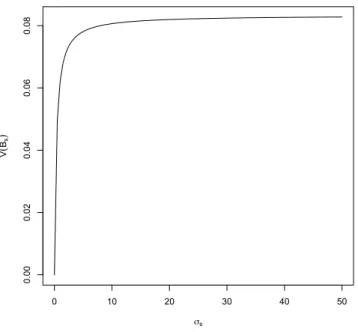
forS =r, e. To understand the influence of the parameter σs, in Figure 1 we plot the varianceV(Bs) as a function of σs by fixing θs. From this plot
we can deduce that the variance of Bs increases by increasing σs and with constantθs. An interesting result is that the limit of the variance V(Bs), as
σs tends to infinity, is 0.08, the variance of a uniform random variable with support the unit interval [0,1]. This outcome is due to the convergence of
the beta density function (9) to a uniform density function as σs diverges to infinity.
Figure 1 around here
When σs goes to zero, we can apply Maclaurin series to equation (10)
ob-taining
V(Bs) =σsθs(1−θs) +O(σ2s),
this means that by fixingθj the variance V(Bs) tends to zero asσs tends to
zero too, as Figure 1 shows. From this approximation we can also deduce that by fixingσs near to zero, the variance V(Bs) becomes a parabola with
maximum inθs= 0.5.
In this paper we propose a method to estimate the unknown parameters
in the mixture of two beta density functions. We use the Expectation-Maximization (EM) algorithm (Dempster et al., 1977) to estimate the
pa-rameters π and θ,σ in equation (8). For notation simplicity, we consider the parameter vectorπ = [π,1−π]0, so we aim at estimating the parameters
vector (π,θ,σ).
In the mixture framework, the observed datalgd= (lgd1, lgd2, ..., lgdn−n0−n1)
whose elements are assumed to be independent and are defined as
zis =
1 iflgdi comes from the states 0 otherwise.
Under the assumption that LGDi are independent and identically dis-tributed random variables with cumulative distribution function (5), the
complete-data log-likelihood function is
lc(π,p0,p1,θ,σ) = lnπ n−n0−n1 X i=1 zie+ ln(1−π) n−n0−n1 X i=1 zir (11) + n−n0−n1 X i=1 X S=e,r zislnfLGD/S(lgdi;θs, σs).
The EM algorithm (Dempster et al., 1977; McLachlan and Krishnan, 1997) maximizes the log-likelihood function (11). Each iteration of the EM
algorithm includes the “E-step”, which computes the conditional expecta-tion of the complete-data log-likelihood (11) given the observed data lgd,
and the “M-step”, which obtains the maximum of the complete-data log-likelihood function (11).
To compute the initial value π(0), analogously to Ji et al. (2005) we assign the smallest 50% oflgdi belonging to the interval (0,1) to the
expan-sion component, and the highest 50% of lgdi to the recession component. Maximizing (11), we obtain the initial values (π(0),θ(0),σ(0)).
Afterwards, the algorithm3 follows the sequence:
(1) On the (k+ 1)-th iteration, the E-step requires the calculation of the
conditional expectation of the complete-data log-likelihood (11). Since Zis non-observed data,zis(k)is replaced by the conditional expectation
of Zis given the observed data lgd and we consider the parameter estimates (π(k),θ(k),σ(k)) from thek-th iteration of the M-step
zis(k+1) = EZis lgdi,π (k),θ(k),σ(k) = PZis= 1 lgdi,π (k),θ(k),σ(k) = πs(k)fs lgdi;θ(sk), σs(k) X s=e,r πs(k)fs lgdi;θ(sk), σs(k) withi= 1,2, ..., n−n0−n1 and S =r, e.
(2) On the (k+ 1)-th iteration, the M-step requires the maximization of the complete-data log-likelihood function (11) with respect toπ,θ,σ
replacingzis by zis(k+1). Firstly, the elements of the updated estimates θ(k+1) are obtained as b π(sk+1)= n−n0−n1 X i=1 zis(k+1) n−n0−n1 , withS=r, e.
To estimateθ(k+1) and σ(k+1), we compute the score functions for θ
and σ (see Appendix). The updated estimates θ(k+1) and σ(k+1) are the solution of the following system
∂lc(π,θ,σ) ∂θ =0 ∂lc(π,θ,σ) ∂σ =0
Since the updated estimates θ(k+1) and σ(k+1) do not have a closed-form, they are obtained by using a nonlinear optimization algorithm.
The E-step and the M-step are alternatively repeated until the difference between two consecutive values of the complete-data log-likelihood (11) is
negligible.
5. Empirical evidence
5.1. Data set
A comprehensive survey on the loan recovery process of Italian banks
was conducted in the years 2000-2001 by the Bank of Italy. Its purpose was to gather information on the main characteristics of the Italian recovery process.
The survey is divided into three main sections. The first focuses on orga-nizational aspects, the second regards credit recovery procedures and the
last concerns analytical data on individual debts. About 250 banks were surveyed by means of a questionnaire. The database is composed of 149,378
defaulted borrowers and, since they covered nearly 90% of total domestic loans, this is the most recent and the most important survey on the Italian
recovery process.
It is important to specify that data refer to individual loans which are
pri-vately held, and not listed on the market. In particular, loans are towards Italian resident debtors non-performing on the 31/12/1998 and entirely
writ-ten off within the end of 1999.
The definition of default chosen in the survey is narrower than the one
pro-posed by the BCBS (2004, paragraph 452). The difference is the inclusion of transitory non-performing debts. Finally, the Bank of Italy established the
discount rates for each quarter from 1975 to 1999 by relying on the interest rates on short-term loans.
We highlight that to constrain LGD within the interval [0,1], we apply the expression proposed by Calabrese and Zenga (2010)
LGD= LOSS
T E =
LOSS EAD+I+L.
whereLOSS is the loss amount and TE denotes the Total Exposure, given
by the sum of the Exposure At Default (EAD), the legal costs (L) and the interest on delayed payment (I).
Table 1 around here
Table 1 reports the main characteristics of the Bank of Italy’s data. Our
re-sults are consistent with the values suggested by the Basel II Accord (BCBS, 2004 paragraph 287-8) under the foundation IRB approach: LGD is fixed
at 45% for all senior unsecured debts and at 75% for all subordinated ex-posures. Moreover, Schuermann (2003) obtain similar values for positions
with different seniority levels and instrument types. For the dispersion, the coefficient of variation (55.17% of the average LGD) is similar to the results
obtained by Schuermann (2003) (53.63% of the average recovery rate) and by Renault and Scaillet (2004) (60.31% of the average recovery rate) on
cor-porate bonds.
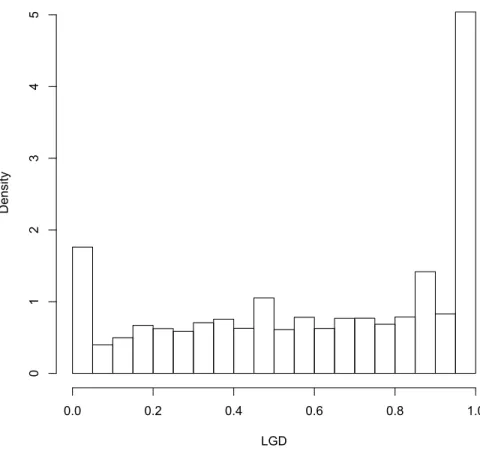
Figure 2 around here
Figure 2 shows the LGD distribution. Firstly, the mode of the LGD distri-bution is the extreme value 1, with 23% of the observations. Besides, LGD
a bimodal LGD distribution for different countries, for example, Araten et al. (2004) and Asarnow and Edwards (1995) for the US, Hurt and
Felso-valyi (1998) for Latin America, Franks et al. (2004) for France, Grunert and Weber for Germany (2005) and Dermine and Neto de Carvalho (2006)
for Portugal. For instance, in Friedman and Sandow’s (2003) study about 10% and 20% of the observations showed recovery rates respectively equal
to zero and one.
5.2. Estimation results and comparative analysis Table 2 around here
In order to estimate the downturn LGD, we apply the methodology proposed in this work and the four methods analysed in Section 2 and 3 to the Bank of
Italy’s database. The results4 are reported in Table 2. Even if the database concerns loans, our proposal is also applicable to bonds.
The main advantage of the methodology here proposed is that it allows
to estimate the downturn LGD distribution, shown in Figure 3, without the arbitrary definition of an economic downturn period or a mapping function
of long-run LGD. Moreover, the high concentration of data at total recov-ery and total loss (Calabrese and Zenga, 2010; Renault and Scaillet, 2004;
Schuermann, 2003) can be replicated by the model suggested in this work.
Figure 3 around here
The approach proposed in this paper is compared with the four models analysed in Section 2 and 3. For the model suggested by Sabato and Schmid
4
(2008) (SS model) we need to estimate the LGD stressing factor defined in equation (2). Following the authors’ suggestion, the LGD stressing factor is
given by the sum of the mean (µP D = 0.0063) and the standard deviation (σP D = 0.0055) of the default rates. These results are obtained from data
of the International Monetary Fund by assigning to each loan the annual default rate evaluated at the time of default. Furthermore, for both the SS
model and the one proposed by the Federal Reserve System (FED model), we consider the average LGD (0.6154) from Table 1.
For the factor model suggested by Barco (2007) we consider α= 0.999. We specify that from equation (4) we should estimateµP Di andρP Di for each
loan. Since these data are not available in the Bank of Italy’s survey, we assign to each loan the annual PD evaluated at default time and supplied
by the International Monetary Fund. This means that we assign the same PD to loans defaulted the same year. Moreover, we compute the correlation
coefficientρP D of the assigned PDs and, for lack of data, it is assumed con-stant for all observations. Finally, compliant to Basel II adverse conditions
are identified as a negative GDP growth rate, occurred only in 1993. This means that in the second approach of Basel II (AC model) the downturn
LGD is given by the mean of 12,992 LGDs defaulted in 1993.
Furthermore, we apply the methodology suggested in this paper and the obtained estimates are reported in Table 2. If we focus our attention only
on the recession distribution, this represents the downturn LGD distribution and it is shown in Figure 3. We compute the average of this distribution
and we report it in Table 3. The downturn LGDs computed by the methods outlined in Section 2 and 3 are also reported in Table 3.
To understand how we should interpret the results in Table 3, we un-derline that for a bank the underestimation of the downturn LGD is more
risky than the overestimation. The first important result of this comparison is that the approach suggested by Basel II and III of using estimates
dur-ing adverse conditions strongly underestimates the downturn LGD. We can deduce it because the estimate of the downturn LGD 0.6370 is very close to
the long-run default-weighted average loss rate µLGD = 0.6154. This result could be due to the long-term influence of the GDP growth rate on LGDs,
coherent with Calabrese (2012) and Bellotti and Crook (2009). In this way, we would show the arbitrariness of identifying adverse conditions.
Even using a mapping function, as SS and FED models do, the estimate of downturn LGD are 8.08% and 5.60% lower, respectively, than the estimate
obtained by our proposal. The FED model shows the clear drawback of using a mapping function with fixed parameters. Even if these parameters
are estimated in the SS model, we obtain a downturn LGD lower than that of the FED model. We presume that this result could be due to the lack of
an accurate method to estimate the LGD stressing factor LGDSF defined in equation (2). This means that also this method is subject to arbitrariness.
Finally, Barco’s model supplies a downturn LGD a bit lower than that of our proposal. This means that Barco’s model overcomes the drawback of
the underestimation of downturn LGD but it needs some information (i.e.
µP Di and ρP Di ) for each loan that are often not available. We highlight that we do not need this information or any kind of additional information to
apply our model.
From this empirical analysis we can conclude that, on the one hand, the
model proposed in this paper overcomes the drawback of arbitrariness of some methods used in the literature. On the other hand, it is an accurate
model that allows to represent the high concentration of data at total loss. In this way it overcomes the drawback of the underestimation of the downturn
LGD, without using any additional information on borrowers.
Different types of portfolios (e.g. for bonds by Renault and Scaillet
(2004) and Schuerman (2003)) and different geographic areas (e.g. Araten et al. (2004) for US, Grunert and Weber for Germany (2005)) show a high
concentration of data at total loss, we could expect also for these datasets that our proposal outperforms the methods used in the literature. In
con-clusion, our proposal could supply accurate estimate of the downturn LGD for different types of portfolios with different geographic locations.
Table 2 around here
6. Concluding remarks
This paper aims at proposing an accurate method to estimate the down-turn LGD distribution to compensate for the fact that the Vasicek regulatory
capital model does not incorporate systematic LGD. To represent the dy-namic behaviour of LGD over the economic cycle, this paper proposes that
the LGD distribution is given by a mixture of an expansion and a recession distributions. To represent the high concentration of data at total loss and
total recovery, we suggest an accurate parametric model for each state of the economic cycle and a method to estimate their parameters.
The main advantages of this proposal are that banks do not need to identify arbitrarily downturn conditions and additional information on the
default risk for each borrower. Finally, we apply our proposal to a com-prehensive dataset of Italian bank loans. The main result of this empirical
analysis is that our model can replicate the high concentration of data at total loss, unlike the other analysed models, so it overcomes the drawback
that banks can use based on their internal data to estimate downturn LGD for different portfolios.
References
Abramowitz M., Stegun I. A., 1972. Handbook of Mathematical Functions with Formulas, Graphs, and Mathematical Tables. Dover, New York.
Altman E. I., Sabato G., 2005. Effects of the new Basel Capital Accord on bank capital requirements for SMEs, Journal of Financial Services
Research, 28, 15-42.
Altman E. I., Resti A., Sironi, A., 2005. Loss given default: A review of the literature. In: Altman E. I., Resti A., Sironi A. (Eds.), The Next
Challenge in Credit Risk Management. Riskbooks: London.
Araten M., Jacobs Jr. M., Varshney P., 2004. Measuring LGD on commercial loans: An 18-year internal study. Journal of Risk Management Association
4, 96-103.
Asarnow E., Edwards D., 1995. Measuring loss on default bank loans: A 24-year study. Journal of Commercial Lending 77, 11-23.
Bank of Italy, 2001. Principali risultati della rilevazione sull’attivit ˜A di
recupero dei crediti. Bollettino di Vigilanza 12, December.
Barco M., 2007. Going downturn. Risk Australia, Spring, 39-44.
Basel Committee on Banking Supervision, 2004. International convergence
of capital measurement and capital standards: A revised framework. Bank for International Settlements: Basel, June.
Basel Committee on Banking Supervision, 2005. Guidance on paragraph 468 of the framework document. Bank for International Settlements: Basel,
July.
Basel Committee on Banking Supervision, 2005b. Working Paper No. 14 Studies on the Validation of Internal Rating Systems. Bank for
Interna-tional Settlements: Basel, September.
Basel Committee on Banking Supervision, 2005c. An Explanatory Note on the Basel II IRB Risk Weight Functions. Bank for International
Settle-ments: Basel, September.
Basel Committee on Banking Supervision, 2011. Basel III: A global
regula-tory framework for more resilient banks and banking systems. Bank for International Settlements: Basel, June.
Bellotti T., Crook J. (2009) Loss Given Default models for UK retail credit
cards. Credit Research Centre, working paper.
Board of Governors of the Federal Reserve Bank, 2006. Basel II Capital Accord-Notice of Proposed Rulemaking. Federak Reserve Bank,
Septem-ber.
Bruche M., Gonz´alez-Aguado C., 2008. Recovery rates, default probabilities and the credit cycle. Working paper, CEMFI.
Calabrese R., Zenga M., 2010. Bank loan recovery rates: Measuring and
nonparametric density estimation. Journal of Banking and Finance 34(5), 903-911.
continuous-discrete model. Applied Stochastic Models in Business and Industry. To appear
Chalupka R. and Kopecsni K. (2009) Modelling Bank Loan LGD of
Corpo-rate and SME Segments: A Case Study. Czech journal of Economics and Finance, 59(4), 360-382.
Committee on the Global Financial System, 2005. The role of ratings in
structured finance: Issues and implications. Bank for International Set-tlements: Basel.
Dempster A.P., Laird N.M., Rubin D.B., 1977. Maximum likelihood from incomplete data via the EM algorithm (with discussion). Journal of the
Royal Statistical Society B 39(1), 1-38.
Dermine J., Neto de Carvalho C., 2006. Bank loan losses-given-default: A case study. Journal of Banking and Finance 30, 1219-1243
Filardo A. S., 1994. Business-cycles phases and their transitional dynamics.
Journal of Business and Economic Statistics 12 (3), 299-308.
Franks J., de Servigny A. and Davydenko, S. (2004) A comparative analysis of the recovery process and recovery rates for private companies in the
U.K., France and Germany, Standard & Poors Risk Solutions Report, 1-93.
Friedman C., Sandow S., 2003. Ultimate recoveries. Risk 16, 69-73.
Gaspar R. M., Slinko I., 2005. Correlation Between Intensity and Recovery
in Credit Risk Models. Working Paper Series in Economics and Finance 614, Stockholm School of Economics.
Gordy M. B., 2003. A risk-factor model foundation for ratings-based bank capital rules, Journal of Financial Intermediation, 12(3), 199-232.
Grunert J., Weber M., 2009. Recovery rate of commercial lending: Empirical
evidence for German companies. Journal of Banking and Finance 33, 505-513.
Gupton G. M., Finger C. C., Bhatia M., 1997. CreditMetrics. Technical
document, J. P. Morgan.
Gupton G. M., Stein R. M., 2002. LosscalcT M: Model for predicting Loss Given Default (LGD). Moody’s Investors Service.
Hurt L., Felsovalyi A., 1998. Measuring loss on Latin American defaulted bank loans, a 27-year study of 27 countries. The Journal of Lending &
Credit Risk Management. (October), 41-46.
Jarrow R., Lando D., Turnbull S., 1997. A Markov model for the term structure of credit risk spreads. Review of Financial Studies, 481-523.
Ji Y., Wu C., Liu P., Wang S., Coombes K.R., 2005. Applications of
beta-mixture models in bioinformatics. Bioinformatics, 21(9), 2118-2122.
McLachlan G., Krishnan T., 2007. The EM algorithm and extensions. John Wiley & Sons, New York.
Miu P., Ozdemir B., 2006. Basel requirements of downturn LGD: modeling
and estimating probability of default and loss given default correlations. Journal of Credit Risk 2(2), 43-68.
free estimation of recovery rate densities. Journal of Banking and Finance 28, 2915-2931.
Sabato G., Schmid M., 2008. Estimating conservative loss given default. Swiss Institute of Banking and Finance, University of St. Gallen working
paper.
Saurina J., Trucharte C., 2007. An Assessment of Basel II Procyclicality in Mortgage Portfolios. Journal of Financial Services Research, 32, 81-101.
Schuermann T., 2003. What do we know about loss given default? Recovery risk. Working paper, Federal Reserve Bank of New York.
Vasicek, O., 2002. Loan portfolio value. Risk (December), 160-162.
7. Appendix
In this appendix, we obtain the score functions forθandσ. The notation
used here is defined in Section 4. The derivatives of the complete-data log-likelihood function (11) with respect toθ and σ are
∂lc(π,p0,p1,θ,σ) ∂θ = n X i=1 X S=e,r z(isk+1)∂lngs(lgdi;θs, σs) ∂θ ∂lc(π,θ,σ) ∂σ = n X i=1 X S=e,r zis(k+1)∂lngs(lgdi;θs, σs) ∂σ . To compute the score functions, we consider the following results
∂lngs(lgdi;θs, σs) ∂θs = 1 θs ψ 1−θs σs + 1 −ψ θs σs + 1 + ln lgdi 1−lgdi and ∂lngs(lgdi;θs, σs) ∂σs = 1 σ2 s θsψ θs σs + 1 + (1−θs)ψ 1−θs σs + 1 + −ψ 1 σs + 2 −ln (lgdi) θs (1−lgdi)1−θs
where ψ(·) is called digamma function (Abramowitz and Stegun, 1972, p. 380)ψ(z) = ∂logΓ(z)
∂z = ∂Γ(z)
Loss Total Exposure LGD Mean 0.1319 0.2275 0.6154 Median 0.0067 0.0133 0.6667 Standard deviation 4.4815 14.0504 0.3395 Minimum 0 ' 0 0 Maximum 1212.3954 5135.7263 1 I quartile 0.0020 0.0045 0.3333 II quartile 0.0067 0.0133 0.6667 III quartile 0.0233 0.0429 0.9545
Table 1: Some characteristics of the Bank of Italy’s data set. The amounts “Loss” and “Total Exposure” are expressed in Thousands of Euros.
ˆ
π pˆ0 pˆ1 θˆ ˆσ
Expansion 0.7337 0.0571 0.1687 0.3925 0.5968
Recession 0.2663 0.0207 0.0612 0.9171 0.1014
Mixture model Barco’s model FED model SS model AC model
Downturn LGD 0.7823 0.7673 0.7385 0.7191 0.6370
Table 3: Average downturn LGD
0 10 20 30 40 50 0.00 0.02 0.04 0.06 0.08 σs V ( Bs )
Figure 1: The varianceV(BS) of the beta random variableBs as a function of the
LGD D en si ty 0.0 0.2 0.4 0.6 0.8 1.0 0 1 2 3 4 5
0.0 0.2 0.4 0.6 0.8 1.0 0 1 2 3 4 5 Downturn LGD D en si ty Pro ba bi lit y 0 0.2 0.4 0.6 0.8 1 0 0.251 0.749 1
Figure 3: Estimate of downturn LGD distribution from the Bank of Italy data set. The upper part of the plot is the estimate of the extreme values 0 and 1 (the discrete compo-nent). The lower part of the plot is the estimate of the values belonging to the interval (0,1) (the continuous component).