i
FACULTY OF HUMANITIES AND SOCIAL SCIENCES
BUSINESS SCHOOL
IMPLICATIONS OF IFRS 8 ADOPTION ON UK LISTED
COMPANIES’ DISCLOSURE PRACTICES AND
EARNINGS’ PREDICTIVE ABILITY
Ibrahim Ali Saleh Al-Aamri
A Thesis Submitted to the University of Newcastle in
Fulfilment of the Requirements for the Award of the
Degree of Doctor of Philosophy
ii
Table of Contents
List of Tables ... v Acknowledgment ... vii Abstract ... ix Chapter 1- Introduction ... 1 1.1: Introduction ... 2 1.2: Study Objectives ... 51.3: Justification of the Study, Research Questions and Research Contribution ... 6
Chapter 2- Segment Reporting Background ... 8
2.1- Segment Reporting Under U.S. Generally Accepted Accounting Principles (GAAP) ... 9
2.2- Segment Reporting Under International Accounting Standards ... 10
2.3- Comparing IFRS 8 with IAS 14R ... 13
2.4- Comparing IFRS 8 with SFAS-131 ... 15
2.5- Segment Reporting Under UK Reporting Regulations ... 15
2.6- Conclusion... 19
Chapter 3- The Rationale for Segment Reporting ... 21
3.1- Introduction (Importance of Accounting Disclosure) ... 22
3.2-The Proposition of Fineness Theorem ... 23
3.3-The Issue of Segment Identification ... 24
3.4- Importance of Segment Information to the Users of Financial Reports ... 29
3.5-Conclusion... 34
Chapter 4- Literature Review ... 35
4.1- Introduction ... 36
4.2- Factors Influencing Accounting Disclosure ... 37
4.2.1- Firm External-Environment Factors ... 37
4.2.2- Firm-Specific Factors ... 38
4.3- Factors Influencing Segmental Disclosure ... 42
4.4- Possible Costs Associated with extensive Segmental Disclosure ... 46
4.5- Implications of the Management Approach on Segment Reporting ... 50
4.6- Advantages of Segmental Disclosure ... 56
4.6.1- Predictive gains to segment information ... 57
4.6.2- Market reaction to segment information ... 63
4.7- The Application of FERC in Financial Disclosure Studies ... 68
4.8- Conclusion... 73
Chapter 5- Data and Research Methodology ... 74
iii
5.2- Study Hypotheses and Models ... 78
5.2.1- Comparability and Consistency ... 79
5.2.2- Accuracy of Financial Analysts’ Earnings Forecast ... 81
5.2.3-Impact of the Quality of Segmental Profit Disclosure on Capital Market ... 83
5.3-Future Earning Response Coefficient (FERC) Methodology: ... 84
5.4- Conclusion: ... 87
Chapter 6- Analysis of the Extent of Segmental Disclosure Pre and Post IFRS 8 ... 89
6.1-IFRS 8 compared to IAS 14R for FTSE 100 and FTSE 250 ... 90
6.2-Analysis of Disclosure According to Sectors ... 98
6.3Conclusion ... 106
Chapter 7- Segmental Information and Analysts’ Earnings Forecast Accuracy ... 108
7.1: Descriptive Statistics and Correlations ... 109
7.2: Analysts’ Forecast Accuracy and Segmental Disclosure ... 118
7.2.1: The Dataset and Variables’ Measurement ... 119
7.2.2: Variables Measurement and Specification ... 121
7.2.3: Non-Segmental Factors Affecting Forecast Accuracy ... 130
7.2.4: A note on the Forecast Error Metric... 140
7.3: Experimental Design and Results ... 142
7.3.1: Experimental Design ... 143
7.3.2: Linear Additive Analysis ... 145
7.3.3: Multiplicative Analysis of Segment Variables ... 159
7.3.4: Fixed Effect Regression Results ... 172
7.3.5: Sensitivity Analysis and Robustness Tests ... 173
Chapter 8- Segment Profit Disclosure and Market’s Ability to Predict Future Earnings. ... 177
8.1: Descriptive Statistics and Correlations ... 178
8.2: Segmental Profit disclosure and Share Price Anticipation of Earnings ... 186
8.2.1: The Dataset and Variables’ Measurement ... 187
8.2.2: Variables Measurement and Specification ... 189
8.2.3: Control Variables Affection Association between Stock Return and Earnings Change ... 194
8.2.4: The Underlying Assumption of FERC Model. ... 197
8.3: Experimental Design and Results ... 200
8.3.1: Experimental Design ... 201
8.3.2: Basic Stock Price Informativeness Model ... 204
8.3.3: Multiplicative Analysis of Segment Variables’ Impact on Stock Price Predictability of Future Earnings ... 207
8.3.4: SUMMARY ... 220
iv
9.1: Introduction ... 221
9.2 Overview of the Study ... 221
9.3: Research Objectives and Research Methods ... 222
9.4: Main Findings and Conclusions ... 224
9.4.1: Implication of IFRS 8 ... 224
9.4.2: Relationship between Analysts’ Forecast and Segment Information ... 226
9.4.3: Segment Information and Stock Return Anticipation of Future Earnings ... 229
9.5: Limitations, Further Research, and Policy Implications ... 233
9.5.1: The Form of Analysis ... 233
9.5.2: The Choice of Earnings Forecast... 233
9.5.3: Measurement Error ... 234
9.5.4: Source of Segment Information and Segments Definitions ... 234
9.5.6: Segments’ Line Items ... 235
9.5.7: Large Forecast Error ... 235
9.5.8: Summary ... 235
Appendix ... 239
v
List of Tables
Table 2.1: Main Changes in Segment Disclosure Post-IFRS 8 ... 15
Table 2.2: Summary of Major Changes in Segment Reporting Regulations (IFRS, USA, and UK) ... 18
Table 5.1: Frequency of Companies by Sector... 77
Table 5.2: Listing Status of Sample Companies... 77
Table 6. 1: Distribution of Sample Companies by Listing and Sectors ... 90
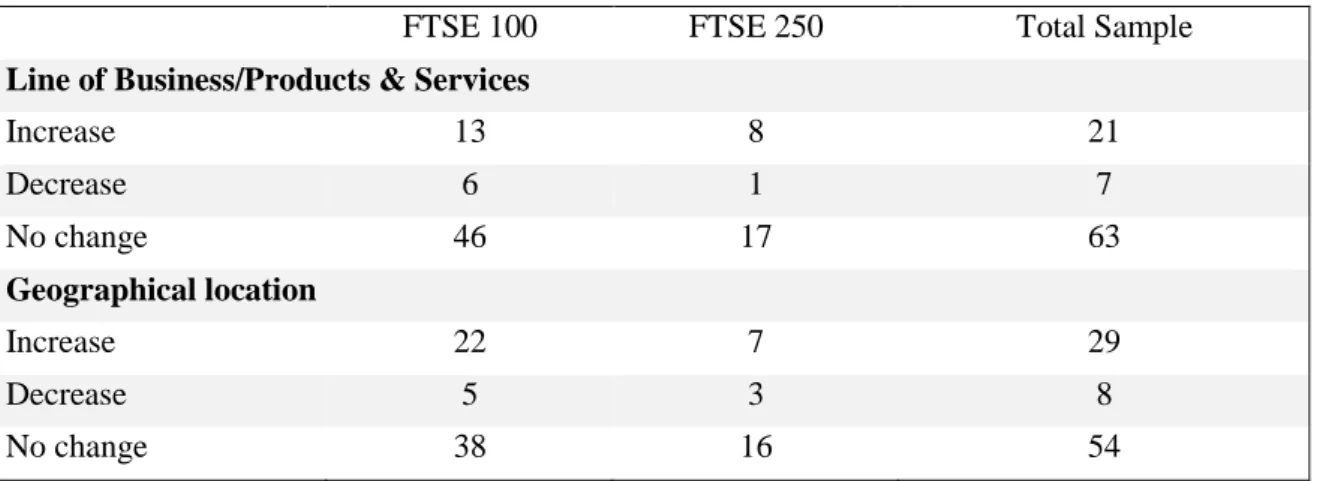
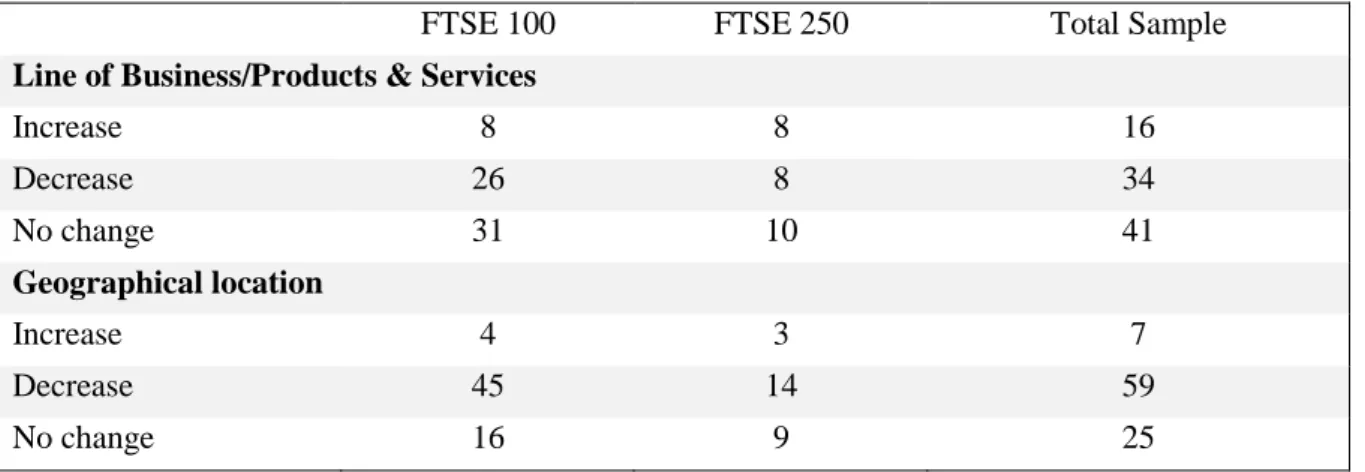
Table 6. 2: Mean number of line of business and geographical segments pre and post IFRS 8 by listing ... 92
Table 6. 3: Number of companies reported a change in the number of segments... 92
Table 6. 4: Mean number of line items of business and geographical segments pre and post IFRS 8 by listing ... 94
Table 6. 5: Number of companies reported a change in the number of line items ... 94
Table 6. 6: Number of companies early adopted IFRS 8 and Identified CODM by listing ... 96
Table 6. 7: Number of companies reported LOB and GEO profits and reported reconciled profit pre and post IFRS 8 ... 97
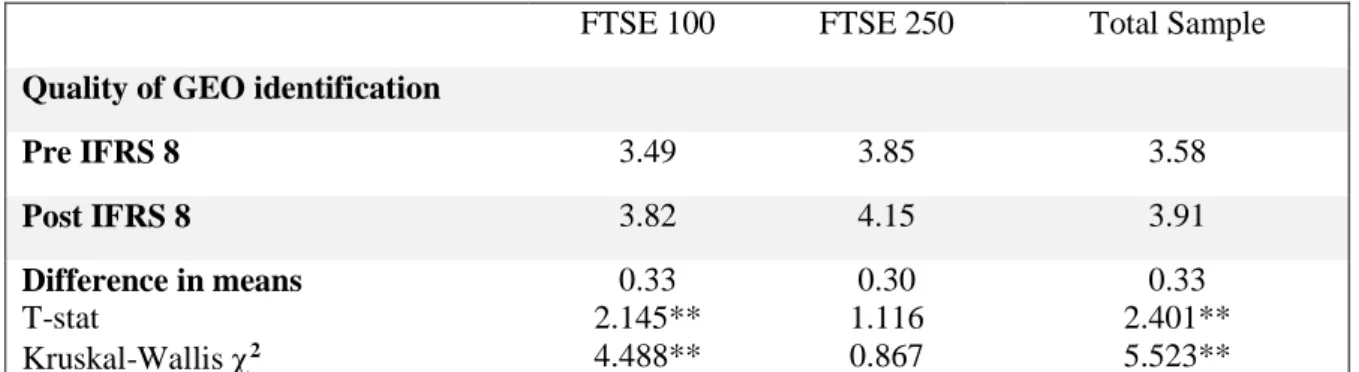
Table 6. 8: Mean Quality of geographical segments pre and post IFRS 8 by listing ... 98
Table 6. 9: Number of companies reported a change in the number of segments by sector .... 99
Table 6. 10: Mean number of line of business and geographical segments pre and post IFRS 8 by sector ... 100
Table 6. 11: Number of companies reported a change in the number of line items by sector 102 Table 6. 12: Mean number of line items of business and geographical segments pre and post IFRS 8 by sector ... 102
Table 6. 13: No. of companies early adopt IFRS 8, Identified CODM, reported LOB & GEO profits and report reconciled profit ... 104
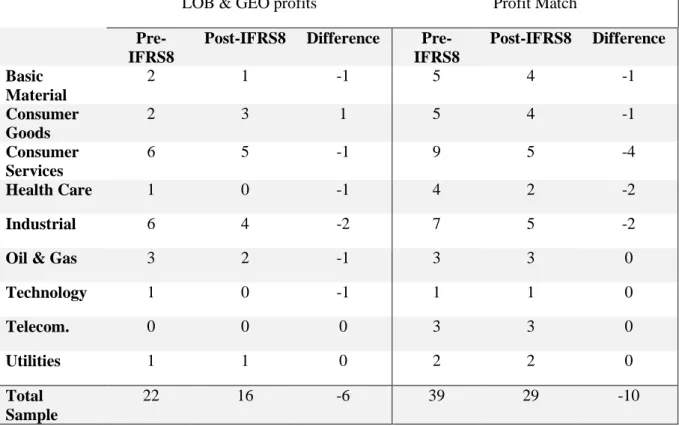
Table 6. 14: No. of companies reported LOB & GEO profits and reported reconciled profit pre and post IFRS 8 by sector ... 105
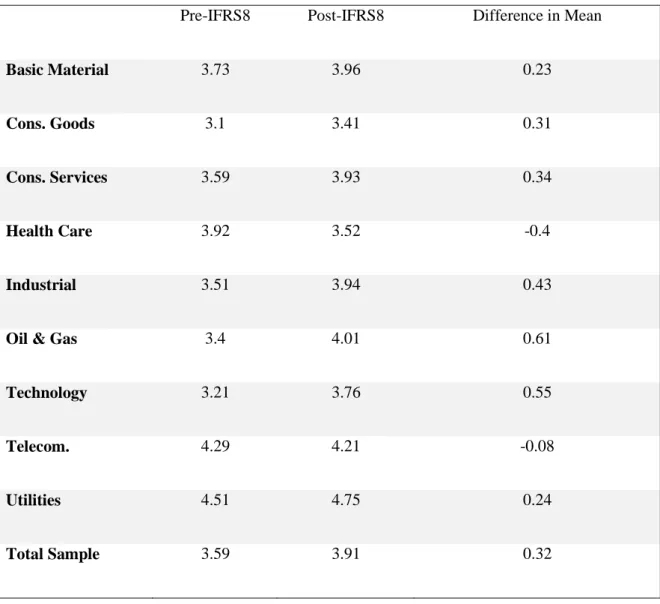
Table 6. 15: Mean quality of geographical segment pre and post IFRS 8 by sector ... 106
Table 7. 1: Descriptive Statistics Whole Sample Period Analyst Forecast Model (IAS 14R & IFRS 8) ... 110
Table 7. 2: Descriptive Statistics Analyst Forecast Model (IAS 14R only) ... 111
Table 7. 3: Descriptive Statistics Analyst Forecast Model (IFRS 8 only) ... 112
Table 7. 4: Frequencies Statistics Four Years Analyst Forecast Model ... 114
Table 7. 5: Frequencies Statistics Four Years Analyst Forecast Model (IAS 14R vs. IFRS 8) ... 114
Table 7. 6: Correlation for IFRS 8 & IAS 14R Analyst Forecast Model ... 115
Table 7. 7: Correlation for IAS 14R Analyst Forecast Model... 116
Table 7. 8: Correlation for IFRS 8 Analyst Forecast Model ... 117
Table 7. 9: Geographical Segment Scoring ... 124
Table 7. 10: STAND & QGEO Linear Additive Analysis (Four Years VS. Two Years Regression) ... 147
vi
Table 7. 11: STAND & QGEO Linear Additive Analysis (Four Years VS. Two Years
Regression) No Single GEO Segments ... 149
Table 7. 12: All Segment’s variables Linear Additive Analysis (Four Years VS. Two Years) ... 152
Table 7. 13: All Segment’s variables Linear Additive Analysis (Four Years VS. Two Years) No Single GEO Segments ... 153
Table 7. 14: Linear Additive Analysis, Comparing STAND and QGEO vs. All Segment Variables over Four Years Period ... 155
Table 7. 15: Linear Additive Analysis, Comparing STAND and QGEO vs. All Segment Variables over Two Years Period ... 156
Table 7. 16: Linear Additive Analysis, Comparing STAND and QGEO vs. All Segment Excluding Single GEO Segment ... 157
Table 7. 17: Regression Nine, Multiplicative Analysis of the Impact of STAND & QGEO on Forecast Accuracy (Two Years) ... 163
Table 7. 18: Regression Ten, Multiplicative Analysis of the Impact of STAND & QGEO on Forecast Accuracy (Four Years) ... 164
Table 7. 19: Regression Eleven, Multiplicative Analysis of the Impact of STAND & QGEO on Forecast Accuracy (Two Years & No Single GEO Segment) ... 165
Table 7. 20: Regression Twelve Multiplicative Analysis of the Impact of STAND & QGEO on Forecast Accuracy (Two Years & No Single GEO Segment) ... 166
Table 7. 21: Regression Thirteen Multiplicative Analysis of the Impact of Different Segment’s Variables on Forecast Accuracy (Two Years) ... 169
Table 7. 22: Regression Fourteen Multiplicative Analysis of the Impact of Different Segment’s Variables on Forecast Accuracy (Four Years) ... 170
Table 7.23: Regression Fifteen Multiplicative Analysis of the Impact of Different Segment’s Variables on Forecast Accuracy (Four Years & excluding single segments) ... 171
Table 8. 1: Table 8. 1: Market Reaction Analysis’s Descriptive Statistics for Whole Sample Period (IAS14 & IFRS 8)... 179
Table 8. 2: Market Reaction Analysis’s Descriptive Statistics for IFRS 8 Period only ... 180
Table 8. 3: Market Reaction Analysis’s Descriptive Statistics for IAS 14R Period only... 181
Table 8. 4: Means Difference of Segment Profit Variables (Market Reaction Model) ... 182
Table 8. 5: Market Reaction Analysis Correlation for Full Dataset ... 183
Table 8. 6: Market Reaction Analysis Correlation for pre-IFRS 8 ... 184
Table 8. 7: Market Reaction Analysis Correlation for post-IFRS 8 ... 185
Table 8.8: Basic Stock Price Informativeness Model ... 206
Table 8. 9: The Impact of MAMRG on Stock Return Ability to Reflect Future Earnings.... 210
Table 8.10: The Impact of BOTHPROF on Stock Return Ability to Reflect Future Earnings ... 213
Table 8. 11: The Impact of PROFMTCH on Stock Return Ability to Reflect Future Earnings ... 216
Table 8. 12: Combined Impact of MAINMRG, BOTHPROF, and PROFMTCH on Stock Return Ability to Reflect Future Earnings ... 219
vii
Acknowledgment
First and foremost, praise to Allah Almighty for his blessings and guidance in giving me the strength, courage, patience and perseverance to endure this long and
challenging study journey.
I am so grateful for the wise council and supervision of my ‘super’ supervisor, Professor Simon Hussain. I have been fortunate, privileged and honoured to know and work under the supervision of such an academic who is responsible for two major and important positions within the Newcastle University Business School namely, the Head of Accounting & Finance subject group and Degree Programme Director - MA in International Financial Analysis and MSc in Strategic Planning & Investment. Simply, I could not wish for a better supervisor. Many thanks Simon for your invaluable guidance, inspirational support and encouragement, as well as your patience in respect of my shortcomings. I am also thankful to my second supervisor, Dr. Chen Su for his useful suggestions, insightful comments and constructive feedback.
I owe a substantial debt of gratitude and thanks to my father, Ali Saleh Al-Aamri and my mother, Shikhah Ahmed Al-Aamri who have given me exceptional love, constant care, emotional support and encouragement throughout my life, and continues to do so. I am deeply grateful to you, and can never repay a fraction of what you have done for me. My special thanks must go to my brothers and sisters, for their invaluable support, care and prayers. All of you have offered untiring support and I truly cannot thank you enough.
I would also like to express my gratitude to my fellow PhD students who have helped me and given me constructive comments during this journey.
ix
Abstract
International Financial Reporting Standard No. 8 (IFRS 8) was issued by the
International Accounting Standards Board (IASB) in November 2006 and became effective for periods beginning on or after January 2009. IFRS 8 is issued as a part of the IASB convergence program with the USA Financial Accounting Standard Board (FASB). IFRS 8 provides guidelines on how segment information should be reported to external users. It requires segment information to be reported in accordance with the management approach. In particular, operating segments are to be identified in the same way they are reported to Chief Operating Decision Makers (CODM). It is worth noting that IFRS 8 replaced International Accounting Standard No. 14 Revised (IAS 14R). IAS 14R requires reportable segments to be identified in accordance with the (risk and reward) approach.
There are three main objectives to this study: (i) to evaluate and compare the
disclosure of segment information pre and post the implementation of IFRS 8 for UK listed companies; (ii) to investigate the impact of the management approach on analysts’ earnings forecast accuracy; and (iii) to investigate the impact of the quality of segments’ profit information on stock market ability to anticipate future changes in earnings. For the purpose of achieving these research objectives a positivist theoretical framework is implemented. The three objectives of this study are investigated using two methods; descriptive statistics and mean difference tests; and regression analysis using Ordinary Least Square (OLS), Fixed Effect and Tobit regressions.
The findings of this study suggest that the disclosure of segmental information post the adoption of IFRS 8 has witnessed significant and sizable changes. The comparison of segment information reporting pre and post IFRS 8 indicates that UK listed companies provide more disaggregated information post the adoption of IFRS 8. The results show that the implementation of IFRS 8 has resulted in more segments reported for both Line of Business (LOB) and Geographical (GEO) segments. The mean number of reported segments increased from 2.98 to 3.34 for LOB segments and from 4.08 to 4.71 for GEO segments. Statistical tests show that the increase in the number of geographical segments is statistically significant. In addition, the analysis documents a statistically significant increase in the quality (i.e. fineness) of geographical segments disclosed post IFRS 8.
However, in contrast the results also show that post the implementation of IFRS 8 the number of line items disclosed has decreased for both LOB and GEO segments. The findings
x
show that the decline in geographical segments’ line items is statistically different from zero. Also, the results reveal that the most significant line item that is no longer provided for geographical segment is related to earnings/profit information. In addition, the analysis documents a decline in the quality of segment profit reported by companies post the adoption of IFRS 8.
With regards to the impact of segmental information on analysts’ earnings forecast accuracy, the results indicate that the adoption of the management approach (IFRS 8), and reporting finer geographical segments provide financial analysts with a significantly better insight about future changes in earnings. In addition, the analysis shows that better quality of segmental earnings disclosure provides financial analysts with a better insight into future changes in earnings. Moreover, we find evidence that companies which defined their main operating segments based on line of business characteristics have been perceived by financial analysts as more informative about future earnings.
With regards to the particular impact of the quality of segmental earnings disclosure on stock price ability to anticipate and reflect future changes in earnings, the study finds strong evidence for the impact of quality of segmental profit disclosure on the market ability to anticipate future changes in earnings. The regression results reveal that when the segmental profit margin is different from the consolidated margin, the market has better ability to foresee future change in earnings over short and long term periods. Reporting earnings figures for both main operating segments and entity-wide segments (mostly geographical) improves stock price’s ability to incorporate future earnings for short term periods (i.e. next year earnings). In addition the study shows that when segment profit matches the consolidated income statement the market anticipation power of the next year’s earnings is higher.
1
Chapter 1- Introduction
OverviewThe purpose of this chapter is to give a brief introduction to the topic of this study and the link between general accounting disclosure studies and studies related to segmental disclosure. This chapter also discusses the research objectives, justification of the study, and research questions. This chapter is structured as follows:
Section 1.1 provides a brief introduction to the corporate financial disclosure and the types of research that are carried out in this field. Then it links these areas of research with segment disclosure studies. It also provides a brief description of what segmental reporting is and introduces the latest amendments to segment reporting standards.
Section 1.2 discusses the three main objectives of this study in association with the changes in segment reporting practices in the UK.
Section 1.3 provides a justification for the study and states the study research questions.
2 1.1: Introduction
The role and importance of firms’ financial information have been extensively discussed and studied in the accounting and finance literature. Financial information is useful for both internal and external users. Companies’ strategic decisions regarding future investments, new products, a major expansion and any other kind of project that involves resource allocation depends to a great extent on the quality, reliability and relevance of financial information.
This also applies to external users; for example, investors rely heavily on the amount of corporate information that is publicly disseminated so they can make informed investment decisions. At the same time, their ability to make sound investment decisions depends on their ability to extract valuable and relevant information from firms’ annual reports. Ettredge et al., (2005) state that if amendments to international accounting standards provide better
information to the market and ultimately better insight to market participants, then these amendments are likely to improve resource allocation.
However, there are many factors that affect the quality and relevance of companies’ financial reports either positively or negatively. Factors such as conflict of interests (Agency Cost), lack of strong market regulation and proprietary cost of financial information could reduce the quality and usefulness of firms’ financial reports. In other words, managers may tend to hide some information from the market if this information will give a negative signal about the management or company performance because this will harm management
reputation, value in the market and the benefits they could receive.
Kothari et al. (2009) suggest that managers’ self-interest objectives such as career progression, market reputation, remuneration packages and wealth maximisation motivate them to withhold bad news from the market. In addition, companies tend to hide any information that might harm their competitive position in the market. Healy and Palepu (2001) highlight the effect of information asymmetry and agency problem in the firms’ disclosure decisions.
On the other hand, there are some factors that could motivate and in some cases force managers to report more information to the market. For example, it is very common to see large firms disclose more information than do small firms. Small firms have a lower level of disclosure because they suffer from a higher information dissemination cost. Most
information media are interested in large companies because they are followed by a wide range of investors. Another element that could determine the extent of firm disclosure is the firm’s future projects and future financial needs. It is possible to find companies with a
3
financing need providing extensive financial reports to obtain the required capital at the lowest possible cost.
These differences in reporting practices from one company to another or from one country to another due to the previously mentioned factors have created pressure to have some sort of a common ground where every company should maintain a certain level of disclosure in their financial reports. This pressure aims at protecting the users of these reports from any possible management manipulation. One of the main influential bodies which govern the reporting practices of the companies is the International Financial Reporting Standards (IFRS)
Foundation. The IFRS Foundation is an independent not- for-profit organisation whose main objective is to have well defined and harmonized accounting practice and disclosure among listed companies all over the world. IFRS Foundation is responsible for setting accounting standards and every now and then it introduces new standards or amends existing ones.
Companies' information is disseminated to the external users through different ways, such as press release, newspapers, social media, and government publications. However, the most commonly used publicly available source of information is audited annual reports. Audited annual reports present financial and non-financial information in accordance with accounting standards and country-specific regulations. In addition, information reported in the annual reports conveys economic information, information about company’s financial position, and information about company’s performance.
Segment information is a crucial part of the annual reports; it breaks down/disaggregates company’s financial information into different categories. There are different definitions for segment reporting. However, one of the clearest definitions is suggested by Roberts et al., (2010, p.428): “segment reporting involves breaking down the enterprise into its constituent parts or segments and reporting financial information for each of these segments”.
Segment information can be categorised in different ways. A company can categorise its segment information based on the types of business or products and services which is known as the line of business. Another company can categorise its segment information based on the location of its customers or location of its operations which is known as a geographic
segment. The aforementioned categorisations those which are the most used. However, some companies could use a mix of the line of business and geographic segmentation.
Segment information is useful to both internal and external users. Internal users use segment information to evaluate different business units and segments. In addition,
4
company’s resources are allocated based on the segment’s performance and potential growth. Such information can only be extracted from segment disclosure. On the other hand, segment information provides additional value to external users such as investors and financial
analysts. It provides them with a better insight regarding future earning, future cash flow, and firm valuation. Berger and Hann (2003), Ettredge et al., (2005) and Venkataraman (2001) document that analysts’ forecast error has decreased after the adoption of new segmental reporting standards (SFAS 131) in the USA. The findings of these researches highlight the fact that companies’ financial disclosure and analysts’ reports are complementing each other. In other words, the positive association between the disclosure and analysts’ accuracy implies that increasing firms’ level of disclosure does not substitute for or eliminate the role of
analysts in the capital market.
The detailed information presented in segment reports allows the users of the annual report to assess the performance of the company more accurately. Since the business environment is currently becoming more complex, segment information helps the users to evaluate the performance of multi-segments companies against industry benchmark and against each other. Nowadays, the majority of the companies are becoming multinational and operates in and sell their products in several geographical locations. This expansion in
companies operations requires some sort of financial information that is disaggregated
specifically to each of these geographical locations. Therefore, the users can determine which of the business activities or geographical locations is under-performing and which is over-performing (Cotter, 2011).
Given the significant role of segment information in companies’ performance evaluation and resource allocation, the IASB is constantly reviewing and modifying the requirement of segment disclosure. Segmental reporting has gone through series of developments over the last few decades. The most recent change in segmental reporting is the shift from the risk and reward approach (IAS 14R) to the management approach (IFRS 8). Chapter 2 provides more detailed background information about the development in segment reporting.
The IFRS Foundation has reviewed and modified the accounting standard related to segment reporting and subsequently in 2006, it issued IFRS 8 (Operating Segment) which replaced IAS 14R (Segment Reporting). IFRS 8 to be effective in fiscal year 2009. For many companies, the new standard involves a significant change to the way they used to report their segment information under IAS 14R. However, the IFRS Foundation hopes that the
5
study aims to evaluate the consequences of IFRS 8 adoption on segment disclosure practices and its implication for future earnings’ predictive ability.
1.2: Study Objectives
There are three main objectives of this study. Firstly, the study seeks to evaluate and compare the disclosure of segment information pre and post the implementation of IFRS 8 (the management approach)1 of UK listed companies. Secondly, the study aims to investigate
the impact of the management approach on analysts’ earnings forecast accuracy. Thirdly, the study pursues to focus on the impact of the quality of segments’ profit information on stock market ability to anticipate future changes in earnings.
Specifically, the analysis of the first objective is based on statistical comparison of segment information reported in annual reports for a sample of FTSE 100 and FTSE 250 companies over a four year period. The first two years are the last two years in which
companies report segment information in accordance with IAS 14R. The second two years are first two years in which companies report segment information in accordance with IFRS 8. The comparison will include different aspects of segment disclosure such as the number of segments, the number of line items, the definition of the main segment, the fineness of geographical segments, and quality of profit disclosure.
The second objective will be empirically examined by assessing the association between the accuracy of financial analysts’ earnings prediction and segment information. This part of the analysis seeks to examine whether segmental information in general and the adoption of IFRS 8, in particular, to provide a better insight for financial analysts into future earnings. The analysis of this objective will be carried out using Ordinary Least Square (OLS), Fixed Effect and Tobit regressions. The dependent variable is the absolute value of Analysts’ Forecast Error (FE). The explanatory variables are the absolute change in earnings, several segment variables, and controls.
The third objective of the study examines the correlation between the ability of stock price to reflect future earnings and the extent of segment’s profit disclosure. The analysis of this part of the study utilises Future Earnings Response Coefficient (FERC) model. The analysis is done by using OLS regression. The dependent variable of this regression model is current
1Whenever management approach is used in this study, it refers to the implementation of the management approach in reporting segment information (i.e. adoption of IFRS 8)
6
stock return and the independents variables are future change in earnings, segment’s profit variables, and controls.
1.3: Justification of the Study, Research Questions and Research Contribution
Although there is relatively extensive amount of research related to the adoption of the management approach (SFAS 131) in the United State. However, few studies have examined and compared the changes in the segmental reporting practices in the United Kingdom (UK) in particular after the adoption of IFRS 8. After the introduction of IFRS 8, there is very little research about segment reporting practices of UK listed companies. Most of these studies evaluated the effect of IFRS 8 on segment disclosure over one year only. Also, most of these studies are either qualitative based researches (interviews or survey) or just evaluate the changes in segment reporting pattern. As far as the author is aware, there is no research which has evaluated the impact of IFRS 8 adoption on earning predictive ability. Thus, more
evidence about the impact of this new standard on the impact of segment disclosure practices on analysts’ and market ability to forecast future earnings is needed. It is believed that this research will fill this gap in the existing literature about the impact of segment’s profit disclosure on predictive ability of earnings. This thesis will provide a great insight about the usefulness of segment profit information to financial analysts to anticipate future earnings accurately; and to the capital market to reflect future earnings in current stock price.
Moreover, the new approach is considered to be controversial in the way segment
information is reported. The new approach requires companies to report segment information in the same way it is reported to the management of company. In many cases these internal reports are not consistent with IFRS measures. Therefore, the new standard is expected to affect the quality of the financial information reported in segment reports in particular profit information.
Baldwin (1984) argues that one of the major objectives for having new accounting standards is to enable the users of financial reports to assess the size and timing of future profit better. Therefore, segment profitability measures are critically important in the predicting future earning and ultimately in the firms’ valuation process.
In addition, one of the most important concerns of the users of the financial reports is that companies will hide more information and aggregate more segments under the new standard particularly after new standards that do not require the disclosure of geographic segment.
Moreover, the flexibility granted by the new standards to the management to report segment results in non-IFRS measure has raised some concerns about the predictive ability of
7
segment information if reported measures do not match with IFRS measure in the consolidated financial statements.
Issues such as consistency and comparability in segmental reporting are hardly mentioned in the previous studies; for example under each of the aforementioned segmental disclosure standards, to what extent firms’ segment information is consistent over the years and to what extent it can be compared across the different companies within the same industry.
In order to gain a better understanding of the implications and consequences of new segmental reporting standards (IFRS 8) on the segment information disclosure practices of UK listed companies, it is important to reflect on the reporting practices under the previous standards. Therefore, the three aforementioned objectives of this study seek to find answers to the following research questions:-
1- Whether segment disclosure have changed significantly across different segment reporting standards (IAS 14, IAS 14R and IFRS 8)
2- Under each segment reporting standards, have there been any changes in the segment information reporting pattern of companies over the years?
3- Is there any significant difference in companies’ segment profitability disclosure under IFRS 8? If so,
4- What are the implications of IFRS 8 profitability measures for the capital market? Although the main objective of this study is to answer these research questions, the findings of this research will cover a wide range of aspects regarding segment reporting in the UK.
The attainment of the above mentioned research questions will contribute to the existing literature in many ways. To the researcher’s knowledge, it is the first study to have examined empirically the impact of segmental disclosure on the ability of analysts and stock prices to predict future change in earnings; specifically, the evaluation of the association between segmental profit disclosure and analysts’ forecast accuracy and stock price ability to reflect future change in earnings. The study also provides significant evidence for the
important role of the fineness of geographical segments to reduce financial analysts’ forecast error. Therefore, the current thesis has contributed to the understanding of the usefulness of segmental information post the adoption of IFRS 8. Moreover, this study provides insights to the IASB and other regulatory bodies about the possible enhancements to IFRS 8, particularly in areas related to profit disclosure and disclosure of other line items.
8
Chapter 2- Segment Reporting Background
OverviewThe purpose of this chapter is historically to review segment reporting requirements, standards, and practices according to international, the USA, and the UK settings.
Section 2.1 provides brief background information about the development of segment reporting requirements under the USA Generally Accepted Accounting Principles (GAAP) and the early studies about segmental reporting that were carried out in the USA.
Section 2.2 reviews the segment disclosure requirements according to international accounting standards. It highlights the principle difference between the risk and reward approach and the internal management approach.
Section 2.3 compares segment disclosure requirements between IAS 14R and IFRS8; it highlights the main changes in the disclosure requirements in IFRS 8. It also highlights the expected changes in the segment disclosure practices post-IFRS8.
Section 2.4 compares IFRS 8 with the similar American accounting principle (SFAS 131) and highlights the major difference between both of them in regards to segment
reporting requirements.
Section 2.5 reviews the legal requirements for segment disclosure in the UK, it begins with a description of segment requirements contained in the Companies Act 1985 and then moved to the time when UK companies were required to report financial information in accordance with International Accounting Standards.
9
2.1- Segment Reporting Under U.S. Generally Accepted Accounting Principles (GAAP)
In the USA, the call for disclosing segment sales and earnings information was initiated by the Securities and Exchange Commission (SEC) in 1969. The SEC required U.S. companies to disclose LOB information in their registration documents. In 1970, the SEC extended their segmental disclosure to be included in 10-K form. Four years after that, it became compulsory for all firms filing with SEC to report LOB segments information in their annual report (Roberts et al., 2010). Thus it can be noticed that researchers’ interest in
segmental reporting empirical studies goes back to 1970s. Studies by Kinney (1971) and Collins (1976) are among the first studies that stressed on the importance of reporting company’s financial result into different segments. In 1976 the Financial Accounting
Standard Board issued SFAS 14 (Financial Reporting for Segments of a Business Enterprise). SFAS 14 was the first USA accounting standard on segmental reporting. Under SFAS 14 companies are required to report their segment information based on risk and return into Line of Business (LOB) and Geographic (GEO) segments. SFAS 14 also identified the line of items to be disclosed under both GEO and LOB segments. There is no doubt that SFAS 14 has made a significant contribution to the financial reporting practices.
However, many companies exploit the flexible areas in SFAS 14 and do not provide the expected level of disclosure. The Association for Investment Management and Research (AIMR) reported that many companies aggregated segment information under one segment whereas they are supposed to have more than one. Consistently with AIMR concerns,
Botosan and Stanford (2005) find that companies used the flexibility in SFAS 14 to aggregate segments under one segment and to hide information about profitable segments. Another area, for which SFAS 14 has been criticised, is that it does not provide sufficient information to external users in the same way it is provided to company’s management.
Similar to AIMR concerns, the Special Committee of Financial Reporting from the American Institute of Certified Public Accountant has listed some of the flaws in SFAS-14. The committee highlighted four areas in which SFAS 14 could be improved. First of all the number of reportable segments should be increased. Secondly, more line items about each segment should be increased too. Thirdly, the reported segments should coincide with what is reported internally for directors’ decision making. Finally, there should be more homogeneity between segment notes and other sections of the annual report (Street et al, 2000). In 1997 the FASB responded to the constant calls from AIMR to improve the segment reporting standards so that it provides more disaggregated information. Thus, FASB issued SFAS 131 (Disclosure
10
about Segments of an Enterprise and Related Information) to improve segmental information reported by USA listed companies.
SFAS 131 has totally a different approach in defining reportable segments compared to it preceding standard. Under SFAS 131 segments are defined based on the management perspective. In other words, companies should disclose their segmental information in the same way it is reported to executive managements for the purpose of decision making. SFAS 131 on paragraph (10) clearly mentioned that operating segment is ‘whose operating results are regularly reviewed by enterprise’s chief operating decision maker to make decisions about resources to be allocated to the segments and assess its performance’. Under this approach, companies can define their operating segments based on different products or services, geographical location, organisation structure, mixed definitions, or any other way in which segmental information is presented to chief operating decision maker. The main motive behind this approach is that the external users can see financial performance of the company from the eyes of the management and at the same time this will result in more disaggregated segments.
However, the new standard is still criticised as having some sort of management discretion which allows companies to aggregate segments under certain conditions. For example if there is no significant difference
“(1) In the nature of the products and services; (2) in the nature of the production process; (3) the type or class of customer for their products and services; and (4) the method used to distribute their products or provide their services.”
(Roberts et al., 2010, p 435.)
2.2- Segment Reporting Under International Accounting Standards
The first international accounting standard that required listed companies to provide a separate section on their segment operations was IAS 14 (Reporting Financial Information by segments). Firstly, in March 1980 International Accounting Standards Committee (IASC) issued Exposure Draft (ED) 15, Reporting Financial Information by Segments, and asked different financial statements’ users, preparers and auditors to provide feedbacks and comments on the expected advantages and possible concerns for the implementation of the new standard.
Then in 1981 IAS 14 was issued and was made effective as of 1st August 1983. IAS 14
11
two categories 1) Line of Business and 2) Geographic Area. According to this standard the companies were clearly asked to report line items related to revenue, inter-segment sales, operating results and assets. In addition, under IAS 14 companies tend to provide additional information related to capital expenditure, depreciation and amortisation, net assets and reconciliation of net operating assets to net assets.
However, there were many concerns about IAS 14 in terms of the discretion given to management to identify significant segment information to be disclosed (Nichols & Street, 2007) and in terms of having broad geographic segments such as continents or ‘the rest of the world’. It has also been criticised for its broad definition of term industry which gave the managers the ability to aggregate line of business segments. In addition to the industry
definition problem, IAS 14 suffered from the discrepancy between what is reported externally from actual internal information particularly if the company is not organised in a way that is compatible with the standard requirement. This creates some sort of artificial picture about the true operation of the company.
A few years later, specifically in 1995, the IASC issued Exposure Draft (ED) 51 as an attempt to modify 1981 IAS 14 and resolve some of the concerns that had been raised about it. At the same time, IASC introduced the concept of reporting the segment information based on the Management Approach. Although the management approach had long been mentioned in disclosure studies such as Emmanuel & Garrod, 1987; the Management Approach was initially introduced as a reporting standard in United States, as will be discussed in the next section (2.2).
In 1997, the IASC issued IAS 14R (Revised) which was made effective for all listed companies on 1st of July 1998. Although IAS 14R introduced the management approach in the international accounting standards settings and allowed companies to report their segment information according to it but it is still mandatory for companies to report their segment information into primary and secondary segments based on Line of Business and Geographic Segments. This mix between risk and return criteria and internal structure has created some ambiguity to the firms on how to identify their reportable segments. In contrast the standard emphasised on the comparability and consistency element of segmental reporting. It is stated in the standard that segment information should be consistent both over time and across different companies within the same industry. Further, the identification of geographic segment should follow certain factors as indicated in paragraph 9 of the standard:
12
A distinguishable component of an enterprise that is engaged in providing products or services within a particular economic environment and that is subject to risks and returns that are different from those of components operating in other economic environments. Factors that should be considered in identifying geographic segments include:
a- Similarity of economic and political conditions;
b- Relationship between operations in different geographical areas; c- Proximity of operations;
d- Special risks associated with operations in a particular area; e- Exchange control regulation; and
f- Underlying currency risks.
However, there are some studies which show that IAS 14R still allow companies to aggregate different segments under a single segment. For example, Nichols & Street (2007) state that IAS 14R suffer from the problem of eliminating the term industry when identifying business segments and that in their opinion has caused some companies to aggregate some of the segments that were previously reported separately.
Despite the changes that have been made in segment reporting under IAS 14R but most of the users of financial reports were concerned about information asymmetry between what is reported externally and internal report to managements. This concern has motivated the International Accounting Standards Board (IASB) to modify the segment reporting standard again. There have also been many calls from the users of companies’ financial reports and particularly from financial analysts to have more disaggregated information than what is reported now. Epstein & Palepu (1999) report that financial analysts indicated segment information to be the most useful piece of information in the annual report.
Another motivation for the changes in segment disclosure is to reduce the differences between American Accounting Standards and International Financial Reporting Standards. (IFRS 8, BC2) “The objective of the project is to reduce differences between IFRSs and USA generally accepted accounting principles”. Thus, in 2006 IASB issued International Financial Reporting Standards IFRS 8. IFRS 8 simulates USA SFAS 131 which is concerned with Disclosure about Segments of an Enterprise and Related Information. SFAS 131, as will be explained in more detail in the next section, requires companies to report segment information based on organisation internal units or the management approach.
IFRS 8 (Operating Segment) was issued in 2006 and in2007 it was endorsed for use in the European Union (EU). In 2009 IFRS 8 became effective for all companies using IFRS, with early adoption encouraged. IFRS 8 requires companies to report their segment
information on the bases of internal report that are regularly reviewed by the management (i.e. in the same way it is reported to Chief Operation Decision Maker).
13
Since IFRS 8 emphasises the internal structure of segment reporting it is expected that the new standard will increase the harmony between the information reported in the segment information notes to accounts and the other narrative parts of the annual report. The external users will have a better understanding of how the managers assess different segments and how resources are allocated among these segments because external users now are able to view different segments performance from the management point of view.
The IASB pointed out that the new standard is expected to achieve the following benefits:
(a) Entities will report segments that correspond to internal management reports;
(b) Entities will report segments information that will be more consistent with other parts of their annual reports;
(c) Some entities will report more segments; and
(d) Entities will report more segment information in interim financial reports. (IFRS 8, paragraph BC 9)
2.3- Comparing IFRS 8 with IAS 14R
The main difference between IFRS 8 and IAS 14R is that IFRS 8 adopts the management approach compared to its predecessor, which was based on risk and reward. Prior to IFRS 8 reporting segmental information in a similar way as firm’s internal structure was very much a voluntary disclosure decision. Many users expect that the management approach will provide a better link between segment disclosure and other narrative parts of the annual report.
Further, the new approach is expected to be less costly for the companies as the information has been already prepared for internal users while under the previous approach companies need to provide new set of segmental reports (i.e. one for the internal use and the other for external reporting).Another major difference is related to financial results disclosed for each operating segment, because IFRS 8 requires companies to report the segments’ financial results in the same way it is reported to Chief Operating Decision Maker (CODM) there is strong concern that these financial numbers will not be in compliance with IFRS measures.
However, the measures that have been used to report total segment income (i.e. not for every individual segment) should be explained and reconcile with a line item in the
consolidated financial statement to help users of financial statements to link what is reported in consolidated financial statements with what is reported under the segment section (see IFRS 8, BC39-BC42).
14
Moreover, while IAS 14R mandates the disclosure of segment information into primary and secondary and if one of them is based on Line of Business, the other should be based on Geographic areas, IFRS 8 requires the reporting of geographic segments only if they are reported to CODM and they constitute more than 10% of total sale, total profit or total assets. However, under IFRS 8, material geographic information should be disclosed in a country level compared to a broader classification of geographic segments under IAS 14R.
Additionally, the items to be disclosed for the primary segment under IAS 14R are well defined compared to IFRS 8. (IFRS 8, BC26) “Therefore, the Board decided not to require defined measures of segment revenue, segment expenses, segment results, segment assets and segment liabilities”.
Previously, under IAS 14R, companies could choose to report their Line of Business and Geographic segments information either separately or in a matrix form. Under IFRS 8, companies are additionally allowed to use mix reporting method. IFRS 8 gives firms’ management more freedom regarding reporting the earnings of secondary segments. For Example, if the company chooses to report its operating segments according to its line of business then it is not required to report its earnings for the geographic segments. This is one of the fears that concern the external users such as investors and analysts. The flexibility given to the management to omit such information could affect the value-relevance of segment disclosure.
Another major difference between the two standards is that under IFRS 8, companies are required to disclose secretly the name and transaction value with major customers if the transactions with this customer represent 10% or more of the company’s total revenue.
The following table summarises the main expected changes in segmental disclosure post adoption of IFRS 8 which are reported by IASB as a result of the feedback it received for its Exposure Draft of IFRS 8:
15
Table 2.1: Main Changes in Segment Disclosure Post-IFRS 8
1- Increases the average number of reported operating segments 2- Increases the average number of reported geographic segments 3- Increases country level geographic segments
4- Reduces information preparation and dissemination cost
5- Allows the users to view the company through management eyes
6- Improves the consistency between segment notes and management discussion 7- Reduces the number of line items disclosed particularly for the Entity-Wide section 8- The use of non-IFRS measures, particularly in segment earnings
2.4- Comparing IFRS 8 with SFAS-131
Although IFRS 8 was copied from the American standard SFAS-131, still there are some differences between these two standards. First of all, the preceding standard (SFAS-14) was mainly based on risk and reward criteria and the introduction of a management approach was a totally new concept to the companies following American GAAP, whereas, the former standard to IFRS 8 was IAS 14R; although it was also based on risk and reward criteria, it also introduced the concept of internal-management approach.
Another difference is that under IFRS 8 companies are required to report operating segments’ total liability if reported internally to CODM, while SFAS 131 does not require the disclosure of operating segments’ total liabilities. In addition, the two standards differ in defining assets line items that need to be disclosed in the Entity-Wide section. Under IFRS 8, assets line item is defined as total assets which include both tangible and intangible assets. Under SFAS-131, the assets line item is defined as long-lived assets, which basically ignores intangible assets (Nichols et al, 2012).
In addition, SFAS 131 requires companies with a matrix organisation structure to define operating segments based on products and services, while IFRS 8 requires such companies to define their operating segments according to the way it is reported to CODM (i.e. it is up to the companies’ management to choose the best definition for their operating segments)
2.5- Segment Reporting Under UK Reporting Regulations
Previously in the UK, there were two main sources of regulations that influenced companies’ segmental reporting. These sources were the Companies Act 1985 and the
16
Statement of Standard Accounting Practice No. 25 (SSAP 25). According to the Companies Act 1985, companies were required to disclose their turnover by Class of Business (Line of Business) and Geographic Area. The Act required companies to provide additional disclosure about their Class of Business and Geographic Areas only if this information was material.
However, there was no clear materiality threshold and materiality judgment was left to companies’ directors to decide upon. One of the major problems with the Companies Act 1985 was the flexibility that has been given to the director. Paragraph 55 states that it is for the directors to determine whether the company has carried on business of two or more classes or has supplies markets that differ substantially from each other and that whether, in the opinion of the directors, the classes of business or markets do not differ substantially from each other they may be treated as one. Emmanuel & Garrod (1987) point out that one of major concerns regarding the segmental information in Companies Act 1985 was the
ambiguous terms in the disclosure requirement which, in their view, were left to the discretion of the management to interpret.
Emmanuel & Garrod (1987) also mention that more than 50% of companies did not comply with requirement of the Companies Act 1985 concerning segmental disclosure. In addition the interviews with the users of the financial statements reveal a common complaint against the segmental disclosure practice of UK companies under the Companies Act 1985, concern the discrepancy between segments reported and comments about segment operations in the chairman’s report.
In 1990 and as many companies in the UK have witnessed substantial expansion in their global trading during which the SSAP 25 was issued and made effective to all UK companies.
SSAP 25 requires companies to provide segment information about their Class of Business and Geographic Areas to help the users of financial statements to analyse different rates of profitability, different opportunities for growth and different degrees of risk
associated with the company different segments. SAAP 25 was expected to help the users of this information:
1- To appreciate more thoroughly the results and financial position of the entity by permitting a better understanding of the entity’s past performance and thus a better assessment of its future prospects; and
2- To be aware of the impact that changes in the significant components of a business may have on the business as a whole.
17
Similar to the Companies Act 1985, SSAP 25 raised some concerns. The first concern was that SSAP 25 is not required from all types of companies (Part 1, Paragraph 4). The second concern was, there is a great scope for directors’ discretion such as in paragraph 6 “ where, in the opinion of the directors the disclosure of any information required by this accounting standard would be seriously prejudicial to the interest of the reporting entity, the information need not be disclosed”. Management discretion could also be seen from the segment identification criteria which are subject to different interpretations. Hussain (1997) argue that segment identification factors under SSAP 25 are so diverse and many differing approaches are consistent with them.
Item information to be disclosed under SSAP 25 includes Turnover, Net Assets, Associated Undertakings, common costs and segment results. The main point in the segment disclosure under SSAP 25 is that all item information should be based on the origin area which is the geographical area from which products or services are supplied. The segment result should be reported before accounting for taxation, minority interest and extraordinary items. Under SSAP 25 the chances of having totally different segment reporting between internal and external users are high due to the discretion given to the directors.
In 2005, UK companies were required to disclose their segment information based on IAS 14R, Segment Reporting, instead of SSAP 25. This was considered as significant change in segment reporting in the UK. Table (2.2) provides a summary of the major changes in the segment reporting regulation.
18
Table 2.2: Summary of Major Changes in Segment Reporting Regulations (IFRS, USA and UK)
IFRS USA UK
YEAR EVENT YEAR EVENT YEAR EVENT
1981
IASC issued IAS 14 which required companies to disclose segment information based on line of business and geographic areas
1969
SEC required all issuers filing Form S-1, Form S-7 and Form 10 to disclose additional information based to line of business
1985
According to The Companies Act 1985 UK companies are required to disclose their turn over by line of business
1983 IAS 14 was made effected to all listed
companies 1970
US firms issuing Form 10-Ks were required to disclose line of business information according to SEC
requirements 1990
SSAP 25 was issued and made effective to all listed firms. SAAP 25 required listed companies in the UK to provide segment information according to their line of business and geographic areas.
1997 IASC issued IAS 14R to replace IAS 14
1976
FASB issued SFAS 14, financial reporting of segments for a business enterprise. SFAS 14 was made effective to all listed US firms and required them to report their segment information into line of business and geographic areas
1998
IAS 14R was made effect to all listed companies and required companies to report segment information into primary and secondary segments
2005
UK companies were required to comply with IAS 14R and report segment information into primary and secondary segments
2006 IASB issued IFRS 8 to replace IAS 14R
1997
FASB responded to the pressure from AIMR to improve the segment reporting standard and issued SFAS 131, disclosure about segments of an enterprise and related information
2009
UK listed companies complied with the requirement of IASB and adopted IFRS 8 to report segment information based on management approach 2009
IFRS 8 was made effective to all listed companies and required companies to report segment information based on internal reporting approach
19 2.6- Conclusion
The disclosure of segmental information has undoubtedly gone through a series of changes and developments both internationally and nationally. The latest change in the segment disclosure’s standard is a major step toward the harmonisation of financial reporting practices between the companies that follow IFRS and companies that follow the USA GAAP.
IFRS 8 introduce a dramatic change in the way segmental information is reported compared to its predecessor IAS 14R. The fundamental criteria in which segment information is reported under IAS 14R is risk and reward, and as such, business activities or geographical locations that have different risk and reward characteristics should be disaggregated and reported separately. On the other hand, the core principle in which segment information is reported under IFRS 8 is internal reporting structure. According to IFRS 8, business activities and geographical location should be disaggregated and reported separately based on the way it is reported to internal managements for the purpose of decision making process.
Due to the fundamental difference between IFRS 8 and IAS 14R in which companies various segments should be identified, the IASB argues that the new standards will result in a better disclosure practice and will provide better insights to the market. However, one of the areas that has raised some concern about IFRS 8 is in relation to the reporting of geographical segments. IFRS 8 requires that geographical segments to be reported only if they are reported to CODM and they constitute more than 10% of total sale, total profit or total assets.
Additionally, the items to be disclosed for the primary segment under IAS 14R are well defined compared to IFRS 8. (IFRS 8, BC26) “Therefore, the Board decided not to require defined measures of segment revenue, segment expenses, segment results, segment assets and segment liabilities”.
One obvious question to ask is whether reporting segment information in the same way it is viewed by company’s chief operating decision maker is actually an added value to the reporting practice; does this change really matter? If the new approach of defining and reporting segment information provides the users of financial information with an insight into a company’s future prospects, then improved segment disclosure may lead to more efficient resource allocation decisions. This research will evaluate the changes in segment information disclosed after the implementation of IFRS 8 and examine the impact of these changes in the accuracy of analysts’ forecast of earnings. It will also examine the impact of changes in reporting segment profit on market informativeness.
20
The next chapter sheds some light on the importance and rational of segmental reporting studies and discusses the problem of segment identification.
21
Chapter 3- The Rationale for Segment Reporting
OverviewThis chapter discusses the importance of segment information (i.e. what is the added value for having disaggregated information in comparison to the consolidated information). First of all, the importance of segment information is linked to general accounting disclosure. This section illustrates the importance of financial disclosure to the business environment and then links this to the usefulness of disaggregated
information to the users of financial reports.
In addition, this chapter presents the proposition of the fineness theorem and how the usefulness of disaggregated information should be at least similar to
consolidated information. Moreover, the chapter discusses the issue of segment identification and the possible ways in which companies may disaggregate
consolidated information. This part presents the specific characteristics and disclosure implications of each segment identification choice. This chapter is structured as follows:
Section 3.1: Introduction (Importance of Accounting Disclosure to Business Environment)
Section 3.2: The Proposition of Fineness Theorem
Section 3.3: The Issue of Segment Identification
Section 3.4: Importance of Segment Information to Users of Financial Reports
22
3.1- Introduction (Importance of Accounting Disclosure)
The significant changes that have been witnessed in the world economy and in particular the expansion in companies’ operations to cover multinational areas have
stimulated the accounting standards setter to cope with these changes. In order to facilitate the communication of the financial information of multinational or multi-operational companies, it was necessary to have some sort of clear reporting pattern that to be complied with by all entities that have public accountability. From here the notion of segment reporting has emerged.
There is a great deal of evidence for the importance of corporate financial information dissemination either on macro (overall economy) or micro (specific company) levels. For example, Salter (1998) argued that the level of financial disclosure can be used as a measurement of a country’s economic development; the more adequate and appropriate (relevant and reliable) corporate financial disclosure is, the more likely the country will be considered as a developed country.
On a company level for example, Diamond & Verrecchia (1991) show that increasing firm’s financial disclosure to reduce information asymmetry is negatively correlated with cost of capital because large investors will be attracted to buying its shares due to high liquidity of its securities. They also document that high disclosure will reduce the risk-bearing capacity available through market makers.
Richardson & Welker (2001), in their analysis of the relation between corporate disclosure (financial and social) and cost of equity capital, report that financial disclosure is negatively related to equity cost of capital (the greater the financial disclosure, the lower the equity cost of capital) and reduce the estimation risk and uncertainty regarding distribution of return.
Similarly, Easley & O’hara (2004) show that cost of capital is affected by the amount of information publicly available to the investors. They rationalised the relation between cost of capital and financial disclosure to the investors’ behaviour to demand higher return for holding the securities of low disclosing companies. They continue their argument by stating that in uninformed market, investors with private information are in a better position than uninformed investors by utilising the information they have to reallocate their investment in a different portfolio.
23
The finding of this study corresponds to the finding of other researches; for example Botosan (1997) argue that disclosure reduces cost of equity capital. Moreover, Sengupta (1998) explain that financial disclosure reduces cost of debt capital. Francis et al. (2008) investigate the link between voluntary disclosure and cost of capital for a sample of 677 companies in the fiscal year 2001 and show that the greater the disclosure, the lower the cost of capital, unconditional with any other factors.
In addition, Al-Akra& Muhammed (2012) find that voluntary disclosure is positively associated with firm value and that the value creation resulted from the reduction in the cost of capital. In many cases when companies are looking for new funding they tend to improve their financial disclosure. Singleton & Globerman (2002) attribute improved and extensive accounting disclosure of Japanese companies to the pressure they have to find funding for their operations and new projects.
The above mentioned evidences in regards to the importance of general accounting disclosure in the business environment raise a question about the importance and the rational for having disaggregated information (segment information) in financial reports. The
following section discusses the theoretical rational for segmental disclosure.
3.2-The Proposition of Fineness Theorem
A theoretical rationale for segmental disclosure is provided by the fineness theorem. The fineness theorem indicates that a finer information set is at least as informative as a less fine information set. Demski (1973) describes what is meant by fineness.
"We say that ji is as fine asi if every signal from ji is fully contained in a signal from i.
Alternatively, we say thatji is as fine as i when knowledge of a signal from jiis sufficient to
construct the corresponding signal from i.... Hence, with ji as fine as i, we know that ji
tells us all that i tells us, and possibly more."(Demski, 1973, p.722).
The quote above provides support for segmental disclosure because segment data fulfils the fineness criteria. An information set consisting of sub-entity data (i.e. disaggregated or segment data) should be at least as informative as a data set consisting of aggregate data only. This is because data contained in the consolidated report can be
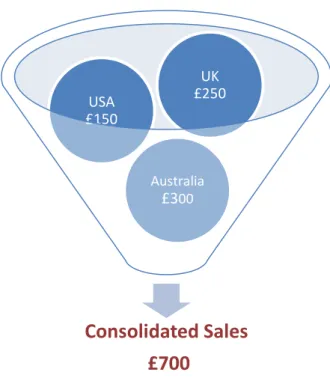
constructed from the equivalent data in the segment report, but the reverse is not true. To give a simple example, consider a manufacturing company, Company X in Figure 3.1 below, which consists of three Geographical (GEO) segments: UK, USA, and Australia.
24 Figure 3.1: Sales Information for Company X
Sales data in the segment report allow construction of the sales data in the
consolidated report, but the sales data in the consolidated report do not allow construction of the sales data in the segment report. Thus, the segment report should be at least as
informative as the consolidated report.
However, although the fineness theorem discussed above provides a theoretical proof of the importance of disaggregated information, there is one important aspect of segmental disclosure that might mitigate the usefulness of segment information. This aspect is related to the identification of reportable segments. Section 3.3 below discusses the issue of segment identification and its impact on the usefulness of segment information to the users of financial reports.
3.3-The Issue of Segment Identification
One of the implications of segment disclosure is the segment identification issue. It is all about the question of how segment information should be categorised. The first attempt to look at reportable segment identification issue was when SFAS 14 was issued in the USA. Some of the previous studies on segmental disclosure have explored the identification of reportable segments and the effect of segment identification on the usefulness of segment information. It is argued that lack of clear guidance on how reportable segments should be defined is a complex task and there are many ways in which the company can define its segments. Therefore many researchers argued that the flexibility of the accounting standards