I May 17, 2011 13:56 WSPC/INSTRUCTION FILE ijcia2010
International Journal of Computational Intelligence and Applications © World Scientific Publishing Company
HYBRID FUZZY LOGIC-BASED PARTICLE SWARM
OPTIMIZATION FOR FLOW SHOP SCHEDULING PROBLEM
S. H. LING*
Faculty of Engineering and Information Engineering, University of Technology, Sydney, NSW 2007, Australia.
F. JIANG
Faculty of Engineering and Information Engineering, University of New South Wales, NSW 2052, Australia.
H. T. NGUYEN
Faculty of Engineering and Information Engineering, University of Technology, Sydney, NSW 2007, Australia.
K. Y. CHAN
DEBllnstitute, Curtin University of Technology, Perth, WA 6'102, Australia.
This paper proposes a hybrid fuzzy logic-based particle swarm optimization (PSO) with cross-mutated operation method for the minimization of makespan in permutation flow shop scheduling problem. This problem is a typical non-deterministic polynomial-time (NP) hard combinatorial optimization problem. In the proposed hybrid PSO, fuzzy infer-ence system is applied to determine the inertia weight of PSO and the control parameter of the proposed cross-mutated operation by using human knowledge. By introducing the fuzzy system, the inertia weight becomes adaptive. The cross-mutated operation effectively forces the solution to escape the local optimum. To make PSO suitable for solving flow shop scheduling problem, a sequence-order system based on the roulette wheel mechanism is proposed to convert the continuous position values of particles to job permutations. Meanwhile, a new local search technique namely swap-based local search for scheduling problem is designed and incorporated into hybrid PSO. Finally, a suite of flow shop benchmark functions arc employed to evaluate the performance of the proposed PSO for flow shop scheduling problems. Experimental results show empirically that the proposed method outperforms significantly the existing hybrid PSO methods. Keywords: Flow shop; Fuzzy logic; Particle swarm optimizatwn; Roulette wheel mecha-msm, Scheduling.
1. Introduction
The flow shop scheduling problem is a very complex combinational optimization problem with many variations. Permutation flow shop scheduling problem consists of scheduling given jobs with same order at all machines. Flow shop scheduling *Corresponding author. Email: [email protected]
I May 17, 2011 13:56 WSPC/INSTRUCTION FILE ijcia2010
2 Ling, Jiang, Nguyen, and Chan
problem is a Non-Polynomial (NP) hard problem, existing mathematical methods, i.e., integer programming, branch-and-prune method, dynamic programming, etc, are only applicable to small-scale problem and they are difficult to find the global solution of the problem. Thus, various global searching algorithms such as genetic algorithm (GA) 1 2 , Tabu search 3 , differential evolution 4 and ant colony opti-mization 5 6 are proposed to solve the flow shop scheduling problems. Recently, a new global searching algorithm namely particle swarm optimization (PSO) is widely used to different industrial areas such as power systems 7 8 9 , parameters learning of neural networks 10 25 , control 12 , inverse problem 13 , modelling 14, and so on. Especially, PSO is effectively to tackle the flow shop scheduling problem 15 16 17 18 19 20 . In the paper 17 19 , PSO is presented to solve the flow shop problem, where the smallest position value (SPV) rule is developed to enable the continuous particle swarm optimization to be applied to all classes of sequencing problems. In addition, a local search method namely variable neighborhood search (VNS) is proposed for embedding in the PSO method to solve the flow shop problems 19, and in the paper 17 , simulated annealing based local search with multiple different neighborhoods is designed. In 18 , a hybrid PSO is used to solve the flow shop scheduling problem where simulated annealing (SA) algorithm is incorporated into PSO. In the paper 20 , a modified binary PSO algorithm is presented to solve the flow shop problem, which all particles are coded with binary number.
Particle swarm optimization (PSO) is inspired by the social behaviors of a ni-mals like fish schooling and bird flocking 21 . Comparing with other population based stochastic optimization methods, such as evolutionary algorithms, PSO has compa-rable or even superior search performance for many hard optimization problems with faster and more stable convergence rates 22 . Furthermore, PSO has memory, pre vi-ously visited best positions in PSO are remembered, while in evolution algorithms,
which are forgotten once the current population changes. However, observations reveal that PSO converges sharply in the early stage of the searching process, but saturates or even terminates in the later stage. It behaves like the traditional local searching methods that trap in local optima.
Recently, different hybrid PSO methods have been proposed to overcome the drawback of trapping in local optima. The hybrid PSO has been first proposed in 1998 23 , in which a standard selection mechanism is integrated with PSO. A new hybrid gradient descent PSO (HGPSO), which is integrated with gradient infor-mation to achieve faster convergence without getting trapped in local minima is proposed 24 . However, the computational demand of HGPSO is increased by the process of the gradient descent. In addition, it is poor to handle the multimodel problem that contain many local minima. In the paper 25 , a hybrid PSO algorithm named HGAPSO is proposed, which incorporates GA's evolutionary operations of crossover, mutation and reproduction. In the paper 7, a hybrid PSO named
HP-I May 17, 2011 13:56 WSPC/INSTRUCTION FILE ijcia2010
Hybrid fuzzy logic-based particle swarm optimization for flow shop scheduling problem 3 SOM is proposed, in which a constant mutating space is used in mutation. In both HGAPSO and HPSOM, the solution space can be explored by performing
muta-tion operamuta-tions on particles along the search, and premature convergence is more likely to be avoided. However, the mutating space is kept unchanged all the time
throughout the search, and the space for the permutation of particles in PSO is
also fixed. It can be improved by varying the mutating space along the search. A hybrid PSO with wavelet mutation operation (HPSOWM) is proposed 26, which
the mutating space is varying by applying wavelet theory. The solution quality and
solution reliability (standard deviation upon many trials) are improved.
In order to make PSO be suitable to solve the combinational (scheduling) prob-lem, a converting process from the continuous position values of particles to job permutations is used. Conventionally, the Smallest Position Value (SPV) rule 17 18
19 28 29 is actually a mapping from an N-dimensional continuous space to a
se-quence with N numbers. The corresponding sequence is represented by the order
of the vector. As we know, the positions of the particles in PSO are updated that
causes velocity and evolution. In some case, the positions of the particles are up-dated, the corresponding sequence is still unchange by using SPV rule 20. This kind of inefficiency of the continuous space will result in the decrease in convergence rate. To overcome this drawback, a sequence-order system based on the roulette wheel
mechanism is proposed in this paper. In this mechanism, the probability represe
n-tation is instead of the position value which is represented by SPV rule.
In the paper 30 , an improved version of PSO with an inertia weight factor is introduced. The aim of the inertia weight provides a balance between the global
exploration and local exploitation and it is governed by a linear characteristic
func-tion. However, not all the optimization problems are linear. Thus, in this paper, a hybrid fuzzy logic-based PSO with cross-mutated operation is proposed. This
proposed approach can be divided into two main parts. First, an adaptive inertia weight is proposed, which incorporates with the fuzzy inference system. Fuzzy logic is good in representing some expert knowledge and experience in some linguistic rule which can be easily understood by the human being. Using fuzzy inference to deter-mine the inertia weight of PSO, such that, the characteristic of function of mertia
weight becomes nonlinear. It w1Il be shown that the nonlinear characteristic of the
inertia weight performs more better solution quality in this paper. Second, a new
operation namely cross-mutated (CM) operation is introduced. The CM operation
effectively solves the drawback of PSO, which makes PSO easier to trap in the local
optima. In CM operation, the control parameter is determined by fuzzy rules and the operation becomes adaptive. Additionally, a swap-based local search method is designed for the local exploration on a discrete job permutation space. This method
is used to fine tune the sequence of the flow shop scheduling problem. In this paper, a suite of benchmark problems for permutation flow shop scheduling problem are used to illustrate the performance of the proposed approach. The resulting
adap-I May 17, 2011 13:56 WSPC/INSTRUCTION FILE ijcia2010
4 Ling, Jiang, Nguyen, and Chan
tive inertia weight and CM operation aid the proposed fuzzy logic-based PSO with cross-mutated operation to perform better solution quality and solution reliability compared with improved PSO (IPSO) 30 and other hybrid PSO methods 7 24 25 26
in solving a suite of benchmarking flow shop scheduling problems.
This paper is organized as follows. Section 2 presents the formulation of flow shop scheduling problem. The implementation of the How shop scheduling problem with hybrid PSO will be discussed in Section 3. In this section, the solution re presen-tation, hybrid fuzzy-based PSO with cross-mutated operation, and the swap local search method are discussed. In Section 4, a suite of flow shop benchmark prob-lems will be given to evaluate the performance of the proposed method. Finally, a conclusion will be drawn in Section .5
2. Permutation Flow shop scheduling problem formulation
The formulation of the permutation flow shop scheduling problem is described in this section. Suppose there is a set of n jobs to be processed in a set of m machines in the same order. The processing time Pj,k for job j (j = 1, 2, ... , n) on machine k (k
=
1, 2, ... , m) is given. The objective is to find a sequence for the processing of jobs in the machines to minimize the total completion time or makespan ( Cmax)· There are several assumptions on this scheduling problem 31 : 1) Each job j can be processed at most on one machine k at the same time; 2) Each machine m can process only one job j at a time; 3)The processing of a job j on a machine k cannot be interrupted; 4) All jobs are independent and are available for processing at time 0; 5) The setup times of the jobs on machines are negligible; 6) The machines are continuously available; and 7) If the next machine on the sequence needed by a job is not available, the job can wait and join the queue at that machine.Let 1r = J 1, J2 , ... , J, denote a permutation of all jobs, and C(J1 , k) denotes the completion time of job J1 on the machine, then the completion time C(Jj, k) can
be calculated as follows-(1)
(2)
C (J1, k) = C (J1, k-1)+
PJt,k, k = 2, ... , m(3)
C(J
1, k) = max{C (J1_1, k), C(
Jj, k-
1)}+
P.J1,k,j = 2, ... , n, k = 2, ... , m (4)(5)
So, the flow shop problem with the makespan criterion is to find a permutation 1r* in the set of all permutations II such that,I May 17, 2011 13:56 WSPC/INSTRUCTION FILE ijcia2010
Hybrid fuzzy logic-based particle swarm optimization for flow shop scheduling problem 5
3. The hybrid fuzzy-based PSO for How shop scheduling 3.1. Solution representation: roulette wheel mechanism
As mentioned in the introduction section, the existing solution representation method, smallest position value (SPV) rule has a drawback which is to decrease the convergence rate and performance. In this section, a sequence-order system based on the roulette wheel mechanism is proposed. In this method, the value of the continuous position of particles represents the probability of the higher ranking. In other words, the position of the higher value of the element of particles will have a higher chance to be select to job sequence list firstly. In this section, the process of the methodology is discussed and an example is given to illustrate the methodology. 3.1.1. Methodology
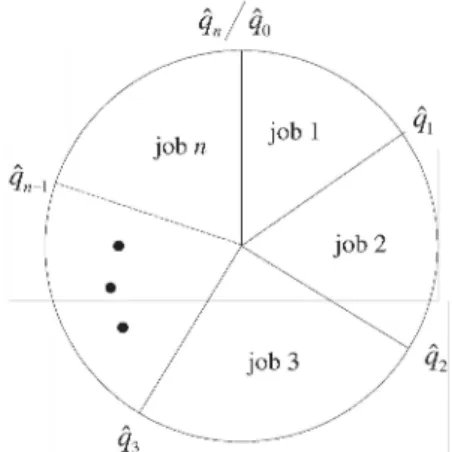
The process of the solution representation with roulette wheel mechanism is de-scribed as follows. Fig. 1 shows the roulette wheel mechanism.
(1) Given a continuous position (element) of the particle Xj, j = 1, 2, ... , n. (2) Assign a probability qj to the Xj such that: qj =
---:/!'-L-
Note thatL
qj~ Xj
:;=1 should equal to 1.
j
(3) Evaluate a cumulative probability
qi
for each x.i such as:q
i
='L
qz.l=l
( 4) Generate a set of floating-point numbers dh E [ 0 1] randomly, h =
1, 2, ... , ry; 77 is the number of generated floating-point number. These float-ing point numbers should be sorted with ascending order. Normally, the number of generated floating-point number TJ equals to 20 x n.
(5) Count the total number of the floating-point numbers for each j are in the range of [ Qj-l Qj] such as: SJ =count (flj-l :::; dh :::; qj), where count() is a function to count how many statement is met the condition. Note that
flo= 0.
(6) Convert the continuous position of SJ to the sequence of job by using largest position value rule. For a given continuous position like [23, 12, 41, 6],
the corresponding sequence is represented by the order of the value. For
example, in decent order, 41 is the largest value, so the first of the sequence should be 3; the second largest value is 2, so the second job of sequence should be 1. Thus, we can obtain the corresponding job sequence 1r is [3, 1, 2, 4].
3.1.2. Example
The whole process is illustrated by the following example. The dimension of the particle of PSO is 5. The step-by-step process is listed as follows:
I May 17, 2011
6
13:56 WSPC/INSTRUCTION FILE ijcia2010
Ling, Jiang, Nguyen, and Chan
X= [0.1, 0.7, 0.3, 0.5, 0.4].
(2) Assign a probability from q1 to q5: q1 ____3:.L_ 0.1 = 0.05, q2 = 0.35,
G 2
L
Xjj=l
q3 = 0.15, q4 = 0.25, and q5 = 0.2.
1
(3) Evaluate a cumulative probability
ih
to izs: iz12::
qz = 0.05, iz2 = 0.4,1=1 q3 = 0.55, q4 = 0.8, and (j5 = 1.
(4) Generate 100 floating-point numbers
(ry
= 20 x 5 = 100), d = [ 0.0099, 0.0118, 0.0153, 0.0185, 0.0196, 0.0579, 0.0648, 0.1365, 0.1389, 0.1509, 0.1730, 0.1763, 0.1897, 0.1934, 0.1987, 0.1988, 0.1991, 0.2026, 0.2028, 0.2311, 0.2523, 0.2714, 0.2722, 0.2844, 0.2897, 0.2987, 0.3028, 0.3046, 0.3093, 0.3412, 0.3420, 0.3529, 0.3704, 0.3784, 0.3795, 0.4057, 0.4103, 0.4186, 0.4289, 0.4447, 0.4449, 0.4451, 0.4565, 0.4660, 0.4692, 0.4860, 0.4966, 0.5028, 0.5226, 0.5252, 0.5341, 0.5417, 0.5466, 0.5681, 0.5936, 0.6038, 0.6068, 0.6154, 0.6213, 0.6449, 0.6602, 0.6614, 0.6721, 0.6813, 0.6822, 0.6946, 0.6979, 0.7027, 0.7095, 0.7271, 0.7373, 0.7382, 0.7468, 0.7621, 0.7919, 0.7948, 0.8132, 0.8180, 0.8214, 0.8216, 0.8318, 0.8381, 0.8385, 0.8462, 0.8537, 0.8600, 0.8757, 0.8801, 0.8913, 0.8936, 0.8939, 0.8998, 0.9169, 0.9218, 0.9318, 0.9355, 0.9501, 0.9568, 0.9797, 0.9883]. (5) Evaluate 81 to 8s: For 81, there are 5 floating-points numbers are in therange of 0 to 0.05 (izo to (j1), thus, 81 = 5. For 82, there are 30 floa ting-points numbers are within 0.05 to 0.4 (q1 to iz2), thus, 82 = 30. Repeat the process, we have 83 = 18, 84 = 23, and 85 = 24.
(6) Convert the continuous position of 81 - 85 to the sequence of job. Now, S = [5, 30, 18, 23, 24]. By using largest position value rule, the job sequence 1r should be [2 54 3 1].
When the element of the particle in PSO is updated, the probability representa -tion is also updated to reflect the order of the job sequence. Considering the previous example, where the continuous position is [0.1, 0.7, 0.3, 0.5, 0.4], by using SPV rule, the smallest position value is 0.1, so the job 1 is assigned to be the first job; the second smallest value 1s 0.3, so the JOb 3 1s ass1gned to be the second JOb and so on. Finally, the job sequence 1r should be [1 3 5 4 2]. Now, the value of the element of particle is updated in next generation and the updated continuous position is [0.1, 0.7, 0.3, 0.55, 0.35]. By using SPV rule, the job sequence 1r should be [1 3 54 2],
which is no different. This kind of inefficiency of the continuous space will result in the decrease in convergence rate and degrade the performance of optimization process. Because of this drawback, the proposed roulette wheel mechanism is used to overcome this drawback and performs faster convergence than SPV rule. With the same example in SPV rule, the updated continuous position is [0.1, 0. 7, 0.3, 0.55, 0.35]. Assuming the set of the random number is unchanged. The 81 to 85 (in
Step (5)) is changed to S
=
[5, 30, 18, 27, 20] and finally the job sequence 1r shouldI May 17, 2011 13:56 WSPC/INSTRUCTION FILE ijcia2010
Hybrid fuzzy logic-based particle swarm optimization for flow shop scheduling problem 7
job.
job 2
•
job 3
Fig. 1: The roulette wheel mechanism
3.1.3. Hybrid fuzzy logic-based particle swarm optimization
Particle swarm optimization (PSO) is a stochastic optimization method which was
developed in 1995 21 . It models the processes of the sociological behaviors associ -ated with the bird flocking and the fish schooling. It uses a number of particles that
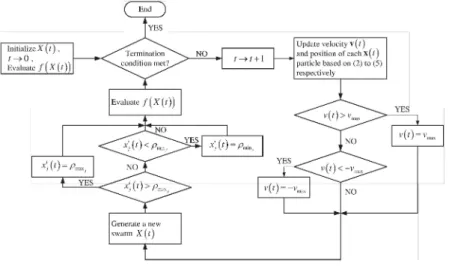
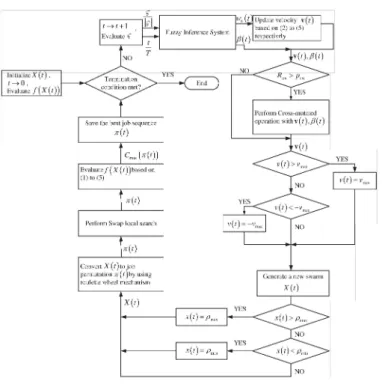
constitute a swarm. Each particle traverses the search space looking for the global optimum. Recently, an improved PSO is proposed 30 where constriction and inertia weight factors are introduced and the searching ability is improved in comparison with the standard PSO 21 . The process diagram of the PSO with constriction and inertia weight factors (IPSO) is shown in Fig.2. In this paper, a fuzzy logic-based
particle swarm optimization with cross-mutated operation namely FPSOCM is
pro-posed to solve flow shop scheduling problem and shown in Fig. 3. The details of
both IPSO and FPSOCM will be discussed as follows.
3.1.4. PSO with constriction and inertia weight factors (IPSO)
From Fig.2, X (t) is denoted as a swarm at the t-th iteration. Each particle xi (t) E X (t) contains n elements xj (t) E xi (t) at the t-th iteration, where i
=
1, 2, ... ,I May 17, 2011 13:56 WSPC/INSTRUCTION FILE ijcia2010
8 Ling, Jiang, Nguyen, and Chan
'I and j
=
1, 2, ... , n; 'I denotes the number of particles in the swarm and n isthe dimension of a particle. First, the particles of the swarm are initialized and
then evaluated by a defined cost (objective) function. The evaluation cost value is
represented by
f
(
x'i (t))
.
In the same time, current generation numbert
is initiallyset at 0. The objective of PSO is to minimize the cost values of particles iteratively.
The swarm evolves from iteration t
+
1 by repeating the processes as shown in Fig.2. The standard PSO 21 operation is discussed as follows.In PSO, there has one important term and called velocity. The velocity is
corre-sponding to the flight speed in the search space. The velocity vj (t) and the position
x'~ (t) of the j-th element of the p-th particle at the t-th generation can be calculated using the following formulae:
(7)
andxi, (t) = xi
(t
-1) +vi (t),1 J J
(8)
where
p" =
[Pl
P2
,
.
.. p~]
and g = [ g1 g2 , . . . gn]; the best position of a particle iis represented as pi; the position of the best particle among all the particles is
represented as g; r1 and r2 return a uniform random number in the range of [0,1]. In
30 , an improved version of PSO (IPSO) is presented, where the constriction factor
and inertia weight factor are introduced. Here, when the PSO with constriction
factor and inertia weight factor is used, (7) will be changed to:
where w is an inertia weight factor; cp1 and cp2 are acceleration constants; k is a
constriction factor derived from the stability analysis of equation
(9)
to ensure thesystem to be converged but not prematurely 30. Mathematically, k is a function of
cp1 and cp2 as reflected in the following equation:
k = 2
12- 'P- Jcp2 - 4cpl
(10)
where cp
=
cp1+
'P2 and cp>
4.IPSO utilizes pi and g to modify the current search point in order to avoid the
particles moving in the same direction, but to converge gradually toward pi and g.
A suitable selection of the inertia weight w provides a balance between the global
and local explorations. Generally, w (t) is governed by the following equation:
( ) _ Wmax - Wmin
W
t
-
Wmax - T Xt
(11)
where
t
is the current iteration number, T is the total number of iteration, Wrnin and Wrnax are the upper and lower limits of the inertia weight, and normally set toI May 17, 2011 13:56 WSPC/INSTRUCTION FILE ijcia2010
Hybrid fuzzy logic-based particle swarm optimization for flow shop scheduling problem 9
In (9), the particle velocity is limited by a maximum value Vmax· The parameter
Vmax determines the resolution with which regions are to be searched between the
present position and the target position. This limit enhances the local exploitation
of the problem space and it realistically simulates the incremental changes of human
learning. If Vrnax is too high, particles might fly past good solutions. If Vrnax is too
small, particles may not explore sufficiently beyond local solutions. Empirically, Vrnax
is often set at 10% to 20% of the dynamic range of the element on each dimension.
A new swarm
X(t)
is updated after the velocity of all particles are updated.To ensure all particle elements
xj
in X (t)
fall within the range [ Pmin, Pmax],the following conditions are considered as follows: If x~(t) >Pmax;, then the
up-dated xi. ( t) should equal to Pmaxr Similarly, If xi. ( t) <Pmin1, then the updated
xi.(t)
should equal to Pmin1. Here, Pmin = Prnin1 Pmin2 • • • Pminn and PmaxPmax1 Pmax2 • • • Prnaxn ; Pmin1 and Pmax1 are minimum and maximum values of
xj(t)
respectively and j = 1, 2, ... ,n
.
Fig. 2: The process diagram of IPSO
3.1.5. Fuzzy logic-based PSO with cross-mutated operation
In this section, the fuzzy logic-based PSO with cross-mutated operation for flow shop
scheduling is presented. The process diagram is shown in Fig. 3. In this proposed
I May 17, 2011 13:56 WSPC/INSTRUCTION FILE ijcia2010
10 Ling, Jiang, Nguyen, and Chan
Fig. 3: The process diagram of FPSOCM for flow shop scheduling
searching compared to other PSO methods. Firstly, an adaptive inertia weight wk(t)
is proposed to improve the solution quality of searching. Secondly, cross-mutated ( CM) operation is given to solve the drawback of IPSO that it is easier to trap into local minima. From this figure, we can see that the adaptive inertia weight wk(t) and the control parameter (3(t) of CM operation are determined by a fuzzy inference
system. The details of the operation of FPSOCM is given in the next subsection.
3.1.6. Adaptive inertia weight
In IPSO, the inertia weight is used to provide a balance between the global explo-ration and local exploitation. A linear inertia weight is governed by the equation (11). From this equation, when the value of t
/
T
is smaller which implies that it is doing global exploration. Similarly, higher value oftjT
implies that it is doing fine-tuning (local exploitation). We can see that the characteristic of this function is linear. However, some of the optimization problems are nonlinear. Thus, an adaptiveI May 17, 2011 13:56 WSPC/INSTRUCTION FILE ijcia2010
Hybrid fuzzy logic-based particle swarm optimization for fiow shop scheduling problem 11
(nonlinear) inertia weight is proposed to enhance the performance of the searching.
In this paper, an adaptive inertia weight wk(t) is proposed, which is incorporated
with a fuzzy inference system. In a fuzzy inference system, there are two inputs and
two outputs. One of the output is adaptive inertia weight wk(t), the other one is
control parameter (3(t) of CM (It will discussed in later ). The inputs of the fuzzy
system are
c;(t)
/
llc;(t)ll
andtjT. c;(t)/
lldt)ll
is a normalized standard deviation ofcost value among all the particles. A larger value of~ (t)/11~
(t)ll
implies that thevariance between each cost value of particle
f (
XP ( t)) is larger. Conversely, whenthe value of ~ ( t) /II~
(
t)II
is smaller, that means the variance between each cost valueof particle f(Xi(t)) is smaller. In other words, the location of each particles are
closer. The formulation of~
(t)/ll
dt)
II
is defined as follows:~ (t)
=
where
'Y
.!_
L
(f
(xi (t))-J
(xi (t)))2"( i
11·11
denotes the l2 vector norm.The adaptive inertia weight Wk (t) is governed by the following fuzzy rules:
Rule j : IF~ (t)/11~
(t)ll
is N{, ANDtjT
is N~, THEN wh:(t)
= aj ,j = 1, 2, ... , E
(12)
(13)
(14)
where N{ and N~ are fuzzy terms of rule j, E denotes the number of rules,
aj E [ Wrwin W·rnin] is the singleton to be determined. In this paper, Wmin and Wmin are set at 0.1 and 1.1 respectively 26. The final value of wk ( t) is given by:
where mj (t) wk (t) =
L
mj (t)ai j=1 llNi (~(t)/11( (t)ll)
X llNi(tjT)
1 2i~
1
(11N
i
(dt)/llc;(t)ll)
X ILN;(tjT))
(15) (16)llNi (~ (t)/11~
(t)
ll)
and llNi(t
/
T
)
are the membership function corresponding to1 2
N·{ and N~ respectively. Noting that the value of wk(t) will replace the value of w(t)
in (9) to produce a new
v}
(t) with adaptive inertia weight. Thus, the new velocitywill be changed to
I May 17, 2011 13:56 WSPC/INSTRUCTION FILE ijcia2010
12 Ling, Jiang, Nguyen, and Chan
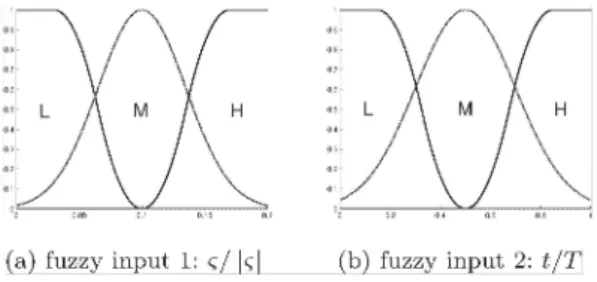
In the proposed algorithm, there are 3 membership functions for each input and shown in Fig. 4. The 3 fuzzy terms are namely L (Low), M (Middle), and H (High).
Based on the characteristic of<; (t)/11<: (t)ll and
t
j
T,
there are 9 linguistic IF-THEN fuzzy rules and the fuzzy rule table for determine wk(t) is shown in Fig. 5 (a). The rationale of the selected fuzzy rules for determine Wk (t) is described as follows: the value of Wk (t) is determined by fuzzy inputs<; (t)/11<: (t) II andt/T.
The value oft
/T
represents the iteration stage (smaller value oft/T
represents the searching process in the early stage, a larger value oftj
T
represents the searching process in the laterstage). The value of Wk
(t)
should be higher as the value oftjT
is smaller (in early stage) implies that a larger value of velocity of particle element is given for globalsearching. Similarly, a larger value of
t
j
T
implies that a higher value of velocity ofparticle element for local searching. Because of it, the values of Wk (t) at
t
j
T
is "L", are larger thant
j
T
is set at"M". For the same reason, the values of Wk(t)
attjT
is "M" are larger than that ast
j
T
is "H". The value of wk (t) should be smaller astjT
increase in order to reduce the value of velocity of particle element for fine-tuning.
As mentioned before, <; (t)/11<: (t)ll is a normalized standard deviation of cost value among all the particles. A larger value of<; (t)/11<: (t)ll implies that the variance between each cost value of particle
f
(Xi ( t)) is larger. In other words, the location of each particle is far away. AttjT
is "L", which the searching process is in early stage and when <:(t)/ll<:(t) II is "H", that implied the location of each particle is far away in early stage. Thus, a larger value of Wk (t) should be given for global exploration.In a special case, when<; (t)/11<: (t)ll is "L", that implies the location of each particle is closed in early stage.
We also set Wk (t) to a larger value, because there has a high chance that the solu-tions are trap into local optima (it is affected from the smaller value of<; (t)/11<: (t)ll).
Therefore, a larger value of Wk (t) is given to force the particle escape the local op-tima. As the value of<; (t)/11<: (t)ll is "M", we set the value of Wk (t) is slight smaller than that <:(t)/ll<:(t)ll is "L" and <:(t)/ll<:(t)ll is "H" in early stage
(t/T
is "L").When
tjT
is "M", which the searching process is in middle stage. The rationaleof the suggested value of Wk
(t)
is similar to rules that when Whent
j
T
is "L". However, there is one difference that when<; (t)/11<: (t) II is "L", the value of wk (t) issmaller than <:(t)/ll<:(t) II is "H". It is because the optimal solution may be found in middle stage where a smaller value of WA: (t) is given. At
t
/T
is "H", which the searching process is in later stage . In this stage, the searching process is undergo fine-tuning process (local exploitation) to find the optimal solution. Because of it, when the value of<; (t)/
II<:
(t)II
is "L" that implied the position of most particles are closed and near the best solution. Thus, a smallest value of wk (t) is given.3.1.7. Cross-mutated operation
In this section, a cross-mutated (CM) operation is introduced. This new CM ope r-ation is merged the idea of crossover and mutation operation of genetic algorithm. The aim of the CM operation is forcing the particle to escape the local optima.
I May 17, 2011 13:56 WSPC/INSTRUCTION FILE ijcia2010
Hybrid fuzzy logic-based particle swarm optimization for fiow shop scheduling problem 13
(a) fuzzy input 1: <;/]l<;jj (b) fuzzy input 2: t/T
Fig. 4: Membership functions a) (x-axis: <;-(t)/11<;-(t)ll ,y-axis: J.LN1(<;-(t)/ll<;-(t)11)) and b)
(x-axis: tjT ,y-axis: J.LN2 ( tjT) ) c; t c; t - - -t
l
lc;(t lll
tllc;(
t l
l
l
- -T L M H T L M H L 1.1 0.9 1.1 L 0.5 0.4 0.6 M 0.6 0.5 0.7 M 0.4 0.3 0.5 H 0.1 0.2 0.3 H 0.1 0.2 0.2 (a) (b)Fig. 5: The fuzzy rule table for determining (a) wk(t), and (b) (J(t)
Furthermore, a control parameter
(3
(t)
is introduced into the CM operation, and the operatwn becomes more adapt1ve. Th1s control parameter 1s governed by somefuzzy rules with the human knowledge. By introducing the CM operation, the
per-formance of the proposed PSO method is improved.
The details of the CM operation is as follows. Every velocity of the particle
element in the swarm will have a chance to undergo CM operation, which is governed by a probability of cross-mutated operation, Pcm E [ 0 1], defined by the user. For
each velocity of the particle element, a random number Rem between 0 and 1 will
be generated such that if it is less than or equivalent to Pcm, the CM operation will take place on that element. The sensitivity of the Pcm with experimental results and the analysis will be discussed later. The choice of the Pcm will affect the quality of the solution.
I May 17, 2011 13:56 WSPC/INSTRUCTION FILE ijcia2010
14 Ling, Jiang, Nguyen, and Chan
The resulting velocity of the particle element under the CM operation is given by:
vj
(t)
=
{1
-
~(t)}vJ
(t)
+
~(t)iij(t)
(18)where
iij (t)
=~
{Pmax;+
Pmin;}+
~ {r::~
·
(Pmax1+
Pmin;)} · (19)vj (
t)
is determined by (17),iij
(
t) is a random velocity of particle element and the value of this velocity is randomly generated and bounded with 0.25 of the dynamic range of the particle element. r3E [ -1 1] is an uniform random number. In (18), the resulting velocity of particle elementvj
(t) is combined with the information ofvj (
t) andii_j
(
t). This information exchanging process is like as crossover operation. However, in CM operation,v.f
(t) is changed (mutated) one-by-one which is like as mutation operation. Therefore, we called it is cross-mutated (CM) operation.In (18), the control parameter ~(t) provides a balance to control the resulting velocity
vj
(t) converge toward v~ (t) orv_j
(t). If ~(t) is approaching 0, thev}
(t) will tends to the v~ (t). Conversely, when ~(t) is approaching 1,thev.}
(t)
will tends to theiij
(t). The proposed random velocityiij
(t) in (19) has ability to force the particle element to escape the local optima with a random movement. In this operation, the value of the ~(t) is governed by nine fuzzy-rules. The fuzzy inference system is same as before we mentioned. The inputs of the fuzzy system are same. They are<; (t)/11.:; (t)ll and tjT. Now, there are 9linguistic fuzzy rules and the fuzzy rule table for determine ~(t) is shown in Fig. 5 (b).
The rationale of the selected fuzzy rules is similar to the rules of adaptive inertia weight in last sub-section. The brief description of the choosing fuzzy rules for CM operation is given as follows: the value of ~(t) is determined by <; (t)/11<; (t)ll and
tjT, and some fuzzy rules. As mention before, the value of the tjT represents the iteration stage. We can see as tjT is "L", where the searching process is in early stage and as tjT is "H", where the searching process is in later stage, the values of
~(t) in early stage are larger than the values of ~(t) in later stage. It is because a sig-nificant random velocity (higher value of ~(t) in (18)) provides a global exploration in early stage. Conversely, the effect of the random velocity should be reduced in later stage for fine-tuning (local exploitation) with smaller value of ~(t).
Till now, we have discussed about the effect of the<; (t)/11<; (t)ll, the concept is same as the rules of adaptive inertia weight. In the early stage, when<; (t)/11<; (t)ll is "L", that implies the location of each particle is closed. Thus, we need to set the value of ~(t) to be larger than that when <;(t)/ll<;(t)ll is "M". The reason lies in the fact that a higher chance that the solution being trapped into a local optimum. Conversely, in the later stage, the searching process undergoes fine-tuning process (local exploitation) to find the optimal solution. Because of this, when the value of <; (t)/11<; (t)ll is "L" that implies the position of most particles are closed (similar)
I May 17, 2011 13:56 WSPC/INSTRUCTION FILE ijcia2010
Hybrid fuzzy logic-based particle swarm optimization for fiow shop scheduling problem 15
and near the best solution. Thus, a smallest value of f3(t) is given.
After the CM operation, an updated swarm is generated. Next, convert all the
particles in the swarm to job permutation
K(t)
by using the sequence-order systembased on the roulette wheel mechanism. This mechanism is presented on section
3.1. After going through the process of the sequence-order system, a set of job
sequence will be formed and then undergo swap based local search operation for
local exploration on a job permutation space.
3.2. Swap based-Local search
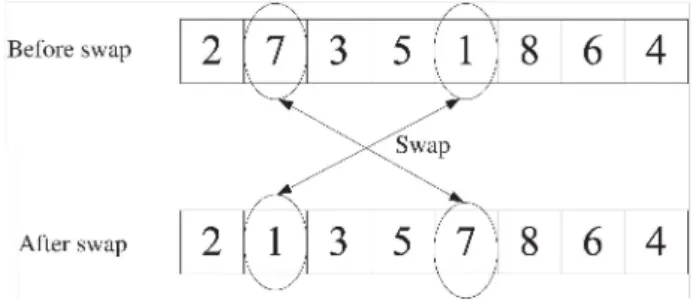
Local searches are very important for the exploitation. In this paper, a swap-based
local search method is designed for fine-tuning on the flow shop scheduling problem.
The operation of this local search is simply to swap the selected two job order
number. The operation of swap based local searching method is described as follows.
(1) Given a sequence of jobs IT, where 'iT= J1, J2, ... , J;-1, J;, Ji+l, ...
Jn-(2) Randomly picks 2 jobs, i.e., J; and Ji+l
(3) Swap the selected 2 jobs.
After the process, the new sequence of jobs should be J 1, J2, ... , J;- l, Ji+ 1,
J;, .. .Jn. An example of swap based-local search method is given in Fig.6. In this
figure, the job 7 and the job 1 are selected to undergo the swap process. After going
through the swap operation, a new job sequence is generated. By using (1)-(5), a
updated makespan Cmax will be evaluated. The optimization process will repeat
until a termination condition is met. The iterative process will be terminated when
a defined number of iteration is met.
Before swap
After swap
I May 17, 2011 13:56 WSPC/INSTRUCTION FILE ijcia2010
16 Ling, Jiang, Nguyen, and Chan
4. Computational results
To test the performance of the proposed FPSOCM to flow shop scheduling prob-lem, computational simulation is carried out with a suite of flow shop benchmark problems 32 . In this paper, 8 benchmark problems 32 from OR-Library are given.
4.1. Experimental setup
The performance of HPSOWM 26, HPSOM 7 , HGAPSO 25 , HGPSO 24 , IPSO 30 , and the proposed FPSOCM on solving the flow-shop benchmarking problems are evaluated.
The following simulation conditions are in use: For All PSOS'
• Swarm size (y): 100 • Number of runs: 20
• Acceleration constant rp1 : 2.05
• Acceleration constant rp2 : 2.05 • Maximum velocity Vmax: 0.2
• Initial population: it is generated uniformly at random For FPSOCM:
• Probability of cross-mutated operation (Pcm):
Pe·rn = 0.05 for Car3, Car8;
Pcm = 0.01 for Carl, Car2, Car4, Car5, Car6, Car7,;
For HPSOWM, HPSOM, and HGAPSO:
• Probability of mutation operation (Pm): it is chosen by trial and error through experiments for good performance for all functions. (Pm
=
0.2 for Carl- Car8)For HPSOWM:
• Shape parameter of the wavelet mutation: it is chosen by trial and error
through experiments for good performance for all functions • Parameter g of the wavelet mutation: 10000
For HGPSO:
• Learning rate: it is chosen by trial and error through experiments for good performance for all functions
For HGAPSO:
I May 17, 2011 13:56 WSPC/INSTRUCTION FILE ijcia2010
Hybrid fuzzy logic-based particle swarm optimization for fiow shop scheduling problem 17
4.2. Results
In this section, the results for the 8 flow shop problem are given to validate the
FPSOCM, which is proven to perform well on flow shop scheduling problem. The
experimental results in terms of the average relative error (ARE), best relative error (BRE), and worst relative error (WRE) are summarized in Table 1. Relative error (RE) is defined as (C*-Crna:x)/C* where C* is the optimal value known so far and
Crnax is the value given by the algorithm. ARE is the average relative error of the 20 runs of the result, which is given by ARE=L::7~
1
REi· BRE and WRE are the best RE and worst RE among all the run respectively. The number of iterations 100 is adopted in all approaches.From the table, we can see that FPSOCM algorithm obtains a smaller ARE,
BRE and WRE in all problems. In problem Car6 which is a 8 jobs 9 machines flow
shop scheduling problem, the ARE of the FPSOCM is 0. Comparing with other
algorithms, only FPSOCM can reach the optimal value. In Problem Car3, the ARE
of FPSOCM is 0.06 which imply around 2.5-6 times improvement compared with
other algorithm. Similarly, in Problem Car5, the ARE of FPSOCM is 0.019 which imply around 8-18 times improvement.
To illustrate the solution stability achieved by the algorithms, the standard de-viations (STD) of the results obtained by all algorithms are shown in Table 1. A smaller standard deviation implies that the algorithm produces a more stable so
lu-tion. If the algorithm produces a better mean value and smaller standard deviation,
it implies that this algorithm can obtain solutions with better performance in terms
of solution quality and solution stability. From Table 1, all the algorithms can found
the optimal value (BRE=O). However, comparing with the other algorithms and the proposal FPSOCM, the ARE and STD obtained by the other algorithms are worse
than those obtained by the FPSOCM. By unitizing the proposed fuzzy inference
system into the FPSOCM, the inertia weight, which is governed by a set of fuzzy rules, can be adapted with the diversity of the positions of the particles. Therefore, unlike the other algorithms, the proposed fuzzy inference system aids the FPSOCM to generate more stable solutions. Apart from this mechanism, the cross-mutated operation is proposed to unitize to the proposed FPSOCM. The cross-mutated
oper-ation IS governed by some fuzzy rules, wh1ch effectively force the solutiOn to escape
the local minimum. With the proposed adaptive initial weight and the proposed cross-mutated operation, the FPSOCM performs better in terms of solution qual
-ity (best mean value) and solution stability (smallest standard deviation) than the other tested algorithms. As conclude, FPSOCM algorithm for flow shop scheduling problem to minimize makespan is more effective.
In order to demonstrate the statistical significance of differences between the results obtained by the proposed algorithm and the other tested algorithms, t-tests
were conducted A t-test table are summarized in Table 2 The t-test is a statistical
method to evaluate the significant difference between two algorithms. The t-value will be negative if the first algorithm is better than the second, and positive if it is
I May 17, 2011 13:56 WSPC/INSTRUCTION FILE ijcia2010
18 Ling, Jiang, Nguyen, and Chan
(A)
Problem
Met bod Carl Cnr2 Car3 Car4
n,m = 1L5; C' = 7038 n,m = 13,4:
c
·
= 7166 n, m = 12, ;j;c
·
= 7312 n, m = 14, 4;c
·
= 8003 0 0 0 0 IIPSOWM 0 0 Willi 0 L203 0 STD 0 0,329 0 ARE 0 (),260 0liP SOY! DRE 0 0 0
Willi 0 L504 0 STD 0 (),520 0 ARE 0 0,:356 0 IIGAPSO DRE 0 0 0 Willi 0 L504 0 STD 0 0,555 0 ARE L03G 0,34;j 0,()12 IIGPSO DRE 0 0 0 Willi 2,930 L504 0,(162 STD L357 (),519 OJJ25 ( (,; 4, ( IPSO DRE 0 0 Willi 0 L792 0 STD 0 (L556 0
(B)
Problem.VIet hod Car,) Car6 Car7 Car8
n, Tn -HI. 6; C""-i t20 n: rn- 8. 9; C:"'-8505 n. rn.- 7. 7; C:"'-6590 n. rn.- 8, H: C'*-8:366 ARE 0,019 FPSOC.Vl DRE 0 WRE O,:l8!J STD 0,(187 ARE HPSOWM DRE WRE WRE STD ARE UGAPSO llHE WRE STD ARE HCPSO DRE WRE STD AH.E IPSO DRE WRE rrr Nun1hcr of machines (LHil 0 0,622 I,:Jos 0,:184 0,549 0 I,:J08 0,422 O,HH 0 O,GO!J 0,21:3 lU43 0 U08
C*: The optimal value known so far
(Ll5:l 0 0,764 0,115 0,764 0,280 0,076 0 0,764 0,2:15 0,22:3 0 (),7(i4 0,:359 OA8:l 0 2,787 0124 0 U160 0,152 0 U160 0,4,)7 (),291 0 UJGO (L718 (),144 0 UJGO
Table 1: Comparison results ofFPSOCM, HPSOWM, HPSOM, HGAPSO, HGPOS,
I May 17, 2011 13:56 WSPC/INSTRUCTION FILE ijcia2010
Hybrid fuzzy logic-based particle swarm optimization for fiow shop scheduling problem 19
HPSOWM HPSOM HGAPSO HGPSO IPSO
Carl N/A N/A N/A N/A N/A
Car2 N/A
NjA
N/A -3.4149N
j
A
Car3 -1.1455 -1.6169 -2.2588 -2.0783 -2.1567 Car4 N/A N/A N/A -2.1795 N/A Car5 -2.5393 -2.9813 -5.4946 -2.4724 -3.3000 Car6 -2.1795 -1.8311 -1.4530 -2.1498 -3.2590
Car7 N/A N/A N/A N/A N/A Car8 -1.2393
NjA
-1.4885 -1.5540 -1.4282Table 2: t-value between FPSOCM and the others PSO methods (N/A means both
algorithms can found the optimal result).
poorer. The t-value is defined as:
t
=
&,
-
,,.
2 where &1 and &2 are theV
cr~ /(( +l)+cr~ /((+1)mean value of the first method and the second method respectively, a1 and a2 are
the standard deviations of the first method and the second method respectively, ~
is the degree of freedom.
When the t-value is smaller than -1.33 (degree of freedom = 19), there is a significant difference between the two algorithms with a 80% confidence level. When the t-value is smaller than -2.09 and -2.86 (degree of freedom
=
19), there is asignificant difference between the two algorithms with a 95% and 99% confidence level. From the table, we can see that FPSOCM is statistically significant. Firstly, all the t-values are negative which implied that the FPSOCM is better than the others. Secondly, most of the t-values are smaller than -1.33 which implied that
the proposed algorithm is a significant with a 80% confidence level and some of
the t-values are smaller than -2.09 and -2.86 which implied that the FPSOCM is a
significant with a 95-99% confidence level.
To further present the performance of the proposed FPSOM, a comparison
was made between the proposed algorithm with results of SGA, PM-NONEH,
SGA+NEH and EM listed in the work 34 35 36. The results are listed in Table 3. As shown, FPSOM with its 20 executions, has less ARE than the other con
-current algorithms, according to this further test, the proposed FPSOM with wave
mutation outperforms conventional algorithms with regard to the accuracy.
5. Conclusion
In this paper, we have proposed a hybrid particle swarm optimization which
in-corporates a fuzzy system and a new cross-mutated operation to tackle job shop
scheduling problem. An adaptive inertia weight of PSO is presented. It is dete r-mined by a fuzzy system. Moreover, in order to solve the local optimum problem of PSO, a new operation namely cross-mutated operation is proposed. With these
I May 17, 2011 13:56 WSPC/INSTRUCTION FILE ijcia2010
20 Ling, Jiang, Nguyen, and Chan
Problem SGA PM-NONEH SGA+NEH EM FPSOM
ARE ARE ARE ARE ARE
Carl 0.27 0 0 0.21 0 Car2 4.07 0 2.93 2.55 0 Car3 2.95 0.17 1.21 2.19 0.06 Car4 2.36 0 0.07 1.95 0 Car5 1.46 0.045 1.14 1.27 0.019 Car6 1.86 0.038 2.82 1.34 0 Car7 1.57 0 1.36 1.12 0 CarS 2.59 0.032 0.03 1.05 0
Table 3: Comparison results on ARE of SGA, PM-NONEH, SGA+NEH, EM and FPSOCM.
proposed operations, the solution quality is improved. The performance of the pro-posed hybrid PSO is compared with other hybrid PSOs with respect to the same set of How scheduling problems. The results demontrate the effectiveness of the pro-posed algorithm for the How shop scheduling problem.
References
1. C. R. Reeves, A genetic algorithm for flowshop sequencing, Comput. Oper. Res. 22
(1) (1995) 5-13.
2. G. I. Zobolas, C. D. Tarantilis and G. Ioannou, Minimizing makespan in permutation
flow shop scheduling problems using a hybrid metaheuristic algorithm, Computer and operations research 36 (2009) 1249-1267.
3. J. S. Chen, J. C. H. Pan and C. K. Wu, Hybrid tabu search for re-entrant permutation
flow-shop scheduling problem, Expect System with Application 34 (2008) 1924-1930.
4. G. Onwubolo and D. Davendra, Scheduling flow shops using differential evolution algorithm,Eur. J. Oper. Res. 171 (2006) 6740-692.
5. C. Rajendran and H. Ziegler, Two ant-colony algorithms for minimizing total flowtime in permutation flowshops,Comput. 8 Ind. Engg. 48 (2005) 789-797.
6. K.C. Ying and C. J. Liao, Aa ant colony system for premutation flow-shop sequencing,
Comput. Oper. Res. 31 (2004) 791-801.
7. A. A. E. Ahmed, L. T. Germano and Z. C.Antomo, A hybnd particle swarm opti
-mization applied to loss power minimization, IEEE Trans. Power Syst. 20 (2) (2005) 859-866.
8. J. Hazra and A. K. Sinha, Congestion Management Using Multiobjective Particle Swarm Optimization, IEEE Trans. Power Syst. 22 ( 4) (2007) 1726-1734.
9. J. G. Vlachogiannis and K. Y. Lee, A comparative study on particle swarm
optimiza-tlOn for optimal steady-state performance of power systems, iEEE 1rans. Power Syst.
21 ( 4) (2006) 1718-1728.
10. A. Chatterjee, K. Pulasinghe, K. Watanabe and K. Izumi, A particle-swarm-optimized
fuzzy-neural network for voice-controlled robot systems, IEEE Trans. Ind. Electron.
I May 17, 2011 13:56 WSPC/INSTRUCTION FILE ijcia2010
Hybrid fuzzy logic-based particle swarm optimization for fiow shop scheduling problem 21
11. C. F. Juang, A hybrid genetic algorithm and particle swarm optimization for recurrent network design, IEEE Trans. Syst. Man and Cybern. B 34 (2) (2004) 997-1006.
12. Y. Song, Z. Chen and Z. Yuan, New chaotic PSO-based neural network pred1ct1ve control for nonlinear process, IEEE Trans. Neural Networks 18 (2) (2007) 595-601.
13. S. L. Ho, S. Y. Yang, G. Z. Ni and K. F. Wong, An improved PSO method with
application to multimodal functions of inverse problems, IEEE Trans. Magnetics 4 (2007) 1597-1600.
14. R. Marinke, E. Araujo, Ld. S. Coelho and I. Matiko, Particle swarm optimization
(PSO) applied to fuzzy modeling in a thernal-vacuum system, in Proc. 5th Int. Con[
Hybrid Intelligent Systems, (Rio de Janeiro, Brazil, 2005) 67-72.
15. Z. Lian, X. Gu and B. Jiao, A novel particel swarm optimization algorithm for pe r-mutation flow-shop scheduling to minimize makespan, Chaos, Solitons and Fractals
35 (2008) 851-861.
16. B. Liu, L. Wang andY. H. Jin, An effective hybrid PSO-based algorithm for flow shop scheduling with limited buffers, Comput. Oper. Res. 35 (2008) 2791-2806.
17. B. Liu, L. Wang and Y. H. Jin, An effective PSO-based memetic algorithm for flow
shop scheduling, IEEE Trans. Syst. Man and Cybern. B, 37 (2007) 18-27.
18. K. Sun and G. Yang, An effective hybrid optimization algorithm for the flow shop
scheduling problem, Proc. 30th IEEE Con[ Decision and Control, (New Orleans,
USA, 1995) 1942-1948.
19. M. F. Tasgetiren and Y. C. Liang and M. Sevkli and G. Gencyilmaz, A particle swarm optimizatiOn algonthm for makespan and total Howtime mmimizatwn m the permutation flowshop sequencing problem, Eur. J. Oper. Res., 177 (2007) 1930-1947. 20. L. Yuan and Z. D. Zhao, A modified binary particle swarm optimization algorithm
for permutation flowshop problem, Proc. 6th Int. Con[ on Machine Learing and Cy-bernetics, (Hong Kong, 2007) 902-907.
21. J. Kennedy and R. Eberhart, Particle swarm optimization, Proceedings of IEEE In-ternational Conference on Neural Networks, (Piscataway, NJ, 1995) 1942-1948. 22. J. Kennedy, R. Eberhart and Y. Shi, Swarm Intelligence (Morgan Kaufmann
Pub-lishers, San Fransisco, USA, 2001)
23. P. Angeline, Using selection to improve particle swarm optimization, Proc. IEEE
Congress on Evolutionary Computing, (Anchorage 1998) 84-89.
24. M. M. Noel and T. C. Jannett, Simulation of a new hybrid particle swarm optimization algorithm, Proc. 36th Southeastern Symposium on System Theory, (Atlanta, USA,
1994) 150-153.
25. C. F. Juang, A hybrid genetic algorithm and particle swarm optimization for recurrent network design, IEEE Trans. Syst. Man and Cybern. B, 34 (2) (2004) 997-1006.
26. S. H. Ling, H. H. C. Iu, K. Y. Chan, H. K. Lam, C. W. Yeung and F. H. F.
Le-ung, Hybrid particle swarm optimization with wavelet mutation and its industrial
applications, IEEE Trans. Syst. Man and Cybern. B, 38 (3) (2008) 743-763.
27. S. H. Ling, H. H. C. Iu, F. H. F. Leung, and K. Y. Chan, Improved hybrid PSO-based
wavelet neural network for modellmg the development of Hmd dispensmg for electromc packaging, IEEE Trans. Industrial Electronic, 55 (9) (2008) 3447-3460.
28. B. A. Norman and A. E. Smith, Random keys genetic algorithm with adaptive penalty
functwn for optimizatiOn of constramed fac1hty layout problems, Proc. IEEE Int.
Con[ on Evolutionary Computation 1997, (1997) 407-411.
29. S. Xu and J. C. Bean, A genetic algorithm for scheduling parallel non-identical batch processing machines, Proc. IEEE Symposium on Computational Intelligence in Scheduling, (Honolulu, Hawaii, 2007) 143-150.
I May 17, 2011 13:56 WSPC/INSTRUCTION FILE ijcia2010
22 Ling, Jiang, Nguyen, and Chan
particle swarm optimization, Proc. IEEE Congress on Evolutionary Computing, (2000) 84-88.
31. Baker, Introduction to Sequencing and Scheduling (John Wiley and Sons, New York,
1974)
32. J. Carlier, Ordonnancements a contraintes disjonctives, R.A.I.R. 0. Recherche
Oper-ationelle/Oper. Res., 12 (4) (1978) 333-351.
33. C. R. Reeves, A genetic algorithm for flowshop sequencing, Computers and Operations
Research, 22 (1), (1995) 5-13.
34. H. Liu, L. Gao, Q. Pan, A hybrid particle swarm optimization with estimation of
distribution algorithm for solving permutation flowshop scheduling problem, Journal Expert Systems with Applications, 38 (4), (2011), 4348-4360.
35. L. Wang and D. Z. Zheng, An effective hybrid heuristic for flow shop scheduling, Int.
J. Adv. Manuf. Technol., 21 (1), (2003), 38-44.
36. L. Bo, et a!., An Effective PSO-Based Memetic Algorithm for Flow Shop Scheduling, IEEE Transactions on Systems, Man, and Cybernetics, Part B: vol. 37, (2007), 18-27.