Macroeconomic Implications of Social Safety Nets
in the Context of Bangladesh
Centre for Policy Dialogue (CPD)
House No. 40/C, Road No. 11 (New), Dhanmondi R/A, Dhaka-1209Bangladesh
Tel: (880 2) 8124770, 9141703, 9141734 Fax: (880 2) 8130951
E-mail: [email protected] Website: www.cpd.org.bd
First Published November 2008
© Centre for Policy Dialogue
Disclaimer: The views expressed in this paper are those of the authors alone and do not necessarily reflect the views of CPD.
Tk. 45.00
to seek constructive solutions to these problems. The Centre has already organised a series of such dialogues at local, regional and national levels. The CPD has also organised a number of South Asian bilateral and regional dialogues as well as some international dialogues. These dialogues have brought together ministers, opposition frontbenchers, MPs, business leaders, NGOs, donors, professionals and other functional group in civil society within a non-confrontational environment to promote focused discussions. The CPD seeks to create a national policy consciousness where members of civil society will be made aware of critical policy issues affecting their lives and will come together in support of particular policy agendas which they feel are conducive to the well being of the country.
In support of the dialogue process the Centre is engaged in research programmes which are both serviced by and are intended to serve as inputs for particular dialogues organised by the Centre throughout the year. Some of the major research programmes of the CPD include The Independent Review of Bangladesh's Development (IRBD), Trade Related Research and Policy Development (TRRPD), Governance and Policy Reforms, Regional Cooperation and Integration, Investment Promotion and Enterprise Development, Agriculture and Rural Development, Environment and Natural Resources Management, and Social Sectors. The CPD also conducts periodic public perception surveys on policy issues and issues of developmental concerns. With a view to promote vision and policy awareness amongst the young people of the country, CPD is implementing a Youth Leadership Programme.
Dissemination of information and knowledge on critical developmental issues continues to remain an important component of CPD’s activities. Pursuant to this CPD maintains an active publication programme, both in Bangla and in English. As part of its dissemination programme, CPD has been bringing out CPD Occasional Paper Series on a regular basis. Dialogue background papers, investigative reports and results of perception surveys which relate to issues of high public interest are published under this series. The Occasional Paper Series also include draft research papers and reports, which may be subsequently published by the CPD.
The present paper titled Macroeconomic Implications of Social Safety Nets in the
Context of Bangladesh has been prepared under the CPD-UNDP collaboration
programme on Pro-Poor Macroeconomic Policies which is aimed at developing pro-poor macroeconomic policies in the context of Bangladesh through research and dissemination. The research papers under the current programme attempt to examine the impact of various macroeconomic policies on poverty alleviation and to establish benchmarks for poverty reduction strategies. The outputs of the programme have been made available to all stakeholder groups including the government and policymakers, entrepreneurs and business leaders, and trade and development partners.
The paper has been prepared by Md Ashiq Iqbal, Senior Research Associate, Towfiqul Islam Khan, Research Associate and Tazeen Tahsina, Former Research Associate, CPD. Assistant Editor:Anisatul Fatema Yousuf, Director (Dialogue & Communication), CPD. Series Editor:Professor Mustafizur Rahman, Executive Director, CPD.
Table of Contents
Acronyms ii
1 Introduction 1
2 The Debate on Optimum Modality for Social Transfers 1
3 Poverty Situation of Bangladesh 4
4 Social Safety Net Programmes (SSNPS) of Bangladesh 5 4.1 Trends in Safety Net Programmes of Bangladesh 6
4.2 Structure of Safety Nets 8
4.3 Programme Choices (Cash Vs Kind transfers and Conditional Vs Non-conditional Transfers)
14
4.4 Success in Reaching the Potential Beneficiaries 15 4.5 Impact Assessment of SSNPs on Poverty of Bangladesh 16
4.6 Inequality Effect of SSNP 17
5 Conclusion and Policy Suggestions 21
List of Tables
TABLE 1: Number and Percentage of Population Below Poverty Line (CBN) 4
TABLE 2: Number and Per Centage of Population Below Hardcore Poverty Line (DCI) 4
TABLE 3: Average Expenditure (Allocation) on SSNPS 7
TABLE 4: Main Types of Safety Net Programmes in Bangladesh 13
TABLE 5: Targeting Criteria Used by Safety Net Programmes 15
TABLE 6: Regional Poverty and Beneficiaries of Safety Net Programmes 15
TABLE 7: Impact of SSNP on Poverty 16
TABLE 8: SSNP’s Contribution to Inequality 19
TABLE 9: SSNP’S Contribution to Inequality by Division 19
List of Figures
FIGURE 1: SSNP of Bangladesh As % of GDP and Public Expenditure 7
FIGURE 2: International Expenditure on Social Protection (As % Of GDP) 8
FIGURE 3: Change in Poverty (%) Due to SSNP 17
List of Boxes
BOX 1: Employment Generation Scheme: A Case Study of India 12
BOX 2: Some Successful Conditional/Unconditional Cash Transfer Programmes 14
Acronyms
CBN Cost of Basic Needs
CCT Conditional Cash Transfer
CSG Child Support Grant DCI Daily Calorie Intake
GDP Gross Domestic Product
HIES Household Income and Expenditure Survey
NGO Non-government Organisation
NREGA National Rural Employment Guarantee Act PESP Primary Education Stipend Program PKSF Palli Karma-Sahayak Foundation
RMG Readymade Garment
SSN Social Safety Net
SSNP Social Safety Net Programme
UNDP United Nations Development Programme
VGD Vulnerable Group Development
1. INTRODUCTION
Social safety net is a measure taken by the government in order to prevent the vulnerable section of its population to fall beyond a certain level of poverty. Social safety net programmes (SSNPs) are designed to provide support for the vulnerable section of the society. With a vision to prevent transmission of poverty from generation to generation, the safety net programmes opt for a more efficient society in terms of the choices made by individuals. The social safety nets play both a redistributive and a productive role supporting moral philosophy as well as managing risks. These two are the major pillars that justify the existence of safety net programmes. It should be mentioned at the outset that the safety net programmes create a path towards poverty reduction in the long run. They do not reduce poverty directly, rather these programmes tend to reduce transitional poverty through ensuring proper nutritional intake, education, health care, etc. In other words, the safety net programmes are methods through which poverty is expected to fall through investment in human capital.
With about 40 per cent of its population living below the poverty line and an increasing number of population being added below the lower poverty line, safety net programmes in Bangladesh are more than a necessary element in fighting poverty. The government has been following a combination of direct and indirect safety net programmes for poverty eradication addressing both human and income poverty. However, despite having a large number of programmes under the safety net, the rate of poverty reduction has not been satisfactory. It is thus crucial to scrutinise the impact of the existing safety net programs on poverty reduction in Bangladesh and identify the kind of programmes that would be more suitable to the socio-economic condition of the country.
This paper, however, does not go into detailed evaluation on which of the various types of safety net programmes has been successful in Bangladesh. Rather it looks at the overall structure of SSNPs in Bangladesh and their poverty impact. Initially, the paper discusses a number of SSNPs that have been considered to be successful in other countries of the world and highlights the current scenario of Bangladesh. The major objective of the study is to look into the overall impact of the existing safety net programmes on poverty reduction in Bangladesh, in terms of inequality. In the final section, the paper provides a number of policy suggestions on design, target and coverage of the existing safety net programmes.
2. THE DEBATE ON OPTIMUM MODALITY FOR SOCIAL TRANSFERS
Governments may decide to provide indirect support in terms of pricing and subsidy in order to change the demand patterns ensuring optimal consumption. The poor usually tend to spend less on health and education. Lowering cost of major food items or
larger share of their income can be diverted towards education and health. However, the level of additional consumption accruing from this will depend on the quantity of additional goods or services the poor are able to consume with the subsidised amount. Moreover, since minimum consumption of certain commodities such as food carries high value, subsidies can play a vital role.
Another rational behind indirect transfers would be that it is relatively easier for providing subsidies than convincing the taxpayers for direct transfers. It is also politically more sustainable as a large part of the benefits are enjoyed by the middle class. Subsidies are easier to conduct and monitor rather than continuously ensuring that certain households are receiving an income transfer. Selecting the group of recipient households or identifying the poor for allocating cash is also a vast as well as critical task. For these reasons in places where commodity markets are inadequate governments tend to prefer to provide in kind support rather than direct cash transfer (Alderman 2002).
One very popular form of direct transfer recently has been the Conditional Cash Transfer (CCT) programmes. The CCTs took off from Latin America and is being considered as a popular tool for poverty eradication. The transfers are made to selected households with conditions for developing human capabilities through education and health related programmes. However, it is often said that CCTs despite covering a large number of population do not contribute highly in poverty reduction. Evidence proves this phenomenon to be incorrect. Zepeda (2006) revealed that CCTs from Brazil and Mexico reached 8 and 5 million households respectively. The study also highlights that the cash transfers occupy a significant share of household’s total income for the poorest 25 per cent of population.
The CCTs provide families an opportunity for developing their skills as well as to decide where they want to spend ensuring better allocation of resources. It also helps to overcome problems of information asymmetries and address gender related problems. Through CCTs poor are better reached compared to the subsidy programmes as they are less prone to error in inclusion. CCTs are often responsible for creating multiple effects on the communities where the programmes are conducted (World Bank 2003). Moreover CCT programs can influence the income level of the poor in the short run and improve human capabilities in the medium and long run. Such programmes can also help to avoid price distortions created by government subsidy programmes. However, sometimes the infrastructural as well as administrative constricts of the low-income economies may lead to failure in implementing conditional transfer programmes.
The unconditional cash transfer programmes can be useful in influencing the income level of the poor. Studies show when direct transfers are made, particularly to women, their
choices for consumption vary which affect the children of the poor families. An example of such programme is the Child Support Grant (CSG) programme in South Africa. The grant is provided to the primary care giver (usually the mother) of the child in order to ensure that the benefit is enjoyed by the child. The unconditional transfers are required in time of emergency such as flood, drought, cyclone, etc (Devereux 2002).
When it comes to a choice between cash or kind while choosing the mode of transfers, it is often argued that in kind transfers do not succeed in bringing back missing entitlements. Cash can restore people’s dignity. Cash provides greater choice to households on their consumption decision. In distributional terms, cash is cheaper and faster compared to commodities such as food, seed, etc. Moreover, cash helps people to exploit local markets and meet a variety of needs and leaves an option for investment in order to earn a livelihood. Cash also empowers women as well as marginalised groups in the society (Witteveen 2006).
Cash transfer is often supported for ensuring complete consumer sovereignty. While in kind transfers leave the consumers with limited choice, cash transfers let the household choose what they want to consume (Gentilini 2007). However, one the verge of an emergency occurred, through natural calamities or any other reason, cash transfers will not be helpful. Under such circumstances, in kind transfers of food and other necessary items is the best option that the government has. In kind transfers are also preferred in situation when there is lack of supply in the market. While cash transfers may not always serve the purpose for which it is being done, in kind transfer would ensure for example a certain amount of food intake for each recipient household. The cash provided through a safety net programme bears the risk of being wasted without the benefit directly being accrued by the family. Studies suggest that such situation may particularly occur when cash transfers are directed towards the male of the households. For this reason, a large number of the safety net programmes provide cash transfer to the females as their choices are presumed to be more beneficial for the family, particularly the children.
However, no matter whatever argument exists related to whether safety net programme should take the form of cash or kind, whether direct transfers are better than indirect ones, whether conditional programmes help reduce poverty compared to unconditional programmes, the success of any programme would solely depend on how factors like cost effectiveness and efficiency, administrative capacity, market assessment, and programme objectives are suitable for the country where the programme will take place. Impact of these programmes solely depends on how well they can be implemented in the context of the relevant country. Success of the programme will be measured by its success in alleviating poverty.
3. POVERTY SITUATION OF BANGLADESH
During the last one and a half decades, Bangladesh has been growing at a pace of 5 per cent per year. Between FY1991 and FY1995 the average growth rate stood at 4.4 per cent which went up to 5.5 per cent between FY2001 and FY2005. Though the country experienced a faster pace of poverty reduction during the 1990s compared to the previous decade in terms of head count ratio, this reduction in poverty was accompanied by a worsening income distribution.
However, historically, the rate of poverty reduction in terms of the daily calorie intake (DCI) method remained stagnant between 1988/89 and 1995/96, reducing from 47.75 per cent to 47.53 per cent. In 2000, 44.33 per cent people stayed below the poverty line while poverty rate reduced to 40.40 per cent in 2005 with an insignificant rise in the number of people living under the poverty line.
Significant reduction in poverty has also been observed when calculated using the cost of basic needs (CBN) method. Table 1 shows, between FY2000 and FY2005, rural poverty has declined more compared to urban poverty; while the DCI method suggests that poverty reduction has been more inspiring in urban area.
TABLE 1: NUMBER AND PER CENTAGE OF POPULATION BELOW POVERTY LINE (CBN)
2000 2005 Residence
No. (in million)
Per cent No. (in million) Per cent National 61.7 48.9 55.4 40.0 Rural 52.7 52.3 45.7 43.8 Urban 8.9 35.1 9.7 28.4 Source: HIES 2005.
Nevertheless, reduction in hardcore poverty has not been as successful during the period under discussion. Despite the fact that 0.5 per cent of people could break out of poverty during the period 2000 to 2005, 2.1 million people were added below the lower poverty line. Though rural poverty during this period remained stagnant, the number of urban hardcore poor increased substantially during the period.
TABLE 2: NUMBER AND PER CENTAGE OF POPULATION BELOW HARDCORE POVERTY LINE (DCI)
National Rural Urban Survey Year
No. ( in million)
Per cent No. ( in million)
Per cent No. (in million) Per cent 2005 27.0 19.5 18.7 17.9 8.3 24.4 2000 24.9 20.0 18.8 18.7 6.0 25.0 1995-96 29.1 25.1 23.9 24.6 5.2 27.3 1991-92 30.4 28.0 26.6 28.3 3.8 26.3 Source: HIES 2005.
Inequality is one of the major concerns for the economic development of Bangladesh. The national gini coefficient for household income group went up from 0.45 in 2000 to 0.47 in 2005. The income share of the top household deciles outweighed the lowest deciles by 18.8 per cent, which was 17 per cent during FY2000. The rural gini coefficient for household income group in 2005 increased to 0.43 from 0.39 in 2000, while the urban gini coefficient for household income group remained unchanged at 0.50 in 2005.
It has also been identified that inequality does not only persist within urban and rural areas. There is strong prevalence of regional disparity. Recent statistics clearly identifies the division between the eastern and westerns parts of the country. Divisions in the east (Rajshahi, Khulna and Barisal) are found to be the highest poverty prone areas, whereas the western divisions (Dhaka, Chittagong and Sylhet) have recorded faster poverty reduction.
Thus, it can be observed that faster reduction in poverty has been accompanied by increasing inequality. However, rate of decline in poverty cannot either be labelled as satisfactory when compared to other countries in the region like China, India and East Asian countries. Although the proportion of population living below the poverty line has declined, the number of poor has increased in absolute terms.
4. SOCIAL SAFETY NET PROGRAMMES (SSNPs) OF BANGLADESH
The government of Bangladesh views poverty from two broad perspectives–income poverty and human poverty. While income and employment generating programmes/projects as well as direct transfers towards the poor are taken to address income poverty, the other types of project/programme to help human development are there to mitigate human-poverty like education, health, nutrition and water and sanitation programmes. The government identifies direct and indirect measures to address these two types of poverty. The direct measures are considered those that are targeted towards the poor, while indirect measures are growth oriented and hence expected to leave indirect effects on poverty reduction. Safety nets are considered as direct measures and different safety net programmes are taken to address both income poverty and human poverty. Examples of indirect or growth oriented measures cover mostly infrastructure development and rehabilitation programmes. However, there are safety net programmes that merge the two concepts of direct and indirect measures. For example, direct measures like Food for Work programmes that are targeted towards the poor are used to construct infrastructure services, falling in the category of indirect measures.
The safety net programmes of the country, if analysed from the structure of the programmes for FY2008, address poverty mainly from the broad perspectives of
education, health, vulnerability of some special groups, employment, special risk reduction, subsidy and micro-credit among the poor. Total safety net programme grossly amounts to 12.08 per cent of the total public expenditure of the year, which is 1.8 per cent of the national GDP. However, the programmes that are listed as safety nets by the government, might justify further scrutiny to be categorised either as safety nets or general public expenditure. Obviously, all the programmes are there with expectations to leave positive impacts on poverty reduction and might even assist the poor directly or indirectly to deal with the desolation of poverty. But as the government denotes itself, SSNP are generally devoted to the hardcore poor; the programmes listed as safety nets are sometimes subject to further scrutiny as some of them are generally poverty reduction oriented and cover both hardcore poor and general poor, even sometimes simply growth oriented. For example, donor assisted “Agriculture research fund” or “Training fund for RMG workers” might be subject to debate whether they are targeted towards the hardcore poor or not. The government, however, provides a different explanation of social protection in Bangladesh Economic Review with wider scopes for safety nets as it states “Social Safety Nets (SSN) are based on the government's policy to (a) reduce income uncertainty and variability, (b) maintain a minimum standard of living; and (c) redistribute income from the rich to the poor.” Yet, there is a common understanding in the study of safety nets, particularly for a low-income country like Bangladesh, that the social security programmes should emphasize the “very poor” rather “poor” in general. As Smith and Subbarao (2003) identifies, the problem in very low-income countries is often not so much deciding what is desirable in terms of safety nets, but rather determining what is feasible. Three factors that generally constrain the feasibility of safety net programmes are (i) the availability of information for identifying potential recipients, (ii) administrative capacity to deliver the services, and (iii) fiscal affordability of the programmes needed. Unfortunately, for Bangladesh all three are obligatory.
4.1 Trends in Safety Net Programmes of Bangladesh
Obviously, there is no answer to the question of what would be an optimum level of spending on safety nets. While this will be largely dependent on the poverty dynamics of a country and availability of resources, other concerns would be the efficiency of government in spending on growth oriented fields as well as the possibility of “leakages” or cost of delivering direct transfers. Smith and Subbarao (2003) argued that if the efficacy of other public spending on health, education or infrastructure is low, direct transfer becomes an important candidate.
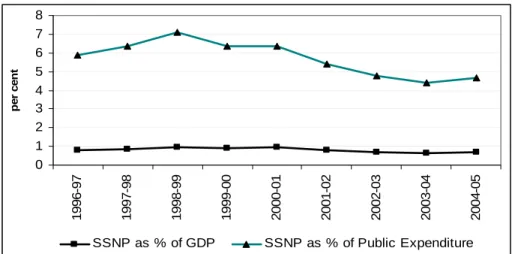
In the case of Bangladesh, in monetary terms, extent of safety net programmes is gradually increasing over the years. However, in terms of share of public expenditure,
investment on safety nets has been falling since 1998/99, against the increasing number of people below the poverty line. On the average, during 1996/97 to 2004/05, Bangladesh has been spending on SSNPs to the tune of 0.8 per cent of the GDP and 5.7 per cent of the total public expenditure (based on World Bank assessment of Bangladesh’s safety nets). It is pertinent to mention here that actual expenditure data on SSNPs is not provided by the government. In the absence of such information, as in other literature available on SSNPs of Bangladesh, expenditure figures mentioned here represent allocations made by the government.
FIGURE 1: SSNP OF BANGLADESH AS % OF GDP AND PUBLIC EXPENDITURE
0 1 2 3 4 5 6 7 8 1996-97 1997-98 1998-99 1999-00 2000-01 2001-02 2002-03 2003-04 2004-05 p e r cen t SSNP as % of GDP SSNP as % of Public Expenditure
Source: Based on World Bank (2006).
However, very recently, more specifically during the fiscal years of FY2007 and FY2008, higher targets have been fixed for providing social security of the poor.
TABLE 3: AVERAGE EXPENDITURE (ALLOCATION) ON SSNPS
(In Crore Tk) Avg 1996-97 to 2000-01 Avg 2001-02 to 2004-05 Avg 2006-07 to 2007-08 1947 2270 7053
Source: WB (2000) and budget documents of GoB.
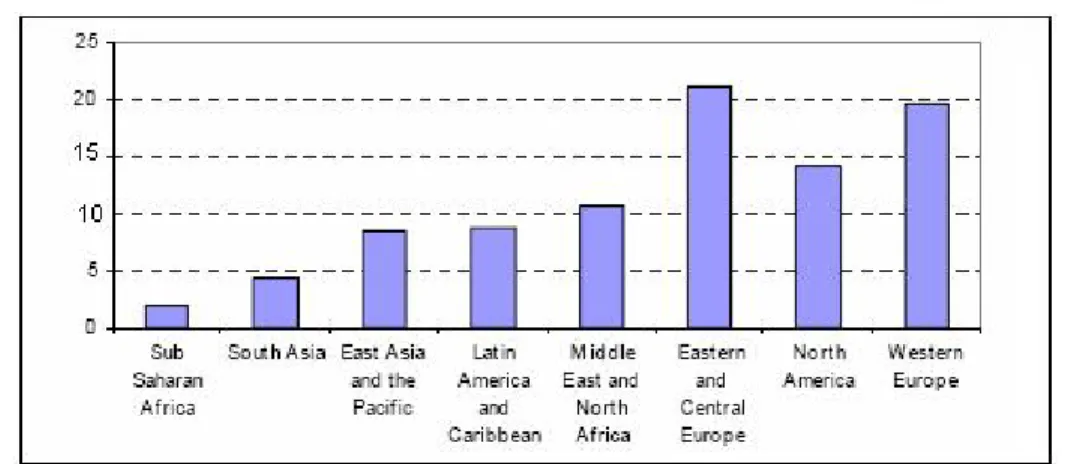
Even with the increased expenditure during the recent two years, Bangladesh seems to be spending far less than the expenditure of other regions identified by the World Bank assessment.
FIGURE 2: INTERNATIONAL EXPENDITURE ON SOCIAL PROTECTION (AS % OF GDP)
Source: World Bank (2006).
According to the annual targets, about Tk 5,700 crore was allocated in the budget for 2006/07 (1.4 per cent of GDP and 9.3 per cent of total public expenditure) and about Tk 8,400 crore has been allocated in the budget for 2007/08 (1.8 per cent of GDP and 12.1 per cent of total public expenditure).
4.2 Structure of Safety Nets
Programmes under the safety net of Bangladesh can be classified into different categories considering different criteria. Keeping in mind the nature and intensions of different programmes, we categorised the safety net programmes of Bangladesh into some broad dimensions like education, health, vulnerability reduction, employment creation, risk reduction, etc. However, a different categorisation is also possible and programmes may overlap between them. The overall structure of safety net evolves from the past and usually do not radically change in subsequent years. Each year safety net allocations are made in the national budget, mostly indicating carryover of programmes from the previous year with few adjustments or inclusions. The following structure is based on the safety net programmes as have been targeted in the national budget of FY2008.
A major portion of the support through safety nets is provided as food assistance, covered through different categories of programmes like direct feeding programmes, employment creation programmes and others. Transfers in the form of food support constitute almost 18 per cent of the total safety net spending. However, apart from this food support, there is also food subsidy included in the safety net programmes of Bangladesh which is more or less evenly targeted among different income deciles. What is acting as a barrier for the non-poor to participate is the social status issue, as the non-poor groups are usually reluctant to stand in line to get the limited offer per person a day. While the fact is that free or subsidised food distribution has been a popular choice politically in the low income countries over cash, what is needed to be kept in mind is that it is recognised in
the literature that untargeted food transfers/subsidies usually tend to prove fiscally unsustainable with gradual increase in cost. Free or subsidised food distribution also tends to distort markets, create dependency, and involve large inclusion errors and leakage to the non-poor. However, the justification for food assistance is that society as a whole considers it unacceptable for people to be living below the food poverty line owing to the threat of starvation (Smith and Subbarao 2003).
Education
As the GoB documents states, safety net programmes relating to education of the poor targets increasing the number of primary school enrollment, reducing drop outs as well as increasing female student enrollment at secondary schools. There are long term social development targets as well like reducing incidence of under age marriage by educating the poor female children. More than 11 per cent of the total safety net is dedicated to education programmes.
The choice varies between countries regarding the mode of transfers (cash or food) for bringing the poor children to the school. In most of the low-income countries, food is provided to the students either through school feeding or by providing packs of food grain to the families. Bangladesh has discontinued food assistance in education programmes and gone for cash support as feeding programmes usually suffer from large inclusion errors because of the difficulties in feeding only the poor in a given class, as well as leakages.
The safety net coverage includes special education programmes for special vulnerable children like orphans or disabled. However, the share of this special support is only about 4 per cent of the total education programme. Apart from the Mosque Based Child and Mass Literacy Programme covering 30,000 centers from where the service is provided, the whole education programme under safety net covers about 9 million children per year.
Health
Surprisingly, safety nets on health in Bangladesh constitute only a little more than 2 per cent of the total protection. The health programmes particularly focus on nutritional protection of women and children. However, a study by Hossain and Osman (2007) mentions somewhat satisfactory performance of the country in improving health situation during the 1990s infant mortality falling below that of India. Based on a World Bank study of 2005, the report said that the expansion of public and NGO health services together appears more generally to have been critical factors driving these gains.
Three programmes are there in the safety nets to provide health support to the poor. Major programme in health includes Health, Nutrition and Population Sector Programme (2003-2010). The programme is the modified version of Health and Population Sector Programme (1998-2003). Two out of the three 3 health programmes under the safety nets are being implemented under this HNPSP programme.
Vulnerability Reduction
There is well justification in support of programmes targeting the vulnerable groups like adged, widowed and others and there is also scope for targeted cash transfers within the specific groups. These groups are generally accepted, even demanded, by the society as deserving candidates of support with recognition of correlation between poverty and their vulnerability.
Safety net programmes of Bangladesh give special consideration for the vulnerable groups within the poor. These groups include aged poor people, widowed or deserted women, disabled persons and others. Bangladesh safety net programmes also provide support to the insolvent or wounded freedom fighters.
Without the Food Aid for Chittagong Hill Tracts programme and the honourarium programme for wounded freedom fighters, the total beneficiaries per year exceeds 3.5 million through these programmes, covering about 16.5 per cent of the total safety net in monetary terms. Other than the programme for Chittagong Hill Tracts and the vulnerable group development (VGD) programme providing support in kind, all programmes distribute cash among the beneficiaries.
Employment Creation
Measures that are seasonally targeted can potentially have a major welfare benefit for the poor, especially for agriculture dependent third world country like Bangladesh. Like most very low-income countries, a majority of the poor population in Bangladesh are dependent on their own production of basic food crops. As a result, geographic and environmental factors cause loss of welfare for the people of some of the areas in the mean seasons. Therefore, even though employment programmes are a relatively expensive way of making transfers and managerially complex compared to pure transfer programmes (Smith and Subbarao 2003), they play a vital role in the social protection of a country.
Apart from other micro credit programmes that also aid employment generation, 8.6 per cent of the total safety net of Bangladesh for FY2008 goes to creating employment opportunities for the vulnerable poor. While there are programmes to bring the extreme
poor to the production process through employment, programmes are there as well to create employment opportunities for those who suffer from seasonal unemployment due to geographic and environmental concerns. “Monga” affected areas in northern Bangladesh have been given special attendance in this regard. These areas yield only one or sometimes two annual harvests in contrast with three crops per year in more fertile areas of the country. Employment opportunities, particularly for the landless and the poorest segment participating in agricultural wage labour, are limited from September to December in average years.
Food for Work (sometimes cash for work) is a traditional safety net programme in the country. It is arguably best to opt for self-targeted workfare because the intervention minimises the tradeoff between investment in growth and safety nets through infrastructure building. There is also programme to develop small entrepreneurs. Regarding employment programmes, ensuring non-participation by the non-targeted population is of concern and calls for self-targeting mechanism with employment at a lower than market wage. Works programme of Bangladesh provide Tk. 100 or 6 kgs of grain a day which fulfills this consideration.
BOX 1: EMPLOYMENT GENERATION SCHEME: A CASE STUDY OF INDIA
One successful case of employment generation through conditional cash transfer programme is the employment generating scheme in rural India. The National Rural Employment Guarantee Act (NREGA) was enacted by the government of India during August 2005. Under this programme the government aimed to provide wage employment to the adult members of the poor families in selected rural areas for a minimum of 100 days per year with minimum wage pegged at Rs 60 per day. Estimates show that this programme could cost the government an amount equivalent to about 2 per cent of the country’s GDP. About 2.25 billion dollar had been allocated for the programme for the year 2006-2007. At the initial phase, about 200 districts of India were planned to be covered under the programme. Under the NREGA, special allowances are to be provided to the households in case a job is not provided within fifteen days of receiving the application.
The scheme came into effect in February 2006. According to the national bulletin for NREGA, the total number of employment that has been demanded so far is 2.69 crore, out of which 2.66 crore jobs have been provided till now. While measuring the success of the scheme, it has been found that the demand for work under the programme since its inception remained the same despite the rise in population throughout the period. The programme has been an effective one since it has been preserved as an act in the parliament. Thus, all the states are bound to participate in it. Since there is no stringent rule for eligibility for receiving the scheme, anyone within the specified area can apply.
The simplicity of the task involved for the programme is one of the main reasons behind its success, although a number of criticisms do prevail about its effectiveness and affordability. Not only in the administrative and managerial part, those who want to avail the opportunity do not need to go through a lot of hassle since there is no particular require as to who can apply or not. There are also list of choices available through detail lists of available tasks that cover building local kacha roads, culverts, strengthening embankments, de-silting irrigation canals, ditches and so on (Harper 2006 and http://en.wikipedia.org/wiki/National_Rural_Employment_Guarantee_Act
Special Risk Reduction
Risk reduction is increasingly seen as the primary function of public safety nets (Holzmann and Jorgenson 1999). The objective of such programmes is to help the households withstand sudden shocks or disasters and avoid steep fall in consumption. This calls for action in different phases; direct support is provided after the shock or disaster; preventive support is provided before the occurrence of such shocks. Support may also be provided by allowing them to take on “riskier,” but higher return activities in the rehabilitation phase.
Bangladesh bears serious consequences from natural calamities, the poorest segment being the worst victim. In 2007, the country faced two floods and a devastating cyclone. During the disaster affected years, the expenditure on safety nets regarding such shocks usually exceeds the initial allocation. Safety net for the FY2008 keeps Tk. 1,505 crore for disaster related activities, which is about 18 per cent of the total. Major programmes include Vulnerable Group Feeding (VGF), Test Relief, immediate disaster fund and GR (Gratuitous Relief) programmes that are targeted to provide direct and immediate support to disaster victims. A fund for small farmers who are victims of disasters is kept to assist them in returning to normalcy after the disaster.
Micro-credit
Reputation of the NGOs of Bangladesh in providing micro-credit to the poorest segment of the society played a role to ensure government-NGO collaboration in poverty reduction efforts. Safety net programmes in micro-credit is one such example. While transfers in the form of micro-credit are carried out by the Palli Karma-Sahayak Foundation (PKSF), the government runs credit programmes through NGOs as well. Tk. 238 crore micro-credit programmes (about 3 per cent of the total safety net) for FY2008 include Tk. 218 crore to be distributed by the NGOs and Tk 20 crore for the self-employment of women through government ministries.
Subsidy
Largest share (34.5 per cent) within the total safety net goes to subsidies for the poor. Within the subsidy programmes, 24.7 per cent is provided as food subsidy while the rest are provided as electricity and fuel subsidy. Food subsidy is considered as direct support to the vulnerable groups justified by the shortfall of food production of the country and associated price hike in food items. The energy and fuel subsidy on the other hand is growth oriented, providing inputs towards future production and long-term food price support with the expectations to ensure poor farmers with access to production inputs. Regarding other types of subsidies, one of the intentions of safety nets is considered to be assisting the vulnerable groups in adjusting with any possible adverse implications of macroeconomic policy changes. Social safety net programmes designed for FY2008 include Tk 750 crore subsidy for marginal farmers (within the total subsidy of Tk 2990
crore kept as safety nets) aiming at such intentions as electricity price adjustment was undertaken in FY2007.
Apart from the programmes that fall within these broad categories, there are other programmes of Tk 445 crore including Agriculture Research Fund, Training Fund for RMG Workers, Workers Welfare Fund and Fund for housing of the homeless. Overall, the structure of the SSNPs of Bangladesh indicates that poverty reduction and social protection of the poor have been well linked with growth facilitation through infrastructure development and employment generation.
4.3 Programme Choices (Cash Vs Kind transfers and Conditional Vs Non-conditional Transfers)
Policymakers usually prefer transfers in kind over cash in most of the low-income countries. It is a general perception that the hardcore poor in need of social protection suffer from starvation and need food support more than anything else. Even though cash can be more efficient for some programmes, it is generally hard to sell politically. Bangladesh, however, seemed to have evolved through a more positive way. About 75 per cent of the transfer is made in cash. Programmes that have shown weaknesses in kind support, for example Food for Education, have been converted into cash. Hossain and Osman (2007) have identified the five types division of cash and kind transfers through the safety net programmes of Bangladesh (Table 4):
TABLE 4: MAIN TYPES OF SAFETY NET PROGRAMMES IN BANGLADESH
Type Programme Examples
Cash transfers
Conditional cash transfers
Public works or training based cash or in kind transfer
Emergency or seasonal relief
Old Age Allowance
Widowed and Distressed Women Allowance Disabled Allowance
Primary Education Stipend Programme (formerly Food-for-Education)
Stipends for Female Secondary Students
Rural Maintenance Programme Food-for-Work
Vulnerable Group Development (VGD)
Vulnerable Group Feeding (VGF) Gratuitous relief Test Relief
BOX 2: SOME SUCCESSFUL CONDITIONAL/UNCONDITIONAL CASH TRANSFER PROGRAMMES
Much of the success story of safety net programmes is attributable to the conditional cash transfer programmes commenced in South America. “Progresa” a conditional cash transfer (CCT) programme launched in Mexico and expanded to other South American countries like Brazil and Argentina has been the best known programme of this sort so far. Transfer under this programme takes place upon conditions that children within the recipient families attend school and go for regular medical check ups. In addition to these, the programmes are directed towards women for ensuring higher bargaining power assuming them to be the prime care giver to the children. Studies have found out that Progresa along with ensuring education to children has improved the nutritional intake of the children (Aguero et al 2006).
“Red Solidaria” in El Salvador is a unique example of how a small country with limited resources can set up a successful CCT programme that is complex in nature. RED’s overarching goal was reducing intergenerational transmission of poverty in El Salvador. This CCT have been designed following pioneer programmes in Brazil and Mexico. The programme’s components include Cash transfer for families with pregnant women and children under 15 who have not completed 6th grade, conditional on basic health care services and school attendance, supply-side programmes in education (Effective Schools Network), health and nutrition (Extension of Health Services), and improvements and rehabilitation of basic and strategic infrastructure (drinking water, sanitation, electricity and rural roads) and promotion of productive projects and micro-credit schemes in the targeted municipalities. The programmes objective is to make short run improvement in child, maternal health and nutrition, basic education and drinking water, sanitation, electricity supply and roads to the remote areas of the country. The focus of this programme very clearly is human capital investment.
A similar programme had been introduced in South Africa during the same period. Although the programme was directed towards women like Progresa and other Latin American programmes, the Child Support Grant (CSG) was distinct in one feature. This programme was unconditional and involves no in kind transfers. The programmes target was to improve on both mental and physical development in the long run. Aguero et al (2006) have shown that the unconditional CSG programme has improved early childhood nutrition. Though it can be assumed that conditioning would boost the effectiveness of the programme even further, but the effectiveness of the programme has been massive. One explanation behind this is that the fund is provided to women whose choices are more likely to be child centric. One argument that can be raised here while choosing an unconditional cash transfer programme as opposed to a conditional cash transfer programme is that the conditioned programmes involve huge administrative cost which is not always viable for developing countries or LDCs to bear.
Unconditional transfer dominates safety net programmes of Bangladesh with about 69 per cent of the total transfer belonging to the category. Mostly the larger programmes in education, disaster programmes, public works and programmes related to vulnerability reductions through employment generation involve conditional transfers.
4.4 Success in Reaching the Potential Beneficiaries
According to the HIES 2005, Safetynet programmes mainly target the population categorised as “Very Poor.”
TABLE 5: TARGETING CRITERIA USED BY SAFETY NET PROGRAMMES
Criteria % of total beneficiaries
Very poor 61.55 Widow, separated 7.78 Landless 7.12 No earner 1.58 Crippled 0.35 Disabled/illness 1.52 Old age 5.58 Freedom fighter 11.82 Other 0.49 Source: HIES 2005.
However, as identified by various studies, there are some clear indications of leakages. Following are some of such evidences:
Twenty-seven per cent of VGD beneficiaries are not poor (World Bank assessment).
Eleven per cent of participants of the PESP (Primary Education Stipend Programme) meet none of the eligibility criteria for programme participation.
None of the beneficiaries meet at least three criteria.
Almost 47 per cent of beneficiaries of the PESP are non-poor and incorrectly included in the programme.
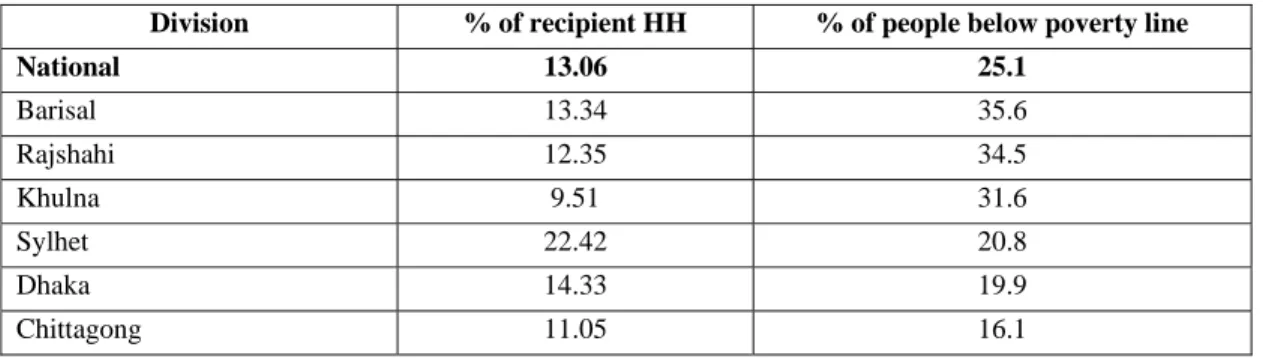
Regional targeting has been one approach of safety net programmes of Bangladesh. Seasonal Unemployment Reduction Fund kept in the safetynet programme of FY2008 is supposed to target regions characterised by high and seasonal poverty incidence. However, little evidence on effective addressing of regional issues is found in the overall SSNP design. As the findings from the HIES 2005 suggest, in regions with high poverty incidence, in terms of per centage of population below the poverty line, per centage of recipients household is less than the regions with lower poverty rate.
TABLE 6: REGIONAL POVERTY AND BENEFICIARIES OF SAFETY NET PROGRAMMES
Division % of recipient HH % of people below poverty line
National 13.06 25.1 Barisal 13.34 35.6 Rajshahi 12.35 34.5 Khulna 9.51 31.6 Sylhet 22.42 20.8 Dhaka 14.33 19.9 Chittagong 11.05 16.1 Source: HIES 2005.
4.5 Impact Assessment of SSNPs on Poverty of Bangladesh
Social safety net is especially designed and implemented for the poor and the vulnerable groups of the society. However, the implication of SSNPs on poverty is often remained untouched. In recent times a number of countries and international agencies initiated researches to find out how SNPs can effectively work for the poor. However, in Bangladesh such initiatives are somewhat limited. One of the major constraints is placed from the inadequacy of necessary information and data. At national level, a survey regarding social safety net has yet to be commenced.
HIES is especially designed to analyse the living standard related statistics at the household level. The survey also covers information on social safety net partially, considering the programmes that directly transfer money (or kind) to a household and considered as a source of income. As a result, the resource transferring programmes and other subsidy supports are not included in the survey. At present micro-credit and other resource transfer programmes are important parts of the social safety net structure in Bangladesh. Nonetheless, the data provided by HIES can be useful to understand the direct effect of social safety net on poverty reduction. Since benefits from SSNPs are accounted as a part of income of the household, using the conventional measures of poverty based on household consumption, such as Cost of Basic Needs (CBN) and Daily Calorie Intake (DCI), cannot be compared as a reflection of SSNPs. For this purpose, this study proposes a threshold of income poverty based on the consumption poverty line used in the HIES 2005 and adjusted for income. The exercise then aims to find how the recipient households find their positions along income poverty threshold in the absence of safety net.
TABLE 7: IMPACT OF SSNP ON POVERTY
Region Change in Poverty due to SSNP (%) Population (Thousand)
National -0.15 215
Rural -0.20 210
Urban -0.01 5
Source: Authors’ calculation based on the HIES 2005.
Table 7 shows that safety net definitely has a positive impact in bringing people out of the poverty line. Under the circumstances table 7 suggests that in 2005 among the beneficiaries, safety net programmes contributed to 0.15 per cent people transferring above the poverty line. In numbers that is equivalent to 215 thousand people. However, the contribution has mainly made to the rural population. This is quite obvious from the fact that 90 per cent of the total safety net programmes is directed towards the rural area. Nonetheless, such a small impact of SSNP on poverty can be explained from the fact that expenditure on safety net as share of total public expenditure is very negligible and
declining further (World Bank 2006). As a result, overall share of social safety net in household income is also insignificant.
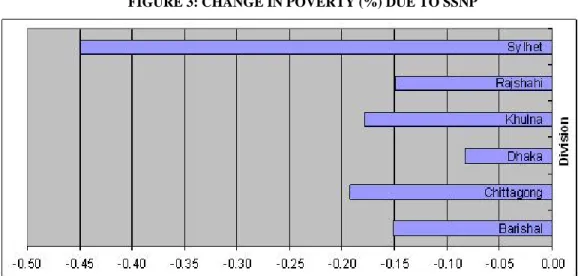
FIGURE 3: CHANGE IN POVERTY (%) DUE TO SSNP
Source: Authors’ calculation based on the HIES 2005.
At division level, SSNPs were most successful in Sylhet to bring people over the poverty line, followed by Chittagong and Khulna. The contribution of VGD programme in the Sylhet division is clearly evident from figure 3. Average amount received per recipient from the VGD programme in Sylhet division stood at Tk. 1,686 in 2005. Whereas Chittagong division is an exception; it is covered with almost all programmes under the consideration. Unfortunately, these two divisions are among the less poverty prone areas in the country, following Dhaka. Considering that Dhaka has the highest share of people under the poverty line. Even though poverty incidence is least in percentage terms, it can be argued that SSNPs in Bangladesh need to be restructured in dealing spatial poverty. However, one may also need to recognise that HIES is not adjusted to seasonal shock. Supporting poor during seasonal and natural shock is a key guideline of social safety net. With a more dedicated survey focusing the safety net issue could have outlined a closer understanding about the safety net’s impact on poverty.
Among the recipients, only 71.51 per cent households can be considered poor according to the abovementioned income threshold drawn for this study. Even if the households’ status is considered in absence of social safety net, the figure may only increase to 72.61 per cent. This reflects that the existing (for the year 2005) safety net left behind a more deserving section of the society. Even if one tries to adjust these figures with different poverty lines, the picture may not change to a large extent.
4.6 Inequality Effect of SSNP
The rising trend in inequality has frustrated the recent “somewhat” improving poverty scenario. Over the years the academics around the world have been arguing on the
relationship between poverty and inequality. However, a number of studies concluded that inequality can influence the poverty structure in two ways–the initial low level of poverty can initiate the responsiveness of poverty to a given rate of income growth (Ravallion 2004) and at the same time changes in inequality during a growth spell affect the poor benefiting from a given level of growth (Bourguignon 2004). Kraay (2005) demonstrated that in the short run income growth accounted for just over two-thirds of the changes in relative incomes, and inequality or distributional change for the rest. Thus in any poverty discourse inequality issue is considered as an essential agenda.
To sketch out the underlying sources of inequality among the economic activities is a common exercise that addresses distribution of growth among different sectors of the economy. The decomposition of Gini ratio reveals the underlying sources of inequality. The methodology suggested by Fei, Ranis and Kuo (1978), Fields (1980), Kakwani (1980) and Lopez-Feldman (2006) is followed here. Similar to deriving a Lorenz distribution of income, “Pseudo-Lorenz distribution” can be derived for each component of income. The pseudo-gini ratio (or concentration ratio) for particular income component can be estimated from respective pseudo-Lorenz distribution. Whereas the Gini ratio is derived from the weighted average of all concentration ratios. Here the share of respective components in total income is considered as the weight.
A number of similar attempts have been made to analyse sources of inequality in Bangladesh. Khan and Sen (2001), Osmani et al. (2003) and Khan (2006) concluded that social safety net is one of the rare equalising sources of income. Recently Bhattacharya and Khan (2008) sought the sources of inequality based on the HIES 2005. However, their study has brought a small change in the calculation of economic activities’ contribution to overall inequality. Contrary to the earlier studies in place of using
population, this paper used household groups in their calculation. This study also advocated that social safety net can be an important policy tool to address inequality. Soares et al. (2007) estimated the inequality reducing effect of the CCT programmes in Brazil, Mexico and Chile and found significant impact of such safety net programme in subsiding inequality. As an impact of this program the Brazilian and Mexican Gini index fell 2.7 points which is equivalent to a decline of 21 per cent. Due to its small size the Chilean programme led to a decline of 0.1 per cent point in the Gini index leading to a 15 per cent decline in inequality. Such achievement is attributable to the outstanding targeting of these programmes.
In this paper an attempt has been made to extent the work of Bhattacharya and Khan (2008) at disaggregated level. However, the discussion here will focus only on the social safety bet issues. Table 8 summarises SSNP’s contribution to overall inequality.
TABLE 8: SSNP’S CONTRIBUTION TO INEQUALITY
Region (1) Overall Gini (2) Pseudo Gini (3) Share of Total Income (%) (4) Contribution to Inequality (5) % Change (6) National 0.491 -0.351 0.11 -0.08 -0.002 Rural 0.462 -0.320 0.16 -0.11 -0.002 Urban 0.512 -0.332 0.05 -0.03 -0.002
Source: Authors’ calculation based on the HIES 2005.
Column (2) reports the overall Gini ratio whereas column (3) shows the Pseudo Gini. The overall inequality scenario is found worse in rural area compared to urban area, however considering the distribution of SSNP is quite similar in both regions. An income component (here SSNP) having a lower (higher) contribution to inequality referred in column (5) compared to its share in total income reported in column (4) is equalising (disequalising). Thus it is found that SSNP regardless of the region considered proved to be highly equalising component among the sources of income in the context of Bangladesh. The last column of Table 8 (column 6) explains the impact that a 1 per cent change in the respective income source will have on inequality. The “elasticity” figures do not give an impressive expression. This can be explained from the fact the SSNP component of the income comprises a very negligible share in overall income. In particular, in urban area SSNP has a very small influence on the income component. Bhattacharya and Khan (2008) also raised the point commenting that the coverage of SSNP in Bangladesh is highly rural biased since only 10 per cent of the SSNP is allocated in urban area. Considering that almost one-third of the hardcore in 2005 lived in urban area, allocation of SSNP needs to be revisited.
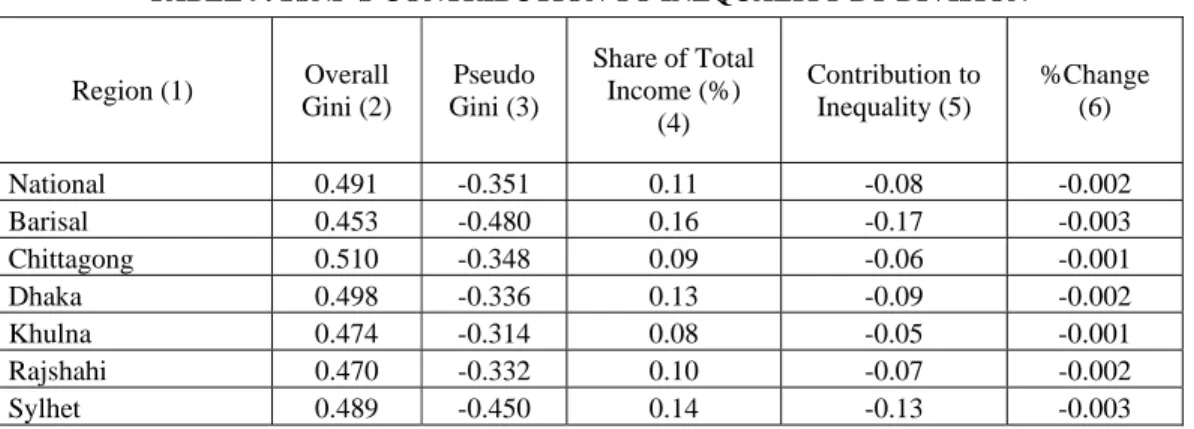
TABLE 9: SSNP’S CONTRIBUTION TO INEQUALITY BY DIVISION
Region (1) Overall Gini (2) Pseudo Gini (3) Share of Total Income (%) (4) Contribution to Inequality (5) %Change (6) National 0.491 -0.351 0.11 -0.08 -0.002 Barisal 0.453 -0.480 0.16 -0.17 -0.003 Chittagong 0.510 -0.348 0.09 -0.06 -0.001 Dhaka 0.498 -0.336 0.13 -0.09 -0.002 Khulna 0.474 -0.314 0.08 -0.05 -0.001 Rajshahi 0.470 -0.332 0.10 -0.07 -0.002 Sylhet 0.489 -0.450 0.14 -0.13 -0.003
Source: Authors’ calculation based on the HIES 2005.
Table 9 suggests that the level of income inequality varies at division level. Interestingly, the less poverty prone divisions suffer from more soaring income distribution. This finding reveals that the growth friendly components of income in Bangladesh are rather disequalising. Nonetheless, dissimilarity in distributional pattern has no effect on the SSNP’s role in income inequality. Across all the divisions, SSNP is found to be strongly
equalising component of income. The gini decomposition also suggests that in Barisal and Sylhet divisions SSNP played more influencing role to content income inequality. However, SSNP’s share in total household income also shows that in these two divisions SSNP restored more importance as a component of household income in 2005 compared to other divisions, even though the figures are also very insignificant.
Since the 1990s the growth of the economy started to find some momentum and that has also reflected in the poverty profile of the country. However, during this period escalating income inequality has also turned out a foremost policy obligation. The above analysis confirmed that social safety net can be a handy option to restore income distribution from further deterioration.
BOX 3:VIETNAM: A WIDELY KNOWN SUCCESS STORY IN POVERTY REDUCTION
One country that has to be brought into light when successful poverty reduction is concerned is Vietnam. Drastic reduction in poverty took place in the country between 1993 and 2002. Poverty reduced from 58.1 per cent to 28.9 per cent during this period. Much of this success is attributed to the programme named “Doi Moi” or renovation launched in 1986 that profoundly changed the way social services were delivered.
The major blow in poverty eradication came about as a result of improvement in rural living standard through employment generation by means of agricultural diversification. Existing literature states that historically the agricultural diversification programme has been the most successful poverty reduction strategy in Vietnam. Household income saw a 60 per cent growth during the tenure between 1993 and 1998. Thus success in poverty reduction in Vietnam has more been a result of the strategic transformations that took place in the economy through “Doi Moi” rather than the safety net programmes that have been undertaken so far.
By poor country standards Vietnam has an extensive social security and safety net programme. The share of government spending directed to social services has remained steady at about 30 per cent since 1994. Vietnam’s modern social security systems include three basic elements: Social insurance for covering risk of unemployment, illness, means-tested social assistance, designed to relieve hardship and provide economic support to vulnerable groups through public (cash and in kind) transfers and categorical transfers, which provide additional resources for social relief (World Bank 2000).
Existing social assistance schemes do not reach all of the poor, but only those who are experiencing extreme hardship. Social assistance policies include Social Guarantee Fund for Veterans, War Invalids and others provide special transfers from the Social Guarantee Fund for Veterans and War Invalids, and cover around two to three per cent of the population. The National Targeted Programme on Hunger Eradication and Poverty Reduction (NTP) provides support for infrastructure development, subsidised production credit; agricultural, forestry and fishery extension services, upland populations; and health care, education and housing support to poor communities. Taken together, the NTP and Programme 135 have delivered substantial resources to poor communities, and in view of the fact that many of the target communes are located in isolated, upland areas and populated by ethnic minorities, it is likely that the programmes have contributed to social stability. Seventeen per cent of Vietnamese households have access to subsidised credit. Less than ten per cent of households have access to free health insurance and about 20 per cent received tuition fee exemptions. Social Guarantee Fund for Regular Relief covers about 0.32 per cent of the total population, including the homeless elderly, orphans and the seriously disabled poor. Contingency Fund for Pre-Harvest Starvation and Disaster Relief provide aid to disaster-struck areas, and to provide short-term assistance to the poor, usually in the form of food aid (or cash to buy food) during the pre-harvest slack season (Walle 2002, Walle 2003).
5. CONCLUSION AND POLICY SUGGESTIONS
There is nothing like an ideal or universal safety net programme design that can be guaranteed for successful poverty reduction. While most countries use indirect transfers in the form of subsidies, a large number of safety net programmes are conducted through direct transfer programmes. Among these, the conditional cash transfer programmes have been successful and replicated in a number of countries while following the same route the unconditional cash transfer programmes in some other countries have also yielded positive results. On the contrary, despite having any particular highly successful safety net programme, Vietnam’s poverty reduction strategy through various policy variables and more particularly through agricultural diversification has managed to set a benchmark in this area. This actually points out the need for a coordinated policy framework for poverty reduction along with effective implementation of the safety net programmes.
The first phase of the PRSP (phased out in 2007) of Bangladesh gave significant importance on the role of safety net in poverty reduction. In fact, safety nets have been treated as one of the four strategic blocks in fighting poverty (Government of Bangladesh 2005). The extended PRSP for FY2008 also similarly emphasises on safety nets in poverty reduction efforts. In view of the identified poverty and inequality impact of safety nets in this study, an increased allocation is well justified since per capita benefit received by the poor is still very small in assisting them to get out of poverty permanently. On the other hand, the coverage is by far less than exhaustive (Government of Bangladesh 2007 a).
A well judged choice on modality is crucial for providing social protection in a country like Bangladesh. With the absence of an optimum mix, the government should opt for more to cash as the mode of transfer in view of the efficiency as well as the inbuilt flexibility that cash contain for the poor in its utilisation. However, in case of risk management, distribution of in kind would be the preferable choice since the nature of disasters in Bangladesh causes starvation more than anything else and mere survival becomes the prime concern. Regarding conditional vs non-conditional transfers, even though the performance of CCTs is well depicted in other countries, resorting only to conditional transfers will be no option for Bangladesh. While unconditional transfers will have to be there for the old and the disabled (the vulnerable groups) and disaster victims, conditional transfers can prove to be a useful tool in relating growth (through infrastructural and human resource development) and poverty reduction. Taking the lessons from other countries, conditional transfers might also help in child nutrition along with the ongoing education programmes. Keeping in mind the declining enthusiasm in
population programmes, an effort to device a method linking it with conditional transfers might prove to be praiseworthy.
One important aspect of safety net programmes demanding improvement in Bangladesh is the “regional disparity” issue. Uneven distribution of wealth and variation in poverty incidence between regions have to be incorporated in targeting the poor. Employment creation in Monga areas in a more permanent basis should be emphasised. At the same time, the growing urban poverty needs to be taken into account and social protection for the urban poor needs to be improved. One concern would be the food subsidy. In view of the steep rise in food price, the subsidy programme should continue with due address to the growing number of lower-middle income group (who does not really belong to below the lower poverty line) resorting to subsidised distribution of food grain.
Financing post disaster security programmes among the victims is always a big issue for a government of a third world country like Bangladesh, calling for donor assistance. However, for other types of safety nets, financing should depend on domestic resources as much as possible since donor contribution to safety nets tends to be discontinuous or not lasting for long being replaced by other initiatives. This may result in loss of efficiency, a scarce resource for any developing country, gained by the implementing authorities from the previous programme. Moreover, often the donor driven programmes are not based upon requirement, rather on what is available from them. Lack of coordination among the funding partners also hold the chance of overlapping target groups, while some of the potential beneficiaries may remain outside the net.
Most important issue would be to manage leakages in transferring resources to the poor. Along with administrative reforms, this will call for better targeting. Avoiding participation of non-poor in the transfers requires self-targeting mechanism, along with community targeting, to be in place as much as possible. The local government bodies will need to be strengthened and work closely with potential beneficiaries to further enhance the targeting efficiency.
All together, a national policy on Social Safety Net will have to be developed with particular focus on strategic options for channeling aid to the safety nets and modality as well as targeting options. The national policy will need to be characterised by its promotional role in public-private collaboration in providing social security. At the same time, it will facilitate a common aim and understanding between political regimes to avoid change of nature and means of safety nets with the change of government.
Obviously, poverty reduction is not confined to, rather supplemented by, safety nets. However, safety nets undoubtedly are vital options to fight damages from natural disasters and for preventing transmission of poverty from generation to generation in the long run. While, on the one hand, the safety nets provide immediate relief during emergencies, by ensuring employment, education and nutritional intake of the poor, these programmes can often play a leading role in addressing poverty and inequality in the long run. Success of any such attempt will depend on how, where and for whom the government decides to design the safety net programmes. There are a lot of lessons to be learnt from the various successful conditional and unconditional transfer programmes taking place in South America, Africa and India. Successful replication of such programmes in the Bangladesh context may help to identify safety net programmes that can leave radical impact on poverty reduction in Bangladesh.
References
Aguero, J. M., Carter M.R. and Woolard I, (2006). The Impact of Unconditional Cash Transfers
on Nutrition: The South African Child Support Grant. DFID and USAID, USA.
Alderman, H. (2002). Subsidies as a Social Safety Net: Effectiveness and Challenges. The World
Bank, Washington.
BBS. (2005). Household Income and Expenditure Survey, BBS, Dhaka.
Bhattacharya, D. and Khan, T.I. (2008). Pro-poor Economic Growth in Bangladesh: Exploring
Growth and Inequality Linkage in Poverty Reduction. In ‘Emerging Issues in Bangladesh
Economy.’ CPD and UPL, Dhaka.
Bourguignon, F. (2004). The Poverty-Growth-Inequality Triangle. Paper presented at the Indian
Council for Research on International Economic Relations, February 4, 2004, in New Delhi, India.
Devereux, S. (2002). Social Protection for the Poor: Lessons from Recent International
Experience. IDS Working Paper 142. Institute of Development Studies, England.
Fei, J.C.H., Ranis, G. and Kuo, W.Y. (1978). Growth and Equity: The Taiwan Case. New York:
Oxford University Press.
Fields, G.S. (1980). A Compendium of Data on Inequality and Poverty for the Developing World.
Ithaca, New York: Cornell University Department of Economics.
Gentilini, U. (2007). Cash and Food Transfers. A Primer. World Food Programme, Rome, Italy.
Government of Bangladesh. (2005). Unlocking the Potentials: National Strategy for Accelerated
Poverty Reduction. General Economic Division, Government of Bangladesh.
Government of Bangladesh. (2007). Expenditure on Social Safety Nets. Budget documents for
FY2008, Bangladesh.
Government of Bangladesh. (2007a). Unlocking the Potentials: National Strategy for Accelerated
Poverty Reduction (extended up to June 2008). General Economic Division, Government of Bangladesh.
Harper, M. (2006). The Indian National Rural Employment Guarantee Act: How the Chars
Livelihood Programme can Learn from it. Bangladesh.
Hossain N. andOsman F. (2007). Politics and Governance in the Social Sectors in Bangladesh,
1991-2006. Research Monograph Series No. 34, BRAC, Dhaka.
Kakwani, N. (1980) “On a Class of Poverty Measures,” Econometrica 48: 437-446.
Kakwani, N., Neri M. and Son H.H. (2006). Linkages Between Pro-poor Growth, Social Programmes and Labour Market: The Recent Brazilian Experience. International Poverty Centre, UNDP, Brazil.
Khan, A.R. (2006). Rising Inequality in Bangladesh: An Analysis of Sources and Policies for
Containment, In Ahmed S., and Mahmud W. (Eds) Growth and Poverty: The
Khan, A.R. and B. Sen (2001). “Inequality and Its Sources in Bangladesh, 1991/92 to 1995/96:
An Analysis Based on Household Expenditure Surveys,” The Bangladesh Development
Studies, Vol. XXVII, No.1.
Kraay, A. (2005). “When Is Growth Pro-Poor? Evidence from a Panel of Countries,” Journal of
Development Economic, prepared as part of the Operationalizing Pro-Poor Growth Research Program.
Lopez-Feldman, A. (2006). “Decomposing Inequality and Obtaining Marginal Effects,” The Stata
Journal 6(1): 106-111.
Osmani, S. R., Mahmud W., Sen B., Dagdeviren H. and Seth A. (2003). The Macroeconomics of
Poverty Reduction: The Case Study of Bangladesh. The Asia-Pacific Regional Programme on Macroeconomics of Poverty Reduction, UNDP.
Ravallion, M. (2004). “Pro-Poor Growth: A Primer”. Policy Research Working Paper 3242. World Bank, Washington, DC. Prepared as part of the Operationalizing Pro-Poor Growth Research Program.
Smith, W.J. and Subbarao K. (2003). What Role for Safety Net Transfers in Very Low Income
Countries? Social Protection Unit, Human Development Network, the World Bank.
Soares, S., Osório R., Soares R.V., Medeiros M. and Zepeda E. (2007). Conditional Cash
Transfers in Brazil, Chile and Mexico: Impact upon Inequality. International Poverty Centre, UNDP, Brazil.
The World Bank. (2000). Vietnam 2010; Entering the 21st Century. Report No. 21411-VN. The
World Bank.
The World Bank. (2006). “Social Safety Nets in Bangladesh: An Assessment,” Bangladesh Development Series – Paper No. 9, The World Bank.
Walle, D.V. (2002). The Static and Dynamic Incidence of Vietnam’s Public Safety Nets. The
World Bank.
Walle, D.V. (2003). Testing Vietnam’s Public Safety Net. The World Bank, Washington.
Witteveen, A. (2006). No Small Change: Unconditional Cash Transfers as a Response to Acute
Food Insecurity: A Description of Oxfam’s projects in Malawi and Zambia from November 2005–2006. Oxfam, South Africa.