Software Development Factories,
the Project Management Perspective
Felician ALECU, PhD, University Lecturer
Department of Economic Informatics and Cybernetics The Bucharest University of Economic Studies, Romania E-mail: alecu[at]ase[dot]ro; Web Page: http://alecu.ase.ro
Abstract: In a software factory, the applications are developed in the same way Henri Ford started manufacturing cars. In such a way, a customized solution could be obtained within a rea-sonable budget and within the foreseen timeframe. This de-velopment method offers a flexible solution that can be rea-dapted rapidly and automatically to the changing business needs, so the Project Management becomes a real challenge.
Keywords: software factory, software development, project manage-ment, project life cycle, project phases.
The Concept of Software Factory
Software factories are the next logical step in the journey of soft-ware development.
A traditional factory is (definition according to dictionary.com):
a building or group of buildings with facilities for the manufac-ture of goods.
any place producing a uniform product, without concern for individuality (see Figure 1).
Figure 1—The Traditional Factory Model
However, a description of the software factory cannot be found into the dictionary, so an alternative source, wikipedia.org, will be used for a definition (Figure 2):
a software factory is an organizational structure that specializ-es in producing computer software applications or software components according to specific, externally-defined end-user requirements through an assembly process.
a software factory applies manufacturing techniques and prin-ciples to software development to mimic the benefits of tradi-tional manufacturing. Software factories are generally involved with outsourced software creation.
Figure 2—The Software Factory Model
As we can see in the pictures above (Figure 1 and Figure 2), the fac-tory paradigms in traditional manufacturing and software development are very different since the software factory is not dealing at all with rep-licas of the items to be manufactured.
Software factories are already a reality of our days since the factory approach can be taken for software development simply because the software development is no different from producing cars, for example. In an article in the June 2010 edition of the IEEE Computer magazine, Margaria and Steffen suggest that the automobile industry matured into a mass market provider through:
Better, more robust components
Better streets
Better driving comfort
Better production processes
The authors argue that the equivalents of these in the software in-dustry are not all that different. We should be striving for:
Better, more robust components
Better connection and interoperability
Better user comfort
Better production processes
Better maintenance & support
Another interesting point of view would be that the software factory resembles more to construction industry than traditional manufacturing because every product is different and it needs to be assembled from scratch, as see into the next image (Figure 3).
The Project Management Perspective
Project Management becomes a real challenge for the software fac-tories of our days, so the question that appears here is how to properly manage such a projects? Is there a way to adapt the existing project management principles for software development factories?
The starting idea could be the PMI’s point of view related to the way in which projects from various fields could be managed. The theory states that any project should use the same project management meth-odology (also called process), since the methmeth-odology is industry inde-pendent. By looking the things from this perspective, any software devel-opment project from the factory will cover the same five project manage-ment process groups (Figure 4) :
Initiating – based on the high-level planning completed at this level, it could be decided the project will be selected to be ac-complished
Planning – the detailed project management plans are devel-oped
Executing – performing the work to be done according to the plans
Monitoring and Controlling – verify the project is on the track in terms of scope, time, cost, risk and quality
Closing – make sure all the work is completed according to the plans and the project met the objectives stated into the pro-ject management plans
Figure 4—PMI’s Project Management Process
The project management process groups can only be applied togeth-er with a progression of phases that are industry dependent, also called project lifecycle, so projects from various fields will implement different stages (generally sequential).
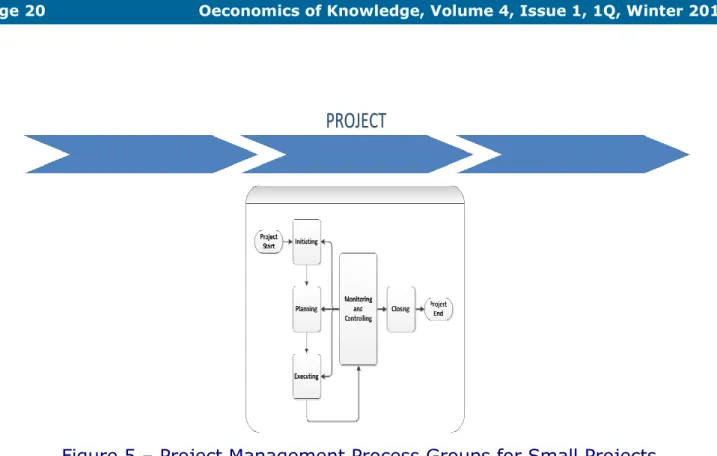
Small projects typically use a single set of project management pro-cess groups, as illustrated in Figure 5, while large projects are usually di-vided into phases, each phase having its own set of project management process groups (Figure 6).
Figure 5 – Project Management Process Groups for Small Projects
Figure 6 – Project Management Process Groups for Large Projects
PROJECT
PROJECT
PROJECT
Conclusions
Software factories can be found in almost any area of software de-velopment. Factories can be implemented for several types of software projects, from mobile applications to complex collaborative systems.
The success or failure of such factory oriented software development could be influenced by the associated project management process. In order to be successful, a very good project management process is re-quired and it has to be adapted to the specific characteristics of the fac-tory.
References
[1] Project Management Institute, A Guide to the Project Management Body of Knowledge: PMBOK Guide, 4th edition, Project Management Institute, 2008
[2] J. Jeston, J. Nelis, Business Process Management, Second Edition: Practical Guidelines to Successful Implementations, Butterworth-Heinemann, 2008.
[3] M. Hotle, S. Landry, Application Delivery and Support Organizational Archetypes: The Software Factory, Gartner Research Report G00167531, May 2009.
[4] P. Clements and L. Northrop, Software Product Lines: Patterns and Practices, 3rd Edition, Addison Wesley, 2001.
[5] A. Brown, A. Lopez, Luis Reyes, Practical Experiences with Software Factory Approaches in Enterprise Software Delivery, ICSEA 2011, The Sixth International Conference on Software Engineering Advanc-es, Barcelona, Spain, October 23, 2011.