Explicating SDKs:
Uncovering Assumptions Underlying Secure Authentication and Authorization
Rui Wang
† *, Yuchen Zhou
‡ *, Shuo Chen
†, Shaz Qadeer
†, David Evans
‡, Yuri Gurevich
††
Microsoft Research
Redmond, WA, USA
{ruiwan, shuochen, qadeer, gurevich}@microsoft.com
‡
University of Virginia
Charlottesville, VA, USA
{yz8ra, evans}@virginia.edu
Abstract
Most modern applications are empowered by online services, so application developers frequently implement authentication and authorization. Major online providers, such as Facebook and Microsoft, provide SDKs for incorporating authentication services. This paper considers whether those SDKs enable typical developers to build secure apps. Our work focuses on systematically explicating implicit assumptions that are necessary for secure use of an SDK. Understanding these assumptions depends critically on not just the SDK itself, but on the underlying runtime systems. We present a systematic process for identifying critical implicit assumptions by building semantic models that capture both the logic of the SDK and the essential aspects of underlying systems. These semantic models provide the explicit basis for reasoning about the security of an SDK. We use a formal analysis tool, along with the semantic models, to reason about all applications that can be built using the SDK. In particular, we formally check whether the SDK, along with the explicitly captured assumptions, is sufficient to imply the desired security properties. We applied our approach to three widely used authentication/authorization SDKs. Our approach led to the discovery of several implicit assumptions in each SDK, including issues deemed serious enough to receive Facebook bug bounties and change the OAuth 2.0 specification. We verified that many apps constructed with these SDKs (indeed, the majority of apps in our study) are vulnerable to serious exploits because of these implicit assumptions, and we built a prototype testing tool that can detect several of the vulnerability patterns we identified.
1
Introduction
Modern applications commonly consist of a client pro-gram and an online service that provides functionality such as cloud storage, social networking, and geograph-ic data. Accessing the servgeograph-ice requires authentgeograph-ication of users and authorization of resource requests. Tradi-tionally, the authentication and authorization mechan-isms were provided by operating systems and carefully implemented in a few core apps such as SSH, remote desktop, etc; with modern apps, however, many develo-pers end up needing to implement such mechanisms. To aid this, major identity providers have developed SDKs that developers can use to integrate authentication and authorization into their apps such as the three SDKs we study in this work: the Facebook PHP SDK, the Microsoft Live Connect SDK, and the Windows 8 Authentication Broker SDK. According to our sampling of popular apps in Windows App Store, 52% of them use these SDKs (see Appendix A).
Authentication/authorization SDKs are becoming a crit-ical foundation for apps. However, no previous study has rigorously examined the security these SDKs pro-vide to real-world apps. Typically, SDK propro-viders sim-ply release SDK code, publish documentation and
ex-amples, and leave the rest to app developers. An im-portant question remains: if developers use the SDKs in reasonable ways, will the resulting applications be se-cure? We show in this paper that the answer today is “No”. The majority of apps built using the SDKs we studied have serious security flaws. This is not due to direct vulnerabilities in the SDK, but rather because achieving desired security properties by using an SDK depends on many implicit assumptions that are not readily apparent to app developers. These assumptions are not documented anywhere in the SDK or its develo-per documentation. In several cases, even the SDK pro-viders are unaware of the assumptions (see Section 5.2). The goal of our work is to systematically identify the assumptions needed to use an SDK to produce secure applications. We emphasize that it is not meaningful to verify an SDK by itself. Instead, our goal is to explicate the assumptions upon which secure use of the SDK depends. We do this by devising precise definitions of desired security properties, constructing an explicit mo-del of the SDK and the complex services with which it interacts, and systematically exploring the space of app-lications that can be built using the SDK. Our approach involves a combination of manual effort and automated formal verification. Any counterexample found by the * The two lead authors are ordered alphabetically.
2 verification tool indicates either (1) that our system models are not accurate, in which case we revisit the real systems to correct the model; or (2) that our models are correct, but additional assumptions need to be captured in the model and followed by application developers. The explication process is an iteration of the above steps so that we document, examine and re-fine our understanding of the underlying systems for an SDK. At the end, we get a set of formally captured as-sumptions and a semantic model that allow us to make meaningful assurances about the SDK: an application constructed using the SDK following the documented assumptions satisfies desired security properties. We argue that explication should be part of the engin-eering process of developing an SDK. Identified SDK assumptions can either be removed by modifying the SDK, or be documented precisely. In addition, in some cases it is feasible to develop automatic tests that detect common ways applications violate the assumptions (we provide an example in Section 6.2).
Results. The work presented in this paper reflects a 12 person-month effort (six months of two lead authors) in systematically explicating the three target SDKs. The resulting models (https://github.com/sdk-‐security) are publicly released so that the community can review and enhance them. As a result of the explication process, we uncovered many SDK assumptions (summarized in Section 5). Some assumptions were especially serious because they can be violated when an app developer has a reasonable alternative interpretation of the develo-per’s guide (dev guide) or when an app runs on certain realistic platforms. These reports were treated very ser-iously by the SDK providers: five cases that we re-ported to Facebook have been fixed (three of which were rewarded by Facebook bounties [14]). An issue uncovered in the Live Connect SDK resulted in Microsoft improving its dev guide. Our report to the OAuth Working Group convinced the group to add a subsection to the OAuth 2.0 draft.
With all the SDK assumptions specified, we were able to successfully verify all the models with the uncovered assumptions (Section 4). Uncovering these SDK as-sumptions also enables effective app testing since a violation of an assumption often leads to a successful exploit. Our study shows that many released apps are indeed vulnerable due to violations of these assump-tions. We tested three sets of apps, including client apps in Windows 8 App Store and service apps using Face-book sign-on, and found that 78%, 86% and 67% of these apps suffer from vulnerabilities related to the implicit assumptions we uncovered (Section 6.2).
2
Illustrative Example
To motivate our work, we describe a simple example in the context of the Live Connect SDK. It illustrates what can go wrong when SDKs are provided without thor-oughly specifying their underlying security assumptions. 2.1 Intended Use
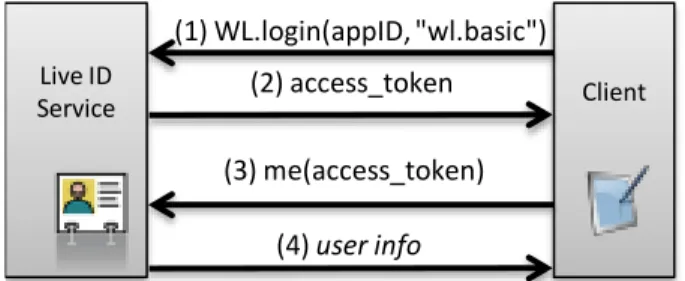
Suppose we want to develop an app using Live ID as the Identity Provider (IdP). We start with the dev guide for Live Connect [25]. The hyperlinks in the start page lead us to a page of detailed instructions about “signing users in” [26] which provides code snippets in Javascript, C#, Objective-C and Java showing how to use Live Connect SDK to sign users into a client app. Ignoring the specifics in these different languages, all the code snippets essentially cover the authentication logic shown in Figure 1.
In the figure, WL stands for “Windows Live”. A developer first needs to call WL.login. The call takes an argument value, "wl.basic", indicating that the app will need to read the user’s basic information after WL.login returns an access token in step (2). The access token is a concept in the OAuth protocol [22]. It is an opaque string dynamically created by the Live ID server for each call to WL.login. Once the app gets the access to-ken, it calls the REST API me to get the user’s basic info using this HTTP request:
https://apis.live.net/v5.0/me?access_token=ACCESS_TOKEN The Live ID service responds with the user’s basic in-formation in message (4), such as her full name and user ID. This completes the process, authenticating the user with the provided information.
2.2 Hazardous Use
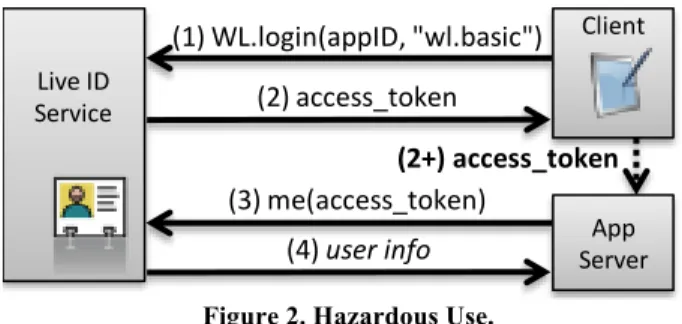
The developer guide as depicted in Figure 1 is valid for a client-only app, but it does not make it clear that the same logic must not be used with an app that also incor-porates an online service. Without stating this explicitly, developers may be inclined to use the SDK insecurely as shown in Figure 2. The interactions with the Live ID
Live ID Service Client (1) WL.login(appID, "wl.basic") (2) access_token (3) me(access_token) (4) user info
3 service are identical in the two figures. The only differ-ence is that in the second scenario, the access token is sent to the service app (i.e., the server side of the app) in message (2+) and it is the service app that calls me to authenticate the user.
This can lead to a serious vulnerability that allows any app on the device to sign into the service app as the user. The rogue app sends a request to the Live ID service for an access token to view public information for the victim, such as a profile record on Facebook. Live ID responds with an access token. The problem is this token, intended for authorizing access to the public resource, is mistakenly used by the service app to auth-enticate its owner as the victim. This allows the rogue app to get into the victim’s account on the service app. This mistake is fairly common in real-world apps. Al-though we first observed it analyzing the Live Connect SDK, we later found that many apps using the Face-book SDK have the same issue. As described in Section 6.2, we tested 27 apps in the Windows 8 App Store and found that 21 of them are vulnerable due to this mistake. 2.3 Resolution
From one perspective, this is simply a matter of develo-pers writing buggy apps, and the blame for the security vulnerability rests with the app developers. We argue, though, that the purpose of the SDK is to enable typical developers to produce apps that use authentication and authorization in a way that provides desired security properties, and the prevalence of buggy apps created using this SDK indicates a failure of the larger engin-eering process. The developer exercised reasonable pru-dence by using the access token to query the ID service for user information and followed exactly the process described in the SDK’s documentation (depicted in Figure 1). The problem is lack of a deeper understand-ing of the relationship between authentication and authorization, and the role of the access token (i.e., why is it safe to use the access token as shown in Figure 1 but not as used in Figure 2). Correct use depends on subtle understanding of what kind of evidence each message represents and whether or not the whole mes-sage sequence establishes an effective proof for a security decision. It is unrealistic to expect most
developers to understand these subtleties, especially without clear guidance from the SDK.
We contacted the developers of some of the vulnerable apps. A few apps have been fixed in response to our re-ports. We also notified the OAuth Working Group (WG) in June 2012 about these vulnerable apps.1 Dick Hardt, editor of OAuth 2.0 specification (RFC 6749) [22], emailed us requesting language to be included in the specification dealing with this issue. We proposed the initial text and discussed with WG members. This resulted in Section 10.16 “Misuse of Access Token to Impersonate Resource Owner in Implicit Flow” being added to the OAuth specification.
The key point this example illustrates is that security of apps constructed with an SDK depends on an under-standing of the external services the app depends on, as well as subtleties in the use of tokens and assumptions about evidence used in authentication and authorization decisions. We believe the prevalence of vulnerable apps constructed using current SDKs is compelling evidence that a better engineering process is needed, rather than just passing the blame to overburdened developers. In particular, we advocate for a process that explicates SDKs by systematically identifying the underlying as-sumptions upon which secure usage depends.
3
Explicating SDKs
In order to explicate the SDKs, we need to clearly de-fine the desired security properties. This section intro-duces our target scenario and threat model, and then de-fines the desired security properties and overviews our process for uncovering implicit SDK assumptions. 3.1 Scenario
A typical question about security is whether some pro-perty holds for a system, even in the presence of an ad-versary interacting with the system in an unconstrained manner. We can view this as a software testing problem: the system is a concrete program, while the adversary is an abstract one (i.e., a test harness in the terminology of software testing) that explores all interaction sequences with the concrete system. In our scenario, however, the target system is not concrete. We wish to reason about all applications that can be built with the SDK
1 Subsequently, we learned that John Bradley, a WG member,
had posted a blog post in January 2012 about a similar issue [10]. The post considers the problem a vulnerability of the protocol, while we view it as a consequence of an unclear assumption about SDK usage because there are correct ways to use OAuth for client+service authentication.
Live ID Service Client (1) WL.login(appID, "wl.basic") (2) access_token (3) me(access_token)
(4) user info ServerApp (2+) access_token
4 ing documented guidelines. Hence, we need to consider both the client app and service as abstract modules. Figure 3 illustrates the modules in our setup. There are three main components: a client device, the application server foo.com, and the identity provider (IdP). The bottom layer of the client device is the client runtime, such as the HTML engine or the HTTP layer. The mid-dle layer is the client SDK. The client app, FooAppC, is created by the developer to interact with the application server. We assume FooAppC always uses the client SDK for authentication and authorization. Like the cli-ent, the application server has three layers: the service runtime represents the server platform, such as PHP or ASP.NET; the server side of the SDK we study; and the application server code. We assume that FooAppS does not directly interact with the service runtime, but only uses it via the service SDK. Note that both FooAppC and FooAppS identify themselves to IdP as “FooApp” with an app ID pre-assigned by IdP. The IdP cannot tell if the caller is a client or the application server.
The modules with brick pattern backgrounds are con-crete modules with concon-crete implementations. They can be divided into two layers. The SDK layer consists of the Client SDK and the Service SDK. The underlying system layer consists of the client runtime, the service runtime, and the IdP. These are complex modules that one typically does not understand in detail in the begin-ning of the study. Developing a semantic model for these components involves substantial systems investi-gation effort (as described in Section 4.3) because the seemingly clear SDK logic actually depends on a much more mysterious (and often incompletely documented) underlying layer. We consider the formal semantic models resulting from this study as one of the main contributions of this work.
The client and server application modules are abstract modules. They do not have concrete implementations: our goal is to reason about all possible apps built using the SDK. Nevertheless, the app modules do have con-straints on their behaviors: FooAppC and FooAppS are only allowed to use the target SDKs for authentication
and authorization, and must not violate rules document-ed in the SDK developer guides.
3.2 Threat Model
We want to reason about security properties of all apps that could reasonably be constructed with the SDK. We assume a malicious application, MalAppC, may be in-stalled on the user’s device. MalAppC’s behavior is not constrained by the client SDK, but it is limited to functionality provided by the client runtime (e.g., it cannot access cookies of other domains or handcraft HTTP requests). The attacker also controls an uncon-strained external machine, which we call “Mallory”. As shown in Figure 4, we can think of Mallory as a combination of a client and server that can freely com-municate with the client, application server, and IdP. We model MalAppC and Mallory as abstract modules. 3.3 Security Properties
Our analysis depends on a formal definition of the se-curity properties the SDK is intended to provide. Granularity: session. Informally, people often say things like “a client is authenticated as Alice”, or “a ser-ver is authorized on Alice’s behalf”. Howeser-ver, it is im-portant to point out explicitly that it is not the client or the server, but the session between them, that is authen-ticated or authorized. More specifically, the end result of an authentication/authorization protocol between a client and a server is to know whom the session repre-sents and what the session is allowed to do. It should not affect the identity or permission of any other ses-sion. Therefore, we always keep the session (identified by its session ID) explicit in our modeling.
Basis of security: secrets and signed data. All mech-anisms we study share a commonality: they use secrets or data signed by the identity provider as unforgeable evidence to differentiate some entities from others. These secrets and signed data are either preconfigured or generated at runtime at the underlying system layer.
FooAppC
Client SDK Client runtime
Identity Provider (IdP)
FooAppS
Service SDK Service runtime
Client Device Server (foo.com)
Figure 3. Modules in Client+Service App.
FooAppC Client SDK
Client runtime
Identity Provider (IdP)
FooAppS Service SDK Service runtime M alA pp C Mallory
5 We distinguish five types of secrets in the studied SDKs: access tokens, Codes2, refresh tokens, app se-crets and session IDs. The first four are protocol data in OAuth, which we will explain in later examples. The only identity-provider-signed data we have seen are signed requests, defined by Facebook, and authentica-tion tokens, defined by Live ID. They are signed data structures containing some or all of the following data: access token, Code, app ID and user ID.
The desired security properties, therefore, need to con-sider what data the adversary may have obtained. This is made explicit by adding a knowledge pool to the mo-del. All secrets and signed data received by the attacker are recorded in the knowledge pool, and can be used by the attacker in all subsequent actions.
Desired security properties. We define the security goal of the authentication/authorization SDKs based on the protections they provide to apps. Apps written using the SDK following explicit programming guidelines should be protected from the following violations: (1) Authentication violation. If some knowledge, k, is about to be added to the pool, and k is sufficient to con-vince the authentication logic of FooAppS that the knowledge holder is Alice, it implies that Mallory (and MalAppC, since they share the knowledge pool) can au-thenticate as Alice, which is an authentication violation. (2) Authorization violation. Depending on the type of k, there are two kinds of authorization violations. If k is Alice’s access token, Alice’s Code, or the session ID for the session between FooAppC and FooAppS, it im-plies that Mallory has obtained the permission to do whatever the session can do. Another authorization vio-lation is when k is the app secret of FooApp. This would allow Mallory to do whatever FooAppS can do on the identity provider.
(3) Association violation. The ultimate goal of authenti-cation/authorization is not only to know who the user is or what she can do, but to correctly bind three pieces of data: the user’s identity (i.e., the authentication result), the user’s permissions (i.e., the authorization result), and the session’s identity (usually known as session ID). This association is actually the end result of authentica-tion/authorization and is what the application logic de-pends on after the process is accomplished. Mistakes in the association (such as binding Mallory’s identity to Alice’s permission, or binding Alice’s identity to Mal-lory’s session) are security violations.
2 To avoid confusion with other meanings of “code”, such as “source code”, we always capitalize the first letter to refer to the “OAuth Code” in this paper.
3.4 The Process of Explicating SDKs
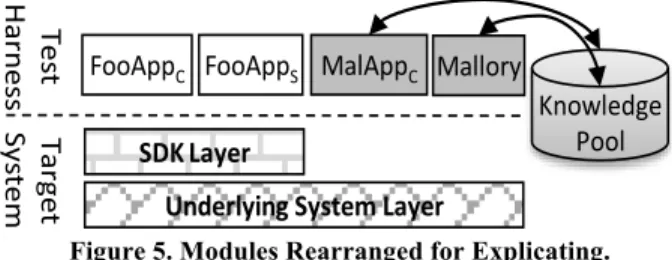
Figure 5 rearranges the modules (from Figure 4) and combines the concrete modules one each layer into one. The dashed line between abstract and concrete modules represents the interface between the test harness and the target system. The essential question is: what assump-tions are necessary for FooApp to achieve the desired security properties?
Explicating SDKs is a systematic investigation effort to explicitly document our knowledge about these mod-ules and examine the knowledge against defined securi-ty goals. As shown in Figure 6, it is an iterative pro-cess, in which we repeatedly refine our model and for-mally check if it is sufficient to establish the security properties or additional assumptions are needed. A failed check (i.e., a counterexample in the model) indi-cates either that our understanding of the actual systems needs to be revisited or that additional assumptions are needed to ensure the desired security properties. The outcome of the process is the assumptions we ex-plicitly added to the model. In Section 5.2, we show that many of the uncovered assumptions can indeed be violated in realistic situations.
4
Semantic Modeling
This section gives an overview of the semantic model-ing effort for the three SDKs. The resultmodel-ing models are available at https://github.com/sdk-‐security/. They reflect six months of effort by our two lead authors (i.e., 12 person-months) in creating and refining the system models.
FooAppS
SDK Layer
Underlying System Layer
Tar
get
Sys
tem
FooAppC MalAppC Mallory
Knowledge Pool Tes t H ar nes s
Figure 5. Modules Rearranged for Explicating.
Obtain new insights about components and incorporate
them into the model
Specify desired security properties Check model
Refine model or add assumptions Documented
assumptions pass
fail output
Figure 6. Engineering Process for Explicating SDKs.
6 4.1 Modeling language
To specify the semantics of the modules, we want a lan-guage that has a suitable formal analysis technology for verification. In the first period of our investigation, we used Corral [24], a property checking tool that can per-form bounded verification on a C program with embed-ded assertions. Corral explores all possible execution paths within a bound to check if the assertions can be violated. Later, we re-implemented all the models in Boogie [9], a language for describing proof obligations that can then be tested using an SMT solver, which allowed us to fully prove the desired properties. This provides a higher assurance than the bounded verifica-tion done by Corral, but the basic ideas and approach are the same for both checking strategies. For con-creteness, this section describes the Boogie version to explain our modeling.
The key Boogie language features needed to understand this paper are:
• The * symbol represents a non-deterministic Boolean value.
• HAVOC v is a statement that assigns a
non-deter-ministic value to variable v.
• ASSERT(p) specifies an assertion that whenever the
program gets to this line, p holds.
• ASSUME(p) instructs Boogie to assume that p holds
whenever the program gets to this line.
• INVARIANT(p) specifies a loop invariant. Boogie
checks if p is satisfied at the entry of the loop, and inductively prove p’s validity after each iteration. If Boogie fails to prove an assertion or an invariant, it reports a counter-example. This leads us to refine the model, adding assumptions when necessary.
4.2 Modeling abstract modules
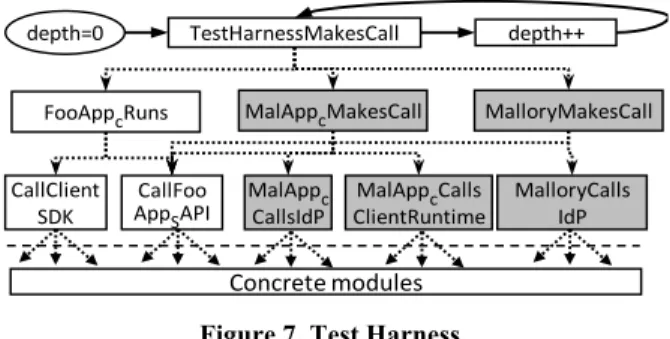
The test harness interacts with the concrete modules in a non-deterministic manner. It implements the abstract modules representing both the unknown (benign) appli-cation and the attacker’s resources. The test harness consists of a loop with the loop count depth. Each itera-tion calls the funcitera-tion TestHarnessMakesCall. This func-tion is implemented as a non-deterministic switch (i.e., a statement of “switch(*){…}”) that chooses to call
FooAppcRuns, MalAppcMakesCall, or MalloryMakesCall.
Eventually, through a series of non-deterministic choices as shown in Figure 7, one of the functions in a concrete module will be called.
Using the knowledge pool. As mentioned in Section 3.3, we use a knowledge pool to model the information
obtained by an attacker. Different types of knowledge, such as access tokens, Codes, and session IDs, are ex-plicitly differentiated. We do not consider attacks that involve providing arguments of the incorrect type, e.g., giving a session ID to a function expecting an access to-ken. There is an AddKnowledge function for each know-ledge type. After each call to MalAppCMakesCall and
MalloryMakesCall, the function AddKnowledge_Type is
called to add any acquired knowledge to the pool. There is a corresponding DrawKnowledge_Type function for non-deterministically drawing knowledge of a particu-lar type from the knowledge pool. It is implemented
us-ing HAVOC i, where i is the array index of the piece of
knowledge non-deterministically chosen. 4.3 Modeling concrete modules
Concrete modules do not have any non-determinism. The key aspects of building semantic models for the concrete modules are summarized below.
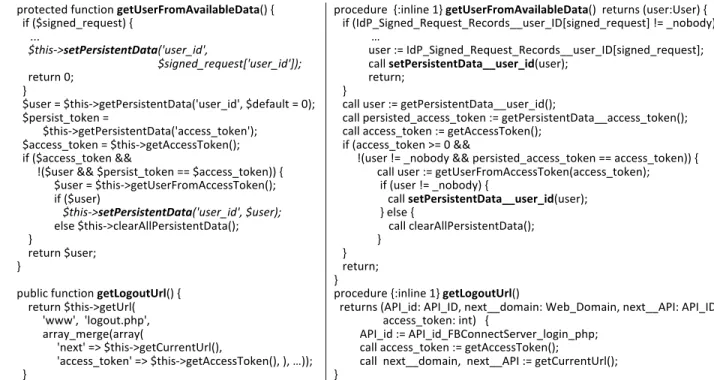
Data types. The basic data types in the models are int and several types for enumerables. We also define structs and arrays over the basic types. In the actual sys-tems, the authentication logic is constructed using string operations such as concatenation, tokenization, equality comparison, and name/value pair parsing. We found that most string values are essentially enumerable, ex-cept those of domain names and user names, which we canonicalize as Alice, Mallory, foo.com, mallory.com, etc. Thus, the basic types, structs, and arrays are sufficient to model data used in the concrete modules. SDKs. The sizes of these SDKs are moderate (all under 2000 lines) and their source code is public. The SDKs we modeled were implemented in HTML, JavaScript and PHP, so we needed to first translate the SDKs func-tion-by-function into Boogie. We do this translation manually, but it is not hard to imagine tools that could mostly automate it. Table 1 shows two functions in the Facebook PHP SDK and our corresponding Boogie procedures. For getUserFromAvailableData, the changes are essentially line-by-line translations. For getLogout-‐ Url, the PHP code performs a string operation and
re-TestHarnessMakesCall
FooAppcRuns MalAppcMakesCall MalloryMakesCall
depth++
CallClient
SDK AppCallFooSAPI MalAppCallsIdPc ClientRuntimeMalAppcCalls MalloryCallsIdP Concrete modules
depth=0
Figure 7. Test Harness.
7 turns a string. Our Boogie translation in this case is not obviously line-by-line. For example, our procedure re-turns a four-element vector instead of a string. The PHP function calls getUrl and array_merge, which concaten-ate substrings, therefore, are implicitly modeled by the four-element return vector.
Underlying system layer. Unlike the SDK, which is simple enough to model completely, the identity provi-der, client runtime, and server runtime are very com-plex and may not even have source code available. Completely modeling every detail of these systems is infeasible, but our analysis depends on developing suit-able models of them. By studying the target SDKs, we identified three aspects of these systems that need to be carefully understood to perform verification. These as-pects are the basis for the security goals the SDKs are designed to achieve:
(1) The identity provider’s behaviors according to diff-erent input arguments and various app settings in its web portal. Each identity provider has a web page for app developers to enter a number of app settings that the identity provider needs to know, such as app ID, app secret, service website domain, and return URL. Many of these settings are critical for the identity provider’s decision-making. Further, different inputs to the provided APIs cause different responses. Because we do not have the source code for the identity provi-ders, we tested these behaviors by constructing different requests and app settings. For example, in the models we’ve built, the identity provider APIs dialog_
permissions_request(), RST2_srf() and oauth20_
authorize_srf()3 involved 11, 8 and 6 if-statements
respectively, to describe different behaviors we observ-ed in testing.
(2) Data passing on the client runtime. As with the identity providers, we do not have access to source code to understand detailed behaviors of the client runtime. Our models were based on observations made during testing. We focused on the client’s decision-making about passing data from one server to another (by redir-ection), delivering data to FooAppC or MalAppC, and attaching cookies to outgoing requests. These decisions are important for security. We maintain a cookie struc-ture for each client app, i.e., FooAppC or MalAppC. The cookie structure contains a session ID field and some optional fields specific to the SDK, such as signed_request and authentication_token.
(3) Sessions, requests, and cookies on the service run-time. In our model, the service runtime is a layer that defines data structures for sessions, requests and cook-ies for the service SDK and FooAppS. (Note that al-though cookies are in the headers of requests, we separ-ate them to flatten the data structure.) The cookie struc-ture is the same as previously described. The request structure is defined according to the SDK’s
3 The APIs are accessed as https://www.facebook.com/
dialog/permissions.request, https://login.live.com/RST2.srf,
and https://login.live.com/oauth20_authorize.srf
protected function getUserFromAvailableData() { if ($signed_request) {
...
$this-‐>setPersistentData('user_id',
$signed_request['user_id']); return 0;
}
$user = $this-‐>getPersistentData('user_id', $default = 0); $persist_token =
$this-‐>getPersistentData('access_token'); $access_token = $this-‐>getAccessToken(); if ($access_token &&
!($user && $persist_token == $access_token)) { $user = $this-‐>getUserFromAccessToken(); if ($user)
$this-‐>setPersistentData('user_id', $user); else $this-‐>clearAllPersistentData(); }
return $user; }
public function getLogoutUrl() { return $this-‐>getUrl( 'www', 'logout.php', array_merge(array( 'next' => $this-‐>getCurrentUrl(), 'access_token' => $this-‐>getAccessToken(), ), …)); }
procedure {:inline 1} getUserFromAvailableData() returns (user:User) { if (IdP_Signed_Request_Records__user_ID[signed_request] != _nobody) { …
user := IdP_Signed_Request_Records__user_ID[signed_request]; call setPersistentData__user_id(user);
return; }
call user := getPersistentData__user_id();
call persisted_access_token := getPersistentData__access_token(); call access_token := getAccessToken();
if (access_token >= 0 &&
!(user != _nobody && persisted_access_token == access_token)) { call user := getUserFromAccessToken(access_token); if (user != _nobody) { call setPersistentData__user_id(user); } else { call clearAllPersistentData(); } } return; }
procedure {:inline 1} getLogoutUrl()
returns (API_id: API_ID, next__domain: Web_Domain, next__API: API_ID, access_token: int) {
API_id := API_id_FBConnectServer_login_php; call access_token := getAccessToken();
call next__domain, next__API := getCurrentUrl(); }
8 tion. For example, requests for the Facebook PHP SDK use a structure containing a Code, a state and an option-al signed_request. The session structure contains a ses-sion ID and a collection of sesses-sion variables (keys) de-fined by the SDK.
4.4 Security assertions
We use ASSERT statements to document and test the de-sired security properties, covering each of the security violations described in Section 3.3.
Authentication violation. An authentication violation occurs when an attacker acquires some knowledge that could be used to convince FooAppS that the knowledge holder is Alice. A simple example is the case we described in Section 2.2, in which the knowledge is an access token. In addition to access tokens, we also consider IdP-signed data such as Facebook’s signed messages or Live ID’s authentication tokens. To detect these violations, when a Facebook Signed Request k is added to the knowledge pool, we assert that
k.user_ID != _alice && k.app_ID != _foo_app_ID &&
TokenRecordsOnIdP[k.token].user_ID != _alice
where TokenRecordsOnIdP represents IdP’s database storing the records of access tokens.4
Authorization violation. To detect authorization viola-tions, we add ASSERT statements inside each AddKnow-‐
ledge_Type function. For example, the assertion in
function AddKnowledge_Code is:
ASSERT(!(c.user_ID == _alice && c.app_ID == _foo_app_ID))
This checks that the Code added to the knowledge pool is not associated with Alice on FooApp. Similar asser-tions are added to the AddKnowledge functions for re-fresh tokens and session IDs. The app secret is different from the above knowledge types, because it is tied to the app not the user. When k is an app secret, we assert that k != _foo_app_secret.
Association violation. At the return point of every web API on FooAppS, we need to ensure the correct associ-ation of the user ID, the permission (represented by an access token or Code), and the session ID. For example, for Facebook PHP SDK, the assertion is the following. It This ensures that the three session variables of the session identified by cookie.sessionID all involve the same user. Concrete cases are given in Section 5.2.
4 To improve presentation readability, the syntax of the above
predicate is slightly changed from the syntax allowed by Boogie; see https://github.com/sdk-‐security/ for the exact syntax.
Sessions[cookie.sessionID].user_ID == CodeRecordsOnIdP[ Sessions[ cookie.sessionID].code].user_ID && Sessions[cookie.sessionID].user_ID == TokenRecordsOnIdP[Sessions[ cookie.sessionID].token].user_ID
5
Results
We applied our approach to explicate the Facebook PHP SDK, Live Connect SDK and Windows 8 Authen-tication Broker. The Facebook PHP SDK is the only server-side SDK provided on Facebook’s developers’ website and is currently among the most widely used authentication/authorization SDKs. Facebook also has SDKs for Android and iOS apps, which have many concepts similar to the PHP SDK, but we have not stud-ied them in detail. The Live Connect SDK is provided by Microsoft for developing metro apps that use Live ID as the identity provider. The Windows 8 Authentica-tion Broker is for metro apps to use an OAuth-based (not only Live ID) identity provider, such as Facebook or Twitter.
5.1 Assumptions Explicated
The models resulting from our study formally capture what we learned about the SDKs and the systems. Our assumptions are specified in two ways: (1) all the
ASSUME statements that we added; (2) when we need to
assume particular program behaviors, such as a function call must always precede another, we model the beha-viors accordingly, and add comment lines to state that the modeled behaviors are assumptions, rather than concrete facts. All the assumptions are added in order to satisfy the assertions that described in Section 4.4. The assertions are fairly uniform — they are all about sensitive data added to the knowledge pool and binding errors in associating sessions, users and permissions. Verification. After all the assumptions were added, the models were automatically verified by Corral with the bound 5 set to 5, meaning that in the test harness (Figure 7), the counter of the main loop (variable depth) does not exceed 5. Such a depth gives a reasonable confi-dence that the security properties are achieved by the models and the added assumptions: the properties could only be violated by attacks consisting of six or more steps. Running on a Windows server with two 2.67GHz processors and 32GB RAM, it took 11.0 hours to check the Facebook PHP SDK, 26.3 hours to check Live Con-nect SDK and 15.1 hours to check the Windows 8 Au-thentication Broker.
5 Corral is a fully automatic tool for exploring code paths
symbolically. The full automation, however, comes with the limitation that it only performs a bounded search.
9 The verification being bounded is a limitation of the models built for Corral, so we subsequently re-imple-mented all three models in Boogie language [9]. Verification of Boogie models is not automatic. It re-quires human effort to specify preconditions and post-conditions for procedures, as well as loop invariants (i.e., the invariant clauses). The Boogie verifier checks that (1) every precondition is satisfied by the caller; (2) if all preconditions of the procedure are satisfied, then all the postconditions will be satisfied when the proce-dure returns; (3) every loop invariant holds initially, and if it holds before an iteration then it will still hold after the iteration. By induction, the verified properties hold for an infinite number of iterations. Rewriting the three models in Boogie took 14 person-days of effort, including a significant portion on specifying appropriate loop invariants. The Boogie modeling did not find any serious case missed in the Corral modeling, but provides a higher level of confidence.
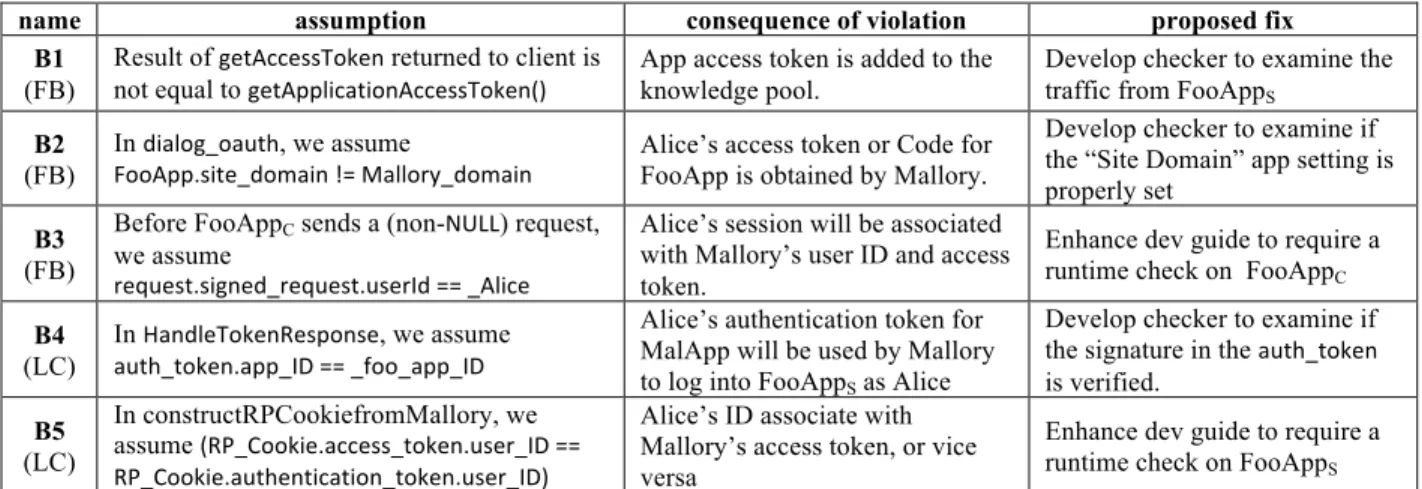
Examining the assumptions in the real world. We manually examined each assumption added to assess whether it could be violated in realistic exploits. This effort requires thinking about how apps may be deployed and executed in real-world situations. Table 2 summarizes the assumptions uncovered by our study that appear to be most critical. These assumptions can be violated in the real world, and the violations result in security compromises. Based on our experience in communicating with SDK providers, finding realistic
violating conditions is a crucial step to convincing them to treat the cases with high priority. This step requires extensive knowledge about systems, and does not appear to be easily automated. We describe these assumptions in more detail in Section 5.2. Table 3 lists some assumptions uncovered that, if violated, would also lead to security compromises. But, unlike the as-sumptions in Table 2, we have not found compelling realistic exploits that violate these assumptions. A few additional assumptions, listed in Appendix B, are needed to complete the verification. They correspond to some simplifications we made to the models. It is un-clear if their violations lead to security compromises, but we make it explicit that we have not considered the situations violating these assumptions.
5.2 Confirmed Exploitable Assumptions
This subsection explains each of the critical assump-tions in Table 2. These results show concretely how the SDK’s security assurance depends on actual system behaviors and app implementations, illustrating the im-portance of explicating the underlying assumptions up-on which secure use of the SDK relies.
5.2.1 Facebook SDK
Assumptions A1, A2, A3, and A6 concern the Face-book PHP SDK.
Namea
(SDK) Assumptionb consequence of violation exploit opportunity
vendor response A1 (FB) In FooAppCMakesACall, we assume FooAppC.cookie.sessionID == _aliceSession.
The ASSERT in Table 1 will be false. Mallory’s session is associated with Alice’s user ID.
When the SDK is used in subdomaining situations, e.g., cloud domains Counter-measure on service platform A2 (FB)
For any PHP page, if getUser is called, then getAccessToken must be called subsequently.
Alice’s user ID will be associated with Mallory’s access token.
When FooAppS contains a PHP page that directly returns the user ID
SDK code fix
A3 (FB)
Before getLogoutUrl returns to client, we assume
logoutURL.params.access_token != getApplicationAccessToken().
App access token is added to the knowledge pool (owned by the adversary).
When a PHP page does not have the second code snippet shown in the dev guide
SDK code fix A4 (LC) In saveRefreshToken on FooAppS, we assume user_id != refresh_token.user_id.
Alice’s refresh token will be associated with Mallory’s session on FooAppS.
When the term “user id on the site” in the dev guide is inter-preted as the user’s Live ID
Dev guide revision A5 (WA) In callAuthenticateAsyncFromMalApp, we assume (app_id == _MalAppID || user == _Mallory).
Alice’s access token or Code for FooApp is obtained by MalAppC.
When a client allows automatic login or one-click login
See Section 5.2.3 A6
(FB)
We assume FooAppC always logs in as Alice, i.e., the first argument of dialog_oauth is “_Alice”.
Alice’s session will be associated with Mallory’s user ID and access token.
When request forgery protection for app logon is missing or ineffective
Notifying developers Table 2. Critical assumptions uncovered in our study.
a FB stands for Facebook PHP SDK, LC for Live Connect and WA for Windows Auth Broker
10 Assumption A1. This assumption states that the cookie associated with Alice’s client must match Alice’s ses-sion ID. Figure 8 is a screenshot of the usage instruc-tions given in the readme file in the Facebook PHP SDK [17]. It seems straightforward to understand: the first code snippet calls getUser to get the logged-in user’s ID (it returns null if the user is not logged in). The second snippet demonstrates how to make an API call, such as me. The third snippet toggles between login and logout, so that a logged-in user will get a logoutURL and a logged-out user will get a loginURL in the response.
The SDK’s implementation for the getUser method is very simple. It calls the getUserFromAvailableData
function shown in Table 1. There are two statements (italicized in Table 1) calling setPersistantData, which is to set a PHP session variable denoted as
_SESSION['user_id']. Setting _SESSION['user_id'] is a
binding operation because it associates the user’s iden-tity with the session, which may affect the predicate that we define against association violations — speci-fically, if Alice’s user ID is assigned to the
_SESSION['user_id'] of Mallory’s session, it would allow
Mallory to act on FooAppS as Alice. Because the ses-sion ID is a cookie in the HTTP request, the assertion must depend on how a client runtime handles cookies. Violating the assumption using subdomaining. Normally, because of the same-origin-policy of the client, cookies attached to one domain are not attached to another. However, the policy becomes interesting when we consider a cloud-hosting scenario. In fact, Facebook’s developer portal makes it very easy to deploy the application server on Heroku, a cloud plat-form-as-a-service. Each service app runs in a subdomain under herokuapp.com (e.g., FooAppS’s sub-domain runs as foo.herokuapp.com). Of course, Mallory can similarly run a service as mallory.herokuapp.com. The standard cookie policy for subdomains allows code
on mallory.herokuapp.com to set a cookie for the parent
domain herokuapp.com. When the client makes a request
to foo.herokuapp.com, the cookie will also be attached to
the request. Therefore, if Alice’s client visits the site
mallory.herokuapp.com, Mallory will be able to make the
client’s cookie hold Mallory’s session ID. Thus, FooAppS binds Alice’s user ID to Mallory’s session. In response to our report, Facebook developed a coun-termeasure, which has been applied on the Heroku plat-form. It generates a new session ID (unknown to Mallory) when a client is authenticated. Facebook offered us a bounty three times the normal Bug Bounty amount for reporting this issue, as well as the same Figure 8. Facebook PHP SDK usage instructions.
(Screenshot from https://github.com/facebook/facebook-php-sdk/blob/master/readme.md)
name assumption consequence of violation proposed fix
B1 (FB)
Result of getAccessToken returned to client is
not equal to getApplicationAccessToken() App access token is added to the knowledge pool.
Develop checker to examine the traffic from FooAppS
B2 (FB)
In dialog_oauth, we assume
FooApp.site_domain != Mallory_domain Alice’s access token or Code for FooApp is obtained by Mallory.
Develop checker to examine if the “Site Domain” app setting is properly set
B3 (FB)
Before FooAppC sends a (non-NULL) request, we assume
request.signed_request.userId == _Alice
Alice’s session will be associated with Mallory’s user ID and access token.
Enhance dev guide to require a runtime check on FooAppC B4
(LC)
In HandleTokenResponse, we assume auth_token.app_ID == _foo_app_ID
Alice’s authentication token for MalApp will be used by Mallory to log into FooAppS as Alice
Develop checker to examine if the signature in the auth_token is verified. B5 (LC) In constructRPCookiefromMallory, we assume (RP_Cookie.access_token.user_ID == RP_Cookie.authentication_token.user_ID)
Alice’s ID associate with Mallory’s access token, or vice versa
Enhance dev guide to require a runtime check on FooAppS Table 3. Assumptions uncovered that would lead to security vulnerabilities if violated but no realistic exploits known.
11 award each for Assumptions A2 and A3 discussed next.6
Assumption A2. This assumption is a case in which Corral actually discovered a valid path for violating an assertion completely unexpected to us. The path indi-cated that if a PHP page on FooAppS only calls getUser (e.g., only has the first code snippet from Figure 8), Mallory is able to bind her user ID to Alice’s session. The consequence is especially damaging if the session’s access token is still Alice’s. Corral precisely suggested the possibility (see Table 1): if there is a signed_request containing Mallory’s user ID, then the first setPersis-‐
tentData call will be made, followed by a return. The
method sets _SESSION['user_id'] to Mallory’s ID without calling getAccessToken, which would otherwise keep the access token consistent with the user ID. Therefore, the association between the user ID and the access to-ken is incorrect. The session will operate as Mallory’s account using Alice’s access token. After investigating our report about this, Facebook decided to add checking code before processing the signed request to the SDK to avoid the need for this assumption.
Assumption A3. This assumption requires that any PHP page that includes the third snippet in Figure 8 must also include the second snippet. In the example code in the figure, it is not obvious why the second snippet is required before the third snippet. However, when we modeled getAccessToken, as shown in Table 4, we realized that in Facebook’s authentication mechan-ism there are two subcategories of access token: user access token, which is basically what people usually refer to as “access token”, and application access token, which is described in Facebook’s dev guide [18]. The application access token is provided to a web service for a number of special purposes, such as “publishing instances of ‘secure Open Graph actions’”. In fact, the app secret can be derived solely from the application access token, so it is a serious authorization violation if Mallory or MalAppC can obtain it.
Method getLogoutUrl in snippet 3 constructs a URL to send back to the client. The URL contains the result of
getAccessToken. To obtain the application access token,
Mallory only needs to send a request that hits a failure condition of getUserAccessToken, which prevents
$this-‐>accessToken from being overwritten in the bold
line in Table 4. We confirmed that this can be done by using an invalid Code in the request.
6 We donated all three bounties to charities. The donations
were one-to-one matched by Facebook.
Interestingly, getAccessToken is also called by getUser in snippet 1 in Figure 8. If a PHP page includes snippet 2, the access token will be used to call a REST API. When it is an application access token, the API will raise an exception, which foils the exploit. That is why snippet 2 is required before snippet 3.
In response to our report on this issue, Facebook modified the SDK so that getLogoutUrl now calls get-‐
UserAccessToken instead of getAccessToken, thus
avoid-ing the need for developers to satisfy this assumption. Assumption A6. This assumption requires that the user on FooAppC should not be Mallory. Otherwise, Mallory would be able to associate its access token and user id with Alice’s session. In Section 6.2, we show that many apps (14 out of 21 tested) indeed violate this assump-tion. Moreover, this association violation can be parti-cularly damaging when the service app has its own credential system, and supports linking a Facebook ID to Alice’s password-protected account. Once the link-ing can be done in the session, Mallory will be able to sign into Alice’s account using Mallory’s Facebook ID. We confirmed that among the 14 service apps which violate the assumption, 6 of them support linking, and thus allow Mallory to login as Alice. We reported this issue to Facebook, who undertook the effort of notifying app and website developers.
5.2.2 Live Connect
Assumption A4 concerns how the Live Connect SDK handles “single sign-on for apps and websites” [27]. The sample /LiveSDK/Samples/PHP/OAuthSample [28] demonstrates how to implement a PHP service app that allows single sign-on. This sample code is essentially the dev guide given as a program skeleton, with comment blocks for app developers to implement. The core of the problem lies in the following function, whose implementation is empty except for a comment:
function saveRefreshToken($refreshToken) { // save the refresh token associated with the // user id on the site.
}
This is precisely what we call a binding operation. The refresh token is the input parameter, but it is not clear where the user id comes from. Within the scope of this
public function getAccessToken() { … $this-‐>accessToken= $this-‐>getApplicationAccessToken(); $user_access_token = $this-‐>getUserAccessToken(); if ($user_access_token) { $this-‐>accessToken=$user_access_token; } return $this-‐>accessToken; }
12 function, the only place to obtain a user ID is from a cookie called AUTHCOOKIE, which contains the user’s Live ID. However, the SDK’s logic is not sufficient to ensure that Alice’s refresh token is associated with her user ID. Appendix C of our technical report provides technical details [37].
We built a proof-of-concept exploit to send to Micro-soft. The Live ID team responded that our attack is valid, but it “does not reflect the scenarios we are tar-geting”. The target scenario is a website which has its own credential system, such as a university website, so “the user id on the site” means, for example, the student ID. We replied to the team that an unclear context like this was exactly what we believe needs to be uncovered and at least documented clearly (indeed, explicating such assumptions is one of our main goals). In this case, the context was almost completely hidden: the OAuthSample sample is the only sample provided in /LiveSDK/Samples/PHP/, so it is expected to target more generic scenarios. This is why if saveRefreshToken tar-gets a specific scenario, the context must be made explicit. The team replied us that they would “add more comments to that code to make the sample code clear on this.” Recently we found that the comment has been revised to “save the refresh token and associate it with the user identified by your site credential system.” This change was also made in the ASP.NET version of the sample code.
5.2.3 Windows Authentication Broker
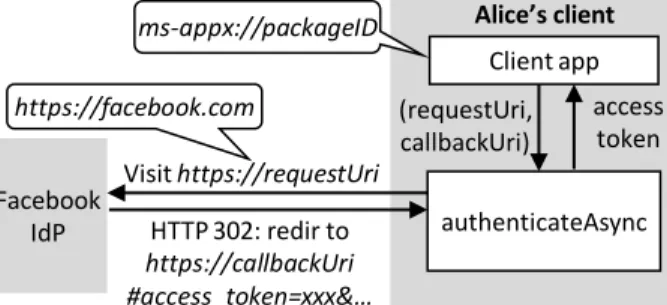
Assumption A5 concerns the Windows 8 Web Authen-tication Broker, used by Windows 8 apps with OAuth-based identity providers. For concreteness of presenta-tion, we assume the Facebook Identity Provider. In the Auth Broker, the only function for authentication is
authenticateAsync. Figure 9 illustrates the data passing
through this function when the app requests an access token. The key observation is that the client does not conform to the same-origin policy, because the 302 response is in the context of https://facebook.com, while on Windows 8, an app runs in its own domain, ms-‐
appx://packageID. Without the same-origin-policy, we
were unable to see why Alice’s access token for FooApp is guaranteed to be passed to FooAppC, not
MalAppC. To test this, we implemented a proof-of-concept MalAppC. It indeed got the access token, which allowed it to do everything FooAppC can do.
We reported this finding to Microsoft and Facebook, and learned their differing perspectives about the re-sponsibility and severity of this issue. Microsoft consid-ered it “a shortcoming of the OAuth protocol and not specific to our implementation.” Facebook pointed out that when authenticateAsync is called, an embedded browser window (usually called a WebView) is always prompted for Facebook password. This lowered the se-verity of the attack. We consider this a shaky security basis: if authenticateAsync someday allows a user to login automatically or with one click without using a password, the basis will become invalid.
We investigated how SDKs on other platforms handle the data passing, and found a similar issue with the Facebook SDK for Android. However, on Android, there is a mechanism to skip the password prompt to get the access token automatically. In response to our re-port, Facebook is developing a fix for its Android SDK.
6
Automated Testing
One additional value of explicating the SDKs is that it may be possible to provide tools that test apps for viola-tions of critical assumpviola-tions. Such tests may not be able to guarantee the app always upholds the assumption, but rather focus on testing apps for common vulnerabil-ity patterns identified as a result of the explicating pro-cess. We developed a prototype to show the feasibility of building such a tester.
6.1 Design
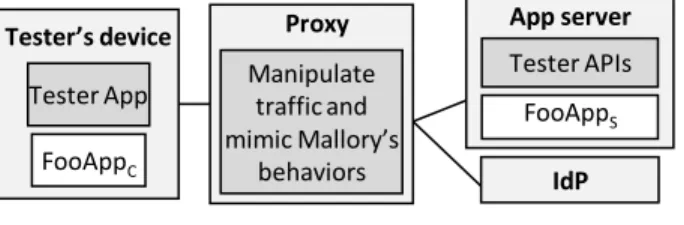
Figure 10 shows our testing framework. For each vul-nerability pattern to test, the test case defines the ac-tions of the tester app, the proxy, and a set of server-side tester APIs (e.g., PHP or ASP.NET files). The tester app behaves as MalAppC. The proxy does the ne-cessary traffic manipulations for requests and responses. It also behaves as the unconstrained machine Mallory. Tester APIs implement specific checks for session states, especially for the associations we focus on. We implemented test cases checking for violations of four assumptions: the vulnerability described in Sec-tion 2 (about using an access token for authenticaSec-tion), and vulnerabilities corresponding to the violations of assumptions A1 (concerning the session ID across sub-domains), A6 (about Mallory’s user ID associated with Alice’s session) and A4 (about binding the user ID with refresh token). Only the test for A4 requires a tester API on the app server.
Facebook IdP authenticateAsync Client app (requestUri, callbackUri) access token Visit https://requestUri HTTP 302: redir to https://callbackUri #access_token=xxx&… Alice’s client ms-‐appx://packageID https://facebook.com
13 In the first test, the tester app performs the IdP’s sign-on steps as Alice, requests an access token, then pre-sents the token to the app server to see if the authenti-cation succeeded. In the second test (regarding A1), if the app server’s hostname is foo.a.com, the proxy creates another hostname mallory.a.com. The test fol-lows the steps described in Section 5.2.1. Eventually the proxy checks if the authentication is successful, but the associated session ID is identical to that of Mal-lory’s session on foo.a.com. In the third test (for A6), the proxy observes the HTTP request that FooAppC sends to Facebook. It finds out which type of data is used as the proof for authentication (a.k.a., the authenticator), which can be either a Code or signed request. The proxy also tries to find a field named state, which is an argument supported by Facebook to prevent request forgery for login [16]. The proxy then replaces the authenticator and the state field (if it exists) with the ones that Mallory’s session owns. After sending the request, the proxy checks whether Mallory can associ-ate her Facebook ID with Alice’s session, and reports a violation if it sees a successful server response. The fourth test (A4) requires the help of a tester API on the server because it tests whether the refresh token is associated with an appropriate user ID. The test uses the proxy to manipulate the AUTHCOOKIE in the request header so that it contains Mallory’s authentication to-ken in Alice’s request. The proxy then mimics Mallory to call the tester API, which calls readRefreshToken and checks if it returns Alice’s refresh token.
6.2 Results
In general, the testing framework is designed for app developers so that they can avert the common pitfalls in their own implementations. Nevertheless, since some of the tests do not need tester APIs on the server, they can be used with access to the apps alone. This opens the possibility of a third party (such as the SDK provider) performing the tests on submitted apps.
We tried using the tests to check Windows 8 and Facebook apps found in the wild. The sets of apps that we tested are named Set 1, Set 2 and Set 3, correspond-ing to the first three aforementioned tests respectively. The test apps were obtained as objectively as possible.
To construct set 1, we queried “Facebook” in the free apps in Windows 8 App Store, which returned about 572 apps. We ranked the apps by user ratings and examined the apps with a rating of 3+ stars. Apps without a backend service were excluded. We then selected apps that authenticate users through identity providers. This left us with a total of 27 apps.
Set 2 was constructed by doing a Google query for “herokuapp.com login”, which gave us many URLs on
herokuapp.com. We visited each URL to see if the
website ran a PHP server and appeared reasonably functional. This gave us a list of 20 websites. We then examined the traffic of each website to determine if it used the Facebook PHP SDK. Seven of the sites did, and these were used for Set 2.
To construct Set 3, we used the Google search query “login.php” and visited the first 40 result pages7 to examine which URLs correspond to PHP websites that support Facebook sign-on. We found 21 candidate websites that comprise Set 3.
Table 5 shows the number and percentage of apps that matched the vulnerability pattern in each set. The results for Set 1 show that 78% of tested services with Facebook sign-on mechanism indeed use the access token for server-side authentication. The results for Set 2 reinforce the value of our SDK analysis — when we studied the SDK, we only hypothesized the possibil-ity of this vulnerabilpossibil-ity. The vulnerabilpossibil-ity we conceived on a hypothetical service app (FooAppS) accurately re-flects the reality of 86% of services tested in Set 2. The results for Set 3 indicate that 67% of the tested apps would allow Mallory’s Facebook ID to be associated with Alice’s session. This violation is mainly due to missing or insufficient request forgery protections for user login. This association mistake can be particularly dangerous when the service apps support certain functionalities. For example, we found that many ser-vice apps have their own credential systems, and allow a user to link her Facebook ID to her password-protected account. After the linking, the user can use a Facebook login to sign into the password-protected account. When assumption A6 is violated, Mallory is able to link her Facebook ID to Alice’s account in the
7 We needed to examine so many result pages because most webpages matched the query “login.php” for reasons not about our intent, e.g., popular pages containing both words “login” and “php” are often considered a match.
FooAppC Tester’s device Tester App App server Tester APIs FooAppS Proxy Manipulate traffic and mimic Mallory’s behaviors IdP
Figure 10. Testing Framework. (Grey boxes constructed for testing.)
Test Set Number of Apps Vulnerable
1 (Section 2) 27 21 (78%)
2 (assumption A1) 7 6 (86%)
3 (assumption A6) 21 14 (67%)