Comparing the cost-efficiency of CoAP and HTTP in Web of Things
applications
Tapio Levä (Corresponding author)
Aalto University, Department of Communications and Networking P.O. Box 13000, 00076 AALTO, Finland
Oleksiy Mazhelis
University of Jyväskylä, Department of Computer Science and Information Systems P.O. Box 35, FIN-40014, Finland
Henna Suomi
Aalto University, Department of Communications and Networking P.O. Box 13000, 00076 AALTO, Finland
Accepted manuscript. Please cite this article as:
Tapio Levä, Oleksiy Mazhelis, Henna Suomi (2014). Comparing the cost-efficiency of CoAP and HTTP in Web of Things applications. Decision Support Systems, vol. 63, July 2014, pp. 23-38, DOI: 10.1016/j.dss.2013.09.009.
ABSTRACT: Constrained Application Protocol (CoAP) has been introduced as a simpler alternative to the Hypertext Transfer Protocol (HTTP) for connecting constrained smart objects to the Web. The adoption of the protocol depends on its relative advantage, and the cost-benefit associated with the use of the protocol is a significant factor affecting a protocol adoption decision. This paper aims at deepening the understanding of the cost-benefits of CoAP and identifies the application scenarios where its use is likely to be economically justifiable. The paper analyzes the costs of using CoAP and HTTP in the Web of Things (WoT) applications, by identifying the components of the total cost of ownership (TCO) model for these applications and by studying the factors affecting individual costs. The use of the model is then demonstrated by means of comparing the TCO of CoAP and HTTP in an environment monitoring application scenario. The results of the analysis suggest that the simpler hardware requirements of CoAP smart objects, as well as the lower communication overhead of the protocol and the resulting reduced power consumption lead to cost advantages in the application scenarios
where the smart objects i) are large in volume and/or are deployed in the field, ii) engage in frequent communications with the Web that are charged for on the basis of the volume of the data being transferred, and iii) are sleeping between the communication sessions. The obtained results may be utilized both by the decision-makers considering the adoption of CoAP in specific solutions, as well as by the academics and practitioners involved in the protocol development.
Keywords: CoAP, HTTP, Web of Things, Total cost of ownership, Adoption
1
Introduction
Proliferation of Internet technologies has resulted in an immense growth of the Web, which in 2012 exceeded 900 million Internet hosts1 and 200 million active web sites2. To date, the growth of the Web has been predominantly attributed to the increase in the number of conventional static and dynamic web sites. However, the Web of Things (WoT) vision predicts the future evolution of the Web towards the state where the everyday objects equipped with computing and communication capabilities – the smart objects – are interconnected with the Web by applying standard web protocols [17,18]. Interconnecting such smart objects with the Web promises a number of benefits to the users, varying from faster and more accurate sensing of our environment to more cost-efficient tracking of industrial processes [16,37].
One of the main paradigms in the WoT applications is the utilization of the well-established architectural principles and protocols of the Web in order to seamlessly interconnect smart objects [17]. These include the Representational State Transfer (REST), defined by Fielding and Taylor [15], as the primary architectural interaction pattern, and using Hypertext Transfer Protocol (HTTP) as the application layer protocol [37]. In RESTful WoT applications, a smart object (which is often running an embedded web server) usually interacts with the counterparts in the Web by exchanging requests and responses over HTTP. While being a standard and well-known application layer protocol, it may be too heavy and inefficient for implementation on constrained, battery-powered devices [26].
In order to cope with the limitations of the HTTP in the WoT applications on constrained devices, the Internet Engineering Task Force (IETF) has introduced the Constrained Application Protocol (CoAP) – a web transfer protocol optimized for the constrained power and processing capabilities of WoT smart objects [27]. Compared to HTTP, CoAP offers numerous potentially beneficial features when implementing WoT applications, among which are a compact binary header, UDP-based transport with simple reliability provisions, built-in resource discovery, and a push mechanism with subscriptions to information [7][26]. At the time of writing, CoAP standardization is still being finalized, and the use of the protocol in industrial products and solutions is still due. Therefore, the
1http://www.isc.org/solutions/survey
competition is still upcoming between the CoAP-based and other solutions for the position of the new dominant design in future WoT applications. The economic forces towards cost minimization, along with social and political forces, will determine whether CoAP will become a part of the new dominant design for WoT applications [31].
The company’s choice of a technology, including protocols, is justified by the need to support its value disciplines of operational excellence, product leadership, or customer intimacy [30]. From the perspective of the WoT applications, the role of CoAP and other protocols is to enable communication between smart objects and their counterparts in the Web. Given the similar functionality offered by the protocols, the use of a particular protocol is unlikely to bring an advantage in terms of product leaderships or customer intimacy. Rather, the protocol choice will contribute to the operational excellence of the company, and therefore, the attainable cost savings due to the use of a protocol are crucial for the protocol adoption decisions. This justifies the analysis of the costs of the WoT applications based on different protocols, in order to identify i) the source of the cost-differences and ii) the magnitude of the cost savings affected by the choice of the protocol as the key factors affecting its adoption [19]. Minimizing the total cost of a connected smart object is also one of the main objectives of CoAP [3] and thus deemed crucial for its successful adoption. However, to the best knowledge of the authors, no publicly available works have focused on systematically studying the cost savings attainable through the use of CoAP.
The objective of this paper is to deepen the understanding of the cost advantages of CoAP, and to investigate scenarios where its application is likely to be economically justifiable. The paper focuses on the Internet-connected, battery-powered smart objects with constrained communications and processing capabilities, and limited random access memory (RAM). Further, the analysis in the paper assumes that openly standardized protocols are the most promising candidates for the future dominant design position [32]. Therefore, the paper evaluates the cost advantages of using CoAP as compared with HTTP, which is the state-of-the-art standard for conventional RESTful web services. On the other hand, the proprietary, domain-specific, and other non-IETF protocol stacks available for constrained devices, such as Z-Wave, KNX, and ZigBee, are excluded from the analysis. Also, any other factors than costs that may potentially affect the adoption decisions – such as the security implications, the architectural choices made, and the organizational policies – are excluded from the analysis for the sake of simplicity.
The research questions addressed in the paper can be formulated as follows:
• How to compare two or more protocols, such as CoAP and HTTP, in terms of their costs? • What are the factors determining the cost-efficiency of CoAP vs. HTTP?
• In which WoT application scenarios is the use of CoAP cost-advantageous as compared with HTTP?
The cost analysis in this paper follows an analytical approach. First, a generic total cost of ownership (TCO) model for WoT applications is created by identifying the individual cost components of TCO. Then, the created TCO model is used for comparing the cost-efficiency of CoAP and HTTP protocols in the context of an exemplary environment monitoring application scenario. The values for the individual cost components and the parameters affecting them are estimated using multiple sources of information, including academic and trade sources, own measurements, as well as expert interviews. To mitigate possible inaccuracies of individual estimates, a sensitivity analysis has been performed and its results are reported in the paper.
The results of the TCO analysis suggest that:
• CoAP is generally more cost-efficient than HTTP for applications with a high number of smart objects, each engaged in frequent communications sessions, whereas for infrequent interactions, the cost difference between the protocols is insignificant.
• CoAP is also more cost-efficient in case the smart objects are deployed in the field, thereby incurring significant costs of battery replacements.
• The use of CoAP allows the cost of the applications to be decreased dramatically in case the charging for the data communications is volume-based, since the small overhead of the protocol and its reliance on the UDP enable a manifold reduction in the transferred data volume.
• Finally, the use of CoAP is found to be economically more beneficial in case the smart objects are awake only for occasionally initiating the communication sessions (push mode of communication) as opposite to the case when the smart object is periodically awake in a listening mode awaiting for incoming communication requests (pull mode).
The paper contributes both to the scientific community and to the community of practitioners. First, the paper contributes by applying the TCO analysis, typically used for supplier selection, into a new context of technology selection between alternative technologies. Second, the article makes a methodological contribution by introducing a generic TCO model that can be used to analyze the TCO of various WoT application scenarios and technological options not limited to IETF standards. Arguably, the model is sufficiently generic to be used also outside of WoT applications, as the architectural elements considered in the model can be identified in a variety of IT systems. Moreover, whereas the cost components of IT systems have been identified in earlier works, this paper elaborates on how to estimate these costs. Finally, the paper makes a practical contribution by deepening the understanding of the factors that make CoAP a more cost-efficient alternative to HTTP in WoT applications. These results are expected to be advantageous to the CoAP standardization and deployment, by providing an early feedback about its strong and weak sides, as seen from the cost perspective.
The remainder of the paper is organized as follows: Section 2 describes the constraints of contemporary smart objects, introduces the CoAP for connecting these objects to the Web, and discusses the potential benefits of using CoAP as opposite to HTTP in constrained environments. Section 3 introduces the TCO as an analytical tool employed in the paper for systematically comparing the costs of the solutions based on CoAP and HTTP. Section 4 identifies the individual cost components and creates a generic TCO model for WoT applications based on a generic technical architecture. In Section 5, the individual costs are further elaborated, estimated, and compared for different application scenarios. The results of the cost comparison are discussed in Section 6. Finally, Section 7 summarizes the paper and provides the directions for future work.
2
Constrained devices: current evolution phase
The Web of Things is envisioned to bring web services cost-efficiently into smart objects, for which the benefit of Internet connectivity has earlier been too low, as compared with the investments needed. Using standard protocols and interfaces, the WoT technologies are expected to reduce the costs, thereby making some of the business cases profitable. Due to the emphasis on reducing costs, as well as on minimizing the physical size and enabling an autonomous operation, these smart objects are often constrained in their computing and communications capabilities. Often these objects employ batteries as their power source, and are expected to run unattended for many months or years. The limited power supply places restrictions on the energy consumption, and hence on the computing and data communication tasks the smart object is capable of executing. Even when the smart objects (e.g., white goods) are powered by the electricity grid, the cost-efficiency requirements lead to the use of microcontrollers with very small code and memory sizes.
2.1 Current state of WoT – proprietary solutions in separate verticals
At present, the WoT technologies are applied in many vertical application domains, varying from automotive and machinery to home automation and consumer electronics. Traditionally, these technologies are implemented as a part of industrial in-house solutions based on machine-to-machine communications and embedded systems. More recently, some products also within the consumer electronics domain have started to appear in the market, with wellbeing devices (e.g., Withings3) and smart home solutions (e.g., GreenWave Reality4) being among the most prominent examples. In many application domains, proprietary standards have been designed to better meet the domain-specific requirements and the limitations of constrained devices. Examples of these include BACnet,
3http://withings.com/
LonWorks, and KNX for industrial and building automation and Z-Wave and Insteon for home automation.
The current solutions are thus dominated by a variety of proprietary and standard platforms, protocols, and interfaces, making the components of solutions provided by different vendors barely compatible, while keeping the prices of the components high. For instance, Z-Wave – a short range wireless technology for home automation – represents a vertically integrated protocol stack that only works on top of Z-Wave proprietary radio. Moreover, it does not specify the interoperability with the Internet protocols, and thus a dedicated gateway is needed to convert the Z-Wave application protocols into a convenient presentation format [24]. In a similar manner, the KNX protocols for building automation specify the layers from the link layer up to the application layer, with a dedicated gateway device needed to perform the conversion to TCP/IP. The ZigBee protocol stack, running on top of IEEE 802.15.4 radio, takes a notably different approach. The network (originally non-IP) and application layer protocols are complemented by the so-called public application profiles that enable cross-vendor interoperability within specific application domains, such as home automation, smart energy, and healthcare. The universality and flexibility of ZigBee come at the cost of greater complexity, thus making it less attractive for constrained smart objects (in addition to some other problems, such as crowded frequency band and compatibility issues5).
2.2 Towards standardization – Constrained Application Protocol (CoAP)
One of the main paradigms of the WoT vision is the utilization of the well-established architectural principles and protocols of the Web in order to seamlessly interconnect smart objects [18,37]. These include the Representational State Transfer (REST), defined by Fielding and Taylor [15], as the primary architectural interaction pattern, and using HTTP as the application layer protocol. In addition to HTTP, which represents the de facto standard for information transfer in the Web, other protocols have been designed to deal with specific type of information and/or specific types of applications, such as the Extensible Messaging and Presence Protocol (XMPP) for instant messaging and presence information exchange, or the Session Initiation Protocol (SIP) and the Real-time Transport Protocol (RTP) for audio and video streaming.
Although HTTP is the de facto standard protocol well-suited to RESTful applications, it is considered as suboptimal for the applications targeting smart objects, especially whenever these objects are battery-powered. A lengthy header and the implied need to establish TCP connections, as well as the reliance on the request/response pull as the only interaction model, result in a low power efficiency of HTTP implementations, while also increasing requirements for the available memory and processing
capabilities of the smart objects’ hardware and thus inflating the related hardware costs. In other words, the HTTP seems to represent a relatively poor match for the WoT applications when implemented on constrained devices [26].
In order to address the limitations of the HTTP in the WoT applications on constrained devices, the IETF established the Constrained RESTful environments (CoRE) Working Group. Its primary goal is to coordinate the design and specification of the Constrained Application Protocol (CoAP) that represents an alternative web transfer protocol optimized for the constrained power and processing capabilities of the WoT smart objects [27]. CoAP specifies a minimal subset of REST requests including GET, POST, PUT, and DELETE, supports resource caching and built-in resource discovery, and relies on UDP as a transport protocol while providing reliability with a simple built-in retransmission mechanism.
As compared with HTTP, CoAP’s characteristics are expected to bring the following benefits when implementing WoT applications [7,26,33]:
• A more compact binary header of 10-20 bytes in total, along with the UDP-based transport, reduces the volume of overhead data that needs to be transmitted along with the payload, thus reducing the delay and minimizing the battery drainage due to data transmission;
• The support for the asynchronous information push (the observe option) enables the smart objects to send information about the resource only when it changes, thus allowing the objects to be asleep most of the time and further reducing their power consumption;
• The use of a minimal subset of the REST requests allows the protocol implementations to be less complex as compared with HTTP, thus lowering the hardware requirements for the smart objects on which it executes.
Due to the compact header and use of UDP-based transport, the communications overhead of CoAP is notably smaller as compared with HTTP. As a result, depending on the payload size and the client-server set-up, the CoAP/UDP transaction may require 8-10 times less bytes to be transferred, as compared with the same transaction using HTTP/TCP [8,11]. Due to its similarity with HTTP, the HTTP-CoAP mapping is relatively easy to realize [6].
Although a promising alternative to the proprietary or prohibitively complex WoT protocols, CoAP is just leaving the research labs and making its way into the industrial products and solutions while the protocol standardization is still being finalized. The proponents of CoAP, such as Ericsson, INRIA, Lulea, NXP, Sensinode, SICS, STMicroelectronics, Watteco, and Wisenet, are testing their CoAP
implementations and their interoperability6. However, only few reported examples of using the protocol in commercial products, such as Sensinode’s NanoService, can be found. Therefore, the competition is still upcoming between the HTTP, CoAP and proprietary solutions for the position of the new dominant design in future WoT applications. If CoAP provides only minor benefits as compared with HTTP, requires significant investments that are unlikely to pay off, or is complex to implement, its adoption and subsequent emergence as a new dominant design is likely to be hindered, similarly to the failure of the WAP protocol in the past [28].
3
Cost analysis based on the total cost of ownership
The total cost of ownership (TCO) analysis represents a systematic analytical tool for understanding the total costs associated with acquiring and using goods or services. As opposite to a simplistic costs analysis based on the acquisition price only, the TCO analysis covers the key cost constituents of pre-acquisition, acquisition and possession, use, and disposal [12,13]. Multiple approaches exist for developing an understanding of the costs. The approach followed in this study is known as the monetary-based approach, where the costs are allocated to different components based on true costs. Alternatively, the cost-ratio or value-based methods can be applied, in case the monetary costs need to be combined with qualitative performance information, which is more difficult to express in monetary terms [5,13].
A number of potential cost constituents are identified in literature [9,14]. According to David et al. [9], the IT-related cost factors can be categorized into the acquisition, operations, and control costs – with the latter being optional costs aimed at improving the IT centralization and standardization, which in turn result in reduced operational costs. The relevance of a particular cost factor depends on the particular application. For instance, transportation costs may be ignored as minor or absent in the case of IT services; however, in the case of WoT solutions involving thousands of devices to be serviced in the field, these costs may be crucial for the analysis.
A significant challenge to the implementation of TCO analysis is the lack of readily available data [22]. A TCO model requires detailed information about the costs, which may be difficult to find or estimate. In this paper, the individual cost components, and the parameters affecting them are estimated using multiple sources of information, including:
(i) Academic and trade literature, e.g., for retrieving the pricing schemes and reference prices applicable today, as well as technical characteristics of the solution components;
(ii) Own measurements, for estimating the power consumption of the smart objects; and
6 Source: IPSO Alliance, “IPSO Alliance Announces Successful Interoperability Event Along With Industry Firsts”, 18.4.2012,
(iii) Semi-structured interviews with domain experts focusing especially on the cost factors that differentiate the solutions based on the CoAP and HTTP protocols.
Further, in order to mitigate the effect of possible inaccuracies of individual estimates and generalize beyond the specific hardware platform used for assessing the energy footprint of the protocols, a sensitivity analysis was performed, whereby the effect of the variation in individual cost components and other parameters on the TCO is studied.
The TCO analysis is further complicated by the fact that the costs are often situation-specific [13] and may change over time. Consequently, a well-defined TCO model is often more valuable than a very detailed analysis of a single case, because the model can be re-used for other applications with different cost values and characteristics. Therefore, this paper focuses more on analyzing the properties and borderline conditions of the cost model than giving definite answers about the technology choice in specific application scenarios.
It should be noted that, in some works, the time-value of money is taken into account in the analysis, by using the net present value (NPV) instead of non-discounted values. This is relevant when the costs realize at different times during the product lifecycle for different options. Buy or lease decision exemplified by Walker et al. [34,35] for the cloud computing related decision-making is one of these cases. In this study, the time-value of money analysis is expected to provide little additional value, because the compared technical alternatives induce costs at roughly the same time. Therefore, the NPV analysis has been omitted. Likewise, the other factors potentially affecting the TCO – such as the declining pricing trends, the quantity discounts, the cost of disposing and the salvage value of the components, and the control costs – have been excluded from the TCO analysis for the sake of simplicity.
Because the TCO approach has been developed for purchasing-related decision-making of well-specified products, it has mainly been used in supplier evaluation and selection at the operational and tactical level (e.g., [10,22]). To the best of our knowledge, TCO has not been widely applied to strategic decision-making concerning technology investments with multiple options. NPV-based techno-economic modeling efforts related to large-scale network investments [23,29] and Multipath TCP adoption [36] represent the closest match, with the distinction that they also take into account revenues to calculate the repayment period and profitability of the investments. These studies also lack the comparison perspective, which is in the core of this paper. Therefore, this paper applies TCO approach to a new context of technology selection.
4
Total cost of ownership of WoT applications
WoT applications can be realized with different alternative communication technologies. The choice depends on the suitability of the technology to each application scenario, where suitability can be
measured by the net benefit for the relevant stakeholders. This paper focuses on the applications where both HTTP and CoAP can be used to implement the application without significant difference in the end-user experience. In other words, the application layer protocol choice has cost impact only. In these cases, the cost analysis is an integral part of the decision-making process. Calculating TCO assures fair comparison between different technologies since it covers the costs accumulated through the entire lifecycle of the application. To formulate a generic TCO model for WoT applications, this section first specifies the technical architecture and the value network under study, and then identifies the cost components of the TCO model and the factors affecting their magnitude for the specified architecture. Finally, the sources for potential cost differences between CoAP and HTTP are discussed.
4.1 Technical architecture
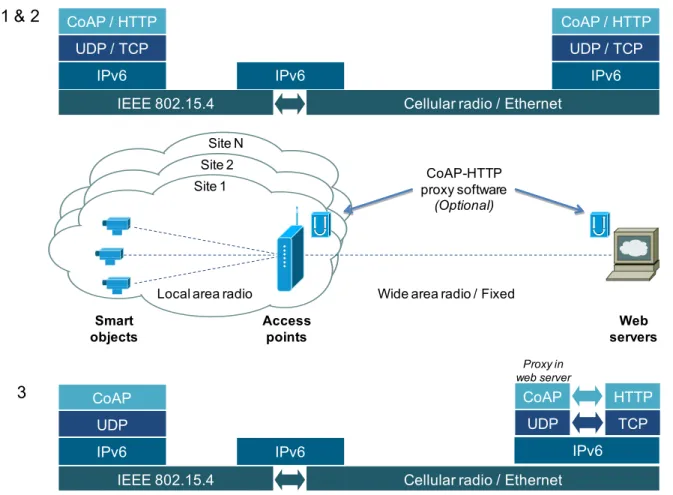
The paper focuses on WoT applications utilizing Internet-connected, constrained devices, i.e., battery-powered smart objects with constrained communications and processing capabilities, and limited RAM. Figure 1 depicts the studied architecture that consists of smart objects, access points and web servers.
Figure 1. Technical architecture for all of the cases under comparison
Web servers CoAP-HTTP proxy software (Optional) Smart objects Access points Site 1 Site N Site 2
Local area radio Wide area radio / Fixed
CoAP UDP
IPv6 IPv6
IEEE 802.15.4 Cellular radio / Ethernet
CoAP / HTTP UDP / TCP IPv6 IPv6 CoAP / HTTP UDP / TCP IPv6
IEEE 802.15.4 Cellular radio / Ethernet
CoAP UDP IPv6 HTTP TCP 1 & 2 3 Proxy in web server
Smart objects (sensors or actuators) communicate through access points with web servers residing in the public Internet. The smart objects are located in the proximity of access points so that they can be connected using license-free short-range radio technologies, such as IEEE 802.15.4. The access points are not resource-constrained and they connect to the web server over long-range radio or fixed links. In some application scenarios, the smart objects are distributed across a wide geographic area, in which case they form multiple sites with their corresponding access points. A CoAP-HTTP proxy is an optional software component in the architecture, which can be used to translate between CoAP and HTTP if the smart objects use CoAP but the server understands only HTTP. Depending on the architectural choice, the proxy is implemented either in the access points or in the web servers. The protocol stack in the bottom of Figure 1 assumes the latter approach, but the cost impact of both options is discussed in Section 4.3.4.
The depicted architecture enables three deployment alternatives using CoAP and HTTP: 1) CoAP end-to-end (CoAP),
2) HTTP end-to-end (HTTP), and
3) CoAP between smart objects and proxy, and HTTP between proxy and web servers (CoAP-proxy).
The paper further differentiates two modes of communication:
- In the pull mode, a smart object acts as a server awaiting the requests from a remote node,
and responds to the requests with the information required, e.g., by delivering the instant sensor reading. The smart object is non-sleeping or frequently awaking, as it shall always be ready to promptly respond to an incoming request.
- In the push mode, a smart object acts as a client and periodically sends the information to a
remote web server. The smart object is mainly sleeping and awakes only when it needs to (sense and) communicate the information. In addition to periodic communication, CoAP also provides the Observe option [20] that allows the smart objects to communicate only when a specified condition is met.
The implementation details may blur the distinction between the two modes. For instance, in the pull mode, the smart object may be asleep for a portion of time if a short delay in responding is tolerated, or if a cached response by the proxy is sufficient until the next communication time. Still, for the analysis in this paper, it is important to distinguish the mode where the smart object is constantly “on duty” (pull) from the mode where the smart object may be offline for a relatively long period of time (push), as it impacts the smart objects’ energy consumption and hence their battery lifetime.
The protocol stacks are different between the CoAP and HTTP cases. CoAP uses UDP as the transport layer protocol, whereas HTTP uses TCP. This has implications for the CoAP-proxy case as
well since the protocol translation is required both at the transport and application layers. Additionally, the communication mode affects the protocol stack implementation on smart objects. In the push scenario the smart object requires only a client module, whereas in the pull scenario both client and server modules are needed. The access points and web server have both client and server modules.
Moreover, the following simplifying assumptions concerning the technical architecture are made: • The 6lowPan IPv6 header compression format [21] is used to transmit IPv6 packets between
the smart objects and the access points, and the translation to regular IPv6 or IPv4 is performed by the access points;
• The smart objects connect directly to access points (i.e., no routing over the smart objects); • The battery-powered smart objects do not harvest energy (i.e., battery replacements are
needed);
• The transmitted messages are short and generally fit into a single IEEE 802.15.4 frame. 4.2 Value network
In order to succeed, the business case of a protocol needs to be positive for each stakeholder of the value network. In the most challenging cases, the deployment of a WoT application may require actions from multiple stakeholders. This paper, however, assumes that a single stakeholder – the end-user (company) of the WoT application – controls the whole WoT application, including all the components presented in Figure 1. This simplifies the analysis and allows focusing on the total cost of ownership from the perspective of a single potential adopter.
The potential adopters are not necessarily the ones who choose the protocols; they often just buy what technology providers sell to them. However, this does not cause problems to the analysis as the incentives of technology providers and their customers are aligned, and the costs to the technology providers (plus some margin) are included in the prices paid by the customers.
4.3 Generic TCO model for a WoT application
This section presents a generic TCO model for a WoT application using the introduced technical architecture and describes the factors that affect the different cost components. The costs are calculated separately for each group of technical components: smart objects (𝑆), access points (𝐴), web servers (𝑊), and the optional proxy component (𝑃). System level costs that cannot be naturally assigned to technical components are listed as other costs (𝑂). The total cost of ownership can be expressed as the sum of the costs for the separate cost components:
where 𝑛, 𝑚 and 𝑙 denote the number of smart objects, access points and web servers in the installation.
Following David et al. [9], the costs of each main cost category are divided into acquisition (𝐶!") and
operating costs (𝐶!"). The acquisition costs covering the purchase and installation of the technical
components are further divided into hardware (𝐶!"), software (𝐶!") and connectivity setup (𝐶!") costs. The operational costs include hardware and software maintenance (𝐶!), connectivity (𝐶!") and
supply (𝐶!") costs. As a result, the cost function for each of the cost categories can be expressed as:
𝐶=𝐶!"+𝐶!"+𝐶!"+𝐶! +𝐶!"+𝐶!", (2)
where 𝐶 is replaced with 𝑆, 𝐴, 𝑊, 𝑃 and 𝑂. In the following subsections, each cost component is described with the factors affecting the magnitude of the costs.
4.3.1 Costs of smart objects (𝑛∗𝑆)
Volume discounts ignored, the hardware acquisition costs (𝑆!") increase linearly when the number of
smart objects (𝑛) increases. The same applies to the software development costs (𝑆!"), if the software
is a standardized offering and the software costs are incorporated into smart object prices. However, with custom-made software developed specifically for the particular application installation, the software development costs are fixed, i.e., they do not depend on the number of smart objects. In this case, the relative share of software costs in the smart object total costs decreases when the number of smart objects increases. The installation of the smart objects incurs personnel costs and potentially also costs for traveling to the sites. However, these initial installation costs are included in the access point installation costs (considered in the next subsection) and are thus excluded here. Finally, since the connectivity between smart objects and the access points uses unlicensed spectrum, the smart object connectivity costs (𝑆!",𝑆!") can be excluded from the model. Consequently, the acquisition
costs of a smart object can be calculated simply as:
𝑆!"=𝑆!"+𝑆!" (3)
The operating of smart objects incurs only maintenance costs, because the connectivity uses unlicensed spectrum, and because the battery-based operation and small size allow the electricity and facility costs to be avoided. The maintenance costs consist of periodical battery replacement (𝑆!,!) and software update (𝑆!,!") costs, as well as occasional hardware replacement costs (𝑆!,!!). 𝑆!,! is a
function of i) the number of battery replacements during the lifetime of the application, calculated as a function of the application lifetime (𝑇) and battery lifetime (𝑡!); ii) the price of a new battery (𝑝!); and iii) the labor and travel costs of visiting the sites and carrying out the replacements (𝐶!"#$!!"#"$) that are divided among all the smart objects on a site (𝑛!"#$):
𝑆!,! =!!
!∗(𝑝!+
!!"#$!!"#"$
The battery lifetime depends on the capacity of the battery and the average energy consumption of the smart object:
𝑡! =!"#$%&!"#$%& !"#$%&'()"# !"#$%& !" ! !"##$%&=!"#"$%&'∗!"#$%&'!"#$% =!∗!! , (5)
where energy consumption depends on the application specific factors, such as the used communication mode (push vs. pull), communication frequency, complexity of parsing, and transferred data volume.
The need for occasionally replacing the smart objects due to malfunctioning causes hardware maintenance costs (𝑆!,!!). These are incorporated in the TCO model by defining the average lifetime
of a smart object (𝑡!,!!). Due to the unpredictable nature of hardware failures, smart object replacement incurs an additional site visit:
𝑆!,!! =!!
!,!!∗(𝑆!"+𝐶!"#$!!"#"$). (6)
Software update costs (𝑆!,!") can be calculated similarly to the hardware maintenance costs by
defining the average time interval for software updates (𝑡!,!"), the development cost of a SW update
(𝑆!,!"!!"#$%&) divided among all the smart objects, and the installation costs (𝑆!,!"!!"#$%&&).
Depending on the application scenario, the software update installation can be either provisioned over the air, which causes connectivity costs, or by visiting the sites as in the case of hardware maintenance.
𝑆!,!"=!!
!,!"∗
!!,!"!!"#$%&
! +𝑆!,!"!!"#$%&& . (7) 4.3.2 Costs of access points (𝑚∗𝐴)
The number of access points (𝑚) depends on the number of sites and the number of access points per site. The number of sites can be calculated as a function of the number of smart objects (𝑛) and the number of smart objects per site (𝑛!"#$), whereas the number of access points per site depends on the
relation between 𝑛!"#$ and the maximum number of smart objects an access point can support (𝑛!"):
𝑚=!!
!"#$∗ !!"#$
!!" , (8)
An access point is a wireless router, where the hardware and software costs are bundled into the access point price (𝐴!"!!"). The initial installation of the access point (and the smart objects connecting to it) in the sites causes installation costs (𝐴!",!"#$%&&) that consist of the personnel costs and costs of travel to the site. Additionally, equipping each access point with data subscription causes connectivity setup costs (𝐴!"). The function for the access point acquisition costs (𝐴!") can be expressed as:
Maintenance costs (𝐴!) are calculated similarly as with smart objects as defined in Eq. 6 and Eq. 7: 𝐴!,!!=! ! !,!!∗(𝐴!"+𝐶!"#$_!"#"$); (10) 𝐴!,!" =! ! !,!"∗ !!,!"!!"#$%& ! +𝐴!,!"!!"#$%&& . (11) The connectivity costs (𝐴!") depend on the pricing model [4] of the long-range connectivity. Simple, flat-rated connectivity pricing schemes are common today and deemed important for boosting the adoption of WoT technologies7. Also, when WoT applications are used in domestic deployments, e.g., as a part of a smart home solution, a landline broadband Internet connectivity is usually available, for which flat-rate is a common charging approach [1]. The cost function for the flat-rate pricing scheme can be expressed simply as the function of the application lifetime (𝑇) and the monthly price 𝐴!"#,!"#$:
𝐴!",!"#$=𝑇∗𝐴!"#,!"#$. (12)
On the other hand, a wide range of volume-based pricing schemes is also available. Subscriptions of this type are common in case the smart objects are mobile, potentially even roaming between multiple cellular networks. In the simplest version of volume-based pricing8, the price per data unit remains constant irrespective of the transferred data volume. However, some communication service providers (CSP)9 offer M2M subscriptions where a tiered pricing is applied, with the price per data unit depending on the data volume, and where pooling data among devices is allowed. With such tiered schemes, the price is subject to a volume discount and decreases as the transferred data volume grows. Due to the large variation in the pricing schemes, the exact connectivity cost function needs to be formulated separately for each application scenario.
Supply costs consist of electricity cost and the rent for premises. The monthly electricity cost is a simple function of the average monthly power consumption of an access point (𝑃!) and the unit price of energy (𝑢), whereas the rent for premises (𝐴!",!") is a constant monthly fee. To obtain the total costs, monthly costs are multiplied with the application lifetime (𝑇):
𝐴!"=𝑇∗ 𝑃!∗𝑢+𝐴!",!" . (13) 7http://www.telefonica.de/news/0/msg/17632/4323/0/o2-data-m2m-flat-first-flat-rate-for-communication-between-machines.html, http://www.koretelematics.com/press-room/20121010-KORE-Wireless-Group-Partners-with-Optus-to-Expand-Global-Connect-Services-in-Asia.html 8http://www.telenor.me/en/Business/Internet/M2M-Machine-2-Machine/, http://www.o2online.de/business/mittelstand/mobil/m2m/datam2m/ 9http://www.orange-business.com/content/mnc/mobility-tarifs-m2m.pdf, http://www2.dir.texas.gov/SiteCollectionDocuments/CTS/Wireless%20Contracts/DIR-SDD-1779/DIR-SDD-1779-appendix-c.pdf, http://m2m.sprint.com/engage-with-us/m2m-pricing
4.3.3 Costs of web servers (𝑙∗𝑊)
In this model, web servers are assumed to be leased from a hosting provider that charges a monthly fee (𝑊!!"#$%&) covering all the hardware, connectivity and supply costs. The fee is based on the features of the leased server and the allowed maximum traffic volume per month. This approach simplifies the cost function significantly, since only the software acquisition (𝑊!") and update costs (𝑊!,!") have to be calculated separately. 𝑊!" consists of both the development costs for the protocol
stack and the web application. 𝑊!,!" is calculated by defining the update interval (𝑡!,!") and the development cost of a single update (𝑊!,!"!!"!"#$) per web server. Consequently, the cost function
of a web server is:
𝑊=𝑇∗𝑊!!"#$%&+𝑊!"+ ! !!,!"∗
!!,!"!!"#$%&
! . (14)
4.3.4 Costs of a CoAP-HTTP proxy (𝑃)
A CoAP-HTTP proxy is an optional software component that allows CoAP smart objects to communicate with HTTP web server by translating between CoAP and HTTP. The proxy can be implemented either in the access points or in the web server. Based on the selection between these two architectural options, the communication over long-range wireless access link uses either CoAP or HTTP, which may have significant cost impacts, as discussed later in Section 4.4.
For the sake of simplicity, the proxy costs are calculated as additional costs on top of the normal access point or web server costs. Most importantly, a new software component increases the software development (𝑃!") and related software update costs (𝑃!,!"). Furthermore, the requirement for more efficient hardware may increase the hardware acquisition (𝑃!") and related maintenance costs
(𝑃!,!!), especially in case the proxy is implemented in access points. All the other costs remain unchanged, thus leading to the following cost function for the proxy:
𝑃=𝑃!"+𝑃!"+𝑃!,!!+𝑃!,!" (14)
4.3.5 Other costs (𝑂)
Other costs cover the costs related to the acquisition (𝑂!") and the operation (𝑂!") of the WoT application that cannot be naturally assigned to separate technical components. 𝑂!" include time-consuming activities, such as searching for components and providers, asking for tenders, and testing the system, which can partly be outsourced to consultants. 𝑂!" consist of the personnel costs related to administering the WoT application, training the personnel, and providing support for the users of the application. Both of these cost components are simply calculated as personnel costs by defining the required person months (𝑃𝑀!", 𝑃𝑀!") and the average salary of an employee (𝑆𝑎𝑙!", 𝑆𝑎𝑙!"):
4.4 Cost comparison between CoAP and HTTP
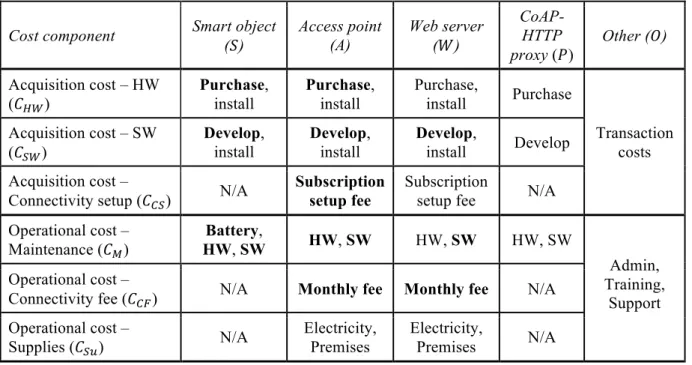
Table 1 summarizes the cost components and the notation of the TCO model introduced in the previous section. N/A denotes that the cost component in question is non-applicable (i.e., the cost is zero). The TCO model is generic and can be applied to assess the costs of various WoT solutions, as well as to compare the cost implications of using different communication protocols, software interfaces, and other technical alternatives that a designer of the WoT solution may need to analyze. Furthermore, the TCO model is sufficiently generic to be used also outside of WoT applications, because the technical architecture of IT systems consists typically of clients (S), middle-boxes (A, P) and servers (W), which are the key components of the model.
This paper focuses on comparing the costs of WoT applications based on CoAP and HTTP. Therefore, the potential sources for cost differences between CoAP and HTTP are highlighted with boldface in Table 1 and discussed further in the following subsections.
Table 1. Generic TCO model for a WoT application: technical components and related cost components. The sources for potential cost differences between CoAP and HTTP are highlighted with boldface.
Cost component Smart object (𝑆) Access point (A) Web server (𝑊) CoAP-HTTP proxy (𝑃) Other (𝑂) Acquisition cost – HW (𝐶!") Purchase, install Purchase, install Purchase, install Purchase Transaction costs Acquisition cost – SW (𝐶!") Develop, install Develop, install Develop, install Develop Acquisition cost –
Connectivity setup (𝐶!") N/A
Subscription setup fee
Subscription
setup fee N/A Operational cost – Maintenance (𝐶!) Battery, HW, SW HW, SW HW, SW HW, SW Admin, Training, Support Operational cost –
Connectivity fee (𝐶!") N/A Monthly fee Monthly fee N/A
Operational cost – Supplies (𝐶!") N/A Electricity, Premises Electricity, Premises N/A
4.4.1 Smart object costs
As CoAP has been developed specifically for constrained devices, the largest reduction in costs is expected with smart objects. The more modest memory and processor requirements likely allow the use of cheaper hardware. Furthermore, the simplicity of CoAP specification as compared with HTTP may lead to savings in software development costs due to faster and easier implementation. In the early stages of CoAP adoption, however, the case may be the opposite, because HTTP as the incumbent protocol may be more familiar to developers and existing software may be reused. This
difference should not be very large, though since CoAP is seen as very “HTTPish” [3]. The differences in hardware and software acquisition costs may also affect the related maintenance costs. Due to the smaller number of bits transferred, CoAP smart objects consume less energy than HTTP smart objects. This difference becomes more evident in the push mode of communication where the time when the receiver is active can be reduced significantly. As a consequence, the batteries last longer, resulting in a smaller number of possibly costly battery replacements. Due to its potentially significant cost impact, the difference in energy consumption and battery lifetime between HTTP and CoAP is considered in detail in Appendix A for both pull and push modes of communication by aggregating the available literature sources with the results of our own measurements.
4.4.2 Access point costs
Since access points only route packets between the local area and wide area networks, they do not care about the application or transport layer protocols used by the smart objects. Therefore, the selection between CoAP and HTTP does not affect the acquisition costs. However, the protocol stack of smart objects might affect the number of access points needed, because every bit of traffic makes a difference in the 802.15.4 networks that are strongly limited in channel capacity. The larger number of packets due to TCP and larger overhead due to HTTP impede the network scalability as compared with CoAP + UDP. Consequently, an access point may support a larger number of CoAP than HTTP smart objects, which matters in those application scenarios where the number of smart objects in the coverage area of an access point exceeds the number of smart objects that a single access point can serve. The increase in the number of access points affects also the number of connectivity subscriptions and replaceable access points.
The selection between CoAP and HTTP may create significant difference in connectivity costs in case the long-range connectivity is based on transferred data volume, because CoAP uses up to 10 times fewer bits in communication. Additionally, CoAP can also use SMS as a carrier [2], which may prove to be cheaper than cellular data in some application scenarios.
4.4.3 Web server costs
Similarly to the smart objects, the development costs of the CoAP protocol stack may be higher than those of HTTP due to the better availability of software implementations, documentation, and knowledgeable developers for the latter. On the other hand, CoAP can provide cost savings over HTTP in the monthly hosting fee due to the significantly smaller data volume, which may allow use of a cheaper hosting service subscription. Furthermore, a single server may be able to support a larger number of CoAP smart objects and concurrent UDP communication sessions, as compared with HTTP + TCP combination.
5
Cost-efficiency of CoAP and HTTP in WoT applications
In order to populate the cost-comparison of CoAP and HTTP with actual numbers, a TCO calculation and comparison model was developed on the basis of the mathematical formulation presented in Section 4. The use of the developed model is demonstrated by analyzing an environment monitoring application, where a large number of environmental sensors regularly transmit the measurements of temperature, humidity, solar radiation, air quality, etc. to the web server. After introducing this baseline scenario, a sensitivity analysis is conducted where the descriptive parameters of the application scenario are varied in order to identify the characteristics that make a particular application scenario more or less attractive for CoAP.
For the purposes of the cost comparison, the values for different parameters and cost components need to be estimated. When considering the values of the cost components, the Western European and US markets are taken as the focal market for the WoT application deployment. Other regions, e.g., the Asia-Pacific countries, also represent a promising market for WoT applications. However, for the practical reason of the unavailability of pricing information, they were left outside of the scope of this paper.
Since the paper focuses on comparing the costs of CoAP and HTTP, the attention in the quantitative analysis is devoted to defining the values for those cost components that are affected by the application layer protocol. However, the costs that do not differ between CoAP and HTTP are also included in the TCO model in order to estimate the relative significance of the cost differences. When defining the values for these cost components, relatively high, though realistic values are chosen, so that the relative cost difference between CoAP and HTTP would not be over-estimated.
5.1 Baseline scenario
This scenario considers a deployment of autonomous stations for environment monitoring – such as Adcon Dust Monitoring Stations10 – that regularly transmit the measurements of temperature, humidity, solar radiation, wind and precipitation, and air quality to the web server. Contemporary stations are working autonomously, owing to internal batteries. The companies specializing in environmental sensing may need to operate hundreds or thousands of stations that are spread across a wide area. Due to this, also the number of sites is high. To limit the number of access points needed, the smart objects use 2.4 GHz radio with range up to 1 km to connect with access points. The communication model is push, meaning that the smart objects occasionally wake up from sleep to conduct measurements and communicate the results, before going to sleep again. In the base setup, this happens once per minute. Being deployed in a remote place, the access point is assumed to rely
on cellular network to provide connectivity. The flat-rate pricing scheme is assumed in the baseline scenario, since the resulting communication costs are likely to be an order of magnitude lower than the costs accrued by using a typical volume-based pricing. However, the impact of volume-based pricing schemes is also analyzed.
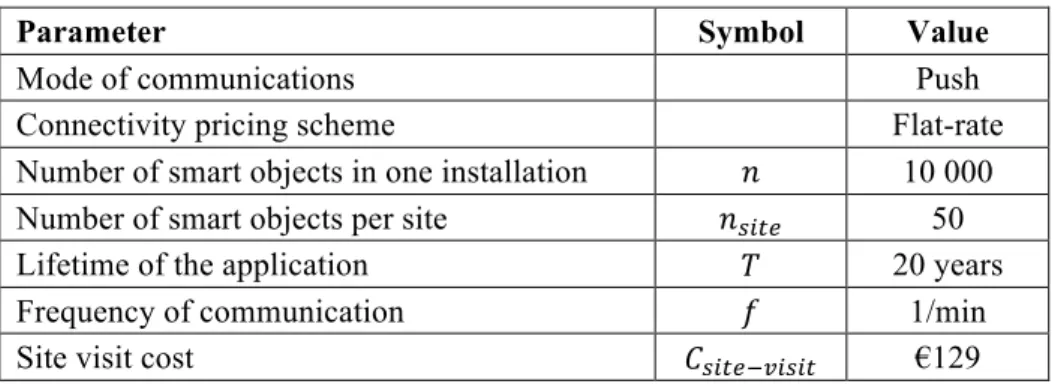
Table 2 lists the descriptive scenario parameters. The other parameter values used in the calculation are introduced in Appendix B with relevant justifications.
Table 2. The descriptive parameters of the baseline scenario
Parameter Symbol Value
Mode of communications Push
Connectivity pricing scheme Flat-rate
Number of smart objects in one installation 𝑛 10 000 Number of smart objects per site 𝑛!"#$ 50
Lifetime of the application 𝑇 20 years
Frequency of communication 𝑓 1/min
Site visit cost 𝐶!"#$!!"#"$ €129
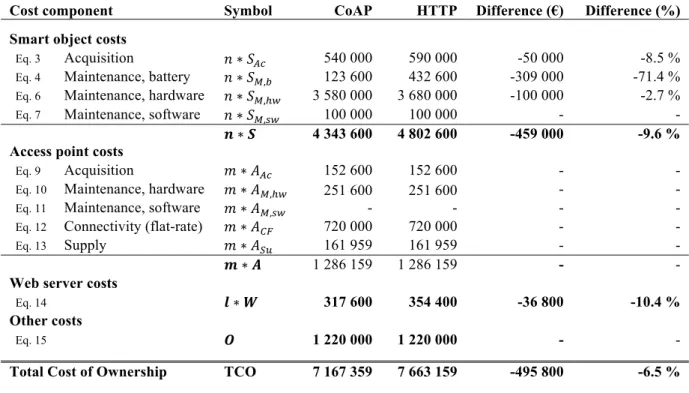
The TCO comparison calculation for the baseline scenario is presented in Table 3. With the chosen values, the CoAP-based solution is 6.5% (i.e., €495 800) less expensive than HTTP-based. This is explained by three key reasons:
i. The acquisition costs of smart objects are smaller with CoAP due to cheaper HW (€50 vs. €55), which also affects the hardware maintenance costs.
ii. The lower energy consumption of CoAP smart objects (see Appendix A for details) translates into smaller number of battery replacements (2 vs. 7) during the lifetime of the application, which reduces the maintenance costs significantly.
iii. The notably smaller traffic volume of CoAP allows the use of a cheaper hosting service, even though the absolute difference in web server costs is relatively minor. The higher development costs of the CoAP stack reduce this difference.
Although Table 1 listed the smart object software costs as a potential differentiator between CoAP and HTTP, they are assumed to be the same for both CoAP and HTTP in the baseline scenario. On the one hand, CoAP specifications are simpler, making its implementation more compact and hence making it simpler to fit the software to the constrained memory of the smart object. On the other hand, the use of CoAP demands from the developers the knowledge of the protocol and the libraries implementing it. Thus, when using CoAP instead of HTTP, the software development efforts first increase due to the need to learn the protocol, but later decrease due to the more compact implementation. As a result, according to the domain experts, the overall smart object software development time is similar for CoAP and HTTP.
Table 3. TCO comparison between CoAP and HTTP for the baseline scenario
Cost component Symbol CoAP HTTP Difference (€) Difference (%)
Smart object costs
Eq. 3 Acquisition 𝑛∗𝑆!" 540 000 590 000 -50 000 -8.5 %
Eq. 4 Maintenance, battery 𝑛∗𝑆!,! 123 600 432 600 -309 000 -71.4 % Eq. 6 Maintenance, hardware 𝑛∗𝑆!,!! 3 580 000 3 680 000 -100 000 -2.7 %
Eq. 7 Maintenance, software 𝑛∗𝑆!,!" 100 000 100 000 - - 𝒏∗𝑺 4 343 600 4 802 600 -459 000 -9.6 % Access point costs
Eq. 9 Acquisition 𝑚∗𝐴!" 152 600 152 600 - -
Eq. 10 Maintenance, hardware 𝑚∗𝐴!,!! 251 600 251 600 - -
Eq. 11 Maintenance, software 𝑚∗𝐴!,!" - - - -
Eq. 12 Connectivity (flat-rate) 𝑚∗𝐴!" 720 000 720 000 - -
Eq. 13 Supply 𝑚∗𝐴!" 161 959 161 959 - -
𝒎∗𝑨 1 286 159 1 286 159 -
-Web server costs
Eq. 14 𝒍∗𝑾 317 600 354 400 -36 800 -10.4 %
Other costs
Eq. 15 𝑶 1 220 000 1 220 000 -
-Total Cost of Ownership TCO 7 167 359 7 663 159 -495 800 -6.5 %
5.2 Baseline scenario with volume-based pricing
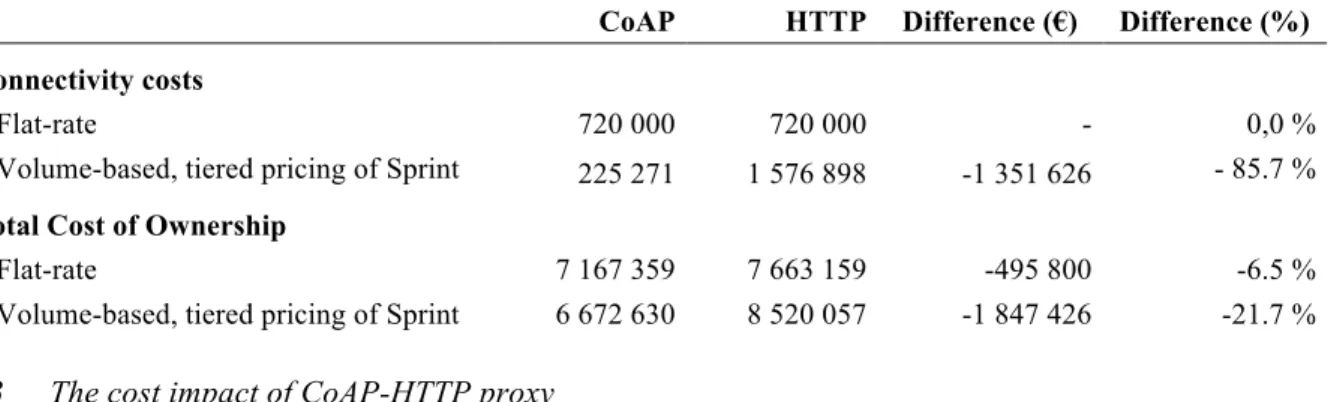
Access point costs account for a significant share of the TCO in the baseline scenario, but there is no difference between CoAP and HTTP in this cost component, since a single access point per site suffices in both cases and since the connectivity is flat-rated. The situation changes, however, if the pricing for the 3G connectivity is volume-based. Together, 10 000 smart objects require 62 GB and 434 GB of data to be transferred monthly by a CoAP-based and HTTP-based solution, respectively. In particular, applying the tiered M2M pricing scheme of Sprint11 will induce circa €225 000 and €1 577 000 in data communication costs over the lifetime of the application12. In this case, the communication costs become the most influential cost differentiator between the protocols, making the use of CoAP economically clearly justifiable, as shown in Table 4. Thus, a fourth reason for choosing CoAP over HTTP emerges:
iv. The notably smaller traffic volume enabled by CoAP translates into significant savings in connectivity costs in the case of volume-based pricing.
11http://m2m.sprint.com/engage-with-us/m2m-pricing
Table 4. Comparison of the flat-rate and volume-based pricing schemes in the baseline scenario
CoAP HTTP Difference (€) Difference (%)
Connectivity costs
Flat-rate 720 000 720 000 - 0,0 %
Volume-based, tiered pricing of Sprint 225 271 1 576 898 -1 351 626 - 85.7 %
Total Cost of Ownership
Flat-rate 7 167 359 7 663 159 -495 800 -6.5 %
Volume-based, tiered pricing of Sprint 6 672 630 8 520 057 -1 847 426 -21.7 %
5.3 The cost impact of CoAP-HTTP proxy
A CoAP-proxy implementation introduces an alternative approach to end-to-end CoAP for realizing the web server side of the CoAP application. As explained in Section 4.3.4, the smart object side remains unchanged and the cost difference between CoAP and CoAP-proxy cases depends solely on the cost ratio between the CoAP server implementation (€20 000) and the combination of HTTP server (€0) and proxy module implementation (€5000). Even though the proxy implementation should be favored on the basis of this calculation, the cost difference is minor as compared with the difference in the TCO. From the cost perspective, the implementation location of the proxy has a larger cost impact than the implementation itself has. In case the connectivity pricing is volume-based, the proxy should namely be implemented in the web server in order to benefit from the cost savings described in Section 5.2. Finally, the end-to-end implementation may provide performance benefits over the proxy implementation that are not taken into account in the calculation. As a consequence, the decision between CoAP and CoAP-proxy implementation is likely to be based on architectural requirements related to, e.g., security, performance or caching, rather than on cost-efficiency.
5.4 Sensitivity analysis
Typically, a sensitivity analysis is conducted to control the uncertainties related to the estimated parameter values, with the objective to study how sensitive the results are to the changes in the estimated values. In this paper, however, the focus is not on the TCO itself, but on the absolute and relative cost difference between CoAP and HTTP. Therefore, it is more interesting to identify the characteristics of the more and less attractive application scenarios. In order to accomplish that, the descriptive parameters of the baseline scenario listed in Table 2 are varied to analyze how the difference in TCO between the CoAP- and HTTP-based solutions behaves. Generally, CoAP becomes more attractive when the relative difference (%) increases. The relative difference is calculated by dividing the absolute difference (€) in the TCO by the TCO of HTTP. It shall be remembered that, if the TCO is high, even a small relative difference translates into substantial absolute difference. As a
consequence, both the absolute and relative cost differences need to be understood for the purpose of evaluating the attractiveness of CoAP in different application scenarios.
5.4.1 Frequency of communications (𝑓)
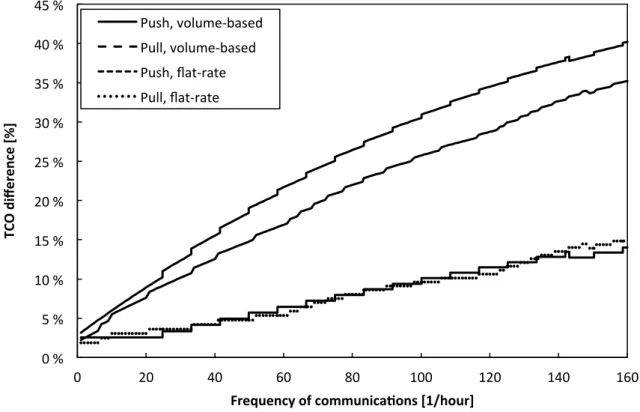
In the case of flat-rate connectivity pricing, the communication frequency affects only the energy consumption of smart objects. With the push mode of communication, the battery lifetime is defined by self-discharge for both CoAP and HTTP, when the communication frequency is smaller than 25/h. With values larger than 25/h, the battery replacement costs of CoAP and HTTP start to diverge step-wise due to additional battery replacements required by HTTP smart objects. The battery replacement costs of CoAP smart objects remain unchanged until the communication frequency reaches 144/h. As a result, also the relative cost difference increases, as shown in Figure 2. A similar pattern is visible with the pull mode of communication, because the difference in the number of battery replacements between CoAP and HTTP evolves similarly in both the push and pull modes.
In the case of volume-based connectivity pricing, the increasing communication frequency increases the absolute and relative cost difference between CoAP and HTTP. The step-wise pattern of battery replacements is still visible, but the volume-based pricing makes CoAP significantly more attractive.
Figure 2. Impact of communication frequency on the relative cost difference between CoAP and HTTP
It should be noted that, for the sake of simplicity, the hosting fee of web servers (𝑊!!"#$%&) is not modeled as a function of the communication volume. As a consequence, the web server costs remain unchanged even though the changing frequency (and the changing number of smart objects analyzed
0 % 5 % 10 % 15 % 20 % 25 % 30 % 35 % 40 % 45 % 0 20 40 60 80 100 120 140 160 TC O d iff er en ce [%]
Frequency of communica7ons [1/hour] Push, volume-‐based
Pull, volume-‐based Push, flat-‐rate Pull, flat-‐rate
in Section 5.4.2) affects the communication volume. However, this simplification does not have significant impact on the results, because the data volume in the baseline scenario is rather high, and still the impact of the web-server hosting fee on the TCO is minor due to the generally low hosting fees.
5.4.2 Number of smart objects (𝑛)
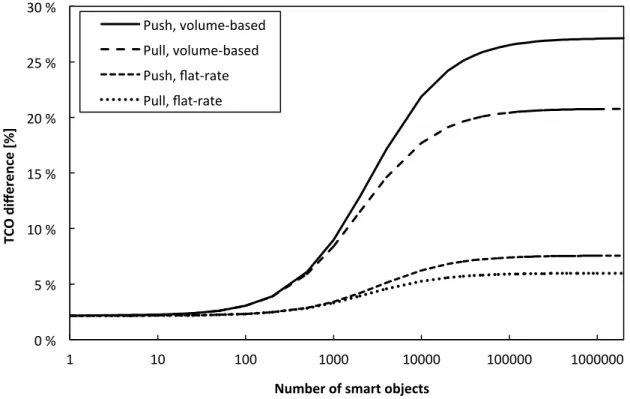
The number of smart objects largely defines the scale of a WoT application – including also the number of sites since the number of smart objects per site (𝑛!"#$) is kept constant at 50 objects. The TCO of both CoAP and HTTP, and the absolute cost difference between them, increases linearly with the number of smart objects. However, as illustrated in Figure 3, the relative cost difference between CoAP and HTTP increases logistically from 2.1% (𝑛 =1) to 7.7% until 𝑛 reaches approximately 110 000. The difference is small in the beginning as the costs that do not depend on the number of smart objects dominate. However, the relative cost difference grows fast with the number of smart objects and reaches 6.5% already with 10 000 smart objects. After 110 000 smart objects, the marginal cost for adding one smart object is €550 for CoAP and €596 for HTTP, where the €46 cost difference originates from the difference in smart object hardware and battery replacement costs.
Figure 3. Impact of the number of smart objects on the relative cost difference between CoAP and HTTP. Please note the logarithmic scale on x-axis.
The communication mode does not affect the behavior of the cost difference function but lowers the upper limit from 7.7% to 6.0%. In the case of the volume-based pricing, the behavior stays similar,
0 % 5 % 10 % 15 % 20 % 25 % 30 % 1 10 100 1000 10000 100000 1000000 TC O d iff er en ce [%]
Number of smart objects Push, volume-‐based
Pull, volume-‐based Push, flat-‐rate Pull, flat-‐rate
but the upper limit increases significantly (to 26.6% in push mode, and to 19.5% in pull mode) since the increasing number of smart objects affects the transferred data volume directly.
It should be noted that, in the TCO model used, the scale of the application does not automatically affect the level of other costs (𝑂), even though a dependency may exist between them. This limitation, however, concerns only the cases with a very small number of smart objects, where the potentially high other costs mask the relative cost difference between CoAP and HTTP. On the other hand, the other costs may be underestimated with a high number of smart objects; however, even after an order of magnitude increase they remain negligible as compared with the TCO.
5.4.3 Number of smart objects per site (𝑛!"#$)
The distribution of smart objects across the sites has a potentially large cost impact. In the TCO model, this is controlled with the number of smart objects per site, which also affects the number of access points per site. With a constant number of smart objects, the number of sites, as well as the related access point costs, decrease when the number of smart objects per site increases. The battery replacement costs also decrease, because the number of sites to visit decreases. In consequence, the TCO decreases exponentially with the increasing number of smart objects per site. In the most extreme case of only one smart object per site, which effectively means that each smart object would be equipped with a cellular modem, the TCO of CoAP and HTTP are 72.7 and 79.5 million euros, respectively. With five objects per site, the TCO is only one fourth of that, and with 100 objects the TCO already approaches the lower boundary of 6.2 and 6.7 million euros.
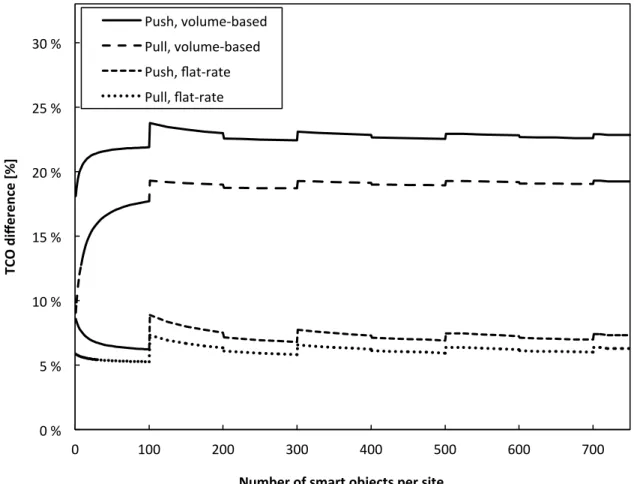
The relative cost difference between CoAP and HTTP, however, does not depend significantly on the distribution of smart objects across the sites. The small, stepwise variation is caused by the difference in the scalability of access points, which starts to have an impact on the costs when 𝑛!"#$ becomes
larger than 𝑛!" for HTTP (𝑛!"#$> 100). After this point, the difference in the access point costs
depends heavily on how efficiently the smart objects are distributed across the sites in relation to 𝑛!".
For example, when 𝑛!"#$ is 200, the number of access points needed is 50 for CoAP and 100 for
HTTP. However, if 𝑛!"#$ is 120, the number of APs grows to 84 and 168 for CoAP and HTTP,
respectively, since each site requires two APs in the case of HTTP, even though they are underutilized. This is visible in Figure 4 as a stepwise increase in the relative TCO difference when 𝑛!"#$> 100, after which the difference starts to decrease again. When 𝑛!"#$ grows over 200, the step
goes in the opposite direction since both HTTP and CoAP require additional access points per site, which leads to a large increase in TCO.
With volume-based pricing, the relative cost difference behaves similarly to the flat-rate pricing. This is due to the fact that, no matter whether volume-based or flat-rate pricing is used, the related charges for the data communications remain unchanged or increase insignificantly along with 𝑛!"#$, as long as the overall number of smart objects or APs, respectively, is kept constant. The only exception is the