Turun kauppakorkeakoulu • Turku School of Economics
Bachelor’s thesis Master’s thesis Licentiate’s thesis Doctor’s thesis Subject MSc Thesis in IMMIT Date 1st June 2019
Author(s) Student number 516176
Number of pages 73
Title Role of Dynamic Capabilities for Digital Transformation: Developing Dynamic
Capa-bilities Essential for Digital Transformation
Supervisor(s) Prof. Hannu Salmela
Prof. Patrick Rousseau
Abstract
Digital transformation pursued by firms is characterized by business distruptions and dynamic changes. Thus, the normal resource base and routine capabilitities are not adequate to manage these changes. ’Dynamic capabailities’, born out of strategic management studies are necessary to manage rapidly the distruptions to pursue the strategic objectives of digital transformation. In this study, 6 dynamic capabilities have been developed through strategic actions as creating and modifying the company’s resource base or integrating and reconfiguring its competences. They are identified either as ’first order’ or ’second order dynamic capabilties’. The results of this research further shows that firms that would have a strong resource base will have lesser firm specific ’second order dynamic capabilities’ while having more ’first order dynamic capabilities’ that would be more homogenous in the manufacturing industry at a higer level. The ’second order dynamic capabailties’ are extension of the ’first order’ and can be developed through the firm specific strategic actions performed to maintain the distruptions during digital transformation.
Key words Dynamic capabilities, digital transformation, digital transformation business strategy,
digital innovation, resources.
Further in-formation
Turun kauppakorkeakoulu • Turku School of Economics
ROLE OF DYNAMIC CAPABILITIES FOR
DIGITAL TRANSFORMATION
Developing Dynamic Capabilities Essential for Digital
Trans-formation
Master´s Thesis in IMMIT Author (s): Eric Kipongi Supervisors: Ph.D. Hannu Salmela Ph.D. Patrick Rousseau May 2019 TilburgPreface
This thesis is the culmination to the completion of my IMMIT study. The study is a memorable phase of my life visiting and doing one of the best programs in IS Management in 3 different European countries. It has been so tough with many obstacles in the way that I have come so far. Coming from a home wanderer without parents’ support since childhood to completing a triple Masters is a personal achievement that I would be proud of, and worth re-telling for others that “Nothing is impossible with God” (Luke 1:37). All Glory and Praise to God that I believe in!
Every single day, I have been fighting to find my place on this earth without any physical support since childhood. Life has not been easy, and I took a leap of faith to even embark on this journey to pursue this study with only €2000 in my pocket and an initial 5 months scholarship in France. The study took an extra year than anticipated, but as they say “the rest is history”. Here, this part of my journey is done!
The space would not allow me to thank everyone who may have helped, so if one has assisted me even just by talking or responding to an email request, he/she is very much appreciated. Just a mention for few notable individuals; my gratitudes to my 2 Supervisors, the IMMIT board members, Professors and associates who have helped along the way. I thank Professor Hannu Salmela specifically for the 5 months research assistant work in Finland, together with Dr Abayomi Baiyere. It was a great help. Thanks. In a similar note, special thanks to Ambassador Pascal Maubert, Prof Jan Czuba & team at DHERST PNG for their support. Also to my Adventist church families in the 3 countries, France, Finland and the Netherlands. Special mention to Mama Elvi & Kirsti, Isä Jussi & Vuoko, Evy & Reijo, Odile Ledésert, plus others who have assisted me in one way or the other. Through this study, I have met them all and made good friends that I will keep forever. I am very much thankful towards them all. Not the least, my 2 mothers back home also deserve the appreciation; and finally my IMMIT colleagues in both cohorts 10 and 11. They have been a superb group of students. Getting to know them all and studying together have been a very good experience. Great memories made and I wish them all the best in their future endeavours.
All in all, this study was not just a paper that I was after but a life-story in the making. I know this experience will be a milestone that I would step on to tell others to persevere and work hard to gain what they want in life. I have always told myself that I will do my masters, but coming from a developing country and having a background as mine, it was a hard fight; yet completing this study is a testament. It is a testament to that desire and peseverence to find my place in this fast paced world where everyone is for themselves. And to this end, I am not yet done with this chapter in my personal life and I am looking forward to what lays ahead again (Psalms 23).
The originality of this thesis has been checked in accordance with the University of Turku quality assurance system using the Turnitin OriginalityCheck service.
Table of Contents
1 INTRODUCTION ... 10
2 RESEARCH APPROACH ... 12
2.1 ManuftX and D4A Project ... 12
2.2 Research Design ... 13
2.2.1 Research Questions ... 13
2.2.2 Qualitative Content Analysis ... 14
2.2.3 Literature Search and Selection ... 16
2.3 Data Collection ... 17
2.4 Validity and Reliability ... 21
2.5 Data Analysis ... 22
3 LITERATURE REVIEW ... 25
3.1 Digital Transformation, Strategy and Innovation ... 25
3.1.1 Digital Transformation ... 25
3.1.2 Digital Transformation Business Strategy ... 27
3.1.3 Digital Innovation ... 30
3.2 Dynamic Capabilities in Technology Driven Transformations ... 31
3.2.1 Dynamic Capabilities ... 31
3.2.2 First and Second Order Dynamic Capabilities ... 33
3.2.3 Dynamic Capabilities in IS Studies ... 35
4 EMPHIRICAL FINDINGS ... 40
4.1 Resource Base and Competence ... 40
4.2 Dynamic Capabilities Development ... 42
4.2.1 Commitment to Customized Service Provision for Individual Customer ... 42
4.2.2 Developing and Integrating Existing Systems ... 45
4.2.3 Structural Adaptation and Business Case Development ... 46
4.2.4 Strategic Commitment to Change Practices ... 48
4.2.5 Dynamic Process Management ... 49
4.2.6 Dynamic Management Capabilities ... 50
5 ANALYSIS AND DISCUSSION ... 53
6 CONCLUSIONS, LIMITATIONS AND FUTURE WORK ... 58
6.1 Conclusions ... 58
7 LIST OF REFERENCES ... 61 8 APPENDIX I – LITERATURE SEARCH ... 67
Figures
Figure 1 – Qualitative Content Analysis using Inductive Coding ... 15 Figure 2 – Procedure Followed in Applying Nvivo software (Bazeley, 2007) ... 23 Figure 3 - Building Blocks of the Digital Transformation Process (Vial, 2019) . 27 Figure 4 - Relations between Digital Transformation Strategy and Other
Corporate Strategies (Matt et al., 2015) ... 28 Figure 5 - Digital Transformation Framework: Balancing Four
Transformational Dimensions (Matt et al., 2015) ... 29 Figure 6 - Critical difference between Teece et al. (1997) and Eisenhardt and
Martin (2000) extracted from Peteraf et al. (2013) ... 32 Figure 7 - Second-Order and First Order Dynamic Capabilities Relationship
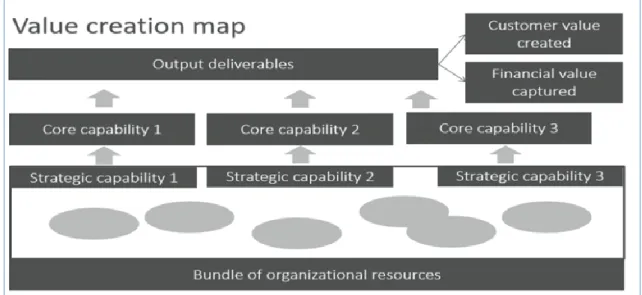
(Schilke, 2014) ... 34 Figure 8 - Value Creation Map (Archival Document) ... 41 Figure 9 - ManuftX Resources & Capabilities Analysis: Strategic Importance vs
Relative Strength (Archival Document). ... 42 Figure 10 - Customer Support Reaction Time from “Used To Be” To “To
Achieve” With Digital Transformation (Archival Document) ... 44 Figure 11 - Doping Kitchen (Archival Document) ... 52 Figure 12 – Extensive Literature Search Process ... 67 Figure 13 - NVivo 12 Screenshot of the Auto-Coded Step 1 - Identify Themes
coding ... 70 Figure 14 - NVivo 12 Screenshot of the Auto-Coded Step 2 – Processing the
Themes ... 71 Figure 15 - NVivo 12 Screenshot of the Auto-Coded Step 3 – Code Sentences
selection ... 72 Figure 16 - NVivo 12 Screenshot of the Auto-Coded – Themes of Coded Nodes73
Tables
Table 2-1 – List of Interviews ... 19
Table 2-2 – Overview of Data ... 21
Table 3-1 - Dynamic Capabilities Associated with IS Studies ... 36
Table 5-1 - Dynamic Capabilities for Digital Transformation ... 53
Table 5-2 – Categorized Dynamic Capabilities ... 55
Table 8-1 – Literature Search Results from Mendeley Software ... 67
1
INTRODUCTION
Technical innovations and emergence has changed the business environment. Digital transformation encompassing recently conceptualized “SMACIT (social, mobile, analytics, cloud, and internet of things)” (Ross et al., 2016) have played very important roles in the performance, development and innovation scales of firms. Those companies who were born with the development of the SMACIT technologies such as Facebook, Amazon and Google are progressively researching and developing them still further gaining added advantage, while the traditional firms have been adopting these technologies to boost their operations and maximize value creations resulting in the studies such as that of the leadership capability and strategies of digital transformation (Sebastian et al., 2017).
In the recent years, many firms have been involved in the digital transformation, and its engulfing both the private and public sectors. Thus, “no sector or organization is immune to the effects of digital transformation” (Hess et al., 2016) when they want to be competitive. Wide varieties of initiatives have been taken for digital transformation but “generally companies were seeking to transform in two dimensions: to know more about their end customers, and to operate in an increasingly digital ecosystem” (Weill & Woerner, 2015). From these two and branching further to the high level to value propositions and being competitive with the digital transfomation strategic objectives.
Before jumping on this engulfing bandwagon of digital transformation hype, the resource and capability assessment is a necessity for firms embarking on the implementation of such strategic plans. It is often one of the first tasks taken by a company to pursue their strategic objectives for creating value and being competitive (Clulow et al., 2007), either in their own market or niche markets.
Since digital transformation is associated with distruptions (Schwertner, 2017) resulting in changes that are dynamic and driven by the technology, a special assement of the resource and capability to manage these disruptions and changes is inevitably a study that has recently been adopted by the IS community (Sambamurthy, et al., 2003; Wheeler, 2002). It’s the study of ”dynamic capabaility” (Eisenhardt & Martin, 2000; Helfat et al., 2007; Teece, 2007; Teece et al., 1997) that has been prevalent in the strategic management strand (Eisenhardt & Martin, 2000; Helfat et al., 2007; Teece, 2007).
The study of dynamic capabilities associated information systems and technology has driven the IS researchers and practitioners to conduct specific studies about dynamic capabilities that would assist the firm to pursue its strategic choices in a volatile environment (Pavlou & El Sawy, 2006; Sambamurthy et al., 2003; Wheeler, 2002) created by the adoption of many technological innovations in their operating realms.
Resource based capability assessment has been done by firms in the different sectors driven by the DT hype, but the need for the assessment of the dynamic capabilities
development resulting from specific actions to meet the unique business requirement is very vital. Therefore, this thesis aims to present the dynamic capabilities necessary for digital transformation and the development activities performed by incumbent manufacturing firms to maintain changes.
2
RESEARCH APPROACH
In this section we present the research approach taken. This includes the brief background of the concerned manufacturing firm, ManuftX, which is discussed and the motivation behind embarking on digital transformation. We also outline the research design taken and the data being collected and analyzed for its reliability and credibility to avoid any possible biases.
2.1
ManuftX and D4A Project
We called the name of the case company where data has been collected as ManuftX. It has been operating for about 30 years but dates back to late 1900s. It is a manufacturing firm and has been providing flexible manufacturing software and machines to other clients in this industry. The company provides automation and integration to their clients in their production environment. Headquartered in Europe, it has offices in China, US and Japan where robotic automation and manufacturing is centered. It has sold its manufacturing systems and tools to over 40 countries. Its a mid-sized firm employing 350-700 staffs across its entire office chain, yet very progressive of its staff maintenance with high competence and skills across the firm.
Since 2016 it has embarked on a digital transformation due to competition from other firms who only provide software than together with machine (hardware) as done by ManuftX. With this challenge, came the need for digital transformation to be competitive and alleviate business performance with continued value creation for its firm and stakeholders.
“I’m not sure if that digitalization is the correct word there, but in some cases, we are already competing against the software companies, companies that do only software. So, some cases it’s possible that the customer purchase the hardware from somewhere, and then there is a software company who builds software that controls the whole production system.” (LCS Director).
This research is part of a collaborative research initiated by the firm together with Turku University to create value for it clients and itself, and aiming at supporting digital tansformation within the company. We refer to this project as Digitalization for Agility (D4A) in this thesis. Researchers from Turku University have been working with the firm in this project in which we have also been involved with the primary research in analysing the collected inteview data. The D4A research project is directly associated with the firm’s R&D department
where they have a strong stance to implement the reseached findings going forward.
ManuftX has a strong resource and capability base. However, the identification and development of the dynamic capabilities necessary for digital transformation to be agile and deliver value in a dynamic environment is of vital importance.
2.2
Research Design
In this research we used a qualitative content anslysis methodology to analyse the secondary data supported by a systematic literature search and review for the knowledge base. This approach taken is backed by research questions that pertains to finding the dynamic capabilities and how they have been identified and developed to support digital transformation necessary for manufacturing firms.
2.2.1 Research Questions
The selection of our main research question is motivated by a very recent article by Vial (2019) that recommends to “study how dynamic capabilities contribute to digital transformation” in the first part of their two research agenda propositions. We then extended it to our research to identify the dynamic capabilities that are fundemental for digital transformation in manufacturing firms with strong resource base. The capabilities and resources enable the firms to achieve their objectives of the digital transformation business strategy, and in this case to study on how the manufacturing firms can actually developed the dynamic capabilities that influence the transformation process.
By aligning the research question from a recent article (Alvesson & Sandberg, 2011), we don’t necessarily claim to fully present every detailed document in the wider spectrum of sources available, but exhaustively search the IS’ Basket of Eight Journals (Bo8), to meticulously examine literatures that would fill our research agenda and present the thesis that will add to the extent literature on digital transformation and dynamic capabilities. This is aided with further documents from Google scholar and few other well known journals as IEEE Xplore as supporting articles.
This research will particularly help the current D4A research project in the dynamic capabilities assessment when outlining the actual capabilities aligned with prior available literature and contribute to the body of dynamic capabilities stud for digital transformation. It will also contribute to the digital transformation embarked on by other manufacturing firms to know the common dynamic capabilities and means to developing them. Thus, the problem statement, “How dynamic capabilities are being identified and
developed through resource base to achieve digital transformation?”, and answering the sub-questions:
RQ1. What are the current resources and capabilities for digital
transformation?
RQ2. What are the dynamic capabilities necessary for manufacturing firms for digital transformation?
RQ3. How are dynamic capabilities being developed?
Below is the outline of how the reseach questions are being answered in this thesis. RQ1. What are the current resources and capabilities for digital transformation? The first question will be answered based on the data analysed to identify the resource base of manufacturing firms. These are said to be homogenous amongst manufacturing firms from where routine activities are adequately performed. From these resource base, a firm may then proceed to develop dynamic capabilities necessary to manage distruptions and changes brought about by the digital transformation. Every firm has resource base and competence to pursue digital transformation and we expected to have the resources identified on a high level from the data and be presented in our findings.
RQ2. What are the dynamic capabilities necessary for manufacturing firms for digital transformation?
This will be done in two fold. The first will be associated with the extant literature review on dynamic capabilities associated with IS studies to revel the dynamic capabilities that have been identified. Then the second part of the identification will be done with the data analysis performed to present the dynamic capabilities necessary for digital transformation. Analysis based on the actions taken to develop the dynamic capabilities will be made on those dynamic capabilities identified via the analysed data so we categorise them as to whether they are arising from a resource base or another level of dynamic capabilities. This resulting in the presentation of the dynamic capabailities in orders.
RQ3. How are dynamic capabilities being developed?
The answer to this research question is the culmination to answering the main research question. The specific actions associated with developing the dynamic capabailities identified in this research will be revealed mostly through the findings from our data being analysed and supported by the extant literatures.
2.2.2 Qualitative Content Analysis
This research is a qualitative research based on inductive content analysis of the secondary data supplied by a senior researcher for the same D4A project where this
research is a party to. The motivation for this research and the selection of the qualitative research approach is associated with:
1. Having the data based on digital transformation for the firm being readily available.
2. Writer has been previously involved in the analysis of the same data for the primary research using a different methodology in grounded theory.
3. Qualitative research approach has been widely utilized in the IS researches (Conboy et al., 2012).
The qualitative content analysis was ideal given that the same data has been analyzed manually in the previous research using ”grounded theory” (Charmaz & Belgrave, 2007; Corbin & Strauss, 1990) methodology. All the contents of the archival documents and the interview data were analyzed. Inductive was employed in here to gather and categorize the themes (Thomas, 2006) after analyzing the whole contents of the documents. We gathered the main ideas around the set of the data to identify the main dynamic capabilities essential for digital transformation.
In this qualitative content analysis, we used computer software to do the analysis while referring also to the manually coded MS Excel file (Neuendorf, 2016), not to arise at a theme that is not widely elaborated as within the interview data and also the archival data.
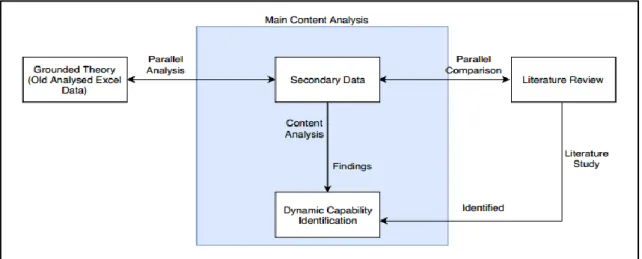
The content was exhaustively analyzed of the interview data supported with the archival documents, and the findings were the major themes generated from the coded contents. This was done in parallel analysis and comparison with the analyzed data using grounded theory methodology for the previous research to avoid manipulation of the data in this research while also trying to avoid the replication of the previous study. Additionally, the major themes were also generated in close comparison with the extant literatures reviewed for the dynamic capabilities necessary for information systems driven transformation in organizations (Lucas et al., 2013). The schematic research designed for the content analysis performed is as shown in Figure 1.
Parallel analysis with the old MS Excel coded file was to identify the capabilities which was one of those major themes revealed using the grounded theory methodology. The literature review served as a guide to enabling if we have found dynamic capabilities that are uniform with those identified by extant literatures or we gathered something unique for this study. All in all, the independence of the content analysis was highly maintained, being done using a computer software and manually reading through each auto-generated themes.
2.2.3 Literature Search and Selection
In this thesis we were selective of the literatures for review to base our background knowledge, especially those related with dynamic capabilities so we can gather the specific dynamic capabilities related to information technology driven transformations. We used a systematic search for the literatures in employing the keywords that defined digital transformation. Systematic is used loosely as an “adjective to refer to the review or literature review, as well as describing the search strategy and selection criteria” (Schultze, 2015). However, the selection of the articles and interpretations were mostly done with an interpretive literature review methodology (Schultze, 2015). We employed the best possible literature search and review methodology for the articles necessary for our research specifically from the Basket of Eight (Bo8) Journals, supported by Google Scholar, IEEE Xplore and those relevant articles forwarded to us by our supervisor.
The keywords used are, digital, transformation, and dynamic capabilities to search for the literatures in the Bo8 journals. In each of the libraries that the particular Bo8 journal was made available, we searched with the keywords each time. We had digital innovation and digital strategy as keywords but we didn’t do the search using these keywords separately as they returned lesser number of articles compared to that of digital. We gathered that the articles related to these keywords were included in the search with digital.
We had the default settings for the dates, and the language to English in the e-library of the journals. All the results returned were exported to two bibliographic softwares, Zotero and Mendeley (Butros & Taylor, 2011). Our selection of the Zotero (paid version) and Mendeley (free) software was for aggregate storing for further searching using distinct criteria.
The total number of articles in the original search, prior to the migraton to the software gathered were over 1000 (9095 to be exact), and some of them were clearly duplicates from the different journals that were saved into these softwares. Due to the difficulty in deleting duplicate documents in Zotero software, all the articles were moved to Mendeley software for specific search. We didn’t apply a particular year range for the articles to be
searched as we wanted to draw down to every specific articles as much as possible, especifally with dynamic capabilities related articles. Both empirical and conceptual articles were selected. The keywords used were, digital innovation and digital strategy, digital and transformation, digital, and dynamic capabilities in the Mendeley software. From the final set of literatures, 13 Bo8 articles were selected specifically for dynamic capabilities associated with IS studies. Added 13 documents on dynamic capabilities from the management strands that were taken from Google scholar and other sources than Bo8 were also reviewed. We also reviewed 26 articles associated with digital business strategy, digital transformation and digital innovation.
The selected articles were based on thorough reading of their titles, abstracts, intro-ductions and conclusions and closely associated with our research agenda. Other docu-ments such as those discussing specifically innovation alone than together with digital transformation or digital innovation were not reviewed. We also checked the references of these articles and cross-cited where applicable (refer to Figure 12, Table 1, Table 8-2, in Appendix I for the literature search and selection).
2.3
Data Collection
The data was primarily collected for the D4A collaborative research project in digital transformation between ManuftX and Turku Univesity. The data sets are highly rich in that semi-structured interviews were conducted by a senior researcher from the university while the firm was strategizing and carrying out digital transformation. Also the firm archival data were adequately suppied and utilized. Credibility of the data is adequality discussed in Section 2.4.
There are two sets of “secondary data” (Vartanian, 2010) that have been used for this research, 60 sets of “semi-structured interview” (Myers & Newman, 2007) data from the senior researcher for a longitudinal study in digital transformation from 2016 to 2018 for the same firm, and company archival data from 1986 to 2018. The phrase secondary data is used to state that we were not directly involved with the collection of the data from the firm initially. It does not mean the data is not significant because it’s vey rich with unique sets of interview data done with more senior and strategic leaders of the firm for the D4A project, and also every detailed firm documents were at our disposal for this thesis.
The semi-structured interview data were done at 2 phases by the senior researcher for the primary research. 40 were related to the assimilation of the motivation for digital transformation and to achieve the planned objective of DT. The interviews were conducted with lower and middle management level, strategy team and leadership of the organization. The 20 were also unstructured interviews and were done a year later to uncover the relationship of IT and business process for the continuing DT.
The interview data were initially audio recorded by the primary researcher. The verbatim transcriptions were made available for our use for this research. The archival data used were all company data - presentations, historical background information of the firm, meeting minutes, intranet blog posts and comments, and all other documents that were necessary for our research as supplied by the senior researcher. We also searched for public information available about the firm, especially through their website for further information. This is necessary for the qualitative content analysis method to confirm that the collection and achieved results are valid (Weber, 1990). The documents were in different formats from jpg (Joint Photographic Experts Group (JPEG)) to pdf (Portable Document Format) file formats.
Though the data is rich, we have not been directly involved in the collection of the data. As such, to be certain of the data being utilized as reliable and useful for the content analysis and our research, we made a parallel acumen answering the questions mentioned by Engel and Schutt (2016, pp.327).
1. What were the agency’s or researcher’s goal in collecting the data?
The goal of the primary researcher was to know the process of digital transformation in the collaborative D4A research project. This thesis is about digital transformation and its still part of this main research project.
2. What data were collected, and what were they intended to measure?
The interview data and archival company data were related to understanding of the processes and the overall firm practices conducive for digital transformation.
3. When was the information collected?
The primary data were collected via participant observations and interviews over a period of 16 months within the firm by the primary research interviewer; specifically between 2016 and 2018. The archival data dated from 1986 to 2018. But the specific relied-upon-documents were that of 2014 to 2018, a period when digital transformation was initiated and implemented.
4. What methods were used for data collection? Who was responsible for data collection, and what were their qualifications? Are they available to answer questions about the data?
“Semi-structured interviews” (Myers & Newman, 2007) were conducted by the senior researcher in the collaborative D4A research project. It was done with middle managers and strategic leaders. The researcher shared only in a web-based shared drive of all the available verbatim transcriptions of the interview and archival data used in the primary research for this study. He was also kind enough to answer any questions sent to him regarding the data or even for the research itself.
5. How is the information organized (by date, event, etc.)? Are there identifiers used to identify different types of data available?
The data were organized in 2 sets: interview data conducted by the senior researcher and archival data provided with high authority by the firm employees to the senior researcher. The interviews were conducted in 2 phases too with the same interviewees.
6. What is known about the success of the data collection effort? How are missing data indicated and treated? What kind of documentation is available
All data came from within the firm and responsible officers who work in the firm. Basically they were qualitative data to our knowledge that were made available for our study by the senior researcher. The archival data were reliable as they were part of the firm’s useful data, most of which came from internal intranet publications or under the authority of the custodians. The semi-structured interviews (Myers and Newman, 2007) were done in a proper manner to triangulate the emerging themes and conclusions drawn from the data.
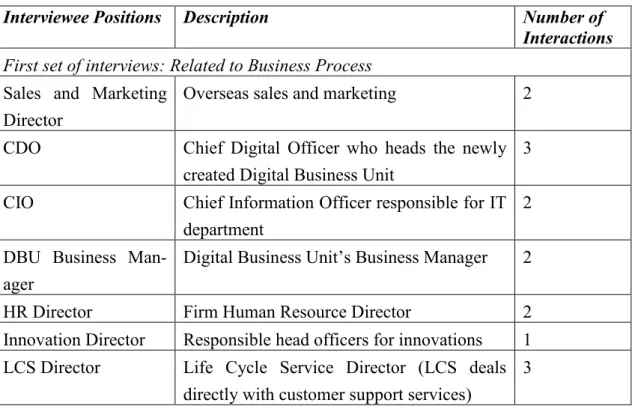
The interviews span a total of almost 67 man-hours, 8 minutes and 34 seconds for the 60 interviews covering around 443, 344 words. All the archival data in English, totally 160 documents were kept while the foreign language documents were removed. Table 2-1 presents the list of interviews conducted while Table 2-2-1 contains the overview of the archived data (hyphen (-) means no case).
Table 2-1 – List of Interviews
Interviewee Positions Description Number of
Interactions First set of interviews: Related to Business Process
Sales and Marketing Director
Overseas sales and marketing 2
CDO Chief Digital Officer who heads the newly created Digital Business Unit
3
CIO Chief Information Officer responsible for IT department
2
DBU Business Man-ager
Digital Business Unit’s Business Manager 2
HR Director Firm Human Resource Director 2 Innovation Director Responsible head officers for innovations 1 LCS Director Life Cycle Service Director (LCS deals
directly with customer support services)
LCS Employee (Intern)
An intern in the LCS business unit. 3
LCS Employee LCS Officer - common employee dealing directly with the clients on support services including sales too.
2
LCS Vice President Life Cycle Service Vice President. 2 Marketing Director Responsible for the marketing. 2 Marketing Employee A representative of the marketing employees. 1 MMS Software
Director
Oversees the development and distribution of the main client software
1
Product Manager Product Manager. 1
Product Manager T Service
T-Service Product Manager. 4
Project Manager Manager responsible for Projects. 1 Proposal Manager Manager responsible for Proposals. 2
Software Director Software Director. 2
Vice President Firm’s Vice President. 2
Vice President (Former CFO)
The current Vice president who used to be the Chief Finance Officer.
2
Second sets of interviews: Related to Agility in Information Systems
CIO Chief Information Officer. 4
Not Mentioned The Interviewee not mentioned but from IT. 2 Named IT Officer Senior IT Officer responsible for Innovation
and IT Agility. Name was mentioned but anonymity kept.
1
IoT Officer Staff responsible for working with the IoT Platform. Named preferred to be anonymous.
1
IT Agility Process Manager
This is for a particular office location. Name of office mentioned but anonymity applied.
1
IT Business Process Agility - Rep
A representative of the IT Business Process Agility.
1
IT HR IT officer responsible for/at HR. 1
IT Office Rep An IT officer representative of a business unit.
1
IT Support Manager An IT officer representative of a business unit.
1
IT Solutions Manager An IT officer representative of a business unit.
IT Office Rep An IT officer representative of a business unit.
1
IT Rep of CFO An IT officer representative of Chief Financial Office.
1
IT Director of Supply Chain
An IT officer representative of a business unit.
1
IT ICS Director Internal IT ICS Director. 1
IT Key User A main System Key User. 1
Senior IT Officer A very senior IT Officer. 1
Total Interviews 60
Table 2-2 – Overview of Data
Type Amount Duration
(hh:mm:ss) Documented Semi-Structured Interviews First set Second Set 60 40 20 67:08:43 45:58:50 21:09:44 443,344 words 296,110 words 147, 234 words Archival Document English Foreign Language 177 160 10 - - - DOC - 49 Pages (10,184 words) PDF - 295 Pages PPT - 520 Slides XLS - 5 Sheets HTML - 2 Files JPG - 8 Files PNG - 4 Files
2.4
Validity and Reliability
In qualitative research, the authentication and the credibility checks of the data are paramount to ascertain the reliability of the data collection and analysis in the content being analyzed (Walliman, 2017). Often vital for qualitative research is also its validity.
The validity and reliability of the qualitative studies have been pursued by the advocates of the qualitative studies and they remain “appropriate concepts for attaining rigor in qualitative research” (Bashir & Azeem, 2008). “Validity in qualitative research means the extent to which the data is plausible, credible and trustworthy; and thus can be defended when challenged” (Bashir & Azeem, 2008). Validity includes the credibility of the data collection, analysis, and techniques and instruments used by the researcher involved in the qualitative research (Bashir & Azeem, 2008).
Reliability is dependent on the validity of the qualitative research being conducted. “There can be no validity without reliability, a demonstration of the validity is sufficient
to establish the reliability" Patton (2001). Thus reliability is the consequence of the validity of the research. It involves the process by which the qualitative research has been carried out.
“Reliability and validity are conceptualized as trustworthiness, rigor and quality in qualitative paradigm” (Bashir & Azeem, 2008). They set the credibility of the qualitative research being conducted.
For this research, a thorough qualitative content analysis has been done on the data, and proper qualitative research methodology has been applied to ascertain its “credibility (reliability and validity)” (Bashir & Azeem, 2008).
The “semi-structured interview” (Myers & Newman, 2007) data were part of the digital transformation research within the firm conducted by a senior researcher for the firm’s collaborative D4A research project with Turku University. All archived data were also made accessible particularly for this thesis. They were provided with higher concern and authority, and none of the documents were required to be saved on the local machine other than the shared cloud drive. Every document was considered confidential outlining the high security and reliability concerns of the data.
We could not directly reach out to the firm except through the senior researcher who was using the same data to conduct the primary study about the role of agility in digital transformation. The interview data collected from credible officers within the firm form the credibility of the data, and they were all transcribed in a uniform format and made available for our use. We have also worked with these data for the primary research as a second coder using ”grounded theory” (Charmaz & Belgrave, 2007; Corbin & Strauss, 1990) method in a constant comparative analysis and ordered coding, and believe also that these data sources are credible.
The content analysis methodology employed to triangulate the data for the second time with a different research question in the digital transformation project for the same firm makes this thesis reliable to really dig deeper into a specific theme of capability of the firm.
Biases were avoided as all documents were passed onto us without being selective of a particular group of documents and the rich interview data. Data analysis of the interview data was done using the NVivo 12 software utilizing the auto coding feature within the software than previously done with manual coding as a second coder using MS Excel 2013 for the primary D4A research in 2018.
2.5
Data Analysis
Qualitative data analysis was done using the NVivo 12 software (Bazeley & Jackson, 2013; Welsh, 2002; Hilal & Alabri, 2013). The NVivo 12 software was used specifically
to avoid biases and “being more rigorous and transparent than would be the case using manual methods” (Welsh, 2002), and to interpret the data more positively. Also to do a quick coding process and identify the themes that would be generated apart from the content of the same data that we have analyzed using grounded theory method as a second coder to the primary study.
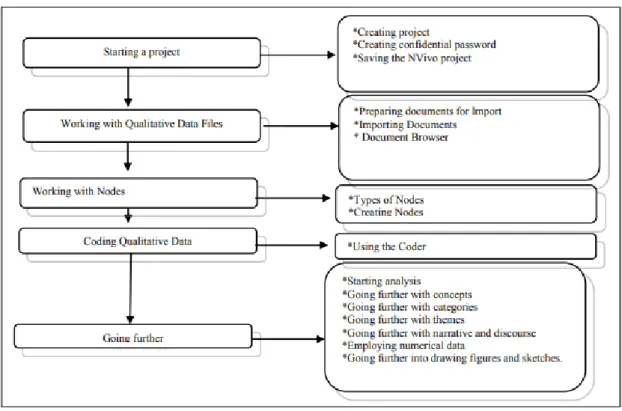
However, the software was not taken as the central analysis tool to our content analysis (Welsh, 2002). We basically used the Nvivo 12 software to do an auto-coding to find the nodes it would generate and organize the data (Smith & Hesse-Biber, 1996). This was for a more thorough data organization and for us to analyze the content and assign the themes. We basically applied the steps mentioned by Bazeley (2007) as shown in Figure 2 to analyze the data and categorize each auto-generated nodes into the main themes. These were done with thorough analysis of the nodes’ contents too. These themes are the dynamic capabilities identified with parallel analysis and confirmation with the previously coded MS Excel file and the literature reviewed respectively, together with the whole contents analysis of the gathered documents.
Figure 2 – Procedure Followed in Applying Nvivo software (Bazeley, 2007)
The NVivo 12 software was accessed via Turku University licensed library for students and staffs, and was installed on one local laptop. All the interview files that were downloaded and saved onto the local drive for this purpose only were imported into the software. Auto-coded themes were generated within the system. The auto coding was done to identify themes generated by the system. There were a total of 43 themes all
generated according to their occurrence in the interview documents (see the coding steps in Nvivo 12 in Appendix II).
Since we had a solid knowledge on the data from the previous work, we were able to identify and remove the irrelevant nodes as thing, guys and bit that doesn’t add any vigor to the categorization of the themes. Then we did a manual parallel comparison with the previously coded MS Excel file done using grounded theory methodology for the primary study of the D4A research project and identified the main categories for this study to avoid generating foreign thoughts not being mentioned in the data. This was highly considered and done, because the interview data being analyzed by the NVivo 12 software were not specifically related to dynamic capabilities nor the research question in this research. However, it was still a relevant study based on the rich data collection for capability assessment for digital transformation. The analysis was also conducted in collaboration with the extant literature on dynamic capabilities necessary for information systems-driven transformations as digital transformation.
Overall the coding and analysis was performed specifically to arrange each nodes into themes generated with the content analysis and literature study that already presented dynamic capabilities necessary for digital transformation, yet not identified in manufacturing firms.
3
LITERATURE REVIEW
In this section, the theoretical background of the digital transformation, innovation and strategy will be defined together with dynamic capabilities to set the phase for the research. Digital transformation and the associated terms’ definitions are briefly covered in a broader scope than taking a specific detailed route, which is not the objective of this thesis. The identification and presentation on the dynamic capabilities is very much from the literatures related to digital or IT driven transformations that are predominantly gathered from the IS Basket of Eight journals. However, added literatures from other sources such as strategic management journals have also been reviewed to give a clear background of the evolution of dynamic capabilities into IS studies, and their roles in digital and technology driven transformations.
3.1
Digital Transformation, Strategy and Innovation
The definition of digital transformation, digital innovation and digital transformation strategy are needed to clearly set the foundation for our research and to highlight the research scope and direction in the IS space where dynamic capabilities are studied. These terms have either been used interchangeably or the definitions are clearly part of the research documents when setting the stage for digital transformation studies to clear any ambiguity in understanding these conceptualized terms. For example, digitization and digital transformation has been used interchangeably in the everyday IS quorum (Bloomberg, 2018). Even the digital transformation is conceptual. Prior research documents have used these words and defined them either as a concept or to suit their research agenda. The definitions and the background theoretical concepts here are necessary in relations to where dynamic capabilities play in the strategic digital transformation realm.
3.1.1 Digital Transformation
The importance of organizational transformation is a necessity that has been practiced and studied in the business, strategy and management fields with different names (Besson & Rowe, 2012). It has recently been given ample research agendas from an IT-driven organizational transformation perspective that has even caused failures (Sarker & Lee, 1999) and also positively impacting the business with value creation (Hess et al., 2016).
While studying the IT enabled organizational and business value creating transformations, researchers have proposed in-depth understanding on the transformation
aspect with detailed and phase-wise presentations. For example, Besson and Rowe (2012) stated that transformations driven by information systems are strategically structured with ”organizational inertia, process, agency and performance” from a ”strategy, organization theory and IS perspective”.
Transformation when taken with digital is not so much of alignment in business and IT (Sabherwal & Chan, 2001; Henderson & Venkatraman, 1999) but to strategizing resources, capabilities, organizational objectives to dynamically perform catering the process changes with agility. A term referred to as Digital Business Strategy discussed in Section 3.1.2. The scope, speed, scale, and sources of strategic digital transformation are adequately captured creating a fusion between business and IT (Bharadwaj et al., 2013; Pereira & Sousa, 2005) for transformation driven by digital business strategy.
“Digital transformation is concerned with the changes digital technologies can bring about in a company’s business model, which may result in changed products or organizational structures or in the automation of processes” (Hess et al., 2016). Often as a result of the internet-based media and connectedness that also can involve consumer and producer collaborations as in the product development process (Arakji and Lang, 2007).
Generally digital transformation is understood as the changes “precipitated by a transformational information technology” (Lucas et al., 2013). This transformation is encompassed in the operational routines (Chen et al., 2014) which are the daily activities that drive the business forward and could be supported by the transformation in the firm’s business processes (Venkatraman, 1994) and its competencies and capabilities (Tan et al., 2015) to enable the firm to either perform in its operating market competitively or enter new markets (Dehning et al., 2003).
Vial (2019) identified 23 unique definitions of digital transformation from 28 different sources. The definitions as identified relates to 3 observations; organizations, technology (types) and information nature and the existence of similarities as in the use of digital technologies in the definitions despite the industry and firm differences.
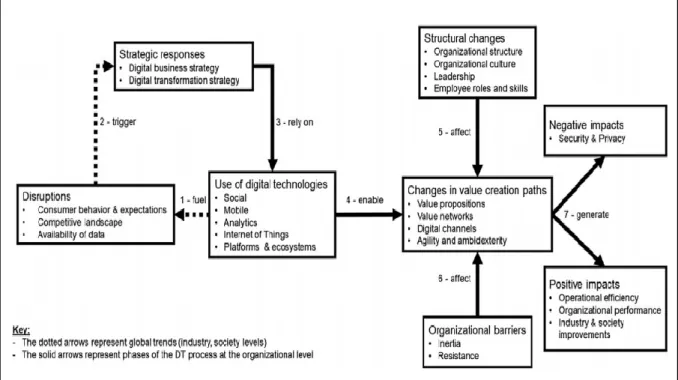
The conceptualized definition of digital transformation we employed is, “a process that aims to improve an entity by triggering significant changes to its properties through combinations of information, computing, communication, and connectivity technologies.” (Vial, 2019). It captures three elements: organization-centric encapsulating the society and industry, ”improvement as an expected outcome of digital transformation without guaranteeing its realization”, and the ”acceptance of the primitive use of digital technologies” as enablers of transformation (Vial, 2019). More importantly it also captures the dynamic changes and disruptions in the transformation enabled by digital technologies. We took this definition of digital transformation as our basis when discussing about the dynamic capabilities that not only discusses resources but processes and the wider environment to digitally innovate and deliver a product or service. The
conceptual framework of digital transformation (Vial, 2019) is presented in Figure 3 that covers all the building blocks of digital transformation. ”The arrows do not represent a statistical relationship or a causality found in variance models. Rather, they detail an overarching sequence of relationships described by the literature on digital transformation” (Vial, 2019).
Figure 3 - Building Blocks of the Digital Transformation Process (Vial, 2019)
3.1.2 Digital Transformation Business Strategy
Firms embarking on digital transformation have developed strategies to implement the transformation and innovation. digital transformation success is not so much on the resources and technology but the strategy (Ismail et al., 2017). In this research we keep the concept of digital transformation business strategy or digital transformation strategy that includes the transformation term to cover for the distruptions rather than digital business strategy. Not a single research document specifically differentiates them. They are basically used interchangeably and we do the same here.
The digital transformation business strategy “serves as a central concept to integrate the entire coordination, prioritization, and implementation of digital transformation within a firm” (Matt et al., 2015).
The large part of an organization is affected by exploitation and the coordination of computerized advances and strategic choices. This also go beyond the boundaries and
affects the “products, business processes, sales channels, and supply chains” (Matt et al., 2015).
Business models are reshaped to carry out digitalization which has many potential benefits that includes “increase in sales, innovation in value creation, and novel forms of interactions with customers among others” (Matt et al., 2015). With respect to this agenda and further outcomes, digital transformation business ”strategies seek to coordinate and prioritize the many independent threads of digital transformation” (Matt et al., 2015). Digital transformation strategies go beyond other business strategies and align with them to account for wider firm objective (Matt et al., 2015). Digital transformation business strategy centers around the products, business proces and the organisational dimensions, affability of the new advances driven by a well functional strategy (Matt et al., 2015).
IT strategy basically focuses on the internal aspects of the information systems delivery but doesn’t necessarily cater for the broader scope of product innovations, processes, and structures including the external impacts of the transformation on the customers (Chanias et al., 2018). Digital transformation strategy caters for the wider spectrum that also introduces the business model of the firm (Matt et al., 2015), and the scope can be differentiated between different organizations (Singh and Hess, 2017). Figure 4. shows the relations between the digital transformation strategy and other strategies.
Figure 4 - Relations between Digital Transformation Strategy and Other Corporate Strategies (Matt et al., 2015)
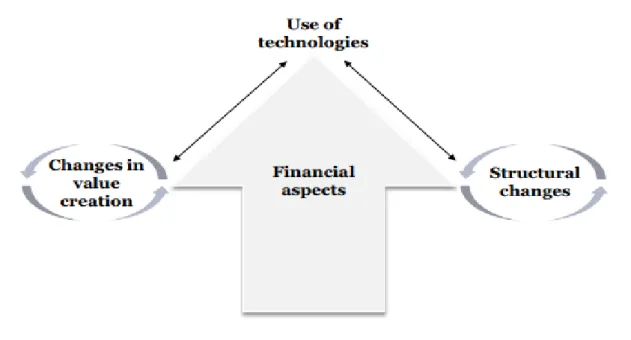
Digital business strategy captures four elements in common namely, ”use of technologies, changes in value creation, structural changes and financial aspects” (Matt et al., 2015; Hess et al., 2016). Figure 5 shows the digital transformation framework balancing the four transformational dimensions. All exclusive of the industry or the firm. The use of its
capabilities and resources to exploit its technical resources and do innovation to create changes in value of the firm driven by structural changes. These is all possible with the evolution of the financial aspect of the firm (Matt et al., 2015).
In the structural changes, the adoption of the digital transformation business strategy has prompted organizational changes to include often digital business units (DBU) headed by a Chief Digital Officer (CDO) (Singh & Hess, 2017; Tumbas et al., 2017) to drive DT and innovation. Somewhat still not a definite term as Chief Information Officer (CIO) yet exclusively used by organizations (Matt et al., 2015) as a strategist. CDO, supported by other digital officers don’t necessarily perform a functional role and report for marginal lost and gain as a CIO, but the role covers a wider organizational space with digital innovation and implementation plans and strategies. (Singh & Hess, 2017). It is “business-oriented, customer-centric and involves the entire organization” (Chanias et al., 2018). Further scope of digital transformation business strategy is not just around technology. Thus, such wider activities as adherence to risk management associated with digital technologies is paramount (Singh & Hess, 2017) and captured in digital transformation transformation strategy.
Figure 5 - Digital Transformation Framework: Balancing Four Transformational Dimensions (Matt et al., 2015)
The need to dynamically manage the products, processes, structures, financial aspects and the technologies as strategic resources is challenging as just as a new systems implementation challenge. This is often with the ever evolving changes in every aspects of the organization which are to be managed dynamically. The digital transformation strategy challenge lies not only in the products design and implementation but also in the
process being managed agilely. Dynamic capabilities play importantly in mapping out the strategic choices in a fluid business domain.
3.1.3 Digital Innovation
Generally “digital innovation is the use of digital technology during the process of innovating.” (Nambisan et al., 2017). Also digital innovation describes the results of innovation. It is termed as “sociotechnical phenomenon” (Nambisan et al., 2017) with consideration to the dynamic nature of the innovation that impacts the business and its clients, environments and the IS research community. Yoo et al., (2010) however, sways from the process innovation to specifically concentrating in product innovation using digital technologies.
The term of innovation is not so specific to a staged period of time as the dynamism continue to evolve. The outcome of innovation can evolve even after it has been implemented. Thus, making innovation not so a “well-rounded phenomenon” with digital transformation (Nambisan et al., 2017). The Innovation processes also have no specific boundary when it ends, as it can be congenitally repeating or evolving (Nambisan et al., 2017) even after a strategic project phase as the period of digital transformation.
In this innovation realm, the “dependence between innovation processes and innovation outcomes are so complex” (Nambisan et al., 2017). Digital innovation also scopes a wider range with “distributed innovation, open innovation and network-centric innovation” (Nambisan et al., 2017) born out of heterogeneous actors (Lyytinen et al., 2016) all driven by digital transformation strategy of the firm or a race to value creation and operational success. The “innovation processes and innovation outcomes” (Nambisan et al., 2017) are yet still complex.
While embarking on a digital innovation, in their extant literature study, Svahn et al (2017) identifies 4 competing concerns incumbent firms face, innovation capability that are in existence and the prerequisites, striking a balance in the product and process innovation to set the innovation focus, innovation collaboration with internal and external partners in resource sharing and organizational collaborations, and the innovation governance of control and flexibility. Yet, innovation capability is at the helm of the quest for digital innovation.
Innovation can be so disruptive that other firms who doesn’t do innovation can be affected. Agility in responding to disruptive digital innovation is achieved with development of capabilities as the use of technology and strategic agility to change the dynamic capabilities to meet the innovation need upfront. This should be enacted (Chan et al., 2018).
With this complex background in digital innovation process and the outcome (Nambisan et al., 2017), the deep knowledge to understanding customers (Weill & Woerner, 2015), collaborators in a networked innovation ecosystem (Lyytinen et al., 2016; Nambisan et al., 2017) and the impacts of innovation in the “sociotechnical phenomenon” (Nambisan et al., 2017), the concept of dynamic capabilities is necessary to know the extent of the impacts in a changing transformational environment driven by the firm’s strong digital transformation business strategy.
3.2
Dynamic Capabilities in Technology Driven Transformations
A firm’s resource base as technology and competence drives organizational transformation. The dynamic capabilities necessary for digital transformation that may see digital innovation driven by a digital transformation business strategy has loosely been studied specific to the scope and problem concerned in the extant literatures. For example, the dynamic capabilities necessary for e-business transformation supported by strong “ability to integrate new and existing IT systems without stifling innovation” (Daniel & Wilson, 2003).Digital transformation is pushing incumbent firms to create capabilities and utilize resources optimally to achieve the strategic firm objective. Dynamic capabilities play important roles in the digital transformational pursuits of the firm. Thus, the dynamic capability assessment is essential for digital transformation.
3.2.1 Dynamic Capabilities
Capabilities in general term is the resource strength that a firm may possess to create present value and be competitive in its given market share. Capabilities has been openly referred to as the operational capabilities converting routines and processes that are performed to carry out a specific routine task to make a present living (Cepeda & Vera, 2007).
Dynamic capabilities studied in strategic management (Eisenhardt & Martin, 2000; Helfat et al., 2009; Teece, 2007) has been to understand how firms respond to changes by creating, extending, and modifying the processes and routines to adequately response to the pressing change (Eisenhardt and Martin, 2000). It has recently been a research area in the IS management field with the adverse impact of the technological changes surrounding the business environment (Pavlou & El Sawy, 2006; Sambamurthy et al., 2003; Wheeler, 2002).
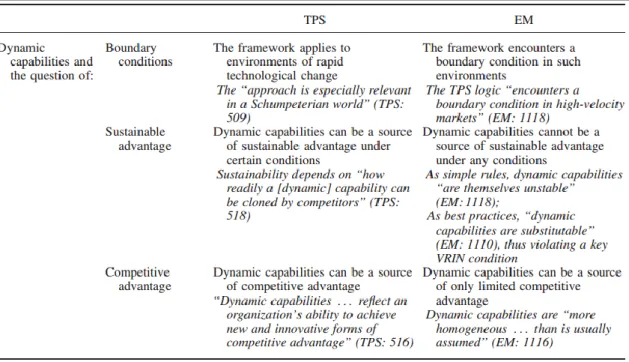
The two mostly quoted strategic management documents for dynamic capabilities are that of Teece et al., (1997) and Eisenhardt & Martin (2000). Peteraf et al. (2013) clarifies the dynamic capabilities in light of these two documents with three dimensional view from Boundary conditions, Sustainable and Competitive Advantage.
Figure 6 - Critical difference between Teece et al. (1997) and Eisenhardt and Martin (2000) extracted from Peteraf et al. (2013)
The definitions of dynamic capabilities were conceptualised in the specific research agendas in the extant literatures. For example, Eisenhardt and Martin (2000) defines dynamic capabilities as a “set of identifiable processes such as product development, strategic decision making and alliancing”. Dynamic capabilities that evolved from the resource based view of organizations (Peteraf et al., 2013) as opposed to normal operational innovation capabilities are value creating and long term. Dynamic capabilities encompasses both the “broad organizational capabilities and specific actions that work together to effect organizational changes” (Yeow et al., 2018). They impact the business and its clients that changes the performance of the business and caters for disruptions.
Dynamic capabilities tackle a change and it’s dynamic with respect to time response considering every aspect of the market environment for sustainability and competitive advantage (Helfat et al., 2009; Teece et al., 1997). Thus, Dynamic capabilities can be distinguished with long haul pledge to specialized resources from the operational or ordinary capabilities that pertain to the present operations of an organization (Drnevich & Kriauciunas, 2011). A dynamic capability is not a specially appointed critical thinking occasion or an unconstrained response. It must contain some designed component, that is, it must be repeatable (Winter, 2003; Schreyögg & Kliesch-Eberl, 2007). Zollo and
Winter (2002) point out that dynamic capabilities are persistent and that ”an organization that adapts in a creative but disjointed way to a succession of crises is not exercising a dynamic capability”. Dynamic is asserted to the changing environment and not the capability of the firm (Ambrosini & Bowman, 2009).
Two different views on dynamic capabilities have been identified by Di Stefano et al (2014). The first one in line with organizational study entailing Behavioral theory. Particularly the organization's response to changes to gaining wider objectives of the organization such as growth, learning and organisational transformation. Resource Based View drives the second view that focuses on the competitive dynamics leading from a competitive strategy in amalgamation to company performance (Di Stefano et al., 2014). But both work in a complementary manner acting as a dynamic system to cover the underlying incompatibilities (Di Stefano et al., 2014).
Dynamic Capabilities studied coupled with “Resource Based View” (Peteraf et al., 2013) is applied in specific sectors as in home health study by Singh et al. (2011). Dynamic Capabilities not only consider the attributes of the RBV but how they are being applied while managing changes in dynamic business environment, both internal and external aspects of the operational environments that impact the organization; the processes and the resources necessary for transformation and the continuous management of the changes (Drnevich & Kriauciunas, 2011).
While “dynamic capabilities are concerned with strategic change, they are not a synonym for it. They are about one type of change, the intentional change of the resource base.” (Ambrosini & Bowman, 2009). They capture the whole organizational view to manage changes (Teece, 2012) such as that driven by a digital transformation business strategy that results in digital innovations and acquisitions for competitive advantage for the firm.
3.2.2 First and Second Order Dynamic Capabilities
From the management strand, there have been studies on the level of capabilities and the identification of the dynamic capabilities. For example, Winter (2003) identifies zero level capabilities or operational capabilities as the resources and competencies to ‘earn a living’ currently and dynamic capabilities as those that modify and change zero-level capabilities. Wang and Ahmed (2007) provides a four level of capabilities. Resources as the zero-order for gaining competitive advantage with VRIN traits, capabilities as first-order which is the capacity of the firm to deploy resources to accomplish an ideal goal, core capabilities as second-order which are the bundle of the firm’s resources and capabilities to integrate in accordance with the firm's strategic direction, and dynamic capabilities as the third-order for “a firm's constant pursuit of the renewal,
reconfiguration and re‐creation of resources, capabilities and core capabilities to address the environmental change” (Wang & Ahmed, 2007).
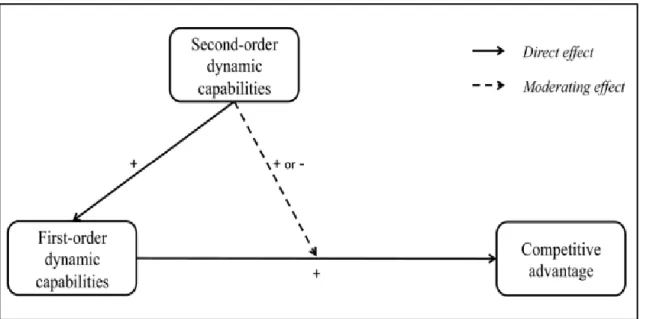
However, two main levels of dynamic capabilities have been theorized, although the levels have been very much progressive. They are based on specifically identifying and categorizing the resources and capabilities. These two are the first and second order dynamic capabilities (Schilke, 2014). The first-order dynamic capabilities “extend, modify, change and/or create ordinary capabilities” (Drnevich & Kriauciunas, 2011). Without the first order, the operational capabilities may readily become core rigidity (Barton, 1992). Second order “performance is indirect and mediated by the first-order dynamic capabilities” (Schilke, 2014). The second order or the higher order dynamic capabilities are deployed with the present methodology or totally in a new way when the first order use is insufficient (Daniel & Franken, 2014). The first order enables quicker responsivesness to new circumstances in shakeout conditions (Daniel & Franken, 2014; Yoo et al., 2010). Theoretically, an inexhaustive movement of the levels of dynamic capabilities may be available, but practically, the second order dynamic capabilities is only realised and the higher orders are less inclined to be maintained (Daniel & Franken, 2014; Yoo et al., 2010). With various mechanisms, the organizational ordinary and dynamic capabilities have influenced firm performance at firm and process levels.
The Second-order dynamic capabilities is associated with strategic changes and it affects performance mostly with transformation of the first order. First order is associated with the transformation of the resource based view of the firm to gain competitive advantage (Schilke, 2014).
Figure 7 - Second-Order and First Order Dynamic Capabilities Relationship (Schilke, 2014)
3.2.3 Dynamic Capabilities in IS Studies
The whole foundation for what basically is digital transformation, digital transformation business strategy and digital innovation associated with dynamic capabilities study has been outlined. The transformation business strategy drives digital transformation that can result in a digital innovation for the firm’s value creation and competitive advantage. The quest for digital transformation is possibly driven by a strong resource base and competences for routine processes. However, technology-driven transformations that is impacted by both the internal and external business dynamic environment calls for a wider capability analysis in dynamic capabilities for the firm.
With respect to dynamic capabilities in transformations propelled by technology and digital transformation strategies, it's all about the competence and response skills of the management to use the firm’s VRIN resources to adequately address changes affected by the dynamic environment for value creation and competitive advantage.
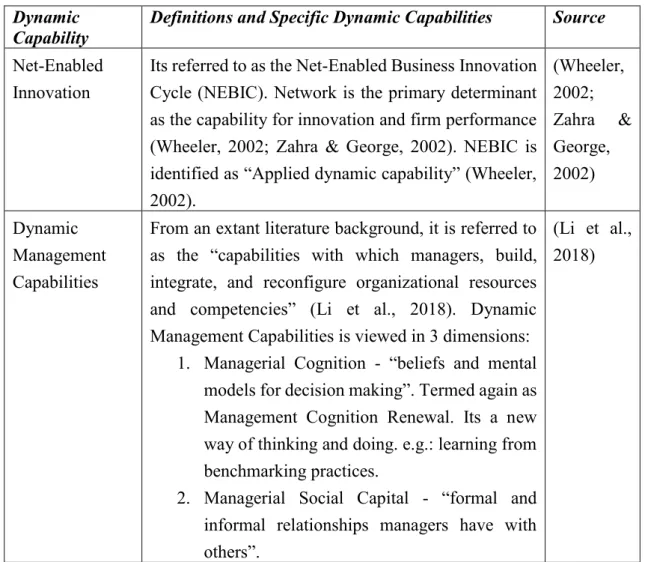
Determined dynamic capabilities have been identified in the digital transformation and IS studies (Pavlou & El Sawy, 2006; Sambamurthy, et al., 2003; Wheeler, 2002). Yeow et al. (2018) presents another view of the dynamic capabilities with emphasis to the broad organizational alignment perspective and exclusively on the distinct actions taken to reconfigure its resources. Specific concentration on the digital alignment strategy in the context of discussing the capacities of sensing, seizing and transforming actions is also presented by Teece (2007). These are cluster of activities or actions that are carried out by the organization using the dynamic capabilities to sustain itself (Teece, 2012).
With the sensing action, it is to sense the full encompassing environment and not being bound by technical chances but rather enveloping other market changes or interior choices that ought to be shaped (Teece, 2007). This is important for digital transformation strategy to adequately incorporate the ongoing changes and steer through uncertainty while scanning, learning and calibrating to cater the environmental changes in the digital strategy. Then seizing to mobilize the resources adequately to recognize the actions determined by sensing activities and capture value those activities by specific actions as designing and selecting among other options. For example, designing includes actions taken to design organizational structures and processes. Finally, transforming includes “continued renewal involving asset alignment, co-alignment, realignment, and redeployment” to maintain the digital transformational strategy (Yeow et al., 2018). Basically the realignment of the organizational resources and processes with specific actions in leveraging the existing resources, creating new resources and processes to serve a particular market or customer, assessing external shared resources to adding value to existing resources, and releasing resources present resources not necessary for the digital strategy (Yeow et al., 2018; Teece, 2007).