A Model of Supply Chain Management for Construction Using
Information Technology
Yu-Cheng LIN a
, H. Ping TSERNGb
a Ph.D. Student, Department of Civil Engineering, National Taiwan Univ., Taipei, Taiwan b Assoctiate Professor, Department of Civil Engineering, National Taiwan Univ., Taipei, Taiwan
Abstract
The objective of supply chain management is to quickly obtain real-time information, minimize cost, increase levels of service, improve communication among supply chain components, and increase flexibility in terms of delivery and response time. In the traditional construction industry, construction processes are always labor-intensive, manual, and time-consuming. With the advent of the information technology, it is possible to achieve the supply chain management for construction by seamlessly connecting all components in the construction chain with real-time information. The supply chain of construction contractors includes internal construction supply chain and external construction supply chain. This paper proposes simplified models for internal and external construction supply chains to achieve supply chain management for construction by utilizing information technologies. These information technologies adapted in construction supply chain management include Internet, Intranet, Extranet, and Mobile devices (such as Personal Digital Assistant device). In addition, XML is introduced for standard and technology designed to accelerate data sharing by seamlessly integrating systems across the construction supply chain effectively.
Keywords: Information Technology; Supply Chain Management; Internet; Intranet; Extranet; Mobile device; PDA
1. Introduction
Supply chain management is a set of approaches utilized to effectively integrate suppliers, manufacturers, warehouses, and stores, so that merchandise is produced and distributed at the right quantities, to the right locations, and at the right time, in order to minimize cost while satisfying service level requirements [1]. The objective of supply chain management is to be efficient and cost-effective, increasing levels of service improved communication among supply chain components, and increasing flexibility in terms of delivery and response time [1].
Because the construction industry is one of the lasts to embrace the Internet revolution, supply chain management has only recently been considered by the construction industry. In fact, it is necessary and important to achieve supply chain management for construction to improve inefficiencies, mistake delays, and poor communications in construction process. The information technologies play an important role in supply chain management because they provide all participants with visibility and decision support via advanced planning systems. However, by using these technologies in construction with the advances in the ability to capture information, inter-enabled SCM facilitates decision-making, increasing flexibility,
responsiveness and speed in operations of construction. Integrated with supply chain management, the information technologies promise to help construction manager at any point in the supply chain perform at their optimum level-making the right decision at the right time, more cost effectively, better and faster. In order to make real-time information available at any time to reduce lead-time and provide better communication between demand and supply in the construction life cycle, this paper investigates how the construction industry can be made more efficient and profitable through utilization of Internet, Intranet, Extranet, and Mobile Device technologies. By utilizing information technologies mentioned above, the simplified models are proposed for internal and external construction supply chains to achieve supply chain management for construction contractors to connect seamlessly all of the links in the construction chain with real-time information service.
2.Information Technology Using in Supply Chain Management for Construction Internet
The Internet has appeared for some time after the BITNET. Serious use of the Internet,
apart from electronic mail, did not start the World Wide Web (WWW); a multi-media and hyper-text-like system hit the Internet since 1979. The Internet was originally built on the Unix operating system and its infrastructural protocol is the TCP/IP. A distinguishing feature of the Internet is that it is predominantly a client/server system which makes it very suitable for multiple and heavy access without too much degradation in performance [2]. The Internet plays the main role in the construction supply chain because the Internet links the entire chain for both internal chain and external chain.
Intranet
Intranets are networks internal to an organization that use the same technology that is the foundation of the Internet [2]. It can further be connected to the Internet via a firewall device to prevent access from outside the corporation without proper authorisation, but letting users within the corporation to access the Internet [2]. The Intranet handles the communication tasks within the enterprise, including electronic messaging, workgroup collaboration, process automation, and browser-based applications [2]. The function of the Intranet in construction supply chain mainly is to link internal supply members within an individual company.
Extranet
The Extranet means connecting two or more corporate networks, all employing Internet technologies, to form a cooperative network environment for commercial transactions. Each corporation retains and maintains the Intranet of its own but allowing partnering organizations to exchange information by mutual agreements. In construction, this is extremely useful as a project involves so many parties. Similarly, it lends itself to internal global organizational integration by sharing internal and external data with processes that span all existing systems [2]. The benefits of the Extranet include better-managed supply chains, tightened partner integration, and quick response to changing market conditions. The role of Extranet in construction supply chain is to link internal construction internal chain to external suppliers’ systems.
Mobile Device
The mobile device is needed in the construction supply chain because of the ineffectiveness and inconvenience of current ways of information processing and data collecting at construction sites. New technologies as personal digital assistants have the ability to extend computer
support to the site. Integrated with the Internet, on-site engineers can access data and information anytime, anywhere to respond accurate and timely information without paper-based and labor-intensive processes through a Personal Digital Assistant (PDA) device or Warp Cellphone device. Therefore, the role of mobile device in construction supply chain is to communicate accurate and timely information between job site and office within the internal construction supply chain.
Bar Coding and Scanning
This particular technology application drastically influenced the flows of product and information within the supply chain. Bar coding and electronic scanning are identification technologies that facilitate information collection and exchange, allowing supply chain members to track and communicate movement details quickly with a greatly reduced probability of error [3]. Usually, the application of bar coding and scanning is utilized in material management and warehouse management in site.
3. Data Standard Using in Supply Chain Management
In supply chain management, data standard is needed and created for information sharing. Extensible markup language (XML) that is an open standard created specifically for use over the Internet is designed for integrating systems between organizations [4]. XML allows data from legacy systems and applications to be sent via the Internet to other companies’ systems without complex and expensive data conversion. Because XML can be read by any system, it enables partners to exchange data without having to standardize on the same back-end technologies. This is very important because it means that trading partners are free to change their in-house systems as needed without cutting themselves off from the supply chain. With interoperable protocols and standards, such as HTTP and XML, disparate technologies and high transaction costs are no longer barriers to entry for partners interested in creating their own collaborative trading networks. The following figure 1 is described for the standard created specifically for use over construction supply chain management.
4. Internal and External Supply Chain for Construction Contractor
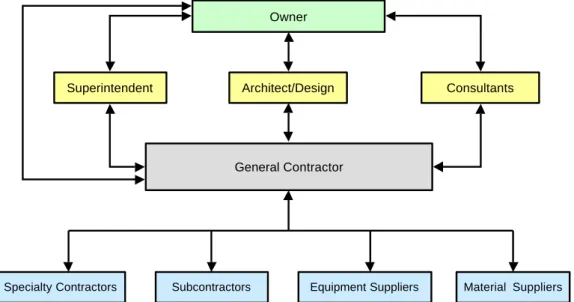
Construction supply chain module for contractor is shown in Figure 2. The upstream supply chain for contractor includes superintendent, architect/design, consultants, and owner. The downstream supply chain includes subcontractor, equipment suppliers, material suppliers, and specialty contractors. The supply chain of construction contractors includes internal construction supply chain and external construction supply chain. The internal construction supply chain is that portion of a given supply chain that occurs within an individual organization. Figure 3 shows construction supply chain management segments of general contractors.
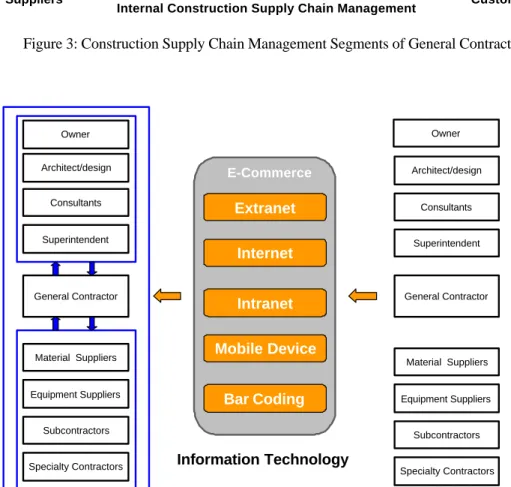
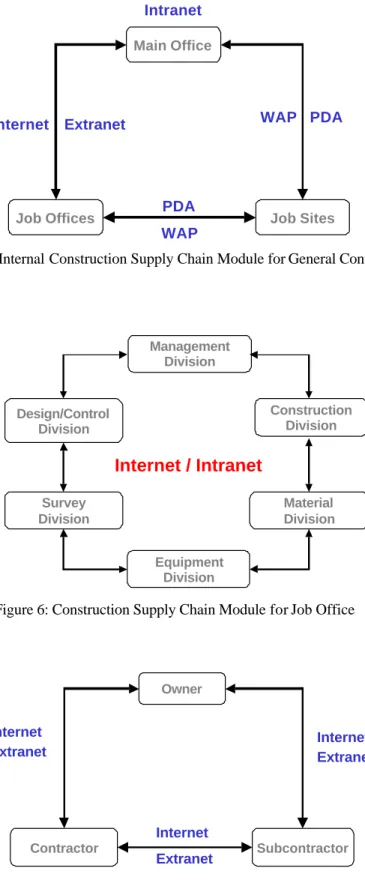
Figure 4 illustrates the framework of supply chain management with the application of Internet, Intranet, and Extranet for construction contractor. The internal supply chain main members for construction contractor includes main office, job office, and job site. Applications of information technologies in the internal construction supply chain are illustrated by Figure 5. Also, each supply chain for every member has its own supply chain individually as shown in Figure 6.
The external construction supply chain is to extend contractors to the external portion of the supply chain (i.e., owner and subcontractor). Figure 7 shows the structure of the construction supply chain for general contractors.
Construction Supply Chain Management
Owner
Direct Suppliers
Architect/design
Indirect Suppliers Main Contractor Subcontractor Consultants Superintendent XML Owner Consultants Superintendent General Contractor Material Suppliers Equipment Suppliers Subcontractors Specialty Contractors Architect/Design
Figure 2: Construction Supply Chain Module for General Contractors Figure 1: Data Standard Using in the Construction Supply Chain Management
Figure 3: Construction Supply Chain Management Segments of General Contractors
Figure 4: Framework of Supply Chain Management with the Application of IT
Subcontractor
Material Supppliers
Equipment Supppliers
Internal Construction Supply Chain Management External Construction Supply Chain Management
Suppliers Customers
Enterprise Resource Planning System
Mobile Supply Chain Management System Supply Chain Management System
Owner Architect Consultant Extranet Internet Intranet E-Commerce Owner Consultants Superintendent General Contractor Material Suppliers Equipment Suppliers Subcontractors Specialty Contractors Architect/design Consultants Superintendent General Contractor Material Suppliers Equipment Suppliers Subcontractors Specialty Contractors Information Technology Architect/design Owner Mobile Device Bar Coding
Management Division Design/Control Division Construction Division
Internet / Intranet
Survey Division Material Division Equipment Division Main OfficeJob Offices Job Sites
Internet PDA Extranet Intranet WAP PDA WAP
Figure 6: Construction Supply Chain Module for Job Office
Owner Contractor Subcontractor Internet Extranet Internet Extranet Internet Extranet
Figure 7: External Construction Supply Chain Module for General Contractors Figure 5: Internal Construction Supply Chain Module for General Contractors
5. Discussion and Conclusion
Supply chain management is both a management process and an e-commerce technology integration that extends beyond the enterprise into supply chain. Information is crucial to the performance of a supply chain because it provides the basic upon which supply chain managers make decisions [5]. Information technology consists of the tools used both to gain awareness of this information and to analyze the information to make the best decisions for the supply chain [5].
The essential process of supply chin management for construction is the exchange of data among components in the chain. In recent years, this exchange occurred using telephone, fax, or paper-based systems. Use of the Internet, Intranet and Extranet has changed the platform for data exchange forever. Ordering, billing and information-sharing functions are migrating to Web-based applications in supply chain management. These applications of information technologies allow the entire construction supply chain more access to information and data and quicker response times by contractors and suppliers.
Extensible markup language (XML) is becoming the new communication standard. Extensible markup language (XML) is poised to become the standard for business-to-business communications. It promises the seamless exchange of data between applications, allowing companies to conduct business via the Web without the heavy-handedness of previous programming languages. In addition, XML technology provides a cross-platform approach to information exchange. Using XML technology, corporations are able to integrate with other corporate business systems through the exchange of business documents.
The ineffectiveness and inconvenience of current ways of information processing and data collecting at construction sites can be improved by integrated with promising information technology such as mobile device - personal digital assistants. In addition, the mobile device enabled on-site engineers to access information cross the supply chain and integrate information into supply chain management system.
Construction Supply Chain Management is intended to make savings by linking the supply chain more closely, making manufacturers more responsive to orders placed online and enabling the widespread use of e-procurement. Its short-term effect will be better scheduling leading to lower inventory costs and eventually manufacturing closely to order. By linking the entire supply chain more closely, contractors will
commerce.
The important of IT in the supply chain will continue to grow. As supply chains become more global and more complex and as customers and competition become more demanding, companies will need the supply chain capabilities that only sophisticated IT systems can give them. Therefore, the important of IT to a supply chain can only increase. The future role of IT in the supply chain, however, is very difficult to predict [3].
6. Reference
[1] Robert B.Handfield,Ernest L.Nichols,jr. (1999) “Introduction to Supply Chain Management” Prentice Hall,Inc., New Jersey.
[2] Richard A. Lancioni Michael F. Smith Terence A. Oliva (2000) :The Role of the Internet in Supply Chain Management, Industrial Marketing Management 29, 45-56.
[3] Sunil Chopra, Peter Meindl (2001) “Supply Chain Management: Strategy, Planning, and Operation” Prentice Hall,Inc.,New Jersey. [4] Elliotte Rusty Harold, Elliote Rusty Harold
(2001) “XML Bible”, IDG.
[5] Simchi-Levi, Kaminsky, and Simchi-Levi (2000) “Designing and Managing the Supply Chain Concept, Strategies, and Case Studies” McGraw-Hill,Inc.,New York.