Contents
1 Intelligent Agents 3
1.1 Introduction . . . 3
1.2 What are agents? . . . 4
1.2.1 Examples of Agents . . . 7
1.2.2 Intelligent Agents . . . 8
1.2.3 Agents and Objects . . . 10
1.2.4 Agents and Expert Systems . . . 11
1.3 Abstract Architectures for Intelligent Agents . . . 12
1.3.1 Purely Reactive Agents . . . 13
1.3.2 Perception . . . 14
1.3.3 Agents with state . . . 15
1.4 Concrete Architectures for Intelligent Agents . . . 17
1.4.1 Logic-based Architectures . . . 17
1.4.2 Reactive Architectures . . . 23
1.4.3 Belief-Desire-Intention Architectures . . . 29
1.4.4 Layered Architectures . . . 35
1.5 Agent Programming Languages . . . 40
1.5.1 Agent-oriented programming . . . 40
1.5.2 Concurrent METATEM . . . 42
1.6 Conclusions . . . 44
1
Intelligent Agents
Michael Wooldridge
1.1 Introduction
Computers are not very good at knowing what to do: every action a computer performs must be explicitly anticipated, planned for, and coded by a programmer. If a computer program ever encounters a situation that its designer did not anticipate, then the result is not usually pretty — a system crash at best, multiple loss of life at worst. This mundane fact is at the heart of our relationship with computers. It is so self-evident to the computer literate that it is rarely mentioned. And yet it comes as a complete surprise to those encountering computers for the first time.
For the most part, we are happy to accept computers as obedient, literal, unimaginative servants. For many applications (such as payroll processing), it is entirely acceptable. However, for an increasingly large number of applications, we require systems that can decide for themselves what they need to do in order to satisfy their design objectives. Such computer systems are known as agents. Agents that must operate robustly in rapidly changing, unpredictable, or open environments, where there is a significant possibility that actions can fail are known as intelligent agents, or sometimes autonomous agents. Here are examples of recent application areas for intelligent agents:
When a space probe makes its long flight from Earth to the outer planets, a ground crew is usually required to continually track its progress, and decide how to deal with unexpected eventualities. This is costly and, if decisions are required quickly, it is simply not practicable. For these reasons, organisations like NASA are seriously investigating the possibility of making probes more autonomous — giving them richer decision making capability and responsibilities.
Searching the Internet for the answer to a specific query can be a long and tedious process. So, why not allow a computer program — an agent — do searches for us? The agent would typically be given a query that would require synthesising pieces of information from various different Internet information sources. Failure would occur when a particular resource was unavailable, (perhaps due to network failure), or where results could not be obtained.
introduction to the main issues associated with the design and implementation of intelligent agents. After reading it, I hope that you will understand:
why agents are perceived to be an important new way of conceptualising and imple-menting certain types of software application;
what intelligent agents are (and are not), and how agents relate to other software paradigms — in particular, expert systems and object-oriented programming;
the main approaches that have been advocated for designing and implementing intel-ligent agents, the issues surrounding these approaches, their relative merits, and the challenges that face the agent implementor;
the characteristics of the main programming languages available for building agents today.
The chapter is structured as follows. First, in section 1.2, I describe what I mean by the term agent. In section 1.3, I present some abstract architectures for agents. That is, I discuss some general models and properties of agents without regard to how such agents might be implemented. In section 1.4, I discuss concrete architectures for agents. The various major design routes that one can follow in implementing an agent system are outlined in this section. In particular, logic-based architectures, reactive architectures, belief-desire-intention architectures, and finally, layered architectures for intelligent agents are described. Finally, section 1.5 introduces some prototypical programming languages for agent systems.
Comments on notation
This chapter makes use of simple mathematical notation in order to make ideas precise. The formalism used that of discrete maths: a basic grounding in sets and first-order logic should be quite sufficient to make sense of the various definitions presented. In addition: if S is an arbitrary set, then℘S is the powerset of S, and S is the set of sequences of elements of S; the symbol is used for logical negation (so p is read “not p”); is used for conjunction (so p q is read “p and q”); is used for disjunction (so p q is read “p or q”); and finally, is used for material implication (so p q is read “p implies q”).
1.2 What are agents?
An obvious way to open this chapter would be by presenting a definition of the term agent. After all, this is a book about multi-agent systems — surely we must all agree on what an agent is? Surprisingly, there is no such agreement: there is no universally accepted definition of the term agent, and indeed there is a good deal of ongoing debate and controversy on this very subject. Essentially, while there is a general consensus that autonomy is central to the notion of agency, there is little agreement beyond this. Part of the difficulty is that various attributes associated with agency are of differing importance for different domains. Thus, for some applications, the ability of agents to learn from
1.2 What are agents? 5 ENVIRONMENT AGENT action output sensor input
Figure 1.1 An agent in its environment. The agent takes sensory input from the environ-ment, and produces as output actions that affect it. The interaction is usually an ongoing, non-terminating one.
their experiences is of paramount importance; for other applications, learning is not only unimportant, it is undesirable.
Nevertheless, some sort of definition is important — otherwise, there is a danger that the term will lose all meaning (cf. “user friendly”). The definition presented here is adapted from [71]: An agent is a computer system that is situated in some environment, and that is capable of autonomous action in this environment in order to meet its design objectives.
There are several points to note about this definition. First, the definition refers to “agents” and not “intelligent agents”. The distinction is deliberate: it is discussed in more detail below. Second, the definition does not say anything about what type of environment an agent occupies. Again, this is deliberate: agents can occupy many different types of environment, as we shall see below. Third, we have not defined autonomy. Like agency itself, autonomy is a somewhat tricky concept to tie down precisely, but I mean it in the sense that agents are able to act without the intervention of humans or other systems: they have control both over their own internal state, and over their behaviour. In section 1.2.3, we will contrast agents with the objects of object-oriented programming, and we will elaborate this point there. In particular, we will see how agents embody a much stronger sense of autonomy than do objects.
Figure 1.1 gives an abstract, top-level view of an agent. In this diagram, we can see the action output generated by the agent in order to affect its environment. In most domains of reasonable complexity, an agent will not have complete control over its environment. It will have at best partial control, in that it can influence it. From the point of view of the agent, this means that the same action performed twice in apparently identical circumstances might appear to have entirely different effects, and in particular, it may fail to have the desired effect. Thus agents in all but the most trivial of environments must be prepared for the possibility of failure. We can sum this situation up formally by saying that environments are non-deterministic.
actions represents the agents effectoric capability: its ability to modify its environments. Note that not all actions can be performed in all situations. For example, an action “lift table” is only applicable in situations where the weight of the table is sufficiently small that the agent can lift it. Similarly, the action “purchase a Ferrari” will fail if insufficient funds area available to do so. Actions therefore have pre-conditions associated with them, which define the possible situations in which they can be applied.
The key problem facing an agent is that of deciding which of its actions it should perform in order to best satisfy its design objectives. Agent architectures, of which we shall see several examples later in this article, are really software architectures for decision making systems that are embedded in an environment. The complexity of the decision-making process can be affected by a number of different environmental properties. Russell and Norvig suggest the following classification of environment properties [59, p46]:
Accessible vs inaccessible.
An accessible environment is one in which the agent can obtain complete, accurate, up-to-date information about the environment’s state. Most moderately complex envi-ronments (including, for example, the everyday physical world and the Internet) are inaccessible. The more accessible an environment is, the simpler it is to build agents to operate in it.
Deterministic vs non-deterministic.
As we have already mentioned, a deterministic environment is one in which any action has a single guaranteed effect — there is no uncertainty about the state that will result from performing an action. The physical world can to all intents and purposes be re-garded as non-deterministic. Non-deterministic environments present greater problems for the agent designer.
Episodic vs non-episodic.
In an episodic environment, the performance of an agent is dependent on a number of discrete episodes, with no link between the performance of an agent in different scenarios. An example of an episodic environment would be a mail sorting system [60]. Episodic environments are simpler from the agent developer’s perspective because the agent can decide what action to perform based only on the current episode — it need not reason about the interactions between this and future episodes.
Static vs dynamic.
A static environment is one that can be assumed to remain unchanged except by the performance of actions by the agent. A dynamic environment is one that has other processes operating on it, and which hence changes in ways beyond the agent’s control. The physical world is a highly dynamic environment.
Discrete vs continuous.
An environment is discrete if there are a fixed, finite number of actions and percepts in it. Russell and Norvig give a chess game as an example of a discrete environment, and taxi driving as an example of a continuous one.
As Russell and Norvig observe [59, p46], if an environment is sufficiently complex, then the fact that it is actually deterministic is not much help: to all intents and purposes, it may
1.2 What are agents? 7
as well be non-deterministic. The most complex general class of environments are those that are inaccessible, non-deterministic, non-episodic, dynamic, and continuous.
1.2.1 Examples of Agents
At this point, it is worth pausing to consider some examples of agents (though not, as yet, intelligent agents):
Any control system can be viewed as an agent. A simple (and overused) example of such a system is a thermostat. Thermostats have a sensor for detecting room tempera-ture. This sensor is directly embedded within the environment (i.e., the room), and it produces as output one of two signals: one that indicates that the temperature is too low, another which indicates that the temperature is OK. The actions available to the thermo-stat are “heating on” or “heating off”. The action “heating on” will generally have the effect of raising the room temperature, but this cannot be a guaranteed effect — if the door to the room is open, for example, switching on the heater may have no effect. The (extremely simple) decision making component of the thermostat implements (usually in electro-mechanical hardware) the following rules:
too cold heating on temperature OK heating off
More complex environment control systems, of course, have considerably richer deci-sion structures. Examples include autonomous space probes, fly-by-wire aircraft, nu-clear reactor control systems, and so on.
Most software daemons, (such as background processes in theUNIXoperating system), which monitor a software environment and perform actions to modify it, can be viewed as agents. An example is the X Windows program xbiff. This utility continually monitors a user’s incoming email, and indicates via aGUIicon whether or not they have unread messages. Whereas our thermostat agent in the previous example inhabited a physical environment — the physical world — thexbiffprogram inhabits a software environment. It obtains information about this environment by carrying out software functions (by executing system programs such asls, for example), and the actions it performs are software actions (changing an icon on the screen, or executing a program). The decision making component is just as simple as our thermostat example.
To summarise, agents are simply computer systems that are capable of autonomous action in some environment in order to meet their design objectives. An agent will typically sense its environment (by physical sensors in the case of agents situated in part of the real world, or by software sensors in the case of software agents), and will have available a repertoire of actions that can be executed to modify the environment, which may appear to respond non-deterministically to the execution of these actions.
1.2.2 Intelligent Agents
We are not used to thinking of thermostats orUNIXdaemons as agents, and certainly not as intelligent agents. So, when do we consider an agent to be intelligent? The question, like the question what is intelligence? itself, is not an easy one to answer. But for me, an intelligent agent is one that is capable of flexible autonomous action in order to meet its design objectives, where by flexible, I mean three things [71]:
reactivity: intelligent agents are able to perceive their environment, and respond in a timely fashion to changes that occur in it in order to satisfy their design objectives; pro-activeness: intelligent agents are able to exhibit goal-directed behaviour by taking the initiative in order to satisfy their design objectives;
social ability: intelligent agents are capable of interacting with other agents (and possi-bly humans) in order to satisfy their design objectives.
These properties are more demanding than they might at first appear. To see why, let us consider them in turn. First, consider pro-activeness: goal directed behaviour. It is not hard to build a system that exhibits goal directed behaviour — we do it every time we write a procedure inPASCAL, a function inC, or a method in JAVA. When we write such a procedure, we describe it in terms of the assumptions on which it relies (formally, its pre-condition) and the effect it has if the assumptions are valid (its post-condition). The effects of the procedure are its goal: what the author of the software intends the procedure to achieve. If the pre-condition holds when the procedure is invoked, then we expect that the procedure will execute correctly: that it will terminate, and that upon termination, the post-condition will be true, i.e., the goal will be achieved. This is goal directed behaviour: the procedure is simply a plan or recipe for achieving the goal. This programming model is fine for many environments. For example, its works well when we consider functional systems — those that simply take some input x, and produce as output some some function
f x of this input. Compilers are a classic example of functional systems.
But for non-functional systems, this simple model of goal directed programming is not acceptable, as it makes some important limiting assumptions. In particular, it assumes that the environment does not change while the procedure is executing. If the environment does change, and in particular, if the assumptions (pre-condition) underlying the procedure become false while the procedure is executing, then the behaviour of the procedure may not be defined — often, it will simply crash. Also, it is assumed that the goal, that is, the reason for executing the procedure, remains valid at least until the procedure terminates. If the goal does not remain valid, then there is simply no reason to continue executing the procedure.
In many environments, neither of these assumptions are valid. In particular, in domains that are too complex for an agent to observe completely, that are multi-agent (i.e., they are populated with more than one agent that can change the environment), or where there is uncertainty in the environment, these assumptions are not reasonable. In such environments, blindly executing a procedure without regard to whether the assumptions underpinning the procedure are valid is a poor strategy. In such dynamic environments,
1.2 What are agents? 9
an agent must be reactive, in just the way that we described above. That is, it must be responsive to events that occur in its environment, where these events affect either the agent’s goals or the assumptions which underpin the procedures that the agent is executing in order to achieve its goals.
As we have seen, building purely goal directed systems is not hard. As we shall see later in this chapter, building purely reactive systems — ones that continually respond to their environment — is also not difficult. However, what turns out to be hard is building a system that achieves an effective balance between goal-directed and reactive behaviour. We want agents that will attempt to achieve their goals systematically, perhaps by making use of complex procedure-like patterns of action. But we don’t want our agents to continue blindly executing these procedures in an attempt to achieve a goal either when it is clear that the procedure will not work, or when the goal is for some reason no longer valid. In such circumstances, we want our agent to be able to react to the new situation, in time for the reaction to be of some use. However, we do not want our agent to be continually reacting, and hence never focussing on a goal long enough to actually achieve it.
On reflection, it should come as little surprise that achieving a good balance between goal directed and reactive behaviour is hard. After all, it is comparatively rare to find humans who do this very well. How many of us have had a manager who stayed blindly focussed on some project long after the relevance of the project was passed, or it was clear that the project plan was doomed to failure? Similarly, how many have encountered managers who seem unable to stay focussed at all, who flit from one project to another without ever managing to pursue a goal long enough to achieve anything? This problem — of effectively integrating goal-directed and reactive behaviour — is one of the key problems facing the agent designer. As we shall see, a great many proposals have been made for how to build agents that can do this — but the problem is essentially still open.
Finally, let us say something about social ability, the final component of flexible au-tonomous action as defined here. In one sense, social ability is trivial: every day, millions of computers across the world routinely exchange information with both humans and other computers. But the ability to exchange bit streams is not really social ability. Consider that in the human world, comparatively few of our meaningful goals can be achieved without the cooperation of other people, who cannot be assumed to share our goals — in other words, they are themselves autonomous, with their own agenda to pursue. To achieve our goals in such situations, we must negotiate and cooperate with others. We may be required to understand and reason about the goals of others, and to perform actions (such as paying them money) that we would not otherwise choose to perform, in order to get them to coop-erate with us, and achieve our goals. This type of social ability is much more complex, and much less well understood, than simply the ability to exchange binary information. Social ability in general (and topics such as negotiation and cooperation in particular) are dealt with elsewhere in this book, and will not therefore be considered here. In this chapter, we will be concerned with the decision making of individual intelligent agents in environments which may be dynamic, unpredictable, and uncertain, but do not contain other agents.
1.2.3 Agents and Objects
Object-oriented programmers often fail to see anything novel or new in the idea of agents. When one stops to consider the relative properties of agents and objects, this is perhaps not surprising. Objects are defined as computational entities that encapsulate some state, are able to perform actions, or methods on this state, and communicate by message passing.
While there are obvious similarities, there are also significant differences between agents and objects. The first is in the degree to which agents and objects are autonomous. Recall that the defining characteristic of object-oriented programming is the principle of encapsulation — the idea that objects can have control over their own internal state. In programming languages likeJAVA, we can declare instance variables (and methods) to be
private, meaning they are only accessible from within the object. (We can of course also declare thempublic, meaning that they can be accessed from anywhere, and indeed we must do this for methods so that they can be used by other objects. But the use ofpublic
instance variables is usually considered poor programming style.) In this way, an object can be thought of as exhibiting autonomy over its state: it has control over it. But an object does not exhibit control over it’s behaviour. That is, if a methodmis made available for other objects to invoke, then they can do so whenever they wish — once an object has made a methodpublic, then it subsequently has no control over whether or not that method is executed. Of course, an object must make methods available to other objects, or else we would be unable to build a system out of them. This is not normally an issue, because if we build a system, then we design the objects that go in it, and they can thus be assumed to share a “common goal”. But in many types of multi-agent system, (in particular, those that contain agents built by different organisations or individuals), no such common goal can be assumed. It cannot be for granted that an agent i will execute an action (method) a just because another agent j wants it to — a may not be in the best interests of i. We thus do not think of agents as invoking methods upon one-another, but rather as requesting actions to be performed. If j requests i to perform a, then i may perform the action or it may not. The locus of control with respect to the decision about whether to execute an action is thus different in agent and object systems. In the object-oriented case, the decision lies with the object that invokes the method. In the agent case, the decision lies with the agent that receives the request. I have heard this distinction between objects and agents nicely summarised in the following slogan: Objects do it for free; agents do it for money.
Note that there is nothing to stop us implementing agents using object-oriented tech-niques. For example, we can build some kind of decision making about whether to execute a method into the method itself, and in this way achieve a stronger kind of autonomy for our objects. The point is that autonomy of this kind is not a component of the basic object-oriented model.
The second important distinction between object and agent systems is with respect to the notion of flexible (reactive, pro-active, social) autonomous behaviour. The standard object model has nothing whatsoever to say about how to build systems that integrate these types of behaviour. Again, one could object that we can build object-oriented programs that do integrate these types of behaviour. But this argument misses the point, which is that the standard object-oriented programming model has nothing to do with these types of
1.2 What are agents? 11
behaviour.
The third important distinction between the standard object model and our view of agent systems is that agents are each considered to have their own thread of control — in the standard object model, there is a single thread of control in the system. Of course, a lot of work has recently been devoted to concurrency in object-oriented programming. For example, theJAVAlanguage provides built-in constructs for multi-threaded programming. There are also many programming languages available (most of them admittedly proto-types) that were specifically designed to allow concurrent object-based programming. But such languages do not capture the idea we have of agents as autonomous entities. Perhaps the closest that the object-oriented community comes is in the idea of active objects:
An active object is one that encompasses its own thread of control [. . . ]. Active objects are generally autonomous, meaning that they can exhibit some behaviour without being operated upon by another object. Passive objects, on the other hand, can only undergo a state change when explicitly acted upon. [5, p91]
Thus active objects are essentially agents that do not necessarily have the ability to exhibit flexible autonomous behaviour.
To summarise, the traditional view of an object and our view of an agent have at least three distinctions:
agents embody stronger notion of autonomy than objects, and in particular, they decide for themselves whether or not to perform an action on request from another agent; agents are capable of flexible (reactive, pro-active, social) behaviour, and the standard object model has nothing to say about such types of behaviour;
a multi-agent system is inherently multi-threaded, in that each agent is assumed to have at least one thread of control.
1.2.4 Agents and Expert Systems
Expert systems were the most important AI technology of the 1980s [31]. An expert system is one that is capable of solving problems or giving advice in some knowledge-rich domain [32]. A classic example of an expert system is MYCIN, which was intended to assist physicians in the treatment of blood infections in humans. MYCIN worked by a process of interacting with a user in order to present the system with a number of (symbolically represented) facts, which the system then used to derive some conclusion. MYCINacted very much as a consultant: it did not operate directly on humans, or indeed any other environment. Thus perhaps the most important distinction between agents and expert systems is that expert systems likeMYCINare inherently disembodied. By this, we mean that they do not interact directly with any environment: they get their information not via sensors, but through a user acting as middle man. In the same way, they do not act on any environment, but rather give feedback or advice to a third party. In addition, we do not generally require expert systems to be capable of co-operating with other agents. Despite these differences, some expert systems, (particularly those that perform real-time control tasks), look very much like agents. A good example is theARCHONsystem [33].
Sources and Further Reading
A view of artificial intelligence as the process of agent design is presented in [59], and in particular, Chapter 2 of [59] presents much useful material. The definition of agents presented here is based on [71], which also contains an extensive review of agent architectures and programming languages. In addition, [71] contains a detailed survey of agent theories — formalisms for reasoning about intelligent, rational agents, which is outside the scope of this chapter. This question of “what is an agent” is one that continues to generate some debate; a collection of answers may be found in [48]. The relationship between agents and objects has not been widely discussed in the literature, but see [24]. Other readable introductions to the idea of intelligent agents include [34] and [13].
1.3 Abstract Architectures for Intelligent Agents
We can easily formalise the abstract view of agents presented so far. First, we will assume that the state of the agent’s environment can be characterised as a set Ss1
s2 of environment states. At any given instant, the environment is assumed to be in one of these states. The effectoric capability of an agent is assumed to be represented by a set A a1
a2 of actions. Then abstractly, an agent can be viewed as a function action : S
A
which maps sequences of environment states to actions. We will refer to an agent modelled by a function of this form as a standard agent. The intuition is that an agent decides what action to perform on the basis of its history — its experiences to date. These experiences are represented as a sequence of environment states — those that the agent has thus far encountered.
The (non-deterministic) behaviour of an an environment can be modelled as a function
env : S A ℘S
which takes the current state of the environment s S and an action a A (performed by the agent), and maps them to a set of environment states env sa
— those that could result from performing action a in state s. If all the sets in the range of env are all singletons, (i.e., if the result of performing any action in any state is a set containing a single member), then the environment is deterministic, and its behaviour can be accurately predicted.
We can represent the interaction of agent and environment as a history. A history h is a sequence: h : s0 a0 s1 a1 s2 a2 s3 a3 au 1 su au
where s0 is the initial state of the environment (i.e., its state when the agent starts
exe-cuting), auis the u’th action that the agent chose to perform, and su is the u’th environ-ment state (which is one of the possible results of executing action au 1in state su 1). If action : S A is an agent, env : S A ℘S is an environment, and s0is the initial state
1.3 Abstract Architectures for Intelligent Agents 13
of the environment, then the sequence
h : s0 a0 s1 a1 s2 a2 s3 a3 au 1 su au
will represent a possible history of the agent in the environment iff the following two conditions hold: u IN au action s0s1su and u IN such that u 0 su env su 1au 1
The characteristic behaviour of an agent action : S A in an environment env : S A
℘S is the set of all the histories that satisfy these properties. If some propertyφholds of all these histories, this this property can be regarded as an invariant property of the agent in the environment. For example, if our agent is a nuclear reactor controller, (i.e., the environment is a nuclear reactor), and in all possible histories of the controller/reactor, the reactor does not blow up, then this can be regarded as a (desirable) invariant property. We will denote by hist agentenvironment
the set of all histories of agent in environment. Two agents ag1and ag2are said to be behaviourally equivalent with respect to environment
env iff hist ag1env
! hist ag2 env
, and simply behaviourally equivalent iff they are behaviourally equivalent with respect to all environments.
In general, we are interested in agents whose interaction with their environment does not end, i.e., they are non-terminating. In such cases, the histories that we consider will be infinite.
1.3.1 Purely Reactive Agents
Certain types of agents decide what to do without reference to their history. They base their decision making entirely on the present, with no reference at all to the past. We will call such agents purely reactive, since they simply respond directly to their environment. Formally, the behaviour of a purely reactive agent can be represented by a function
action : S A
It should be easy to see that for every purely reactive agent, there is an equivalent standard agent; the reverse, however, is not generally the case.
Our thermostat agent is an example of a purely reactive agent. Assume, without loss of generality, that the thermostat’s environment can be in one of two states — either too cold, or temperature OK. Then the thermostat’s action function is simply
action s"
#
heater off if s = temperature OK heater on otherwise.
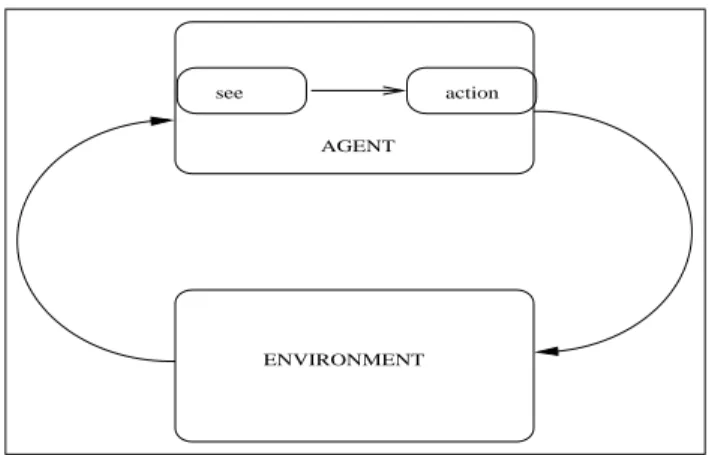
ENVIRONMENT action
AGENT see
Figure 1.2 Perception and action subsystems.
1.3.2 Perception
Viewing agents at this abstract level makes for a pleasantly simply analysis. However, it does not help us to construct them, since it gives us no clues about how to design the decision function action. For this reason, we will now begin to refine our abstract model of agents, by breaking it down into sub-systems in exactly the way that one does in standard software engineering. As we refine our view of agents, we find ourselves making design choices that mostly relate to the subsystems that go to make up an agent — what data and control structures will be present. An agent architecture is essentially a map of the internals of an agent — its data structures, the operations that may be performed on these data structures, and the control flow between these data structures. Later in this chapter, we will discuss a number of different types of agent architecture, with very different views on the data structures and algorithms that will be present within an agent. In the remainder of this section, however, we will survey some fairly high-level design decisions. The first of these is the separation of an agent’s decision function into perception and action subsystems: see Figure 1.2.
The idea is that the function see captures the agent’s ability to observe its environment, whereas the action function represents the agent’s decision making process. The see function might be implemented in hardware in the case of an agent situated in the physical world: for example, it might be a video camera or an infra-red sensor on a mobile robot. For a software agent, the sensors might be system commands that obtain information about the software environment, such asls,finger, or suchlike. The output of the see function is a percept — a perceptual input. Let P be a (non-empty) set of percepts. Then see is a function
see : S P
which maps environment states to percepts, and action is now a function
action : P A
1.3 Abstract Architectures for Intelligent Agents 15
which maps sequences of percepts to actions.
These simple definitions allow us to explore some interesting properties of agents and perception. Suppose that we have two environment states, s1 S and s2 S, such that s1 $
s2, but see s1% see s2. Then two different environment states are mapped to the same percept, and hence the agent would receive the same perceptual information from different environment states. As far as the agent is concerned, therefore, s1 and s2 are
indistinguishable. To make this example concrete, let us return to the thermostat example. Let x represent the statement
“the room temperature is OK”
and let y represent the statement
“John Major is Prime Minister”.
If these are the only two facts about our environment that we are concerned with, then the set S of environment states contains exactly four elements:
S&'( x y ) *,+ -s1 . xy ) */+ -s2 x y ) *,+ -s3 xy ) */+ -s4
Thus in state s1, the room temperature is not OK, and John Major is not Prime Minister;
in state s2, the room temperature is not OK, and John Major is Prime Minister. Now, our
thermostat is sensitive only to temperatures in the room. This room temperature is not causally related to whether or not John Major is Prime Minister. Thus the states where John Major is and is not Prime Minister are literally indistinguishable to the thermostat. Formally, the see function for the thermostat would have two percepts in its range, p1and
p2, indicating that the temperature is too cold or OK respectively. The see function for the
thermostat would behave as follows:
see s0
#
p1 if s s1or s s2 p2 if s s3or s s4.
Given two environment states s S and s12 S, let us write s3 s1 if see s4 see s1. It is not hard to see that3 is an equivalence relation over environment states, which partitions S into mutually indistinguishable sets of states. Intuitively, the coarser these equivalence classes are, the less effective is the agent’s perception. If 56375.75S5, (i.e., the number of distinct percepts is equal to the number of different environment states), then the agent can distinguish every state — the agent has perfect perception in the environment; it is omniscient. At the other extreme, if 56375. 1, then the agent’s perceptual ability is non-existent — it cannot distinguish between any different states. In this case, as far as the agent is concerned, all environment states are identical.
1.3.3 Agents with state
We have so far been modelling an agent’s decision function action as from sequences of environment states or percepts to actions. This allows us to represent agents whose decision making is influenced by history. However, this is a somewhat unintuitive representation,
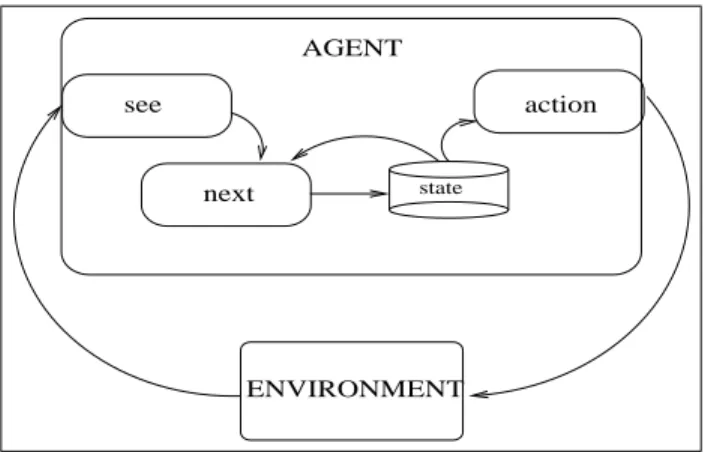
action see
next state
AGENT
ENVIRONMENT
Figure 1.3 Agents that maintain state.
and we shall now replace it by an equivalent, but somewhat more natural scheme. The idea is that we now consider agents that maintain state — see Figure 1.3.
These agents have some internal data structure, which is typically used to record in-formation about the environment state and history. Let I be the set of all internal states of the agent. An agent’s decision making process is then based, at least in part, on this information. The perception function see for a state-based agent is unchanged, mapping environment states to percepts as before:
see : S P
The action-selection function action is now defined a mapping
action : I A
from internal states to actions. An additional function next is introduced, which maps an internal state and percept to an internal state:
next : I P I
The behaviour of a state-based agent can be summarised as follows. The agent starts in some initial internal state i0. It then observes its environment state s, and generates a percept
see s. The internal state of the agent is then updated via the next function, becoming set to next i0see s
. The action selected by the agent is then action next i0 see s
. This action is then performed, and the agent enters another cycle, perceiving the world via see, updating its state via next, and choosing an action to perform via action.
It is worth observing that state-based agents as defined here are in fact no more powerful than the standard agents we introduced earlier. In fact, they are identical in their expres-sive power — every state-based agent can be transformed into a standard agent that is behaviourally equivalent.
1.4 Concrete Architectures for Intelligent Agents 17
Sources and Further Reading
The abstract model of agents presented here is based on that given in [25, Chapter 13], and also makes use of some ideas from [61, 60]. The properties of perception as discussed in this section lead to knowledge theory, a formal analysis of the information implicit within the state of computer processes, which has had a profound effect in theoretical computer science. The definitive reference is [14], and an introductory survey is [29].
1.4 Concrete Architectures for Intelligent Agents
Thus far, we have considered agents only in the abstract. So while we have examined the properties of agents that do and do not maintain state, we have not stopped to consider what this state might look like. Similarly, we have modelled an agent’s decision making as an abstract function action, which somehow manages to indicate which action to perform — but we have not discussed how this function might be implemented. In this section, we will rectify this omission. We will consider four classes of agents:
logic based agents — in which decision making is realised through logical deduction; reactive agents — in which decision making is implemented in some form of direct mapping from situation to action;
belief-desire-intention agents — in which decision making depends upon the manip-ulation of data structures representing the beliefs, desires, and intentions of the agent; and finally,
layered architectures — in which decision making is realised via various software layers, each of which is more-or-less explicitly reasoning about the environment at different levels of abstraction.
In each of these cases, we are moving away from the abstract view of agents, and beginning to make quite specific commitments about the internal structure and operation of agents. In each section, I will try to explain the nature of these commitments, the assumptions upon which the architectures depend, and the relative advantages and disadvantages of each.
1.4.1 Logic-based Architectures
The “traditional” approach to building artificially intelligent systems, (known as symbolic AI) suggests that intelligent behaviour can be generated in a system by giving that system a symbolic representation of its environment and its desired behaviour, and syntactically ma-nipulating this representation. In this section, we focus on the apotheosis of this tradition, in which these symbolic representations are logical formulae, and the syntactic manipulation corresponds to logical deduction, or theorem proving.
The idea of agents as theorem provers is seductive. Suppose we have some theory of agency — some theory that explains how an intelligent agent should behave. This theory might explain, for example, how an agent generates goals so as to satisfy its design
objective, how it interleaves goal-directed and reactive behaviour in order to achieve these goals, and so on. Then this theoryφcan be considered as a specification for how an agent should behave. The traditional approach to implementing a system that will satisfy this specification would involve refining the specification through a series of progressively more concrete stages, until finally an implementation was reached. In the view of agents as theorem provers, however, no such refinement takes place. Instead,φis viewed as an executable specification: it is directly executed in order to produce the agent’s behaviour.
To see how such an idea might work, we shall develop a simple model of logic-based agents, which we shall call deliberate agents. In such agents, the internal state is assumed to be a database of formulae of classical first-order predicate logic. For example, the agent’s database might contain formulae such as:
Open valve221
Temperature reactor4726321
Pressure tank77628
It is not difficult to see how formulae such as these can be used to represent the properties of some environment. The database is the information that the agent has about its environ-ment. An agent’s database plays a somewhat analogous role to that of belief in humans. Thus a person might have a belief that valve 221 is open — the agent might have the pred-icate Open valve221 in its database. Of course, just like humans, agents can be wrong. Thus I might believe that valve 221 is open when it is in fact closed; the fact that an agent has Open valve221 in its database does not mean that valve 221 (or indeed any valve) is open. The agent’s sensors may be faulty, its reasoning may be faulty, the information may be out of date, or the interpretation of the formula Open valve221 intended by the agent’s designer may be something entirely different.
Let L be the set of sentences of classical first-order logic, and let D ℘L be the set of L databases, i.e., the set of sets of L-formulae. The internal state of an agent is then an element of D. We write∆∆1 for members of D. The internal state of an agent is then simply a member of the set D. An agent’s decision making process is modelled through a set of deduction rules,ρ. These are simply rules of inference for the logic. We write∆8 ρφ if the formulaφcan be proved from the database∆using only the deduction rulesρ. An agents perception function see remains unchanged:
see : S P
Similarly, our next function has the form
next : D P D
It thus maps a database and a percept to a new database. However, an agent’s action selection function, which has the signature
action : D A
is defined in terms of its deduction rules. The pseudo-code definition of this function is as follows.
1.4 Concrete Architectures for Intelligent Agents 19 1. functionaction ∆: D : A 2. begin 3. for eacha Ado 4. if∆8 ρDo a then 5. returna 6. end-if 7. end-for 8. for eacha Ado 9. if∆ $ 8 ρ Do a then 10. returna 11. end-if 12. end-for 13. returnnull
14. end functionaction
The idea is that the agent programmer will encode the deduction rulesρand database
∆in such a way that if a formula Do a can be derived, where a is a term that denotes an action, then a is the best action to perform. Thus, in the first part of the function (lines (3)–(7)), the agent takes each of its possible actions a in turn, and attempts to prove the form the formula Do a from its database (passed as a parameter to the function) using its deduction rulesρ. If the agent succeeds in proving Do a, then a is returned as the action to be performed.
What happens if the agent fails to prove Do a, for all actions a A? In this case, it attempts to find an action that is consistent with the rules and database, i.e., one that is not explicitly forbidden. In lines (8)–(12), therefore, the agent attempts to find an action a A such that Do a cannot be derived from its database using its deduction rules. If it can find such an action, then this is returned as the action to be performed. If, however, the agent fails to find an action that is at least consistent, then it returns a special action null (or noop), indicating that no action has been selected.
In this way, the agent’s behaviour is determined by the agent’s deduction rules (its “program”) and its current database (representing the information the agent has about its environment).
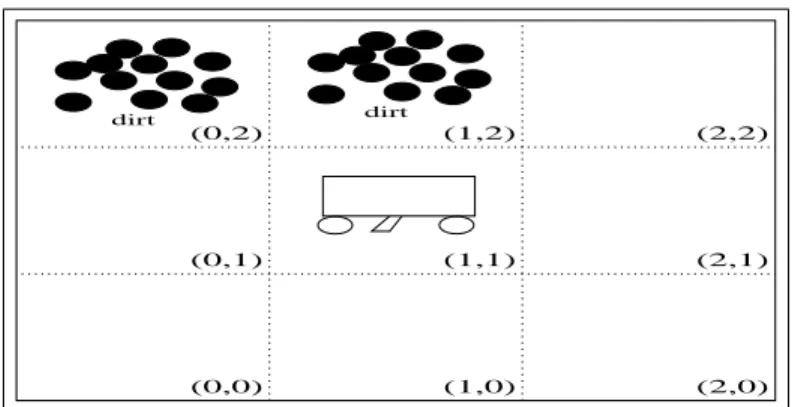
To illustrate these ideas, let us consider a small example (based on the vacuum cleaning world example of [59, p51]). The idea is that we have a small robotic agent that will clean up a house. The robot is equipped with a sensor that will tell it whether it is over any dirt, and a vacuum cleaner that can be used to suck up dirt. In addition, the robot always has a definite orientation (one of north, south, east, or west). In addition to being able to suck up dirt, the agent can move forward one “step” or turn right 909 . The agent moves around a room, which is divided grid-like into a number of equally sized squares (conveniently corresponding to the unit of movement of the agent). We will assume that our agent does nothing but clean — it never leaves the room, and further, we will assume in the interests of simplicity that the room is a 3 3 grid, and the agent always starts in grid square 0
0
dirt dirt (0,0) (1,0) (2,0) (0,1) (0,2) (1,1) (2,1) (2,2) (1,2)
Figure 1.4 Vacuum world
To summarise, our agent can receive a percept dirt (signifying that there is dirt beneath it), or null (indicating no special information). It can perform any one of three possible actions: f orward, suck, or turn. The goal is to traverse the room continually searching for and removing dirt. See Figure 1.4 for an illustration of the vacuum world.
First, note that we make use of three simple domain predicates in this exercise:
In xy agent is at x y Dirt xy there is dirt at xy
Facing d the agent is facing direction d
Now we specify our next function. This function must look at the perceptual information obtained from the environment (either dirt or null), and generate a new database which includes this information. But in addition, it must remove old or irrelevant information, and also, it must try to figure out the new location and orientation of the agent. We will therefore specify the next function in several parts. First, let us write old ∆ to denote the set of “old” information in a database, which we want the update function next to remove:
old ∆4& P t1 tn
:5 P; In
DirtFacing and P t1tn < ∆
Next, we require a function new, which gives the set of new predicates to add to the database. This function has the signature
new : D P D
The definition of this function is not difficult, but it is rather lengthy, and so we will leave it as an exercise. (It must generate the predicates In
, describing the new position of the agent, Facing
describing the orientation of the agent, and Dirt
if dirt has been detected at the new position.) Given the new and old functions, the next function is defined as follows:
next ∆ p
4 ∆= old ∆2> new ∆ p
1.4 Concrete Architectures for Intelligent Agents 21
have the form
φ
? ψ
whereφandψare predicates over some arbitrary list of constants and variables. The idea being that ifφmatches against the agent’s database, thenψcan be concluded, with any variables inψinstantiated.
The first rule deals with the basic cleaning action of the agent: this rule will take priority over all other possible behaviours of the agent (such as navigation).
In xy
2 Dirt x y
? Do suck (1.1)
Hence if the agent is at location xy
and it perceives dirt, then the prescribed action will be to suck up dirt. Otherwise, the basic action of the agent will be to traverse the world. Taking advantage of the simplicity of our environment, we will hardwire the basic navigation algorithm, so that the robot will always move from 00
to 01 to 0 2 and then to 12 , 1 1
and so on. Once the agent reaches 2 2
, it must head back to 0 0
. The rules dealing with the traversal up to 02
are very simple.
In 002 Facing north2@ Dirt 0 0
Do f orward (1.2)
In 012 Facing north2@ Dirt 0 1
Do f orward (1.3)
In 02
2 Facing north2@ Dirt 0 2
Do turn (1.4)
In 02
2 Facing east4 Do f orward (1.5) Notice that in each rule, we must explicitly check whether the antecedent of rule (1.1) fires. This is to ensure that we only ever prescribe one action via the Do
predicate. Similar rules can easily be generated that will get the agent to 22
, and once at 2 2
back to 00 . It is not difficult to see that these rules, together with the next function, will generate the required behaviour of our agent.
At this point, it is worth stepping back and examining the pragmatics of the logic-based approach to building agents. Probably the most important point to make is that a literal, naive attempt to build agents in this way would be more or less entirely impractical. To see why, suppose we have designed out agent’s rule setρsuch that for any database∆, if we can prove Do a then a is an optimal action — that is, a is the best action that could be performed when the environment is as described in∆. Then imagine we start running our agent. At time t1, the agent has generated some database∆1, and begins to apply its
rulesρin order to find which action to perform. Some time later, at time t2, it manages
to establish∆1 8 ρDo a for some a A, and so a is the optimal action that the agent could perform at time t1. But if the environment has changed between t1and t2, then there
is no guarantee that a will still be optimal. It could be far from optimal, particularly if much time has elapsed between t1and t2. If t2 t1is infinitesimal — that is, if decision making is effectively instantaneous — then we could safely disregard this problem. But in fact, we know that reasoning of the kind our logic-based agents use will be anything but instantaneous. (If our agent uses classical first-order predicate logic to represent the environment, and its rules are sound and complete, then there is no guarantee that the
decision making procedure will even terminate.) An agent is said to enjoy the property of calculative rationality if and only if its decision making apparatus will suggest an action that was optimal when the decision making process began. Calculative rationality is clearly not acceptable in environments that change faster than the agent can make decisions — we shall return to this point later.
One might argue that this problem is an artifact of the pure logic-based approach adopted here. There is an element of truth in this. By moving away from strictly logical representation languages and complete sets of deduction rules, one can build agents that enjoy respectable performance. But one also loses what is arguably the greatest advantage that the logical approach brings: a simple, elegant logical semantics.
There are several other problems associated with the logical approach to agency. First, the see function of an agent, (its perception component), maps its environment to a percept. In the case of a logic-based agent, this percept is likely to be symbolic — typically, a set of formulae in the agent’s representation language. But for many environments, it is not obvious how the mapping from environment to symbolic percept might be realised. For example, the problem of transforming an image to a set of declarative statements repre-senting that image has been the object of study in AI for decades, and is still essentially open. Another problem is that actually representing properties of dynamic, real-world en-vironments is extremely hard. As an example, representing and reasoning about temporal information — how a situation changes over time — turns out to be extraordinarily dif-ficult. Finally, as the simple vacuum world example illustrates, representing even rather simple procedural knowledge (i.e., knowledge about “what to do”) in traditional logic can be rather unintuitive and cumbersome.
To summarise, in logic-based approaches to building agents, decision making is viewed as deduction. An agent’s “program” — that is, its decision making strategy — is encoded as a logical theory, and the process of selecting an action reduces to a problem of proof. Logic-based approaches are elegant, and have a clean (logical) semantics — wherein lies much of their long-lived appeal. But logic-based approaches have many disadvantages. In particular, the inherent computational complexity of theorem proving makes it question-able whether agents as theorem provers can operate effectively in time-constrained envi-ronments. Decision making in such agents is predicated on the assumption of calculative rationality — the assumption that the world will not change in any significant way while the agent is deciding what to do, and that an action which is rational when decision making begins will be rational when it concludes. The problems associated with representing and reasoning about complex, dynamic, possibly physical environments are also essentially unsolved.
Sources and Further Reading
My presentation of logic based agents is based largely on the discussion of deliberate agents presented in [25, Chapter 13], which represents the logic-centric view of AI and agents very well. The discussion is also partly based on [38]. A number of more-or-less “pure” logical approaches to agent programming have been developed. Well-known examples include the CONGOLOG system of Lesp´erance and colleagues [39] (which is
1.4 Concrete Architectures for Intelligent Agents 23
based on the situation calculus [45]) and the METATEM and Concurrent METATEM programming languages developed by Fisher and colleagues [3, 21] (in which agents are programmed by giving them temporal logic specifications of the behaviour they should exhibit). Concurrent METATEM is discussed as a case study in section 1.5. Note that these architectures (and the discussion above) assume that if one adopts a logical approach to agent-building, then this means agents are essentially theorem provers, employing explicit symbolic reasoning (theorem proving) in order to make decisions. But just because we find logic a useful tool for conceptualising or specifying agents, this does not mean that we must view decision-making as logical manipulation. An alternative is to compile the logical specification of an agent into a form more amenable to efficient decision making. The difference is rather like the distinction between interpreted and compiled programming languages. The best-known example of this work is the situated automata paradigm of Leslie Kaelbling and Stanley Rosenschein [58]. A review of the role of logic in intelligent agents may be found in [70]. Finally, for a detailed discussion of calculative rationality and the way that it has affected thinking in AI, see [60].
1.4.2 Reactive Architectures
The seemingly intractable problems with symbolic/logical approaches to building agents led some researchers to question, and ultimately reject, the assumptions upon which such approaches are based. These researchers have argued that minor changes to the symbolic approach, such as weakening the logical representation language, will not be sufficient to build agents that can operate in time-constrained environments: nothing less than a whole new approach is required. In the mid-to-late 1980s, these researchers began to investigate alternatives to the symbolic AI paradigm. It is difficult to neatly characterise these different approaches, since their advocates are united mainly by a rejection of symbolic AI, rather than by a common manifesto. However, certain themes do recur:
the rejection of symbolic representations, and of decision making based on syntactic manipulation of such representations;
the idea that intelligent, rational behaviour is seen as innately linked to the environment an agent occupies — intelligent behaviour is not disembodied, but is a product of the interaction the agent maintains with its environment;
the idea that intelligent behaviour emerges from the interaction of various simpler behaviours.
Alternative approaches to agency are sometime referred to as behavioural (since a com-mon theme is that of developing and combining individual behaviours), situated (since a common theme is that of agents actually situated in some environment, rather than being disembodied from it), and finally — the term I will use — reactive (because such sys-tems are often perceived as simply reacting to an environment, without reasoning about it). This section presents a survey of the subsumption architecture, which is arguably the best-known reactive agent architecture. It was developed by Rodney Brooks — one of the most vocal and influential critics of the symbolic approach to agency to have emerged in
recent years.
There are two defining characteristics of the subsumption architecture. The first is that an agent’s decision-making is realised through a set of task accomplishing behaviours; each behaviour may be though of as an individual action function, as we defined above, which continually takes perceptual input and maps it to an action to perform. Each of these behaviour modules is intended to achieve some particular task. In Brooks’ implementation, the behaviour modules are finite state machines. An important point to note is that these task accomplishing modules are assumed to include no complex symbolic representations, and are assumed to do no symbolic reasoning at all. In many implementations, these behaviours are implemented as rules of the form
situation action
which simple map perceptual input directly to actions.
The second defining characteristic of the subsumption architecture is that many haviours can “fire” simultaneously. There must obviously be a mechanism to choose be-tween the different actions selected by these multiple actions. Brooks proposed arranging the modules into a subsumption hierarchy, with the behaviours arranged into layers. Lower layers in the hierarchy are able to inhibit higher layers: the lower a layer is, the higher is its priority. The idea is that higher layers represent more abstract behaviours. For exam-ple, one might desire a behaviour in a mobile robot for the behaviour “avoid obstacles”. It makes sense to give obstacle avoidance a high priority — hence this behaviour will typi-cally be encoded in a low-level layer, which has high priority. To illustrate the subsumption architecture in more detail, we will now present a simple formal model of it, and illustrate how it works by means of a short example. We then discuss its relative advantages and shortcomings, and point at other similar reactive architectures.
The see function, which represents the agent’s perceptual ability, is assumed to remain unchanged. However, in implemented subsumption architecture systems, there is assumed to be quite tight coupling between perception and action — raw sensor input is not processed or transformed much, and there is certainly no attempt to transform images to symbolic representations.
The decision function action is realised through a set of behaviours, together with an inhibition relation holding between these behaviours. A behaviour is a pair ca, where cA P is a set of percepts called the condition, and a A is an action. A behaviour c
a will fire when the environment is in state s S iff see s c. Let BehB ca45cA P and a A be the set of all such rules.
Associated with an agent’s set of behaviour rules RA Beh is a binary inhibition relation on the set of behaviours:C&A R R. This relation is assumed to be a total ordering on R (i.e., it is transitive, irreflexive, and antisymmetric). We write b1C b2if b1
b2
:DC , and read this as “b1inhibits b2”, that is, b1is lower in the hierarchy than b2, and will hence get
priority over b2. The action function is then defined as follows:
1. functionaction p : P : A
1.4 Concrete Architectures for Intelligent Agents 25 3. varselected : A 4. begin 5. f ired : c a D5 c a ? Randp c 6. for each ca < f ireddo 7. if FE4 c1 a
1< f iredsuch that c1 a 1?C c a then 8. returna 9. end-if 10. end-for 11. returnnull
12. end functionaction
Thus action selection begins by first computing the set f ired of all behaviours that fire (5). Then, each behaviour ca
that fires is checked, to determine whether there is some other higher priority behaviour that fires. If not, then the action part of the behaviour, a, is returned as the selected action (8). If no behaviour fires, then the distinguished action null will be returned, indicating that no action has been chosen.
Given that one of our main concerns with logic-based decision making was its theoretical complexity, it is worth pausing to examine how well our simple behaviour-based system performs. The overall time complexity of the subsumption action function is no worse than O n2, where n is the larger of the number of behaviours or number of percepts. Thus, even with the naive algorithm above, decision making is tractable. In practice, we can do considerably better than this: the decision making logic can be encoded into hardware, giving constant decision time. For modern hardware, this means that an agent can be guaranteed to select an action within nano-seconds. Perhaps more than anything else, this computational simplicity is the strength of the subsumption architecture.
To illustrate how the subsumption architecture in more detail, we will show how sub-sumption architecture agents were built for the following scenario (this example is adapted from [66]):
The objective is to explore a distant planet, more concretely, to collect samples of a particular type of precious rock. The location of the rock samples is not known in advance, but they are typically clustered in certain spots. A number of autonomous vehicles are available that can drive around the planet collecting samples and later reenter the a mothership spacecraft to go back to earth. There is no detailed map of the planet available, although it is known that the terrain is full of obstacles — hills, valleys, etc. — which prevent the vehicles from exchanging any communication.
The problem we are faced with is that of building an agent control architecture for each vehicle, so that they will cooperate to collect rock samples from the planet surface as efficiently as possible. Luc Steels argues that logic-based agents, of the type we described above, are “entirely unrealistic” for this problem [66]. Instead, he proposes a solution using the subsumption architecture.
The solution makes use of two mechanisms introduced by Steels: The first is a gradient field. In order that agents can know in which direction the mothership lies, the mothership generates a radio signal. Now this signal will obviously weaken as distance to the source
increases — to find the direction of the mothership, an agent need therefore only travel “up the gradient” of signal strength. The signal need not carry any information — it need only exist.
The second mechanism enables agents to communicate with one another. The charac-teristics of the terrain prevent direct communication (such as message passing), so Steels adopted an indirect communication method. The idea is that agents will carry “radioactive crumbs”, which can be dropped, picked up, and detected by passing robots. Thus if an agent drops some of these crumbs in a particular location, then later, another agent hap-pening upon this location will be able to detect them. This simple mechanism enables a quite sophisticated form of cooperation.
The behaviour of an individual agent is then built up from a number of behaviours, as we indicated above. First, we will see how agents can be programmed to individually collect samples. We will then see how agents can be programmed to generate a cooperative solution.
For individual (non-cooperative) agents, the lowest-level behaviour, (and hence the behaviour with the highest “priority”) is obstacle avoidance. This behaviour can can be represented in the rule:
if detect an obstacle then change direction. (1.6)
The second behaviour ensures that any samples carried by agents are dropped back at the mother-ship.
if carrying samples and at the base then drop samples (1.7)
if carrying samples and not at the base then travel up gradient. (1.8)
Behaviour (1.8) ensures that agents carrying samples will return to the mother-ship (by heading towards the origin of the gradient field). The next behaviour ensures that agents will collect samples they find.
if detect a sample then pick sample up. (1.9)
The final behaviour ensures that an agent with “nothing better to do” will explore randomly.
if true then move randomly. (1.10)
The pre-condition of this rule is thus assumed to always fire. These behaviours are arranged into the following hierarchy:
16 ?C 1 7 ?C 1 8 ?C 1 9 ?C 1 10
The subsumption hierarchy for this example ensures that, for example, an agent will always turn if any obstacles are detected; if the agent is at the mother-ship and is carrying samples, then it will always drop them if it is not in any immediate danger of crashing, and so on. The “top level” behaviour — a random walk — will only every be carried out if the agent has nothing more urgent to do. It is not difficult to see how this simple set of behaviours will solve the problem: agents will search for samples (ultimately by searching randomly), and when they find them, will return them to the mother-ship.


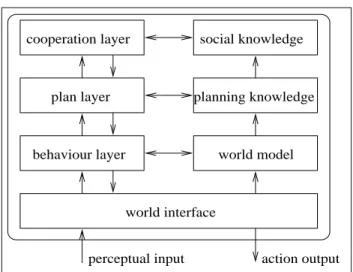
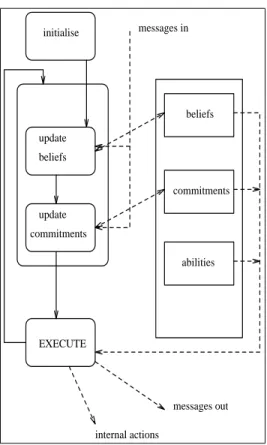
![Figure 1.6 Information and control flows in three types of layered agent architecture (Source: [47, p263]).](https://thumb-us.123doks.com/thumbv2/123dok_us/959589.2625395/36.918.245.771.162.438/figure-information-control-flows-types-layered-architecture-source.webp)