Extended Dualization: Application to Maximal Pattern
Mining
Lhouari Nourine, Jean-Marc Petit
To cite this version:
Lhouari Nourine, Jean-Marc Petit. Extended Dualization: Application to Maximal Pattern Mining. Journal of Theoretical Computer Science (TCS), Elsevier, 2016, 618, pp.107-121. <hal-01261861>
HAL Id: hal-01261861
https://hal.archives-ouvertes.fr/hal-01261861
Submitted on 17 Nov 2016HAL is a multi-disciplinary open access archive for the deposit and dissemination of sci-entific research documents, whether they are pub-lished or not. The documents may come from teaching and research institutions in France or abroad, or from public or private research centers.
L’archive ouverte pluridisciplinaire HAL, est destin´ee au d´epˆot et `a la diffusion de documents scientifiques de niveau recherche, publi´es ou non, ´emanant des ´etablissements d’enseignement et de recherche fran¸cais ou ´etrangers, des laboratoires publics ou priv´es.
Extended Dualization:
Application to Maximal Pattern Mining
Lhouari Nourine
∗and Jean-Marc Petit
†Abstract
The dualization in arbitrary posets is a well-studied problem in combinato-rial enumeration and is a crucial step in many applications in logics, databases, artificial intelligence and pattern mining.
The objective of this paper is to study reductions of the dualization problem on arbitrary posets to the dualization problem on boolean lattices, for which output quasi-polynomial time algorithms exist. Quasi-polynomial time algo-rithms are algoalgo-rithms which run in no(logn) where n is the size of the input and output. We introduce convex embedding and poset reflection as key no-tions to characterize such reducno-tions. As a consequence, we identify posets, which are not boolean lattices, for which the dualization problem remains in quasi-polynomial time and propose a classification of posets with respect to dualization.
From these results, we study how they can be applied to maximal pattern mining problems. We deduce a new classification of pattern mining problems and we point out how known problems involving sequences and conjunctive queries patterns, fit into this classification. Finally, we explain how to adapt the seminalDualize & Advance algorithm to deal with such patterns. As far as we know, this is the first contribution to explicit non-trivial reduc-tions for studying the hardness of maximal pattern mining problems and to extend the Dualize & Advancealgorithm for complex patterns.
Keywords: Hypergraph Dualization, Enumeration algorithms, Patterns mining
∗Clermont-Université, Université Blaise Pascal, LIMOS, CNRS, France ( [email protected]) †Université de Lyon, CNRS, INSA-Lyon, LIRIS, France([email protected])
1
Introduction
The dualization in arbitrary finite1 partially ordered sets (poset for short) is well-studied in combinatorial enumeration such as minimal transversals of a hypergraph, the blocker of a clutter, minimal dominating sets and maximal cliques of a graph. The dualization problem is the following: Given a compact representation of a poset P and an antichain B+ of P, find another antichainB− of P such that the union of
the ideal induced byB+ and the filter induced by B− is exactlyP.2 The dualization problem has been popularized largely through the work on artificial intelligence and pattern mining [9, 12, 21, 10, 18, 19], where P is a boolean lattice and B+ is given by a monotocally decreasing predicate. This link has been done through the well known Dualize & Advance algorithm [21, 15, 3, 4, 23, 22]. Many authors have investigated the existence of an output-polynomial time algorithm for listing without duplications the antichain B−. An output-polynomial algorithm is an algorithm
whose running time is bounded by a polynomial depending on the sum of the sizes of the input and output. The existence of an output-polynomial algorithm for the enumeration of minimal transversals of a hypergraph is a widely open question and is closely related to many data mining problems [11].
In this paper, we are interested in characterizing posets for which the dualiza-tion is equivalent to the enumeradualiza-tion of minimal transversals of a hypergraph. The strategy is based onreductions of the dualization problem on arbitrary posets to the dualization problem on boolean lattices. On posets, the dualization problem can be stated as follows:
DualizeOnPoset
Input: A representation of a poset(P,≤), B+ an antichain ofP.
Output: B− such that(B+, B−)are dual sets. On boolean lattices, it is stated as follows:
DualizeOnSet
Input: A finite set E,B+ an antichain of P(E) (the powerset of E).
Output: B− such that(B+, B−)are dual sets in P(E).
The complexity of DualizeOnSet is known to be quasi-polynomial time while the complexity ofDualizeOnPosetis still open in most posets (for example, lattice)
1It also works for infinite partially ordered sets that are well ordered, i.e. all antichains are finite. 2B+ and B− are dual sets, also known as blocker and anti-blocker or positive and negative
Figure 1: Reduction fromDualizeOnPosetto DualizeOnSet
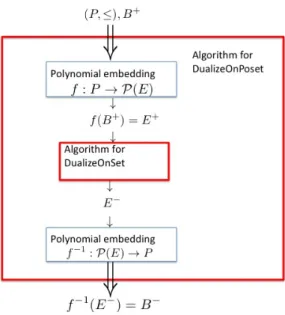
[11]. In this setting, we are interested in studying the reduction from DualizeOn-Poset to DualizeOnSet, i.e. under which conditions DualizeOnSet is polyno-mially equivalent to DualizeOnPoset. Notice that reductions for the hardness of enumeration problems are not well established as for decision problems. In this pa-per, we consider only polynomial time reductions, inspired from classic polynomial reductions of decision problems (cf. Figure 1).
Contribution on dualization We introduce convex embedding and poset reflec-tion as key notions to characterize such reductions. As a consequence, we identify posets, which are not boolean lattices, for which the dualization problem remains quasi-polynomial time (cf. Figure 1) and propose a classification of posets with respect to dualization.
From these results, we study how they can be applied to maximal (or more spe-cific) pattern mining problems. Mining interesting patterns in databases has been extensively studied in the data mining community over the last twenty years, from association rules and frequent itemset mining to frequent graph mining or functional dependency inference to mention a few. For studying their complexity, the under-lying dualization problem has been identified as the main bottleneck in [21, 15, 23].
Roughly speaking, for a partial order(P,≤)(representing patterns) and some mono-tonically decreasing predicate Q over P, the dualization consists in identifying all maximal elements ofP verifying Q from all minimal elements of P not verifying Q, and vice versa.
The seminal work of Mannila and Toivonen [21] proposes a general framework, especially they classify pattern mining problems that are (isomorphically) equivalent to frequent itemset mining (FIM). Nevertheless, the isomorphism requirement is too restrictive for many “complex” patterns such as sequences, episodes or graphs to mention a few. The ambition of this paper is to take into account such complex patterns and to propose a new framework for studying their complexity. From a practical point of view, the idea is to be able to re-use as much as possible the myriad of techniques and algorithms developed for FIM to such complex patterns.
Contribution on maximal pattern mining From the contributions on dualiza-tion, we deduce a new classification of pattern mining problems. We point out how known problems involving sequences and conjunctive queries patterns, fit into this classification. Finally, we explain how to adapt the seminal Dualize & Advance [15] algorithm to deal with such complex patterns.
As far as we know, this is the first contribution to explicit non-trivial reductions for studying the hardness of maximal pattern mining problems and to extend the Dualize & Advance algorithm for complex patterns.
This paper is a consolidation and an extension of two papers published in the proceedings of the conference ECAI 2012 [23] and the workshop ISIP 2014 [24].
2
Preliminaries
We briefly recall definitions on partial orders, embeddings, borders and pattern min-ing problems [6, 23].
A partial order is a binary relation ≤ over a set P which is reflexive, antisym-metric, and transitive. Let x, y be elements of P, if x ≤ y or y ≤ x, then x and y are comparable, otherwise they are incomparable. A partial order under which every pair of elements is comparable is called achain. A subset of a poset in which no two distinct elements are comparable is called an antichain. We say that y covers x if whenever x ≤ z ≤ y then z = x or y = z; we denote by ≺ the covering relation. For S ⊆ P, ↓ S (resp. ↑ S) is the downward (resp. upward) closed set of S under
the relation≤ (i.e. ↓S is an ideal and ↑S a filter of(P,≤))3. In case of ambiguity,
↓ S (resp. ↑ S) will be denoted by ↓≤ S (resp. ↑≤ S). A subset S ⊆ P is convex
in P if for all x, y, z ∈ P, x, y ∈ S and x ≤ z ≤ y imply z ∈ S. We denote by
Max≤(S) (resp. Min≤(S)) the maximal (resp. minimal) elements of S with respect to ≤. When ≤ is clear from context, (P,≤) (resp. Max≤(S) and Min≤(S)) will be denoted byP (resp. Max(S), Min(S)).
Let(P,≤P)and (Q,≤Q)be posets and f :P →Qa mapping. f is anembedding
if for all x, y ∈ P, x ≤P y iff f(x) ≤Q f(y). The mapping f is an isomorphism
if f is a bijective embedding. In this case P and Q are said to be isomorphic. f is a convex embedding if f is an embedding and f(P) is convex in (Q,≤Q). Since
f is injective, there exists another mapping g : f(P) → P such that g ◦f = Id, the identity function. A reflection4 of a poset (P,≤) is a poset(P,≤0) on the same
ground set P such that for all x, y ∈P, x ≤0 y ⇒ x ≤ y, i.e. a reflection preserves
incomparibilities only.
Two antichains (B+,B−)of P are said to be dual if ↓ B+∪ ↑ B− =P and
↓ B+∩ ↑ B− = ∅. The relationship between these dual sets is known as the
dual-ization, i.e. given B+, compute B−
(or inversely). In the sequel, (B+,B−)
will be referred to as aborder.
Let f :P →Q be a mapping and (B+,B−) a border in P. The border (E+,E−)
inQ is an extension of (B+,B−)
with respect to f, if f(B+)⊆ E+ and f(B−)⊆ E−
. The extension(E+,E−)is said to be apolynomial extension of(B+,B−)if|E+|+|E−|
is polynomial in |B+|+|B−|.
The intuition of the reduction of enumeration problems used in this paper is based on finding a mapping between posets such that borders are polynomially preserved, i.e. every border has a polynomial extension.
2.1
Pattern mining problem
We recall the framework of Mannila and Toivonen [21]: Given a database d, a description L of the language of patterns L∗ derivable from L , and a predicate Q
for evaluating whether a pattern ϕ ∈ L∗ is “interesting” in d. We assume that the
size of L∗ is exponential in the size of the description of L, otherwise the size of L∗ is polynomial and the mining problem is obviously polynomial by brute force
enumeration. For instance, the description of the language for frequent itemset
3Here, an ideal or filter does not have to be upward directed
4A reflection of a posetP is a new poset obtained fromP by deleting a subset of its
mining is given by the set of items, the set of itemsets being exponential.
The discovery task is to find the theory of d with respect to L and Q, i.e. the setTh(L,d,Q) ={ϕ∈ L∗|Q(d, ϕ) holds}. We assume that the set of patternsL∗ is
structured with a partial orderand the predicateQis monotonically decreasing wrt
, i.e. for all θ, ϕ∈ L∗, ϕ θ, Q(d, θ)⇒ Q(d, ϕ). The antichain B+ ⊆Th(L,d,Q) such that ↓ B+ = Th(L,d,Q) is known as the positive border of Th(L,d,Q). The antichain B− such that ↑ B− = (L∗ \Th(L,d,Q)) is known as the negative border
of Th(L,d,Q). (B+,B−) is a border of (L∗,).
2.1.1 Problem statement
In the data mining context, the problem statement is quite different since the an-tichain B+ is known implicitly (given by a monotically decreasing predicate) and it can be defined as follows:
Pattern mining problem (PMP)
Given a pattern mining problem (L,,d,Q), enumerate the positive border of Th(L,d,Q).
We now make explicit some usual assumptions, valid for almost every pattern mining problem:
• The predicate Q is computable in polynomial time in the size ofd,
• Given two patterns θ, φ ∈ L∗, checking θ φ (or φ θ) is computable in polynomial time.
In this setting, the PMPproblem can be simplified by ignoring both the database d and the predicate Q. In the sequel, we shall use (L∗,)
instead of
(L,,d,Q).
An enumeration algorithm is said to be incremental quasi-polynomial time, when it enumerates one by one the positive border such that the time it takes to list another one is quasi-polynomial in the size of the input and the previous output, i.e. no(logn) wheren is the sum of the sizes of the input and the output. It is worth noting that whenever(L∗,)
is isomorphic to (P(E),⊆)for some setE, PMPcan be solved in incremental quasi-polynomial time [15] (known asDualize & Advancealgorithm) in the size of the positive and negative borders.
In the next section, we shall consider dualization on arbitrary posets; we will come back to maximal pattern mining problems in Section 4.
3
Classification of posets with respect to dualization
In this section, we describe two properties of posets that lead us to have polynomial time reductions to DualizeOnSet. First we show that a convex embedding from a poset (L∗,) to P(E) for some set E is sufficient to re-use algorithms of Dual-izeOnSet. Second, we show that the convex embedding is not a necessary condition and introduce the reflection of a poset(L∗,)to obtain a new poset(L∗,0)in whichthere is a convex embedding. Indeed, a reflection of a poset(L∗,)corresponds to an
embedding which preserves incomparabilities only, i.e. some comparabilities could be lost. As a consequence, extra-elements may appear to the dualization. Intuitively, whenever the number of extra-elements is bounded by a polynomial, the dualization can be reduced to DualizeOnSet. To do so, we ask the following questions:
Given a poset of patterns (L∗,),
• Does there exist a convex embedding of (L∗,) into (P(E),⊆) for some finite
set E? If not,
• Does there exist a reflection(L∗,0) of (L∗,) such that there exists a convex
embedding of(L∗,0) into (P(E),⊆) for some finite set E?
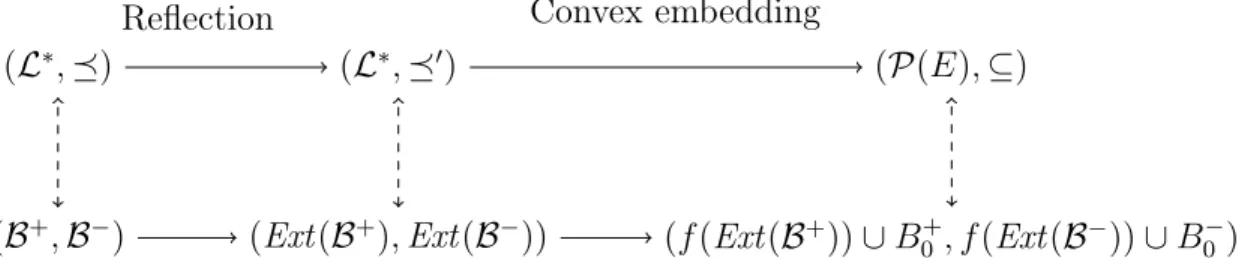
These two questions and their associated computational costs allow to come up with new classes of posets with respect to dualization. Figure 2 gives an illustration of the proposed framework. In the sequel, we first give some definitions of pattern structures based on convex embedding. Then, we propose poset reflection as a key notion to reach the convex embedding constraint.
(L∗,) (L∗,0) (P(E),⊆)
(B+,B−) (Ext(B+),Ext(B−)) (f(Ext(B+))∪B+
0, f(Ext(B
−))∪B−
0) Reflection Convex embedding
Figure 2: Overview of the main transformations
3.1
Convex embedding
Wild [26] studied some sufficient and necessary conditions for posets to have a cover preserving embedding into boolean lattices, but none of them can be re-used in this
paper since the input poset is given implicitly in our case.
First, let us recall that any poset has an embedding into a boolean lattice.
Proposition 1 [6] For any poset (L∗,), there exists an embedding from(L∗,) to (P(E),⊆), for some finite set E.
It follows that any poset has a set representation but obviously the dualization on(L∗,) may be more difficult than the dualization on (P(E),⊆)[23]. We define
the set of posets representable as sets (RAS for short) as follows:
Definition 1 (L∗,) ∈ RAS iff (L∗,) and (P(E),⊆) are isomorphic, for some
finite set E.
This class of posets gathers together many patterns such as frequent itemsets (FIM) [2], functional dependencies (FD) [20], inclusion dependencies (IND) [8]. This class is known asrepresentation as sets class of pattern mining problems defined in [21] (also known as strong duality [25]).
Nevertheless, requirements to be inRAS are restrictive, since the poset must be isomorphic to a boolean lattice, and therefore its size has to be equal to 2n where
n = |E|. One may remark that (L∗,) is trivially convex in (P(E),⊆), suggesting
to relax the bijective constraint of RAS without losing the convexity on the set representation. Hence, we extend RAS to a new class, called X RAS, for conveX RAS.
Definition 2 (L∗,)∈ X RAS iff there exists a convex embeddingfrom (L∗,) to (P(E),⊆), for some finite set E.
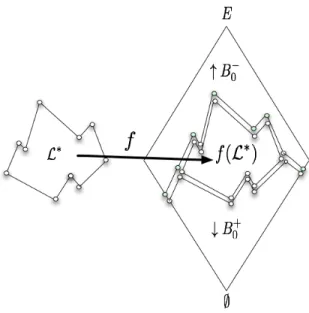
The idea is still to require an isomorphism but just between the poset of patterns and some subset of P(E), instead of the entire set P(E) (see Figure 3). Moreover, the subset of P(E) has to be convex, which was true but implicit in the definition of RAS. Note also that f is injective since f is an embedding. The following proposition points out a simple yet important characterization ofX RAS problems. An illustration is given in Figure 3.
Proposition 2 (L∗,)∈ X RAS iff there exist two antichainsB+
0 and B
−
0 of P(E)
such that ↓B0+∪ ↑B0− =∅ and (L∗,) is isomorphic to (P(E)\(↓B+ 0 ∪ ↑B
−
0 ),⊆).
Proof: Let f be a convex embedding from (L∗,) to (P(E),⊆) and F = f(L∗).
Figure 3: The class X RAS
We show that ↓B0+,↑B0− and F is a partition ofP(E).
Clearly↓B0+∪ ↑B0−∪ F =P(E),↓B0+∩ ↑B0− =∅andF ∩ ↑B0− =∅. Now we show that F ∩ ↓ B+0 =∅. Suppose that exists F ∈ F ∩ ↓ B+0. The fact that B0+∩ F =∅
implies that existX ∈B0+ and F0 ∈ F with F ⊂X ⊂F0. This contradicts the fact that F is a convex set in P(E)since X /∈ F.
The other direction holds sinceP(E)\(↓B0+∪ ↑B0−)is a convex set ofP(E). The proof of Proposition 2 gives a particular pair of antichains (B0+, B0−), but many such pairs exist to achieve the convex embedding. We also note that the size of the setsB0+ and B0− could be exponential in the size of the description L.
The next definition introduces computationally efficient version of problems of
X RAS, calledEX RAS.
Definition 3 (L∗,)∈ EX RAS if (L∗,)∈ X RAS and there is a pair (B+ 0 , B
−
0)
of antichains such that |B0+∪B0−| is polynomial in the size of the description L.
The following proposition points out that a polynomial extension of any border of (L∗,)
exists if (L∗,)∈ EX RAS
Proposition 3 Let (L∗,) ∈ EX RAS with f : L∗ → P(E) a convex embedding,
for some set E, and (B0+, B0−) two antichains such that (L∗,) is isomorphic to (P(E)\(↓B0+∪ ↑B0−),⊆) and |B0+∪B0−| is polynomial in the size of L.
Then for every border (B+,B−) of (L∗,), (Max(B+
0 ∪f(B+)), Min(B
−
0 ∪f(B
−)))
is a polynomial extension of (B+,B−) in (P(E),⊆).
Proof: Let (B+,B−) be a border of (L∗,). By definition of EX RAS, we have (B+,B−) as a border of (L∗,) iff (f(B+), f(B−)) as a border of (P(E)\(↓B+
0 ∪ ↑ B0−),⊆) since (L∗,) is isomorphic to (P(E)\(↓B+
0 ∪ ↑B
−
0),⊆). We show that(Max(B0+∪f(B+)),Min(B−
0 ∪f(B−))) is a border ofP(E). First, we show that↓Max(B0+∪f(B+)∩ ↑Min(B−
0 ∪f(B −)) =∅, or equivalentely (↓B0+∪ ↓f(B+))∩(↑B− 0 ∪ ↑f(B−)) =∅. By Proposition 2 we have↓B0+∩ ↑ B − 0 =∅. Moreover, ↓ f(B+)∩ ↑ f(B−) = ∅ since f is a bijective embedding of (L∗,) into (P(E) \ (↓ B0+∪ ↑ B0−),⊆) and (B+,B−) a border of (L∗,). Finally, we have ↓f(B+)∩ ↑ B− =↑ f(B−)∩ ↓ B+ =∅ since ↓f(B+)∪ ↑f(B−) ⊆(P(E)\(↓ B+
0 ∪ ↑ B0−).
Now we show that ↓ Max(B0+ ∪f(B+)∩ ↑ Min(B−
0 ∪f(B −)) = P(E). Since (f(B+), f(B−)) as a border of (P(E)\ (↓ B+ 0 ∪ ↑ B − 0),⊆), we have ↓ f(B+)∪ ↑ f(B−) =P(E)\(↓B+ 0 ∪ ↑B −
0) and it union with ↓B + 0∪ ↑B
−
0) gives P(E). Thus (Max(B0+ ∪f(B+)), Min(B−
0 ∪ f(B
−))) is a border in P(E) which is a
polynomial extension of (B+,B−) since |B+ 0 ∪B
−
0| is polynomial in the size of the description L.
3.2
Polynomial reflection of posets
We now consider posets that are not in X RAS. Our idea is to transform the initial poset to a new poset over the same ground set, in order to get a convex embedding. As a consequence, two natural questions arise:
(1) For a given poset(L∗,), does there exist a “polynomial reflection” (L∗,0) such that(L∗,0)belongs to EX RAS?
(2) How to quantify the “loss of comparabilities” induced by a reflec-tion?
In the sequel, we study poset reflection to give answers to the previous questions. Since the reflection of a poset induces the lost of some comparabilities in the original poset, we have to recover them efficiently.
3.2.1 Examples with different posets of sequences
Let us consider sequences with or without wildcard (see e.g. [3]).
Let Σbe a totally ordered alphabet which contains the wildcard ?as a minimal letter. A sequence is an element of Σ∗ and a rigid sequence is of the form P =
P[1]. . . P[m] ∈ Σ∗ such that P[1] 6= ? and P[m] 6= ?. Let Σ∗R be the set of rigid sequences and Σ∗ the set of sequences. We denote by Σn (resp. Σn
R) the set of all
(resp. rigid) sequences inΣ∗ (resp. ΣnR) of size at most n. We define different partial orders over Σ∗R and Σ∗:
• (Σ∗,≤s) : Let P[1..m], Q[1..n] ∈ Σ∗ with m ≤ n. P is subsequence of Q,
denoted P ≤s Q, if P can be obtained from Q by deleting n − m letters.
Formally, P ≤s Q if there exist integers i1 < . . . < im in [1..n] such that
P[j] =Q[ij] for all j ∈[1..m].
P is a prefix of Q, denoted byP ≤p Q, if P[1..m] =Q[1..m].
• (Σ∗R,v): Let P[1..m], Q[1..n] ∈ Σ∗R: P occurs in Q at position j ∈ [1..n], denoted by P vj Q, if for every i ∈ [1..m], either P[i] = Q[j + i− 1] or
P[i] = ?. We say that P occurs as prefix in Q if P v1 Q. We write P v Q if there exists j ∈[1..m] such thatP vj Q.
It is worth noticing, that (Σ∗,≤s),(Σ∗,≤p),(Σ∗R ,v) and (Σ ∗
R ,v1) are partial orders. Moreover(Σ∗R,v1)(resp. (Σ∗,≤p)) is a reflection of(Σ∗R,v)(resp. (Σ
∗,≤ s)),
since P v1 Q (resp. P ≤p Q) implies P vQ(resp. P ≤s Q).
The following example shows that the posets (Σ∗,≤s)and (Σ∗R ,v) cannot have
a convex embedding in the boolean lattice P(E) for some set E. Indeed, consider the set A = {a, b, ab, ba} ⊆ Σ∗ ∩Σ∗R . Then for any embedding f of (Σ∗,≤s) into
(P(E),⊆), there exists a set X ⊆ E such that f(a) ⊆ X ⊆ f(ab), f(b) ⊆ X ⊆
f(ba) and X is not an image of f. Otherwise (P(E),⊆) will not be closed under intersection, since f(ab)∩f(ba) must contain f(a) and f(b) and there is no word w∈Σ∗ such thata≤s w≤saband f(w) = f(ab)∩f(ba). Thus the set of all images
of f is not a convex set in (P(E),⊆). The same reasoning applies for (Σ∗R ,v).
Now consider the posets (Σ∗R ,v1) and (Σ∗,≤p) which are refections of (Σ∗R ,v)
and(Σ∗,≤s)respectively. In the following, we first show that(Σ∗R,v1)has a convex embedding and that no convex embedding exists for (Σ∗,≤p) into(P(E),⊆).
(1) Letf : Σ∗R → P(E)be an embedding, for some finite setE[23, 3]: fassociates to each letter of a sequence a pair (index, letter). For instance, let aband babe two patterns. Thenf(ab) ={(1, a),(2, b)}andf(ba) = {(1, b),(2, a)}. It is easy to verify
that f(Σ∗R) is convex in (P(E),⊆) [23]. Let us again consider A = {a, b, ab, ba}: we only have a v1 ab, b v1 ba, (two comparabilities are lost) allowing to reach the convexity constraint.
(2) Consider the set A = {a, aa, aaa}. A is convex in (Σ∗,≤p) but its image by
any embedding cannot be convex in (P(E),⊆) since P(E) cannot contain a convex set which is a chain of length 3.
3.2.2 Reaching convexity by poset reflection
The two previous examples point out that we have to transform the poset (through reflection) to get a chance to obtain some convex embedding. Note that for any poset there exists a reflection which has a convex embedding in a boolean lattice. But the difficulty is how to retrieve lost comparabilities?
Given a poset reflection, we define the lost successors and lost predecessors in-duced by a poset reflection for each element of the poset.
Definition 4 Let (P,≤0) be a reflection of a poset (P,≤) and x ∈ P. The lost
predecessors of x in the reflection of (P,≤) to (P,≤0
), denoted by LostPred(x), are defined by:
LostPred(x) = Max≤0{y ∈ P|y ≤ x, y 6<0 x}. Similarly, the lost successors are
defined by: LostSucc(x) = Min≤0{y∈P|x≤y, x6<0 y}.
By extension, we note LostPred(X) = S
x∈X LostPred(x) (resp. LostSucc(X))
for X ⊆P.
Example 1 Let us consider the previous reflection (Σn
R ,v1) of (ΣnR , v). Let
S ∈ ΣnR. We have LostPred(S) = Maxv1{S[i..|S|]| 1 ≤ i ≤ |S|, S[i] 6= ?} and LostSucc(S) = Minv1{x ? . . . ?
| {z }
i
S|0 ≤ i ≤n− |S|, x ∈ Σ\ {?}}. For instance with
n= 5 and Σ ={?, a, b}, LostPred(a ? ba) = Maxv1{a ? ba, ba, a} and LostSucc(ba) = Minv1{ba, aba, bba, a ? ba, b ? ba, a ? ?ba, b ? ?ba}.
As shown in the following lemma, we can recover the initial poset from any reduced poset withLostPred and LostSucc.
Lemma 1 Let x∈P and (P,≤0) a reflection of (P,≤). Then:
1. ↓≤x=↓≤0
LostPred(x) and 2. ↑≤x=↑≤0
Proof: (1) Let y ∈↓≤ x. We have either y ≤0 x or y 6<0 x. If y ≤0 x, then
y ∈↓≤0
LostPred(x) since x ∈ LostPred(x). If y 6<0 x, then there exists z ∈ P such that y≤0 z, z ∈LostPred(x), i.e. y∈↓≤0
LostPred(x). Now lety∈↓≤0
LostPred(x). Then existsz∈LostPred(x)such thaty≤0 z. Since
f is a reflection we have z ≤xand thus y∈↓≤ x.
The same reasoning applies for (2).
Some remarks have to be made: First, for any poset, there always exists a re-flection that has a convex embedding into a boolean lattice. It suffices to take a reflection which is an antichain, i.e. that deletes all comparabilities. In this case, the number of lost comparabilities can be exponential in the size of the description of the poset. Second, we would like to be able to recover lost comparabilities in polynomial time. This is formalized with the notion ofpoly-reflection as follows.
Definition 5 (L∗,0) is a poly-reflection of (L∗,) if (L∗,0) is a reflection of (L∗,) and for all x ∈ L∗, LostPred(x) and LostSucc(x) are computable in
polyno-mial time in the size of the description L.
Example 2 Continuing the previous example, for allS ∈ΣnR,|LostPred(S)| is poly-nomial in n and for all s v S, there exists s0 ∈ LostPred(S) such that s v1 s0.
Therefore, (Σn
R ,v1) is a poly-reflection of (ΣnR ,v).
Now we show the relationship between borders in a poset and its reflection. For a given border on the initial poset, we define its extension in the reduced poset to take into account lost comparabilities.
Definition 6 Let (L∗,0)
be a poly-reflection of (L∗,)
and (B+,B−)
a border of
(L∗,). The extension of (B+,B−) in (L∗,0), denoted by (Ext(B+),Ext(B−)), is
defined by:
Ext(B+) = Max
≤0{LostPred(x)|x∈ B+}
Ext(B−) = Min
≤0{LostSucc(x)|x∈ B−}.
The "preservation" of borders can now be formally stated.
Proposition 4 Let (L∗,0) be a poly-reflection of (L∗,) and(B+,B−) a border of (L∗,). Then (Ext(B+),Ext(B−)) is a polynomial extension of (B+,B−).
Proof: We have to show:
1. (Ext(B+),Ext(B−)) is a border of (L∗,0) with B+ ⊆ Ext(B+) and B− ⊆
2. |Ext(B+)|+|Ext(B−)| is polynomial in |B+|+|B−|.
(1) Any reflection preserves all incomparabilities and x ∈ LostPred(x) (resp x ∈
LostSucc(x)) for allx∈ L∗. SinceB+andB−are antichains in(L∗,), we haveB+⊆
Ext(B+) and B− ⊆Ext(B−). By definition, Ext(B+)and Ext(B−) are antichains in (L∗,0).
We show that (Ext(B+),Ext(B−)) is a border of (L∗,0). Since (B+,B−) is a
border of (L∗,), we have ↓ B+∪ ↑ B− =L∗ and ↓ B+∩ ↑ B− =∅. By definition of
the polynomial extension, for any x ∈ B+ (resp. x ∈ B−) we have LostPred(x) ⊆↓
Ext(B+)(resp. LostSucc(x)⊆↑Ext(B−)), and, by Lemma 1,↓≤ x=↓≤0
LostPred(x)
(resp. ↑≤ x =↑≤0
LostSucc(x)). Since B+ ⊆ Ext(B+) and B− ⊆ Ext(B−), we have ↓Ext(B+)∪ ↑Ext(B+) =L∗.
Now suppose that there is an element x ∈↓ Ext(B+)∩ ↑ Ext(B−). Then there
exist y ∈ B+ and z ∈ B− x ∈↓≤0
LostPred(y)∩ ↑≤0
LostSucc(z). By Lemma 1, we deduce that x∈ (↓≤ y)∩(↑≤ z) which is a contradiction with (B+,B−) a border of (L∗,).
(2)|Ext(B+)|+|Ext(B−)|is polynomial in|B+|+|B−|since(L∗,0)is a poly-reflection
of (L∗,)since computing LostPred(x) and LostSucc(x)can be done in polynomial
time in the size of the description of L.
The notion of poly-reflection allows to define the last class of posets, called
EWRAS, meaningEfficient weak representation as sets. EWRAS is the more gen-eral class ensuring the existence of quasi-polynomial time algorithms. It combines both poly-reflection of posets and EX RAS.
Definition 7 (L∗,)∈ EWRAS iff there exists a poly-reflection(L∗,0)of(L∗,)
such that (L∗,0)∈ EX RAS.
Then, this definition means that if some comparabilities can be forgotten – up to a polynomial cost to recover them – to get a new poset satisfying the condition of EX RAS, then the dualization problem on the initial poset can be reduced to
DualizeOnSet.
Example 3 Continuing previous examples, we have (Σ∗R ,v1) is a poly-reflection of
(Σ∗R ,v) and (Σ∗R ,v1) belongs to EX RAS. Then, (Σ∗R ,v) belongs to EWRAS.
From Propositions 3 and 4 we deduce the main result concerning the EWRAS
Theorem 1 Let (L∗,) ∈ EWRAS. Assume that (L∗,0) is a poly-reflection of (L∗,) such that (L∗,0) belongs to EX RAS, i.e. (L∗,0) isomorphic to P(E)\(↓
B0+∪ ↑B0−) for some antichains B0+, B−0 ⊆ P(E). Then, for every border (B+,B−)
of (L∗,) the pair (Max(B+
0 ∪f(Ext(B+))),Min(B
−
0 ∪f(Ext(B
−)))) is a border in (P(E),⊆) and it is a polynomial extension of (B+,B−)
The following corollary gives the relationship between all the classes introduced so far.
Corollary 1 Let (L∗,0) be a poly-reflection of (L∗,) such that (L∗,0) belongs
to X RAS, i.e. there exists two antichains B0+ and B0− of P(E) such that (L∗,0)
isomorphic to P(E)\(↓B0+∪ ↑B0−). We have: 1. (L∗,)∈ RAS if (L∗,) = (L∗,0) and B+ 0 =B − 0 =∅. 2. (L∗,)∈ X RAS if (L∗,) = (L∗,0).
3. (L∗,)∈ EX RAS if (L∗,) = (L∗,0)and the size ofB+ 0 ∪B
−
0 is polynomial
in the size of the descriptionL.
4. (L∗,) ∈ EWRAS if the size of B+ 0 ∪B
−
0 is polynomial in the size of the
description L.
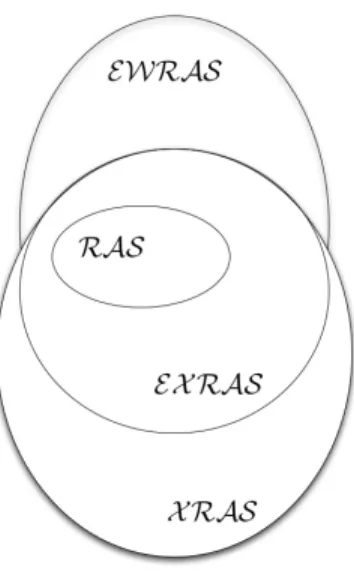
To sum up, Figure 4 gives inclusion between classes of posets introduced in this paper.
In the rest of this section, we point out a surprising result: the dualization problem on sequences is equivalent to the dualization problem on sets.
3.3
DualizeOnSeq is equivalent to DualizeOnSet
Recall that we consider rigid sequences only. The dualization problem can be stated as follows:
DualizeOnSeq Input: Let(Σn
R,v)the poset of rigid sequences, whereΣa totally ordered alphabet
with a minimal element?, n a positive integer and B+ a positive border ofΣnR.
output: B− such that (B+, B−)is a border of Σn R.
We have shown in the previous section that DualizeOnSeq is at most as hard as DualizeOnSet (see also [23]). In the sequel, we point out that DualizeOnSet
Figure 4: Posets classification with respect to the dualization problem
is at most as hard as DualizeOnSeq, and therefore the two problems are poly-nomially equivalent. Indeed, we show that DualizeOnSet is a particular case of
DualizeOnSeq.
LetΣ = {1,2, ..., n, ?}be an ordered alphabet (i.e. ? < 1<2... < n) andS∈Σn. The sequence S is said to be an ordered sequence if for every i, j ∈ [1..n] such that i < j, S[i] 6= ? and S[j] 6=? we have S[j]−S[i] =j −i. We denote Σn
O ⊆ ΣnR the
set of all ordered sequences of size at mostn. For example, the sequence2? ?5is an ordered sequence but 2?5is not.
We define the set of forbidden sequences B0− = {i∗k j | i, j ∈ Σ, i ≥ j, k ∈ [0..n−2]} ∪ {i∗kj | i, j ∈Σ, i < j, k∈ [0..n−2], k 6=j−i−1}. For example for Σ ={1,2,3,∗}and n = 3, we haveB0−={11,1∗1,22,2∗2,33,3∗3,21,2∗1,31,3∗ 1,32,3∗2} ∪ {13,1∗2,2∗3}.
The following lemma characterizes ordered sequences.
Lemma 2 Let Σ = {1,2, ..., n, ?} be an ordered alphabet and S ∈ (Σn
R,v). Then
S ∈ΣnO iff for any S0 ∈B0−, S0 6vS. Furthermore, ΣnR\ ↑B0−= ΣnO.
Proof:
Let S = x1x2...xm ∈ ΣRn. Suppose that S ∈ ΣnO. Then for all 1 ≤ i < j ≤ m
xi? . . . ?
| {z }
k
xj withk =j−i−1cannot belong toB−0 (by construction ofB
−
0 ) and thus for any S0 ∈B0−,S0 6vS
Now suppose that S /∈Σn
O. Then there exists 1 ≤ i < j ≤ m such that xj 6= ?,
xi 6=? and xj −xi 6=j−i. Let k=j−i−1∈[0, n−2]. We distinguish two cases: • xi ≥xj: then the sequence xi? . . . ?
| {z } k xj ∈B0− with xi? . . . ? | {z } k xj vS. • xi < xj: the sequencexi? . . . ? | {z } k xj ∈B0− sincek 6=xj−xi−1, and,xi? . . . ? | {z } k xj v S.
Finally we conclude that Σn R\ ↑B
−
0 = ΣnO.
LetE ={1, ..., n} be a set. We define the mappingf :P(E)→ΣnR such that for any X ∈ P(E), f(X) = S with S[i] =i if i ∈ X and S[i] =? otherwise. Without loss of generality, we delete the symbols ? that are prefix or suffix of f(X). Note that f(X)[i] =? means thati /∈X. For examplef({2,5}) = 2? ?5 and f({})is the empty sequence.
Proposition 5 Let E ={1, ..., n} be a set. Then the mapping f is a convex embed-ding of P(E) into Σn
R. Moreover f(P(E)) = ΣnO. Proof:
LetP, Qbe two sequences that are images of two setsA⊂B ⊆E, i.e. f(A) = P and f(B) = Q. Clearlyf(A)@f(B).
Now suppose there is a sequence S such thatP @S @Q.
For every i, j ∈ [1..n], i 6= j, we have either S[i] 6= S[j] or S[i] = S[j] = ?, by definition of the embedding f. Then the set C = {x ∈ E | S[i] = x, i ∈ [1..n]} is clearly defined. Moreover f(C) = S and A ⊂ C ⊂ B, since for any x ∈ Σ, x 6@ ?, but ?@x.
We have f(P(E)) = ΣnO by construction.
Now we are able to show that the dualization on rigid sequences with wildcard is equivalent to the dualization on set, i.e. enumerating minimal transversals of a given hypergraph.
Proof:
First we show that DualizeOnSeq is polynomially reducible to DualizeOnSet
[23]. Consider an instance of DualizeOnSeq: Let (Σn
R,v) be the poset of rigid
sequences andB+a positive border ofΣn
R. We construct an instance of DualizeOn-Set, i.e. a set E, E+ an antichain of P(E)as follows:
Consider first the reflection(Σn
R,v1)of(ΣnR,v). By Lemma 1, we have↓
v x=↓v1 LostPred(x) and ↑v x =↑v1 LostSucc(x) with LostPred(S) = Max
v1{S[i..|S|]|1 ≤
i ≤ |S|, S[i] 6= ?} and LostSucc(S) = Minv1{x ? . . . ? | {z }
i
S | 0 ≤ i ≤ n − |S|, x ∈ Σ}. Clearly (Σn
R,v1)is a poly-reflection of (ΣnR,v) since |LostPred(S)| ∈ O(n) and |LostSucc(x)| ∈O(n.m), i.e. their sizes are polynomial in the size of the description
ΣnR and n.
Now consider the embedding f : (Σn
R,v1) → P(E) that associates for every P[1..m]∈Σn
R a set of pairs of E = ({1, ..., m} ×(Σ\ {?}))as follows:
f(P) ={(i, P[i])|i∈[1..m], P[i]6=?}
Then f is a convex embedding with B0+ = {{(i, x) | x ∈ Σ, i ∈ [2..n]}} and B0− = {{(1, x),(1, y) | x, y ∈ Σ, x 6= y}} ∪ {{(1, x),(i, y),(i, z)} | x, y, z ∈ Σ, y 6=
z, i∈ [2..n]}. Hence |B0+∪B0−| is polynomial in m and n since |B0+| ∈ O(n.m) and
|B0−| ∈O(n.m3), wherem =|Σn
R| and n =|S|.
From Theorem 1, we conclude that DualizeOnSeq is polynomially reducible to DualizeOnSet, i.e. (B+,B−) are duals in (Σn
R,v) iff (B
+
0 ∪f(Ext(B+)), B
−
0 ∪ f(Ext(B−))) are duals inP(E).
Conversely, Proposition 5 shows the existence of a convex embedding from P(E)
into ΣnR. Moreover we have shown that B0+ = ∅ and according to Lemma 2 the size ofB0− is bounded by O(n3). Thus DualizeOnSet is polynomially reducible to
DualizeOnSeq.
4
Applications to Maximal Pattern Mining
Prob-lems
We are now interested in the PMPproblems given in Section 2.1.1, i.e. the mining of maximal interesting patterns. In the simplest case, it is well-known that maximal interesting patterns(i.e. the positive border) can be computed incrementally by using the Dualize & Advance algorithm [15] as a subroutine. In this section, we study how to modify the Dualize & Advance algorithm in more complex cases.
Table 1: A new classification of pattern mining problems DualizeOnPoset PMPproblems RAS RASP M X RAS X RASP M EX RAS EX RASP M EWRAS EWRASP M
From the classification of posets given in previous sections (see Figure 4), it follows immediately a similar classification forPMP problems, as depicted in Table 1.
Note that most of PMPproblems are known to be NP-Hard [5, 15]. Nevertheless, some of them can be solved in incremental quasi-polynomial time in the size of the positive and negative borders (see [15] forRASP M problems).
In the sequel, we recall basic results of the simplest case, i.e. pattern mining problems said to be representable as sets [21]. Then we show how to apply the materials defined in previous sections to the problem of frequent simple conjunctive queries in databases [14] and the problem of frequent rigid sequences.
4.1
Known results
We recall RAS problems defined in Section 3.1, and we give the relationship be-tween the positive and negative borders through the notion of minimal transversal of hypergraphs.
Let H ⊆ P(E) be a hypergraph on a set E. We denote by Max(H) (resp.
Min(H)) the set of maximal (resp. minimal) hyperedges of H with respect to set inclusion. H is said to be simple if H=Min(H) =Max(H). A minimal transversal of H is a set of elementsX ⊆E such that (1) X has a non-empty intersection with every hyperedge of H and (2) X is minimal w.r.t. this property. We denote by
MinTr(H) the set of minimal transversals of H and H ={E\e|e∈ H} the set of complements inE of the edges of H.
Let S ⊆ P(E). We define B+(S) = Max(S) and B−(S) = Min(P(E)\ ↓ S).
Note that for a given set S of P(E), the sets B+(S) and B−(S)
are duals in P(E). The relationship between the positive and negative borders is given as follows [21]:
Theorem 3 [21] Let (L∗,d,Q) ∈ RASPM
, S ⊆ L∗ and f : L∗ →P(E) a bijective
We recall the complexity of the Dualize & Advance algorithm proposed in [16] for problems representable as set (akaRASP M). Let us denote bywidth(L∗,)
the maximal number of immediate successors on (L∗,), and t(n) = no(log n).
Corollary 2 [15] Let (L∗,,
d,Q)∈ RASPM and T h its theory.
B+(T h)can be computed in time polynomial in|B+(T h)|andt(|B+(T h)|+|B−(T h)|),
while using at most |B−(T h)|+ width(L∗,)×|B+(T h)| queries.
4.2
Application to Frequent simple conjunctive queries
The frequent queries problem has been studied for instance in [7, 13, 14, 17]. We consider the simple problem statement defined in [14]5 and we assume a set semantic for the relational model. LetR={R1, . . . , Rn}be a database schema,D the domain
of R and sch(R) = {Ri.A|Ri ∈ R, A ∈ Ri}. A (simple) conjunctive queries Q over
R is of the form πX(σF(R1 × · · · × Rn)) where X ⊆ sch(R), F a conjunction of
equalities of the formRi.A=Rj.B orRi.A=cwithi6=j,Ri.A, Rj.B ∈sch(R)and
c∈ D and (R1× · · · ×Rn) a cartesian product betweenn relation schemas (with no
repetition). When clear from context, πX(σF(R1× · · · ×Rn))will be notedπX(σF).
The reader may refer to [1] for more details on database notations.
LetQr be the set of all possible simple conjunctive queries overR. Note that any
query which is syntactically correct belongs to Qr. For a given database d over R,
we noteAdom(d)⊆ D the active domain ofd andQ(d) the result of the evaluation of Qagainst d.
Let Q1, Q2 be two simple conjunctive queries over R. Q1 is contained in Q2, denoted Q1 ⊆Q2, if for every database d over R, Q1(d) ⊆Q2(d). Q1 is diagonally
contained inQ2, denoted Q1 ⊆∆Q2, ifQ1 is contained in a projection of Q2, i.e. for instanceQ1 ⊆πX(Q2)
The frequency of Q = πX(σF(R1 × · · · ×Rn)) in d, denoted by f req(Q,d), is
defined by: f req(Q,d) =|πX(σF(R1×· · ·×Rn))(d)|. A queryQisfrequent indwith
respect to a threshold if f req(Q,d) ≥ . f req(Q, d) is monotonically decreasing with respect to⊆∆ [13].
The problem statement can now be given:
FQ problem: Given a database d over R and a threshold , enumerate the positive border of -frequent queries of (Qr,⊆∆) ind.
5Query containment being NP-Complete, we restrict ourselves to a simple fragment, the
so-called “Simple Conjunctive Queries” where every relation occurs only once. Thus, the number of Simple Conjunctive Queries is finite and deciding containment is possible in linear time (syntactic check of the where clause).
In the following, we show that (Qr,⊆∆) is isomorphic to a boolean lattice, i.e.
FQ belongs toRAS.
To do so, we denote by F the finite set of all possible selection formulas over R
and Adom(d), i.e. F = {{A, B} | A ∈ sch(R), B ∈ sch(R)∪Adom(d)}. First, notice that a bijection trivially exists between Qr and P(F ∪R). So it remains to
show thatQr ordered under ⊆∆ is a boolean lattice.
Proposition 6 Let Q1 =πX1(σF1) and Q2 = πX2(σF2) be two queries of Qr. Then
Q1 ⊆∆ Q2 iff X1 ⊆ X2 and F2 ⊆ F1. Equivalently, Q1 ⊆∆ Q2 iff X1 ∪(F \F1) ⊆ X2∪(F \F2).
Proof: (⇒)Suppose Q1 ⊆∆ Q2. Then there existsX ⊆R such that Q1 ⊆π
X(Q2).
Clearly X ⊆ X2 and X = X1, which implies that X1 ⊆ X2. Moreover, for every database d overR,πX1(σF1)⊆πX1(σF2) and it follows σF1 ⊆σF2 and then F2 ⊆F1.
(⇐) Suppose X1 ⊆X2 and F2 ⊆F1. Let d be a database over R and t∈Q1(d) a tuple over X1. Then t satisfies F1 and also F2 since F2 ⊆ F1. Since X1 ⊆X2, we havet∈πX1(Q2)(d)and therefore Q1 ⊆
∆Q 2.
From the Proposition 6, the mapping f : Qr → P(R ∪ F) with f(πX(σF)) =
X∪(F \F) is a bijective embedding andFQ belongs toRAS.
Example 4 LetR={R1, R2}be a database schema,da database overR, Adom(d) =
{1,2}andR =R1×R2 such thatsch(R) ={A, B, C}. The set of possible conditions
F is{{A, B},{A, C},{B, C},{A,1},{B,1},{C,1},{A,2},{B,2},{C,2}}. Let us consider two queries:
Q1 =π{B}σ(A=B∧C=1)(R) and Q2 =π{A,B}σ(C=1)(R).
Then, f(Q1) = {B,{A, C},{B, C},{A,1},{B,1},{A,2},{B,2},{C,2}}
andf(Q2) = {A, B,{A, B},{A, C},{B, C},{A,1},{B,1},{A,2},{B,2},{C,2}}.
Re-mark that Q1 ⊆∆Q2 and f(Q1)⊆f(Q2).
Clearly, FQ belongs to RASP M and from Corollary 2, the following result is
straightforward. LetT h be the theory of (Qr,⊆∆, d, f req(Q, d)). Corollary 3 B+(T h)can be computed in timet(|B+(T h)|+|B−
(T h)|), wheret(k) =
ko(log k), while using at most (|B−(T h)|) + (n2 +pn).(|B+(T h)|) queries, where n =
|R| and p=|Adom(d)|.
It means that the complexity of mining frequent simple conjunctive queries in databases is incremental quasi-polynomial time in the size of the two borders, i.e. classic algorithms like Dualize & Advance can be re-used up to a polynomial
transformation. Nevertheless, this result is rather artificial since whenever we con-siderconsistent simple conjunctive queries only, the problem is no longer inRASP M. Indeed, the set of queries Qr allows queries which are not consistent, i.e. there
is no database such that their evaluation returns a value different from zero. For instance, σ(B = 1∧B = 2) or σ(A = B ∧A = 1∧B = 2) are not consistent but belong toQr.
In the following, let us consider the set of all consistent queries, denoted by QC,
defined by QC ={Q ∈ Qr| there exists a database d such that f req(Q,d) 6= 0}. A
new problem statement, slightly modified fromFQ, can be given as follows:
CFQ problem: Given a database d over R and a threshold . Enumerate the positive border of -frequent queries of (QC,⊆∆)in d.
Consider the mapping f0 :QC → P(R ∪ F) with f0(Q) =f(Q). f0 is no longer
bijective and the problem does not belong to RASP M. Now we show that CFQ
belongs toX RASP M, but does not belong to EX RASP M.
Lemma 3 Let Q1 = πX1(σF1) and Q2 = πX2(σF2) be two queries of Qr such that
Q1 ⊆∆Q2. Then Q1 is consistent implies Q2 is consistent.
Proof: Q1 ⊆∆ Q2 implies F2 ⊆ F1 or equivalently σ(F1) ⊆ σ(F2). Q1 consistent means there exists a database d such that Q1(d) 6= ∅. Let t ∈ Q1(d). Then t∈πX1(πX2(σF2))(d), i.e. Q2 is consistent.
We now point out how the restriction to consistent queries changes the classifi-cation of the initial problem.
Proposition 7 CFQ∈ X RASP M but CFQ6∈ EX RASP M.
Proof: From lemma 3, we deduce that(Qc,⊆∆)has a convex embedding, and there-fore CFQ belongs to X RASP M. From Proposition 2, there exists two antichains
B0+ and B0− such that (Qc,⊆∆) isomorphic to P(R ∪ F)\(↓ B+ 0 ∪ ↑ B
−
0). Clearly, the setB0− is empty whereas the setB0+ contains all maximal non-consistent queries. Without loss of generality, we assume a total order < on attribute set. A maximal non-consistent query has the following form:
πR(σA1=A2∧···∧An−1=An∧A1=v∧An=v0) where v 6= v
0
and A1, A2, . . . An−1, An is a chain
with Ai < Ai+1 and Ai, Ai+1 pairwise distinct for all i∈[1..n−1].
Thus, the size of B0+ is exponential in the size of R∪Adom(d) since the number of chains is exponential in the number of attributes. We conclude that CFQ does not belong toEX RASP M.
4.2.1 Application to Frequent Rigid Sequences with Wildcard
Continuing examples given in section 3.2.1, we consider the poset (Σn
R,v) of rigid
sequences with wildcard. Let us fix a finite string, called an input sequence, S =
S[1]. . . S[n] ∈ ΣnR of length n ≥ 0. Consider P ∈ ΣnR. The location list for P in S is the set LS(P) = {p ∈ [1..n] | P vp S}. The frequence of P in S is defined by:
f req(P, S) = |LS(P)|, i.e. the number of times that P occurs in S. A motif P is
said to bek-frequent inS if f req(P, S)≥k. Ak-frequent motifP inS is said to be
maximal if for every motif Qsuch that P vQ, Q is not k-frequent in S.
The corresponding frequent sequence mining problem is the following:
SEQ problem: Given a sequence S ∈ Σn
R and a threshold . Enumerate the
maximal-frequent rigid sequences of S.
From the proof of Theorem 2 and [23], we deduce that SEQ ∈ EWRASP M
and then, we have the following complexity result. Let T h be the theory of (ΣnR,v
, S, f req(P, S)).
Corollary 4 SEQcan be computed in timet(nm+n.|B+(T h)|+nm3+nm.|B−(T h)|),
where t(k) = ko(log k), while using at most |B−(T h)|+nm.|B+(T h)| queries, where m=|Σn
R| and |S|=n.
5
Algorithms for Dualization
In this section, we assume that the reader is familiar with theDualize & Advance algorithm proposed for RASP M in [15].
Dualize & Advance has the best known complexity for this class of problems, i.e. incremental quasi-polynomial time in the sum of the sizes of the positive and negative borders. Dualize & Advancetakes as input a set of itemsE, a databasedand a Interestingness predicateQ :P(E)×d→ {0,1}, referred to asDualize & Advance(E,d,Q). A setXis said to be interesting if Q(X,d) holds.
Suppose now we are given a pattern mining problem P = (L∗,,d,Q). We
distinguish the three efficient classes of problems identified in the previous sections, leading to three algorithms derived from Dualize & Advance. They are given hereafter.
5.1
P
∈ RAS
P MBy definition of RAS, there is an isomorphism f : (L∗,) → (P(E),⊆). Given A⊆E, let us consider the predicate Pred1 defined as follows:
Pred1(A,d) = Q(f−1(A),d)
Algorithm 1: Mining for RASP M Input: (L∗,,d,Q)∈ RASPM
, E
Output: The positive border B+
C =Dualize & Advance(E,d,Pred1)
Return f−1(C)
Algorithm 1 is the Dualize&Advance on the powerset of E with the corre-sponding predicatePred1.
5.2
P
∈ EX RAS
P MBy definition of EX RAS, there are two antichains B0+ and B0− of P(E) such that
(L∗,)is isomorphic toP(E)\(↓B+ 0 ∪ ↑B
−
0). Letf :L∗ → P(E)be the associated convex embedding. Given A ⊆ E, let us consider the predicate Pred2 defined as follows: Pred2(A,d) = 1 if A∈↓B0+ 0 if A∈↑B0− Q(f−1(A),d) otherwise
Again, Algorithm 2 is also similar to Dualize&Advance, with two key differ-ences: First, the predicate Pred2 has to verify whether or not a given pattern is covered by B0+ or B0− before accessing to the data; Second, at the end, elements of B0+ have to be removed from the output.
5.3
P
∈ EWRAS
P MThis case corresponds to the more sophisticated extension of Dualize&Advance, since we have to deal with the poly-reflection of the initial poset.
Let(L∗,,d,Q)∈ EWRAS. Then, we consider the following notations: • B+ (resp. B−) is the positive (resp. negative) border of Th(L∗,,d,Q)
Algorithm 2: Mining for EX RASP M Input: (L∗,,d,Q)∈ EX RASPM
, E,B0+
Output: The positive border B+
C = Dualize & Advance(E,d,Pred2) Return f−1(C \B0+)
• Eis a finite set,f :L∗ → P(E)a map andB+ 0, B
−
0 two antichains ofP(E)such that(Max(B0+∪f(Ext(B+))),Min(B−
0 ∪f(Ext(B
−))))
is a border of(P(E),⊆) • Forθ ∈ L∗,LostPred(θ)is an algorithm which computes the set of predecessors
ofθ inL∗ that are lost in the associated reflection, from whichExt(B+)can be computed.
Conveniently, we also define f−1(E) = ∪X∈Ef−1(X), for E ⊆f(L∗).
Algorithm 3: Dualize & Advance revisited
Input: (L∗,,d,Q)∈ EWRAS,(E, f,LostPred, B+ 0 ,B
−
0 )
Output: The positive border B+ of Th(L,d,Q).
1 C0 =B0+;i= 0; Continue = true;
while Continue do
2 Di = {complements of sets in Ci}
3 Continue = false
4 for each minimal transversal X of Di do
5 if X 6∈B−0 then
6 if Q(d, f−1(X)) holds then
7 θ=AMSS(f−1(X));
8 Ci+1 =Max⊆(Ci∪f(LostPred(θ))); 9 i=i+ 1; Continue = true;
quit forloop
10 if N ot(Continue) then
11 return Max(f−1(Ci\B0+)) and exit;
The main changes in Algorithm 3 with respect to the original version of Dualize & Advance [15] are:
Algorithm 4: AMSS revisited
Input: φ, a counter-example
Output: θ ∈ B+(Th(L∗,,d,Q))such that φθ
θ =φ;
while there exists α such that θ ≺α and Q(d, α) holds do
θ =α return θ
• C0 is initialized with B0+ instead of ∅ (line 1),
• a minimal transversal ofDi may belong toB0−and will not be evaluated against the database (line 5),
• finding a maximal supersetθ of a counter example f−1(X)(line 7): Algorithm 4 performs a search in L∗ instead of P(E),
• the lost comparabilities of a maximal pattern have to be added to the border of P(E) thanks to LostPred() (line 8),
• the final result has to delete all patterns inf−1(C
i\B0+)that are not maximal in (L∗,) (line 11), those extra elements were added to the current solution
byLostPred().
Consider the two particular cases:
• IfP belongs toRAS thenLostPred(θ) = {θ}, B0+ =B−0 =∅andf is bijective sincef(L∗)=P(E). Algorithm 3 is the classic
Dualize & Advancealgorithm of [15].
• If P belongs to EX RAS then LostPred(θ) = {θ} and (B0+ 6= ∅ or B0− 6= ∅). Algorithm 3 starts with B0+ (line 1) and it avoids to check (in line 5) the predicate for sets in B0−. Note also that elements of B0+ are first enumerated and then removed at the end in Algorithm 2 whereas Algorithm 3 avoids to enumerate them with the initialization (line 1).
The proofs are extensions of the proofs given in [15].
Lemma 4 At any stepi of Algorithm 3,↓(B0+∪f(Ext(B+))) 6⊆ ↓C
i iff at least one