DISCUSSION PAPER PI-0302
Polish Pension Funds, Does The System
Work?
Cost, Efficiency and Performance
Measurement Issues
Dariusz Stanko
January 2003
ISSN 1367-580X
The PENSIONS INSTITUTE
Birkbeck College, University of London, 7-15 Gresse St.
London W1T 1LL, UK
Polish Pension Funds, Does The System Work?
Cost, Efficiency and Performance Measurement Issues
Dariusz Stanko
Graduate School of Economics, Osaka University
Warsaw School of Economics, Chair of Social Insurance
Contents
1. I
NTRODUCTION...1
2. P
OLISHP
ENSIONS
YSTEM...2
2.1. Reform...2
2.2. Pension pillars...2
3. P
OLISH PENSION FUND MARKET...5
3.1. Market structure...5
3.2. Investment limits...8
3.3. Current problems... 10
3.4. Overall investment result of the system... 11
4. C
OSTE
FFICIENCY OFT
HEI
NDIVIDUALA
CCOUNTSR
ETIREMENTS
YSTEM..12
4.1. Investment performance evaluation of pension funds... 12
4.2. Cost of the system from the perspective of the insured... 13
4.2.1. Charges... 14
4.2.2. System-built costs ... 18
4.2.3. Possible cost reductions ... 19
4.3. Incentive effects of the fee structure... 20
4.3.1. Linear performance contracts... 20
4.3.2. Performance-related incentives... 21
5. P
ERFORMANCEM
EASUREMENTR
EGULATIONI
SSUES...22
5.1. Introduction... 22
5.2. Current benchmark... 23
5.3. Drawbacks of performance measuring system... 24
5.3.1. Misleading information... 24
5.3.2. Herding... 25
5.3.3. Costs ... 26
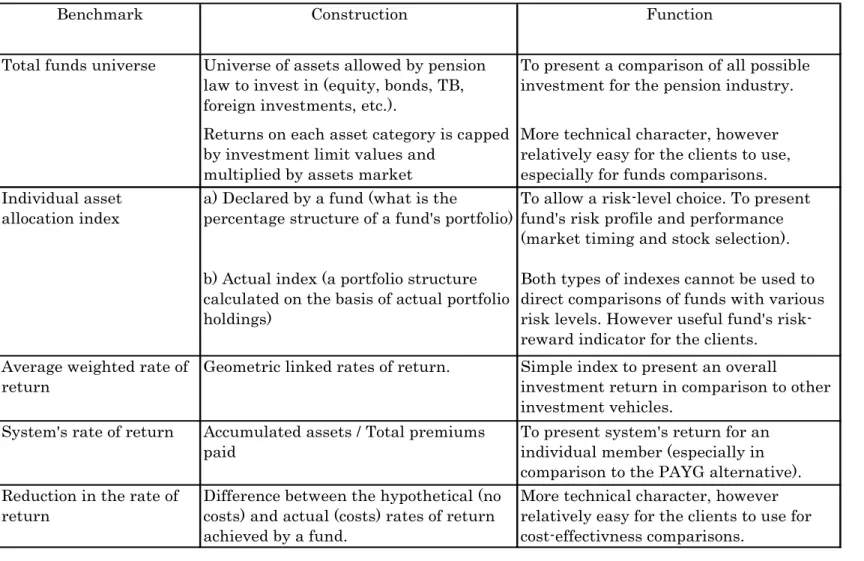
5.4. Benchmark proposals and their application for the performance incentives26 5.4.1. Improvements of the current framework ... 26
5.4.2.Market indices... 27
5.4.4. Other proposals ... 30
5.5. Compulsory participation and public information policy... 30
6. C
ONCLUSIONS...31
R
EFERENCES...34
List of Figures
Figure 1 Structure of the Polish fund market according to net assets...7Figure 2 Flow of premiums and costs incurred during the retirement saving process ... 15
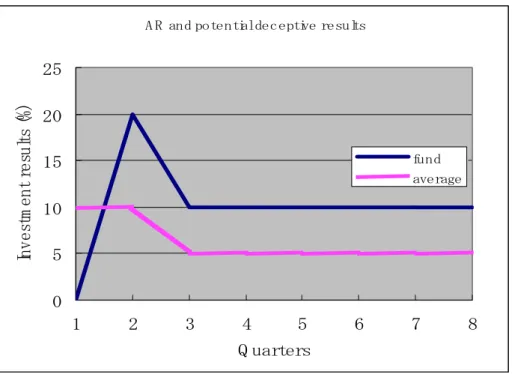
Figure 3 Potential deceptive interpretation of AR...24
List of Tables
Table 1 Current pension system in Poland ...2Table 2 The net assets and the market structure of the pension funds. ...7
Table 3 Comparison of Polish pension fund administrators according to their share capital ...7
Table 4 Investment limits...8
Table 5 System-built costs ... 19
A
BSTRACTThis paper is a part of the author’s wider research on the current Polish pension fund system. It deals with the system’s efficiency from the point of view of the individual fund member. After over three years of functioning, the savings accumulated with the pension funds only slightly exceed the total premiums that have so far been paid. The study shows that the system is not cost effective and that the incentives produced by the fees and the peer-based performance measurement frameworks have a detrimental impact on active investment management. The low net results from the second pillar are also caused partly by the relatively low share of the funded component of the retirement premium.
It is shown that considerable cost improvements can be obtained by immediate corrections. However, more fundamental changes in the system are suggested. In particular, the fee structure should be rearranged to create better motivation for active management. To achieve this, the penalty institution of minimal required rate of return should be abandoned. Furthermore, the investment limits should be reconsidered to allow for greater diversification and higher long-run risk to overcome the capacity problem of the local stock market. This study shows that the evaluation of funds should employ an external index to avoid herding and to allow a long-run investment strategy for retirement purposes. Several possible candidates for benchmarks are proposed.
c t
Journal of E onomic Li erature Classification Numbers: H-55 (Social Security and Public Pensions)
G-28 (Government Policy and Regulation)
G-23 (Pension Funds; Other Private Financial Institutions)
Keywords: pension reform, public pensions, pension funds, government regulation
I am indebted to Ilian Assenov Charles Yuji Horioka, Wen Jie Ma, Kazuhiko Nishina, Yasuhiko Tanigawa, Midori Wakabayashi and Jun Min Wan for their helpful comments, continuous support and assistance. I extend many thanks to Alice Williams who kindly corrected my English.
C
APSULER
EVIEWFunded pension schemes are becoming a key point for modern economics and economic policy. Poland has recently launched its public mandatory system of individual accounts run by private pension administrators. However, the results obtained so far have been rather disappointing. During the last three years, the system’s rate of return was much lower than the rate of inflation. What are the reasons for such a situation? Stanko (2002) demonstrates that the investment skills of fund managers were positive. Therefore it is the design of the system and its operational costs that contribute to low efficiency. Partly, it is also caused by the relatively low share of the funded component of the retirement premium. This paper discusses these issues. It describes the pension market and its current problems. The research investigates cost and performance issues and points out that there can be considerable savings if the system is redesigned. In particular, the fee structures and their incentives for active management must be changed along with the operating and regulation framework; both of which generate high costs for the fund operators and therefore, for individual affiliates. The performance evaluation system ought to be changed as well because the existing peer-group benchmark leads to distortions in investment behaviour. Its main drawbacks are herding, median result clustering and short-horizon over-conservative investment portfolios. This paper backs the performance-related fee framework and proposes the external benchmark as a target for the pension managers.
1. I
NTRODUCTIONFunded pension schemes are becoming a key point for modern economics and economic policy. Increasing demographic pressure combined with the need for reforming the existing ineffective and politically vulnerable systems bring about the current trend for privatising the welfare state and using capital market-based solutions in the old-age provision.
Poland is one of the first countries to launch a fully funded pension fund system as a part of its public pension system. It has been three years since the individual account system was introduced. Although to a great extent based on the Chilean model, the Polish solution attempts to avoid some of its weaknesses. Most of the European countries are currently considering their pension reform strategies and are facing similar problems, especially the demographic ones. Therefore, the Polish system has a lot of insights to offer.
The extensive performance analysis by the Superintendence of Pension Funds (UNFE, 2000) is already out of date and differs in various aspects due to its administrative angle. This paper is a part of the first wide evaluation research of the Polish system. In his performance evaluation research, Stanko (2002) presents facts concerning the positive efficiency of pension fund investment. This part analyses recent features and the overall efficiency of the fully funded pension fund pillar from the participants’ point of view. It contributes to the literature by proposing certain improvements in cost and public performance framework. Most of these suggestions are closely related to the state’s overall economic and social policy and more specifically, to the design of the pension funds system.
The paper is organized as follows: section 2 briefly sketches the Polish retirement system, section 3 investigates current issues concerning the pension fund market, section 4 provides an analysis of performance evaluation results and the costs of the system. The problems of the state’s performance monitoring and its consequences are discussed in Section 5.
2. P
OLISHP
ENSIONS
YSTEM2.1. Reform1
Pension reform in Poland followed the World Bank (1994) proposal to balance the system’s redistribution and insurance tasks by establishing the three-tiered old-age security framework. The change concerned people who were younger than 50 at the time the new system was introduced (January 1, 1999). Those below 30 had to join the reformed scheme. Persons in the age bracket of 30-50 were given an alternative to choose either the new system or stay within the old one. However, once taken, such a decision was irrevocable. The reform did not affect some social groups covered by other social insurance schemes, i.e. farmers2, priests, police or
military personnel.
The previous state system was partly reformed and is now referred to as the first pillar. The two other pillars are individual accounts (the second pillar of public pension funds) and private or occupation pensions (the third pillar). The retirement age is 60 for women and 65 for men. Due to financial strains, social security premiums in all pillars are subject to taxation at the moment of payment.
The new system is supposed to bring in some quality improvements. The main ones include a tighter relationship between pension and contributions, removal of earlier entitlement to pension benefits, creation of an individual saving mechanism that encourages a prolonging of the contributory period and late retirement and removal of privileges for certain professional groups within the pension system.
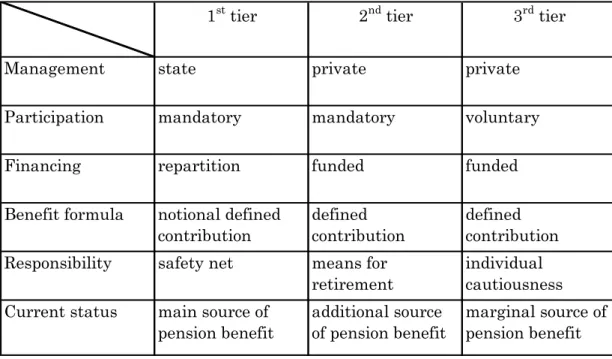
A brief summary of the current Polish pension system is presented in Table 1.
Table 1 Current pension system in Poland
2.2. Pension pillars
The social insurance premium remains high. It is equal to 46.62% of gross monthly salary with an upper income ceiling of 30 average monthly salaries. The pension related premium is 19.52% of gross earnings. The bigger part (12.22% of
1 Details of the pension reform are described, among others, in Chlon, Gora, Rutkowski
(1999) and Gora (2001).
2 This is a numerous social group. The farmers belong to the Kasa Ubezpieczenia Rolniczego
(Farmers’ Insurance Office). At the moment there are 1.9m retirees. Almost 1.5m working farmers are subject to mandatory insurance. However only 1.05m of them pay premiums. The system is financed principally by the state or, in other words, by other social groups. Premiums cover only less than 5% percent of the system’s expenditures; the rest being financed in the form of direct transfers from the budget.
gross earnings) is allocated to individual accounts in the first pillar, while the rest (7.3% of salary) is transferred to pension fund accounts in the second pillar. Other social security risks covered by the system are: disability (13.00% of gross earnings), sickness (2.45%) and industrial accidents (1.62%). While employee and employer pay pension and disability premiums in equal parts the employee pays the sickness premium and the employer finances the disability risk. National health insurance (paid by the insured) is equal to 7.3% of personal income before tax (10% of gross earnings). There are four main legal Acts that regulate the reformed pension system3:
- Act on the social insurance system dated 13 October 1998 (reform)
- Act on retirement pensions and other benefits from the Social Insurance Fund dated 17 December 1998 (first pillar)
- Act on organisation and operation of pension funds dated 28 August 1997 (second pillar)
- Act on employee pension programs dated 22 of August 1997 (third pillar). Two out of the three pillars are mandatory. The first pillar is the Pay As You Go (PAYG)4 system run by the state-owned Social Insurance Institution (Zaklad
Ubezpieczen Spolecznych, ZUS). It has been organizationally reformed and now operates on the notional account5 basis. The ZUS registers all work-related
information. It also acts as a central collector of social security premiums and transfers contributions to individual accounts in the second pillar.
The notional account balance is indexed in line with the inflation rate plus 75% of real wage bill growth. That is why the rate of return is the same for all insured. Accumulated assets are used at retirement to buy a life annuity.
The first pillar acts mainly as a redistributive and insurance mechanism and it provides the safety net for all citizens. It is assumed that the main part of future retirement benefits will come from the funded component. However, since the premiums paid into the first pillar are still considerably higher than the fully funded premiums, the first pillar component is going to be the most important for a
3 The current law documents are listed in KNUiE, Quarterly Bulletin 2/2002.
4 PAYG is the system, where the current contributions of the employed are used to finance
the pension benefits of the current retired. It is therefore a system, which uses a form of contract between the generations.
5 Within such system, each individual account is credited with some theoretical points
to represent contributions paid by the insured. The points are subject to growth at the rate decided by the government regulations. However, the notional accounts do not actually contain cash, stock, bonds or other securities.
long time6. The real values of pensions from all three pillars are expected to increase.
At the same time, there will be a decrease in the replacement ratio (expressed as a percentage of the wage before retirement).
The second pillar represents public pension funds run by private managing companies who invest savings of system participants in the capital market. In the event of the death of the account owner, the resources are not lost7; half of the assets
are paid into the spouse’s pension account while other beneficiaries inherit the other half. Upon retirement, the accumulated capital is used to purchase a life annuity from a retirement company. The detailed regulations concerning that particular life insurance entity have yet to be decided. First payments are expected to take place in 2009 but detailed regulations have still to be issued.
The current number of opened accounts in the pension funds is 11.35m (end of September 2002) with some 2.09m “inactive” accounts8. These are the associates
who have never paid or do not pay their premiums mainly due to unemployment (currently 18%). Therefore only 9.26m accounts are active. However, this number is perhaps even lower since there were around 8.29m transfers per month in 20029.
Even though the second pillar is expected to be an effective vehicle for pooling pension savings, the benefits from the first pillar will still be the most important source of retirement provision. Due to fiscal considerations10 it has not been
possible to free up more resources from the repartition tier.
The market of pension funds represents a mixture of state (whose role involves supervision and guarantee), public (savers) and private entities (managing companies). The funds themselves resemble loaded semi-mutual funds whose investment portfolios have (or should have) a structure typical for the pension saving purpose and whose investment behaviour is limited by investment constraints imposed by the state and common sense prudent man11 rules. State
6 This fact is not recognized by most of the insured. Some commentators are worrying that
the future pensions from the funded scheme will fail expectations and that it will be the cause of political and economic problems.
7 As opposed to the first PAYG tier. 8 KNUiFE, Quarterly Bulletin 3/2002.
9 Author’s calculations (www.zus.pl/images/ofe/excel/of021127.xls).
10 Premiums directed to the second pillar are invested in the capital market and cannot be
used for financing the retirement benefits of current retirees. Therefore, a switch to the fully funded system creates an immediate budgetary deficit. This is the reason why the premium for the first pillar is still dominating.
11 There is still no legal source for trust or prudent man law except that of commercial and
civil codes. Some interesting discussion on these issues in the American context can be found in Del Guercio (1996), where the author argues that the prudent-man law has distorting
bears particular responsibility in the area of regulation, as it is the state that makes the participation in the system mandatory.
The third tier of social insurance is, according to World Bank (1994) suggestions, a domain of individual thrift and cautiousness. Contributions are paid on an after-tax basis and pension benefits are tax exempt. Under the Polish regulation it is possible to save for additional retirement benefits either via individual savings or via occupational retirement schemes.
Private saving comes in several forms; the most popular vehicles are mutual funds and life insurance policies. The freedom of savings is not supported by any tax preferential system. As a matter of fact, recent tax regulations introduced 20% tax on capital and interest incomes.
There are four legal entities for occupational plans: the corporate pension fund, the mutual pension fund, group life insurance, group life insurance in a life insurance company or in a mutual insurance society. The first two legal entities are more capital-based solutions, while the other two are predominantly of an insurance character. However, once employer and employees decide on the occupational pension scheme it can be run only in one of those legal forms12. At the
end of November 2002 there were 181 corporate pension schemes.
3. P
OLISH PENSION FUND MARKET3.1. Market structure
The reform started on 1st January 1999, but the fund system itself started
officially on 1st April 199913. However, it took several months before the funds set
out their real activity. Firstly, the public had several months to take a final decision about their access to the system and to choose a particular fund. Furthermore, the initial number of participants and accumulated assets had been too small to start the real investment activity.
effects on institutional investing.
12 Such limitation obviously comprises a barrier for development of occupational schemes.
Firstly, it constrains the freedom of choice amongst the workers. It also creates a huge obstacle for pension mobility. If an employee switches to another company where a retirement scheme is different, they will be compelled to either resign from the previous agreement (with considerable loss to their assets due to premature liquidation) or refrain from entering into the company’s plan (with another opportunity cost).
13 The delay was caused by above-mentioned long-lasting problems with the implementation of software for the Social Security Institution database. Anecdotic enough, many commentators linked the intentions of the system designers with the start of the system on the April’s Fool Day.
Most of the Polish pension funds had started their activity by June 1999. Initially, licenses were given to 15 fund administrators. Three others joined in September 1999 and by October 1999 all 21 fund administrators were operating. Despite intensive efforts by the supervisory body Urzad Nadzoru nad Funduszami Emerytalnymi, (UNFE, Superintendence of Pension Funds), to prevent mergers and acquisitions, four of the pension funds have already disappeared from the market. The Pekao fund absorbed three others; Epoka, Pionier and Rodzina on 9 April 2001, 23 July 2001 and 10 December 2001, respectively. The Pocztylion fund merged with Arka-Invesco on 14 December 2001. By the end of December 2002, there were 17 active pension administrators managing 17 public pension funds14
From February 2003, there will be 16 funds since the Ego fund (overtaken by Skarbiec) will finish its activity. This number will surely decrease in the future as the funds that are too small to operate with profit will have to withdraw from the market.
By the end of November 2002, (almost four years after the funds started) the accumulated assets of pension funds have reached 30.4 billion zlotys (approx. 7.6 billion USD). This amounts to 26.8 % of total capitalization of the Warsaw Stock Exchange and to 4.2% of the 2001 Polish GDP15. The economic importance of this
class of institutional investors is rapidly increasing as their net assets have been growing recently by some 0.3bn USD which translates to annual growth of 2.8 bn USD. Some persons voice their opinion that the portfolio limits with regard to the foreign investment should be either abandoned or considerably limited. Otherwise there is the danger of saturation of the domestic capital market in the not so distant future.
On 1 April 2002 UNFE was replaced by Komisja Nadzoru Ubezpieczen i Funduszy Emerytalnych (KNUiFE, Committee of Insurance and Pension Fund Supervision). It became a new supervisory body for both insurance and pension fund sectors.
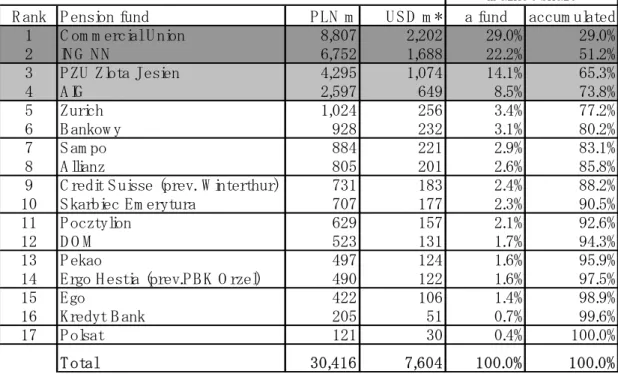
A characteristic feature of the Polish pension fund market is its relatively high concentration (Table 2 and Figure 1). One can distinguish four categories of funds with the first two dominating. The biggest two funds have half of the market. The next two are also big, for they constitute another quarter of the market. Hence, the Polish market is as highly concentrated as the UK one, where the top five
14 The Polish pension law envisages that one operator can manage only one fund.
15 Own calculations based on data from: www.money.pl/emerytury (pensions),
management houses administer over 80% of the voluntary individual pension assets (Blake et al., 1998). The other 13 funds are severely sandwiched within the remaining quarter of the market. They can be labelled either as small (seven funds having less between 2 and 4 per cent) and very small (another six funds with shares lower than 2%, making up a total of seven percent). Such a situation represents an oligopoly market.
Table 2 The net assets and the market structure of the pension funds. Figure 1 Structure of the Polish fund market according to net assets
Contrary to one’s expectations, the companies who have the biggest market share are not the biggest institutions with respect to their capital bases. Table 3 demonstrates that their own capitals are relatively small. The administrators with the highest three share capital positions are ranked 13th, 6th, 11th and 8th
respectively places in the net asset ranking. This suggests that the rationale used by the public for choosing the fund was not based on the size of the managing company16. As a matter of fact, the historical perception of these financial
institutions has been more important. Their advantage was that they had already been recognised by most of the Polish public in the 1990s. Further, the biggest funds launched broad and costly marketing campaigns. Therefore, the previous presence of some institutions plus marketing were the decisive factors in the process of attracting clients to new pension funds.
Slow mobility of the insured between the funds (for instance 0.8% in 3rd quarter
of 200217) represents another feature of the system. Changes of membership are
expensive as the law imposes some financial consequences for those who change before the two-year period18. Regardless of good intensions, this impediment on
mobility must be assessed rather critically since it does not contribute to competition of the system.
Table 3 Comparison of Polish pension fund administrators according to their share capital
16 The capitals of managing companies have not changed considerably since 1999. 17 Author’s calculations based on KNUiFE, Quarterly Bulletin 3/2002.
18 That rule originates from negative Chilean experiences in this matter. The Polish legisla-tor tried to avoid the “marketing war” and frequent, economically irrational switching of membership between funds induced by promotion campaigns. As a rule, the insured have a right to change their pension fund every two years. If such a decision is taken earlier, the member has to pay a transfer fee that decreases as the time approaches the next two-year period.
3.2. Investment limits
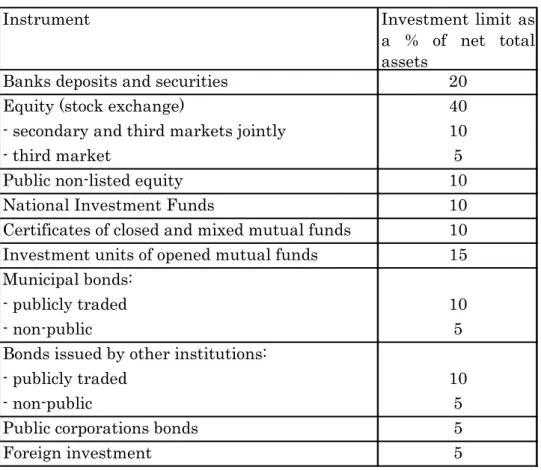
The funds operate under the investment limits specified by Polish law (Chapter 15 of the Bill of 28 August 1997). Table 4 introduces the main rules. The most important constraints concern stock and bond investment. Funds are allowed to invest up to 60% in stocks. Maximum of 40% of assets may be hold directly in stock and up to another 20% indirectly through the use of mutual funds. In the later case (indirect stake holding), the pension manager does not receive management compensation for them.
There exist some bounds for a single investment. In the case of investment in closed or mixed investment funds, the ceiling is 2%. This value is higher (5%) for investments in open funds.
The above regulations put a constraint on the pension funds in their indirect stock exposure since the mutual fund industry’s assets in equity-related styles (balanced, shares, closed, growth) currently amounts to only 8.6%19 of the pension
assets. The limits for investments in single security or abroad are 5%.
Table 4 Investment limits
In the opinion of the author, the Polish pension funds should be allowed to invest more in international instruments when the covariance between the returns in Poland and foreign markets is negative. Foreign investments offer an opportunity to reinsure and facilitate the problems of limited capacity of the local financial market. In the case of positive but low covariance, investing overseas still has some sense because it provides a diversification against political and spatial risks (for example weather cataclysms). Investing abroad brings, of course, the exchange risk. However, there is no other solution to the problem of domestic market saturation. Moreover, Poland will joint the EC before long and the currency problem will be considerably offset.
The problem of foreign investment limits concerns both the supervising agency and policy makers. It is difficult, for political reasons, to accept a situation where domestic savings go elsewhere and finance foreign economies even though this can reduce the overall risk and improve the system’s efficiency. Another problem relates to the public and the way they may perceive such an action (Feldstein-Horioka’s (1980) domestic bias). It seems that from a purely organisational perspective, pension funds can easily and quickly implement the strategy. Most of the
19 Author’s calculations, based on http://tfi.hoga.pl/tfi_rankingi.asp, end of November
administrators are foreign-based companies and they certainly have a good market research at their headquarters. However, due to current law provisions, the costs of overseas operations are borne by the administrator and not by the fund. This is perhaps another major factor impeding a switch towards international investments.
The recent bear market and built-in system disincentives (discussed in the following sections) have shaped the current stock-bond asset allocation to about 30:70 ratio. It is much lower than the investment limits permit. However, it seems that the maximum equity-bond asset allocation ratio implied by the law is too strict especially if some systematic barriers for more active management are removed. On the one hand it is obvious that the system, especially at its infancy stage, should be well guarded. However, the long-run character of the retirement saving process questions the feasibility of stock limitations especially if the system deterrents are removed. With high system costs it seems impossible to achieve a decent replacement rate unless more investment in equity is allowed. It appears again, that the needs for budgetary financing was the main motive for constructing the 60:40 maximum asset allocation rule which is, nota bene, an exact opposite to the common allocation strategy followed by the American corporate pension funds.
This suggests that the primary reason why stock investment is limited by investment law is not for safety considerations but rather the state’s desire to make pension funds invest a considerable part of their assets into Treasury bonds and other Government debt instruments. Current legislation creates a stable and predictable demand for Treasury Bills from institutional investors and makes financing of the state deficit cheaper and more operational. However, the cost of this is indirectly borne by citizens, especially the young20. Enforced investment in “safe
instruments” lowers the expected rate of return of their pension portfolios and in effect endangers future pensions. The potential benefits of lower taxes due to the reduced cost of financing the state deficit debt are quite illusionary as the state taxes and expenses are usually difficult to moderate. In addition, the cost of asset management becomes much higher in relation to the overall risk profile of managed portfolios (section 4).
20 One can distinguish between market assets and human labour assets. In the case of the
young, the expected value of income from labour is high. Thus, the risk-return profile of their investments (represented as a mix of risk free and risky assets) can and usually should be more aggressive in the earlier stage of the process of saving for retirement. For more discussion on the role of labour income component for optimal portfolio choice see for instance Bodie (2002) and Davis and Willen (2000) or Jagannathan and Kocherlakota (1996).
3.3. Current problems
One of the most serious problems of the market relates to the scandal surrounding the computerisation of the ZUS office. Even though the contract was concluded well before the start of reform, the computer system has not been completed yet. The recording and transferring of over 6 million payments per month between employers and funds without a properly working information system seems to be a doomed task. An immediate effect was that part of the contributions paid in by employees stuck somewhere in the system with the result that the pension fund administrators did not receive a considerable fraction of the payments.
The state-run ZUS have had to pay penalty interest21 and consequently
resorted to borrowing money from the commercial banks. Beside the cost of commercial loans, the ZUS also had to pay a penalty interest for transfers that it did not complete on time. By the end of June 2002 this quota amounted to 101.7m PLN (around 50m USD) which is almost 0.5% of all the premiums paid into the system so far. The penalty interests were and still are very expensive (21% for the period May 1999-October 2000, 30% for the period November 2000 – December 2001 and 20% for 2002). The ZUS has still not transferred to the funds around 7 bn PLN (including overdue interest)22 and by the end of 2002 this sum is expected to reach
10 bn PLN. The cost of reform has not only become higher but also the pension funds have had to adjust their financial strategy to the irregularity of transfers. This has had an adverse effect on their liquidity positions and definitely lowered the results of their active investment management.
Another important issue are dead accounts. Many of the participants applied to more than one fund as a result of malpractice during the enrolment campaign. Others signed contracts unaware that they simply could not join the system. In effect, pension funds suffer from some void or non-working accounts. The ratio of such amounts was around 23.7% in 2000 with a slight decrease to 20.6% in 2001 and 18.4% in 2002 (end of September)23. That means that roughly 2m accounts have
21 According to the Social Insurance Institution (ZUS), its debt to public pension funds is currently around 4 bn zlotys (1 bn USD). These estimates differ from the fund providers’ calculations indicating a debt of 3 – 6 bn zlotys (0.75-1.5 bn USD). Only the interest due at the beginning of the year was around one billion PLN with its probable value at the end of 2001 at 1.5 – 2 bn PLN. The Finance Ministry wanted to pay an allowance payment but finally withdrew this proposal.
22 Source: Chamber of Pension Fund Administrators, Bulletin 3/2002. 23 ING fund (www.ing.pl) and KNUiFE, Quarterly Bulletin 3/2002.
never received any contributions. The highest fraction of non-working accounts was around 57% (Polsat) and 47% (Ergo-Hestia), while the lowest ranged at 7% (ING) and 5% (CU)24. For instance, the cost of inactive accounts in 2000 for the whole
industry amounted to 20 m PLN (around 5m USD, Wojciechowski, 2002).
One more problem that the pension funds have begun to face is a high concentration of their investments in the stock market. A steady requirement for assets from the funds can, in light of foreign investment restrictions, distort the supply and demand balance in the long run. The pension funds hold currently around 17-18% of the stock market’s free float and twice as much in the case of some blue chips25. The small size of the stock market in comparison to constantly growing
pension assets creates a problem with corporate governance26. Additionally, funds
invested solely in Poland can create the effect observed in Chile where an artificially high demand from domestic pension funds triggered the foreign investors to close their investment positions. They resold their portfolio holdings to the Chilean pension funds at attractively high prices27.
The barriers to foreign investment by the Polish funds are not only constituted of the current 5% ceiling. The costs of overseas operations are borne by the fund administrators while the domestic operation costs are transferred to the funds themselves. Such a situation creates a strong disincentive to opening positions in foreign instruments. In addition, the current pension law does not offer clear regulations and ways to treat the exchange rate risk28.
3.4. Overall investment result of the system
Comparisons of total premiums (plus penalty interest) that have been paid into the system with the accumulated assets lead to quite pessimistic conclusions. While there was over 23.6bn PLN (in nominal terms) paid so far by the members, the total assets of the funds at the end of June 2002 comprised of 25.1bn PLN29 During the
first three years of functioning the system obviously created the economic deficit in real terms. The system produced the result of a nominal 6.17% rate of return (or
24 KNUiFE, Quarterly Bulletin 3/2002.
25 The Warsaw Voice, 3 March 2002, No. 9, www.warsawvoice.pl/v697/Business06.html. 26 That is, the situation when a company’s majority stakeholders use their voting rights to
achieve goals not in line with the company and/or minority holders’ interests.
27 Source: Mr. Chełchowski (a member of the Board of Directors in the Credit Suisse Life &
Pensions PTE S.A.), Chamber of Pension Fund Administrators, Bulletin 3/2002.
28 Source: Mr. Mikuc (a member of the Board of Directors of the Allianz managing house),
Chamber of Pension Fund Administrators, Bulletin 3/2002.
roughly 7.4% if one accounts for the fact that premiums are transferred once a month to the funds). In real terms the rates are – 17.23% and – 16.36%, respectively. This result is a big disappointment for the participants and reform makers. The system lost with the most naïve passive investment vehicles like bank deposits or Treasury Bonds. For instance, bank deposits brought at that time amounted to roughly 40% (for PLN) and around 12% (for USD - appreciation effect included). A more sophisticated strategy for retirement saving based on investment in Treasury bonds would have earned around 51% percent while 1-year Treasury Bills would have earned even slightly more (52.2%)30.
Therefore, it is obvious that there is something wrong with the system. There are two main areas where one should seek an explanation. It might be the case that the investment process is not efficient for several reasons. One of the possibilities is that the managers possess low investment skills. This issue is researched in Stanko (2002) and the results are briefly presented in the next section. Another explanation may be more general flaws implied by the system’s design. Such distortions can concern cost and efficiency issues or built-in agency problems and disincentives (performance monitoring, compensation system, level of competition). The cost and compensation system is a subject of the next section while the performance and competition issues are discussed in section 5.
4. C
OSTE
FFICIENCY OFT
HEI
NDIVIDUALA
CCOUNTSR
ETIREMENTS
YSTEM4.1. Investment performance evaluation of pension funds
Stanko (2002, Table 9) reports the funds’ abnormal returns achieved during period between 1 June 1999 and 28 June 2002. Almost half of the funds revealed abnormal returns31 significant at 5% level. The industry’s annualised alphas were
also significant. For 14 funds that were present during all the period researched, the average alphas ranged between 3.7% and 4.0%, depending on the model. Funds that survived but started their activity later had lower average abnormal returns
30 Calculations are based on the following sources: National Bank of Poland (bank deposits
and inflation rate), Merrill Lynch Bank (GOPL index) and Internet sites (www.hoga.pl,
www.money.pl, www.parkiet.com; bond mutual funds returns).
31 Abnormal return is the difference between the realized and expected return. The later is
calculated on the basis of a market model that assumes that all the public information is reflected in the price of the security. Therefore, the non-zero abnormal return indicates positive or negative investment skills of the manager who uses additional, private information for her management decisions. Abnormal return is related to taking a diversifiable (non-market or idiosyncratic) risk.
(2.8-3.3%). The variation of the cross-sectional alpha distributions, measured by the interquartile range32, was computed. For the funds that were present during all the
period, the variation of the cross-sectional raw excess returns was lower than the variation of the cross-sectional excess returns. It indicates that the unconditional performance models used were able to detect the abnormal performance.
However, the annualised interquartile ranges were very narrow, both for excess returns (1.6%) and alphas (1.8-2.1%). Such a clustering around the middle values suggests that the pension managers were inclined to follow the median manager. Blake et al. (2001) report the same effect for the UK pension funds.
Consequently, pension funds do produce additional value during the investment process and one cannot blame the pension funds’ investment efficiency for the system’s overall result. However, the clustering effect suggests that the long run results in the future might be better if the investment policy is changed. The reason for the system’s unsatisfactory rate of return, experienced during last three years, therefore must be attributed to the state’s overall regulatory framework. Blake et al. (2001) link the funds’ performance to the incentive effects of the fee structures, the performance evaluation environment and the degree of the industry concentration.
An additional important issue is that the financial claims offered by the pension systems (PAYG or fully funded) can hardly be directly comparable with the returns from other investment vehicles33. While the “ordinary” financial claims might offer
higher returns and can be managed freely, they are market contingences. Moreover, moral hazard, free raider or ignorance issues, not to mention the bad luck element, might endanger saving for retirement. The pension systems eliminate those problems34 although at the price of the liquidity and sometimes, lower future
returns.
4.2. Cost of the system from the perspective of the insured
Information about alphas is of primary concern for the pension administrators and for the managers themselves. It enables them to measure and compare the efficiency of the investment management. Thus pension fund trustees mainly use this as a measure of management performance. However, an efficient investment does not necessarily imply an efficiency of the overall process of saving for
32 That is, the difference between top 75% and 25% results. 33 I thank Midori Wakabayashi for pointing out this problem.
34 Bad luck might be partially eased by the insurance (redistribution) feature of the
retirement. The efficiency for the insured is the net rate of return on pension fund investment. It is the rate achieved on investment reduced by administrative charges (Chlon, 2002). However, one should also add opportunity costs caused by the system. The latter are the system-built costs and costs due to sub-optimal investment portfolios. The following subsections provide more detailed discussion.
4.2.1. Charges
There are two main categories of costs that define the economic efficiency of retirement accumulation. The first comprises of the charges paid directly by the insured. The second consists of the costs borne by pension administrators. These are the operational costs and system costs. The fund administrators’ expenses usually have an indirect effect (via charges and reduced assets to be invested) on the results of pension fund members.
With respect to the fees imposed on fund members, Blake and Board (2000) remark: “there is an ongoing debate as to whether personal pension plans deliver investment returns high enough to justify these charges”. The same issue applies to the publicly mandated pension funds.
Charges can be categorized mainly as those based on contributions and those charged on accumulated assets (Blake and Board, 2000). The first type can involve up-load (entry) fees that may or may not be related to the size of contributions as well as regular charges that, again, may depend, on the contribution amount. Within the second group there are charges based on either the intermediate value or the final value35. Hence, the fees can be levied either on the flow of funds or on
the account balance. The former method is popular in Latin American countries while the latter is widespread in Europe and the USA. Other solutions are possible. For instance the Mexican system has commissions based on the real rate of return although this approach does not apply to all of the funds (Sinha et al., 1999).
The Polish system of individual accounts belongs to the retail-type market. Characteristics of such a system are the direct relationship between insured individuals and a fund (James et al., 2001) as well as the free choice of a fund. In the institutional market there is an intermediary that aggregates individual contributions; the institutional investors are competing for management of huge money blocks. According to James et al. (2001) such a solution is twice as cheap as the retailed one. However, there is less choice and transparency and a greater
35 In the Polish system there are no explicit exit fees. However there is a hidden switch fee
danger of political influence.
Figure 2 presents the route of premiums in the Polish system. The contributions are sent once a month from the employer to the state entity (ZUS), which keeps records of social insurance contributions for each individual. The ZUS allocates part of the premium to cover each type of social risk. The premium designed for old-age protection is split between the state repartition scheme (first pillar, approx. 63% of pension premium) and the pension fund scheme (second pillar, approx. 37%).
Figure 2 Flow of premiums and costs incurred during the retirement saving process
The cost of transferring premiums to the pension funds is currently 0.8%36 of
their total value. Such a high charge seems to be hardly justified especially when it reduces already low results of future pensioners. The ZUS agency has still not sent some of the premiums to the funds (subsection 3.3). It represents an additional burden for the society as a whole because the arrears have to be ultimately met from the pockets of taxpayers.
The fund administrators impose front-loaded fees ranging between 6.5% and 10% of the premium. During the last three years the average was approximately 8.5%. Given that the longer the membership, the lower the fees, the average charge should be approximately 6.84% after 5 years, 6.8% after 10 years and 5.8% after 20 years of participation37. According to the recent news38, the government intends to
limit these charges considerably.
As an illustration, one might assume that for new money entering the fund, the up-front fee should not drop the one-year net investment result below risk-free rate39, that is:
)
1
(
)
1
)(
1
)(
1
(
E
R
M
x
r
fx
−
+
−
≥
+
36 The fee is decided every year in the budget law. In 1999 there was no charge, in 2000 it
was 0.6% and during last two years it reached its statutory maximum of 0.8%.
37 Author’s calculations based on emerytura.hoga.pl.
38 The Polish government is considering now decreasing the up-front fee to a max. of 2.5%.
In exchange, the asset management fee would be increased from 0.05% to 0.083% per month but not more than to 15 m PLN (PAP, Polish Press Agency).
39 Of course, there is no particular reason for the first year investment return to be at least
equal to risk-free rate. In fact, there may be cases when the first few years’ return produced by a new stream of money entering the retirement account generates much lower returns. With the long-run investment it is the final return on the assets that counts. However, the above illustration gives some idea as to what the higher bound for entry-fees should be if the returns from the assets do not change considerably each year.
where: x = premium, E = entry charge,
R = investment return net of investment costs, M = management fee,
rf = risk-free return net of investment costs.
Therefore,
−
+
+
−
≤
)
1
)(
1
(
)
1
(
1
M
R
r
E
fand for the recent situation with the funds earning on average 15% p.a. and a risk-free rate of 10%, the maximum bound is equal to:
%
77
.
3
)
006
.
0
1
)(
15
.
0
1
(
)
1
.
0
1
(
1
=
−
+
+
−
≤
E
If the initial fee brings down the two (three) year net return to a risk-free rate, the bound values are 7.4% and 10.89% respectively.
The argument against the current level of up-loaded charges becomes stronger when one analyses the structure of portfolio holdings. Stock or other instruments that are commonly believed to require high investment skills comprise merely 25-30% of all investments. Bonds comprise over 65% while Treasury bills and bank deposits represent several percent of pension portfolios. Whereas it might be argued that such an asset allocation strategy is a response to current market prospects, there is still no justification for the level of charges. Either the investment limits should be relaxed so that the majority of assets could be invested in stock or the charges should be lowered. Otherwise clients are overcharged since the mandatory savings make it impossible for them to resign from such costly investment services. Had there been no compulsory participation they could have replicated the low-risk holdings relatively easily via much cheaper individual investment (naïve or index investment) while retaining in the pension account only a voluntary equity portfolio.
The costs related to the investment activity (brokerage fees, services, bills for depositary) and the remuneration for asset management are calculated and deducted directly from the assets of the fund. Typical brokerage fees at the Polish
market for institutional investors (transactions from 0.5 m PLN) can be estimated roughly at 0.27% for stock and 0.09% for bonds operations40. The administrators of
the fund charge the asset management fee at its maximum level of 0.05% of net assets per month i.e. 0.6% per annum. With the pension portfolio structured at 30:70 (shares/bonds) the asset management fee is comparable to prices of services that the large investment banks offer for wealthy individuals. For instance, CitiCorp charges its clients 0.8% for managing the WIG-related 10m PLN portfolio. In the case of bond portfolios the prices are 0.25% (inflation-linked) and 0.4% (no-linkage), respectively. The Polish mutual funds charge around 1.75% and 0.8% p.a., respectively (with upfront fees equal to 1% and 0%).
It seems that the management fee is acceptable41 though there is still room for
improvement because the pension fund administrators have clients with a potentially long membership and constantly growing assets. Furthermore, customers have few funds to choose from. Mandatory savings represent a huge flow of assets and competition between the operations is much lower than in the case of numerous mutual funds who must fight for voluntary deposits. As previously mentioned, the pension market is over ten times bigger than the mutual one and it is growing much faster.
Chlon (2002) uses 2000 Polish data to estimate that the up-front and management charges reduce the rate of return by approx. 0.88%. The cost of administrator charges in Poland is comparable to the Latin American systems and is closer to the lower boundary (Chlon, 2002). However, Chlon (2002) does not provide information about the effect of overall systematic costs on the net rate of return.
As will be seen in the next subsection, the charges could be considerably reduced if one cut down the costs of the system. James et al. (2001) assess that a one percent reduction in administration fees reduces accumulation and pension by 20%. There is also an alternative way of huge cost reduction which is, however, rather theoretical as it would require fundamental changes. Choosing an institution-based retirement system would result in a framework with costs approximately half as
40 Information of Citi Bank on typical commissions of its brokerage partners
(www.citibank.pl/poland/corporate/polish/hanza/oakcyjne.htm).
41 The typical annual management fee for the UK is 0.5% (small pension funds), 0.25%
(fund of 100m USD) and less then 0.01% (very large pension funds) per annum (Blake et al., 2001, pp. 6, 20). The annual UK management fee for the median size of the Polish fund of 183 m USD should be roughly 0.15% of assets. However, the scale of assets and development of the institutional investors market is much higher in the UK than in Poland, which implies a lower cost of financial services.
much as in a retail market (James et al., 2001).
4.2.2. System-built costs
The level of charges is driven by the level of competition (profit margin for financial institutions) and by the environment designed by the state. The costs are shouldered on the insured, though not directly. In general, the cost structure of the Polish retirement system consists of two main subsystems. The first represents the financial intermediaries’ operational costs which mainly cover start-up investments, record-keeping and communication expenses, investment costs and marketing expenditure. To a certain extent, the pension providers have an influence on those costs. However, their actions are restricted by existing legislation and regulatory framework. The biggest item here is related to marketing expenditure. In 2001, acquisition of new clients plus advertising expenses amounted to 32.8% of total operating costs42.
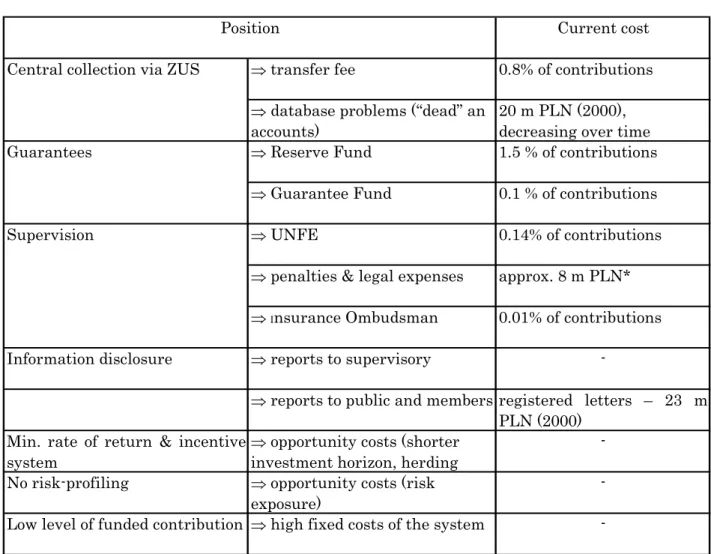
The second group consists of mandatory costs and is of more interest as it is the state that defines the costs and at what level they must be borne (Table 5). The main positions include fees for the central collector (Social Insurance Institution, ZUS), system guarantees, supervision, information disclosure and opportunity costs of minimum required rate of return. Furthermore, choosing the risk level appropriate for a person’s age and personal situation is practically impossible. This issue will become more and more important as the members approach their retirement age. Although Polish law permits creating “B-type” pension funds with lower risk profiles, the system remains highly inflexible to various levels of personal risk aversion, age, wealth or occupational income. It seems reasonable to argue that at least a few different investment styles within a pension fund (but not necessarily separate institutions) should exist. This would allow the people to change the investment mix as they approach the retirement age or their “endowed exposure43”
changes.
As a final remark, one can point out a systematic problem concerning the percentage of contributions channelled to the funded pillar. Due to economic constraints only 20% of social security or 37% of pension-related premiums are invested in the capital market. James (2000) observes that small accounts result in higher costs per assets and lower net returns and therefore lower pensions. Small
42 KNUiFE, Quarterly Bulletin, 4/2001.
43 Defined as a quantity invested in the risky assets to minimize variability of consumption
accounts are inevitably suffering from relatively high or even economically prohibitive, transaction costs (Lucas, 2001). This is the situation in Poland where the average monthly premiums (May 1999—end of September 2002) have ranged between 75 and 130 PLN (approx. 20 – 30 USD) with an industry average of 106 PLN (approx. 25 USD)44.
Table 5 System-built costs
4.2.3. Possible cost reductions
Some commentators and representatives of the industry voiced their concerns about the cost level. In 2001, the Chamber of Pension Fund Administrators issued a document in which they argued that it was possible to cut down the expenses of the system by 57%. Although this number is questionable in the context of the conflict of interest between the pension administrators and the public, it is obvious that still a considerable part of the expenses could be avoided quite easily. Chlon (2002) discusses the administrative costs and the potential cost reductions in detail.
There are several areas where one could seek cost improvements. The first applies to up-front fees. As the initial phase of the expenses (related to entering the market and the marketing war) are over, there is more possibility to lower these charges even at the cost of increasing asset management fees. Not only would it increase the accumulation rate in the near future but it would also bring some positive incentives for more efficient management. As a matter of fact, the government has recently put forward a proposal for such a change.
The system-build costs should be reconsidered as well. Following the previous argument, there is no particular need for keeping the guarantee allowances at the current level. The fee charged by the Social Security Institution is just another levy imposed on already highly taxed individual savings. The idea of a main collector was to create a solid information database framework and also to ensure a higher coverage rate. However, at the current stage the service quality is low whereas the charge imposed by ZUS reduces individual savings to be invested in capital market in a considerable way. The effect on future retirement benefits is strong. A reduction of just 0.1% in the fees would increase accumulations and pensions by 2% (James, 2000).
The supervisory-related costs might be successfully reduced if the frequency of detailed reporting to the KNUiFE were changed. At the moment, funds are required
to provide exhaustive information on a daily basis. It is quite doubtful whether such a flow of information is really needed and whether the supervisory body actually does make use of this data. Of course, less severe data requirements should be carefully balanced with the potential risks of weakening supervisory efficiency and public information disclosure. Nevertheless, weekly reports for instance, should be sufficient.
The report-keeping and communication expenses would be lowered provided that the funds did not have to use registered mail letters when communicating with their members. The regular mail is three times cheaper and does not require collecting of unaccepted letters45. The pension law requires funds to send the annual
reports to all account holders even though, on average, 18% (in some cases 57%) of the accounts are inactive.
Finally, the opportunity costs might be lowered if an action aimed at establishing proper benchmarks and performance evaluation rules is taken. Currently the minimum required rate of return creates a short-term investment horizon, herding around the results achieved by the biggest market players and lower competition (section 5.3). This issue is closely related to the properly functioning mechanism of built in incentives charges. The Polish system should employ more ex-post performance incentives and should also be focused on competing with costs instead of the promises of (ex-ante) performance results. Blake and Board (2000, p. 545) provide an excellent remark:-
“A scheme with charges levied principally on contributions offers the fund manager little incentive to achieve good performance, and places all of the risk of underperformance on the client”
4.3. Incentive effects of the fee structure
4.3.1. Linear performance contracts
Along with the cost issues, the incentive effects of the fee structure are equally important. Blake and Board (2000) claim that the front loaded charges (where the fees are paid before the service is delivered) do not usually provide the best incentives for the service provider to produce additional value. According to these scholars the back-loaded remuneration (paid after the service is delivered) serves
45 One might wonder whether the regulation was not intended to bring some profitable
services to the state-owned post monopoly. Other financial institutions (like banks or mutual funds) do not have to use registered letters.
this purpose better. In their study on UK pension funds, Blake and Timmermann (2002, p. 117) conclude that the fee structure seems to discourage active management. The same problem affects Poland.
The difficulty lies in the linear nature of fees specified by performance evaluation contracts and in the relative strength of incentives and risks. The incentive for investment executives to apply active management and thus increase the assets value, is quite weak. The additional reward to be obtained in the case of successful management is around two full orders of magnitude smaller than the base fee itself (Blake and Timmermann, 2002, p. 117). The same applies for Poland. The fee is a product of the ex-post return and the management fee that the fund administrating company receives. Since the investment returns are subject to random deviations it is quite probable that the ex-post return might be negative. Stock returns are usually non-normal (leptokurtic) with skewed distribution tails and this fact indicates that the sporadic extreme results may lead to considerable losses. That is why there is not much motivation for the administrator to undertake a very active policy. The expected marginal disutility due to possible failure increases much faster than the expected marginal utility due to increased management rewards. A spectacular failure can lead to the loss of a job at the level of investment manager. For the administrating company, bad returns would create an outflow of clients (in the Polish case) or a loss of mandate (in the British case). Blake and Timmermann (2002, p. 118) conclude therefore that: “the probability of relative underperformance due to bad luck outweighs the prospective benefits from active management for all but the most certain security selection or market timing opportunities.” The managers try not to push their luck and this effect is even strengthened by the penalty payment existing in the Polish performance measurement system (section 5.2).
The issue of proper incentive mechanisms is important since they may alleviate the agency problems between managers and affiliates. Ross (1989) states in his theory that the magnitude of agency conflicts is inversely related to the level of institutional transparency and that the performance itself is proportional to the level of institutional transparency.
4.3.2. Performance-related incentives
Blake and Board (2000) argue that providers should compete on the basis of charges rather than on past investment performance. Their reasoning is based essentially on the non-testability and non-sustainability of superior performance. In
the Polish context an additional reason is that the investment results are quite similar due to herding behaviour.
A proper fee structure should eliminate the tendency towards keeping close to the index via creating incentives for managers to apply active management and to deviate from the benchmark. The fee should include a base part that covers the fixed expenses and a variable part that is a reward for beating the target. Blake and Timmermann (2002, p. 122) propose such a solution (existing currently in the UK specialised funds industry) and suggest that it is crucial to apply a fee rate that is symmetric around the target to avoid the excessive risk taking:
t t t t
g
V
f
V
g
f
t
period
in
fee
related
e
Performanc
* 2 1(
)
]
,
0
max[
−
+
=
−
where:f1 = the proportion of the fee in relation to the difference between the realized
performance gt and benchmark (target) gt*,
f2 = the base fee to cover the fixed expenses,
Vt = the value of the fund in period t.
Section 5.4.3 proposes an asset allocation index that might serve as a yardstick (gt* in the above equation). The framework can work properly only if disincentives
caused by current measurement regulations are removed.
5. P
ERFORMANCEM
EASUREMENTR
EGULATIONI
SSUES5.1. Introduction
Public pension systems ought to be carefully designed and supervised to make sure that their purposes are met, the economic consequences are appropriate and that the individual members are given some basic protection. Even in the case when the retirement provision is “opted out” from the hands of the state and is operated by private entities some sort of supervision is still needed. Usually the state’s involvement is more than marginal46.
The Polish financial market is relatively new and consumers’ knowledge about insurance products and capital market mechanisms has still to be improved. Further, since membership in the scheme is mandatory, there are more expectations towards the state to ensure that the system functions properly. The same applies for
46 For instance, as the UK history shows, the self-regulatory framework can fail even in the
state guarantees; their potentially substantial costs invoke stronger regulation. Important elements of this framework are: performance measurement, minimal required rate of return and the benchmark.
5.2. Current benchmark
Poland applies a system of performance measurement similar to that of some Latin American countries. The results of pension managers are compared to the industry’s average return (AR). The AR is calculated every three months as an arithmetic average of individual funds weighted by their market shares during the period. The market shares are arithmetic averages of initial and final values and represent the proportion of all the pension assets that was under the management of a pension administrator. Consequently, the AR measure is a peer-group index. Another important performance facility is the minimal required rate of return (MR) calculated as the lower of two values; 50% of AR or AR reduced by 4%. Both measures are determined every three months and use the results of the past two years for their calculations.
According to the pension law, those fund administrators whose investment results are lower than the required minimum have to pay the difference to their affiliates. Therefore, all members of the system can be sure that their rate of return will at least be equal to the MR. Pension administrators must make up the difference from their reserve funds (1.5% of accumulated assets). If those assets are insufficient the managing company has to use its own capital. In the case of insolvency, the fund is taken over by another fund, the administrating company is liquidated, and the Treasury takes over outstanding obligations.
Until now, only one administrator managing the Bankowy fund has had to compensate the difference. Three payments worth in total 14m USD were the consequence of relatively aggressive stock investments that proved to be costly when the market collapsed.
The creators of the system hoped that such a performance framework would make the system more competitive and at the same time, safer for the clients. It turned out, however, that it has produced some rather perverse effects which are described in the next subsection. It seems that a continuation of the assessment system in its current shape may seriously threaten the retirement income security of the members.
5.3. Drawbacks of performance measuring system
5.3.1. Misleading information
The asset-weighted benchmark can be misleading For instance, the administrator of Bankowy (the only one that has experienced lower than MR results) generated for the period 1 June 1999 – 29 June 2002 a return of 43.4% (Stanko 2002, Table 7). There were other six funds with lower results. However their operators did not have to make any supplementary payments. Consequently, the running industry average represented by AR does not describe the general picture of managerial skills well. The average can produce completely deceptive results, as the hypothetical result in Figure 3 shows. In this example, the manager who experienced a lower than average result in the first period still has to pay the penalty during the next periods even though her results are higher than the market. Thus, the entry values used for calculation can be distorted either by local market price changes or by managers themselves.
Figure 3 Potential deceptive interpretation of AR
The first problem relates to the frequency and time span with which the industry performance measure is computed. The results cover only two years. Moreover, the quarterly frequency of such calculations forces the managing houses to follow short-term strategies to avoid the penalty payment. The managers concentrate on a three-month investment strategy to make sure that the current results do not fall down below the average. The long-term strategy, so important in the process of accumulation, is abandoned causing the opportunity costs for the system members. Blake and Timmermann (2002, p. 123) suggest that the assessment frequency should correspond to the speed with which the market anomalies are corrected. One may infer from their example, that this horizon is somewhere between several and ten years. Since the Polish financial markets are not so much efficient, the minimal span for the evaluation horizon and frequency should be longer with an economic cycle of perhaps 5-7 years.
Lakonishok et al. (1991) provide some evidence on the second issue of “window-dressing”. The fund administrators take short-time actions aimed at temporarily improving their results and portfolio structure. Though not officially documented, one should expect that such a phenomenon does also occur in Poland.
5.3.2. Herding
Another effect of the performance evaluation framework and incentive fees (subsection 4.3) is herding around the mean manager. Blake and Timmermann (2002, p. 117) conclude that: “The relative performance evaluation provides a strong incentive not to underperform the median fund manager”.
They also notice that in the presence of a peer-group median or peer-group distribution measures, fund manager behaviour is likely to be distorted. In effect, a target that uses a group’s median will create an outcome very close to this median. Not knowing what the median fund manager result will be at the end of the period makes managers stick to one other so as not to deviate from the final result. That is why the results are not much higher than those obtained from passive investment strategies. This is also a reason why an external benchmark should be used (Blake and Timmermann, 2002, p. 122).
Stanko (2002) also demonstrates that the Polish fund managers have a tendency to cluster around the median outcome. The interquartile range values (showing the difference between the top 75% and 25% results) computed for returns and alphas during a period of 1999-2002, were very and quite narrow respectively. For raw monthly returns, the range was around 160 basis points (1.6%). That is approx. a distance of +/- 1.7% of the average return. The interquartile range for empirical alphas of around 200 basis points translates to a deviation of +/- 20% of the average individual alphas. It is so, because within the AR framework the safest strategy is to imitate the portfolios of the biggest participants. Therefore, such action minimises the risk of return’s deviation below the industry’s weighted average. The big funds (representing almost 75% of the market) have theoretically more freedom in deciding their risk profiles. However, in the game where nobody knows future returns it is still better to adapt a low-risk strategy to minimize the probability of penalty payments. Every three months, when the next “beauty context” approaches, the players can immunize their portfolios against the MR risk by increasing holdings of more stable and predictable instruments like bonds and treasury bills. Consequently, the funds can “lock-in” the returns to make sure the final result will not fall below the current average.
The industry’s weighted average becomes the actual benchmark portfolio which the fund managers prefer to stick to. Following the benchmark portfolio, even though this exposes them to some risk, will never cause them regret (Clarke et al., 1994). In the Polish conditions the regret from not sticking to the benchmark is enhanced by the penalty payments in the case of negative deviation. Keeping with
the median manager immunizes managing companies from the MR risk and the investment managers are protected from regret and the threat of being fired as a consequence of taking on higher-than-average risks. The legislation induces a two-layered agency problem; a conflict between the customers and managing house interests and an internal one between the managing houses and the fund managers themselves.
5.3.3. Costs
The market weight in the AR formula strengthens the herding effect and increases the opportunity costs. The system achieves the local optimum from the point of view of the managing houses. However from the view of long run saving its global equilibrium is sub-optimal (short time and conservative investment strategy). Th