Stimulating economic growth
Full Report
Liberalisation
Gateway
TABLE OF CONTENTS
EXECUTIVE SUMMARY
1
1
INTRODUCTION 9
1.1 AIM AND SCOPE 9
1.2 CONTINUING PREVALENCE OF IGW MONOPOLIES 10
1.3 REPORT STRUCTURE 12
2
BASIC CONCEPTS
14
2.1 OVERVIEW 14
2.2 IGWS AND INTERNATIONAL INFRASTRUCTURE 14
2.3 IGW INTERCONNECTION WITH INTERNATIONAL NETWORKS 17
3
MODELS FOR ACCESS TO INTERNATIONAL SERVICES
21
3.1 DIFFERENT MODELS OF ACCESS 21
3.2 MONOPOLY IGW MODELS 21
3.3 COMPETITIVE IGW MODELS 24
3.4 CONCLUSION 29
4
HISTORICAL OVERVIEW OF IGW REFORM AND TRENDS
30
4.1 SCOPE AND PURPOSE 30
4.2 HISTORICAL OVERVIEW IN DEVELOPED MARKETS 30
4.3 HISTORICAL OVERVIEW IN DEVELOPING MARKETS 33
4.4 IMPACT OF MARKET AND TECHNOLOGY DEVELOPMENTS 34
5
ECONOMIC PRINCIPLES
43
5.1 INTRODUCTION 43
5.2 THE CASE AGAINST MONOPOLIES 43
5.4 EFFECT OF IGW LIBERALISATION ON DOMESTIC CHARGES AND AFFORDABILITY 45
5.5 POLITICAL IMPLICATIONS 46
6
THE IMPACT OF IGW LIBERALISATION
47
6.1 INTRODUCTION 47
6.2 IGW MONOPOLY PRICING AND BEHAVIOUR 47
6.3 DIRECT BENEFITS OF IGW LIBERALISATION 52
6.4 WIDER BENEFITS ARISING FROM IGW LIBERALISATION 57
7
POLICY CONCLUSIONS
60
7.1 INTRODUCTION 60
7.2 HOW MUCH LIBERALISATION? 60
7.3 BARRIERS TO LIBERALISATION 63
7.4 BEST PRACTICE REGULATORY FRAMEWORK FOR IGW LIBERALISATION 67
7.5 CONCLUDING COMMENTS 73
APPENDIX A: IGW COUNTRY CASE STUDIES
74
APPENDIX B: STATUS OF INTERNATIONAL GATEWAY LIBERALISATION 106
APPENDIX C: SUMMARY OF ELASTICITY ESTIMATES FOR INTERNATIONAL
CALLS 113
APPENDIX D: ECONOMIC SIMULATION RESULTS
117
1
INTRODUCTION 117
2
THE SIMULATION
117
3
IMPLICATIONS AND FURTHER WORK
122
APPENDIX E: SAMPLE IGW LICENCE
123
1
INTERNATIONAL SERVICES
124
2
THE LICENSED SYSTEM
124
3
CONNECTION OF OTHER SYSTEMS AND APPARATUS
125
4
OPERATION OF LICENSED SYSTEM
126
6
TARIFFS, CHARGES, CALL METERING AD BILLING
129
7
COMPETITIVE SAFEGUARDS
131
8
PRE-NOTIFICATION OF JOINT VENTURES
133
9
NUMBERING ARRANGEMENTS
134
10
CUSTOMER INFORMATION
134
11
BYPASS 134
12
REPRESENTATION OF CONSUMERS’ INTERESTS
135
13
REQUIREMENT TO FURNISH INFORMATION TO THE COMMISSION 136
14
PAYMENT OF FEES
136
15
REVOCATION 136
EXECUTIVE SUMMARY
This study examines the experience of a range of countries at various stages of liberalising their international gateway (IGW) services. We assess the overall effect of liberalisation in terms of prices, traffic volumes, demand elasticity and the wider economic effects as well as the relative success of different approaches to liberalisation.
IGWs are the facilities through which international calls are sent and received. For developing countries to fully participate in the globalising economy, it is imperative that their IGW are fully liberalised to mobile network operators.
While most developed markets now have fully competitive international
telecommunications markets, many countries in the Asia-Pacific region, Middle East, Africa and Central and South America have not implemented IGW liberalisation. Resistance to IGW liberalisation is based on the false notion that the high outbound call charges IGW monopolies are economically advantageous to, and facilitate the national interests of developing countries. The assumptions underlying these arguments have been made redundant by recent market and technological developments, namely, vigorous competition in international call service markets and the increasingly rampant use of illegal bypass to avoid high IGW monopoly charges.
The question is: which structure – monopoly or liberalisation – best serves a country and its citizens today? In this study, we have analysed 8 countries at various stages of liberalisation (from nil to full liberalisation) to compare the impact of IGW liberalisation against that of IGW monopolies.
Our findings suggest IGW monopolies are highly inefficient ways of achieving
development and policy objectives. Detriments outweigh any supposed gains from IGW monopolies. In contrast, IGW liberalisation reduces consumer costs, increases traffic volume and improves quality of service. This in turn delivers macro-economic benefits through lower cost of business to facilitate trade and greater connectedness to the globalising economy. These are goals, which are particularly important to developing countries.
(a) Key findings
Based on the range of experiences drawn from the case study countries, the following central propositions are made about the effect of gateway liberalisation.
1. Gateway liberalisation delivers substantial economic benefits to a nation. These comprise direct benefits in the form of dramatically lower international inbound and outbound call prices, increases in international bandwidth and lower costs in the provision of international services. Moreover, there are often wider economic benefits through lowering the cost of business and facilitating trade and investment and thereby raising overall employment and living standards.
2. Provision of international services, and the right to operate IGWs, traditionally has been viewed as the responsibility of fixed operators. Fixed incumbents were historically granted monopolies over IGWs. The underlying assumption was that an IGW monopoly would allow a country to keep its international charges high. High outbound charges would discourage outbound calling. This was coupled with the effect that consumers in developed countries had a better ability to pay for high international call charges than those in developing countries. Thus inbound call profits were seen as valuable source of revenue to fund network rollout by the fixed incumbent and, in many cases, to share with the Government through its
ownership of the fixed incumbent and through taxes.
3. Changes in technology have however substantially lowered the cost of entry in the provision of international services, particularly with the deployment of Voice over IP (VoIP) services and small aperture satellite dishes (VSATs). Technological
developments have thereby significantly increased competition, whether legitimised through regulation or illegal. Entry into the international sector is now an irresistible force which regulatory restrictions are unlikely to prevent. In countries which have attempted to maintain IGW monopolies, illegal bypass can account for 30-60% or more of traffic.1 Although bypass delivers cheap prices to consumers, it does so at a cost: the cost of good service quality and the risk of service interruption for consumers when local services relying on illegal technologies are shut-down. Governments are faced with significant regulatory and law enforcement costs in seeking to prevent bypass at the same time as losing out on the tax revenue that could be generated by legal services. In contrast, IGW liberalisation has the ability to deliver lower retail prices, better services and wider benefits for the country as a whole.
Hence, the issue for policy makers and regulators is not whether there will be competition. The question is whether competition will occur within a
regulatory framework, where the legitimate competitors and the Government are able to realise value for the provision of international services, or whether this value will be lost to illegal operators.
4. Despite the changes in technology, some Governments have been reluctant to introduce IGW liberalisation. This reluctance stems from the belief that IGW liberalisation will result in decreases in inbound international revenue and thus less funds for the incumbent operator to expand its network. However, with illegal bypass, Governments are losing control over the IGW monopoly and the inbound revenue due to the high cost provision of inbound services. Liberalisation options therefore need to be considered in light of this dynamic of lower technological
1 These estimates are based on responses by mobile operators to Country Surveys conducted for this report. These countries estimate that bypass traffic accounted for the following proportions of total incoming and outgoing international traffic: Bangladesh 55%; Egypt 45%; Pakistan and Indonesia 40%; and Chad and the Democratic Republic of Congo 30%.
barriers to entry, the consequent entry of illegal operators and the loss of control that this entails.
5. Early, incremental approaches to liberalisation continued to adhere to the
assumption that fixed operators would be responsible for IGWs. Thus, even when the first step in liberalisation was to introduce mobile competition, the mobile operators were often required to access international services through the monopoly IGW or, in the case of multiple IGWs, were required to interconnect through the competing fixed international gateway providers. In many cases, mobile operators were prevented from establishing their own IGWs.
6. A major re-evaluation of this approach to incremental liberalisation is required, based on two compelling trends:
First, mobile operations have been key in delivering access in developing markets. In many countries, particularly developing countries, access to telecommunications services by consumers is by way of mobile phones. Access is no longer the exclusive domain of fixed service providers. Hence, previous arguments that fixed providers should be the IGW providers so that international inbound revenue may fund the extension of the fixed network apply at least equally to mobile operators who provide the primary means of telephony access in many developing countries. Further, liberalisation of the mobile market has meant that mobile operators
compete vigorously with each other across the range of services provided and this competition can extend to international services where permitted to do so.
Second, developments in the international market have seen the emergence of specialist international operators and networks. International networks were once non-competing cooperative undertakings between Government-owned national fixed carriers. However, the international market has become very competitive, with the emergence of specialist global providers of connectivity, construction of private undersea cable networks, the privatisation of the international satellite organisations, the development of alternative commercial models for international traffic to the accounting rate system, such as traffic exchanges and hubbing arrangements and an excess of capacity on many routes. This means that
assumptions made by Governments about international revenues obtained through the bilateral accounting rate system are now very dated and can no longer be relied upon due to the vastly more dynamic nature of the international
telecommunications market.
7. These two trends suggest that consumers will realise greater benefits where the model for liberalisation allows mobile operators to directly access the international market for services and capacity through their own international gateways. Lesser known are the wider opportunities available to governments if they target one of the last remaining anomalies in the liberalised domestic and international
(b) Costs of IGW monopolies
We find that there are often large costs associated with restrictions on the provision of IGW services. These costs go beyond the higher prices suffered by consumers making international calls to and from the country. The price and quality of international
communication services can be a key factor in location choice for foreign direct investment. For instance, low price international call services can be critical to the economics of cross-border business process outsourcing. A failure to liberalise can be particularly harmful when other similarly-placed countries have successfully pursued liberalisation.
Further, any reasons for maintaining the monopoly which may have existed are being undermined by the increasing prevalence of bypass technologies and the increasing opportunity to re-route traffic through third countries to avoid high monopoly costs. IGW monopolies also give rise to other perverse effects, particularly in an environment where other services have been liberalised. Where IGW revenues are used to subsidise particular markets, they can act to discourage entrants from competing in those markets with the result that the incumbent maintains its monopoly and competition is foreclosed. Such monopolies also tend to lead to bypass arrangements which deliver cheaper retail prices for consumers, but ultimately exist as a result of the inefficient IGW monopoly system.
(c) Benefits of liberalisation
Direct benefits
In this study, we assess the actual effects of liberalisation in practice with regard to a number of case studies. We find that IGW liberalisation generates substantial direct benefits:
• Dramatic benefits to consumers in terms of lower retail prices:
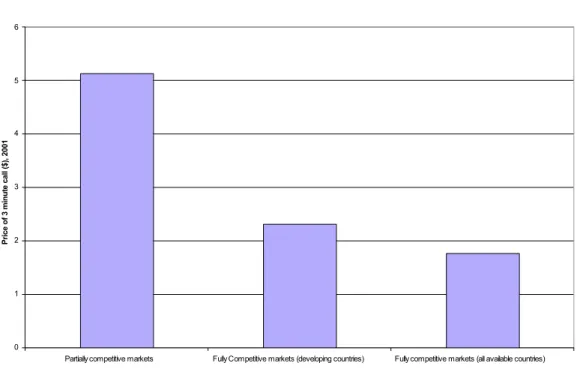
o Average international call prices in countries liberalising fell by at least 31% with partial liberalisation and as high as 90% in the years
immediately following full liberalisation. Prices for other international services such as international leased lines also fell.
o Where countries initially partially liberalised, further price falls resulted following full liberalisation. For instance, while Kenya provided IGW licences for data transmission in 2004 (enabling lower VoIP call prices), it was only this year following receipt of their own IGW licences that the Kenya mobile operators were able to substantially cut the price of mobile international calls. o These price reductions can represent a substantial increase in consumer
• Higher levels of international call volumes:
o Under monopoly, higher international call prices and limited capacity acted to constrain demand. Following liberalisation, our case studies showed
increases in international call volumes of between 32% and 104% in the years immediately following liberalisation.
o Existing studies and our case studies suggest a reasonable range for price elasticities for international calling from -0.7 to -1.5 or larger in the long-run. This implies that any price reductions in international calls will lead to an increase in the traffic volumes.
o The surplus generated for consumers by these additional calls that otherwise would not have been made represents an overall increase in welfare and GDP for the country.
• More efficient and higher quality telecommunications services:
o Multiple IGW providers lead to improved international connectivity including greater service reliability and reduced prices for internet connectivity.
• Increased investment and employment opportunities in telecommunications-related industries.
o Liberalisation in Nigeria was followed by substantial new investment by new entrants including a 675 million project by Globalcom to expand its network and install 3 international gateways.
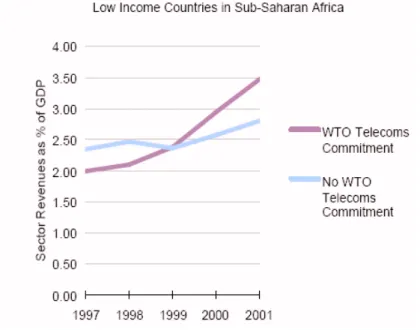
o Countries that made WTO commitments towards liberalising their telecommunications sector have achieved higher sector revenues as a percentage of GDP than comparable countries that have not made such commitments.
Wider economic benefits
Through these direct benefits, IGW liberalisation also leads to wider economic benefits. At its most basic, lower telecommunications prices are a key determinant in the decisions of multi-national corporations to invest, given that international connectivity is a basic requirement for such businesses. Countries are competing against one another for international business. Just as low labour costs have been attributed to advances in outsourcing, the countries analysed in this report show a direct correlation between IGW liberalisation and the propensity for foreign direct investment:
o Following lower prices and improved reliability for international calls resulting from IGW liberalisation, HSBC chose Malta for the location of one of its main call centres employing up to 350 new employees.
o Lower international communication prices can also support lower businesses that need low-cost, reliable communications to fully take advantage of export opportunities.
Research has shown that an improved performance of the telecommunications sector yields significant macroeconomic benefits. For example, in a study of Middle Eastern and North African countries, it was found that a one percent improvement of their indicator of telecommunication sector performance increases the ratio of manufactured export to GDP by 0.37 percent and increases FDI by 0.75 percent.
We have used modelling to isolate the effects of liberalisation of the international gateways in Bangladesh. This shows that liberalisation would lead to higher growth and employment. In particular, liberalisation would create an additional 5,350 jobs in the initial year after liberalisation. Liberalisation also leads to higher international trade and
investment with Bangladesh’s overall balance of trade improving. Benefits to Government
There are also benefits to Government associated with IGW liberalisation. Competitive international gateways lead to rapid decreases in the cost of provision of international gateway services which is passed on to consumers in the form of lower retail prices. As traffic volumes increase, liberalised operators generate revenues, become more profitable and make greater tax payments to the government.
Higher investment and employment contribute to raising a country’s overall GDP and the living standards of its citizens. This effects can be illustrated as:
Increased Competition
Lower Prices Better Reliability
Higher investment, Higher tax revenues
Higher GDP
Higher Volumes and More Expenditure
IGW liberalisation makes sense for developing countries and those responsible for telecommunications regulation as it creates a feasible case for wide and long-term economic benefits.
(d) Addressing the impediments to liberalisation
It is acknowledged that there may be impediments to the direct adoption of an IGW liberalisation policy. Arguments advanced against liberalisation, and the findings of this study that debunk those arguments, include:
• The idea that IGW liberalisation may lead to a loss of international revenue used for investment by the monopoly or for other Government services:
o The evidence shows that liberalisation actually stimulates investment and that the fear of loss of international revenues is illusory.
• The argument that liberalisation requires tariff rebalancing, with consequent increases in local tariffs and reduction in affordability of lines:
o The evidence shows that affordability of fixed lines is not a significant social issue, with most lines being used by business and middle to high income earners. In fact, this issue illustrates the role of mobile phones which are more widely used for social purposes such as access in developing countries.
• Country-specific rights, such as exclusive rights conferred by a monopoly IGW licence, can be problematic. The monopoly operator may demand compensation for loss of its IGW exclusivity.
o By weighing the costs of exclusivity against the costs of liberalisation, an individual country can make its own assessment about the suitability of IGW liberalisation as a regulatory goal.
The key lesson is that these impediments do not preclude IGW liberalisation occurring. Liberalisation does not necessarily need to occur in a single “big bang” radical regulatory shift. Alternatives include a phased-in approach, or partial liberalisation; or a regulation that requires the IGW monopolist to share the benefits of added inbound traffic with mobile operators.
(e) Conclusion
We find that partial liberalisation can deliver significant economic benefits stemming from reductions in international call prices and improved reliability.
However, our case studies also showed that full benefits from liberalisation may not be realised through only limited liberalisation. For instance, while ISPs can deliver
substantial price reductions for international VoIP calls, any such benefits will be confined to consumers who are in a position to access Internet services.
In contrast, the much greater availability of mobile services in many countries implies that a liberalised scheme of IGW licences for mobile operators can be critical to achieving widespread access to low-cost international calling for consumers. Combined with the
wider economic benefits to a country and its Government, IGW liberalisation is a rational and best practice regulatory response to the IGW monopoly.
1 INTRODUCTION
1.1 AIM AND SCOPE
Subscribers are increasingly using their mobile devices to make and receive international calls, to send and receive international SMS and MMS, and to access content which is hosted on the global internet. The impact of the growth of mobile services has been particularly strong in developing countries. China is the largest mobile market and there are substantially more mobile subscribers in developing countries than the industrial world. Pyramid Research estimates that over 80 per cent of new mobile subscribers added to global mobile networks over 2004-2009 will be in Africa, the Middle East, Asia and Eastern Europe.2An Ofcom report noted in 2000 that whilst use of mobiles is still considerably lower than use of fixed lines to call abroad, Oftel Market Information
indicates an increase in international calls from mobile phones. Similarly, calls made from abroad on UK mobile phones are also on the rise.3 By 2005, it was reported that
between 40% and 60% of calls made from mobiles are international calls. In the US, the current level of international calls made from mobiles is not this high, but this is seen as an untapped source and the level is predicted to grow rapidly.4
Mobile operators need to interconnect with international networks to provide these services to their subscribers. Domestic networks within each country, whether fixed or mobile, access international networks through facilities called International Gateways (IGWs).
GSMA commissioned CRA International and Gilbert + Tobin to undertake this study to examine:
• the status of liberalisation of IGWs worldwide;
• the economic drivers and conditions for different types of liberalisation, including the comparative benefits of a fully liberalised approach as opposed to a duopoly or staggered liberalisation approach;
• post liberalisation trends including:
o the incremental benefits of liberalisation of the sector including any increase in FDI, employment, and competitiveness in export-oriented industries; o the opportunities for bypass that exist when the IGW is monopolised, the
technology employed for bypass purposes and the economic effects of bypass measures; and
2 Telecom Finance, Issue 137, 26 July 2006.
3 Ofcom, Consumers’ use of mobile telephony: Summary of Oftel residential survey, Nov 2000. 4 Larry Frank, In Focus: How U.S. mobile operators can take full advantage of international service
o the impact that monopoly IGW pricing has had on the mobile industry. While the focus of this study is on mobile originated and terminated international services, most of the discussion and conclusions would equally apply to other competing domestic networks such as fixed wireless, fibre and cable networks.
1.2 CONTINUING PREVALENCE OF IGW MONOPOLIES
As Figure 1 shows, there has been a clear trend towards partial or full IGW liberalisation over the last seven years:
Figure 1 - International trend towards IGW liberalisation
2005
Liberalised 29% Partial Liberalisation 16% Non-liberalised 38% Unknown 17%2000
2005
Liberalised 29% Partial Liberalisation 16% Non-liberalised 38% Unknown 17%2000
Liberalised 21% Partial Liberalisation 9% Non-liberalised 63% Unknown 7% Source: ITU.Most developed markets have fully competitive markets for the provision of IGW facilities and services. The developing economies of Eastern Europe implemented IGW
liberalisation when joining the European Union. However Figure 2 shows, approximately half of the countries in Asia Pacific, Africa the Middle East and Central and South America have not implemented IGW liberalisation:
Figure 2 – Global status of liberalisation Liberalised Partially Liberalised5 Non-Liberalised Unknown Number of countries 56 31 70 33 Africa region 10 13 23 6 Americas region 8 5 13 10 Asian region 12 9 18 7 European region 24 3 6 10 Oceania region 2 1 10 -
Governments can be slow to move towards IGW liberalisation for three reasons:
• First, if the incumbent is Government owned, the Government’s viewpoint may be driven by the profits generated by the international business of the incumbent operator. The fear is that as liberalisation will drive down retail prices, tax receipts and profit distributions will fall.
• Second, the IGW monopoly is often seen as protecting scarce foreign exchange reserves. This stems from the vast imbalance between outgoing (less) and
incoming (more) minutes in many developing countries This is highlighted by using Bangladesh as an example where international outbound traffic volume was much less than inbound traffic volume from 2004 to 2006:
Figure 3 - Comparisons of Bangladesh inbound and outbound traffic volumes Year Outbound traffic volume Inbound traffic volume 2004 (full 4 quarters) 350m paid minutes 2100m paid minutes 2005 (full 4 quarters) 370m paid minutes 2405m paid minutes 2006 (first 3 quarters) 300m paid minutes 2100m paid minutes
5 “Partial Liberalisation” refers to a country that has licensed more than one IGW operator, but the number of IGW licences remains restricted by law, regulation or Government policy. This means that partially liberalised countries are subject to oligopolistic conditions. Countries which are “Liberalised” have no restrictions on number of licences, although there may be qualifying criteria with requisite commitments such as licence fee payments.
The fear is that as liberalisation drives down retail prices, more outbound
international calls will be made by a country’s citizens. Hence, the traffic balance will shift towards foreign carriers and more foreign currency will have to be found to pay for termination of those outbound calls.
• Third, it is argued that international revenue is an important source of revenue and funds for subsidising other market segments in developing countries. The
argument proceeds that revenue from incoming calls will be used to subsidise network infrastructure investment or investing in new services and that this revenue needs to be protected and remain the exclusive domain of an IGW monopoly operator.
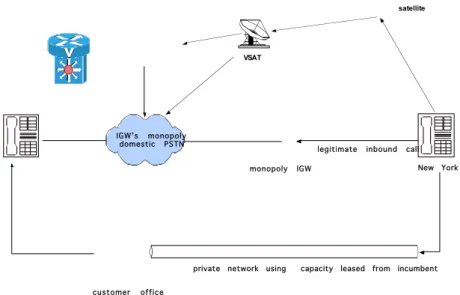
As will be seen from this study, the ability of Governments and an incumbent IGW monopoly to quarantine or protect artificially high international charges is being severely undermined by illegal bypass operators. Low-cost technologies such as VoIP and VSATs make prevention and detection of large scale bypass difficult. Bypass traffic accounts for 30 to 60% of total international traffic in many developing countries.6 Illegal bypass traffic makes no contribution to tax revenues or to funding investment in domestic infrastructure and services.
Monopolies are usually a highly inefficient way of achieving development and policy objectives. As discussed in this study, the evidence from markets where IGW liberalisation has been implemented suggests that any supposed gains from the IGW monopolies are likely to be outweighed by the detriment of high cost, low quality international services.
1.3 REPORT STRUCTURE
This report is structured to set out:• the basic models for retail service provision and interconnection between domestic operators and IGWs in monopoly and liberalised international services markets; • a comparison of the drivers for IGW liberalisation;
• the problems of IGW monopolies;
• the benefits and options for IGW liberalisation, including pricing and other data from the case study countries;
• policy conclusions arising from the research and economic analysis; and • a sample annotated licence for an open IGW regime.
6 These estimates are based on responses by mobile operators to Country Surveys conducted for this report. These countries estimate that bypass traffic accounted for the following proportions of total incoming and outgoing international traffic: Bangladesh 55%; Egypt 45%; Pakistan and Indonesia 40%; and Chad and the Democratic Republic of Congo 30%.
Background material relevant to the country case studies in this report are contained in Appendix A.
2 BASIC
CONCEPTS
2.1 OVERVIEW
In this section, we provide a description of:
• what an IGW is, how it operates and how international connectivity occurs; • of how the IGW interconnects with the domestic network; and
• how IGW operators exchange international traffic between each other.
2.2 IGWS AND INTERNATIONAL INFRASTRUCTURE
At its most basic, an IGW exchange is a telephone switch that forms the gateway between a domestic telephone network and one or more other international networks. These international networks may be provided by way of submarine cables, satellite or, in some bordering countries, by wireless links.
The IGW comprises a unique network node, equipped for interfacing with all international variants of telecommunications signalling protocols. The most common international signalling protocol used by operators is the SS7 signalling protocol. The IGW operates as a protocol converter and translates messages between the different protocol formats used in international networks and domestic networks.
The IGW exchange has to support international accounting and settlement arrangements so that the right domestic and international networks can be charged or paid for each international message. The IGW exchange also has to capture information about the calling and called parties, the originating network and each out of the country’s network over which the message travels to the called party.
The IGW exchange must also support the numbering plan of each country to which it provides connection (or at least the higher levels of those numbering plans) so that outbound calls can be correctly routed.
(a) IGW
network
architecture
Figure 4 illustrates the network architecture of an IGW and how it is connected to the international system. The international connection may be provided by satellite, submarine cable system or wireless links. Submarine cable networks are preferred for carriage of voice calls because satellite services have an inherent delay, which means that in a two way telephone call the parties can end up talking over each other. Satellite capacity can be cost effective for data transmissions, such as downloading content from the global internet. Nonetheless, some developing markets, such as Samoa, are not connected to any cable networks and rely solely on satellite for all their international services.
Figure 4 - IGW architecture New York Hong Kong US fixed PSTN Hong Kong I G W M N O U S I G W satellite
earth station earth station
s u b m a r i n e cable network
(b) Cable-based international network architecture
Figure 5 illustrates the basic elements of the onshore facilities of a cable-basedinternational network. The cable comes ashore at a cable landing station where the cable capacity which is being “landed” in the country is stepped down (called de-muxing) from the cable system.
The cable station is connected over backhaul capacity provided on fibre links to one or more Points of Presence (PoPs) located within the country. The PoP is the interface between the domestic networks and the international network. The IGW exchange (there may be more than one) sends and receives traffic across that interface.
In a monopoly environment, the IGW operator will usually own or control the cable station, the international capacity which lands in the country, the backhaul, the PoP and the IGW exchange.
In a competitive IGW environment, the incumbent may still own much of the onshore international infrastructure and the competing IGW operators will require access in order to connect to the capacity which they have acquired on international networks. As Figure 5 illustrates, a competing IGW operator may either:
• directly connect its IGW exchange to its cable capacity at the cable station, in which case it will require the cable station owner (which may be the incumbent) to provide co-location facilities; or
• connect to its international capacity through the PoP, in which case it requires co-location space at the PoP and backhaul capacity to the cable station (again, usually from the incumbent).
Figure 5 - Cable-based international network architecture
capacity leased or built by I G W1 c o m p e t i n g I G W1 c o m p e t i n g I G W2 i n c u m b e n t I G W
international cable capacity cable landing s t a t i o n b a c k h a u l provided by i n c u m b e n t c o l o c a t i o n s p a c e leased or built by IGW2 P o P
(c) IGW
interconnection
with
domestic
networks
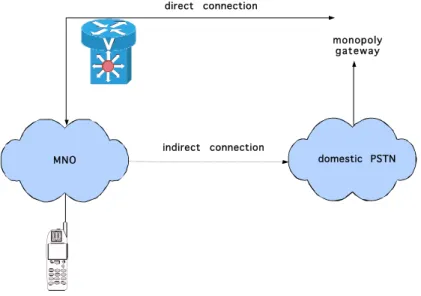
The most efficient way for each domestic fixed and mobile network to directly interconnect with the international network is for each to directly interface with the IGW. This is shown in Figure 6.However in an IGW monopoly environment, the incumbent fixed operator may require other domestic networks to hand over calls at a lower point in the incumbent’s fixed network and indirectly connect to the IGW. This will involve more carriage over the incumbent’s network. In the case of outbound calls, competing domestic operators may have to pay higher interconnection charges to cover the additional switching and carriage required in the incumbent’s domestic fixed network to reach the IGW. In the case of inbound calls terminating on another operator’s network, the competing operator may receive a lower share of the charges paid by the foreign operator because the incumbent carries the call further over its own network.
Figure 6 - Direct interconnection with IGW direct connection domestic PSTN monopoly gateway MNO indirect connection
Calls are routed between domestic networks and international networks based on the dialled number. In the case of an outbound call, the network connecting the calling party will recognise the international dialling prefix (e.g. “00”) and, without further processing the call (i.e. analysing the rest of the dialled number), will route the call to the IGW. The IGW exchange then will analyse the dialled number to identify the country code of the called location to determine to which foreign IGW to send the call.
As the called country is likely to be served by a number of IGWs, the originating IGW may analyse the city or area code within the dialled number: for example, to send a call dialled to a New York City number to an IGW on the East Coast rather than the West Coast of the United States.
2.3 IGW
INTERCONNECTION WITH INTERNATIONAL NETWORKS In order to understand the dynamic nature of the international services market, it is important to understand the fundamental commercial arrangements which support the market and the changes that have occurred in that market over time.The arrangements for the exchange of international traffic between IGW operators historically has been governed by a model originally developed by the International Telecommunications Union (ITU) called the “international accounting rate system”. This system, in turn, reflected how monopoly IGWs co-operated to build and operate
international networks, particularly cable systems.
International submarine cables used to be built by consortia of monopoly IGWs formed for each cable system. The consortium owned the cable system as a whole, but capacity was allocated to individual consortium members, and sometimes sold to non-consortium parties, on a half circuit basis. This arrangement meant that each IGW operator owned a
notional mid point between its own country and each other country to which it wanted a connection. It was intended to establish a complete link with another country an IGW operator had to enter bilateral arrangements to match its half circuits with the half circuits of an IGW operator in the other country7.
The international rate system determines the payments which each IGW operator then makes to use capacity on the other IGW operator’s half circuits to terminate international calls. The international accounting rate system has three elements:
• First, the collection rate. This is the retail rate which the calling party pays for the end to end call. This rate is set by the retail provider of the call, which usually will be the IGW operator.
• Second, the accounting rate. This is the rate agreed between the two IGW operators which represents the end to end wholesale value of the capacity used in each call. The accounting rate is to cover the international capacity and the origination and termination on the domestic networks at each end of the call. Accounting rates are not necessarily cost related.
• Third, the settlement rate. This is the amount which the originating IGW operator pays the terminating IGW operator for termination, including domestic termination. The settlement rate is calculated as a proportion of the accounting rate, usually 50% to reflect the underlying half circuit arrangements. If the terminating IGW operator uses domestic networks of other operators to terminate the call, it will be responsible for paying interconnection charges to those other operators, which it funds out of the settlement rate.
Figure 7 illustrates how the accounting rate system overlays the half circuit capacity and domestic interconnection arrangements.
7 Half circuits are only a notional concept. There is not an actual physical dividing point on the cable mid-way between the two countries.
Figure 7 - Relationship between half-circuit capacity and the accounting rate system New York Hong Kong I G W HK MNO U S I G W HK IGW h a l f c i r c u i t US PSTN US IGW h a l f c i r c u i t n o t i o n a l h a l f w a y p o i n t
accounting rate agreed between Hong Kong and US IGWs direction of the call
Hong Kong IGW pays settlement rate = 50% of accounting rate US IGW pays domestic operators m o b i l e s u b s c r i b e r pays MNO retail charge
On any given route, one IGW operator pays settlements to another IGW operator only to the extent that there is a traffic imbalance – that is, one IGW operator has terminated a greater volume of telephone minutes than the other.
The accounting rate system makes carriers’ net international revenue for international service a function of their accounting/settlement rates as well as their collection charges. If a carrier has a significant incoming traffic deficit, the settlement payments which it must make to its foreign correspondent IGWs limit its ability to reduce its collection charges. Conversely, an IGW operator with a net traffic surplus has little incentive to operate more efficiently or to reduce the accounting rate because of the net settlement benefits it receives under the status quo.
In the 1990s, with the liberalisation of domestic telecommunications markets in developed economies, the international accounting rate system came under great pressure.
Collection (retail) rates fell dramatically in competitive markets but IGWs in monopoly markets or in markets which had a net inflow of traffic resisted reductions in the accounting rates. As a result, IGWs in competitive markets faced a price squeeze. The Federal Communications Commission (FCC) in the United States took action by setting benchmark accounting rates between the US and other countries. The FCC enforced its ruling by prohibiting US carriers (and any foreign carriers with foreign subsidies in the US) from agreeing rates higher than the benchmark rates. The ITU followed and determined similar rates in similar bands to the FCC.
However, the international accounting system has proved remarkably resilient. It has adapted to accommodate arrangements on routes with competing IGWs at each end.
There are a range of other options for terminating traffic outside the accounting rate system which keeps downwards pressure on accounting rates.
The combination of domestic liberalisation and falling costs of international capacity and termination has directly translated into falling international retail prices paid by customers. Telegeography estimates that the average retail price of an international call dropped from US$1.57 in 1983 to $0.42 in 2001. Competitive markets witnessed even greater price falls - in 1997, the price of a call from the US to the UK cost around US$0.30 per minute, whereas current prices are now around US$0.04.8 In the USA, the average price paid per minute for an international call in 1995 was $1.63 whilst by 2003 the average price had fallen by over 80% to $0.29 per minute. Whilst prices fell for calls to most countries, we have seen bigger price reductions for calls to countries that have liberalised in this period. 9
However as discussed below, the benefits of a more competitive international market will be less likely to flow through to end users where an IGW monopoly persists. Where the domestic mobile market has been liberalised, the monopoly IGW represents a “choke point” between the competitive international and mobile market and is able to collect a toll from each. This creates irresistible pressure for customers and operators in each market to bypass this artificial IGW bottleneck.
8 Figures reported in C Rossotto, A Lewin, C Gomez and B Wellenius, Competition in International Voice Communications: The Cost of Non-Reform for Developing Countries, The World Bank Group.
3
MODELS FOR ACCESS TO INTERNATIONAL SERVICES
3.1 DIFFERENT MODELS OF ACCESS
At the outset, it is important to understand the retail and wholesale relationships which underpin access to the international services market. In the simplest case, a vertically-integrated monopoly which controls access to all telecommunications (including the IGW) services in a country is the sole retail and underlying network provider of the international service.
Where there are competing providers of telecommunications services (whether the fixed or mobile), then it is important to understand the different models for access to
international services. This is because the different models have an impact of revenue flows and competitive nature of the supply of international services.
When an international call originates or terminates on a domestic network not owned by the IGW operator, a two step analysis is involved:
• Step 1: Determine which operator is the provider of the retail international call to the calling party.10 This is usually, but not always, the operator which invoices the calling party.
• Step 2: The other operators will then usually be treated as providers of wholesale services to the retail service provider. As they do not recover a retail charge, they need to recover their costs of supplying carriage on their networks through the international settlement and domestic interconnection charges.
We first describe the IGW monopoly models and then describe the IGW competitive models of access to the international services market.
3.2 MONOPOLY IGW MODELS
There are two basic access models described below which apply when there is a monopoly IGW provider and a separate local or mobile operator:
• Model 1: The IGW operator acts as the retailer of the international service, with the local/mobile operator acting as a wholesaler; or
• Model 2: The local/mobile operator acts as the retailer of the international service with the IGW operator acting as the wholesaler.
10 In some call cases the retail charge will be paid by the called customer, for example reverse or collect charge calls. The same principles apply but the retail provider will be the terminating network or terminating IGW.
(a) Model 1: IGW operator as monopoly retail provider
(outbound calls)
Figure 8 – Model 1: IGW operator as monopoly retail provider (outbound calls)
New York m o b i l e
c u s t o m e r
origination provided by fixed incumbent to monopoly IGW operator
i n t e r n a t i o n a l P S T N
end to end call provided by monopoly IGW operator to mobile subscriber m o b i l e
s w i t c h i n t e r n a t i o n a lg a t e w a y
In this case, the IGW operator acquires an origination service from the mobile operator and often a service to bill and collect retail charges, for which it will pay a fixed per minute or per call charge or more usually a revenue share. The IGW operator sets the retail price, although in practice the mobile operator may be allowed to credit some of its revenue share to the customers which provides for a limited scope for different international prices on fixed and mobile networks.
The respective functions of the mobile operator and the IGW operator under Model 1 may be summarised as follows:
Function Mobile Operator IGW Operator
Role Provides origination to IGW. Provides retail service to
mobile end user.
Retail price No role, but may be allowed to credit some of revenue share.
Sets retail price.
Billing and collection of retail charge
Includes international call charges in standard bill. Provides as a service to the IGW operator.
Contracts with mobile operator to bill and collect international call charges on its behalf.
Bad debt Responsibility of IGW
operator.
IGW operator may factor into the revenue share which mobile operator entitled to retain.
For inbound calls under this model, the IGW monopoly would generally collect the
inbound international termination revenue and only pay a local terminating fee to the local (fixed or mobile) operator.
This access model applies in Bangladesh where the IGW is not liberalised and remains a monopoly of the incumbent (BTTB). BTTB sets the retail charges for international outbound calls and mobile operators are not compensated for use of BTTB’s network in making outbound or inbound calls.11 As a result of Bangladesh’s use of this model
international traffic has remained relatively static with 2 international voice traffic minutes per person in 2000 and 3 in 2004.12
(b) Model 2: IGW operator as monopoly international
wholesale provider (outbound calls)
Figure 9 depicts a less common model in the monopoly environment which is for the IGW operator to provide outbound switched wholesale services to the mobile operator.
Figure 9 – Model 2: IGW operator as monopoly international wholesale provider (outbound calls)
New York m o b i l e
c u s t o m e r
international wholesale service provided by monopoly IGW operator to mobile operator
i n t e r n a t i o n a l P S T N
end to end call provided by mobile operator to mobile subscriber
m o b i l e
s w i t c h i n t e r n a t i o n a lg a t e w a y
The mobile operator sets the retail price, providing for some measure of competition with the retail price on fixed network. The wholesale outbound charges may be a discount off the retail IGW prices. This discount could be based on the retail and network costs the vertically-integrated operator avoids as a result of the call originating on the mobile network rather than the fixed network. The inbound call model is the same.
The respective functions of the mobile operator and the IGW operator under Model 1 may be summarised as follows:
11 Bangladesh survey response to GSMA. 12 The World Bank.
Function Mobile Operator IGW Operator
Role Provides retail service to
mobile end user.
Provides wholesale outbound call minutes.
Retail price Sets retail price. No role.
Billing and collection of retail charge
Bills and collects as part of its retail charges.
No role.
Bad debt Responsibility of mobile
operator.
Receives wholesale charge irrespective of whether mobile subscriber pays.
For inbound calls under this model, the IGW operator may share the incoming revenue with the local operator (whether fixed or mobile) in recognition of the fact that the local operator, with the connection to the customer, is substantially contributing to the volume of inbound calls.
3.3 C
OMPETITIVEIGW M
ODELSThe models which apply in a competitive IGW context are more complex for obvious reasons, with a range of local and IGW providers available to provide retail and wholesale services. It is important to note that the outcomes in a competitive model are dictated more by competition than regulation, so the relevant model is likely to emerge from the competitive nature of the market and not determined by way of regulation. .
The following models are considered:
• Model 3: The mobile operator is allowed to establish its own gateway and provides
mobile and international services to its customers as a single package.
• Model 4: The mobile operator is not permitted to establish its own gateway but the
mobile operator provides the retail international service to end users and acquires wholesale services from one of competing IGWs.
• Model 5: The mobile operator is not permitted to establish its own gateway and the
competing IGWs are the retail providers of the outbound calls services. This raises the issue of how customers of the mobile operator access the international services of the IGW, as discussed further below. Access may be through call-by-call
selection, pre-selection or other access means such as through the use of calling cards. As a result of these different customer access methods, there is a range of sub-options within Model 5 depending on the customer access method.
(a) Model 3: Mobile operator self–provides IGW
The IGW is “self-provided” by the mobile operator. When a customer dials an
international service, the international service is provided by the mobile operator. The mobile operator is responsible for obtaining its own international capacity and for negotiating termination arrangements with IGWs in other countries.
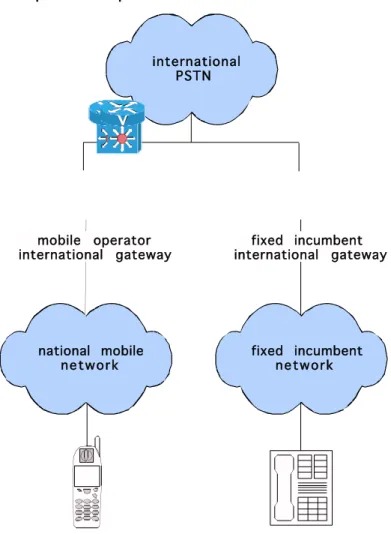
Under this model, mobile operators compete with other national (whether fixed or mobile) operators in supplying international services, as depicted below:
Figure 10 – Mobile operator self-provides IGW
national mobile network mobile operator international gateway international PSTN fixed incumbent network fixed incumbent international gateway
In this case, the revenue flows are very straightforward. The mobile operator collects all retail revenues and is responsible for all costs of providing the end-to-end international service (including the international settlement with overseas operators).
Malta employs this model with great success. Since liberalisation in 2003, the volume of outgoing calls has increased dramatically. Within a year of IGW liberalisation the outgoing minutes jumped by 18 million minutes from 35 million minutes to 53 million
minutes. In 2006, this figure is believed to have grown to 80 million minutes.13 Additionally, international call prices decreased by 79% between Q3 2002 and Q3 of 2004.
In 2006, Kenya adopted this model when it awarded IGW licences to the two main mobile operators. Since obtaining the licences the mobile operators have announced new prices including the announcement by Safaricom in September 2006 of a 70% reduction in its international call prices.
(b) Model 4: Mobile operator acquires wholesale
inter-national services from a range of possible IGW
pro-viders
In this model, the mobile operator acquires wholesale international services from an IGW operator. The mobile operator may be connected to one or more IGW operators and may route calls to the cheapest IGW provider depending on the call destination and the time of day.
Figure 11 – Mobile operator acquires wholesale international services model
International PSTN National market
IGW (1)
IGW (2)
end to end call provided by mobile operator to mobile operator end-user
international termination provided by gateway operator to mobile operator
International PSTN International PSTN National market IGW (1) IGW (2)
end to end call provided by mobile operator to mobile operator end-user
international termination provided by gateway operator to mobile operator
Here, the mobile operator is the retail provider, provides the end-to-end international service and collects all retail revenue. The mobile operator is responsible for the cost of providing the service, including the cost of acquisition of the wholesale international service from the IGW operator.
The revenue flows are the same as apply in the case of Model 2. However, with Model 2, there is likely to be a strong case for regulation of the price charged by the monopoly IGW provider. Competition is likely to set an appropriate price of supply in the case of this model due to the multiple IGW providers who may provide the wholesale international service.
Sri Lanka is an example of a country that uses Model 4. In 2003, Sri Lanka issued four facilities based IGW licenses and 29 non-facilities based IGW licenses. The non-facilities based licences were required to use the facilities based IGWs to provide international services. Since liberalisation, there has been large growth in both the fixed and mobile sector.
(c) Model 5: IGW operator as retail provider
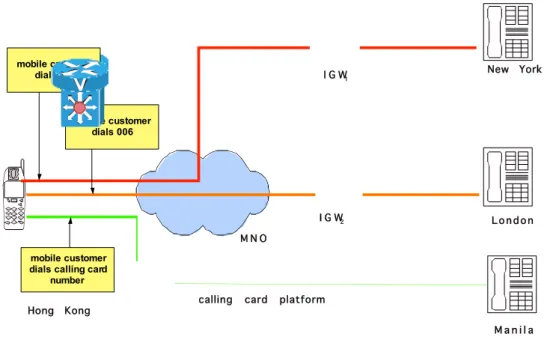
The mobile operator may be providing its own retail service but it may also be required to provide access to international services of other IGW operators.
Figure 12 – IGW as retail provider
I G W1 mobile customer dials 008 mobile customer dials 006 mobile customer dials calling card
number
Hong Kong calling card platform
I G W2
New York
L o n d o n
M a n i l a M N O
Egypt is an example of a country that uses this model. In February 2006, Egypt
announced that it would liberalise its IGWs in a two stage approach. In the first stage, the two additional companies will hold IGW licenses but they must operate the IGW based on infrastructure provided by the incumbent.
If this model applies, then the mobile operator provides the relevant IGW with an
originating access service. The IGW operator collects the retail revenue in the same way as in Model 1.
However with Model 5, it is important to consider the options for the customer to choose between multiple providers of international services, including the mobile operator’s own international service (if permitted).
There are three basic options for consumers to access competing IGW providers (in addition to accessing the mobile operator’s own international service if permitted) using Model 5:
• Call-by-call selection: In this case, a consumer chooses between competing
IGWs made by the consumer at the retail level on a call by call basis. A default may occur if the customer dial the standard international code (eg 001) and this default may set to the mobile operator’s own service or, in some cases, the provider of the international service using the same default code. To access competing IGW operators’ international services, each IGW provider will be allocated an access code (eg 002, 003, etc). When the customer prefixes the international country code with this access code, the mobile operator routes the call to the relevant IGW operator and the IGW operator provides the retail service to the customer in the manner described above.
Indonesia uses call-by-call selection in its international calling. In 2004, the Government partially liberalised the IGW with Telkom and Indosat operating as duopoly IGW operators. A Decree was issued that allowed customers to freely select their international providers by dialling the operators individual prefix code on a call-by-call basis.
• Pre-selection: The retail customer makes a choice between competing IGWs,
usually at the time of connection. For all international calls made by the customer, the mobile operator automatically routes these calls to the pre-selected IGW operator. Customers may still access alternative providers using the call-by-call selection method if they choose to do so. This method of customer access is less common at the retail mobile level and is more common in developed countries in relation to access to international services from fixed lines.
• International calling card: The mobile customer dials a special calling card
number (e.g. an 800) number or a local number to access the calling card operator’s platform. The customer then keys in their account number and PIN or access code. The calling card platform determines whether the customer is authorised to make the call and, if so, provides a second dial tone to the customer who then dials the international number in the usual way.
This involves two separate calls: a call to the calling card platform which the mobile operator charges to the calling customer in the same way as any other mobile call; and an international call which the calling card provider charges to the customer, either against their credit card or from a pre-paid account.
3.4 C
ONCLUSIONFinal market outcomes will be determined by a combination of demand and cost factors as well as market structure. Our case studies and analysis below show that the full benefits of liberalisation are unlikely to be realised without allowing for the entry of multiple gateway operators or the threat of new entry should the existing players price too highly.
While partial liberalisation such as the licensing of a second IGW operator can deliver significant benefits particularly in relation to improved reliability of international connectivity as well as some price reductions to stimulate the demand to utilise the new capacity as the second operator builds its own customer base, our case studies showed that even after partial liberalisation there was substantial scope for further price reductions.
Accordingly, the models which support full liberalisation (namely, Model 3, 4 and 5 above) are the models which will deliver the most benefits from liberalisation. Whether different customer access models need to be available having regard to the cost of doing so, when compared with the benefits, is discussed further below. In summary, Models 3 or 4 would appear to provide the full benefits while minimising the cost of liberalisation and it is those models which are supported by this study.
4
HISTORICAL OVERVIEW OF IGW REFORM AND
TRENDS
4.1
SCOPE AND PURPOSEThis section contains:
• an overview of the experience in the early IGW liberalising economies of Australia, the United Kingdom, Japan and the United States;
• the impact of market and technology developments of gateway liberalisation, particularly the strong role that mobile now plays in telecommunications; and • an evaluation of the bypass problems on the feasibility of IGW monopolies. It will be seen from this section that the previous models of deregulating the international telecommunications sector are not necessarily the best way forward.
While the historical overview is important to give IGW liberalisation some context, it is moreover relevant in identifying any trends and their possible application to the current environment.
4.2 H
ISTORICALO
VERVIEW IND
EVELOPEDM
ARKETSEarly IGW liberalisation in most developed markets was characterised by two main features:
• First, IGW functions were typically considered to be the province of fixed line operators. IGW liberalisation, therefore, was part of the process of fixed network liberalisation. As international networks and services had been a club of monopoly fixed operators, competing fixed IGWs were seen as more consistent with how the international market worked. As the mobile sector was also liberalised, mobile operators licence rights generally did not extend to establishing their own IGWs. Mobile operators might be entitled to obtain a separate IGW licence, but usually they were required to interconnect to international networks through the fixed IGWs.
• Second, in most countries, other than the United States and Japan, the right of an operator to establish an IGW generally formed part of a general fixed carrier licence. The model in Australia and the United Kingdom, and many countries throughout Europe, was that vertically-integrated fixed competitors were licensed to compete with the fixed incumbent. The policy rationale for this vertically integrated form of deregulation was to ensure that new entrants could fund domestic network deployment from the lucrative international call revenue stream.
(a) United
States
In the United States, IGW was one of the first telecommunications markets to be opened to competition. Unlike other jurisdictions, the monopoly over telecommunications, including the IGW, arose in the US as a result of patents owned by the Bell. In 1879 Bell was granted patents over all voice communications over wire. The first step towards liberalisation in the US was achieved after the expiry of the Bell patents. In 1971, the Specialised Common Carrier decision allowed AT&T’s competitors to enter the common carriage market through microwave and satellite networks. This decision allowed MCI, AT&T’s oldest competitor to establish its business. In the 1971 decision, the FCC concluded:14
We further find and conclude that a general policy in favour of the entry of new carriers in the specialised communications field would serve the public interest, convenience and necessity.
This position quickly evolved into a model of unrestricted entry with the only test posed by the FCC being that competitors in the international market should not enjoy a monopoly position in the local market.
The dominant feature of the telecommunications market in the United States was the Modified Final Judgment in 1982 following which AT&T was ordered to divest its local operations into Regional Bell Operating Companies (RBOCs). The RBOCs were prohibited from competing in long distance and international markets. Although vertical integration was no longer a feature of the US market following the 1982 divestiture, telecommunications competition policy was driven from the perspective of the fixed sector.15 Even today, mobile remains a secondary feature of the telecommunications
market in the US.
Proportional return rules also divided the market for terminating incoming international traffic among the US carriers on a country-by-country basis, in proportion to a US carrier’s share of billed outgoing international traffic to the corresponding country. Subsequently, additional carriers invested heavily in network roll out and by 1985 the incumbent AT&T had only 28% of total fibre system route miles and the relatively new carrier, Sprint, had a fibre system that was almost as extensive AT&T’s.16 In May 1999, in response to a
petition regarding an arbitrage proceeding, the FCC deregulated carrier to carrier interconnection charges for international communications. By 2003, there were over 2,000 operators supplying international services in the US.17
14 Federal Communications Commission, 1971, Microwave Communications, Inc decision, p920. 15 The 1996 Telecommunications Act permitted RBOCs access to the long-distance market on the
condition that they allow sufficient competition in their local market. In 2001 an FCC decision authorised the first RBOCs to offer long-distance services.
16 Cave, Majumdar & Vogelsang, Handbook of Telecommunications Economics, Volume 1, Elsevier, 2002, p62.
17 Policy Division, Global ICT Department, Competition in International Voice Communications, Report No 27671. January 2004, p 45 (Citing TeleGeography 2003).
(b) United
Kingdom
Liberalisation was staggered in the UK. In 1984, BT was privatised and a Duopoly Policy was established. The Duopoly Policy was pursued from 1984 to 1992 and it limited competition in the fixed network to BT and Mercury, a subsidiary of Cable & Wireless and the first fixed line competitor. The emergence of the second operator who provided fixed services only in this vertically integrated market allowed some limited competition in international services. The liberalisation of fixed services was slowly introduced throughout the 1990s.
The UK progressed on an early path of rebalancing and price controls through CPI-X price caps. As a result, the dominant carrier’s domestic and international call tariffs were rebalanced over the course of 1984 to 1989 in a phased manner.18
The 1991 White Paper, Competition and Choice: Telecommunications Policy for the
1990s, announced that the UK would allow new competition in international services by
licensing some companies to provide low cost International Simple Resale (ISR) to certain routes. In 1996, full competition in international services was allowed when the Government licensed an initial batch of 44 companies to provide international
telecommunications services on any route they choose over their own IGW.
In the mobile market, two operators were licensed in 1985, BT Cellnet (now O2) and Vodafone. In 1993 two new operators, Orange and Mercury One to One, were granted licenses. The mobile operators were initially not allowed to operate their own IGW, as the IGW licensees were exclusively provided to fixed operators. It was not until full
competition was introduced in 1996 that all mobile operators were able to own and operate their own IGW.
As at 2004 there were around 500 suppliers of international services in the UK.19
(c) Australia
A similar duopoly approach was adopted in Australia with the licensing of Optus. A political argument in Australia over the direction of the international telecommunications market lead to the formation of two competing companies. Telstra, the incumbent operator, merged with the Overseas Telecommunications Corporation (OTC) to form the AOTC. Optus was licensed as a second vertically-integrated fixed line competitor to the AOTC in the international market.
The deregulation of the IGW market in Australia was focussed on fixed line services and only fixed operators were able to obtain a licence to install an IGW. Mobile companies,
18 R Nicholls, Bypass and Transit – Arbitrage Issues in International Interconnection and Revenue Reporting in Developing Countries, presented to the Pacific Telecommunications Council Conference in Honolulu, Hawaii on 19 January 2005, citing Ros and Banerjee (2000).
19 Policy Division, Global ICT Department, Competition in International Voice Communications, Report No 27671. January 2004, p 46.
such as Vodafone, were initially prohibited from owning their own IGW and had to use either the Telstra or Optus IGW to provide international services to its customers. Full liberalisation of the international market in Australia was achieved in 1997.
(d) Japan
Japan pursued a middle path with IGW liberalisation. Initially, Japan had separate international and national operators. In 1952, the Nippon Telegraph and Telephone Public Corporation (NTT) was granted a monopoly over domestic telecommunications and Kokusai Denshin Denwa (KDD) had a monopoly over international services. The Government allowed each to enter the others market as vertically integrated operators and then allowed entrants at both the national and international level, so the companies could choose to operate on a non-vertically integrated basis.
Japan introduced competition into the market in 1985 by simultaneously liberalising the terminal equipment market and introducing competition into the provisioning of
telecommunications network infrastructure and services. There are no longer any line-of-business restrictions in Japan and many major global companies are competing in the Japanese telecommunications market. As a result, there is strong competition in the international market.
In the mobile market, NTT enjoyed a monopoly position until 1988. In April 1994, Japan allowed competition in the mobile market with four digital cellular mobile carriers allowed to enter each of ten separate regional markets. Up to this point the mobile operators had to use the IGW of NTT to access international services.
Since IGW liberalisation and the ability of mobile companies to operate their own IGWs, mobile subscriptions have increased six-fold. The rapid growth of mobile networks has led some commentators to consider that these can be an alternative to local fixed voice telephony, which is still dominated by NTT.20 While Japan was one of the earliest countries to initiate liberalisation in the 1980s its unique market structure with monopolies in the domestic and international market has meant slower progress than the UK and the USA. Japan now has many carriers in each segment of the market and is the second largest telecommunications market in the world.21
4.3 H
ISTORICALO
VERVIEW IND
EVELOPINGM
ARKETSThe case studies in Appendix A provide some background to the rationale and trends in IGW liberalisation some key developing countries. By way of overview and historical
20 OECD, Regulatory Reform in Japan, Regulatory Reform in the Telecommunications Industry, 1999. 21 OECD, Regulatory Reform in Japan, Regulatory Reform in the Telecommunications Industry, 1999.
context, Rossotto et al noted that by the late 1990s/early 2000s there were substantial regional and global differences in international voice competition:22
• competition in international voice communications appeared prevalent in several
Latin American countries such as Argentina, Bolivia, Brazil and Chile. Chile’s liberalisation in the mid-1990s is widely recognised and noted by Rossotto as one of the notable successful cases in consumers reaping the benefits of full
competition.
• in South-East Asia, competition had been established in India and Malaysia. Sri
Lanka undertook a detailed study of the options for IGW liberalisation in 2002, resulting in the issuing of new IGW licences in 2003;
• however despite these developments, the 25 per cent of global outgoing
international traffic that was then not open to competition originated almost exclusively from developing countries.
Rossotto et al concluded that Latin America was the leader among deve