MHD. FURQAN
Thesis submitted in fulfillment of the requirements for the award of the degree of
Master of Science in Computer
Faculty of Computer System and Software Engineering UNIVERSITI MALAYSIA PAHANG
ABSTRACT
Face is one of the unique features of human body which has complicated characteristic. Facial features (eyes, nose, and mouth) can be used for face recognition. Support Vector Machine (SVM) is a new algorithm of data mining technique, recently received increasing popularity in machine learning community. The Smooth Support Vector Machine (SSVM) is a further development of the SVM. Smoothing methods, extensively used for solving important mathematical programming problems and applications. They are applied here to generate and solve an unconstrained smooth reformulation of the support vector machine for pattern classification using a completely arbitrary kernel. Such reformulation is a SSVM. A Newton-Armijo algorithm for solving the SSVM converges globally and quadratically. Here, the SSVM is applied as a classifier on face recognition using eigenfaces as the input. In relation to that, Jacobi's method is used to compute the eigenvalues and eigenvectors. The eigenfaces is projected onto human faces to identify the features vector. These significant features vector are further refine using Gaussian kernel. An experiment using standard data set from AT&T Laboratories Cambridge with 400 samples of human faces is conducted. In addition to that, tenfold cross validation is used to validate the performance of the proposed method. The results have revealed that the accuracy rate of 99.68% is achieved.
ABSTRAK
Wajah adalah salah satu ciri unik manusia. Ciri-ciri yang ada pada wajah iaitu mata, hidung, dan mulut boleh digunakan untuk pengenalan wajah. Support Vector Machine (SVM) adalah satu teknik dalam bidang perlombongan data dan diterima oleh komuniti penyelidik dalarn bidang berkenaan. Smooth Support Vector Machine (SSVM) merupakan pengembangan lebih lanjut dari SVM tersebut. Kaedah smoothing, banyak digunakan untuk menyelesaikan rnasalah pengaturcaraan dan aplikasi matematik. Ia digunakan untuk menghasilkan sebuah reformulasi dari SVM untuk kiasifikasi pola menggunakan kernel. Dari reformulasi tersebut, terhasil SSVM. Algonitma Newton-Arm(Jo digunakan untuk menyelesaikan SSVM secara global dan kuadratik. Di sini, SSVM diterapkan sebagai pengklasifikasi pada pengenalan wajah menggunakan eigenfaces sebagai input. Sehubungan dengan itu, kaedah Jacobi digunakan untuk mengira nilai eigen dan vektor eigen. Eigenfaces dijalankan ke atas imej wajah-wajah manusia untuk mengenal pasti vektor ciri. Vektor ciri yang signifikan mi diperhalusi menggunakan kernel Gaussian. Uijikaji dijalankan menggunakan data standard yang ditetapkan dan AT&T Laboratories Cambridge dengan 400 sampel wajah manusia. Selain itu, tenfold cross validation digunakan untuk rnengesahkan prestasi untuk kaedah yang dicadangkan. Keputusan kaj ian mendapati bahawa tahap ketepatan pengenalan wajah sebanyak 99.68% dapat dicapai.
TABLE OF CONTENTS SUPERVISOR'S DECLARATION STUDENT'S DECLARATION ACKNOWLEDGMENT iv ABSTRACT ABSTRAK TABLE OF CONTENTS LIST OF TABLES LIST OF FIGURES LIST OF SYMBOLS
LIST OF ABBREVIATIONS xiii
CHAPTER 1 INTRODUCTION 1.1 Overview 1.2 Problem statement 2 1.3 Research Objectives 4. 1.4 Research Scope 4 1.5 Research Motivation 4 1.6 Research Framework 5 1.7 Research Contribution 6 1.8 Summary o
CHAPTER 2 LITERATURE REVIEW
2.1 Background and related work 7
2.2 Face Recognition 8
2.2.1 Overview 8
2.2.2 Background and related work 8
2.2.3 Outline of typical face recognition system 10
2.2.4 Problem during face recognition 12
2.2.5 Statistical face recognition 14
2.2.6 Face recognition system using AT&T Database
and SVM method 15
am
2.2.7 Application of Face Recognition 17
2.3 Summary 17
CHAPTER 3 EIGENFACES AND SMOOTH SUPPORT VECTOR MACHINE
3.1 Introduction 18
3.2 Eigenfaces 19
3.3 Support Vector Machine 22
3.3.1 Classification Problem 24
3.3.2 Optimal Separating Hyperplane 24 3.3.3 Support Vector Machines Algorithm 25 3.3.4 Kernel Trick and Nonlinear Classification 27
3.4 Linear Smoot Support Vector Machine 29 3.4.1 Performance analysis of the integral of the sigmoid function 32
3.5 SSVM for a Nonlinearly Separable Case 34 3.6 Newton-Arrnijo Algorithm for SSVM 35
3.7 K Fold Cross Validation 35
3.8 Summary 36
CHAPTER 4 RESEARCH METHODOLOGY
4.1 Flowchart of Implementation 38
4.2 Flowchart of Eigenfaces 39
4.3 Eigenfaces Algorithm 42
4.3.1 Process of Eigenfaces 43
4.4 Flowchart and Process of SSVM
44 4.4.1 Linear SSVM 4.4.2 Process of SSVM 4.4.3 Non Linear of SSVM 44 45 49 4.5 Summary 49
ix
CHAPTER 5 EXPERIMENTAL RESULT AND DISCUSSION
5.1 Introduction so 5.2 Experiment 50 5.2.1 Database 50 5.2.2 Preprocessing 51 5.2.3 Dimension reduction 51 5.2.4 Normalisation 52 5.2.5 SSVM data 52 5.2.6 Processing of SSVM 52 5.2.7 Face Database 53 5.3 Evaluation performance 53 5.4 Result analysis 53 5.5 Discussion 57 5.6 Summary 57
CHAPTER 6 CONCLUSION AND FUTURE WORK
6.1. Introduction 58
6.2 Conclusion 58
6.3 Future work 59
REFERENCES 60
APPENDICES
A AT&T face database images 65
B Preprocessing in l00x100 Pixels 69
C Mean face images 73
D Eigenfaces image
LIST OF TABLES
2.1 History AT&T and Bern database recognition in Face Recognition 15 2.2 Comparison of eigenfaces SVM method in face recognition 16 3. 1 Kernel function using in the system, the parameters p,o,v,c are 28
given beforehand
4.1 Average Bits Per Pixel 39
5.1 Data Experiment 54
5.2 Data of Tenfold on SSVM testing
5.3 Data of Software testing and Experiment result
xi
/
LIST OF FIGURES
1.1 Research frameworks 6
2.1 Outline of typical face recognition system Processing Data 12 2.2 (a) Original face image; (b) Scale variance (c) Orientation 13
variance; (d)Illumination variance; (e) Presence of details
3.1 Many linear classifiers (hyperplanes) may separate data 23 3.2 SVM Finding optimal hyperplane to separate between 25
two class -1 and +1
3.3 The separating plane x 'w = y, midway and parallel the two bounding 26 parallel planes x = y ± I with maximal separation margin
3.4 Mapping in Kernel Process 28
3.5 Plus function, x, x E [-3,3] 32
3.6 p-function with a 5,p(x, 5),x E[-3, 3] 32
3.7 K fold cross validation process 36
4.1 Face recognition process 38
4.2 Flowchart of Eigenfaces 41
4.3 Flowchart of SSVM 44
4.4 Flowchart of Stepsize 48
5.1 AT&T database 50
5.2 Image after preprocessing 51
LIST OF SYMBOLS
VJ(x) The gradient off at x which is a row vector in R"
\72J(x) Second partial derivatives off at x and the n x n Hessian matrix
H Hessian matrix
C Matrix covariance
A Transpose of matrix A
K' Inverse of matrix A. -
yi Class label 1 or -1 for xi for pattern classification
Kernel function
ith rn-dimensional training data Diagonal of matrix Plus function Matrix ones Gamma Psi Phi Eigenvector matrix Lamda Transpose of omega Partial derivative K(A,A) XI D X, e F,1 qi V 2 nT a
LIST OF SYMBOLS
Vj(x) The gradient off at x which is a row vector in R
V2 J(x) Second partial derivatives off at x and the n x n Hessian matrix
H Hessian matrix
C Matrix covariance
A Transpose of matrix A A Inverse of matrix A.
yi Class label I or -I for xi for pattern classification
K(A,A) Kernel function
xi ith rn-dimensional training data
Diagonal of matrix X+ Plus function e Matrix ones F, 'y Gamma 'P Psi Phi V Eigenvector matrix 2 Lamda
fI
Transpose of omegaa
Partial derivative XIILIST OF ABBREVIATION
CNN Convolutional Neural Network
CV Cross Validation
DDAG Decision Directed Acyclic Graph
FDA Fisher Discriminant Analysis
GA Genetic Algorithm
GCC GNU C Compiler
GNU GNU's Not Unix
GPL General Public License
HMM Hidden Markov Model
ICA Independent Component Analysis
FLD Fisher Linear Discriminant
KDD Knowledge Discovery Database
KL KarhunenLoeve -
LDA Linear Discriminant Analysis
NN Neural Network
ORL Olivetti Research Laboratory
OSH Optimal Separating Hyperplane
PCA Principal Component Analysis
PDBNN Probabilistic Decision-Based Neural Network
SOM Self Organizing Map
SVM Support Vector Machine
CHAPTER 1
INTRODUCTION
1.1 OVERVIEW
Pattern Recognition is the scientific discipline in which its goal to classify the objects into a number of categories or classes. Pattern recognition has a long story, but before 1960s it was mostly the output of theoretical research in the area of Statistics. Furthermore, the advance of computers increasing the demand for practical applications of pattern recognition, which is in turning set new demands for further theoretical developments. As our society evolves from the industrial to its postindustrial phase, automation in industrial production and the need for information handling and retrieval are becoming increasingly important. This trend has pushed pattern recognition to the high edge in today's engineering application and research. Pattern Recognition is an integral part in most machine intelligence system built for decision maLng.
Traditionally, pattern recognition is broken into three areas: segmentation, feature extraction, and classification (lou and Rafael, 1074). Segmentation is the first step to find regions of possible signals. The second step is the feature extraction to search for the most important or significant features of the regions passed by the segmentor which can be used in the final step, classification. Classification compares the extracted features to those of previously identified objects and identifies the object as one of the previously identified classes. Typical application in pattern recognition areas in machine vision, character recognition (OCR), computer aided diagnosis, speech
recognition, face recognition, biometrics, image data base retrieval, data mining, bioinforrnatics (Theodoridis S., and Koutraumbas, K., 2006).
Face recognition is a pattern recognition task performed specially on faces. The face is the most unique from the part of human body. We can recognize someone from others by seeing the details of face. The face is our primary attention focus in social intercourse, playing a major the role in conveying identity and emotions. Although the ability to infer intelligence or character from facial appearance is identified, the human ability to recognize faces is remarkable. Face recognition has become an important issue in many applications such as in security systems, credit card verification and criminal identification. Computational models of face recognition must address several difficult problems. This difficulty arises froni the fact that faces must be represented in a way that best utilizes the available face information to distinguish a particular face from all other faces. Faces pose a particularly difficult problem in this respect because all faces are similar to one another in that they contain the same set of features such as eyes consist of right eye and left eye, nose, mouth arranged in roughly the same manner. It can be described as classifying a face either "known" or "unknown", after comparing it with stored known individuals. It is also desirable to have a system that has the ability of learning to recognize unknown faces (Atalay Ikey, 1996).
We use Smooth Support Vectqr Machine (SSVM) as one of classification methods as Supervised Learning in Data Mining is further development of Support Vector Machine (SVM). SVM have been introduced by Vapnik in 1999, and SSVM have been introduced by Lee Y.J and Mangasarian, 01 in 2001. Smoothing methods, extensively used for solving important mathematical programming problems and applications, are applied here to generate and solve an unconstrained smooth reformulation of the Support Vector Machine for pattern classification using arbitrary kernel.(Vapnik,1999; Mangasarian, O.L., 1999).
1.2 PROBLEM STATEMENT
According to the literature and experiment results, the problem of automatic face recognition involves three key steps/subtasks:
3
1. Face segmentation (detection) and Localization of faces 2. Extraction of the relevant information
3. Identification and verification
The first step in any automatic face recognition is to detect faces within images. Face detection, however, has always been regarded as a challenging problem in the field of computer vision, due the large intra-class variations caused by the changes in facial appearance, lighting, pose, and expression.
The second step is to extract the information component from face candidate locations. The relevant information such as feature vectors, which determine the accuracy of the face recognition system.
The third step is to compare the extracted components and coded information with similar template from a particular database, using matching algorithm. Also the approach based on classification technique to perform this step. In identification problems, the input to the systems is unknown face, and the system reports back determined identity from a database of unknown individuals, whereas in verification problems, the system needs to confirm or reject the claimed identity of the input face.
A general statement of the poblem of machine recognition of faces can be formulated as follows:
• What are the strong features of core components that can be applied to face recognition?
• What are the features of extraction technique which are approachable and reliable to improve the accuracy of face recognition?
• What is the best method in classifying face to identify and verify the human face to obtain the best prediction of accuracy?
1.3 RESEARCH OBJECTIVES
1. To identify the face of an unknown person by applying eigenfaces. 2. To study and apply the SSVM classification method in face recognition. 3. To evaluate the performance of SSVM as human face classifier.
1.4 RESEARCH SCOPE
The study will focus on study of algorithms of two techniques: using eigenfaces method as feature extractor proposed by Rizon M., et al., in 2006. And to recognize face using smooth support vector machine proposed by Lee,Y.J., in 2000, as the classifier and obtain the prediction or accuracy using ten fold cross validation from the training and testing results that have been done
The implementation taken on raw image from AT&T (ORL) database contains 400 human face images from 40 individuals. Each individual is represented in the 10 images from different facial expressions like normal, smile or happy and others. Face images are frontal views by cropping the facial features like eyes, mouth, and nose.
1.5 RESEARCH MOTIVATION
As one of the most successful applications of image analysis and irnderstanding, face recognition has recently received significant attention, especially during the past several years. At least two reasons account for this trend: the first is the wide range of commercial and law enforcement applications, and the second is the availability of feasible technologies after 30 years of research. Even though current machine recognition systems have reached a certain level of maturity, their success is limited by the conditions imposed by many real applications.
Face recognition itself is difficult because it is a fine discrimination task among similar objects, once we can find faces, which are quite similar. Adding pose variation naturally makes the problem more difficult. This i because the appearance of a person's face changes under rotation since the fdcè has a complex 3D structure. Therefore using
5
preprocessing as input to process the cropped facial features of face like eyes, mouth, and nose, taken from frontal views. It is made to reduce noise from the different background, illumination, and pose variation.
Face recognition is an active research area involving different fields such as physics, psychology, biology, mathematics, Computer science and several others. A wide range of problems has been approached, resulting in many interesting applications. In the research presented here, we look at one of the core problems in a face identification system.
Since the support vector machine appear to solve classification problems, many researchers use and improving the method. One of them named smooth support vector machine by Lee, Y.J. (2001) in linear problems. And kernel function can be viewed as a non-linear transformation that increases the separability of the input data by mapping them to a new high dimensional space, non linear classification smooth support vector machine to explore the inherent data pattern in the new space.
As new data mining technique, smoothing methods from support vector machine for convex inequalities and linear complimentary problems (Chen C., and Mangasarian, O.L., 1995). Now on smooth support vector machine has been applied on data classification mining. Therefore we had motivation to implement smooth support vector machine as classifier to face recognition because not application yet before.
1.6 RESEARCH FRAMEWORK
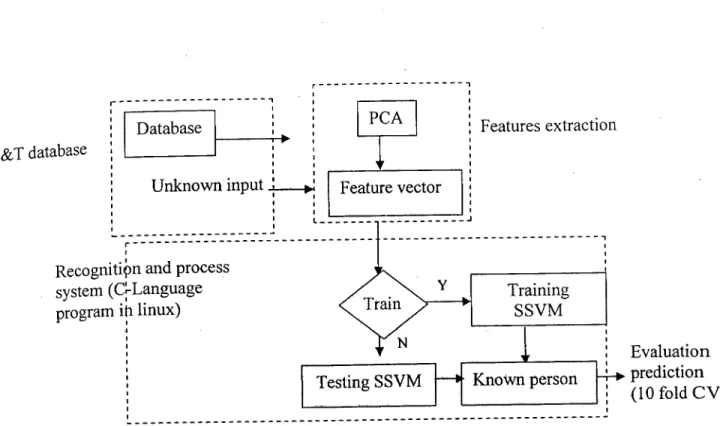
Research method based on library research method or literature method. Literature method using of find the scientific data about how to identify the face characteristic feature in mathematical model and how to apply the modeling and to implement the algorithm system using tools onto programming language. The process describe as follows:
T&T database
Unknown input P. Feature vector
Recogflitfl and process
—I
system (CLanguage ,Z
N " I
Trainingprogram iti linux) <Train r—P1 SSVM
Evaluation [Testing SSVM k'[Known person prediction
I I (10 fold CV)
Figure 1.1: Research Frameworks
1.7 RESEARCH CONTRIBUTION
1. Propose new method in face recognition using both ssvm and eigenfaces. 2. This study, proof that the proposed method produced higher accuracy.
Develop a prototype software using eigenfaces.
1.8 SUMMARY
This chapter describes the research background, problems finding, objective writing, scopes and motivation exploration. As well as on how to design the frameworks, conduct the experiments and obtain its contributions upon this thesis.
CHAPTER 2
LITERATURE REVIEW
2.1 BACKGROUND AND RELATED WORK
Pattern Recognition is a part of Computer Science, mapping data onto specific concept which is defined previously. The specific concept mentioned class or category. Application of pattern recognition is very wide, some of them, are voice recognition in security system, iris recognition, face recognition, finger recognition, and diagnosis of disease from medical records. Methods are known in pattern recognition, such as linear discrimination analysis, hidden markov model and artificial intelligent. The latest method is Support Vector Machine (SVM) (Byun H, 2003; Tsuda, K. 2000). SVM developed by Boser, Guyon, Vapnik, and first presented in 1992 in Annual Workshop on Computational Learning Theory. The Basic concept of •SVM is harmonic combination from computation theories has existed several years before, like margin hyperplane Duda & Hart in 1973, Cover in 1965, Vapnik in 1964,_ and so on. Kernel published by Aronszajn in 1950, and the other supported concept. Until 1992, has never been effort to unite the component from theories (Vapnik, 1999; Cristianini, 2000). Differences from neural network is to find hyperplane separator between class, SVM is to find the best hyperpiane input space. The SVM basic principle is linear classifier and develops to apply non-linear problem with input of kernel trick on high space dimensional. This development gives stimulus in pattern recognition research to investigate the potential of SVM ability theoretical and application. From now on, SVM has success applied to real-word problems. And generally comparable result is better then other methods like artificial neural network (Abe, S., 2005).
2.2 FACE RECOGNITION
2.2.1 overview
Face recognition is a pattern recognition task performed specially on faces. It can be described as classifying a face either "known" or "unknown", after comparing it with stored known individuals. It also desirable to have system that has the ability of learning to recognize unknown faces.
Computational models of face recognition must address several difficult problems. This difficulty arises from the fact that faces must be represented in a way that best utilizes the available face information to distinguish a particular face from all other faces. Faces pose a particularly difficult problem in this respect because all faces are similar to one another in that they contain the' same set of features such as eyes, nose, mouth arranged in roughly the same manner.
2.2.2 Background and related work
The earliest work on face recognition can be traced back at least 1950s in psychology and the 1960s in the engineering literature. Some of the earliest studies include work on facial expression bS' Darwin in 1972, and research on automatic machine recognition of faces started in 1970s. Over the 30 ye-.1s extensive research has been conducted by psychophysicist, neuroscientist, and engineers on - various aspects by humans and machines (Zhao, et.al., 2003).
Many methods of face recognition have been proposed during the past 30 years. Face recognition is such a challenging yet interesting problem that it has attracted researchers who have different backgrounds: psychology, pattern recognition, neural networks, computer vision, and computer graphics. It is due to this fact that the literature on face recognition is vast and diverse. Often, a single system involves techniques motivated by different principles. The usage of a mixture of techniques. makes it difficult to classify these systems based purely on what types of techniques
they use for feature representation or classification. To have a clear and high-level categorization, we instead follow a guideline suggested by the psychological study of how humans use holistic and local features. Specifically, we have the following categorization: (Zhao et. al., 2003; Zhao, 2006).
(i) Holistic matching methods. These methods use the whole face region as the raw
input to a recognition system. One of the most widely used representations of the face region is eigenpictures (Kirby and Sirovich 1990; Sirovich and Kirby 1987), which are based on principal component analysis.
(ii) Feature-based (structural) matching methods. Typically, in these methods, and
mouth are first extracted and their locations and local statistics (geometric and/or appearance) are fed into a structural classifier.
(iii) Hybrid methods. Just as the human perception system uses both local features and
the whole face region to recognize a face, a machine recognition system should use both. One can argue that these methods could potentially offer the best of the two types of methods (Zhao, et al., 2003).
History of still face recognition techniques according to applied approach and representative work. First, the holistic' methods using Principal Component Analysis (PCA) are Eigenfaces has done by direct application of PCA are Craw and Cameron in 1996 (Kirby and Sirovich, 1990 and Turk and Pentland, 1991) and recently methods (Rizon, M, et al., 2006). Second, using probabilistic eigenfaces with two class problem with measure problem by Mohaddam and Pentland in 1997. Third, using fisherface/subspace LDA with FLD on eigenfaces by Beihurneur et al., in 1997, Swets and Weng in 1996b, Zhao et al., in 1998. Evaluation pursuit to enhance GA learning by Liu and Wechsler in 2000, feature lines with point-to-line distance based by Li and Lu in 1999, ICA-based feature analysis by Bartlett et al., in 1998. Two-class problem based on SVM (Phillips, 1998), and SVM in multiclass problem (Guo 0., et al., 2009), SVM with 2 layer data and muiticlass (Cui Guoqin, Gao Wen, 2004). Theil, Smooth SYM based on Eigenfaces by Furqan M., et al., in 2009.
The other representations methods are using LDAIFLD on raw image by Etemad and Chel1aPPa in 1997 and Probabilistic decision based NN or PBNN (Lin et al., 1997).
The feature based-methods are using pure geometry methods with earlier methods by Kanade in 1973), Kelly in 1970 and recent methods by Cox et al, in 1996 and Manjunath et al, in 1992. Using dynamic link architecture graph matching methods by Okada et al., in 1998, and Wiskott et al., in 1997. Using Hidden Markov model (HMM) methods by Nefian and Hayes in 1998, Samaria in 1994 (Samaria and Young,
1994). Using SOM learning based CNN methods (Lawrence et al., 1997).
The hybrid methods are Modular eigenfaces Eigenfaces and eigenmodules (Pentland et al., 1994) and hybrid LFA Local feature method by Penev and Atick in 1996 and shape-normalized Flexible appearance models by Lanitis et al, in 1995 and Component-based face region and components by Huang et al, in 2003).
The key issue and difficulty in detection is to account a wide range of variations in face images. There have been numerous innovative strategies proposed for solving this problem. Most of then used image invariants (Rowley, 1998), snake or splire (Vieren, 1995; Welsh, 1991), templates (Sung, 1998; Lanitis, 1997; Tsukamoto, 1994a;
1994b) or eigenfaces (Pentland A. and Moghaddarn, 1994; Turk and Pentland, 1991).
Appropriate schemes should be chosen based on the specific. requirements of a given task. Most of the systems reviewed here focus on the subtask of recognition, but others also include automatic face detection and feature extraction, making them fully automatic systems (Lin, et.al ., 1997; Moghaddam and Pentland, 1997; Wiskott, et al.,
1997).
2.2.3 Outline of typical Face Recognition System
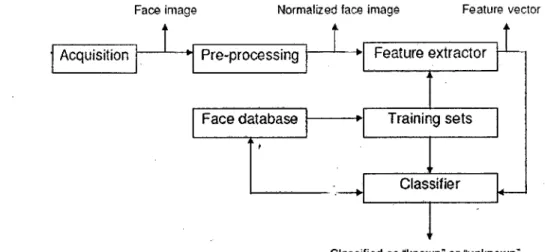
i. The acquisition task. It is the module where the face under consideration is Presented to the system. The user prepares to present a face image to face recognition
module. It is can request a face image from several different environments: the face can be image file from files or from captured by video or scanned from paper.
ii. The Processing task. It is face normalized and desires, they are enhanced to improve the performance of recognition system. Some of following pre-processing steps may be implemented in face recognition system:
• Image size normalization is usually done to change image size to default image such as 1 OOx 100 pixels. This specific size we use to proposed in this thesis. • Histogram equalization is usually done on too dark or too bright images to
enhance image quality and improve systems, some important facial features become more apparent.
Background removal. In order to deal primarily with facial information itself, face background can be removed. This is especially important for face recognition systems where entire information contained in the image is used. It is obvious that, for background removal, the preprocessing module should be capable of determining the face outline.
• Translational and rotational normalizations. In some cases, it is possible to work on a face image in which the head is somehow shifted or rotated. The head plays the key role in the determination of facial features. Especially for face recognition systems that are based on the frontal views of faces, it may be desirab' that the processing module determines and if possible, normalizes the shifts and rotations in the head position.
• Illumination normalization. Face images taken under different illuminations can degrade recognition performance especially for face recognition systems based on the principal component analysis in which entire face information is used for recognition.
L The feature extraction task. After performing some pre-processing (if necessary), the normalized face image is presented to the feature extraction module in order to find the key features that are going to be used for classification. In other words, this module is responsible for composing a feature vector that is well enough to represent the face image.
ii. The classification task. In this module, with the help of a pattern classifier, extracted features of the face image is compared with the ones stored in a face library or face database. After doing this comparison, face image is classified as either known or unknown.
iii. Training set. Training sets are used during the "learning phase" of the face recognition process. The feature extraction and the classification modules adjust their parameters in order to achieve optimum recognition performance by making use of training sets.
iv. Face library or face database. After being classified as "unknown", face images can be added to a library (or to a database) with their feature vectors for later comparisons. The classification module makes direct use of the face library. It is describe in figure 2.1.
Face imago Normalized taco imago Feature vector
Acquisition Featur^extractor
i
Face database I ol Training sets
Classifier
Classified as known" or unknown
Figure 2.1: outline of typical face recognition system
Source: Atalay Ilker, 1996
2.2.4 Problem during Face Recognition
From many literature (Theodoridis S., 2006; Zhao, 2003; Delac K., 2007) can describe of recognition in face problems. It is possible to classify a face recognition
13
system as either "robust" or "weak" based on its recognition performances under these circumstances. The objectives of a robust face recognition system are given below:
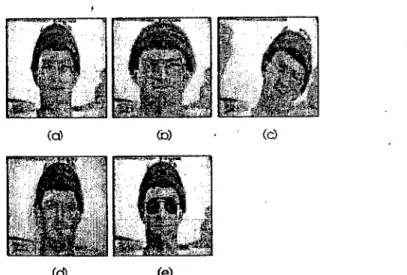
• Scale in variance. The same face can be presented to the system at different scales as shown in Figure 2.6-b. This may happen due to the focal distance between the face and the camera. As this distance gets closer, the face image gets bigger.
• Shift in variance. The same face can be presented to the system at different perspectives and orientations as shown in Figure 2.6-c. For instance, face images of the same person could be taken from frontal and profile views. Besides, head orientation may change due to translations and rotations.
• Illumination in variance. Face images of the same person can be taken under different illumination conditions such as, the position and the strength of the light source can be modified like the ones shown in Figure 2.6-d.
• Emotional expression and detail invariance. Face images of the same person can differ in expressions when smiling or laughing. Also, like the ones shown in Figure 2.6-e, some details such as dark glasses, beards or moustaches can be present. • Noise in variance. A robust face recognition system should be insensitive to noise
generated by frame grabbers or cameras. Also, it should function under partially occluded images.
(0) (D) (C)
bei ibti
(0) (e)
Figure 2.2: (a) Original face image. (b) Scale variance. (c) Orientation variance.
(d) Illumination variance. (e) Presence of details.