CRANFIELD UNIVERSITY
School of Aerospace, Transport and Manufacturing
Pedro Cavestany
Distributed Scene Reconstruction From
Multiple Mobile Platforms
PhD Thesis
Academic year 2014/2015
Supervisors:
Dr. Toby Breckon
Dr. Humberto Martínez-Barberá
May 2015
This thesis is submitted in partial fulfillment of the requirements for the degree of
Doctor of Philosophy (PhD)
©Cranfield University, 2015. All rights reserved. No part of this publication may be reproduced without the written permission of the copyright holder.
Abstract
Recent research on mobile robotics has produced new designs that provide house-hold robots with omnidirectional motion. The image sensor embedded in these devices motivates the application of 3D vision techniques on them for navigation and mapping purposes. In addition to this, distributed cheap-sensing systems acting as unitary entity have recently been discovered as an efficient alternative to expensive mobile equipment.
In this work we present an implementation of a visual reconstruction method, structure from motion (SfM), on a low-budget, omnidirectional mobile plat-form, and extend this method to distributed 3D scene reconstruction with several instances of such a platform.
Our approach overcomes the challenges yielded by the plaform. The un-precedented levels of noise produced by the image compression typical of the platform is processed by our feature filtering methods, which ensure suitable feature matching populations for epipolar geometry estimation by means of a strict quality-based feature selection. The robust pose estima-tion algorithms implemented, along with a novel feature tracking system, enable our incremental SfM approach to novelly deal with ill-conditioned inter-image configurations provoked by the omnidirectional motion. The feature tracking system developed efficiently manages the feature scarcity produced by noise and outputs quality feature tracks, which allow robust 3D mapping of a given scene even if - due to noise - their length is shorter than what it is usually assumed for performing stable 3D reconstructions. The distributed reconstruction from multiple instances of SfM is attained by applying loop-closing techniques. Our multiple reconstruction system merges individual 3D structures and resolves the global scale problem with
strated in the 2-session case.
The management of noise, the stability against ill-configurations and the robustness of our SfM system is validated on a number of experiments and compared with state-of-the-art approaches. Possible future research areas are also discussed.
Acknowledgements
I feel immensely grateful to my supervisor Dr. Toby Breckon, who has constanly followed and directed my progress. His stimulating comments and suggestions throughout this work have been an encouraging motivation in my research. I am also grateful to Dr. Humberto Martínez-Barberá who proposed the distributed aspect of the thesis, and sought the necessary fundings for the realisation of my PhD. I would like to acknowledge as well the work done by Dr. Yifan Zhao on the bureaucratic front during the last stage of the thesis and in the arrangements of the viva.
I want to acknowledge the valuable academic support provided by Dr. An-tonio L. Rodríguez, who has always kindly attended my queries related to 3D vision, and whose advice was decisive in developing our SfM approach. I find very difficult to convey how much, and in how many aspects, I have learned and enjoyed the company and enriching conversations of Dr. Robert Sawko. I am absolute certain that many experiences and ideas that we have shared have made their way through in this thesis. I harbour similar feelings regarding Dr. Juan José Alcaraz, whose bright approaches to problems have enlightened me in many occasions.
During my PhD I have met people so interesting that I am sorry to just list them here. Belén Iglesias, Sarah Bergin, Alex Charlton, Luca Camosi, Marcin and Milena Tracyk, Michał and Gosia Czapinski, Reuben Yarwood, Marianne Hewitt, Morag Skinner. . . all of them have left somehow their im-print on this work.
Last but definitely not least, I owe a great deal of this thesis to my closest family: my brothers and sisters, for their support (not limited to affection)
express their contributions to this thesis.
This work has been supported by a Departmental scholarship of the Applied Math- ematics and Computing Group, of School of Engineering, Cranfield University, and by a grant of the Regional Employment Service of Mur-cia (Spain), through the Science and Technology Regional Office, Séneca Foundation.
Contents
List of Figures vii
List of Tables xi
1 Introduction 1
1.1 Robotics and 3D Vision . . . 1
1.2 Structure From Motion . . . 4
1.3 Objectives and Research Question . . . 9
1.4 Approach Overview . . . 12 1.5 Thesis Outline . . . 12 2 Literature Review 15 2.1 Robotics and SfM . . . 17 2.1.1 Low-Budget Robots . . . 18 2.1.2 Omnidirectional Robots . . . 19 2.2 Image Noise . . . 21 2.3 Image Features . . . 23
2.3.1 Feature Detectors and Descriptors . . . 23
2.4 The Correspondence Problem . . . 28
2.4.1 Feature Matching . . . 28
2.4.2 Robust Estimation of Epipolar Geometry . . . 32
2.5 Feature Tracking . . . 35
2.6 Motion Recovery . . . 37
2.6.1 SfM in Real Time . . . 38
2.6.2 Epipolar Geometry . . . 39
2.6.4 Ill-Configurations . . . 45
2.6.5 Resection . . . 47
2.7 Structure Triangulation . . . 48
2.8 Bundle Adjustment . . . 50
2.9 Collaborative Perception . . . 54
2.9.1 Distributed Reconstruction and Localisation . . . 55
2.9.2 Different Configurations . . . 57
2.10 Summary . . . 58
3 Structure from Motion on a Single Platform 61 3.1 The Platform: Rovio . . . 62
3.1.1 Noise . . . 66
3.1.2 Small Baselines . . . 67
3.2 Camera Calibration . . . 68
3.3 Image Reception and Preprocessing . . . 71
3.4 Matching Process . . . 73
3.4.1 Recursive Matching Process . . . 74
3.4.2 Spurious Matches Trimming . . . 74
3.4.3 Feature Detection and Matching . . . 77
3.5 Relative Pose Estimation . . . 79
3.6 Feature Tracking System . . . 81
3.7 Global Pose Estimation and Structure . . . 87
3.7.1 Resection . . . 87
3.7.2 3D Structure . . . 88
3.8 Bundle Adjustment . . . 89
3.8.1 Quaternions . . . 89
3.8.2 Local and Global BA . . . 90
3.9 Final Scene Recovery . . . 90
3.9.1 Surface Rendering . . . 92
CONTENTS
4 Structure from Motion across Multiple Platforms 95
4.1 Multiple Structure from Motion: our Approach . . . 96
4.2 Multiple Reconstruction . . . 98 4.2.1 Loop Closing . . . 99 4.2.2 FAB-MAP . . . 102 4.3 Overlap Management . . . 108 4.3.1 SessionI1 . . . 109 4.3.2 SessionIi,i >1 . . . 110
4.3.3 Distributed Bundle Adjustment . . . 112
4.4 Post-Process . . . 113
4.5 The Case r= 1 . . . 114
4.6 Summary . . . 115
5 Performance Evaluation 117 5.1 Methodology for Evaluation . . . 118
5.2 Single Case . . . 121
5.2.1 Experiments . . . 124
5.2.2 Evaluation of the System . . . 124
5.2.3 Comparison with State of the Art Systems . . . 134
5.2.4 Validation against Benchmark Data-Sets . . . 138
5.2.5 Evaluation against Ground-Truth . . . 139
5.3 Multiple Case . . . 142
5.3.1 Multi-Session Evaluation . . . 143
5.3.2 Loop-Closings in Single Sessions . . . 146
5.4 Summary . . . 147 6 Conclusions 149 6.1 Contributions . . . 149 6.2 Future Work . . . 151 References 153 Appendix 177
A Structure from Motion - a Geometric Overview 177
A.1 Homogeneous Coordinates . . . 178
A.2 Camera Calibration . . . 180
A.2.1 The Intrinsic Matrix . . . 180
A.2.2 Normalised Coordinates . . . 182
A.2.3 The Camera Matrix . . . 183
A.3 Homographies . . . 184
A.4 The Epipolar Geometry . . . 187
A.4.1 The Fundamental Matrix . . . 188
A.4.2 The Essential Matrix . . . 191
A.4.3 Estimation of the Epipolar Geometry . . . 194
A.4.4 The Essential Space . . . 196
A.4.5 Extraction of Rand t . . . 196
A.5 Sequential SfM: the Problem of the Scale. . . 198
A.5.1 Resection . . . 200
A.6 Reconstruction . . . 201
A.6.1 Triangulation . . . 202
A.7 Bundle Adjustment . . . 203
A.7.1 Reprojection Error . . . 203
A.7.2 Levenberg–Marquardt Algorithm . . . 204
B Algebraic Definitions 207 B.1 Hat operator and cross product . . . 207
List of Figures
1.1 A 3D reconstruction model . . . 2
1.2 Example of 3D software: Photo tourism . . . 4
1.3 Dense 3D reconstruction: DTAM . . . 5
1.4 3D vision application: Artificial lens blur . . . 6
1.5 The mobile robot Rovio . . . 8
1.6 Omni-wheel and possible motion directions . . . 10
2.1 Critical sequences in uncalibrated motion . . . 19
2.2 Feature detection and matching . . . 24
2.3 Robust estimation applied to linear regression . . . 32
3.1 Flowchart of SfM process . . . 62
3.2 Rovio features . . . 63
3.3 A blurred image delivered by Rovio. . . 64
3.4 Software environment . . . 65
3.5 Mosquito effect . . . 66
3.6 Checkerboad “Tsai grid” used for camera calibration. . . 69
3.7 Bilateral filtering . . . 72
3.8 Effect of bilateral filtering over feature detection. . . 73
3.9 Typical distribution of distance between descriptors in a match . . . 75
3.10 Trimming effect of the noise filters on the set of corresponding features . 76 3.11 Error correspondence on the projection of a 3D point . . . 77
3.12 Merging of two features in abundle . . . 82
3.13 Filters employed in the feature tracking system . . . 83
3.15 Feature tracking system: case 2 . . . 85
3.16 Feature tracking system: case 3 . . . 86
3.17 Histogram of feature track lengths . . . 88
3.18 Flowchart of the post-processing stage . . . 91
3.19 Surface rendering of 3D reconstructions . . . 93
4.1 2D mapping from direct encounters . . . 97
4.2 A general scenario of multiple reconstruction . . . 98
4.3 Example of loop-closure . . . 99
4.4 A false loop-closure . . . 100
4.5 Example of sequence overlapping . . . 101
4.6 Vocabulary of bags-of-words (BOW) . . . 102
4.7 Categories of the training data-set for vocabulary generation . . . 103
4.8 Precision and recall . . . 105
4.9 loop-closure occurrence with the platform used . . . 107
4.10 The initial position problem . . . 108
4.11 BA management of overlaps . . . 113
5.1 Experiments studied in the single case . . . 122
5.2 Camera poses and 3D structures of the four experiments . . . 123
5.3 Structure information on the data-sets referenced . . . 125
5.4 Statistical information on the data-sets referenced . . . 126
5.5 Epipolar lines in visionlab and turntable sequences . . . 126
5.6 Influence of baseline distance on reprojection error . . . 127
5.7 Comparison of results between SfM process and post-process . . . 128
5.8 Comparison of feature track histograms between SfM process and post-process . . . 129
5.9 Comparison of 3D structures between SfM process and post-process . . . 130
5.10 Computational times in SfM process and post-process . . . 131
5.11 Computational times in the global BA thread . . . 132
5.12 Rendered surface of turntable sequence . . . 133
5.13 Point cloud of theturntable sequence . . . 134
5.14 Rendered surface of industrialArea sequence . . . 135
LIST OF FIGURES
5.16 Reconstruction of Leuven Castle by evaluated systems . . . 139
5.17 engineRoom Experiment . . . 139
5.18 Validation of the studied cases against ground-truth . . . 140
5.19 Detail of the comparison with Ground-Truth on engineRoom0 sequence. 141 5.20 Validation of turntable sequence against ground-truth . . . 141
5.21 Omnidirectional motions inpipeline sequence. . . 142
5.22 Camera poses reconstructed by state of the art softwares in the pipeline sequence. . . 142
5.23 camera poses and 3D structure of the engineRoom0 and engineRoom1 sequences. . . 144
5.24 Camera poses and 3D structure of the merged sessions. Since all the cameras are joined by a line, there is a line joining the last camera of the first session and the first camera of the second session . . . 145
5.25 Comparison between ground-truth and our results in the merged camera poses of theengineRoom experiment. . . 145
5.26 Camera poses in the sequence turntable2. . . 146
5.27 Loop closing evaluation in the case r= 1. . . 147
A.1 The pinhole camera . . . 178
A.2 The geometric camera model . . . 180
A.3 Central projection . . . 183
A.4 The epipolar geometry . . . 186
A.5 Transfer of projections through homography . . . 187
A.6 The triple scalar product . . . 192
List of Tables
2.1 Necessary samples to ensure an outlier-free model in robust estimation . 34
3.1 Effects of bilateral filtering . . . 73
3.2 Comparison between feature detectors and descriptors . . . 78
3.3 Evaluation of different query tree structures of FLANN . . . 78
3.4 Computational times taken by FLANN implementations . . . 78
3.5 Possible cases in the feature tracking system . . . 85
3.6 Surviving matches after each filter during the post-process stage . . . 91
3.7 Comparison between SfM process and post-processing . . . 92
4.1 Precision and recall indices for engineRoom and turntable2 sequences. . 106
5.1 Lengths of feature track covered by bundles . . . 129
5.2 Comparison of results with state of the art systems . . . 135
5.3 Ratios regarding the projections generated onvisionlab sequence. . . 136
5.4 Comparison of results between our system and state of the art systems . 137 5.5 Ratios regarding the projections generated onturntable sequence. . . 137
5.6 Comparison of the reprojection error given by our system and the state of the art systems on the sequences studied. . . 138
5.7 Comparison of our system and state of the art systems on the Leuven castle data-set. . . 138
5.8 Overlap detection in multiple reconstruction . . . 143
Chapter 1
Introduction
This thesis addresses research challenges within the domain of robotic visual sensing in specific relation to 3D perception of an environment by one or more robotic platforms.
1.1
Robotics and 3D Vision
Robotics is used in a vast number of fields: industry, military and medicine represent just a small example of the increasing importance that robots are gaining in many aspects of our society. Indeed, robots have recently found their way into the domestic world. As time goes by, more mobile robots are affordable by household budgets, thanks to increasing returns to scale and simpler designs. Alongside the integration of robotics into our domestic environment we additionally see that research in the area of computer vision has been introduced into this domestic sphere as the primary sensing mechanism for such types of robot. Finally, distributed cheap-sensing systems acting as unitary entity have recently been discovered as an efficient alternative to expensive mobile equipment.
By applying mathematical and computational algorithms computer vision extracts in-formation out of images. The range of knowledge that can be retrieved with computer vision is wide, but in this work we will focus on 3D vision. 3D vision is a part of computer vision that tackles the extraction of 3D information from a scene covered by a given set of input images. It also provides information about the relative location of each image within the sequence. Robotics can take advantage of this technique for
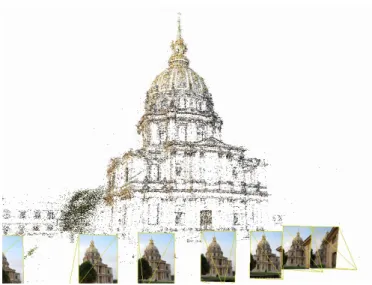
Figure 1.1: A 3D reconstruction model attained with computer vision. Source: Olsson et al. (2010).
mapping and navigation purposes (Nister et al. (2004)). We intend to employ these techniques in a distributed fashion.
The mathematical substratum of 3D vision methods is projective geometry, which stud-ies the geometric propertstud-ies which are preserved under projective transformations. The use of projective geometry started in the Renaissance (14th - 17th centuries), when painters learned how to depict scenes using the laws of perspective, such as vanishing points. Later on, in the era of computers, projective geometry has been employed for rendering real or synthetic scenes or objects in a large variety of applications.
3D vision researchers take the theory of projective geometry in the opposite direction. Instead of projecting a given 3D scene on a 2D image, the postulates of projective geometry are applied to a sequence of images in combination with statistical inference methods and other algorithms from image processing in order to obtain information about where each image was taken, relatively to each other, and about the 3D structure of the scene. This is the inception of the discipline multiple view geometry (MVG), which studies the geometric projective relationships between multiple views of a common environment (Hartley and Zisserman (2004)). Appendix A describes the necessary background in MVG and projective geometry to understand the algorithms used by this work. Fig 1.1 shows the 3D reconstruction of a scene performed out of images with MVG techniques, along with the estimations of the locations where each picture was taken.
1.1 Robotics and 3D Vision
Multiple view geometry finds in mobile robots a most proper field of application, and with the increasing use of mobile robots in so many areas, the methods offered by MVG have become of common use in robotics. Indeed, often robots are used in haz-ardous and inaccessible environments, such as a mine, a pipe or a chamber filled with toxic gas. These premises have boosted the development of mobile and autonomous robots, in order to perform those tasks with precision and without risk to human life. Whereas fixed robots are widespread in industry, mobile robots are still maturing their techniques, mainly because it is very difficult for a mobile robot to maintain a reliable estimation of its location within an unknown (or even known) scene while transiting it. MVG techniques not only allow to create a 3D map of the environment transited, but also provide the relative location of the mobile robot as it moves around. There-fore, researchers have shown great interest in 3D vision applied to mobile robotics as a primary method to perform visual navigation.
Inside the area of mobile robotics, multiple robot systems and swarm systems have recently been also attracting research work (Jeong and Lee (2013); Kim et al. (2010); Radke (2008)). Based on relatively simple rules that each individual has to abide by, the synergetic aggregation of individual robots into a unified group results in complex and nearly inteligent behaviours. Examples of this are present in nature: Many insects, birds and fish take advantage of this mechanism. Given how expensive a fully-equipped mobile robot is, a great deal of research is devoted to develop distributed systems so that it is possible for groups of affordable, commercially available robots accomplish tasks that otherwise would need a high-technologically developed and expensive single robot.
Distributed systems of robots where each one is equipped with a sensor, such as GPS, infrared, ultra-sound sensors or even wireless signal receptor can take advantage of the information gathered by each individual (Chang and Wu (2013); Otsuka et al. (2013); Wendel et al. (2012)). By bringing together the sensor information along with other parameters (location, time, etc.) into a common pool and taking into account the uncer-tainty involved in the problem, a distributed robotic system (DRS) can extract accurate and robust knowledge about the environment. We will implement this paradigm to ex-plore the application of 3D vision on the field of distributed sensing, since little work has been done in this regard and its explotation can provide results comparable to other
Figure 1.2: Photo tourism allows to reconstruct monuments out of images taken in the Internet. Source: Snavely et al. (2006).
much more expensive systems like LIDAR, stereo rigs or depth cameras like Microsoft Kinect (Guan (2006); Zhang (2012)).
This work addresses the problem of obtaining 3D reconstruction and motion informa-tion from images streamed from a group of low-budget mobile robots, with the aid of 3D vision techniques. There are mainly two methodologies in 3D vision to obtain the struc-ture and camera information from a set of input images: strucstruc-ture from motion (SfM) and visual simultaneous localisation and mapping (VSLAM). This work implements SfM, and here an overview on VSLAM is given in Chapter 2 for completeness.
1.2
Structure From Motion
The core of this work is based on a well-established research area, Structure from Motion (SfM), which finds its foundations in the works of Longuet-Higgins (1981). SfM is an interdisciplinary technique, combining computer vision and projective geometry, that has attracted significant attention from researchers over the past 25 years (Hartley (1997); Hartley and Zisserman (2004); Horn (1990)). Furthermore, the SfM realisation requires a comprehensive knowledge of advanced linear algebra, due to the geometry involved in the overall process.
As said above, the SfM technique essentially performs the reverse process of image formation: out of a scene projected on 2D images SfM extracts 3D maps of the real scene and the relative positions of those images with respect to each other. In the last decade, thanks to a few significant breakthroughs and hardware improvements, this field has experienced a renaissance and its applications have proliferated in many aspects of image processing. To name a few, augmented reality, hand-eye calibration,
1.2 Structure From Motion
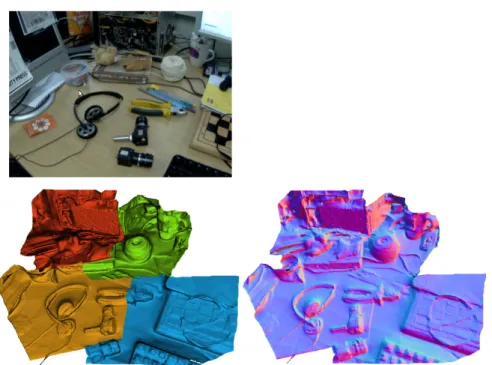
Figure 1.3: Dense reconstruction by Newcombe et al. (2011). Top: Overview of the scene. Bottom Left: four patch local 3D maps stitched into the global reference. Right: the final reconstruction.
remote sensing and image organisation / browsing are examples where SfM is used (Wei et al. (2013)).
Many applications have been found for SfM in the last ten years, and impressive results have been achieved in visual reconstruction. Using the Internet as source of images, it is easy to find databases with thousands of images of monuments such as The Eiffel Tower, the Coliseum or the Big Ben. Snavely et al. (2006) present a system calledPhoto Tourism based on SfM which takes large sets of pictures from Internet photo sharing
sites and automatically estimates each photo’s location, as well as a global 3D model of the scene. Fig 1.2 shows the Coliseum reconstructed with this software.
Current research is oriented towards the management of large datasets, and Photo Tourism is an example of this. This effort is especially interesting to mobile robotics,
for the autonomy and reliability of a mobile robot is directly related with the amount of images that it can handle. Cummins and Newman (2011) works with databases of millions of images in an appearance-based automobile navigation system capable of finding loop-closures over a range of 1000 kilometres of transited roads. In the field of reconstruction, Klingner et al. (2013) makes use of the formalisms of SfM to align
Figure 1.4: Artificial lens blur by Yu and Gallup (2014). Left: one of several input photos. Middle: Depth map. Right: Photo with lens blur.
the camera poses of billions of images taken by the contemporary street view service of Google.
SfM has also been applied over video sequences and images from hand-held cameras. Newcombe et al. (2011), by means of GPU hardware, developed a robust system (called DTAM) which creates in real time dense reconstruction of a scene covered by a hand-held camera, as shown in Fig 1.3. An impressive result with mobile cameras is the work presented by Yu and Gallup (2014). By just taking as input images the different shots taken by a smartphone, whose different locations are only given by accidental motion of the hand, this work manages to extract the depth of the scene and with it the 3D reconstruction. This result is applied to relocate at will the focus in the image and to create synthetic parallaxes. In Fig 1.4 an example of this work is shown.
In the area of robotics the achievements of 3D vision have been remarkable too. 3D vision techniques have been used in the NASA Mars exploration rover mission, where the rover Opportunity performs SfM in order to obtain visual reconstruction models of its environment and for navigation (Maimone et al. (2007)). Based on the work of DTAM, Forster et al. (2014) implements a visual odometry algorithm which runs in real time on embedded systems. This algorithm has successfully been deployed on unmanned aerial vehicles with excellent results.
There have been numerous works on collaborative systems. Werfel et al. (2014) pre-sented a group of termite robots which can build a construction without any human help, by following simple rules, in a similar manner as termites behave.
Collabora-1.2 Structure From Motion
tion between heterogeneous groups of robots has been shown in Mathews et al. (2012), where flying drones communicate with a swarm of ground robots in order to perform difficult tasks. Flight formation and coordination with groups of nano-quadrotors has been achieved by the GRASP Lab, from University of Pennsylvania. Working collabo-ratively, these drones can pick up and carry heavy weights or create structures.
More specifically in SfM, this method has attracted a significant number of prior studies over the past years (e.g., Snavely et al. (2008a); Torr et al. (1998); Wai Yin Leung
(2006)). Indeed, SfM is finding its place in many applications (Wei et al. (2013)). SfM replaces other scanning real-world object techniques, like laser scanning. SfM has largely been applied to augmented reality and for animation purposes (Jebara et al. (1999)). Many feature films use SfM when performing special effects and introducing fictitious characters to the scene (Haley-Hermiz et al. (2012)). In many computer vision algorithms, SfM is used as useful intermediate component. For example, in Brostow et al. (2008) segmentation and recognition tasks are developed based on SfM and Torr et al. (1998) uses SfM to guide the feature matching in a video sequence. Projects in computer-human interaction and information encoding have found SfM appropriate for their applications, as SfM helps track face gestures or movements and gives compressed data of a scene through 3D points.
Of all the uses that can be found for SfM, perhaps the most suitable and naturally applied is robotics. Out of the three main necessary competences for a mobile robot to navigate in a given environment, which are:
1. Self-localisation: to know where it is relatively to its surrounding environment, without the aid of neither active nor active external elements (sources of signal, beacons, landmarks, etc).
2. Map-building and its interpretation: to know where the objects in the surrounding environment are with respect to itself, which facilitates to estimate the permitted areas for transiting.
3. Path planning: to estimate the optimal path to move from one point to another, in a given environment.
SfM facilitates greatly the achievement of the first two, regardless the type of scene (either outdoors or indoors), and provides an excellent framework to perform the third
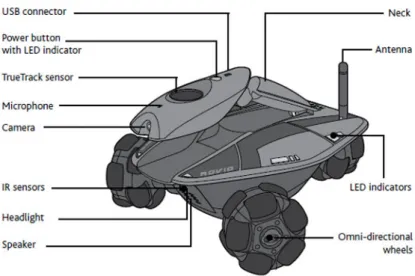
Figure 1.5: The mobile robot Rovio. Right image from Dang and Hundal (2011).
competence, path planning. The self-localisation given by SfM not only locates the robot within a frame of reference, but it also places the robot with its orientation. The map built as a result of the visual reconstruction model created by SfM is a 3D map, so the obstacle-avoidance skill is largely facilitated, as opposed to 2D maps. Moreover, SfM does not require to alter the environment in any way, as it does not need artificial landmarks such as beacons, nor it needs prior information about the scene.
Another advantage of SfM is that this technique does not use any special or expensive sensor. Just an embedded camera is necessary. The minimal requirements of hardware from SfM make it really convenient for mobile platforms, since one of the issues encoun-tered in the design and manufacturing of mobile robots is their cost. In this work we have chosen a low-budget platform for our implementation of SfM. The reason for this is two-fold: first, low-budget robots are being considered for environmental exploration in a distributed fashion; second, this is an opportunity of bringing high technology research algorithms to off-the-shelf mobile robots.
Specifically, the chosen platform evaluated here is the low-budget omnidirectional Wow-Wee Rovio mobile robot (shown in Fig. 1.5) which consists of a wireless network con-nected low-cost mobile device. Rovio has been designed to be commanded over the Internet and be used for surveillance tasks and as a camera web. The low cost sensor on board possesses its own specific problems with regard to noise characteristics for the task feature identification and matching and this challenge will form part of this work. We will examine the details of this subject in Chapter 3.
We have applied SfM for image-based 3D modelling and autonomous navigation of low-budget mobile robots. Therefore, our work is based on a state of the art technique
1.3 Objectives and Research Question
which is actively used by the scientific community. While this work copes with specific problems and issues provided by the poor quality of the sensors used and the particular characteristics of the mobile platform, the knowledge of SfM technique and its related fields acquired during this work enables us to address a wide range of areas of image processing in future works.
1.3
Objectives and Research Question
The goal of this work is to achieve a 3D understanding of a given scene by using the image sensors of a group of low-budget mobile robots. This is attained with the implementation of a well known but complex method in computer vision, Structure from Motion (SfM), on a small group of commercial mobile robots (WowWee Rovio). This work, where the particular characteristics of a collaborative system are used to optimise the SfM task, has not yet been addressed, as highlighted by recent surveys in the area (Radke (2008)).
The research question that set out this work is two-fold. Firstly, we consider the imple-mentation of SfM on low-budget, omnidirectional mobile platforms, and the challenges that this type of platform entails: low quality imagery, inter-image ill-configurations. Is it possible to obtain reliable visual odometry of a low-cost, omnidirectional robot, and obtain 3D maps of the scene while it transits along? Secondly, we explore the adap-tation of recent work in SfM supported by real-time robust feature point extraction techniques for distributed 3D scene understanding - that is, if multiple robots all see different isolated parts of a given environment and we know approximately where the robots may be relative to each other (with known uncertainty) then collectively can we try to reconstruct the global scene in 3D as they transit in an intersecting search pattern through the environment. This work aims towards the realisation of multi-entity SfM and will combine aspects of image mosaiking, robot motion estimation and multi-robot 3D reconstruction.
The main challenge of this work resides on the chosen platform, which is a low-budget, omnidirectional platform. An omnidirectional (also addressed as holonomic) robot plat-form has as many actuators as degrees of freedom. In the case of a wheeled robot, which has three degrees of freedom (two normal directions and rotation angle), a robot needs three actuators to be holonomic. Specifically in our work this configuration is achieved
Figure 1.6: Left: omni-wheel detail; Right: possible motion directions for the omnidirec-tional robot platform.
by three independently commanded wheels, which are able to move almost friction-less along the perpendicular direction to their axis of displacement. This paradigm is rep-resented by the omni wheels (Fig. 1.6). The manoeuvrability provided by this design allows an omnidirectional robot to turn on the spot and move sideways or diagonally while keeping its orientation (Fig. 1.6). Such omnidirectional platform often offers key manoeuvrability characteristics which has recently boosted research on mobile naviga-tion in complex environments.
Under omnidirectional configuration (Fig. 1.5), abrupt changes in robot orientation provoke rapid changes in the camera field of view. This creates frequent difficult epipolar configurations when transiting a given scene. In addition, the low quality of the image sensor and the wireless streaming compression reduces the amount of features detected in the images, and increases their measurement noise.
Sequential Structure from Motion (SfM) techniques have been applied to obtaining robust 3D mapping and self-localisation on mobile robots (Maohai et al. (2006); Ortin and Montiel (2001); Royer et al. (2007)). However, in the case of an omnidirectional robot the facts here discussed (small baseline distance, high measurement noise and feature sparsity) complicate the extraction of the epipolar geometry between image pairs (Jebara et al. (1999); Shakernia et al. (2003); Szeliski and Kang (1994); Vidal and Oliensis (2002)) and render the navigation task challenging.
The first goal of this work, therefore, is to achieve a robust and stable SfM method capable of locating the camera poses and extract as dense as possible 3D information of the scene out of low resolution and noisy images. In addition, this algorithm should
1.3 Objectives and Research Question
be able to deal with the unique ill-conditioned configurations created by the movement typical of such a holonomic robot.
As an extension of the singular case, SfM applied on a single mobile platform, the eventual co-issue of this work arises:- how to combine the structure recovered by multiple deployed mobile robots within a common environment and merge this information so that the 3D model of the whole environment is obtained. This requires an efficient solution to the challenge of recognising a previous visited areas, called in the literature review loop-closing (Cummins and Newman (2011); Zhang et al. (2010)).
Specifically, the key contributions of this work can be listed as
follows:-• We have overcome the problem of noise created by the low quality of the image sensor and the JPEG compression imposed on the imagery by wireless stream-ing. JPEG-compression has only been treated in the context of SfM by Torr and Zisserman (1997). By implementing a sequence of filters, our system copes with levels of noise not found in the literature (Gang and Reinhard (2005); Ruiz et al. (2006)).
• We have developed an incremental SfM pipeline (Hartley and Zisserman (2004)) capable of retrieving the relative camera poses under omnidirectional conditions, which lead to ill-conditioned situations (Vidal and Oliensis (2002)). SfM has not been performed on omnidirectional platforms before (Bonin-Font et al. (2008); Fraundorfer and Scaramuzza (2012); Scaramuzza and Fraundorfer (2011)). • We have developed a novel feature tracking system that manages the scarcity
produced by noise and outputs quality feature tracks, which allows a stable 3D mapping of a given scene. Our feature tracking system generalises the work of Ro-hith et al. (2013) to any type of scenario.
• We have attained distributed reconstructions from multiple instances of the SfM system developed, by applying loop-closing techniques (Cummins and Newman (2011)). This is demonstrated on the 2-session case.
• We have developed a multiple reconstruction system that merges individual 3D structures and resolves the global scale problem with minimal overlaps. Our results extend the work of Zhang et al. (2010) which requires overlaps between stretches of sequences. This is demonstrated on the 2-session case.
The SfM system described in Chapter 3 comprises the contents of Cavestany et al. (2015), which will be published in the proceedings of the international conference of image processing of 2015 (ICIP). We plan to expose the multiple reconstruction system in a subsequent paper.
1.4
Approach Overview
Since this work has two parts clearly distinguished: SfM on a single platform and 3D reconstruction on multiple platforms, we apply two different methodologies for each section of this work:
Single SfM
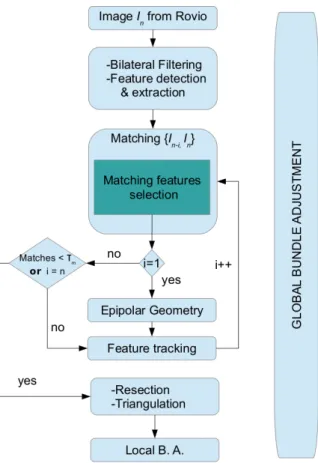
The approach taken on the retrieval of 3D structure and camera motion of a single mobile platform follows a classical pipeline of a SfM system (see Fig. 3.1), with the addition of a preprocessing of the imagery prior to the matching process step. Subsequently the epipolar geometry is estimated by means of state-of-the-art minimisation methods and resection over the last camera is performed. Here we novelly develop a feature tracking system to make to most of the scarcity of features that this problem poses. The triangulation step is refined via the application of Bundle Adjustment. Finally, semi-dense 3D reconstruction is attained by using commonplace rendering methods.
Multiple Reconstruction
The methodology followed in the estimation of a global 3D map out of 3D structures retrieved by multiple instances of the mobile platform of study is based on minimal loop-closures. More specifically, the loop-closing problem is addressed by an implementation of FAB-MAP (Cummins and Newman (2011)). Once the loop-closures between different sequences are found a global 3D structure and the relative pose of all the cameras involved are calculated by Bundle Adjustment.
1.5
Thesis Outline
This thesis is divided in two main Sections: SfM on a single mobile robot and collabo-rative SfM. In order to familiarise the reader with the terminology used in this thesis,
1.5 Thesis Outline
Appendix A explains the core elements of the SfM method and the general algorithm that should be followed to attain 3D reconstruction and the relative camera poses of a given sequence of pictures. Chapter 2 goes through the state of the art on 3D recon-struction. All the current techniques used to perform are discussed, as well as different approaches that researches have taken to achieve visual navigation. Additionally, the present contributions towards distributed 3D perception are described. The specific SfM algorithm implemented for a single mobile and omnidirectional platform is explained in detail in Chapter 3. Here the main obstacles encountered on an omnidirectional, low-budget mobile robot are highlighted, and the various implementations proposed are described. Chapter 4 goes into the collaborative multi platform task; now the main concern is to match pictures from different sequences, so that these sequences can be linked and their 3D maps merged. The technique used to close the loops between se-quences is explained here. Since we have developed a new system for the application of SfM on mobile robots, it is necessary to validate it and compare it with established methods. This evaluation is carried out in Chapter 5, where also an error analysis is shown. The conclusions drawn from this work and the research areas that remain open in this field are discussed in Chapter 6.
Chapter 2
Literature Review
This work addresses the problem of obtaining 3D reconstruction and motion information from images streamed from a mobile robot. Therefore, it involves two fields of research: robotics and multiple view geometry (MVG). MVG provides tools and methods from which robotic research can take advantage for navigation purposes. Likewise, robotics offers a suitable platform for 3D computer vision research to obtain 3D maps of a scene. There are mainly two methodologies to obtain the structure and camera information from a set of input images: structure from motion (SfM) and visual simultaneous local-isation and mapping (VSLAM). Here we give an overview of both of them and present the contributions from the fields of robotics and MVG most relevant for this work. VSLAM combines the method known as simultaneous localisation and mapping (SLAM), introduced by Smith and Cheeseman (1986) with projective geometry techniques. SLAM is a method extensively used in robotics as it is devised to solve the fundamental robotic problem of navigation and self-localisation. SLAM aims to answer for a mobile robot two questions: What does the world look like? and Where am I? This is achieved by
updating the state of the robot by the perception of its own odometry and of land-marks of a scene, which are used for alternately update the location of the robot and a map of the surroundings. The updating step is performed through the application of the Kalman Filter (KF). KF is an algorithm that produces a statistically optimal estimates of the state of a given system. KF works with the current and previous es-timate of a series of measurements. Firstly the current eses-timate is predicted with the information of the previous estimate (priori estimate), and then the current estimate
mostly implemented in its non-linear versions, such as Extended Kalman filter (EKF) or the recent Unscented Kalman filter (Wan and Merwe (2001)).
The landmarks used in SLAM can be obtained by a range of sensors, such as LIDAR, GPS, sonar sensors or depth cameras. VSLAM uses instead a camera as a main sen-sor. Therefore, the landmarks obtained in VSLAM are feature points identified in images taken by the camera, which are easy to track through a sequence of pictures. MonoSLAM (Davison (2003); Davison et al. (2007)) is one of the first reported inves-tigations on monocular VSLAM to achieve real time camera pose estimations and 2D mapping. Subsequent research has tried to reduce the complexity of the problem while increasing the density of scene mapping. Mouragnon et al. (2006a) implement a local
minimisation of the structure by using Bundle Adjustment (BA) techniques on a mobile robot, where the matching selection of the features is realised with SIMD hardware. Strasdat et al. (2010) shows a detailed analysis of the relative merits of SLAM approach and BA - expressed in key-frame selection basis - in terms of accuracy and computational cost. This work demonstrates that when the tracking cost is included BA outperforms SLAM in general.
VSLAM is strongly related with SfM. The mapping step can be deployed by a SfM technique. This approach suffers of an important issue, and it is that the accuracy depends heavily on the baseline distance. Tomono (2005) addresses this problem by selecting an appropriate baseline based on criteria for the trade-off between the baseline distance and the number of feature points visible in the images.
VSLAM does not handle as efficiently as SfM image features in 3D space. Since in this work the management of features is crucial, SfM has been implemented in order to obtain 3D reconstruction models and as a solution of the navigation problem in robotics. This chapter addresses the literature review of the SfM process by breaking it down into the different methods that it is composed of. Firstly the contributions on the characteristic points of this work -mobile robotics and noise- are reviewed, so the most relevant works on SfM regarding these fields are revised. Secondly, the main steps of the SfM process are reviewed: feature detection and correspondence matching, feature tracking, motion recovery, triangulation and Bundle Adjustment (BA). We have showed different approaches currently present in the research community for each algorithm, emphasizing those more relevant for our work, i.e. those which deal with noise, ill-configurations or have sparse feature populations. In order to provide a good picture
2.1 Robotics and SfM
of the state of the art of certain methods, in some sections the historical evolution of the approaches for a given algorithm has been explained. Finally, recent research on collaborative robots, with special attention to those works which present significant advances towards distributed reconstruction, is also reviewed.
2.1
Robotics and SfM
One of the essential tasks that a mobile robot needs to accomplish in order to interact with its environment and perform activities is autonomous navigation. Many paradigms have been proposed to solve the navigation problem, and many types of sensors have been deployed for this purpose, ranging from inertial sensors to time-of-flight cameras, including laser, infra-red, sonar, GPS, etc (Lobo et al. (1998)). Sensors for Dead-Reckoning have also been used. However, the extereoceptive sensor which has been proven most convenient for mobile navigation is the monocular camera (DeSouza and Kak (2002)). A camera provides great amount of information, it is available to all budgets and easy to integrate in a robot.
Within visual navigation many approaches have been presented to solve the navigation problem, ranging from reactive techniques based on qualitative characteristics extrac-tion and appearance-based localisaextrac-tion to ground plane detecextrac-tion and visual sonar. For example, by handling several thousand features Castle et al. (2008) generate multiple maps for navigation, from which wearable cameras can select the correct local map and localise themselves, in a Augmented Reality (AR) context. SLAM has also been proposed to localise a mobile robot within an environment. However, the implemen-tation of SfM solves simultaneously the self-localisation problem and the map-building requirement, and offers a natural platform to accomplish the path-planning goal. Since autonomous navigation can be defined as the ability of a mobile robot to know at once where it is in an environment, what is the layout of such environment and which path should it take to arrive at a target point, SfM appears as the most suitable available method to solve autonomous mobile navigation. It is for this reason that early on in the mobile robotics era researchers turned to SfM and SLAM in order to find a competent autonomous navigation solution.
Nevertheless, when it comes to actually reconstruct through SfM, many issues need to be addressed. Occluded features, non-smooth motion between frames, blurred pictures
and ambiguous patterns in images make difficult the SfM implementation on mobile robots. Chang and Hebert (2002) tries to overcome these setbacks by using sampling-based representation on feature tracking. Another way to get around the complications at matching is to make use of optical flow. This is a very convenient approach, since the baselines between images on a moving robot are small. Kawanishi et al. (2009) proposes a feature flow model for obtaining matches from separate positions, whereas Pietzsch (2004) uses optical flow to compute the motion.
In this work we introduce a robust SfM procedure for the autonomous navigation of a commercial low-budget robot, equipped with a monocular webcam. The main prob-lems tackled are sparse matching populations produced by the great variance of the noise present in the images and the ill-conditioned configurations provoked by the ma-noeuvrability of the omnidirectional platform chosen. We intend to lessen the hardware requirements that navigation methods currently impose on mobile robots by introduc-ing robust and light noise filters and robust trackintroduc-ing systems, as well as noise-proof epipolar geometry estimation methods.
2.1.1 Low-Budget Robots
The purpose of this work is to enable robust autonomous navigation on low-budget robots by devising new methods which overcome their image quality, rough odometry and motion limitations and allow the implementation of SfM on them. Mobile robots are already present in many areas (from everyday fields like health care, remote presence to specific fields like search and rescue and ocean data collection). Yet recently a plethora of low-budget household mobile robots have appeared in society. The range of applications where home robots are finding a niche is becoming countless. Pool-cleaning robots, vacuum cleaners, scrubbing robots, gutter wipers, the list of household robots keeps increasing as days go by.
Mobile robots with a more social purpose have also been introduced in the household sphere (Denning et al. (2009)).
The platform chosen for this work is the mobile robot platform Rovio, shown in Fig. 1.5. Rovio is a significantly sophisticated mobile platform manufactured by WowWee that has been designed to be controlled over the Internet and can be used as a mobile web-cam. Rovio specifications are described in detail in Chapter 3. Rovio’s capabilities have been considered for performing planning motion, by processing detected landmarks on
2.1 Robotics and SfM
Figure 2.1: Sequences made up of orbital motion, rotation about parallel axes and arbi-trary translation and planar motion make unfeasible to obtain Euclidean reconstructions from uncalibrated images. Source: Sturm (1997).
a Support Vector Machine (Dang and Hundal (2011)). Fladung and Mwaura (2011) attach a laser pointer to a Rovio robot to create a 2D map with supervised learning techniques. The retractile arm of the Rovio has been used in Buente et al. (2011) as a non-simultaneous stereo rig in order to achieve a primitive self-localisation and 2D mapping performance.
In a more advanced scope, a visual based navigation algorithm is presented in Begum et al. (2010). Begum et al. make use of checkpoints to elaborate a path from a start
configuration to a goal configuration while enabling Rovio to avoid obstacles. Rovio is also considered by Karnadet al. as a mobile tele-immersion platform to be used in
shared tele-presence meetings (Karnad and Isler (2010)).
2.1.2 Omnidirectional Robots
One of the advantages of our platform - which constitutes, at the same time, one of the challenges of this work - is its mobility. It has been mentioned in Chapter 1 that Rovio is a holonomic robot platform. This paradigm is represented by the omni wheels (Fig. 1.6). Such omnidirectional platform often offers key manoeuvrability characteristics with a wide range of application domains.
The manoeuvrability offered by this design allows an omni-directional robot to turn on the spot and move sideways or diagonally while keeping the same orientation. This manoeuvrability allows the platform to change abruptly directions and to take sequences of pictures of a scene in a sideways motion. These are desired features of a mobile platform when reconstructing a scene in a distributed manner. On the other hand,
under omnidirectional configuration abrupt changes in robot orientation provoke rapid changes in the camera field of view. This creates degenerate epipolar configurations when transiting a given scene. In fact, even if the baseline distances are carefully selected, away from ill-conditioned configurations, the sequences of pictures that an omnidirectional platform can take fall in the set critical motion sequences, as Sturm
demonstrated Sturm (1997), and therefore lead to inherent ambiguities in uncalibrated Euclidean reconstruction. These types of sequences are shown in Fig. 2.1.
The advent of omni wheels have drawn the attention of researchers towards omnidirec-tional mobile platforms. Since this is a recent paradigm in robotics, a number of design prototypes have been proposed. Several wheel configurations have been tested (Ren and Ma (2013); Rojas and Förster (2006); Safar et al. (2013)) and different types of holonomic-enabling wheels tried out (Chamberland et al. (2010); Udengaard and Iag-nemma (2008); Ueno et al. (2009); Ye et al. (2011)). The work presented in Liu et al. (2010) shows in detail the engineering design process for an omnidirectional mobile robot of 4 omni wheels. The design includes a mechanical base, a digital signal process-ing microcontroller-based control system and the analysis of omnidirectional motions. Interestingly, the work of Liu et al. (2010) shows that preferential directions exist, ac-cording to wheel configuration, along which the platform finds least friction. One of the main challenges when operating with holonomic robots is the adequate modelling of their dynamics so as to establish a stable control system. A motion analysis of three and 4 wheel omnidirectional mobile platforms is performed in Oliveira et al. (2009), and a model determined. Udengaard and Iagnemma (2008) studies the dynamics of an omnidirectional robot on rough terrains.
The motion model problem is not trivial as a good model should account for the slippage of the omni wheels. Almeida et al. (2013) characterises the wheel friction and slipping in a differential wheel configuration, and proposes a hierarchical traction control archi-tecture. Williams et al. (2002) studies the omnidirectional mobile robot dynamic slip motion and test the dynamic model derived. Nevertheless, due to frequent slippage the odometry provided by holonomic robots is specially rough. This is shown in Zou et al. (2011), where the accumulation of error along different paths taken by an omnidirec-tional robot is analysed.
Later in Chapter 3 the odometry provided by our platform is considered to establish a minimum bounding box within which the estimation of a camera pose should fall. The
2.2 Image Noise
kinematic model applied over the odometry information follows the principles stated in Ashmore and Barnes (2002). This work uses in the estimation of the kinematics of a three wheel omni-drive mobile platform the concept of induced velocity. The induced velocity of an omni wheel comprises the slippage present in the motion. Therefore Ashmore and Barnes (2002) derives a concise and linear model of the movement which also explains friction sources.
Despite the interest with robotics motion research (DeSouza and Kak (2002); Strasdat et al. (2010)), several challenges remain for computer vision based SfM from an om-nidirectional platform (Fig. 1.5). Here we explore the use of such platform for SfM. Since a crucial aspect of the mobile robot considered is that it is a cheap, affordable by household economies, the quality of its sensors are often limited. The first point reviewed therefore is the research on noise, since this is a problem present in this work throughout all the steps of the SfM process.
2.2
Image Noise
One of the main problems that this work has encountered is the levels of noise associated with low cost sensors that are typical of omnidirectional platforms. Since our source of information is imagery, any image noise becomes ubiquitous in all the phases of the process. Therefore filters against noise have been devised along all the steps of the work. In the literature noise is taken as a factor against which methods should be tested to demonstrate their robustness (Ruiz et al. (2006)), but little research has been found that addresses the issue of noise all over their work-flow. Furthermore, the uncertainty considered is usually a Gaussian with σ 6 1 pixels. In a theoretical and abstract scope, Hartley and Zisserman (2004) copes with noisy measurements explicitly and robust, noise-proof algorithms are described all along their work. Nevertheless, the algorithms shown in Hartley and Zisserman (2004) can not overcome the noisy matching populations that our system produces, and methods need to be devised to reduce the noise to tolerable levels. Thomas and Oliensis (1999) treats the consequences of noisy images on an incremental SfM implementation by estimating the motion error. The motion error is seen as a cause of correlation in the 3D points of the structure. Therefore, by estimating the correlation between 3D world points, Thomas et al. retrieves the
a Kalman Filter, along with the image error. Onessis et al. measure the error by
means of covariances, which does not represent uncertainty for SfM universally. In particular, this representation is not valid in situations when the correspondence noise is relatively large with respect to camera baselines (Chang and Hebert (2002)). This is the case of most of inter-image configurations in our sequences. Another approach to noise is to take advantage of special features usually present in the scene such as lines and planes. Gang and Reinhard (2005) stabilise the estimation of the exterior orientation by applying prior knowledge on collinear and coplanar points of the scene to reduce noise. However, this approach does not deal with noise as such, but it applies instead some understanding from the scene to the matching population in order to attain robust estimations. Chang and Hebert (2002) convert the tracking problem and the SfM estimation into a particle filter approach. They create sampled representations of measurements uncertainty (both in tracking measurements and SfM measurements) on a series generated over time, and use this paradigm to propagate SfM uncertainty over a discrete period of time. While this jointly representation of measurements and noise facilitates the tracking of features through occlusions and it is robust against non-smooth motion between frames and presence of noise, it is hardly extendible to a distributed system, where various mobile platforms may share the view of a 3D point. Noise is also an obstacle that pre-processing algorithms encounter. In order to ho-mogenise shadows and bright parts in a picture of a given scene, Upcroft et al. (2014) uses the proposed illuminant invariant by Ratnasingam and Collins (2010) and RGB images to perform image classification of urban scenes despite challenging variations in lighting conditions. However, this method is quite sensitive if a single RGB channel is over-exposed or under-exposed. This can result in noisy images after the transform especially if compression artifacts are present, like in the case of JPEG compression (Solomon and Breckon (2011)).
The system developed in this work deals with noise in scalable and manageable way. Strict and light filters are devised to overcome the problems of both spuriousness and sparseness of feature matches, and a robust tracking system has been developed for the specific inter-image configurations encountered. Here, in this unexplored case, noisy matches are efficiently trimmed, and the scarcity of surviving feature matches is man-aged by a novel feature filtering tracking method.
2.3 Image Features
Noise affects principally to the extraction of features, the base of the whole SfM process. In next section the state of the art feature detectors and extractors are reviewed.
2.3
Image Features
The first step in any method which intends to relate different images of the same scene is to find points corresponding to the same world point. These points should have special characteristics as they should be recognisable across different perspective, scaling and lighting changes. It is for this reason why they are called key-points or image features. Image features must be easy to track in a sequence of images, and with this purpose multi-dimensional invariant norms have been devised to describe them uniquely under as many transformations as possible.
In SfM image features are the main source of information that the method takes as input. Corresponding features are used to recover the motion between images, and these very same features are later on back-projected in 3D space with the information of the recovered motion to estimate the 3D point that originated them. It is therefore crucial that features detected in images are of the best quality, since both motion and structure recovery rely on them (and structure doubly). Provided that image information is not readily accessible due to noise presence, it is paramount to apply the most suitable feature detectors and feature descriptors under the conditions of our problem. Here we give an overview of the current algorithms for feature detection and extraction in robot navigation.
2.3.1 Feature Detectors and Descriptors
The robust detection of characteristic features is an important issue in computer vision. Many algorithms rely on the extraction of robust key-points. Therefore, many efforts have been made to develop efficient and powerful methods that identify points unam-biguously. These key-points must be easy to identify in images of the same object taken from different points of view, different lighting conditions and even different cameras. The Fig. 2.2 shows two images of the Eiffel Tower taken from different locations and aspects. It is noticeable that, apart from the fact that lighting conditions have changed, the Eiffel Tower appears to be rotated, scaled and even distorted, this given by per-spective laws. We say that it has undergone a projective transformation. If we want
Figure 2.2: Two pictures of Eiffel Tower (left pair), taken under two different perspectives. A good feature detector must find those characteristic points that are distinctly recognisable in both images (right pair). A good feature extractor should define norms with invariant metrics in projective transformations.
to find matches in these two images, we must not only provide suitable key-points, but also give a description of them in such a way that all the aforementioned changes will not modify their characterisation. Therefore, along with every key-point a descriptor is defined. A good feature detector should find special points from each image of Fig. 2.2, with unique descriptors of them, so that it will be possible to robustly identify the same points of the tower in both images.
Schmidt et al. (2013) evaluate the most currently relevant feature detectors and descrip-tors in the literature in the context of robot navigation. Here we extend this survey, by widening the range of feature detectors selected and incorporating more recent feature detectors. The strategies followed to detect and retain salient points are explained, as well as the constraints they are subject to. This review will help understand what is the most appropriate method to apply in the context of this work.
Harris and Stephens (1988) proposed a method to extract key-points using Hessian matrices and their eigenvalues, which provided some consistency under rotation. Later on, Shi and Tomasi (1994) found that even better results were obtained by simplifying the criteria of corner selection.
Based on these works Lowe Lowe (2004) implemented Scale Invariant Feature Transform (SIFT), a method to find key-points in an image that was invariant to the scale, and intended to be invariant to affine transformation as well. Also, SIFT is invariant to moderate changes in lighting conditions, which is very convenient in many real world computer vision problems. The output of this method is, for each feature, not only
2.3 Image Features
the location and orientation of it, but also a scale in relation to where it was found and additionally a multidimensional descriptor (regularly 128) that tries to describe uniquely the feature point through derivatives. SIFT is a really effective method to localise many prominent features and it provides accurate descriptors to match them with features from other images. The main flaw of SIFT is the computation time. In order to be scale invariant, a number of Gaussian convolutions over different scales of the image are done, along with other computations, which make it impossible to apply SIFT to a streaming video at greater than 10 fps, on commodity hardware.
By contrast, Matas et al. (2004) presented Maximally Stable Extremal Regions (MSER). This work uses extremal regions for wide-baseline stereo matching problem, so instead of finding key-points it detects blobs in images. An extremal region is a set closed under projective transformations and monotonic transformations. MSER presents a near linear complexity in the construction of detectors and a computation speed near frame rate, and it was designed to be affine invariant. MSER also provides descriptors, which are also scale invariant. MSER algorithm extracts from an imageI a number of
co-variant regions,Maximally Stable Extremal Regions. These regions are characterised
as stably connected components of some level sets of the imageI. In less formal words,
MSER can be seen as a method based onthresholding. If we classify an image according
to the intensity values of its pixels, we could create a sequence ofnimagesS={It}tt==0n wherenis the range of intensity values that a pixel can take. Itis an image in which all the pixels whose intensity values are above a thresholdtare white and black otherwise.
If we went through the sequenceS we would start with a white image, and see appear
black regions inItastincreases, with these regions growing and merging until the whole image would be black. In this analogy, an extremal region is a connected component of a thresholded image. The set of all connected components of all frames of the sequence
S is the set of all Maximally Stable Extremal Regions. Even though MSER is really
stable and extensively used, it does not work well with images where motion blur is present.
Bay et al. (2006) developed a method for detection and descriptors extraction called Speeded-Up Robust Features (SURF), which aimed at overcoming the main setback of SIFT. SURF is significantly both faster and simpler, and suitable for real-time processes - computational workload. Although its performance does not reach the standards of SIFT, it is usually sufficient for matching tasks (Mikolajczyk and Schmid (2005); Miksik
and Mikolajczyk (2012)). The quickest feature detector in the literature is the method
Features from Accelerated Segment Test (FAST) by Rosten and Drummond (2006).
Based on a simple brightness test on a circle of pixels around a candidate corner, it offers very good results with small image transformations.
The feature detector developed by Agrawal et al. (2008) coined as CenSure, was specif-ically designed for visual odometry on mobile platforms. CenSure is a Scale-invariant centre-surround detector. It uses a bi-level approximation of the Laplacian of Gaus-sians (LoG) filter, where the circular mask of LoG is replaced by an approximation that allows to preserve rotational invariance. STAR, a commonplace implementation of Cen-sure, uses a mask that consists of two squares rotated 45 degrees between each other. Calonder et al. (2010) introduced a feature descriptor, Binary Robust Independent El-ementary Features (BRIEF). BRIEF was designed for resource-constraint applications,
and it provides excellent results coupled with FAST, when processing speed is a concern. BRIEF introduces binary strings as feature descriptors. It applies intensity comparisons on sets of location pairs(x, y)of smoothed image patches. These intensity comparisons are then arranged in binary strings, so that Hamming distance1 can be used on them
to match the descriptors created.
In 2011 Rublee et al. (2011) proposed Oriented Fast and Rotated BRIEF (ORB) as
an alternative to SIFT and SURF. It is a fusion of FAST key-point and BRIEF de-scriptor, where some steps have been enhanced. ORB applies Harris corner measure on FAST keypoints, along with a pyramidal approach to produce multiscale-features. The orientation, needed for a feature to be rotation invariant, is given by the vector from the feature to the intensity weighted centroid of a considered patch. The descriptor is formed out of BRIEF descriptors, by “steering” BRIEF descriptors according to a rotation defined by the orientation of the key-point. ORB is a good choice in low-power devices such as smartphones. In this same year Leutenegger et al. (2011) presented
Binary Robust Invariant Scalable Keypoints (BRISK). BRISK is a feature detector and
descriptor extractor based on FAST. BRISK enables scale invariance by analysing the surrounding pixels of the upper and lower octave layers. The descriptor is a 512 bit binary, and it is computed with the weighted Gaussian average over a selected pattern of points near the key-point, equally spaced on concentric circles with the key-point
1
The Hamming distance between two arrays of the same length is the number of elements at which the corresponging values are different.
2.3 Image Features
feature. In a similar manner as BRISK descriptor, Fast REtinA Keypoint (FREAK),
developed in 2012 by Alahi et al. (2012), applies a sampling pattern upon the key-point, but the pattern formed by these Gaussian averages is biologically inspired by the retinal pattern in the eye. The pixels being averaged overlap, and are much more concentrated near the key-point.
Amongst these features detectors and descriptors, BRIEF and ORB clearly outperform the rest when there is little in-plane rotation. FREAK on the contrary presents lower accuracy than the others. The SURF descriptor, on the other hand, it is the most influenced by the type of feature detector used. STAR provides good results but it requires a relatively feature-rich environment.
The last feature detector and descriptor with a significant relevance is KAZE, created by Alcantarilla et al. (2012). KAZE is a multi-scale detector and descriptor which works in a non-linear scale space. KAZE uses non-linear diffusion filtering, gradient-dependent equations introduced by Alcantarilla et al. (2012) to reduce the diffusion at the location of edges. This filtering encourages smoothing within a region instead of smoothing across boundaries. Since there are no analytical solutions for the partial differential equations involved in non-linear diffusion filtering, the Additive Operator Splitting numerical methods are used as approximation. Although more expensive to compute than SURF due to the construction of the non-linear space, KAZE outperforms the state of the art techniques both in detection and description. This computational burden was fixed by Accelerated KAZE (AKAZE) (Alcantarilla et al. (2013)) by using
new numerical methods called Fast Explicit diffusion in the feature detection process. In addition, AKAZE comes with a new descriptor, Modified-Local Difference Binary,
based on the same principle as BRIEF, but making the grid sub-sampling function of the scale of the feature.
Alternatively to point features lines and edgelets can be used for matching, or along with image features. Lines provide additional information such as planar and orthogonal constraints. The key disadvantage is that they are more difficult to match and track (to start with, they can be more easily occluded). In addition, the extremes of a line segment might not be present in the image.
The abundance of types and variations of feature detectors and descriptors is justified provided the amount of algorithms in image processing that base their performance on image features. Within the scope of this work, image features will be used as matching