DISSERTATION submitted
to the
Combined Faculty for the Natural Sciences and Mathematics of
Heidelberg University, Germany for the degree of
Doctor of Natural Sciences
Put forward by
M.Sc. Le Van Quoc Anh . . . . Born in: Hue, Vietnam . . . . Oral examination: . . . .
Pattern Discovery from Event Data
Abstract
Events are ubiquitous in real-life. With the rapid rise of the popularity of social media channels, massive amounts of event data, such as information about festivals, concerts, or meetings, are increasingly created and shared by users on the Internet. Deriving insights or knowledge from such social media data provides a semantically rich basis for many applications, for instance, social media marketing, service rec-ommendation, sales promotion, or enrichment of existing data sources. In spite of substantial research on discovering valuable knowledge from various types of social media data such as microblog data, check-in data, or GPS trajectories, interestingly there has been only little work on mining event data for useful patterns.
In this thesis, we focus on the discovery of interesting, useful patterns from datasets of events, where information about these events is shared by and spread across social media platforms. To deal with the existence of heterogeneous event data sources, we propose a comprehensive framework to model events for pattern mining purposes, where each event is described by three components: context, time, and lo-cation. This framework allows one to easily define how events are related in terms of conceptual, temporal, and spatial (geographic) relationships. Moreover, we also take into account hierarchies for contexts, time, and locations of events, which naturally exist as useful background knowledge to derive patterns at different levels of abstrac-tion and granularity. Based on this framework, we focus on the following problems: (i) mining interval-based event sequence patterns, (ii) mining periodic event patterns, and (iii) extracting semantic annotations for locations of events. Generally, the first two problems consider correlations of events whereas the last one takes correlations of event components into account.
In particular, the first problem is a generalization of mining sequential patterns from traditional data, where patterns representing complex temporal relationships among events can be discovered at different levels of abstraction and granularity. The second problem is to find periodic event patterns, where a notion of relaxed periodicity is formulated for events as well as for groups of events that co-occur. The third problem is to extract semantic annotations for locations on the basis of exploiting correlations of contexts, time, and locations of events. For the three prob-lems above, we respectively propose novel and efficient approaches. Our experiments clearly indicate that extracted patterns and knowledge can be well utilized in various useful tasks, such as event prediction, semantic search for locations, or topic-based clustering of locations.
Zusammenfassung
Events sind im t¨aglichen Leben allgegenw¨artig. Mit der rasant wachsenden Beliebtheit sogenannterSocial MediaAnwendungen werden sehr große Datenmengen ¨uber Events von Benutzern im Internet generiert und geteilt. Beispiele hierf¨ur sind Informationen ¨
uber Festivals, Konzerte, oder Meetings. Aus diesen Datens¨atzen der Social Media Anwendungen abgeleitetes Wissen stellt eine semantisch reiche Grundlage f¨ur zahlre-iche Anwendungen dar, beispielsweise f¨ur Social Media Marketing, Produkt- und Dienstleistungsempfehlungen, aber auch f¨ur das semantische Anreichern vorhandener Datenquellen. Trotz weitreichender Forschung um wertvolles Wissen aus verschiede-nen Social Media Daten (z.B. Mikroblogs, Check-in-Daten, und GPS-Trajektorien) zu extrahieren, gibt es aktuell nur wenige Arbeiten, die sich mit der Extraktion von Mustern aus Eventdaten besch¨aftigen.
Der Schwerpunkt dieser Arbeit liegt auf dem Auffinden interessanter, n¨utzlicher Muster aus Event-Datens¨atzen, wobei die Informationen ¨uber Events ¨uber unter-schiedliche Social Media Anwendungen geteilt und verbreitet werden. Zur Verar-beitung der heterogenen Datenquellen stellen wir ein umfassendes Framework vor, das Events f¨ur die Mustererkennung modelliert. Ein Event besteht dabei aus drei Komponenten: Kontext-, Zeit- und Ortsinformation. Mithilfe dieses Frameworks k¨onnen konzeptionelle, zeitliche und r¨aumliche Eventrelationen intuitiv definiert wer-den. Zus¨atzlich werden Hierarchien f¨ur alle drei Dimensionen ber¨ucksichtigt, wobei die Hierarchien gew¨ohnlich als n¨utzliches Hintergrundwissen zur Verf¨ugung stehen. Mithilfe solcher Hierarchien k¨onnen Muster auf verschiedenen Abstraktionsebenen und verschiedenen Granularit¨aten erkennt werden. Basierend auf diesem Frame-work adressieren wir die folgenden drei Probleme: (i) die Extraktion intervallbasierter Eventsequenzmuster, (ii) die Extraktion periodischer Eventmuster sowie (iii) die Ex-traktion semantischer Annotationen f¨ur die Ortsinformationen zu Events. Allgemein gesprochen betreffen die ersten beiden Probleme Eventkorrelationen, w¨ahrend das dritte Problem Korrelationen von Eventkomponenten betrachtet.
Insbesondere das erste Problem ist eine Verallgemeinerung der Erkennung se-quenzieller Muster in traditionellen Datens¨atzen, in denen Muster komplexe zeitliche Beziehung zwischen Events auf verschiedenen Abstraktionsebenen und verschiedener Granularit¨aten darstellen. Das zweite Problem konzentriert sich auf die Suche nach periodischen Mustern. Hierzu werden vereinfachte Periodizit¨aten f¨ur Events, aber auch f¨ur Mengen von Events, die gemeinsam auftreten, zu Grunde gelegt. Das dritte Problem befasst sich mit der Extraktion von semantischen Annotationen f¨ur Orte, wobei Korrelationen von Zeit, Ort, und Kontext von Events ausgenutzt werden. Zur
L¨osung der oben dargestellten Probleme stellen wir neue und effiziente Methoden vor. Unsere Experimente belegen klar, dass die gewonnenen Muster und das gewonnene Wissen f¨ur zahlreiche Anwendungen n¨utzlich sind, beispielsweise f¨ur die Vorhersage von Events, f¨ur die semantische Suche nach Orten, oder einem Themen-basierte Clus-tering von Orten.
Acknowledgements
The accomplishment of this thesis would not have been possible without the support of many people. First and foremost, I would like to express my deepest gratitude to my supervisor, Prof. Dr. Michael Gertz, for his patient guidance and persistent support throughout my PhD study. I extremely appreciate all his time, insightful suggestions, and valuable comments to make this work possible. Moreover, I have learned from him not only the right way to conduct research but also how to think creatively and critically. Specially, his encouragement of thinking “out of the box” has definitely helped me a lot to accomplish the goal. I feel very lucky for the opportunity to be one of his PhD students.
Besides my supervisor, I would also like to thank the other committee members for their time and feedback. Their constructive comments have been definitely useful for me to clarify and refine the thesis.
I would like to acknowledge all my friends and colleagues for their interaction and support, professionally as well as personally, during my four years of study. The Database Systems Research Group at Heidelberg University has been a source of friendships as well as good advice and collaboration. I want to thank Ayser, Canh, Florian, Hamed, Christian, Jannik, and other members of the group for their constructive discussions and enthusiastic help. It has been a great time for me to work with those people. I also thank Chan, Nhu, and other friends for taking time to proofread and give useful comments during the preparation of this manuscript.
I am also thankful to the Ministry of Education and Training (MOET) Vietnam and Der Deutsche Akademische Austauschdienst (DAAD) for their financial support granted through their scholarship program.
Last but not least, I am deeply grateful to my parents, younger sister, and younger brother for their constant love, concern, and support. I could achieve nothing without the support of my family.
Contents
1 Introduction 1
1.1 Problems, Challenges, and Our Approaches . . . 3
1.1.1 A Unified Event Model for Pattern Mining Tasks . . . 3
1.1.2 Pattern Languages and Interestingness Measures . . . 5
1.2 Contributions . . . 7
1.3 Thesis Organization . . . 9
2 Background and Related Work 11 2.1 The Pattern Mining Problem . . . 11
2.2 Mining Patterns from Spatial, Temporal, and Spatio-Temporal Data . 13 2.2.1 Co-location Pattern Mining . . . 14
2.2.2 Sequential Pattern Mining . . . 17
2.2.3 Periodic Pattern Mining . . . 21
2.3 Concept Hierarchies and Pattern Mining . . . 23
3 Event Data and Event Model 25 3.1 Preliminaries . . . 25
3.1.1 What is an Event? . . . 26
3.1.2 Event Data Sources . . . 26
3.1.3 Event Modeling . . . 28
3.2 Concepts, Hierarchies, and Event Contexts . . . 29
3.2.1 Concepts . . . 29
3.2.2 Concept Hierarchies . . . 31
3.2.3 Event Contexts . . . 34
3.3 Location and Time . . . 36
3.3.1 Spatial Framework for Event Location . . . 36
3.3.2 Temporal Framework for Event Time . . . 39
3.4.1 Events . . . 44 3.4.2 Event Templates . . . 44 3.5 Event Relationships . . . 46 3.5.1 Spatial Relationships . . . 47 3.5.2 Temporal Relationships . . . 48 3.5.3 Conceptual Relationships . . . 50
3.6 Event and ET Constraints . . . 51
3.6.1 Spatial, Temporal, and Conceptual Constraints . . . 52
3.6.2 Constraints on Event Templates . . . 52
3.7 Discussion . . . 54
4 Mining Interval-based Event Sequence Patterns 55 4.1 Introduction . . . 56
4.2 Related Work . . . 57
4.3 Basic Concepts and Notations . . . 59
4.3.1 Interval-based Events . . . 59
4.3.2 Event Cliques . . . 60
4.4 Temporal Arrangements . . . 63
4.5 Pattern Definition . . . 68
4.5.1 Interval-based Event Sequence Patterns . . . 68
4.5.2 Interestingness Measure . . . 69
4.5.3 Most Specialized Prevalent Patterns . . . 71
4.6 Mining Most Specialized Prevalent Patterns . . . 72
4.7 Experimental Evaluation . . . 75
4.7.1 YAGO2 Dataset . . . 76
4.7.2 Eventful Dataset . . . 79
4.8 Discussion . . . 83
5 Mining Periodic Event Patterns 85 5.1 Introduction . . . 86
5.2 Related Work . . . 87
5.3 Basic Concepts and Notations . . . 89
5.3.1 Event Occurrences and Constraints . . . 89
5.3.2 Event Co-occurrences . . . 91
5.4 Formulating Periodic Event Patterns . . . 91
5.4.1 Time Slots . . . 91
5.4.3 Periodic Event Patterns . . . 95
5.5 Mining Periodic Event Patterns . . . 97
5.5.1 Detecting Periods . . . 97
5.5.2 Finding P-Patterns . . . 98
5.6 Experimental Evaluation . . . 101
5.6.1 Datasets and Experimental Setup . . . 101
5.6.2 Periodicity Analysis . . . 103
5.6.3 P-Pattern Discovery . . . 105
5.7 Discussion . . . 108
6 Extracting Semantic Annotations for Locations from Event Data 111 6.1 Introduction . . . 112
6.2 Related Work . . . 115
6.3 Basic Concepts and Notations . . . 116
6.3.1 Events and Event Components . . . 117
6.3.2 Location-Time-pair Instances and Classes . . . 119
6.3.3 NPMI Estimation . . . 122
6.4 LT-Profiles and Applications . . . 124
6.4.1 Generating Location-Time-Profiles . . . 125
6.4.2 Updating Location-Time-Profiles . . . 127
6.4.3 Location Annotations . . . 130
6.4.4 Similarity Measure for Locations . . . 130
6.4.5 Location Clustering based on Annotations . . . 131
6.5 Experimental Evaluation . . . 131
6.5.1 Datasets and Experimental Setup . . . 132
6.5.2 Annotation Extraction . . . 133
6.5.3 Location Clustering . . . 135
6.5.4 Runtime and LTP-Updater Efficiency . . . 141
6.6 Discussion . . . 143
7 Conclusions and Future Work 145 7.1 Summary and Conclusions . . . 145
7.2 Future Work . . . 146
Chapter 1
Introduction
We are living in the “Age of Big Data”, where the amount of data in our world has been exploding. Analyzing such data to extract insights or knowledge is a funda-mental research area, popularly known asKnowledge Discovery in Databases orData Mining, with many important applications to business intelligence, scientific explo-ration, e-government, medicine, or education [43]. Consequently, various data mining tasks have been addressed and realized for different applications, different analysis requirements from different users, as well as different types of data. Basically, these tasks differ in their goals, that is, the types of extracted knowledge they find.
Pattern mining [78] is one of the most important data mining tasks, where a pat-tern (‘knowledge’ in this context) is a substructure, such as a subset, a subsequence, or a subgraph, that significantly occurs in the analyzed data. For example, a pat-tern can be a set of products frequently purchased together by customers, a sequence of places most visited by tourists, or groups of social network users that share the same interest. Generally speaking, pattern mining is to find ‘interesting’ patterns from a given dataset, where each pattern is formulated on the basis of a predefined pattern language whereas the interestingness of that pattern is determined by a set of predefined constraints. For different applications, such a pattern language as well as pattern constraints can be defined in different ways.
A famous instance of pattern mining is frequent itemset mining [1], where a pat-tern is defined as a set of items that often appear together in a transaction, and the interestingness of a pattern is specified based on a frequency-based constraint. For example, from customer transactions of an e-commerce company, one typically finds many items that are frequently purchased together, e.g., iPad and tablet cover, digital camera and memory card, or laptop and software. In other application do-mains, patterns representing more complex substructures can be found. For example,
sequential patterns are often discovered from DNA sequences [116], GPS trajecto-ries [16], or Web usage data [15]. Frequent subgraphs might be found in protein-protein interaction networks [102], chemical compound structure data [123], or online social networks [30]. A co-location pattern representing a group of features of objects where objects exhibiting these features frequently co-occur is typically discovered from spatio-temporal data [51].
Many approaches to the discovery of patterns as mentioned above have been proposed and successfully applied in practice, for example, in identifying buying be-haviors of customers for product and service recommendation, suggesting hypotheses for scientists, or extracting regularities and trends from historical data for future prediction. However, with the appearance and rapid growth of non-traditional data, especially social media data, finding interesting, useful patterns from such data poses many new challenging research issues.
With the rapid rise of the popularity of social media channels and near ubiquitous mobile access, massive amounts of data have been increasingly created and exchanged by users on the Internet. For example, people share their check-in locations on social networks (e.g., Facebook, Twitter, or Foursquare), provide information about events such as concerts or sports and share these events with other people (e.g., Last.fm, Eventful.com, or Eventbrite.com), contribute articles to collaborative projects (e.g., Wikipedia), or share their GPS trajectories (e.g., OpenStreetMap). Although a single data record of a social media source can be noisy, unreliable, and sometimes inac-curate, valuable knowledge can reliably be derived from a large dataset consisting of a significant number of data records. Additionally, with the rapid development of the Linked Open Data (LOD) cloud [46], a large variety of such data is widely available in the Resource Description Framework1 (RDF), a standardized, machine processable form, e.g., DBPedia [11], LinkedGeoData [105], YAGO2 [48], or Event-Media [109]. Accordingly, social media data become potential data sources to extract valuable knowledge for many applications, such as online social network marketing, service recommendation, sales promotion, or enrichment of existing data sources.
In this thesis, we focus on the discovery of interesting, useful patterns from event data, where each event corresponds to “something that happens at a given place and time” and information about it is provided and shared on social media channels. For example, an event might be a public activity (e.g., a concert, festival, or sports competition), a historical event (e.g., a war, conflict, or battle), or a meteorological phenomenon (e.g., an observable weather event). Such data can be obtained from
various sources, including popular social media channels sharing information about events, Wikipedia, or LOD sources.
Basically, a description of an event represented in a dataset contains three main components: (1) a context describing what that event is about, (2) a time compo-nent describing when that event occurred/will occur, and (3) a location compocompo-nent describing where that event occurred/will occur. For example, information about the context, time, and location of an event called “Berlinale 2013” are described as: “the 63rd Annual Berlin International Film Festival”, “from 7 to 17 February 2013”, and “Berlin, Germany”, respectively. Such information about events can be provided as either raw textual data crawled from popular social media channels or standardized RDF-based datasets from the LOD cloud. Although event data in these sources are typically less noisy and more accurate than other types of social media data such as check-in data or microblogs, there are still challenges in fully exploiting such information. These challenges will be discussed in the next section.
The rest of this introductory chapter is organized as follows. First, Section 1.1 motivates and discusses the challenges related to the discovery of interesting, useful patterns from event data. We also outline our approaches to tackle these challenges. Next, the contributions of this thesis are summarized in Section 1.2. Finally, Sec-tion 1.3 outlines the structure of the thesis.
1.1
Problems, Challenges, and Our Approaches
For mining interesting, useful patterns from event data, we first discuss the necessary features of a comprehensive framework to model events in Section 1.1.1. Based on this framework, we then introduce our approaches to different pattern mining problems in Section 1.1.2.
1.1.1
A Unified Event Model for Pattern Mining Tasks
Similar to other types of social media data, a huge amount of event data has been increasingly generated from many social media sites. These data sources provide different information about events in terms of the number of attributes, data types, and even the meaning of attributes. Moreover, some event data sources are presented in the form of LOD sources employing different event ontologies, e.g., LODE [101], YAGO2 [48], or SEM [112]. The existence of heterogeneous data sources of events
motivates a general, comprehensive framework to model events for pattern mining purposes. Such a framework needs to address the following problems:
• Since there are various definitions for the term ‘event’, one needs to precisely specify what an event is and which attributes describe an event in the model.
• Basically, an event pattern represents significant correlations among events, which are typically determined by exploiting conceptual, temporal, and spatial relationships between events. Modeling events needs to retain these relation-ships for pattern mining tasks.
• As useful background knowledge, concept hierarchies play an important role in deriving patterns at different levels of abstraction. In the context of event data, such hierarchies naturally exist for topics, time, and locations of events. For example, the topic of the event “Berlinale 2013” mentioned earlier can be generalized to topics “International Film Festival”, “Film festival”, “Festival in Berlin”, or “Festival”, based on, e.g., the Wikipedia categorization. Interesting patterns might consist of any of these topics. It is therefore necessary to support concept hierarchies in the framework.
• As a type of spatio-temporal data, location and time components of an event might be specified at different granularities, such as hour, day, or month for an event time, and address, city, or country for an event location. For example, a concert is often scheduled with a specific day and time and located at a particular address whereas a festival often occurs during a time interval and at different locations of a city. Thus, the framework needs to support multiple granularities for locations and time of events.
• The interestingness of a pattern is often subjective and varies from user to user. Moreover, in practice, the user might be interested in patterns that are valid in a specific time interval, in a specific geographic region, and/or simply refer to a specific concept. These requirements are typically specified as event constraints supported by the framework.
To the best of our knowledge, none of the existing approaches to the discovery of event patterns fully considers all these features as discussed above. For example, some approaches do not consider concept hierarchies, e.g., [53, 64, 73, 117, 124], whereas some others, e.g., [57, 58, 91, 92, 120], do not take into account geographic relation-ships between events. These approaches seem ad-hoc, because they are proposed for specific types of event data only.
Aiming at a comprehensive event model for the purpose of mining event patterns and knowledge discovery, we address the above problems and propose a framework to model events in Chapter 3. As shown later on, this framework is employed in all approaches presented in this thesis, where each approach is designed for a specific mining task.
1.1.2
Pattern Languages and Interestingness Measures
Since pattern mining is an application-oriented task, a pattern language and an in-terestingness measure are often specified for a particular application. In this thesis, we focus on three main research problems: (1) mining interval-based event sequence patterns, (2) mining periodic event patterns, and (3) extracting semantic annotations for locations of events. Although they employ the same unified event model as de-scribed in the previous section to extract useful knowledge from event data, they are different in terms of their objectives. We briefly describe these problems, including their challenges, and our respective approaches as follows.
• Mining Interval-based Event Sequence Patterns: Occurrences of real-life events often obey patterns. For example, a data mining conference frequently follows some workshop sessions; a burst of flu-related queries submitted to an on-line search engine appears before or during a flu outbreak; people are likely to visit nearby tourist attractions while attending a particular annual festival or cultural event. Finding patterns that exhibit significant correlations among events plays an important role for various applications such as event prediction, business intelligence, or user behavior analysis. However, this task is not trivial for the following reasons.
First, one needs to define a pattern language that is powerful enough to express not only timepoint-based but also interval-based temporal relationships, such as before, overlaps, or during, between events. Moreover, most of the existing approaches to the problem of mining sequential patterns, e.g., [53, 89, 131], only allow one type of temporal relationships in a pattern. For example, a pattern “a concert is followed by a cultural event, and this cultural event is followed by a so-cial event” is typically described as concert→cultural event →social event. However, that problem becomes more complicated if two or more types of tem-poral relationships appear in a single pattern. For example, how to model a pattern “a music concert is performed after a cultural event and both of them occur during a festival” so that it can be discovered by an algorithmic approach?
Next, a suitable interestingness measure is important to distinguish useful, in-teresting patterns from trivial or obvious ones. In addition, approaches to the discovery of patterns from event data have to take hierarchies associated with event components into account since interesting patterns might be obtained at any level of granularity and abstraction. Finally, one needs an efficient algo-rithm to discover such patterns from an event dataset, typically consisting of a significant number of events and associated with large concept hierarchies. For the above challenges, we propose an approach to the discovery of sequential patterns from event data in Chapter 4.
• Mining Periodic Event Patterns: Periodicities commonly exist in real-life event data, e.g., daily activities of an individual, weekly concerts, monthly meetings, or annual festivals. Finding patterns that exhibit such periodicities is important for tasks such as predicting future events, analyzing user behavior for service suggestion, or identifying anomalies in data for fraud prevention. Approaches to the discovery periodic patterns from event data need to address the following problems.
First, one needs a relaxed definition of periodicity since real-life events rarely obey perfect periodic patterns. For example, a particular concert is performed every Sunday, but sometimes, it might be canceled or moved to another day. Another problem is that sequences of events are typically not given but built by exploiting conceptual, spatial, and temporal relationships between events. Ac-cordingly, traditional approaches to the discovery of periodic patterns, e.g.,[18, 42, 75], cannot be directly applied to event data. Similar to the previous pat-tern mining task, mining periodic patpat-terns from event data also needs to take hierarchies associated with event components into account to derive patterns at different levels of granularity and abstraction.
We will detail our approach that addresses the above problems in Chapter 5.
• Extracting Semantic Annotations for Event Locations: Meaningful, de-scriptive information about locations is essential for location-based services, e.g., location recommendation, location-based mobile advertising, or social event rec-ommendation [29, 47, 93]. Unfortunately, such information tends to be poor in many data sources. Therefore, in Chapter 6, we propose a novel approach to extract semantic annotations for locations from event data. For this, we address the following problems.
Figure 1.1: Overview of the major contributions of the thesis.
Given an event dataset, the key idea of annotating locations is to extract char-acteristic information of these locations from that dataset. However, this poses the first challenge: “What information from the event data is useful in seman-tically annotating locations?”. Following this, another challenge arises: “How to efficiently extract this information?”. Finally, assuming that annotations of locations are extracted, one needs a systematic approach to measure how good the extracted annotations are. This is also a big challenge since there is typically no pre-existing ground-truth for location annotations.
Our approaches to the problems mentioned above make contributions that are listed in the following section.
1.2
Contributions
Figure 1.1 illustrates the major contributions of this thesis. First, we propose a comprehensive framework to model events in Chapter 3. Including all the features listed in Section 1.1.1, this framework provides the basis for our approaches to the three research problems of mining event patterns discussed in Section 1.1.2. These approaches will be detailed in Chapters 4, 5, and 6. To summarize, this thesis makes the following contributions:
• A Comprehensive Framework to Model Events: We propose a compre-hensive framework to model events, where each event is described by three components: context, time, and location. This allows one to flexibly define how events are related in terms of conceptual, temporal, and spatial relationships. In addition, these event components can be individually generalized to higher
levels of abstraction and granularity to deriveevent templates describing topics of events. The concepts and notions of events and event templates are funda-mental to define a pattern language and an interestingness measure for a specific pattern mining approach later on. Finally, to guide the search for interesting patterns, this framework also supports the user to specify constraints on events and event templates.
• An Efficient Approach to the Discovery of Interval-based Event Se-quence Patterns: Based on the above framework, we address the problem of mining interval-based event sequence patterns. Different from traditional approaches that consider only timepoint-based relationships between event oc-currences, we introduce a pattern specification language that is able to express complex temporal relationships for a set of interval-based events. For example, a pattern “a music concert is performed after a cultural event and both of them occur during a festival” can naturally be described with our pattern language. Furthermore, we propose an interestingness measure and present an algorithmic approach to efficiently extract complex patterns at different levels of abstrac-tion and granularity based on hierarchies. We demonstrate the feasibility and utility of our framework by using two different real datasets from YAGO2 and the Website eventful.com.
• An Efficient Approach to the Discovery of Periodic Patterns: Here we consider the problem of mining interesting periodic patterns in the presence of hierarchies for contexts, time, and locations of events. We utilize the event model introduced earlier to formulate periodic event patterns, which describe relaxed periodicities of event topics. For this, we introduce a probabilistic mea-sure called p-score to determine how likely an event topic occurs (or multiple event topics co-occur) during a time window. We propose an effective algorithm for the discovery of significant periodic event patterns from a dataset of events. Finally, we demonstrate the feasibility and utility of our framework by using datasets of real-life events, e.g., concerts, sports, or festivals.
• An Event-based Framework to Extract Semantic Annotations for Lo-cations: We focus on the problem of enriching location information on the basis of correlations among event topics, locations, and time. For this, we formu-late Location-Time-Profiles (LTPs) and propose a measure based on Pointwise Mutual Information to extract LTPs consisting of event topics that describe characteristics of a particular location. For example, considering event topics
related to festivals, ‘Oktoberfest’ and ‘Beer’ are related to the city of Munich (Germany) whereas ‘Opera’ and ‘Puccini festival’ are related to the city of Torre del Lago (Italy). We also present an efficient algorithm to extract semantic an-notations for locations from event data. Such information of locations can be exploited further for tasks such as topic-based search for locations or clustering locations based on their semantic similarity. Since the number of locations for annotating is often large, it is infeasible to manually validate the result. We therefore propose an indirect method to evaluate how good the extracted anno-tations are with hierarchical clustering. Additionally, taxonomies of locations are then built from the analysis of location clusters. To deal with periodic up-dates of event datasets, we furthermore give a scalable and efficient approach to incrementally update location annotations. Finally, we use real event datasets to demonstrate the performance of our approach.
1.3
Thesis Organization
The rest of this thesis is organized as follows.
In Chapter 2, we give a general introduction to the pattern mining problem. We also discuss existing approaches to the discovery of patterns from spatial/temporal data as well as existing approaches that utilize concept hierarchies to find patterns. In Chapter 3, we describe a comprehensive framework to model events. Based on that, we propose approaches to the discovery of interval-based event sequence patterns, periodic event patterns, and semantic annotations for locations from event data in Chapters 4, 5, and 6, respectively. Finally, we summarize the thesis and discuss some interesting directions for future studies in Chapter 7.
Chapter 2
Background and Related Work
In this chapter, we first give a general introduction to the pattern mining problem. We then discuss approaches related to the pattern mining problem in the context of spatial and temporal data. Finally, we review pattern mining approaches exploiting concept hierarchies since they are also related to our work.
2.1
The Pattern Mining Problem
In this section, we consider a theoretical perspective of thePattern Mining Problem, which is based on concepts and notations as introduced by Mannila and Toivonen [78]. Given a dataset D, a predefined pattern language L for expressing patterns, and a predicate φ for evaluating whether a pattern ϕ∈ L is ‘interesting’ or not, the set of all interesting patterns with respect to L, D, and φ is defined as
T h(L,D, φ) = {ϕ∈ L | φ(D, ϕ) is true}. (2.1) Based on this definition, the pattern mining problem is defined as to efficiently com-pute the set T h(L,D, φ), i.e., finding the theory of D with respect toL and φ.
Generally speaking, a pattern is a substructure of data, e.g., an itemset, a subse-quence, or a subgraph. A set L of patterns with the same structural characteristic (e.g., set, sequence, or graph) is called a pattern language, which is application-specific. The interestingness of a pattern is determined on the basis of a predefined predicate φ, which is typically a single pattern constraint or a conjunction of several pattern constraints. For example, in the frequent itemset mining problem [1, 43], a pattern is defined as a set of items that often appear together in a transaction, and the interestingness of a pattern ϕ is determined by φ(D, ϕ) := (Support(D, ϕ) ≥
min support), where Support(D, ϕ) is the number of transactions in the dataset D that contain all items of the pattern ϕ, andmin support is a user-defined threshold. Based on Equation (2.1), it is straightforward to compute the set of all interesting patterns by iterating through every element ϕ∈ L and evaluate φ(D, ϕ). However, this naive approach is clearly inefficient and sometimes infeasible. In particular, if the set Lis infinite, then this approach will not terminate. Therefore, computing the set T h(L,D, φ) without exploring the (infinite) set L is often considered. Such an approach is typically based on certain characteristics of the set L and the predicate
φ. That is, a partial order, called specialization relation, is assumed over the setL, and the predicate φ ismonotonic/anti-monotonic with respect to. The definitions of monotonicity and anti-monotonicity properties are as follows.
Definition 2.1 (Monotonicity) Let D be a dataset and L be a set of patterns with a partial order . A predicate φ is monotonic with respect to iff ∀ϕ, ψ ∈ L,
ϕψ and φ(D, ϕ) is true ⇒ φ(D, ψ) is true.
Definition 2.2 (Anti-monotonicity) LetD be a dataset andL be a set of patterns with a partial order . A predicate φ is anti-monotonic with respect to iff
∀ϕ, ψ∈ L, ϕψ and φ(D, ϕ) is false ⇒ φ(D, ψ) is false.
For example, in the context of the frequent itemset mining problem mentioned above, the support constraint φ(D, ϕ) := (Support(D, ϕ) ≥ min support) is anti-monotonic over itemsets with respect to the subset relation ⊆. This is commonly known as the Apriori property, stated as “all nonempty subsets of a frequent itemset must also be frequent” [43]. In other words, if an itemset is infrequent then every superset of it is also infrequent.
The monotonicity (or anti-monotonicity) property is important to develop an ef-ficient approach to compute the set T h(L,D, φ) without exploring the whole set L. Such an approach is based on the following strategies:
(1) the patterns of the set L are considered in the order of the most gener-alized patterns to the most specigener-alized ones (vice-versa for the case of anti-monotonicity), and
(2) if a pattern ϕ is not interesting (i.e., φ(D, ϕ) is false) then all elements of the set L that are specializations of the pattern ϕcan be safely pruned.
These strategies allow developing efficient algorithms that utilize pattern space pruning techniques for a specific pattern mining problem, such as the Apriori al-gorithm [1, 43] for mining frequent itemsets, or various Apriori-like algorithms for
mining sequential patterns, e.g., [2, 104, 131]. As shown in Chapters 4 and 5, we also employ these strategies to efficiently mine interesting patterns from event data.
Since pattern mining is an application-driven research problem, several pattern mining approaches have been proposed for several applications and data types. Al-though these approaches are typically based on the theoretical, general model as described above, they differ in the types of patterns (pattern languages) as well as interestingness constraints to deal with, for instance, mining sequential/periodic patterns from time-related data or mining co-location/co-occurrence patterns from spatial/spatio-temporal data. In the following, we review important approaches to the pattern mining problem in the context of spatial, temporal, and spatio-temporal data, which are closely related to our work.
2.2
Mining Patterns from Spatial, Temporal, and
Spatio-Temporal Data
With modern data acquisition technologies such as remote sensors, GPS tracking systems, or mobile devices, huge amounts of spatial and spatio-temporal data (ST-data), such as sensor data, trajectories of moving objects, event data, or data in sports analytics, have increasingly been collected. The success of substantial research in spatial and temporal data models and database systems gives rise to new approaches for extracting useful patterns from such data, see, e.g., [31, 32, 40, 77, 97]. Many types of patterns that are typically found in transaction data have been formulated in the context of ST-data [81]. For example, co-location patterns [51], where each pattern is defined as a set of spatial features that often co-occur, are equivalent to frequent itemsets. Sequential and periodic patterns typically found in transaction data also exist in trajectory data and event data, see, e.g., [53, 65, 66, 71].
Recent approaches show that patterns discovered from ST-data can be utilized as well in various application domains. For example, co-location and co-occurrence patterns are useful in understanding ecological predator-prey relationships, in trans-portation planning, or in identifying tactics in battlefields, sports, and games [20]. Patterns extracted from user activity data (e.g., mobile phone usages, user trajecto-ries, or check-in data) can infer social relationships of individuals and the behavior of users [64, 72, 84]. In the computer network security domain, patterns describing spa-tial and temporal correlations among network events are valuable for understanding global network phenomena, such as fault cascading in communication networks [117].
Analyzing spatial and temporal trends of keywords from search engine query data can improve early detection of infectious diseases, e.g., an approach employed by Google to detect influenza epidemics [39].
Although many efficient approaches to the discovery of useful patterns from trans-action data have been proposed, utilizing these approaches to fully exploit ST-data for useful patterns has many challenges. For example, compared to transaction data, mining ST-data needs to take spatial and temporal relationships into account. Ap-proaches based on partitioning space/time for transactions might not be natural due to the continuity of space and time [53]. In particular, spatial/temporal relation-ships among objects across transactions might be lost when partitioning space/time for transactions.
In the following subsections, we review key approaches related to the discovery of patterns from ST-data, which are closely related to our work. Section 2.2.1 describes prominent approaches related to co-location and co-occurrence patterns. Sections 2.2.2 and 2.2.3 discuss approaches to the discovery of sequential and periodic patterns, respectively, where temporal relationships play an important role in building patterns.
2.2.1
Co-location Pattern Mining
In the context of spatial/spatio-temporal pattern mining, features (or object-types) are key ingredients in constituting patterns, analogous to the concept of ‘item’ in the frequent itemset mining problem. Some examples of features include species of plants or animals, location types (e.g., hotel, restaurant, or parking lot), road types, crime, and diseases.
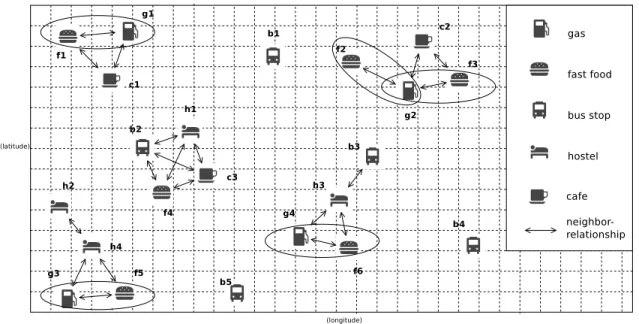
Given a set F of features, a (spatial) co-location patterns is a subset of F con-taining features that frequently appear nearby together in some geographic space. For example, as illustrated in Figure 2.1, the set {‘gas’, ‘fast food’} is an exam-ple of a co-location pattern describing that a gas station and a fast food restaurant are often located together. Nile Crocodile and Egyptian Plover Bird constitute an-other prominent example of a co-location pattern [51]. Note that in the problem of mining co-location patterns, prevalent patterns mean interesting patterns. Existing approaches to the discovery of interesting co-location patterns can be categorized into three groups: statistics-based,clustering-based, andassociation rule-based approaches. We review work in each group in the following.
Statistics-based approaches use statistical measures to estimate spatial correla-tions between features, such as the cross-K function [27] or G-function [37]. A
com-Figure 2.1: Example spatial dataset. Instances of each feature in the set {‘gas’, ‘fast food’, ‘bus stop’, ‘hostel’, ‘parking’, ‘cafe’} are placed at different geographic locations. An instance of the feature ‘gas’ and an instance of the feature ‘fast food’ tend to be located nearby.
mon limitation of these approaches is that computing all possible co-location patterns is computationally expensive. Such approaches are therefore not scalable. Only few works belonging to this category have been proposed.
Traditional data clustering techniques can be utilized to discover co-location pat-terns. Clustering-based approaches are further divided into two subcategories: object-clustering and feature-clustering. Castrol et al. [33, 34] use an object-clustering approach to find prevalent co-location patterns. For each feature, objects exhibit-ing this feature are clustered. Boundaries of clusters are also computed. Based on the Apriori algorithm [43], candidates of co-location patterns are generated. From these, interesting ones are obtained based on a prevalence measure computed from the overlapping areas of respective cluster boundaries. Since this prevalence measure is anti-monotonic, the above approach can utilize the strategies as discussed in the previous section to efficiently prune the pattern space. However, the quality of results heavily depends on the quality of clustering processes. Thus, such an object-clustering approach fails in cases where objects of one or more features cannot be clustered well. Instead of clustering objects, Huang et al. [54] cluster features to find co-location patterns. The authors treat each feature as a layer and cluster these layers. They define a density-based metric to compute the similarity between two layers. Basically, this metric is computed from the area of overlapping regions of respective layers.
Discovered clusters are considered co-location patterns. The main drawback of this method is that each feature is assigned to only one cluster. Consequently, one feature occurs in at most one co-location pattern. This is not appropriate in many application domains. Furthermore, the quality of results is impacted by the selected clustering algorithm as well as the characteristics of the input data.
The third category consists of approaches motivated by frequent itemset mining approaches. The Apriori Algorithm [43] is suitably applied for mining co-location pat-terns. Following this, there are two main directions: transaction-based and instance-based approaches.
The key idea of a transaction-based approach is to define transactions for the input dataset so that the Apriori algorithm can be applied. Koperski and Han [61] propose a method to define transactions based on a set of predefined predicates, e.g., is a(X, house) or close to(X,beach). A transaction consisting of predicates is then generated for each object belonging to a reference-feature specified by the user. For example,
{is a(X,house), close to(X,beach), is expensive(X)}is a transaction corresponding to the objectX of the reference-featurehouse. Prevalent patterns discovered by applying the Apriori algorithm are relevant to the selected reference-feature. Generalizing this approach to the case where no reference-feature is specified is nontrivial.
Different from transaction-based approaches, instance-based approaches do not rely on defining transactions. Instead, instances of patterns are computed dynamically based on spatial distances between objects exhibiting the relevant features. Such instances are then utilized to compute the interestingness (here, the prevalence) of patterns. Three common steps are: (1) candidate pattern generation, (2) instance collection, and (3) prevalence evaluation. Most of the recent approaches use the Apriori algorithm in the first step to generate candidates. However, they differ in implementing and optimizing the last two steps.
Morimoto [83] enumerates instances for a co-location pattern based on space par-titioning. In his approach, the interestingness of a co-location pattern is simply the number of the corresponding instances. However, to obtain the anti-monotonic prop-erty for this measure, the author assumes a non-overlapping instance constraint, that is, any object must belong to only one instance. Thus, this approach might find an incomplete set of patterns because of missing instances [51].
To obtain completeness and correctness in mining co-location patterns, Huang et al. [51] define another prevalence measure, called the participation index, which not only allows overlapping instances but also has the anti-monotonic property. Their approach, known as a full-join approach, is based on joining instances of size-k
pat-terns to compute instances of size-(k+1) patterns. For example, instances of the pattern {‘gas’, ‘fast food’, ‘cafe’} are computed based on instances of {‘gas’, ‘fast food’} and {‘gas’, ‘cafe’}. This method is inefficient for dense datasets containing a large number of instances. Therefore, recent approaches have been proposed to improve the performance of the mining process, including partial-join approach [129], joinless approach [130] and density-based approach [122].
Yoo et al. [129] propose a partial-join approach based on finding maximal cliques to reduce the number of join operations in generating instances. However, finding maximal cliques is also computationally expensive. Thus, the authors also propose a joinless approach [130] based on an instance-lookup scheme. Instead of finding maximal cliques, they build a table of so-calledstar instances to enumerate instances. A disadvantage of this approach is the memory cost to store the table of star-instances. Another direction to reduce the number of join operations in enumerating in-stances is based on an upper bound of the prevalence measure. Xiao et al. [122] propose a method to early prune false pattern candidates based on dividing space into partitions, for example, cells of a grid. In the step of generating size-k instances, these partitions are sorted by descending density of size-(k-1) instances. Instead of considering all objects in the whole space, only objects of a partition are considered to enumerate instances. Based on this, an upper bound of the prevalence is computed for each pattern candidate, and false pattern candidates can be pruned early.
Note that all approaches mentioned above consider only the spatial dimension for mining co-location patterns. For spatio-temporal data, co-location patterns can be extended to co-occurrence patterns to represent features that frequently occur nearby in space and time, e.g., [20, 115, 124]. Although these approaches take the temporal dimension into account, they only consider temporal relationships between objects to enumerate instances, i.e., at the instance level. Thus, their pattern language cannot express temporal relationships, e.g., before, after, or follows, between features. In the next section, we review well-known approaches to the discorvery of sequential patterns where temporal relationships between features are taken into account.
2.2.2
Sequential Pattern Mining
Whereas co-location/co-occurrence patterns are subsets of object features, a sequen-tial pattern is typically described as a sequence of features where the order of features in this sequence is important. Sequential patterns are often extracted from sequence data, e.g., customer purchasing records, stock data, web log of a click stream, or
DNA sequences. Approaches to the discovery of sequential patterns are reviewed in the following.
The problem of mining sequential patterns has been introduced by Agrawal and Srikant [2] for the purpose of extracting all frequent subsequences from time-related data. In their approach, a sequence is a list of transactions ordered by transaction time, and a transaction is a set of items. They propose an algorithm, calledAprioriAll, that employs the Apriori property, i.e., any super-pattern of an infrequent pattern cannot be frequent. To improve the performance of AprioriAll, the authors present a new algorithm called GSP, which employs a hash structure for fast support counting in their subsequent work [104]. The algorithms GSP and AprioriAll create a large number of pattern candidates and also make multiple passes over the database. In other words, these approaches are not efficient.
For the purpose of improving the sequential pattern mining performance, several approaches have been proposed. Zaki [131] proposes a lattice-based approach, called SPADE (Sequential PAttern Discovery using Equivalence classes), to minimize the computational cost. In addition, this approach can discover frequent subsequences of subsets of items (e.g.,{a, b} → {c} → {a, d, e}), not just subsequences of single items (e.g., a →c →b) as in the approach of Agrawal et al. [2]. In the SPADE approach, a vertical layout of the sequence database, called id-list, is built for fast instance counting and also reducing the number of database scans. Based on the id-list, a lattice of patterns is constructed on-the-fly with an initialization based on size-1 and size-2 frequent subsequences, which are precomputed using an Apriori-like method. To solve the problem that the lattice may not fit in main memory, this approach partitions the lattice into disjoint subsets, where each subset, called an equivalence class, can be separately processed in main memory. The lattice can be traversed in either breadth-first (BFS) or depth-first search (DFS). BFS takes advantage of more information available for pruning since the frequent patterns at the current level (size) must be completely discovered before processing the next level. On the other hand, DFS requires less memory than BFS, and therefore, it may be the only feasible approach when the number of frequent patterns is large.
Similar to SPADE, another approach, called SPAM [8], employs a data structure that is assumed to fit in main memory, called a vertical bitmap, for efficient support counting. This approach also assumes a transaction database as input. Each item appearing in transactions of the database is represented by a bitmap, where the
i-th bit of the bitmap corresponds to the presence or absence of the item in the i-th
sequence. The children of a node in the tree are created by extending the sequence corresponding to the node using either sequence-extension step (i.e., increasing the sequence length) or itemset-extension step (i.e., increasing the number of items for the itemsets of the current sequence). SPAM traverses the tree in depth-first-search and utilizes the vertical bitmaps to efficiently prune infrequent patterns. Experiments show that SPAM outperforms SPADE in terms of computation time, but it is less efficient than SPADE in terms of memory consumption [76].
An alternative to the generate-and-test method appearing in Apriori-based approaches is the pattern-growth method introduced in some approaches such as FreeSpan [44] or PrefixSpan [89]. Generally, these approaches generate as few pattern candidates as possible by growing longer patterns from shorter ones. Such approaches are typically based on projected-databases to partition the search space. Let α be a subsequence and D be a dataset of sequences. In the approach FreeSpan [44], sequences of theα-projected-database are derived from sequences ofDthat haveαas a subsequence. In the approach PrefixSpan [89], the α-projected-database contains sequences where each one is a postfix of some sequence in D that has α as a prefix. For each pattern α, only the α-projected-database is considered to compute the support for α and to generate super-patterns of α. Experimental results show that PrefixSpan outperforms FreeSpan [89]. In the experiments of Ayres et al. [8], both PrefixSpan and FreeSpan do not perform well for large datasets.
To reduce the computation time and also to find only patterns that satisfy the requirements of the user, constraint-based approaches are often considered. Mannila et al. [79] propose an approach to mine frequent episodes in a sequence of events, where each episode follows some predefined template. A template is defined as a directed acyclic graph of event types. For example, type A event → type B event
is an example of a serial episode template. Another direction to constrain types of patterns in the output is using regular expressions, such as an approach called SPIRIT [36]. Generally, the efficiency of a constraint-based approach depends on the properties of the constraints (i.e., monotonicity or anti-monotonicity). Such proper-ties allow pushing constraints inside the pattern mining process so that false pattern candidates can be pruned early. However, some constraints are neither monotonic nor anti-monotonic (e.g., regular expression constraints). For such a constraint, a possible solution might be based on relaxing that constraint [36] or generalizing the monotonic/anti-monotonic properties, e.g., to prefix-anti-monotonicity [90].
All the approaches mentioned above consider only the temporal dimension, i.e., in terms of chronological order of transactions. Moreover, these approaches assume that
sequences explicitly exist in the input dataset. For example, a → {b, c, d} → {a, c}
is a sequence of 3 transactions, where the first transaction consists of an item a, the second transaction consists of items b, c, and d, and the last transaction consists of two itemsaandc. In the context of spatio-temporal data, such sequences are typically not given or simply do not make sense. Indeed, such sequences will be derived from both spatial and temporal relationships among events in the spatio-temporal dataset. Thus, new approaches come into play for the purpose of mining sequential patterns from spatio-temporal data.
One direction to tackle the problem in which sequences of events are not explicitly given is a method based on partitioning the space into discrete locations. For each location, events occurring at this location constitute a sequence. For example, an approach proposed by Tsoukatos and Gunopulos [110] uses a grid and a reverse-z order to enumerate sequences of environmental events, e.g., temperature or atmospheric pressure. Subsequently, sequential patterns can then be discovered by one of the approaches such as SPADE or PrefixSpan. Another direction is based on identifiers of objects producing events to build event sequences from moving object datasets [16, 17]. Generally, approaches in both directions are designed foronly specific spatio-temporal data types, e.g., moving object data or environmental data. As mentioned earlier, partitioning space for transactions is not natural, and object identifiers might not exist in some cases.
Huang et al. [53] propose a general framework to discover sequential patterns from a dataset of events in which both spatial and temporal relationships between events are considered. Based on the concept of a spatio-temporal neighborhood of events, significant sequential event patterns can be extracted without explicitly defin-ing event sequences. We also employ this idea to model event patterns and instances in Chapter 4. However, different from their approach where they consider only fol-lows-relationships between time point-based events, our approach can discover event patterns expressing complex combinations of multiple temporal relationships, e.g., before, during, oroverlaps, among interval-based events. Furthermore, with the pres-ence of topic-based, spatial, and temporal hierarchies of events, our approach is able to derive spatio-temporal patterns at different levels of abstraction and granularity. This has not been considered by the approach of Huang et al. This idea will be detailed in Chapter 4.
2.2.3
Periodic Pattern Mining
Generally, periodic patterns describe regular appearances of some elements in a long sequence, such as a time series or a moving object trajectory. Different from mining sequential patterns as mentioned in the previous section, mining periodic patterns is to find patterns that occur in some regularity. For example, some data mining and machine learning conferences annually co-occur, or an individual tends to follow the same route from his home to his office every working day of the week. Finding such patterns is important for many applications, for instance, forecasting upcoming events, predicting user behavior for service suggestion, or for better understanding the inherent characteristics of the underlying dataset. In the following, we discuss problems and existing approaches related to mining periodic patterns from time-related data.
First, periodicity needs to be explicitly modeled. Given a sequence of elements (features as mentioned in Section 2.2.1), if an element periodically appears in that sequence, then it will be found in that sequence in every fixed time interval, called cycle. A period is a duration of one cycle that an element re-occurs. Most of the traditional approaches to the discovery of unknown periods from time series or se-quence data are typically based on the Discrete Fourier Transform (DFT) and its variations [113]. Since in Chapter 5 we will employ one of these methods as a tool to detect periods for periodic patterns, we briefly describe the DFT in the context of periodicity analysis for time series data as follows.
Given a time series of N real values, denotedx(n),n= 0,1,2, ..., N−1, the DFT of a sequence is a sequence ofN complex numbers defined as:
X(k) :=
N−1 X
n=0
x(n)e−i2πkn/N k= 0,1,2, ..., N −1. (2.2) Note that each X(k) is a complex number that encodes the amplitude and phase of a sinusoidal component of the original data x(n). The frequency, amplitude and phase of this sinusoid are Nk, |XN(k)|, and arg(X(k)), respectively. Based on X(k), the original datax(n) can be represented as
x(n) = 1 N N−1 X k=0 X(k)ei2πkn/N n = 0,1,2, ..., N −1. (2.3)
The DFT of a given time series can be efficiently computed in O(Nlog(N)) time, where N is the length of the time series, with a Fast Fourier Transform (FFT), e.g.,
the Cooley-Tukey algorithm [113]. Based on the DFT, the power spectral density at a frequency Nk can be estimated as P SD(k) = |X(k)|2. This value represents how much the expected signal power at that frequency is. Since period is the inverse of frequency, significant periods can easily be detected by selecting the frequencies carrying most of the energy. For sparse data, the Lomb-Scargle periodogram [74, 99], known as a variation of the Fourier transform, can improve the performance.
Another method to detect significant periods is using the circular AutoCorrelation Function (ACF) [114] defined as
ACF(t) = 1 N N−1 X n=0 x(t).x(n+t) t= 0,1, ..., N −1. (2.4) Generally, the valueACF(t) represents how similar the sequencex(n) is to its previous values for differenttlags. The higher theACF(t) is, the more likelytis a true period. Thus, based on this, significant periods can be automatically identified.
For each period t that is detected by any of the methods mentioned above, a periodic pattern is then a length-t subsequence of the original sequence. However, such a pattern is only able to represent a full-cycle periodicity in the sense that all points in a cycle have to be repeated. In cases where only some points have a cyclic behavior, approaches to the discovery of partial periodic patterns [42, 45, 75] can be employed. For example, a music event that occurs every Monday and Saturday but might or might not occur on other days of the week can be represented as a pattern (music,*,*,*,*,music,*). A more flexible model of partial periodic patterns is a model of asynchronous periodic patterns [126]. An asynchronous periodic pattern is a subsequence of the original sequence that only repeats in some disjoint segments of the original sequence, and two consecutive segments are allowed to be separated by at most a time distance threshold. Some other variations of periodic patterns are surprising periodic patterns modeled by an information gain metric [125], partial pe-riodic patterns withgap penalties [127],cyclic association rules [85], orrepresentative trends based on relaxed periods [55].
In each approach mentioned above, periodic patterns are discovered from a long sequence that is assumed to obey some periodicity. Such an approach cannot directly be applied to spatio-temporal data for the following reasons. As mentioned in Sec-tion 2.2.2, sequences are not typically given in a spatio-temporal dataset (e.g., event data) but are often derived from spatial and temporal relationships between events. Although in the context of moving object data, an object trajectory can be consid-ered a sequence of geo-coordinates, a coordinate rarely repeats itself exactly in such
a sequence [18, 77]. Therefore, new approaches are needed for spatio-temporal data. Since such approaches are closely related to our approach presented in Chapter 5, they will be discussed in more detail and compared with our work there.
2.3
Concept Hierarchies and Pattern Mining
As useful background knowledge, concept hierarchies play an important role in pattern mining approaches to the discovery of patterns at different levels of abstraction. Such hierarchies naturally exist in various real-world application domains, typically in the form of a taxonomy tree or a more complex structure such as a directed acyclic graph (DAG). In this section, we review recent approaches to the discovery of patterns at different levels of abstraction in the presence of concept hierarchies.
Srikant and Agrawal [103, 104] generalize the problem of mining frequent itemsets and association rules for cases where hierarchical relationships (is-a relationships) between items are available. Their approach aims at finding generalized association rules consisting of items at different levels of the underlying hierarchy. Since this approach uses a single support threshold for all levels of abstraction, many uninter-esting rules will be included in the result if the threshold is rather low, but many interesting rules will be discarded if the threshold is rather high. Instead of using a uniform threshold for support, Han and Fu [41] propose an approach using multi-ple support thresholds, where each threshold corresponds to a particular level of the hierarchy. Consequently, each pattern discovered by this approach only consists of items at the same level of the hierarchy [92]. Moreover, explicitly specifying support thresholds based on hierarchy levels might not always be trivial, especially in cases where concept hierarchies are represented by DAGs.
Several approaches to the discovery of patterns from multi-dimensional databases can be considered related to this field. Pinto et al. [91] propose an approach to find sequential patterns in the presence of multi-dimensional information for sequence data. For example, multiple attributes of a customer (e.g., job, age-group, or income-group) can be embedded in his transaction sequence, such ash(business, middle-aged, high-income), habacbii, where habacbi is a sequence of products purchased by that customer. This approach allows attributes to be generalized to a meta-symbol ‘*’ (referred to ALL) in a pattern. For example, the pattern h(*, *, high-income), habii describes that customers belonging to the high-income group will buy item ‘b’ after buying item ‘a’. Thus, this approach can be considered a special case of multilevel
pattern mining, where only two levels are considered, namely the most specific level and the most generalized one (denoted by ‘*’).
A more general approach to the discovery of multilevel patterns from multidimen-sional databases is proposed by Plantevit et al. [92]. Similar to our approach that will be detailed in Chapter 4, their approach can deal with sequential patterns in which each item can be a tuple of multiple attributes. However, although their approach can handle concept hierarchies, their patterns are only able to represent timepoint-based relationships. Moreover, they do not consider spatial relationships and therefore their approach cannot be applied for spatio-temporal data.
In the Semantic Web, ontologies, often described within the Resource Description Framework (RDF), can be considered promising sources to obtain concept hierarchies. In such RDF-based data sources, an RDF statement is the basic element consisting of a subject, a predicate, and an object. Based on RDF, hierarchical relationships between concepts can be defined with special predicates, e.g., is-a, sub-class-of, or type. Jiang and Tan [57, 58] propose an approach based on traditional algorithms for mining frequent itemsets from transaction databases to discover frequent relationsets (sets of RDF statements) from RDF data. Using concept hierarchies embedded in RDF data, this approach can find patterns containing not only original RDF state-ments in the RDF dataset but also generalizations of such RDF statestate-ments. However, since this approach defines a transaction as an RDF document that contains RDF statements, it cannot be applied for spatio-temporal data. As mention earlier, in the context of spatio-temporal data, defining transactions is not natural due to the continuity of space and time.
In summary, pattern mining is an application-driven problem which is often ad-dressed and realized for a particular application and data type. In this chapter, we reviewed prominent approaches that are closely related to our work. Briefly, none of these approaches can be applied to event data which are provided and shared by so-cial media platforms. Before describing our approaches, we introduce a comprehensive framework to model events in the next chapter.
Chapter 3
Event Data and Event Model
For the purpose of data mining and knowledge discovery from event data, one needs a comprehensive framework to model events. With the explosive growth of the Linked Open Data cloud of datasets, various event ontologies have been proposed to describe event information. However, to the best of our knowledge, there is no model in existing work that fits the pattern mining tasks we focus on in this thesis well, even there are still various definitions for the term ‘event’. The importance of an event model for the pattern mining approaches described in the later chapters motivates us to conduct a systematic study of a comprehensive and flexible model.
In following section, we define the term ‘event’ that will be used in this thesis. We then sketch an event model consisting of context, time, and location components. These three components will be described in detail in Section 3.2 and Section 3.3. Based on that, Section 3.4 formulates events and introduces the concept of event templates to describe event topics. Finally, we introduce event relationships and event constraints in Sections 3.5 and 3.6.
3.1
Preliminaries
Since there is no single agreed upon formal definition for the term ‘event’, we first specify what an event is in our context. We then discuss the availability and hetero-geneity of event data sources on the Internet. Finally, we propose an event model for the purpose of pattern mining and knowledge discovery, which is simple but flexible to deal with the heterogeneity of such event data.
3.1.1
What is an Event?
The term ‘event’ is used in many domains and it has several meanings. In general, an event refers to an observable occurrence or a phenomenon in the real world. For example, an event might be a festival, a live concert, or a sports competition. In me-teorology and climatology, meteorological phenomena are observable weather events such as hurricanes, blizzards, or floods. In social media data, a check-in, a tweet, or a comment of a user might also be considered an event. In software development, an event can be a user action (e.g., a keystroke or a mouse click) or a system occur-rence (e.g., running out of memory or a firewall event). Moreover, an event might be a collections of other subevents, for example, a conference event consists of multi-ple presentations. In brief, ‘event’ might have different definitions and semantics in different application domains and contexts.
Despite the fact that there are various definitions and meanings for the term ‘event’, in this thesis, we simply take this definition from WordNet1: “something that happens at a given place and time”. This definition is also commonly used in the Information Retrieval community [35], and especially in Topic Detection and Tracking [3].
From such a definition, an event, or more precisely, a spatio-temporal event, is typically described with three types of information: context,time, andlocation. They are considered three core components of an event description to answer the three following questions about the corresponding fact in the real world: “What happened?”, “When did it happen?”, and“Where did it happen?”.
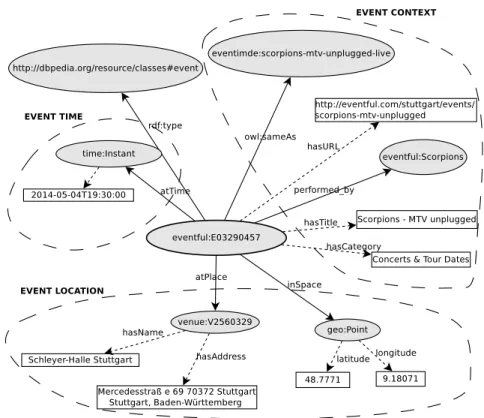
For example, Figure 3.1 depicts an event about a performance of the band Scor-pions in Stuttgart, described using an RDF-based event description. One can see different related information about the events represented as properties, such as the title, the category, or the venue. Such properties can be classified as either contextual, temporal, or spatial information, such as the grouping shown in Figure 3.1.
In the following sections, we will discuss from where to obtain such event data, and how to utilize the data for the purpose of mining interesting event patterns.
3.1.2
Event Data Sources
Nowadays, there is a huge number of data sources available on the Internet that provide event data where each record consist of information about the context, time
1Princeton University “About WordNet.” WordNet. Princeton University. 2010.