SECURING THE SOFTWARE-DEFINED NETWORKING CONTROL PLANE BY USING CONTROL AND DATA DEPENDENCY TECHNIQUES
BY
BENJAMIN E. UJCICH
DISSERTATION
Submitted in partial fulfillment of the requirements
for the degree of Doctor of Philosophy in Electrical and Computer Engineering in the Graduate College of the
University of Illinois at Urbana-Champaign, 2020
Urbana, Illinois
Doctoral Committee:
Professor William H. Sanders, Chair Assistant Professor Adam Bates Professor Carl A. Gunter Professor Ravishankar K. Iyer
ABSTRACT
Software-defined networking (SDN) fundamentally changes how network and security practition-ers design, implement, and manage their networks. SDN decouples the decision-making about traffic forwarding (i.e.,the control plane) from the traffic being forwarded (i.e., the data plane). SDN also allows for network applications, or apps, to programmatically control network forward-ing behavior and policy through a logically centralized control plane orchestrated by a set of SDN controllers. As a result of logical centralization, SDN controllers act as network operating systems in the coordination of shared data plane resources and comprehensive security policy implementation. SDN can support network security through the provision of security services and the assurances of policy enforcement. However, SDN’s programmability means that a network’s security consider-ations are different from those of traditional networks. For instance, an adversary who manipulates the programmable control plane can leverage significant control over the data plane’s behavior.
In this dissertation, we demonstrate that the security posture of SDN can be enhanced using control and data dependency techniques that track information flow and enable understanding of application composability, control and data plane decoupling, and control plane insight. We support that statement through investigation of the various ways in which an attacker can use control flow and data flow dependencies to influence the SDN control plane under different threat models. We systematically explore and evaluate the SDN security posture through a combination of runtime, pre-runtime, and post-runtime contributions in both attack development and defense designs.
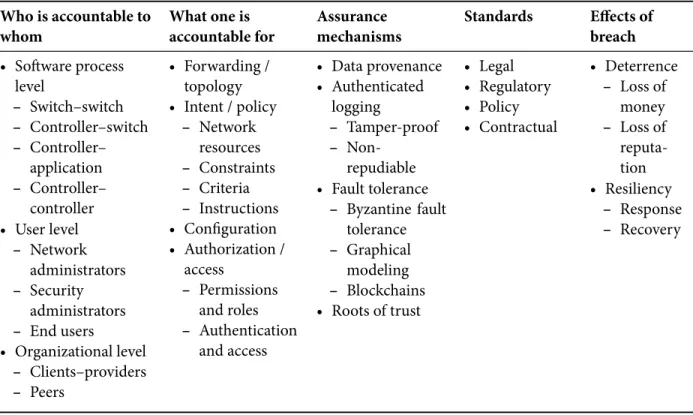
We begin with the development a conceptual accountability framework for SDN. We analyze the extent to which various entities within SDN are accountable to each other, what they are ac-countable for, mechanisms for assurance about accountability, standards by which accountability is judged, and the consequences of breaching accountability. We discover significant research gaps in SDN’s accountability that impact SDN’s security posture. In particular, the results of applying the accountability framework showed that more control plane attribution is necessary at different layers of abstraction, and that insight motivated the remaining work in this dissertation.
Next, we explore the influence of apps in the SDN control plane’s secure operation. We find that existing access control protections that limit what apps can do, such as role-based access controls, prove to be insufficient for preventing malicious apps from damaging control plane operations. The
reason is SDN’s reliance on shared network state. We analyze SDN’s shared state model to discover that benign apps can be tricked into acting as “confused deputies”; malicious apps can poison the state used by benign apps, and that leads the benign apps to make decisions that negatively affect the network. That violates an implicit (but unenforced) integrity policy that governs the network’s security. Because of the strong interdependencies among apps that result from SDN’s shared state model, we show that apps can be easily co-opted as “gadgets,” and that allows an attacker who min-imally controls one app to make changes to the network state beyond his or her originally granted permissions. We use a data provenance approach to track the lineage of the network state objects by assigning attribution to the set of processes and agents responsible for each control plane object. We design the ProvSDN tool to track API requests from apps as they access the shared network state’s objects, and to check requests against a predefined integrity policy to ensure that low-integrity apps cannot poison high-integrity apps. ProvSDN acts as both a reference monitor and an information flow control enforcement mechanism.
Motivated by the strong inter-app dependencies, we investigate whether implicit data plane de-pendencies affect the control plane’s secure operation too. We find that data plane hosts typically have an outsized effect on the generation of the network state in reactive-based control plane de-signs. We also find that SDN’s event-based design, and the apps that subscribe to events, can induce dependencies that originate in the data plane and that eventually change forwarding behaviors. That combination gives attackers that are residing on data plane hosts significant opportunities to influ-ence control plane decisions without having to compromise the SDN controller or apps. We design the EventScope tool to automatically identify where such vulnerabilities occur. EventScope clus-ters apps’ event usage to decide in which cases unhandled events should be handled, statically ana-lyzes controller and app code to understand how events affect control plane execution, and identifies valid control flow paths in which a data plane attacker can reach vulnerable code to cause unintended data plane changes. We use EventScope to discover 14 new vulnerabilities, and we develop exploits that show how such vulnerabilities could allow an attacker to bypass an intended network (i.e.,data plane) access control policy. This research direction is critical for SDN security evaluation because such vulnerabilities could be induced by host-based malware campaigns.
Finally, although there are classes of vulnerabilities that can be removed prior to deployment, it is inevitable that other classes of attacks will occur that cannot be accounted for ahead of time. In those cases, a network or security practitioner would need to have the right amount of after-the-fact insight to diagnose the root causes of such attacks without being inundated with too much informa-tion. Challenges remain in 1) the modeling of apps and objects, which can lead to overestimation or underestimation of causal dependencies; and 2) the omission of a data plane model that causally links control and data plane activities. We design the PicoSDN tool to mitigate causal dependency modeling challenges, to account for a data plane model through the use of the data plane topology to
link activities in the provenance graph, and to account for network semantics to appropriately query and summarize the control plane’s history. We show how prior work can hinder investigations and analysis in SDN-based attacks and demonstrate how PicoSDN can track SDN control plane attacks.
ACKNOWLEDGMENTS
First, I would like to thank my Ph.D. co-advisors, Prof. William H. Sanders and Prof. Adam Bates, for their tireless support, guidance, and advice in helping to plan the research direction of this dis-sertation. Both gave me the freedom to pursue my research interests, the environment to become an independent researcher, and the space to discuss any questions about research, careers, and life. I am grateful to Prof. Ravishankar K. Iyer and Prof. Carl A. Gunter for their advice as Ph.D. com-mittee members. I would also like to thank Prof. Andrew Miller, Prof. Klara Nahrstedt, Prof. Tarek F. Abdelzaher, Prof. Romit Roy Choudhury, Prof. Indranil Gupta, Prof. David M. Nicol, and Prof. Michael Bailey for their research discussions throughout my time at Illinois.
Much of this dissertation’s work came about from three summer internships at MIT Lincoln oratory in Lexington, Massachusetts, which included external collaborators from MIT Lincoln Lab-oratory, Northeastern University, and Princeton University. I am indebted to Samuel Jero, Richard Skowyra, Steven R. Gomez, Hamed Okhravi, Anne Edmundson, Bryan C. Ward, Nathan H. Burow, Prof. Cristina Nita-Rotaru, James Landry, and Roger I. Khazan for their help, discussions, support, and friendship. Those significant and long-lasting collaborations throughout those summers and during the intervening academic years were instrumental in shaping this dissertation’s research di-rection. I am forever thankful for my external colleagues who encouraged me in challenging times to persevere and to make this dissertation’s research contributions the best that they could be.
I have been blessed to have had a wonderful group of friends and colleagues at Illinois with whom I have had many discussions about research and about life in general. In the Performability Engi-neering Research Group (PERFORM), I would like to thank Uttam Thakore, Mohammad Noured-dine, Carmen Cheh, Ahmed Fawaz, Michael Rausch, Atul Bohara, Ronald Wright, Varun Badrinath Krishna, David Huang, Brett Feddersen, Ken Keefe and Gabriel Weaver. In the Secure & Trans-parent Systems Laboratory (STS), I would like to thank Wajih Ul Hassan, Pubali Datta, Riccardo Paccagnella, Dawei Wang, Noor Michael, Akul Goyal, Sneha Gaur, Saad Hussain, and Jai Pandey. I would additionally like to thank Qi Wang, Arjun Athreya, Subho Banerjee, Saurabh Jha, Yoga Varatharajah, Hui Lin, Homa Alemzadeh, Zane Ma, Joshua Reynolds, Deepak Kumar, Paul Murley, Seoung-kyun (Simon) Kim, Kartik Palani, and Elizabeth Reed.
practi-tioners who shared insights on various operational challenges. Debbie Fligor and Wayland Morgan in Technology Services at Illinois provided me with a better understanding of the networking, se-curity, and privacy challenges of large enterprise environments. I would also like to thank David Grogan at the University of Illinois System’s Ethics and Compliance Office for his discussions about the university system’s approaches to data protection.
I am particularly grateful to Jenny Applequist, Jan Progen, and Jamie Hutchinson for their ed-itorial assistance with this dissertation and related publications. I am appreciative of the wonder-ful support staff at Illinois, including Dawn Cheek-Wooten, Kelli Anderson, Linda Morris, Erica Kennedy, and Amy Irle, for their assistance with any question or need in the Coordinated Science Laboratory and Information Trust Institute. I am also indebted to Mandy Wisehart and Kathy Atch-ley (at Illinois), and Sue Haslett (at Carnegie Mellon University) for their incredible help with the preparation of my faculty and industry applications.
My research journey was inspired early on by several people during my time as an undergraduate and high school student. Prof. Kuang-Ching Wang and Prof. Harlan Russell at Clemson University encouraged me in my research pursuits and in the then-nascent SDN architecture. Dan Schmiedt and Brian Parker at Clemson University allowed me to observe the operational challenges of run-ning a university network, which inspired my research interest in the operational challenges of net-work debugging, troubleshooting, and security. Several summer internships with great colleagues at the GENI Project Office at Raytheon BBN Technologies exposed me to various networking re-search activities being performed across the country. Prof. Varavut Limpasuvan at Coastal Carolina University inspired my interest as a high school student in the value and enjoyment of research.
Finally, I would like to thank my parents. I am grateful for their time spent listening to my chal-lenges and successes throughout the dissertation process, and I am thankful for their unconditional and endless love.
This dissertation is based upon work supported by the Army Research Office under Award No. W911NF-13-1-0086; by the Air Force Research Laboratory and the Air Force Office of Scientific Re-search under agreement number FA8750-11-2-0084; by the Department of Defense under Air Force Contract No. FA8721-05-C-0002; by the Assistant Secretary of Defense for Research and Engineer-ing under Air Force Contract No. FA8702-15-D-0001; by the National Science Foundation under Grant Nos. CNS-1657534 and CNS-1750024; by the Maryland Procurement Office under Contract No. H98230-18-D-0007; by generous support from MIT Lincoln Laboratory; and by generous sup-port from the Roy J. Carver Fellowship provided by the Roy J. Carver Charitable Trust. Any opin-ions, findings, and conclusions or recommendations expressed in this dissertation are those of the author and do not necessarily reflect the views of the sponsoring organization.
TABLE OF CONTENTS
LIST OF TABLES . . . x
LIST OF FIGURES . . . xi
LIST OF ALGORITHMS . . . xii
LIST OF ABBREVIATIONS. . . xiii
CHAPTER 1 INTRODUCTION . . . 1 1.1 Overview . . . 1 1.2 Contributions . . . 3 1.3 Organization . . . 6 CHAPTER 2 BACKGROUND . . . 7 2.1 SDN Architecture . . . 7 2.2 SDN Architecture Attacks . . . 13 2.3 SDN Architecture Defenses . . . 19
CHAPTER 3 ACCOUNTABILITY IN SOFTWARE-DEFINED NETWORKING . . . 27
3.1 Introduction . . . 27
3.2 Designing an Accountable SDN Architecture . . . 29
3.3 Case Study: Accountable SDN Applications. . . 34
3.4 Conclusion . . . 36
CHAPTER 4 CONTROL PLANE CROSS-APP POISONING . . . 37
4.1 Introduction . . . 37
4.2 Threat Model. . . 40
4.3 Challenges . . . 41
4.4 Cross-App Poisoning . . . 42
4.5 Cross-App Poisoning Case Study: Security-Mode ONOS . . . 46
4.6 Information Flow Control Policies . . . 53
4.7 ProvSDN. . . 54
4.8 Discussion . . . 60
4.9 Related Work. . . 63
CHAPTER 5 CONTROL PLANE EVENT-BASED VULNERABILITIES . . . 65
5.1 Introduction . . . 65
5.2 Challenges . . . 69
5.3 EventScope Overview . . . 71
5.4 Event Use Analysis . . . 73
5.5 Event Flow Analysis . . . 79
5.6 Implementation . . . 85
5.7 ONOS Vulnerability Evaluation Results . . . 86
5.8 Discussion . . . 94
5.9 Related Work. . . 96
5.10 Conclusion . . . 98
CHAPTER 6 CONTROL PLANE CAUSAL ANALYSIS . . . 99
6.1 Introduction . . . 99
6.2 Challenges . . . 101
6.3 PicoSDN Provenance Model . . . 106
6.4 PicoSDN Threat Model . . . 112
6.5 PicoSDN Design . . . 112 6.6 Implementation . . . 120 6.7 Evaluation . . . 121 6.8 Discussion . . . 126 6.9 Related Work. . . 127 6.10 Conclusion . . . 128 CHAPTER 7 CONCLUSIONS . . . 129 7.1 Review of Contributions . . . 129 7.2 Overall Takeaways. . . 130 7.3 Future Research . . . 133
APPENDIX A PUBLICATIONS RELATED TO THE DISSERTATION . . . 135
APPENDIX B ProvSDN . . . 137
B.1 Security-Mode ONOS Details . . . 137
B.2 Selected Code for Reactive Forwarding App . . . 139
B.3 W3C PROV-DM Representations. . . 139
B.4 Implementing ProvSDN on Other Controllers. . . 139
APPENDIX C EventScope . . . 143
C.1 ONOS Application Structure . . . 143
C.2 ONOS Event Flow Graph Example . . . 147
C.3 Number of Clusters and Detection Rate . . . 147
LIST OF TABLES
2.1 Known Attacks on the SDN Architecture. . . 14
2.2 Runtime Defenses for the SDN Architecture. . . 21
3.1 Summary of Design Considerations and Properties for SDN Accountability. . . 28
4.1 Static Analysis Results of CAP Gadgets for Security-Mode ONOS Apps. . . 51
4.2 ProvSDN Micro-Benchmark Latencies. . . 59
5.1 Event Listener Vulnerabilities Based on Event Flow Graph Analysis and Event Use Filtering (τ=0.90). . . 87
6.1 Nodes in the PicoSDN Provenance Graph Model. . . 107
6.2 Edges (Relations) in the PicoSDN Provenance Graph Model. . . 107
6.3 List of PicoSDN Hooks. . . 120
B.1 Partial RBAC Model for Security-Mode ONOS and Included ONOS Apps. . . 138
LIST OF FIGURES
2.1 SDN architecture overview and app interactions via service APIs and event callbacks. 8
2.2 SDN architecture with event listeners and event dispatchers. . . 11
4.1 Example of a cross-app information flow graphG. . . 45
4.2 Cross-app information flow graphGONOS. . . 48
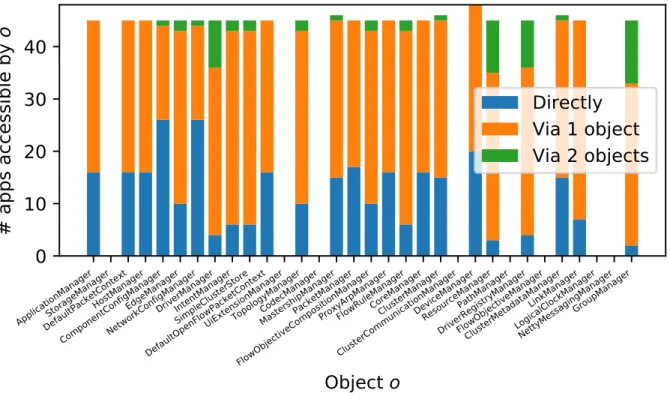
4.3 App to object accessibility (via shortest paths) inGONOS. . . 49
4.4 Object to app accessibility (via shortest paths) inGONOS. . . 49
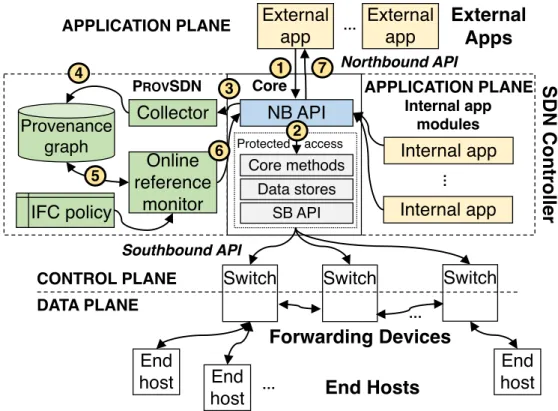
4.5 ProvSDN architecture showing an app calling the NB API. . . 55
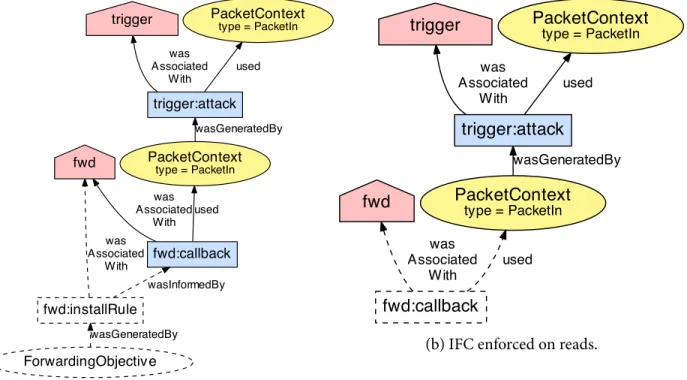
4.6 Provenance graphs generated from example CAP attack. . . 58
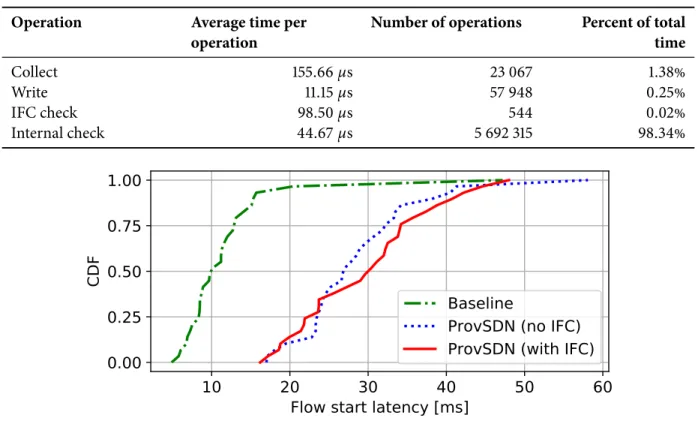
4.7 Flow start latency macrobenchmarks. . . 59
5.1 Cross-plane attack example. . . 69
5.2 EventScope architecture overview. . . 72
5.3 ONOS event use matrix. . . 77
5.4 Dendrogram representation of ONOS network event type similarity among apps. . 78
5.5 Event flow graph of fwd’s packet processor. . . 82
5.6 Component analysis performance results. . . 85
5.7 Partial event flow graph showing vulnerable code paths used in CVE-2018-12691. . 89
5.8 Partial event flow graph showing vulnerable code paths used in CVE-2019-11189.. . 92
6.1 Topology of the CVE-2018-12691 attack scenario. . . 102
6.2 Data, process, and agency provenance of the CVE-2018-12691 attack scenario. . . . 103
6.3 Data partitioning models for flow rules. . . 109
6.4 Comparison of execution partitioning models. . . 110
6.5 Data plane model. . . 111
6.6 PicoSDN architecture overview with example workflow. . . 112
6.7 PicoSDN latency performance results.. . . 122
6.8 Relevant features of the host migration attack’s graph. . . 124
6.9 Relevant features of the graph from the cross-app attack. . . 126
B.1 Selected reactive forwarding app code. . . 140
C.1 Abbreviated code structure of an example ONOS network application.. . . 144
C.2 Event flow graph of ONOS with core service components and several apps. . . 145
C.3 ONOS apps’ candidate and valid vulnerabilities as a function of clustering thresholdτ.. . . 147
LIST OF ALGORITHMS
4.1 Cross-App Information Flow Graph Generation . . . 44
5.1 Candidate Vulnerability Generation . . . 74
5.2 Event Flow Graph Generation . . . 81
5.3 Vulnerability Validation . . . 84
6.1 Data Plane Model . . . 115
6.2 Common Ancestry Trace . . . 116
6.3 Iterative Backward-Forward Trace . . . 117
6.4 Network Activity Summarization . . . 118
LIST OF ABBREVIATIONS
API Application programming interface ARP Address Resolution Protocol
AS Autonomous system
AST Abstract syntax tree
BDDP Broadcast Domain Discovery Protocol BGP Border Gateway Protocol
CAP Cross-app poisoning
CVE Common Vulnerabilities and Exposures DAG Directed acyclic graph
DHCP Dynamic Host Configuration Protocol DoS Denial of service
DPID Datapath identifier
HMAC Hash-based message authentication code ICMP Internet Control Message Protocol IDS Intrusion detection system
IFC Information flow control
IP Internet Protocol
IPC Inter-process communication IPv4 Internet Protocol version 4 LLDP Link-layer Discovery Protocol MAC Media access control
MLS Multi-level security
NB API Northbound application programming interface NOS Network operating system
ODL OpenDaylight
ONOS Open Network Operating System OSGi Open Services Gateway initiative
OVS Open vSwitch
PROV-DM W3C Provenance Data Model RBAC Role-based access control REST Representational state transfer ROP Return-oriented programming SAT Boolean satisfiability problem
SB API Southbound application programming interface SMT Satisfiability modulo theories problem
SDN Software-defined networking
STRIDE Spoofing, Tampering, Repudiation, Information Disclosure, Denial of Service, and Elevation of Privilege
TCAM Ternary content-addressable memory TCB Trusted computing base
TCP Transmission Control Protocol TOCTTOU Time-of-check-to-time-of-use VLAN Virtual local area network
CHAPTER 1
INTRODUCTION
1.1
Overview
Software-defined networking (SDN) is an emerging paradigm that provides flexible design of and control over computer networks. SDN has seen rapid commercialization to date, having been in-corporated into a variety of application domains spanning industrial utilities, cloud computing, and telecommunication providers, among others [1]. As a result, it has been estimated that the market value of SDN will total more than $12 billion by 2022 [2]. In contrast to traditional legacy networks, SDN decouples the decision-making of traffic forwarding (i.e.,the control plane) from the traffic being forwarded (i.e.,thedata plane), logically centralizes the decision-making into anSDN
con-trollercomposed of software processes, and exposes a set of network abstractions and API services to allow for development ofnetwork applicationsthat extend the control plane’s functionality [1].
Given that the SDN architecture’s centralization allows a network operator to “see” all network ac-tivities [3], SDN has been proposed as a network security service that augments the functionality of existing host-based security services. For instance, SDN’s flexibility in defining network forwarding rules allows for the implementation of fine-grained network security policies [4,5]. In contrast to separate middleboxes (e.g.,firewalls) that operate independently of the network’s forwarding devices (e.g.,switches and routers), the same network security functionality can be composed as network applications that react to network state changes and ensure that the proper network access control policies for hosts are enforced.
While SDN can implement network security services to further secure hosts on networks, the se-curity of SDN, too, must be understood in order to systematically evaluate the overall SDN sese-curity posture relative to that of legacy networks. The SDN architecture introduces several new security considerations, such as attacks on controllers, the lack of trust between network applications and controllers, and the lack of trusted forensics tools for control plane insight [6]. Those issues, among others, have become more pronounced as simple SDN controllers have grown into complex and full-fledged programmablenetwork operating systems.
Much like traditional desktop operating systems, network operating systems are responsible for the coordination and security of resources shared among applications and users. For networks,
the shared resources are the network’s control plane and the network’s various abstractions. SDN controllers operating as network operating systems, such as OpenDaylight (ODL) and the Open Network Operating System (ONOS), typically provide 1) a set ofnetwork abstractionsfor reasoning about network objects; 2) a set ofcore servicesand API calls that allow network applications to inter-act with ashared SDN control plane state, which comprises topological information and forwarding rule behavior; and 3) anevent-basednotification system that dispatches events to interested network applications and core services upon control plane state changes.
Given that the most popular SDN controllers have been designed as network operating systems, we consider the traditional challenges of secure operating system design as applied to the SDN context. That approach allows us to evaluate the security of SDN and the overall SDN security posture. We want to understand the unique characteristics of SDN that pose new challenges in the design of secure network operating systems, and we focus in particular on control plane insight and information flow within the control plane because of the control plane’s systemic effect on network operations. Taking SDN characteristics into account, we formulate three research questions about SDN control plane security vis-à-vis operating system design, as follows.
First, to what extent does the SDN design of composable network applications impact over-all SDN security properties? We compare SDN to different domains for which operating sys-tems have been designed and deployed. For instance, mobile operating syssys-tems, such as An-droid, can allow applications to operate relatively independently as sandboxes and to communi-cate through well-defined inter-process communication (IPC) [7]. In contrast, the SDN archi-tecture inherently focuses on the network as a single shared resource,1 and most security solu-tions to date have focused on authorization, permissions, and access control over that shared re-source [10,11,12,13,14,15,16,17,18,19,20,21]. In network operating systems, network applications share information through the use of API calls to core services, and these calls generate or use data that comprise the shared SDN control plane state. That inter-app communication mechanism via the shared state creates security challenges based on the potential for information flow from lower-integrity network applications to higher lower-integrity network applications.
Second, to what extent does the SDN design of control and data plane decoupling impact overall SDN security properties? Compared to legacy networks, a touted benefit of SDN is its decoupling of the control and data planes into separate concerns and abstractions [1]. One consequence of that design decision is that the design allows for the centralization of decision-making within the controller and for the use of “dumb” forwarding devices (i.e.,switches and routers) to implement the forwarding. Although control planes can be proactively configured, reactive control planes make 1Network “slicing” is possible through the use of network hypervisors, such as FlowVisor [8], that are positioned above an SDN controller or network operating system. However, network hypervisors suffer from scalability chal-lenges [9] and have been largely supplanted by SDN controllers that account for multi-tenant operators and virtual networks.
decisions based on data plane information; for instance, control plane decisions can be made based on data from incoming packets that were generated by network hosts. Control plane decisions made from untrusted sources, such as spoofed packets, can have systemic effects in the control and data planes [22]. Thus, the apparent decoupling of planes belies the implicit information flow, which has far-reaching and unintended network security ramifications.
Third, what design considerations are necessary for greater control plane insight? For instance, to guarantee coverage over all control plane activities in order to take preventative actions against undesired behavior, mechanisms such as reference monitors [23] should ensure that interposition over calls and events to enforce policy is possible. However, current SDN controllers and network operating system designs do not provide a central location that can interpose over all such activi-ties. Furthermore, given a shared-state design, the modeling of network abstractions and controller processes significantly affects the ability to reason about past activities for troubleshooting, root cause analysis, and attack understanding. However, current SDN controllers provide neither effi-cient mechanisms for accurate and precise tracking and understanding of causal dependencies, nor the precise agency representations necessary for attribution.
1.2
Contributions
It is our thesis that:
The security posture of a software-defined network can be enhanced using control and data dependency techniques that track information flow and enable understanding of ap-plication composability, control and data plane decoupling, and control plane insight.
This dissertation explores SDN control plane security with a focus on the design of secure network operating systems. Our goal is to study the security and accountability2 of the control plane as a primary objective, and we use control and data dependency techniques to solve the associated research questions. In particular, we leverage data provenance, or the metadata about how data were used and generated, as a core methodology in our exploration. Data provenance is frequently represented graphically: nodes represent data objects, system activities, and system principals; and edges represent relations among such objects, activities, and principals. The resulting graphical structure is amenable to causal dependency reasoning. We also leveragestatic analysisto aid in the identification of security-relevant control and data flows within the control plane’s core services and network applications.
2Accountability, as used in this dissertation, refers to attribution mechanisms that enhance “non-repudiation, deter-rence, fault isolation, intrusion detection and prevention, and after-action recovery and legal action” [24].
Throughout the dissertation, we use the ONOS SDN controller [25] as a running case study. ONOS is an open-source SDN controller developed in part by the Open Networking Foundation’s Open Networking Lab and supported as a Linux Foundation project. The ONOS code base is freely available online [26], which has allowed us to examine and extend its source code. ONOS also incorporates an extensive API and event-based notification system among its core services’ compo-nents and network applications. The ONOS code base also provides numerous network applications for analysis, and they serve as an underlying dataset for evaluating the efficacy of our various ap-proaches.
Our specific contributions in this dissertation are the following:
C1 We applied a conceptual framework of accountability to SDN to identify the agents, system entities, processes, and standards involved in network accountability assurance.
C2 We illustrated the need for accountability through a practical case study scenario of SDN net-work applications.
C3 We identified the information flow control (IFC) integrity problem in SDN,i.e.,cross-app poi-soning (CAP). We demonstrated that malicious apps can utilize a lack of information flow protections to poison the control plane’s state and escalate privilege.
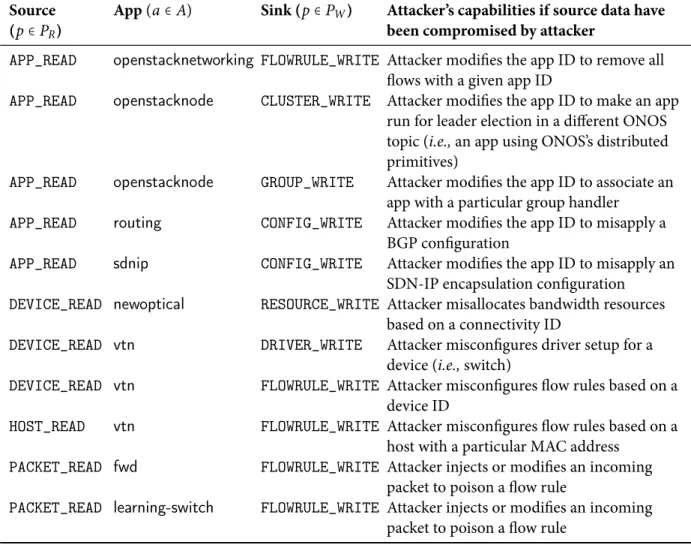
C4 We systematically identified CAP attack vulnerabilities, given a specified RBAC policy, by mod-eling the SDN control plane’s allowed information flows.
C5 We designed a defense against CAP attacks, ProvSDN, that uses data provenance for detection and prevention of CAP attacks by enforcing IFC policies online in real-time.
C6 We implemented and evaluated CAP attacks and ProvSDN with the ONOS controller.
C7 We designed an automated approach for analyzing SDN control plane event use by applications that identifies likely missing event handling and checks whether this lack of event handling, in combination with activities of other apps, can cause data-plane effects.
C8 We created the event flow graph data structure, which allows for succinct identification of (a) event dispatching, event listening, and API use among SDN components, as well as (b) a context in which vulnerabilities can be realized.
C9 We implemented our vulnerability discovery tool, EventScope, in Java and Python.
C10 We discovered and validated 14 new vulnerabilities in ONOS that escalate data plane access.
C11 We designed an approach to the dependency explosion problem for SDN attack provenance that utilizes event listeners as units of execution.
C12 We designed an approach to the incomplete dependency problem for SDN attack provenance that incorporates a data plane model and tracking of network identifiers.
C13 We designed and implemented PicoSDN, which we use with ONOS to evaluate SDN attacks and to demonstrate PicoSDN’s causal analysis benefits.
C14 We evaluated the performance and security of PicoSDN using recent SDN attacks.
In combination, data provenance and static analysis provide insight into an SDN control plane’s control and data flows prior to, during, and after runtime to ensure security properties and to strengthen the overall SDN security posture. Thus, we consider our research contributions on data provenance and static analysis temporally:
• Runtime:We used data provenance to build a graphical model of the lineage of objects
com-prising the shared SDN control plane state as that state changes over time (C5andC13). We used a reference monitor that referenced the provenance graph to enforce control plane infor-mation flow control (IFC). The IFC was based on an integrity policy of interest that prevented high-integrity network applications from being corrupted by low-integrity network applica-tions.
• Pre-runtime: We used static analysis to find “gadgets” of data flows that began at
permis-sioned API read calls in network applications and flowed to permispermis-sioned API write calls (C4). Such “gadgets” can be used by low-integrity network applications to influence high-integrity network applications implicitly through the shared SDN control plane state. We also used static analysis techniques to study the extent to which information originated in the data plane (e.g.,incoming packets to be processed), traversed API calls and event dispatches within core services and network applications, and influenced control plane state changes that affected the data plane (e.g.,flow rule installation) (C8).
• Post-runtime: We used data provenance techniques to answer network-relevant questions
for root cause analysis (C14). Key benefits of organizing past network state provenance in a graphical model include the ability to discard noncausal activities from past history and the ability to understand the effects of undesired activities on other activities, both of which simplify a practitioner’s task of root cause analysis after a security attack has occurred. In addition to a temporal categorization, we can also consider our research contributions from the attacker’s and the defender’s perspectives:
• Attack development: We investigated a class of integrity-based information flow
that act as confused deputies (C3). We demonstrated that such attacks were possible through the use of a malicious app that instigated a series of cross-app poisoning “gadgets” (C4). We also investigated the class of information flow attacks that leverage data plane input to cause changes (via the control plane) to the data plane. We call such attackscross-plane event-based
attacks (C7). We found 14 new cross-plane event-based vulnerabilities in ONOS network applications, demonstrated several exploits that bypassed intended security policies, and reg-istered 8 Common Vulnerabilities and Exposures (CVE) identifiers with MITRE (C10).
• Defense design: We designed provenance-based defense mechanisms and implemented
them by extending the ONOS codebase and writing ONOS network applications to collect and query provenance data (C5andC13). We hooked relevant API calls and event dispatches within core services so that we would be able to interpose on all relevant calls and events. We designed a provenance model that mitigates challenges in the modeling of the network’s causal dependencies (C11 and C12). We built additional data provenance analysis tools to provide after-the-fact root cause analysis insight into collected runtime provenance (C13).
1.3
Organization
The rest of the dissertation is organized as follows:
• Chapter2provides background on the SDN architecture’s components, the known security attacks against the architecture, and the defenses against such attacks.
• Chapter3proposes an accountability framework for the SDN architecture and points out gaps in the existing body of effort to secure the architecture.
• Chapter4presents the cross-app poisoning problem and the runtime defense tool ProvSDN for information flow control.
• Chapter5presents the cross-plane event vulnerability problem and the pre-runtime defense tool EventScope for vulnerability discovery.
• Chapter 6 presents the challenges to control and data plane causal analysis and the post-runtime defense tool PicoSDN for causal analysis.
• Chapter7concludes the dissertation and provides overall takeaways and future research di-rections.
CHAPTER 2
BACKGROUND
In this chapter, we introduce the software-defined networking (SDN) architecture. We detail the architecture’s various components (Section2.1), which include the controller, network applications, and forwarding devices. Based on the design of the SDN architecture, we provide a comprehen-sive overview of the known security-related attacks against the SDN architecture (Section2.2) and defenses that improve the SDN architecture’s security posture against such attacks (Section 2.3). We categorize attacks related to flooding (Section2.2.1), information leakage (Section2.2.2), policy modification (Section2.2.3), and spoofing (Section2.2.4). We categorize defenses related to run-time detection (Section 2.3.1), pre-runtime detection (Section2.3.2), and post-runtime detection (Section2.3.3).
2.1
SDN Architecture
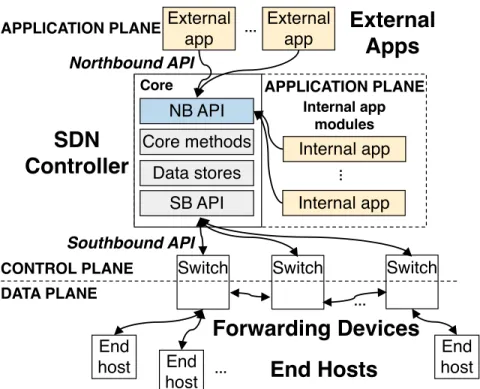
Figure 2.1ashows an overview of the SDN architecture. SDN decouples how traffic decisions are made (i.e.,thecontrol plane) from the traffic being forwarded (i.e.,thedata plane). Traffic decisions are made in a logically centralized (but perhaps physically distributed)controllerthat functions as the core of anetwork operating system. Controllers manage network configurations and forwarding rules in the network’s forwarding devices through thesouthbound API(e.g.,OpenFlow [27]). The
application plane extends the control plane’s management functionalities through the use of net-work applications(orapps) that can query the network’s current state or set high-level intents that
influence the network’s state. The aforementioned properties regarding plane decoupling, logical centralization, and programmability distinguish the SDN architecture from traditional networking architectures [1].
2.1.1
Controllers and the Control Plane
TheSDN controller(or simply thecontroller) acts as a network operating system to coordinate con-current applications, to provision resources, and to implement security or network policies [1].
Sev-Switch Switch
External
Apps
SDN
Controller
Core Internal app modules Internal app Internal app … External app External app NB API Core methods Switch CONTROL PLANE … SB API Data storesForwarding Devices
Northbound API DATA PLANE … End host End host End host … APPLICATION PLANE Southbound API APPLICATION PLANEEnd Hosts
(a) Architecture. SDN separates the data and control planes to logically centralize network control. The application plane modularly extends the control plane functionality. Apps can reside either as modules within the controller or as external processes.
Switch CONTROL PLANE DATA PLANE Switch Switch … Host store
APPLICATION PLANE App 1 App 2
Shared data structure n Host
service
API for shared data structure n SDN Apps SDN Controller Forwarding Devices 1 2 4 3 … … Flow rule service Flow rule store … App x
(b) Service API interactions.1:App 1 calls one of the host service’swrite()methods to insert a new host.2:The host service adds the object to its own data store.3:App 2 calls one of the host service’s
read()methods (not shown), and the service
queries the store.4:The host service returns the object to app 2.
Switch Switch Switch …
App 1 App 2 App 3
Event listener 1 2 3 4 5 6 CONTROL PLANE DATA PLANE APPLICATION PLANE Shared data structure n
API for shared data structure n … … SDN Apps Forwarding Devices SDN Controller
(c) Event callback interactions.1:A switch notifies the controller about an event.2:The event listener sends the event to the first registered app.3 and 4:Additional registered apps receive the event.
5:The last app optionally returns an event.6:The event is actuated (e.g.,in the data plane).
Figure 2.1: SDN architecture overview and app interactions via service APIs and event callbacks. eral controller frameworks exist, such as Floodlight [28], Ryu [29], the Open Network Operating System (ONOS) [25], and OpenDaylight (ODL) [30]. Special-purpose controllers for secure
envi-ronments include SE-Floodlight [15], Rosemary [14], and Security-Mode ONOS [19]. Controllers are written in general-purpose programming languages such as Java [15,19,25,28,30], Python [29], and C [11,14,31]. Apps are typically written in the same language as the controller (i.e.,as an internal module) but can also be language-independent (i.e.,as an external module).
2.1.1.1 Core services, core methods, and data stores
Controllers providecore servicesthat maintain the current state of the network and that enable a set of abstractions for additional functionality through apps. For instance, a controller could maintain an abstraction about data plane hosts (e.g.,aHostclass) that reside on the network (see Section2.1.1.2 for details about network abstractions). For such host objects, the controller would provide a host core service that enables apps to update information about hosts or retrieve information about hosts. For instance, the ONOS controller provides core services related to hosts, network topology, flow rules, forwarding devices, topology links, topology paths, network configurations, network statis-tics, and packets [32].
Core services maintaindata storesthat store representations of the network’s state. For distributed controllers that use more than one instance for high availability or fault tolerance, data stores can ei-ther be strongly consistent (i.e.,network partitions may hinder availability) or eventually consistent (i.e.,network partitions will not hinder availability but may induce temporary state inconsistencies across instances). For instance, the ONOS controller uses the Raft protocol for maintaining strongly consistent state [33].
Core services interact with their respective data stores throughcore methods. Apps and forward-ing devices interact with the controller’s core services throughapplication program interfaces(APIs). (See Section2.1.1.3for details about APIs.) Changes to objects within data stores may trigger the fir-ing of event dispatches to event listeners. (See Section2.1.1.4for details about events.)
2.1.1.2 Network abstraction model
Controllers exposeabstractions of network objects and processes. For instance, the ONOS controller includes abstractions forHostobjects that represent end hosts, and forDeviceobjects that represent forwarding devices. Those abstractions are built on top of information learned or programmed from lower levels. In ONOS, the host location provider (i.e.,a core service) buildsHostobjects based upon information learned fromPacketobjects’ header information. As a result, apps that are interested in changes to hosts can reason about such changes at the level of a host abstraction rather than a packet abstraction. That reduces the amount of redundant functionality that would otherwise need to be implemented across various apps.
2.1.1.3 API model
Controllers communicate via application program interfaces (APIs). The northbound API allows network applications to query controllers for network state abstractions or set intents about net-work policy. Thesouthbound APIallows controllers to set low-level forwarding rules in forwarding devices (e.g., switches and routers) and to query about network state. The eastbound/westbound
APIallows controllers to communicate among themselves or with other SDN systems to exchange
distributed state.
Northbound API (controller↔app) With service API calls, an app can read from or write to
one of the controller’s data stores via a corresponding service and the service’s public API methods. As shown in Figure2.1b, apps use the host service’sread()andwrite()methods to interact with the underlying host data store.
There is no standard controller-to-application interface among all controller frameworks, and each framework may establish different boundaries between the core functionalities and extensible apps. Apps can be implemented in two ways: as internal modules within the controller (represented by the dashed box in Figure2.1a) or as separate external processes decoupled from the controller. For example, the ONOS controller uses the OSGi framework in Java to manage internal app modules and states. ONOS, ODL, and Floodlight, among others, include a RESTful API for external apps.
Southbound API (controller↔forwarding device) SDN controllers also interact with network
forwarding devices to disseminate rules and to collect data plane statistics. One popular stan-dard protocol between controllers and forwarding devices is OpenFlow [27]. OpenFlow configures switches’ forwarding behavior through flow tables, such that each flow table consists of flow entries that match attributes of incoming data plane packets and assigns data plane forwarding actions. The protocol includes messages for sending data plane packets to and from the controller (i.e.,PacketIn andPacketOut), to modify forwarding behavior (i.e.,FlowMod), and to request and receive flow en-try statistics (i.e.,StatsRequestandStatsReply), among others. Other southbound API protocols include NETCONF [34], ForCES [35], and P4 [36].
Eastbound/Westbound API (controller↔controller) For distributed or federated SDN
archi-tectures, controller instances can share relevant state and state changes with each other through an eastbound/westbound API. The underlying consensus protocol for distributed controller instances (e.g.,Raft in ONOS [25]) can be viewed as the eastbound/westbound API.
SDN Controller Controller Core App A … Event Dispatchers (Northbound API) Core Services (Northbound API) CONTROL PLANE Southbound API Core Data Stores
DATA PLANE
…
APPLICATION PLANE
(Reactive Event-Based Network Applications)
EL (event kind X) App Internal Methods
App Internal Data Store OpenFlow Messages Network Events (in) Data Store Events Data Plane Connections EL (event kind Y) … App B EL EL … Network Events (out) Core Service Events EL EventListener Data Plane Host Forwarding Device …
Figure 2.2: SDN architecture with event listeners and event dispatchers. Apps subscribe to event dispatchers and implement event listeners. Network, data store, and service updates generate events.
2.1.1.4 Event model
In addition to API requests, controllers also implement aneventsystem. With event callbacks, an app registers itself with the controller to receive events of interest as they occur. In the example shown in Figure2.1c, all apps have registered to receive data plane events from a data plane event listener. Subsequent events may be generated as a result of the first event.
Most SDN implementations are event-driven systems that model data plane changes as asyn-chronous events; such changes might include, for example, the processing of an incoming data plane packet, the discovery of new network topology links, or changes in forwarding device states. Events have differentkindsdepending on the abstraction they describe (e.g.,hosts, packets, or links), and each event kind may have differentevent types that further describe the functional nature of the event (e.g.,host added or host removed).
Events are sent fromevent dispatchersand received throughevent listeners. Figure2.2shows a rep-resentative example of an event dispatcher that distributes events to event listeners. For instance, the controller may dispatch a network link event to all apps that are interested in network link state changes (i.e.,all apps that have registered link event listeners). An app that cares about new network links can use such an event to make decisions about what functionality to perform (e.g., recalcula-tion of bandwidth for QoS guarantees). Such an app can also gather informarecalcula-tion about what the control plane’s state looks like in the present (i.e.,perform API read calls), request changes to the control plane (i.e.,perform API write calls), or notify other apps and core services asynchronously
(i.e.,perform event dispatching). That process is replicated by other apps and core services that reg-ister event listeners and react to events, and the combination of such interactions forms the basis (and complexity) of the event-driven SDN architecture.
In the ONOS controller, apps can access the control plane’s state through API read calls (e.g.,
Host-Service.getHosts()) or by registering to receive asynchronous events (e.g.,listening forHostEvent events). API write calls can trigger event dispatches. ONOS uses a special listener for data plane packet events, thePacketProcessor, that allows components to receive or generate data plane pack-ets through the southbound API.
2.1.2
Apps and the Application Plane
The SDN architecture enables third-party and independent developers to writenetwork applications, orapps. For instance, HP Enterprise’s HPE Virtual Application Networks (VAN) SDN Controller includes an “app store” [37]. The ONOS controller includes a set of reference apps within its core repository [38] as well as a set of sample apps [39]. Such apps enable functionalities such as traffic engineering (e.g.,forwarding, routing, and IP address assignment with DHCP), security (e.g., fire-wall and data plane access control), integration (e.g.,OpenStack integration with SDN), monitoring (e.g.,telemetry), and general-purpose utilities (e.g.,network garbage collection) [38].
As noted earlier, apps can use the controller’s API calls and event system to receive updates upon state changes or request the current state. Appendix C.1 provides the skeleton code for a repre-sentative internal module app for the ONOS controller. Apps include activation and deactivation methods, event listeners, and API calls.
2.1.3
Forwarding Devices and the Data Plane
The SDN architecture implements the data plane by using a set offorwarding devices. In contrast to traditional networking architectures that separate the network into different areas of concern (e.g.,Layer 2 forwarding for local networks and Layer 3 routing for wide-area networks), SDN mod-els such switches and routers as generic forwarding devices. Each forwarding device contains a set offorwarding tables(orflow tables). Each forwarding table contains a set offorwarding rules(orflow
rules) that dictate how packets are matched and forwarded. Each forwarding rule contains a set of match fieldsupon which incoming packets are matched (e.g.,IPv4 source and destination prefixes)
and a corresponding set ofactionsthat can be taken (e.g.,drop, forward, or rate-limit).
As SDN centralizes the control plane decision-making in the controller, forwarding devices do not need to make decisions themselves about how to forward traffic. In contrast to traditional net-working architectures, each forwarding device can send relevant network configuration packets to
the controller that will make a decision. For example, a controller may send Link-layer Discovery Protocol (LLDP) or Broadcast Domain Discovery Protocol (BDDP) packets into the data plane to learn the network’s topology and link information. Based on that information, the controller may instantiate new forwarding rules and use a southbound API protocol (e.g.,OpenFlow) to do so.
As a result of such flexibility in decision-making, forwarding devices can operate much like Layer 2 reactive forwarding switches, Layer 3 routers, or middleboxes such as stateful firewalls. Pro-grammable data planes such as P4 [36] allow for additional flexibility on arbitrary match fields and actions.
Forwarding devices may be implemented in hardware or software. Hardware-based forward-ing devices may use ternary content addressable memory (TCAM) to store forwardforward-ing tables and forwarding rules for line-rate lookup speeds [27]. Open vSwitch [40] is a popular software-based forwarding device implementation found in network virtualization. Mininet [41] is a network emu-lator that uses Open vSwitch. OpenFlow-based forwarding devices are uniquely identified through a 64-bit datapath identifier (DPID) that consists of a 48-bit MAC address and a 16-bit implementor-dependent identifier [42] such as a VLAN number.
2.2
SDN Architecture Attacks
The “softwarization” of programmable networks introduces new and varied threats relative to tra-ditional networking architectures. Based on the SDN architecture presented in Section2.1, we now consider the potential vulnerabilities that the SDN architecture introduces.
Kreutz et al. [6] identify seven threat vectors in the SDN architecture: forged or faked traffic flows, switch vulnerabilities, control plane communication vulnerabilities, controller vulnerabili-ties, trust between controller and management applications, administrative host vulnerabilivulnerabili-ties, and lack of trusted forensics tools. Hizver [73] proposes a taxonomy for the SDN architecture’s security threats by categorizing threat sources, attacker actions, and threat targets. Bentonet al.[74] identify OpenFlow-based SDN architecture vulnerabilities. Klötiet al.[75] use the STRIDE methodology to identify OpenFlow-based SDN architecture vulnerabilities.
Several surveys investigate the SDN architecture’s security. Scott-Haywardet al.[76] categorize SDN security attacks and solutions according to unauthorized access, data leakage, data modifi-cation, malicious/compromised apps, denial of service, configuration issues, and system-level SDN issues. Martinet al.[77] survey SDN threats based on assets, users, and risks. Khanet al.[78] survey SDN topology-based threats. Sattoloet al.[79] survey SDN poisoning attacks based on outcomes, layers, and requirements. Yoonet al.[80] survey SDN attacks and categorize them based on one of the following attack locations: control plane remote attacks, control plane local attacks, control
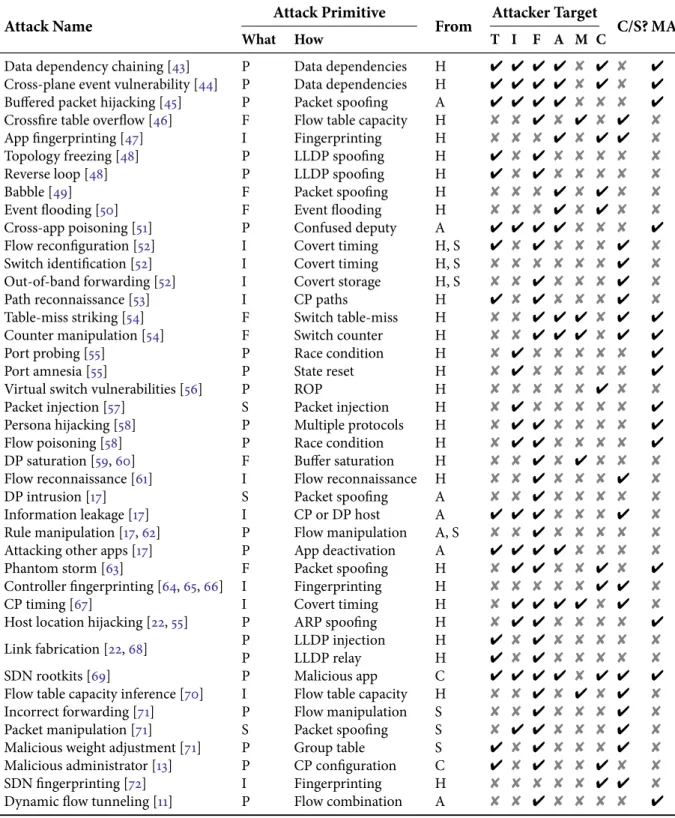
Table 2.1: Known Attacks on the SDN Architecture.
Attack Name Attack Primitive From Attacker Target C/S? MA?
What How T I F A M C
Data dependency chaining [43] P Data dependencies H ✔ ✔ ✔ ✔ ✘ ✔ ✘ ✔ Cross-plane event vulnerability [44] P Data dependencies H ✔ ✔ ✔ ✔ ✘ ✔ ✘ ✔ Buffered packet hijacking [45] P Packet spoofing A ✔ ✔ ✔ ✔ ✘ ✘ ✘ ✔ Crossfire table overflow [46] F Flow table capacity H ✘ ✘ ✔ ✘ ✔ ✘ ✔ ✘
App fingerprinting [47] I Fingerprinting H ✘ ✘ ✘ ✔ ✘ ✔ ✔ ✘
Topology freezing [48] P LLDP spoofing H ✔ ✘ ✔ ✘ ✘ ✘ ✘ ✘
Reverse loop [48] P LLDP spoofing H ✔ ✘ ✔ ✘ ✘ ✘ ✘ ✘
Babble [49] F Packet spoofing H ✘ ✘ ✘ ✔ ✘ ✔ ✘ ✘
Event flooding [50] F Event flooding H ✘ ✘ ✘ ✔ ✘ ✔ ✘ ✘
Cross-app poisoning [51] P Confused deputy A ✔ ✔ ✔ ✔ ✘ ✘ ✘ ✔
Flow reconfiguration [52] I Covert timing H, S ✔ ✘ ✔ ✘ ✘ ✘ ✔ ✘ Switch identification [52] I Covert timing H, S ✘ ✘ ✘ ✘ ✘ ✘ ✔ ✘ Out-of-band forwarding [52] I Covert storage H, S ✘ ✘ ✔ ✘ ✘ ✘ ✔ ✘
Path reconnaissance [53] I CP paths H ✔ ✘ ✔ ✘ ✘ ✘ ✔ ✘
Table-miss striking [54] F Switch table-miss H ✘ ✘ ✔ ✔ ✔ ✘ ✔ ✔
Counter manipulation [54] F Switch counter H ✘ ✘ ✔ ✔ ✔ ✘ ✔ ✔
Port probing [55] P Race condition H ✘ ✔ ✘ ✘ ✘ ✘ ✘ ✔
Port amnesia [55] P State reset H ✘ ✔ ✘ ✘ ✘ ✘ ✘ ✔
Virtual switch vulnerabilities [56] P ROP H ✘ ✘ ✘ ✘ ✘ ✔ ✘ ✘
Packet injection [57] S Packet injection H ✘ ✔ ✘ ✘ ✘ ✘ ✘ ✔
Persona hijacking [58] P Multiple protocols H ✘ ✔ ✔ ✘ ✘ ✘ ✘ ✔
Flow poisoning [58] P Race condition H ✘ ✔ ✔ ✘ ✘ ✘ ✘ ✔
DP saturation [59,60] F Buffer saturation H ✘ ✘ ✔ ✘ ✔ ✘ ✘ ✘
Flow reconnaissance [61] I Flow reconnaissance H ✘ ✘ ✔ ✘ ✘ ✘ ✔ ✘
DP intrusion [17] S Packet spoofing A ✘ ✘ ✔ ✘ ✘ ✘ ✘ ✘
Information leakage [17] I CP or DP host A ✔ ✔ ✔ ✘ ✘ ✘ ✔ ✘
Rule manipulation [17,62] P Flow manipulation A, S ✘ ✘ ✔ ✘ ✘ ✘ ✘ ✘ Attacking other apps [17] P App deactivation A ✔ ✔ ✔ ✔ ✘ ✘ ✘ ✘
Phantom storm [63] F Packet spoofing H ✘ ✔ ✔ ✘ ✘ ✔ ✘ ✔
Controller fingerprinting [64,65,66] I Fingerprinting H ✘ ✘ ✘ ✘ ✘ ✔ ✔ ✘
CP timing [67] I Covert timing H ✘ ✔ ✔ ✔ ✔ ✘ ✔ ✘
Host location hijacking [22,55] P ARP spoofing H ✘ ✔ ✔ ✘ ✘ ✘ ✘ ✔
Link fabrication [22,68] P LLDP injection H ✔ ✘ ✔ ✘ ✘ ✘ ✘ ✘
P LLDP relay H ✔ ✘ ✔ ✘ ✘ ✘ ✘ ✘
SDN rootkits [69] P Malicious app C ✔ ✔ ✔ ✔ ✘ ✔ ✔ ✔
Flow table capacity inference [70] I Flow table capacity H ✘ ✘ ✔ ✘ ✔ ✘ ✔ ✘ Incorrect forwarding [71] P Flow manipulation S ✘ ✘ ✔ ✘ ✘ ✘ ✔ ✘
Packet manipulation [71] S Packet spoofing S ✘ ✔ ✔ ✘ ✘ ✘ ✔ ✘
Malicious weight adjustment [71] P Group table S ✔ ✘ ✔ ✘ ✘ ✘ ✔ ✘ Malicious administrator [13] P CP configuration C ✔ ✘ ✔ ✘ ✘ ✔ ✘ ✘
SDN fingerprinting [72] I Fingerprinting H ✘ ✘ ✘ ✘ ✘ ✔ ✔ ✘
Dynamic flow tunneling [11] P Flow combination A ✘ ✘ ✔ ✘ ✘ ✘ ✘ ✔ Key to attack primitives:F = flooding, I = information leakage, P = policy modification, S = spoofing.
Key to from:H = hosts, A = apps, S = forwarding devices (i.e.,switches), C = controller configuration.
Key to attacker targets:T = topology, I = identity, F = forwarding rules, A = apps, M = switch memory, C = controller. Key to other abbreviations:CP = control plane, DP = data plane, C/S = covert/side, MA = misattribution.
channel attacks, and data plane attacks.
We provide an overview of the known attacks against the SDN architecture found in the literature to date. Table2.1summarizes the known attacks. We focus on theattack primitivethat each attack uses, how such a primitive manifests itself, where the attack is launched from, what the intended targets of the attack are, and whether such attacks attempt to use covert channels or misattribute the attack source. Those particular categories for analysis were chosen because they relate to the SDN architecture’s information flow, accountability, and attribution challenges. We organize the at-tack primitives into flooding (Section2.2.1), information leakage (Section2.2.2), policy modification (Section2.2.3), and spoofing (Section2.2.4).
We note that certain attack primitives may overlap. For instance, a spoofing attack may induce an unintended policy modification. In such cases, we classify an attack in its own primitive unless it could be considered a subset of another attack primitive. For instance, a spoofing attack is classified as a spoofing attack if its goal is not to induce a policy modification attack. For scoping reasons, we do not include attacks in which data plane hosts attack other hosts through the network, unless specific and unique characteristics of the SDN architecture are involved.
2.2.1
Flooding
Floodingattacks allow an attacker to disrupt the normal operation of the SDN network by causing
a degradation or denial of an intended service level. Flooding can cause a system failure when the rate of input to be processed exceeds the processing capacity [24].
Data-plane-to-control-plane saturation Flooding attacks in one component of the SDN
archi-tecture can cause systemic effects elsewhere [81]. For instance, flooding in the data plane can cause the control plane to stop functioning correctly, which in turn can cause further data plane denial of service. Shin et al.[60] and Ambrosinet al. [59] describe the challenges of data plane satura-tion attacks in which data plane hosts cause control plane denial of service through incomplete TCP handshakes (e.g.,SYN flooding) that exhaust available TCAM memory in forwarding devices. Smythet al.[63] describe the “phantom storm” attack, which floods the control and data planes with spurious packets. In that attack, a malicious data plane host uses ARP cache poisoning to send a spoofed IP address into the network. Benign data plane hosts reply, but given that the target host does not exist, the controller broadcasts and floods the data plane with additional packets for each reply. Xuet al.[46] propose the crossfire table-overflow attack in which colluding data plane hosts exhaust multiple forwarding tables intermittently.
Control plane reflection attacks use data plane packets as input to trigger expensive control plane decisions. Zhanget al.[54] propose the table-miss striking and counter manipulation attacks.
Table-miss striking attacks use targeted packets to determine which match header fields in packets are sensitive to causing such packets to be redirected to the controller (i.e.,which packets were a “miss” when matched against a forwarding device’s forwarding tables). Counter manipulation attacks use targeted packets to determine which southbound API messages are sent to the forwarding device.
Distributed controller consistency and event flooding The consistency model assumptions of a
distributed controller are also a significant flooding target. Smythet al.[50] show that the targeting of events through event flooding can induce a control plane denial of service when strong consis-tency guarantees need to be met. Hanmeret al.[49] show that the Raft consensus protocol used in ONOS is vulnerable to “babble” attacks, which exploit the timing assumptions about Raft and require expensive recomputations (e.g.,network intent recompilation) to be performed in order to flood the controller’s processing capabilities with spurious events.
2.2.2
Information Leakage
Information leakageattacks allow an attacker to infer information about the SDN network’s state
without being able to access such information directly. Such attacks can occur through side (or covert) channels that leverage storage or timing information.
Attackers who reside on data plane hosts may not have access to the network’s current state, con-figuration, and policies. Thus, an attacker may want to know any of the following: 1) whether or not the host resides on an SDN-controlled network; 2) if the network is SDN-controlled, which controller is implemented; and 3) if the network is SDN-controlled, which apps are installed. Such answers allow an attacker to exploit implementation-specific vulnerabilities.
SDN-controlled network fingerprinting Shin and Gu [72] report that an attacker can infer that
an SDN architecture is in use (i.e.,instead of a traditional networking architecture) because reac-tive SDN control plane configurations require that the first packet of a flow be processed by the controller. That additional latency is perceptible from the data plane hosts’ perspectives. Bifulcoet
al. [66] show the feasibility of such attacks on hardware-based forwarding devices. Sonchacket
al.[67] show that the timing differences can be statistically significant in practice.
Controller fingerprinting Azzouni et al. [65] fingerprint OpenFlow-based SDN controllers
(ODL [30], Floodlight [28], POX [82], Ryu [29], and Beacon [83]) based on timing and packet analy-sis. Timing-based techniques involve different default values in hard and idle timeouts of flow rules of different controllers, as well as different execution speeds for packet processing. Packet-based
techniques involve different responses to and fields of LLDP and ARP protocol messages for topol-ogy and host information discovery. Zhanget al.[64] further fingerprint SDN controllers based on specific match fields in packet headers.
App fingerprinting Caoet al.[47] use encrypted control plane traffic patterns to infer that specific
apps are installed and running in the SDN controller.
Flow rule configuration inference Zhouet al. [70] demonstrate that the flow table capacity in
forwarding devices can be inferred as a result of the limited amount of memory typically available. Wen et al. [17] note that apps can leak sensitive and confidential information about the network configuration to hosts. Liuet al.[61] propose flow reconnaissance attacks in which an attacker can force the instantiation of particular flow rules and observe the resulting timings in order to infer existing flow rules that may exist in forwarding devices. Caoet al. [53] propose path reconnais-sance attacks for inferring whether control plane traffic is being sent in-line with data plane traffic. Thimmarajuet al.[52] propose teleportation attacks related to out-of-band forwarding, switch iden-tification, and flow reconfiguration. Such attacks use side channels to relay information about the network’s configuration and to exfiltrate information.
2.2.3
Policy Modification
Policy modificationattacks allow an attacker to change the desired policy of the SDN network’s
op-eration into an unintended state. Such policies include the data plane access control policies (i.e., al-lowing or denying communication among end hosts), the fairness rules about resource allocation (e.g.,network bandwidth capacity), and the control plane access control policies (i.e.,allowing or preventing apps from taking certain actions). Given that one of the major design goals of network operating systems is to control and enforce policy, policy modification attacks are of significant concern to the overall SDN security posture.
Policy modification by apps Porraset al.[11] show that dynamic flow tunneling attacks can bypass
intended data plane access control if the combination of several flow rules is not considered as a group. Furthermore, Wenet al.[17] argue that malicious apps can bypass each other’s configurations to induce such an attack. They describe how malicious apps can manipulate flow rules if they are given coarse-grained permission to do so and are not detected by other apps. Röpke and Holz [69] propose the notion of SDN rootkits that are implemented through malicious apps. Such rootkits can arbitrarily affect the intended network policy and provide an attacker with remote access. Ujcichet
shared state control plane model (see Chapter4). Caoet al.[45] further show that buffered packets to be processed by the controller can be manipulated by different apps.
Policy modification by forwarding devices The software processes that execute virtual
forward-ing devices can be used as attack vectors to influence policy. Thimmarajuet al.[56] demonstrate that virtual forwarding devices such as Open vSwitch [40] are vulnerable to return-oriented pro-gramming (ROP) attacks. Such attacks can allow an attacker to control the controller process’s host. They identify the design characteristics of hypervisor co-location, centralized control, unified packet parsers, and untrusted inputs as key components of the attack surface that can be exploited. Chiet
al.[71] find that malicious forwarding devices can adjust the weight of traffic and incorrectly forward traffic. Zhang [62] describes how malicious forwarding devices can bypass intended flow rules.
Policy modification by topology modification The modification of the network’s topology can
indirectly change the network’s forwarding policy. Such topology changes arise from changes in network links or in host location.
For changes in network links, Honget al.[22] and Alharbiet al.[68] show that unauthenticated LLDP packets for topology discovery can be abused by data plane hosts. Malicious data plane hosts can either generate fake LLDP packets based on well-defined specifications of how such packets should be formulated, or relay LLDP packets in order to create spurious links when seen from the controller’s perspective. Such fabricated links can either provide an attacker with eavesdropping capabilities over newly created paths or induce black-hole routing if such links do not actually exist. Port amnesia attacks [55] leverage the dynamic nature of topology changes to give the controller an incorrect view of a port when the port goes down. Marinet al.[48] show that the topology freeze attack can prevent the controller from updating its network state when multiple links share the same source port, and the reverse loop attack can force the controller to recompute the network’s topology indefinitely from forged LLDP packets.
For changes in host location, Honget al.[22] and Skowyraet al.[55] show that data plane hosts can trick the controller into forwarding traffic from benign host locations to attacker-controlled hosts by breaking the MAC-to-port mapping that the controller maintains. Port probing attacks [55] leverage a race condition that exists when a benign host changes its location such that an attacker can attempt to complete the move before the benign host can complete the move.
Jeroet al.[58] show that attacks against network identifiers can influence the network’s topology and forwarding decisions. Persona hijacking attacks [58] break the mappings between the MAC address and the port location, between the MAC address and the IP address, and between the IP address and the hostname. To break the MAC-address-to-port-location binding, the flow poisoning attack [58] leverages a race condition between a victim host and an attacker host in which stale flow
rules temporarily direct data plane traffic to the attacker.
Policy modification by administrators Matsumotoet al.[13] note that the centralization of
net-work policy and control in SDN architectures can create administrative challenges if malicious ad-ministrators poison the network’s configuration.
Other policy modification Untrusted data plane input can have systemic effects on controller
processes and hosts that execute such processes. Ujcichet al.[44] demonstrate that cross-plane vul-nerabilities can be identified from missing and unhandled events in the controller (see Chapter5). Xiaoet al.[43] demonstrate similar vulnerabilities that can execute commands and exfiltrate data from the controller’s host.
2.2.4
Spoofing
Spoofing attacks allow an attacker to mask a data plane sender’s identity or to masquerade as the
intended data plane recipient [24]. This attack primitive manifests itself in several SDN components. Chiet al.[71] show that compromised SDN forwarding devices can spoof data plane packets that they receive. Even if such packets are encrypted, the forwarding device can cause denial of service through the addition of decryption errors. Wenet al. [17] show that compromised apps can use the southbound API to request data plane packets (i.e.,PacketIns) or to inject data plane packets (i.e.,PacketOuts) arbitrarily, which can induce spoofing by malicious apps. Denget al.[57] show that any unmatched packet handled by forwarding devices can be exploited by data plane hosts to induce false packet processing in the controller.
2.3
SDN Architecture Defenses
We now consider the existing defenses for the SDN architecture against adversarial attacks, and we organize them according to a software development and deployment lifecycle. Such mitigation or prevention of attacks through defenses can occur during the network runtime execution (Sec-tion2.3.1), during the design and testing phases prior to network runtime execution (Section2.3.2), or during the analysis and forensic phases after network runtime execution (Section2.3.3). Some overlaps exist between these phases, such as post-runtime analysis that iteratively informs pre-runtime design considerations.
Although the SDN architecture has been proposed as a way to further enhance the security of end hosts in the data plane (e.g., via dynamic and modular access control for end hosts [5]), we
consider such security defenses only if they have systemic impact on the security properties of the SDN architecture or if they target an SDN control plane component.
2.3.1
Runtime Defenses
A runtime defense prevents attacks from occurring while the network control plane is executing code. Such defenses necessarily rely on the current runtime conditions in order to mitigate or pre-vent attacks (e.g.,the determination of an access control decision for an app’s API call). Table2.2 summarizes the runtime defenses for the SDN architecture. We focus on thedefense primitivesin which the defenses map to the attack primitives in Section2.2. We also organize such defenses in terms of how they are implemented (e.g.,access control of APIs), the trusted computing base (TCB) of the components assumed to be secure and trusted, the components from which attacks can be launched, and the components that implement the defense.
Access control of APIs Most access control defenses for the SDN architecture are variants of
role-based access control (RBAC). Such defenses impleme