IEEE Region 10 Conference, Tencon 92 11th
-
13th November, 1992 Melbourne. AustraliaInheritance-Based Object-oriented Software Metria
Chi-Ming C h u g
and
Mmg-Chi
Lee
Department
of Computer Science
Tamkang University
Taipei,
Taiwan,
R.O.C.
Abstract
Object-oriented software develo ment, including object-oriented analysis
(OOA),
object-oriented design (OOD) and object-oriented programming POOP), is a new promising approach for developing software systems to reduce software costs and to increase software reusability, flexibility, and extensibfity. Software metric is an important technique used to measure software complexity to improve software quality and enhance software correctness. However, there is still no software metrics based on object-oriented programming languages(OOPLs)
developed to help object-oriented software development.This
paper describes a graph-theoretical complexity metric to measure object-oriented software complexity. It shows that inheritance has a close relation with the object- oriented software complexity, and reveals that misuse of repeated (multipk) inheritance will increase software complexity and be prone to implicit software errors. An algorithm to support this software metric is presented. Its time complexity is O ( n 3 ) .1
Introduction
Object-oriented software development [Booch 861 C o d 901 is a new promising approach for developing software systems to reduce software cost and to lmprove soltware productivity. It has been the major tendancy of software development
in
1990’s but it is still lacking of testing methodologies and software metrics based on the OOPLs. In the software lifecycle, there are two important techniques to insure software reliability and quality. One is through software testing to minimize errors, and the other is to utilize software metrics to monitor the software complexity for improving the quality of the pro.
A high quality software should have the characteristics of understandability and measurability [Adlion 8 2 v m c e complexity is a significant and determinant factor of a system’s success or failure, the risk is high for software development by ignoring the complexity measurement. Software metric theory has received growing attention over the past decade. Much of the researches on software metrics has been involved with procedure-oriented languages such as PL/I, Pascal, Fortran and C. Many studies have dealt with the subject of measuring these procedureoriented program complexity, but few studies have con- centrated on measuring the complexity of the object-oriented sojttuan. Most existing procedure-oriented software metrics are developed from program factors such as program size, control flow and data dependency. However, the program factors of OOPLs are not merely limited on these factors. Generally speaking, an object-oriented programming language must exhibit four program factors (features): inheritance, data abstraction, dynamic bind- ing, and information hiding [Pinson 881. Most of these features do not exist in procedure-oriented programming languages, especially the inheritance does not exist in them. It is desirable to take the features of OOPLs into consideration for the development of object-oriented software metria. This paper concentrates on the inheritance feature.Inheritance is the most important feature for software reuse and it supports the elms hierarchy design and captures the the is-a relationship between a class and its subclass. This class hierarchy design, represented by an inheritance graph, has been widely applied to object-oriented software, object-oriented database, and graphics system design [Seidewitz 89][Horowice 911. Although repeated inheritance and multiple inheritance allows a class to inherit from more than one parent class to increase reusabfity, the possibility of confliction between parent classes not only increases software complexity but also leads to implicit software errors [Meyer 88a]. This type errors are called name-confliction
.
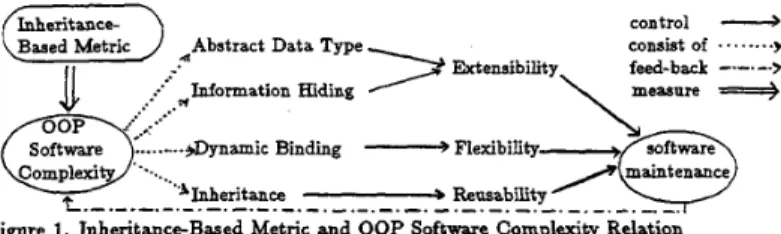
In this paper, we present an inheritance-based metric to measure the objectoriented software complexity for detecting software errors and improving software correctness. Three graph theorems are proposed and prove that any repeated inheritance graph must consist of a set of unit repeated inheritances (URIs) which are the basis of this metric. The more URIs an inheritance graph contains, the more complex and error-prone it would be. This relationship between the inheritance-based metric and OOP software complexity is shown in figure 1.control 4 consist of
....--..
)Extensibility feed-back --.--.-->
*IPformation Hiding measure
Figure 1. Inheritance-Based Metric and
OOP
Software Complexity RelationIn
Section 2, the procedure-oriented software metrics are briefly introduced. In section 3, the graph theory is applied to describe the inheritance mechanism and three graph theorems to support the inheritance-based metric are proposed. In Section 4, an algorithm to support this metric is presented. In section 5, we propose this metric and illustrate the application of it to measure the class hierarchy design complexity. The future research is recommended in thefinal
section.2
Software Metrics
Software metrics have been widely used and applied in the field of software development for a number of years. Use of software metrics is well recognized as an effective technique to improve the quality of software. Most metrics are derived from complexity factors such as factors of size, control flow, and data dependency. Therefore, metrics could be classified iuto size metrics, control flow metrics, and data data flow metrics IChung 881. A. Program Size Based Metric
Halstead proposed a family of metrics called software science. It is one of most well known metrics which has been widely accepted and applied. In software science, a propam is treated as a group of tokens. Tokens are divided into two classes, one is operands, the other is operators. A family of metria is derived from the basic counts: Vocabulary, Length, Length Estimate, Volume, Program Level, Effort, and Lnquage Level (Halstead 771.
B .
Control Flow Based MetricMost
control flow complexity metrics are derived from the control flow graph of a program. The control flow graph is the basis of control flow metrics. A pOw qraphPG
= (V,E,s,t) d e h e d as a binary directed graph, where V is a set of vertices reachable from the start vertex,E
is a set of directed edges representing the control flows, SE V is the start vertex with no edge enteriag it, and t E V is the terminal vertex with no edge going out.C. Data Flow Metric
Data flow based metrics are concerned about the inter and intramodale’s data dependency complexity. Nmeroas studies show that the data dependency of a program has a significant effect on the programer’s tracing, debugging, and understanding capability [Donsmore 791.
3
Inheritance and Graph
Theorems
Inheritance is the major mechanism of OOPLs for software reuse which is different from the module reuse, such as subroutine calls or package in Ada [Meyer 88al. It allows the same code inherited from parent class without any function (subroutine) calls. It also supprots the class hierarchy design which captures the is-a relationship between a class and its subclass. The class hierarchy is usually represented by a directed graph, called inheritance ’%inheritance graph could be divided into three basic structures: 1. single inheritancc, 2. multiple inheritance, and 3. repeated inheritance; they are represented by a connected directed graph G=(V,E), where V is a set of classes, and
E
is
a set of inheritance edges which are ordered relations such that E ={ 2
+ yI
y inherits from x, where x and y E V}.
Also, there are three types of inheritance edges tne edges, forward edgcq and backeges: tree edges connect parents to chiIdren in the graph, and forward edges connect ancestors to decendants. However, back edges which connect decendants to ancestors should be avoided. The reason is that using back edge is prone to enter a cyclic inheritance Horowize 911. Now, we discuss the three basic structures of inheritance graph and present three theorems to hAp develop theOOP
software metria. First, a single inheritance is that each class inherits uniquely from one parent class. Second, if a class is permitted to inherit from more than one parent class, it is called a multiple inheritancelGeib 901.Lemma 1 : Suppose inheritance graph Gmul =
(V,
E)
contains multiple inheritance, whereVis
a set of classes and E is a set of inheritances edges. Then, there is at least one vertex U E V whose in-degree is2
2.For example, If a class A inherits from two parent classes, class B and class C, then the in-edges of class A are 2. However, this case would lead to function name clashes between the inherited classes. If, for example, both
B
and C contain a function print, it is an ambiguity for class A, because
A
cannot distinguish it [Meyer 88bj. This function clash is called name-confliction.Third, for given a multiple inheritance Gmui = (V, E), if there exists a common ancestor class such that the parent classes of Vinherit from it, the repeated inheritance is deiined as Gmul U the common ancestor U the inheritances edges between the parent classes and the common ancestor.
Lemma 2 : Given a repeated inheritance graph Gtep = (S,
F),
there must exist a multiple inheritance graph G,l = ( V , E ) which is a subgraph of Grep =(S,
F)
such that Vs
S
andE
s
F is hold.Theorem 1: Let
G
=(V,
E)
be a repeated inheritance graph, then the vertex numbers of V2
3 is hold and G contains closed regions.Lemma S: If G =
(V,
E) is an inheritance graph containing repeated inheritance, then the culcr’s region number of G2
2 is hold (Le, G contains at least one closed region).Theorem 2: Let G =
(V,E)
is an inheritance graph. If it contains repeated inheritances, then the graph G could be decomposed into a set of unit repeated inheritanes (URIs).4
Algorithm for Finding
URIs
In this section, the algorithm for h d i n g unit repeated inheritances (URIs) is proposed. The data structure of inheritance relations are represented by a directed graph G=(V,E
,
where V is the set of all classes andE
is the set of all inheritance edges. To illustrate this algorithm, many dekitons are needed.Definition:
1. root class: it is a class node with no in-edges. 2. terminal class: it is a class node with no outedges. 3. Ancestor(v): it is a set which records all the ancestor class Algorithm: Finding Unit Repeated Inheritances (URIs) Input: A set of classes and inheritance relations Output: Unit repeated inheritances
Step 1. Build a directed graph consists of classes and inheritance edges and initialize Ancestor(u) = {U}
.
Step 2. Using bread-first traverse for all rootnumbers of v and itself, where v is a class of V.
classes; in the process of traverse, parent ancestor set is added into its children ancestor sets.
Step 3. For all terminal classes do
if the number of the ancestor set
2
2 then beginUnion (seti, s e t j ) { 2 5 i j
5
n and set;#
s e t j }if common parent is found, record the anion set A unit repeated inheritance is found. else if the number of ancestor set = 1
discard the union set (no URI exists) end
else endif
no repeated inheritances exists
Let n be the numbers of total classes, t be the numbers of terminal classes and 1
5
t5
n, Anccstor(i) be the ancestor sets of the ith class, and s i be the number of the elements in Anccstor(i), for all class i E terminal classes and 15
s i5
n. For each terminal class, we can union the ancestor set to iind out all the URIs and the t h e complexity of this algorithm is shown as follows:5
Inheritance-Based Metrics
In the previous section, we propose an URI algorithm to help to find out the unit repeated inheritances. In this section, we utilise this algorithm and the graph theorems proposed in section 2 to develop the inheritance-based metric. By theorem 2, we have shown that an inheritance graph is composed of a set of URIs. The more URIs an inheritance graph contains, the more complex and error-prone it will be. Therefore, the complexity of an inheritance graph is defined to be the numbers of the unit repeated inheritances and it is defined as follows:
t
URI(G) = Union
(2)
(Ancestor(i)) i=lwhere the Union operation and Ancestor set are d e h e d in section 4.
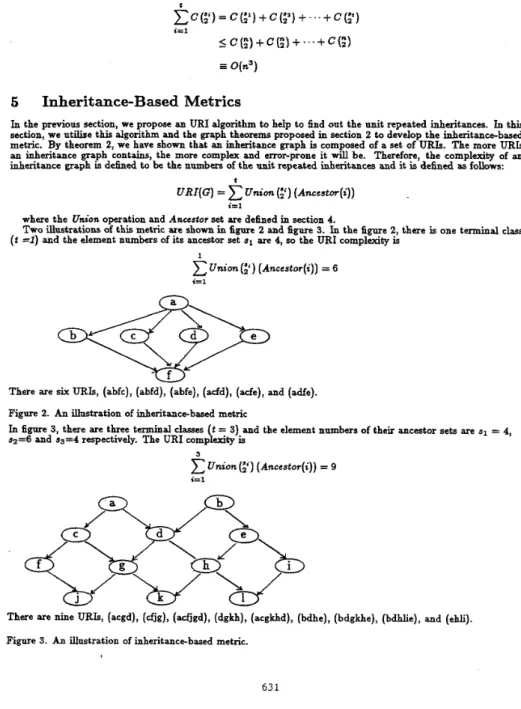
Two illustrations of this metric are shown in figan 2 and figure 3. In the figure 2, there is one terminal class (i = I ) and the element numbers of its ancestor set SI are 4, so the URI compl&ty is
1
Union
(2)
(Anccstw(i)) = 6i=l
There are six
URIs,
(abfc), (abfd), (abfe), (add), ( d e ) , and (adfe). Figure 2. An illustration of inheritancebased metricIn figure 3, there are three tenninal classes t = 3) and the element numbers of their ancestor sets are s1 = 4, sz=6 and s3=4 respectively. The URI com&xi@ is
3
Union
(2)
( ~ n c e s t o r ( i ) ) = 9i=l
There are nine URIs, (acgd), (cfjg), (acfjgd), (dgkh), (acgkhd), (bdhe), (bdgkhe), (bdhlie), and (ehli).
Figure 3. An illustration of inheritance-based metric.
6
Conclusion
In
this paper, an inheritance-based metric is proposed to measure the complexity of object-oriented software. Also, an algorithm to support this metric is presented. This metric could reflect object-oriented software complexity efficiently to enhance software quality. Furthermore, the proposed algorithm could be implemented to become an useful tool in object-oriented design phase to detect improper inheritance structures.M h e r studies based upon this research are : 1. to develope an object-oriented software testing methodology based on this metric to detect the objectoriented software errors. 2. to integrate object-testing to design a new testing tool to build an object-oriented software development environment.
References
[Adrion 821 Adrion, W.R. et al. Validation, v d c a t i o n , and testing computer software, ACM Comp surv, 14, 2 (Booch 861 Grady Booch, ‘Objectoriented Development,” IEEE Trans. Software Eng., voL2 no.2 ,Feb. 1986. [Chung 881 Chung, C.M., A Software Metrics Based Testing Enviroment,Ph.D. Dissertation, The advanced [Coad 901 Coad,
P.
and Yourdon, E. Object-oriented Analysis. Yourdon Press, 1990.[Cox 861 Cox, B. Object-Oriented Programming: An Evolutionary Approach. Addison-Wesley, New York, 1986. [Gannon 811 Gannon, J. ‘Data Abstraction Implementation Specification, and Testing,” ACM Trans on [Geib 90 Geib, Jean-MaK: and Came, Bernard ‘The Point of View nortion for Multiple Inheritance,” [Horowfe 91
Ellis
Horowize and Rajiv Gupta, Object-Oriented Databasewith
Applications t o Case, Networks, [Jackson 831 M. Jackson, System Development. Englewood Cliffs, NJ:PrenticeHall,
1983.[Meyer 88a] Betrand Meyer, Object-Oriented Software Construction, Prentice
Hall
1988.[Meyer 88bl Betrand Meyer, “Eiffel: A Language and Environment for Software Engineering,” The Journal of [Pascoe 861 GeoErey A. Pascoe “Elements of Object-Oriented Programming,” BYTE AugustJ986, pages [Pinson 881 Lewis J. Pinson. Richard
S.
Wiener, An Introduction to Object-oriented Prgramrning and Smalltalk, [Seidewitz 891 Seidewita, E. General object-oriented software development: background and ezperience, J. Syst. [Seidewitz 871 Seidewita,E.
and Stark, M.’ Towards a general object-oriented software development [Ward 891 Ward, P.Haw
to integrate object orientation with structured analysis and design. IEEE(June 1982) pp.160.
Center for Computer Studies, Univ, of Southwester Louisiana, Lafayette, Louisiana, 1988.
-
Programming Language System, vol.3, July, 1981, pp 211-223. OobsLA, 19%.
and VLAI CAD, Prenteice
Hall
1991.Systems and Software 1988. 139-144.
Addison-Wesley pp 49-60, 1988. and Software. 19, (1989), 95-108.
methodology.” Ada Letters, 7 (July/Augmt 1987) pp 54-67. Softw.March, 1989), 74-82.