
A Novel Variable Step Size Adjustment Method
Based on Autocorrelation of Error Signal for the
Constant Modulus Blind Equalization Algorithm
Merve Abide DEM
İ
R, Ali OZEN
Dept. of Electrical and Electronics Eng., Karadeniz Technical University DSP Lab., 61080 Trabzon, Turkey [email protected], [email protected]
Abstract. Blind equalization is a technique for adaptive
equalization of a communication channel without the use of training sequence. Although the constant modulus algo-rithm (CMA) is one of the most popular adaptive blind equalization algorithms, because of using fixed step size it suffers from slow convergence rate. A novel enhanced variable step size CMA algorithm (VSS-CMA) based on autocorrelation of error signal has been proposed to improve the weakness of CMA for application to blind equalization in this paper. The new algorithm resolves the conflict between the convergence rate and precision of the fixed step-size conventional CMA algorithm. Computer simulations have been performed to illustrate the perform-ance of the proposed method in simulated frequency selec-tive Rayleigh fading channels and experimental real com-munication channels. The obtained simulation results using single carrier (SC) IEEE 802.16-2004 protocol have demonstrated that the proposed VSS-CMA algorithm has considerably better performance than conventional CMA, normalized CMA (N-CMA) and the other VSS-CMA algorithms.
Keywords
VSS-CMA, error autocorrelation, blind equalization, IEEE 802.16-2004.
1.
Introduction
Inter symbol interference (ISI) due to bandwidth lim-ited channels or multipath propagation and phase rotation because of Doppler frequency shift are two main factors which affect the performance of wireless communication systems. In order to mitigate the effects of these impair-ments, several channel estimation and equalization methods have been developed in the last few decades. One of the best ways to cancel these effects is to use an equal-izer filter which eliminates the ISI while combining the multi path energy [1]-[3]. In practice, Linear Transversal Equalizers (LTE) and Decision Feedback Equalizers (DFE) are the most common structures used [4], [5]. However,
conventional adaptive equalization techniques use a train-ing sequence in order to reduce the ISI. One obvious draw-back of this approach is that the training causes a reduction of the useful information rate with respect to the total in-formation rate. In other words, training leads to an increase of the necessary bandwidth on the duration required to send a given amount of data.
Blind identification and equalization of wireless com-munication channels have attracted considerable interest in recent years because they can recover the transmitted signal without the use of training sequences. In order to equalize the channel, blind equalizers utilize only the out-put sequence and some a priori statistical information on the input sequence. Although the constant modulus algo-rithm (CMA), proposed by Godard and Treichler, is the most common used blind equalization technique, one of the important drawbacks of the CMA is its relatively slow convergence [6], [7].In order to solve this problem, there are many methods such as Modified CMA (M-CMA) [8], Normalized CMA (N-CMA) [9], Fuzzy based CMA (F-CMA) [10] and Variable Step Size CMA (VSS-(F-CMA) have been improved.
The convergence rate of the CMA is quite sensitive to the step size parameter which is used in update equation for an accurate and robust training. Using a small step size will cause slower convergence; however the results can be unstable when a big step size is used. Therefore, the choice of the step size reflects a trade–off between misadjustment and speed of convergence. For a non-blind equalizer training using the conventional least mean squares (LMS) algorithm, a bigger step size is desirable to start a faster convergence and smaller step size is used to complete the training as in the fine tuning mode. However, the conver-gence features of a blind training are different since an initial recovery of the equalizer filter is hardly obtained. A noticeable convergence in a blind training is obtained after a certain delay which is generally more than 100-200 training iterations. Therefore, in order to get a better recov-ery the step size for a blind training should start with a vrecov-ery small value, then the step size of CMA should be increased to accelerate the convergence providing error level is not increasing. Finally, if the error level is smaller and stable
then the step size should be reduced to get better tuning for the coefficients. There are many methods available to im-prove performance of the CMA during the different stages of adaptation. Among them the most commonly used is the automatic switching scheme [11] that utilizes a large step size during the transient state and switches to a smaller step size during the steady state. Other methods include:
(i) Chahed et al. [8] adjusts the step size by using a time varying step size parameter depending upon squared Euclidian norm of the channel output vector and on the equalizer output.
(ii) Douglas L. Jones [9] controls the step size, for efficient implementation, by using the channel output signal vector energy, ||vk||2, is computed recursively as in the normalized LMS algorithm [4], [5].
(iii) Xiong et al. [12] employed the lag(1) error
autocorrelation function between ˆk and ˆk1. Here, ˆk is
the output error of the blind identification system.
(iv)An alternative scheme that considers a nonlinear function of instantaneous error for adjusting the step-size parameter is proposed by Liyi et al. [13].
On the other hand there are quite a lot of successful works in the literature controlling the step size parameter of CMA algorithm obtaining a better convergence and error performance using analytical or fuzzy logic based approaches [14]-[16]. As far as authors’ knowledge all these systems were considering an analytic approach to the step size adjustment by doing either considering error variations or obtaining a possible trajectory for the training. This study is not far from those studies in terms of the theory of the convergence analysis of the CMA algorithm. However, instead of using an analytic approach, this work, inspired by [17] and [18], aims to design a training trajec-tory for the simple CMA algorithm using lag(1), lag(2), …, lag(N) error autocorrelation functions which provides a simple and more deterministic control on the training tra-jectory. Here, N denotes the adaptive filter order. Thus, with the help of proposed technique the performance of the conventional CMA algorithm has become comparable to other adaptive VSS-CMA training algorithms. Simulation results have shown that the proposed VSS-CMA algorithm performs better than other VSS-CMA [12], [13] training algorithms found in the literature.
The remainder of the paper is organized as follows: Section 2 introduces the system model for the blind chan-nel equalization. Section 3 explains the proposed VSS-CMA algorithm based on error autocorrelation in detail. Section 4 summarizes single carrier (SC) IEEE 802.16-2004 protocol employed in simulation and experimental studies. Section 5 presents the obtained performances from various blind training algorithms and their comparisons using the simulated and experimental IEEE 802.16-2004 SC radio channel and data transmission format. Finally, the paper is concluded in section 6.
2.
Blind Channel Equalization
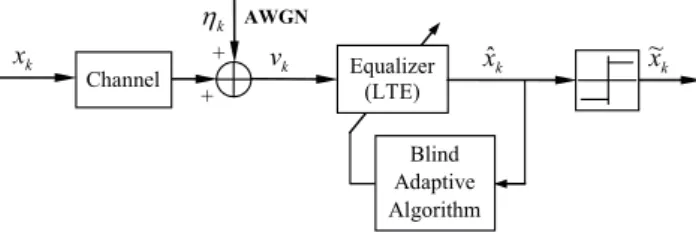
The general structure of the adaptive blind channel equalization system is illustrated in Fig. 1.
Blind Adaptive Algorithm
Channel Equalizer (LTE)
AWGN + k v k x + k xˆ x~k k
Fig. 1. The system model of adaptive blind equalization system.
The baseband model of a digital communication channel can be characterized by a symbol-spaced Finite Impulse Response (FIR) filter and additive white Gaussian noise (AWGN) source. Let us consider that a wireless communication system with quadrature phase shift keying (QPSK) modulation. The modulated signal passes through a linear time-invariant channel to provide a received signal,
vk is given by 1 0 L i i k i k k hx v (1)
where xk is the transmit data sequence, hi is the ith tap coef-ficients of the tapped-delay-line filter model of a channel, L
is the tap number of the channel, ηk is the AWGN compo-nent and k is the time index. The channel is assumed quasi-static in (1) which the argument is generally valid for short data packet durations and in low mobility channels. How-ever it is not too difficult to consider a time-varying chan-nel, since the subjected adaptive equalization techniques are able to track the channel variations. The offset fre-quency effect is also ignored in (1) since there is several research articles properly compensating the carrier offset frequency. The ISI of (1) is cancelled by a time domain equalizer filter. LTE and DFE filter can be used for this aim. When LTE filter is employed, its output xˆk is
calcu-lated by
1 0 ˆ N i i k i k wv x (2)where N is the tap number of LTE and wi is the ith LTE coefficient. For an ordinary training case, the error function of an equalizer is calculated by ˆkxkLoffsetxˆk where, training is supervised which means the training sequence is known by the receiver. The number indicated by Loffset is attained for the adjustment of the centre tap of equalizer filter.
However, if a training sequence is not issued in the transmission, one of the blind algorithms has to be applied. For the adaptive blind training, the most popular blind equalization algorithms are the family of Godard algo-rithms [6], which are stochastic gradient descent (SGD) methods for minimizing the cost functions
... , 2 , 1 }, ) ˆ {( ) (W E x 2 q J q q k Godard (3)
Here, W is the equalizer coefficient vector described as
W = [w0, w1, …, wN - 1]T, the superscript [.]T indicates the
transpose of the matrix [.], E{ } is the expectation operator,
k
xˆ is the kth estimation of the equalizer filter given by (2),
and Δq = E{|xk|2q}/E{|xk|q} is a real positive constant cal-culated by using transmit data. For the particular case
q = 2, equation (3) is the cost function of the conventional CMA, which was independently developed using the idea of penalizing the output samples that do not have the con-stant modulus property [7].
It should be noted here that if Woptis obtained verify-ing the cost function (3) for q = 2, JCMA(Wopt), it produces the same results as Wx = exp(jΦ)Wopt, 0 ≤Φ≤ 2π so, the algorithm always produces a phase error which can not be corrected by the CMA criterion [16], [19], therefore the phase of estimated symbol is not processed by a hard de-tector directly. The defined problem has to be solved by further operations using schemes either a differential modulation or a phase compensating coding techniques.
The error function to verify CMA criterion is ) ˆ ( ˆ ˆk xk 2xk2 (4)
and similar to the stochastic gradient algorithm the adaptation of W according to [6], [7] is given by
N i v w wi i kˆk k* i, 0,1,... 1 (5)
where μk is the step size parameter of CMA, ˆk is the kth
estimate of error function using CMA criterion and v*ki is
the complex conjugate of kth incoming signal vk with the shift number i for ith equalizer coefficients. In order to guarantee a stable operation in all VSS-CMA algorithms, a sufficient condition for the step size parameter is [4], [5].
] [ 3 2 0 R tr k (6)
where R is the input autocorrelation matrix.
3.
The Proposed Variable Step Size
Constant Modulus Algorithm
For several blind adaptive filtering applications, the autocorrelation function between ˆk and ˆk1 is a poor index of convergence closeness. For correlated inputs and/or some particular kinds of impulse response of the unknown system, the autocorrelation between ˆk and ˆk2,
k
ˆ and ˆk3 or other lags provides more information than simply using lag(1) error autocorrelation [12]. In [12], lag(1) error autocorrelation function could reduce the step-size value too early in some situations, but, resulting in a slower convergence. Decision-directed error function (ˆk ~xkxˆk) is considered as an error function in [12] and [13]. Where, x~k is the previously detected symbol of the
estimated equalizer output xˆk. However, error function, given by (4), is employed in this study.
The proposed method, inspired by [17] and [18], con-siders the lags from 1 to N in the error autocorrelation functions, improving the convergence speed and perform-ance. Then, let us consider Δk as a smooth estimation of the autocorrelation functions between ˆk and previous error
functions ˆk1, ˆk2,…,ˆkN given by
1 0 2 * 1 (1 ) ˆ ˆ N i i k k k k . (7)Thereafter the step-size update equation is given by k
k k
1 (8)
where α, and γ are positive parameters.
Assuming perfect estimation of the autocorrelation of between ˆk and previous error functions ˆk1, ˆk2, …,ˆkN, the instantaneous behavior of the step size will be
smoother. Error autocorrelation, employed by Xiong et al. [12], and non linear error auto correlation, used by Liyi et al. [13], provide noise immunity. However, the proposed VSS method provides both noise and ISI immunity since the error function (4) includes both channel output and noise information.
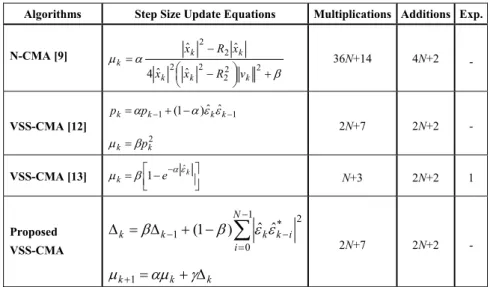
One of the best methods used to cancel the inter-sym-bol-interference included by (1) is a time domain channel equalizer filter. In order to illustrate the accuracy of the proposed method, LTE or soft DFE (SDFE) filter has been employed for simulated communication channels and experimental real communication channels, respectively in this study. The obtained results have shown that a combi-nation of the proposed technique and LTE or SDFE pro-vides faster convergence rate, an effective and robust way for blind adaptive channel equalization. In simulation studies, the step size update equations and computational complexities of subjected VSS-CMA algorithms are given by Tab. 1.
In order to investigate the advantages and disadvan-tages of the algorithms against each other, their computa-tional complexity needs to be known in each recursion period. The level of computational complexity involved in obtaining the adaptive weights of update equation of each algorithm determines the required processing speed, com-plexity of the hardware, and ultimately the cost of the sys-tem. In this study, the computational complexity is defined by the required number of multiplications and additions running each weight update process.
The greatest advantage of the CMA algorithm is the fact that it requires far less computational complexity as for the other blind algorithms. The complexity incurred by the proposed technique does not prevent its application. The comparison of the computational complexities of the step size update equations required for per weight update is given in Tab. 1. Here, N is the tap number of the LTE or SDFE filter. As can be seen from Tab. 1 the computational
complexity of the proposed VSS-CMA is similar to whom using the other VSS-CMA. Tab. 1 shows that the addi-tional computaaddi-tional complexity brought by the proposed technique to the VSS-CMA [13] algorithm, proposed by Liyi et al., is N+4 multiplications. But there is one
addi-tional exponential operation in Liyi’s study. However, the proposed method has the same computational complexity with [12], proposed by Xiong et al. Thus, a more robust version of CMA algorithm is developed with a very small complexity concern.
Algorithms Step Size Update Equations Multiplications Additions Exp. N-CMA [9] 2 2 2 2 2 2 2 ˆ ˆ 4 ˆ ˆ k k k k k k v R x x x R x 36N+14 4N+2 - VSS-CMA [12] 1 1 (1 )ˆ ˆ k k k k p p 2 k k p 2N+7 2N+2 - VSS-CMA [13] e k k 1 ˆ N+3 2N+2 1 Proposed VSS-CMA
1 0 2 * 1 (1 ) ˆ ˆ N i i k k k k k k k 1 2N+7 2N+2 -Tab. 1. The step size update equations and computational complexities of VSS-CMA algorithms.
4.
IEEE 802.16-2004 SC Radio
Physi-cal Layer Employed in Computer
Simulations
IEEE 802.16 working group was set up in 1999 to develop a new standard for broadband wireless access (BWA) and published the first IEEE 802.16 standard in October 2001. In October 2004, the new standard 802.16-2004 was published, which is actually an amalgamation of 802.16 and 802.16a. In the first phase of the standard, Single-Carrier (SC) for 11-66 GHz and Multi-Carrier (MC) transmissions for sub-11 GHz frequency regions were considered for a fixed wireless access. By the publications of IEEE 802.16-2004 [20], its applications have been extended to single carrier transmission for sub-11 GHz systems. Recently, the 802.16e standard was also ratified in December 2005 by allowing the upgrade from fixed BWA systems to mobile service provision up to vehicular speeds for sub-11 GHz systems [21]. IEEE 802.16-2004 protocol also supports quite wide range of digital modulation techniques (Spread-BPSK, QPSK, 16-QAM, 64-QAM and 256-QAM) in both main transmission techniques which are single- and multi-carrier systems [20], [21].
Fig. 2 shows SC IEEE 802.16-2004 physical layer’s basic components for the receiver and the transmitter in single carrier communications, where Reed Solomon and convolutional coding for forward error correction (FEC) coding, and soft output Viterbi decoding for the FEC de-coding is used.
A 1912 (=8x239) bits of a 2047 bits PN sequence is used as the payload sequence, and coded by the (255, 239, GF 28) Reed-Solomon coding for the outer code (page 357,
[20]), block interleaved (see page 258, [20]) and then coded by the binary convolution code (CC) with the rate of 1/2 as an inner code (see pages 258-259, [20]). The bit randomizer is also employed over raw data. The output of the FEC encoder is modulated with one of the desired modulation types (BPSK, QPSK, 16-QAM, 64-QAM and 256-QAM). The resulting data sequences are transmitted over a multipath channel and corrupted by white Gaussian noise. Synchronization and channel estimation is done using the three 64 constant amplitude zero autocorrelation code (CAZAC) sequences at the beginning of each data packets [20]. 2047 bits PN Generator FEC Coding 1912 bits 4080 bits I-Q Mapping Input Data Decision FEC De-Coding 1912
bits 4080bits I-Q De- Mapping Output Data ISI Channel AWGN Equalizer LTE / DFE Blind Adaptive Algorithm
Fig. 2. The block scheme of the IEEE 802.16-2004 SC radio physical layer.
The receiver converts the received signal in the base-band and normalizes. Data normalization is made by set-ting the received signal plus noise power to a unit value. The normalization is one of the essential steps when implementing a channel estimation and equalization algo-rithms, since the transmit data needs to be considered as
having unit energy. After normalization, equalization process starts using blind or non-blind equalization algo-rithms for normalized data. The equalized data are demodulated. The demodulated data are decoded by inner decoder, de-interleaved and decoded again by the outer decoder. Reed-Solomon decoder and soft output Viterbi algorithm (SOVA) are used together in FEC decoding. Finally, output data is obtained at the output of decision block and then the desired performance comparisons are also performed.
5.
Computer Simulation Results
The simulation studies have composed of two stages. In the first stage studies are performed using the simulated communication channel. In the second stage studies are implemented employing the experimental real communica-tion channel. Bit error rate (BER) performances are ob-tained at the output of error correcting decoder for both the simulated communication channel and the experimental real communication channel.
5.1
Simulation Results
In this first section, simulation results are demon-strated to confirm the performance of the proposed VSS-CMA algorithm in simulated frequency selective Rayleigh fading channels. The proposed method is compared with Xiong’s VSS-CMA [12], Liyi’s VSS-CMA [13], Jones’s N-CMA [9] and conventional CMA.
The simulation studies are performed using the physi-cal layer specifications of IEEE 802.16-2004 SC radio via 1000 Monte Carlo type iterations using the QPSK modula-tion. In this paper, a three taps channel profile with average coefficient amplitudes given by (0.407, 0.815, 0.407), which is defined by Proakis, is used [5]. An 11 taps LTE filter is used in the blind channel equalization. Tab. 2 shows the step-size parameters of VSS-CMA blind training methods for blind channel equalization. The step size pa-rameter for conventional CMA was equal to 0.005. Maxi-mum and miniMaxi-mum step size values are limited to 0.01 and 1x10⁻⁷ respectively for all simulated VSS-CMA algorithms.
Equalizer coefficients are initialized to zero value, except the central tap which is set to unit value before blind adap-tation. Parameters Algorithms N-CMA [9] 0. 5 0.015 - VSS-CMA [12] 0.994 0.979 - VSS-CMA [13] 0.3 0.095 - Proposed VSS-CMA 0.978 0.996 0.85 Tab. 2. The step size parameters of VSS-CMA algorithms for
simulated communication channels.
Two performance criteria were used to assess the convergence rate of blind equalizers in simulation studies. The first criterion was a decision-based estimated mean square error (MSE) metric at each adaptation sample based on a block of NMSE symbol-spaced data samples.NMSE was equal to 200 for all simulated blind equalizer in this study.
NMSE k k k MSE x x Q N MSE 1 2 ˆ ) ˆ ( 1 (9)where Q(xˆ(k)) denotes the quantized equalizer output defined by 2 ˆ arg ) ˆ ( min k k x k x x x Q k . (10)
The second criterion was the BER metric.
0 500 1000 1500 2000 2500 3000 3500 -15 -10 -5 Iteration Number MS E ( d B) N-CMA Jones -1996 Conventional CMA VSS - CMA Xiong et al.-2004 VSS - CMA Liyi et al.-2009 Proposed VSS - CMA {0.407, 0.815, 0.407}
Simulated Proakis channel profile
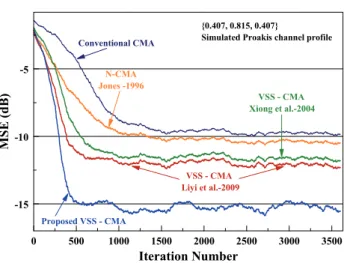
Fig. 3. Comparison of the MSE performances of the blind adaptive channel equalizers.
The MSE versus iteration number performances of the conventional CMA, N-CMA [9], VSS-CMA [12], [13] and the proposed VSS-CMA-LTE filters are obtained in the value of Signal to Noise Ratio (SNR) of 20 dB given in Fig. 3 for a stationary environment. The length of iteration is 4080 QPSK symbols for the MSE performance compari-sons in all simulated algorithms.
It is shown in Fig. 3 that the Jones’s N-CMA [9] algorithm little accelerates the CMA and converges to the lower MSE floor at the end of the training. It is observed that the performance of the VSS-CMA [12], [13] algorithm is exceeding to the performance of the conventional CMA and N-CMA algorithms and converges to the lower MSE floor. It can be easily seen that the proposed technique outperforms the performance of the all blind equalization algorithms and converges to the lowest MSE floor.
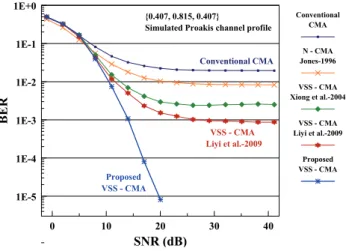
The coded BER performances obtained as a response to the MSE curves are given in Fig. 4 where the same con-ditions are valid as in Fig. 3 for all blind training algo-rithms, except the length of the payload data after training was 4080 symbols of QPSK modulation. It should be men-tioned here that BER performance samples are obtained after 4080 iterations of blind trainings.
0 10 20 30 40 1E-5 1E-4 1E-3 1E-2 1E-1 1E+0 SNR (dB) BER Conventional CMA N - CMA Jones-1996 VSS - CMA Xiong et al.-2004 VSS - CMA Liyi et al.-2009 Proposed VSS - CMA Proposed VSS - CMA VSS - CMA Liyi et al.-2009 Conventional CMA {0.407, 0.815, 0.407}
Simulated Proakis channel profile
Fig. 4. Comparison of the coded BER performances of the blind adaptive channel equalizers.
The obtained BER performances agree with the MSE performances given by Fig. 3. It can be seen from Fig. 4 the BER performance obtained using the N-CMA [9] and Xiong’s VSS-CMA [12] algorithms are little better than the performance of the conventional CMA algorithm but the obtained results are not of significance. It is observed that the VSS-CMA [13] performs better than the N-CMA [9] and VSS-CMA [12] algorithms and it also converges to the lower BER floor. The BER performance of the proposed VSS-CMA algorithm gets better than the performance of the all blind equalizers. Thus, the proposed VSS-CMA improves the performance of the conventional CMA algo-rithm significantly. The controlled training by the proposed VSS-CMA based on error autocorrelation has become faster, very accurate and more stable.
5.2
Simulation Results Using Experimental
Data
In this second section, simulation results using experimental data are demonstrated to confirm the per-formance of the proposed VSS-CMA algorithm in true frequency selective Rayleigh fading channels in the experimental IEEE 802.16-2004 SC radio environment around 3.5 GHz. Experimental IEEE 802.16-2004 SC radio set and measurement conditions are explained in detail in [22, see pages 686-688, Section 4]. The proposed method is compared with Xiong’s CMA [12], Liyi’s VSS-CMA [13], Jones’s N-VSS-CMA [9] and conventional VSS-CMA for blind equalization, and LMS and RLS algorithm for non-blind equalization. In order to equalize BPSK, QPSK, 16-QAM and 64-16-QAM data measured in the experiments, a thirteen taps SDFE filter, composed of a feed forward filter (FFF) of nine taps and soft feedback filter (SFBF) of four taps, is used in both blind and non-blind channel equalization. The block diagram of the proposed VSS-CMA algorithm based on error autocorrelation with SDFE is given in Fig. 5.
As can be seen from Fig. 5, soft decision feedback has been employed as different from the conventional DFE in the proposed method. The decision feedback
equaliza-tion is a technique widely used for removing ISI in fre-quency selective multipath channels. The major problem in DFE is so called error propagation; a decision error propa-gating through the feedback filter enhances ISI instead of cancelling it. Thus, a single error may cause a burst of errors in subsequent decisions. Therefore, the use of soft decisions to mitigate error propagation in a conventional DFE is considered for application to blind equalization in this paper. 1 0 2 * ˆ ˆ N i k k i Blind Equalization Algorithm Estimated Signal FFF k v xˆ k Channel Output + + x~k
2
2xˆk k ˆ Error Auto- Correlation k FBFFig. 5. The proposed variable step size CMA algorithm based on error autocorrelation with SDFE.
Tab. 3 shows the step-size parameters of VSS-CMA blind training methods for blind channel equalization. The step size parameter for conventional CMA was equal to 0.005 for BPSK and QPSK, and 0.000015 for 16-QAM and 64-QAM. The step size parameter of LMS was equal to 0.045 and the forgetting factor of RLS was 0.999 for all modulation types. The centre tap of SDFE is set to unit value in blind trainings and otherwise the values of all taps are initialized to zero before starting training. Maximum and minimum step size values are limited to 0.01 and 1x10⁻⁷ respectively for all simulated VSS-CMA algorithms.
The non-blind trainings, LMS and RLS, are carried out using all three CAZAC sequences at the beginning of each assigned sub-sequences. Therefore only 192 steps of non-blind training are executed before starting the recovery of incoming data for attained modulation types.
PARAMETERS BPSK - QPSK 16-QAM – 64-QAM Algorithms N-CMA [9] 0. 35 0.075 - 0. 05 0.0018 - VSS-CMA [12] 0.997 0.989 - 0.984 0.995 - VSS-CMA [13] 0.23 0.083 - 0.016 0.047 - Proposed VSS-CMA 0.965 0.992 0.74 0.786 0.998 0.45 Tab. 3. The step size parameters of VSS-CMA algorithms for
experimental real communication channels.
Fig. 6 shows a sampled channel profiles with 7 taps observed above the noise floor of the receiver used in the experiments, at the first ten measurements of the
experi-mental studies [22, see page 688, Fig. 8]. 0 1 2 3 4 5 6 0 0.1 0.2 0.3 0.4 0.5 0.6 0.7 A m plitud e o f Chann el Co efficients Ch anne l Tap Inde x
The First Ten Measurements of the Experimental Studies
Fig. 6. A sampled channel profile obtained from the experimental IEEE 802.16-2004 SC radio set.
The obtained comparative MSE versus SNR perform-ances related to experimental blind and non-blind channel equalizations are given by Fig. 7 for BPSK and 16-QAM, and Fig. 8 for QPSK and 64-QAM. The MSE perform-ances are obtained after 4080 iterations of blind and non blind trainings for 4080 symbol payload data all modula-tion types. 0 5 10 15 20 25 -20.0 -15.0 -10.0 -5.0 0.0 5.0 SNR (dB) MS E (dB ) Conventional LMS Conventional RLS Conventional CMA N-CMA Jones-1996 VSS-CMA Xiong et al.-2004 VSS-CMA Liyi et al.-2009 Proposed VSS-CMA 16-QAM BPSK Proposed VSS-CMA
Fig. 7. Comparison of the MSE versus SNR performances of the blind and non-blind equalizers for BPSK and 16-QAM.
As can be seen from Fig. 7 for BPSK modulation, the Jones’s N-SDFE [9] little accelerates the CMA-SDFE and converges to the MSE value of -9 dB. It is ob-served that the performance of the VSS-CMA-SDFE [12], [13] is exceeding to the performance of the conventional CMA and N-CMA-SDFE and converges to the lower MSE value of -11 to -12.5 dB. However, it can be easily seen that the proposed technique outperforms the performance of the all blind equalization algorithms and converges to the lowest MSE value of -17.5 dB and catches the per-formance of non-blind equalizer (LMS and RLS-SDFE). Similar performances are also obtained in Fig. 7 for 16-QAM. However, obtained MSE performances are worse than the BPSK modulation.
Similar results are also obtained in Fig. 8 for QPSK and 64-QAM modulation. However, different MSE per-formances are obtained due to the change of the modula-tion type. 0 5 10 15 20 25 -15.0 -10.0 -5.0 0.0 5.0 10.0 SNR (dB) MS E ( dB ) Conventional LMS Conventional RLS Conventional CMA N-CMA Jones-1996 VSS-CMA Xiong et al.-2004 VSS-CMA Liyi et al.-2009 Proposed VSS-CMA 64-QAM QPSK Proposed VSS-CMA
Fig. 8. Comparison of the MSE versus SNR performances of the blind and non-blind equalizers for QPSK and 64-QAM.
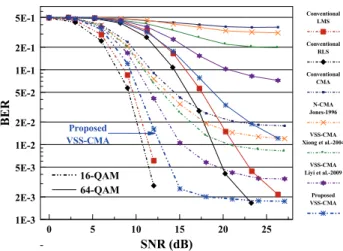
The obtained comparative coded BER versus SNR performances related to experimental blind and non-blind channel equalizations are given by Fig. 9 for BPSK and QPSK, and Fig. 10 for 16-QAM and 64-QAM. For BPSK and QPSK modulation, the coded BER performances are obtained after 192 (CAZAC sequence) iterations of blind and non blind trainings for 4080 symbol payload data. However, for 16-QAM and 64-QAM, the coded BER per-formances are obtained after 4080 iterations of blind and non blind trainings for 4080 symbol payload data.
-5 0 5 10 15 20 1E-4 1E-3 1E-2 1E-1 1E+0 SNR (dB) BE R Conventional LMS Conventional RLS Conventional CMA N-CMA Jones-1996 VSS-CMA Xiong et al.-2004 VSS-CMA Liyi et al.-2009 Proposed VSS-CMA BPSK QPSK Proposed VSS-CMA
Fig. 9. Comparison of the coded BER versus SNR performances of the blind and non-blind equalizers for BPSK and QPSK.
The obtained BER performances agree with the MSE performances given by Fig. 7 and 8 for BPSK and QPSK modulation. As can be seen from Fig. 9 the BER perform-ance of the proposed VSS-CMA-SDFE algorithm outper-forms the performances of conventional CMA, N-CMA [9] and the other VSS-CMA-SDFE [12], [13] algorithms and converges to the performances of LMS and RLS-SDFE
non-blind training algorithms. This is one of the first experimental studies of blind equalizations that the per-formances of the proposed technique has also reduced approximately till 1-1.5 dB performance difference with non-blind equalization. The obtained performances of blind techniques for BPSK are quite important that the blind techniques are as good as their non-blind counterparts in noise limited region (SNR < 20 dB), which is endorsing new researches in spread spectrum communications using blind interference cancellation and channel tracking. Simi-lar performances are also obtained in Fig. 9 for QPSK modulation but, obtained BER performances are worse than the BPSK modulation.
0 5 10 15 20 25 1E-3 2E-3 5E-3 1E-2 2E-2 5E-2 1E-1 2E-1 5E-1 SNR (dB) BE R Conventional LMS Conventional RLS Conventional CMA N-CMA Jones-1996 VSS-CMA Xiong et al.-2004 VSS-CMA Liyi et al.-2009 Proposed VSS-CMA 16-QAM 64-QAM Proposed VSS-CMA
Fig. 10. Comparison of the coded BER versus SNR performances of the blind and non-blind equalizers for 16-QAM and 64-QAM.
The obtained BER performances agree with the MSE performances given by Fig. 7-8 for 16-QAM and 64-QAM modulation. As can be seen from Fig. 10 the BER perform-ance of the proposed VSS-CMA-SDFE algorithm outper-forms the performances of all aforementioned blind equali-zation algorithms and converges to the performances of LMS and RLS-SDFE non-blind training algorithms. How-ever, the obtained performances of blind equalizations start to be varying since the blind equalizers produce error floor. Nevertheless, there is 1-1.5 dB performance difference between blind and non-blind equalizations till 15 dB of SNR value. Similar performances are also obtained in Fig. 10 for 64-QAM modulation but, obtained BER perform-ances are much worse than the 16-QAM modulation.
6.
Conclusion
In this paper, a novel low complexity VSS-CMA blind equalizer based on error autocorrelation has been proposedas a solution to the problem of slow convergence of the conventional CMA blind equalizer. It has been shown that a combination of conventional CMA and the proposed VSS technique provides an effective and robust way for adaptive blind equalization. The proposed tech-nique has been applied to the time domain channel equali-zation of a single carrier IEEE 802.16-2004 radio standard
in simulated frequency selective Rayleigh fading channels and experimental real communication channels. The per-formance improvement by the proposed method is very significant with little increase on the complexity. Thus, the simple CMA has become with a high performance blind adaptive channel equalizer technique. The results of this study show that the proposed VSS-CMA based on error autocorrelation is also shown to be very suitable for high speed blind trainings and offers a very low complexity alternative for high performance applications.
References
[1] QURESHI, S. U. H. Adaptive equalization. In Proceedings of the IEEE, September 1985, vol. 73, no. 9, p. 1349-1387.
[2] BELFIORE, C. A., PARK, J. H. Decision feedback equalization. In Proceedings of the IEEE, August 1979, vol. 67, no. 8, p. 1143-1156.
[3] BOYD, R. T., MONDS, F. C. Equaliser for digital communication. IEE Electronic Letters, January 1971, vol. 7, no. 2, p. 58-60. [4] HAYKIN, S. Communication Systems. 3rd ed. John Wiley&Sons,
1994.
[5] PROAKIS, J. G. Digital Communications. 4th ed. Singapore:
McGraw-Hill Co., 2001.
[6] GODARD, D.N. Self recovering equalization and carrier tracking in two dimensional data communication systems. IEEE Trans. Comm., 1980, vol. 28, no. 11, p. 1867-1875.
[7] TREICHLER, J. R., AGEE, B. G. A new approach to multipath correction of constant modulus signals. IEEE Trans. Acoust. Speech, Signal Process., 1983, vol. ASSP-28, p. 459-472.
[8] CHAHED, I., BELZILE, J., KOUKI, A. B. Blind decision feedback equalizer based on high order MCMA. In Canadian Conf. on Electrical and Computer Engineering 2004. Niagara Falls (Canada), 2004, vol. 4, p. 2111-2114.
[9] JONES, D. L. A normalized constant modulus algorithm. In IEEE Conference Record of the Twenty-Ninth Asilomar Conference on Signals, Systems and Computers 1995. Pacific Grove (USA), 1995, vol. 1, p. 694-697.
[10] OZEN, A., KAYA, I., SOYSAL, B. Variable step-size constant modulus algorithm employing fuzzy logic controller. Wireless Personal Communications, July 2010, vol. 54, no. 2, p. 237-250. [11] WEERACKODY, V., KASSAM, S. A. Variable step size blind
adaptive equalization algorithms. In IEEE International Sympo-sium on Circuits and Systems, 1991, p. 718–721.
[12] XIONG, Z., LINSHENG, L., DONGFENG, Z., ZENGSHOU, D. A new adaptive step-size blind equalization algorithm based on autocorrelation of error signal. In 7th International Conference on Signal Processing. Bejing (China), 2004, vol. 2, p. 1719-1722. [13] LIYI, Z., LEI, C., YUNSHAN, S. Variable step-size CMA blind
equalization based on non-linear function of error signal. In International Conference on Communications and Mobile Computing 2009. Kunming (China), 2009, vol. 1, p. 396-399. [14] ZHIMIN, D., SHENG, Z., PENG, W., WEILING, W. Novel
variable step size constant modulus algorithms for blind multiuser detection. In 54th IEEE Conference on VTS Vehicular Technology Conference. Atlantic City (USA), Oct. 2001, vol. 2, p. 673–677. [15] OZEN, A. A fuzzy based outer loop controller design improving
communication receivers. Doctoral Dissertation. Karadeniz Technical University, July 2005.
[16] CHEN, S. Low complexity concurrent constant modulus algorithm and soft decision directed scheme for blind equalization. IEE Proc. Visual Image Signal Proces., 2003, vol. 150, p. 312-320.
[17] ZIPF, J. G. F., TOBIAS, O. J., SEARA, R. A VSSLMS algorithm based on error autocorrelation. In 16th European Signal Processing Conference (EUSIPCO 2008). Lausanne (Switzerland), August 2008, p. 25-29.
[18] OZEN, A. A novel variable step size adjustment method based on channel output autocorrelation for the LMS training algorithm. International Journal of Communication Systems (Wiley-Blackwell), 2011, vol. 24, no. 7, p. 938-949.
[19] BAYKAL, B. Blind channel estimation via combining autocorrelation and blind phase estimation. IEEE Trans. on Circuits and Systems-I: Regular Papers, 2004, vol. 51, no. 6, p. 1125-1131.
[20] Standard IEEE 802.16-2004 Local and Metropolitan Area Networks, Part 16: Air interface for fixed broadband wireless access systems, 2004.
[21] Standard IEEE 802.16e/D10 Local and Metropolitan Area Networks, Part 16: Air interface for fixed and mobile broadband wireless access systems, 2005.
[22] OZEN, A. A novel QAM technique for high order QAM signaling. Radioengineering, September 2011, vol. 20, no. 3, p. 683-691.
About Authors
Merve Abide DEMİR was born in Ankara, Turkey, in
1989. She received Bachelor degree from Karadeniz Tech-nical University in 2011. Her current research interests are wireless communications, statistical signal processing, blind and non-blind equalization, channel measurement and equalization, WiMAX radio and WiMAX-LTE.
Ali OZEN was born in Adana, Turkey, in 1967. He
received B.S., M.Sc. and Ph.D. degrees from Karadeniz Technical University, in 1994, 1999, and 2005, respec-tively. He was a research assistant at the Dept. of Electrical and Electronics Engineering, Karadeniz Technical Univer-sity (Feb. 1996 - May 2004). Later he qualified as a univer-sity lecturer at the same department (Sept. 2005 – Nov. 2008). He has been working as an Assistant Professor in the same department since 2008. His current research interests are wireless communications, fuzzy based channel estimation and equalization, statistical signal processing, system identification, blind equalization, channel meas-urement and equalization, MIMO systems, WiMAX radio, WiMAX-LTE, cognitive radio and cooperative communi-cations. Dr. Ozen is a member of the IEEE and IEICE.

![(Z) 2 [(2,4 Dimethylphenyl)imino] 1,3 thiazinan 4 one](data:image/gif;base64,R0lGODlhAQABAIAAAP///wAAACH5BAEAAAAALAAAAAABAAEAAAICRAEAOw==)