This thesis must be used in accordance with the
provisions of the Copyright Act 1968.
Reproduction of material protected by copyright
may be an infringement of copyright and
copyright owners may be entitled to take
legal action against persons who infringe their
copyright.
Section 51 (2) of the Copyright Act permits
an authorized officer of a university library or
archives to provide a copy (by communication
or otherwise) of an unpublished thesis kept in
the library or archives, to a person who satisfies
the authorized officer that he or she requires
the reproduction for the purposes of research
or study.
The Copyright Act grants the creator of a work
a number of moral rights, specifically the right of
attribution, the right against false attribution and
the right of integrity.
You may infringe the author’s moral rights if you:
- fail to acknowledge the author of this thesis if
you quote sections from the work
- attribute this thesis to another author
- subject this thesis to derogatory treatment
which may prejudice the author’s reputation
For further information contact the University’s
Director of Copyright Services
AUTOMATIC POPULATION OF
STRUCTURED REPORTS FROM
NARRATIVE PATHOLOGY REPORTS
A thesis submitted in fulfilment of the requirements for the
degree of Doctor of Philosophy in the School of Information Technologies at
The University of Sydney
Ying Ou
2015
ii
Abstract
Pathology reports provide vital information for the clinical management of cancer patients, allowing accurate diagnosis, staging and determination of treatment and prognosis. However, there are several issues resulting from traditional narrative reports compared to structured reports. For example, essential elements are occasionally omitted, especially negative results, which are not always reported clearly. As well, the referring doctors often find it difficult to identify the necessary elements in a free-text pathology report to justify a given diagnosis. There are a number of advantages for the use of structured pathology reports: they can ensure the accuracy and completeness of pathology reporting; it is easier for the referring doctors to glean pertinent information from them, thus improving the communication between
pathologists and clinicians. Furthermore, they also facilitate efficient extraction of information for cancer registries, data collection and research purposes.
The goal of this thesis is to extract pertinent information from free-text pathology reports and automatically populate structured reports for three cancer diseases, namely melanoma, colorectal cancer, lymphoma and identify the commonalities and differences in processing principles to obtain maximum accuracy.
Unlike previous works that regard the task as automatic structuring of sentences of interest in narrative medical reports, this study aims to populate certain fields in structured reports based on the global view of the entire document. This is challenging, as it requires either inference from the entities or combination of various entities as well. The fields predefined in structured templates were
determined mainly by utilizing three structured cancer reporting protocols from the Australia and the Royal College of Pathologists of Australia as well as advice from clinicians and pathologists.
A detailed corpus analysis was conducted on a set of pathology notes, with the objectives of
identifying lexical and linguistic characteristics in the narratives, and the difficulties or challenges that may be encountered when processing these texts. Assessment of the level of completeness of original reports, and proposals for appropriate strategies for the establishment of structured templates were subsequently completed.
Three pathology corpora were annotated with entities and relationships between the entities in this study, namely the melanoma corpus, the colorectal cancer corpus and the lymphoma corpus. Detailed annotation schemas and guidelines were developed in an iterative process to ensure annotation consistency.
A supervised machine-learning based-approach was developed to recognise medical entities from the corpora. Specifically, the medical entity recognition system used conditional random fields (CRF) learners. The CRF-based models were able to capture a significant portion of the entity boundaries by
iii
using contextual information. The application of rich feature sets provided useful clues for the classification of entity types. By feature engineering, the best feature configurations were attained, which boosted the F-scores significantly from 4.2% to 6.8% in 10-fold cross-validation experiments on the training sets. Several common effective features across the three corpora were identified, which can be beneficial for other medical entity recognition tasks.
Without proper negation and uncertainty detection, final outputs for several fields in the structured templates will be affected, and consequently the quality of the structured reports will be diminished. The negation and uncertainty detection modules were built to handle this problem. The modules obtained very good performance (with over 99% overall F-scores) on the training sets, which dropped on the test sets (where overall F-scores decreased to 76.6% – 91.0%).
A relation extraction system was presented to extract four relations from the lymphoma corpus. A rule-based approach was applied to classify Spatial Specialization relation, while a supervised machine learning-based approach was adopted to identify Result-Positive, Result- Negative and Result-Equivocal relations. Simple heuristic rules were applied in the rule-based module, while several useful features were prepared for the support vector machines (SVM) classifier. The system achieved very good performance on the training set, with 100% F-score obtained by the rule-based module and 97.2% micro-averaged F-score attained by the SVM classifier.
Predefined templates were designed based on a thorough review of the structured reporting protocols and analysis of the training corpora. Rule-based approaches were used to generate the structured outputs and populate them to the templates.The rule-based system attained over 97% F-scores on the training sets. A pipeline system was implemented with an assembly of all the components described above. It achieved promising results in the end-to-end evaluations, with 86.5%, 84.2% and 78.9% micro-averaged F-scores on the melanoma, colorectal cancer and lymphoma test sets respectively.
The pipeline system can be applied to cancer registries, clinical audits and epidemiology research. With further improvement, it can also significantly improve the quality of pathology reporting in the clinical setting.
iv
Acknowledgements
First and foremost, I would like to sincerely thank my supervisor Prof Jon Patrick, who introduced me to the field of Natural Language Processing and afforded me valuable experiences during the past few years. He provided me with the opportunity to carry out this study and cultivate my research skills independently. His rich knowledge and logical thinking always inspired me. His support,
encouragement and advice were of great significance to my study and this thesis.
I would like to express my sincere gratitude to Dr Stephen Crawshaw for his intelligence and patience. He not only provided medical knowledge for me to tackle clinical documents, but also spared no effort on various annotations, helped me when I had difficulty processing the documents, and proofread the draft of this thesis.
I would like to warmly thank other (or former) members in the Health Information Technologies Research Laboratory: Drs Yefeng Wang, Min Li, Nguyen Doang and Pooyan Asgari, for their great support on solving many technical issues during my study.
I would also like to thank the computational linguists in the annotation team and pathologists from the Royal Prince Alfred Hospital and Royal College of Pathologists of Australasia for giving me their assistances to obtain, annotate and understand the data.
Last but not least, I would like to give my special thanks to my family, especially my mother, Jiaying Liang. Without their understanding and encouragement, it would be impossible for me to finish this work.
v
Table of Contents
Abstract ... ii
Acknowledgements ... iv
List of Tables ... x
List of Figures ... xiii
Chapter 1 Introduction ... 1
1.1 Structured Reporting ... 1
1.2 Information Extraction ... 3
1.3 The Obstacles to Information Extraction ... 5
1.4 Research Problems and Approaches ... 6
1.4.1 Corpus Analysis... 6
1.4.2 Corpus Annotation ... 6
1.4.3 Medical Entity Recognition ... 6
1.4.4 Negation and Uncertainty Detection ... 7
1.4.5 Relation Extraction ... 7
1.4.6 Structured Output Generation ... 7
1.5 Contributions... 7
1.6 Thesis Organization ... 8
Chapter 2 Literature Review ... 10
2.1 Introduction ... 10
2.2 Medical Entity Recognition ... 10
2.2.1 Dictionary Look-up Approaches ... 10
2.2.2 Rule-based Approaches ... 13
2.2.3 Statistical Approaches ... 15
2.2.4 Hybrid Approaches ... 18
2.3 Negation and Uncertainty Detection ... 20
2.3.1 Negation Detection ... 20 2.3.2 Uncertainty Detection ... 24
2.4 Relation Extraction ... 25
2.4.1 Rule-based Approaches ... 26 2.4.2 Statistical Approaches ... 272.5 Automatic Structuring ... 29
2.5.1 Structured Template ... 322.6 Conclusion ... 33
2.6.1 Medical Entity Recognition ... 33
vi
2.6.3 Relation Extraction ... 34
2.6.4 Automatic Structuring ... 34
Chapter 3 Corpus Analysis ... 36
3.1 Corpus Overview ... 36
3.2 Lexical Analysis ... 37
3.2.1 Alphabetic Words ... 38
3.2.2 Non-alphabetic Tokens ... 41
3.3 Language Phenomena in Pathology Reports ... 43
3.4 Completeness Analysis ... 44
3.5 Conclusion ... 53
Chapter 4 Corpus Annotation ... 54
4.1 Introduction ... 54
4.1.1 Overview of Existing Annotated Corpora ... 54
4.1.2 Objective ... 58
4.2 Annotation Schema ... 58
4.2.1 Entity Type ... 59 4.2.2 Relation Type ... 824.3 Methods... 84
4.3.1 Annotation Tool... 84 4.3.2 Annotation Guidelines ... 854.3.3 Main Annotation Exercise ... 90
4.3.4 Recursive Validation ... 92
4.4 Results ... 92
4.4.1 Entity Annotation ... 92 4.4.2 Relation Annotation ... 984.5 Discussion ... 98
4.6 Conclusion ... 102
Chapter 5 Medical Entity Recognition ... 104
5.1 Introduction ... 104
5.2 Conditional Random Fields ... 105
5.3 Evaluation Methods ... 107
5.3.1 Evaluation Metrics ... 107
5.3.2 Cross-validation ... 108
5.3.3 Matching Criteria ... 108
5.4 Pre-processing ... 109
vii
5.4.2 Tokenisation ... 110
5.4.3 Proof Reading ... 111
5.4.4 Part-of-speech Tagging and Shallow Parsing ... 113
5.4.5 Lemmatisation ... 114
5.4.6 Section Context Detection ... 115
5.4.7 Ring-fenced Tagging ... 121
5.5 Methods... 122
5.5.1 Overview of the System ... 122
5.5.2 Feature Sets ... 122
5.5.3 Experiment Setting ... 132
5.6 Results and Discussion ... 132
5.6.1 System Performance on Melanoma Corpus... 132
5.6.2 System Performance on Colorectal Cancer Corpus ... 134
5.6.3 System Performance on Lymphoma Corpus ... 137
5.6.4 Discussion on Three Corpora ... 139
5.6.5 Limitations ... 143
5.7 Conclusion ... 144
Chapter 6 Negation and Uncertainty Detection ... 145
6.1 Introduction ... 145
6.2 Case Study on Lymphoma Corpus... 146
6.2.1 Negation Detection ... 146
6.2.2 Uncertainty Detection ... 163
6.3 Negation and Uncertainty Detection in the Other Two Corpora ... 167
6.3.1 Melanoma Corpus ... 167
6.3.2 Colorectal Cancer Corpus ... 169
6.4 Results and Discussion ... 173
6.4.1 Lymphoma Corpus ... 173
6.4.2 Melanoma Corpus ... 174
6.4.3 Colorectal Cancer Corpus ... 175
6.4.4 Discussion of the Three Corpora ... 177
6.5 Conclusion ... 179
Chapter 7 Relation Extraction ... 181
7.1 Introduction ... 181
7.2 Support Vector Machines... 182
7.3 Relation Extraction System ... 186
7.3.1 Classification Strategy ... 186
viii
7.3.3 Rule-based Module ... 189
7.3.4 Feature Sets ... 190
7.3.5 Vector Representation ... 195
7.4 Results and Discussion ... 196
7.4.1 Experimental Settings ... 196
7.4.2 System Performance ... 196
7.5 Conclusion ... 208
Chapter 8 Structured Output Generation ... 210
8.1 Introduction ... 210
8.2 Design of Structured Templates ... 210
8.2.1 Structured Template of the Melanoma Corpus ... 211
8.2.2 Structured Template of the Colorectal Cancer Corpus ... 212
8.2.3 Structured template of the Lymphoma Corpus ... 219
8.3 Mapping Strategies ... 228
8.3.1 Mapping Strategy for the Melanoma Corpus ... 228
8.3.2 Mapping Strategy for the Colorectal Cancer Corpus ... 229
8.2.3 Mapping Strategy for the Lymphoma Corpus ... 229
8.4 Rule-based System for Structured Output Generation ... 229
8.4.1 Document Classification... 230
8.4.2 Specimen Context Detection ... 230
8.4.3 Candidate Preparation... 230
8.4.4 XML Generation ... 238
8.5 Results ... 240
8.5.1 First Round Evaluation on the Training Sets ... 244
8.5.2 Second Round Evaluation on the Training Sets ... 250
8.5.3 End-to-End Evaluation on the Test Sets ... 251
8.6 Discussion ... 256
8.6.1 Comparison of Different Template Construction Strategies ... 256
8.6.2 Comparison with Other Works ... 257
8.6.3 Discussion of the Three Corpora ... 257
8.6.4 Limitations ... 259
8.7 Conclusion ... 259
Chapter 9 Conclusions ... 261
9.1 Thesis Overview ... 262
9.2 Future Work ... 264
9.2.1 Further Improvement ... 264 9.2.2 Further Development ... 267ix
Appendix I Details of the Post-processing Modules and Ranking Criteria for the
Structured Fields in Each Corpus ... 269
I.1 Post-processing Modules ... 269
I.2 Ranking Criteria ... 275
Appendix II Application of the Post-processing Modules and Ranking Criteria
for the Structured Fields in Each Corpus ... 285
II.1 Melanoma Corpus ... 285
II.2 Colorectal Cancer Corpus ... 287
II.3 Lymphoma Corpus ... 291
Appendix III Output Examples for Some Structured Fields in Each Corpus . 294
III.1 Melanoma Corpus ... 294
III.2 Colorectal Cancer Corpus ... 297
III.3 Lymphoma Corpus ... 302
Appendix IV Screenshots from the Structured Reporting Web Page ... 307
Appendix V Examples of Poorly-written Reports ... 324
x
List of Tables
Table 1.1 Output knowledge frame from a radiology natural language processor. ... 3
Table 1.2 Challenging issues and examples in a medical entity recognition task. ... 4
Table 3.1 Distribution of training sets and test sets on each corpus. ... 36
Table 3.2 Basic token statistics of each corpus. ... 37
Table 3.3 Frequencies of alphabetic words and the distributions in each lexical resource. ... 38
Table 3.4 Examples of unknown words. ... 39
Table 3.5 Examples of misspelling correction. ... 40
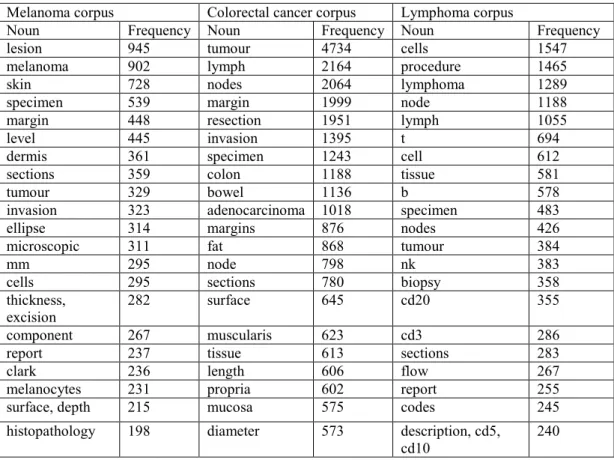
Table 3.6 Twenty most common nouns and their frequencies in each corpus. ... 40
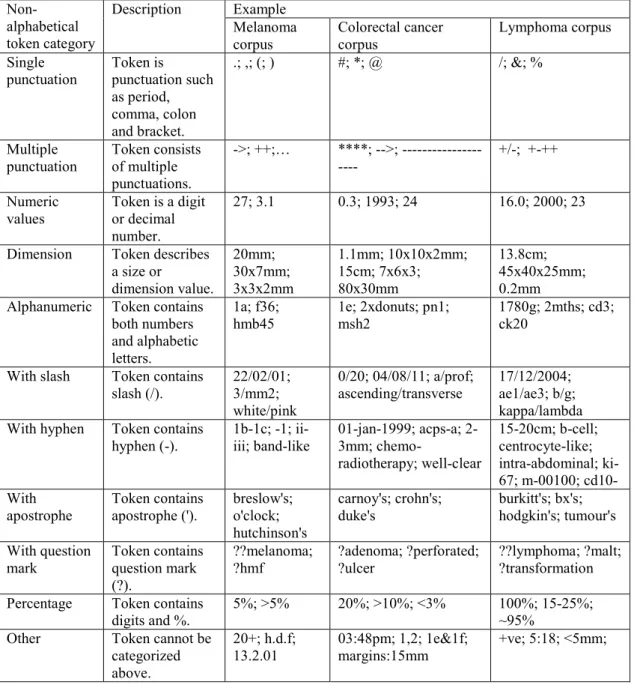
Table 3.7 Descriptions and some examples for each non-alphabetic token category. ... 42
Table 3.8 Multiple functions and examples of apostrophe, slash and hyphen. ... 43
Table 3.9 Examples of abbreviations with their expansions. ... 43
Table 3.10 Completeness measures of standards on the melanoma corpus. ... 45
Table 3.11 Completeness measures of guidelines on the melanoma corpus. ... 46
Table 3.12 Completeness measures of standards on the colorectal cancer corpus.. ... 49
Table 3.13 Completeness measures of guidelines on the colorectal cancer corpus. ... 50
Table 3.14 Completeness measures of standards on the lymphoma corpus. ... 51
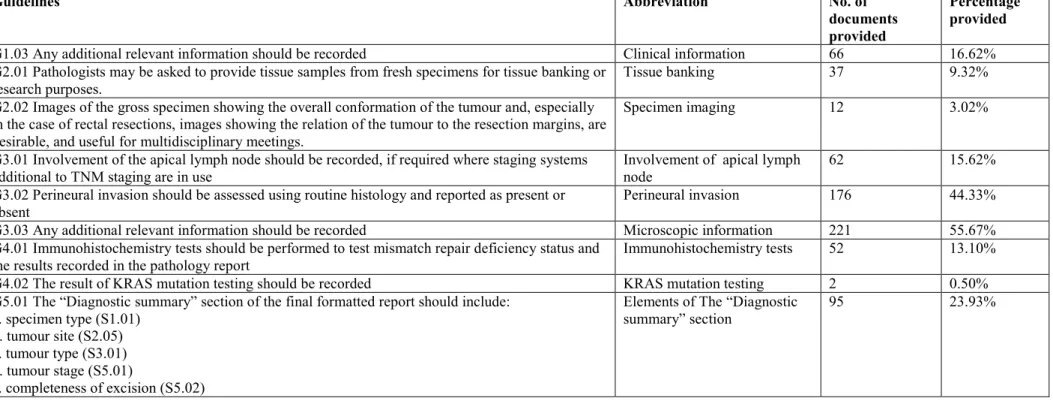
Table 3.15 Completeness measures of guidelines on the lymphoma corpus. ... 52
Table 4.1 Potential arguments for each relation type. ... 84
Table 4.2 Correspondence and boundary specification for entity types in the melanoma
corpus. ... 88
Table 4.3 Correspondence and boundary specification for entity types in the colorectal
cancer corpus. ... 89
Table 4.4 Correspondence and boundary specification for entity types in the lymphoma
corpus. NP: noun phrase, ADJP: adjective phrase. ... 90
Table 4.5 Error types of entity annotation and their corrections. ... 93
Table 4.6 Entity frequency for the melanoma corpus. ... 94
Table 4.7 Entity frequency for the colorectal cancer corpus. ... 95
Table 4.8 Entity frequency for the lymphoma corpus... 97
Table 4.9 Comparison of entity densities among the three corpora. ... 97
Table 4.10 Distribution of relation types and sentence distance between two entities in the
lymphoma corpus. ... 98
Table 5.1 Entries in the four dictionaries for each corpus. ... 113
Table 5.2 Results of lemmatisation, POS tagging and shallow parsing on a sentence: “The
appearances are those of in-situ melanoma of superficial spreading type.” from the GENIA
tagger ... 114
Table 5.3 Predicates used for representing the orthographic features (examples from section
heading instances).. ... 116
Table 5.4 Scores for section heading detection experiments on the melanoma corpus. ... 117
Table 5.5 Scores for section heading detection experiments on the colorectal cancer corpus.
... 117
Table 5.6 Scores for section heading detection experiments on the lymphoma corpus. ... 117
Table 5.7 Performance of each heading with the best model on the melanoma corpus. ... 118
Table 5.8 Performance of each heading with the best model on the colorectal cancer corpus.
... 118
xi
Table 5.10 Some training examples in a basic pattern file and complex pattern file.. ... 121
Table 5.11 Default output for some chunks of text from the ring-fenced engine. ... 122
Table 5.12 Numbers of medical entities present in the sections with the highest frequency in
the melanoma corpus. ... 124
Table 5.13 Numbers of medical entities present in the sections with the highest frequency in
the colorectal cancer corpus. ... 124
Table 5.14 Numbers of medical entities present in the sections with the highest frequency in
the lymphoma corpus. ... 125
Table 5.15 Ten most common bigrams and their frequencies in each corpus. ... 127
Table 5.16 Ten most frequent suffixes for the alphabetic tokens in each corpus. ... 128
Table 5.17 Ten most frequent prefixes for the alphabetic tokens in each corpus. ... 128
Table 5.18 Orthography feature with examples from some medical entities.. ... 130
Table 5.19 Full word class and brief word class features for some tokens. ... 130
Table 5.20 Features generated for token t at position i used in the experiments. ... 131
Table 5.21 Contribution of features to the system performance on the melanoma corpus.. 133
Table 5.22 Performance of the best model by entity types on the melanoma corpus. ... 133
Table 5.23 System performance on the colorectal cancer corpus according to the contribution
of features... 135
Table 5.24 Scores for the best model by entity types on the colorectal cancer corpus. ... 136
Table 5.25 System performance on the lymphoma corpus with the contribution of features..
... 137
Table 5.26 Performance of each entity type attained by the best model on lymphoma corpus.
... 138
Table 5.27 Beneficial features and their contribution to the corpora. ... 140
Table 5.28 Partial match performance on the three corpora. ... 143
Table 6.1 Trigger terms and termination cues for negation detection in the lymphoma
corpus.. ... 148
Table 6.2 Contribution of features to the machine learning-based approach on the lymphoma
training set (evaluated with the strict metric). ... 157
Table 6.3 Performance metrics across report sections for negation detection for the three
methods on the lymphoma training set (evaluated with the strict metric). ... 157
Table 6.4 Test set performance metrics across report sections for the three evaluation
methods (Strict, Lenient and Average) for the lymphoma corpus. ... 159
Table 6.5 Summary of errors from medical entity recognition and negation detection on the
lymphoma test set. ... 160
Table 6.6 Run time for applying each method to the examples. s: seconds. ... 163
Table 6.7 Trigger terms and termination cues for uncertainty detection on the lymphoma
corpus.. ... 164
Table 6.8 Results for uncertainty detection on the lymphoma training set and test set. ... 165
Table 6.9 Trigger terms and termination cues for negation detection on the melanoma
corpus.. ... 167
Table 6.10 Trigger terms and termination cues for uncertainty detection in the melanoma
corpus.. ... 169
Table 6.11 Three types of terms and examples for the colorectal cancer corpus. ... 170
Table 6.12 Examples of valid and invalid negations.. ... 172
Table 6.13 Results for combination of negation and uncertainty detection modules on the
lymphoma training and test sets. ... 173
xii
Table 6.14 Results for combining negation and uncertainty detection modules on the
melanoma training and test sets. ... 174
Table 6.15 Performance for Negation/Uncertainty/Inapplicability Detector on the colorectal
cancer training and test sets. ... 176
Table 7.1 Entity pairs generated with their relation types in the sentences displayed in Figure
7.4. ... 188
Table 7.2 Lists of lexicons for searching headwords of Immunohistochemistry-Positive and
Flow Cytometry-Positive entities... 192
Table 7.3 Examples of features prepared for the entity pair (positive, CD4) in the sentence:
“The atypical lymphoid cells are positive for CD3, CD4, CD45RO but are negative for
CD20, CD8 and CD30.”.. ... 194
Table 7.4 Associated indices for the examples in Table 7.3. ... 195
Table 7.5 Contribution of each individual feature to the model.. ... 197
Table 7.6 Performance for each individual relation type. ... 201
Table 8.1 Structured template of the melanoma corpus.. ... 214
Table 8.2 Structured template of the colorectal cancer corpus.. ... 217
Table 8.3 Structured template of the lymphoma corpus.. ... 221
Table 8.4 Mapping strategy for the melanoma corpus.. ... 223
Table 8.5 Mapping strategy for the colorectal cancer corpus.. ... 225
Table 8.6 Mapping strategy for the lymphoma corpus. ... 227
Table 8.7 Entity types involved and brief descriptions of post-processing modules. ... 232
Table 8.8 Brief descriptions of ranking criteria.. ... 236
Table 8.9 Lexical entries of each gazetteer.. ... 237
Table 8.10 Scores from structured output generation system of first and second round
evaluations on the melanoma training set. ... 241
Table 8.11 Scores from structured output generation system of first and second round
evaluations on the colorectal cancer training set... 243
Table 8.12 Scores from structured output generation system of first and second round
evaluations on the lymphoma training set.. ... 244
Table 8.13 Distribution of the errors in each category in the first round evaluation.. ... 245
Table 8.14 Distribution of the errors in each category in the second round evaluation.. ... 251
Table 8.15 Results of end-to-end evaluation on the melanoma test set.. ... 252
Table 8.16 Results of end-to-end evaluation on the colorectal cancer test set.. ... 253
Table 8.17 Results of end-to-end evaluation on the lymphoma test set. ... 254
Table 8.18 Error types for each test set. ... 254
xiii
List of Figures
Figure 1.1 Organisation of the thesis. Relation extraction is performed on the lymphoma
corpus. ... 8
Figure 4.1 Generic and corpus‐specific categories and entities types in the three corpora.. . 60
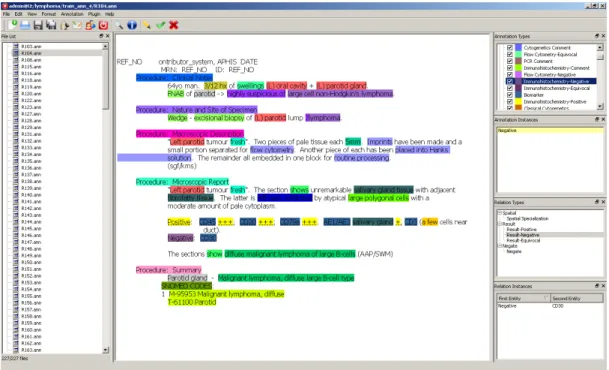
Figure 4.2 The Working environment of the Visual Annotator. ... 85
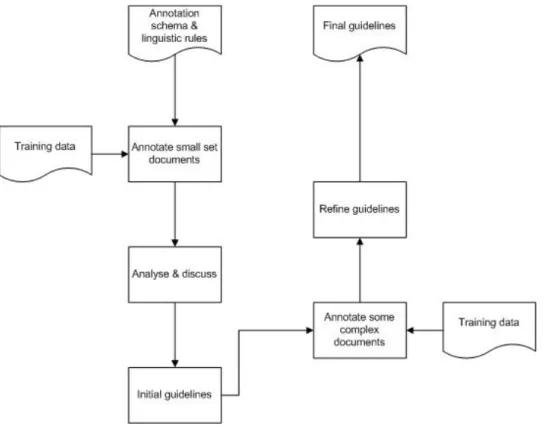
Figure 4.3 Annotation guidelines development process. ... 86
Figure 5.1 Graphical structure of linear chain CRF. ... 105
Figure 5.2 The BIO representation of the sentence: “The appearances are those of in-situ
melanoma of superficial spreading type.” ... 107
Figure 5.3 Examples of exact match, left boundary match, right boundary match and sloppy
match. ... 109
Figure 5.4 Proof reading process. ... 112
Figure 5.5 Proportions of medical entities contained in each main section of the melanoma
corpus. ... 126
Figure 5.6 Proportions of medical entities contained in each main section of the colorectal
cancer corpus. ... 126
Figure 5.7 Proportions of medical entities contained in each main section of the lymphoma
corpus. ... 126
Figure 6.1 Processing components for negation detection on the lymphoma corpus. ... 147
Figure 6.2 Workflow of the lexicon-based approach for negation detection on the lymphoma
corpus. ... 148
Figure 6.3 Dependency parse of the sentence: “No necrosis is identified.” ... 150
Figure 6.4 Rules for constructing negation patterns. ... 152
Figure 6.5 The incorrect parse tree of the text example as generated by the Stanford parser.
... 161
Figure 7.1 Support Vector Machines separate positive and negative examples. ... 183
Figure 7.2 Data sets cannot be separated by a linear classifier. ... 185
Figure 7.3 Higher dimensional space transformed from the original input space. ... 185
Figure 7.4 Three sentences with 9 entities and 3 relations hold between them. ... 187
Figure 7.5 Architecture of the relation extraction system. ... 188
Figure 7.6 Workflow of the rule-based module in the relation extraction system. ... 189
Figure 7.7 Parse tree of the sentence: “Immunohistochemical stains show positive staining of
the large atypical cells with CD30 (on repeated stain), fascin and to a lesser extent with
CD15.” ... 199
Figure 7.8 Dependency parse of the original sentence: “CD20, CD79a - positive small and
large cells” and revised sentence “CD20 and CD79a are positive in small and large cells”.
... 200
Figure 7.9 Parse tree of the sentence: “CD5 - Scattered small cells positive consistent with
reactive T-cells.” ... 205
Figure 7.10 F-scores of three kernels on each language model. ... 206
Figure 7.11 Precisions of three kernels on each language model. ... 206
Figure 7.12 Recalls of three kernels on each language model. ... 207
1
Chapter 1 Introduction
1.1 Structured Reporting
The treatment of cancer is often made based on input from a multidisciplinary team including surgeons, oncologists, radiologists, and pathologists. In particular, a pathology report on a cancer specimen can provide critical information related to diagnosis and prognosis, which should be accurate and complete. If a pathologist is not guided by a cancer-specific standardized template, but rather writes a non-organised prose report, it is easy to omit information that may be required for clinical decision making. The purpose of this research is to investigate models of how prose pathology reports might be automatically converted into structured reports and to build a technology that demonstrates the feasibility and accuracy at which the task can be performed.
Traditional narrative reports have significant variability since different pathologists use a multitude of different reporting styles to describe their findings. Such variability often results in missing important clinically relevant data elements such as margins, lymphatic invasion etc. Research indicate that the presence of both perineural invasion (Griffantibartoli et al., 1994; Nagakawa et al., 1993) and lymphovascular invasion (Tannapfel et al., 1992) which are poor prognostic indicators, were not reported in 16% and 34% respectively in free-text reports (Gill et al., 2009). As well, study points out that traditional pathology reporting underestimates the rate of margin positivity in pancreatic
carcinoma (Verbeke et al., 2006). As a result, clinicians cannot make a proper management plan for an individual case, as they usually rely on the pathology reports to diagnose the patient. However, with the introduction of structured reporting, these issuses can be mitigated to a great extent. The
completeness of information presented in pathology reports can be improved significantly. The structured format has been proven to result in more complete reports for patients with melanoma and breast cancer (Scolyer et al., 2004; Harvey et al., 2005).Moreover, the free-text reports affect the efficiency of clinical decision making, as clinicians sometimes find it difficult to pull out the relevant information from a long paragraph of continuous text, and they often have to search through
paragraphs of information in various sections in order to find the key elements to manage clinical care (Srigley et al., 2009).
A great number of studies have emphasized the importance of structured reporting (also called synoptic reporting in some cases) for diverse cancers, including melanoma (Haydu et al., 2010; Karim et al., 2008), colorectal cancer (Beattie et al., 2003; Chan et al., 2008; Chapuis et al., 2007),
haematologic and lymphoid neoplasms (Mohanty et al., 2007), etc.
Structured reports can ensure the accuracy and completeness of pathology reports. A structured report can ensure the pathologists avoid omission of all relevant data and necessary details, especially trainees and new pathologists. A survey on the reporting of colorectal cancer specimens in a tertiary
2
care pathology department (Chan et al., 2008) found that before synoptic reporting, macroscopic features such as the presence or absence of serosal involvement, and distance to the radial margin, microscopic parameters such as radial resection margin status, extramural venous invasion and host inflammatory response were underreported. Such features showed significant improvement after synoptic reporting (ranging from 50% to 80%).
It is easier for the referring doctors to glean pertinent information from structured reports, thus it is more user-friendly for both clinicians and pathologists since it can improve communication between them and thus reduce requests for repeat pathology and call-back for explanations from clinicians.
Furthermore, structured reports can also facilitate efficient extraction of information for cancer registries, data collection and research purposes. A lot of information regarding TNM and stage grouping is embedded in the pathology reports on resection specimens (Hammond and Henson, 1995). The information is critical for cancer surveillance systems and it is also used by cancer registrars, cancer agencies, and epidemiology researchers. Structured reports are much more readily usable than traditional narrative reports, since the information is populated in the reports or easy to be inferred from the reports. Structured pathology reports can also be used in quality improvement. One of the examples is the information about the retrieval of lymph nodes from colorectal cancer resection specimens (Wright et al., 2004). Lack of sufficient sampling nodes will lead to under-staging and consequently over-utilization of adjuvant chemotherapy. The total count of lymph nodes retrieved and the number involved by metastatic tumour can be derived with ease from a report in structured format. Likewise, clinical audits for tumour stage or margin positivity in resection specimens can also be facilitated by structured reporting.
Currently, there are many researchers focused on developing synoptic or structured reporting tools for pathologists to edit and standardize their reports, to simplify the process of routine reporting of pathology. For example, Qu et al. introduced a template-based tumour reporting system that
minimized exhaustive list checking and extensive text editing to reduce reporting errors and improve work efficiency (Qu et al., 2007). However, these methods also have some potential disadvantages. Pathologists may be reluctant to change reporting practice with concerns that such tools may lack space for sufficient observations and flexibility for recording of microscopic details (Dworak, 1992; Nochomovitz, 1998). Some may regard this as a relatively cumbersome and time-consuming process, which requires additional steps to enter or edit the contents compared to traditional reporting formats (Mohanty et al., 2007). Besides, such tools cannot handle the free-text reports that have already been written or dictated, as, there is still much useful information in the reports which can be reused with other feasible and efficient approaches.
To avoid these issues and maintain the benefits of structured reporting, natural language processing (NLP) is one promising approach to extract critical findings and incorporate them into a predefined structured template, thereby achieving the goal of automatic population of structured reports.
3
1.2 Information Extraction
Generally, information extraction (IE) is a sub-discipline of NLP, which focuses on the identification of the specific facts and relations within unstructured texts, the extraction of the relevant values, and their transformation into standardized codes and/or structured information. The goal of IE is to extract significant information from unstructured data sources and transform it into structured data to
facilitate access and retrieval of information.
Previous works on automatic structuring of free-text medical reports have attained some successes by classifying the relationships (e.g., dependencies) among medical entities with statistical methods at sentence level. In other words, they regard the task as automatic structuring of sentences of interest in the free texts. For example, useful information can be output in a frame from a radiology natural language processor with this method (Taira et al., 2001). An example is presented in Table 1.1:
Input: “A mass is seen in the right lower lobe that measures 5 cm in maximum diameter and is unchanged from the previous examination.”
has location Value right lower lobe
Relation in
has size Value 5cm
Dimension maximum diameter
has size trend Value unchanged
Reference event previous examination Table 1.1 Output knowledge frame from a radiology natural language processor.
However, such approaches would not be a bestfit for this study, since the population of fields in a structured report should be based on the full view of the whole document rather than each sentence; besides, in many cases, it also requires inference from the entities or combination of various entities to instantiate a knowledge representation model. For instance, by using such approaches, the maximum dimension measurement (4.5cm) cannot be directly extracted from this example “Measurements: Length 4.5cm, width 4cm, depth 0.6cm” but rather only inferred by an added processing system. It suggests that more complex methods implemented in an IE system are preferable for this study.
From the author’s point of view, a desirable clinical IE system for automatic structured reporting should consist of three major processes, which are medical entity recognition (MER), relation extraction (RE), and structured representation (SR).
Named entity recognition (NER) aims at identifying specific words or phrases (“entities”) and categorizing them. In the general English domain, NER focuses on person, location, and organization; in the biomedical domain, genes and proteins are its main themes. In the clinical narrative, however, the semantic types for it are likely to be medical entities (e.g., disorders, signs or symptoms, anatomical sites, medications, and procedures). Moreover, in a particular sub-domain, the semantic
4
types can be problem-specific. For example, the Third i2b2 Workshop on Natural Language
Processing Challenges for Clinical Records focused on the identification of medications in discharge summaries, including dosages, modes of administration, frequencies, durations, and reasons for administration (Uzuner et al., 2010). For this reason, although medical entity recognition (MER) is derived from NER, it can be more complicated than NER.
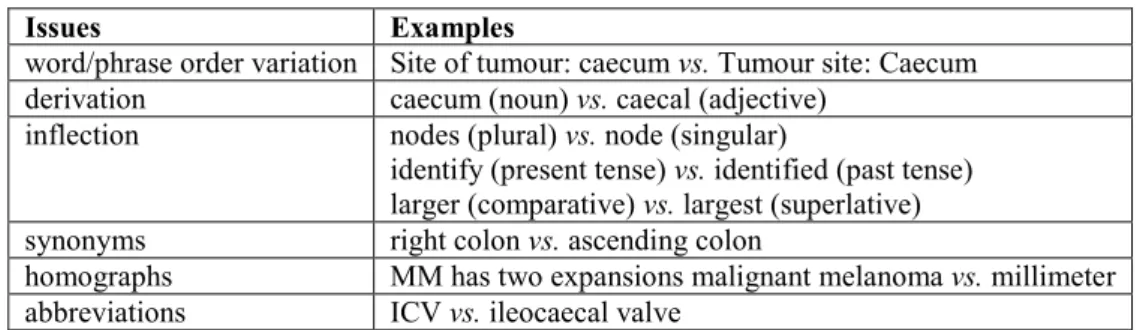
As in NER, several issues can make MER challenging, such as word/phrase order variation (varying order of words or phrases appears in instances), derivation (suffixes transform one part of speech to another), inflection (changes in number, tense, comparative/superlative forms), synonyms,
homographs and abbreviations. Table 1.2 illustrates some examples of these issues collected from narrative pathology reports.
Relationship extraction (RE) focuses on determining relationships between entities or events. By extracting relations among the entities involved and how these entities are described, a clearer picture of the semantics is obtained. For instance, to answer questions like “what is the positive biomarker for the immunohistochemistry results on this patient?”, not only “positive” and “CD20” should be extracted, but also the relation between these entities should be extracted from this sentence “CD20: most cells positive”.
The relations embedded in a clinical document can be explicit as well as implicit, such as negation and uncertainty. Negation and uncertainty identification aims at inferring whether an entity is present or absent, and quantifying that inference’s uncertainty. In fact, nearly half of all symptoms, diagnoses, and findings in clinical reports are estimated to be negative or uncertain (Chapman et al., 2001a). Take, for example, the clinical coding of medical concepts in a report, where the coding of a negative or uncertain finding or diagnosis may result in an over-coding financial penalty.
Without appropriate representation, the extracted entities and relations can be meaningless for the users. Structured representation involves construction of a predefined template and population of the template. The template is usually user-oriented, depends on the specific requirement of the users. For example, in the radiology domain, the radiologists often need to determine the size and the location of
Issues Examples
word/phrase order variation Site of tumour: caecum vs. Tumour site: Caecum derivation caecum (noun) vs. caecal (adjective)
inflection nodes (plural) vs. node (singular)
identify (present tense) vs. identified (past tense) larger (comparative) vs. largest (superlative) synonyms right colon vs. ascending colon
homographs MM has two expansions malignant melanoma vs. millimeter abbreviations ICV vs. ileocaecal valve
5
a tumour. Thus there ought to be associated items (e.g., “tumour size”, “tumour location”) in the template.
1.3 The Obstacles to Information Extraction
Building such an IE system to fulfil this task is usually a slow and laborious process, because clinical reports often contain multiple sections, for instance, a typical pathology report may consist of these sections: Diagnosis, Macroscopic Description, Microscopic Description, and Comments, which often vary in narrative structure and uniformity; and there is also institutional or individual variation in reporting practices (e.g., the same clinical concept can be expressed in different ways).
Currently, there are known barriers to information extraction in the clinical domain.
On the one hand, it is difficult to access available clinical data for training and evaluation from many hospitals and clinics, due to concerns regarding patient privacy and revealing unfavourable
institutional practices. As a result, annotated data are usually unique to a research group or laboratory that generated them for some tasks and that cannot be reused for other tasks without considerable translational effort.
On the other hand, clinical notes are more difficult to handle than newswire text, because it requires both linguistic expertise and understanding clinical domain knowledge. Moreover, in different sub-domains, there are different sub-languages used. For instance, abbreviations like “HMF (Hutchinson’s melanotic freckle)” and “SSM (superficial spreading melanoma)” appear frequently in melanoma pathology reports, but rarely in other pathology reports (e.g., colorectal cancer reports).
Moreover, unlike radiology reports, the information reported in pathology notes can differ from one disease to another. Thus a general template prepared for reports of all kinds of diseases seems inappropriate and cannot satisfy the requirements of the pathologists and clinicians. In the past, due to a lack of consensus and authorized materials as standards, it was very difficult to obtain such disease-specific templates. However, in recent years, the United Kingdom and the United States have defined processes for the development and review of structured reporting protocols. In line with these international developments the Royal College of Pathologists of Australasia (RCPA) is also implementing structured pathology reporting of cancer through its Cancer Services Advisory Committee to ensure that pathologists throughout Australasia have access to appropriate, nationally endorsed protocols (RCPA, 2013a). The RCPA structured cancer reporting protocols (RCPA, 2013b) served as the main sources for building standardized templates for this research.
6
1.4 Research Problems and Approaches
Since NLP techniques have been applied to different IE tasks and achieved state-of-art performance, this thesis addresses an issue as to whether these techniques can be utilised or modified to resolve automatic structured reporting from narrative notes.
The goal of this thesis is to extract pertinent information from free-text pathology reports and automatically populate structured reports. Specifically, the work focuses on medical entity
recognition, negation and uncertainty detection, relation extraction, and structured output generation.
In this study, both rule-based approaches and machine learning methods are used, depending on the particular problem to be solved.
In order to utilize the machine learning approaches and evaluate system performance, it was necessary to acquire semantically annotated corpora for medical entity recognition, negation and uncertainty detection and relation extraction. Annotation schemas and annotation guidelines were also developed to ensure annotation consistency.
1.4.1 Corpus Analysis
A lexical analysis was completed on three pathology corpora of different cancers: melanoma, colorectal cancer and lymphoma.
The aim of the corpus analysis was to identify the characteristics and language phenomena of the pathology notes as well as identify necessary processing steps required to reduce noise in processing.
1.4.2 Corpus Annotation
Annotated corpora are prerequisites for IE systems with supervised machine learning methods. The process of annotation is mainly to add linguistic and semantic information to the raw texts. The annotation schema defines the types of information needed to be associated with the raw texts.
Three corpora were annotated in this study. Detailed annotation guidelines were developed in an iterative process to ensure annotation quality. The annotations were used as the training data to build a supervised machine learning system as well as gold-standards for evaluation on medical entity recognition, negation and uncertainty detection and relation extraction.
1.4.3 Medical Entity Recognition
Since supervised machine learning-based approaches have been widely adopted and achieved encouraging results in many tasks of MER (Patrick and Li, 2010; Patrick et al., 2011), they were also
7
adopted in this study. One of the advantages of using supervised machine learning-based approaches is that the entities can be classified into broader categories rather than restricted to a concept in a controlled terminology. Another advantage is that it can resolve lexical ambiguity to some extent.
1.4.4 Negation and Uncertainty Detection
Study of the training materials indicated that utilization of an existing algorithm without tuning could not attain satisfactory results in an IE system to detect negation in pathology reports. It was necessary to build a specific module to handle this problem.
There is comparatively smaller amount of research into solving uncertainty problems than negation detection in pathology reports, probably because it represents a reasoning process, which is usually hard to capture. However, it is a common language phenomenon in the reports. Resolving it can help users better understand the reports and direct their attention to the undetermined findings or diagnoses to make plans for further examinations or tests.
1.4.5 Relation Extraction
Relationship extraction is intended to find associations between medical entities. It may not be easy for a rule-based system to extract complex relations, but it is a suitable strategy when the training sample size is small. Machine learning methods are better at identifying the different forms of linguistic patterns to represent relationships between medical entities when there are sufficiently large training samples. Hence, given different training sample sizes, both rule-based and machine learning approaches have been adopted in this study.
1.4.6 Structured Output Generation
After a thorough review of the protocols and the training corpora, predefined templates were designed, and associated entities and relation types were mapped to the items in the templates.
The structured report components required either very large segments of text that would have been impossible to infer reliably, or inferences from the structure of a variety of medical entities to be properly constructed. Therefore, rule-based approaches were used to generate the structured output and populate the templates.
1.5 Contributions
As a result of a systematic study of IE problem in the clinical domain, one of the main contributions is the establishment of a methodology to make full use of NLP techniques to instantiate a knowledge representation model. Other primary contributions of this research can be concluded as follows:
8
• A comprehensive study of the language phenomena in narrative pathology notes.
• A detailed process to annotate pathology notes, as well as the annotation guidelines.
• Annotated corpora with both entities and relations suitable for training a supervised IE system.
• Ideas of how to achieve state-of -the-art performance on medical entity recognition, negation and uncertainty detection, relation extraction, and structured output generation.
• An implementation of a pipeline system which is able to achieve encouraging performance so that it can help pathologists to validate their reports and improve communication between pathologists and clinicians.
1.6 Thesis Organization
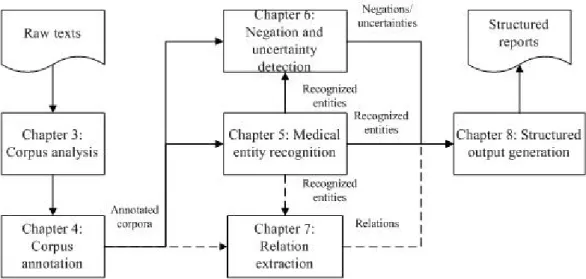
This thesis is organized in the order of the workflow in an automatic structured reporting system. Apart from chapters 2 and 9, each chapter presents one of the major components in the pipeline system, which is illustrated in Figure 1.1.
Figure 1.1 Organisation of the thesis. Relation extraction is performed on the lymphoma corpus.
Chapter 2 presents a survey of previous works on information extraction. The four major subtasks in information extraction: medical entity recognition, negation and uncertainty detection, relation extraction andstructured output generationare reviewed.
Chapter 3 presents the detailed analysis of the training data in this study.
Chapter 4 describes a process for annotating pathology reports. Three semantically annotated corpora were developed, and annotation schemas and annotation guidelines are introduced.
9
In Chapter 5, a machine learning-based MER system is developed. Various features are explored, and integrated into the machine learner.
In Chapter 6, three different approaches including lexical-based approach, syntactic-based approach and supervised machine learning based approach have been experimented with for negation detection. To resolve uncertainty, a rule-based module is also proposed.
Chapter 7 shows a relationship extraction system, using both rule-based approaches and machine learning methods to extract relations from the lymphoma corpus.
Chapter 8 illustrates the design of predefined templates, ranking criteria and special rules tailored to the corpus, and development of a structured output generation system.
10
Chapter 2
Literature Review
2.1 Introduction
This chapter introduces previous works related to information extraction (IE). It gives a general overview about the current state of the art techniques in information extraction, and includes reviews of the four main subtasks: medical entity recognition (MER), negation and uncertainty detection, relation extraction (RE), and automatic structuring.
2.2 Medical Entity Recognition
2.2.1 Dictionary Look-up Approaches
A dictionary look-up approach also refers to concept mapping or encoding (Friedman et al., 2004) in some cases. It deals with the identification of relevant term(s) by mapping a concept from textual notes into a reference terminology, and it also links the concept with a referent identifier. Encoding information into a standard terminology can not only increase the accessibility of the information, facilitating storage and retrieval of it, but also achieve better interoperability between different information resources and enable the exchange and sharing of data.
Standard terminologies or a collection of terminologies with large lexical resources, such as the Unified Medical Language System (UMLS) (McCray, 2003), the Systematized Nomenclature of Medicine Clinical Terms (SNOMED CT) (IHTSDO, 2007-2014) and International Classification of Diseases (ICD) (WHO, 2009-2014), provide vast and rich lexical resources for these approaches to map the text in clinical notes to concepts.
The UMLS contains the greatest number of concepts in the medical domain, including three Knowledge Sources: Metathesaurus, Semantic Network and Specialist Lexicon (NLM, 2006-2014). There are more than 100 source vocabularies in the UMLS Metathesaurus, including terminologies designed for use in patient-record systems; large disease and procedure classifications used for statistical reporting and billing; vocabularies used to record data related to psychiatry, nursing, medical devices, and adverse drug reactions. The Semantic Network consists of a set of Semantic Types, that provide a consistent categorization of all concepts represented in the UMLS
Metathesaurus, and a set of Semantic Relations between these concepts. The SPECIALIST Lexicon has been developed to provide the lexical information needed for the SPECIALIST natural language processing (NLP) System, including both common English words and biomedical vocabulary. The lexicon entry for each word records the syntactic, morphological, and orthographic information needed by the SPECIALIST NLP System.
11
The MetaMap Program is a well-known system that can parse free-text into simple noun phrases, and then map them to UMLS concepts (Aronson, 2001). In the program, first, the input text is parsed into simple noun phrases to limit the scope of further processing so that the mapping can be more tractable. For each phrase, the program generates rich variants, including acronyms, abbreviations, synonyms, derivational variants, meaningful combinations of these, and inflectional and spelling variants. Then it evaluates each candidate retrieved from UMLS Metathesaurus against the input text by first
computing a mapping from the phrase words to the candidate’s words and then calculating the strength of the mapping with four metrics: centrality, variation, coverage and cohesiveness. Complete mappings are constructed by combining candidates involved in disjoint parts of the phrase. The highest scoring complete mappings were chosen to represent the input.
The large number of source dictionaries in UMLS can help a dictionary look-up method to attain a high recall, however, they also bring some problems, e.g., indiscriminate use of a large set of
overlapping terminologies in UMLS can introduce too much noise, and it can lower the efficiency of a dictionary-based system as well.
To overcome these issues, Huang et al proposed a context-based mapping method by restricting the concepts in different sections of the reports and mapping them to specific UMLS vocabularies (Huang et al., 2003). They found that this could increase precision effectively without a significant decrease in recall.
Another possible solution is to prune the mapping sources according to the focus of the research problem. For example, Long developed a program by using a small dictionary to divide disease statements into phrases for coding (Long, 2005). It was able to quickly identify the most specific codes available in SNOMED CT from UMLS for the statements in the discharge summaries. It was tested on 23 discharge summaries with 250 phrases to be coded, with only 19 false positives returned.
SNOMED CT is a comprehensive clinical terminology that provides clinical content and expressivity for clinical documentation and reporting. In 2004, the American Consolidated Health Informatics initiative identified SNOMED CT as the standard ontology for diagnoses, problem lists, and anatomy (Richesson and Krischer, 2007). There are over 400,000 atomic concepts and pre-coordinated concepts which are organized into 19 top-level hierarchies in SNOMED CT (in the January 2013 Release). It offers even more expressiveness through post-coordination (Elkin et al., 2003). Each concept in SNOMED CT is logically defined through its relationships to other concepts.
The Text to SNOMED CT (TTSCT) system was developed to detect SNOMED CT’s concepts in free text and to annotate them with clinical reference terms (Patrick et al., 2007a). It generated an
augmented lexicon composed of atomic words of SNOMED CT descriptions which were normalized with removal of all stop words, and each word was indexed with a list of associated DescriptionIDs (whose full names contain the word). A token matching algorithm was applied to the input text after
12
pre-processing (i.e., sentence boundary detection, stemming, lower case conversion, spelling variation generation, abbreviation expansion), the candidate DescriptionIDs are extracted by looking up the augmented lexicon. Then a dynamic programming algorithm checks all candidate combinations, and finds the combination with the maximum coverage of the text. In the evaluation of 487 clinical notes from an Intensive Care Service with 4,054 medical concepts, the system correctly identified 2,852 concepts, results in a precision of 70.4%, although the recall rate could not be fully evaluated (Wang and Patrick, 2008).
To reduce the ambiguities when mapping text to SNOMED CT core concepts, Hina et al first extracted 390023 SNOMED CT core concepts from SNOMED CT as a single gazetteer, and then developed separate gazetteers for each class defined in SNOMED CT (Hina et al., 2010). Evaluations on 300 discharge summaries showed that there is considerable improvement in reducing ambiguities by identifying the concepts in separate gazetteers rather than a single gazetteer.
The dictionary look-up component of the Mayo Clinic’s Information Extraction system (renamed as clinical Text Analysis and Knowledge Extraction System (cTAKES) at present) was tested on a corpus of 160 free-text clinical notes (Kipper-Schuler et al., 2008), showing that such an approach had the potential to work well on MER, as it achieved an F-score of 0.56 for exact matches. However, it also indicated that the characteristics of clinical texts which include many lexical variations, disjoint concepts, and extensive use of abbreviations and acronyms could make the task more complex.
To address these issues, Wang performed some dictionary look-up experiments to match the concepts in the clinical notes with the SNOMED CT concepts (Wang, 2009). Removing unrelated terms and concept categories in the lexicon could reduce the ambiguity of the lexicon, leading to higher precision and recall. Proofreading such as correcting spelling errors or irregular conventions,
resolution and expansion of abbreviations and acronyms in the notes, further increased both precision and recall. The dictionary look-up method finally achieved a relatively high precision with 74.81%, suggesting that it is an effective method to identify clinical concepts, but the extensive efforts it requires on pre-processing may not be easy to adapt to other corpora. In addition, it fails to identify some long and complex terms and resolve term disambiguation.
There are also other issues that should be noticed about dictionary look-up approaches. For example, the number of extracted entities is definitely hindered by the coverage of the terminologies in the medical corpora. For instance, a study pointed out that the Specialist Lexicon of UMLS only had about 79% coverage for syntactic information and 38% coverage for semantic information in a corpus of discharge summaries (Johnson, 1999). Thus, it is very likely that some entities will be overlooked in extraction with these approaches.
13
2.2.2 Rule-based Approaches
Rule-based methods were also prevalent in many early works on MER, and usually comprised hand-crafted rules and regular expressions to define patterns.
One of the typical rule-based systems is the medical language extraction and encoding (MedLEE) system (Friedman et al., 1994). It consisted of a pre-processor, a parser, a compositional regularizer, an encoder and a recovery component, which are described below: the pre-processor first identified sentences and abbreviations with rules, recognized and categorized words and phrases with lexical lookup; the parser used a grammar, a set of rules based on semantic and syntactic co-occurrence patterns to identify the structure of a sentence and to generate an intermediate structure that consisted of primary findings and different types of modifiers for the sentence; the compositional regularizer used a table of structural mappings to compose individual words into phrases when applicable; the encoder mapped words and phrases into codes with an encoding table; the recovery component allowed the parser to choose alternative strategies to structure the text if the initial one failed.
It was originally developed for the domain of radiological chest reports, but has subsequently been extended to mammography, discharge summaries, electrocardiography, echocardiography, and pathology (Friedman, 2000).
In general, rule-based methods are suitable to extract entities with explicit lexical, morphologic or orthographic patterns, e.g., medication information, test results and scores.
Turchin et al designed software with regular expressions to identify and extract blood pressure values and anti-hypertensive treatment intensification from physician notes with high accuracy (Turchin et al., 2006). This approach has both advantages and disadvantages. A set of regular expressions can be developed much faster than a full-fledged natural language processor, however, it lacks generality so that a new set of regular expressions has to be developed and validated for another particular task. Its applications are limited to data items with a constrained lexical scope, and variants like synonyms have to be manually generated as well.
To extract medication information from discharge summaries, Yang developed a relatively simple rule-based approach with manually curated feature term lists and token-based regular expressions (Yang, 2010). This approach performed reasonably well with a micro-averaged F-score of 80% for the term-level results and 81% for the token-level results. It was based on few annotated data, and was competitive without using pre-existing domain-specific tools and resources.
Similarly, without any deep NLP, such as part-of-speech (POS) tagging, chunking or syntactic parsing, a medication detection system first recognized drug names with a semantic lexicon, and then explored the context of these names to extract related information (mode, dosage, etc) according to rules capturing the document structure and the syntax of each kind of information (Deleger et al.,
14
2010). It initially obtained an F-measure of 77% in the 2009 i2b2/VA Challenge and increased to 81% with lexicon filtering and rule refinement. It demonstrated that a simple NLP system with surface rules could achieve high performance to capture medication-related information in clinical records.
The above methods could not perform well when encountering complicated medications that contain multiple signatures or contextual level information. MedEx adopted a more sophisticated method to cope with the task (Xu et al., 2010). It consisted of a sequential tagger and a combined parser: the sequential tagger combined lexical look-up, regular expression, and rule-based disambiguation components, could sigificantly improve the accuracy of semantic labeling of drug names and signatures. The parser combined a Chart parser and a regular expression-based Chunker to improve the ability to parse more complicated medications. The evaluation showed that MedEx can accurately extract not only drug names, but also associated information, such as strength, route, and frequency, with high F-scores (from 93.2% to 96.0%).
There are a number of research works indicating that dictionary look-up methods can also benefit from integrating with rules.
An NLP engine was developed to measure the quality of colonoscopy procedures, based on rules and dictionary look-ups (Harkema et al., 2011). Firstly, it utilized the MetaMap Transfer (MMTx) program (NLM, 2008-2014) to map words and phrases in each sentence in the report to a subset of concepts in the UMLS Metathesaurus, including the following semantic categories: Anatomical Structure, Neoplastic Process, and Sign or Symptom. Then a set of regular expression patterns was prepared to parse and interpret the temporal expressions and measurements of size. The ConText algorithm was used to identify the clinical and linguistic properties of the extracted concepts
(Harkema et al., 2009). The values of the target variables were established by using some simple rules. The NLP engine attained encouraging results with 0.89 of average accuracy and 0.74 of average F-score.
A more detailed study was performed on a MER task with two dictionary-based systems MetaMap and Peregrine (Schuemie et al., 2007), by comparing with and without the use of a rule-based NLP module, which was composed of a set of post-processing rules that utilized POS and chunking information (Kang et al., 2013). It revealed that with this module, the F-scores of MetaMap and Peregrine improved by 12.3% and 14.1% respectively for exact boundary matching, and by 11.1% and 12.9% respectively for concept identifier matching, compared to those without this module.
However, it should be noted that the limitations of the rules can also propagate to dictionary look-up methods when they are integrated. Schadow et al used a rule-based parser by employing regular expressions to search for specimen headers in the diagnosis section of pathology reports, and guide the coding process by accepting only certain UMLS semantic types that fit the expected meaning of the input phrase (Schadow and McDonald, 2003). They found that 91% of 275 reviewed reports were
15
coded by this approach with the parser relying on regular expressions to attain structural clues. Thus it faced great difficulties when processing less consistently formatted reports.
2.2.3 Statistical Approaches
Recently, with more advanced machine learning algorithms being released, statistical methods have become more popular. One of the main characteristics of these methods is that they can utilize contextual information to predict the entities, which is especially useful when the coverage of the dictionary is quite limited, or rules or patterns are too difficult to be captured from the training examples.
According to the strategies by which machine learners generate their models, they can be classified as either generative techniques or discriminative techniques. Generative techniques seek to create rich models of probability distributions, and with such models, they can generate synthetic data; discriminative techniques are usually thought to be more utilitarian, since they directly estimate posterior probabilities based on observations. Besides, discriminative models often allow using more features than generative models, since when many features are used, generative models can become intractable. Bayesian networks (Ben-Gal, 2007) and hidden Markov models (HMM) (Stamp, 2004) are examples of generative methods, while support vector machines (SVM) (Cristianini and Shawe-Taylor, 2000) and conditional random fields (CRF) (Sutton et al., 2007) are examples of
discriminative methods.
SymText uses probabilistic Bayesian networks to represent semantic types and relations (Haug et al., 1994). Syntactic knowledge comes from augmented transition networks. The system depends on a set of reports to train the network for a specific medical domain. For instance, when extracting
pneumonia-related concepts from chest x-ray reports, it utilized three Bayesian networks: the first Bayesian network represented radiographic findings; the second one modeled the diseases that can be described in the reports; the third one modeled the devices that are frequently described in the chest x-ray reports (Fiszman et al., 2000). The performance of SymText was compared against four
physicians, two different keyword searches, and three lay persons. The accuracy of SymText was similar to that of physicians and better than that of lay persons and keyword searches.
In its successor M+ (Christensen et al., 2002), Bayesian networks were represented in an object-oriented format and a bottom-up chart parser provided syntactic analysis. In addition, M+ used an abstract semantic language to link Bayesian network types to each other in a predication format. The advantages of using Bayesian networks for semantic representation include tolerance of noise and partial matches and sensitivity of context to the recognition of semantic patterns. In addition, its ability to guess the semantic types of unknown words is very valuable for bootstrapping semantic knowledge.
16
Nonetheless, both systems are limited to the domain covered by the semantic knowledge that is stored within the Bayesian networks. The creation of training cases is also a time-consuming task.
MER is one the tasks of the 2009 and 2010 i2b2/VA Challenges. The 2009 Challenge focused on the identification of seven types of medication information in discharge summaries, including dosages, modes of administration, frequencies, durations, and reasons for administration (Uzuner et al., 2010). The winner used a CRF model to extract the entities and achieved the best micro-averaged F-score of 85.65% (Patrick and Li, 2010). The 2010 Challenge defined three classes which were Test, Problem, and Treatment were extracted (Uzuner et al., 2011). Most of participants used CRF as the framework together with feature engineering specific to these classes in the challenge. For example, Patrick et al adopted a CRF learner to identify the entities and attained a micro-averaged F-score of 81.79% (Patrick et al., 2011).
Theoretically, CRF is a representative sequence labelling algorithm, which is suitable for the MER tasks, while SVM is based on large margin theory and has difficulty handling sequence labelling problems as it ignores the relationships between neighbouring tokens in sequences. For instance, Li et al proved that CRF outperformed SVM on MER of disorders in clinical notes (Li et al., 2008). However, CRF also has its own weaknesses, e.g., it is unable to utilize the global information in the notes.
To combine the advantages of both CRF and SVM, Tsochantaridis et al proposed a new machine learning algorithm named Structural Support Vector Machines (SSVM) for structural data, which is an SVM-based discriminative algorithm for structural prediction (Tsochantaridis et al., 2005). Tang et al applied SSVM to recognize clinical entities in discharge summaries and compared the performance of CRF and SSVM on the 2010 i2b2/VA Challenge data (Tang et al., 2012). Their evaluation showed that the SSVM-based system required less training time, but achieved better performance than the CRF-based system with the same features.
A combination of machine learners can also overcome some shortcomings of a stand-alone classifier.
Wang and Patrick presented a machine learning approach to MER using a combination of machine learners (Wang and Patrick, 2009). They firstly built a CRF based model to identify the entities and then reclassified the identified entities by Maximum Entropy and SVM models. A voting strategy was employed between the three classifiers to determine the class of the recognized entities. The results showed that the reclassifier effectively boosted the F-score by 3.35% over the stand-alone CRF model.
Xu et al purposed a novel method for MER of follow-up and time information in radiology reports which combined a labeled sequential pattern (LSP) classifier with a CRF recognizer (Xu et al., 2012). The LSP classifier was an SVM classifier that used binary features, each of which corresponds to a set of patterns mined for positive set and negative set respectively. In the training phase, the LSP
17
local contexts of positive examples; in the test stage, it used global patterns in a sentence to narrow down a set of candidate sentences. The experiment showed significant improvement of the
performance of the CRF recognizer, due to the process of cleaning-up the training data and compensation for CRF’s inability to use global information by the LSP classifier.
Feature Selection
Choosing proper features for machine learners is as important as selecting an appropriate machine learning technique, as features can provide critical clues for the learners to construct the models and make prediction on the test data. Usually, features can be categorized as follows:
• Contextual features: local context features (e.g., the bag-of-words (BOW), also called context window of words), global context features (e.g., section context, document types).
• Lexical features: such as lemma, lowercase of words.
• Syntactic Features: part-of-speech (POS) tags, chunking information, etc.
• Morphological features: affixes, orthography and so on.
• Semantic features: for example, exploring external resources can provide additional domain knowledge.
There is much research addressing the importance of feature selection or feature engineering.
The results from Li and Martinez’s experiments on the extraction of a large number of categories from pathology reports (Li and Martinez, 2010) showed that a high level of accuracy could be attained on predicting nominal categories by using BOW feature. This indicated that pathology reports contain similar lexical items that can be captured by a BOW model. It als