Research Paper Volume-2, Issue-11 E-ISSN: 2347-2693
Mobile Learning Using Cloud Computing
Dr. S. Dhanalakshmi
1, S. Suganya
2*and K. Kokilavani
31
Department of Computer Science and Applications
2*,3
Department of Computer Science
Vivekananda College of Arts and Sciences for Women, Namakkal, TamilNadu, India
www.ijcaonline.org
Received: Oct/26/2014 Revised: Nov/08/2014 Accepted: Nov/22/2014 Published: Nov/30/2014
Abstract- Mobile cloud learning, a combination of mobile learning and cloud computing, is a relatively new concept that holds considerable promise for future development and delivery in the education sectors. With the mass popularity of 3G, WIFI wireless network and intelligent mobile terminal equipment (intelligent mobile phone, tablet computer, etc.), mobile learning has become one of the important ways of learning. But the traditional mobile learning mode has many disadvantages, and the mobile learning based on cloud computing is a good way to overcome the disadvantages. This paper first introduces the concept and cloud computing, then designs a structure of mobile learning system based on cloud computing and mobile learning architecture and how mobile learning differentiate from e-learning.
Keywords - Cloud computing; mobile learning; e-learning; mobile technologies. I. INTRODUCTION
Mobile devices (e.g., smartphone, tablet pcs, etc) are increasingly becoming an essential part of human life as the most effective and convenient communication tools not bounded by time and place. Mobile users accumulate rich experience of various services from mobile applications (e.g., iPhone apps, Google apps, etc), which run on the devices and/or on remote servers via wireless networks. The rapid progress of mobile computing (MC) becomes a powerful trend in the development of IT technology as well as commerce and industry fields. However, the mobile devices are facing many challenges in their resources (e.g., battery life, storage, and bandwidth) and communications (e.g., mobility and security). The limited resources significantly impede the improvement of service qualities.
INTRODUCTION TO CLOUD COMPUTING Cloud Computing has been one of the most booming technology among the professional of Information Technology and also the Business due to its Elasticity in the space occupation and also the better support for the software and the Infrastructure it attracts more technology specialist towards it. Cloud plays the vital role in the Smart Economy, and the possible regulatory changes required in implementing better Applications by using the potential of Cloud Computing.
The main advantage of the cloud is that it gives the low cost implementation for infrastructure and some higher business units like Google, IBM, and Microsoft offer the cloud for Free of cost for the Education system, so it can be used in right way which will provide high quality education.
The term cloud computing is being bandied about a lot these days, mainly in the context of the future of the
web. But cloud computing potential doesn't begin and end with the personal computer's transformation into a thin client – the mobile platform is going to be heavily impacted by this technology as well. At least that's the analysis being put forth by ABI Research. Their recent report, Mobile Cloud Computing, theorizes that the cloud will soon become a disruptive force in the mobile world, eventually becoming the dominant way in which mobile applications operate.
II. MOBILE LEARNING
Mobile learning is a system which is implemented for education using cloud computing. The main objective of Mobile-Learning is that the learners can get the knowledge from the centralized shared resources at anytime and anywhere they like to read that too at free of cost. Mobile-learning is a system where one can learn through any source on topics of his choice without the need of storing everything in his device. As-you-pay and that much you can use the services from the cloud data centers for learning selected topics over mobile phone even you in a small village or remote area. For example, if student want learn a JAVA technologies from his agricultural land and works.
Mobile learning has many different definitions and is known by many different names, like M-Learning, U-Learning, personalized learning, learning while mobile, ubiquitous learning, anytime / anywhere learning, and handheld learning. One definition of mobile learning is, "any sort of learning that happens when the learner is not at a fixed, predetermined location, or learning that happens when the learner takes advantage of the learning opportunities offered by mobile technologies".
Figure 1: The Process flow of Mobile-Learning Cloud Computing
The person who wants to make use of Mobile-learning (Figure. 1) has to register and get the credentials to use it via web. It can also be downloading as a mobile application which will be installed in the mobile and through the GPRS/WIFI connectivity they can access the content over the cloud and the user can select among various available topics the one he needs. The topic might be Text based documents , audio and video files which will be buffered from the cloud to that mobile user and downloaded in the mobile if the memory is available in the mobile(if the user wishes to do so). The user can read the documents, look at the video tutorials, listen to lectures or seminars and finally they can take up self-assessments. They will be given a results analysis so that they can evaluate their strengths & weaknesses on their own. This system helps to "Learn while you roam" and also education for all at any time anywhere globally. Experts can also share their valid tutorials in to the cloud for development of the education community.
MOBILE LEARNING CLOUD MODEL In this cloud model (Figure 2) the User will access the cloud space using his/her credentials so that the required data will be shared from the cloud based on the client request only for the authenticated user.
Figure 2: The Process flow of Mobile-Learning Cloud Model
In this paper, the process flow of mobile learning cloud as we shown in figure 2 which is having 6 steps. Data storage is used for storing the huge data where users are retrieving or handle the data from the data centers. Memory management is organizing and manages the data which is coming from clouds to mobile subscribers and process layer is interacting with security firewalls and memory management.
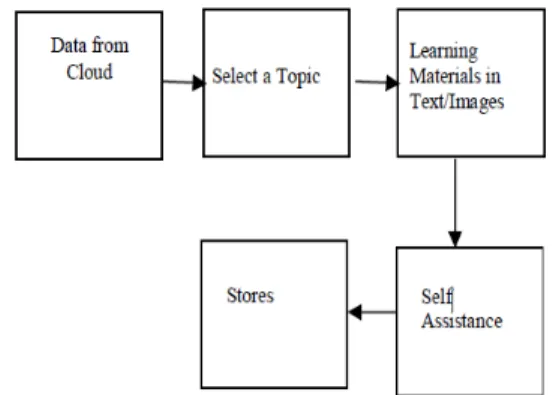
MOBILE-LEARNING CLIENT MODEL In this client model (Figure 3) the user has to download this application and install in their Personal Digital Assistance (PDA) devices or in their mobile phones. The user has to connect to GPRS / Bluetooth / Wi-Fi and connect to the cloud network and get the required topics and based on the selected topic the materials will be downloaded to the mobile for the reading process.
Figure 3: The Process flow of Mobile-Learning Client Model
In figure 3, the mobile users retrieve the data either in the form of text/video/voice from the cloud center. The subscribers are select which they want to download or retrieve from the data centers with the help of self-assistance and keep downloaded data at mobile database.
III. MOBILE TECHNOLOGIES FOR M-LEARNING
Mobile technologies are an attractive and easy means to maintain literacy skills and gain constant access to information. They are affordable, can be easily distributed and thus hold great potential for reaching marginalized groups and providing them with access to further learning and development. Mobile technologies facilitate distance learning in situations where access to education is difficult or interrupted because of geographical location or due to post-conflict or post-disaster situations. Mobile devices and personal technologies that can support mobile learning include:
E-book
Handheld audio and multimedia guides, in museums and galleries
Handheld game console, modern gaming consoles such as Sony PSP or Nintendo DS
Personal audio player, e.g. for listening to audio recordings of lectures (podcasting)
Personal Digital Assistant, in the classroom and outdoors
Tablet computer
UMPC, mobile phone, camera phone and Smart Phone
Technical and delivery support for mobile learning include:
3GP For compression and delivery method of audiovisual content associated with Mobile Learning GPRS mobile data service, provides high speed
connection and data transfer rate
Wi-Fi gives access to instructors and resources via internet
Cloud computing for storing and sharing files and also, we need baseline requirements for mobile technologies that support learning outside of school settings. These technologies should be:
1) Highly portable: The technology is available whenever the user needs to learn.
2) Individual: The technology can be personalized to suit the individual learner‘s abilities, knowledge and learning style, and is designed to support personal learning rather than general office work.
3) Unobtrusive: The learner can capture situations and retrieve knowledge without the technology becoming overly noticeable or imposing on the situation.
4) Available: The learner can use the technology anywhere, to enable communication with teachers, experts and peers.
5) Adaptable: The technology can be adapted to the context for learning and the learner‘s evolving skills and knowledge.
6) Persistent: The learner can use the technology to manage learning throughout a lifetime, so that the learner‘s personal accumulation of resources and knowledge will be immediately accessible despite changes in technology.
7) Useful: The technology is suited to everyday needs for communication, reference, work and learning. 8) Easy to use: The technology is easily
comprehended and navigated by people with no previous experience using it.
IV. MOBILE LEARNING ARCHITECTURE BASED ON CLOUD
This architecture is proposed for higher education in a cloud computing environment. The main objective of Mobile-Learning in the cloud environment is to provide learners the knowledge from the centralized shared resources at anytime and anywhere. Our proposed architecture for Mobile Distance Learning is given in Fig. 4. It incorporates communication between end-user devices (terminals) and the Data Center in a cloud computing environment. The terminals can be connected to the Infrastructure inside the University Local Area Network (LAN), or they can be connected on external networks (the internet). The University Platform Server (Course
Management System) hosts educational resources and it is connected on the University LAN.
A user may access the platform directly from the University LAN or through the Internet in order to collect the learning materials. The user can access the Data center either from University LAN, or directly from the internet. The authentication server will manage the authorized access to the Data Center, and it will be directly connected on both passive and active server. The passive and the active servers need to be connected to the Load Balancer, which determines which server is active. The Load Balancer will determine which server needs to manage the load (either the active, or both), i.e. the incoming service request from the user. Both active and passive servers can be connected to the storage area network and the network infrastructure.
Figure 4: Architecture for cloud based M-learning The server takes additional data from the storage area network that needs to be processed. The advantage of this architecture is that it offers an interactive mode on mobile devices, as a special benefit from using the Data center within the mobile cloud environment. In our case, another advantage of this model is that it can provide service continuity, or seamless mobility as the user handovers from the external network to the University Local area network. According to this architecture the University classrooms will be connected to the Server Platform and the internet. The University Classroom usually should have the following equipments: A PC, or laptop, microphone,
speakers, tablet, webcam, projector, and a monitor, or screen.
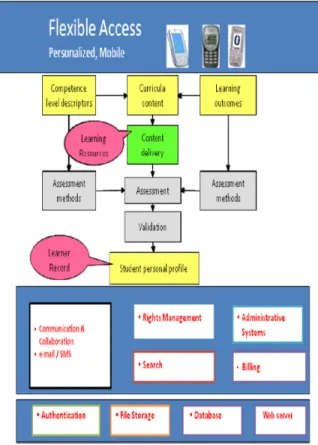
Figure 5: Detailed components of the Architecture At the University Classroom the lecturer will present and deliver the content of the learning material to the students in a classical manner, or via the internet to the students that are at home, at work, or simply they are mobile (on the road). The students that are at home, or at work connect to the course by using their PCs, or laptops using the high speed internet from their homes, or their offices. On the other hand, the mobile students (students on the road) use their mobile devices (mobile smart phones, or tablets) to connect to the course via their mobile networks (such as GPRS, UMTS, HSPA, WiFi, WiMAX or LTE) which is shown in Fig 5.
According to the technology development trend, increased speed and density of Integrated Circuits, Enhanced Transmission capacities on Optic Fibre Networks and Networking Flexibility, Distributed and Open Platform-based Communication Software, Capacity Growth and new Application Services on Wireless, Emergence of Next-Generation Networks (IP-based), Delivering QOS for Real time services, Ubiquity of networks through RFID & IPv6 (Next Generation Internet) are the demand of the age. In continuation to that use of Coaxial Cable for Telecom Services (Cable TV Network for Broadband and telephony local loop), Use of DSL technology on traditional Copper Loops, Wireless Access Service for Fixed and Mobile communication, VSAT-based Access in remote areas,
Power line based Access (BPL), Free Space Optics (FSO) are also implied demanded service trend.
The Server Platform provides possibility to host the digital educational resources, which can be accessed by the lecturer and all students either locally, or throughout the internet connection. Additionally all students, as well as the lecturer over the internet can access the Server Platform to collect, or download the data that needs to be computed in a cloud computing environment. The components of the proposed architecture are mainly to solve the sharing of computing resources, which can be used as the e-learning resource library. It includes hardware, storage, and some other IT infrastructure and resource pool. It uses virtualization technology, coordinating action to ensure stability and reliability. At the same time it provides the basic network supported environment to ensure scalability and efficient use of resources in the cloud computing application. The service system is a software system of an actual run of storage, maintenance and provision of data, it is a collection of objects of storage medium, processing and management system, and it is the web development integration platform. In addition to the content network storage and maintenance, this also provides standard interfaces. When resources in the library have a rich accumulation and a certain amount of knowledge systems, there is a need for resources package to form an independent resource platform to the upper access. The service system contains all the blocks implementing the local and distributed management functionalities of Education Cloud. The administration and authentication unit provides and implements the Cloud’s access facilities. This task falls into the security scope of identification, authentication and permission management. Since designing a cloud system is not purely a matter of technical sophistication, we necessitate the incorporation of a strategic framework into the process of system design. The strategic framework should include various aspects that should be considered in designing a cloud system.
V. HOW M-LEARNING DIFFERS FROM E-LEARNING
E-learning plays an important role in the educational growth of any nation. It also offers opportunities for developing nations to enhance their educational development. It can also plays a critical role in preparing a new generation of teachers, as well as upgrading the skills of the existing teaching force to use 21st century tools and pedagogies for learning. So it is the changing trend in education. The modern technologies particularly the internet made education no longer limited to the four walls of the class room.
E-learning comprises all forms of electronically supported learning and teaching. The information and Communication systems, whether networked or not serve as specific media to implement the learning process. The term will still most likely be utilized to reference out-of classroom and in-classroom educational experiences via
technology, even as advances continue in regard to devices and curriculum.
Mobile learning combines E-learning and mobile computing. Mobile learning is sometimes considered merelyan extension of E-learning, but quality M-learning can only be delivered with an awareness of the special limitations and benefits of mobile devices. Mobile learning has the benefits of mobility and its supporting platform. M-learning is a means to enhance the broader M-learning experience. M-learning is a powerful method for engaging learners on their own terms.
Mobile technology in word open various ways for new educational technologies aimed at fulfilling the country’s educational needs. There are various ways to use mobile phones for enhancing learning. Mobile phone plays an important role in our day-to-day lives in various purposes. One of the important purposes is learning. Mobile learning, as a novel educational approach, encourages flexibility; students do not need to be a specific age, gender, or member of a specific group or geography, to participate in learning opportunities. Restrictions of time, space and place have been lifted.
VI. CHARACTERISTICS OF MOBILE LEARNING Mobile cloud learning has the following characteristics. 1. Storage and sharing: Learning outcomes and
resources can be stored in the “Cloud,” which provides almost unlimited store and computation capacities. Documents can be commonly edited and shared in the “Cloud,” such as services provided by GoogleDocs, Live Skydrive, and Office Live.
2. Universal accessibility: Learners can study as long as they have access to the network. Mobile cloud learning also makes a low-cost access terminal possible, because software, applications, and data are all operated in the cloud servers. This improved accessibility can greatly benefit developing regions.
3. Collaborative interactions: Learners can cooperate anywhere in the “Cloud.” From social learning perspectives, they can collaboratively build common knowledge through frequent and convenient interactions.
4. Learner centered: Mobile cloud learning is heavily people-oriented, which meets the individual needs of learners. Learners in the “Cloud” select suitable resources and can track their learning progress and outcomes.
Given the above characteristics, mobile cloud learning is mostly utilized to enable communication between educators and students, manage the teaching and learning processes, and add knowledge to interested and willing users, utilized among learners, and so on.
The responses of learners to using this learning method are excellent. Most studies share the finding that currently
young people natively communicate through the language of mobile phones, the Internet, and social networks. Today’s learners have more readily embraced learning and educational technologies compared to other traditional learning methods, as these new learning methods allow them to share their knowledge and experiences through online sites. Learners have also been identified as exhibiting better learning behaviours, while using these learning technologies, since they are a flexible, ‘fun’ way to learn, and manageable.
In a recent survey of students in a UAE university, a large percentage of learners (about 80%) use laptops, mobile phones, or both regularly for their learning purposes. Kennington, Olinick, and Rajan (2010) found most learners revealed that gadgets, such as laptops and mobile phones, are must haves and that Internet access is absolutely necessary. Additionally, learners want learning environments to be freer and more comfortable than classrooms. They prefer informal places rather than formal ones. Mobile cloud learning provides such an opportunity, allowing learners to check their timetables, obtain tutor’s notes/assignments, complete research, and even learn an entire course using the same process.
VII. LIMITATIONS OF M-LEARNING
• Connectivity: There may be some connectivity
problems while uploading and downloading of data and because of poor mobile network signals.
• Screen size: As the screen size is too small, it can strain the eyes of the learners if they use it for long period of time. Also only less information or just the gist of content can be provided due to size constraints.
• Device: Learners must possess the mobile device that is supporting the courseware and this device may be expensive. As technology keeps changing at a rapid rate, these devices should be upgraded frequently. In addition to the cost of these devices, there are monthly data charges from mobile network providers; so downloading large content not only takes time but also costs a lot.
• Distraction: While accessing the course through mobiles, if the learner gets a call or SMS or social media updates, then they are bound to get distracted.
Therefore, mobile learning can really help employees to avail the benefits of anytime and anywhere learning train in their organizations. It opens so many doors to new technology and will continue as the years go.
VIII. APPLICATIONS OF M-LEARNING M-LEARNING FOR EDUCATION
The World Wide Web is the most successful educational tool to have appeared in a long time. It combines and integrates text, audio and video with interaction amongst participants. It can be used on a global scale and is platform
independent. While largely an asynchronous medium, it can be used also for synchronous events. It is not surprising, therefore, that trainers, lecturers, distance education providers and teaching institutions at all levels are increasingly using the Web as a medium for delivery. The statistics showed that: The number of Americans accessing the mobile web went up 107% last year; Mobile Web Access is growing around 15-20% a month; Mobile internet growth is 8x greater than PC-based growth; and Mobile social networking sites are getting more popular, mobile Facebook has 4 million users a day. In this section we will map the evolution from the wired virtual learning environment of today, to the wireless learning environment of tomorrow.
The studies should evaluate each of these technology models on the six major dimensions of distance education provision:
The provision of course content to off-campus students
The provision of feedback to off-campus students The provision of student support services to
off-campus students
Links to the WWW and other resources Student-to-student interactivity
Student to tutor and institution interactivity.
Each of these dimensions should be analysis and evaluate on a four point grid for decision makers: Student user friendliness, Didactic effectiveness, Technical feasibility, Cost effectiveness.
Mobile devices, and their technologies and systems, are eroding established notions of time as a common structure that had previously underpinned social organization and the consensual understanding of the world. Time-keeping is being replaced by the ‗approx-meeting ‘and the ‗ multi-meeting‘, ‗socially negotiated time‘, the ‗micro coordination of everyday life‘alongside the ‗softening of schedules ‘afforded by mobile devices and Nyiri says, ―with the mobile phone, time has become personalizedǁ. Whereas previously our social and business relations had to be organized and synchronized by absolute clock time, now mobile technologies allow us to renegotiate meetings and events on-the-fly. However, Basic mobile phone features are: Making and receiving calls; Sending and receiving text messages; and Basic office tools e.g. calculator. Advanced mobile phone features include: Bluetooth; Camera capable of taking stills and more commonly now video; e-book readers, games; Recording audio; GPS / location aware; and Web browser to connect to the internet.
Mobile learning can happen anywhere: in a classroom, at the dining room table, on a bus, in front of a science exhibit, and anywhere. Portability is not as important as the ability of the learner to connect, communicate, collaborate, and create using tools that are readily at hand. We have got them working as part of the M-Learning project. We are using the seductive power of these new technologies to re-inspire young learners who are dropping out of traditional
learning. Research and development has been ongoing for the last two years and many learners have already been trying out these approaches and contributing to their development.
IX. CONCLUSION
Mobile learning is not meant for schools and universities only, it is becoming a part of the workplace training experience as well providing information and a new format for testing understanding. With many businesses already supplying workers with Smartphone’s for work, it makes sense to get the most out of these devices as possible. Mobile devices are an excellent source of reference information should a student encounter an unfamiliar situation.
Increased use of tablets and Smartphone’s, improved broadband access for increased mobile-specific applications, extended use of digital textbooks and online instructional materials as a main learning resource, growth in preparation and use of open source materials providing for greater collaboration and cross-device use, further integration of social networking integrated into the learning process for increasing learners’ collaboration and connections with instructors, the movement to cloud computing and online classroom management systems that gather student achievement data and allow for more personalized instruction will undoubtedly bring new meaning and content to education as a whole, as well as new possibilities to provide for a higher educational level. REFERENCES
[1] Paul Hofmann, SAP Labs, Dan Woods, CITO Research: The Limits of Public Clouds for Business Applications: Digital LibraryNovember/December 2010.
[2] Uhlig, R., Neiger, G. Rodgers, D. S.M. Kagi, A.Leung, F.H. Smith : Intel Corp., USA: Intel visualization technology IEEE Computer Society: May 2005.
[3] Perez, R., van Doom, L., Sailer, R. IBM T.J. Watson Res. Center, Yorktown Heights, NY: Visualization and Hardware-Based Security –October 2008.
[4] GregorPetri: The Data Center is dead; long live the Virtual Data Center? Join The Efficient Data Center Nov 2010. [5]N. M. Rao, C. Sasidhar, and V. S. Kumar, Cloud
Computing Through Mobile Learning,? (IJACSA) International Journal of Advanced Computer Science and Applications, Vol 1, No. 6, pp. 42 – 46, December 2010. 2. K. Verma, S. Dubey, M.A.Rizvi, Mobile Cloud A New Vehicle For Learning: m-Learning Its Issues And hallenges?s, Volume 1, No.3, July – August 2012, International Journal of Science and Applied Information Technology.
[6]A. Hossain Masud, X. Huang, J.Yong ?Enhanced M-Learning with Cloud Computing: The Bangladesh Case?, Proceedings of the 2011 15th International Conference on Computer Supported Cooperative Work in Design, witzerland.
[7]Hong-qing Gao, Yan-jie Zhai, ―System Design of Cloud
Computing Based on Mobile Learningǁ, Knowledge
Acquisition and Modelling (KAM), Third International Symposium, PP. 239 – 242, IEEE 2010.
[8]A. Hossain Masud, X. Huang , ―A Novel Approach for
Adopting Cloud-based E-learning Systemǁ, 2012
IEEE/ACIS 11th International Conference on Computer and Information Science, China, pp 37-42.
[9]Ercan, T., “Effective use of cloud computing in educational institutions”, Procedia Social and Behavioural Sciences, 2, 2010, 938-942.
[10] Masud, A. H. and Huang, X., “A Cloud Based M- learning Architecture for Higher Education”, Archives Des Sciences Vol 66, No. 1; Jan 2013
[11]Dong, B., Zheng, Q., Yang, J., LiQiao, H., An E-learning Ecosystem Based on Cloud Computing Infrastructure, 9th IEEE International Conference on Advanced Learning Technologies, pp. 125–127. IEEE Press, Latvia (2009). [12]Erenben, C., "Cloud computing: the economic
imperative", eSchool News, Vol. 13, March, 2009, available at:
www.eschoolnews.com/emails/esntoday/esntoday061509. htm