Helicopter Night
Operations
Study
Final Report
August 24, 2010
Helicopter Night Operations Study
August 24, 2010 Prepared By:
Forest Service U.S. Department of Agriculture
San Dimas Technology & Development Center 444 E. Bonita Avenue San Dimas, CA 91773 And
Fire Program Solutions, LLC 17067 Hood Court
Table of Contents
Acknowledgements ... iii
Executive Summary ...v
Introduction ...1
The Study ...1
Step 1 Review History ...3
Step 2 Review Current Operations ...3
Step 3 Document Currently Available Technology or Technology That May Be Available Soon ...4
General Equipment List ...4
Mission Specific Equipment ...4
Emerging Technologies Available to the Civilian Market ...4
Step 4 Mission Definition and Quantification ...4
Missions Carried Forward for Further Evaluation ...4
Missions not Considered for Further Evaluation ...5
Global Mission Limitations as well as Flight Crew, Aircraft, and Support Requirements ...5
Step 5 Presentation of Alternatives and Selection of Course of Action ...9
Step 6 Perform a Risk Assessment for Candidate Helicopter Night Missions ...9
Identification of Systems and Subsystems ...11
Evaluation of Hazards and Mitigation Measures ...12
Rating of Hazards and Mitigation Measures with Benefits and Costs ...14
Considerations for Implementing Mitigation Measures ...23
Quality Assurance ...40
Findings, Conclusions, and Recommendations ...44
Glossary ...48
Appendixes ...55
Appendix A – Project Team Members ...57
Appendix B – Hazards and Mitigation Measures Developed by SMEs ...63
Appendix C – 2009 Aviation Risk Management Workbook ...79
Appendix D – Study Plan (Scoping) ...89
Appendix E – History of Helicopter Night Operations ...97
Appendix F – Overview of Site Visits ...117
Appendix G – Night Vision Aiding Equipment ...127
Appendix H – U.S. Army Accidents during Night Aided Operations ...133
Acknowledgements
This report was developed by Carl Bambarger, aviation program leader, San Dimas Technology and Development Center, and Fire Program Solutions LLC, in cooperation with PJKelly
Consulting, LLC; Safe Fire Programs Inc.; and Janine Smith LLC (On Course Safety).
Tory Henderson, equipment and chemicals fire program manager, served as chair of the project steering committee and provided advice and council throughout the process.
The contributions made by members of the organizations listed below are very much appreciated and contributed substantially to the project team’s knowledge regarding helicopter night
operations. The following organizations hosted site visits from members of the project team:
• U.S. Immigration and Customs Enforcement, Riverside, CA. • Los Angeles County Fire Department Air Operations.
• San Diego City Fire Department Air Operations. • AirLink of St. Charles Medical Center, Bend, OR.
• U.S. Army Fort Rucker Aviation Training Center, Fort Rucker, AL. o U.S. Army Night Vision Facility.
o U.S. Army Aeromedical Research Lab.
o U.S. Army Combat Readiness Safety Center.
• U.S. Coast Guard Air Training Command, Mobile, AL. • Oregon Army National Guard, Salem, OR.
David Luke, Night Flight Concepts, and Stephen Hatley, Night Readiness, LLC, made presentations to the steering committee, subject matter experts (experts), and project team. The consultants appreciate the professionalism, integrity, and commitment to achieving
improvements to the Forest Service aviation program by the experts and technical specialists who were assigned to the project team.
Executive Summary
In 1976, the Forest Service, U.S. Department of Agriculture, contracted for a Bell 212 helicopter with night operational capability utilizing night vision goggles. In 1977, a Los Angeles County helicopter and a Forest Service helicopter collided during night operations on a wildfire resulting in a fatality. The Forest Service continued contracting for two night-operations capable
helicopters until 1983 when the program was discontinued due to limited use and program cost. This report documents a helicopter night operations study including a programmatic risk
assessment and definition of a quality assurance program for the use of helicopters at night to support wildland fire suppression operations. The scope of work was coordinated with the project steering committee by San Dimas Technology and Development Center.
The findings and recommendations for the use of helicopters during night operations are:
Findings
1. The agency can design, implement, and operate a safe helicopter night operations program. There are significant hazards, organizational challenges, and implementation considerations that need to be resolved to achieve implementation.
2. The missions of water and retardant dropping using a fixed tank with ground fill, aerial supervision, and aerial ignition with the plastic sphere dispenser can have potential benefit to the agency and an implementation plan for each should be pursued.
3. The mission of emergency medical transport (with hoist) is a mission the agency currently does not have. Further definition of this mission and the level of care provided should be addressed in the implementation plan and by the agency for its normal day operations. The entire medical mission needs to be further defined.
4. Support technology, such as night vision goggles and helicopter terrain awareness and warning system for helicopter night operations, has evolved to where operations can be conducted with a high degree of reliability and safety.
5. Forest Service fire and aviation managers have identified that the helicopter night operations missions may provide fire suppression benefits. However, no attempt was made to quantify these benefits during this study.
6. The amount of effort, expense, and organizational reprioritization to implement a helicopter night operations program will be substantial and will take years to implement the agency’s first night-operational helicopter.
7. The agency lacks standards and guidelines for ground forces operating with helicopter night operations.
8. There is little corporate memory of the agency’s helicopter night operations efforts in the late 1970s and early 1980s.
9. Nonrecurring startup costs will be significant.
10.Recurring multiyear organizational costs will be significant.
11.The Forest Service contracts for 99 percent of its helicopter services. The study reviewed many night helicopter operations and found that all of them are cooperator
owned-and-operated services. Further, with the exception of the U.S. Army, the cooperators operate from a home base with a substantial knowledge of the terrain and hazards that they encounter within their designated area of operation.
12.The Forest Service helicopter program is based on all helicopters and pilots meeting the same standards. In addition, a total mobility concept is used with aircraft moving interchangeably throughout the United States. To implement helicopter night operations successfully, this total mobility program model may need to be modified.
13.The commitment required for a helicopter night operations program includes appropriate funding and staffing, not collateral duty functions. Without appropriate funding and staffing this program could result in a weakening of the overall helicopter program.
14.This risk assessment stands alone regarding the hazards and risk associated with night operations, but relies on prior risk assessments and their mitigating actions to apply to the aircraft and other system, e.g. aircraft performance, operation of the plastic sphere dispenser, etc.
Recommendations
1. The decision to proceed with any of the analyzed missions at night should be made at the Chief’s level.
2. Identify a helicopter night operations program manager and project manager to lead this effort.
3. Develop a helicopter night operations implementation plan including information contained in this report.
4. Present the helicopter night operations implementation plan to the Chief’s level for approval. 5. Develop operational standards and guidelines for ground personnel working with helicopter
night operations.
6. To ensure safe internal Forest Service program implementation, all 130 mitigation measures identified in the risk assessment need to be implemented. Additionally, integrate the
appropriate mitigation measures from the prior risk Forest Service assessments.
7. Develop performance measures to implement and monitor in order to demonstrate a benefit based on program cost.
8. While the Forest Service develops its internal program, the agency could work with the southern California cooperator’s program to achieve the Forest Service’s needs for helicopter night operations.
Helicopter Night Operations Study
Introduction
This study documents missions that the Forest Service, U.S. Department of Agriculture, decided to analyze for use at night with the aid of night vision goggles (aided-flight). This study includes a programmatic risk assessment and definition of a quality assurance program for the use of helicopters at night to support wildland fire suppression operations. This study incorporates both risk assessment and quality assurance information resulting in unified findings and
recommendations.
The scope of work was coordinated with the project steering committee by the San Dimas Technology and Development Center. The consultants used the safety management system as defined in the Federal Aviation Administration’s Advisory Circular 120-92 (appendix I) and the 2009 Aviation Risk Management Workbook, (appendix C). The Aviation Risk Management Workbook is used as a point of departure for the risk assessment. This study does not duplicate an analysis of those hazards and mitigations, which are identified for the overall helicopter wildfire mission.
To develop the study, the Forest Service provided subject matter experts who identified
helicopter missions to be studied further. The subject matter experts (experts) developed mission definitions and mission limitations. A programmatic risk assessment was completed that
identified hazards and mitigation measures, projected costs for the mitigation measures, and rated the cost benefit of implementing the mitigation measure.
The experts included agency specialists with a wide variety of expertise at the national, regional and local levels including the following skills: forest air attack group supervisor, national emergency management specialist, national branch chief for aviation risk management and training systems, regional aviation officer, regional supervisory pilot, regional helicopter inspector pilot, national fire operations risk management specialist, and national helicopter operations specialist. In addition, there were nine site visits to locations that currently do night helicopter operations. These site visits provided a wide variety of information pertinent to flying missions at night.
A glossary of terms that are specific to aviation and night vision is included.
The Study
In 1976, the Forest Service contracted for a Bell 212 helicopter with night operational capability utilizing night vision goggles. In 1977, a Los Angeles County helicopter and a Forest Service helicopter collided during night operations on a wildfire resulting in a fatality. Los Angeles County suspended their night vision goggle program at that time. The Forest Service continued contracting for two night-operations capable helicopters until 1983, when the program was discontinued due to limited use and program cost. In 2001 Los Angeles County began building
Currently in southern California, San Diego City, Orange County, Los Angles City, Los Angles County, Santa Barbara County, and Kern County are currently or preparing to operate 17 helicopters in a night operations mode.
This project was proposed in July 2008, by the Forest Service assistant fire director for
operations, to be completed by the San Dimas Technology and Development Center. This project identified the primary firefighting operations that occur during the daytime that should be studied for continued use during the night by using night vision aiding technology. In identifying the feasibility of cross walking these functions to night operations, the initial assessment included use for fire initial attack and large fire support.
The Forest Service utilizes helicopters for a variety of daytime firefighting missions including:
• Personnel transport for fire suppression.
• Reconnaissance flights for gathering intelligence. • Detection flights for wildfires.
• Aerial supervision (supervisory aerial platform). • Retardant/water/foam/gel delivery.
• Helitack operations providing initial attack of wildfires.
• Rappeller operations providing rappelling to initial attack wildfires. • Equipment and supply transport operations.
• Infrared imagery operations. • Aerial ignition operations. • Other fire suppression operations.
Night flight can be aided or unaided. These terms are defined as follows: • Night-aided flight: Flying a night mission using night vision goggles.
• Night-unaided flight: Flying a night mission without using night vision goggles.
Missions performed at night using night vision goggles (night helicopter operations) are the focus of this project.
Currently, the Forest Service has no helicopters, helicopter pilots, or crews trained, equipped, qualified, or current to accomplish night firefighting missions. Occasionally, emergency night flights have been authorized.
The following discussion provides a context to understand the scope and scale of the Forest Service’s helicopter program and its comparison to the U.S. Army aviation program. The U.S. Army statistics for aviation Class A-C flight accidents averaged over the period of 2000 to 2009 was 9.53 accidents per 100,000 hours of flight time. All Army helicopters are equipped and qualified for night flight operations. Hence the accident statistics apply to the entire fleet.
Twenty-eight percent of all U.S. Army accidents have occurred using night-aided equipment, such as night vision goggles. The 10-year average of U.S. Army aviation Class A-C accidents involving night-aided operations is 15.54 accidents per 100,000 hours, twice the day operations rate of 7.74 per 100,000. U.S. Army night-aided flight makes up 17 percent of all Army aviation flight hours.
The Forest Service contracts for 99 percent of its helicopter flight hours for an average of 39,924 flight hours per year. The Forest Service accident rate from 2000 to 2009 is 7.26 per 100,000 hours of flight time. This accident rate is solely based on daytime flight operations. This equates to one accident per every 13,775 hours or 2.89 accidents per year.
The Forest Service can project the following night-flight accident rate based on the U.S Army statistics with the assumption of utilizing five helicopters in night operations.
• Total flight time per year for five aircraft equals 500 hours or 100 hours per aircraft. • Total day flight hours for five aircraft equals 413 hrs (82.60 percent) or 82.6 hours per
aircraft.
• Night-aided flight hours for five aircraft equals 87 hours (17.4 percent) or 17.4 hours per aircraft.
• Night-aided accidents per 100,000 hours equals 15.54 or one accident per 6,435 hours. Initial scoping for this project was performed and the report of that effort is contained in appendix D. The study was conducted in seven steps:
Step 1. Review history.
Step 2. Review current operations.
Step 3. Document currently available technology or technology that may be available soon. Step 4. Define and quantify mission.
Step 5. Present alternatives and selection of course of action.
Step 6. Perform a risk assessment for candidate helicopter night missions. Step 7. Complete report.
Step 1. Review History
A history of Forest Service helicopter night operations is provided in appendix E.
Step 2. Review Current Operations
Schedule site visits with organizations and personnel that currently perform night helicopter operations. Locations visited include:
• U.S. Immigration and Customs Enforcement, Riverside, CA – March 31, 2010. • Los Angeles County Fire Department Air Operations, April 1, 2010.
o U.S. Army Night Vision Facility, May 4th, 2010.
o U.S. Army Aeromedical Research Lab, May 4th, 2010.
o U.S. Army Combat Readiness Safety Center, May 5th, 2010.
• U.S. Coast Guard Air Training Command, Mobile, AL, May 6, 2010. • Oregon Army National Guard, Salem, OR, May 11, 2010.
A summary of these site visits is provided in appendix F.
Step 3. Document Currently Available Technology or Technology That May Be Available Soon
A survey was performed regarding technology that could support night-aided flight. A detailed description of technology is contained in appendix G. A summary list follows:
General Equipment List
• Searchlight and spotlights. • Radar altimeter.
• Night vision goggles.
• Moving map or electronic data manager. • Traffic advisory system.
• Helicopter terrain awareness and warning system.
• TurboFlare© or similar (Landing zone marking and lighting device). • Lip light and finger light.
Mission Specific Equipment
• Imaging and laser system. (This is a one-system camera with laser, infrared and electronic
data system.)
• Gyro-stabilized, high-magnification sensor systems. • Digital and analog wireless communication systems.
• Integration with other avionics to form a total system solution. • Hoist.
Emerging Technologies Available to the Civilian Market
• Heads-up display systems (monocles). • Synthetic vision.
• Smartpad and Smartphone flight data applications.
Step 4. Mission Definition and Quantification
The project steering committee directed the group of experts to analyze the potential helicopter night operations missions that could be conducted and to rank them in order of priority. The highest priority missions were to be those with the greatest potential to produce firefighting benefits. The committee determined that the analysis would proceed as follows.
Missions Carried Forward For Further Evaluation
• Water and retardant dropping using a fixed tank with ground fill. • Aerial supervision.
• Emergency medical transport (hoist).
• Aerial ignition with plastic sphere dispenser. Missions not Considered for Further Evaluation
Those missions that presented significant hazards, which in the opinion of the experts could not be mitigated, were not considered for further evaluation. Also dismissed were missions that in the opinion of the experts had either low potential benefit or which were perceived to be extremely difficult to implement. The following missions were dismissed from further consideration:
• All missions that require cargo to be slung under the helicopter.
o Missions such as water dropping with a bucket, aerial ignition with a flying drip torch, and supply transport in a cargo net slung under the helicopter.
• Personnel transport fire suppression and helitack operations.
o Personnel transport missions on wildland fires are often flown to unimproved and unlit landing sites. These missions would have infrequent use and a high
implementation cost.
• Reconnaissance, detection, and infrared imagery flights.
o There are alternative methods to accomplishing these missions, which are simpler, safer, and less expensive to conduct.
• Rappelling.
o Rappelling is a complex daytime operation for initial attack on wildland fires.
• Equipment and supply transportation.
o Advantages gained by the occasional delivery of cargo at night are seen as minimal.
o Missions would have only infrequent use entailing high risk and at an extremely high cost to implement.
o Alternative ground methods of transport would exist in most cases. The experts defined global mission limitations as well as flightcrew, aircraft, and support requirements. These limitations are global because they apply to more than one mission. Global Mission Limitations as well as Flightcrew, Aircraft, and Support Requirements
• Essential support equipment and personnel are briefed, in place, and operational before
darkness.
• Availability of aircraft approved and properly equipped for the night mission.
• Recommend to use only exclusive use approved cooperator helicopters or Forest Service
owned.
• Heliport meets Category B requirements for takeoff minimums.
• Mission launch only if illumination is greater than to-be-defined ambient light conditions. • Need to establish weather minimums (recommend 1,000 foot ceiling with 3-mile
visibility).
• Need to obtain Air Force weather forecast for determination of illumination and thermal
data.
• No vertical reference missions.
Flight Crew Requirements
• Meet Federal Acquisition Regulation, Part 61. • Establish agency standards.
• Define where two or more crewmembers are needed based on the mission. • Define training and currency requirements.
• Meet carding requirements for mission.
• Train and qualify all crewmembers in the use of night vision goggles.
• Require mission specific crew resource management training (includes mission pilot and
crewmembers).
• Develop and implement an inadvertent instrument meteorological conditions plan. • Ensure pilots have completed an approved mountain flying course.
Aircraft Requirements
• Meet technical standard order C-164. • Aircraft avoidance system.
• Moving map technology that incorporates known hazards. • Explore helicopter terrain avoidance technology.
• Public address/siren system.
• Additional night-aiding technology and specification to be determined (goggles,
spotlights, lip lights and finger lights).
• Develop a minimum performance specification for Type 1 and 2 helicopters.
Support Requirements
• Require aerial supervision with technology to adequately support the operation for two or
more aircraft.
• Agency ground support personnel trained and equipped for night operations. • Helibase night lighting and support equipment.
• Identify any additional training needs for aerial supervision and equipment. • Heliport meets Category B requirements for takeoff minimums.
• Maintain night-aiding technology at a Part 141 facility. • Need for aviation life support equipment requirements.
• Need to staff a national night operation specialist.
• Expand flight and maintenance crew staffing to support 15-hour flight coverage during a
24-hour period.
• Adjust crew duty day and flight time to reflect 24-hour period operation.
• Develop a continual evaluation process. Provide life cycle planning to recommend
night-aided mission related equipment.
• Obtain Air Force weather forecast for determination of illumination and thermal data. • Develop personal protective equipment with identification marking requirements. • Develop standard ground signaling methods.
• Develop training on standardized protocols when working with night operation.
• Ensure ground night communications center staffing (dispatch, incident command post,
and incident helibase).
• Establish and maintain confirmed communications at location where air-to-ground flight following is maintained (example is 15-minute check-in).
• Have adequate day sleeping facilities.
In addition to the global limitations, the experts provided a description, limitations, flight crew requirements, aircraft requirements, and support requirements for each specific mission.
Water and Retardant Dropping Using a Fixed Tank with Ground Fill
Mission description
• Aiding in suppression of fires by applying water and retardant to the fire or fuels in the
proximity of the fire.
Mission limitations in addition to day operations
• Location, size, and type of water source. • Temporary flight restriction in place.
• Limited to Type 1 and 2 helicopters (need to add technical specification). • Helicopter tank ground fill operations only at controlled sites.
• No water dropping operations using a slung vessel.
Flight crew requirements
• Require water-ditching training for all flightcrew members.
Aircraft requirements
• No additional, see global mission limitations.
Support requirements
• No additional, see global mission limitations.
• Manages incident airspace and controls incident air traffic. • Conduct risk management for resources.
• Coordinate, assign, and evaluate the use of aerial resources in support of incident
objectives.
• Collaborate with ground personnel to develop and implement tactical missions.
Mission limitations
• Exclude noncrewmembers from this mission.
• Mission to be accomplished at least 500 feet above vegetation. • No lead plane mission by aerial supervision aircraft.
Flight crew requirements
• Air tactical group supervisor or helicopter coordinator on board.
Aircraft requirements
• Fuel capacity, which defines the length of the time before refuel.
Support requirements
• No additional, see global mission limitations.
Remarks
• Helicopter is not the only way to accomplish this mission.
• When the air tactical group supervisor’s aircraft requires refueling, reduce the number of
helicopters working to one.
Emergency Medical Transport
This mission is not currently defined and authorized by the Forest Service for day or night implementation. This prospective mission is important to consider as part of the agency’s desire to provide more rapid medical transport capability to firefighters deployed in remote areas. Mission description
• Transportation of injured personnel from the location of the injured person(s) to advanced
life support.
• Transport adequately trained, certified, and equipped medical personnel. • For transportation of personnel with life threatening injuries.
Mission limitations
• No short haul.
• No emergency helicopter extraction.
Flight crew requirements
• Two night-vision-goggle qualified crewmembers on board. (Note: The medical personnel
Aircraft requirements
• Type 2 aircraft for transport of the injured person by litter. • Hoist.
Support requirements
• No additional, see global mission limitations.
Remarks
• Need to have requirements integrated into the medical plan for the incident.
Aerial Ignition with Plastic Sphere Dispenser
Mission description
• Provide ignition of fuels by aerial ignition techniques.
Mission limitations
• Normal crewmember compliment and all are night-vision-goggle qualified.
Flight crew requirements
• None additional.
Aircraft requirements
• Aircraft has a bubble window on the right side (both sides need bubble windows). • Need adequate lighting in the back.
Support requirements
• None additional, see global mission limitations.
Remarks
• None.
Step 5. Presentation of Alternatives and Selection of Course of Action
The project steering committee reviewed the experts’ analysis and decided that four missions should be subjected to an in-depth safety management systems risk assessment. The missions, in descending priority are:
1. Water and retardant dropping using a fixed tank with ground fill. 2. Aerial supervision.
3. Emergency medical transport (with hoist). 4. Aerial ignition with plastic sphere dispenser.
night aided fire operations. For example, this risk assessment does not repeat the risk and mitigating actions associated with low level flight (the hazard posed by helicopters hovering in the height velocity curve in the event of an engine failure) found in the helicopter rappel risk assessment. This assessment assumes the appropriate actions have been completed and that the risk and mitigation associated with this set of missions is applied to the aircraft here as lessons learned. The three prior risk assessments that apply are:
• Independent Risk Assessment for Personnel Transport in Type I Helicopters, May 13, 2009
• Programmatic Risk Assessment and Quality Assurance Evaluation for Aerial Ignition Using the Plastic Sphere Dispenser, April 10, 2010
• Programmatic Risk Assessment and Quality Assurance Evaluation for Helicopter Rappelling, March 1, 2010
Systems, Hazards, and Mitigation Measures
The consultants designed a risk assessment process based upon the principles of safety
management systems as described in Federal Aviation Administration Circular 120-92 (appendix I).
The Circular states that:
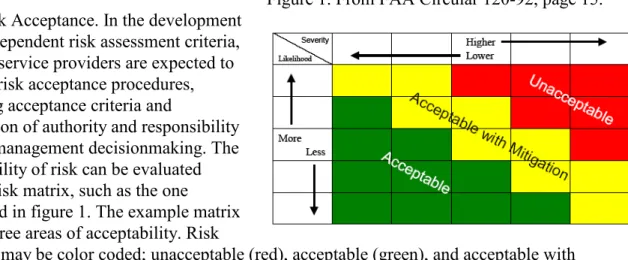
“(5) Risk Acceptance. In the development of its independent risk assessment criteria, aviation service providers are expected to develop risk acceptance procedures, including acceptance criteria and
designation of authority and responsibility for risk management decisionmaking. The acceptability of risk can be evaluated using a risk matrix, such as the one
illustrated in figure 1. The example matrix shows three areas of acceptability. Risk
matrices may be color coded; unacceptable (red), acceptable (green), and acceptable with mitigation (yellow).
“(a) Unacceptable (Red). Where combinations of severity and likelihood cause risk to fall into the red area. The risk would be assessed as unacceptable and further work would be required to design an intervention to eliminate that associated hazard or to control the factors that lead to higher risk likelihood or severity.
“(b) Acceptable (Green). Where the assessed risk falls into the green area, it may be accepted risk to as low as practicable regardless of whether or not the assessment shows that it can be accepted as is. This is a fundamental principle of continuous improvement.
“(c) Acceptable with mitigation (Yellow). Where the independent risk assessment falls into the yellow area, the risk may be accepted under the defined conditions of mitigation.”
The Forest Service, in the 2009 Aviation Risk Management Workbook, did not establish risk thresholds including risk acceptance and management processes asdescribed in section 5 (a), (b), and (c) of the Federal Aviation Administration Circular 120-92. The process used to develop the hazards and mitigation measures together with the ratings of each premitigation and
postmitigation compared the likelihood and severity rating to obtain an outcome of low, medium, serious, or high (figure 2). The process did not establish within these four outcome values which values were unacceptable, acceptable with mitigation, or acceptable without mitigation.
Figure 2. Outcome matrix from Forest Service 2008 Systems Safety Aviation Guide and 2009 Aviation Risk Management Workbook
In this project, the consultants utilized a similar process as used by the Forest Servicein preparing the 2008 Systems Safety Aviation Guide and 2009 Aviation Risk Management Workbook, but with modifications. The key modification was the development of an additional rating matrix for the benefit-to-cost of the mitigation measures.
As used by the Forest Service in the 2008 Systems Safety Aviation Guide and the 2009 Aviation Risk Management Workbook, all hazards appear to be classified as section 5 (c), Federal
Aviation Administration Circular 120-92, acceptable with mitigation. In this independent risk assessment,the consultants followed the same procedure. The consultants assume the Forest Service might utilize an additional process such asa program review to determine which hazards fall within the categories of section 5 (a), (b), and (c) from Federal Aviation Administration Circular 120-92.
The rankings are made in relationship to each other and do not propose benchmarks, such as acceptable, unacceptable, or acceptable with mitigation.
Identification of Systems and Subsystems
Using the helicopter section of the 2009 Aviation Risk Management Workbook as a reference, the experts identified five systems. They further identified 24 subsystems some of which appear in more than one system.
• Visibility subsystem. • Inspection subsystem. • Equipment subsystem. • Maintenance subsystem. F - Helicopter Facilities Night
• Communications subsystem. • Environment subsystem. P - Helicopter Personnel Night
• Utilization subsystem. • Policy subsystem. • Training subsystem. • Human factors subsystem. T - Helicopter Technology Night
• Utilization subsystem. • Maintenance subsystem. • Human factors subsystem. H - Helicopter Operations Night
• Mission subsystem.
• Management decisions subsystem. • Utilization subsystem.
• Environment subsystem. • Communications subsystem. • Training subsystem.
• Water and retardant dropping using a fixed tank with ground fill subsystem. • Aerial supervision subsystem.
• Hoist for emergency medical transport subsystem. • Aerial ignition with plastic sphere dispenser subsystem.
Hazards and mitigation measures were defined within each of the categories. A listing of these measures is provided in appendix B.
Evaluation of Hazards and Mitigation Measures
The identification of hazards and mitigation measures for helicopter night operations was developed using a process similar to the one described in the 2008 Systems Safety Aviation Guide, Tab 5, System Safety Assessment – Helicopters and the 2009 Aviation Risk Management Workbook, Helicopters.
Evaluation Model Description
provide a risk rating for each hazard and mitigation measure. Six subject matter experts and three technical experts attended this workshop (appendix A). The consultants facilitated a process where the experts developed an evaluation and rating matrix. One item classified was the probability (likelihood) of a hazard resulting in an accident. The second item classified was the severity (consequences) of a hazard. Each was classified premitigation and postmitigation.
Figure 3. Rating matrix for rating hazards premitigation and postmitigation.
The classifications and the resultant rating matrix is shown in figure 3. The experts assigned a numeric value to each classification. The sum of these two numbers became the score for each combination of probability and severity. The experts structured the scores into five rating classes shown in figure 4.
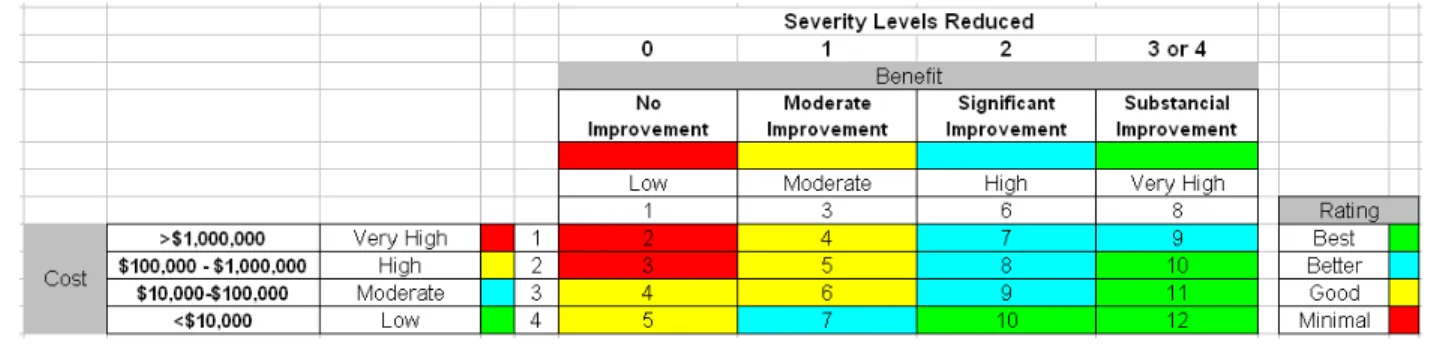
Next, the experts were asked to develop estimates for the costs to implement each mitigation measure. Some measures can be implemented with minimal-to-no cost and some measures might require millions of dollars. The benefit of implementing a mitigation
measure was determined by the reduction of risk-rating classes that was achieved. For example, if the mitigation measure resulted in a reduction of three or four risk rating classes, the benefit was classified as substantial improvement or very high. The classifications and the rating matrix is shown in figure 5.
Figure 5. Rating matrix for costs and benefits premitigation and postmitigation.
Figure 4. Scores defining the ratings.
The experts assigned a numeric value to each classification. The sum of these two numbers became the score for each combination of benefit and cost. The experts structured the scores in four rating classes as shown in figure 6.
Rating of Hazards and Mitigation Measures with Benefits and Costs
A listing of the hazards and mitigation measures follow in tables 1 through 5, including ratings for premitigation, postmitigation, and benefit/cost.
Figure 6. Scores defining the ratings.
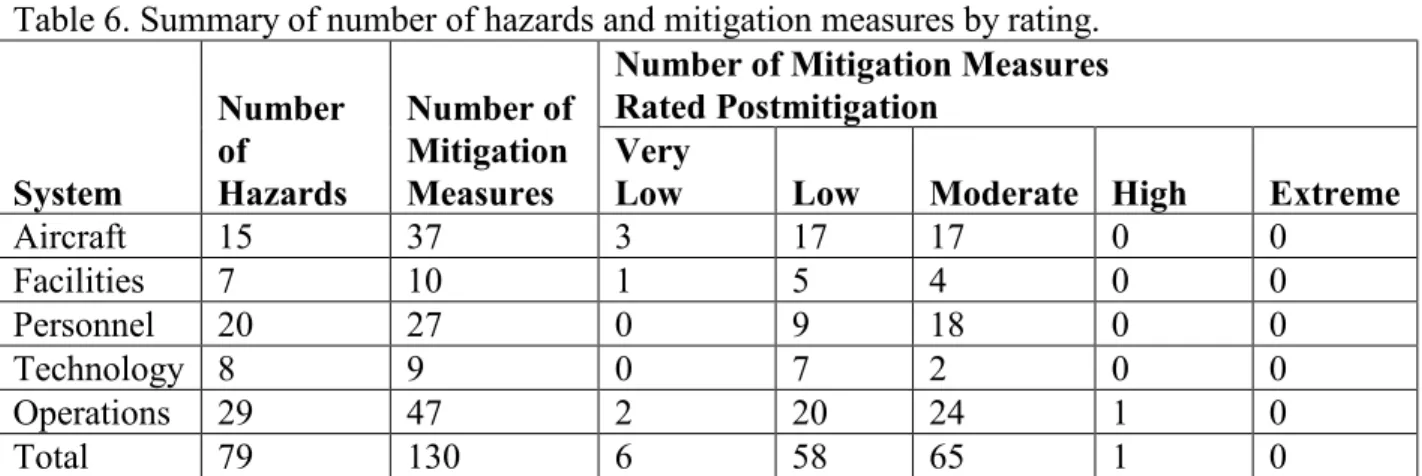
Table 6 summarizes the number of post-mitigation ratings by rating class. Table 6. Summary of number of hazards and mitigation measures by rating.
System Number of Hazards Number of Mitigation Measures
Number of Mitigation Measures Rated Postmitigation
Very
Low Low Moderate High Extreme
Aircraft 15 37 3 17 17 0 0 Facilities 7 10 1 5 4 0 0 Personnel 20 27 0 9 18 0 0 Technology 8 9 0 7 2 0 0 Operations 29 47 2 20 24 1 0 Total 79 130 6 58 65 1 0
Considerations for Implementing Mitigation Measures
Risk cannot be eliminated entirely even when highly effective mitigation measures are used. After these mitigation measures are designed but before the system is placed back online, an assessment must be made determining whether the mitigation measures are likely to be effective and/or if they introduce new hazards to the system. Residual risk is defined as the risk remaining after mitigation is implemented. Substitute risk is defined as any hazard that is introduced by a mitigation effort. Implementation considerations include a discussion of the following:
• Ease of introduction; i.e., will this measure be difficult to introduce? • Acceptance; i.e., will users and management accept this measure? • Durability; i.e., will this measure stand the test of time?
• Enforceability; i.e., will the measure be implemented?
• Expanded effect; i.e., could implementation of this measure change standards?
• Time to implement from time of adoption; i.e., it could be an immediate implementation (1 month or less), short-term (1 to 6 months), long-term period (6 months to 1 year) or extended period (greater than 1 year).
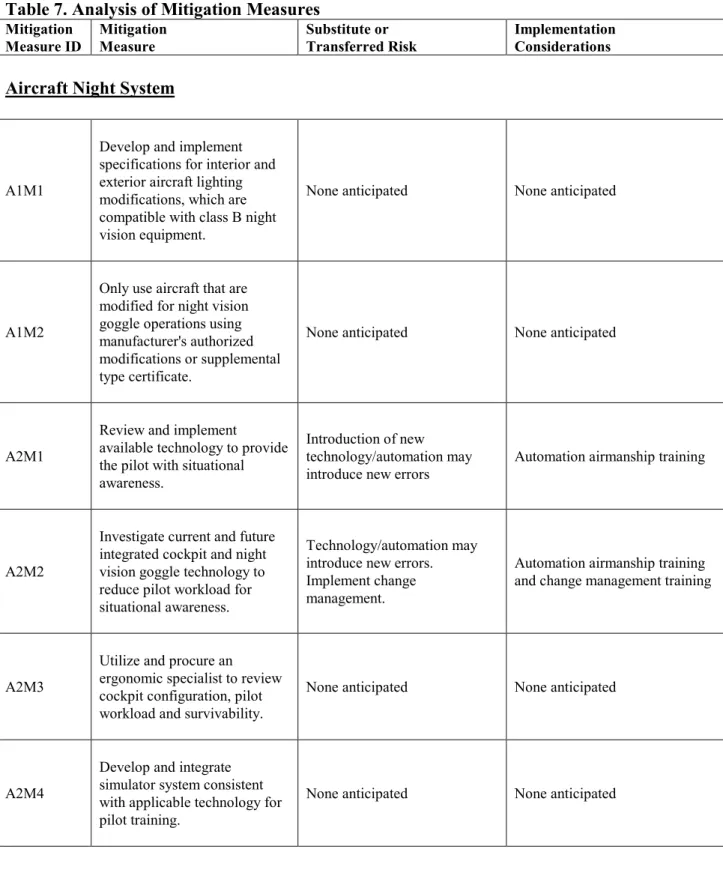
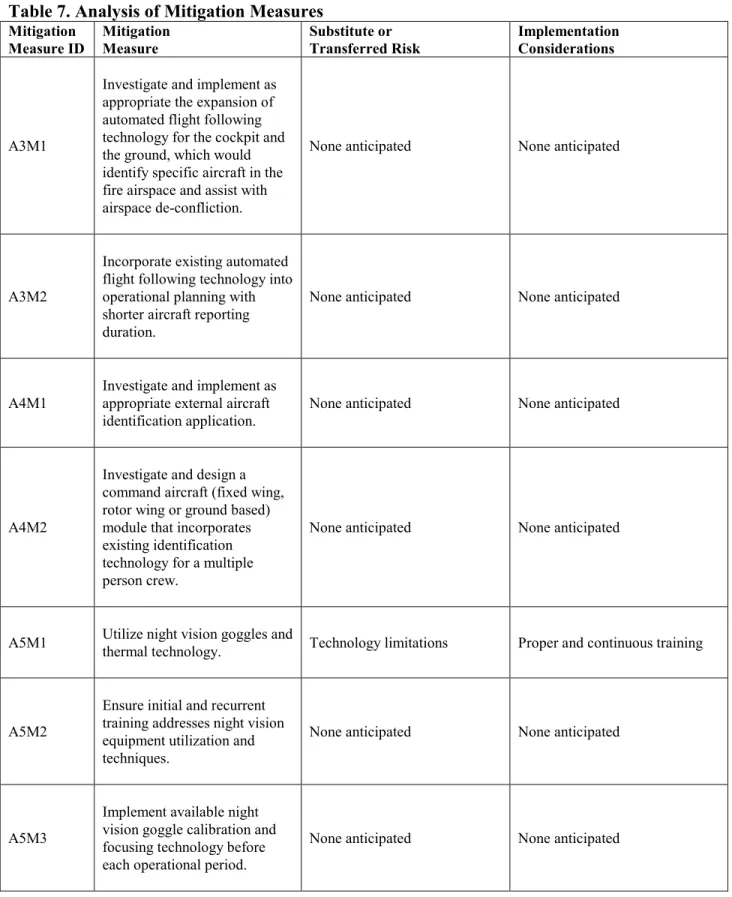
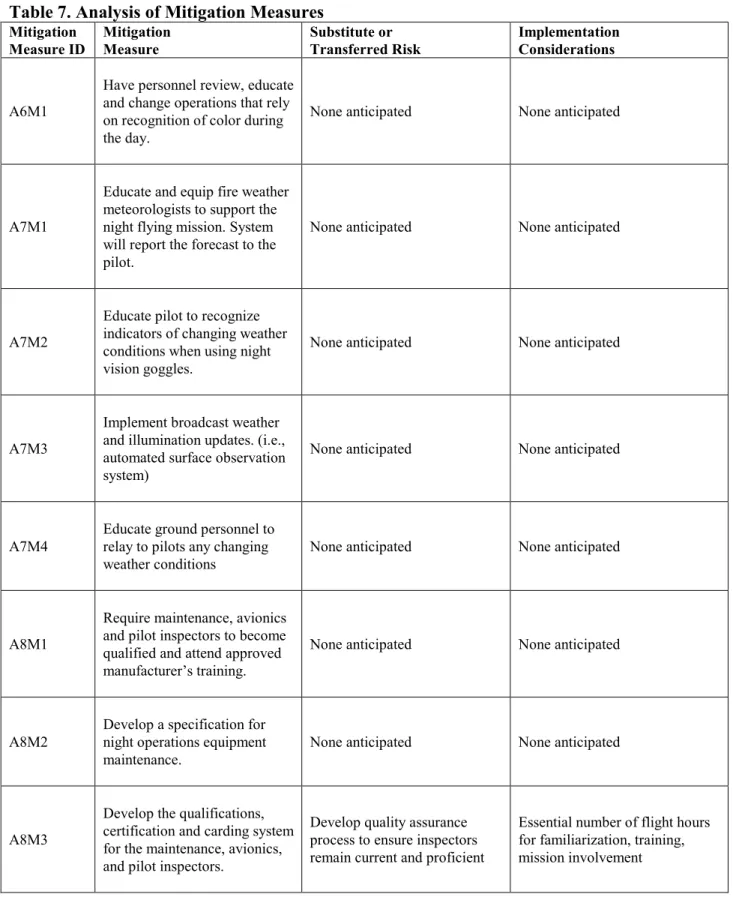
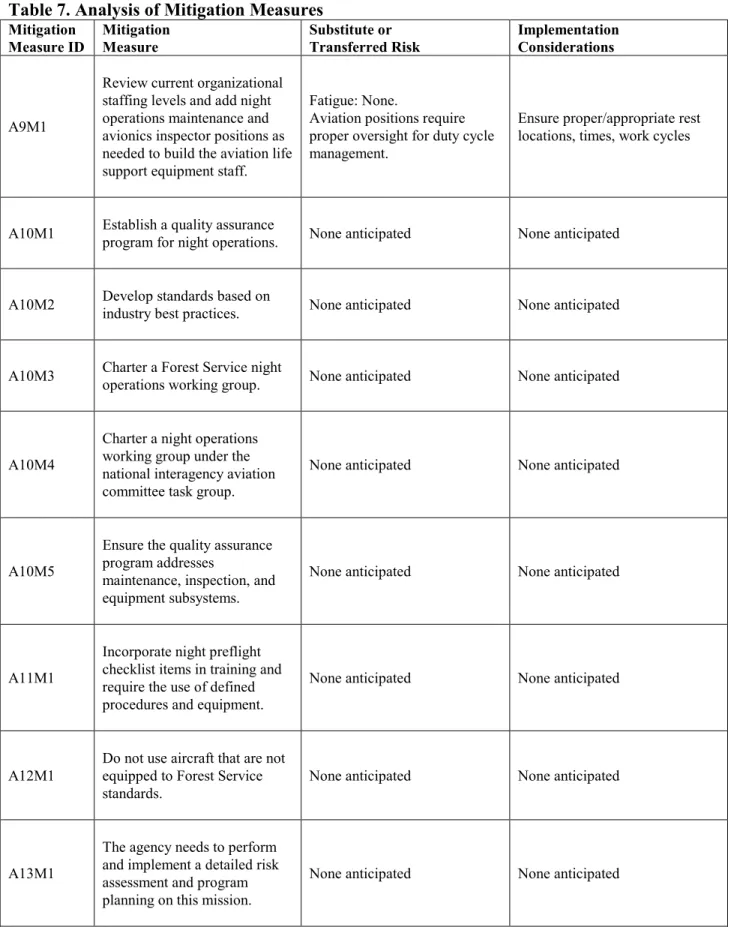
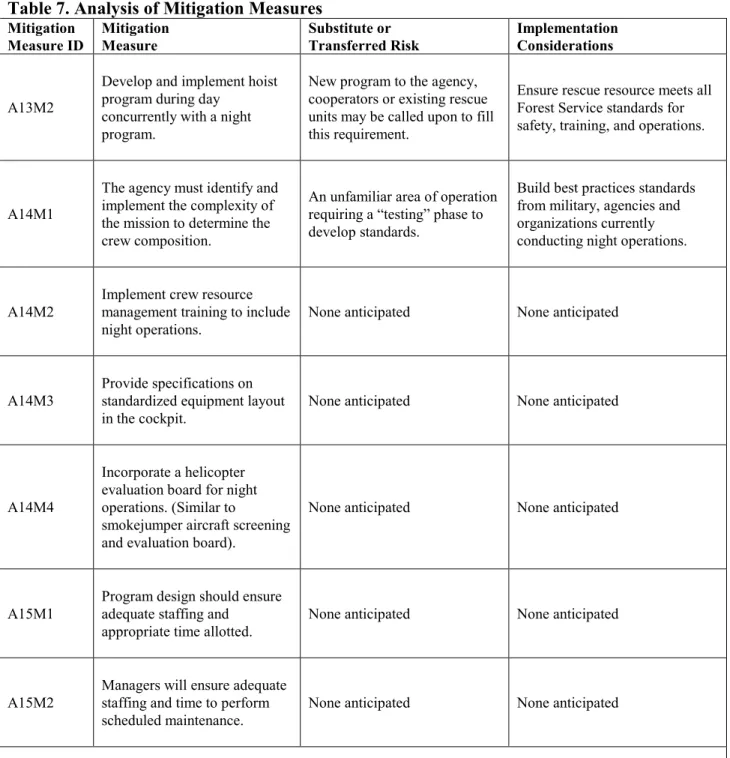
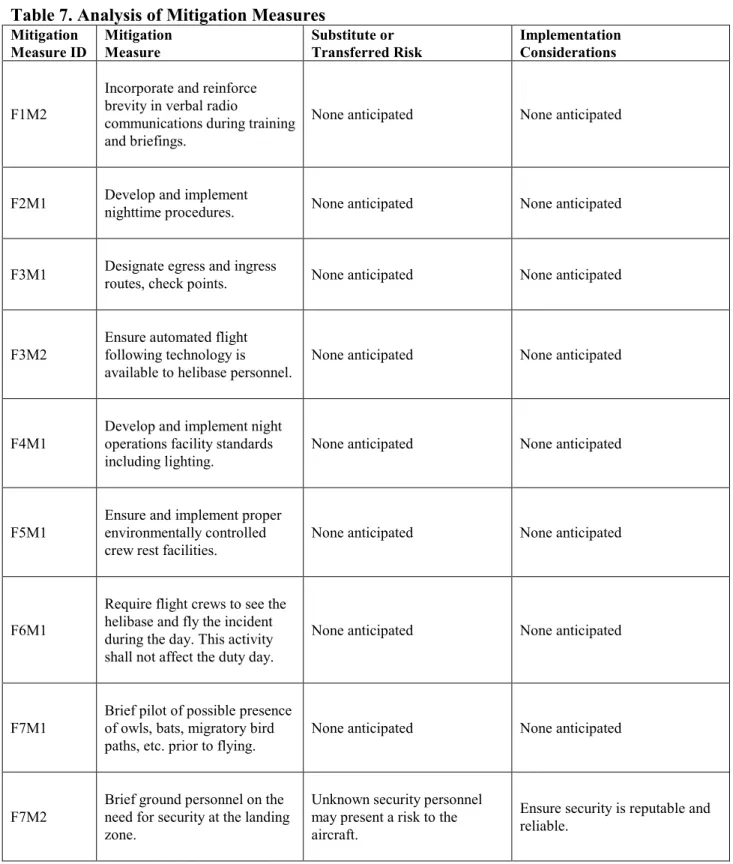
Effectiveness of the mitigation measure is addressed in the comparison of premitigation and postmitigation ratings. In table 7, each mitigation measure is listed with residual risk, substitute risk, and implementation considerations.
Table 7. Analysis of Mitigation Measures
Mitigation
Measure ID Mitigation Measure Substitute or Transferred Risk Implementation Considerations
Aircraft Night System
A1M1
Develop and implement specifications for interior and exterior aircraft lighting modifications, which are compatible with class B night vision equipment.
None anticipated None anticipated
A1M2
Only use aircraft that are modified for night vision goggle operations using manufacturer's authorized modifications or supplemental type certificate.
None anticipated None anticipated
A2M1
Review and implement
available technology to provide the pilot with situational awareness.
Introduction of new technology/automation may
introduce new errors Automation airmanship training
A2M2
Investigate current and future integrated cockpit and night vision goggle technology to reduce pilot workload for situational awareness.
Technology/automation may introduce new errors. Implement change management.
Automation airmanship training and change management training
A2M3
Utilize and procure an ergonomic specialist to review cockpit configuration, pilot workload and survivability.
None anticipated None anticipated
A2M4
Develop and integrate simulator system consistent with applicable technology for pilot training.
Table 7. Analysis of Mitigation Measures
Mitigation
Measure ID Mitigation Measure Substitute or Transferred Risk Implementation Considerations
A3M1
Investigate and implement as appropriate the expansion of automated flight following technology for the cockpit and the ground, which would identify specific aircraft in the fire airspace and assist with airspace de-confliction.
None anticipated None anticipated
A3M2
Incorporate existing automated flight following technology into operational planning with shorter aircraft reporting duration.
None anticipated None anticipated
A4M1 Investigate and implement as appropriate external aircraft
identification application. None anticipated None anticipated
A4M2
Investigate and design a command aircraft (fixed wing, rotor wing or ground based) module that incorporates existing identification technology for a multiple person crew.
None anticipated None anticipated
A5M1 Utilize night vision goggles and thermal technology. Technology limitations Proper and continuous training
A5M2
Ensure initial and recurrent training addresses night vision equipment utilization and techniques.
None anticipated None anticipated
A5M3
Implement available night vision goggle calibration and focusing technology before each operational period.
Table 7. Analysis of Mitigation Measures
Mitigation
Measure ID Mitigation Measure Substitute or Transferred Risk Implementation Considerations A6M1
Have personnel review, educate and change operations that rely on recognition of color during the day.
None anticipated None anticipated
A7M1
Educate and equip fire weather meteorologists to support the night flying mission. System will report the forecast to the pilot.
None anticipated None anticipated
A7M2
Educate pilot to recognize indicators of changing weather conditions when using night vision goggles.
None anticipated None anticipated
A7M3
Implement broadcast weather and illumination updates. (i.e., automated surface observation system)
None anticipated None anticipated
A7M4 Educate ground personnel to relay to pilots any changing
weather conditions None anticipated None anticipated
A8M1
Require maintenance, avionics and pilot inspectors to become qualified and attend approved manufacturer’s training.
None anticipated None anticipated
A8M2 Develop a specification for night operations equipment
maintenance. None anticipated None anticipated
A8M3
Develop the qualifications, certification and carding system for the maintenance, avionics, and pilot inspectors.
Develop quality assurance process to ensure inspectors remain current and proficient
Essential number of flight hours for familiarization, training, mission involvement
Table 7. Analysis of Mitigation Measures
Mitigation
Measure ID Mitigation Measure Substitute or Transferred Risk Implementation Considerations
A9M1
Review current organizational staffing levels and add night operations maintenance and avionics inspector positions as needed to build the aviation life support equipment staff.
Fatigue: None.
Aviation positions require proper oversight for duty cycle management.
Ensure proper/appropriate rest locations, times, work cycles
A10M1 Establish a quality assurance program for night operations. None anticipated None anticipated
A10M2 Develop standards based on industry best practices. None anticipated None anticipated
A10M3 Charter a Forest Service night operations working group. None anticipated None anticipated
A10M4
Charter a night operations working group under the national interagency aviation committee task group.
None anticipated None anticipated
A10M5
Ensure the quality assurance program addresses
maintenance, inspection, and equipment subsystems.
None anticipated None anticipated
A11M1
Incorporate night preflight checklist items in training and require the use of defined procedures and equipment.
None anticipated None anticipated
A12M1 Do not use aircraft that are not equipped to Forest Service
standards. None anticipated None anticipated
A13M1
The agency needs to perform and implement a detailed risk
Table 7. Analysis of Mitigation Measures
Mitigation
Measure ID Mitigation Measure Substitute or Transferred Risk Implementation Considerations A13M2
Develop and implement hoist program during day
concurrently with a night program.
New program to the agency, cooperators or existing rescue units may be called upon to fill this requirement.
Ensure rescue resource meets all Forest Service standards for safety, training, and operations.
A14M1
The agency must identify and implement the complexity of the mission to determine the crew composition.
An unfamiliar area of operation requiring a “testing” phase to develop standards.
Build best practices standards from military, agencies and organizations currently conducting night operations.
A14M2 Implement crew resource management training to include
night operations. None anticipated None anticipated
A14M3 Provide specifications on standardized equipment layout
in the cockpit. None anticipated None anticipated
A14M4
Incorporate a helicopter evaluation board for night operations. (Similar to
smokejumper aircraft screening and evaluation board).
None anticipated None anticipated
A15M1 Program design should ensure adequate staffing and
appropriate time allotted. None anticipated None anticipated
A15M2 Managers will ensure adequate staffing and time to perform
scheduled maintenance. None anticipated None anticipated
Facilities Night System
F1M1
Define and implement
opportunities where technology or equipment can replace verbal communication.
Communication errors
Clear, simple, and thorough training on nonverbal
communications, technology, and equipment
Table 7. Analysis of Mitigation Measures
Mitigation
Measure ID Mitigation Measure Substitute or Transferred Risk Implementation Considerations F1M2
Incorporate and reinforce brevity in verbal radio
communications during training and briefings.
None anticipated None anticipated
F2M1 Develop and implement nighttime procedures. None anticipated None anticipated
F3M1 Designate egress and ingress routes, check points. None anticipated None anticipated
F3M2 Ensure automated flight following technology is
available to helibase personnel. None anticipated None anticipated
F4M1 Develop and implement night operations facility standards
including lighting. None anticipated None anticipated
F5M1 Ensure and implement proper environmentally controlled
crew rest facilities. None anticipated None anticipated
F6M1
Require flight crews to see the helibase and fly the incident during the day. This activity shall not affect the duty day.
None anticipated None anticipated
F7M1 Brief pilot of possible presence of owls, bats, migratory bird
paths, etc. prior to flying. None anticipated None anticipated
F7M2 Brief ground personnel on the need for security at the landing zone.
Unknown security personnel may present a risk to the aircraft.
Ensure security is reputable and reliable.
Table 7. Analysis of Mitigation Measures
Mitigation
Measure ID Mitigation Measure Substitute or Transferred Risk Implementation Considerations
Personnel Night System
P1M1
Define and implement the night operations program to address the mission, staffing, retention, organization, procedures, logistics, support, policy, training, facilities, and operational control.
Implementing the program without fully developing the program.
Assign minimum milestones as required checkpoints prior to implementation.
P1M2 Assign a national night operations project leader. None anticipated None anticipated
P2M1
Assign a national night operations project leader to coordinate interagency personnel and cooperators. Position will take the lead for Forest Service night operations working group.
None anticipated None anticipated
P3M1 Staff and train night operations government contract
administrators. None anticipated None anticipated
P3M2
Do a needs analysis to
determine the adequate number of night operations government contract administrators.
None anticipated None anticipated
P4M1 Develop a standard for night operations and firefighting operations.
None anticipated None anticipated
P5M1
Specifications, which fully define the night vision equipment requirements, need to be developed and
transmitted to vendors.
Table 7. Analysis of Mitigation Measures
Mitigation
Measure ID Mitigation Measure Substitute or Transferred Risk Implementation Considerations P6M1 Develop and incorporate a safety management system
specification in all contracts. None anticipated None anticipated
P7M1
Develop and implement standards and protocols for interagency and cooperator operations.
None anticipated None anticipated
P7M2
Ensure interagency and cooperators are involved with agency working groups and committees.
None anticipated None anticipated
P8M1 Assign supervision and oversight to ensure compliance
during night operations. None anticipated None anticipated P8M2 Brief and monitor compliance by overhead teams. None anticipated None anticipated
P8M3 Incident personnel must perform an operational risk assessment on night operations.
Incident personnel filling out paperwork without fully developing the risk assessment
Ensure incident personnel understand the importance of the operational risk assessment process.
P9M1 Task Washington Office to develop practical test standard. None anticipated None anticipated
P10M1
Explore industry minimum pilot flight time standards for night operations and establish agency minimum flight time requirements for night vision goggle missions.
Industry minimums may be inadequate.
Develop standards based on proficiency and performance by utilizing continuous reviews.
P11M1
Provide adequate management support for maintaining a high
Table 7. Analysis of Mitigation Measures
Mitigation
Measure ID Mitigation Measure Substitute or Transferred Risk Implementation Considerations P12M1 Staff all systems with qualified and current personnel. None anticipated None anticipated
P13M1 Ensure flight crews and crewmembers have trained and
operated together. None anticipated None anticipated
P14M1
Develop and integrate
nighttime simulation system for flight crew, crewmembers, and incident management
personnel.
None anticipated None anticipated
P14M2 Ensure the simulation and the simulator keeps pace with new
technology. None anticipated None anticipated
P15M1 Develop a training standard and implement in contracts. None anticipated None anticipated
P16M1
Develop standards and procedures to ensure well-rested night operations personnel. Develop and implement standards and procedures.
None anticipated None anticipated
P16M2 Gather and apply latest research on fatigue related to
aviation operations. None anticipated None anticipated
P17M1 Ensure automation airmanship training is taken by flight
crews. None anticipated None anticipated
P18M1 Develop and implement national electronic based flight
Table 7. Analysis of Mitigation Measures
Mitigation
Measure ID Mitigation Measure Substitute or Transferred Risk Implementation Considerations
P19M1
Require all night operations pilots to be commercial/airline transport pilot instrument rated and trained in brownout and whiteout conditions.
None anticipated None anticipated
P20M1
Nighttime air operations personnel continually re-evaluate decisions at the appropriate level. Apply risk management principles from Interagency Helicopter Operations Guide Chapter 3.
None anticipated None anticipated
Technology Night System
T1M1
Make the existing automated flight following application an agency corporate application or locate a new one.
None anticipated None anticipated
T2M1
Investigate, develop and implement technology and tactics for air and ground such as infrared and laser
technology. Ensure all equipment is eye safe.
None anticipated None anticipated
T3M1 Develop and implement a life cycle equipment program for both government and vendors.
None anticipated None anticipated
T4M1 Do a benefit versus weight and complexity analysis for all
hardware. None anticipated None anticipated
T5M1 Ensure new equipment is engineered for compatibility
Table 7. Analysis of Mitigation Measures
Mitigation
Measure ID Mitigation Measure Substitute or Transferred Risk Implementation Considerations T6M1
Develop and implement techniques used by other agencies to perform this activity.
None anticipated None anticipated
T7M1
Ensure that quality assurance and safety personnel are in place to review and improve maintenance processes and procedures.
None anticipated None anticipated
T8M1 Implement unmanned aerial system as appropriate. Unmanned aerial system program will create significant change in current processes.
Implement change management to incorporate unmanned aerial system.
T8M2
Implement pre-mission electronic operational risk analysis for handheld computing devices, e.g. iPAD™.
None anticipated None anticipated
Helicopter Operations Night
H1M1 Educate the community about Forest Service intent to conduct
night operations. None anticipated None anticipated
H1M2 Ensure the use of temporary flight restrictions where
appropriate. None anticipated None anticipated
H1M3
Reaffirm dispatcher and airspace coordinator's responsibility to deconflict military training routes.
None anticipated None anticipated
H2M1 Establish and follow policy, guidelines and direction prior
Table 7. Analysis of Mitigation Measures
Mitigation
Measure ID Mitigation Measure Substitute or Transferred Risk Implementation Considerations
H3M1
Ensure that all missions are clearly defined and approved by management prior to implementation (mission creep). Collaborate with other program managers such as law enforcement.
None anticipated None anticipated
H4M1 Utilize program when appropriate criteria has been
met. None anticipated None anticipated
H4M2 Define an effectiveness measures program. None anticipated None anticipated
H4M3 Implement a routine proficiency training program. None anticipated None anticipated
H5M1
Establish minimum
illumination value and night weather minimums for night operations.
None anticipated None anticipated
H6M1 Develop a communications and marketing plan for distribution
to the field. None anticipated None anticipated
H7M1
Ensure incident command personnel receive training on the requirements and best practices of night operations.
None anticipated None anticipated
H8M1 Ensure training specification incorporates transition from
aided to unaided environment. None anticipated None anticipated
Table 7. Analysis of Mitigation Measures
Mitigation
Measure ID Mitigation Measure Substitute or Transferred Risk Implementation Considerations
H10M1
Develop procedures, such as dry runs, utilization of sirens, ensuring the drop zone is clear, etc. to ensure ground personnel will not be impacted.
None anticipated None anticipated
H10M2
Investigate and implement as appropriate illumination equipment for ground personnel and add to the aviation life support equipment handbook.
None anticipated None anticipated
H11M1 Define and implement standards for all water and retardant equipment.
None anticipated None anticipated
H11M2 Communicate standards to cooperators and military.
Even when briefed, cooperators and military may revert to their own standard operating procedures.
Ensure managers of a/c are fully familiar with helicopter night operations standard operating procedures.
H12M1 Investigate and implement equipment and procedures
associated with tank filling. None anticipated None anticipated H13M1 Utilize approved helibases and helispots. None anticipated None anticipated
H14M1 Each helicopter will have its own assigned pad. None anticipated None anticipated
H14M2 Establish fill capabilities at each pad. None anticipated None anticipated
H14M3
Identify the maximum number of helicopters from a helibase or helispot for nighttime ground fill operations.
None anticipated None anticipated
Table 7. Analysis of Mitigation Measures
Mitigation
Measure ID Mitigation Measure Substitute or Transferred Risk Implementation Considerations H15M2
Attempt to locate helibases and helispots to where hydrants or water sources can be used to eliminate water tender traffic.
None anticipated None anticipated
H16M1 Ensure the aerial supervisor is
night vision goggle qualified. None anticipated None anticipated H17M1 Utilize multi-engine airplane. None anticipated None anticipated H18M1 Consider use of a helicopter. None anticipated None anticipated
H19M1 Use of auxiliary tanks on the helicopter. Weight compromise Utilize appropriate and fully capable airframe.
H20M1 Utilize a crewmember monitoring the hoist to talk to
the pilot. None anticipated None anticipated
H20M2 Develop and implement techniques used by other agencies to perform this activity.
Other agency assumes risk but Forest Service is responsible party
Close oversight of outside agency operations
H20M3 Utilize a light to illuminate the scene. May impact night vision for ground and air personnel if used inappropriately.
Strict standards for use of external light sources.
H21M1 Utilize current technology to assist stabilizing hover
operations. None anticipated None anticipated
H21M2 Establish and meet a currency and proficiency requirement. None anticipated None anticipated
H21M3 Utilize specialized crew resource management for this
Table 7. Analysis of Mitigation Measures
Mitigation
Measure ID Mitigation Measure Substitute or Transferred Risk Implementation Considerations H22M1 Ensure proper training of ground personnel to hazards
and site preparation. None anticipated None anticipated
H22M2 Minimize the number of ground personnel under the aircraft and down slope.
Ground personnel in these locations are at risk.
Strict standards to control ground personnel location in relation to helicopter and drops.
H23M1
Analyze emergency medical services accident and lessons learned and develop a training program to include crew resource management.
None anticipated None anticipated
H24M1 Develop a mission specific go/no go checklist. Train to the
mission. None anticipated None anticipated
H25M1
Develop and implement a national standard for levels of emergency medical services response.
Overreliance of the use of emergency medical technicians can result in the placement of personnel in riskier locations.
Develop chain of approval
H26M1 Utilize technology to identify the fireline. None anticipated None anticipated
H26M2 Utilize ground personnel to fire out the perimeter. Slower movement to safe zones due to night activities. Well established standard operating procedures and minimize distance to safe areas. H27M1 Provide adequate and compatible lighting. None anticipated None anticipated
H28M1 Define the minimum requirements for night
Table 7. Analysis of Mitigation Measures
Mitigation
Measure ID Mitigation Measure Substitute or Transferred Risk Implementation Considerations H28M2
Ensure plastic sphere dispenser operator and firing boss are trained to night operations standards.
None anticipated None anticipated
H29M1
Prior to ignition, utilize the public address system and radio to announce the mission intention.
None anticipated None anticipated
H29M2 Confirm with ground personnel that the target area is clear. None anticipated None anticipated
Quality Assurance
Quality assurance, as a primary pillar of the safety management system, has been employed in conjunction with the risk management process throughout this review. This safety assurance method bolsters risk management by assuring that the quality of mission implementation, as intended by the agency, is carried out at its highest possible level.
The Federal Aviation Administration has described quality assurance as follows:
Quality assurance is designed to validate factual information to ensure that aviation operations perform as intended and accomplish the intended outcome. The expectation of this process is that the organization will monitor, measure, and evaluate the performance and effectiveness of all risk controls as well as ensure regulatory (policy) compliance. The purpose of a safety
management system is to identify, document, monitor and control hazards in the operation (FAA Advisory Circular 120-9) (appendix I).
With the organizational and programmatic operations under an assurance process that seeks continual improvement, the National Transportation Safety Board has recently taken on the issue of an assurance program that will address the individual at every level. In an attempt to raise the bar of individual professionalism, the Board has begun a process to lead organizations to address continual improvement and monitoring at the individual level. Just as programs are reviewed, analyzed, and improved, the organization can only be as good as the professionalism and ethical fabric of the individual. With the human at the core of all organizational activities, addressing self-awareness, individual error, emotional intelligence, individual professional improvement and ethics education is just as critical in safety assurance of a program as any other aspect defined by the Federal Aviation Administration.
The Forest Service Office of Aviation Risk Management and Training has been leading the agency’s aviation programs into implementation of the safety management system. This approach to daily operations and safety of all aviation programs is actively moving ahead of a forthcoming implementation required by the Federal Aviation Administration.
As the agency continues to implement this organizational system, it is essential that the quality assurance aspect of the safety management system is developed and performs at the highest level. The Federal Aviation Administration has developed a detailed safety management system
assurance process, which is the framework used for this helicopter night operations quality assurance proposal.
The Federal Aviation Administration has stated that the safety management system assurance guide as well as the safety management system framework is not regulatory at this time although operators are encouraged to establish additional or more stringent requirements. With this in mind and with the agency already well on its way to building a robust safety management system, this helicopter night operations quality assurance process builds upon the current agency quality assurance practices and weaves them into a comprehensive strategy based upon the Federal Aviation Administration’s quality assurance foundational framework.
The agency has a solid history of quality assurance processes implemented throughout each program. These processes have served the agency well and provide some program assurance aspects that Federal Aviation Administration and other international organizations identify as necessary implementation processes. The concern with the current agency assurance processes for the existing programs is that it does not fall into an all encompassing quality assurance standardized program and does not capture findings on a national scale. This often leaves lessons learned confined to regions or even more locally. Without cross-regional communication, the national program could become disjointed in quality assurance implementation. This could result in lost information and a degraded ability to capture critical areas of concern. In order to build a strong system for helicopter night operations, it is important to determine from those with extensive agency experience where quality-assurance efforts are lacking.
At a meeting in Missoula, Montana, the agency experts for the helicopter night operations project provided feedback. Twelve comments were made that would improve the quality assurance system:
1. Develop a quality assurance checklist from the strategic program risk assessments. 2. Implement a comprehensive set of standards and metrics for helicopter night operations
program performance.
3. Implement a comprehensive set of standards and metrics for aviation personnel performance.
4. Designate a national quality assurance team for internal evaluations and standards reviews.
5. Offer or bolster the reporting system (SAFECOM and SAFENET) capabilities to better incorporate cooperators and vendors and call-when-needed contractors.
6. Ensure consistent and standardized information gathering and trending from the reporting system by program on a national level.
7. Ensure a centralized repository and management of the repository for the reporting system.
8. Conduct online surveys to evaluate safety culture and aviation program support.
9. Conduct after action reviews following each season gathering lessons learned and ensure that the findings are distributed nationally back to the end user.
11.Ensure proper staffing to fully support a robust quality assurance program. 12.Ensure that a quality assurance program will have full support by upper level
management to ensure reviews, findings, and recommendations are fortified.
In order to eliminate gaps and ensure that quality assurance findings produce the ability to better understand the health of a program, developing a solid process for the helicopter night operations program is essential. Based on the Federal Aviation Administration’s guidance, quality assurance will ensure a continuously successful implementation of this entirely new program for the agency and help shore up the current agency quality assurance processes. In looking at achieving a higher level beyond the Federal Aviation Administration basic quality assurance framework, this report incorporates the National Transportation Safety Board’s recent push to raise awareness in developing and reinforcing professionalism for aviation safety.
Framed by the Federal Aviation Administration’s Safety Management System Assurance Guide dated July 15, 2009, revision 2, the helicopter night operations quality assurance plan should contain the following elements.
Continuous Monitoring
The agency should monitor operational data, including products and services received from contractors, to identify hazards, measure the effectiveness of safety risk controls, and assess system performance.
Internal Audits by Operational Departments
The agency should perform regularly scheduled internal audits of its operational processes, including those performed by contractors, to determine the performance and effectiveness of risk controls.
Internal Evaluation
The agency should conduct internal evaluations of the safety management system and operational processes at planned intervals to determine that the safety management system and programs conform to the objectives and expectations.
External Auditing of the Safety Management System
The agency should include the results of audits performed by oversight and outside organizations in its analysis of data.
Investigations
The agency should establish procedures to collect data and investigate incidents, accidents, and instances of potential regulatory noncompliance that occur to identify potential new hazards or risk control failures.