Implementation-level Analysis of the JavaScript Helios
Voting Client
Michael Backes
∗†, Christian Hammer
∗, David Pfaff
∗, Malte Skoruppa
∗ ∗CISPA, Saarland University †
Max Planck Institute for Software Systems, Saarland University
{backes,hammer,pfaff,skoruppa}@cs.uni-saarland.de
ABSTRACT
We perform the first automated security analysis of the actual Java-Script implementation of the Helios voting client, a state-of-the-art, web-based, open-audit voting system that is continuously being deployed for real-life elections. While its concept has been exhaus-tively analyzed by the security community, we acexhaus-tively analyze its actual JavaScriptimplementation. Automatically ascertaining the security of a large-scale JavaScript implementation comes with major technical challenges. By creating a sequence of program transformations, we overcome these challenges, thereby making the Helios JavaScript client accessible to existing static analysis techniques. We then automatically analyze the transformed client using graph slicing, reducing an approximately 7 million node graph representing the information flow of the client’s implementation to a handful of potentially harmful flows, each individually consisting of less than 40 nodes. Our interpretation of this analysis results in the exposure of two thus far undiscovered vulnerabilities affecting the live version of Helios: a serious cross-site scripting attack leading to arbitrary script execution and a browser-dependent execution path that results in ballots being sent in plaintext. These attacks can be mitigated with minor adaptations to Helios. Moreover, our program transformations result in a version of Helios with fewer external dependencies and, accordingly, a reduced attack surface.
CCS Concepts
•Security and privacy→Information flow control;Vulnerability
scanners; Web application security;
Keywords
Information flow analysis; JavaScript; remote electronic voting
1.
INTRODUCTION
Electronic voting protocols have received tremendous attention by the scientific community in the last few years. Their appeal and
Permission to make digital or hard copies of all or part of this work for personal or classroom use is granted without fee provided that copies are not made or distributed for profit or commercial advantage and that copies bear this notice and the full citation on the first page. Copyrights for components of this work owned by others than the author(s) must be honored. Abstracting with credit is permitted. To copy otherwise, or republish, to post on servers or to redistribute to lists, requires prior specific permission and/or a fee. Request permissions from [email protected].
SAC 2016,April 04 - 08, 2016, Pisa, Italy
Copyright is held by the owner/author(s). Publication rights licensed to ACM.
ACM 978-1-4503-3739-7/16/04. . . $15.00
DOI:http://dx.doi.org/10.1145/2851613.2851800
their increased acceptance even for real-life elections are fueled by their ability to offer efficient, sound tallying while providing users the convenience of voting remotely. One of the most widely deployed electronic voting protocols is Helios [9,10]: a state-of-the-art, web-based, open-audit voting system that has seen real-life deployment in a variety of different settings, such as for the election of a university president [10], student elections [14,5], as well as for the election of the IACR committee [3].
From a security perspective, remote electronic voting protocols such as Helios typically exhibit a highly complex design that uses ad-vanced cryptographic primitives such as homomorphic encryptions, mixnets, and zero-knowledge proofs, that involves many interactions between different parties, and that intends to achieve a wide range of sophisticated security properties. Consequently, securely designing such protocols constitutes a highly challenging and intriguing task. A multitude of approaches have been recently proposed to automati-cally ascertain central security properties for electronic voting, such as vote privacy or vote verifiability. In particular the security of the Helios protocol has been thoroughly investigated and its security rigorously proven for many of its intended security properties. As of now, Helios constitutes one of the most widely examined voting protocols in the scientific literature.
Virtually all existing approaches for conforming the security of voting protocols focus on identifying conceptual (logical) or al-gorithmic (cryptographic) attacks against the protocol considered, i.e., they consider a protocol’s symbolic abstraction or algorithmic description, and are therefore agnostic to security violations that arise in the actually deployed implementation. However, history has shown that even security protocols long deemed and even formally proven secure can exhibit severe implementation-level vulnerabili-ties. Particularly illustrative examples are the recently discovered
Heartbleedin the OpenSSL cryptography library, or Apple’sgoto failin its own SSL/TLS implementation. An implementation-level analysis is thus of the utmost importance for every security protocol that should see widespread real-life deployment while intending to offer strong security requirements. Electronic voting protocols, with their strong dependency on societal acceptance, clearly cannot af-ford severe implementation-level vulnerabilities, and thus naturally call for corresponding analyses.
1.1
Our contribution
We are the first to perform an analysis of the expected security properties of the Helios voting client at theimplementationlevel. This goal encompasses several major points.
Security reification through code transformation and static analysis
We provide code transformations and static analysis to track poten-tially harmful information flows that harm the confidentiality and integrity properties in a JavaScript implementation. The
transforma-tions involve the replacement of specific features, whose presence makes reliable static analysis impossible. By replacing these fea-tures with functionally equivalent code, we enable existing static analysis techniques and are able to faithfully model the information flow within a complex JavaScript program by a static dependency graph. By phrasing integrity and privacy properties as an informa-tion flow problem, we can use graph slicing to significantly reduce the number of nodes under consideration from roughly 7 million to a handful of potentially threatening flows, of which two can be leveraged into real-world exploits. Our approach describes a general means to enable and conduct a security reification through static analysis in real-world JavaScript programs.
VulnerabilitiesWe report the presence of two vulnerabilities in the JavaScript Helios voting booth client, that, despite years of manual and conceptual analysis, have not yet been revealed:1) a cross-site scripting (XSS) attack resulting inarbitrary script execution; and
2) an undocumented feature, which causes the client to send unen-crypted plaintext votes without the prior consent of or notification to the user.
Availability of a hardened clientThe aforementioned code transfor-mations yield two independent benefits. First, they make the voting client amenable to static analysis. Second, they yield an implicitly hardened version of the Helios voting client with fewer external dependencies and thus a reduced attack surface. We make this hardened version publicly and freely available [1]. For the sake of exposition and reproducibility of the individual steps, this version in-tentionally does not yet integrate the fixes to the vulnerabilities that we report on. We stress that while our analysis was performed on the transformed code, the found vulnerabilities are equally present in the original code.
1.2
Related work
Conceptual attacks on HeliosA multitude of approaches have been recently proposed to formalize central security properties for elec-tronic voting (e.g., [11,18]). The analysis of Helios in particular has received a tremendous attention from the scientific community.
Several publications investigateprivacyof ballots in Helios, and the notion ofvote independencehas given rise to considerable de-bate: Vote independence means that by seeing a voter’s encrypted ballot, another voter should not be able to cast a meaningfully re-lated ballot. The authors of [16] show that Helios does not satisfy vote independence and exploit this fact in order to compromise vote privacy. They discuss a countermeasure known asballot weeding, and show that their revised scheme offers vote privacy in a symbolic model. The authors of [12] define vote privacy in a computational model and prove that this revised version of Helios fulfills their definition, though only under non-standard assumptions. In parallel, [13] studies pitfalls of the Fiat-Shamir heuristic for non-interactive zero-knowledge proofs used in Helios, and shows that a stronger variant of the heuristic leads to ballot independence.
Helios puts an even greater concern onverifiability(both indi-vidual and universal) than on privacy, and thus, the extent to which Helios fulfills this expectation has also been thoroughly investigated in the literature. [25] puts forth a formal definition of verifiability in a symbolic model and uses it to analyze the Helios protocol. A more fine-grained model to assess the verifiability of eVoting protocols such as Helios is presented in [26]. They show that Helios is vul-nerable to so-calledclash attacks, wherein malicious administrators could surreptitiously replace a voter’s ballot, and discuss counter-measures. In [13], the authors also show how the aforementioned pitfalls of the Fiat-Shamir heuristic may be exploited by colluding
election administrators to break universal verifiability in Helios. Fi-nally, [15] defines the notions ofweakandstrongverifiability in a computational model. They provide a generic way to transform weakly verifiable election schemes into strongly verifiable ones.
Practical attacks on HeliosThere is only scant work that considers actual attacks against the implementation of Helios. Instead of exposing flaws in the implementation of Helios itself, some related work has demonstrated exploits in incidental components using Helios as a case study. [19] shows how vulnerabilities in Adobe Reader can be exploited in order to install a malicious browser rootkit that subverts the integrity of a user’s vote in Helios. Their attack does not identify a vulnerability in Helios; it is only used as a case study. Similarly, [30] highlights logical web application flaws that arise from using TLS in an insecure manner, and also uses Helios as a case study in order to show how this can be exploited to surreptitiously cast votes on behalf of honest voters. Like our work, [20] focuses on the analysis of the client-side implementation of Helios. However, their code inspection is done purely by hand, and the vulnerabilities they find are different from those that we exhibit.
Static analysis of JavaScriptDuring the last decade, there has been extensive research into information flow violations, which can break the integrity or confidentiality of programs. Early approaches fo-cused on type systems [27], but they tend to be excessively complex and conservative. Jensen et al. model the HTML DOM and Browser API [23] as an extension of earlier work on type analysis [24]. Richards et al. [29] dispel common myths on the use ofevalin a large-scale study. In turn, [22] shows howevalcan, in certain cases, be safely removed to aid static analysis. Andromeda [31] delivers demand-driven tracking of potentially vulnerable information flows in JavaScript.
2.
THE HELIOS VOTING SYSTEM
The Helios voting system is available in well-documented open source form [2], and a public server is running onhttp://heliosvoting. org, allowing anyone to create and run their own election. In this paper we focus on the current version (Helios 3.1) in its latest revision (f977ea6586) available at the time of this writing.
The server-side code is mostly implemented in Python (with Django), while the client-side code (which runs in the user’s browser) is written in HTML and JavaScript. Our analysis focuses exclusively on the client-side code implementing the voting booth.
2.1
A short review of the Helios protocol
In Helios, any registered user may create a new election. In the initial setup phase, the user who created the election, considered as theadministrator, can set up the ballot and other election data and specify a list of eligible voters. A key pair is generated by the Helios server, or a set of trustees, for each new election.
Once the administrator is ready, they canfreezethe election and move on to the submission phase, in which eligible voters may submit ballots. On a high level, the submission phase is very simple: First, a voter requests a specific election from the Helios server, which sends back the browser voting application, called thevoting booth, as well as the corresponding election data. The voter uses the voting booth to record and encrypt her answers and to submit her encrypted ballot to the Helios server. It is only at this point that the Helios server asks the voter to authenticate herself: By doing so, the voter confirms her wish to actuallycasther ballot. Finally, the voting server records her encrypted ballot, along with the voter’s identity (or an alias) on a public bulletin board.
In the tallying phase, an encrypted tally is computed from all published ballots using homomorphic properties of the encryption
scheme (see [17,10]), which is then jointly and verifiably decrypted by the trustees. This can be publicly audited by anyone.
In Helios 3.x, authentication in the submission phase can leverage third-party web services such as Google, Facebook or Twitter.
2.2
The Helios voting booth
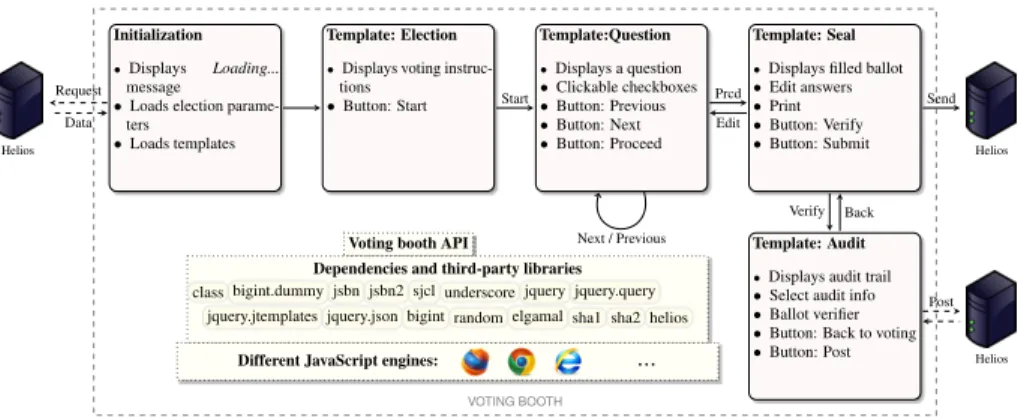
The most complex element during the submission phase is the voting booth. Its behavior is depicted inFig. 1. It guides the voter through the questions and records her answers. After her choices have been recorded, the voting booth encrypts the ballot. The voter may then choose to either submit the encrypted ballot to the server or to audit the ballot. In the latter case, she may later submit her ballot after encrypting it with new randomness.
Designed with security in mind, the voting booth is written as a
single-page web application: After initially pre-loading the election data and page templates, the voting booth makes no further network requests until the ballot is sealed and submitted to the voting server. JavaScript functions implement the entire functionality of the voting booth and take care of updating the rendered HTML user interface during the interaction with the voter. Our aim is to verify that the voting booth fulfills the expected security requirements and that neither its integrity nor its privacy can be compromised. We stress that the threat model here is not a corrupt voter (who could use another application in the first place), but rather a (passive or active) attacker trying to exploit vulnerabilities in the actual voting booth implementation interacting with a honest voter in order to learn, or even surreptitiously modify, a voter’s vote. To this end, we analyze the behavior of the actual voting booth’simplementation using automated tools in order to find potentially hidden flaws. The code analysis is complicated by the fact that it depends on a multitude of complex dependencies and third-party libraries, such as jQuery. We discuss these challenges in depth in the next section.
3.
CHALLENGES IN THE ANALYSIS OF
THE JAVASCRIPT IMPLEMENTATION
3.1
Implementation-level security properties
Existing approaches that verify security properties for Helios focus on the security protocol on a symbolic or algorithmic level. Thus, they are agnostic to security violations that happen on the application layer. The symbolic primitives are too coarse-grained to capture the minute details of the JavaScript language semantics. Conversely, note that the client merely implements one part of the entire protocol. Therefore, our aim is not to prove the entire protocol secure by formulating some implementation-level properties that the client must uphold. Rather, we want to identify necessary condi-tions that the implementation must fulfill so that symbolic security properties are not violated by the implementation. We phrase these conditions as information-flow properties: A breach of confiden-tiality and the associated loss of privacy is perceived as the flow of secret data, e.g., a vote, without proper sanitization (e.g., encryption) to a public channel, such as a network request. A breach of integrity is perceived as the flow of untrusted input to critical data stored on the client side that can force the client to behave in an unintended manner. To analyze the security of the implementation w.r.t. such properties, we leverage static analysis, which derives a semantics-preserving abstraction of the program, such that its (in-)security according to a formal model can be automatically inferred.
3.2
JavaScript is highly dynamic
JavaScript uses higher-order functions and closures, extensive type coercion rules, and a flexible object model where objects can
be changed at runtime by adding or removing fields and methods. These dynamic and abstract features encumber static analysis. On top of these language features, ECMAScript consists of 161 func-tions and objects that need to be modeled. In particular the function
evaland its variants allow dynamic construction of program code from strings. Reasoning about the behavior of such code requires a-priori knowledge of the strings that can appear and their analysis is therefore not amenable to static analysis. Therefore, highly dynamic features likeevalneed to be removed or their effects conservatively approximated. Fortunately, the core Helios client does not make use ofeval. Third party libraries, however, do. We consider the difficulties arising in this context inSection 3.4.
3.3
JavaScript cannot be separated from the
HTML DOM and browser API
JavaScript programs are usually executed in a rich environment. Web applications execute in a browser environment that interacts with the Document Object Model (DOM) representing the page’s HTML, as well as sophisticated libraries such as jQuery. Unfortu-nately, some of those interfaces (e.g. DOM) are implemented in C++, which prevents fully automatic analysis. Typical client-side programs are thus specified in a combination of scripting, speci-fication and low-level programming languages, for all of which a specification is required.
Execution in JavaScript isevent-driven; hence the analysis must model the event system, including dynamic registration of event han-dlers, event bubbling and capturing (recursive triggering of events in nested DOM components) and event-specific object properties. Fur-ther, all event handlers are callback functions, i.e., they are queued when a specific event triggers. This leads to asynchronous execution, which results in fragmented code and unstructured execution paths that static analysis must somehow resolve.
The HTML document structure also interferes when resolving variable names defined in HTML attributes. If an event handler is triggered, the scope chain includesallDOM objects in the lookup path from the HTML element containing the trigger up to the root of the document. Consider the following example:
<script>var src="foo.png";</script> <img src="bar.png" onclick="alert(src)"/>
The onclick-event handler references the variablesrc. However, it is not the variablesrcpreviously defined in the script tag, but the
srcvariable in theimgtag. Hence the onclick action will trigger an alert containingbar.pngrather thanfoo.png. Furthermore, the HTML API features a number of non-trivial interactions. For example, setting theonclickproperty of an HTML element at runtime causes a string to be interpreted as event handler code.
3.4
Included libraries
To compound the problems above, many applications build on libraries that alleviate browser incompatibility problems or simplify common tasks such as HTML DOM navigation and AJAX commu-nication. Among others, the Helios voting client uses jQuery, Un-derscore and class.js, which simulates classical object-oriented pro-gramming paradigms including inheritance. From a static analysis perspective, these libraries—while convenient for a programmer— complicate the analysis process severely. By providing their own abstractionon topof very abstract features such as event handling and DOM objects, a highly precise modeling of heap structures and a high degree of context- and flow-sensitivity is required in order to produce helpful results with a low number of false alarms. jQuery in particular includes the$function that has completely different semantics based on its argument, which can be anything ranging from an HTML string to a DOM element.
Voting booth API
Dependencies and third-party libraries
Different JavaScript engines: . . . Initialization
•Displays Loading...
message
•Loads election parame-ters
•Loads templates
Template: Election
•Displays voting instruc-tions •Button: Start Template:Question •Displays a question •Clickable checkboxes •Button: Previous •Button: Next •Button: Proceed Template: Seal
•Displays filled ballot
•Edit answers
•Button: Verify
•Button: Submit
Template: Audit
•Displays audit trail
•Select audit info
•Ballot verifier
•Button: Back to voting
•Button: Post Helios Helios Helios jsbn2 jsbn bigint.dummy
class sjcl underscore jquery jquery.query
random bigint jquery.json
jquery.jtemplates elgamal sha1 sha2 helios
VOTING BOOTH Request Data Start Next / Previous Prcd Edit Send Post Verify Back
Figure 1: User interaction and implementation of the voting booth
4.
IMPLEMENTATION-LEVEL ANALYSIS
In this paper, we focus exclusively on the client-side code im-plementing the voting booth. The phases of our analysis reflect the challenges explained in the previous section. We present code transformations that resolve the majority of the problems caused by included libraries (seeSection 3.4). We then process the results of our transformations with WALA to provide a unified program rep-resentation and a number of analyses tackling problems caused by the JavaScript and the HTML/Browser components (seeSection 3.2
andSection 3.3). Finally, we automatically look for potentially dangerous paths between manually specified sources and sinks (see
Section 3.1). Our findings as well as the applicability of our findings to the original code will be discussed inSection 5.
WALA [7] is a Java library originally designed to provide static analysis capabilities for Java bytecode. It has been used in sev-eral research projects as well as further analysis tools, such as Andromeda [31]. Most of the WALA API internally leverages the WALA IR (intermediate representation) instead of source code. The IR is general enough to represent and to analyze other languages as well: Currently there are frontends for Java and JavaScript. Among other analyses, WALA supports call graph construction and pointer analysis, interprocedural dataflow analysis and context-sensitive tabulation-based program slicing [33].
4.1
Code transformations
The implementation of the Helios voting booth heavily relies on the third-party libraries such as jQuery, Underscore and others.1Due to the highly reflective nature of these libraries, it is extremely hard to perform automated static analysis on the Helios voting booth’s code. Their size is another problem: The uncompressed version of jQuery 1.2.2 (as used by Helios) amounts to 100 KB (its compressed version 60 KB) as compared to about 50 KB for the Helios voting booth (excluding smaller dependencies). While jQuery and other libraries make developing Web applications easier, they typically prevent automated static analysis, as current tools, including WALA, can only cope with some of the dynamic features that are present in these libraries, and even for these only in a very limited way (this is subject to active research as discussed inSection 1.2.) To enable static analysis, we hence refactored the Helios implementation so as to use native JavaScript equivalents. These code transformations yield a client that is independent of the aforementioned libraries. The changes were canonical and could even be refactored automatically.
In this section, we exemplarily describe some of these code trans-formations. Our complete modified code is publicly available [1].
1
http://jquery.com,http://underscorejs.org
The modified code is functionally identical to the original code, i.e., the voting booth works in exactly the same way and any changes can be applied to the current version of the complete Helios system. The jQuery library for JavaScript provides facilities for accessing and updating the DOM, handling events or writing Ajax applications, in a convenient and portable manner. One of its key benefits is that it avoids the need for developers to deal with JavaScript DOM API idiosyncrasies across browsers, and allows them to write concise and legible code. However, newer standards for the browser, like the DOM API, CSS and HTML5, provide equivalent functionality for most of jQuery’s APIs, which yields a straightforward refactoring. Among the core jQuery functions used by Helios are those for performing asynchronous HTTP requests. Namely, Helios uses the
.get(),.getJSON()and.post()methods (all of which are wrapper functions for jQuery’s.ajax()method that sets up a Java-ScriptXMLHttpRequestobject). These functions are particularly interesting for our analysis, since they constitute information sinks that may potentially lead to confidential information being sent over the network, as discussed later. The following jQuery call performs an asynchronous HTTP request tourland calls the given success handler function upon receiving the server’s reply.
$.get(url, function(response) { /* process answer */ });
In pure JavaScript, this functionality is somewhat more boilerplate: var request = new XMLHttpRequest();
request.open('GET', url, true); request.onload = function() {
if (request.status>=200 && request.status<400) {
var response = request.responseText;
/* process answer */ }}; request.send();
The code for the.getJSON()and.post()functions is similar.
4.2
Intermediate representation
As noted previously, the intermixing of JavaScript and HTML is commonplace, but unduly hinders static analysis. In order to faithfully process all aspects of such programs, WALA integrates the HTML components into a unified JavaScript model. After con-version, WALA leverages Rhino [6] to parse the JavaScript program, creating anintermediate representation(IR). The IR represents a method’s instructions in a Java bytecode-like, static single assign-ment (SSA) form that eliminates stack abstraction and instead maps variables to symbolic registers. As is typical in compilers, the IR organizes instructions in acontrol-flow graph.
4.3
System dependency graphs
As a next step, WALA converts the IR to another program repre-sentation more suited to information flow analysis:system depen-dency graphs(SDG). SDGs are used to conservatively approximate all possible information flow within a program. Formally, an SDG
G= (N, E)for a programpis a directed graph where the nodes inNrepresentp’s statements and predicates and the edges inE
represent the dependencies between them [21]. The SDG is parti-tioned intoprocedure dependence graphs(PDG) that model single procedures. In a PDG, a nodeniscontrol dependenton a nodem, ifm’s evaluation controls the execution ofn.nisdata dependent
on a nodem, ifnmay use a value computed atm. The PDGs are connected atcall sites, consisting of a call nodec(i.e., a node con-taining aninvokeordispatchstatement) that is connected with the entry nodeeof the called function. Parameter passing and result returning, as well as side effects of the called function, are modeled via formalparameterandreturnnodes and edges. For passed pa-rameters there exists an appropriate formal node at caller and callee sites, calledPARAM_CALLERandPARAM_CALLEErespectively. Likewise, there existRETURN_CALLERandRETURN_CALLEE
nodes for return value passing. ThePARAM_CALLERnodes (re-ferred to as formal-outnodes) are control dependent on the calling statementc, whereas thePARAM_CALLEEnodes (called formal-in
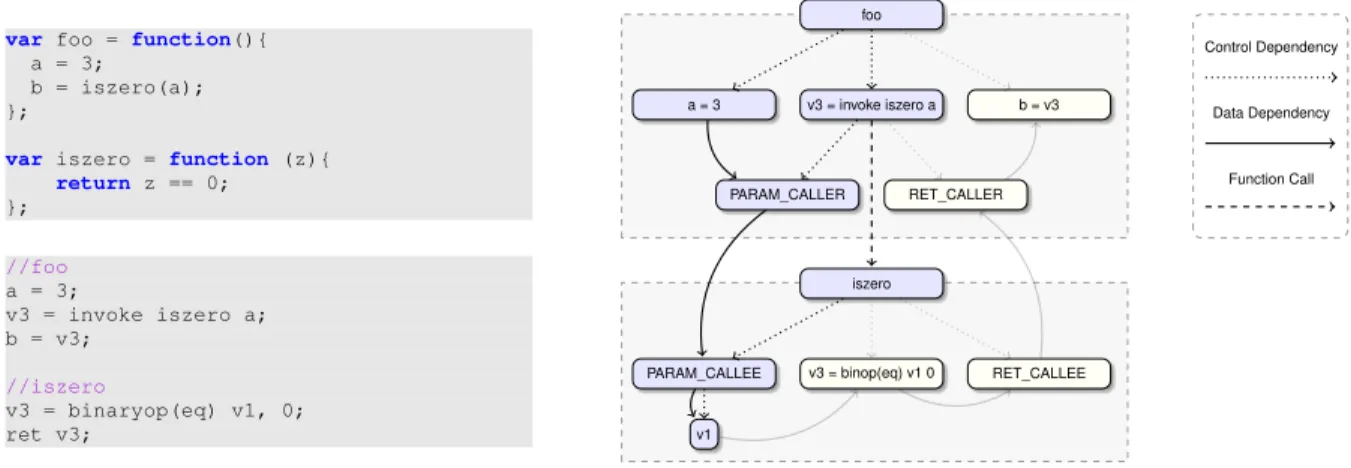
nodes) are control dependent on the function entry nodee. Likewise for the return nodes. This parameter passing model guarantees that all inter-procedural effects of a function are propagated via call sites. A machine-checked proof [32] shows that the SDG is a conservative approximation to the real data and control flows in a program, i.e., it contains all actual flows. For the running example inFig. 2, the formal-in and out nodes are constructed as described in the previous paragraph. For the sake of exposition, we appendv1, highlighting the argumentz, to the graph.
4.4
Slicing
Slicing[28] is used to find all nodes in the SDG reachable from a specificseednode. In the example inFig. 2, we are interested in which statements can influence the value passed as a parameter to the functioniszeroat a specific call site. We thus compute abackwards slicecontaining only nodes reachable by traversing dependencies backwards, be they control, call or data dependencies. Starting atv1, the data dependency can be followed backwards toPARAM_CALLEE, from where it passes out ofiszeroback into the calling function to thePARAM_CALLERnode, and from there to the statementa = 3. By also including control depen-dencies (indirect flow) we can similarly includeiszero(from
PARAM_CALLEE),v3 = invoke iszero a(fromiszero
andPARAM_CALLER) andfoo.
4.5
Information flow analysis
Conventionally, information flow analysis distinguishes between
explicitandimplicitflows. Explicit flows correspond to directly copying secret (high) information to a public (low) variable for confidentiality, and vice-versa for integrity. Implicit flows appear when thecontrol flowof the program, i.e., the sequence of statements that are executed, is dependent on high variables.
Numerically, the full SDG of the Helios client consists of roughly 7 million nodes and is therefore impossible to analyze manually. Computing appropriate slices w.r.t. a given information flow concern yields subgraphs of at most6000nodes. Only considering paths between high and low statements leaves us with only a handful of different paths containing less than 40 nodes each and therefore suitable for manual inspection.
Confidentiality We state our confidentiality problem as a
declassi-ficationproblem: Sending high, confidential data over a low, public channel without declassifying first constitutes a compromise of con-fidentiality. In the SDG this corresponds to a path from a high input (e.g., a secret vote) to a low output (e.g., an XMLHttpRequest) without a declassification mechanism (e.g., encryption). Note that there is no automatic decision procedure whether a function is an
appropriatemeans of declassification.
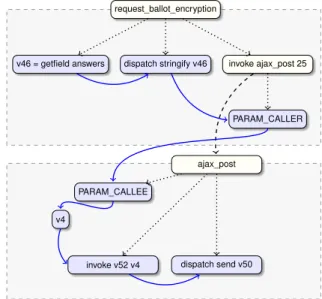
Fig. 3shows parts of a slice resulting from slicing backwards from an XMLHttpRequestsend. The nodedispatch send v50
represents a call to the functionsend, its argument is stored in
v50. The valuev50is computed from the previous statement
invoke v52 v4. Following the data dependencies backwards, one eventually crosses from the calleeajax_postinto the calling functionrequest_ballot_encryption. In this function, we reach the statementv46 = getfield answers. This state-ment retrieves the highly confidential votes. Since this data depen-dency path contains no declassification, we have to consider it as potentially dangerous. Upon manual inspection, we find that none of the functions constitute an appropriate means of declassification.
request_ballot_encryption
v46 = getfield answers dispatch stringify v46 invoke ajax_post 25
PARAM_CALLER
ajax_post
PARAM_CALLEE
v4
invoke v52 v4 dispatch send v50
Figure 3: Relevant parts of a backwards slice with
XMLHttpRequest.send()as the seed.
Integrity Conversely, integrity is formulated as anendorsment
problem: Public, low input that reaches high-integrity data without prior endorsment compromises integrity. In terms of information flow, we can thus phrase this problem as a forward flow from calls that retrieve low input (e.g.,GETparameter values) and eventually lead to a high variable (e.g., internal data used to display possible answers or cast a vote) without passing through an endorsement function (realized by sanitizing these parameters). As with declassi-fication, there is no automatic way to ascertain that a function is an
appropriatemeans of endorsement. Hence we again require human insight to confirm the functions called on a path are sufficient.
5.
VULNERABILITIES
Our automatic analysis found two flaws in the client’s code: one breach of integrity, and one breach of confidentiality. We verified that these flows can be exploited in practice in the live version of Helios by successfully deploying corresponding exploits in a mock election. The breach of integrity results in a browser-independent vulnerability leading to arbitrary script execution, while the breach of confidentiality is only evident in a subset of browsers.
var foo = function(){ a = 3;
b = iszero(a); };
var iszero = function (z){
return z == 0; }; //foo a = 3; v3 = invoke iszero a; b = v3; //iszero v3 = binaryop(eq) v1, 0; ret v3; foo a = 3 v3 = invoke iszero a b = v3 PARAM_CALLER RET_CALLER iszero v3 = binop(eq) v1 0 RET_CALLEE PARAM_CALLEE v1 Control Dependency Data Dependency Function Call
Figure 2: Two functions with their SDG and a backwards slice (blue) ofv1.
5.1
Arbitrary script execution
The first flaw we discovered is across-site scripting(XSS) at-tack. We notified the authors of Helios of this vulnerability and they acknowledged that it is a severe problem that they intend to fix. Cross-site scripting is considered one of the most critical and most prevalent security vulnerabilities in web applications [4]. XSS occurs when poorly validated user input sent to the browser is exe-cutedby the browser’s interpreter, instead of, e.g., beingdisplayed
as text. The execution of this exploit depends on the attacker being able to deceive the victim into clicking a specially crafted link that directs her to the Helios server.
Reflected client-side XSS exploitIn our case, an XSS vulnerability
arises from a specially craftedGETparameter. The Helios voting booth is generally loaded via a URL such as
http://heliosvoting.org/booth/vote.html?election_url= /helios/elections/<UUID>
where<UUID>is an election-specific identifier. TheGET param-eterelection_urlis processed by the client-side code.2 The client parses this parameter in order to load election data, election metadata, and additional entropy from the server:
var election_url = $.query.get('election_url'); ...
$.get(election_url, function(resp) {
/* set up election data */ });
$.getJSON(election_url+"/meta", function(resp){
/* set up election metadata */ });
$.get(election_url+"/get-rand", function(resp){
/* add server randomness */ });
With a proper parameterelection_url, these requests invoke the Helios server API to return JSON objects containing data to initialize the booth. Unfortunately, the parameterelection_url
is not sanitized on the client side. Hence an attacker can point it towards an external resource, e.g., an attacker-controlled server:
http://heliosvoting.org/booth/vote.html?election_url= http://evil.com/get-bad-data
The server atevil.comis set up to return corrupted JSON strings.
Circumventing the same-origin policy Note that this will not
work if done naively, as the browser’ssame-origin policywould prevent processing the retrieved JSON strings: The requests will be sent, but the response will beundefinedin the JavaScript code. However, web servers may allow their replies to be processed by
2
The parameter is presented in URL-decoded form for readability.
client-side scripts running on other domains using thecross-origin resource sharing(CORS) mechanism. That is, the attacker can set up her server so as to attach the following HTTP headers to the replies containg the corrupted JSON strings:
Access-Control-Allow-Origin: *
Access-Control-Allow-Headers: X-Requested-With, Origin, Content-Type, Accept
Content-Type: application/json
The responses will then be successfully passed to and processed by the corresponding handler functions. Using this approach, the attacker can manipulate the election data contained in returned JSON strings, with severe consequences: The attacker can compromise the integrity of the vote by intentionally mislabeling the answers (e.g., switching the displayed order of names) in a vote, deceiving the user into voting for the wrong person. Likewise, the attacker can violate vote privacy by modifying the encryption key used to submit the encrypted ballot. The attack even deceives the ballot auditing process: The verification link generated by the voting booth contains the sameGETparameter as the URL of the voting booth. Still, while the attacker can alter JSON object-specific values to her liking, she is still unable to execute arbitrary code on her own.
Arbitrary script execution The attack can be escalated even
fur-ther in the original client by setting up an external server that sends JavaScript instead of the expected JSON object. This leads to the script being loaded and executed by the Helios voting booth client. This behavior is a consequence of how jQuery evaluates the
$.getJSONfunction when it is called with an external URL as its argument: It tries to circumvent the same-origin policy by itself. Instead of issuing an XMLHttpRequest for the resource, jQuery creates a<script>tag inside the DOM’s header and sets itssrc
attribute to the remote URL. Since remote scripts included in this manner are intentionally exempt from the same-origin policy, this causes the browser to load and execute the retrieved content. Nor-mally,$.getJSONwould expect to retrieve a JSON object, which does not hold executable content. By sending a JavaScript instead of a JSON object from the remote server, the attacker gains the ability to execute arbitrary code.
5.2
Leaking the vote
Additionally, we found a flaw in a program path that leads to anunencrypted ballotbeing openly sent over the network. Specif-ically, when the voting booth’s DOM is loaded, the Helios client confirms that the client supportsweb workers(scripts running in background threads). Web workers are used in Helios to perform
encryption of a voter’s choice and generation of zero-knowledge proofs. Surprisingly, if the browser does not support web workers, Helios simply requests the server to encrypt the ballot, and sends it the unencrypted ballot:
$.post(BOOTH.election_url + "/encrypt-ballot", {'answers' : $.toJSON(BOOTH.ballot.answers)}, function(result) { /* process encrypted ballot */ });
Clearly, this code was included on purpose, yet this comes as a complete surprise, as the voting booth does perform a network request while interacting with the voter, contradicting the premise of a single-page web application and the claim of the original paper [9]. Sending the plaintext ballot violates all assumptions. It could be argued that using a secured HTTPS connection, a passive attacker cannot read the secret ballot; however: This also means that an additional layer of encryption on top of Helios’ own encryption is needed to guarantee privacy. This is not mentioned in the original paper [9], leading one to believe the Helios protocol by itself already guarantees privacy. Furthermore, the version of Helios downloaded from the original Github repository contains installation instructions that lead to the Helios client running over plain HTTP by default. While it is possible to run the Helios server-side implementation on top of a TLS terminator, this requires additional knowledge and expertise. The documentation neither explains the procedure nor mentions its necessity. Lastly, even when run over HTTPS, the key pair used for TLS is a different one than the key pair generated by Helios for each election. In particular, an administrator with access to the server’s private HTTPS key can compromise vote privacy of voters who use older browsers—even in an election set up with an election key pair generated by a set of trustees.
In summary, running the Helios client in browsers that do not sup-port web workers leads to a clear violation of vote privacy. Browsers that do no support web workers, yet see a non-trivial deployment in practice include Internet Explorer 9 and earlier, as well as all available versions of Opera Mini.3Depending on the actual statis-tics used, the combined worldwide percentage of people using these browsers lies between 12% and 36%.4 A secure way to deal with
these browsers would be to simply disallow them completely and prompt the voter to select a different browser. At the very least, this unexpected behavior should be clearly documented and plainly pointed out to election administrators. Currently, neither is the case. When we notified the Helios authors of this vulnerability, they stated that they were not concerned, since in Helios, some inherent trust is placed in the server anyway. While they acknowledged that the claim of a “single-page web application” from the first paper is no longer true, they argued that the alternative of not supporting old browsers is unacceptable. They also pointed out that, even though the election server may indeed see a large portion of plaintext ballots during the election process, there is no single-ownerlong-term stor-age of plaintext ballots. In summary, their point of view is that the need for usability and the support of a wide range of versions of all major browsers outweighs the threat to voter privacy by a possibly malicious server administrator.
6.
DISCUSSION AND TAKEAWAYS
Although our analysis was performed on a modified version of the Helios client, the attacks also apply to the original client. We confirmed these vulnerabilities in an unmodified Helios client. The converse does not hold in general: We saw inSection 5.1how an attack that allowed arbitrary modification of a set of variables could be amplified to arbitrary script execution in the original client. This
3
http://caniuse.com/#feat=webworkers 4
http://gs.statcounter.com,http://netmarketshare.com
was possible due to jQuery’s internal behavior, and does not apply to the transformed code. Hence, our analysis on the transformed code is mostly useful to uncover previously unknown vulnerabilities, but not as a constructive proof of security.
The original Helios paper [9] expected auditors to closely investi-gate the client-side JavaScript code, and that using the jQuery library would make it easier to understand and analyze the implementation due to its abstraction layer on top of low-level JavaScript functional-ities, which makes the code more concise and easier to follow. As actual auditors of the code, we found that this is not necessarily the case. From a developer’s perspective, modern browsers are more compatible than ever: Standardized and well-documented APIs for DOM traversal and manipulation, event handling or server commu-nication have been adopted by all major browsers, decreasing the demand for jQuery [8]. While it might be argued that jQuery eases support for older web browsers such as Internet Explorer 9 or earlier, we saw inSection 5.2that supporting such browsers may induce additional vulnerabilities jQuery cannot prevent. From an analyst’s perspective, automated analysis becomes much harder in the pres-ence of libraries, while manual analysis implies putting blind trust in the security and behavior of a third-party library.
We conclude that a voting booth that doesnotrely on jQuery is easier to inspect and trust. Most of the functionality provided by jQuery can be implemented in native JavaScript code that runs in all modern browsers, removing a highly complex library. The same applies for the Underscore library and the implementation of class inheritance in JavaScript. This also significantly reduced the program size: With all uncompressed libraries included, the original version of the Helios client code amounts to almost 500 KB and over 9000 LOC in total. Without these libraries, the client has less than 250 KB and under 4000 LOC. Keeping dependencies low is a good idea both for security reasons and conciseness of the entire codebase. Note that the code transformations that we implemented to simulate the functionality of third-party libraries used by Helios can easily be exported into an external lightweight library. This allows our analysis to be easily reproduced in future versions of Helios. We note that at the time of publication of the Helios paper at USENIX2008, compatibility between browsers was a greater issue and that these libraries made a lot more sense. Due to the rapid development of browsers, performance of modern JavaScript engines and the availability of standardized, cross-platform Java-Script APIs, the client codebase could be drastically reduced, easing code review processes and increasing trust in its implementation.
Finally, we point out that the vulnerabilities that we found are eas-ily fixed. The confidentiality problem (Section 5.2) is a purposefully built (though questionable) feature that can be removed. For the integrity problem (Section 5.1), it suffices to sanitize the parameter obtained from the URL query string. We stress the fact that although these attacks are simple, no manual code review has unveiled them so far, which highlights the benefits of an automated analysis. In fact, a very similar bug had already been reported,5yet has not led to the discovery of the XSS vulnerability described in this paper.
7.
CONCLUSION
We performed the firstimplementation-levelanalysis of the He-lios JavaScript voting client—one of the most widely deployed and analyzed remote electronic voting protocols—and showed how to overcome the intricate technical challenges associated with analyz-ing a real-world JavaScript web application. By faithfully modelanalyz-ing and subsequently reducing a 7 million node dependency graph to a handful of potentially harmful information flows, we discovered two
5
new, heretofore unknown, vulnerabilities: a major XSS vulnerability that was escalated to arbitrary script execution, and a minor flaw that led to leaking the plaintext ballot.
Our methodology addressed the gap between real-world and stati-cally analyzable code, and we expect approaches in the same vein can be applied in a variety of related settings to find vulnerabilities in client implementations that were overlooked during manual audits.
Acknowledgments
We thank the anonymous reviewers for their comments. This work was supported by the German Ministry for Education and Research (BMBF) through funding for the Center for IT-Security, Privacy and Accountability (CISPA) and the initiative for excellence of the German federal government.
8.
REFERENCES
[1] Hardened Helios Javascript client.https://infsec.cs. uni-saarland.de/~skoruppa/sac2016/heliosbooth_sac.zip
[2] Helios Github.https://github.com/benadida/helios-server. [3] Should the IACR use e-voting for its elections?
http://iacr.org/elections/eVoting/.
[4] The open web application security project.https://owasp.org. [5] Princeton Helios voting.https://princeton.heliosvoting.org/. [6] Rhino.https://developer.mozilla.org/en/docs/Rhino.
[7] T.J. Watson Libraries for Analysis (WALA).http://wala.sf.net. [8] You might not need jQuery.
http://youmightnotneedjquery.com.
[9] B. Adida. Helios: Web-based open-audit voting. InProc. 17th USENIX Security Symposium, pages 335–348. USENIX Association, 2008.
[10] B. Adida, O. de Marneffe, O. Pereira, and J. Quisquater. Electing a university president using open-audit voting: Analysis of real-world use of Helios. InElectronic Voting Technology Workshop / Workshop on Trustworthy Elections, EVT/WOTE ’09. USENIX Association, 2009.
[11] M. Backes, C. Hritcu, and M. Maffei. Automated verification of remote electronic voting protocols in the applied
pi-calculus. InProc. 21st IEEE Computer Security Foundations Symposium, CSF 2008, pages 195–209. IEEE Computer Society, 2008.
[12] D. Bernhard, V. Cortier, O. Pereira, B. Smyth, and
B. Warinschi. Adapting Helios for provable ballot privacy. In
Proc. 16th European Symposium on Research in Computer Security, pages 335–354. Springer, 2011.
[13] D. Bernhard, O. Pereira, and B. Warinschi. How not to prove yourself: Pitfalls of the fiat-shamir heuristic and applications to Helios. InProc. 18th International Conference on the Theory and Application of Cryptology and Information Security, ASIACRYPT 2012, pages 626–643. Springer, 2012. [14] P. Bulens, D. Giry, and O. Pereira. Running mixnet-based
elections with Helios. InElectronic Voting Technology Workshop / Workshop on Trustworthy Elections, EVT/WOTE ’11. USENIX Association, 2011.
[15] V. Cortier, D. Galindo, S. Glondu, and M. Izabachène. Election verifiability for Helios under weaker trust
assumptions. InProc. 19th European Symposium on Research in Computer Security, pages 327–344. Springer, 2014. [16] V. Cortier and B. Smyth. Attacking and fixing Helios: An
analysis of ballot secrecy. InProc. 24th IEEE Computer Security Foundations Symposium, CSF 2011, pages 297–311. IEEE Computer Society, 2011.
[17] R. Cramer, R. Gennaro, and B. Schoenmakers. A secure and optimally efficient multi-authority election scheme. InProc. International Conference on the Theory and Application of Cryptographic Techniques, pages 103–118. Springer, 1997. [18] S. Delaune, S. Kremer, and M. Ryan. Verifying privacy-type
properties of electronic voting protocols.Journal of Computer Security, 17(4):435–487, 2009.
[19] S. Estehghari and Y. Desmedt. Exploiting the client vulnerabilities in internet e-voting systems: Hacking Helios 2.0 as an example. InElectronic Voting Technology Workshop / Workshop on Trustworthy Elections, EVT/WOTE ’10. USENIX Association, 2010.
[20] M. Heiderich, T. Frosch, M. Niemietz, and J. Schwenk. The bug that made me president a browser- and web-security case study on Helios voting. InE-Voting and Identity - Third International Conference, pages 89–103. Springer, 2011. [21] S. Horwitz, T. Reps, and D. Binkley. Interprocedural slicing
using dependence graphs.ACM Transactions on Programming Languages and Systems (TOPLAS), 12(1):26–60, 1990. [22] S. H. Jensen, P. A. Jonsson, and A. Møller. Remedying the
eval that men do. InInternational Symposium on Software Testing and Analysis, ISSTA 2012, pages 34–44. ACM, 2012. [23] S. H. Jensen, M. Madsen, and A. Møller. Modeling the HTML DOM and browser API in static analysis of JavaScript web applications. InProc. 8th joint meeting of the European Software Engineering Conference and the ACM SIGSOFT Symposium on the Foundations of Software Engineering (ESEC/FSE), pages 59–69. ACM, 2011.
[24] S. H. Jensen, A. Møller, and P. Thiemann. Type analysis for JavaScript. InStatic Analysis, pages 238–255. Springer, 2009. [25] S. Kremer, M. Ryan, and B. Smyth. Election verifiability in
electronic voting protocols. InProc. 15th European Symposium on Research in Computer Security, ESORICS 2010, pages 389–404. Springer, 2010.
[26] R. Küsters, T. Truderung, and A. Vogt. Clash attacks on the verifiability of e-voting systems. InIEEE Symposium on Security and Privacy, SP 2012, pages 395–409. IEEE Computer Society, 2012.
[27] A. C. Myers. jFlow: Practical mostly-static information flow control. InProc. 26th ACM Symposium on Principles of Programming Languages, pages 228–241. ACM, 1999. [28] T. Reps, S. Horwitz, M. Sagiv, and G. Rosay.Speeding up
slicing, volume 19. ACM, 1994.
[29] G. Richards, C. Hammer, B. Burg, and J. Vitek. The eval that men do - A large-scale study of the use of eval in JavaScript applications. In25th European Conference on Object Oriented Programming, pages 52–78. Springer, 2011. [30] B. Smyth and A. Pironti. Truncating TLS connections to
violate beliefs in web applications. In7th USENIX Workshop on Offensive Technologies. USENIX Association, 2013. [31] O. Tripp, M. Pistoia, P. Cousot, R. Cousot, and S. Guarnieri.
Andromeda: Accurate and scalable security analysis of web applications. InProc. FASE 2013, pages 210–225. Springer, 2013.
[32] D. Wasserrab and D. Lohner. Proving information flow noninterference by reusing a machine-checked correctness proof for slicing. In6th International Verification Workshop, VERIFY 2010, pages 141–155, 2010.
[33] M. D. Weiser. Program slices: Formal, psychological, and practical investigations of an automatic program abstraction method. 1979.