Accepted Manuscript
A Multi-Feature Selection Approach for Gender Identification of
Handwriting based on Kernel Mutual Information
Ning Bi, Ching Y Suen, Nicola Nobile, Jun Tan
PII:
S0167-8655(18)30171-5
DOI:
10.1016/j.patrec.2018.05.005
Reference:
PATREC 7171
To appear in:
Pattern Recognition Letters
Received date:
8 November 2017
Revised date:
22 April 2018
Accepted date:
3 May 2018
Please cite this article as: Ning Bi, Ching Y Suen, Nicola Nobile, Jun Tan, A Multi-Feature Selection
Approach for Gender Identification of Handwriting based on Kernel Mutual Information,
Pattern
Recog-nition Letters
(2018), doi:
10.1016/j.patrec.2018.05.005
This is a PDF file of an unedited manuscript that has been accepted for publication. As a service
to our customers we are providing this early version of the manuscript. The manuscript will undergo
copyediting, typesetting, and review of the resulting proof before it is published in its final form. Please
note that during the production process errors may be discovered which could affect the content, and
all legal disclaimers that apply to the journal pertain.
ACCEPTED MANUSCRIPT
Research Highlights (Required)
To create your highlights, please type the highlights against each\itemcommand.
It should be short collection of bullet points that convey the core findings of the article. It should include 3 to 5 bullet points (maximum 85 characters, including spaces, per bullet point.)
• propose a kernel mutual information approach to select features;
• predict the gender of the writers from their handwriting samples;
• handwritten features extracted from different methods, include geometrical and transformed features;
• •
ACCEPTED MANUSCRIPT
Pattern Recognition Letters
journal homepage: www.elsevier.com
A Multi-Feature Selection Approach for Gender Identification of Handwriting based on
Kernel Mutual Information
NingBia, Ching YSuenb, NicolaNobileb, JunTana,∗∗ aSun Yat-sen University, Guangzhou, 510275, China
bConcordia University, Montreal, QC, H3G 1M8,Canada
ABSTRACT
This paper presents a new flexible approach to predict the gender of the writers from their handwriting samples. Handwriting features like slant, curvature, line separation, chain code, character shapes, and more, can be extracted from different methods. Therefore, the multi-feature sets are irrelevant and redundant. The conflict of the features exists in the sets, which affects the accuracy of classification and the computing cost. This paper proposes an approach, named Kernel Mutual Information (KMI), that focuses on feature selection. The KMI approach can decrease redundancies and conflicts. In addition, it extracts an optimal subset of features from the writing samples produced by male and female writers. To ensure that KMI can apply the various features, this paper describes the handwriting segmentation and handwritten text recognition technology used. The classification is carried out using a Support Vector Machine (SVM) on two databases. The first database comes from the ICDAR 2013 competition on gender prediction, which provides the samples in both Arabic and English. The other database contains the Registration-Document-Form (RDF) database in Chinese. The proposed and compared methods were evaluated on both databases. Results from the methods highlight the importance of feature selection for gender prediction from handwriting.
c
2018 Elsevier Ltd. All rights reserved.
1. Introduction
The prediction of gender from handwriting samples has re-cently gained much attention. It has many applications, for ex-ample, in forensic analysis where the investigation of crimes usually involves a handwriting examination. Forensic examin-ers may have to identify the handwritings of individuals. Gen-der prediction can help investigators to focus on a certain group of suspects. The relationship between handwriting and person-ality remains disputed and is not completely evaluated by sci-entific metrics (Tett and Palmer, 1997). However, only the rela-tionship between handwriting and the gender of the writer has been validated by experiments (Beech and Mackintosh, 2005).
This study was built on the recent advances of the combi-nation of image processing and machine learning techniques. Some new computer science knowledge and information
tech-∗∗Corresponding author: Tel.: +0-8620-8411-1161; fax: +
0-8620-8411-1188;
e-mail:[email protected](Jun Tan)
nology were used for analyzing the gender from off-line scanned handwritten images (Bandi and Srihari, 2005). An in-formation system for processing handwriting can partially re-place manual analysis. Many systems have been developed for automatic analysis of handwriting. The main applications in-clude writer identification, word spotting, handwriting recog-nition, and signature verification. Automatic identification of gender from handwriting is still a challenge with only a few contributions (Ibrahim et al., 2014).
Ref. (Liwicki et al., 2011) proposed a method to predict gen-der from on-line and off-line handwritings by using the Gaus-sian mixture models as a classifier. The results of classification showed that on-line features produce better performance than off-line features. Shape description method (Sokic et al., 2012) which contains the tangent angle function, curvature function, and Fourier descriptors to analyze the differences between male and female writers. The typical features of male and female handwritings infer a difference in the shape descriptor. Fur-thermore, the different features calculated from the same word for gender discrimination were presented and addressed Siddiqi
ACCEPTED MANUSCRIPT
(Siddiqi et al., 2014). Writing samples can reflect such features as slant, curvature, texture, and legibility. The classifiers are artificial neural networks and support vector machines.
For recent advances in gender prediction from handwriting, the 12th International Conference on Document Analysis and Recognition (ICDAR 2013) (Hassaine et al., 2013) had orga-nized a competition for gender recognition from handwriting. The competition attracted 194 participants from both academia and industry. A competition data set containing Arabic and En-glish handwritings, which were produced by 475 writers, was used. This set is a subset of the Qatar University Writer Identifi-cation (QUWI) (Al M´aadeed et al., 2012) database that was pro-posed at the International Conference on Frontiers Handwriting Recognition (ICFHR 2012), There were more than 1000 writers approximately distributed among 50% male and 50% female. The competition provided some known features from the hand-written images. The evaluation metric was the percentage of documents that correctly identified the writer gender.
Male and female writers have various writing styles. Related features can be extracted from scanned handwriting images. In this paper, we only consider some known features to be selected optimally for gender prediction in English and Arabic hand-writing. Some feature types include direction, curvature, chain code, gradient direction, textural and allographic features (Bu-lacu and Schomaker, 2007), and wavelet domain local binary patterns (WD-LBP) (Du et al., 2010). For Chinese handwrit-ing, features such as Fourier transform, shape and structure (Tan et al., 2011), Gabor filter (Tan, 1992), normalization-cooperated gradient (Liu, 2007), fragmented edge structure (Wen et al., 2012), and weighted grid micro-structure (Xu et al., 2011) have been explored.
Feature selection is the process of selecting a subset of rele-vant features from the original large set of features(Ring and Es-kofier, 2015). The minimal-Redundancy-Maximal-Relevance (mRMR) (Peng et al., 2005) method is a specific feature se-lection method based on Mutual Information (MI). However, when the data is complex, mRMR will increase computation complexity in order to improve the correlation between features and the classes. Another problem is inconsistency (Dash and Liu, 2003) as described in the paper. In this paper, the authors show the time complexity of computing with the inconsistency ratio is close toO(N) when the size of the set is N. The rate is also monotonic and has some tolerance to noise. However, it is only available for discrete values. Hence, it needs discretiza-tion for continuous features. The process will greatly affect the computation complexity and consume more memory.
To tackle the above drawback of traditional feature selec-tion methods, we propose a new feature selecselec-tion approach named kernel mutual information (KMI). KMI benefits from kernel function (Wang et al., 2014) and the mutual information (MI) method. Additionally, KMI joins kernel learning, max-relevance, and min-redundancy. In this paper, we use the KMI method to predict the gender of writers from handwritings.
The contributions of this paper are summarized as follows: 1) We applied the KMI feature selection method for gender
prediction to handwritings. The results were compared with other feature selection methods. It was observed that
the KMI method had a lower computation complexity and a high identification accuracy.
2) The KMI method analyzes various types of features de-rived from slant, orientation, roundness, and curvatures in handwriting styles. Such features have been proposed by different researchers, they have been proved to be effective by theory and by experimentation. KMI combines these features together to gain the best performance while re-ducing the dimension.
3) Experiments were performed on two completely differ-ent databases involving handwriting word samples in var-ious languages (Arabic, English, Chinese). Analyzing identification performance includes both text-independent and text-dependent methods, and script-independent and script-dependent modes.
The remainder of this paper is organized as follows: Section 2 introduces some handwriting feature extraction methods and previous related work. We also present the preprocessing study, i.e., handwriting segmentation and optical character recogni-tion(OCR). Section 3 presents the KMI method and its feature selection algorithm, which consists of schemes to select optimal squeezed features. We also discuss the implementation issue to choose among several kernels and different classifiers. The re-sults of experiments for gender prediction on various types of data sets are described in Section 4. The data sets include Ara-bic, English, and Chinese handwriting data sets. In the last sec-tion, the conclusions are discussed and the potential direction of research in future research are concluded.
2. Feature Extraction
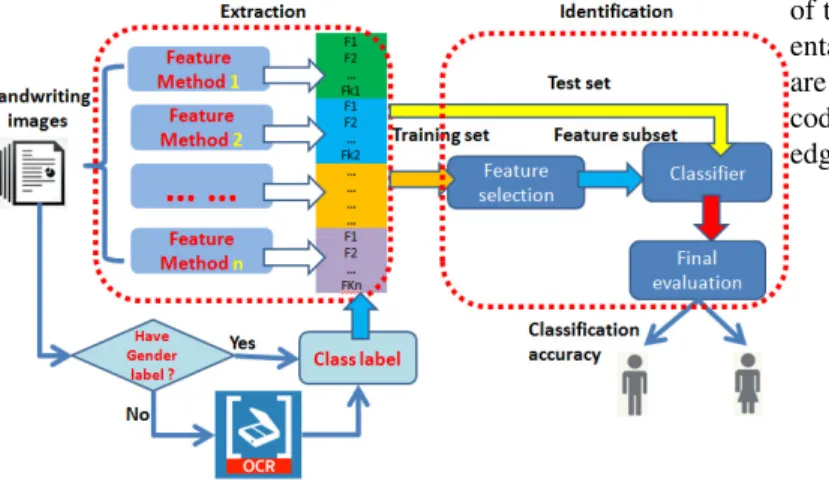
Our goal is to discriminate the different styles of male and female writings, the flowchart of our approach is shown in Fig. 1. We focused on all types of features in handwritings which can be categorized into geometrical and transformed features. The geometrical features consider the geometrical information of handwritten images, such as the slant, orientation, round-ness, curvatures, etc. They are extracted directly from images. The feature value reflects the pattern of a handwriting style. The transformed features are the result of mathematical trans-formation on original handwritten images, i.e., Fourier feature, Gabor feature, and WD-LBP feature. Hence, the above features are addressed in this section. Moreover, to extract the special features from the handwritten text, we used the related segmen-tation method to divide the connect components (CC). The goal is to confirm the gender label from handwritings quickly. The optical character recognition (OCR) technique was adopted and described in this section.
2.1. Geometrical Features
Ordinarily, graphologists use geometrical features to mea-sure the characteristics of handwriting. The general met-rics give an overall impression of a handwriting style. Thus, graphologists categorize the handwriting in terms of clarity, fine balance, originality, slant, regularity, and continuity. The per-sonality traits are usually associated with stroke quality (Ahmed
ACCEPTED MANUSCRIPT
Fig. 1. Flowchart of the approach for gender identification.and Mathkour, 2008). Related technology has been developed as shown in Fig. 2.
Fig. 2. Analysis of personality traits with handwriting.
The slant and curvature information, extracted from con-tours, are common features in the analysis of handwriting im-ages. The contour was chosen because of the common belief that the shape of handwritten text, from a handwritten image, can be represented by its contours. Analysis on contours allows us to compensate from the sensitivity of the writing instrument. Contours are expressed by a sequence of chain codes, which have been widely applied to character recognition (Blumenstein et al., 2007) and writer recognition(Siddiqi and Vincent, 2010). Because the work of gender identification also uses handwrit-ing images, we applied the chain code representation for fea-ture extraction. According to the chain code representation, the contour is expressed as a sequence of contour pixels with
{pi|1<i≤Nj−1}, wherepi∈ {0,1, . . . ,7}andNjis the length of contour j. Using the chain code, we can calculate the his-togram of each code, which ordinarily is seen as a slope density function. The bins of the histogram represent the relative dis-tribution of the eight directions. This is similar to textural and allographic features (Bulacu and Schomaker, 2007). One draw-back of using chain code is that the direction between forward and backward strokes are not discriminated.
To measure curvature at the pixel of contour, chain code fea-tures calculate the histogram of chain code pairs. We initialized a matrixA8×8with each element initialized to 0. Once we find a pair (i,j),0≤i≤7,0 ≤ j≤7, we increment the related bin of A. The distribution is regarded as a metric of the curvature
of the vector of strokes. The chain code features represent ori-entation and curvature effectively. However, the feature values are sensitive to noise distortion in writing samples. The chain code features are illustrated in Fig. 3, whereCiis the contour edge between pixelPi−1andPi,θiis an angle of curvature.
Fig. 3. Chain code representation and pair(0,3) represents a45◦at pixelpi.
Polygon-base features are used to estimate the contours of handwriting samples by using the sequential polygonization al-gorithm (Abbasi et al., 2013). The angle interval [−π
2,π2] is divided into 8 bins. The slope lines, used for approximating the contours, are assigned to their bins respectively. The angle
αievaluates curvature between each pair of connected segment vectorsVi,Vi+1, which is defined as
αi=π−arccos
Vi·Vi+1
|Vi||Vi+1| (1)
an example of polygonized contours of handwriting is shown in Fig.4,
Fig. 4. Polygonization algorithm, (a)original handwriting images, and (b) polygonized contours.
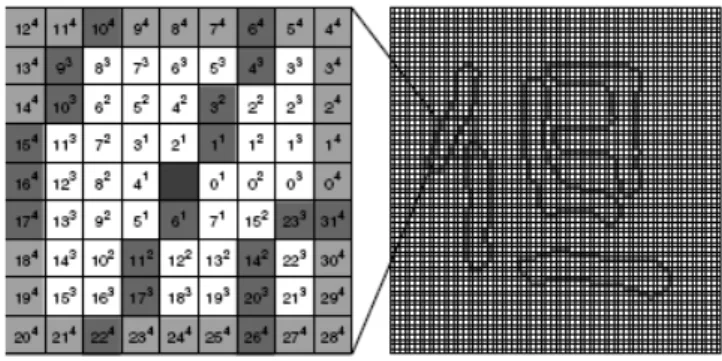
The Grid Micro-Structure Feature (GMSF) (Xu et al., 2011) is a text-independent feature which can work in several lan-guages. In addition, the GMSF is extracted from handwrit-ing contours. Suppose the contour image is covered by a (2N+1)×(2N+1) mask andNis the size of the grid. In Fig5, each square in the grid is labeled asim, wheremdenotes the biggest distance from the square to the center,i∈ {0, . . . ,8m−1}
is the square index. The pixel pair<im,jl>represent two con-tour pixels in a pair of squares. We useh(im,jl) to compute the total number of edge pixels in each square pair of the grid when
<im,jl>satisfies the following criteria in Eq.(2):
1im≤,jlm∈=El≤N,i< j (2) whereEis a set of the edge pixels. The positions of the pixel pairs are at the same distance away from the center, the 2 other similar criteria includesm=l−1,m=l−2.
ACCEPTED MANUSCRIPT
Fig. 5. GMSF features are derived from the pixel pairs.All of the above conditions are for the three sets and for the pixel pairs<im,jl>in the sets. Hence,h(im,jl)=h(im,jl)+1, and the sum of all occurrence numbers isH =Pi,j,m,lh(im,jl). The probability density distributionpof the pixel pair<im,jl> is defined as follows:
p(im,jl)=h(i m,jl)
H (3)
where p(im,jl) is named the Grid Microstructure Feature (GMSF).
2.2. Transformed Feature
The mathematical transform could be applied to analyse the handwritten images under different scales. Sub-images of dif-ferent scales reflect the information of the handwritings with various widths, blocks with various size and structure. To get transformed features for gender recognition, we extracted some transform features from handwritten images of different scales. The Fourier transformation is a traditional method for trans-forming data from a spatial plane to a frequency plane, which had been applied to handwritten feature extraction in(Chen et al., 2008)(Abandah et al., 2014). For anN×Ngiven hand-writing image f(x,y), the 2D Fast Fourier Transform (FFT) is defined as: F(u,v)= 1 N N−1 X x=0 exp[−j2πux N N−1 X y=0 f(x,y)exp[−j2πvy N ] (4)
where j = √−1, u,v are the frequency variables. u,v =
0,1, . . . ,N−1, and x,yare the spatial variables. F(u,v) is
di-vided into Mparts, and the mean of the energy distribution for each part was computed. We obtained MFFT features as
fol-lows: →−
F =[F1,F2, . . . ,FM]T (5)
whereFi = P|F(u,v)i|/M,iis an index from part of the FFT energy|F(u,v)|distribution.
The Gabor-filter-based multichannel method (Tan, 1992) has been proven to be the most effective in texture feature extraction for texture classification. Generally in 2D Gabor filers, he,ho denote the even and odd symmetrical filter functions. We define the Gabor filters with the unity aspect ratio as follows:
he(x,y)=g(x,y)·cos[2πω0(xcosθ+ysinθ)]
ho(x,y)=g(x,y)·sin[2πω0(xcosθ+ysinθ)] (6)
whereω0is the central frequency andθis the orientation. For a given image f(x,y),g(x,y) is one of the output functions of the four input cells which is denoted by
g(x,y)= 1
2πσ2exp[−
x2+y2
2σ2 ] (7)
whereσis a spatial constant. F(u,v) is a Fourier transform of
f(x,y). Therefore, the Gabor filter is represented in frequency plane as:
He(u,v)=[H1(u,v)+H2(u,v)] 2
Ho(u,v)=[H1(u,v)−H2(u,v)]
2j (8)
where j= √−1, and the definition ofH1(u,v),H2(u,v) is given by:
H1(u,v)=exp{−2π2σ2[(u−ω0cosθ)2+(v−ω0sinθ)2]}
H2(u,v)=exp{−2π2σ2[(u+ω0cosθ)2+(v+ω0sinθ)2]} (9) Based on the above result, for a givenN×Nimage, we chose six frequencies,ω0 withω0 ≤ N/2, and four orientations, i.e,
N = 128. Hence, ω0 ∈ {2,4,8,16,32,64} and the four ori-entations areθ ∈ {0o,45o,90o,135o}. We obtained 24 central frequency locations defining 24 visual cortical channels. By considering the mean values and the standard deviations of each channel output, we extracted 48 Gabor features from the given texture sample.
2.3. Handwriting Segmentation
The above features are the text-independent features, but many features (Tan et al., 2012) for the forensic document ex-amination are text-dependent. Each handwritten document was scanned into a digital picture. Line images and word images were segmented from the document images. Hence, text seg-mentation was an indispensable step in handwriting recogni-tion - especially for the strong overlapping and touching char-acters. The separation boundaries between characters are non-linear, which usually leads to failure for segmentation.
Ref. (Liu et al., 2004) presented a segmentation method for handwritten numbers and texts. Some application results of the methods are shown in Fig.6.
Fig. 6. Examples of handwritten document segmentation:(a)text lines, and (b)Chinese characters.
ACCEPTED MANUSCRIPT
In their research, all the strokes labeled{S1,S2, . . . ,Sn}from an image were extracted. nis the total number of strokes. The gravity<Gk
x,Gky>ofkth strokeSkis defined as follows:
Gkx=( M X i=1 i×Px(i))/( M X i=1 Px(i)) (10) Gk y=( N X i=1 i×Py(i))/( N X i=1 Py(i)) (11)
whereM,Nare respectively the width and height of the stroke
Sk, andPx(i),Py(i) is the pixel in theith vertical and jth hori-zontal line. Using spectral clustering, we transformed the Eu-clidean distance of stroke to a similarity matrixW =[wi j]n×n
wi j=
0exp((−kSi−Sjk)/σc) otherwisei fkSi−Sjk<r (12)
whereσcis the variance of all the distances andris the mean of all distances. The clustering algorithm was implemented as follows:
1. A diagonal matrixDis calculated by the similarity matrix
W =[wi j],Dii=Pnj=1wi j.
2. Gain the matrixL=D−12(D−W)D−12.
3. Search the k eigenvectors {x1,x2, . . . ,xk} of L, k is the number of clusters, matrixX=[x1,x2, . . . ,xk].
4. Take each row of X as an item and cluster the items intok
clusters by K-means.
5. Obtain the cluster label of each stroke according to the cluster label.
Therefore, we obtained the cluster label for the n strokes. They were combined to form characters according to their la-bels and position.
2.4. Optical Character Recognition
The ICDAR 2013 hassaine competition data set has 475×4= 1900 handwritten documents. Registration-form documents data set(Tan et al., 2015) has 11118 handwritten documents. Our goal was to identify the gender of the handwriting sam-ples. We needed to obtain the gender labels of the large hand-written documents, which was a huge difficult task in order to transform the handwritten characters into the digital label man-ually. Hence, optical character recognition (OCR) was used to recognize the gender of the handwritten words. Here, we only need to recognize handwritten Chinese characters of males and females for gender recognition.
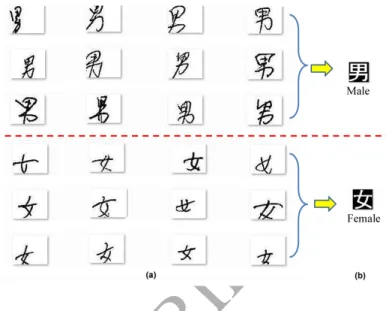
In this paper, some handwritten characters of gender from the registration-form documents set are shown in Fig.7. We can see that Fig.7(a) views the characters in the first three rows as males and in the last three rows as females.
Similar to other pattern recognition (Yin and Liu, 2009) methods, the OCR process involves reading an image, convert-ing it to gray scale and black and white images, and resizconvert-ing the image to that of a template in a reference dictionary, which is shown in Fig.7(b). Here we set a template size of [42,42]
which means that the width and the height of the image are both
Fig. 7. Chinese handwritten characters express gender,(a)original hand-written characters, and (b) character in reference dictionary .
42 pixels. We prepare for recognizing a character image ma-trixA. The recognition scheme for basic characters is based on shape identification. An efficient template matching approach was employed to recognize individual characters of each group. Given the template matrixTi,i=1, . . . ,N,Nis the total num-ber of templates in the dictionary (N = 2 in this paper). We computed the correlation betweenA andT iand searched the maximum correlation by max i∈{1,...,N} cov(A,Ti) √cov(A ,A)cov(Ti,Ti) (13) where cov(A,Ti) is the covariance matrix between A and
Ti. According to selecting conditions, and by using the fea-tures demonstrated above, we considered the characters in both groups they may be correctly classified.
3. Kernel Mutual Information to Select Feature
The Mutual Information method is an important way to learn mapping of a large number of input features to an output class label. With this view, we integrated the kernel into mutual in-formation. In this section, we review the related methods and present a certain criterion of KMI for feature selection. We performed theoretical analysis of KMI and explain why it is a suitable method.
3.1. Description of Feature Selection Problem
SupposeX(⊂Rm×n)is a set of input feature vectors. The vec-tor of the output class label isY(⊂Rm). There arem indepen-dent distributed paired samples for theuiclass. It is described as follows:
{(ui,yi)|ui∈ X,yi∈ Y,i=1, . . . ,m} (14)
heremis number of samples, and it is also the dimension size of the input feature vectors.nis the number of features in setX.
ACCEPTED MANUSCRIPT
The relationship betweenmandnwill affect the classification performance. xi is the feature vector withmdimensions. The original data are denoted by:
X=[u1, . . . ,um]>=[x1, . . . ,xn]∈Rm×n, (15)
Y=[y1, . . . ,ym]>∈Rm, (16)
where>means the transpose of a vector. The joint distribution function of densitypx,y(x,y) can be derived from here.
In the pattern recognition or machine learning fields, the most important work is to search for a predictor function f(·), which maps the feature vector xto output classy. f(·) is drawn from the training set, including the sample pairs(x,y), by using a ma-chine learning method. If we assume that f(·) is a member function of the predictor categorized by different parametersω, then we specify a special member function as fω(·). The goal is to useωminimize the objective function as follows:
minΓ(ω)=min
Z
L(fω(x),y)p(x,y)dxdy (17) whereL(fω(x),y) is a loss function when returning fω(x). In fact, the valuey, p(x,y) is a joint density function of x and y. The maximum loss functionLis defined as the misclassifica-tion rate for classificamisclassifica-tion problems. The ordinary criterion is in following form:
L(fω(x),y)= 1
2ky−fω(x)αk22+λkαk1, (18) whereα=[α1, . . . , αn] is a coefficient vector for regression to the featuresλ >0, which is a regularization parameter.k·k1,k·k2 are`1−and`2−norms.
3.2. Mutual Information for Max-Relevance and Min-Redundancy
The goal of mutual information is to look for one variable and test its value. As a result, the best separation among the classes could be found. To realize the goal, we reduce the class label entropy according to the class distribution function of the train-ing data by the average entropies of the new partitions. Their mutual informationI(x,y) ofxandyis defined with their indi-vidual or joint density probability functionp(x),p(y),p(x,y):
I(x,y)=
Z Z
p(x,y)log p(x,y)
p(x)p(y)dxdy (19) The purpose of using MI in feature selection focuses on two issues. The first one is to remove irrelevant variables, named Max-Relevance. The second issue is to remove redundant variables as much as possible, named Min-Redundant. Max-Relevance means select features, via the maximal relevance cri-terion, between the input feature subsetΦ,(xi∈Φ) and the out-put classyit is denoted by
I(Φ,y)= 1
|Φ|
X
xi∈Φ
I(xi,y). (20) It is clear that relevancy requires evaluating a joint metric of redundancy because Max-Relevance usually has a rich redun-dancy in the feature selection process. Min-Redundant views
that two features highly depend on each other. If one of them was removed, the respective classification performance would not decrease, so the following minimal redundancy criterion can be added to choose suitable features in a candidate feature setΦ: R(Φ)= 1 |Φ|2 X xi,xj∈Φ I(xi,xj). (21) Combining the above Eq. (20)(21), the criterion is named ”minimal-Redundancy-Maximal-Relevance”(mRMR)(Ding and Peng, 2005). Therefore, the optimization problem from Eq.(19) transforms to a new criterion by MI. The following form optimizesI(Φ,y) andR(Φ) together:
minL(fω(x),y)=min(−I(Φ,y)+R(Φ)) =max(I(Φ,y)−R(Φ)) =max[X xi∈Φ I(xi,y)− 1 |Φ| X xi,xj∈Φ I(xi,xj)] (22)
In fact, the MI method is based on a sufficient statistic distri-bution. Only a low dimensional space may exist for generation of sufficient statistics. There is an absence of sufficient statistics in high dimensions. Therefore, evaluating the MI could be dif-ficult in order to solve the optimization problem in the general multi-class high dimension feature space.
3.3. Integrate Kernel Function with MI
The Kernel function maps the original data to a high dimen-sional feature space. With the Kernel transform, the optimiza-tion problem of the redundancy and relevance of features may be solved easily. Widely used types of kernel functions, includ-ing the polynomial kernel, Gaussian kernel (or called radial ba-sis function (RBF) kernel), exponential kernel, sigmoid kernel, and delta kernel:
Polynomial kernel: k(x,y)=(x>y+c)d, (23) Gaussian kernel: k(x,y)=exp(−kx−yk 2 2σ2 ), (24) Exponential kernel: k(x,y)=exp(−kx−yk 2σ2 ), (25) Sigmoid kernel: k(x,y)=tanh(cx>y+d), (26) wherec,d andσare parameters of the kernels. Their values are obtained from practical problems. The value of sigmais usually set to the number of samples.
We consider the feature vector x, a mapping functionφ(·) :
x −→ φ(x), and a transform output vector yusing the map-pingφ(·) : y −→ φ(y). φ(·) is a nonlinear mapping function and a kernel function can be denoted by the mapping func-tion: k(x,y)=φ(x)>φ(y). Therefore, the optimization equation
ACCEPTED MANUSCRIPT
for feature selection from Eq.(18), using the kernel method, is given by
minL(fω(x),y)=min{kφ(y)−αφ(x)k2F+λkαk1} (27) wherek · kF is Frobenius norms. Then, we may see that:
L(fω(x),y)=kφ(y)−αφ(x)k2 F+λkαk1 =T r(φ(y)−αφ(x))>(φ(y)−αφ(x))+λkαk 1 =T r(φ(y)>φ(y))−2T r(α>φ(y)>φ(x)) +T r(α>φ(x)>φ(x)α)+λkαk 1 (28)
To optimize the above equation, we also assumed that the loss function L for the given input data was differentiable with respect to the coefficient vectorα, i.e. we may compute
∂L(xi,y)/∂α for the willful feature vector xi followed by the willful coefficientαi. We have:
∀α,∂L
∂α =0, (29)
Hence, the gradient of the criterion with respect to the arbi-trary coefficientαis:
∂L ∂α = ∂[T r(φ(y)>φ(y))] ∂α − ∂[2T r(α>φ(y)>φ(x))] ∂α +∂[T r(α >φ(x)>φ(x)α)] ∂α + ∂[λkαk1] ∂α =−φ(x)>φ(y)+|α|>φ(x)>φ(x)+λ =−k(x,y)+|α|>k(x,x)+λ (30)
where we considered the caseλ=0, compared to Eq.(22). The criterion above, defined with the kernel, is similar to the mutual information. The kernel method was used to test the depen-dence between two random variables. Hence, we instead define MII(x,y) with kernel functionIk(x,y), called the Kernel Mutual Information (KMI) functionIk(·). We obtain the new criterion:
minL(fω(x),y)=max(Ik(Φ,y)−Rk(Φ)) =max[X xi∈Φ Ik(xi,y)− 1 |Φ| X xi∈Φ;xj<Φ Ik(xi,xj)] (31) whereRkis a function redefined by the kernel from Eq.(21) andΦis a feature set which hasifeatures selected. The purpose of the method is to find the best optimal (i+1)th feature from set{X−Φ}. The respective optimization algorithm to search for the (i+1)th feature can be denoted by:
max xi∈Φ[Ik(xk,y)− 1 i X xj∈X−Φ;xi∈Φ Ik(xj,xi)] (32) where the parameter|Φ|has been replaced byiwhich is the number of selected features. This criterion forms the basis for later feature selection algorithms .
4. Experiment
In this section, we used our proposed KMI method to se-lect an optimal subset of features in order to identify the writer
gender in two handwritten data sets. The data sets have multi-features and samples and the total size of the multi-features in the two data sets is large. The ranges of the feature values vary. Thus various data sets increase the challenges to gender identi-fication. It would require a quality feature selection method to achieve a higher accuracy and be robust in complexity experi-mental conditions. We compared our proposed KMI methods with existing methods for gender prediction on above data sets. The comparison results of performance are discussed and ana-lyzed.
4.1. Data Sets
Two real handwritten data sets were used in our experi-ments for gender prediction which include the ICDAR 2013 sets(Hassaine et al., 2013) and our registration-form document data sets(Tan et al., 2015).
ICDAR 2013 (Hassaine et al., 2013) organized a competi-tion for gender identificacompeti-tion from handwriting through Kaggle. The data set is publicly available and has more than 475 writers with a distribution of about 50% male and 50% female. Each writer wrote four handwritten documents - two pages contain-ing Arabic handwritten text and another two pages containcontain-ing English handwritten text. The competition provided geometric features extracted from all the handwritten images. All images were digitized by an Epson GT-S80 scanner at a 600 DPI reso-lution. The format of the digital images is JPEG. The training set has 282 writers whose genders are provided. The gender of the remaining 193 writers is required to predict.
Our registration-form documents (RDF) set has 11 118 hand-written documents which consist of 9 256 gray images and 1 862 color images. In this paper, we consider each type of field in the registration forms except for the sheet letters, which were machine-printed. All other words were handwritten. All the writers were required to write his or her name and personal in-formation on the registration form. Because the form consisted of personal information, the data set is not open to the public. The text of the form contains Chinese characters and Arabic numerals. Personal information (address, workstation, gender, birthday, telephone number, post code, person ID, job) was only written once. Handwritten signature, Arabic numerals, and cor-responding Chinese characters were used frequently. The writ-ers were requested to write the content five times in the forms. In our experiments, we selected 75% form images for training, and the remaining images were used as the test set.
The descriptions of the data sets are summarized below (shown in Table1 ):
The data stored in the ICDAR 2013 database consists of fea-ture values and original document images. The RDF data set only has original images. Some sample images of the above data set are shown in Fig.8. Besides the feature values, the IC-DAR 2013 training data set contains the class label. The value of the class label could be 0 or 1. A value of ’1’ indicated male and ’0’ for female.
Many feature types were considered for gender identifica-tion in this paper. We used the KMI feature selecidentifica-tion algo-rithm for the multi-feature problem. Some selected features were geometry-based features and others were transformation features. We list the various feature types in Table 2.
ACCEPTED MANUSCRIPT
Table 1. Summary of real handwritten data sets.Data Set Name Language # of Documents # of Writers # of Features Is Public ICDAR 2013(Hassaine et al., 2013) Arabic+English 1900 475 7066 Yes
RDF (Tan et al., 2015) Chinese 11118 11118 9517 No
Table 2. Summary of feature types.
Feature Type Name #of Features Transformed or Geometrical Text-Independent Data Set
TortuosityHist (Abbasi et al., 2013) 10 Geometrical Yes ICDAR 2013
Direction (Blumenstein et al., 2007) 40 Geometrical Yes ICDAR 2013
Curvature (Siddiqi and Vincent, 2010) 900 Geometrical Yes ICDAR 2013 Chain Code (Siddiqi and Vincent, 2009) 5020 Geometrical Yes ICDAR 2013
Gradient Direction (Liu, 2007) 1096 Transformed Yes ICDAR 2013
Fourier (Chen et al., 2008) 1600 Transformed Yes RDF
Gabor (Tan, 1992) 36 Transformed Yes RDF
GMSF (Li and Ding, 2009) 6561 Geometrical Yes RDF
Allographic (Bulacu and Schomaker, 2007) 1296 Geometrical Yes RDF
Shape+Structure (Tan et al., 2011) 24 Geometrical No RDF
Fig. 8. Some original images in ICDAR 2013 and RDF, (a)Arabic text, (b)English text, and (c) Arabic numbers, (d)Chinese text.
4.2. Comparison of Methods
The goal of this paper is to employ feature selection to opti-mize the subset for gender recognition. According to the fea-tures that have been introduced above, we needed to prove that the KMI feature selection method would improve the accuracy more than using the isolated features. In this experiment, we chose the kernel and classifier in order to finish the task effec-tively. Furthermore, we compared our proposed KMI methods with the existing methods using the above data sets. Compari-son results of the performances are addressed.
As commonly accepted, the kernel metric is the bridge that connects the original data with the learning methods. Kernel methods play a key role for KMI and they are convenient. The-oretically, kernels should be adapted to the requirements of real applications for all types of cases. The ideal kernel functionφ
is denoted ask(x,y)=φ(x)φ(y), but we do not know the form of the function φ(·). Learning is required in most real cases. Therefore, we begin with a simple kernel and combine it to more complex kernels. Some kernels come from different fam-ilies and are chosen for use in many applications. We analyzed the properties of various kernels from different kernel families. In this experiment, four popular kernels including linear, poly-nomial, RBF, and Tanh were considered.
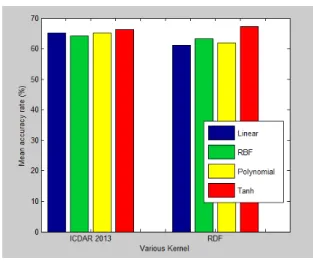
Fig. 9 shows the mean classification accuracy of gender prediction using KMI with various kernels. The Tanh kernel achieved the highest performance in two data sets. The highest accuracy was obtained on the RDF data set. We had an
aver-age accuracy of 67.2%. The difference between Tanh and the other kernels was small. The linear kernel had the lowest av-erage accuracy at 61.7%. The accuracies of all kernels were similar. Performance of the Tanh kernel was 67.2% and 66.3% in RDF and ICDAR 2013 sets respectively. Achievements of the other kernels were less than Tanh. As a result, we decided to choose the Tanh kernel as our KMI kernel according to the requirements of gender recognition from handwriting.
Fig. 9. Mean performance of various kernels.
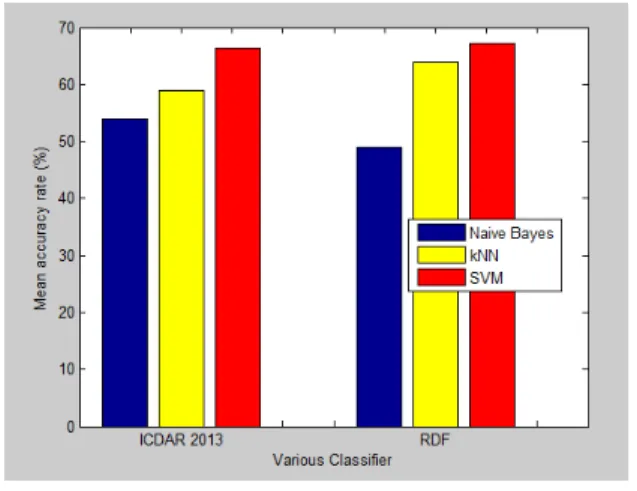
In the KMI framework, the classifier plays a vital role. Hence, we wanted to choose a classifier that would perform feature selection to provide a good performance. Three popular classifiers were considered which consisted of Support Vector Machine (SVM), Naive Bayes (NB), and k-Nearest Neighbor (kNN).
Fig. 10 shows the mean classification accuracies for NB, SVM, and kNN. As can be seen, the accuracy for the SVM achieved 67.2%, which was higher than both NB and kNN. The mean accuracy of kNN was close to that of the SVM. The high-est accuracy for the kNN was 63.8% on the RDF data set and
ACCEPTED MANUSCRIPT
the lowest was 59% on the ICDAR 2013 data set. The corre-sponding accuracy for the SVM was 66.3%.
Compared with the kNN and SVM, NB did not perform as well in these experiments. The NB classifier requires calculus density and probability, and the values of features to be positive. Thus, occasionally, the NB classifier could not be implemented normally. The mean classification accuracy of the NB was the lowest among the three classifiers. The corresponding accura-cies of the NB were respectively 49.0% and 54.0% in the two data sets. Therefore, in the following experiment, SVM was chosen as the default classifier.
Fig. 10. Mean performance of various classifiers.
Two real world handwritten data sets were used in our exper-iments - ICDAR 2013 and RDF. Different feature types were used to evaluate the performance of gender identification. Com-parisons among the results from the two data sets are summa-rized below (shown in Tables (3),(4)):
• Table 3 views the average individual classification accura-cies for the different feature types in ICDAR 2013. The first set type is TortuosityHist(Abbasi et al., 2013). The size of the features is 10, which is the smallest feature set among ICDAR 2013. Accuracy for this type of feature was 59.2%. The performance of the Direction (Blumen-stein et al., 2007) features had a high accuracy at 61.7%. Classification accuracy of Curvature (Siddiqi and Vincent, 2010) was lowest, indicating that the Direction (Blumen-stein et al., 2007) features were better than the Curvature (Siddiqi and Vincent, 2010) features. The size of the chain code features was the largest among all the types. The number of features is 5020, but many values are zero. When all types of features are combined, the number of features becomes 7066. Accuracy for the combined fea-tures was 65.2%. We used the KMI method for gender identification and we obtained the highest classification accuracy, from the KMI, at 67.3%. When the number of features was 150, we had the lowest accuracy of KMI at 64%. When the number of features was 10, the mean ac-curacy was 66.3%.
• From Table 4 show that the experimental results obtained from using the RDF set. The size of the Gabor (Tan, 1992)
Table 3. Result of gender recognition in ICDAR 2013, ICDAR feature per-formance shown for comparison.
Feature Type # of Features Accuracy
TortuosityHist (Abbasi et al., 2013) 10 59.2% Direction (Blumenstein et al., 2007) 40 61.7% Curvature (Siddiqi and Vincent, 2010) 900 56.1% Chain Code (Siddiqi and Vincent, 2009) 5020 58.5% Gradient Direction (Liu, 2007) 1096 58.8%
Total features 7066 65.2%
KMI 150 66.3%
Table 4. Result of gender recognition in RDF, all types of features are per-formed for comparison.
Feature Type Name #of Features Accuracy Fourier (Chen et al., 2008) 1600 35.2%
Gabor (Tan, 1992) 36 56.7%
GMSF (Li and Ding, 2009) 6561 37.8% Allographic (Bulacu and Schomaker, 2007) 1296 45.9% Shape+Structure (Tan et al., 2011) 24 37.8%
Total features 9517 61.1%
KMI 200 66.7%
type features was the smallest, at 36. However, the accu-racy of Gabor (Tan, 1992) was highest among all types of features, which was 56.7%. The size of GMSF (Li and Ding, 2009) type of features was the largest, at 6561. The lowest accuracy was 35.2% when we only used Fourier features. The accuracy was 61.1% when we combined all the features together. The total number of all features was 9517. The highest accuracy of KMI was 66.7% when the number of selected features was 200 and the lowest ac-curacy was 38% when the selected feature number was 10. The KMI accuracy has the best performance among the other methods. Results from Table4 show that, for the main data set, the mean classification accuracies of KMI were significantly higher than the individual and total fea-tures.
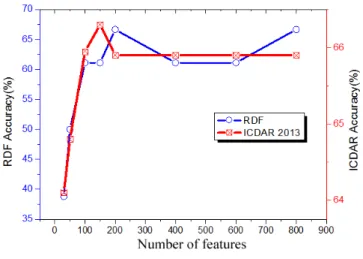
We selected various numbers of features and employed them in this experiment in order to validate our algorithm. Therefore, we selected the top 10,30,50,100,150,200,400,600,and800 features respectively from the ICDAR 2013 and RDF data sets. We see in Fig. 11, the red curve, representing the accuracy of gender recognition in the ICDAR 2013 data set, and the blue curve that describes the accuracy of gender recognition in the RDF data set. The result shows the lowest accuracy was 38% when the number of features was 10 in RDF. KMI had the high-est accuracy at 68% when the top selected number was 200. The accuracy did not change for the number of features of≥ 800. In Fig. 11, the left and right axes show the performances in the various data sets. The left blue axis is for RDF and the right red vertical axis expresses the classification accuracy of KMI in ICDAR, which is high. Results using KMI achieved a 67.3% accuracy rate when the selected number of features was 150. We also selected the top 1000,2000,4000,6000 features and discovered that when the number of features is greater than 200, the recognition accuracy will stay constant at 65%. With
ACCEPTED MANUSCRIPT
Table 5. Mean accuracy of gender recognition comparison.Algorithm ICDAR 2013 RDF
mRMR(Peng et al., 2005) 63.7% 61.4%
Correlation 62.5% 59.3%
KMI 66.3% 66.7%
various numbers of selected top features, the experiment can be tested in small-sample or big-sample conditions. All of this study was to promote objectivity when comparing all the meth-ods.
Fig. 11. Gender identification accuracy of KMI in various data sets.
The KMI, mRMR, and Correlation methods are approxima-tions of the mutual information selection scheme, their classi-fication accuracies are shown in Table 5. Thus, we only com-pared their performances in terms of computation complexity. These comparisons are expressed by the running time for real data. We know that mRMR cannot be executed in complex data sets, therefore, we compared them using the ICDAR 2013 and RDF data sets.
Experiments were conducted on an Intel Core i5-4250 CPU machine with 4 GB memory running windows 7.0. The soft-ware was developed and executed with Matlab versions 7.0 and v2012.
We obtained the computation complexity by computing the average time for one feature. The running time was obtained by running all methods and selecting the topmfeatures for each data set. We then recorded the total runtimeT and calculated the average running time to bem/T seconds/per feature. Table 6 shows the time costs for the three methods and for each of the data sets. In ICDAR 2013, all methods took longer to fin-ish the task than in ICDAR. KMI took about 0.778 seconds to select one feature in ICDAR 2013. The time for mRMR and Correlation are 0.913 and 1.16 seconds respectively.
We also tested computation complexity in the RDF data set, which was hard work for the mRMR. In ICDAR 2013, the Cor-relation method took 0.8125 seconds and KMI took 1.833 sec-onds. Correlation took an average of 0.8125 seconds to find a feature while KMI uses 1.16 seconds in ICDAR 2013. The data
Table 6. Mean running time (second/per feature).
Algorithm ICDAR 2013 RDF
mRMR(Peng et al., 2005) 0.9314 0.6213
Correlation 1.1685 0.8125
KMI 0.7778 0.564
set not only had the largest number of features, their feature values were more complex than the other data sets. As a result, the time to run them using ICDAR 2013 was longer than that for the RDF data set.
From the above data analysis, and our experiment in the two data sets, KMI had the lowest average running time compared to mRMR and Correlation. The result demonstrates the effec-tiveness of the KMI method in computation complexity.
4.3. Analysis of Results
With our proposed KMI methods, we focused on gender pre-diction based on handwritings from multi-featured data sets. KMI is a feature selection method which consists of a kernel function and classifier. It makes use of the wrapper filter pro-cess to select the features. We obtained a high accuracy per-formance at a low computation cost. The KMI method opti-mizes the mutual information to yield a candidate feature sub-set by using a kernel function. Thus, the features in the subsub-set have new metrics based on max-relevance and min-redundancy. KMI is ideal for solving the problem of multi-feature, high di-mensional, and complexity of feature values.
Compared to traditional gender recognition algorithms, KMI avoids the conflict of multi-features. The task is very chal-lenging and it is easy to make mistakes when multi-features are mixed together. According to the analysis and experiments shown in the previous section, we used kernel-based methods to compute the mutual information of gender label and feature vectors. The result proved that the difficulty of using multi-features could be overcome. Kernel-based methods can im-prove the accuracy and reduce the redundancy effectively.
Although, in our experiments, KMI feature selection usually had a higher classification accuracy than the other methods, oc-casionally, there were some ups and downs in the classification accuracy and redundancy rate. For instance, in Tables 4 and 6, KMI did not have the highest performance when the number of features was minimum. Many conditions can be the reasons for the fluctuations. The first reason was that not enough features had led to bad classification results. Another reason was that cross validation may have yielded the fluctuations in classifica-tion.
Traditional feature selection methods consist of incremental search, which includes both forward and backward selections. All these methods cannot confirm the local optimization of the search path since the main difficulty in searching is to cover the entire vector space. Meanwhile, global optimization leads to over-fitting and high computational cost. Hence, KMI obtained a greater classification accuracy and good performance while having a low computation cost.
In our experiments, our goal was to compare the various ker-nels, classifiers, and other gender classification methods. In
ACCEPTED MANUSCRIPT
the most complex conditions, KMI increased the accuracy of classification and decreased the computational cost. It had the highest classification accuracy in the ICDAR 2013 data set. Al-though partial achievement on RDF was not satisfactory, it has the overall highest accuracy and it solved the problem the other methods could not perform on this data set. The results of our experiment show that the KMI performs with high accu-racy and is an effective method for feature selection to predict gender. The KMI method can be considered as an open, inno-vative framework, to select features with high effectiveness and to merge all possible new features.
5. Conclusion
In this paper, we used the KMI feature selection method to identify writer gender from handwriting. Under this frame-work, various types of geometrical and transformed multi-features were mixed together. The multi-features came from differ-ent sources. The goal of this paper was to iddiffer-entify gender using multi-features. Compared with other methods, the KMI method improved the accuracy of gender identification and avoided the complexity computation problem. Finally, we reported the re-sults of our experiments using two data sets. More than 7,066 mixed features in ICDAR 2013 data set and 9517 features in RDF were used. The average rate of correct classification was higher than the compared methods. The KMI method integrates the kernel function, classifier, and mutual information. Results of our experiments demonstrated that the KMI candidate fea-ture search, from the remaining feafea-ture subset, performed very well at low processing cost.
6. Acknowledgments
This work was supported by the Guangdong Provincial Gov-ernment of China through the ”Computational Science Inno-vative Research Team” program and the Guangdong Province Key Laboratory of Computational Science at the Sun Yat-Sen University, the Technology Program of GuangDong (Grant No. 2012B091100334), and the National Science Foundation of China (Grant No. 11471012), and China Scholarship Coun-cil(Grant No. 201506385010).
References
Abandah, G.A., Jamour, F.T., Qaralleh, E.A., 2014. Recognizing handwritten arabic words using grapheme segmentation and recurrent neural networks. International Journal on Document Analysis and Recognition (IJDAR) 17, 275–291.
Abbasi, H., Olyaee, M., Ghafari, H.R., 2013. Rectifying reverse polygoniza-tion of digital curves for dominant point detecpolygoniza-tion. Internapolygoniza-tional Journal of Computer Science Issues(IJCSI) 10, 154–163.
Ahmed, P., Mathkour, H., 2008. On the development of an automated graphol-ogy system., in: Proceedings of International Conference on Artificial Intel-ligence, pp. 897–901.
Al M´aadeed, S., Ayouby, W., Hassaine, A., Aljaam, J.M., 2012. Quwi: An ara-bic and english handwriting dataset for offline writer identification, in: Pro-ceedings of International Conference on Frontiers in Handwriting Recogni-tion (ICFHR), IEEE. pp. 746–751.
Bandi, K., Srihari, S.N., 2005. Writer demographic classification using bagging and boosting, in: Proceedings of 12th International Conference on Grapho-nomics Society, pp. 133–137.
Beech, J.R., Mackintosh, I.C., 2005. Do differences in sex hormones affect handwriting style? evidence from digit ratio and sex role identity as deter-minants of the sex of handwriting. Personality and Individual Differences 39, 459–468.
Blumenstein, M., Liu, X.Y., Verma, B., 2007. An investigation of the modified direction feature for cursive character recognition. Pattern Recognition 40, 376–388.
Bulacu, M., Schomaker, L., 2007. Text-independent writer identification and verification using textural and allographic features. IEEE Transactions on Pattern Analysis and Machine Intelligence 29, 701–717.
Chen, Q., Yan, Y., Deng, W., Yuan, F., 2008. Handwriting identification based on constructing texture, in: Proceedings of First International Conference on Intelligent Networks and Intelligent Systems(ICINIS), IEEE. pp. 523–526. Dash, M., Liu, H., 2003. Consistency-based search in feature selection.
Artifi-cial Intelligence 151, 155–176.
Ding, C., Peng, H., 2005. Minimum redundancy feature selection from mi-croarray gene expression data. Journal of Bioinformatics and Computational Biology 3, 185–205.
Du, L., You, X., Xu, H., Gao, Z., Tang, Y., 2010. Wavelet domain local binary pattern features for writer identification, in: Proceedings of 20th Interna-tional Conference on Pattern Recognition (ICPR), IEEE. pp. 3691–3694. Hassaine, A., Al Maadeed, S., Aljaam, J., Jaoua, A., 2013. Icdar 2013
com-petition on gender prediction from handwriting, in: Proceedings of 12th International Conference on Document Analysis and Recognition (ICDAR), IEEE. pp. 1417–1421.
Ibrahim, A.S., Youssef, A.E., Abbott, A.L., 2014. Global vs. local features for gender identification using arabic and english handwriting, in: Proceed-ings of IEEE International Symposium on Signal Processing and Informa-tion Technology (ISSPIT), IEEE. pp. 000155–000160.
Li, X., Ding, X., 2009. Writer identification of chinese handwriting using grid microstructure feature, in: Advances in Biometrics. Springer, pp. 1230– 1239.
Liu, C.L., 2007. Normalization-cooperated gradient feature extraction for hand-written character recognition. IEEE Transactions on Pattern Analysis and Machine Intelligence 29, 1465–1469.
Liu, C.L., Sako, H., Fujisawa, H., 2004. Effects of classifier structures and training regimes on integrated segmentation and recognition of handwrit-ten numeral strings. IEEE Transactions on Pattern Analysis and Machine Intelligence 26, 1395–1407.
Liwicki, M., Schlapbach, A., Bunke, H., 2011. Automatic gender detection using on-line and off-line information. Pattern Analysis and Applications 14, 87–92.
Peng, H., Long, F., Ding, C., 2005. Feature selection based on mutual informa-tion criteria of max-dependency, max-relevance, and min-redundancy. IEEE Transactions on Pattern Analysis and Machine Intelligence 27, 1226–1238. Ring, M., Eskofier, B.M., 2015. Optimal feature selection for nonlinear data
using branch-and-bound in kernel space. Pattern Recognition Letters 68, 56–62.
Siddiqi, I., Djeddi, C., Raza, A., Souici-meslati, L., 2014. Automatic analysis of handwriting for gender classification. Pattern Analysis and Applications , 1–13.
Siddiqi, I., Vincent, N., 2009. A set of chain code based features for writer recognition, in: Proceedings of 10th International Conference on Document Analysis and Recognition(ICDAR), IEEE. pp. 981–985.
Siddiqi, I., Vincent, N., 2010. Text independent writer recognition using redun-dant writing patterns with contour-based orientation and curvature features. Pattern Recognition 43, 3853–3865.
Sokic, E., Salihbegovic, A., Ahic-Djokic, M., 2012. Analysis of off-line hand-written text samples of different gender using shape descriptors, in: Proceed-ings of IX International Symposium on Telecommunications (BIHTEL), IEEE. pp. 1–6.
Tan, J., Lai, J.H., Wang, C.D., Feng, M.S., 2011. A stroke shape and structure based approach for off-line chinese handwriting identification. International Journal of Intelligent Systems and Applications (IJISA) 3, 1.
Tan, J., Lai, J.H., Wang, P., Bi, N., 2015. Multiscale region projection method to discriminate between printed and handwritten text on registration forms. International Journal of Pattern Recognition and Artificial Intelligence 29, 153–185.
Tan, J., Lai, J.H., Zuo, X.X., 2012. The dataset system of economic dispute handwritten (dsedh) based on stroke shape and structure features, in: Pro-ceedings of 21st International Conference on Pattern Recognition (ICPR), IEEE. pp. 661–664.
ACCEPTED MANUSCRIPT
Tan, T., 1992. Texture feature extraction via visual cortical channel modelling, in: Proceedings of 11th IAPR International Conference on Pattern Recogni-tion Vol. III. Conference C: Image, Speech and Signal Analysis, IEEE. pp. 607–610.
Tett, R.P., Palmer, C.A., 1997. The validity of handwriting elements in relation to self-report personality trait measures. Personality and Individual Diff er-ences 22, 11–18.
Wang, J.J.Y., Bensmail, H., Gao, X., 2014. Feature selection and multi-kernel learning for sparse representation on a manifold. Neural Networks 51, 9–16. Wen, J., Fang, B., Chen, J., Tang, Y., Chen, H., 2012. Fragmented edge struc-ture coding for chinese writer identification. Neurocomputing 86, 45–51. Xu, L., Ding, X., Peng, L., Li, X., 2011. An improved method based on
weighted grid micro-structure feature for text-independent writer recogni-tion, in: Proceedings of International Conference on Document Analysis and Recognition (ICDAR), IEEE. pp. 638–642.
Yin, F., Liu, C.L., 2009. Handwritten chinese text line segmentation by cluster-ing with distance metric learncluster-ing. Pattern Recognition 42, 3146–3157.