Shira Y. Pittle. Towards a Set of Core Competencies for Museum Librarianship. A Master’s Paper for the M.S. in L.S degree. March, 2011. 47 pages. Advisor: Diane Kelly
This paper describes a research study in which a self-administered survey questionnaire was sent to current museum librarians. The study investigated educational backgrounds, opinions of the adequacy of post-graduate education as preparation for practice in museum librarianship, career plans and paths, work practices and job responsibilities for this cohort in order to generate a tentative list of core competencies for the profession, which has no dedicated professional organization and no established list of core competencies or best practices. The study found little to distinguish museum librarianship from other areas of librarianship, finding instead an emphasis on the traditional areas of librarianship such as cataloging and reference, and on professional concerns such as time management and volunteer and staff supervision. The core competencies are therefore extremely tentative, since it is still believed that distinctions do exist; it is recommended that this work be taken up by active professionals.
Headings:
Duties of librarians -- Museum librarians Museum librarians -- Qualifications
by Shira Y. Pittle
A Master’s paper submitted to the faculty of the School of Information and Library Science of the University of North Carolina at Chapel Hill
in partial fulfillment of the requirements for the degree of Master of Science in
Library Science.
Chapel Hill, North Carolina March 2011
Approved by
Introduction
Modern museums are cultural institutions which collect, preserve and interpret objects for the benefit of the public (AAM, 2010b). They grew out of the
Wunderkammmern, or cabinets of curiosities, which began to appear in fifteenth to sixteenth century Europe, collections of exotica which displayed the worldliness and education of their collectors (Dilevko & Gottlieb, 2004). Books, libraries and librarians were associated with these cabinets of curiosity from the sixteenth century, if not before (Ibid.). The British Museum, one of the first modern museums in that it was open to the public and held in public trust, was founded with a collection that consisted in large part of books and manuscripts (British Museum, n.d.). Libraries and museums have long been associated in the New World as well. For example, the Metropolitan Museum of Art in New York City was founded in 1870 as both a museum and a library of art (Metropolitan Museum of Art, 2010), while the first museum in the United States, the Charleston Museum in South Carolina, was founded in 1773 by the Charles-Town Library Society (Rea, 1923).
Museum libraries today are special libraries which exist under parent museum institutions, constituting unique information environments (Marty, 2006b). Generally speaking, the primary purpose of museum libraries is to serve the parent museum community and advance the museum’s mission by providing appropriate information
the Seattle Art Museum libraries reads in part: “the main objective of the SAM Research
Libraries... is to support the research needs of SAM curators, their assistants, other museum staff and docents,” (SAM Libraries, n.d.) while the mission of the Watson
Library, the primary library at the Metropolitan Museum of Art in New York City, states that “the primary mission of the Library is to support the research activities of the
Museum staff” (Metropolitan Museum of Art, 2009).
Museum librarians, the professionals who create and staff these museum libraries, encounter conditions and issues stemming from the specialized context of the museum and the problem of building a collection subservient to and based around another, more important collection: the parent museum’s collection of objects. A greater understanding is needed of these specialized issues, concerns, activities and responsibilities, what skills and knowledge are needed to navigate them, and how current museum librarians have gained that knowledge (Marty, 2005). At the present time, there are only four ALA-accredited graduate library schools that have specializations focused on museums and museum libraries (Kent State University, n.d.). All four were founded within the last five years (Pratt Institute, personal communication, December 6, 2010), showing this to be an area of both growing awareness and growing importance in the field.
it is not clear that the students who take these classes become museum librarians. The most recent examination of museum librarians’ educational and career paths (Bierbaum, 1988b) is discussed later in this paper; it is now twenty two years old. A more recent study (Marty, 2005), also discussed in detail later in this paper, approached similar issues, but focused on museum information professionals other than librarians. There also exist published lists of core competencies for librarianship, including for specialized areas such as music librarianship, law librarianship, and art and visual librarianship, but no such core competencies have been identified/established for museum librarianship.
The purpose of this study is to suggest a set of core competencies for museum librarians. This was accomplished by first describing the state of education of current museum librarians, their career paths, and their views of how their post-graduate educations prepared them for practicing museum librarianship, and using these
descriptions, in combination with published lists of established library core competencies, to generate the list of museum librarianship core competencies. Museum librarians are defined as professional library employees who work in libraries that are contained within museum institutions. Post-graduate education are defined as formal education occurring under the aegis of an accredited educational institution which occurs after the completion of a bachelor’s degree and is in pursuit of a degree. Core competencies are defined as the
competency after entering the field, such as on-the-job training and attending seminars and other ongoing professional education events.
Research questions
The study addresses the following research questions:
1. What are the post-graduate educational backgrounds of current museum librarians? 2. What are the views of current museum librarians about how their post-graduate educational backgrounds prepared them for practicing museum librarianship? 3. What career paths have current museum librarians taken?
4. What are the responsibilities that current museum librarians must fulfill, and what are the activities they engage in to do so?
5. What are the skills, knowledge and behaviors they require to complete these activities and fulfill their responsibilities?
This research is intended to rectify the aforementioned lacks in current
knowledge. The increased understanding that this will enable will create opportunities for improved pedagogies relating to the area, as well as aiding museum librarians-to-be in making decisions relating to their education and training.
Literature Review
agreement that preparation in a subject field is essential for special librarianship” (1966, p.3) and Craddick discusses why: “special libraries exist to support the parent
organization and make its work more effective” (1997, p.276). In the case of museum libraries, this is important because both museums and museum libraries “function as
stewards of our culture and history, of our world and our place in it” (Ibid.). Despite this increase in the importance of and interest in museum information professions, there are important gaps in the knowledge of the field of library science that, if filled, would enable improved preparation for professionals entering the field.
One such gap in the literature is that of examination of the field of museum librarianship. Craddick commented on this absence in 1997, and it is still true today: “[one] major obstacle [to improving museum libraries and librarianship] is the lack of available literature on the subject of museum libraries” (p.276). Much of the literature
which does exist was written by Esther Bierbaum, and is at least eleven years old now. The earliest of Bierbaum’s articles on the subject, “The museum library revisited,” (1984)
refers in its title to several even older surveys of American museum libraries which she cites, ranging from 1959 to 1980. Bierbaum addressed the state of museum library affairs in America twice, in 1984 and 1997, both times using organizational stature measures such as funding, staffing and use as metrics. As the title of the latter article, “Museum libraries: the more things change...” suggests, she discovers similar and very discouraging
general public. These results were later examined and discussed in the context of framing museum librarians as information professionals (Koot, 2001).
Bierbaum’s first study (1984) is motivated simply by the belief that the available
data on museum libraries are insufficiently current. Much of the emphasis in the article’s introduction is given to a survey of similar studies leading up to hers, which were
Part of the reason for the lack of current investigations and discussions of museum librarianship seems to be a shifting in focus to museum informatics, to the exclusion of examinations of more traditional library roles in museums. Museum
informatics has been defined as the study of the sociotechnical interactions that take place at the intersection of people, information and technology in museums (Marty, 2010). Interest in museum informatics is growing, as evidenced by increasing publications and professional conferences since the term’s origination in 1986 (Bearman, 1987; Marty,
2010), much of the current museum informatics research relevant to this study has been published by a single researcher.
Although the final step of generating a set of core competencies is not taken, it would seem that Marty, 2006b addresses precisely the same concerns and asks precisely the same questions as this study: the roles, responsibilities, and skills of museum
information professionals. However, there is an important difference: that his sample of museum information professionals includes no museum librarians, as he purposely excluded them from his study in order to focus instead on newly emerging roles. In the end, as alluded to above, rather than a tentative set of core competencies for the field, four profiles are generated which are intended to model different types of museum information professionals. Of these four profiles – the Chief Information Officer, the Information and Communication Technologies Specialist, the Webmaster, and the Information Resource Manager – the Information Resource Manager (IRM) is described as having skills and responsibilities that would seem to be similar or the same as those of museum librarians, though libraries and librarians are never mentioned in the description. The IRM is tasked with, among other things, assessing the future value of information resources and mediating between the museum’s information resources and users with
diverse information needs. The other profiles described are not obviously relevant to this study.
as Marty, 2006b, namely that it specifically excludes museum librarianship from
consideration. This study has another problem, as well: the conclusions drawn are, in the words of the researcher himself, both “rather obvious” and “literally ridiculous” (Marty,
2005, p.131). Marty is referring here to the fact that his final recommendations are that in order to be best prepared, students seeking entry into this non-lucrative field attain beforehand a subject degree in the area of the museum in which they wish to work, a professional degree in LIS, a second professional degree in Museum Studies, and work experience, possibly unpaid, in museums.
There is another study by Marty (2007a), based on different sets of data, which are substantially relevant to this study and related to this gap in the literature. The first study (2007a) study focused on data gathered from an online survey questionnaire
intended for museum professionals who self-identify as having an interest in the future of information science and information technology in museums. The questionnaire was publicly accessibly to whose with the URL, which he distributed via professional mailing lists. The resulting data were analyzed by calculating the Pearsons correlations between responses to the different questions in order to attempt to identify meaningful
relationships between the various factors examined. Once again, this study was not intended to result in generalizable or representative data, but rather to provide insight into the mindsets of those museum professions who, by virtue of this professed interest in IS and IT in museums, are members of a group which Marty identified as likely to lead museums into the 21st century.
whether there were any invalid responses. His primary reported conclusion is that museum professionals who are interested in information science and information technology in museums are more interested in acquiring skills and knowledges they do not possess than in maintaining those they do, a finding of marginal relevance to this study.
Another gap in the literature of library science is that of an identified educational path for LIS students hoping to pursue museum careers (Marty, 2005). As mentioned above, there are presently four ALA-accredited LIS masters programs which feature concentrations or certificates in museum work, all begun within the past five years, which is evidence that this subject focus is still in its infancy in library schools. In addition, a study was recently published discussing integration of museum informatics into LIS curricula for the past ten years (Marty & Twidale, 2011) framing museum informatics as an emerging and evolving area in LIS education.
The study which most closely aligns with this one, and which therefore informs it most significantly, is “Museum, arts, and humanities librarians: careers, professional development, and continuing education” (Bierbaum, 1988b). The motivating purpose of Bierbaum’s study, optimizing conference events and continuing education opportunities
for professionals in the field, is different from this study, though overlapping; this study seeks to inform and strengthen educational offerings for the field, including continuing education. Much as the motivation is overlapping but not identical, the goals of the two studies are similar: Bierbaum aimed to describe the state of the profession of museum librarianship, while this research aimed to do so in service of the greater goal of
methodology are therefore also nearly identical: the professional education, career paths, and job situations of a sample of museum librarians, and the respondents’ opinions on
these things, were sought via survey, though this study added to that original data collection the seeking of data on the activities and responsibilities of the professionals in the field. Though this first set of data had been gathered before, it deserved to be
gathered again: even if one collection of data were sufficient to establish fact, which it certainly is not, Bierbaum’s data are now out of date.
Bierbaum examined professional education, career paths, and job situations, including “personal and educational characteristics of the respondents; job choice; and
such aspects of the job situation as length of time in position (and since graduation) and the number of coworkers and workers supervised” (Bierbaum, 1988b, p. 128). She used
a survey to gather data, with which she achieved response rates of 50%, representing 148 returned protocols from a random sample of 295 members of the Special Libraries Association division of Museums, Arts and Humanities (MAHD). Of the 148 returned surveys, 121 were usable. Bierbaum does not discuss her sampling method, including how she arrived at her sample size, nor does she specify the size of the MAHD (the membership of which constitutes her sample frame) or of the SLA. It is noted, however, that MAHD membership represented 3.5% of the SLA total. Her research instrument is not included in her published results, nor is the text of any of the questions it included.
from the museum libraries survey conducted twelve years before (Hull & Fearnley, 1976). Respondents were more likely than SLA librarians in general to hold Masters degrees from ALA-accredited schools (88% as compared to 80%), and more likely to be female (90% versus 85%). The respondents had not intended to go into museum
librarianship, but would make the choice to do so again, given the option. They were most divided on the issue of whether they had received adequate career guidance in library school (39% saying yes as compared to 36% saying no), but a majority (56%) felt that their library school educations prepared them well for their first museum library positions.
Another, more recent paper that addresses this theme of the educational paths of LIS professionals in museums, Marty, 2005, is discussed in detail above. As noted there, its utility to this study is limited by its exclusion of museum librarians from its scope. More recently still, a study was published analyzing the evolution of museum informatics courses in the LIS curriculum (Marty & Twidale, 2011). The motivating purpose of this new study is similar to that of Marty’s other studies; here, the motivation is drawn from increased interest on the part of LIS students in careers that “transcend the boundaries
between libraries, archives and museums” (Marty & Twidale, 2011, p. 9). The goal of the study was to explore the relevance and value of museum informatics courses in LIS curricula through the lens of the evolution of the teaching of museum informatics at the authors’ institutions, Florida State University and University of Illinois at
publications. The study resulted in the identification of factors that led to curricular changes at the examined universities; these factors included migration from classroom to online instruction, the publication of an edited monograph on museum informatics, and the inclusion of hands-on projects in the course assignments. While not directly relevant to this study, the work by Marty and Twidale provides interesting context for it.
A third gap in the literature is that of an established set of core competencies for museum librarianship, identifying the knowledge, behaviors and skills that are needed in museum librarianship. A knowledge of this would enable the subject field preparation which Roth et al. speak of as acknowledged to be necessary (1966). Core competencies are used in librarianship to identify the knowledge, behaviors and skills required for practice in the area of librarianship covered by the scope of the given core competency list, which is in turn used to focus efforts in professional and continuing education and professional development in that area (Ball, 2006). They are most often compiled by committees formed by professional organizations, and they have been defined for many different specialties, as well as various levels of specialization. For example, the
American Library Association has identified core competencies for the profession in general, as well as for the specific skill-set relating to intellectual freedom. At the level of area specialization, there is a proliferation of core competency statements for such areas as law librarianship, children's services in public librarianship, art and visual librarianship, federal librarianship, special librarians, special collections librarians, music librarians, and so forth. These core competencies are used in a number of ways,
survey and further discussion of core competencies and their potential applications can be found in Ball, 2006.
The remainder of the literature which will be discussed here is discussed as support for the initial form of methodological inquiry used in this study, and can be grouped together and described as stakeholder surveys on library school curricula. There are several different approaches to the stakeholder survey in the sources represented here, showing it to be an accepted research strategy in the field for gathering views on
professional education and drawing conclusions from those views.
Of the four studies discussed here which employ this type of methodology (not counting the Bierbaum study of museum librarians discussed at length above) two studies, Damasco and McGurr (2008) and Laskowski (2010), survey practicing
practicum should be a required part of the cataloging curriculum. The research instrument used in the study is included in an appendix.
Laskwoski, like this study, examines a particular section of specialized practitioners and seeks their opinions of how well their library school coursework
prepared them to practice. In this case, the area of practice was media librarianship. The motivation for this two-part study was to confirm or deny anecdotal reports that media librarians receive the majority of their education relating to the issues of media on the job. The components of the study are an online survey of practitioners and a web
analysis of library school course offerings. The overall finding was a confirmation of that anecdotal evidence, shown in the section relating to the survey through the use of
descriptive statistics. The article details no further analysis of this portion of the study, other than a single mention of a lack of correlation between two of the examined factors. The relevance of Laskowski’s research to this study is strictly in the support for the use of
the methodology and inquiry strategy.
Powell, Young, & Flanagan, all graduate students at the time of the study’s
writing, surveyed library school directors in a study which began as a class project. They sought opinions about curricula in general and certain issues in particular, using Likert-type response scales. Their motivation was to compare the views of the directors of accredited and unaccredited library schools, and their primary finding had to do with respondents’ dissatisfaction with the rigid definitions and strictures of required courses, both in curricula and in the wording and structure of the study’s research instrument.
Again, the relevance of these two articles to this study is in the support for the use of the methodology and inquiry strategy.
Methodology
This study used a mixed methods approach to gather data. The instrument was a self-administered, cross-sectional online survey questionnaire, distributed via a relevant professional mailing list, which gathered a combination of data, some of which was analyzed quantitatively, and some qualitatively.
Social surveying is a research method in which the same information is collected from every participant (Aldridge & Levine, 2001). Survey questionnaires are a method for administering survey research, involving a pre-defined, pre-ordered list of questions which may be open- or closed-ended (Fowler, 2002; Wildemuth, 2009). Social surveys have varying validity and high reliability. This is due to the distinctive qualities of surveys: they allow for probability sampling and standardized measurement (Fowler, 2002). This standardization and sampling allows for repeatable results, leading to high reliability, but, for closed-ended questions, limits the response choices of participants, therefore giving no more insight than the researcher allows and lowering validity. When open questions are introduced, validity will increase, but the loss of standardization will also lead to a lowering of reliability. This study used a survey questionnaire with both direct questions seeking singular, nonscalar answers, and open-ended questions in which the participant supplies the response; this was appropriate to this study because it
to the population (in this case, museum librarians) at large (Creswell, 2003; Babbie, 1990). Unfortunately, this generalization is limited by the non-random nature of the sample.
The population being studied is museum librarians. This group was defined as professional library employees who work in libraries that are contained within museum institutions. Due to the lack of availability of any list that could serve as a sample frame, and the untenability of constructing one from scratch, the survey was instead distributed via a relevant professional electronic mailing list, that of the Museums, Arts &
Humanities Division of the Special Libraries Association. This approach has significant drawbacks when compared to a random sample drawn from a complete sample frame. For example, the size of the mailing list is unknown, as is the proportion of people subscribed to it who fit the characteristics of the target group; therefore, the response rate is unknown. And it is not only the size of the mailing list that is unknown; the number of the population of museum librarians as a whole is also unknown, and it is therefore unknowable what percentage of the population the sample represents, though it is certainly a rather small one. Another limitation to this approach is that the sampled population is self-selecting, and there is no way of knowing if there is some shared characteristic of those who chose to respond that is not represented in those who did not, or the reverse. However, despite these limitations, this method of distribution had the advantage of being attainable, and so it was selected.
questions. Each question in the instrument addresses part or all of one of the study’s
research questions. The questions were designed to have face validity, and those questions which provide a choice of answers are meant to be exhaustive, exclusive, and equivalent in their supplied answers.
Question one explores the educational backgrounds of museum librarians,
addressing research question 1. The responses gathered were at the ratio or scale level of measurement; in the descriptive statistics, there is of course a distinction between
librarians holding only a library or information science degree and those holding only an advanced subject-area degree, but for the purposes of statistical analysis, these two responses signifying one degree are treated as equal.
Question two seeks to discover how long respondents have been out of school, addressing research question 3 and informing the data which address research question 1. The responses gathered represent the interval or scale level of measurement. Question three examines the career plans and intentions of museum librarians while they pursued their professional degrees, in order to inform the responses received for question one and question six, which seeks respondents opinions on whether their graduate educations prepared them adequately to begin practice in the field. Question three addresses
Questions four and five investigate career paths and address research question 3. Question four generated responses at the ordinal level of measurement, while question five gathered data at the nominal level of measurement, in addition to free-response data which were analyzed qualitatively. Questions seven, eight, and nine are meant to provide an understanding of the responder’s place of employ in order to give insight into
the sizes and organizational structures of the museums which employ museum librarians, and were used to inform the interpretation of data gathered in response to research questions 4 and 5. Questions ten, eleven, twelve and eighteen collected free-response data and sought to clarify the roles that respondents play within their employing
institutions and their understandings of those roles. The data from these questions relate to research question 3 and were analyzed qualitatively.
Questions thirteen, fourteen, fifteen, sixteen and seventeen directly address research questions 4 and 5, examining the knowledge, behaviors and skills that
respondents require in order to carry out their work. The data from these questions were free-response, and were analyzed qualitatively. The responses to these questions, along with the free response data gathered in questions five, six, ten, eleven, twelve, and eighteen, and existing sets of core competencies, were analyzed qualitatively using a content-driven inductive coding and categorizing methodology in order to generate the tentative set of core competencies for museum librarianship that is the heart of this study.
The study did not have a physical location; it took place online. Participant involvement was brief, only as long as it took each participant to answer the
were recorded; there were no invalid responses. There was no compensation or cost associated with participating in this study, apart from a small amount of the respondent’s time.
The primary ethical concern related to this study is whether survey respondents will benefit from the research, rather than only the researcher. In order to avoid a situation in which participants are in no way rewarded for their participation, the researcher will attempt to make the study’s final results publicly available, that they
might be used to improve museum library education, including, possibly, continuing education and professional development.
A secondary ethical concern relates to responsible data stewardship by the researcher. To address this concern, the survey instrument was administered using Qualtrics survey management software, in order to take advantage of their excellent data storage policies. Qualtrics is certified for data security and privacy standards under at least three different sets of stringent guidelines, including the federally-mandated rules for privacy of medical records enacted under HIPAA (Qualtrics, 2010a; Qualtrics, 2010b). No personally identifiable data were collected beyond IP addresses of respondents, now destroyed, and the occasional volunteering of the name of a respondent’s workplace. The identifying institution names were not transferred to
Data Analysis
The survey data analysis process began with the separation of open-ended responses from closed-ended and multiple choice data from the twenty two full and partial responses. Descriptive statistics were generated. Descriptive statistics were the main form of result-reporting in the studies cited above, in the literature review; some, though, such as Bierbaum, 1988b, also performed statistical analysis.
The open-ended question responses separated out in the first step were analyzed in a qualitative, inductive coding and categorizing process. This involved reading
through the responses to identify trends and categories in the answers, rereading to verify these trends and categories, and then using these trends and categories as codes that were assigned to whole or partial responses. These codes were then counted to generate data on relative importance. The resulting data were used to generate the tentative list of core competencies that is the heart of this study.
Results and Discussion
As mentioned above, twenty two partial and full responses to the questionnaire were recorded; the size of the population of museum librarians, both in general and specifically reached by this study’s request to participate, is, again, unknown, and therefore the sample’s relative significance cannot be judged. What follows is a
views on how their post graduate educations prepared them for museum librarianship, framed in terms of this study’s research questions.
Educational backgrounds
Questions one and two inquire about graduate degrees and when these degrees were earned, respectively. All twenty two respondents answered question one. Ninety percent of respondents had an LIS graduate degree; of these, half had only that degree, and half also had a subject-area degree. The remaining respondents possessed only a subject area degree. The response data for question one are seen in table 1.
Table 1: Question one, What relevant graduate degree(s) have you earned, or are you studying for now?
Answer Responses Percentage
None 0 0%
Library/Information Science degree only 10 45%
Subject area degree only 2 9%
Library/Information Science degree and subject area degree 10 45%
Views on how educational experiences prepared respondents for work
Question six had two parts; the first directly posed the question of how their post-graduate educational background prepared them for practicing museum librarianship to respondents, while question three sought to inform these views by discovering whether respondents had had museum librarianship in mind as a career while in school, and could therefore have tried to tailor their educations to it. All respondents answered both
questions; a cross-tabulation is seen in table 2.
Table 2: Questions three, “While you were in graduate school, did you hope and/or plan to work in museum libraries?” and six, “Did your graduate experiences adequately prepare you for your first museum library job after graduation?”
Questions While you were in graduate school, did you hope and/or plan to work in museum libraries?
Did your graduate experiences adequately prepare you for your first museum library job after graduation?
Responses Yes No
Yes 6 5
No 3 8
perceptions of preparedness. The results of the coding process are shown in table 3 below.
Table 3: Question six, “Please explain whether your graduate experience prepared you for your first museum library position.”
Inductive codes Coded responses
Graduate experiences failed to prepare me for work by not providing knowledge of practical aspects of the work
13
Graduate experiences prepared me for work by providing knowledge of theory 8 Museum librarianship was not discussed in courses/I didn’t know about it 5
I felt well prepared 4
No response/Irrelevant response which failed to address the question 3
While half (eleven) of the respondents stated that their graduate experiences prepared them adequately for their first professional museum library positions, more than half (thirteen) also indicated that their graduate experiences had failed to provide them with important practical knowledge. As seen above, however, in the cross-tabulation, respondents who considered museum librarianship as a career while they were in
graduate school were more likely to feel that their experiences there prepared them for it. This suggests that programs provide enough coursework concerning or relating to
museum librarianship that planning and consideration on the part of students may enable them to gain a solid grounding for it.
Career paths
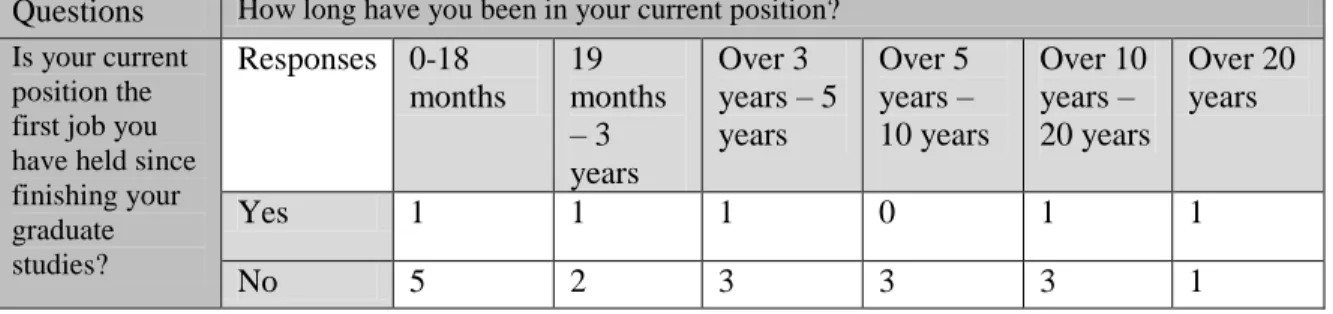
and part one of question five, followed by table 5, the results of the coding of the second part of question five, which seeks descriptions of past positions. All twenty two
respondents answered all parts of these two questions.
Table 4: Questions four, “How long have you been in your current position?” and five, “Is your current position the first job you have held since finishing your graduate studies?”
Questions How long have you been in your current position? Is your current
position the first job you have held since finishing your graduate studies?
Responses 0-18 months 19 months – 3 years Over 3 years – 5 years Over 5 years – 10 years Over 10 years – 20 years Over 20 years
Yes 1 1 1 0 1 1
No 5 2 3 3 3 1
Table 5: Question five, “Please describe your previous positions.”
Inductive codes Coded responses
Listed paraprofessional positions 14
Listed professional positions 7
Previous positions include museum library work 6
First job, no previous positions 5
No response 0
The data show a mobile group of professionals, over two thirds of whom have held previous positions. Half of the respondents are currently in their first museum library position, having come to the field from diverse other areas, including law, corporate, medical, academic and Judaica librarianship. Only two respondents who still hold their first professional positions have been in those positions for ten years or more.
Questions ten, eleven, twelve and eighteen sought more information about respondents’ current positions and their understandings of those positions, specifically
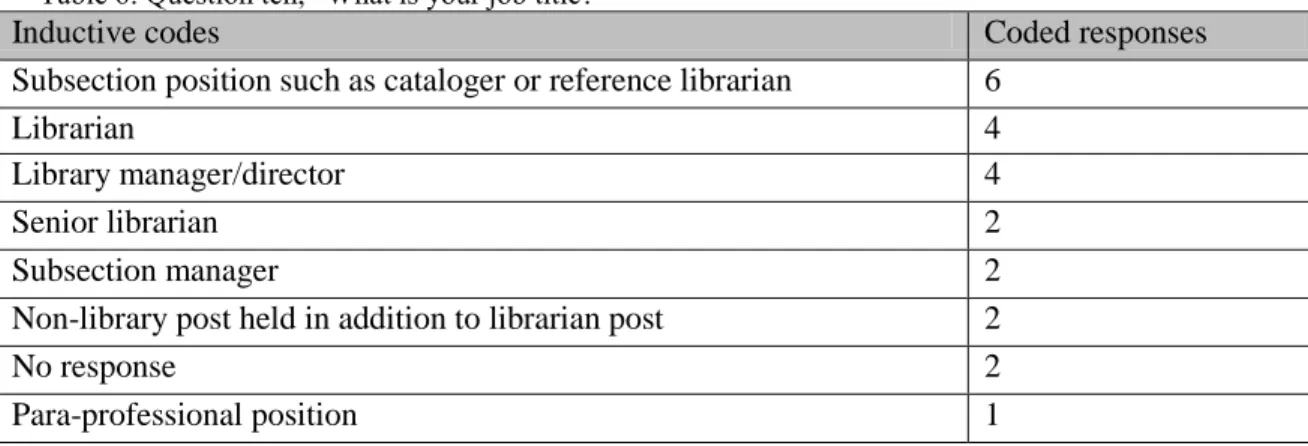
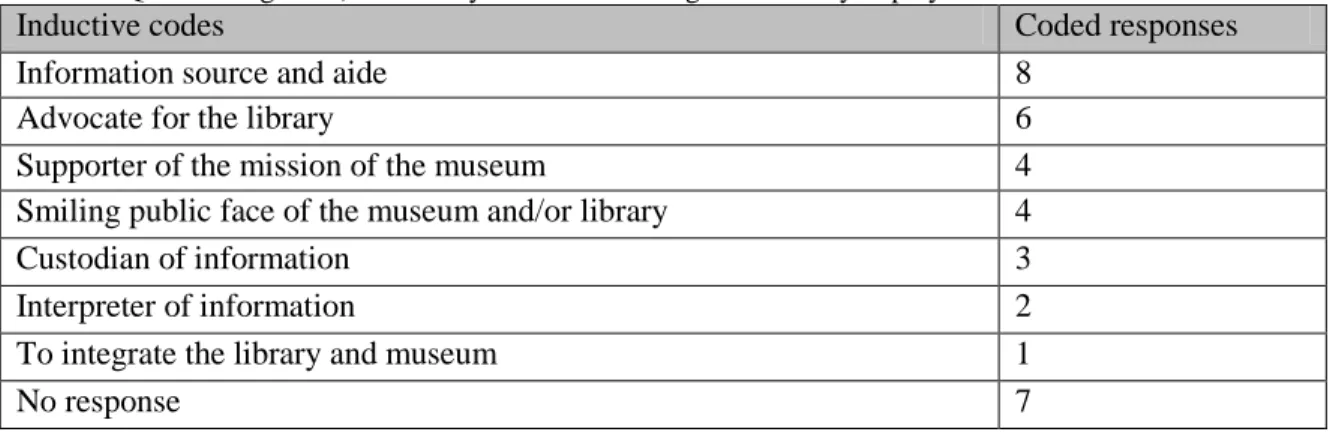
All of these questions gathered free-response data that were coded qualitatively; the results of that coding are below, in tables 6, 7, 8 and 9. The data show that respondents have a wide variety of job titles and a wider variety of responsibilities covered in their job descriptions. They feel, on the whole, that their job descriptions are mostly or completely accurate, and they regard their roles in their museums in a variety of ways ranging from the more literal, such as an aide in finding information, to the abstract, as in a supporter of the museum’s mission.
Table 6: Question ten, “What is your job title?”
Inductive codes Coded responses
Subsection position such as cataloger or reference librarian 6
Librarian 4
Library manager/director 4
Senior librarian 2
Subsection manager 2
Non-library post held in addition to librarian post 2
No response 2
Para-professional position 1
Table 7: Question eleven, “What is your job description?”
Inductive codes Coded responses
Reference/instruction 13
Technical support/online work 9
Collections development 7
Managing staff and volunteers 7
Policy/planning/grants and fundraising 7
All 6
Cataloging 6
Preservation 4
Administrating 3
Budgeting 3
Circulation 3
Inter-library loan 3
Organizing 3
Projects 1
No response 4
Table 8: Question twelve, “Does your job description match your actual job responsibilities?”
Inductive codes Coded responses
Yes 9
Yes, but… 6
Sometimes 3
No 1
No response 3
Table 9: Question eighteen, “What is your understanding of the role you play within the museum?”
Inductive codes Coded responses
Information source and aide 8
Advocate for the library 6
Supporter of the mission of the museum 4 Smiling public face of the museum and/or library 4
Custodian of information 3
Interpreter of information 2
To integrate the library and museum 1
No response 7
Job tasks and responsibilities, and the skills and knowledge they require
This topic is addressed by questions thirteen, fourteen, fifteen, sixteen and seventeen, which ask about job responsibilities, the tasks of a typical week, other activities respondents consider important, the hardest parts of those tasks, and the skills that respondents consider important to completing same. In addition, this topic is addressed by questions seven, eight and nine, which gathered descriptive information about the size of respondents’ museums that informs the interpretation of the more
skew towards large, with over half having annual operating budgets of over $5 million, and a third possessing more than one library. Interestingly, while those large museums are more likely to be AAM-accredited than smaller ones, they are still not all that likely to be, with only seven of the twelve large museums having accreditation.
Table 10: Questions seven, “Is the museum at which you work accredited by the American Association of Museums?” and eight, “In terms of annual budget, is the museum at which you work small, medium or large in size?”
Questions Is the museum at which you work accredited by the American Association of Museums?
In terms of annual budget, is the museum at which you work small, medium or large in size?
Responses Yes No
Small (Under $1 million)
1 4
Medium ($1 million to $5 million)
2 1
Large (Over $5 million)
7 5
Table 11: Questions seven, “Is the museum at which you work accredited by the American Association of Museums?” and nine, “Does the museum at which you work contain one library, or more than one library?”
Questions Is the museum at which you work accredited by the American Association of Museums?
Does the museum at which you work contain one library, or more than one library?
Responses Yes No
One library 9 4
More than one library
1 7
Table 12: Questions eight, “In terms of annual budget, is the museum at which you work small, medium or large in size?” and nine, “Does the museum at which you work contain one library, or more than one library?”
Questions In terms of annual budget, is the museum at which you work small, medium or large in size?
Does the museum at which you work contain one library, or more than one library?
Responses Small (Under $1 million)
Medium ($1 million to $5 million)
Large (Over $5 million)
One library 4 3 7
More than one library
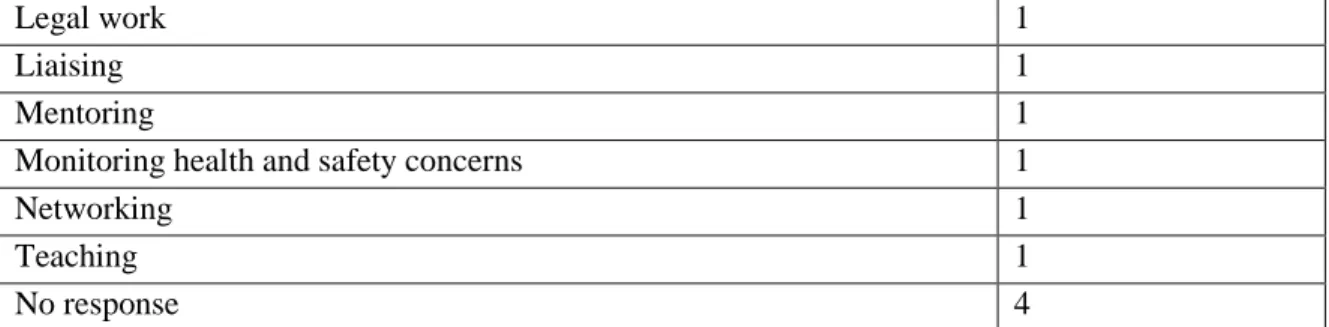
Questions thirteen, fourteen, fifteen, sixteen and seventeen all gathered free-response data that was coded qualitatively. The results of that coding are below, in tables 13, 14, 15, 16 and 17, and show a variety of trends. Questions thirteen and fourteen, which address job tasks and responsibilities, show a heavy emphasis on traditional library activities such as cataloging, reference, and collections development. This is echoed in the responses to question seventeen, which asked respondents to identify skills important to their work; one of the themes identified was competence in professional library skills. The other identified themes are communication and time management. These match up nicely with the responses to question sixteen, which inquired as to the hardest parts of respondents’ tasks and activities; here, the themes identified included internal relations,
customer relations and staff management, as well as time management, multi-tasking and balancing responsibilities.
Table 13: Question thirteen, “What responsibilities do you fulfill in your job?”
Inductive codes Coded responses
Reference/Instruction 11
Cataloging 9
Staff and volunteer management/supervision 8
Acquisitions/Collections development 7
Technical support/Online work 5
All 4
Planning 4
Writing 4
Collection management 3
Preservation 3
Circulation 2
Exhibits 2
General 2
Inter-library loan 2
Outreach 2
Work outside the library 2
Legal work 1
Liaising 1
Mentoring 1
Monitoring health and safety concerns 1
Networking 1
Teaching 1
No response 4
Table 14: Question fourteen, “What sort of tasks do you do at work in the course of a typical week?”
Inductive codes Coded responses
Cataloging 11
Reference/Instruction 10
Staff and volunteer management/supervision 7
Technical support/online work 6
Attending meetings 4
Collection management 4
Writing 4
Inter-library loan 3
Physically managing the collections 3
Planning 3
Budgeting 2
Circulation 2
Customer/user services 2
Donor relations 2
Information retrieval/research 2
Arranging events 1
Assessment 1
Internal relations 1
Keeping abreast of developments in the field 1
Liaising 1
Professional development 1
Promoting the library 1
Table 15: Question fifteen, “Are there other activities that you engage in for your job that you feel are important? What are they?”
Inductive codes Coded responses
External networking 5
Committee work 4
Internal networking 3
Internal marketing 2
External marketing 2
Professional development/learning 2
Projects 2
Teaching 2
Alumni involvement 1
No response/Irrelevant response that does not address the question asked 10
Table 16: Question sixteen, “What are the hardest parts of these tasks and activities?”
Inductive codes Coded responses
Time management 6
Internal relations 5
Finding a balance 3
Managing staff/volunteers 2
Multi-tasking 2
Customer support 1
Nothing, it’s not challenging 1
Technical support/Online work 1
No response 7
Table 17: Question seventeen, “What skills do you have that are important to being able to do your work?”
Inductive codes Coded responses
Communications skills, especially good listening and effective writing, and interpersonal skills
8
Library knowledge 5
Time management/Multi-tasking 5
Relation of results to research questions
As discussed above, the results gathered in this study are not conclusive; however, responses, though tentative, were generated for all five research questions. Research question 1 asked, “What are the post-graduate educational backgrounds of current museum librarians?” It was addressed by the questions in the first subsection of this section, Educational backgrounds; the study results indicate that the vast majority of museum librarians have an LIS degree, and over half hold a subject-area degree. None of the respondents reported holding neither degree. Research question 2 asked, “What are the views of current museum librarians about how their post-graduate educational backgrounds prepared them for practicing museum librarianship?” It was addressed by the second subsection, Views on how educational experiences prepared respondents for work. Findings indicated that those respondents who had considered or planned for a career in museum libraries while in graduate school were more likely than not to feel prepared for their first museum library position, while those respondents who did not have museum libraries in mind during their educations were less likely to feel prepared than unprepared. Overall, half of respondents felt prepared and half felt unprepared. The free-response data gathered on this topic suggested a slightly more nuanced view; in this context, over half of the respondents gave responses suggesting that they felt their educational experiences failed to prepare them for work in that they were not given an understanding of practical aspects of their future work. Research question 3 asked. “What career paths have museum librarians taken?” It was addressed by the questions in
library experience, but many of these came from special library positions of some sort. Roughly a quarter of respondents still hold their first professional positions, though these respondents were not necessarily recent entrants to the field; two of these five had been in their positions for over ten years. Research questions 4 and 5 ask, respectively, “What are the responsibilities that current museum librarians must fulfill, and what are the activities they engage in to do so?” and “What are the skills, knowledge and behaviors they require to complete these activities and fulfill their responsibilities?” They are addressed by the same set of questions, which are addressed in the subsection Job tasks and responsibilities, and the skills and knowledge they require. Responses to the questionnaire items designed to provide answers to these research questions provided a variety of answers, discussed in more detail above, in the Job tasks subsection, and below, in the Core Competencies section.
Core Competencies
The purpose of this paper is to create a tentative set of core competencies for museum librarianship. More broadly, the purpose of this study is to attempt to discover the ways, if any, that museum librarianship differs from other areas of librarianship, and to use those differences to shape the core competency list. It was expected that such differences exist, and hoped that they would be apparent in the study data; it was thought that they might revolve around the challenge of creating, as it says in the introduction, “a
community whose interests are centered on the objects in the museum collection and who face the unusual task of curating exhibits. However, such specialized concerns were not readily apparent in the questionnaire responses. Exhibits were mentioned infrequently, and museum collections barely at all, and never in the context of library work; rather, some respondents had responsibilities outside the library involving the collections. It was clear that respondents felt their libraries to be very important to the museums which house them, but why and how was not directly asked in the instrument nor mentioned in responses.
In light of this, while a set of core competencies was generated based on the study data gathered, it is only a supplementary set, not a full, comprehensive set of core
competencies as was as laid out and discussed in the exemplary monograph by Ball (2006), and by the conjectures discussed above which led to this study. (The set of core competencies in Ball, 2006 is that of the Art Libraries Society of North America
competencies such as cataloging and reference, rather than specific museum library concerns. Regardless, this lack in the data and the resulting highly tentative nature of the core competency list laid out here should serve, as the study itself was meant to, as a call to museum library professionals to create and distribute an official list of museum librarianship core competencies, in the mold of the ARLIS/NA list written by a committee of professionals on behalf of a professional organization.
As discussed in Ball (2006), such a list of core competencies has a multitude of potential uses. To paraphrase, they can be used to help plan or develop careers, to write job descriptions, to evaluate staff or job candidates, and to inform the design of
mentoring programs and LIS and continuing education curricula, among other things (Ball, 2006, p.8).
Table 18: Tentative, supplemental core competencies for museum librarianship
Core competency (via Ball, 2006) Supplemental museum librarianship competency Subject knowledge and expertise Specific knowledge of the subject area covered by the
museum
Reference and information access Special skill in listening and communications Instruction Emphasis on positive interactions
Collection management, development and organization
Emphasis on preservation concerns
Research and assessment Public service
Managerial and supervisory Emphasis on representing their institutions well
Special skill at managing time and balancing obligations Emphasis on effective budgeting and development, including grant-writing and donor relations
Conclusion
This study was meant to address the lack of professional literature and attention given to the issues and practices of museum librarianship. This was accomplished through the examination of the educational histories and career paths of current museum librarians, as well as their responsibilities, practices and knowledges, and the collection of their views on what parts of this matter and why. These data were then used to inform a tentative set of core competencies for museum librarianship.
The data gathered were, in some ways, weak, and failed to address the special practices of museum librarianship, as well as its whys and wherefores. However, they were not insufficient to gain a sense of the daily practices and priorities of current museum librarianship. The data painted a picture of a group of highly educated and mobile professionals who are relatively recent entrants to the museum library field. Respondents emphasized the importance of fundamental library skills such as cataloging, reference and collection development, and professional concerns such as fostering
communications skills, supervising volunteers and staff, building and maintaining relationships with administration and with other sections in the institution, and
representing the library well, both externally, to the public and internally, to the museum staff.
This study is important because museum librarians and other museum
information professionals are of increasing importance to museums (Marty, 2004), which are critical components of our culture’s infrastructure for preserving our cultural
above-discussed lack of examination of these professionals. The assessment of these librarians’
career paths, educational preparation, work tasks and responsibilities and the tentative set of core competencies based on that assessment should serve as both feedback and guide for Library and Information Science faculty, as well as professional associations and providers of continuing education to museum librarians.
This study will lay groundwork useful for evidence-based curricula and
educational practices, thereby strengthening them and providing better opportunities for students seeking museum careers. It should also serve as motivation for professional associations, such as the Museums, Arts and Humanities division of SLA, to form committees to more officially and thoroughly carry out this same work, with more time and expertise than a master’s paper allows, or for practicing professionals to do the same.
References
AAM. (2010a, September 28). List of accredited museums. Retrieved on 11/30/10 from http://www.aam-us.org/museumresources/accred/list.cfm
AAM. (2010b, November 10). What is a museum?. Retrieved on 11/30/10 from http://www.aam-us.org/aboutmuseums/whatis.cfm
ALA. (2009, January 27). ALA’s core competences of librarianship. Retrieved on 3/1/11
from
http://www.ala.org/ala/educationcareers/careers/corecomp/corecompetences/finalcoreco mpstat09.pdf
Aldridge, A., & Levine, K. (2001). Surveying the social world: Principles and practice in survey research. Buckingham, UK: Open University Press.
Babbie, E. (1990). Survey research methods (2nd ed.). Belmont, CA: Wadsworth.
Ball, H. (Ed). (2006). Core competencies & core curricula for the art library and visual resources professions. Kanata, Ont.: Art Libraries Society of North America.
Bearman, D. (1987). What are/is informatics?: And especially, what/who is Archives & Museum Informatics? Archives and Museum Informatics, 1(1), 8.
Bierbaum, E. G. (1988a). Teaching the cataloging of three-dimensional objects. Journal of Education for Library and Information Science, 29(1), 3-14.
Bierbaum, E. G. (1988b). Museum, arts, and humanities librarians: careers, professional development, and continuing education. Journal of Education for Library and
Information Science, 29(2), 127-134.
Bierbaum, E. G. (1996). Museum libraries: the more things change... . Special Libraries, 87(2), 74-88.
Bierbaum, E. G. (2000). Museum librarianship (2nd ed.). Jefferson, NC: McFarland.
British Museum. (n.d.). General history. Retrieved on 11/30/10 from http://www.britishmuseum.org/the_museum/history_and_the_ building/general_history.aspx
Craddick, R. R. (1997). Untitled review: Museum librarianship by Esther Green Bierbaum. Libraries & Culture, 32, 275-277.
Creswell, J W. (2003). Research design : Qualitative, quantitative, and mixed method approaches. Thousand Oaks, Calif.: Sage Publications.
Damasco, I. T., & McGurr, M. J. (2008). A survey of cataloger perspectives on practicum experiences. Cataloging & Classification Quarterly, 45(4), 43-64.
Fowler, Jr., F. J. (2002). Survey research methods (3rd ed,). Thousand Oaks, CA: Sage.
Gibbs, G. R. (2007). Analyzing qualitative data. Thousand Oaks, CA: Sage.
Hull, D., & Fearnley, H. D. (1976). The museum library in the United States: A sample. Special Libraries 67(7), 289-298.
Kent State University - School of Library and Information Science. (n.d.). SLIS and University Circle Libraries form educational partnership with $553,000 IMLS grant. Retrieved on 11/22/10 from http://www.slis.kent.edu/content/view/360/1/
Koot, G.-J. (2001.) Museum librarians as information strategists. INSPEL, 35(4), 248- 258.
Laskowski, M. S. (2010). A media librarian’s education: an assessment of the availability
and need for specific training in media librarianship issues and practices. Library Trends, 58(3), 391-401.
Marty, P.F. (2005). So you want to work in a museum? Guiding the careers of future information professionals in museums. Journal of Education for Library and Information Science, 46(2), 115-133.
Marty, P.F. (2006a). Finding the skills for tomorrow: Information literacy and museum information professionals. Museum Management and Curatorship, 21(4), 317-335.
Marty, P.F. (2007a). Museum professionals and the relevance of LIS expertise. Library & Information Science Research, 29(2), 252-276.
Marty, P.F. (2007b). The changing nature of information work in museums. Journal of the American Society for Information Science and Technology, 58(1), 97-107.
Marty, P.F. (2010). Museum informatics. In Bates, M.J. & Maack, M.N. (Eds.)
Encyclopedia of Library and Information Science (pp. 3717-3725). 3rd Edition. New York: Taylor & Francis, Inc.
Marty, P.F., & Twidale, M.B. (2011). Museum informatics across the curriculum: Ten years of preparing LIS students for careers transcending libraries, archives, and museums. Journal of Education for Library and Information Science, 52(1), 9-22.
Metropolitan Museum of Art. (2009, June). Thomas J. Watson Library >> collection development policy. Retrieved on 11/22/10 from http://libmma.org/portal/collection- development-policy/
Metropolitan Museum of Art. (2010). About the Met. Retrieved on 11/30/10 from http://www.metmuseum.org/about/
Powell, R. R., Young, A.P., & Flanagan, C. (1974). Library school directors and the Master’s curriculum: an attitude survey. Journal of Education for Librarianship, 14(3), 157-163.
Qualtrics. (2010b). Security statement. Retrieved on 12/2/10 from http://www.qualtrics.com/security-statement/
Ray, J. (2009). Sharks, digital curation, and the education of information professionals. Museum Management and Curatorship, 24, 357-368.
Rea, P. M. (1923). One hundred and fifty years of museum history. Science, 57(1485), 677-681.
Roth, H. L., et al. (1966). Education for special librarianship. Journal of Education for Librarianship, 7(1), 3-20.
SAM Libraries. (n.d.). Colldev. Retrieved on 11/22/10 from http://www.seattleartmuseum.org/Learn/Library/pdf/colldev.pdf
SLA. (2003, June). Competencies for info pros. Retrieved on 3/1/11 from http://www.sla.org/content/learn/members/competencies/index.cfm
Trant, J. (2009). Emerging convergence? Thoughts on museums, archives, libraries and professional training. Museum Management and Curatorship, 24, 369-387.
van der Wateren, J. (1999). The importance of museum libraries. INSPEL, 33(4), 190- 198.
Appendix A: Research Instrument
Instrument: Self-administered online survey, to be hosted by Qualtrics
[Survey begins with disclosure and consent form]
Question 1: What relevant graduate degree(s) have you earned, or are you studying for now? [None/Library Science degree only/Subject area degree only/Library or
Information Science degree and subject area degree]
Question 2: In what year(s) did you finish or do you expect to finish your graduate studies?
Question 3: While you were in graduate school, did you hope and/or plan to work in museum libraries? [Yes/No]
Question 4: How long have you been in your current position? [0-18 months/19 months - 3 years/Over 3 years - 5 years/Over 5 years - 10 years/Over 10 years - 20 years/Over 20 years]
Question 5: Is your current position the first job you have held since finishing your graduate studies? [Yes/No]
If no, please describe your previous position(s).
Question 6: Did your graduate educational experiences adequately prepare you for your first museum library job after graduation? [Yes/No]
Question 7: Is the museum at which you work accredited by the American Association of Museums? [Yes/No]
Question 8: In terms of annual budget, is the museum at which you work small, medium or large in size? [Small (under $1 million)/Medium ($1 million to $5 million)/Large (over $5 million)]
Question 9: Does the museum at which you work contain one library, or more than one? [One library/More than one library]
Question 10: What is your job title?
Question 11: What is your job description?
Question 12: Does your job description match your actual job responsibilities?
Question 13: What responsibilities do you fulfill in your job?
Question 14: What sort of tasks do you do at work in the course of the typical week?
Question 15: Are there other activities that you engage in for your job that you feel are important? What are they?
Question 16: What are the hardest parts of these tasks and activities?
Question 17: What skills do you have that are important to being able to do your work?
Question 18: What is your understanding of the role you play within the museum?