ABSTRACT
Meiotic recombination is the process by which homologous chromosomes exchange genetic material during gamete production by “crossing over.” This shuffling of parental
chromosomes is not only thought to be important for increasing genetic diversity in a population, but also a necessary step in segregating chromosomes appropriately during meiosis. Plant
breeders may find it desirable to preserve advantageous gene combinations in their crops through generations and, in this context, manipulation of recombination can have a significant impact in breeding methods. Most eukaryotes, including humans and plants, require at least one crossover (CO) per chromosome to avoid non-disjunction and resulting genetic disorders associated with chromosome mis-segregation. Nonetheless, evidence of crossover-independent meioses have been observed in many organisms including insects such as Drosophila males, mammals, and plants.
In all sexually reproducing species studied thus far, including plants, the topoisomerase-like protein SPO11-1 initiates meiotic recombination by catalyzing DNA double-strand breaks (DSBs) to initiate crossing over. Thus in the absence of SPO11-1 recombination does not occur, resulting in a sterile phenotype. My project seeks to find a SPO11-1 mutant that maintains fertility in the absence of recombination through a chemical mutagenesis screen.
INTRODUCTION
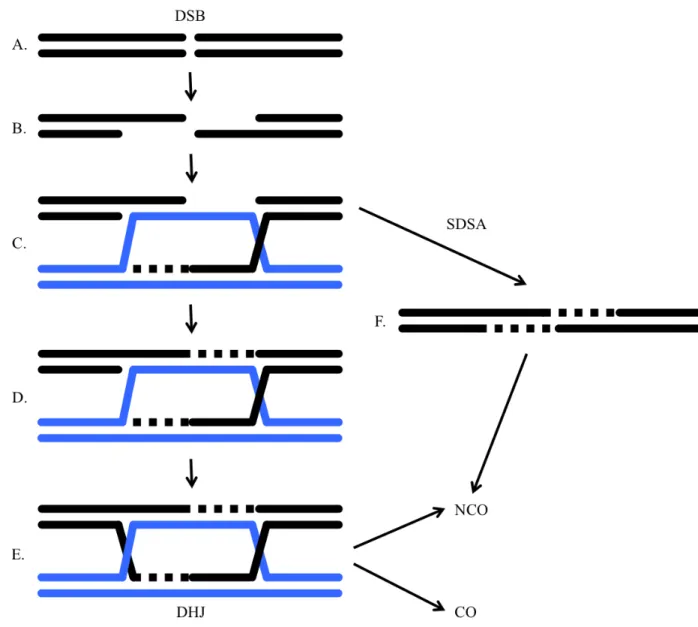
Figure 1. Current model for meiotic recombination. A. Initial DSB formation. B. Resection of 5'
ends. C. D-loop formation and DNA synthesis of the invading strand. D. Other strand in
chromatid using the D-loop as a template for DNA synthesis. E. DHJ intermediate that primarily leads to COs according to findings in S. cerevisiae. F. NCO formation by the SDSA pathway.
research in genetics and molecular biology; there are only five chromosomes in Arabidopsis, all of which have been sequenced and annotated, and it has a relatively short life cycle, taking only seven weeks to reach seed maturation after germination. Arabidopsis is particularly useful for studying recombination because it produces lots of gametes (pollen) (The Arabidopsis
Information Resource, 2008; Multinational Arabidopsis Steering Committee, 2013).
In some instances, it may be advantageous to bypass meiotic recombination in order to maintain favorable haplotypes through generations. In most plant species, at least one CO event is required per chromosome for proper segregation. Many species however have been observed to correctly segregate chromosomes during meiosis without recombination—a phenomenon known as achiasmatic segregation (Ito, Takegami, & Noda, 1983). Achiasmatic segregation has been observed in Bombyx mori (silkworm), in Drosophila males, and in the plant species Allium amplectans (Rasmussen, 1977; Wolf, 1994; Stack, 1973). The goal of this project is to conduct a forward genetic screen for Arabidopsis achiasmatic mutants that are able to undergo meiosis in the absence of COs.
In all sexually reproducing eukaryotes studied thus far, SPO11-1 mediates DSB
formation to initiate meiotic recombination. Arabidopsis has three SPO11 homologs: SPO11-1, SPO11-2, and SPO11-3. SPO11-1 and SPO11-2 act non-redundantly, thus loss of either leads to a sterile phenotype, while SPO11-3 is dispensable for meiosis and plays a role in
RESULTS
In the experimental system we have designed there are four ways a spo11-1-/- plant can be fertile: 1) reversion of the spo11-1-4 mutation to the original wild-type allele, 2) DSB formation in the absence of SPO11-1, 3) activation of a recombination bypass pathway, and 4) a
recombination event that separates the SPO11-1 allele from the marker we used to track it (Figure 2A). Because spo11-1-4 is an insertion (T-DNA) allele a reversion of the mutation is unlikely. While it is not the aim of our study, finding a mutation that can catalyze meiotic DSBs in the absence of SPO11-1 activity would provide valuable mechanistic insight into the initiation of recombination. Because achiasmatic segregation has been observed in multiple taxa, it is possible that a cryptic recombination bypass pathway might be activated in Arabidopsis via mutagenesis. Recombination events that separate the SPO11-1 allele from linked marker used to track it are anticipated but are not useful. The marker and the SPO11-1 locus are separated by 83.3 kb (~0.5 cM) so recombinants will occur at a low but predictable frequency.
Seeds from spo11-1+/- plants were mutagenized with ethyl methanesulfonate (EMS) and grown to produce M1 lines. EMS (CH3SO3C2H5) alkylates guanine bases that subsequently
mismatch with thymine, causing G/C to A/T transitions (Maple & Møller, 2007). Mutagenesis was carried out by graduate student Daniela Muñoz. Fertile, spo11-1+/- plants were identified by visual screening and polymerase chain reaction (PCR) genotyping and allowed to set self-fertilized seeds (M2). For each M1 line, ~50 M2 progeny were planted and screened for fertile
spo11-1-/- plants. M2 plants could be fertile because they carry a wild-type SPO11-1 allele
DsRed2 expression was driven by a LAT52 promoter, which has a pollen-specific expression pattern. Using this system, fertile M2 plants expressing DsRed2 in their pollen were discarded,
and those without DsRed2 expression were kept as candidates. We collected 406 M1 lines and
have completed screening the M2 progeny of 281. After screening 14,272 M2 plants, we
identified 200 candidates.
To distinguish true fertile spo11-1-/- plants from candidates that resulted from a recombination event between the SPO11-1 locus and the DsRed2 marker we used PCR and allele-specific primers to determine their SPO11-1 genotype. All 200 candidates were
recombinants. The screen is being continued and may yield plants with the desired achiasmatic phenotype, or other interesting meiotic defects. While I did not identify the desired mutant, my phenotyping and genotyping efforts have helped optimize the screen.
MATERIALS AND METHODS
Plant Material
All experiments were performed using the Arabidopsis thaliana Columbia (Col-0) ecotype. The spo11-1-4 allele was obtained from the Arabidopsis Biological Resource Center at Ohio State University and was previously described by Sanchez-Moran et al. (2007). FTL 1371, which has the LAT52::DsRed2 marker transgene insertion near the SPO11-1 locus, was
previously described by Francis, Lam, Harrison, Bey, Berchowitz, and Copenhaver (2007). Seeds were planted in 24-well flats held by a support tray. One of the corner wells was removed for watering so only 23 wells were used for planting.
Pesticide-treated commercial soil was used for planting to prevent fungus-gnat
with water to moisten the planting surface. Sewn seeds were stratified in a 4 °C cold room for 5-7 days and transferred to a long-day (18 hr/day light) growth room maintained at 20 °C.
Genetic Crosses
Plants homozygous for the dsRED marker (R) were crossed with spo11-1-4+/- plants and spo11-1-4+/-;R/+ progeny were identified by PCR using primers specific for the T-DNA insertion in spo11-1-4 (Figure 2B).
Mutagenesis and subsequent crosses
Seeds from spo11-1-4+/-;R/+ plants were mutagenized using 0.25% ethyl
methanesulfonate (EMS) and grown to produce M1 plants. Sterile plants that make up roughly
25% of the self-segregating population were discarded. Roughly 25% of the population would be homozygous for the DsRed2 marker and thus homozygous for wild-type SPO11-1. These plants were also discarded. The remaining spo11-1-4+/-;R/+ plants were allowed to set self-fertilized M2
Figure 2. Crosses conducted using fluorescently-tagged and mutant SPO11-1. A. Chromosome representation of SPO11-1 locus and DsRed2 (FTL 1371) transgene on chromosome 3. B. Crosses conducted in this mutagenesis screen. Red “X” marks represent discarded plants while green boxes indicate our mutant of interest.
Visual Assay
boric acid, 0.1% v/v Triton X-100) on a glass microscope slide to release the pollen from the anthers. Pollen from SPO11-1+/+ or SPO11-1+/- plants will fluoresce. If none of the pollen
fluoresces for a fertile plant, the plant does not contain a wild-type SPO11-1 allele and is marked as a candidate for achiasmatic segregation (Figure 3).
Figure 3. From left to right, DsRed2 fluorescence of pollen tetrads indicating homozygosity (SPO11-1+/+), heterozygosity (SPO11-1+/-), and absence of wild-type SPO11-1 (SPO11-1-/-) (Berchowitz & Copenhaver, 2008).
PCR
Candidates are genotyped by PCR using wild type (SALK172-F TTTCAGTGTAGTCGGTACAACTTGAATGTG-3'] and SALK172-R
DISCUSSION
The spo11-1-/- screen for achiasmatic mutants has yet to yield a validated candidate. We are continuing with the screening of M2 plants and generating new sets of mutagenized M1 plants.
If a true candidate is to be found, bulk segregant mapping will be utilized to locate the mutant allele conferring fertility in the absence of COs according to the procedure outlined by Lukowitz (2000). Valid candidates found from the screen will be crossed to the Landsberg ecotype,
resulting in progeny heterozygous at the SPO11-1 and mutant locus (F1 generation). F1 plants
will be allowed to set self-fertilized seed. Fertile F2 plants will be genotyped at the SPO11-1 locus using PCR and allele-specific primers. Fertile spo11-1-4-/- plants which are presumably also mutant-/- for the locus conferring achiasmatic segregation will be used in bulk segregant mapping.
In the case the mutant locus lies on the same chromosome arm as the SPO11-1 locus mapping may be obscured and the mutant will be transferred to a spo11-2-/- background.
Mapping the mutant locus will potentially reveal clues about the function of the underlying locus and inform follow-on characterization and experimentation.
ACKNOWLEDGEMENTS
Special thanks to Daniela Muñoz, my graduate student mentor, and Dr. Gregory Copenhaver, my research advisor. Additional thanks to Ashley Albright, Sarah Lowder, Jennifer Modliszewski, Shayna Purcell, Kenan Courtney, Allan Rene de Cotret, and Jamie Winshell.
1. Allers, T., & M., Lichten (2001). Differential timing and control of noncrossover and crossover recombination during meiosis. Cell, 106(1), 47-57.
http://dx.doi.org/10.1016/S0092-8674(01)00416-0
2. Austin-Phillips, S., Krysan, P.J. (2008, December 2). PCR primers. WiscDsLox T-DNA Lines. Retrieved from
https://mywebspace.wisc.edu/groups/Krysan/Web/2010/IPCR_Primers.htm
3. Berchowitz, L.E., Copenhaver, G.P. (2008). Fluorescent Arabidopsis tetrads: A visual assay for quickly developing large crossover and crossover interference datasets. Nature Protocols, 3(1), 41-50. http://dx.doi.org/10.1038/nprot.2007.491
4. Francis, K.E., Lam, S.Y., Harrison, B.D., Bey, A.L., Berchowitz, L.E., & Copenhaver, G.P. (2007). Pollen Tetrad-based Visual Assay for Meiotic Recombination in
Arabidopsis. Proc. Natl. Acad. Sci., 104(10), 3913-3918. http://dx.doi.org/10.1073/pnas.0608936104
5. Ito, M., Takegami, M.H., Noda, S. (1983). Achiasmate meiosis in the Fritillaria japonica group. II. Formation of synaptonemal complexes in microsporocytes. Japanese Journal of Genetics, 58(4), 377-381.
6. Lukowitz, W., C.S. Gillmor, and W.R. Scheible (2000). Positional cloning in Arabidopsis. Why it feels good to have a genome initiative working for you. Plant Physiol, 123(3), 795-805. http://dx.doi.org/10.1104/pp.123.3.795
7. Maple, J., & Møller, S.G. (2007). Mutagenesis in Arabidopsis. Circadian Rhythms: Methods and Protocols, 362, 197-206. http://dx.doi.org/10.1007/978-1-59745-257-1 8. Multinational Arabidopsis Steering Committee (2013, June 24). Arabidopsis: The Model
Plant. Retrieved from http://www.nsf.gov/pubs/2002/bio0202/model.htm
9. Rasmussen, S.W. (1977). The transformation of the synaptonemal complex into the “elimination chromatin” in Bombyx mori oocytes. Chromosoma, 60(3), 205-21. http://dx.doi.org/10.1007/BF00329771
10.Sanchez-Moran, E., Santos, J., Jones, G.H., & Franklin, F.C.H. (2007). ASY1 mediates AtDMC1-dependent interhomolog recombination during meiosis in Arabidopsis. Genes & Development, 21(17), 2220-2233. http://dx.doi.org/10.1101/gad.439007
11.Schwarzacher, T. (2003). Meiosis, recombination and chromosomes: a review of gene isolation and fluorescent in situ hybridization data in plants. J. Exp. Bot., 54(380), 11–23. http://dx.doi.org/10.1093/jxb/erg042.
12.Stacey, N.J., Kuromori, T., Azumi, Y., Roberts, G., Breuer, C., Wada, T., Maxwell, A., Roberts, K., Sugimoto-Shirasu, K. (2006). Arabidopsis SPO11-2 functions with SPO11-1 in meiotic recombination. Plant J, 48(2), 206–216. http://dx.doi.org/10.1111/j.1365-313X.2006.02867.x
13.Stack, S. (1973). The synaptonemal complex and the achiasmatic condition. J Cell Sci, 13, 83-95.