Disability Rights as Social Movement in Argentina
Zoe Zakin
A Senior Honors ThesisThe University of North Carolina at Chapel Hill
Submitted in partial fulfillment for Honors in Global Studies April 2016
Approved by:
_____________________________________ Advisor: Dr. Neel Ahuja
Table of Contents
Acknowledgements...3
Chapter 1
Introduction...4
Why ask this question?...6
Methodology...8
What is disability?...12
What are disability rights?...13
Chapter 2
Literature Review...17
Social Movement Theory: Resource Mobilization, Collective Identity, and Framing...17
Disability Rights Movement: Institutions, Accessibility, and Civil Rights...23
Social Movements in Latin America and Argentina: Horizontalism, Anti-Neoliberalism, and Progressivism...29
Chapter 3
Disability in Argentina: History and Background...38
Disability in Argentina...39
Disability Rights Legislation in Argentina...43
Disability Rights Organizations in Argentina...46
Overview...46
Interview Background...49
The Power of CSOs...50
History of Major CSOs...52
Chapter 4
Analysis...60
What would a movement seek to accomplish?...61
Is there a movement?...63
Why has no movement formed?...67
What can theory offer us?...72
Why a movement at all?...74
Concluding Remarks...78
Appendix...80
Acknowledgements
I would first like to thank my thesis advisor Dr. Neel Ahuja of the English & Comparative Literature Department for his guidance, support, and insights throughout the thesis process. I would also like to thank Dr. Michal Osterweil of the Global Studies Department for being my second reader and also a mentor for this process. Both Dr. Ahuja and Dr. Osterweil were tremendously patient as I worked through this topic and I am extremely grateful to them for challenging me to think in new ways while allowing me to explore on my own.
I would like to also acknowledge several individuals who were invaluable in helping me form connections that made this thesis possible. First, Dr. Cassandra Hartblay, currently a
postdoctoral fellow at the University of California San Diego, who not only helped me find key people to speak with studying Disability at UNC but also assisted in my grant writing process, offered feedback on my proposals, and nominated me for undergraduate conferences. The support has been tremendous and invaluable, thank you. Second, Dr. Sue Coppola of the UNC School of Medicine for her help in connecting me to occupational therapists in Argentina to interview. And finally, Yael Rubel, my friend and advisor from my first visit to Argentina who worked so hard to help me find valuable interviewees when I returned the second time around.
I must also acknowledge and thank my interviewees for being so cooperative and engaged in this process. Thank you to my dear friend Stephanie Zayed Atallah for her assistance in transcribing and translating multiple of my interviews. Thanks to my family and friends for their support throughout this entire experience.
Chapter 1
Introduction
Mothers wearing white handkerchief veils marching in front of the president’s house.
Thousands of protesters congregating, blocking major highways and streets. Workers occupying
factories and hotels after their owners sell them, refusing to leave. These are the images of
political protest for which Argentina is world-renowned. Since the 1970s, as a nation Argentina
has been associated with dynamic and provocative mobilizations of its citizens against injustice.
In the 70s and 80s, it was the mothers and grandmothers of those “disappeared” (imprisoned,
tortured, or killed) by the Argentine military dictatorship who began circling the Plaza de Mayo,
which faces la Casa Rosada, the Argentine president’s abode. Las Madres de la Plaza de Mayo,
as they came to be called, became an international symbol for human rights. At the turn of the
century, it was the thousands of workers left jobless and deprived after the economy crashed in
2001. They took to the streets banging pots and pans in protests called cacerolazos and became
known as los piqueteros, militants of the Unemployed Workers Movement. Their actions
brought about massive economic and political changes in the country and served as catalysts for
similar changes in surrounding countries.
In August of 2014 I moved to Argentina for four months, excited to learn about these
incredible traditions of social movements, just described, in the places they occurred and from
the people who carried them out. Studying abroad on a program that focused on “regional
integration, development, and social change,” I encountered these themes constantly. When it
came time to investigate my own theme in an independent study, I chose disability. For years,
thousands of wheelchair users and other individuals with mobility disabilities abandoning their
supports and crawling up the U.S. Capitol steps—because there were no ramps; the largest sit-in
occupation of a government building in American history, forcing the ratification of the 1968
Rehabilitation Act. Now I had the chance to understand this phenomenon in another country, a
country with an intense history of social movements. What was the disability experience like in
Argentina? What I found was puzzling.
Despite high potential for a movement surrounding disability rights, similar to those
described above, one has not cohesively formed. Argentina clearly has the history and potential
for massive social movements. Its citizens are politically active and confident in openly defying
their government. The government has recognized disability rights as an issue, community
organizations addressing them are plentiful and active, and the number of people with disabilities
is growing in number. Yet, disability rights activists and organizers I spoke with told me that
either there was no disability rights movement, or that it was in its infancy with little power.
In this paper I will investigate disability rights in Argentina—their history, current status,
and future goals. My primary research question is given that Argentina has great potential for a
strong social movement to achieve disability rights, why has one not yet developed? In order to
continue with the proposition that there is no “strong social movement,” first we must ask: what
is a social movement in this context? And what is the status of disability rights and activism in
Argentina today, if they do not form one? A subsequent sub-question asks what are the barriers
to a full-fledged social movement forming? Finally, I’ll question whether a social movement, in
the ways its been described by Western social movement theory, would even be the most
effective model to achieve the desired disability rights in Argentina. To answer this, we must
their actions? I will continue this introduction by sharing how I came to my questions and my
methodology for answering them.
---Why ask this question?
As quite often occurs in the social sciences, the research question I address in this paper
is not what I originally set out intending to answer. Instead, I came to it via a round-a-bout route,
with a few changes along the way. As previously shared, I began this study while studying
abroad in Buenos Aires, Argentina during the fall of 2014. Throughout November, I conducted
independent research on access to employment for people with disabilities in Argentina.
Through interviews with an activist, NGO leader, and a few government officials, I tried to
understand barriers to employment for people with disabilities (PWDs)1. I found their roots in
both institutional and cultural spheres. I utilize these interviews some in this paper as they prove
relevant, and since I conducted follow-up interviews with two of the informants.
While conducting this original research, I came across an organization named REDI.
REDI stands for la Red por los Derechos de Personas con Discapacidad, or the National Network
for the Rights of Persons with Disabilities. Through background research, I discovered that they
attributed the commonly found link between disability and poverty to the capitalist system. In
fact, when los piqueteros were protesting in the early 2000s against neoliberal, capitalist policies
and their economic repercussions, representatives of REDI were right alongside them. REDI
fascinated me because it represented a radicalism that I associated more with my preconceived
notions of Latin American social movements than anything else I had seen in the Argentine
1 In this paper I choose to use the language “people with disabilities” in keeping with People
disability rights world. This combination of disability rights with the unemployed workers
movement struck me as unique and worth investigating, so when it was time to go back to
Argentina to conduct further research, it was through this lens that I was looking.
I returned to Buenos Aires in October of 2015 for eight days to conduct further
interviews. Through these interviews I wanted to understand why, in Argentina, had disability
rights activists so explicitly linked anticapitalism and disability rights when this had not occurred
strongly in the disability rights movements of other countries. This was made even more
fascinating to me when I realized that in disabilities studies literature, the current condition of
people with disabilities—their status as extremely marginalized citizens, almost a class unto their
own—is directly linked to industrialization and capitalism (Hahn 1997, Joly 2008, Oliver 1990).
I sought out interviews with anyone I could find who was doing work with disability rights in
Buenos Aires that was free during those eight days, including individuals from REDI. I could
not, however, get in contact with the two individuals from REDI who, in my background
research, had so prominently discussed this link and REDI’s position within the unemployed
workers movement. Because of this, and a few other realizations that I will discuss later, I came
to the conclusion that it may not be practically possible to answer my original question about
how this organization came to its radical approach.
In this second round of interviews, I noticed another interesting trend. When I asked the
informants how they perceived the Argentine disability rights movement, the majority responded
that it was just really beginning, not strong yet, and or that they do not believe there is a
movement at all. The answers to explain these responses varied but there were some interesting
commonalities, and I realized that this was another fascinating question. Why, given the number
movements, had one not formed for disability rights? This is the question I ultimately sought to
answer in this thesis.
Methodology
I approach this question by attempting to tell the little-known story of disability rights in
Argentina. In order to tell this story, I sought to comprehensively understand the condition of
being disabled in Argentina, the rise of organizations providing services for PWDs, and the
advocacy groups working with the government to create disability rights laws. The primary way
I do this is via in-person open-ended interviews with activists, organizers, and volunteers. I
conducted the interviews in Spanish and in only one interview did I have the help of a translator
—though informally. I then transcribed and translated relevant pieces of the interviews upon
returning to the United States with the help of a native speaker2. A full list of my informants
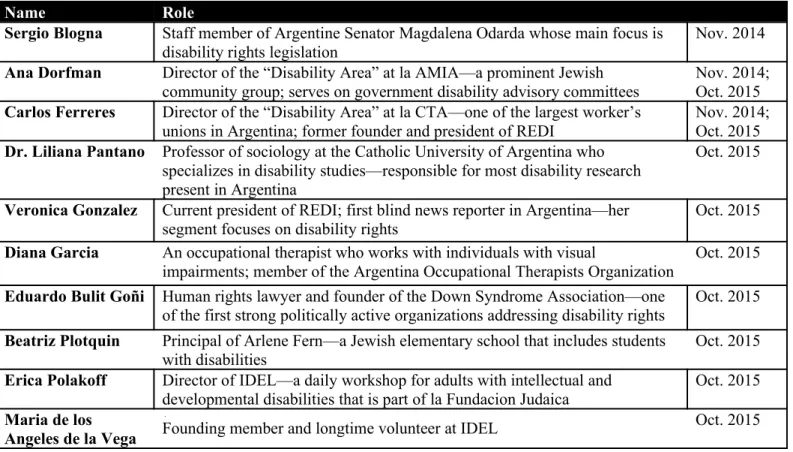
with descriptions of their relation to disability rights can be found in Table 1.1. It was critical to
use interviews for this study because there is very little written information on disability in
Argentina, and especially on disability rights. The few sources that do exist are almost all related
to my informants in some way—either they knew the author or contributed to the work
themselves. In my opinion, this signifies how small the community of people working for
disability rights is. In addition, they are all centralized in the same place—Buenos Aires.
I discovered my informants through a variety of means. The most useful connection I
made was with an Argentine disability rights scholar. She herself has cerebral palsy and is
currently pursuing her PhD on disability employment in Argentina (she told me she was inspired
by her own difficulties finding employment). After being introduced during my study abroad
period, she became an incredible asset as she connected me with the majority of my informants.
In addition, I reached out via email to a few organizations and obtained some interviews that
way. With the exception of the two REDI individuals mentioned earlier, people were responsive
and open to meeting with me. I was constantly impressed by how friendly and helpful everyone
I met with was—it was clear they all were happy to talk about this subject and excited that
someone, especially a foreigner, was interested in it.
Table 1.1: List of Interviewees
Name Role
Sergio Blogna Staff member of Argentine Senator Magdalena Odarda whose main focus is disability rights legislation
Nov. 2014
Ana Dorfman Director of the “Disability Area” at la AMIA—a prominent Jewish community group; serves on government disability advisory committees
Nov. 2014; Oct. 2015
Carlos Ferreres Director of the “Disability Area” at la CTA—one of the largest worker’s unions in Argentina; former founder and president of REDI
Nov. 2014; Oct. 2015
Dr. Liliana Pantano Professor of sociology at the Catholic University of Argentina who specializes in disability studies—responsible for most disability research present in Argentina
Oct. 2015
Veronica Gonzalez Current president of REDI; first blind news reporter in Argentina—her segment focuses on disability rights
Oct. 2015
Diana Garcia An occupational therapist who works with individuals with visual
impairments; member of the Argentina Occupational Therapists Organization
Oct. 2015
Eduardo Bulit Goñi Human rights lawyer and founder of the Down Syndrome Association—one of the first strong politically active organizations addressing disability rights
Oct. 2015
Beatriz Plotquin Principal of Arlene Fern—a Jewish elementary school that includes students with disabilities
Oct. 2015
Erica Polakoff Director of IDEL—a daily workshop for adults with intellectual and developmental disabilities that is part of la Fundacion Judaica
Oct. 2015
Maria de los Angeles de la Vega
.
Founding member and longtime volunteer at IDEL Oct. 2015
As evidenced by the table above, I met with a diverse range of individuals who while all
are working toward improving the conditions of life for people with disabilities, come at this
goal from many angles. I met with each individual (with the exception of the government and
IDEL interviews, which were each joint) for between thirty minutes and an hour to have a
where it would. My goals in these interviews were to understand who this individual was and
how they related to disability rights in Argentina, if they were a part of an organization—what
their organization did, and their thoughts on Argentine disability rights in general.
This last part is key to answering my question, and I came at it from a variety of angles.
Questions to address it that I tried to ask in every interview (conducted in 2015, not 2014)
include: How do you perceive the disability rights movement in Argentina? (Do you think there
is a movement at all?) In your opinion, what is the biggest barrier facing disability rights (or
your organization)? What do you think is the most important next step in Argentina in the fight
for rights? Because of these questions, I feel I obtained ample material to analyze the status of a
rights movement and what its goals would be, based on the thoughts of people actually working
towards it.
Interviewees most definitely had differing perceptions or opinions about aspects of
Argentine disability rights—including but not limited to the role and impact of social
organizations and the effectiveness of legislation and the government. There were, however,
also common threads throughout all of my conversations. In this paper, I use the words of my
interviewees to tell the story of disability rights in Argentina—I show consenting and dissenting
opinions and try to portray the “truth” as objectively as possible, while recognizing that my
sources, as well as myself, are subjective beings. Using content and historical analysis, I piece
together the narrative of disability in Argentina through these interviews in order to understand
its disability rights movement, or lack thereof. The rest of this Introduction will address the
condition of disability rights in general and give context to how disability as a phenomenon will
According to the World Health Organization, people with disabilities (PWDs) make up
approximately 15% of the global population. They are the world’s largest minority, present in
every culture and every society. Despite this pervasiveness, people with disabilities are still
denied basic human rights around the world (WHO 2011). While some nations in the Global
North, or minority world, have begun to make advancements in disability rights, PWDs in most
parts of the Global South, or majority world, still face countless challenges. Early disability
rights movements in the minority world have focused on physical accessibility and solutions to
the segregation of PWDs from the rest of society. These movements have evolved, increasingly
basing their strategies on inclusion and integration into the various aspects of daily life for
PWDs. Disability rights are now viewed as human rights in the global sphere. Accessibility to
education, transportation, and health systems has been expanded upon in many countries.
However despite these advancements, PWDs still remain extremely segregated and marginalized
from the work force around the world.
In most cultures, people with disabilities are characterized as being “unable to work”. By
being barred from participating in the economic system, PWDs are denied the ability to provide
for themselves (WHO 2011). This fosters a strong link between disability and poverty, where it
is more likely for someone who has a disability to enter into poverty, and someone who is
impoverished to gain a disability (WHO 2011). This link has been attributed to the form of
oppression known as ableism, which is the systemic discrimination and exclusion of PWDs
(Young 2013). While ableism manifests itself across many aspects of life for PWDs,
marginalization of PWDs from employment is arguably one of the most detrimental forms this
oppression takes on. In order to fully understand the marginalization of PWDs from society, it is
What is disability?
Disability encompasses the child born with a congenital condition such as cerebral palsy or the young soldier who loses his leg to a land mine, or the middle-aged woman with severe arthritis, or the older person with dementia, among many others. Health conditions can be visible or invisible; temporary or long term; static, episodic, or degenerating; painful or inconsequential.
-- World Report on Disability (The World Health Organization and World Bank 2011)
As this quote illustrates, disability is an extremely diverse condition. As an evolving
concept, it has many definitions. A good starting point is in the World Health Organization
(WHO) and World Bank’s World Report on Disability from 2011: “Disability is the umbrella
term for impairments, activity limitations and participation restrictions, referring to the negative
aspects of the interaction between an individual (with a health condition) and that individual’s
contextual factors (environmental and personal factors)” (4). This definition acknowledges that
disability not only has medical, but also social dimensions. This reflects a recent shift in
disability studies and perspectives, which views disability as an interaction between an
individual and their environment instead of a purely a medical condition, which would be
referred to as an “impairment” (Hahn, 1997). This definition does not fit some of the recent
models for understanding disability, which will be discussed further in Chapter 2, however it
gives a solid basis.
A disability can manifest in many forms, traditionally divided into categories such as
physical, mental, intellectual, developmental, and sensory disabilities. Today, organizations such
as the WHO view disability on a continuum rather than broken into categories. It is important to
note that it is much less common to be born with a disability than to acquire one later on in life;
the WHO estimates approximately 87% of all people with disabilities acquired them after birth.
Within this percentage, the majority of disabilities are associated with the process of aging
“temporarily able-bodied,” and could potentially join the category of “disabled” at any moment.
In the following chapter I will delve more into different models for understanding disability and
how these have informed social change around the issue.
What are disability rights?
In this paper I refer to disability, disability rights, and disability rights movements. While
all similar they all reference something slightly different. Disability is the condition defined
above, whereas disability rights are the intrinsic human rights that should be available to people
with disabilities. Disability rights movements are then the social movements led by individuals
within a community—be that local, provincial, national, or international—to achieve these
rights. Disability rights movements will be discussed further on in this paper, however here I
will detail internationally how the concept of “disability rights” has come to take prominence.
The purpose of this section is to give background context for where Argentina stands in
comparison with the rest of the world with respect to disability rights, and what kinds of
international pressures may be placed on it to achieve those rights.
The 1970s brought about the start of international awareness of disability rights as many
developed nations underwent social movements led by self-advocates, such as the Disability
Rights Movement (DRM) in the United States. In 1971, the UN General Assembly adopted the
“Declaration on the Rights of Mentally Retarded Persons” which focused on the exploitation and
legal rights of people with disabilities (MIUSA 2003). Through the 1970s and 80s, new
declarations or conventions were introduced by the United Nations that expanded their focus to
political and civil rights. The years 1982-1992 were even declared by the United Nations the
In 2006 the United Nations introduced the Convention on the Rights of Persons with
Disabilities (UN-CRPD). The Convention was developed by a committee of individuals ranging
from lawyers to self-advocates, and by its final meeting included thousands of individuals with
disabilities from around the world (Bulit Goñi 2015). It functions as an international agreement
requiring governments to uphold the rights of people with disabilities (MIUSA 2003). The
purpose of the CRPD as written in the Convention itself is as follows:
The purpose of the present Convention is to promote, protect and ensure the full and equal enjoyment of all human rights and fundamental freedoms by all persons with disabilities, and to promote respect for their inherent dignity.
Persons with disabilities include those who have long-term physical, mental, intellectual or sensory impairments which in interaction with various barriers may hinder their full and effective participation in society on an equal basis with others.
Esme Grant from the United States International Council on Disabilities (USICD)
explains that the CRPD provides:
Greater clarity of the obligations on nations to promote, protect and ensure the rights of persons with disabilities. Since many people with disabilities face discrimination based on their disability, the CRPD is relevant as an international agreement that reinforces existing rights and aims to assure that people with disabilities will have the same opportunities as others with respect to their nation’s laws (MIUSA 2003).
The CRPD also specifically acknowledges women with disabilities and their rights, since they
typically face double discrimination and face many hardships especially when it comes to
reproductive and health rights. So far, 147 countries have ratified the convention, including
Argentina (AWID 2013).
In a personal correspondence with a disability rights researcher for the Human Rights
Watch, I learned that within the UN and international NGOs there is a big movement to
incorporate disability rights into all international development projects. This includes
mainstreaming disability in the Millennium Development Goals. This means any project must
earmarked specifically as having to do with disability rights. This trend has been called the
“Twin-track approach” where (i) disability is mainstreamed throughout development
programming and (ii) disability-specific programming is provided in cases where particular
supports are required (MIUSA 2003).
Organizations like USAID and the World Bank are insisting on “universal design” in all
their programming—meaning any new projects must be accessible to people with disabilities and
incorporate them in the goals and design of the project (MIUSA 2003). These international
organizations have also pushed for greater reporting on the prevalence and experience of
disability around the world. In partnership, the WHO and World Bank produced the first ever
World Report on Disability in 2011 which, “provides the best available evidence about what
works to overcome barriers to health care, rehabilitation, education, employment, and support
services, and to create the environments which will enable people with disabilities to flourish”
(WHO 2015).
These advancements in disability rights legislation on an international level greatly
influence disability rights on the national level. The CRPD, for example, provides concrete
guidelines for countries to follow when implementing specific legislation on what rights people
with disabilities have or do not have. A specific example, given to me in an interview by
Eduardo Bulit Goñi, is that before the CRPD, it might have been assumed that children with
disabilities deserve an education. Now, with the CRPD, it is clearly outlined that children with
disabilities deserve an equal, inclusive education, meaning they are incorporated into the primary
classrooms instead of put into special education schools. The impact of the CRPD will be made
awareness of disability rights in the UN, World Bank, and other international organizations that
focus on development, have a profound impact on the experience of disability around the world.
---The following chapter will provide an overview of the literatures on social movement
theory, disability rights movements, and Latin American social movements. This literature
review seeks to provide a background and understanding of social movements in all contexts
necessary for this study. Since I am questioning if there is a social movement in Argentina
surrounding disability rights and asking if not, why not? It is necessary to have an understanding
of relevant social movement theories. In order to determine how disability rights movements can
and have been effective, I must show what disability rights movements look like and how they
function. And finally, to place in the context of Argentina, it is crucial to have an understanding
of the country’s social movement history. Chapter 3 will piece together the current landscape of
disability rights in Argentina right now via secondary research and interviews, answering my
sub-questions: what is the status of disability rights and activism in Argentina today? And, what
disability rights still need to be fulfilled? Chapter 4 will be an analysis of my primary question,
using my interviews to discover the barriers to a full-movement forming and then questioning
whether a social movement is even the most effective response, given what was discussed in
Chapter 2
Literature Review
Introduction
The relevant literatures for this paper fall into three categories: Social Movement Theory,
Disability Rights Movements (DRM), and Latin American and Argentine Social Movements.
These literatures will give the framework necessary with which to analyze my question on
Argentina’s disability rights movement and whether it in fact forms a social movement, and if
no, why not? Social movement theory provides the tools to understand the study of social
movements, which impacts how we define and decide what counts as a movement.
The American DRM sets a precedent for most disability rights movements around the
world, including other nations in the Global North; therefore it will be the primary focus for
those literatures. Disability studies and how they came about as an effect of the American DRM
will also be discussed in this section, as they are important to understanding DRM in general.
Finally, in this review I will discuss literatures surrounding Latin American social movements,
explicating how these differ from the previously discussed social movement theories. I will also
focus in this section on social movements in Argentina in order to understand, for the rest of the
paper, how this phenomena functions within the country-specific context.
Social Movement Theory: Resource Mobilization, Collective Identity, and Framing
The definition of a social movement, as previously discussed, is a bit elusive. Defining
social movements is, to some extent, the goal of many social movement theorists. The issue in
defining social movements lies, in part, in the abundance of different theories that attempt to
therefore vary. In general, definitions have in common that a social movement is a collective
attempt by individuals or groups to alter societal institutions or engage in sustained challenges
with powerful opponents (Toch 1965, Zald and Ash 1966, Tarrow 1998, Opp 2009). Snow and
Oliver find that the following elements are included in the majority of conceptualizations of
social movements: “change-oriented goals; some degree of organization; some degree of
temporal continuity; and some extra-institutional (e.g. protesting in the streets) and institutional
(e.g. political lobbying) activity” (1955, 571). This section will summarize and synthesize the
primary models that have been developed to explain and study social movements, beginning in
the 1970s.
Social movements are usually associated with protest, which can be defined as “joint (i.e.
collaborative) action of individuals aimed at achieving their goal or goals by influencing
decisions of a target” (Opp 2009, 38). A social movement therefore is a type of protest group, but
one that is characterized by certain degrees of formal organization, large size, and longevity,
however the exact degree to which is necessary is debated (Opp 2009). Social movement theory,
then, generally refers “to the body of work—emerging mostly from sociology and political
science—that took movements for social change as its empirical objects of study” (Osterweil
2004, 13). It came about as an empirical category of study in the early 1970s, a result of the
emergence of movements for the rights of students, women, the environment, etc. This class of
struggles was deemed the “new” social movements, a term originally common in Europe that
migrated to the U.S. Study of the subject prior to this focused on sporadic acts of protest or
collective action like riots or mobs, instead of viewing social movements as organized political
the primary model that came about, challenging classic social movement theory, was called the
resource mobilization model (Osterweil 2004, Opp 2009).
The resource mobilization (RM) approach, according to Michal Osterweil, “was
developed to counter a long term North American tendency to treat social movements—viewed
as spontaneous, unpredictable, and uncontainable—as lacking the capacity to effect long term
(legitimate) political (read: institutional) change” (2004, 16). The original article introducing the
approach was written by McCarthy and Zald in 1977. The approach focuses on explaining the
mechanisms for the emergence of social movements, and not necessarily the motivations behind
them (Osterweil 2004). In this model, social movements are seen as rational institutions made
up of rational actors, who mobilize resources such as money, labor, or legitimacy to accomplish
their goals (McCarthy and Zald 2002). According to RM, resources and organization, not the
individual actors, determine a movement. Tilly and McAdam also contribute to this model,
focusing more on the political struggle instead of economic factors, which McCarthy and Zald
were preoccupied with (Opp 2009). In this approach, legitimacy is only given to social
movements that are seen to have the capacity to affect formal change, that is, change in the
political and institutional spheres (Osterweil 2004).
In the RM approach, theorists contend that social strain in a society is constant, and it is
when resources become available that a social movement occurs in response to the strain (Opp
2009). Tarrow challenged the RM approach because it relied heavily on rational choice theory
and cost-benefit analysis—he sought to show that social movements and collective action occur
even when it is difficult to bring about (Osterweil 2004). In addition, the early RM approach
focuses on resources that are in the hands of the elite, implying that movements are the most
Tarrow put forth the political opportunity structure (POS) perspective in response, which
argues that “changes in the political opportunity structure create incentives for collective actions.
The magnitude and duration of these collective actions depend on mobilizing people through
social networks and around identifiable symbols that are drawn from cultural frames of
meaning” (Tarrow 1994, 6). Tarrow states that POSs emphasize resources external to the group
(1991). Eisinger also contributes to this theory, defining POSs as “changes in the political
environment that influence the ‘chances of success’” (Opp 2009). POS approach gives greater
value to the resources innate in a group instead of just those of the elites, common in RM, by
emphasizing the importance of indigenous organization (McAdam 1982). Both RM and POS
place emphasis on outcomes of success, usually based on the ability to effect change, which
ignores the goals of these movements and the actors that make them up (Osterweil 2004). This
treatment of social movements “as unified entities, as personages rather than socially constructed
collective realities” leads Melucci to focus on collective identity (Osterweil 2004, 28).
Melucci claims that the actor is missing from the classical, RM, and POS approaches
(Opp 2009). His article from 1988 sets the basis for an identity approach where he is interested
in “processes in which the actors produce meanings, communicate, negotiate, and make
decisions” (Melucci, 331). He proposes that actors produce collective action because they are
able to “define themselves and to define their relationship with the environment” in a non-linear
fashion (1988, 332). On this definition Melucci writes:
This method emphasizes the importance of subjective factors, such as identity, however Melucci
also seeks to utilize multiple analytical levels to understand more objective empirical data than
some other theorists (Opp 2009, Osterweil 2004). Melucci puts forth that collective action is
never based solely on cost-benefit calculation, something RM approach emphasizes (1988). Opp
stresses an identity-proposition, in which identity has a positive effect on collective action, and
“the stronger the collective identity of individuals, the more likely they engage in protest
behavior” (2009, 218).
Another attempt to shift away from previous theories is the framing approach. This
approach addresses the major question, when are the arguments that social movements articulate
accepted by unmobilized individuals or other third parties (Opp 2009)? Snow et al. wrote about
this question in 1986 and call this acceptance “frame alignment.” Frames are a “‘schemata of
interpretation’ that enable individuals ‘to locate, perceive, identify, and label’ occurrences within
their life space and the world at large” (Snow et al. 1986, 464). Snow et al. hypothesizes that
frame alignment is a necessary condition for protest participation and that with high frame
“resonance,” or similarities between frames, there will be more successful frame alignments,
which leads to higher chances of mobilization (1986, Opp 2009). They outline four types of
frame alignment processes, including frame bridging, frame amplification, frame extension, and
frame transformation (Snow et al. 1986, 467-473). Frame bridging is the most common type of
frame alignment and occurs when there is increased awareness in the unmobilized population
that their frames and the frames of the social movement organizations align (Snow et al. 1986).
McAdam, Tarrow, and Tilly wrote a book in 2001 that further challenges all previous
approaches by rejecting any application of theory and criticizing the use of “rational analysis”—
focuses on including “contentious politics” in social movement studies (Opp 2009). Tilly
defines contentious politics as “interactions in which actors make claims bearing on someone
else's interest, in which governments appear either as targets, initiators of claims, or third parties”
(Tilly 2008, 5). They claim the field should extend to include “contentious politics,” covering a
much wider set of phenomena than are typically studied in social movements. They seek to draw
connections or find variations amongst the different contentious episodes (Opp 2009). The
authors critique previous theories for focusing on static instead of dynamic relationships, not
being applicable when looking at broader episodes of contention, being focused on American
political systems from the 1960s, not focusing sufficiently on the later phases of contention, and
only addressing single, versus multiple, actors of a movement (Opp 2009, 305).
As evidenced by this section, there are many ways to analyze and understand social
movements. While each new theory critiques the old, there are relevant portions that can be
drawn upon in any discussion. Oftentimes, the approaches continue to evolve and build off of
each other after their initial introductions. The RM approach was the first to seriously look at
social movements as organized phenomena that can affect political change, however a major
critique is that it puts too much in store by “how successful” the movement is, measuring success
by institutional changes. The RM approach also focuses on elite resources and the importance of
access to them. The POS approach looks more at external and indigenous resources, also
introducing the idea of specific moments in time that are the most opportune for a movement to
emerge. Melucci in the identity approach rejects these last two for focusing too much on
movements as a whole and not paying enough attention to the individual actors as their collective
identities, which he states, leads to collective action. The framing perspective looks at another
The concept of “frames” helps explain social movement strategy and goals. Finally, the
dynamics contention approach rejects all theory, and looks to give more value to contentious
politics in the study of social movements. These approaches have changed in popularity and
prevalence throughout the previous decades, and will continue to do so as the field evolves.
These, however, are the major theoretical frameworks that have been developed, primarily by
Western scholars, to explain and understand social movements.
Disability Rights Movement: Institutions, Accessibility, and Civil Rights
“[The contradictions of the disability experience have been characterized as a] hard to unravel…tangled, knotted ball [of] isolation and differentness versus a common identity; images of weakness, vulnerability, enforced childishness, learned helplessness versus defiance, willingness to make waves and change the status quo; pity, destroying dignity, fear of our differentness, our ‘imperfection,’ as if perfection were humanly achievable; and then our own fear, raw fear of attitudes that would destroy our kind, whether by genocide, selective abortion, euthanasia, assisted suicide or rationing of care.” – Cheryl Marie Wade in The Disability Rights Movement: From Charity to Confrontation
(Fleischer and Zames 2011, 201)
This section will analyze the history, strategies, and perspectives of the American
Disability Rights Movement (DRM). Due to the United States’ DRM role as a precedent and
model for most DRMs in the world, it will be the primary focus of this section. However, I will
touch upon some trends in the U.K.’s DRM, which prove relevant later in my analysis. The idea
of “disability rights” is a relatively new and novel one, introduced in the U.S. during the
development of its DRM (Pelka 2012). Fred Pelka describes the development of this movement
in What We Have Done: An Oral History of the Disability Rights Movement (2012). He writes,
“That people with disabilities are an oppressed minority with protected rights is a relatively new
idea and is an American innovation” (2012, 3). This idea developed along with the changing
cultural perception of what it means to be disabled, shifting from a predominantly medical to a
Multiple models have arisen in social sciences as perspectives for understanding
disability and its significance. The most dominant model historically is called the medical model
and it still prevails in most cultures today, including in Argentina (Marks 1996). The medical
model views disability as a health condition that must be cured in order for the person to become
a fully participating member of society (Marks 1996). Within this model, the onus is on the
individual to adjust in order to fit into society. It contributes to negative attitudes toward people
with disabilities by promoting the mindset that a PWD is outside the norm and it is their fault for
not altering themselves. A more recent and contrasting way of understanding disability, the
social model, arose in the U.K. and takes into consideration the individual’s context
(Shakespeare 2006). The social model puts forth that societal factors, both physical and
institutional, create the barriers that block people with impairments from fully participating in
society (Marks 1996). Under this model, it is the responsibility of society to adjust in order to
accommodate people with disabilities.
Tom Shakespeare writes in The Disability Studies Reader that while the social model has
arguably become the “most powerful form which social approaches to disability have taken,” it
presents key issues (2006, 199). The social model proved instrumental in executing the British
Disability Rights Movement, which occurred at a similar period to the American DRM, however
it makes several problematic assumptions. Shakespeare argues that it disregards the impairment
as a problem in itself. He writes that “the social model suggests that people are disabled by
society not by their bodies,” which leads to not only a rejection of medicalization, but rejecting
“medical prevention, rehabilitation or cure of impairment” (2006, 200). Shakespeare suggests
that this approach may work with impairments that are static, for example a physical impairment
cause medical complications, pain, or discomfort, it is difficult “to ignore the negative aspects of
impairment” (2006, 200). Another key issue with the social model is that it becomes difficult to
distinguish between the impact of an impairment, or the impact of social barriers. Shakespeare
also writes that the idea of a completely barrier-free world is utopic, pointing out that there are
parts of the natural world that will always be inaccessible. The social model, therefore, has its
uses however Shakespeare argues we must recognize its limitations and not rely solely upon it.
These models prove useful to conceptualizing disability and how movements choose to approach
achieving disability rights.
A challenge for the movement comes from the nature of disability itself—as described in
this paper’s Introduction, disability is a diverse experience that manifests in different ways, to
different severities, and at different points in life. Lennard Davis describes in Crips Strike Back:
The Rise of Disability Studies how it seems strange that more people cannot or do not identify
with the disability rights movement since disability is “a potentially universal condition” (1999,
502). He writes that it is because “disability disturbs people who think of themselves as non
disabled” (1999, 502). History seems to support this, as Pelka describes the numerous laws that
have supported the oppression of PWDs throughout American history. Some of the most brutal
include forced sterilization laws that permeated America during the 1920s; something the ruling
Justice in the precedent-setting case claimed, was “better for all the world” (Pelka 2012, 2).
Forced sterilizations were supported by the eugenics movement, which came about in large part
due to the establishment of “normalcy” as the human ideal (Davis 1997). The forced
sterilizations linked mental disability with crime and defined alleged disability or criminality as
time as an excuse for sterilization as well, including poor white Southerners and
African-Americans (Pelka 2012).
In addition to forced sterilizations, the history of being disabled in the United States also
includes institutionalization and perpetual segregation. These patterns were made possible by
the cultural attitude toward disability as something to pity and fear, rather than as a minority
group of people (Pelka 2012). The medical model perpetuated the idea that PWDs could and
should be cured, and those that were not cured were expected to be cared for by families, or
placed in institutions, hospitals, and rehabilitation facilities. Disability was also increasingly
defined in terms of ability to work during the mid-20th century. Social security definitions
revolved around who was disabled, creating an “all or nothing” definition of disability where a
PWD had to maintain unemployment in order to receive any social security benefits based on
their disability. Due to disability being defined by one’s inability to work, “it follows then that
anyone working a steady job was by definition not ‘disabled’—no matter what his or her
physical or mental attributes or impairments” (Pelka 2012, 13). Efforts post-World War II also
included pushing vocational rehabilitation programs onto PWDs, especially veterans, in which
counselors provided treatments (Pelka 2012). This only helped the “less” disabled, and very
much perpetuated the medical model that PWDs have to be fixed in order to participate in
society.
The movement toward rights involved a transition of power as PWDs redefined their own
identity and position in society, uniting for the first time. Pelka writes, “The very notion that
people with disabilities are entitled to define their own identity rather than having it imposed on
them by outside authorities is itself unprecedented” (2012, 4). This happened in cohesion with
minority-model posits PWDs as an oppressed minority group and claims that society has the
power to shape the environment to be non-disabling, but has been incapable of doing so because
of social attitudes and prejudice (Hahn 1997). There had been organizations rallying for rights of
specific groups throughout history, starting with Deaf organizations in the 1850s, then groups for
the Blind and Physically handicapped in the 1930s and 1940s (Pelka 2012). These groups,
however, were relatively isolated from each other and focused solely on their specific type of
disability. Pelka describes how the early efforts for a greater movement organized themselves:
The labor movement provided the conceptual model for these early activists, so that, according to this often unarticulated analysis, people with disabilities were analogous to exploited workers, who could best win their rights through organizing, while the primary goal remained entering or reentering the workforce and then winning better conditions from employers (2012, 19).
In reaction to the many returning disabled veterans post-World War II, there were pushes for
better rehabilitation services, expanded public assistance, and social acceptance. Despite these
pushes, by the 1960s disability still for the most part meant isolation in society (Pelka 2012).
The Civil Rights Movement provided the catalyst for the rest of the DRM. Its successes
in the 1960s sparked the resurgence of disability rights activism in the late 1960s and early 1970s
and the movement followed examples of sit-ins, court cases, and nonviolent demonstrations
(Pelka 2012). The reclaiming of Black pride and Black power also set a model for disabled
activists to embrace their own condition, questioning “the assumption that disability was a flaw
or defect rather than an intrinsic part of the human condition” (Pelka 2012, 23). University
students with disabilities and parents of children with disabilities pushed for inclusion in the
public school system during the 1970s. The case PARC v. Pennsylvania, which established the
right to access public schools for children with disabilities, brought the idea of disability rights as
during the 70s as well, and more explicitly political groups that crossed multiple disability types
emerged. Pelka writes, “All of these groups had moved beyond the old labor model for
organizing, turning instead to the civil rights movement and then later to the women’s movement
for theory, tactics, and inspiration” (2012, 25). Disability rights were advanced in several laws
passed during the 1970s addressing greater Civil Rights, in addition laws targeting disability
specifically.
Disability’s position as an “open minority”, meaning there is no set disability culture one
is born into and people can enter and leave the category throughout their lifetimes, provided both
advantages and challenges (Pelka 2012). Not having a communal culture or identity definitely
restricted some of the movement as individuals did not automatically agree on which actions
were best since they had to accommodate such a broad range of experiences. Doris Zames
Fleischer and Frieda Zames describe this in The Disability Rights Movement: From Charity to
Confrontation (2011). They write that there were three “strands” to the movement, each
representing a different group with different goals.
The first strand was made up of PWDs who lived independently without the need of
personal assistance services, therefore fought for civil rights as a means of securing equal access
to transportation, education, employment, etc. The second strand consisted of people with severe
disabilities who required personal assistance services in order to live independently, therefore
stressed the need for services that could ensure their independence. Finally, the third strand was
made up of institutionalized people with significant disabilities and focused on
deinstitutionalization with all the supports necessary to allow for them to live independently.
Fleischer and Zames write that this third strand “infused the disability rights movement with a
Despite these challenges, there are also advantages to being an open-minority. The
biggest is that almost every American has an extended family member with some form of a
disability, giving them an incentive to advance the movement. When Ronald Reagan was
elected in 1981 and posited government as “the problem”, seeking to minimize its role as much
as possible, many activists saw a threat to continuing the advancement of their rights. However
according to Pelka, this universal nature of disability cut across party lines and conservatives
were able to find common ground in order to push the movement forward into what was called
the “golden age” of disability rights (Pelka 2012). This decade ended with the passing of the
Americans with Disabilities Act (ADA) in 1990, marking a significant benchmark in the rights
of people with disabilities. The ADA now serves as a model for disability rights legislation
around the world, and the American DRM created a precedent for other nations to follow as well.
As Pelka writes, “No longer a scourge of God, an individual pathology, or a ‘spoiled
identity,’ disability for the first time in history is coming to be recognized as an integral and
valued part of the human experience” (2012, 29). This shift occurred due to the emergence of
PWDs from the shadows, which was encouraged by the return of WWII veterans and the
successes of the Civil Rights Movement. The social model and minority-group model allowed
for PWDs to create their own group identity, and demand that government support and grant
rights to that identity. The movement has many ties to disability theory, however the movement
also allowed for Disability studies to emerge after giving PWD’s visibility for the first time.
Social Movements in Latin America and Argentina: Horizontalism, Anti-Neoliberalism, and Progressivism
is also another society that may be rooted in remote rural areas and organized in communities but can also exist in the peripheries of large urban centers. This other society has different ways of organizing itself, including its own system of justice, forms of production, and organizational models for making decisions that are parallel to, or on the margin of, the establishment.” – Raul Zibechi on Latin America (2012, 176)
In this quote, Uruguayan self-proclaimed militant-activist and author Zibechi rejects the
idea that he claims is intrinsic to Western social movement theory—there is only “one” society.
He puts forth that there are actually two systems that govern life in Latin America—one
institutionalized society of the state, and the other noninstitutionalized, fighting to breathe on the
margins. He claims that social movement theories, such as those explicated earlier in this
chapter, assume there is only one society and that movements come about when groups within
this society make demands of the state. He writes that social movements are actually a product
of when this other society—the fragmented and noninstitutionalized society—fights for the state
to “visualize” and “respect” it (Zibechi 2012).
This section will focus on Latin American social movements, describing the movements
themselves but also the issues that have arisen with trying to use traditional social movement
theories to explain them. As Zibechi described above, Latin American societies are complex and
defined by a history of inequality. Alvarez, Dagnino, and Escobar discuss in the introduction to
Cultures of Politics, Politics of Cultures (1998) that since Latin American nation-states came
about, politics have been centered on exclusion. This began with the latifundio and hacienda
systems, and has been maintained even through “democratization” (Alvarez et al. 1998). They
write that the “liberalism” embraced by Latin American countries was contradictory, as it
embraced Western understandings of political culture but within a historical context of
important to understand the unique manners in which social movements in Latin America take
shape—in reaction to a state that appears pluralist but in fact harbors power amongst the elites.
Argentina is the second largest country in South America, after Brazil. It has a
population of approximately 43 million people, roughly half of whom live in the province of
Buenos Aires, the nation’s capital (Index Mundi 2014). Argentina was one of the first states in
Latin America to achieve independence from Spain, and had an early history of economic
success with Buenos Aires as a major port city (Romero 2014). Demographically, the majority
of Argentines are of European-descent, giving the country a slightly different feel than many
others in Latin America where indigenous communities are more present. Argentina’s
government is a federal constitutional presidential republic, and operates under their 1853
Constitution (Romero 2014).
This system became less than democratic in the 1960s and 1970s when Argentina,
amongst many other Latin American countries, came under rule of a military dictatorship in what
the country refers to as the “Dirty War” (Finchelstein 2014). The goal of these regimes was to
suppress leftist—traditionally Peronist (a previous Argentine president and now the name-sake
for their left-leaning political party)—viewpoints. The silencing of these political dissidents
escalated quickly until the government was responsible for “disappearing”—killing—between 15
and 30 thousand citizens. Massive protests resulted in the election of a new president in the early
1970s (Romero 2014).
An important symbol from this time period comes from the actions of Las Madres de la
Plaza de Mayo, described earlier in this chapter. Mothers and grandmothers of the “disappeared”
marched every day peacefully in the plaza facing the president’s home. They became an
Argentina (Finchelstein 2014). To this day, Las Madres march once a week and usually new
political activist groups join them to show they recognize the roots of their social action in the
work of Las Madres (Romero 2014). The late 1970s and early 1980s saw a transition back to
democracy. In the 1980s we find the beginning of the causes for the latest major social
movement in Argentina, a reaction to neoliberal economic policies in 2001 (Romero 2014).
The 1980s in Latin America have commonly been referred to as the “Lost Decade”.
They acquired this name as growth slowed and debt and hyperinflation increased throughout the
1980s, after relative success and growth during the 1960s and 1970s (Hayes 1988). In reaction
to the many crises that erupted out of these conditions, during the 1990s the United States and
the Bretton Woods Institutions, the International Monetary Fund (IMF) and World Bank, stepped
in to many Latin American nations, offering them money in exchange for changes in economic
policies (Jun 2009). Argentina’s newly elected president, Carlos Menem, approached the
economy’s hyperinflation by acquiring large sums of foreign credit. He opened up the economy
to foreign trade, linked the Argentine peso to the U.S. dollar, and privatized a high number of
previously government-owned companies (Jun 2009). These measures, as well as other
neoliberal policies required under the foreign loans, led to relative success for Argentina for most
of the next decade. However, Argentina’s debt was continuing to grow – from 29 percent of
GDP to 41 percent between 1993 and 1998 (Jun 2009, 5).
Argentina was extremely susceptible to international financial events, and a series of
crises throughout the world during the late 1990s led to Argentina entering recession by October
1998 (Jun 2009). Investors began to withdraw from the country, signaling to the rest of the
globe that it was nearing collapse. Following pressures from the IMF, Argentina’s government
(Jun 2009). Many of the policies exacerbated the recession, as Argentine policy makers seemed
to do more to reassure foreign lenders that they could repay their debt, than to handle the
recession itself (Jun 2009). Throughout this, the IMF continued to offer financial support to
Argentina. Despite Argentina’s efforts, the debt continued and foreign investors remained scared
to associate themselves with the failing economy, so on December 1st, 2001, a corralito was
established, which restricted capital movements and cash retirements from banks (Jun 2009).
The IMF abandoned Argentina a few days later, and in a final desperate move, “the government
seized billions of dollars from pension funds and converted them into treasury bonds” (Jun 2009:
9). This was the final straw for many Argentines, and led to the cacerolazos.
The looting and protests between December 19th and 20th lead to 24 deaths and the
resignation of then-President de la Rua. Between then and January 1st, 2002, Argentina went
through four presidents as each was temporarily elected and subsequently resigned (Jun 2009).
It was under these conditions that the unemployed workers movement erupted. Beginning earlier
in 2001, and building on years of preparation, protesters, or piqueteros, were able to shut down
major highways and demand international attention (Petras 2002). James Petras outlines the
conditions that allowed for this movement to flourish:
(1) There was a high concentration of unemployed industrial workers, never-employed young persons, and women heads of households in quasi-segregated and relatively homogeneous barrios, not much subject to lower-middle class influence; (2) In the barrios there were fairly large numbers of unemployed industrial workers with union experience and familiarity with collective struggle; (3) The prolonged nature of the crisis devastated households to such an extent that it activated a disproportionate share of militant women (the same was true for adolescents, most of whom had no prior work experience and faced bleak futures); and (4) The barrios are located close to the major highways over which goods and commuters travel between the major cities and across national frontiers (2002: 4,266).
The movement employed a strategy that rejected the trade unions and electoral parties, and
immediate demands, the movement “has demanded an end to debt payments and austerity
programs, the reversal of the neoliberal model, and the re-emergence of state regulated and
financed economic developments” (Petras 2002: 4,268). This movement resulted in a more
progressive government of the Kirchners until 2015, when Mauricio Macri was elected—the first
non-radical or Peronist president democratically elected in Argentina in almost 100 years. These
are the conditions that have influenced Argentina’s relationship with activist groups, which will
be discussed later on in this paper.
Zibechi writes about how the latest wave of political movements in Latin America, of
which the unemployed workers movement is one, counters the hierarchical structure of the state.
The new movements are horizontal, autonomous, and democratic modes of organizing that “are
not state-centric or hierarchical organizations with a strict division between their leadership
base” (Zibechi 2012, 165). The organizations are smaller than in the past, and meetings are open
to everyone where a leader “facilitates” instead of monopolizes the time. Previous organizations
were much larger and mirrored the state’s hierarchical nature. Since this newer model desires to
be non-state centric, the organizations avoid bureaucracy, which proves to be a major advantage.
The new movements are formed from people who are outside the political system, so
there is no need or desire to orient their struggle the same way the state does. In the past
factory-workers had been primarily exposed to the “institution” and therefore their movements mirrored
how it functioned. Zibechi writes, “As a result, they are organizing themselves in ways that do
not differ much from forms that are practiced in everyday life” (2012, 167). This new way of
organizing, based on modes of everyday life, works well with local groups, but since it is slow
and making decisions is time-consuming, Zibechi posits it may not be the best system to oppose
Alvarez et al. also write about this trend by discussing social movement “webs” or
“networks” (1998). They show that movements draw strength and success from various social
networks such as family, community, or ethnicity—they are “multilayered entanglements of
movement actors [in] natural-environmental, political-institutional, and cultural-discursive
terrains” (Alvarez et al. 1998, 15). This idea of drawing on local community or base for power is
reminiscent of Melucci’s focus on collective identity. He postulated that the formation of a “we”
was essential to the strength of a social movement (Melucci 1988). Another aspect of the new
style of these movements involves breaking down institutions slowly and steadily in a subtle,
instead of confrontational, manner.
The origins of these new political movement trends are debated, however it is clear that
their roots lie, at the very least, a few decades before. Zibechi considers 1968 the primary year
of origin because two processes he deems important to the new movements began then (2012).
He writes that 1968 marked a change in the role of women and youth, who became more
involved in society, and created a crisis in patriarchy. He claims that this lead to greater creative
energy and a new cultural experience for the next generation. Second, by tracing influential
movements back in time, he sees 1968 as periodizing the appearance of these new forms of
organizations (Zibechi 2012). Alvarez et al. also discuss the emergence of military regimes in
the 1960s and 1970s due to pressures to maintain democracy and capitalism while faced with
rising populist alliances and democratic socialist alternatives (1998). Under these regimes, the
trend of political exclusion became “political elimination” through “state repression and systemic
violence” (Alvarez et al. 1998, 11). These incited stronger reactions than before due to their
The reactions to the regimes were in and of themselves movements, primarily focused on
human rights and democracy, as peoples throughout South America organized to dismiss the
oppressive dictators. I discussed how this came about in Argentina earlier in this chapter. These
movements can be credited with the transition to more progressive governments in the majority
of Latin American countries. All of these, Zibechi notes, function differently in relation to each
other, the social movements that put them there, and the United States (2012). He does state,
though, that there are two primary characteristics that all of them have in common—maintenance
of the extractive model and “the expansion of social policies that seek to neutralize the social
movements and cushion or prevent conflict” (2012, 171). The movements, he states, have
difficulty maintaining effectiveness as the government co-opts them into their own social
programs. This occurs differently in countries where social action has come into direct conflict
with the government—in Venezuela, Bolivia, and Ecuador, for example, movements are still
strong, whereas in Brazil and Uruguay they are less prominent as the movement-government
relationship has been more stable (Zibechi 2012). Argentina, Zibechi maintains, lies somewhere
in the middle as he sees “interesting trends in the restructuring of the movements, even though
they are on the defensive in the face of a very active and intrusive state” (2012, 173).
Positioning Latin American political movements into the categories created by social
movement theory is difficult for many reasons, one of which I explained at the start of this
section. Social movement theory sees a country as having “one society”—one state, one system
of justice, one political system. As described, Zibechi argues that this is not true of Latin
America, therefore those theories are not applicable. He states that the concept of social
movements is “an idea coined by intellectuals in the North to explain the reality of movements in